This is a repository copy of Engineering in development: transport.
White Rose Research Online URL for this paper:
http://eprints.whiterose.ac.uk/79176/
Version: WRRO with coversheet
Book:
Lovelace, R and McLoughlin, A (2014) Engineering in development: transport. Engineers
Without Borders .
[email protected] https://eprints.whiterose.ac.uk/
Reuse
Unless indicated otherwise, fulltext items are protected by copyright with all rights reserved. The copyright exception in section 29 of the Copyright, Designs and Patents Act 1988 allows the making of a single copy solely for the purpose of non-commercial research or private study within the limits of fair dealing. The publisher or other rights-holder may allow further reproduction and re-use of this version - refer to the White Rose Research Online record for this item. Where records identify the publisher as the copyright holder, users can verify any specific terms of use on the publisher’s website.
Takedown
If you consider content in White Rose Research Online to be in breach of UK law, please notify us by
promoting access to White Rose research papers
White Rose Research Online
[email protected]
Universities of Leeds, Sheffield and York
http://eprints.whiterose.ac.uk/
White Rose Research Online URL for this paper:
http://eprints.whiterose.ac.uk/79176/
Paper:
Lovelace, R and McLoughlin, A (2014) Engineering in Development. Engineers
Without Borders
Engineering in Development:
Transport
EWB-UK
Copyright © 2014 EWB-UK
The moral rights of the authors have been asserted.
Published under Creative Commons Licence: Attribution-NonCommerical-ShareAlike 4.0 International
To view a copy of this licence visit http://creativecommons.org/licenses/by-nc-sa/4.0/ or send a letter to Creative Commons, 444 Castro Street, Suite 916, Mountain View, CA 94041
First edition published 2014
Notice of Liability
While every precaution has been taken in the preparation of this book, neither the authors, nor EWB-UK shall have any liability to any person or entity with respect to any loss or
damage caused or alleged to have been caused directly or indirectly by the instructions contained in this book. The aim of this book is to assist the development process, however
we strongly advise all readers to consult an expert and community leaders before making decisions about a project.
To contact the authors about technical aspects of the book or additional case studies please write to [email protected] or [email protected] for issues regarding
roads or vehicles respectively. We plan to update this book as an ongoing project so any feedback will be gratefully received.
Any omissions or errors should be reported to: [email protected] or write to:
Engineers Without Borders UK 1 Great George Street
London SW1P 3AA
United Kingdom
Printed in the UK by printondemand-worldwide, Peterborough First printing, 2014
Further copies of this book and others in the series can be ordered from EWB-UK. Visit their website http://www.ewb-uk.org/
Contents
Index of case studies i
Acknowlegements iii
About the authors v
A word from EWB-UK vi
Foreword vii
Chapter 1 About this book 1
Chapter 2 Transport and poverty 3
Chapter 3 Infrastructure 6
Chapter 4 Road design 9
Chapter 5 Materials 18
Chapter 6 Speciic design aspects 27
Chapter 7 Road construction 58
Chapter 8 Vehicles 87
Chapter 9 Vehicle operating costs 113
Chapter 10 Mobile phones 124
Chapter 11 Conclusion 128
Case study title and author
Page
Pamplona community suspension bridge Author: Daniel Gallagher, Ecuador
15
Dadiya road river crossings
Author: Don Stevenson and Christina Doris, Nigeria 71
Nias road rehabilitation project
Author: Andy McLoughlin on behalf of Charlie Perry, Indonesia
84
Motorcycle ambulance trailer Author: Ron Dennis
92
Namibian bicycle ambulance Author: Michael Linke
99
Re~Cycle for Africa, UK Author: Merlin Matthews
104
Community bicycle trailers, UK
Author: Robin Lovelace, EWB-UK Shefield
108
A bamboo rickshaw, UK Author: Miriam Kennedy
111
Transport – Acknowledgements
Acknowlegements
This book could not have been produced without the efforts of many individuals, the vast majority of them volunteers who gave up their time and effort for free to help in its production.
In particular, we would like to thank Peter Bentall whose vast experience of working in the rural road development sector was demonstrated not only by providing us with a huge amount of literature on the subject, but also by supplying us with plenty of written text, diagrams, photographs and interesting stories about his time spent working in Africa.
In the domain of appropriate vehicle technologies, we would like to thank Michael Linke of Bicycle Empowerment Namibia for both his excellent case study and for demonstrating exemplary standards in outreach, documentation and international collaboration to spread the knowledge far beyond its place of inception.
Thanks also to Daniel Gallagher, Don Stevenson, Christina Doris,
Ron Dennis, Merlin Matthews, EWB-UK Shefield, Miriam Kennedy
and Imogen Bellwood-Howard for their case study contributions. For reviewing early drafts of book, thanks go to Robert Petts of Intech Associates for his comments and contributions, and to Gina Porter for her interest in the book, provision of some excellent additional references and for providing the inspiration to develop the chapter on information and communications technology.
We would also like to extend our thanks to Steve Evans for a number of illustrations he produced and also to Emma-Louise Carroll for the cover design. We would like to thank the open source software community for providing tools to make diagrams in the book.
Some content of this Engineering in Development initiative resulted from the research of E-Futures PhD students, funded by the
EPSRC at the University of Shefield. Thanks to E-Futures for inancing the initial print run.
Finally, we would like to thank all members of the EWB-UK community who put in, collectively, hundreds of hours to make this project possible (see engineeringindevelopment.org/ for more). Muhammad Tahir and Judith Paskin deserve special mention here. Muhammad tirelessly motivated us all to keep the project moving
forwards and Judith converted our drafts into the inal product with
Transport – About the authors
About the authors
Robin Lovelace
Robin Lovelace is a post-doctorate researcher at the University of Leeds focussed on modelling transport systems. He has a strong interest in the wider impacts of transport, and expertise in quantifying the energy costs of personal travel. Robin is the longest
standing committee member of EWB-UK Shefield to date and
initiated the Wind Turbine group in 2009. From 2010 until 2013 he co-ordinated the Pedal Powered Machines group and successfully deployed several bicycle trailers, a ‘pedal cinema’ and hundreds of ‘pedal smoothies’ to the local community. See robinlovelace.net for more information.
Andy McLoughlin
Andy McLoughlin is a Chartered Engineer who works as a Consultant specialising in Highways and Transportation. His experience is varied and he has knowledge of several transport infrastructure-related disciplines including highway design, asset
management, trafic engineering, road safety, transport planning and
– vi –
Transport – A word from EWB-UK
A word from EWB-UK
There are many excellent books about technologies that are appropriate for developing country contexts. But this book is unique. It has been written not just by engineers but by engineers without borders; by the new generation of engineers that are supported by the Engineers Without Borders UK organisation and who are part of a global movement for change.
Engineering in Development is also unique because it will never be a
inished product. Rather, it is a process. Its content has been created
by the people who use it. And as a process, each edition allows for
new material to emerge and existing content to be reined. Though
any given edition will never be comprehensive – because the work of EWB-UK’s volunteers will never cover every type of technology – each edition marks a new iteration, or new milestone, that gathers the best know-how of the EWB-UK community.
In fact, each edition contains just a selection of all the expertise that is gathered and available on www.engineeringindevelopment.org.
Unlike knowledge, ‘know-how’ is very hard to transcribe.
Craftsmanship is tricky to communicate. Skills are dificult to share.
Because of this, EWB-UK struggles to get its volunteers to write down the experience they gain from their work around the world. The core purpose of the Engineering in Development process is to transform the act of writing down this ‘know-how’ into a bite-size project.Without shame, it draws on the inspiration and universal admiration of another book called Engineering in Emergencies and its contributors aspire to achieve a similar standard of work.
Engineering in Development can be shared freely and openly,
removing barriers to access and enabling others to identify how to use technology to determine their own development.
With considered judgement, the humility to listen and learn about context, and a degree of manual competence, the ‘know-how’ contained in these pages becomes a very powerful force for good indeed.
Transport – Foreword
Foreword
Many people in the world lack access to basic transport facilities. This is especially true in rural areas, which are less likely to be served by good quality transport infrastructure or public transport. Even in wealthy cities, access to suitable vehicles is limited for many people
due largely to inancial cost. This situation has a huge human impact,
harming access to jobs, education, healthcare, trade and above all else, life chances. Poor transport provision also exacts large environmental
and social cost, due to air pollution, road trafic accidents - widespread
in many parts of the developing world - and other knock-on effects. Large scale government funded road building programmes backed up by frequent, reliable and safe transport services have long been seen as the solution to transport problems. Yet these are not always implemented and may be unsuitable for sparsely populated areas. It is in this context that smaller scale solutions are developed. Undertaken correctly, these can be more appropriate for local conditions, lower in cost, and capable of being maintained locally.
This book focusses on such solutions, by looking at what is appropriate for the application of engineering under such
circumstances. This includes using labour-based techniques of road construction, and choosing the right type of vehicle appropriate for the local context. Examples illustrating good practice in the
ield are given. An innovative feature of the book is that it tackles
vehicles and roads in the same volume. This is important because vehicles and roads are two sides of the same coin, yet there has been a tendency in previous engineering work in this area to focus mainly
on road construction, with little attempt to consider or inluence the
types of vehicle likely to use them.
The book has also been written so that it can be read by anyone with an interest in the transport development sector and no specialist knowledge is required to read it. References are provided
at the back of the book for those wishing to ind out more. We hope you will ind this book a useful companion regardless
of whether you are about to undertake an overseas placement with Engineers Without Border UK, or merely have an interest in the subject matter.
Transport chapter 1 – Introduction
1
About this book
Basic transport infrastructure such as safe roads and bridges are largely taken for granted in the developed world yet silently play a major role in society. In combination with suitable vehicles, this infrastructure boosts mobility, allows access to essential services and, when designed well, enables healthy and sustainable travel for
all. These beneits become clear in areas lacking basic transportation
technologies. In many areas in low-income countries moving food,
water and people is dificult and dangerous. Poor quality roads
mean that motorised transport further damages critical routes and the local environment, making travel hazardous and unpleasant for other road users. In terms of road accidents and access to medical services, poor transport kills.
Engineering in Development: Transport is about how to address some
of these issues from an engineering perspective. This book does not prescribe solutions that attempt to emulate the developed world (where the prevalence of motorised transport has caused its own problems) but is about the role of transport in development.
Following the appropriate technology ethic, ‘development’ here
is deined broadly as improved wellbeing and opportunity. The
book focuses on small-scale interventions to improve infrastructure, vehicles and optimise travel behaviours. These projects can
realistically be set-up during EWB-UK volunteer placements, in collaboration with local organisations. Initiatives are generally intended to be low-cost and harness local resources such as labour, materials, enterprises and the communities themselves.
The overall aim is to provide a cohesive, concise and practical
guide to help ield practitioners (such as EWB-UK placement
volunteers) maximise the positive impact of transport-related projects. To do this, the book:
• summarises the wider context in which transport for development projects take place
– 2 –
Transport chapter 1 – Introduction
• describes solutions to these problems, and evidence about which are most effective
Transport chapter 2 – Transport and poverty
Figure 2.1 – This recently completed gravel road in Ghana makes travel to market much easier (photo courtesy: P. H. Bentall).
2
Transport and poverty
The role of transport in society is often seen as an enabler of economic growth, providing access to jobs, goods, markets and services. Transport also affects lives directly, allowing social links to be maintained over longer distances, reducing the toil of everyday
tasks, and, through greater eficiency, reducing transport-related
environmental damage. A lack of access to reliable transport is a problem for many people in the world, meaning that they have trouble in accessing employment, education and health. Poor rural access translates into high unit transport costs and low earnings for, or wastage of, local produce. Limitations to transport can relate to a lack of transport infrastructure such as a road as shown in Figure 2.1, or the absence of a vehicle, be it a bicycle or bus, to make a journey, at an affordable cost. A lack of access to reliable transport is therefore a major barrier to the alleviation of poverty.
Throughout this book we will consider both main components of effective transport systems:
• a viable transport network (infrastructure)
– 4 –
Transport chapter 2 – Transport and poverty
not have the resources or capacity to maintain an extensive road network for example, the road design and maintenance plans may have to be adapted accordingly. Engineering solutions can be thought of as the end-product of a wider process that rests on social, political and economic foundations (Figure 2.2). Many underlying political and economic problems are beyond the reach of international NGOs to solve. However, the vehicle stock and transport infrastructure can be directly affected by engineering projects, hence this book’s focus on these elements of the wider problem. This is not to say the wider problems should not be tackled by engineers. Appreciation of the operational environment is vital for developing pragmatic solutions (O’Neill et al., 2010) and dialogue and awareness creation with partners can help to bring about positive changes.
Figure 2.2 – The wider context of engineering solutions for poverty alleviation and development.
Another complexity is that although this book deals with vehicles
and infrastructure separately, neither alone is suficient. It is the
interaction between these elements that determines the effectiveness of the transport system. The vehicles used in an area must be compatible with the long-term infrastructure and vice versa. For example, it would be counter-productive to construct a large paved road in an area where car ownership and bus usage is very low. Likewise, it would be unwise to focus on bicycle provision in areas where the terrain and road surfaces make cycling unsafe and
Transport chapter 2 – Transport and poverty
2.1
EWB-UK’s role
EWB-UK’s role in a transport context can be split into transport infrastructure and vehicles. Chapters 3 to 7 in this book relate to infrastructure while chapters 8 to 10 are associated with vehicles and communications technology.
between transport infrastructure and vehicles are the cause of many
transport problems and the it between the two elements should
be considered early on in EWB-UK project design. Engineers are used to breaking problems up into smaller and smaller manageable chunks – transport can be divided into road construction, road maintenance, vehicle design etc.. However, holistic thinking is needed to provide long-term solutions. In the same way, transport itself should be seen as just one aspect of the development story: what’s the point of building a bridge, for example, if there is little demand for crossing it? Perhaps a well sited clinic, market place or school may be a more effective solution than a new or rehabilitated
road? Considering cost-beneit and wider knock-on effects is
especially important in low-income areas, as every penny must have the best impact. Is the project really necessary? Can it be maintained with local resources after the volunteers have left? Could the money be better spent on something else? As with all projects, these
dificult questions must be asked both to the project instigators and, more importantly, the beneiciaries. Critical thinking and
strategic planning is especially important regarding infrastructure projects due to the long-term impacts, whereas small vehicles can be replaced relatively quickly.
The recommendations in this book relate to ‘affordable’ local means of transport and what are normally termed Low Volume Roads (LVR). These can be expected to carry up to 400 motor
– 6 –
Transport chapter 3 – Intfrastructure
3 Infrastructure
There are many different types of transport infrastructure, ranging from roads to railways, from footpaths to cycle tracks, from
runways to gravity ropeways and from bridges to culverts. Transport infrastructure also includes the ancillary assets associated with
larger scale works such as road signs, trafic signals, street lighting
columns, road markings, kerbs and drainage. The list of different elements of transport infrastructure is vast, and easily overlooked by development schemes that are focussed predominantly on improving accessibility.
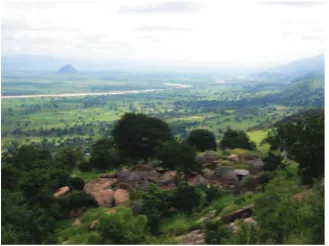
[image:20.433.63.228.284.407.2]Typical EWB-UK placements in transport infrastructure involve road building/rehabilitation projects in rural and often remote locations as shown in Figure 3.1.
Figure 3.1 – Remote Dadiyaland in Nigeria is one location where EWB-UK transport infrastructure placements have taken place (photo courtesy: C.Doris and D.Stevenson).
Transport chapter 3 – Intfrastructure
3.1 Accessibility
The greatest economic beneits in terms of transport infrastructure
in a development context can be gained from providing basic access (Broch et al., 2004), i.e. reliable all year round access that still functions in the wet season. To provide basic access will normally be the main goal of an EWB-UK transport infrastructure placement.
3.2
Transport infrastructure placements
EWB-UK placements have been run in the past relating to road building and rehabilitation projects in rural areas with low population densities.
3.2.1 Economic analysis
Justiication for road building is normally based on economic analysis
carried out by governments or their agencies, which are responsible for road development and construction nationally (as described in
Overseas Road Note 5 guidance). As there is rarely enough money
available to government to build, rehabilitate and maintain all roads, economic analysis is used to set priorities in order for government to decide which road projects to develop. Priorities are typically developed based on the cost of construction and maintenance over
the estimated life of the road versus the economic beneits resulting
from the construction of the road. These are normally measured in terms of reduced road user costs (e.g. time savings and reduction in vehicle operating costs). As road user costs are calculated as a function of the number of vehicles using the road, economic analysis tends to favour development schemes that are likely to be used by higher numbers of vehicles. This means that basic access roads in lightly
traficked, remote rural locations are less likely to be prioritised for
development by governments since the conventionally measured savings in road user costs may be less than the costs of construction and maintenance.
It is on these type of Low Volume Roads (LVR) that EWB-UK
– 8 –
Transport chapter 3 – Intfrastructure
roads that may not be funded for development by government. Efforts are being made to develop analytical tools to better evaluate
the wider social, employment and poverty reduction beneits of
Transport chapter 4 – Road design
4
Road design
This chapter outlines the basic design principles likely to be associated with a typical EWB-UK road infrastructure development placement. It explains the purpose of roads as likely to be encountered by EWB-UK placement volunteers and is laid out in the form of key points backed up by appropriate photos and diagrams.
This chapter is not intended to be a comprehensive guide to the design of highway infrastructure, but rather as an overview of the basic knowledge and principles likely to be required by a placement volunteer. References are provided for those seeking additional detail to that provided.
4.1 Introduction
Road access is a component of many development projects, even if not necessarily a project in itself. Often roads are not considered to be an integral part needing proper engineering input compared to other project components and examples of such short-sightedness are commonplace.
Emergency road access works following a natural disaster, for
example, often fail to have any lasting beneit, thus wasting time,
[image:23.433.82.277.444.581.2]energy and scarce resources. Roads constructed without due consideration to established engineering principles will not last. Many roads in the world remain in a poor condition and can be impassable, especially in the wet season as shown in Figure 4.1.
Figure 4.1 – Unsurfaced
roads can become dificult to
– 10 –
Transport chapter 4 – Road design
4.2 Purpose
Road access may be required for a variety of purposes:
• as part of a national/local road network of varying standards
• as access to rural communities, public facilities; construction sites; agricultural developments; seasonal crop evacuations
• to restore communications after natural disasters
• as temporary links while a more permanent construction is being undertaken.
The purpose of the road is key to its design and construction with respect to user requirements and modes of transport, ‘intended
working life’, standards and speciications to be used, and therefore
the costs and resources required.
4.3
Road users
Proper consideration should be given to likely users of the road access, during its design and construction. Potential users may include:
• pedestrians for access to markets often with heavy head loads or panniers
[image:24.433.70.209.281.458.2]• animal haulage; handcarts; rickshaws (examples of Non-Motorised Transport – NMT)
Transport chapter 4 – Road design
• bicycles; mopeds; motorcycles; motorised rickshaws
• basic motorised haulage; pickups; saloons
• public transport; light/heavy trucks; 4 wheel drives
• long distance heavy haulage transport.
Potential road users will inluence decisions regarding standards
of width, gradients, alignments, pavement or surface construction. As roads must be constructed to withstand the weight and number of vehicles using them, determination of the type and volume of expected road users should be undertaken at the planning stage of any project. Guidance is available in documents such as Overseas
Road Notes 6 and 16, and national design manuals such as the South
Sudan LVR manual.
Provision for mobility impaired and vulnerable road users should be considered where possible (Overseas Road Note 21).
4.4 Technology
Design and construction decisions should be based on a choice of engineering technology appropriate to the local situation. For most road works tasks there is a choice of technology to achieve the required standard of construction.
In many areas, abundant labour is an available resource and should be mobilised to the extent possible.
Historically, most of the world’s major construction projects were built using labour-based technology and appropriate basic equipment.
It is important to appreciate that the technologies developed for and currently used in the economically developed countries are based on the high cost of labour and relatively low cost and ease of obtaining credit. In developing country situations, labour is relatively
low cost and credit is usually expensive and/or dificult to obtain.
– 12 –
Transport chapter 4 – Road design
4.5 Labour
Among the advantages of labour-based technologies are:
• reduction in cost compared to expensive machines
• boost to rural/local economy from labour wages
• reduction in foreign exchange component of construction costs
• creation of a sense of ‘ownership’ of the project through local consultation/involvement/participation and future maintenance.
Some tasks in road construction are more suitable for light/heavy equipment (e.g. soil compaction; long distance haulage and some high standard surfacing). The resources input should be a labour/
equipment balance to achieve the speciied standards of construction,
appropriate to the local circumstances.
4.6 Equipment
It is likely that light or heavy equipment appropriate for rural road construction e.g. tractors, trailers and graders, compacters, concrete mixers etc. can be sourced through local enterprises, government agencies or communities. For the rationale, selection, costing and potential road works applications of agricultural tractors and other intermediate equipment, see the HandbookofIntermediate Equipment for Road Works in Emerging Economies (2012).
Hand tools for use on road works should ideally be of construction
rather than agricultural quality. Guidance on speciications is available
[image:26.433.64.357.203.300.2]in the MoW Tanzania Labour Based Road Works Manual Volume 3.
Transport chapter 4 – Road design
4.7
Local participation
Development projects are often speciic to a local community.
Roads by their nature may serve several communities.
All communities/groups/organisations who stand to beneit or
who are affected by the road development, should be consulted about the proposal at the earliest possible opportunity. Active
[image:27.433.77.247.398.513.2]participation in the planning, design and ultimate construction should be elicited through whatever local organisation structures exist.
Figure 4.4 – Basic access for communities is needed for vehicle and
pedestrian trafic alike (photo courtesy: P. H. Bentall).
Figure 4.5 – Engagement with local stakeholders is a key factor for ensuring the long-term success of any community focussed road building projects (photos courtesy: P. H. Bentall).
Plans and designs should be adapted to local needs and concerns and other resources to foster a sense of local ‘ownership’ in the project.
– 14 –
Transport chapter 4 – Road design
Road development projects can be political, and a common danger is that a local politician tries to commandeer the project for personal political advantage. This aspect needs to be handled sensitively as conversely the politician may be able to mobilise some resources or facilitation.
Communities may be able or asked to contribute some human and/or material resources to the project and any employment opportunities should be carefully allocated. It is preferable to encourage a partnership arrangement than a recipient-without-responsibilities culture.
Particularly in the case of a road, subsequent maintenance is vital for sustainability and local participation is a key factor, in order to give a sense of project ownership to the community and also develop their knowledge of how to maintain the road.
The following case study of a EWB-UK placement demonstrates how effective community engagement can help to make a project successful.
Figure 4.6 – Ensuring that the needs of women are understood and met is an essential part of stakeholder engagement (photo courtesy P. H. Bentall).
fully involved, particularly women and marginalised groups. The consultation process will enable the scope and activities of the project to be discussed and any local cultural or social constraints/
Transport chapter 4 – Road design
Case study: Pamplona community suspension bridge
Daniel Gallagher, Ecuador, 2009
In 2009, EWB-UK volunteers Daniel Gallagher and Mariam Niknejad travelled to Pamplona, Intag in the Ecuadorean Sierras to re-establish an important community footbridge crossing that had
been damaged by loodwater.
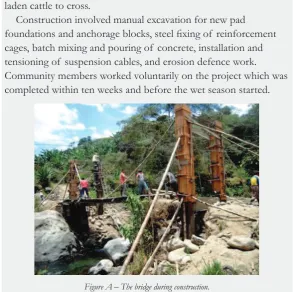
The project began with a community consultation, which helped identify the high water mark so that the bridge could be constructed above this level. A bridge inspection then followed which showed the timber deck had rotted beyond repair, but that the stone and concrete foundations were sound. A standard suspension bridge design was then agreed, sourced and adapted to the local context, with design and drawings undertaken back in the
ofice. The bridge was designed with a live load allowance to allow
laden cattle to cross.
Construction involved manual excavation for new pad
foundations and anchorage blocks, steel ixing of reinforcement
[image:29.433.76.371.298.590.2]cages, batch mixing and pouring of concrete, installation and tensioning of suspension cables, and erosion defence work. Community members worked voluntarily on the project which was completed within ten weeks and before the wet season started.
– 16 –
Transport chapter 4 – Road design
A particular success of the project involved using local community knowledge to develop innovative solutions. For example, a zip-line was used to transport materials from the roadside to the inaccessible bridge site. Also, locals knew that cut-off sections of rubber tyre
could be used for bearing pads to allow thermal expansion of the bridge deck without overly stressing the foundations. This local knowledge ensures that the bridge can be maintained by the local community.
A particular challenge on site was managing health and safety. Children and families had to continue using the existing bridge during construction and the lack of mobile phone signal
and dificult terrain meant that even minor injuries could have
had serious consequences. Educating parents and children of the dangers of construction was part of the risk management strategy that ensured the project was completed without incident.
Lessons learned:
Engineers are most effective when acting as a broker of technical advice rather than a provider of solutions. Listening carefully
to the community’s needs, inding solutions that had worked
previously and then validating suggestions with engineering rigour made sure that the decision-making process was effective,
participative and that the community had conidence in the solution.
Engineers need to understand risks and be aware that safety is challenging in remote areas. Risks were reduced by minimising excavation and minimising working at height. Residual risks were minimised by making everyone aware of the dangers.
Engineers in developing countries should respect the limits of their knowledge. Development engineers abroad are continually faced with complex challenges that they don’t have all the answers
Transport chapter 4 – Road design
to. It was reassuring to have contact with Bridge Engineers I had worked with back in UK to help overcome technical challenges.
Ultimately, the project was successful in constructing a new bridge that restores a key link between two parts of a community. The main impact was to improve primary education levels through higher school attendances. Secondary impacts include longer-term improvements in infrastructure that comes with the community members’ increased knowledge of construction methods and health and safety.
About the author: Daniel Gallagher graduated from the
– 18 –
Transport chapter 5 – Materials
5 Materials
5.1 Soils
Roads are built onto existing soils and the rock formations beneath. Around the world, there are many different types of soils such as those shown in Figure 5.1. Those that are most likely to be encountered are described in this chapter. Some of the soils can be used in the construction of pavement layers. Where the properties
are deicient for various pavement layer or surfacing requirements,
they may sometimes be improved by stabilisation techniques: mechanical (physical blending/mixing), lime, cement, bitumen, emulsion. Specialist advice should be sought.
Laterites
[image:32.433.254.345.432.545.2]The most widely occurring concretionary tropical soils are the laterites, weathered oxidic iron rock in a sandy/clay matrix. Lateritic gravels as shown in Figure 5.2 are used for un-surfaced roads and as sub-bases and roadbases. They compact easily and harden to concrete-like material on exposure to air. They occur extensively in South America, tropical Africa, and southern Asia as shown in Figure 5.3.
Figure 5.1 – Global distribution of the principal types of tropical residual soils (Millard, 1993).
Transport chapter 5 – Materials
Calcretes and Silcretes
Calcretes and Silcretes as shown in Figures 5.4 and 5.5 are found in many desert areas. Although softer generally than laterites, water and compaction can produce concrete-like material.
Figure 5.4 – Calcrete soil. Figure 5.5 – Exposed silcrete formation.
Alluvial gravels
[image:33.433.76.218.350.455.2]Alluvial gravels as shown in Figure 5.6 occur in the upper reaches of most rivers from where the eroded stone has been carried downstream with silt/sand. They may be suitable for concrete aggregates, but may require to be crushed/screened.
[image:33.433.212.368.355.448.2]– 20 –
Transport chapter 5 – Materials
Quartzitic gravels
Quartzitic gravels as shown in Figure 5.7 derive from the weathering of granite and acidic rocks and where they contain iron oxide leached from above form laterised quartz gravels appropriate for road pavements. They can also usually be crushed/screened to be suitable for concrete.
[image:34.433.85.346.63.264.2]Figure 5.6 – Alluvial gravels.
Transport chapter 5 – Materials
Volcanic soils
Some volcanic soils as shown in Figure 5.8 can be used for lightly
traficked gravel roads. Blast-furnace slag is a stronger alternative
where available.
Expansive clays
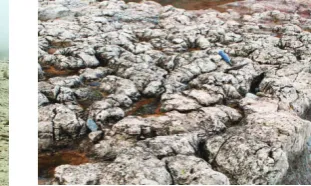
Expansive clays (montmorillonite) as shown in Figure 5.9 and black cotton soil occur widely in tropical/sub-tropical regions. They exhibit dramatic changes in character between wet and dry seasons.
In the dry, they shrink rapidly causing block pattern issures, and
in the wet they re-expand rapidly and at high moisture content can become almost liquid. They are generally avoided where possible in road construction, but if the moisture content can be controlled around the optimum with suitable protection, they can be used for low embankments.
[image:35.433.77.221.145.252.2]Specialist advice is recommended where these soils are encountered.
Figure 5.8 – Volcanic soil (photo courtesy: A. McLoughlin.)
Figure 5.9 – Expansive clay.
Desert soils
Desert soils as shown in Figure 5.10 are predominantly wind-blown
sands, shifting with the prevailing wind along the desert loor. Often they are dificult to traverse even in four-wheel drive vehicles, and too loose to provide a irm road sub-grade without deep compaction
[image:35.433.242.371.147.242.2]– 22 –
Transport chapter 5 – Materials
Topsoil
The surface layer of soil in which plants and vegetation grow is the topsoil. Topsoil contains organic matter and changes properties
signiicantly with season and moisture content. It is unsuitable for
[image:36.433.168.358.55.210.2]road building and must be removed before construction on top of the sub-grade (the sub-soil) can begin. Due to the high rainfall that can be experienced in tropical zones, the layer of topsoil may be thin or non-existent.
Figure 5.11 – Topsoil and the layers beneath. Figure 5.10 – Desert soils
[image:36.433.64.210.364.502.2]Transport chapter 5 – Materials
5.2
Natural rock
Choosing natural rock for road building purposes, and concrete
aggregates will need analysis by a qualiied materials engineer as
some may change properties or deteriorate on exposure to air or moisture.
Rock may be quarried by hand and shaped for structures and paving units. It may also be hand crushed and screened for concrete aggregates. Masonry structures can be mortar jointed, or where the local skills exist can be dry jointed (thereby saving the need for expensive cement).
In many communities, masonry skills are established for building
construction and can be beneicially mobilised in the road works.
5.3 Bitumen
Bitumen grades (called asphalt in USA) available in-country will have been chosen to suit the local climatic conditions. Different grades are used for different applications from surface dressing to pre-mix macadams to asphalt-concretes. Specialist advice is recommended.
Use of bitumen-based surfacing has a number of advantages
including:-• sealing the road surface to reduce the ingress of water into the road structure
• prevention of vehicle generated dust
• improved skid resistance
• lower maintenance compared to gravel surfaced roads
[image:37.433.78.234.263.371.2]• reduced road/tyre noise level.
– 24 –
Transport chapter 5 – Materials
However, often the bitumen products have to be imported with a high cost implication. Penetration and cutback bitumen grades usually require heating for their application. Bitumen emulsions can be used without heating for many surfacing, paving layer and stabilisation techniques and are more suitable for safe labour-based applications. Pre-mix macadams and asphalt concretes require expensive capital equipment and high levels of testing and quality control. Unless such production facilities are already established in the area, it will be expensive and problematic to mobilise and use these.
5.4 Timber
Local timber is often commonly available and where it is proposed for structural work in bridges/culverts it is important that it is durable and unlikely to be affected by insects such as termites, or fungi, both of which can dramatically shorten the service life of any timber structure. It can also be used for temporary works and formwork. Local treatment practices should be explored.
In some locations, timber applications for piling and matting in soft ground are established. They can provide medium term solutions in
dificult conditions.
In many communities, carpentry skills are established for building
construction and can be beneicially mobilised in the structures’ works.
Transport chapter 5 – Materials
5.5
Cement and lime
Cement is commonly used for concrete and mortars in structures (bridges, culverts, retaining walls). It can also be used for
stabilisation of sands and gravels, and for making surface paving units. Cement can be expensive and sometimes has to be imported.
Lime can be used for stabilisation of ine-grained soils (clays).
5.6
Fired clay brick
Clay bricks may be ired
with coal, gas, wood and even agricultural waste products such as rice husk. Burning bricks in ‘clamps’ is a tradition established in many rural areas. However, they are usually
only of suficient quality
for use in simple domestic building structures. High strength bricks can be
[image:39.433.204.366.389.492.2]produced from agricultural waste (e.g. rice husk) using simple kilns. Crushing strengths of more than 20 N/mm2 are achievable. These
Figure 5.14 – Timber deck culvert (left) and timber deck bridge (above) nearing completion (photos courtesy: P. H. Bentall).
Figure 5.15 – Beehive or bell shaped kilns for rice
husk iring of clay bricks suitable for road paving and
– 26 –
Transport chapter 5 – Materials
5.7 Steel
Steel can be used for reinforcing concrete and as structural members. Unfortunately, this is usually imported and of high cost. Gabion
baskets and mattresses illed with rock pieces can be used for
relatively low cost retaining and anti-erosion structures. The cages can be assembled from imported units or can be woven locally using steel wire.
bricks are suitable for structures and road paving (Dzung and Petts, 2009 includes a design for a small scale kiln). An added advantage is that these bricks are environmentally attractive as the CO² produced
in brick production iring is only a portion of the CO² taken up in
Transport chapter 6 – Speciic design aspects
6
Speciic Design Aspects
6.1 Introduction
The irst consideration is whether there are established national design standards, speciications or manuals for the category of road
that is being considered for the EWB-UK volunteer assignment. Often, these can be non-existent for Low Volume Roads (LVR),
deicient, or out of date. If existing, there will be an obligation
to use them. However, the recommendations in the following text are based on recent research and accumulated good practice in a number of economically developing regions and can serve as a basis for discussion and agreement regarding achievement of appropriate, affordable and sustainable designs for the assignment road(s). Any designs should be approved by the authority responsible for the road, whether central government, local government, community or private.
In developing countries, substantial proportions of the rural road network are earth or gravel surfaced.
Earth roads can be constructed from the in-situ soil in many circumstances by shaping into a compacted camber (typically 4%–7% crossfall) and providing a proper drainage system of side drains, turnout drains and cross drainage such as culverts, drifts or bridges.
– 28 – Transport chapter 6 – Speciic design aspects
In-situ soils with a strength of CBR 1 15 or more are usually suitable
for light trafic (up to 50 motor vehicles equivalent per day). Some
soils can become too weak or slippery in wet weather. Longitudinal gradients of more than 6% will quickly become eroded in rain. Most earth roads can be very dusty in the dry season causing problems for residents and crops alongside roads. However, a maintained earth road can be an important component of affordable Basic Access.
A route that is predominantly to earth standard can provide year round access at lowest cost if:
• it is maintained (principally camber and drainage)
• limited problem sections, such as weak soils, steep gradients, low lying, etc. are treated with spot improvements of better quality surface or raised embankments.
1. California Bearing Ratio. This can be measured in-situ using a low cost Dynamic Cone Penetrometer (DCP)
Transport chapter 6 – Speciic design aspects
A maintained, cambered and drained earth road surface on most soils will normally quickly drain and dry out after a rainstorm,
allowing normal trafic to resume safely within hours, without severe
damage to the running surface.
If available within reasonable haul distances, natural gravel can be added to the shaped and drained earth formation to provide a basic
all-weather road. This surface is suitable for trafic of between 50
and 200 motor vehicles per day (vpd). Unfortunately, gravel surfaces
also erode due to the action of trafic and weather and need to be
maintained regularly (routine: camber and drainage) and the lost surface materials need to be periodically replaced by re-gravelling. Recent research (Cook and Petts, 2005) has recommended that gravel should not normally be used as a running surface where:
• trafic is more than 200 motor vehicles per day • annual rainfall is greater than 2,000mm
• gradient of road surface is more than 6%
• through community settlements
• the haul distance from the quarry/pit to the road site is more than 10km
• the road section experiences looding, or • the gravel is of poor quality.
– 30 – Transport chapter 6 – Speciic design aspects
Figure 6.3 – Basic Access concept using Engineered Natural Surface – ENS (earth road) and spot improvements (image courtesy: R. Petts).
The major threat to any road is water. Roads should be designed to prevent ground-water encroachment and actively manage rainwater to minimise damage to the road and adjacent areas. New roads interfere with natural drainage patterns and need special attention to be given to drainage measures. Existing tracks/roads may simply
require drainage to be upgraded and/or ampliied.
Transport chapter 6 – Speciic design aspects
6.2 Alignments
Road alignment can be thought of as a 3D problem that is broken down into two 2D components. These are:
• horizontal alignments (plan view)
[image:45.433.242.369.131.223.2]• vertical alignments (proile view).
Figure 6.5 – Horizontal and vertical alignments.
The vertical and horizontal layouts of a road form the alignments and these are primarily dictated by the topography and design speed selected.
Construction costs can be minimised by allowing the road alignments to take the form of natural topography where feasible, thus minimising earthworks.
Horizontal alignment
Horizontal alignments are made up of straight sections, arcs, and transition curves between them. The arcs are usually segments of
a circle providing a smooth low of vehicles along the curve. The
primary challenge in determining horizontal alignments is to ensure that transitions between different directions are both safe and comfortable for road users. A minimum horizontal radius of 50 metres should be used for a road design speed of 40 km/h. Sharp bends should be smoothed out. Radii have to be relaxed at hairpin bends in severe terrain.
Vertical alignment
Vertical alignments are made up of straight sections known as grades or tangents, connected by vertical curves. The objective of vertical alignment is to determine the appropriate elevation to ensure safety and allow for adequate drainage.
In rural areas, earth and gravel roads are frequently developed along
– 32 – Transport chapter 6 – Speciic design aspects
Figure 6.6 – Measuring the gradient using simple equipment (ILO, 2008).
vehicles, gradients should ideally be < 6.7% i.e. a 0.2 metre change in rise for every 3 m in the horizontal plane as shown in Figure 6.6.
At steeper gradients erosion by surface water is a major concern. Steeper gradients up to about 15% can be accommodated by some surface/paving options. However, these can be unsuitable for animal drawn vehicles and some other Non-Motorised Transport (NMT).
Vertical alignments and curves
Vertical curves provide a smooth and gradual change from one tangent grade to another to ensure that vehicles run smoothly. They are normally parabolic in shape and the vertical curves are based on the principles of a parabola. The two types of vertical curves are:
• crest vertical curves
• sag vertical curves.
Crests occur where the road moves from a positive to a negative gradient, such as at the brow of a hill. Sags occur where the gradient moves from a negative to a positive gradient, such as at the bottom of a valley. Examples of both are shown in Figure 6.7.
Transport chapter 6 – Speciic design aspects
Determining the transition between two grades to form a vertical curve for a crest or sag is the primary challenge in designing vertical alignments.
Further details relating to selecting a design speed and appropriate horizontal and vertical alignments is available in Overseas Road Note 6,
and also in the Ministry of Roads and Bridges Government of South Sudan
(2013), South Sudan Low Volume Roads Design Manual.
Dificult terrain
[image:47.433.133.314.430.556.2]In mountainous areas steeper grades and sharper bends may be unavoidable as shown in Figures 6.8 and 6.9 and bituminous, concrete or other surfacings over certain lengths may be considered to reduce erosion damage and promote safe passage.
Figure 6.8 – Recommendations for hairpin bends (image courtesy R. Petts).
– 34 – Transport chapter 6 – Speciic design aspects
Vertical gradients can be reduced by forming cuttings through hillsides and embankments over valleys, consistent with the desired design speed for the road.
Long level lengths of road should be avoided to eliminate the risk of water ponding, but if this is unavoidable the vertical alignment should be designed at least 50 cm above existing ground level to mitigate that risk.
Further details relating to principles of low cost road engineering in mountainous regions is available in Overseas Road Note 16.
6.3
Sight distances
Stopping sight distance
The minimum stopping sight distance is the distance at which a vehicle can stop after seeing an object in the vehicle’s path without hitting the object. It is made up of the time taken for a driver to recognise the need to apply the brake (the perception-reaction time) and the time taken for a vehicle to stop after applying the brake (the stopping distance).
1.05m – 2.00m
Figure 6.10 – Measurement of stopping sight distance (DMRB, 2002).
Transport chapter 6 – Speciic design aspects
Overtaking sight distance
[image:49.433.140.321.174.264.2]The overtaking sight distance is that required to allow a driver to complete a passing manoeuvre without colliding with an opposing vehicle or cutting off the passing vehicle. It should also allow the driver to abort the passing manoeuvre and return behind the vehicle being passed if required.
Figure 6.11 – Measurement of overtaking stopping distance (DMRB, 2002).
Further details relating to the principles of stopping sight distances can be found in the Design Manual for Roads and Bridges, Volume 6,
Section 1, Part 1, TD 9/93.
Note that engineering judgement and local knowledge must be used in conjunction with design guidance, since assumptions over the condition of vehicles and road surfaces in the context of rural environments in developing countries may be different to those from which the design guidance was formulated.
6.4 Earthworks
Earthworks relate to pre-construction site clearance, excavation and the movement of soil and rock. Earthworks should be kept to a minimum and an optimum vertical alignment will ensure that material from cuttings can be placed in adjacent embankments with the minimum of haulage. Due adjustment should be made for the
compaction factor cut/ill.
Material can be hand-cast up to a few metres, or wheel-barrowed, head-loaded, stretchered or panniered up to about 100 metres. Carts or equipment haulage are usually required for longer haulage
distances. Signiicant earthworks will add substantially to the works’
– 36 – Transport chapter 6 – Speciic design aspects
Embankments should be speciied to be constructed in layers
appropriate to the compaction equipment to be used, the standard of compaction required (e.g. 95%–98%) and the optimum moisture content (OMC) for the material.
Figure 6.12 – Labour based earthworks (photo courtesy: P. H Bentall).
Figure 6.13 – Applying water to the road formation to achieve the OMC before compaction (photos courtesy: P. H Bentall).
In-situ compaction testing is possible if appropriate apparatus is
available. An alternative is a method-speciication based on the type
of equipment and local knowledge of the behaviour of the material, otherwise compaction until no observed movement under the roller
Transport chapter 6 – Speciic design aspects
6.5 Drainage
Well-designed drainage is essential to ensure that damage to the road surface and structure is minimised, and to avoid problems at points of discharge to the adjacent land. Prevention of damage to the sub-grade should be a major priority since structural damage to the road will require extensive works to rectify.
Road surface
Rainfall should be drained away from the road surface as shown in Figure 6.14.
Figure 6.14 – The relationship between roads and the water cycle (ILO, 1990).
Camber / crossfall
Road surface drainage is affected by constructing the carriageway with a camber or crossfall. Initially this should be 6% or 7% for an
earth or gravel surface, which will reduce gradually under trafic
action and weathering. The camber should be maintained between 3% and 7%. For paved roads, less crossfall is required and this is
typically speciied as 2.5%–3%.
Roadside drainage
– 38 – Transport chapter 6 – Speciic design aspects
Ditches constructed by grading equipment are usually V-proile.
However, using labour-based techniques it is easier to construct ditches of trapezoidal section. This is also preferable to a V-section
for better low and erosion characteristics.
Minimum ditch gradients should be 2% to minimise silting and on steep sections if > 4% then scour checks are required to minimise erosion as shown in Figures 6.16 and 6.17. Spacing of these decreases from 20 m to 5 m with gradients of 4%–10%.
[image:52.433.63.351.371.609.2]Figure 6.16 – (above) scour checks in a ditch using stones (ILO, 1990).
Figure 6.15 – Side drains collect surface water from the road and embankments to be discharged at suitable locations or through culverts (ILO, 1990).
Transport chapter 6 – Speciic design aspects
Turnout drains are speciied
[image:53.433.220.370.359.565.2]to lead water from the side drains to adjacent land at convenient points where no erosion damage will result as shown in Figure 6.19. Where possible, these should be constructed at 20 metre intervals on the basis that ‘little and often’ will minimise erosion risks or siltation on adjacent land, and the risk of land users blocking them off.
Figure 6.18 – Catchwater drain situated above the cutting (ILO, 1990).
Figure 6.19 – Turnout drain (ILO, 1990).
– 40 – Transport chapter 6 – Speciic design aspects
Cross drains are required to accommodate existing water courses and where water in side drains needs to be transferred as shown in Figure 6.20. Pipe sizes and culvert openings are designed on normal hydraulic principles, with minimum pipe diameter/openings of 60 cm to allow easier maintenance.
Culverts may be of pre-cast pipe concrete, cast in-situ concrete,
stone masonry, treated timber or ired clay brick. Drifts can be used to discharge water across LVR where there is insuficient depth for
a culvert and adequate cover under the road surface, or on bedrock.
Standard designs and speciications exist for pipe and box culverts;
inlets and outlets; short-span bridges; and they should be consulted e.g. the Small Structures for Rural Roads Guideline and Overseas Road Note 9.
Small bridges for rural roads can be concrete, stone masonry,
ired clay brick or timber; single or multi-span depending upon the water low and trafic volume. An example of a single span bridge
structure is shown in Figure 6.21.
Figure 6.20 – Cross drainage (ILO, 1990).
Transport chapter 6 – Speciic design aspects
Larger structures in steel or reinforced concrete should be subject
to a full rigorous design process by qualiied engineers to reduce the
risk of structure failure as shown in Figure 6.22.
6.6 Pavements
Basic principles
In road engineering, the term ‘pavement’ refers to the road surface and its underlying structure. The pavement is constructed on the subgrade or road (earthworks) formation. One or more of the pavement layers shown in Figure 6.23 may be required to
satisfactorily spread the trafic loading stresses so that the subgrade
can accommodate them. In some situations an ‘improved subgrade’ may be adopted to improve the properties of the in-situ material (e.g. by stabilisation).
The basic principle of pavement engineering is to distribute vehicle loads over a larger area than the area the vehicle is in contact with as shown in Figure 6.24.
– 42 – Transport chapter 6 – Speciic design aspects
Figure 6.23 – Typical structure of a road pavement (TRL, 1993).
Figure 6.24 – Road pavements work by spreading loads over a wider area.
In general, the thicker and/or stiffer the pavement, the heavier and the higher number of vehicles it can support without failing.
Transport chapter 6 – Speciic design aspects
Pavement Structure
Road pavements are usually said to be either lexible (e.g. bituminous)
or rigid (e.g. concrete) in nature and examples of both are shown in Figure 6.25.
Incremental paving such as stone setts or concrete/brick pavers are usually characterised as rigid.
In developing countries, paved rural roads are predominantly
lexible with a thin bituminous seal surfacing. They usually have base
and sub-base layers consisting of the best locally available material to minimise the haulage costs associated with carrying construction materials to site.
Standard road design criteria are recommended by Overseas
Road Note 31. Recent national LVR manuals, such as South Sudan,
incorporate good practice and recent research that can be considered for adaption to local circumstances if no local guidance exists.
Figure 6.25 – Typical structures of lexible and rigid pavements (Millard, 1993).
Engineered Natural Surface – ENS (Earth Roads)
These are the lowest cost type of roads and do not have a
– 44 – Transport chapter 6 – Speciic design aspects
Gravel
Gravels are commonly used as a surfacing material for rural roads in developing countries. Gravel is normally the next cheapest alternative to ENS in terms of initial costs. However, the need for regular re-gravelling to replace lost surface material can make gravel surfaces more expensive than some paving options in whole life cost terms.
The gravel is transported to the road site and placed on a
previously shaped and compacted in-situ earth subgrade. The gravel
is shaped, watered and compacted to the required inished proile.
Gravels are derived from a number of natural processes and usually occur in limited deposits of usable particle grading. The gravel should be laid to the same crossfall with a constant thickness. Maximum particle size is 40 mm for good performance and to avoid high material loss and surface roughness problems. Oversized materials can be screened or hand-picked out. The overall constructed gravel thickness is typically 15 cm–30 cm. Individual gravel layer thickness
is usually up to 15 cm (compacted) maximum. Deicient natural
gravel can be blended with selected soil/sand to improve quality. Gravel as a running surface is a wasting resource under the action the light of the likely impact of the Road Environment factors. The option involves the shaping and compaction of existing in-situ or
immediately adjacent material to form a basic surface for trafic with
a cross-fall of 3% to 7% away from the road centre line to disperse rainwater into side drainage. Alternatively the surface may be raised above surrounding ground on embankment. Soils with an insitu CBR of 15 or more can provide good ENS. Longitudinal gradient should not be more than 6% due to weather related erosion factors. Problem sections of the route should be considered for selective upgrading or spot improvement to other surface/paving types.
Soils that are predominantly sand will not hold a camber shape
and should be left with a lat cross section as they will normally be free draining. Some sandy soils can be dificult to pass over with
vehicles. They can be possible to stabilise by mechanically mixing in
Transport chapter 6 – Speciic design aspects
of trafic and weather. In dry conditions, iner particles disappear
as dust and coarser particles are displaced into the ditches. In wet weather, surface material is eroded. With surface gravel losing typically 30 mm–50 mm per year, a re-gravelling operation should be expected every 3–6 years. Excessive clay may render the road impassable in the wet season, but too little and the surface becomes loose and a driving hazard.
Paving options
A wide range of other surfacing and paving options are proven and many can make good use of local labour and materials resources. Synthesis of research and good practice are contained in the Low
Volume Rural Road Surfacing and Pavements Guideline (Cook et al., 2013).
For a road intended to include a surfacing layer, attention needs
to be paid to the sub-base and roadbase layers to ensure suficient strength for the anticipated trafic loads. These layer options may be: • crushed stone for dry-bound/wet-bound macadams
• natural gravels (lateritic/quartzitic)
• cement/lime stabilised in-situ or imported material (specialised design)
• bitumen stabilised in-situ or imported material (specialised design)
• cement-bound granular
• lean concrete
• hand packed stone.
Such pavements will need the full design process by a qualiied
road engineer.
Bituminous surfacings
Bituminous surfacings are another specialist area and can be:
• asphaltic concrete (continuously graded aggregate/bitumen mix)
• rolled asphalt (gap-graded aggregate/bitumen mix)
• mastic asphalt, which is often used on bridges (ine aggregate/
– 46 – Transport chapter 6 – Speciic design aspects
However, the above bituminous surfacing are normally too expensive for LVR application. The following are usually more applicable:
• in-situ mixes (Otta Seal, bitumen spray on graded aggregate layers, penetration macadam)
• surface dressing (bitumen spray and chippings, 1 or 2 layers)
• sand or gravel seals
• combination chip and sand seals (e.g. Cape Seal).
Road surfacings will need a full engineering design. The advantage of a surfacing, even a single surface dressing, is the protection of
the base layer from deterioration by trafic and weather, but regular
maintenance is essential to prevent potholes forming.
Further details relating to selecting bituminous surface materials are available in the Manual For The Labour-Based Construction Of
Bituminous Surfacings On Low-Volume Roads (2003).
Concrete pavements
Concrete (rigid) pavements are not used extensively in the tropics, although some well designed and constructed examples have given excellent service for many years.
Lack of consistent standards of concrete and thermal strains induced by variations in temperature are the main problems. However, with good design, supervision and quality control a local building contractor can produce concrete of adequate quality for road works.
For rural roads the use of concrete is usually conined to spot
improvements and drifts across stream beds as shown in Figure 6.26. Concrete strength of 20 N/mm² at 28 days laid at a minimum thickness of 125 mm is recommended for drifts. Edge, cut-off and anti-erosion detailing are important design issues. In areas subject to frost occurrence, the required strength should be increased to 25N/ mm2. Drift mesh reinforcement to limit thermal cracking should be
Transport chapter 6 – Speciic design aspects
Figure 6.26 – Drift across a dry stream bed (ILO, 1990).
[image:61.433.75.370.350.538.2]– 48 – Transport chapter 6 – Speciic design aspects
Expansion joints for thermal movement and contraction joints for crack inducement are required. Variations on such joints are shown in Figure 6.28.
Concrete curing is the process of controlling the rate and extent of moisture loss from concrete during cement hydration. It is particularly important in tropical temperatures and needs to be
speciied and well supervised, with coverings kept consistently damp
[image:62.433.67.350.110.468.2]throughout the curing period. Concrete should not be poured when ambient shade temperatures are above 38°C or below 30°C.