A Novel Routing Protocol for Improved
Performance and Security in VANETs
Riya Rajan1, Hari.S2
P.G. Student, Department of Electronics and Communication Engineering, Mount Zion Engineering College,
Kadamanitta, Kerala, India1
Assistant Professor, Department of Electronics and Communication Engineering, Mount Zion Engineering College,
Kadamanitta, Kerala, India 2
ABSTRACT: Vehicular Ad-hoc Network (VANET) is a collection of vehicles in a wireless network that are dynamic in nature and communicate with each other and also with nearby Road Side Units (RSUs). These networks are used in real time scenarios. VANETs can provide improved safety applications, intelligent transport applications, comfort applications, efficiency and weather information. But the VANET is time critical, where safety messages should be delivered as fast as possible without much of delay which is a challenge. Security is another major challenge in VANET because the wireless medium used here can render the network vulnerable to security attacks such as interference, jamming and eavesdropping. This paper presents a modification on existing Ad-hoc On-Demand Distance Vector (AODV) routing protocol in order to increase the speed and to decrease the delay. Routing using this enhanced AODV protocol which is named as VRP, also increases the throughput and overall performance of the network. To protect the network from security attacks, RSA cryptographic technique is employed here. Finally, extensive simulations are conducted using network simulator NS2 to evaluate the performance of VRP, compared with AODV. Results show that VRP performs better than AODV in the area of VANETs.
KEYWORDS: VANET, AODV routing protocol, RSA cryptosystem.
I. INTRODUCTION
Intelligent transportation system (ITS) plays an important role in achieving traffic efficiency by reducing traffic related problems. It enhances users by providing prior information regarding traffic and real-time running information, thus improving safety and comfort. Vehicular Ad-Hoc Network (VANET) is a growing and most challenging research area to provide intelligent transportation system services to the users. They are certain types of Mobile ad- hoc Networks (MANETs), where moving vehicles are considered as nodes and connected to each other and thus forming a network. It is a self governing and self-coordinating wireless communication network [1]. The main objective of this system is to send data and information between vehicles and thereby increasing safety. VANET changes each and every engaging vehicle in to a wireless router and helps vehicle drivers to communicate among themselves to avoid any critical situations like road accidents, speed control, traffic jams, unseen obstacles, free passage of emergency vehicles etc... It facilitates communication among nearby vehicles, between vehicle to vehicle (V2V) and nearby fixed equipment called road side unit (RSU) , which is vehicle to infrastructure (V2I) [2].
(CALM) was designed to address the issues of continuous communication among vehicles and between vehicles and road side infrastructure. The concept of CALM is based on heterogeneous cooperative communication framework to provide continuous communication to user transport. C2CNet architecture has been proposed for safety applications. C2C-CC deals with safety as well as non-safety applications. C2C-CC is designing C2CNet protocol that differs from IP. It provides fast data transmission for vehicle to vehicle and vehicle to infrastructure communication [3].
Due to high mobility of nodes and fast topology changes in VANET, it faces more challenges than other networks. One of the main challenge in VANETs is the time critical issue where, safety messages should be delivered as fast as possible without much of delay. Then only the nodes can take decision and perform actions accordingly. Also security and privacy requirements in VANETs should be assured as VANET provides the road safety applications which are life critical therefore, security of these messages must be satisfied. The secure routing problem becomes more challenging due to the characteristics of VANETs. Thus security is another major challenge in VANETs [4]. The goal of this study is to makeover those challenges in VANETs. Routing protocol also plays an important role in VANETs. Because, the aim of the routing protocol is to compute the optimal path between any source and destination pair with minimal control traffic overhead.
This paper presents an enhanced version of AODV routing protocol named as VRP routing protocol for routing in VANETs, with the aim of increasing the speed and decreasing the delay in the network. Here hop selection is done based on certain criteria’s where, hop selection is minimized by considering factors such as by calculating the speed of vehicles. In a car parking area, speed of the vehicles lying in that area will be zero thus it can be avoided. Also in a four-way scenario, calculation of speed, direction and position of vehicles travelling in opposite direction can be neglected. Thus minimizing the total no: of hops taken into account and thereby decreasing the delay and increasing the speed and throughput. Security is also achieved using RSA cryptographic technique to protect the network from security attacks.
II. RELATEDWORK
Researchers have done many efforts for finding the best routing protocols in VANET system. Also different routing protocols has been evaluated with different VANETs simulator in terms of network parameters. The related works of this paper can be grouped in to three categories. First one is the topology based routing protocol in VANETs, the second one is the position based routing protocol and the last one is the MAC protocols in VANETs.
Routing protocol plays a vital role in the performance of VANETs. Also the routing protocols applied on MANET cannot be used directly on VANET. Temporally Ordered Routing Algorithm (TORA) which is one of the topology based routing protocol is unsuitable in VANETs, because of its need for geographical location information [5]. As highly changing topology is one of the characteristics of VANET networks, routing protocols must be applied effectively. In [6 ] two routing protocols, reactive protocol RBVT-R and proactive routing protocol RBVT-P were proposed. These protocols were compared with protocols like AODV, OLSR and GPSR that are applied on MANET and also with GSR protocol that are applied on VANETs. Results showed that the two protocols RBVT-R and RBVT-P outperform the existing protocols in terms of delivery ratio and delay. Reduction of bandwidth consumption and control overhead makes AODV suitable for VANETs. In [ 7] a PAODV routing protocol is proposed by doing certain modifications to the existing AODV protocol. Here route discovery phase is eliminated by restricting neighbour’s distance and number of restricted routes which in turn helps in reducing the control overheads.
In [8] two routing protocols, Ad-hoc on-demand distance vector (AODV) and Dynamic source routing (DSR) were simulated and analysed. They came to the following finding that AODV protocol is more suitable for VANET than the DSR protocol. Also it is more flexible with VANETs for high speed and complex transportation system than DSR. In [9] for reducing the packet delay, an improvement to AODV routing protocol is done and a new protocol called AODV-BD is proposed. When local repairing is continuing AODV-BD establishes a routing to the destination node by broadcasting data packets. As a result, both data packets and request packets will be broadcasted.
there exists certain drawbacks which are, the performance degrades with increase of loads. Also, it cannot provide delay bounded access for VANETs and a strict quality of service (QOS) for cooperative safety.
In [11] two outstanding TDMA MAC protocols, STDMA and VeMAC in VANETs has been proposed. TDMA MAC protocol provides better performance as load increases and also enables delay bounded access. But it cannot handle varying vehicle density perfectly, particularly the constant change in vehicle density. Nodes in both protocols reserve slots based on what they sense. The difference between both protocols is in its perception range. For STDMA, it is one-hop and and for VeMAC it is two-hop. But the challenging vehicular environment leads in high packet error rate which in turn leads to inaccurate perception and causes more collisions.
In [12] a software defined network (SDN) based MAC protocol is proposed to handle the challenges in VANETs such as high mobility and dynamic network densities. Here decoupling of control plane and data plane is done which provides greater rapidness and liveliness. Thus it can handle rapid mobility and varying vehicle density. SDN provides flexibility and programmability to networks along with new services and features to VANETs. SdnMAC also eliminates merging collisions with a lowest packet loss rate.
III.PROPOSEDSYSTEM
A. AODV ROUTING PROTOCOL FOR VANET
Ad-hoc On-demand distance vector (AODV) is one of the most popular reactive routing protocol which is simple, efficient and on-demand routing protocol. It provides route purely on-demand which makes it very useful for VANET applications. Thus it reduces large amount of overhead. Advantages of AODV routing protocol are, the connection setup delay is lower and also destination sequence number are used to find the latest route to the destination. As it only maintains one route that is actively used, AODV can adapt to these changes quickly[13]. In VANETs, there occurs a sudden change in topology frequently and also the number of nodes used are large. Therefore, AODV is more suitable than any other protocol in this network. Routing using AODV consists of two phases which are, route discovery process and route maintenance process. When a node requires route to the destination, it initiates a route discovery process within the network. Once a route found the process is completed and all possible route permutations are calculated [14]. Route maintenance is the process which is done by means of the route error packets (RERR) when there occurs a link breakage. The message types defined by AODV are, Route Requests (RREQs), Route Replies (RREPs), and Route Errors (RERRs). As well as the sequence number, routing information also has a timeout associated with it. For connectivity information and signal link breaks on active routes with error messages, AODV can use hello messages.
B. ENHANCEDAODVPROTOCOL–VRP
Fig.1 Block diagram of the proposed system
A wireless network can be created by using the components of a mobile node and its configurations in every layer. Data communication between nodes can be initialized with transport and application layer agents that are required to be attached to both sender and receiver nodes. The physical layer facilitates the configuration of channel, interfaces, antenna type, signal propagation model, energy model, error model etc…In the simulation parameters setup of VANET, wireless channel is the channel type and wireless physical is the network interface type used. The antenna model configured is the Omni directional antenna as they provides good all round coverage and also commonly used in cellular telephone sets and wireless routers. The radio propagation model implemented is the two-ray ground reflection model as it considers both the direct path and a ground reflected path which gives more accurate result. In successive layers, different type of interface queues , MAC layer protocols , Network layer protocols, Transport layer protocols and Application layer protocols can be applied. The interface queue type used is the DropTail queue model and IEEE 802.11 is the MAC type. VRP is used as the network layer protocol as it has many advantages over other protocols in the case of VANETs and therefore used for routing. TCP and FTP are configured as the transport layer and application layer protocols respectively. Application layer agents have the choices for packet size, data rate, data transmission interval, start and stop time of data transmission. Thereafter sufficient wireless nodes are created and they are configured with the initial mobile node parameter setup. The connectivity of these wireless nodes are determined by their distance from one another. As wireless nodes can move, their distances from one another change over time. The topology used here is flat grid. To keep track of each node’s position in the topology grid, we need to create a General Operations Director (GOD) object. The God object stores, the total number of mobile nodes and a table of shortest number of hops required to reach from one node to another. Also the next hop information is normally loaded into god object from movement pattern files, before simulation begins. The node mobility model can be created with specification of target location and speed and nodes with different communication range can be configured.
same with that of the neighboring hop the hop will be selected. Positive value of direction indicates that the vehicle is moving in forward direction and negative value indicates that the vehicle is moving in opposite direction with that of source. And if the condition is not satisfied consider next node and so on. Thus selecting the nodes that satisfied the condition based on the information calculated. Also sending this calculated speed and direction information to other nodes for hop selection and for route discovery by source node. Thus unwanted nodes are avoided and route is selected. Here special packets are used which contains position, speed and direction information. The criteria that speed should be greater than zero has been set in order to ensure that the vehicle is moving. Thus hop selection can be minimized by eliminating those hops that does not satisfy the criteria. Also when considering a four way scenario, those nodes whose direction opposite to ideal node should not be considered. RSA cryptography technique is used to encrypt the data to protect it from intruders before sending it through the network.
Security is an important issue for routing in VANETs and the characteristics of VANETs make the secure routing problem more challenging. Various security requirements that are essential for VANETs are, authentication, message integrity, message non-repudiation, access control, message confidentiality, privacy and real-time guarantees [15]. RSA, has been commonly used for secure transmission of data. Here the encryption key is used as public and the decryption key is kept private. This asymmetry is based on the practical difficulty of the factorization of the product of two large prime numbers which is the factoring problem. The operation of RSA algorithm involves four steps which are, key generation, key distribution, encryption and decryption. At the receiver side the packets are received and then decrypted. Nodes that are assigned with this application can only perform encryption and decryption. Here we assigned all nodes with this application thus all nodes can perform this operation.
IV. RESULTS
A. Simulation Environment
Network simulator, ns-2 simulator is used here for the experiments. It is a discrete event simulator developed by the University of California at Berkeley. We are using NS2 for simulations of protocols. It provides substantial support for simulation of TCP, routing and multicast protocols over wired and wireless networks. A typical wireless NS-2 simulation produces an event trace file and an animation trace file which is used by the included utility NAM to provide animation of the simulation. Transmission of packets between the wireless nodes can be viewed during animation. At the end of simulation, an event trace file is generated which follows a specific format for wireless networks that include event type, time, nodes involved in it, and data specifications. It can be analysed using the specific AWK scripts for performance analysis.
B. Simulation Parameter Setup
TABLE I Simulation Parameters
PARAMETER VALUE
Channel Type Wireless
Radio Propagation Model Two Ray Ground
Network Interface Type Wireless Physical
MAC Type IEEE 802.11
Interface Queue Type Drop Tail
Link Layer Type LL
Antenna Model Omni directional Antenna
Maximum Packet in Interface Queue Type 10
Number of Mobile nodes 14
Routing Protocol VRP
X and Y dimensions of Topography 1301 X 601
Time of Simulation end 40.0
C. Results And Analysis
This section verifies the effectiveness of the VRP protocol over the conventional AODV protocol, by showing computer simulation results. Analysis of both protocols has been done using performance metrics such as average throughput, average drop and average end to end delay. Fig.2, shows the output trace file generated for AODV routing protocol and VRP routing protocol for fourteen nodes. Simulations are done for fourteen different node numbers at different vehicle speeds and time.
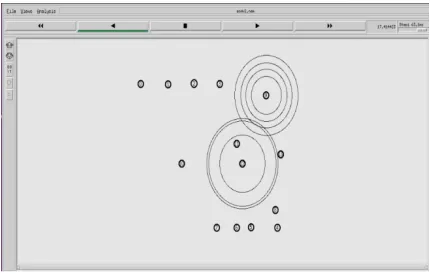
Fig.2, Output trace file generated for fourteen nodes (a) Output trace file of AODV for fourteen nodes at different time (b) Output trace file of VRP for fourteen nodes at different time NAM file visualises the animation of mobile nodes within the network. Fig.3, shows the output NAM visualization of VRP routing protocol for a number of 14 nodes at different speeds and time.
Fig.3. Output NAM file generated for VRP which consists of analysis of fourteen different nodes at different time
D. Performance Analysis
Here the performance of AODV routing protocol is compared with that of the proposed VRP protocol in terms of performance parameters such as average throughput, average drop and average end to end delay. Results obtained are mentioned in the following tabular column.
TABLE II
Comparison of AODV and VRP routing protocols based on the performance parameters
PARAMETERS AODV Routing protocol VRP Routing protocol
Average throughput 904 1018
Average packet drop 45 47
Average end to end delay 83.9552 ms 46.0039 ms
By analyzing the above results, we can understand that VRP routing protocol achieves a better throughput of 1018 when compared with that of AODV. As throughput increases drop also increases manually. But in the case of VRP protocol, for more than hundreds of increase in throughput only an amount of 2 increased in the packet drop. When considering the delay, VRP achieves lesser end to end delay when compared with AODV which is essential for VANETs. Thus it can be concluded that VRP offers better speed and performance than existing AODV protocol. The graphical analysis of the above mentioned parameters except delay are shown in the following figure.
1. Average throughput
(a) (b)
Fig.4, Average throughput versus time for two protocols (a) Average throughput obtained for AODV, which is 904 at different time (b) Average throughput obtained for VRP at different time is 1018
2. Packet drop
It indicates the number of packets that have not reached the destination. The following figure, Fig.5, shows the packet drop for AODV and VRP respectively. Since there occurs an increase in throughput, drop also will increase. But in the case of VRP for an increase of hundreds in throughput only packet drop of two has been occurred.
(a) (b)
Fig.5, Packet drop versus time for two protocols (a) Packet drop for AODV is 45 during different times (b) Packet drop for VRP is 47
V. CONCLUSION
In this paper, a new routing protocol, VRP is proposed which is the modification of existing AODV routing protocol. The main goal of this protocol is to handle some of the challenges in VANETs such as time critical issue and security issue. VRP uses two important parameters which are speed and direction as the criterion for hop selection. Thus instead of selecting all the neighboring hops, here hop selection is minimized based on this criteria during the route discovery phase. Thus speed and throughput of the network can be increased along with much lesser delay. RSA cryptosystem is also implemented to protect the network from security attacks and to ensure integrity of the messages transferred. Finally, our simulation results showed that VRP achieves better throughput, lesser delay and lesser packet drops when compared with that of AODV routing protocol. Thus we can say that VRP performs better than AODV in the area of VANETs.
REFERENCES
[1] Valsangkar Farid , Prof Shirgan S.S , Kadganchi Harshad, “ Design and Analysis of AODV Routing Protocol in VANET Using NS2”, International Journal for Research in Applied Science and Engineering Technology, Vol. 2, Issue IX, September 2014.
[2] Rajvardhan Somraj Deshmukh, Tushar Singh Chouhan and P.Vetrivelan, “ VANETS Model: Vehicle-to-Vehicle, Infrastructure-to-Infrastructure and Vehicle-to-Infrastructure Communication using NS-3”, International Journal of Current Engineering and Technology, Vol.5, No.3 , June 2015. [3] Elias C. Eze, Sijing Zhang and Enjie Liu, “Vehicular Ad Hoc Networks (VANETs): Current State, Challenges, Potentials and Way Forward”, 20th International Conference on Automation & Computing, Cranfield University, Bedfordshire, UK, 12-13 September 2014.
[4] Shubham Kapoor and Surjeet, “VANETs: Basics, Issues and Challenges in its Practical Deployment”, International Journal of Engineering Trends and Technology (IJETT) – Volume 57, Number 2 - March 2018.
[5] Anuj K. Gupta, Dr. Harsh Sadawarti, Dr. Anil K. Verma, “Performance analysis of AODV, DSR & TORA Routing Protocols”, International Journal of Engineering and Technology, Vol.2, No.2, April 2010.
[6] N. Josiane, R. Neeraj, and W. Guiling, "VANET routing on city roads using real-time vehicular traffic information", IEEE Transactions on Vehicular Technology, Volume: 58 , Issue: 7 , Sept. 2009.
[7] A. Omid, B. Reza and M. Abdollahi, "Improving route stability and overhead of the AODV routing protocol and makeing it usable for VANETs", 2009 29th IEEE International Conference on Distributed Computing Systems Workshops, July, 2009.
[8] J. Liu, F. Chen and J. Xu, " The study of routing strategies in vehicular ad-hoc networks", 2010 International Conference on Wireless Communications and Signal Processing, November, 2010.
[9] L. Baozhu, L. Yue and C. Guoxin, "Improved AODV routing protocol for vehicular ad hoc network", 3rd International Conference on Advanced Computer Theory and Engineering(ICAC), 2010.
[10] K. Sjoberg, E. Uhlemann, and E. G. Strom, “How severe is the hidden terminal problem in VANETs when using CSMA and STDMA?” in Proc. IEEE Veh. Technol. Conf. (VTC Fall), pp. 1–5, Sep. 2011.
[11] H. A. Omar, W. Zhuang, and L. Li, “VeMAC: A TDMA-based MAC protocol for reliable broadcast in VANETs,” IEEE Trans. Mobile Comput., vol. 12, no. 9, pp. 1724–1736, Sep. 2013.
[12] Guiyang Luo, Jinglin Li, Lin Zhang, Quan Yuan, Zhihan Liu, and Fangchun Yang, “sdnMAC: A Software-Defined Network Inspired MAC Protocol for Cooperative Safety in VANETs”, IEEE Transactions On Intelligent Transportation Systems,Issue: 6, Volume: 19, Year: 2018.
[13] N. Surayati, M. Usop, and A. Abdullah, "Performance evaluation of AODV, DSDV & DSR routing protocol in grid environment", IJCSNS International Journal of Computer Science and Network Security, Vol.9 No.7, July 2009.
[14] Asma Ahmed, A. Hanan, Izzeldin Osman, “Aodv Routing Protocol Working Process”, Journal of Convergence Information Technology (JCIT)Volume 10, Number 2, March 2015.