COMMISSION OF THE EUROPEAN COMMUNITIES DG XII- RESEARCH, SCIENCE, EDUCATION
RAW MATERIALS
RESEARCH AND DEVELOPMENT
STUDIES ON SECONDARY RA\N MATERIALS
IV. FERMENTATION-HYDROLYSIS
PROCESSES FOR THE UTILISATION
OF ORGANIC WASTE MATERIALS
VOLUME I
September 1979
For official use only
COMMISSION OF THE EUROPEAN COMMUNITIES
'
(,.;;. 0 6 '/. f .2
~ (,.#frS'{
(Directorate General XII - Research, Science, Education)
~ERMENTATION
- HYDROLYSIS PROCESSESFOR THE
UTILISATION OF ORGANIC WASTE MATERIALS _
- l i /
- v
c l .. -m..tJ 5 o..f,.:' 1CReport by
L.O. Hopkins
et
a)
, . I
R.J. Griffith D.M. Malone
T.
McManus::K~ fto.fb~~~;
I?<'V"-ltl
o..t-~
Ue"C''()fwt"'"L
~1-uJ,~.s
err-~rrt"'J
.
.._:-1
lo..w tt~-k\.L als j Ve
I'
Ii1 \JINSTITUTE FOR INDUSTRIAL RESEARCH AND STANDARDS Bally•un Road
Dublin 9 <Ireland)
This document was prepared under the sponsorship of
the Commission of the European Communities.
Neither the Commission of the European Communities,
its contractors nor any person acting on their
be-half, guarantee the accuracy or completeness of the
information herein contained, or are responsible for
PREFACE
This study of fermentation-hydrolysis processes is part of a
series
ot
assessment studies on Secondary Raw Materials that
have been prepared under the sponsorship of the "Commission
of the European Communi ties" (Directorate-General for Research,
Scienoe and Education).
The decision to carry out such studies, as well as other work to be
published under the general heading "Raw Materials Research
andDe-velopment", results from current concern about prospects of supplying
the European Community with raw materials in sufficient quantities and
at acceptable costs in the mid- to long-term.
Anessential part in
de-fining the purpose and scope of the work was played by a Sub-Committee
of CREST (1), established to investigate on-going activities in the
member states, both in the areas of primary and secondary raw materials,
in order to determine what R
&
D actions, if any, should be undertaken
by the Community to alleviate its supply problems.
The study comprises
5reports, prepared under contracts with the
European Economic Community.
List of reports
andof contracting bodies:
---Report 1. INSTITUTE OF INDUSTRIAL RESEARCH
AND STANDARDS, Dublin
(Contract no. 304-76-12 ECI EIR)
Report 2. CATHOLIC UNIVERSITY OF LOUVAIN,
Louvain-la-Neuve
(Contract no. 310-76-12 ECI B)
Report 3. STATE UNIVERSITY OF GHENT .
(Contract no. 307-76-12 ECI B)
Report
4•UMWELTBUNDESAMT, Berlin
(Contract no. 306-76-12 ECI D)
Report
5.
TECNECO S.p.A., S. Ippolito
(Contract no. 305-76-12 ECI I)
Volume One
Volume Two
Volume Two
Volume Two
Volume Two
Joint recommendations for future research and development are given in
section
1
of the first report.
i
-CONTENTS
Page
PREFACE 1
PROJECT DESCRIPTION 2
PROJECT OBJECTIVE 3
GENERAL STRATEGY 4
SUMMARY 6
SECTION 1 INTRODUCTION
1.1 Introduction 23
1.2 Domestic Refuse 28
1.3 Agricultural Residues 33
1.4 Industrial Residues 40
1.5 Municipal Sewage 44
1.6 Potential of Fermentation-Hydrolysis 48
References 50
SECTION 2 ANAEROBIC DIGESTION
2.1 Introduction 52
2.2 Microbiology 54
2.3 Raw Materials and Products 58
2.4 Commercial Processes 74
2.5 Research and Development 86
2.6 Economics 120
References 143
SECTION 3 COMPOST
3.1 Introduction 152
3.2 Microbiology 155
3.3 Raw Materials and Products 158
3.4 Commercial Processes 163
3.5 Research and Development 183
3.6 Economics 195
Contents/r.ontinued
SECTION 4 PROTEIN PRODUCTION
4.1 Introduction
4.2 Microbiology
4.3 Technology
4.4 Raw Materials and Products
4.5 Commercial and Pilot Scale Processes
4.6 Research and Development
4.7 Economics
References
SECTION 5 CARBOHYDRATE HYDROLYSIS
J>.l
5.2
5.3
5.4
5.5
SECTION 6
6.1
Introduction
Raw Materials and Products
Commercial Processes
Research and Development
Economics
References
ALTERNATIVE PROCESSES
Introduction
6.2 Protein Recovery by Non-Fermentation
Processes
6.3
6.4
6.5
6.6
Recovery of Protein from Farm Wa~te
Animal Feedstuffs as By-Products of
Industrial Processes
Protein from Vegetable Sources
Protein from Primary Raw Materials
6.7 By-Products Recovery in the European
~ iii
-Contents/continued
Page
SECTION 7 RECOMMENDATIONS FOR FUTURE RESEARCH
AND DEVELOPMENT
7.1 Introduction 380
7.2 Anaerobic Digestion 381
7.3 Composting 386
7.4 Protein Production 389
7.5 Carbohydrate Hydrolysis 392
l
-PREFACE
This report has been prepared from data collected from Denmark,
France, Ireland and the United Kingpom, and also from
literature studies of non-conununity developments in the
area of interest.
Similar reports have been prepared for the Federal Republic
of Germany (Umweltbundesamt), Italy (Tecneco), and the Benelux
countries (Universities of Ghent and Louvain).
The recommended areas for further research in the field of
fermentation-hydrol~sis contained in this report, are those jointly agreed upon by the pilot and co-pilot countries
PROJECT DESCRIPTION
The current level of fermentation-hydrolysis technology available
for the economic production of valuable materials such as
fertilisers and animal feedstuffs from organic wastes is examined.
Organic wastes of interest are:
consumer wastes
industrial wastes
agricultural wastes
forest product wastes
-. other bulk organic wastes
As required by contract,the study is confined to fermentation
type processes within the following fields:
anaerobic digestion of organic wastes
composting
carb~hydrate hydrolysis
protein recovery through fermentation routes
Recommendations are made for areas of research where objectives
are most likely to be realised and where progress will most
rapidly contribute to the widespread utilisation of fermentation
-3-PROJECT OBJECTIVE
The objective of the project is to identify and evaluate
present practices and research needs in the area of the
production and recovery of valuable products, such as
proteinaceous animal feedstuffs and fertilisers, from
organic wastes by fermentation-hydrolysis processes, and
to provide a list of possible research areas worthy of
GENERAL STRATEGY
Initial thoughts suggest that the first subject for study
should be the process input feed - organic wastes or residues.
However, this is a subject sufficiently large and complex
to warrant a separate individual study. Thus we have avoided
an indepth study of the distribution, collection and disposal of
organic waste materials.
Instead, we have concentrated on the acquisition of information
on processes which are presently commercially viable or are at
the pilot plant stage, in each of the four technological areas
under study. In addition, of course, we were also interested
in experimental and novel processes which are still at the research
and development stage.
Information gathered from the literature is naturally an essential
ingredient of any study and of course this has formed an
important part of our work. However, in order to reasonably
assess progress in any field it is necessary to visit and talk
with those people who are intimately involved in the subject
being examined. Therefore, we have made intensive efforts
to visit as many relevant companies, research departments and
individuals who are involved in the utilisation of organic
wastes as has been possible in order to see their processes and
to hear their views.
Altogether we have interviewed 60 people in Ireland, 62 people
in U.K., 15 people in Denmark, 48 people in France, 12 people
in U.S.A.
This study is primarily based on information acquired during
these visits and supplemented by literature information.
The information and data acquisition schedule followed is
A
Current conunercial processes
B
Pilot plant processes
c
Exper:iJnental processes
requiring further
R&D
D
Novel processes at R
&
D stageFig. I
-5-' E Organic
~---~-t
waste,,
SUMMARY
The conversion of organic waste to useful products may be achieved
using technologies based on incineration, pyrolysis, chemical
hydrolysis and fermentation.
The scope of this study includes the examination of the current
levels of fermentation technology, both aerobic and anaerobic,
which are available for the economical production of useful
secondary materials. These for example, include the production
of fertilisers, animal feedstuffs and chemicals from consumer
wastes, agricultural and forest product residues and other
bulk organic wastes.
The process types included are:
anaerobic dige~tion
composting
protein production
carbohydrate hydrolysis
Additionally, the priorities of waste recycling and the
constraints to the successful commercial use of present fermentation
processes are examined so that technological areas in need of
R&D may be identified.
It is not surprising to find that the four most important sources
of organic wastes arise from:
the agricultural industry
municipal sewage and refuse
the food processing industry
the forest products industry
The basic conversion sequence considered for these wastes ~s
-7-RAW MATERIALS
MWlicipal Agricultural Forestry Processing
waste waste waste waste
Primary Conversion
Biological Chemical
Secondary Conversion
Aerobic
I
Anaerobicj
PhotosyntheticPRODUCTS
Fuel Food Fertilisers Biochemicals
Fig. 2 Product chart for organic waste
The 1975 figures for the EEC alone, were 950 million tons for
agriculture waste,200 million tons sewage, 90 million tons of
household refuse.
Not all of this waste is collectable, but even at a SO% availability,
it represents a vast resource which largely remains ignored
Whilst there are, in the case of all the waste materials
mentioned, industrial processes which are capable of utilising
these wastes as a raw material, few are operating at this
present time on a completely commercial basis. The reason
for this may he summed up in a few words - the process economics
are generally not attractive enough. This is particularily
so in an era in which there has been a cheap and plentiful
supply of virgin raw material alternatives. However this
state of affairs is rapidly changing and in a number of incidences
it has become commercially attractive to process materials
previously considered awaste. The production of animal feed
proteiJ?. from a rich sugar containing effluent is one such example.
In this case, the·value of the product helps offset the negative cost of straight effluent disposal. Processes are now available
for .the economic conversion of straw to a ruminant feedstuff having
the same nutritional value as good hay. This is a far better use of
the huge amounts of straw burnt annually on the field in some community
countries.
There will be in many cases competitive processes and uses for organic waste residues. Apart from the competitive processes,
there are certainly similar products already on the market
derived from other processes. All of these factors must
be taken into account when considering the utilisation of organic
waste mat~rials. That is, irrespective of any emotive reasons
for using waste, the process and product must be economically
sound.
Our brief has been to examine fermentation-hydrolysis processes
capable of utilising organic waste material and to decide whether
such processes have any commercial future.
We have come to the conclusion that fermentation-hydrolysis
processes do have an important and economic basis for the utilisation
of organic waste materials - whilst recognising that in many
-9-processes. Our recommendation that further R&D in the field
of fermentation-hydrolysis, should be undertaken, naturally
follows these conclusions. Our choice of areas for R&D
are biased towards those which seem to us to offer a
reasonable chance of success and may be expected to lead
to a viable or more viable commercial process. It is our
opinion that these objectives are more likely to be
achieved by multidisdplinary teams and that industrial
participation is desirable.
Anaerobic Digestion ·
The harnassing of the anaerobic digestion process to
produce energy and to treat a waste material has been investigated
to varying degrees over the past 100 years or so. While it has
been used extensively in certain areas,only rec~ntly have
advances been made in improved digester design and operation.
Anaerobic digestion has been used most extensively at sewage
treatment works for the stabilisation of sewage sludge and
energy prdduction, At the Mogden works outside London, about
90% of all the energy requirements of the sewage treatment works
are provided by the combustion of the methane gas produced on
digestion. Similarily at the Acheres plant outside Paris over 75% of the energy requirements are provided in the same fashion.
Such digestion units are enormous with a maximum size of up to
4000 m3 (or 1 x 10⁶ gallons). Many smaller digesters have been
constructed and have operated successfully down through the years.
In fact,when one considers the types of material being digested,
it is surprising that the operation of anaerobic sludge digesters has been so successful. Reports of digesters going "sour" have
Anaerobic Digestion (continued)
operation and basic ignorance on the part of the plant operators.
In the case of animal manures, anaerobic digestion to produce
methane was practised extensively in Germany and France during
and after World War II. When oil was scarce,such devices proved
useful as reliable $ources of energy. Furthermore the digested
manure was felt to be a better fertiliser than the undigested
manure. However, the availability of oil as a cheap, convenient,
reliable energy souce caused many of these digesters to fall
into disuse. Also operational difficulties arising from a
lack of proper control and knowledge on the part of the farmers
have contributed, 'in no small part, to their disuse. However,
the increasing costs of inorganic fertilisers, coupled with the
enforcement of anti-pollution laws should encourage farmers to
reconsider the value of anaerobic digestion processes. The
use of anaerobic digestion for the treatment of industrial
effluent has great potential even though there are few examples of actual digesters in operation. Where properly operated, most
of these ha~e ·run successfully for years. Digesters using industrial
effluents which have fairly uniform characteristics are more
easily ~ontrolled. The methane generated can be readily utilised
on site and sufficient facilities and expertise should be present
to enable proper control to be exercised. Recent developments
in this area are promising. Notable among these, are the use
of anaerobic digestion processes to treat starch-gluten process
effluent at plants in Bordeaux, France, and Ashford, UK, with
the subsequent use of the methane generated as a plant energy source.
Nevertheless, further pilot studies are required to demonstrate
the overall effectiveness and economics of the process as a waste
-11-Anaerobic Digestion (continued)
Much of the research on anaerobic digestion being carried out
at universities and research institutes in the EEC deals with
farm residues. There is little work being done on industrial
effluents and sewage sludge. One interesting large scale pilot
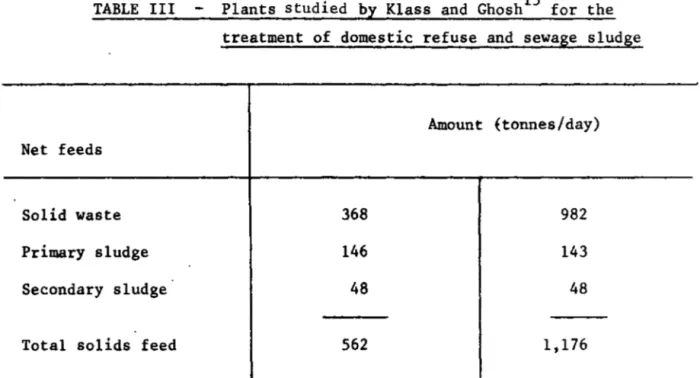
plant, designed to treat domestic refuse and sewage sludge,
is currently under construction in the United States. This
mode of refuse disposal is an alternative to landfilling, incineration,
pyrolysis,etc., and developments at this plant should be closely
followed.
While many single di1cipline team& have produced and are
producing good results from their research on anaerobic digestion,
the outputs of multi-disciplinary teams are more impressive in
terms of practicable utilisation of the process. Such
multi-disciplinary teams, consisting of for example, microbiologists,
engineers and commercial interests, are necessary to bring
anaerobic digestion to the stage where reliable "off the shelf"
digester units are available.
The study group consider that support for R&D should be given
in four areas. These are,in order of priority:
commercial pilot digesters
fundamental process mechanisms and microbiology
feedstuff products
disposal of digested slurry
Recommendations in the first priority area are aimed at encour~ging
the development of economic reliable digesters for the treatment of
agricultural, industrial and domestic wastes. It is our opinion
that present anaerobic digestion technology is sufficient to enable
Anaerobic Digestion (continued)
Nevertheless, we recognise that worthwhile improvements in
existing processes could be made QY a better understanding
of the fundamental microbiology and kinetics of the anaerobic
digestion system. Work in this second priority area need not be
confined to methane production alone. The prime objective of
work in this area should be the ultimate applicability of results
to the development of viable commercial processes. Strict
control of R&D projects will be necessary to ensure this.
The remaining areas are concerned with the possible production
of animal feedstuffs and the disposal of digested slurry.
Although anaerobic digestion reduces the pollutant nature of
wastes, there is always a residue to dispose of after digestion.
The use of these residues as either an animal feedstuff or a
fertiliser and the survival of pathogenic organisms are important
aspects which need further study.
It is of interest to note that experimental programmes on
anaerobic digestion are being set up in Sweden (Swedish Institute
of Agricultural Engineering) and Finland (Helsingen Yliopiston
Mikrobiologin Lailos).
Composting
Composting has a long history of use in the treatment of municipal
solid wastes. The traditional windrow method, although still
extensively used, is largely an inefficient process. The
process not only lacks proper control but is also land intensive
and time consuming. The product ~rom this process is
variable and frequently of poor quality. This has resulted
in product marketing difficulties and a diminishing interest in
-
13-Composting (continued)
However, the development of accelerated composting systems
represents a major technological advancement. The tower type
composter requires a small land area, operates at pasteurising
temperatures and is capable of producing mature compost in as
little as six days. ·using this type of technology, one
American company, Ecology Incorporated, is able to profitably
market compost produced for municipal waste. The further
development of accelerated composting systems capable of full
process control and producing a standard product should be
attractive especially to European local authorities who have
a statutory obligation to dispose of municipal waste in a
hygienic manner. Apart from new technological improvements
in the composting process, the valuable and perhaps vital role
that compost could have in preserving existing soil and ensuring
its long-term fertility should not be ignored. The fertility of
soil is related to the amount of humus present. While the value of
using compost ~s a source of humus to replace the humus destroyed
by high soil ·temperatures is well recognised in hot arid countries,
there is a tendency to assume that compost has no role to play
in countries with stable soils and temperate climates. However
soil. deterioration has been detected in a number of temperate
zone countries. The deterioration of fertile soils in temperate
countries will become more evident with the increasing use of
modern intensive farming techniques necessitated by the world's
pressing demands for more food. Although inorganic fertilisers
are necessary for increased crop production, they do not provide
the humus needed to sustain soil fertility under intensive
cropping conditions. Some means of retaining the humus balance
in soil is required and the application of compost would help
Composting (continued)
In addition to its humus content, compost has a certain fertiliser
value, having a nitrogen content ranging from 0.4 to 3.5%
dry matter, a phosphorus content ranging from 0.3 to 3.5% and
a potassium content ranging from 0.5 to 1.8%. The EEC
requirements for nitrogen, phosphorus and potassium for the
year 1975-1976 amounted to 5.78 million, 3.86 million and
3.74 million tonnes respectively. Thus if the 90 million tonnes
of domestic refuse generated in the EEC in 1975 had been composted,
approximately 2.8% of the nitrogen, 3.1% of the phosphorus, and
5.3% of the potassium requirements ef the EEC could have been
supplied in this manner.
Although the large scale use of compost is normally associated
with horticultural outlets, its use in viticulture is well known
in France and Germany, where it is used to stabilise vineyard
slopes. Composting is particularly acceptable in France and
some 10 percent of the municipal solid waste collected in France
is composted, resulting in an annual production of around 500,000
tons of compost, half of which is used in vineyards. At present
there· are ~ome 74 composting plants currently in operation in
France • The number of composting plants in the United Kingdom
has halved to about 8 over the past six years. Only two of these
plants appear to be selling compost with any degree of success.
No municipal waste composting is carried out in Ireland. In
Denmark,there are two municipal waste treatment plants which
carry out composting operations. The products from these plants
are used mainly for landfill.
An
interesting variation of thecomposting process is carried out at Odense in Denmark. Here
domestic refuse is pulverised, mixed with a small amount of
domestic sewage sludge and used directly for landfill where
-
15-Composting (continued)
While there are a considerable number of commercial processes
available for oomposting municipal wastes, few are suitable for crop and animal wastes. However, the growth in the numbers
of intensive animal production units, coupled with the increasing
prices of inorganic fertilisers and the greater awareness of the need
to return organic matter to soil in order to retain its long
term fertility are factors which favour the more widespread use
of agricultural waste composting. Although at present there
is little R&D activity in this area, one process under active
development appears to have considerable potential. This is a low technology process which composts a mixture of animal
slurry and straw and produces a product having content of 4% nitrogen, 2-3% potassium and 2-3% phosphorus, on a dry weight
basis, at a cost of about £10/tonne. This product could be used
effectively as a horticultural or agricultural fertiliser.
Compost is a product which although often undervalued, has considerable
potential. Poor product quality control, together with a lack of
aggressive marketing has militated against the viable economic
operation of most composting processes. Whilst under certain
socio-economic conditions, the latter may not be completely
necessary, it is always desirable. In the short or medium
term, the stimulus required for the more widespread acceptance
of compost may well come from the introduction and enforcement
of environmental legislation.
The study group has concluded that research and development
is essential in two distinct areas if better acceptance of
the composting process is to be achieved. These areas are:
market outlets and product acceptability
Recommendations made in the first area,concern the identification of market outlets and the quality of the product. Product quality
is closely linked to the elimination of undesirable substances
such as plastics, heavy metals and toxic chemicals.
Within the processing area, R&D aimed at achieving complete process and PfOduct quality control in accelerated composting
systems is necessary and success here would greatly enhance
the acceptance of the composting process as a satisfactory way
of utilising organic waste. In the agricultural sector, the
development of cheap, simple to operate reliable composting
systems for farm waste should not be neglected. The availability
of such systems would enable farmers to make beneficial use
of much of the agricultural waste generated within the EEC
annually - 950 million tonnes were produced in 1975.
Protein Production
Worldwide,quite a number of industrial plants for the production of single cell protein from a primary raw material are at the
planning stage, while a few such processes are operational.
Four of these plants have been constructed in the EEC. Two
100,000 tonne/year plants, the Liquichimica Reggio Calabria
plant and the ANIC/BP Sarroch plant,have not operated yet due
to problems in obtaining product approval from the Italian
Health A~thorities. The BP 20,000 tonne/year plant at
Cap Lavera, France ceased production in 1976 because of poor
economics. Only the 4,000 tonne/year BP Grangemouth, U.K.,
plant, which uses a paraffin substrate, continues production
of single cell protein. Apart from these plants and the
-
17-Protein Production (continued)
Billingham, U.K., there is no tangible evidence that industry
in Denmark, France, Ireland or the United Kingdom are especially
enthusiastic about the immediate future of single cell protein
production from primary raw materials.
There is a general non-acceptance of single cell protein as a
food for human consumption. The acceptance of single cell
protein as a human food must be preceded by favourable results
from extensive chemical and toxicity tests. Because of this,
the use of single ~ell protein is largely confined to animal feed at the present time. For this purpose, single cell protein
has to be able to compete economically with soya bean protein.
Whilst single cell protein could be used to replace part of the
traditional animal feed protein, the general opinion is that
the economics of present single cell protein processes are,
at best, only marginally favourable.
However, there is a long history of yeast protein production
using wastes such as whey and spent sulphite liquors. The
best inune.diate prospects for single cell production lie in
this direction,and especially where successful adaptation of
medium to low level technology fermentation processes to the
treatment of organic wastes is achieved. Notably within the
EEC,Bel Industries in France have been successfully producing
2,000 tonnes/year of food yeast from whey and they are currently
constructing two new plants of similar capacities.
The greatest impetus for single cell protein production comes
from the increasing requirements for both solid waste and
liquid effluent waste to be disposed of in a manner compatible
with the preservation of the environment. The capital and
operating costs of waste treatment plants necessary to reduce
Protein production {continued)
which reduces the BOD of waste, and meanwhile produces a
saleable by-product capable of offsetting running costs, must
be attractive to industry. Two processes embodying this principle
and producing protein biomass are operating on a commercial
basis. These are the Swedish Symba process, designed to treat
effluents with high starch content, and the Finnish Pekilo
process which treats spent sulphite pulp liquors.
In addition to these commercial plants, a significant number
of industrial companies are operating pilot plants with the
same objectives in mind. While there are few commercial processes,
a large number of R&D projects are underway in universities
and research institutes. This work is mainly centred on
identifying wastes suitable as substrates and on improving
technology. The main types of wastes under examination are animal
slurries, municipal sewage, cellulosic wastes, and food industry
effluents. In addition, some work is in progress on fermenter
design.
The factors of prime importance in assessing the viability of
a process for producing protein from organic waste are:
J
the costs of conventional means of disposing or
treating the waste.
the price the protein will fetch, having regard to
other protein sources available.
the seasonal variations in the quantity and quality
of waste available.
- material, labour, transport and other costs
The study group consider that Community support for R&D should
be given in two main areas. Firstly, there should be encouragement
for the development of low cost reliable and simple processes
suitable for agricultural wastes and for well defined high strength
industrial effluents such as those arising 1n food processing
-
19-Protein Production (continued)
should not be ignored.
Secondly, there should be support for product studies. Co-ordinated
feeding trials are considered essential. Market studies
are needed and the legal situation in different Member States
of the community towards the use of waste as an animal feedstuff
should be established and the situation harmonised.
Carbogydrate Hydrolysis
Since cellulose is a major component of some organic wastes
-notably waste paper and wood residues,it is necessary to exam~ne
ways in which cellulose could be used either directly or
indirectly as a raw material for a fermentation process. Simple carbohydrates are readily assimilated by the micro-organisms used
in or occuring in the aforementioned processes:
anaerobic digestion
composting
protein production by fermentation
However, the more complex carbohydrate - cellulose - is much
less susceptible to microbial attack and it is in general a
poor raw material substrate for these processes. This is of
importance ~hen considering the possible microbial conversion of
organic wastes which have a high cellulose content. Unfortunately,
the development of viable one-stage fermentation processes
capable of utilising cellulose efficiently has not met so
Carbohydrate Hydrolysis (continued)
This being so, first thoughts might suggest that alternative
uses, such as the burning of wood residues a~ a fuel, are more
attractive and in the short term this is probably so. However
in the long term we cannot afford to take thi·s view.
Cellulose is the world's most abundant renewable resource. It
has been estimated that some 10 billion tonnes of cellulose
are produced annually. In an er~ of increasing energy and
materials shortage it is important that this renewable source
of chemicals and energy be fully utilised. As a resource,
cellulose is extremely versatile. As an energy fuel it can
be directly burned or pyrolysed to yield a crude oil.
It's versatility is greatly incr~ased by converting it to glucose
by hydrolysis. Glucose is an energy food which can be used
by people and most animals. It can also be used as a substrate
for many single cell protein producing micro-organisms which
are unable to metabolise cellulose. Glucose can be fermented
to ethanol. Not only can ethanol be used as a fuel, but it
is itself a raw material for chemicals such as ethylene and
butadiene. Glucose can also be converted microbially to such
chemicals as butanol, citric acid, lactic acid and glycerol.
Cellulose is therefore potentially a very valuable resource
if economic processes for its conversion and utilisation
can be developed.
Wood and straw are two of the best known and richest sources of
cellulose. We estimate that about 25 million tonnes of wood
were produced in the four countries - Denmark, France, Ireland
-
21-Carbohydrate Hydrolysis (continued)
of straw were produced in 1976. There are of course other
sources of cellulose, namely:
- many non-wood plants like bamboo
- peat
- waste paper
- animal manures
Indeed, .we have estimated that animal manures produced in
1976 contained in excess of 2 million tonnes dry weight of
cellulose.
Within the strict interpretation of our terms of reference
for the Fermentation-Hydrolysis study, we have been unable to
classify rich sources of cellulose, such as forest residuals,
as waste materials. There are too many viable alternative
uses of cellulose for this to be so. However, because of the
vital role that cellulose must have in the worlds future economic
and social,survival, we consider that it is necessary and justified
to recommend that R&D should be carried out on cellulose hydrolysis processes.
The need for a pre-fermentation hydrolysis treatment of cellulose
to enable its efficient use in a fermentation process requires
the hydrolysis step to be able to produce glucose at a cost which
is competitive with that of glucose derived from other sources.
Enzyme hydrolysis processes, whilst highlighted by the U.S.
Army Natick Laboratories research work on the hydrolysis of
newsprint, are not likely to meet this cost criteria. Amongst
the problems currently associated with this type of process is
Carbohydrate Hydrolysis (continued)
The acid hydrolysis of cellulose has been carried out on an
industrial scale, especially during the last war. Although
progress has been made in increasing the yields of glucose
to ethanol, it is still cheaper to produce such basic chemicals
as ethylene and butadiene from petroleum. Nevertheless, we feel
that the chemical hydrolysis of cellulose has a greater probability of commercial success than the enzyme hydrolysis route. Accordingly,
we have recommended that research should be carried out with the
object of improving the chemical hydrolysis process. Along
with this,we feel ~hat the development of one-stage microbiological
processes capable of the economic and direct production of such
useful products as ethanol, acetone, and single cell protein are
also worthy of attention.
Of prime importance however, is the necessity to find an
economical means of increasing the susceptibility of cellulose
to both chemical and biological hydrolysis processes. Success
in this direction would greatly enhance the prospects of
1
1
1
1
1
1
1
1
1
1 1
1
1
1
1
1
1
1
1
1
1 1
1
1
1
1
1
1
1
1
1
1 1
1
1
1
-
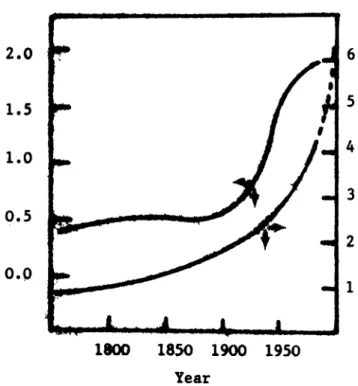
23-1.1 The 20th century has witnessed an unprecendented growth in
the world's human population. The magnitude of this growth
is evident from data in Table I. Fig. 1 illustrates
graphically the dramatic increase in population compared
with the previous century.
TABLE I
Period
1 - World population growth
Average annual growth rate
%
Doubling time (years)
One million BC to 8,000 BC 0.0015 46,200
8,000 BC to 1 AD 0.036 1,925
lAD to 1750 0.056 1,155
1750 to 1800 0.44 157.5
1800 to 1850 0.52 133.3
1850 to 1900 0.54 128.3
1900 to 1950 0.79 87.7
1950 to 1974 1.71 40.3
1974 to 2000 1.90 36.5
2.0 6
1.5 5
Average annual 1.0 4
growth rate
3
('%/year)
o.s
2
0.()
1
1800 1850 1900 1950
Year
Fig. 1. World population growth since 1750 AD.
Population at end of
period (million) 8 300 800 1,000 1,300 1,700 2,500 3,900 6,400
World population
Population growth is dependant on adequate supplies of food and energy. The significant technological advances made by man over the last hundred years have made it possible for both commodities to be abundantly available This has enabled the world's population to grow at a rate
unparalleled in history. Increasing population, together with a rising standard of living, creates a tremendpus demand
on the world's resources. Whilst in the past man has acted as if these resources were infinite, we are now forced to recognise that this is not so. Fossil fuels and mineral
deposits are not renewable and in many cases it is now possible to estimate the balance remaining.
Fossil fuels are at the present time critical to the world's energy requirements. Additionally, these fuels have
alternative uses as sources of chemicals required by man. The world fossil fuel resources are given in Table II.
TABLE II - Total world fossil fuel reserves (1974)
2
Proved and Estimated total
Reserve currently recyJerable recoy~rable remaining
10 MJ 10 MJ
Natural·gas 1.9 - 2.85 10.02 - 10.44 Natural gas liquids 0.21 - 0.32 1.06
Crude oil 3.27 ··- 4.43 11.50
Sync rude from oil shale 1.70 14.80
Coal 14.60 113.40 - 130.0
Total reserves 21.63 - 23.84 149.0- 167.00
-
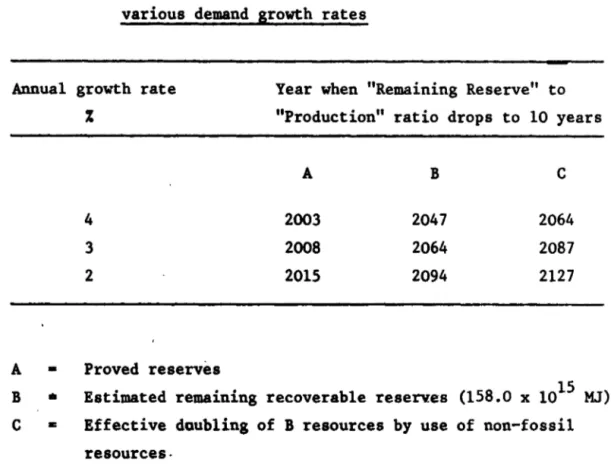
25-TABLE Ill -Life of world fossil fuel resources at various demand growth rates
Annual growth rate Year when "Remaining Reserve" to
% "Production" ratio drops to 10 years
A B
c
4 2003 2047 2064
3 2008 2064 2087
2 2015 2094 2127
A • Proved reserves
B • Estimated remaining recoverable reserves (158.0 x 10¹⁵ MJ)
C • Effective doubling of B resources by use of non-fossil resources.
Currently the annual European growth rate for energy consumption is approximately 4%. At this rate known fossil fuel reserves will be exhausted within the next 80 years or so. Strict
conse~vation practice is essential if the life of these reserves is to be prolonged. W.ilst fossil fuel reserves are the most critical non-renewable resource at present, the conservation of all non-renewable resources is now clearly essential.
A significant contribution to the conservation of
non-renewable resources could be made by the recovery and recycling of useful,materiala from the vast amount of waste produced
daily. The EEC alone produced 1.7 billion tons of waste in 1976, or 4.6 million tons daily. This is increasing at a rate of
approximately 5% annually. Apart from the separation and recovery of useful materials such as paper, glass and metals, organic wastes which account for a considerable amount of the total waste produced may be converted to useful products such as food, fertilisers and chemicals. The development of technology
'
waste generated by present industrialprocesses is undeniably
important as is the development of markets for secondary
materials so produced.
Waste must then be regarded as a vast, untapped, renewable
resource which can, and must, be fully exploited in the future.
Successful utilisation of waste may be equated to the
conservation of scarce and vital resources and its attendant
economic benefits. Waste is a resource which the world cannot
afford to neglect.
At present, waste receives more attention on account of its
n4isance value than its potential as a resource. Disposal
costs are increasing steadily due partly to the non-availability
of convenient dumping sites near urban areas and partly to the
now recognised need to dispose of waste in a manner which will
not cause damage to the environment. In short, waste disposal
is a problem and waste disposal costs money. The exploitation
of waste as a raw material resource could at the very least
reduce present disposal costs.
Besides the demands that a growing population makes on
non-renewable resources, it is also necessary to produce
increasing amounts of food in order to sustain this population.
Although food sources are normally renewable, the amount of land
available for food production is limited and in the foreseeable
future many of the highly.populated areas of the world will have
insufficient land available to produce enough food by traditional
methods. One answer to this problem is the correct development
of intensive animal production units. Such units can be
operated on relatively small sites without the need for much
land. However, these intensive units do give rise to large
volumes of manurial wastes which are in many cases far in excess
of what can be disposed of by traditional landspreading techniques
due to the limited land area immediately available. A serious
waste disposal problem is therefore associated with these units
and indeed some areas, notably those supporting intensive pig
production, are already experiencing major environmental
-
27-Manures are a resource and should be treated as such.
With proper use and the necessary process development, this
resource oould make a significant contribution to the world's
growing food requirements while reducing the non~eneficial
pollution problem frequently associated with manurial wastes.
The huge volume of such potential resource is best illustrated
by reference to Euroform No. 21/76 (25.5.1976) - Annex 1 where
it is stated that in 1975, the EEC threw away 1.5 billion tonnes
of waste, including
90 million tonnes of household refuse
950 million tonnes of agricultural waste
115 million tonnes of industrial waste
200 million tonnes of sewage sludge
150 million tonnes from the extractive industries.
These figures are increasing by 5% per annum.
In an era when many are beginning to realise that natural
resources are not infinite, the current profligate approach to
waste management must be questioned and alternative methods
1.2 DOMESTIC REFUSE
An increasing population and improved living standards
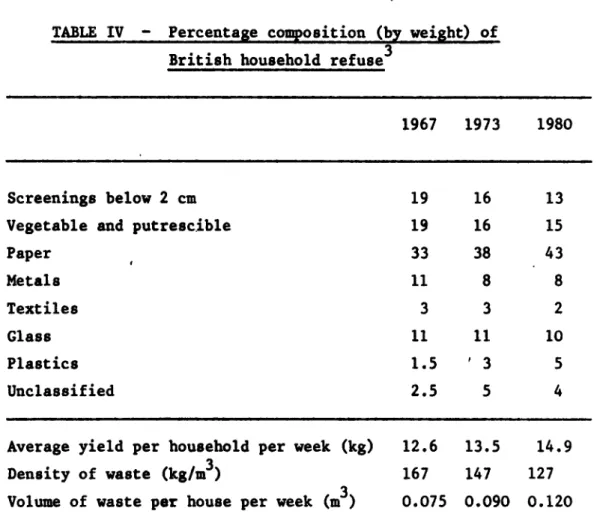
have led not only to a significant increase in the amount of domestic refuse available, but also to a marked change in its composition. The changing composition of British household refuse is illustrated in Table IV.
TABLE IV - Percentage composition (by weight) of British household refuse3
1967 1973
Screenings below 2 cm 19 16
Vegetable and putresc.ible 19 16
Paper 33 38
Metals 11 8
Textiles 3 3
Glass 11 11
Plastics 1.5 I 3
Unclassified 2.5 5
Average yield per household per week (kg) 12.6 13.5 Density of waste (kg/m3) 167 147
3
Volume of waste per house per week (m ) 0.075 0.090
1980
13 15 43 8 2 10 5 4
14.9 127 0.120
Component Putrescible matter Paper Fines Metal Glass Plastics Miscellaneous Generation (kg/ capita/ week)
TABLE
V
-!pprozt.&te percentage CO!fOsition(by
weight)and
4
5 6 generation rates of solid wastes, Western Europe ' '
Ireland (Du~lin)
France Netherlands West Switzerland Italy Germany 38 21 22 21 15 20 25 31 38 34 25 28 45 20 4 11 20 20 28 20 25 3.5 9 8 3 7 5 3 10 9 8 10 9 5 7 8 2.5 4 4 3 3 5 5.5 3.5 4 17 10 2 15 5.3 6.1 5.2 4.0 6.7 4.8 4.1 Denmark 40 27.5
4 6 NI \C I
5
TABLE VI - Dom~stic wastes, disposal practices
Land Disposal Incineration Composting Recycling
France 70 20 10
Germany 77 20 3
Italy 83 13 1
Netherlands 61. 23 16
Switzerland 34 53 13
United Kingdom 90 10
United States 92 8
The trend towards increasing volumes of less dense refuse
has a number of important implications.
Until recently, land disposal sites tended to be located
near urban centres. As "urban sprawl" became more
wide-spread, distances between such sites and the
refuse-generating urban concentrations increased. This has been
accompanied by rising land costs. The situation now is
that landfill and landspread sites are becoming progressively
scarce and expensive, particularly in urban areas. These
factors have increased the cost of dumping, thereby reducing
the margin between the cost of dumping and the costs of
3
recycling. The price of recycled materials has traditionally been
regarded as excessive, but with the escalating price of
primary materials, the concept of recycling is even more
relevant.
Traditionally, worked-out ~uarries and shallow water areas have been landfilled to create sites suitable for building.
The progressive decrease in refuse density noted in Table IV
means that landfilled areas are becoming less suitable for
-
31-light structures. High density compaction might seem
to be the answer as this forms a denser tip and is
economical in terms of land usage. However, the energy
required in the compacting process is significant and the
decay of putrescible components is retarded.
Other methods of disposal such as incineration and
pyrolysis Auffer from a number of disadvantages. Although
incineration can effect volume reductions of the order of
904 and the heat generated used for district heating, capital investment is high, noxious gases may be produced, and the
disposal of incinerator clinker presents a further problem.
Pyrolysis can achieve volume reductions in excess of 90%
but requires a high energy input.
Composting is a long established process and its potential
seems to be consistently underrated, partly because of
the long maturing time and land requirement involved.
However, advances in composting technology have made it
possible to achieve as much as a six-fold reduction in the
bulk of domestic refuse in as little as 6 days, while
producing an end-product with excellent soil-conditioning properties.
Currently, approximately 10% of French domestic refuse is
composted, and the obvious acceptance of the value of the
TABLE VII - Domestic refuse treatment in France (1980)7
Disposal method Probable percentage Desirable percentage
Dumping Land fill Incineration Composting Others
5 0
45 30
40 50
10 20
0 0
A realisation of the potential of domestic refuse as an energy source is typified by current developments in the U.S.A. Methane from the spontaneous anaerobic digestion of landfill domestic refuse is being used to generate electricity. The use of methane from anaerobic digestion of domestic refuse to produce substitute natural gas
1.3
1.3.1
-
33-AGRICULTURAL RESIDUES
Manures
The need to feed a rapidly growing population has made it necessary to resort to intensive farming techniques. The results have been spectacular in terms of increased agricultural output, and equally spectacular in terms of amounts of waste to be disposed of. Another
disadvantage is the change in the composition of certain of these wastes.
Animal slurry, particularly pig slurry, poses a difficult disposal problem. Application of slurry to land is
affected by weather, and, where heavy soil with poor drainage properties is involved, there is the danger of run-off to lakes and rivers, with consequent
eutrophication. Furthermore, concentrations of large
cattle and pig units tend to occur in the same geographical area with a consequent pressure on the amount of land
available for slurry application. The situation is particularly serious in the case of intensive pig units which require a land area for slurry disposal purposes out of all proportion to the area of the unit itself. The situation for cattle is not quite so critical at the moment but is liable to deteriorate as
farmers switch to slatted units.
The enormity of the pig slurry problem can be appreciated by the fact that there were 11,000,000 pigs in EEC in
1~76,
producing an average of approximately 550,000 tonnesCountry
Ireland
TABLE VIII - EEC pig population and volume of slurry
produced
P . 1g popu at1on 1 . 8
(millions)
0.99
Weight of slurry
produced per annum
(in million tonnes)
2.78
United Kingdom 8.20 23.04
Denmark 7.92 22.26
France 12.05 33.87
Germany 20.73 58.26
Netherlands .1.. 35 20.66
Belgium 4.85 13.63
Luxembourg 0.09 0.25
Italy 9Jl0 25.57
71.28 200.32
Although the pig population in Ireland is comparatively small,
pig slurry disposal ia a major problem, particularly in
Co. Cavan, which is noted for its coarse fishing lakes
(see Fig. 2 ). A large number of the bigger pig units in
Ireland are located in Co. Cavan, including the largest
in Europe, with 50,000 pigs. A 1973 - 1974 survey of Irish
lakes indicated that excessive enrichment was manifest in eight
lakes, five of which are in Co. Cavan. In the case of one
lake, Lough Sheelin, the pollution was attributed to effluent
from large scale intensive pig rearing units. Furthermore,
it was stated that continuing pollution could, in the long
21
IS
-
35-I:!J*?
--
S••ort •lldtules 1111 ot •••Iht loulloll • ICILI ol IIUII 11111
)fig. 2·
LOUGH
SH EELI N
SIUEY IF UICIMUI UU
111111111111 If Sll L IY PlS
LIUIIU I Sill If PI& IIIIS I IF SILl lilTS
Cuclr
llldiCOIU
t.•u ot
,,,,,
1010
7100
liDO
1180
ill
'"
IDI 110 100.,.,.
HAll Ol "G llllSAnimal
sl~rriesare particularly suitable to anaerobic
digestion. Methane is produced, which can be used to
run dual-fuel electricity generators or burned
directly to heat water fot space-heating purposes in
farm dwellings. A digested sludge is produced which
combines soil conditioning and improved fertiliser
properties. The process also reduces the level of
harmful micro-organisms present in the untreated
slurry, gives an effluent which will not cause odour
pnoblems if land spread, and which can subsequently be
readily •tpolishad" to conform to local anti-pollution
standards.
The world's fossil fuel supplies are not infinite and the
role of methane as an energy source should not be
underestimated. In two World Wars, methane was used
as a fuel, but decades of unrealistically low oil
prices since 1945 have led to a false sense of security.
The
recen~increases in oil prices seems to have lost
their impact. Perhaps the recent moves by President
Carter to come to terms with the United States energy
problems may jolt other nations out of their
complacency and stimulate interest in alternative
energy sources such as methane.
There is· also a limit to the world's supply of land and
it is being consumed, although less obviously, in a far
more sinister way. Heavy use of fertilisers, the
intro-duction of heavy machinery,
andoverstocking with
animals are leading to deterioration in soil structure.
Agriculture in many countries has now reached the point
where there is little to be gained from furtherfertiliser
1.3.2
-
37-nitrogen per year. Considering the deterioration in soil
condition that increasing levels offertiliser
application have caused in some
areas~·the
r~cyclingof organic wastes in the form of fertilisers and soil
conditioners is essential, if the long-term fertility
of the world's soil is to be preserved.
Vegetable Waste
Straw is another common agricultural waste of
nuisance value. Straw production figrres for
U.K., Denmark and Ireland are given
~n
Table
particular
France,
IX.
TABLE IX
Straw production in
19~6Country
Amount (million tonnes)
France
25 - 30United Kingdom
10Denmark
7Ireland
1.4The situation is particularly bad in Denmark where in
1976 a total of 6.8
~lliontonnes wjs burnt or ploughed
in. Consequently particular interesl in strawutilisation.
has been shown in Denmark. One such process is the
alkaline hydrolysis of straw to give a fodder with enhanced
feed value, suitable for ruminants, and which is
Apparently more palatable tban unt::jted straw.
Alsopromising process, involving the composting of
mixtures of straw and animal slurry, has been developed
in Britain. Depending on th~ degree of maturity of the
compost it can be used.either as a horticultural or
agricultural fertiliser. Indications are that it may
also be possible to use the compost as an animal
feed-stuff.
In August, 1974, the Danish Environmental Agency issued
a booklet entitled "Environmental Reforms and Agriculture".
The regulations which came into force in October, 1974,
specified inter alia the minimum permissible distance
from streams and lakes of farm buildings; that sewer
systems should be provided for the collection of waste;
that waste should be tanked and landspread;· and that
discharce to open waterways was forbidden. Such regulations
are of particular importance in Denmark which is heavily
dependent on agriculture but has few watercourses of
significant size. Consequently, run-off and eutrophication
are serious problems which unfortunately seem to have
become accepted as unavoidable.
Legislation exists in the U.K. to control pollution at
farm level but. like Denmark and Ireland, there seems to
be a general reluctance to enforce the legislation. There
is often a tendency to regard environmental legislation
as an expensive way of appeasing small, but articulate
pressure groups. This line of argument is refuted by a
recent joint economic study carried out by the EPA and
the Council on Environmental Quality? In the United States
it wa1 found that environmental regulations have had a
noticeable if modest effect on economic growth,
employment and prices. In 1976 environmental regulations
caused an increase in the rate of economic growth of 0.2%,
-~-Wholesale'Price Index of 0.5%, and an increase in the
Consumer Price Index of 0.4%. Ultimately comprehensive
environmental legislation, properly enforced, could be the stimulus for large scale utilisation of fermentation
-hydrolysis techniques for the upgrading and recycling of
1;4 INDUSTRIAL RESmUES
Industrial effluents can be broadly classified as:
effluents from food and drink manufacture, which consist mainly of natural organic compounds
other organic effluents, consisting mainly of.
animal or'vegetable matter, deriving from the paper, leather and textiles industries
effluents from the engineering industry, containing metals and cyanides
effluents from industries either using or manufacturing chemicals
Industrial effluents of particular interest are those which can be used as substrates for the production of single cell protein.
Single cell· protein (SCP) has been subject to considerable debate. This is understandable considering the pressure bein$ put on conventional protein sources to feed a rapidly expanding population. The search for novel proteins is stimulated even further by the need to combat malnutrition in many of the developing countries. Another factor is that in the more affluent developed countries there is a
consumption of protein, particularly animal protein, in excess of nutritional needs. Currently there is not only a protein shortage but a protein imbalance and if the present trend continues, the introduction of novel proteins such as SCP is inevitable as an animal feedstuff, if not as a human foodstuff.
Shortages in the availability of existing conventional protein will have dramatic economic implications. Denmark, for example, is one of the world's greatest importers of protein in the
-
41-"cheap" protein to produce "expensive" protein in the form of processed foods for export. Any significant reduction
in availability or any substantial increase in price would have a very adverse economic effect. Situations which could
iead to such a chain of events include crop failure, political re-alignment, increased domestic utilisation of "cheap" p~otein by the producer countries, and even long-term
changes in climate.
One classical example of the economic effects of a change in climate is the case of the Peruvian anchovy fishery. This fishery, on which the Peruvian fish-meal industry depends, requires high plankton production. The plankton production, in turn, depends on the Bumboldt current to provide cold,
nutrient-rich waters. In 1972, a prolonged southward extension of warm equatorial water prevented the upwelling of the cold current. The resulting chain of effects brought about a decline in the stocks of anchovy, which had radical economic consequences for the Peruvian fishing industry -at th-at time the largest in the world. The behaviour of the
warm current in this instance was related to anomalous
meteorological conditions 1500 miles westward in the Pacific. Less dramatic but similar phenomena have been observed in other areas such as the English Channel an~ the North Sea, which have affected herring catches. Concern at the possible
consequences of a protein shortage has stimulated considerable interest on the part of Danish research workers in the
extraction of protein from oats and barley. Protein self-sufficiency may be unattainable; but lesser dependence on outside protein sources would seem to be in the interest of the EEC.
Food industry wastes such as whey and other carbohydrate