This is a repository copy of
Quality of missing data reporting and handling in palliative care
trials demonstrates that further development of the CONSORT statement is required : a
systematic review
.
White Rose Research Online URL for this paper:
http://eprints.whiterose.ac.uk/121285/
Version: Published Version
Article:
Hussain, Jamilla A, Bland, Martin orcid.org/0000-0002-9525-5334, Langan, Dean et al. (3
more authors) (2017) Quality of missing data reporting and handling in palliative care trials
demonstrates that further development of the CONSORT statement is required : a
systematic review. Journal of Clinical Epidemiology. pp. 81-91. ISSN 0895-4356
https://doi.org/10.1016/j.jclinepi.2017.05.009
[email protected] https://eprints.whiterose.ac.uk/ Reuse
This article is distributed under the terms of the Creative Commons Attribution-NonCommercial-NoDerivs (CC BY-NC-ND) licence. This licence only allows you to download this work and share it with others as long as you credit the authors, but you can’t change the article in any way or use it commercially. More
information and the full terms of the licence here: https://creativecommons.org/licenses/
Takedown
If you consider content in White Rose Research Online to be in breach of UK law, please notify us by
Quality of missing data reporting and handling in palliative care trials
demonstrates that further development of the CONSORT statement is
required: a systematic review
Jamilla A. Hussain
a,*
, Martin Bland
b, Dean Langan
c, Miriam J. Johnson
d, David C. Currow
e,
Ian R. White
f,ga
Hull York Medical School, University of York, John Hughlings Jackson Building, York YO10 5DD, UK b
Health Sciences Department, University of York, York YO10 5DD, UK c
Centre for Reviews and Dissemination, University of York, York YO10 5DD, UK d
SEDA, University of Hull, Hertford Building, Cottingham Road, Hull HU6 7RX, UK e
Palliative and Supportive Services, Flinders University, 216 Daws Road, Daw Park, SA 5041, Australia fMRC Biostatistics Unit, Cambridge Institute for Public Health, Forvie Site, Robinson Way, Cambridge CB2 0SR, UK
gMRC Clinical Trials Unit at UCL, London WC2B 6NH, UK
Accepted 15 May 2017; Published online 19 May 2017
Abstract
Objectives: Assess (i) the quality of reporting and handling of missing data (MD) in palliative care trials, (ii) whether there are dif-ferences in the reporting of criteria specified by the Consolidated Standards of Reporting Trials (CONSORT) 2010 statement compared with those not specified, and (iii) the association of the reporting of MD with journal impact factor and CONSORT endorsement status.
Study Design and Setting: Systematic review of palliative care randomized controlled trials. CENTRAL, MEDLINE, and EMBASE (2009e2014) were searched.
Results: One hundred and eight trials (15,560 participants) were included. MD was incompletely reported and not handled in accor-dance with current guiaccor-dance. Reporting criteria specified by the CONSORT statement were better reported than those not specified (partic-ipant flow, 69%; number of partic(partic-ipants not included in the primary outcome analysis, 94%; and the reason for MD, 71%). However, MD in items contributing to scale summaries (10%) and secondary outcomes (9%) were poorly reported, so the proportion of MD stated is likely to be an underestimate. The reason for MD provided was unclear for 54% of participants and only 16% of trials with MD reported a MD sensitivity analysis. The odds of reporting most of the MD and other risk of bias reporting criteria were increased as the journal impact factor increased and in journals that endorsed the CONSORT statement.
Conclusion: Further development of the CONSORT MD reporting guidance is likely to improve the quality of reporting. Reporting recommendations are provided. Ó2017 The Authors. Published by Elsevier Inc. This is an open access article under the CC
BY-NC-ND license (http://creativecommons.org/licenses/by-nc-nd/4.0/).
Keywords:Missing data; Data reporting; Research report; Randomized controlled trials; Palliative care; Systematic review
1. Introduction
Missing data (MD) present a significant risk to the power, precision, generalizability, and validity of random-ized controlled trial (RCT) findings. Transparent reporting of MD is therefore crucial to the critical appraisal of trial results by clinicians, patients, policymakers, journal-ists, and researchers [1,2]. Palliative care trials in
particular have large amounts of MD, as well as differen-tial rates and reasons of missingness across trial arms that potentially introduce bias[3].
To strengthen the reporting standards of MD in trial re-ports, the 2010 Consolidated Standards of Reporting Trials (CONSORT) statement highlights the potential impact of MD on the validity of intention-to-treat analyses [4]. The guidance recommends using a participant flow diagram that demonstrates post-randomization losses and exclusions (with reasons) and to report the number of participants included in each analysis[4]. It does not however provide specific guidance on how to report methods to handle MD, assumptions about the MD mechanism, and MD Conflict of interest: None to report.
* Corresponding author. Tel.: þ44-870-1245500; fax: þ 44-019-04321696.
E-mail address:[email protected](J.A. Hussain).
http://dx.doi.org/10.1016/j.jclinepi.2017.05.009
0895-4356/Ó2017 The Authors. Published by Elsevier Inc. This is an open access article under the CC BY-NC-ND license (http://creativecommons.org/ licenses/by-nc-nd/4.0/).
What is new?
Key findings
Missing data (MD) in palliative care trials are not reported and handled in a clear, complete, and transparent manner.
Criteria specified by the Consolidated Standards of
Reporting Trials (CONSORT) 2010 statement were better reported than those specified by other reporting guidelines.
The odds of reporting most MD and other risk of bias reporting criteria were increased as the journal impact factor doubled and in journals that endorsed the CONSORT statement.
What this adds to what was known?
Assessment of the risk MD pose to the power, pre-cision, generalisability and validity of trial findings is substantially hindered by poor reporting.
What is the implication and what should change now?
Further development of the CONSORT MD
ing guidance would potentially strengthen report-ing standards. Reportreport-ing recommendations are provided for published trial reports.
sensitivity analyses. It could be argued that the application of the general CONSORT principles would encourage the reporting of all these [5], but it is unknown if this is the case.
Guidelines that specify additional criteria for reporting MD are available. Akl et al. [2] conducted a systematic survey of literature to identify recommendations for report-ing MD in RCTs. They selected 13 articles includreport-ing the CONSORT 2010 statement for parallel trials [6]and the CONSORT extensions for patient-reported outcomes [7], harm [8], and cluster trials[9]. From these recommenda-tions, they provided reporting guidance covering the proportion, reasons, patterns, analytical methods, and interpretation of MD[2].
Several groups have provided further guidance on the prevention and handling of MD, including recommenda-tions for reporting[1,10e14]. The Methods Of Researching End of Life Care collaboration proposed that palliative care trials should specifically report the proportion of attrition because of death and illness[12]. Trialists are also encour-aged to report comparisons of baseline characteristics between trial arms of participants with observed data and missing values to assess the effect of MD on the balance of trial arms for measured participant characteristics
[13] - although it is important to note that trials are not
necessarily powered for such analyses, and the absence of differences does not guarantee lack of bias.
No single method of accommodating MD is recommended for all trials[15]; however,principledmethods, which do not attempt to replace the missing values directly but instead combine information from observed data with explicit as-sumptions about the MD, are advocated[16]. These methods, such as multiple imputation, generate statistical information about the MD and/or its mechanism, thus taking account of the uncertainty in estimating the missing values
[10,11,16,17]. In contrast, ad-hoc methods (e.g., complete case analysis [CCA] and last observation carried forward) either exclude participants with MD or impute a single value for the MD and then treat the data set as if it were the fully observed data[16]. These are generally discouraged as they rely on strong assumptions that are often unlikely to be true. CCA in particular is inefficient as it ignores the information that is typically provided by incomplete cases[16]. However, all methods to analyze MD are based on assumptions that cannot be verified from the partially observed data; therefore, conducting MD sensitivity analyses that explore the sensitivity of the results to different assumptions about the missingness mechanism is strongly recommended[11,18].
An important consideration, especially in palliative care, is that data unmeasured because of death should not be considered as missing but rather as undefined [19]. Such data are referred to as ‘truncated due to death’ to distinguish them from MD in living participants[20]. The handling of truncated data presents a different problem to MD in those alive, and a distinction should be made between the methods to handle such data. This is a developing area of research, and several methods, taking different approaches to condi-tioning on survival, are advocated[20].
The compliance of palliative care trial reports with guid-ance on MD reporting and handling is unknown. Given the extent and risk of bias posed by MD in palliative care trials, clear reporting should be given particular attention in this field. Two reviews of trials across disciplines published in high-impact medical journals found that 45% of trials used CCA as their primary analysis [21,22], and a MD sensi-tivity analysis was reported in 21% [21] and 35% [22], respectively. These reviews however assessed a limited number of criteria relating to MD reporting and primarily focused on the amount and handling of MD, without specif-ically differentiating between MD in those alive and trun-cated data due to death.
Furthermore, it is also important to understand which factors are associated with the implementation of MD reporting guidance. A Cochrane review of whether journal endorsement of CONSORT affected the completeness of RCT reports concluded that ‘despite relative improvements when CONSORT is endorsed by journals, the completeness of reporting remains suboptimal’[23]. Moreover, a review that compared methodological characteristics of RCTs pub-lished in higher vs. lower impact clinical journals found that loss to follow-up was reported more commonly in
higher impact journals (80% vs. 68%)[24]. Assessment of the effect of journal impact factor (JIF) and CONSORT endorsement status on the quality of MD reporting will be a useful first step to understand how implementation of MD reporting guidance can be optimized.
This systematic review of RCTs evaluating palliative in-terventions in patients with advanced life-limiting illness aimed to assess (1) to what extent MD are reported and handled in accordance with current reporting guidance, (2) whether quality of reporting differs between MD criteria specified by the CONSORT 2010 statement and MD criteria not specified by CONSORT, and (3) whether JIF and CONSORT endorsement status are associated with the quality of MD reporting and how this compared to the reporting of other methodological risks of bias such as allocation concealment and blinding.
2. Materials and methods
This systematic review was done as part of a larger project. Detailed description of the methods is available elsewhere[3].
2.1. Eligibility criteria
Eligible studies were RCTs that included participants with an advanced life-limiting illness with no possibility of remission and tested a palliative intervention that aimed to improve quality of life rather than modify the disease process or improve survival. Outcomes were patient reported and included among others symptom control, psychospiritual, and quality of life outcomes. Trials pub-lished between January 2009 and April 2014 were included to capture current reporting practice that overlaps with the publication of the CONSORT 2010 statement. There were no language restrictions.
2.2. Search strategy and study selection
CENTRAL, OVID MEDLINE, and EMBASE (January 2009eApril 2014) were searched by an information
specialist who combined the validated Cochrane PaPaS palliative care search strategy[25]and the sensitivity maxi-mizing Cochrane Highly Sensitive Search Strategy for iden-tifying RCTs in MEDLINE[26](Appendix A; last searched May 2014; see on the journal’s Web site at www.elsevier. com). A random sample of 100 trials was initially chosen from those identified by the search to obtain a representative rather than exhaustive sample for this methodological review of a broad subject area such as palliative care. How-ever, a large proportion of the studies screened were not eligible for inclusion, and consequently, all the identified trials were screened to identify the desired number of trials. Two reviewers independently conducted the screening and selection of trials. Any discrepancies were discussed in a meeting, and arbitration by a third reviewer was not required. Authors were only contacted if there was
insufficient information to make a decision about inclusion based on the published article and supplementary material.
2.3. MD criteria
In this review, MD are defined as observations that were intended to be made but were not[16]. This included MD that occur at different levels: (1) unit-level MD, where the participant was not available to provide data and (2) item-level MD, where individual questions from questionnaires, surveys, or scale measures are missing; and with different patterns: (1) monotone MD, where the participant with-draws completely from the trial and provides no further data and (2) intermittent MD, where the participant does not pro-vide data at particular time points while remaining in the trial. The MD reporting criteria are listed in Table 1, and the definitions used to determine whether the criteria were successfully reported are presented in Appendix B(see on the journal’s Web site atwww.elsevier.com).
2.4. Data extraction
Duplicate data extraction was conducted. A data extrac-tion form that combined the MD reporting recommenda-tions of the CONSORT 2010 statement [27] with those by other groups was developed and piloted [1,2,10e13]. Although further MD reporting guidance is provided in some of the extensions of the CONSORT statement
[7e9], as MD are ubiquitous across trial designs, this review differentiated between the CONSORT 2010 recom-mendations for two-group parallel trialsdwhich provide
guidance for the reporting of all RCTs [6]dand those not
specified in this guidance. If more than one primary outcome was reported or no primary outcome was speci-fied, the first outcome reported was considered to be the primary outcome. For repeated measures, where the pri-mary end point was not clearly specified, the final observa-tion was taken as the primary end point. The reporting of other methodological risks of bias (random sequence gener-ation, allocation concealment, and blinding) was also ex-tracted, as were the reported reasons for MD and methods used to handle MD.
2.5. Data synthesis and analysis
The proportion of trials that reported each criterion and the reported reasons and methods to handle MD were tabu-lated. The relationship of the quality of reporting MD and other methodological risks of bias with the JIF (as reported by Thomson Reuters Journal Citation Report 2014[28]) and with the CONSORT endorsement status of the journal (deter-mined on July 7, 2015 in accordance with the list reported on the CONSORT Web site [29]) was assessed using logistic regression with either log-transformed JIF or endorsement status as the independent variable and the reporting criterion as the dependent variable. To reduce the risk of multiple testing,a prioriit was decided to test only those criteria that
were reported by at least 10% of trials and for the reasons for MD to test only if any reason was provided. Some journals published a number of trials, and such clustering was taken into account using the cluster command in STATA (Stata-Corp LLC, College Station, Texas), version 13[30]. All an-alyses were conducted using STATA, version 13 [31]. The level of statistical significance was set at 5% for all analyses.
3. Results
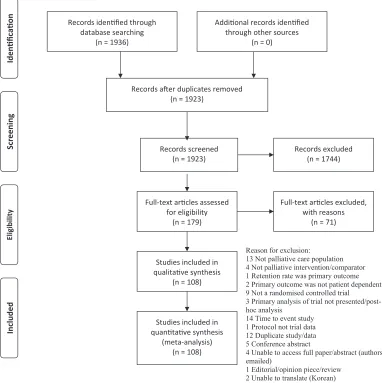
The search yielded 1,923 identified references that were screened; 179 articles were read in full, and 108 were included in the review (Fig. 1). The full texts for four arti-cles were not available (Appendix C; see on the journal’s Web site at www.elsevier.com), and two included articles were translated from French and Chinese to English. Study demographics are presented inAppendix D(see on the jour-nal’s Web site atwww.elsevier.com).
[image:5.594.48.546.73.386.2]3.1. Quality of MD reporting
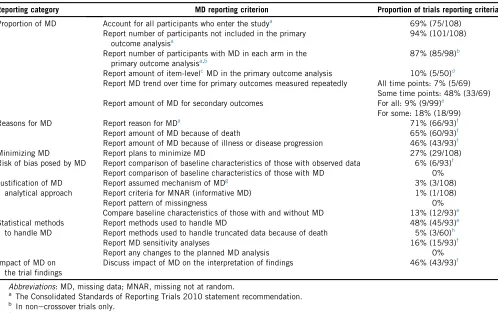
Table 1 presents the proportion of included trials that reported the MD criteria specified by current guidance.
3.1.1. Proportion of MD
Sixty-nine percent of trials (75 of 108) accounted for all participants who entered the study, 94% (101 of 108) reported the number of participants not included in the primary outcome analysis, and 87% of nonecrossover
trials (85 of 98) reported the number of participants with MD in each arm. Fourteen percent (15 of 108) of trials re-ported that there were no MD. Of trials reporting a scale summary, only 10% (5 of 50) reported item-level MD. When the primary outcome was measured repeatedly, MD at each time point was reported by 7% (5 of 69) of trials. Only 9% (9 of 99) of trials reported the amount of MD for all secondary outcomes. However, for 59% (58 of 99), the proportion could be assumed to be the same as for the primary outcome as the reason for MD seemed to relate to unit nonresponse (i.e., the participant was missing) through the use of terms such as attrition or withdrawaldalthough the definition of these terms was
not specified.
3.1.2. Reasons for MD
Of the trials that reported MD (n593), 71% (66 of 93) reported the reason for MD for all participants, 16%
Table 1.Quality of MD reporting according to current reporting guidance
Reporting category MD reporting criterion Proportion of trials reporting criteria
Proportion of MD Account for all participants who enter the studya 69% (75/108)
Report number of participants not included in the primary outcome analysisa
94% (101/108)
Report number of participants with MD in each arm in the primary outcome analysisa,b
87% (85/98)b
Report amount of item-levelcMD in the primary outcome analysis 10% (5/50)d
Report MD trend over time for primary outcomes measured repeatedly All time points: 7% (5/69) Some time points: 48% (33/69)
Report amount of MD for secondary outcomes For all: 9% (9/99)e
For some: 18% (18/99)
Reasons for MD Report reason for MDa 71% (66/93)f
Report amount of MD because of death 65% (60/93)f
Report amount of MD because of illness or disease progression 46% (43/93)f
Minimizing MD Report plans to minimize MD 27% (29/108)
Risk of bias posed by MD Report comparison of baseline characteristics of those with observed data 6% (6/93)f
Report comparison of baseline characteristics of those with MD 0%
Justification of MD analytical approach
Report assumed mechanism of MDg 3% (3/108)
Report criteria for MNAR (informative MD) 1% (1/108)
Report pattern of missingness 0%
Compare baseline characteristics of those with and without MD 13% (12/93)e
Statistical methods to handle MD
Report methods used to handle MD 48% (45/93)e
Report methods used to handle truncated data because of death 5% (3/60)h
Report MD sensitivity analyses 16% (15/93)f
Report any changes to the planned MD analysis 0%
Impact of MD on the trial findings
Discuss impact of MD on the interpretation of findings 46% (43/93)f
Abbreviations: MD, missing data; MNAR, missing not at random.
a
The Consolidated Standards of Reporting Trials 2010 statement recommendation.
b
In nonecrossover trials only.
c
For example, missing individual questions from a questionnaire, survey, or scale.
d
In 50 trials, the primary outcome was a scale summary.
e
In trials that measured secondary outcomes only.
f
About 15 trials reported no MD and therefore were excluded.
g
For example, missing completely at random, missing at random, or MNAR.
h
In trials that reported data was truncated due to death.
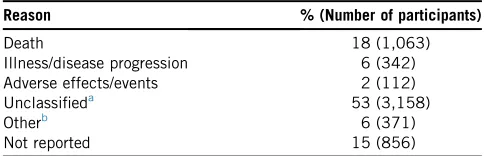
(15 of 93) for some participants, 9% (8 of 93) did not report any reasons, and in 4% (4 of 93), it was unclear. In this palliative care sample, 65% (60 of 93) of trials re-ported the proportion of MD because of death and 46% (43 of 93) the proportion due to illness. For more than half of all the participants with MD, the reported reason for missingness was described as ‘loss to follow-up’ or ‘with-drawal’ with no further qualification of how these were defined or description of the underlying reason for the ‘loss to follow-up’ or ‘withdrawal’ (Table 2). Only two trials specified that they differentiated between with-drawal from the trial and withwith-drawal from the interven-tion or control while remaining under follow-up.
3.1.3. Minimizing MD
Twenty-seven percent (29 of 108) of trials reported an attempt to minimize MD during the design or conduct phase of the trial. The most common reported method was the exclusion of participants with an expected poor
prognosis or poor performance status. Other methods included limiting the number of outcomes and frequency of data collection, sending telephone/mail reminders, flexi-bility in the protocol, and monetary incentives.
3.1.4. Risk of bias posed by MD
Six trials that reported MD compared baseline character-istics of participants with observed data; two conducted a significance test, of which one found evidence of a differ-ence between trials arms at the 5% significance level. No trials compared the characteristics of those with MD in different trial arms.
3.1.5. Justification of MD analytical approach
Three trials reported in the Methods section that they assumed MD were missing at random [32e34]. One trial also specified the missing not at random (MNAR) assump-tions that formed part of their sensitivity analysis[35]. No trials specifically reported whether the reasons for
Records iden Þed through database searching
(n = 1936)
S
cr
e
e
n
in
g
In
cl
u
d
e
d
E
li
g
ib
il
it
y
Id
e
n
Þ
ca
o
n
Addi onal records iden Þed through other sources
(n = 0)
Records aヲer duplicates removed (n = 1923)
Records screened (n = 1923)
Records excluded (n = 1744)
Full-text ar cles assessed for eligibility
(n = 179)
Full-text ar cles excluded, with reasons
(n = 71)
Studies included in qualita ve synthesis
(n = 108)
Studies included in quan ta ve synthesis
(meta-analysis) (n = 108)
Reason for exclusion: 13 Not palliative care population 4 Not palliative intervention/comparator 1 Retention rate was primary outcome 2 Primary outcome was not patient dependent 9 Not a randomised controlled trial 3 Primary analysis of trial not presented/post-hoc analysis
14 Time to event study 1 Protocol not trial data 12 Duplicate study/data 5 Conference abstract
4 Unable to access full paper/abstract (authors emailed)
[image:6.594.107.489.68.451.2]1 Editorial/opinion piece/review 2 Unable to translate (Korean)
missingness were considered likely to be MNAR, that is, related to the value of the outcome that was missing. Twelve trials reported a comparison of the baseline charac-teristics of those with observed and MD; and in seven of these, there was a statistically significant difference in at least one characteristic.
3.1.6. Statistical methods to handle MD
The method of handling MD was reported in 48% (45 of 93) of trials with MD. In a further 37% (34 of 93) of trials, the method was not reported, but the text and tables indi-cated that only complete cases were included in the final analysis. In 15% (14 of 93) of trials, the method of analysis could not be deduced, and it was assumed that CCA was used as this is the default method in most statistical pack-ages, and it is likely that if other methods to handle MD were used, these would have been reported. Of the trials that reported MD, 78% (73 of 93) used only one method of analysis: 60% (56 of 93) used or were assumed to have used CCA, 3% (3 of 93) other ad-hocmethods, and 15% (14 of 93) principled methods. Fourteen percent (13 of 93) of trials used more than one ad-hoc method, and 8% (7 of 93) used both principled andad-hoc methods. Only three trials[33,36,37]reported that they handled truncated data due to death differently or separately to MD for other reasons, with only one using a recommended method that accounts for participants who died[37].
Sixteen percent (15 of 93) of trials used more than one method to analyze MD and reported a MD sensitivity anal-ysis. Of these, 12 reported anad-hocmethod of accommo-dating MD as the primary analysis, and 11 used CCA and one other method of analysis.
3.1.7. Impact of MD on trial findings
The potential impact of MD on the interpretation of the trial results was discussed in 46% (43 of 93) of trials with MD. This was most often described in the limitations sec-tions of the article, and few articles specifically discussed the potential for MD to bias the treatment effect estimate
[37e49].
3.2. Differences in quality of reporting between criteria
The four MD reporting criteria specified in the CONSORT 2010 statement were reported in more than 69% of trials (range, 69e94%) (Table 1). Additional
criteria from other guidelines were less well reported (range, 0e65%), with comparison of baseline
characteris-tics of those with MD, pattern of missingness, and changes to methods of handling MD not reported in any of the selected trials.
3.3. Reporting of MD according to JIF and CONSORT endorsement status
The median JIF of the included trials was 2.8 (interquar-tile range, 1.8e4.5; range, 0e55.9), and 41 trials were
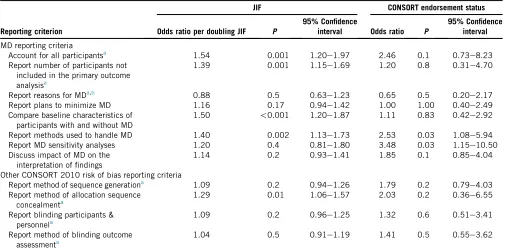
pub-lished in journals that endorsed the CONSORT statement. Univariable logistic regressions (Table 3) demonstrated that as the JIF doubled the odds of reporting all but the reasons for MD were increased. This was similarly the case for trials reported in journals that endorsed the CONSORT statement, except that the odds ratio for the reporting of plans to minimize MD was 1.00. At the 5% significance level, the odds of accounting for all participants, reporting the number of participants not included in the analysis, comparing baseline characteristics of those with and without MD, reporting method of handling MD, and report-ing allocation concealment were statistically significantly increased as the JIF doubled. Journals that endorsed the CONSORT statement as of July 2015 only had statistically significantly higher odds of reporting both the method of handling MD and an MD sensitivity analysis (Table 3).
4. Discussion
MD in palliative care RCTs are not reported in a clear, complete, and transparent manner. Criteria specified by the CONSORT statement were better reported. However, item-level and secondary outcome MD were poorly re-ported, thus the proportion of MD reported in published ar-ticles is likely to be an underestimate. The reported reasons for MD were unclassified in more than half of the partici-pants and the risk of bias posed by MD and justification of the analytical approach were the least well reported cat-egories. Guidance on methods to handle MD was poorly implemented, and only one trial reported the use of a rec-ommended method to handle data truncated by death. The odds of reporting most of the MD and other risk of bias criteria tested were increased as the JIF increased and in journals that endorsed the CONSORT statement.
[image:7.594.43.285.85.163.2]One possible explanation for poorer reporting of MD criteria not specifically recommended by CONSORT is that the journal word count requirements restrict what could be stated. However, a review of MD in health technology assessment monographs, which do not have a word count limit, found MD was rarely discussed and that MD
Table 2.Reported reasons for MD (total number of participants with
MD55,903)
Reason % (Number of participants)
Death 18 (1,063)
Illness/disease progression 6 (342)
Adverse effects/events 2 (112)
Unclassifieda 53 (3,158)
Otherb 6 (371)
Not reported 15 (856)
Abbreviation: MD, missing data.
a Described as loss to follow-up or withdrawal with no further
de-tails of the underlying reason.
b
These included, for example, reported exclusions from the anal-ysis because the ‘treatment failed’ or there was a ‘protocol violation’, as well as ‘researcher error’, ‘response not evaluable’, and ‘care trans-ferred to another setting’.
sensitivity analyses were only reported in 30% of trials[50]. This review preceded the CONSORT 2010 statement, which has addressed MD somewhat, but our study illustrates that further development of the CONSORT MD guidance could be a key step to the improvement of MD reporting.
The results of our review are consistent with a Cochrane review of the reporting of criteria recommended in the 1996 and 2001 CONSORT statements. This review found allocation concealment and the method for sequence genera-tion to be statistically more likely to be reported in CONSORT-endorsing journals [51]. Inconsistencies in reporting may be explained partly by a study that found that only 41% of journal editors made the CONSORT statement part of their peer-review process, 47% made it part of their editorial process[52], and only 38% of journals mentioned CONSORT in their instructions to authors [52]. As the median JIF for the palliative care trials included in this review was only 2.8 and fewer than half of the trials were published in journals that endorsed the CONSORT statement, it is important to develop a better understanding of how to optimize implementation of the CONSORT statement across journals, so that future developments in the reporting of MD guidance can improve RCT reporting practice.
It is important that reasons for MD are reported. This is crucial to the assessment of how MD can be minimized, whether MD introduces bias through differential reasons for missingness across trial arms, and the most appropriate methods to handle MD. This review demonstrated that terms such as withdrawal and loss to follow-up are often
used without being defined. Definitions of these terms vary in the literature, and there is no specification that the under-lying reasons for withdrawal or loss to follow-up should be reported[53e55]. Future guidance on MD reporting should highlight this and recommend that the underlying reason is reported and that any ambiguous terms are defined.
[image:8.594.48.553.85.336.2]Choice of methods to handle MD was also reported inadequately. CCA was used as the sole method to analyze MD in 60% of trials, although a large proportion of MD in this population is expected to be due to death and disease progression and therefore potentially cause bias in a CCA. Only 16% of trials conducted any MD sensitivity analysis with most not using a principled method for the primary analysis and only one study reporting the sensi-tivity of the effect estimate to an MNAR assumption. This is worse than the findings of two previous reviews of trials published in high-impact medical journals[21,22]. Our re-view provides further evidence that better implementation of guidance to handle MD is required and importantly in-cludes trials published across journals with a range of impact factors. Although CONSORT does not aim to make recommendations about how trials should be analyzed [6], it does indirectly affect trial analysis as transparent report-ing can highlight gaps in implementation[6]. Therefore, we recommend that future guidance includes a specific require-ment to report how MD are handled for both participants who are alive and those whose data were truncated by death (if applicable), with justification of the methods used, and an MD sensitivity analysis.
Table 3.Univariable logistic regressions of MD reporting criteria and other risk of bias CONSORT reporting criteria with JIF and whether the journal endorsed the CONSORT statement
Reporting criterion
JIF CONSORT endorsement status
Odds ratio per doubling JIF P
95% Confidence
interval Odds ratio P
95% Confidence interval
MD reporting criteria
Account for all participantsa 1.54 0.001 1.20
e1.97 2.46 0.1 0.73e8.23
Report number of participants not included in the primary outcome analysisa
1.39 0.001 1.15e1.69 1.20 0.8 0.31e4.70
Report reasons for MDa,b 0.88 0.5 0.63
e1.23 0.65 0.5 0.20e2.17
Report plans to minimize MD 1.16 0.17 0.94e1.42 1.00 1.00 0.40e2.49
Compare baseline characteristics of participants with and without MD
1.50 !0.001 1.20e1.87 1.11 0.83 0.42e2.92
Report methods used to handle MD 1.40 0.002 1.13e1.73 2.53 0.03 1.08e5.94
Report MD sensitivity analyses 1.20 0.4 0.81e1.80 3.48 0.03 1.15e10.50
Discuss impact of MD on the interpretation of findings
1.14 0.2 0.93e1.41 1.85 0.1 0.85e4.04
Other CONSORT 2010 risk of bias reporting criteria
Report method of sequence generationa 1.09 0.2 0.94
e1.26 1.79 0.2 0.79e4.03
Report method of allocation sequence concealmenta
1.29 0.01 1.06e1.57 2.03 0.2 0.36e6.55
Report blinding participants & personnela
1.09 0.2 0.96e1.25 1.32 0.6 0.51e3.41
Report method of blinding outcome assessmenta
1.04 0.5 0.91e1.19 1.41 0.5 0.55e3.62
Abbreviations: MD, missing data; CONSORT, the Consolidated Standards of Reporting Trials; JIF, journal impact factor.
a CONSORT 2010 recommendation.
b Assessed as whether they reported any reasons for MD.
1Missingness mechan
*These criteria could be provided as part of supplementary material available on-line
ism relates to Little and Rubin’s taxonomy: missing completely at random (MCAR), missing at random (MAR) and missing not at random (MNAR).
Methods section:
1. Report the justification of the missing data analytical approach including all of the following:
a. Any assumptions about the missing data mechanism1with justification.
b. What analyses will be performed to support assumptions about the missingness mechanism. For
example, comparison of variables according to whether the partially observed variable of interest was
missing may shed light on the credibility of the MAR assumption.
c. *How the assumed missingness mechanism and any relevant features of the data such as pattern of
missingness would influence the choice of method(s) to handle missing data and missing data
sensitivity analyses.
d. Details of the statistical methods used to handle missing data.
e. How truncated data due to death will be handled and justification of method(s) (if applicable)2.
Results section:
2. Report the following measures of the amount of missing data
a. For each outcome: number of participants in each arm with missing data (unit-level missing data).
b. For outcomes that are scale summaries: amount of item-level missing data, for example the number
of participants in each arm with some items reported and some items missing, and/or the proportion of
item-level missing data.
c. For repeated outcomes: number of participants in each arm with missing data at each time-point.
3. Reasons for missing data in each arm, with enough detail that the reported reason can be used to reduce
the uncertainty about the potential underlying mechanism of missing data. If terms such as loss to follow
up or withdrawal are used, these must be defined and the underlying reason specified.
4. Comparison of the baseline characteristics of those included in the analysis (if participants are excluded
from the analysis post-randomisation).
5. *Results of investigations of the missingness mechanism and/or pattern, and whether these led to
changes to the choice of the primary method3 to handle missing data.
6. *Missing data sensitivity analyses results including analyses based on plausible missing not at random
assumptions if appropriate.
Discussion section:
7. Impact of missing data on the interpretation of findings, including effect on validity and
generalisability.
2
Not specifically recommended in previous reporting guidance but considered important for the assessment of whether appropriate methods to analyse data were used.
3
The primary analysis should involve a principled method to accommodate missing data that is based on plausible assumptions about the missingness mechanism and takes into account the uncertainty in estimating the missing values.
This review had several limitations. The protocol for the review was submitted for publication to PROSPERO (August 2014); however, as this was a methodology review with no direct health-related outcomes, it did not meet the eligibility criteria. It was then submitted to the Cochrane Methodology Review register (August 2014); however, this was not undergoing updates at this time because of resource constraints. In view of the time constraint to commence the review, the protocol was not submitted for external peer review although it was reviewed by all authors of this article and the director of a local trials unit. Because of the evolving nature of palliative care, identification of relevant literature can be difficult, and some trials may have been missed. Four identified trials could not be included as the full texts could not be retrieved. It was decideda-priori that data reported elsewhere would not be assessed because clinicians, researchers, and policymakers often rely solely on the peer-reviewed journal article to make a judgment about the methodological risks of bias, although supple-mentary online material was reviewed. Finally, it was not possible to determine retrospectively whether all the jour-nals that endorsed the CONSORT statement did so specif-ically at the time of publication of each study.
This systematic review is the first to assess how well MD are reported according to current guidance. We have used these findings to provide further reporting recom-mendations that build on those proposed by the CON-SORT 2010 statement [6] and other groups
[1,2,10e14,20,56] (Fig. 2). Our recommendations focus specifically on what should be reported in trial reports rather than on which methods should be used to minimize and handle MD, in keeping with the scope of the CON-SORT statement. The rigorous methods, evolving nature, and wide recognition and endorsement of the CONSORT statement[6]make it ideally placed to facilitate better re-porting of MD. Incorporation of these recommendations into future CONSORT statements will potentially improve the awareness of journal editors, peer reviewers, re-searchers, clinicians, patients, journalists and policy-makers on what should be reported with regard to MD to enable a more accurate assessment of the risk of bias posed; the quality of reporting; and the quality of trial conduct and handling of MD. Further research is required to understand how to improve the implementation of re-porting guidance.
Acknowledgments
The authors acknowledge the contributions of Jo Abbott (information specialist at the Cochrane PaPaS Group) who helped design and conduct the search strategy as well as Nicole Valtorta and Winny Wong for translating articles. This work was funded as part of a National Institute of Health Research Doctoral Research Fellowship (J.A.H.; reference number DRF-2013-06-001). The National Institute of Health Research was not involved in the study
design, data collection, analysis, interpretation of data, writing of the report, and in the decision to submit the article for publication.
Supplementary data
Supplementary data related to this article can be found at
http://dx.doi.org/10.1016/j.jclinepi.2017.05.009.
References
[1] Li T, Hutfless S, Scharfstein DO, Daniels MJ, Hogan JW, Little RJ, et al. Standards should be applied in the prevention and handling of missing data for patient-centered outcomes research: a systematic review and expert consensus. J Clin Epidemiol 2014;67:15e32. [2] Akl EA, Shawwa K, Kahale LA, Agoritsas T,
Brignardello-Petersen R, Busse JW, et al. Reporting missing participant data in randomised trials: systematic survey of the methodological litera-ture and a proposed guide. BMJ Open 2015;5:e008431.
[3] Hussain JA, White IR, Langan D, Johnson MJ, Currow DC, Torgerson DJ, et al. Missing data in randomized controlled trials testing palliative interventions pose a significant risk of bias and loss of power: a systematic review and meta-analyses. J Clin Epidemiol 2016;74:57e65.
[4] Moher D, Hopewell S, Schulz KF, Montori V, Gotzsche PC, Devereaux PJ, et al. CONSORT 2010 explanation and elaboration: updated guidelines for reporting parallel group randomised trials. BMJ 2010;340:c869.
[5] Kistin CJ. Transparent reporting of missing outcome data in clinical trials: applying the general principles of CONSORT 2010. Evid Based Med 2014;19:161e2.
[6] Schulz KF, Altman DG, Moher D, Consort Group. CONSORT 2010 statement: updated guidelines for reporting parallel group rando-mised trials. J Clin Epidemiol 2010;63:834e40.
[7] Calvert M, Blazeby J, Altman DG, Revicki DA, Moher D, Brundage MD, et al. Reporting of patient-reported outcomes in random-ized trials: the CONSORT PRO extension. JAMA 2013;309:814e22. [8] Ioannidis JP, Evans SJ, Gotzsche PC, O’Neill RT, Altman DG, Schulz K,
et al. Better reporting of harms in randomized trials: an extension of the CONSORT statement. Ann Intern Med 2004;141:781e8.
[9] Campbell MK, Piaggio G, Elbourne DR, Altman DG, CONSORT Group. Consort 2010 statement: extension to cluster randomised trials. BMJ 2012;345:e5661.
[10] European Medicines Agency. European Medicines Agency guide-line on missing data in confirmatory clinical trials. London; 2011. [11] Panel on Handling Missing Data in Clinical Trials. The
preven-tion and treatment of missing data in clinical trials: Napreven-tional Research Council; 2010. Available at http://www.cytel.com/hs-fs/hub/1670/file-2411099288-pdf/Pdf/MissingDataNationalAcademy of_Medicine.2010.pdf. Accessed June 15, 2017.
[12] Preston NJ, Fayers P, Walters SJ, Pilling M, Grande GE, Short V, et al. Recommendations for managing missing data, attrition and response shift in palliative and end-of-life care research: part of the MORECare research method guidance on statistical issues. Palliat Med 2013;27:899e907.
[13] Dumville JC, Torgerson DJ, Hewitt CE. Reporting attrition in randomised controlled trials. BMJ 2006;332:969e71.
[14] Gewandter JS, McDermott MP, McKeown A, Smith SM, Williams MR, Hunsinger M, et al. Reporting of missing data and methods used to accommodate them in recent analgesic clinical trials: ACTTION systematic review and recommendations. Pain 2014;155:1871e7.
[15] Little RJ, D’Agostino R, Cohen ML, Dickersin K, Emerson SS, Farrar JT, et al. The prevention and treatment of missing data in clinical trials. N Engl J Med 2012;367:1355e60.
[16] Carpenter J, Bartlett J, Kenward M. Available at http://www. missingdata.org.uk. London School of Hygiene and Tropical Medicine. Available at http://missingdata.lshtm.ac.uk. Accessed December 2, 2014.
[17] International conference on harmonisation of technical requirements for registration of pharmaceuticals for human use. ICH Harmonised Tripartite Guideline: Statistical Principles for Clinical Trials. 1998. [18] Carpenter J, Kenward M. Guidelines for handling missing data in social science research. London School of Hygiene and Tropical Medicine. Available at https://missingdata.lshtm.ac.uk/files/2017/ 03/guidelines.pdf.
[19] Diehr P, Johnson LL. Accounting for missing data in end-of-life research. J Palliat Med 2005;8(Suppl 1):S50e7.
[20] Kurland BF, Johnson LL, Egleston BL, Diehr PH. Longitudinal data with follow-up truncated by death: match the analysis method to research aims. Stat Sci 2009;24:211.
[21] Wood AM, White IR, Thompson SG. Are missing outcome data adequately handled? A review of published randomized controlled trials in major medical journals. Clin Trials 2004;1:368e76. [22] Bell ML, Fiero M, Horton NJ, Hsu CH. Handling missing data in
RCTs; a review of the top medical journals. BMC Med Res Methodol 2014;14:118.
[23] Turner L, Shamseer L, Altman DG, Weeks L, Peters J, Kober T, et al. Consolidated Standards of Reporting Trials (CONSORT) and the completeness of reporting of randomised controlled trials (RCTs) published in medical journals. Cochrane Database Syst Rev 2012; 11:MR000030.
[24] Bala MM, Akl EA, Sun X, Bassler D, Mertz D, Mejza F, et al. Ran-domized trials published in higher vs. lower impact journals differ in design, conduct, and analysis. J Clin Epidemiol 2013;66:286e95. [25] Cochrane PaPaS. Palliative care search strategy online: Cochrane
Collaboration; 2014. Available at http://papas.cochrane.org/ searching-studies. Accessed June 15, 2017.
[26] Lefebvre C, Manheimer E, Glanville J. Chapter 6: searching for studies. In: Higgins JPT, Green S, editors. Cochrane handbook for systematic reviews of interventions version 510. Chichester: The Cochrane Collaboration; 2011.
[27] Moher D, Hopewell S, Schulz KF, Montori V, Gotzsche PC, Devereaux PJ, et al. CONSORT 2010 explanation and elaboration: updated guidelines for reporting parallel group randomised trials. Int J Surg 2012;10:28e55.
[28] Thomson Reuters. 2014 J Citation ReportsÒ, 2015.
[29] CONSORT. Endorsers: journals and organisations: CONSORT; 2015. Available athttp://www.consort-statement.org/about-consort/ endorsers. Accessed July 7, 2015.
[30] StataCorp. Stata 13 base reference manual. College Station, TX: Stata Press; 2013.
[31] StataCorp. Stata statistical software: release 13. College Station, TX: StataCorp LP; 2013.
[32] Abernethy AP, McDonald CF, Frith PA, Clark K, Herndon JE, Marcello J, et al. Effect of palliative oxygen versus room air in relief of breathlessness in patients with refractory dyspnoea: a double-blind, randomised controlled trial. Lancet 2010;376:784e93. [33] Bakitas M, Lyons KD, Hegel MT, Balan S, Brokaw FC, Seville J,
et al. Effects of a palliative care intervention on clinical outcomes in patients with advanced cancer: the Project ENABLE II random-ized controlled trial. JAMA 2009;302:741e9.
[34] Nava S, Ferrer M, Esquinas A, Scala R, Groff P, Cosentini R, et al. Palli-ative use of non-invasive ventilation in end-of-life patients with solid tu-mours: a randomised feasibility trial. Lancet Oncol 2013;14:219e27. [35] Davies HE, Mishra EK, Kahan BC, Wrightson JM, Stanton AE,
Guhan A, et al. Effect of an indwelling pleural catheter vs. chest tube and talc pleurodesis for relieving dyspnea in patients with malignant pleural effusion: the TIME2 randomized controlled trial. JAMA 2012;307:2383e9.
[36]Cheville AL, Kollasch J, Vandenberg J, Shen T, Grothey A, Gamble G, et al. A home-based exercise program to improve func-tion, fatigue, and sleep quality in patients with Stage IV lung and colorectal cancer: a randomized controlled trial. J Pain Symptom Manage 2013;45:811e21.
[37]Downey L, Diehr P, Standish LJ, Patrick DL, Kozak L, Fisher D, et al. Might massage or guided meditation provide ‘‘means to a better end’’? Primary outcomes from an efficacy trial with patients at the end of life. J Palliat Care 2009;25:100e8.
[38]Abernethy AP, Currow DC, Shelby-James T, Rowett D, May F, Samsa GP, et al. Delivery strategies to optimize resource utilization and performance status for patients with advanced life-limiting illness: results from the ‘‘palliative care trial’’ [ISRCTN 81117481]. J Pain Symptom Manage 2013;45:488e505.
[39]Beijer S, Hupperets PS, Borne BE, Wijckmans NE, Spreeuwenberg C, Brandt PA, et al. Randomized clinical trial on the effects of adenosine 5’-triphosphate infusions on quality of life, functional status, and fatigue in preterminal cancer patients. J Pain Symptom Manage 2010;40:520e30.
[40]Blomberg J, Wenger U, Lagergren J, Arnelo U, Agustsson T, Johnsson E, et al. Antireflux stent versus conventional stent in the palliation of distal esophageal cancer. A randomized, multi-center clinical trial SR1-PDF. Scand J Gastroenterol 2010;45: 208e16.
[41]Breitbart W, Rosenfeld B, Gibson C, Pessin H, Poppito S, Nelson C, et al. Meaning-centered group psychotherapy for patients with advanced cancer: a pilot randomized controlled trial. Psychooncol-ogy 2010;19:21e8.
[42]Chen HW, Lin IH, Chen YJ, Chang KH, Wu MH, Su WH, et al. A novel infusible botanically-derived drug, PG2, for cancer-related fatigue: a phase II double-blind, randomized placebo-controlled study. Clin Invest Med 2012;35:E1e11.
[43]Cheung DY, Kim JY, Hong SP, Jung MK, Ye BD, Kim SG, et al. Outcome and safety of self-expandable metallic stents for malignant colon obstruction: a Korean multicenter randomized prospective study. Surg Endosc 2012;26:3106e13.
[44]Matlock DD, Keech TAE, McKenzie MB, Bronsert MR, Nowels CT, Kutner JS. Feasibility and acceptability of a decision aid designed for people facing advanced or terminal illness: a pilot randomized trial. Health Expect 2014;17:49e59.
[45]Ng CG, Boks MPM, Roes KCB, Zainal NZ, Sulaiman AH, Tan SB, et al. Rapid response to methylphenidate as an add-on therapy to mirtazapine in the treatment of major depressive disorder in termi-nally ill cancer patients: a four-week, randomized, double-blinded, placebo-controlled study. Eur Neuropsychopharmacol 2014;24: 491e8.
[46]Nilsson S, Strang P, Aksnes AK, Franzen L, Olivier P, Pecking A, et al. A randomized, dose-response, multicenter phase II study of radium-223 chloride for the palliation of painful bone metastases in patients with castration-resistant prostate cancer. Eur J Cancer 2012;48:678e86.
[47]Suh SY, Choi YS, Oh SC, Kim YS, Cho K, Bae WK, et al. Caffeine as an adjuvant therapy to opioids in cancer pain: a randomized, double-blind, placebo-controlled trial. J Pain Symptom Manage 2013;46:474e82.
[48]Tarumi Y, Wilson MP, Szafran O, Spooner GR. Randomized, double-blind, placebo-controlled trial of oral docusate in the management of constipation in hospice patients. J Pain Symptom Manage 2013;45:2e13.
[49]Temel JS, Greer JA, Muzikansky A, Gallagher ER, Admane S, Jackson VA, et al. Early palliative care for patients with metastatic non-small-cell lung cancer. N Engl J Med 2010;363:733e42. [50]Sylvestre Y. CONSORT: missing missing data guidelines, the
effects on HTA monograph reporting. Trials 2011;12(Suppl 1): A61.
[51]Turner L, Shamseer L, Altman DG, Schulz KF, Moher D. Does use of the CONSORT statement impact the completeness of reporting of randomised controlled trials published in medical journals? A Cochrane review. Syst Rev 2012;1:60.
[52]Hopewell S, Altman DG, Moher D, Schulz KF. Endorsement of the CONSORT statement by high impact factor medical journals: a survey of journal editors and journal ’Instructions to Authors’. Trials 2008;9:20.
[53] The Cochrane Collaboration. The Cochrane Collaboration Glossary Oxford: The Cochrane Collaboration; 2005. Available at http:// community.cochrane.org/glossary. Accessed July 9, 2015.
[54] Akl EA, Briel M, You JJ, Lamontagne F, Gangji A, Cukierman-Yaffe T, et al. LOST to follow-up Information in Tri-als (LOST-IT): a protocol on the potential impact. TriTri-als 2009; 10:40.
[55] Domanski MJ, McKinlay S. Chapter 9: quality assurancedprevention of missing data. In: Domanski MJ, McKinlay S, editors. Successful randomized trials: a handbook for the 21st century. Philadelphia, PA: Lippincott Williams & Wilkins; 2009.
[56] Carpenter JR, Kenward MG. Missing data in randomised controlled trialsda practical guide. London: London School of Hygiene and Tropical Medicine; 2007.