Authenticated Encryption Algorithm
COFFE
Ivan Tjuawinata, Tao Huang, Hongjun Wu Division of Mathematical Sciences School of Physical and Mathematical Sciences,
Nanyang Technological University, Singapore [email protected]
[email protected] [email protected]
Abstract. COFFE is a hash-based authenticated encryption scheme. In the original paper, it was claimed to have IND-CPA security and also ciphertext integrity even in nonce-misuse scenario. In this paper, we analyse the security of COFFE. Our attack shows that even under the assumption that the primitive hash function is ideal, a valid ciphertext can be forged with 2 enquiries with success probability close to 1. The motivation of the attack is to find a collision on the input of each of the hash calls in the COFFE instantiation. It can be done in two ways.
The first way is by modifying nonce and last message block size. Chosen appropriately, we can ensure two COFFE instantiations with different nonce and different last message block size can have exactly the same intermediate state value. This hence leads to a valid ciphertext to be generated. Another way is by considering two different COFFE instantiations with different message block size despite same key. In this case, we will use the existence of consecutive zero in the binary representation ofπto achieve identical intermediate state value on two different COFFE instantiations. Having the state collisions, the forgery attack is then conducted by choosing two different plaintexts with appropriate nonce and tag size to query. Having this fact, without knowing the secret key, we can then validly encrypt another plaintext with probability equal to 1.
Key words: COFFE, Authenticated cipher, Forgery Attack
1
Introduction
Authenticated encryption is a symmetric encryption scheme aiming to provide authenticity at the same time as confidentiality to the message. Initially, Bellare and Namprempre proposed the au-thenticated encryption(AE) schemes by integrating an encryption scheme with an authentication scheme in 2000, [1]. In 2001, Krawczyk published a paper [8] that studies the possibility to solve this problem by applying the existing symmetric key cryptosystem and hash function one after another. The difficulty of the general composition approach is although the security of the parts individu-ally is well-studied, the application of one function may affect the security of the other. Furthermore, in implementation point of view, it is not very efficient and error-prone considering it is required to have two different primitives, one for encryption, one for plaintext integrity.
To tackle the first difficulty, a lot of dedicated designs to simultaneously encrypt and authenticate the message have been proposed, among which the authenticated encryption mode is a commonly used design approach. Some examples of these mode of operations are IAPM [7], OCB [11], Jambu [12], GCM [5], CCM [4] and ELmD [3].
Another way to solve this problem is to purely use a hash function for both encryption and authentication purposes. Some of AE modes that is based on hash functions are OMD [2] and COFFE [6].
COFFE is a hash-function-based authenticated encryption scheme designed by Forler et al. . It was published in ESC 2013 [6]. COFFE is designed to be secure for computationally constraint environment. As mentioned above, COFFE utilises a hash function for both encryption and authen-tication without introducing any block cipher primitive. According to [6], COFFE is one of the first authenticated encryption that is purely based on hash function. This alternative direction of con-structing an authenticated encryption system is interesting for concon-structing a secure authenticated encryption.
The designers claim that COFFE is secure against chosen plaintext attack in nonce-respecting scenario. It is also claimed to have ciphertext-integrity even in nonce-misuse scenario. In particular, it is claimed that the ciphertext integrity of COFFE is at least strong as the indistinguishability of the hash function used. That is, forging a ciphertext with a valid tag should be as hard as finding collision in the underlying hash function. Furthermore, it also provides additional features. Firstly, it provides failure-friendly authenticity, that is, COFFE provides reasonable authenticity in the case of weaker underlying hash function. Secondly, it also provides side channel resistance under nonce-respecting scenario.
In this paper, we first analyse the design of COFFE. During the analysis we consider the scheme firstly under the nonce-repeating scenario. Instead of using any specific hash function for the un-derlying primitive, we analyse it on the generic construction case with an ideal unun-derlying hash function. We show that under these settings, some instances of COFFE with particular parameters are vulnerable to distinguishing attack, ciphertext forgery attack, or related key recovery attack. Thus, the security claim of COFFE for these parameters does not hold.
The attacks come from the consideration that intermediate state values of two different COFFE instantiations can be made the same while having different inputs. The vulnerability comes from the fact that having most of the parameters to be variables, different set of parameters can be chosen and combined to create the collision. The attack starts by first trying to find a specific value for the parameters where this can happen. Having found these parameters, different approaches are made to exploit this discovery to launch either distinguishing attack, forgery attack, or key recovery attack. In this paper, we found that for the distinguishing and forgery attack, if we use the same secret key for all the instantiations, the success probability is close to 1.
The rest of this paper is structured as follows: The generic specification of COFFE is given in Section 2. Section 3 provides some analysis and observation of COFFE. Section 4 introduces the distinguishing attack. Section 5 provides two variants of ciphertext forgery attack. We proposed a related key recovery attack on section 6. Lastly, section 7 concludes the paper.
2
The COFFE Authenticated Cipher
The COFFE family of authenticated ciphers uses six parameters: key length, nonce length, block size, hash function input and output size, and tag length. We will briefly describe the specification of COFFE authenticated cipher. The full specification can be found in [6]. An overview of COFFE is provided in Figure 1.
2.1 Notations
Throughout this paper, we will be using the following notations: – F : Underlying Hash function
• γ: Input size forF assuming “one compression function invocation per hash function call”
• δ: Output size for F
– LK : Secret key length expressed in bits. The length of this string should be a multiple of a byte
– LV : Nonce length expressed in bits. The length of this string should be a multiple of a byte
– LT : Tag length expressed in bits. The length of this string should be a multiple of a byte,
Fig. 1.General scheme of COFFE encryption and authentication (Fig. 2 of [6])
– α: Message block size
– β : Last message block size,β≤α≤δ
– x: Bits for domain value. The string length will follow the number of bytes needed to express β+ 5 in bits.
– Letvbe a binary string and bbe a positive integer.
• |v| : The length ofvin bits.
• |v|b : A b−bit binary representation ofv.
• [v] : The length ofvin byte.
• [v]b : A b−byte binary representation ofv.
• b : [β+ 5].
– S1||S2: Concatenation of stringS1 followed byS2.
– S1L`S2 : The`- bit strings obtained by XOR-ing the` least significant bits ofS1 andS2. • S1=bS2: The lastbbits of both S1andS2 is the same.
– S1||0?||S2: When clear the total length should be, say a bits, concatenate S1 with 0-bits then
withS2 with the number of 0-bits being the difference betweenaand the total length ofS1 and S2.
– K: Secret key string – V : Nonce
– L: The number of message blocks for the encryption – S: Session Key with lengthδbits
– H: Associated Data
– M[i],1≤i≤ L: Thei-th message block, anαbit string except forM[L] having lengthβ bits. – C[0] : The initial vector
– C[i],1≤i≤ L: Thei-th ciphertext block with the same length asM[i]
– T[i],0≤i≤L: Chaining values for the scheme each of which having lengthδbits – T: Message Tag.
2.2 Associated Data Processing
The method of processing the associated data, H, can be divided into three cases based on the length of the associated data.
– If the length ofH is less than δ bits, it is appended by 1 followed by appropriate number of zeros to reachδbits. This is defined asT[0] and a domain valuexis defined to be 1.
– If the length ofH is exactlyδbits, this is directly defined as T[0] while the domain valuexis set to be 2.
2.3 Initialization
There are two values that need to be computed in the initialization phase, S and C[0]. Firstly, the session key, S which is defined based onK,V,LK,LV, and b. The value of S is defined to be
F(K||V||0?||L
K||LV||[0]b).Note that here 0? is used to pad the string to make the length equals to
γ.
Next, the constant C[0] which depends only on the message block sizeα. C[0] is defined to be the first α
4 post-decimal values ofπ interpreted as a hexadecimal string. So for example, since the
decimal values of πis.14159. . . ,ifα= 16,ThenC[0] = 0x1415 = 0001010000010101.
2.4 Processing plaintext
Plaintext is encrypted to obtain the ciphertext after the generation of session keyS, the initialization vectorC[0],initial chain valueT[0] and the domain value,x. The plaintext blocks are processed as follow:
T[1] =F((SL
T[0])|| C[0]|| 0? ||[x]b)
C[1] =M[1]L
αT[1]
for all blocksM[i],2≤i≤ L −1{ T[i] =F((SL
T[i−1]) || C[i−1]||0? || [4]b)
C[i] =M[i]L
αT[i]
}
T[L] =F((SL
T[L −1]) || C[L −1]|| 0? ||[4]
b)
C[L] =M[L]L
βT[L].
2.5 Tag generation
After the associated data and plaintext are processed, theLT-bit tagT is derived:
T =F((SLT[L])|| C[L]||0? || L
T ||β+ 5)
The decryption is trivial and we omit it here. For the verification, only theLT least significant
bits of the tags are checked.
2.6 Security goals of COFFE
COFFE is claimed to have the INT-CTXT (ciphertext integrity) and IND-CPA(indistinguishable under chosen plaintext attack) property under nonce-respecting scenario.
In particular, in lemma 1 of [6], we have:
Lemma 1. Let Π be a COFFE scheme as defined above with F as its underlying hash function. Then the advantage of adversary A under nonce-respecting scenario with q queries and ` message blocks to the encryption oracle with time bounded by tcan be upper bounded by:
AdvCPAΠ (q, `, t)≤ 8` 2+ 3q2
2n + 2.Adv
PRF-XRK
F (q, `, t).
In other words, distinguishing COFFE from a random function with chosen input under the bound of (q, `, t) should be at least as hard as distinguishingFfrom a random function $ :{0,1}γ ⇒
{0,1}δ.
Additionally, COFFE has some other security claim under different circumstances. Firstly, under the nonce-misuse scenario, it claimed that
Lemma 2. Let Π be a COFFE scheme as defined above with F as its underlying hash function. Then in the nonce-ignoring adversary scenario with qqueries for` message blocks andt times, we have
AdvINT-CTXTΠ (q, `, t)≤ 3`
2+ 2q2
2δ +
q
2LT +Adv PRF
F (q+`, O(t)).
This implies that the hardness of forging a ciphertext with a valid tag should be at least as hard as distinguishingF from a random function from {0,1}γ to{0,1}δ.
Secondly, COFFE also provides a failure-friendly authenticity. That is, under a weaker assump-tion on the security of the underlying hash funcassump-tion F, the authenticity of the message is still kept.
Lastly, COFFE also provides a reasonable resistance against side channel attack. This is so because “for each encryption process, a new short term key is derived from a nonce and the long term key” [6].
3
Analysis on the COFFE scheme
In our analysis, we will assumeF :{0,1}?⇒ {0,1}δ to be an arbitrary ideal hash function withγ
being the largest possible length of the input to ensure exactly one compression function invocation per hash function call. Here we are assuming the possibility of the parameters to have length more than 255 bits. In other words, it is possible that it requires more than 1 byte to representLK,LV,LT
in their binary format.
The first observation is about the input for the hash function call. Note that since we are only considering concatenation, there is not always a way, given the concatenated string, to uniquely determine the value for each strings before the concatenation. For example, if a||b = 11011, it is possible for a= 110, b= 11 ora= 1, b= 1011. This leads to the possibility that two different sets of strings to be concatenated to the same string.
Observation 1 For the input of any hash function call, due to the absence of separator between substrings and changeable elements lengths, it is possible to have two different sets of strings to be concatenated to the same string.
On the following subsections, we analyse this observation further to find whether it is possible to utilise this to cause a collision in the intermediate state value of the COFFE. We first consider the case when we fix the message block size while allowing two different last message block sizes, β1 andβ2,to be used. The analysis is focused on the case when|β1−β2|is a multiple of 256. The
analysis on this can be found on section 3.1. Next we also consider the possibility of having identical intermediate state values when we change the message block size, α, while keeping β fixed. The analysis is focused on how αshould be chosen in such a way for the first message block encryption of both instantiations to have identical hash value output. This is discussed in section 3.2.
3.1 Modification of β
We fix α and consider different values of β. In our next observation, with large enough α, it is possible to haveβ1< β2≤αsuch thatβ2−β1 is a multiple of 256.This implies that the last byte
of the input ofFin the tag generation for the two different plaintexts can be the same. As discussed above, however, we want the collision to happen in the whole input string for anyF input. If both β1+ 5 andβ2+ 5 require 2 bytes to represent in binary format, the second to last byte will never
agree. So for collision to happen, we need β1+ 5<256,256≤β2+ 5<65536 andβ2 =β1+ 256ρ
for some integer 1≤ρ≤255.
Note that in the message processing, assuming thatγis big enough, there are enough bits of the zero padding between C[i] and the domain values for the encryption to absorb the additional byte for the domain values in caseβ+ 5 is increased from one byte to two bytes value. So the parts that need to be taken care of for this to happen are the session key generation and tag generation.
In the session key generation, we consider the last several bytes of the input ofF.Here we have the input to be . . . || a || LK || LV || 0. Note that when we expand the domain value from 1- to
2-byte value, the domain value should still have the same value. So the second to last byte for the input must be 0.This gives us our next observation.
Observation 2 To ensure that collision can occur when extending the domain from 1- to 2-byte value, the initial value ofLV must be a multiple of 256. This means that if the initialLV is a 1-byte value, it must be0,that is, no nonce in the first instance.
Our primary goal in this section is to investigate the possibilities to have two different (key, nonce) pairs, (K1,V1) and (K2,V2) with lengthsLK1,LV1,LK2,LV2 respectively such that
(K1 || V1 ||0? || LK1 || LV1 ||[0]1) = (K2|| V2|| 0 ? || L
K2 || LV2 || [0]2).
For simplicity, let
S1= (K1 || V1 ||0? || LK1 || LV1 ||[0]1), S2= (K2 || V2 ||0? || LK2 || LV2 ||[0]2).
Here, we note that collision is indeed possible as illustrated by the following example: Let SHA-512 be our hash function. We can choose any 256-bit string, sayK, and setK1=K2=K. Now we
use any one bit value (0 or 1) as ourV2while V1 is set to beV2 appended by 255 zeros. Now if we
use 472 zero paddings on the first string while using 727 bits for the second string we will have
S1=S2= (K ||1 ||0255 ||0472|| [1]1 ||[0]1 ||[1]1|| [0]1|| [0]1).
In the remaining of this section, we will try to analyse whether such collision is possible for other instances of COFFE. Here we analyse different cases ofS1on the possibility of havingS1=S2.The
factors that we need to consider are the number of bytes required for LKi,LVi and whether there is any zero paddings required. Note that if LKi or LVi is a 3-byte value, the value will be at least 65536 which is too big. To simplify our discussion, for this paper, we will only consider the key and nonce to have length whose binary format can be represented as at most a 2-byte value. Due to the big number of cases we need to consider and the similarity of the cases, we will just discuss one case as example and a full analysis of the other cases can be found in the appendix while the Table 1 containing the conclusion is provided for reference.
I.3.c Case I.3.c.: S1has no zero paddings, [LK1] = 1,[LV1] = 2,[LK2] = 1,[LV2] = 2.
By observation 2,LV1 = 256band LK1 =a where 1≤a,b≤255. Both a andbare nonzero
because of the following reasons. First of all, sinceLK1 =a,ifa= 0,then there is no secret key,
in which case, no confidentiality for the message. So we can disregard the case whenLK = 0.
Next, since [LV1] = 2, this should mean thatLV1 ≥256 since otherwise, [LV1] = 1.So ifb= 0,
this impliesLV1 = 0 which violates the requirementLV1 ≥256.Hence
S1= (K1|| V1|| a||b||[0]2).
LetV1=V10 ||dwheredis the last byte ofV1.So
S1= (K1|| V10 ||d|| a||b||[0]2).
Consider the alternative stringS2. Recall that here we wantS1=S2 whereS2 has its domain
value represented as a 2-bytes value. This implies that the [0]2 in the last 2 bytes of S1 must
appear as the domain forS2.So this implies that LK2 =dandLV2 = 256a+b.Lett
0 be the
number of zero padding inS2wheret0≥0.EquatingS1withS2,we haveK1|| V10 =K2|| V2||0t 0
Now comparing the length of these substrings, we have a+ 256b−8 =d+ 256a+b+t0 or equivalently, 255(b−a) =d+ 8 +t0.Consider the family:
F(1,2),(1,2)={(a,b,d, t0) : 1≤a,b,d≤255, t0 ≥0,255(b−a) =d+ 8 +t0}.
Now we consider the feasibility of each element ofF(1,2),(1,2). Feasibility here means the
possi-bilities of using these values as the parameters to have the collision. Let (a,b,d, t0)∈ F(1,2),(1,2).
Note that the collision may not happen with probability 1 due to the case whenK16=K2.Note
that since key is the first part of the collided string, this can only happen whenLK1 6=LK2.
Before going on to the analysis, we have an assumption first. Suppose thatLK1 >LK2. Since
K1 is the firstLK1 bits ofS1,K2 is the firstLK2 bits ofS2 and we needS1=S2,the firstLK2
bits of K1 must be K2. Instead of assuming that this happens by chance, we will assume the
following: The user has 2 different instantiations of COFFE scheme with different parameter and different key length. However, the keys chosen by the user are not independent. The longer key is an extension of the shorter key by a random secret string. We note that this assumption is only made for the related key setting attack and not for the general attack.
Based on this assumption, we then have the probability ofK1 to have its first LK2 bits to be
the same asK2is exactly 1.
Now back to our case, we have thatLK1 =a andLK2 =d.So the length difference of the two
keys is |a−d| bits. Now ifa=d, then we have K1 =K2.Now the rest of the two strings are V0
1 ||d|| a||b||[0]2andV2 ||0t 0
||d||a||b||[0]2.So we haveV1=V2||0t 0
||d.Now since
V1can be controlled by the attacker, we can easily set this to be true. So the probability of the
two strings to collide is 1 ifa=d.
Now consider when a 6= d, specifically, a > d. The other case can be analysed using ex-actly the same way. Now let K1 = K2 || K10 where K10 is the last a −d bits of K1. We
have K01 || V10 || d || a || b || [0]2 and V2 || 0t 0
|| d || a || b || [0]2 as the remaining part
of the two strings truncating the first d bits. Thus, K0
1 || V10 = V2 || 0t 0
. Note that since 1 ≤ a,d ≤ 255,a−d ≤ 255,V2 has length 256a+b ≥ 256. So the entire K01 is in V2. In
other words, for the two strings to collide, we need the last a−dbits ofV2 must be equal to K0
1.Since K01 is supposed to be unknown, the probability of this collision is 2a−d.It is easy to
see that the remaining substring can be set to collide with probability 1. So the probability of collision to happen is 2−(a−d). Using exactly the same analysis, we will see that when d>a,
the probability of collision to happen is 2−(d−a).Hence, for any non-negative integerk, we can
define a subfamily ofF(1,2),(1,2),
F(1,2),(1,2),k={(a,b,d, t0)∈ F(1,2),(1,2):|a−d| ≤k}.
Then for any quadruplet (a,b,d, t0)∈ F(1,2),(1,2),kwe take as parameter, the collision probability
is at least 2−k.
We remark that this probability is applicable for any choices of K1 and K2. This observation
is essential in our attacks later to decide whether the attacks are only applicable to a family of key to any value of key with the given length.
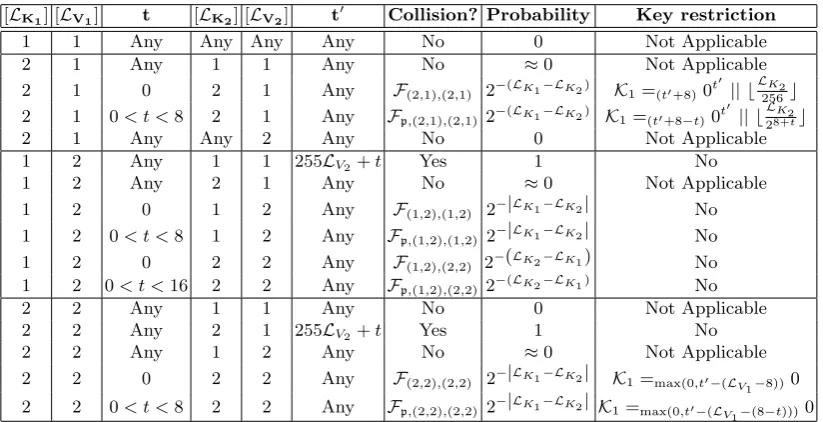
We include in Table 1 the full list of conclusion of the session key generation analysis. Here we will use t to represent the zero padding for S1 and t0 for S2. In the Collision column, No means
a collision in this case is impossible, yes means a collision will always happen on any choices of the parameter values (with appropriate choice of key and nonce). Lastly, F(a,b),(c,d) or Fp,(a,b),(c,d)
is the family of parameter values that belongs to the respected case that collision is possible. The definition of each of the family can be found in the complete analysis of each case that is either can be found above or in the appendix.
Recall that in the tag generation, givenT[L],S,andC[L],the input ofF is
SMT[L] || C[L]|| 0? || LT ||β+ 5
.
[LK1] [LV1] t [LK2] [LV2] t
0
Collision? Probability Key restriction
1 1 Any Any Any Any No 0 Not Applicable
2 1 Any 1 1 Any No ≈0 Not Applicable
2 1 0 2 1 Any F(2,1),(2,1) 2 −(LK
1−LK2) K1=(t0+8)0t 0
|| bLK2
256 c
2 1 0< t <8 2 1 Any Fp,(2,1),(2,1) 2−(LK1−LK2) K1=(t0+8−t)0t 0
|| bLK2
28+tc
2 1 Any Any 2 Any No 0 Not Applicable
1 2 Any 1 1 255LV2+t Yes 1 No
1 2 Any 2 1 Any No ≈0 Not Applicable
1 2 0 1 2 Any F(1,2),(1,2) 2−|LK1−LK2| No
1 2 0< t <8 1 2 Any Fp,(1,2),(1,2) 2 −|LK
1−LK2| No
1 2 0 2 2 Any F(1,2),(2,2) 2 −(LK
2−LK1) No
1 2 0< t <16 2 2 Any Fp,(1,2),(2,2) 2−(LK2−LK1) No
2 2 Any 1 1 Any No 0 Not Applicable
2 2 Any 2 1 255LV2+t Yes 1 No
2 2 Any 1 2 Any No ≈0 Not Applicable
2 2 0 2 2 Any F(2,2),(2,2) 2 −|LK
1−LK2| K1=max(0,t0−(LV 1−8))0
2 2 0< t <8 2 2 Any Fp,(2,2),(2,2) 2−|LK1−LK2| K1=max(0,t0−(L
V1−(8−t)))0 Table 1.Session Key Generation Input Collision
values to be divisible by 8. Here the values that are related to the remainder of any value divided by 256 must be divisible by 8.So for example, in the case when [LK] = 2,if LK = (a ||b), then
we do not need a to be divisible by 8. We just need b to be divisible by 8. This will not change the existence of any of the families. However, it will certainly requires a bigger parameter value. For example, for the case when [LK1] = [LV1] = [LK2] = 2 and [LV2] = 1,if we want all the values
to be byte aligned, the smallest parameters we can use is when LK1 =LK2 = 256,LV2 = 8, and
LV1= 2048.This leads to the input size for the hash function to be at least 2048 + 256 + 5×8 = 2394
bits. Here we setV2= 128 andV1=V2||02040and the other settings to be the same as the previous
example.
We move on to the tag generation whenβ+ 5 changes from 1-byte value to 2-byte value. Note that the only possible source of this 1-byte value is fromLT.So, in the second instantiation where
β+ 5 is changed to a 2-byte value, the tag length will be different from the initial one. In fact, the first tag length needs to be a 2-bytes value, saya||band the second tag length needs to beawhile the difference between the two βs needs to be 256×b.
3.2 Modification of α
This section discusses a special case of the analysis in which the user has at least two instantiations of COFFE where they have different message block sizes but the same (or related) key. Since we are considering changing α,the one we really need to take care of is just the generation of C[0]. This is because for any other place whereα affects the system, it is generated by the previous chain in which we can truncate easily.
Recall thatC[0] is the first α
4 post decimal values ofπinterpreted as hexadecimal values. Suppose
that we want the difference of the two block sizes,α1andα2, to bekwithα2being the larger value.
Since we are assuming the ideality ofF,we want the input ofF in this point for both instantiation to coincide. So in other words, if the initial vector of the first instantiation is theα1bitC1 and the
second one to be theα2bitC2,the additionalkbits ofα2should be absorbed by the next substring
of the input, which is the zero padding. Hence, the last k bits of C2 should all be zeros. In other
words, the value of α1 so that it can coincide with the positions in the post decimal values ofπto
have a consecutive 0k bits. So for example, if we wantα
2=α1+ 8,andα1 andα2 to be a multiple
of 8,then we will need to wait until the 306-th decimal place to get the 8 bits of consecutive zeros. In this case, α1 = 1224 and α2 = 1232. The requirement that α1 and α2 are divisible by 8 comes
4
Distinguishing Attack
In this section, to form a distinguishing attack, we use the session key collision discussed in the previous section and the appendix. Assuming that we have the same secret key, different nonce, and different number of byte of domain value but the same session key, as before, we assume that now the session key for each instantiation is the same, each uses the proper number of byte of domain value.
We set the parametersα, β1, β2,LT1 andLT2 as follows:
1. β1+ 5<256< β2+ 5≤α+ 5≤δ+ 5
2. β2−β1= 256ρfor some positive integerρ
3. LT1 <256≤ LT2 whereLT2 = 256LT1+ρ.
Set the first plaintext to be a two-blocks message,M1= (MB1 || MB2) such thatMB1hasα
bits andM2 hasβ1 bits with tag length set to beLT2.Assume the ciphertext isC1= (CB1 || CB2)
withT1as the tag.
The second message block, is then chosen to be M2 = (MB1 || MB02) such that MB02 has β2
bits. Here we will use the tag length to be LT1.We also assume the ciphertext isC2= (CB01 || CB02)
withT2as the tag.
As discussed above, since the first block of both message are the same,MB1, we should have CB1 = CB01 and T[1] and T[2] should also be the same. Now remember that MB2LCB2 and MB02
L
CB02 tells us the last β1 and β2 bits of T[2] respectively. So if C1 and C2 are both from
COFFE instantiation, we must haveCB1 =CB01and the last β1 bits of CB2 and the lastβ1bits of CB02 should agree. So we will guess that it is a COFFE instantiation instead of a random function if these requirements are met. Note that this can happen if it is a random function with probability 2−(α+β1).
Recall that a distinguishing attack works as follows. An oracle randomly chooses whether it uses a random function or a COFFE instantiation with the given parameter. Then as an attacker, we can request for encryption for some plaintext. Then an adversary tries to decide whether the oracle uses a random function or a COFFE instantiation. The distinguishing attack described above has error probability 0 if we conclude that the oracle uses a random function. However, if we guess that the oracle uses a COFFE instantiation, there is a probability of 2−(α+β1) of the function is actually a
random function instead of COFFE. Note that sinceα≥256 in our attack, the failure probability is at most 2−256which is very small. Therefore, with 2 enquiries to the oracle with 4 message blocks , COFFE with ideal underlying hash function in nonce-respecting scenario can be distinguished with probability close to 1. So in these instantiations of COFFE, the security claim given in Lemma 1 is not satisfied.
5
Ciphertext Forgery Attack
In this section, we will propose two different ciphertext forgery attacks. The first attack is based on the observation on subsection 3.1. It exploits the possibility of having an identical intermediate state value for two different instantiations when we fix α while using different values of β. The detail of the attack can be found in section 5.1. Similarly, Section 5.2. discusses the forgery attack based on the discussion on subsection 3.2. Here we try to forge a valid ciphertext in the case when there exists two different COFFE instantiations with same key for different message block size. Here both attacks require 2 enquiries and can forge a valid ciphertext with probability one. The success probability 1 is applicable whenever we assume for both instantiations, the secret key used is the same instead of one key being an extension of the other. Lastly, we will also discuss the possibility of combining the two forgery attacks. This can be found in subsection 5.3
5.1 Forgery Attack with Constant Message Block Size
Take any (K1,V1),(K2,V2) (key, nonce) pairs from the discussion session such that they generate
session key generation with 1-byte domain value and S2be the input for the session key generation
with 2−bytes domain value. Here we assume that the input for session key generation is chosen accordingly based on the number of bytes of domain value. Hence, after this point, we can ignore the secret key and nonce and we can just assume that for each instantiation, we are using the same session key and associated data.
Note that any full block plaintext-ciphertext pair leaksαleast significant bits of the output of the hash function for a fixed input, while anyβ-bit block plaintext-ciphertext pair leaks onlyβ least significant bits of it. So sinceβ ≤α,it is always more desirable to get a full-block plaintext-ciphertext pairs since they leak the output value more.
Here we set the parametersα, β1, β2,LT1 andLT2 as described before in Section 4.
Next we define the first message M1, a 3−block message (MB1 || MB2 || MB3) such that |MB1|=|MB2|=α,|MB3|=β2.Let the ciphertext of this message beC1 = (CB1 || CB2 || CB3)
with tag T1 with LT set to any value. Here we can compute the values of CB1 and CB2 since MB1LCB1gives us the lastαbits ofT[1] andM2LC2 gives us the lastαbits ofT[2] which are
essential in the attack.
We define our second messageM2,a 2−block message (MB1 || MB02) with the length ofMB02
to be β1 bits and tag length to beLT2. The first block is chosen to be exactly the same as before
to ensure the value ofT[1] andT[2] can be kept constant. Based on the previous message, the least αbits of both values are known. Suppose that the ciphertext of this plaintext isC2= (CB1 || CB02)
with tagT2.
Using the information we obtain, we generate the following valid ciphertext. Define another 2-block messageM3= (MB1 || MB002). Here we setMB1to be the same as the first block from the
previous message blocks. This is again to ensure the value of T[1] and T[2] can be kept constant. We let the length ofMB002 to beβ2and chooseMB002 such thatMB
00 2
L
β2T[2] =C2||0
β2−β1.Here,
MB002 can be calculated since we know the last αbits of T[2] andα > β2. Using this message, it is
easy to see that the tag generation will have the same input as before, althoughLT is nowLT1.So
the tag for this ciphertext will be the lastβ1 bits ofT2.
This attack has success probability equal to the probability of the two strings used as the input session key generation to be the same. As we have discussed before, for some parameters such as the ones in case I.3 and case II.3, this can even be 1.In other words, in the case when the success probability is one, the attack above proves that the ciphertext integrity of this cipher does not satisfy the bound given in lemma 2 even in an ideal hash function situation.
Note that here we use three COFFE instantiations for each attack (2 for enquiry and 1 for the guess), while in our discussion on session key generation collision, we only consider the collision for two (key, nonce) pairs. So the same attack cannot directly work for nonce-respecting scenario unless we can find three (key, nonce) pairs that collide to the same session key.
5.2 Forgery Attack with Dynamic Message Block Size
In this section, we are assuming the existence of two different instantiations of COFFE with different message block size but the same secret key and constant last message block size β. Now we pick α1< α2 such thatα2−α1=k. Next we find the valid size ofα1andα2 based on our discussion in
the discussion section. Here since we assume constant last message block size,β,we assumeβ≤α1.
Since we are using constant last message block size, to get the same session key, we can consider the nonce-misuse scenario where we use the same key and nonce for both instantiations. Note that this means the tag length should still be kept the same.
First, we generate message, M1 = (MB1 || MB2) with |MB1| = α2 and |MB2| = β. Now
assume that we get the ciphertextC1= (CB1,CB2) with tagT1.In this pair, our objective is to find
the lastα2 bits ofT[1] which can be obtained by calculatingMB1LCB1.
We then consider the following message:M2= (MB01|| MB 0
2) with|MB 0
1|=α2and|MB02|=β.
We further require the lastkbits ofMB02L
α1T[1] are all zeros. Note thatMB
0
2can be generated
easily with the knowledge of the lastα1bits ofT[1].Assume that the ciphertext isC2= (CB01|| CB02)
with tagT2.Here the lastkbits ofCB01 are all zero andCB02
L
MB02 tells us the lastβ bits ofT[2]
Now having this information, we will proceed to our forgery attack. The message block that we will use isM3= (MB001 || MB
0
2).Here we have|MB 00
1|=α1 andMB001 is chosen such that
MB001Mα1 T[1]
||0k=CB01.
We also note that the second block is exactly the same used in M2. Then it is easy to see that the
ciphertext isC3= (CB001 || CB 0
2) whereCB 00
1 =MB
00 1
L
α1T[1]. Furthermore, the tag is exactlyT2.
This forgery attack requires 2 enquiries to the oracle with 4 message blocks. So this attack provides a family of instances of COFFE that cannot provide ciphertext integrity as claimed in Lemma 2 under nonce-misuse scenario.
5.3 Combination of the Existing Attacks
In our previous two subsections, we change one of the parameters (α, β) while letting the other constant. This is done to simplify the analysis. However, it is possible for us to combine both attacks to generate new attack, that is, we changeαandβ in the same time. Notice that by combining the two attacks, the “nonce-misuse” requirement is not a must anymore. As discussed in the constant message block size subsection, as long as we can find a triple of (key,nonce) pairs that generate the same session key, we can launch the attack in the nonce-respecting scenario.
6
Related Key Recovery Attack
Note that, in most of the attacks we have mentioned, we are assuming same secret key. In this section, we will discuss the case with two different instances of COFFE with different key length. As discussed in our observations, in this case we assume that the longer key is obtained by extending the shorter key with secret string. As we have discussed in the appendix, there are (K1,V1),(K2,V2)
pairs that leads to the same session key (with one of them using one-byte domain value while the other using two-byte value) with different key length. Here we will use the pairs with k-bits key length difference and all of the difference are all in the nonce of the corresponding shorter length key. Now assume that|LK1|>|LK2|.
We again choose the parameters α, β1, β2,LT1, andLT2 as in Section 4. The attack here is an
adaptation of the distinguishing attack we proposed earlier. We use the two messagesM1 andM2
as described in section 4. The difference here is that for M2 with two bytes domain value and
shorter key length, we will enquire 2k different blocks of it with different k most significant bits
of V2.Note that if the k most significant bits ofV2 coincide with thek-bit extension of the secret
key, then CB1 =CB01 and the lastβ1 bits of CB2 and the last β1 bits of CB02 should agree. So by
using this approach, we can guess the k-bits extension of the secret key with the same complexity as exhaustive search for ak-bits secret key.
As discussed in the distinguishing attack section, when we decide that the guessed k-bits is wrong, the probability that thek-bits is actually the correct extension key is 0.So there will not be a false negative. However, when the k-bits we guess is wrong, the probability of false positive is, as discussed in the distinguishing attack, 2α+β1 which is at least 2−255which is negligible.
So for the related key recovery attack, to recover thek-bit extension of the secret key in nonce-respecting scenario, we will need 2k+ 1 plaintext-ciphertext pairs with success probability
approxi-mately 1. Note that the exact same attack can be adapted to the case when |K1|<|K2|.
7
Conclusion
7.1 Attack Summary
From the discussion above, we see that the security claim for the nonce-misusing scenario is not met for many different parameters. The same attack can be adapted to give a distinguishing attack for the nonce-respecting scenario for some subfamilies of the parameters mentioned above.
used belongs to the family we have found earlier, the extension of the key can be recovered with exhaustive search in the same way as if the secret key is justkbits.
In conclusion, COFFE does not satisfy any of the two security claims for some of the parameters that we have discussed before. The problem arises from the fact that concatenation of strings cannot be inverted uniquely and hence giving the opportunity of having two different set of strings concatenated to the same resulting strings.
7.2 Lesson Learned
Here we see that the the forgery and distinguishing attacks are feasible due to the possibility to have different (key,nonce) pairs to generate the same session key. This can be fixed by fixing the space for every given parameters. If some parameters are variables (such as the message blck size in COFFE), we should ensure that the values of the variables get authenticated so as to prevent the forgery attack.
References
1. M. Bellare and C. Namprempre.Authenticated Encryption: Relations Among Notions and Analysis of the Generic Composition Paradigm. Extended Abstract in Advances in Cryptology: Asiacrypt 2000 Proceedings, Lecture Notes in Computer Science (Springer-Verlag) 1976: 531-545.
2. S. Cogliani, D.S. Maimut, D. Naccache, R.P. do Canto, R Reyhanitabar, S. Vaudenay, D. Viz/’ar.Offset Merkle-Damg˚ard (OMD) version 1.0 A CAESAR Proposal. Submission to CAESAR. Available from: http://competitions.cr.yp.to/caesar-submissions.html. 2014.
3. N. Datta and M. Nandi.ELmD v1.0. Submission to CAESAR. Available from:http://competitions. cr.yp.to/caesar-submissions.html. 2014.
4. M. DworkinRecommendation for BlockCipher Modes of Operation: The CCM Mode for Authentication and Confidentiality. NIST Special Publication 800-38C. May, 2004.
5. M. Dworkin.Recommendation for Block Cipher Modes of Operation: Galois/Counter Mode(GCM) and GMAC. NIST Special Publication 800-38D. November, 2007.
6. C. Forler, D. McGrew, S. Lucks, J. Wenzel.COFFE: Ciphertext Output Feedback Faithful Encryption Authenticated Encryption Without a Block Cipher. Early Symmetric Crypto ESC, 2013. Also accessible fromhttps://eprint.iacr.org/2014/1003.pdf
7. C.S. Jutla. Encryption Modes with Almost Free Message Integrity. Advances in Cryptology - EURO-CRYPT 2001 (Springer): 529-544
8. H. Krawczyk. The Order of Encryption and Authentication for Protecting Communications (or: How Secure Is SSL?). CRYPTO 2001 Proceedings of the 21st Annual International Cryptology Conference on Advances in Cryptology (Springer-Verlag): 310-331
9. C. Meyer and S. Matyas.Secure Program Load with Manipulation Detection Code, 1988.
10. B. Preneel, R. Govaerts, J. Vandewalle.Hash Functions Based on Block Ciphers: A Synthetic Approach. CRYPTO, Lecture Notes in Computer Science (Springer), 1993. 773: 368-378.
11. P.Rogaway, M. Bellare, J. Black, T. Krovetz. OCB: A Block-Cipher Mode of Operation for Efficient Authenticated Encryption. Proceedings of the 8th ACM conference on Computer and Communications Security. 2001: 196-205.
12. H. Wu and T. Huang.JAMBU Lightweight Authenticated Encryption Mode and AES-JAMBU. Submis-sion to CAESAR. Available from:http://competitions.cr.yp.to/caesar-submissions.html. 2014.
Appendix
Session Key Generation Analysis
Recall that here we are trying to investigate the session key generation step whether we can introduce a collision between two valid input such that one has 1−byte value for the domain value, named
S1,and another with 2−bytes value for the domain value,S2.Here we need to consider the number
of bytes for LK1,LV1, and whether zero padding exists inS1. We will assume that if a string has
I. S1 has no zero padding. LetS1= (K1|| V1|| LK1 || LV1 ||[0]1).We will divide this case into
smaller sub-cases to handle independently.
I.1. Case I.1. [LK1] = [LV1] = 1.By observation 2, we have thatLV1 = 0.Let 1≤a≤255 such
that LK1 =a.Then we have:
S1= (K1 ||a ||[0]2).
Now we consider the second string S2 with the domain value being expressed by 2-bytes
string. Then we have LV2 ≥a. Since we need at least 1 byte to representLK2 and a
non-empty string ofK2,we need at leasta+2 bits in the remaining unused string inS2.However,
since we want S1=S2,we only havea bits left that is unused. Hence if [LK1] = [LV1] = 1,
it is impossible for us to have a collision betweenS1 andS2.
I.2. Case I.2. [LK1] = 2 and [LV1] = 1.Observation 2 implies thatLV1 = 0.LetLK1= 256a+b
for some 0≤a,b≤255 wherea6= 0.So we have:
S1= (K1 ||a ||b||[0]2).
Now we consider the second stringS2.We have different cases depending on the number of
bytes forLK2 andLV2.
– Case I.2.a. [LK2] = [LV2] = 1. Then we have that LK2 = a and LV2 = b. Now if S2
has no zero padding, then we have that 256a+b = a+bwhich implies that a = 0 which contradicts the fact thatLK1 needing to be expressed as a 2-bytes value. So S2
must have zero padding. A simple comparison tells us that there will be 255a bits of zero paddings inS2.However, remember that this zero padding comes fromK1which is
not controllable by us the attacker. Hence we can just hope this is true with probability 2−255a. Since a ≥ 1, this probability is too small to be feasible. So this case can be discarded from the possibleS1 collision with S2.
– Case I.2.b. [LK2] = 2,[LV2] = 1.For simplicity, letK1=K01||cwherecis the last 8 bits
ofK1.ThenLK2 = 256c+aandLV2=b.Lett0 be the number of bits of zero padding
inS2.Then equating the length ofS1 andS2, we get 256a+b= 256c+a+b+t0+ 8
where the 8 comes fromcbeing a part ofK1despite it not being a part ofK2|| V2||0t 0
. This can be simplified to 255a= 256c+t0+ 8. So we define
F(2,1),(2,1)={(a,b,c, t0) : 0≤a,b,c≤255, t0≥0,a,c= 0,6 255a= 256c+t0+ 8}.
Now we consider the feasibility of each quadruple (a,b,c, t0)∈ F(2,1),(2,1).
Let (a,b,c, t0)∈ F
(2,1),(2,1).Since we haveK01=K2|| V2||0t 0
,it is clear that|K1|>|K2|.
Then we have 256a+b−(256c+a) = 255a+b−256cbits ofK1 which needs to be
known or fixed. Like before, we assume the bits of K1 which is in K2 coincide with
probability one since we assume that K1 is the extension of K2 by appending it with
some bits. So the probability of this happening is 2−(255a+b−256c). A simple calculation
tells us that we can set 255a+b−256cto be as low as 8.Now for any integerk≥8,we defineF(2,1),(2,1),k={(a,b,c, t0)∈ F(2,1),(2,1),255a+b−256c≥k}.Then if we take the
quadruple (a,b,c, t0)∈ F(2,1),(2,1),k,we know that the probability of collision to happen
is at least 2−k. We also need to note that sinceK
1 =K2 || V2 || 0t 0
||c, we must have the lastt0+ 8 bits of K1 to be 0t
0
|| c. So any collision we derive from this family, K1
cannot be chosen to be any keys. The collision will only happen in the subfamily of the 256a+b-bits string such that the lastt0+ 8 bits must be 0t0 || c.
– Case I.2.c. [LV2] = 2. Then LV2 = 256a+b. Note that here we again have K
0
1 =
K2 || V2 ||0t whereK10 is a 256a+b−8 bits binary string. However, this is impossible
sinceV2 itself should have 256a+bbits by itself. So this case is again impossible.
I.3. Case I.3. [LK1] = 1,[LV1] = 2.By observation 2,LV1 is a multiple of 256.Let 1≤a,b≤255
such thatLK1=aand LV1 = 256b.Then we have
S1= (K1 || V1 ||a ||b|| [0]2).
– Case I.3.a [LK2] = [LV2] = 1. Then LK2 = a and LV2 = b. Then certainly S2 must
have zero paddings. More precisely, we must haveK1=K2 andV1=V2||0255b.So for
any choice of key and nonce, we must have the collision with probability one as long as
V1=V2||0255b.
– Case I.3.b [LK2] = 2,[LV2] = 1. LetV1 =V10 || c. Then we have LK2 = 256c+a and
LV2 =b.Now let S2 to have t0-bits zero padding. Then equating the length ofS1 and S2,we have K1 || V1=K2 || V2|| 0t
0
||c.So we havea+ 256b= 256c+a+b+t0+ 8. Then we have 255b= 256c+ 8 +t0.As before, we define a family
F(1,2),(2,1)={(a,b,c, t0) : 1≤a,b,c≤255, t≥0,255b= 256c+ 8 +t0}.
Now we consider the feasibility of each quadruple (a,b,c, t0)∈ F(1,2),(2,1).
Let (a,b,c, t0)∈ F(1,2),(2,1). Then the length of the bits that is in K2 but not in K1 is
256cNow remember that sinceLK2= 256c+a, c6= 0.So the probability of collision to
happen is at most 2−256 which is infeasible. So we can disregard this case.
– Case I.3.c [LK2] = 1,[LV2] = 2. This case has been discussed in detail in the main
section. So we will skip the discussion of this case here. – Case I.3.d [LK2] = [LV2] = 2.LetV1=V
00
1 ||d||cwhered||cis the last 2-bytes ofV1.So LK2 = 256d+candLV2 = 256a+b.Similar as before, we letS2to havet0−bits of zero
padding. Now equating the length ofS1andS2,we haveK1|| V100=K2|| V2||0t 0
|| LK2.
In other words,a+ 256b= 256d+c+ 256a+b+t0+ 16 or equivalently
255(b−a) = 256d+c+t0+ 16. LetF(1,2),(2,2)be the family:
F(1,2),(2,2)={(a,b,c,d, t0) : 1≤a,b,d≤255,0≤c≤255, t0≥0,
255(b−a) = 256d+c+t0+ 16}.
Now we investigate each quintuple in this family. Let (a,b,c,d, t0)∈ F(1,2),(2,2).
Obvi-ously, since [K2] = 2 and [K1] = 1, |K2| >|K1|. Note that the number of bits that is
inK2but not inK1, and hence needs to be guessed, is 256d+c−a.This gives us the
success probability of the collision to be 2a−256d−c. A simple calculation tells us that
this can be as small as 3, for example when a = 253,b= 255,c= 0,d= 1, t0 = 238. Now as before, for any integerk≥3,we define a subclassF(1,2),(2,2),kofF(1,2),(2,2)such
thatF(1,2),(2,2),k={(a,b,c,d, t)∈ F(1,2),(2,2): 256d+c−a≥k}.Note that here since K2 is the longer key and K1 || V100 =K2 || V2 ||0t
0
|| LK2, the extension of theK2 but
not inK1 must be inV100which is controllable. So any choice ofK2 is vulnerable to the
collision.
I.4. Case I.4. [LK1] = [LV1] = 2. By observation 2, we have LV1 is a multiple of 256. Let
1≤a,c≤255,0≤b≤255 such thatLK1 = 256a+bandLV1 = 256c.Then we have:
S1= (K1 || V1 ||a ||b|| c|| [0]2).
Dividing the case further based onS2,we have the following cases:
– Case I.4.a [LK2] = [LV2] = 1. ThenLK2 =bandLV2 =c.Now letS2 to havet0 bits of
zero padding. Now equating the length ofS1andS2,we haveK1|| V1||a=K2|| V2||0t 0
. So we have 256a+b+256c+8 =b+c+t0.So we havet0= 256a+255c+8.Now considering the string K1 || V1 || a = K2 || V2 || 0t
0
from the right, we have that since a 6= 0, we must havet0≤7 Since otherwise, this will forcea= 0.So we have 256a+ 255c+ 8≤7. However, this is clearly impossible since 1≤a,c. So we can disregard this case. – Case I.4.b [LK2] = 2,[LV2] = 1. ThenLK2 = 256a+band LV2 =c.LettingS2 to have
t−bits of zero padding, equatingS1 to S2, we haveK1|| V1=K2 || V2 ||0t.Now since LK1 =LK2, we must haveK1 =K2.So this leaves us with V1=V2 || 0
t which implies
– Case I.4.c [LK2] = 1,[LV2] = 2. Then we have LK2 = a and LV2 = 256b+c. Now
inspecting the first part of both S1 and S2, we must have at least 255a+b bits of K1 that is not in K2 which means it must be guessed. Now since a 6= 0, we have the
probability of success to be at most 2−255which is already infeasible. So we can disregard this case.
– Case I.4.d [LK2] = [LV2] = 2. For this, we let V1 =V10 || d where dis the last byte
of V1. Then we have LK2 = 256d+a and LV2 = 256b+c. Let S2 have t−bits of
zero padding. Then equating S1 to S2, we have K1 || V10 =K2 || V2 || 0t 0
. So we have 256a+b+ 256c−8 = 256d+a+ 256b+c+t0.Equivalently, we have
255(a−b+c) = 256d+t0+ 8. LetF(2,2),(2,2)be the family:
F(2,2),(2,2)={(a,b,c,d, t0) : 1≤a,b,c,d≤255, t0≥0,
255(a−b+c) = 256d+t0+ 8}.
Now we investigate the feasibility of each quintuple in the family. Let (a,b,c,d, t0)
∈ F(2,2),(2,2). Note that there are |256a+b−(256d+a)| = |255a+b−256d|
bit-s that ibit-s in one but not both bit-secret keybit-s. Thibit-s meanbit-s that the probability of bit- suc-cess is at most 2−|255a+b−256d|. We can perform a simple calculation to discover that the value |255a+b−256d| can be made to be 0, for example, when (a,b,c,d, t0) =
(1,1,2,1,246). For this purpose, for any non-negative integers k, we define a sub-class F(2,2),(2,2),k of F(2,2),(2,2) such that F(2,2),(2,2),k = {(a,b,c,d, t) ∈ F(2,2),(2,2) : |255a+b−256d| ≤k}.So for any quintuple extracted fromF(2,2),(2,2),k,it can be used
to guess the extension of at mostk bits of the secret key with the success probability being at least 2−k.
Now we need to investigate the extension of the secret key. Recall that K1 || V10 = K2 || V2 || 0t
0
. Now if K2 is longer, then the extension will all be in V10 considering
the left term only hasV0
1 in addition toK1. So for this case, there is no restriction for
either key. Now we check the case whenK1 is longer. Note that ifK1 is longer, then the
extension is fromV2||0t 0
.Now ifV0
1is longer thant0,then since the two strings are equal,
no bits from the extension ofK1 can be from the zero padding. So ift0 <LV0
1 =LV1−8,
then there are no restriction toK1. On the other hand, if t0 > LV1 −8, then the last
t0−(LV1−8) bits of K1 must be zero. So in other words, whenK1 is longer, the last
max(0, t0−(LV1−8)) bits of it must be 0.
II. S1has at−bits zero padding. So now we haveS1= (K1 || V1||0t|| LK1 || LV1 || [0]1).We will
again consider some small sub-cases to analyse.
II.1. Case II.1. [LK1] = [LV1] = 1 As before, Observation 2 tells us thatLV1 = 0.Let 1≤a≤255
such thatLK1=a. Then we have:
S1= (K1 ||0t ||a||[0]2).
Now we consider the second stringS2.Note that hereLV2 ≥a.So we will divide this to two
cases:
– Case II.1.a.LV2 =a. We also have thatK1 || 0t =K2 || V2 ||0t 0
||LK2 where t0 is the
length of the zero padding ofS2. Now since we need the next 1 or 2 bytes in the left
ofLV2 to be LK2 and it cannot be 0, it implies that t <8 if [LK2] = 1 and t <16 if
[LK2] = 2. Now note that hereK1 has the same length as V2. So for the two strings
to be the same, we need the sum of the length ofK2,0t 0
,and LK2 must be equal to t,
which must be strictly less than 16.This tells us that LK2 cannot be a 2-bytes value.
So this gives us that [LK2] = 1 and t <8.Letbbe the last 8−tbits ofK1 which must
satisfy b6= 0. Then we have LK2 = b.2
t. So equating the length here, we have that
– Case II.1.b.LV2 >a.So [LV2] = 2. Now ift >8,we will have that the most significant
byte ofLV2 is zero, which cannot be by the observation we made in the very beginning
of this section. So we havet <8.We again letbto be the last 8−tbits ofK1andb6= 0.
Then we haveLV2 =b.2
t+8+a and the remaining string to beK0
1. AssumingS2 has
t0-bits of zero padding, equating the strings, we have K0
1=K2 || V2 ||0t 0
|| LK1. Recall
that hereK0
1 must have length strictly less than 256 bits since [LK1] = 1 and it has been
truncated by 8−tbits. However, by assumption, we must already haveV2 itself to have
length more than 256 bits. Obviously, this is impossible. So we can disregard this case. II.2. Case II.2. [LK1] = 2,[LV1] = 1.By Observation 2, we haveLV1 = 0.Let 0≤a,b≤255,a6= 0
such thatLK1= 256a+b.Then we have
S1= (K1 ||0t ||a|| b||[0]2).
Here, consideringS2,we again have two cases:
– Case II.2.aLV2 = 256a+b.Then equating the length of the two strings, we must have
K1||0t=K2|| V2||0t 0
|| LK2 wheret
0is the length of zero padding ofS
2.Now since the
length ofK1 and V2 are the same, we must have the sum of the lengths ofK2,0t 0
, and
LK2 to be equal tot.Now note that by the same argument as before,tmust be less than
8 if [LK2] = 1 and t <16 if [LK2] = 2.Now ifLK2 is a 2-byte string, the length of the
string in the right hand side must exceed 256 bits. However, the one on the left cannot even exceed 16. So we cannot haveLK2 to be a 2-byte string. So we have [LK2] = 1.
So we havet <8.Furthermore, we have that t=LK2+t0+ 8 where the addition by 8
comes from the fact thatLK2 is an 8-bit string. However, this is impossible since all the
terms here are non-negative and this causes the left hand side to be strictly less than 8 while the right hand side is at least 8. So we can again disregard this case.
– Case II.2.b. LV2 = b. For this, we further can divide the case into two depending on
[LK2].First of all, ifLK2 is a 1-byte value, then we haveLK2 =a.From here we see that
there must be 255a+bbits that can be found in K1 but not in K2. Now sincea6= 0,
this means at least 255-bits of secret string that we need to guess. This implies that the success probability of this case is at most 2−255which is already infeasible. So we need [LK2] = 2.By the same observation as before, t < 8. LetK1 =K
0
1 || cwhere cis the
last 8−tbits ofK1.Then we have thatLK2 =c.2
8+t+a.Now we letS
2havet0-bits of
zero padding. Then we haveK0
1 =K2 || V2 ||0t 0
. So equating the length, we have that 256a+b−(8−t) =c.28+t+a+b+t0.Equivalently, we have that
255a=c.28+t+t0+ 8−t.
Note that this also tells us thatLK1≥ LK2.As before, we define a family:
Fp,(2,1),(2,1)={(a,b,c, t, t0) : 1≤a,b≤255,1≤t <8,1≤c≤28−t−1
t0≥0,255a=c.28+t+t0+ 8−t}. Now we consider the feasibility of each quadruple in the family.
Let (a,b,c, t, t0) ∈ Fp,(2,1),(2,1). Then the length of the bits in K1 but not in K2 is
256a+b−(c.28+t+a) = 255a+b−(c.28+t).Now a simple enumeration of the cases tells
us that this value can be kept as low as 8. An example of such quintuple is (a,b,c, t, t0) = (249,1,124,1,14).
One more thing to note here is that sinceK1=K2 ||V2|| 0t 0
|| c, we have that the last t0+ 8−tbits ofK1 is fixed to be 0t
0
||c.So here we have a restriction of theK1that is
vulnerable to the collision. The secret string must have its lastt0+ 8−tbits to be 0t0 ||c. For any integersk≥8,we define a subfamilyFp,(2,1),(2,1),k ofFp,(2,1),(2,1) satisfying:
Fp,(2,1),(2,1),k={(a,b,c, t, t0)∈ Fp,(2,1),(2,1): 255a+b−(c.28+t)≤k}.
Taking any quintuple ofFp,(2,1),(2,1),k, we can use this to guess at most k−bits of key
II.3. Case II.3. [LK1] = 1,[LV1] = 2. By observation 2, we must haveLV1 to be divisible by 256.
So we let 1≤a,b≤255 such thatLK1 =aandLV1 = 256b.Then we have:
S1= (K1 || V1 ||0t ||a|| b||[0]2).
Now as before, we consider the number of bytes ofLK2 andLV2.
– Case II.3.a. [LK2] = [LV2] = 1.ThenLK2 =aandLV2 =b.NowLK1 =LK2 and they
are the firsta bits of the stringsS1 =S2.SoK1=K2.This implies thatV2 should be
the firstbbits ofV1 and the next 255bbits ofV1 should be the zero padding so that it
can be absorbed by the zero padding ofS2.
– Case II.3.b. [LK2] = 2,[LV2] = 1.Using the same analysis as before, we havet <8 and
we can letV1=V10 ||cwherecis the last 8−tbits ofV1.Then we haveLK2=c.28+t+a
andLV2=b.Now this means that we havec.2
8+tbits that is inK
2but not inK1.Now
since we havet >0 andc6= 0,the success probability of the collision is at most 2−256
which is infeasible. So we can disregard this case.
– Case II.3.c. [LK2] = 1,[LV2] = 2.By the same analysis as before, we get thatt <8 and
we can letV1=V10 ||cwherecis the last 8−tbits ofV1.So we haveLV2 = 256a+band
LK2 =c.2
t.AssumingS
2to havet0bits of zero padding, we haveK1|| V10 =K2|| V2||0t 0
. So we havea+ 256b−(8−t) =c.2t+ 256a+b+t0.Simplifying this, we get:
255(b−a) =c.2t+ 8−t+t0. So we can consider the family:
Fp,(1,2),(1,2)={(a,b,c, t, t0) : 1≤a,b≤255,0< t <8,1≤c≤2(8−t)−1, t0 ≥0,
255(b−a) =c.2t+ 8−t+t0}.
Now we discuss the feasibility of each quintuple in this family. Let (a,b,c, t, t0) ∈ Fp,(1,2),(1,2). So there will be |a−c.2t|-bits of secret string that is in one but not in
both of the secret keys. In other words, we will need to guess these bits. A simple calcu-lation reveals that this value can be kept as low as 0. A really small example would be to set (a,b,c, t, t0) = (2,3,1,1,260).For any non-negative integerk,we then can define a non-empty subfamilyFp,(1,2),(1,2),k such that:
Fp,(1,2),(1,2),k={(a,b,c, t, t0)∈ Fp,(1,2),(1,2):
a−c.2t ≤k}.
Having these subfamilies, we know that if we take a quintuple fromFp,(1,2),(1,2),k, then
it can help us in guessing the extension of at most k−bits of secret key with success probability at least 2−k.Now we also still need to investigate the extension secret string.
We again equate the two strings to getK1 || V10 =K2|| V2||0t 0
.Now ifK2is the longer
one, since the left term contains onlyK1 andV10,the extension can only come fromV10.
So if K2 is longer, we have no restriction on either K1 or K2. On the other hand, if K1 is the longer one, the same argument cannot be used since the right term contains
0t0. However, we again notice that [LK1] = [LK2] = 1.So [LK1− LK2] = 1.Now since
[LV2] = 2,certainly LK1− LK2 <LV2.So again, all the extension can only come from
the controllable nonce.
So we proved that in either case, we have no restriction on the choice of the secret key. So any choice of key following the parameters inFp,(1,2),(1,2)is vulnerable to the collision.
– Case II.3.d. [LK2] = [LV2] = 2. Then we have that LV2 = 256a+b. Furthermore, by
the same analysis as before, we have t < 16 and we can let V1 = V10 || c where c is
the last 16−t−bits of V1. We also have that if t < 8, we need c ≥ 28−t to ensure LK2 to be a 2-bytes value. Then we have LK2 = c.2
t. Note that this gives us that
LK1 =a <256≤c.2
t=L
K2. SoLK1 <LK2. Now we haveK1 || V
0
1=K2 || V2 || 0t 0
assumingS2hast0−bits of zero padding. So equating the length of these two strings, we
havea+ 256b−(16−t) =c.2t+ 256a+b+t0 or equivalently
Now as usual, consider the family
Fp,(1,2),(2,2)={(a,b,c, t, t0) : 1≤a,b≤255,1≤t≤15,max(1,28−t)≤c≤216−t,
t0≥0,255(b−a) =c.2t+ 16−t+t0}.
Now we consider the feasibility of each quintuple. Let (a,b,c, t, t0)∈ Fp,(1,2),(2,2).Then
we havec.2t−a bits that is in K
2 that is not in K1 and hence needs to be guessed.
A simple calculation tells us that this value can reach as low as 3, which is achievable, for instance, when (a,b,c, t, t0) = (253,255,128,1,269). So like before, we can define a subfamily ofFp,(1,2),(2,2),k for any integerk≥3 :
Fp,(1,2),(2,2),k={(a,b,c, t, t0)∈ Fp,(1,2),(2,2),c.2t−a≤k}.
Then we have that for any quintuple taken fromFp,(1,2),(2,2),k,the success probability
of collision of the session key is at least 2−k.
II.4. Case II.4. [LK1] = [LV1] = 2. Then we can have 0 ≤ a,b,c ≤ 255,a,c 6= 0 such that
LK1= 256a+bandLV1 = 256c.Here 256 dividesLV1 due to Observation 2. So we have:
S1= (K1 || V1 ||0t ||a|| b||c||[0]2).
As before, we further divide this case to 4 smaller subcases based on [LK2] and [LV2].
– Case II.4.a. [LK2] = [LV2] = 1. Then we have LK2 = b and LV2 = c. Now since
a6= 0, ift0 is the number of zero paddings in S2, we must havet0 <8. Then we have K1|| V1||0t||a=K2|| V2||0t
0
.So equating the length, we have 256a+b+256c+t+8 = b+c+t0 or equivalently
256a+ 255c+t=t0−8<0.
Now note thata,c, t >0.So the expression 256a+ 255c+tmust be a positive number. So the inequality cannot be satisfied for any value of the variables. Hence this case is impossible and can be disregarded.
– Case II.4.b. [LK2] = 2 and [LV2] = 1. Then we haveLV2 =candLK2 = 256a+b. As
before, this implies thatK1=K2 andV1=V2 ||0255c.
– Case II.4.c. [LK2] = 1 and [LV2] = 2.Then we haveLV2 = 256b+candLK2 =a.So we
have 255a+bbits ofK1 that is not inK2 and hence needs to be guessed. Sincea6= 0,
this translates to a success probability of at most 2−255 which is infeasible. So we can
again disregard this case.
– Case II.4.d. [LK2] = [LV2] = 2. Then we haveLV2 = 256b+c and by similar analysis
as before, t < 8. Furthermore, if we let V1 = V10 || dwhere d is the last 8−t-bits of V1, we have LK2 = 2
8+td+a.Then we have K
1 || V10 =K2 || V2 || 0t 0
where t0 is the number of zero paddings inS2.So equating the length, we get 256a+b+ 256c−(8−t) =
d.28+t+a+ 256b+c+t0.Simplifying this, we have the equation:
255(a−b+c) =d.28+t+ 8−t+t0. So we can define the family
Fp,(2,2),(2,2)={(a,b,c,d, t, t0) : 1≤a,b,c≤255,1≤t≤7,1≤d≤28−t−1,
t0≥0,255(a−b+c) =d.28+t+ 8−t+t0}
Next we check the feasibility of each elements of this family. Let (a,b,c,d, t, t0) ∈ Fp,(2,2),(2,2). Then we have
256a+b−(d.28+t+a) =
255a+b−d.28+t
secret bits that is in one secret key but not both. So this needs to be guessed. Now enumerating all the elements of the family, we see that this value can be as low as 0 which, for instance, can be realised by the element (a,b,c,d, t, t0) = (2,2,3,1,1,260). Then as before, we can define a subfamilyFp,(2,2),(2,2),k for any non-negative integers such that
Fp,(2,2),(2,2),k={(a,b,c,d, t, t0)∈ Fp,(2,2),(2,2):
Then taking any element fromFp,(2,2),(2,2),k,the success probability of a collision is at
least 2−k.Lastly, we still need to investigate the extension of the secret key. Recall that
K1|| V10 =K2|| V2||0t 0
.As we have discussed in Case I.4.d, ifK2is longer, no restriction
is required forK2. However, itK1 is longer, we must have the last max(0, t0− LV0
1) of
K1to be all zero. Now in here we haveLV0
1 =LV1−(8−t).So this is the only difference
![Fig. 1. General scheme of COFFE encryption and authentication (Fig. 2 of [6])](https://thumb-us.123doks.com/thumbv2/123dok_us/7928042.1316378/3.595.114.503.67.241/fig-general-scheme-coffe-encryption-authentication-fig.webp)