Editorial
Academic requirements for Certi
fi
cate of Completion of Training in surgical
training: Consensus recommendations from the Association of Surgeons in
Training/National Research Collaborative Consensus Group
Keywords: Academic output
Certificate of completion of training Research competencies
Surgical training
a b s t r a c t
Background: Surgical trainees are expected to demonstrate academic achievement in order to obtain their certificate of completion of training (CCT). These standards are set by the Joint Committee on Surgical Training (JCST) and specialty advisory committees (SAC). The standards are not equivalent across all surgical specialties and recognise different achievements as evidence. They do not recognise changes in models of research and focus on outcomes rather than process. The Association of Surgeons in Training (ASiT) and National Research Collaborative (NRC) set out to develop progressive, consistent andflexible evidence set for academic requirements at CCT.
Methods: A modified-Delphi approach was used. An expert group consisting of representatives from the ASiT and the NRC undertook iterative review of a document proposing changes to requirements. This was circulated amongst wider stakeholders. After ten iterations, an open meeting was held to discuss these proposals. Voting on statements was performed using a 5-point Likert Scale. Each statement was voted on twice, with80% of votes in agreement meaning the statement was approved. The results of this vote were used to propose core and optional academic requirements for CCT.
Results: Online discussion concluded after ten rounds. At the consensus meeting, statements were voted on by 25 delegates from across surgical specialties and training-grades. The group strongly favoured acquisition of‘Good Clinical Practice’training and research methodology training as CCT requirements. The group agreed that higher degrees, publications in any author position (including collaborative authorship), recruiting patients to a study or multicentre audit and presentation at a national or inter-national meeting could be used as evidence for the purpose of CCT. The group agreed on two essential ‘core’requirements (GCP and methodology training) and two of a menu of four‘additional’requirements (publication with any authorship position, presentation, recruitment of patients to a multicentre study and completion of a higher degree), which should be completed in order to attain CCT.
Conclusion: This approach has engaged stakeholders to produce a progressive set of academic re-quirements for CCT, which are applicable across surgical specialties. Flexibility in rere-quirements whilst retaining a high standard of evidence is desirable.
©2016 IJS Publishing Group Ltd. Published by Elsevier Ltd. This is an open access article under the CC BY-NC-ND license (http://creativecommons.org/licenses/by-nc-nd/4.0/).
1. About ASiT
The Association of Surgeons in Training (ASiT) is a professional body and registered charity working to promote excellence in
surgical training for the benefit of junior doctors and patients alike (http://www.asit.org). With a membership of over 2700 surgical trainees from all 10 surgical specialities, the Association provides support at both regional and national levels throughout the United Kingdom and Republic of Ireland. Originally founded in 1976, ASiT is independent of the National Health Service (NHS), Surgical Royal Colleges, and specialty associations.
2. About the NRC
The National Research Collaborative (NRC) is a conglomeration of all trainee research collaboratives in the United Kingdom and Ireland (http://nationalresearch.org.uk). The NRC co-ordinate
Abbreviations:ASiT, Association of Surgeons in Training; CCT, Certif-icate of completion of training; GCP, Good Clinical Practice; JCST, Joint Committee on Surgical Training; LETB, Local Education and Training Board; NIHR, National Institute of Health Research; NRC, National Research Collaborative; RCT, randomised controlled trial; RCSEng, Royal College of Surgeons of England; SAC, Specialty Advisory Commit-tee; SSL, Surgical Specialty Leads.
Contents lists available atScienceDirect
International Journal of Surgery
j o u r n a l h o m e p a g e : w w w . j o u r n a l - s u r g e r y . n e t
http://dx.doi.org/10.1016/j.ijsu.2016.08.236
nationally to bring high impact multicentre research, which is delivered by trainees. Each year we deliver a national project and run a national conference. Other multi-centre projects are also disseminated through the NRC.Fig. 1provides an overview of the active surgical collaboratives.
3. Introduction
Surgical training in the UK culminates in the award of a certifi -cate of completion of training (CCT), allowing the trainee to seek employment as a consultant surgeon. As well as operative skills, award of CCT requires evidence of management, educational and research achievements. The latter stems from requirements set out by the General Medical Council to‘provide effective treatments based on the best available evidence’and‘apply scientific method and approaches to medical research’[1]. CCT requirements relating to research may be particularly important in surgery, given that the quality of research studies in thisfield has been criticised and lags behind other medical specialties[2].
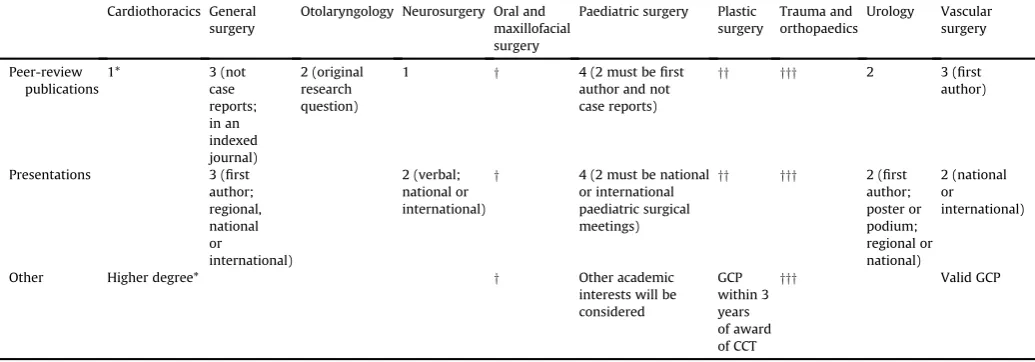
At present, CCT requirements vary across surgical specialties (Table 1). Exact levels of evidence required are set at national levels, however in some specialties guidance states that they can be set locally[3]. This has the potential to lead to imbalance of academic competence across specialities. Moreover, the current limited scope of evidence lends itself to a‘tick box’mentality, where completion of threefirst-author peer-reviewed papers is more important than the quality of research or process of research. To overcome this, the academic requirements for CCT in Trauma and Orthopaedic surgery have recently been revised by the Specialty Advisory Committee (SAC) for Trauma and Orthopaedics, allowing a wider scope of ac-tivity to be recognised[3]. This includes evidence of completion of Good Clinical Practice (GCP) training, as well as critical appraisal skills, clinical trial activity and publications.
In May 2015, medical students and representatives from surgical trainee research collaboratives highlighted a desire to participate in clinical trials and called for research training to be embedded into surgical training programmes[4,5]. Following this, the Association of Surgeons in Training and the National Research Collaborative worked together to propose a new framework for academic achievement for CCT.
The aim was to develop a flexible framework, inclusive of several aspects of academic practice for recommendation to the surgical SACs.
4. Method
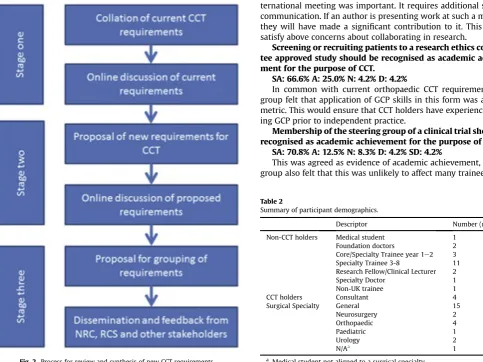
A working group from the NRC and representatives from ASiT prepared a discussion document using a modified Delphi process. This process is summarised inFig. 2.
Current academic CCT requirements were collated from the JCST website into a single document. The relevance of each of these to current surgical research was discussed in an online group over a two-month period. This discussion identified positive and negative aspects of current requirement, and highlighted the variation in current CCT requirements.
The synthesis stage (stages 2) took feedback on these require-ments, and generated a list of activities, which could show aca-demic achievement for the purpose of CCT. The frame of reference for this stage included current requirements and changes to surgical research including collaborative models and clinical tri-als. Online discussion over four weeks facilitated iterative pro-posals, which were entered into a document after ten cycles. At the outset,fifteen objectives were proposed. These were refined
to ten objectives at the end of the stage.
Subsequent discussion of proposed objectives suggested grouping into‘mandatory’and‘supplementary’groups of evidence. This was driven by the aim of a high standard of achievement asso-ciated withflexibility in evidence. These were circulated amongst stakeholders at the NRC including regional collaborative groups. The document was also shared with the Research Lead for the Royal College of Surgeons of England, the Chair of the Joint Committee on Surgical Training (JCST) and the Chair of the JCST Quality Assurance Group.
Following written and verbal feedback on these proposals, a set of sixteen statements was produced. These were designed to cap-ture current thoughts on training and aspirations around evidence and implementation of new research metrics for CCT. Five of these statements addressed the current state of academic education in higher surgical training, and the academic aspirations of CCT holders. Nine statements addressed forms of achievement relevant to obtaining CCT and two statements addressed implementation of new standards.
The consensus session was held at the ASiT 2016 conference in Liverpool on Saturday 19th March 2016. The attendance at the ses-sion was limited to 25 delegates, but registration was open to all conference delegates. Invitation was extended to members of ASiT and those registered on the NRC mailing list, including trainees in all surgical specialties.
Following initial introduction and representations from JCST and RCSEng representatives, consensus voting was undertaken. Each statement was presented to the group and voted upon anony-mously and without discussion. There was then room for discussion and, if necessary, rewording of the statement prior to a second vote. Voting was undertaken using a 5-point Likert-scale from strongly agree to strongly disagree. In order for a statement to be accepted or rejected by the group, an agreement (or disagreement) of
80% was required in thefinal vote.
Following voting, there was discussion about how results could be used to form a framework of CCT requirements. This was subse-quently formally approved by the consensus group.
5. Results
Twenty-five delegates attended the session. There was repre-sentation across the surgical specialties, including general surgery, paediatric surgery, vascular surgery, urology, orthopaedic surgery and neurosurgery. Participants ranged from medical student to Specialty Trainee Year 7. There were four Consultant delegates, rep-resenting Royal college of Surgeons of England, the Confederation of the Postgraduate Schools of Surgery and the JCST. These demo-graphics are summarised inTable 2.
Sixteen statements were presented to the group, of which two were rejected.
The results of thefinal vote as a percentage are presented next to each statement as strongly agree (SA), agree (A), neutral (N), disagree (D) and strongly disagree (SD). The text below each state-ment summarises the ensuing discussion amongst the consensus group.
5.1. Current status and aspiration
Current CCT requirements support the acquisition of Good
Clinical Practice (GCP) certification.
SA: 4.2% A:0% N: 12.5% D: 25.0% SD: 58.3%
Fig. 1.Active trainee research collaboratives in the UK.
Table 1
Current CCT academic requirements for surgical specialties[3].
Cardiothoracics General surgery
Otolaryngology Neurosurgery Oral and maxillofacial surgery
Paediatric surgery Plastic surgery
Trauma and orthopaedics
Urology Vascular surgery
Peer-review publications
1* 3 (not
case reports; in an indexed journal)
2 (original research question)
1 y 4 (2 must befirst
author and not case reports)
yy yyy 2 3 (first author)
Presentations 3 (first
author; regional, national or
international)
2 (verbal; national or international)
y 4 (2 must be national or international paediatric surgical meetings)
yy yyy 2 (first author; poster or podium; regional or national)
2 (national or
international)
Other Higher degree* y Other academic
interests will be considered
GCP within 3 years of award of CCT
yyy Valid GCP
*Denotes alternate options.
yBy the end of training, trainees are expected to have completedfive pieces of evidence from the following:first author publications, presentations at national or international meetings, extensive literature review and presentations at local meetings/regional teaching.
yyTrainees must provide evidence of demonstration of critical appraisal and research skills as evidenced by regular publications, presentations, posters and/or higher degree.
There is an expectation of at least one such piece of evidence per training year.
yyyTrainees should undertake research during training and provide evidence of a minimum of either two peer reviewed authored publications or evidence of
[image:3.595.44.562.467.648.2]training. Currently, only plastic surgery, vascular surgery and Trauma and Orthopaedics has GCP as a requirement for CCT.
Surgical training should equip CCT holders with critical appraisal skills.
SA: 92.0%, A: 8.0%
The group supported this statement. These skills are required in order to undertake new research and apply evidence in practice. It is clear that this is assessed in some specialties with the academic component of the Fellowship exam, however this is not consistent across all groups.
Surgical training should equip CCT holders with skills to re-cruit to clinical trials (i.e. Good Clinical Practice training).
SA: 58.3% A: 33.3% N: 8.3%
As surgical research moves from a competitive to a collaborative model, we will see an increase in opportunities to participate in research. We do not think that geographic location should prevent trainees or patients from accessing clinical trials, therefore the group advocates a wide spread of these skills.
Not all CCT holders will undertake independent research. SA: 58.3% A: 25.0% N: 4.2% D: 8.3% SD: 4.2%
The consensus group was very clear that not all CCT holders would lead their own research projects or programmes. As such, we should not set requirements at a level of leadership, but at a level of participation.
5.2. Evidence of academic achievement
Higher degrees (MSc, MS, MRes, MPhil, MD, PhD) should be
recognised as academic achievement for the purpose of CCT. SA: 83.3% A: 12.5% N: 4.2%
The group strongly felt that higher degrees help to develop skills in critical appraisal and research, regardless of length of pro-gramme. The group also indicated that these skills were not subject to timing out and were transferrable. As a result, they indicated that a higher degree obtained at any time should be counted towards evidence for CCT.
Collaborative authorship in peer-reviewed publications should be recognised as academic achievement for the purpose of CCT.
SA: 66.6% A: 29.2% N: 0% D: 4.2%
This statement led to a long discussion within the group. Ulti-mately, it was felt that collaborative and corporate authors can require a significant amount of work and that this was not currently recognised as evidence. Referencing a rejected statement (see below), authors felt thatfirst authorship was not essential and that by extension, this statement recognises authorship in any po-sition. One group member expressed concern that collaborative authorship could be obtained with relatively little work done, but the group felt on the whole, collaborative authorship was usually earned. Some members of the group suggested that authorship po-sition was less relevant than impact factor of the journal or citation metrics of the paper, although this was not the view of the whole group. The group agreed that case reports would not count towards this measure.
Presentation to a national or international meeting should be recognised as academic achievement for the purpose of CCT.
SA: 95.8% A: 4.2%
As at present, the group felt that presentation to a national or in-ternational meeting was important. It requires additional skills of communication. If an author is presenting work at such a meeting, they will have made a significant contribution to it. This should satisfy above concerns about collaborating in research.
Screening or recruiting patients to a research ethics commit-tee approved study should be recognised as academic achieve-ment for the purpose of CCT.
SA: 66.6% A: 25.0% N: 4.2% D: 4.2%
In common with current orthopaedic CCT requirements, the group felt that application of GCP skills in this form was a useful metric. This would ensure that CCT holders have experience of us-ing GCP prior to independent practice.
Membership of the steering group of a clinical trial should be recognised as academic achievement for the purpose of CCT.
SA: 70.8% A: 12.5% N: 8.3% D: 4.2% SD: 4.2%
[image:4.595.41.525.378.740.2]This was agreed as evidence of academic achievement, but the group also felt that this was unlikely to affect many trainees.
Fig. 2.Process for review and synthesis of new CCT requirements.
Table 2
Summary of participant demographics.
Descriptor Number (n¼25)
Non-CCT holders Medical student Foundation doctors
Core/Specialty Trainee year 1e2 Specialty Trainee 3-8
Research Fellow/Clinical Lecturer Specialty Doctor
Non-UK trainee
1 2 3 11 2 1 1
CCT holders Consultant 4
Surgical Specialty General Neurosurgery Orthopaedic Paediatric Urology N/Aa
15 2 4 1 2 1
Attendance at a recruiting to trials or research methodology workshop should be recognised as academic achievement for the purpose of CCT.
SA: 56.0% A: 28.0% N: 8.0% D: 8.0%
The group agreed that formal teaching in research skills and methodology would be useful for future practice. Whilst the group recognised that not all CCT holders would undertake independent research, it felt that such a course would be beneficial to trainees.
Evidence of successful research grant applications should be recognised as academic achievement for the purpose of CCT.
SA: 54.2% A: 29.2% N: 8.3% D: 4.2% SD: 4.2%
This was agreed as evidence of academic achievement, but the group also felt that this was unlikely to affect many trainees.
Committee membership of a trainee research collaborative should be recognised as academic achievement for the purpose of CCT.
SA: 56.0% A: 24.0% N: 12.0% D: 4.0% SD: 4.0%
This was agreed as evidence of academic achievement. Concerns were raised over how this might be evidenced and it would require further discussion to clarify.
5.3. Institution of recommendations
Completion of GCP is essential to obtaining CCT. SA: 56.0% A: 24.0% N: 12.0% D: 4.0% SD: 4.0%
The group agreed that this should be a requirement for CCT. There was discussion about whether this would need to be valid at CCT, or whether completion at any time during higher surgical training was adequate. If this change is proposed with the spirit that CCT holders should be able to apply GCP, then it should be valid at time of CCT.
Flexibility in requirements, whilst retaining a high level of proof, is desirable.
SA: 54.2% A: 29.2% N: 4.2% D: 4.2% SD: 8.2%
In keeping with the aim of the session, the group felt that providing a menu of options rather than a list of requirements was preferred. The list of options might vary over time as opportu-nities change.
5.4. Rejected statements
At the end of voting two statements were rejected:‘Current CCT requirements support the acquisition critical appraisal skills’(SA: 12.0% A: 24.0% N: 24.0% D: 20.8% SD: 4.2%) and‘Full length peer re-view publications should be recognised as academic achievement regardless of author position (SA: 58.3% A: 20.8% N: 12.5% D: 4.2% SD: 4.2%). The statement on current acquisition of critical appraisal skills showed wide spread across agreement categories. Discussion indicated that certain specialities (Paediatric surgery and Trauma and Orthopaedics) felt that these were well supported. Other spe-cialties did not report the same satisfaction. The statement about authorship position achieved 79.1% agreement on second vote, but could not be passed. Despite this, the group felt that collabora-tive authorship should be recognised. In the discussion, they felt that the collaborative statement effectively covered‘any authorship position’and were happy with that result.
5.5. Synthesis offindings
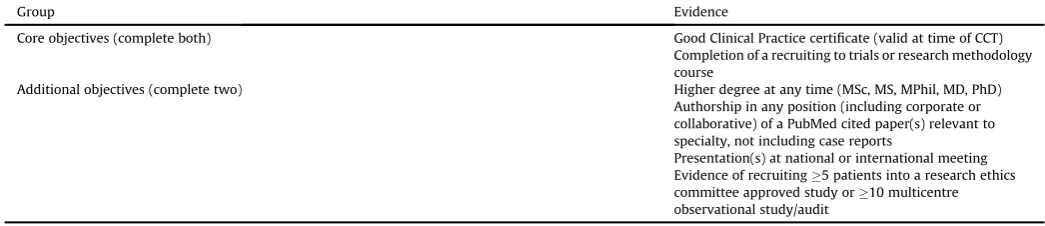
Following voting, activities proposed in the discussion docu-ment were grouped into ‘core’, ‘additional’ and ‘aspirational’ groups. The group agreed‘core’objectives as essential for obtaining CCT, and that two of the‘additional’objectives should be met. The aspirational group were agreed as holding merit as evidence, but it was felt that these would apply to small numbers of trainees at pre-sent, and consequently complicate guidance documents. A sum-mary of the proposed requirements is presented in Table 3. A group of aspirational requirements, those which could carry merit but should not be included in guidance at this point, are presented inTable 4.
6. Discussion
This document describes trainee proposals for changes to aca-demic requirements for completion of surgical training. It reports a desire to move from traditional models with counting of publica-tions to a diverse model with opportunities to engage in clinical research. The Royal College of Surgeons of England has led an initia-tive aimed at improving surgical research. The main components
Table 4
‘Aspirational objectives’- these might be presented as evidence in future recommendations.
Aspirational objectives (not included in recommendations at present, but could be considered in future)a
Membership of a research collaborative demonstrated by either a committee role24 months or running collaborative project on steering group or as local lead Membership of an NIHR portfolio study management group
Co-applicant on a successful clinical trial grant application to a major funding body
[image:5.595.40.563.86.199.2]aThese are unlikely to be core objectives due to amount of time required to complete. Table 3
Recommendations for research output for CCT.
Group Evidence
Core objectives (complete both) Good Clinical Practice certificate (valid at time of CCT)
Completion of a recruiting to trials or research methodology course
Additional objectives (complete two) Higher degree at any time (MSc, MS, MPhil, MD, PhD)
Authorship in any position (including corporate or collaborative) of a PubMed cited paper(s) relevant to specialty, not including case reports
include investment in Surgical Trials Centres and Surgical Specialty Leads (SSLs, individual surgeons responsible for championing RCTs within their specialistfields). In the last three years, 57 new RCTs in surgery have been initiated, producing 175 new chief and principal investigators, an increase in the number of hospitals recruiting into surgical studies, and double the number of patients entering surgi-cal RCTs (25,500 in 2014e15 compared with 11,000 in 2011e12). Recent surgical papers have reported using collaborative or corpo-rate authorship, recognising the significant contribution of collabo-rators in the delivery of a clinical study[6e9].
The inclusion of Good Clinical Practice and an appropriate research skills course is important to ensure quality clinical research in the future. By placing these in the ‘core’ group, we will ensure that outcomes look at the process of research training rather than focussing solely on outputs. As mandatory courses, we would expect these to be funded by the Local Education and Training Board (LETB), as with other courses considered mandatory for CCT. Local education and training boards will need to work with their University and Clinical Trials Unit colleagues to deliver the research courses. As surgical trials units are required to develop surgical investigators, this is might lead to beneficial outcomes for both trainees and course providers. Due to constraints of the session, the shape and content of the recruiting/research course were not clearly defined. Before any implementation, it is impor-tant to confirm the design and aims of the course. GCP can be completed online or by attendance at a course, as such, it should not be an onerous task to complete.
The‘additional’group has been designed to offerflexibility. The group of trainees who have undertaken a research degree are likely to also have published PubMed citable papers. Trainees who partic-ipate in collaborative projects willfind it easy to supply evidence for patient recruitment and publication in any position. It is impor-tant to note that this section does not prejudice against those who wish to fulfil the current requirements offirst author papers and presentations.
This document has not made any recommendations on the development of critical appraisal skills, but results from the voting session demonstrate that this varies across specialties. It is impor-tant that these skills are fostered. As shown inTable 1, Trauma and Orthopaedic surgery already recognises these skills in their CCT requirements.
A potential source of bias in the generation of new proposals is that the online group had all engaged with collaborative research, or had undertaken clinical research projects including trials. This may have skewed proposals to support these activities. There is also the risk that other relevant forms of evidence were not
identi-fied. Despite this, the proposals were ratified by a wider group, including trainees with no attachments to collaborative groups and representatives of professional bodies. This suggests wider acceptability of these proposals.
We have not attached absolute numbers to the outputs as we felt this might be regressive rather than progressive. Should the JCST wish to develop a points-based or weighted system, we would strongly advocate keeping this simple, with fair weighting across achievements to allowflexibility.
7. Conclusion
Trainees have discussed and reached consensus on a new set of academic requirements for CCT. These requirements will recognise evidence of clinical research and support trainees in continuing to engage in quality research after their CCT.
Conflict of interest
The authors are current medical students with an interest in a career in surgery, surgical trainees or Surgical Consultants. The au-thors have no other relevantfinancial or personal conflicts of inter-est to declare in relation to this paper.
Funding
Nil.
References
[1] Good Medical Practice, General Medical Council, 2013.http://www.gmc-uk.org/ guidance/good_medical_practice.asp(accessed 01.07.16).
[2]R. Horton, Surgical research or comic opera: questions, but few answers, Lancet 347 (9007) (1996) 984e985.
[3] Certification Guidelines. Joint Committee on Surgical Training.http://www.jcst. org/quality-assurance/certification-guidelines. (accessed 01.07.16)]
[4]A. Bhangu, P. Marriott, D. Nepogodiev, A.G. Kolias, A. Jamjoom, M.D. Gardiner, F.D. McDermott, C. Skerritt, R.L. Harries, J. Cornish, A.L. Stimpson, J.C. Glasbey, D.C. Bosanquet, S. Chapman, S. Shaikh, G. Taylor, M. Lee, J. Wild, M. Mawdsley, W. Manning, S. Jaunoo, H.L. Adams, N.S. Blencowe, J.A. Smith, C. Burdett, V.J. Gokani, P.W. Stather, J.B. Haddow, N.R. Symons, N. Ventham, G. Nicholson, Surgical training and clinical trial involvementethe trainees' view, BMJ 350 (2015) h2773.
[5]T.M. Drake, M. Bath, H.A. Claireaux, C. Kong, C. Khatri, L. McNamee, M. Mohan, Training and trialsebuilding a future, BMJ 350 (4) (2015) h2772.
[6] Reinforcement of Closure of Stoma Site Collaborative, West Midlands Research Collaborative. Feasibility study from a randomised controlled trial of standard closure of stoma site versus biologic mesh reinforcement, Colorectal Dis. (2016),http://dx.doi.org/10.1111/codi.13310.
[7]STARSurg Collaborative. Impact of postoperative non-steroidal anti-infl amma-tory drugs on adverse events after gastrointestinal surgery, Br. J. Surg. 101 (11) (2014) 1413e1423.
[8]FOXTROT Collaborative Group, Feasibility of preoperative chemotherapy for locally advanced, operable colon cancer: the pilot phase of a randomised controlled trial, Lancet Oncol. 13 (11) (2012) 1152e1160.
[9]A. Kolias, D. Bulters, C. Cowie, M. Wilson, F. Afshari, A. Helmy, E. Broughton, A. Joannides, B. Zebian, S. Harrisson, C. Hill, A. Ahmed, D. Barone, B. Thakur, C. McMahon, D. Adlam, R. Bentley, C. Tolias, P. Mitchell, P. Whitfield, G. Critchley, A. Belli, P. Brennan, P. Hutchinson, British Neurosurgical Trainee Research Collaborative; British Neurotrauma Group; UKCRR Collaborative Group, Proposal for establishment of the UK cranial reconstruction registry (UKCRR), Br. J. Neurosurg. 28 (3) (2014) 310e314.
Mathew J. Lee*,1,2
Association of Surgeons in Training Council, Association of Surgeons in Training, 35-43 Lincoln's Inn Fields, London, WC2A 3PE, UK South Yorkshire Surgical Research Group (SYSURG), Yorkshire and Humber, UK
A. Bhangu1,3
Association of Surgeons in Training Council, Association of Surgeons in Training, 35-43 Lincoln's Inn Fields, London, WC2A 3PE, UK West Midlands Research Collaborative (WMRC), West Midlands, UK
Natalie S. Blencowe1,4
Association of Surgeons in Training Council, Association of Surgeons in Training, 35-43 Lincoln's Inn Fields, London, WC2A 3PE, UK Severn and Peninsula Audit and Research Collaborative for Surgeons (SPARCS), Severn and Peninsula, UK
D. Nepogodiev3
West Midlands Research Collaborative (WMRC), West Midlands, UK
Vimal J. Gokani1
Association of Surgeons in Training Council, Association of Surgeons in Training, 35-43 Lincoln's Inn Fields, London, WC2A 3PE, UK
Association of Surgeons in Training Council, Association of Surgeons in Training, 35-43 Lincoln's Inn Fields, London, WC2A 3PE, UK Welsh Barbers Research Group (WBRG), Wales, UK
*Corresponding author.
E-mail address:m.j.lee@sheffield.ac.uk(M.J. Lee).
8 July 2016 Available online xxx
1
www.asit.org. 2
www.sysurg.co.uk. 3
www.wmresearch.org.uk. 4
www.sparcs.org.uk. 5