This is a repository copy of Big Data Text Analytics an enabler of Knowledge Management.
White Rose Research Online URL for this paper: http://eprints.whiterose.ac.uk/101046/
Version: Accepted Version
Article:
Khan, Z. and Vorley, T. orcid.org/0000-0002-3889-245X (2017) Big Data Text Analytics an enabler of Knowledge Management. Journal of Knowledge Management, 21 (1). pp. 18-34. ISSN 1758-7484
https://doi.org/10.1108/JKM-06-2015-0238
[email protected] https://eprints.whiterose.ac.uk/
Reuse
Unless indicated otherwise, fulltext items are protected by copyright with all rights reserved. The copyright exception in section 29 of the Copyright, Designs and Patents Act 1988 allows the making of a single copy solely for the purpose of non-commercial research or private study within the limits of fair dealing. The publisher or other rights-holder may allow further reproduction and re-use of this version - refer to the White Rose Research Online record for this item. Where records identify the publisher as the copyright holder, users can verify any specific terms of use on the publisher’s website.
Takedown
If you consider content in White Rose Research Online to be in breach of UK law, please notify us by
1
Big Data Text Analytics an enabler of Knowledge Management
Zaheer Khan()
Lecturer (Assistant Professor) in Strategy & International Business Sheffield University Management School, the University of Sheffield, UK S10 1FL
email: [email protected] Tim Vorley
Chair in Entrepreneurship
Sheffield University Management School, the University of Sheffield, UK S10 1FL
email: [email protected]
Please cite: Khan, Z., & Vorley, T. (2016). Big Data Text Analytics an enabler of Knowledge Management, Journal of Knowledge Management, DOI:10.1108/JKM-06-2015-0238
Abstract
Purpose – The purpose of this paper is to examine the role of big data text analytics as an enabler of knowledge management. The paper argues big data text analytics represents an important means to visualise and analyse data, especially unstructured data, which has the potential to improve knowledge management within organizations.
Design/methodology/approach – The study uses text analytics to review 196 articles published in two of the leading knowledge management journals - the Journal of Knowledge Management and the Journal of Knowledge Management Research & Practice in 2013 and 2014. The text analytics approach is used to process, extract and analyse the 196 papers to identify trends in terms of keywords, topics and keyword/topic clusters to show the utility of big data text analytics.
Findings – The findings show how big data text analytics can be a key enabler role in knowledge management. Drawing on the 196 articles analysed, the paper shows the power of big data-oriented text analytics tools in supporting knowledge management through the visualization of data. In this way we highlight the nature and quality of the knowledge generated through this method for efficient knowledge management in developing a competitive advantage.
2
value of big data in the context of knowledge management, and highlight how future studies could develop and extend these findings in different contexts.
Practical implications – Results contribute to understanding the role of big data text analytics as means to enhance the effectiveness of knowledge management. The paper provides important insights that can be applied to different business functions, from supply chain management to marketing management, to support knowledge management through the use of big data text analytics.
Originality/value –The study demonstrates the practical application of the big data tools for data visualisation and with it improving knowledge management.
3
1.
Introduction
The role of big data in effective decision-making and improving many business functions from marketing to supply chain has been acknowledged (Chae, 2015; Chen, Chiang, & Storey, 2012; Davenport, 2013; Waller & Fawcett, 2013). As such, big data was acknowledged by Davenport & Patil (2012) as the next big thing in the 21st century. Testament to this, a Businessweek (2011) survey of the state of business analytics found that 97 percent of companies with revenues exceeding $100 million were to use some form of business analytics. However, according to IBM as much as 80% of the data available to an organization is unstructured (George et al., 2014), and so there is a significant opportunity to leverage in the analysis of unstructured data. Unlocking this potential represents the next Big Data challenge for businesses, concerning how to use big data to extract useful information to make more informed decisions and develop a competitive advantage (Rajaraman & Ullman, 2011).
Companies such as Amazon, eBay and Walmart are using big data text analytics to effectively manage vast amount of knowledge, communicate with their customers and enhance their operations (Davenport & Patil, 2012). This has led to a growing academic interest in big data text analytics, yet there is a dearth of research examining the role of big data text analytics as an enabler of knowledge management (Davenport, 2013; Watson & Marjanovic, 2013). Indeed big data has been characterized as powering the next industrial revolution, so it is somewhat surprising that it has not figured more prominently in the field of knowledge management. Big data has been characterised in terms of volume, variety and velocity (Laney, 2001), while knowledge has been defined in terms of tacit, explicit, implicit, complex, simple, as well as tacit codified and encapsulated (Nonaka & Takeuchi, 1995; Zander & Kogut, 1995; Gao et al., 2008; van den Berg, 2013). There is an opportunity in big data to discover hidden knowledge and generate new knowledge which is important to enable and enhance knowledge management using big data text analytics.
4
However, there is a paucity of research on the role of big data text analytics in KM (Chen et al., 2012; Davenport, 2013). However, it has previously been stated that big data text analytics is an important part of KM (Chen et al., 2012; King, 2009; Wang & Wang, 2008). It can help not only in the sharing of common knowledge of business intelligence, but also helps in extending human knowledge (Wang & Wang, 2008). However, the application and utility of big data text analytics in the generation of knowledge insights as part of KM is not fully explored. Big data text analytics tools could help organizations in the discovery of hidden knowledge and generation of new knowledge from vast amounts of structured and unstructured data.
The aim of this article is to show the utility of big data text analytics as an enabler of knowledge management (George, Haas, & Pentland, 2014; Grant, 1996). We apply text analytics as an example on 196 articles published in two of the leading journals in the domain of knowledge management- the Journal of Knowledge Management and Knowledge Management Research & Practice during 2013-14 to show how the vast amount of data can be visualized. The paper demonstrates the value of big data text analytics in visualising data and improving knowledge management. By doing so, the article demonstrates the utility of big data text analytics as a method for the discovery of hidden knowledge and generation of new knowledge. The remainder of the paper is structured as follows: The second section deals with conceptual background; the third section discusses big data text analytics as a method; the fourth section presents the findings; and the final section of the paper is the core discussion and conclusions.
2. Conceptual background
Big Data Text Analytics
5
unstructured data (Chen et al., 2012), which through its categorization, visualization and interpretation can enables more effective KM (Chen et al., 2012; Davenport, 2013).
In this context big data text analytics role becomes even more salient in enabling the processes and practices of capturing and sharing of vast amount of data (Chen et al., 2012; Rajaraman & Ullman, 2011). There has been a growing use, and reliance, on big data in a variety of different industries and commercial contexts from finance, healthcare to supply chain domains (Chae, 2015; George et al., 2014). Big data text analytics applications have even been trialled in detecting epidemic diseases in society (Ginsberg et al., 2009), as a means of digital infectious disease surveillance. Arguably the growing role of dig data analytics could lead to the reframing of what constitutes knowledge and how we engage with data and information (Boyd & Crawford, 2012).
As noted above, big data can be structured and/or unstructured, and may originate from multiple sources. Consequently big data is often not well understood due to its complexity. Understanding big data demands a combination of analytic tools and high-level skills that are often not widely available (Tambe, 2014). Indeed the challenge of big data is particularly in its interpretation, converting seemingly data into insights that can improve knowledge management (e.g. Cheung et al., 2005; van den Berg, 2013). In this context, big data text analytics plays an important role in generating valuable knowledge which otherwise would be impossible for organizations to source and share. This is in keeping with previous studies which have found out that ICT-enabled data analytics tools support both the acquisitions and sharing of information and knowledge (Jarle Gressgard et al., 2014).
(Mayer-6
Schönberger & Cukier, 2013). Similarly the use of data analytics, and text mining specifically, have generated significant research interest (George et al., 2014), with applications including predicting stock market (e.g. Chung, 2014).
Due to the volume of data available, big data text analytics play a key role in capturing and sharing key information (Chen et al., 2012). Similarly Lazer et al. (2009:722) suggest that big data text analytics offers ‘the capacity to collect and analyze data with an unprecedented breadth and depth and scale'. Due to these characteristics Boyd and Crawford (2012:6) suggested that big data text analytics ‘reframes key questions about the constitution of knowledge, the processes of research, how we should engage with information, and the nature and the categorization of reality'. Big data text analytics could transform personal knowledge management, with the role of individual knowledge workers becoming increasingly vital as well (Pauleen, 2009). Similarly scholars suggest that many organizations are developing information systems to facilitate the sharing and integration of knowledge (Alavi & Leidner, 1999; Jarle Gressgard et al., 2014). Despite the academic interest in big data, there is still a limited understanding about its opportunities and challenges, and particularly the paucity of research an enabler of KM (Davenport, 2013; LaValle, Lesser, Shockley, Hopkins, & Kruschwitz, 2013; Watson & Marjanovic, 2013). This could be due to the inherent challenges associated with big data text analytics and the fact it is difficult to capture, store, analyze and visualize vast amount of data; or it could be the result of lack of availability of skilled big data analysts (e.g. Ahrens et al., 2011; Chen & Zhang, 2014; Tambe, 2014). Next we review characteristics of knowledge and knowledge management before exploring the links between knowledge management and big data.
Knowledge and Knowledge Management
7
et al., 2001; Magnier-Watanabe & Senoo, 2010). Knowledge conversion refers to making the acquired knowledge useful for the organization (Gold et al., 2001; Orzano et al., 2008) by structuring it or transforming tacit knowledge into explicit knowledge. Knowledge application refers to the use of knowledge to perform tasks (Sabherwal & Sabherwal, 2005). Thus, KM includes the firm's processes of acquiring new knowledge, converting knowledge into a form that is usable and easily accessed, and applying knowledge in the organisational setting (Verkasolo & Lappalainen, 1998; Gasik, 2011). KM processes enable organizations to capture, store and transfer knowledge efficiently (Grant, 1996; Magnier-Watanabe & Senoo, 2010), and within this context big data text analytics is becoming increasingly important (Chen et al., 2012; Davenport, 2013).
The most widely cited types of knowledge is are those of explicit and tacit knowledge
(Inkpen & Dinur, 1998; Polanyi, 2009; Crane & Bontis, 2014). Explicit knowledge is that which can be documented and (Nonaka, 1991), and can consequently be easily transmitted Kogut and Zander, 1992) and embedded in standardised procedures (Martin & Salomon, 2003; Nelson & Winter, 1982). Tacit knowledge, by contrast, is often implicit and not codified. Such knowledge is difficult to capture in the form of text and is context dependent (Crane & Bontis, 2014), often derived and shared through a process of learning by doing (Nonaka, 1994). Nonaka and Takeuchi (1995) posit that explicit and tacit knowledge are not mutually exclusive, but rather complementary with knowledge converted from one form to the other in some organisations.
8
Knowledge management and big data share similar objectives, as both role is to create competitive advantage for organizations (Chen et al., 2012; George et al., 2014; Grant, 1996), while big data text analytics allow firm to track and catalogue sources of external knowledge to enable effective sharing of knowledge (Chen et al., 2012; Davenport, 2013; Davenport & Prusak, 1998; Gold et al., 2001). Both roles are important as the bases for creating competitive advantage for firms, and neither can be pursued independently of the other (Alavi & Leidner, 1999; Nonaka, 1994). However, there is hardly any research on the mutual relationship between big data and knowledge management (Davenport, 2013; LaValle et al., 2013; Nonaka & Takeuchi, 1995; O'Leary, 2013).
Big Data and Knowledge Management
The relationship between big data and knowledge management is rooted in the knowledge- based view of the firm and it can provide an overarching theoretical framework (Davenport, 2013; Grant, 1996; Kogut & Zander, 1993). The KBV sees knowledge as a key source of competitive advantage, and suggests a similar reciprocal relationship between knowledge and knowledge management. On the one hand, knowledge serves as the basis for knowledge management, for example Grant (1996) notes the complementarity between different kinds of knowledge. Big data text analytics, to this end, has the potential to capture and utilise different sources of explicit and tacit knowledge, and produce new depth of knowledge as a basis of more effective decision making (e.g. Grant, 1996; Kitchin, 2013; Laney 2012). Similarly, knowledge management can improve and strengthen the combinations of knowledge resources (Cockrell and Stone, 2010).
9
KM processes and transactive memory systems in leveraging the value of big data (Alavi & Leidner, 1999; Argote, McEvily, & Reagans, 2003; O'Leary, 2013).
3. Method of Big Data Text analytics
The growing amount of data available to decision-makers in organisation is becoming overwhelming. In practice this means big data cannot be processed manually, and consequently KM tools are required to support more informed and effective decision making in a timely manner. It is in this context that big data text analytics tools offers a means to identify patterns and other non-trivial information and knowledge from vast amount of both structured and unstructured data that may otherwise not be visible. This new and emerging research domain endeavours to address potential data overload issues by using techniques of data mining, information retrieval, machine learning and knowledge management (Feldman & Sanger, 2006; Chen et al., 2012; Davenport, 2013).
There has been a rise in the use big data text analytics in scholarly research. The use of big data text analytics in the social sciences (King, 2014; Varian, 2014), and particularly regional and information sciences (e.g. Chen et al., 2012; Chen & Zhang, 2014; Gandomi & Haider, 2015; Rae & Singleton, 2015), as a means of data collection, processing, extraction and analysis (Chen et al., 2012; Chaudhuri et al. 2011, Watson & Wixom 2007). Big data text analytics offer a high potential value and wide applications in diverse areas to develop a competitive advantage (Chen et al., 2012). For instance, it has been used in understanding supply chain related issues, and guests’ experiences and preferences for hotels (Chae, 2015; Xiang, Schwartz, Gerdes, & Uysal, 2015), as well as in mapping digital businesses (Nathan & Rosso, 2015). However, the application of big data text analytics is still lacking in different fields including KM, which is in part due to lack of understanding about the possibilities of big data text analytics (e.g. Davenport, 2013; LaValle et al., 2013), and of the big data capture, processing and analysis techniques available (see Chen & Zhang, 2014).
In this article, we apply the method big data text analytics to articles published in two of the leading journals in the domain of knowledge management as a means to demonstrate the insights that can be generated. Over a 2 year period (2013 and 2014) a total of 196 articles were published on variety of topics from the Journal of Knowledge Management and
10
converted them into plain text format to facilitate processing in the subsequent analysis.
During the conversion process, we removed graphs, tables, authors’ related information,
journal name and references pages as these could create potential repetitions into the analysis. We then applied text analytics techniques with the aim to show the application of big data text analytics techniques in the capturing, acquisition and sharing of knowledge (Davenport, 2013; Grant, 1996; Scarbrough & Swan, 2001). We applied text analytics approach on the entire document instead of picking particular sections of the documents as we wanted to avoid self-selection bias in the analysis.
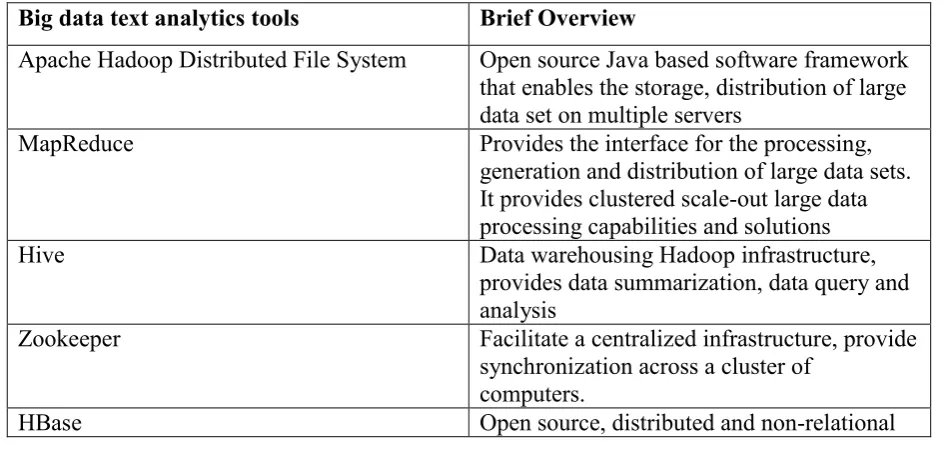
[image:11.595.63.536.547.772.2]Applying big data text analytics approach to the entire document is more comprehensive as it can give depth of information about a particular topic. In this way insights can be identified and presented more effectively and intuitively (Simoff et al., 2008). We also applied custom stop words to overcome any potential bias related issues arising from the analysis, for instance 'journal of knowledge management' or the words 'they' and 'research & practice' could potentially show up as the most frequent word in the words list. We added such words to the stop word query in order to have a reliable list of most frequent words. By applying text analytics techniques on the 196 articles we identified the 50 most frequent words used across these articles. This approach further helps in capturing important knowledge, but also the organization and analysis of knowledge. Various tools for big data text analytics are available to organizations in capturing, acquiring and sharing organization-wide knowledge and table 1 list some of these tools.
Table 1. Available tools for big data text analytics
Big data text analytics tools Brief Overview
Apache Hadoop Distributed File System Open source Java based software framework that enables the storage, distribution of large data set on multiple servers
MapReduce Provides the interface for the processing, generation and distribution of large data sets. It provides clustered scale-out large data processing capabilities and solutions
Hive Data warehousing Hadoop infrastructure,
provides data summarization, data query and analysis
Zookeeper Facilitate a centralized infrastructure, provide synchronization across a cluster of
computers.
11
database management systems, based on non-SQL approach
Cassandra A distributed database system, handles big data distribution across multiple computers Apache Pig Platform for the analysis of large data sets
that consists textual language- PigLatin (process both structured and unstructured data)
Source: based on various sources including Raghupathi and Raghupathi (2014).
4. Findings
Big data text analytics and KM
The 196 articles published during 2013 and 2014 were analysed using big data text analytics. The findings suggest that big data text analytics can be an enabler of effective KM, as it generates quality of knowledge. Figure 1 is a word cloud of the most frequent words across the 196 articles. For reasons of space and readability, we only show the most frequent words that appear at least 50 times in the entire sample of articles. The larger and darker the word is, the more frequent it appears in 196 articles. This form of visualization helps in the quick extraction of key knowledge from a large volume of data, in this case the 196 published articles.
[Insert figure 1 about here]
Figure1. Most Frequent Words across 196 articles published in the Journal of Knowledge Management and the Journal of Knowledge Management Research &
12
The frequency of words appearing in the 196 articles published in 2013 and 2014 are shown in Table 2, which clearly shows the focus to range from the organizational level to individual level. The most frequent words 'organizational', 'sharing', 'information', 'innovation', 'social', 'learning' and 'transfer'. These are the terms that are important for KM and creating competitive advantage for firms (Alavi & Leidner, 1999; Argote et al., 2003; Grant, 1996). Such visualizations of both unstructured and structured data facilitate KM and improve timely decision making. These findings show the utility of text analytics for capturing, acquiring and constructing important knowledge (Chen et al., 2012; Davenport, 2013; Grant, 1996). Knowledge of the most frequent and popular words is beneficial for understanding the focus of the research and its emerging domains.
One of the central challenges for organization has been how to codify and share knowledge (more) effectively. Big data text analytics increases the capacity to capture, process and analyse data, as well as it speed compared to traditional KM tools. The importance of visualizing knowledge also further aids in the codification of important knowledge, which was another limitation of traditional KM tools. The analysis also indicates that research in the domain of knowledge management have been mostly done at the organisation level, with less focus on micro level issues concerning knowledge management.
[Insert Table 2 about here]
Table 2. Most frequent words appeared across 196 articles published during 2013-14 in
the Journal of Knowledge Management and the Journal of Knowledge Management
13
In addition to the combined analysis, we has also conducted separate analysis for each of the journals to see how the pattern changes across the two journals. The Figure 2 is a comparative analysis of the two journals, showing the difference in rank of the most frequently appearing words ranked in the top 50 of both journals. The pattern extrapolated from the data also shows that while the terms are shared, that certain terms tend to be more dominant in each journal. The analysis of big data text analytics serves to show respective specialisms and priorities in each of the journals as is reflected by the 196 articles.
Both Journals Journal of Knowledge Management
Knowledge Management Research & Practice
Words Word
Count Words
Word
Count Words
Word Count
organizational 7683 sharing 3837 organizational 1929 information 6903 organizational 3604 innovation 1868 sharing 6892 information 3387 information 1621 innovation 6811 innovation 3059 learning 1442 social 5565 social 2943 intellectual 1230 learning 5480 transfer 2825 firm 1223 transfer 5069 learning 2441 social 1209 performance 4629 performance 2009 performance 1193 capital 4511 organizations 1678 sharing 1109 development 3354 processes 1668 systems 889
processes 3313 development 1641 firms 886 organizations 3204 network 1512 development 860 systems 3097 work 1503 strategic 828 technology 3093 technology 1482 resources 781 network 3072 systems 1434 technology 729 work 3069 individual 1357 processes 726 strategic 2750 firms 1325 product 712 individual 2741 strategic 1312 work 710 employees 2634 employees 1300 organizations 692 resources 2480 international 1167 transfer 678 creation 2433 resources 1165 system 673
14
[image:15.595.75.546.154.337.2][Insert figure 2 here]
Figure 2. Difference in ranks of the most frequently used shared words
15
[image:16.595.194.442.201.431.2][Insert figure 3 here]
Figure 3. Most Frequent Words according to Clusters
16
[Insert table 3 here]
Table 3: The Most Frequent Terms appearing in each Cluster
Clusters Most frequent terms within the cluster
1- Transfer sharing, information, tacit, people, innovation,
international, processes, systems, communication, team, practices
2- Networks individual, social, trust, capital, network, intellectual, relationships
3- Resources creation, practices, structure, activities, strategic,
technology
4-Organizational external, capacity, customer, strategic, creation, networks, relationship, innovation, strategy, internal, managers, processes
5. Discussion and Conclusions
The purpose of this article is to examine the potential of big data text analytics as a method by highlighting the depth of knowledge that can be generated from big data for effective knowledge management through the visualisation, organization, interpretation and analysis of information that would not otherwise be feasible. Despite the increasing interest in big data and business analytics, the topic remains underdeveloped within the KM literature, and its role as an enabler of KM in particular is not well understood (Davenport, 2013; LaValle et al., 2013; Watson & Marjanovic, 2013). Yet the big data text analytics approach presents opportunities for organizations, the majority of whom are ill-informed about how big data text analytics can support making informed and timely decisions through the generation of valuable knowledge and its subsequent interpretation (e.g. Davenport, 2013; LaValle et al., 2013).
17
[image:18.595.105.532.181.766.2]KM, and in contrast to traditional KM systems, highlight the utility of big data text analytics in KM (Malhotra, 2005). The key findings of this study in the context of KM are threefold. Table 4 presents the summary of the key findings.
Table 4. Summary of key Findings
Utility of big data text analytics and role in knowledge management
Key findings
1. Capturing and visualizing most frequent words from a vast amount of both structured and unstructured data
big data text analytics plays an important role for the timely transfer, sharing and management of vast amount of data.
generations of key words through text mining of big data can help in the internalization, sharing and effective management of key knowledge assets.
text analytics of big data could potentially overcome information overload problems and facilitate both codification and personalization knowledge management strategies.
2. Organization of dispersed knowledge into categories and key words
enable the effective codification of important knowledge.
stop words can be applied for real time filtering of knowledge.
making the delivery and optimization of relevant knowledge available to multiple constituents within an organization for effective as well as timely decision-making.
knowledge generated through text analytics of big data is fine-grained and precise and organizations could
potentially benefit from such an efficient, and high-quality knowledge thus enabling the effective retention and sharing of valuable knowledge.
3. Analytics oriented clustering analysis provide important contextual details through the clustering of important knowledge.
clustering and the visualization of vast amounts of data can provide an interface that is well suited for effective knowledge management and improved & timely decision making.
analytics oriented clustering and categorization of big data help KM systems to improve the relevancy, quality and timeliness of knowledge that is captured, codified, and shared.
18
effective KM.
First, we demonstrate the utility of big data text analytics by capturing and visualizing most frequent words. Figure 1 and Table 2 indicate that the focus of the research in KM have focused on understanding KM at the organisational level issues related to KM such as organizational knowledge creation, sharing, transfer and innovation. However, less attention has been paid to micro level issues impacting knowledge management such as the role of individuals in the creation and transfer and management of knowledge, routines, processes, as well as particular managerial actions, communications- the micro-foundations of KM. As such, big data text analytics plays an important role for the timely transfer, sharing and management of such vast amount of data as this study has demonstrated. The generations of key words through big data text analytics can help in the internalization, sharing and effective management of key knowledge assets (Davenport, 2013; LaValle et al., 2013; Nonaka & Takeuchi, 1995; O'Leary, 2013), which would otherwise be very time consuming through the use of traditional KM methods (e.g. Chen et al., 2012). For instance, Hansen et al. (1999), noted that it was a mistake on the part of the traditional KM systems to apply codification and personalization strategies at the same time, and indicated that companies should only focus on one of them. As the findings of the study indicate, big data text analyticscould overcome such problems and facilitate both codification and personalization knowledge management strategies. Put differently, the conversion of unstructured and structured forms of data could generate explicit knowledge that may lead to easier absorption (Cohen & Levinthal, 1990), which is exemplified by the two journals reviewed. Traditional KM systems have faced information overload issues and emphasized on predetermined workflows and rigid
‘information-push’ approaches (Malhotra, 2005). Big data text analytics can overcome information overload with so-called information-push strategies making importantknowledge accessible and available.
19
helps analyzing all the data rather than choosing a particular set of data. The knowledge generated through text mining of big data is fine-grained and precise, therefore, organizations could benefit from such an efficient, and high-quality knowledge thus enabling the effective retention and sharing of valuable knowledge (e.g. Kogut & Zander, 1992).
Big data text analyticscan be utilized in the capture of both structured and unstructured data to enable the generation of new depth and codification of knowledge as the basis of competitive advantage (e.g. Grant, 1996; Kitchin, 2013; Laney, 2012). Traditional KM approaches have often been criticized for being expensive, time consuming and unable to provide timely knowledge to the right persons, whereas the application of big data text analytics, as demonstrated in this paper, suggests that rich and quality knowledge can be generated through such approach (e.g. Chen et al., 2012; Laney, 2012). The richness and generation of quality knowledge then facilitates the effective sharing of this knowledge across the organization, thus improving workers productivity and 'transactive memory systems' (e.g. Argote et al., 2003; Argote & Ren, 2012; Lewis & Herdon, 2011). The generation of quality knowledge through big data text analyticshas wider implications for organization since knowledge has been suggested to be important for developing competitive advantage in the knowledge-based economy (Grant, 1996; Kogut & Zander, 1992; Spender, 1996), and most of the organizations are not well-informed on the opportunities offered by text mining of big data for making timely decisions (e.g. Davenport, 2013; LaValle et al., 2013).
20
The big data text analytics clustering approach offers important insights for not only the effective deployment of knowledge assets, but also making informed decisions in the organization. These findings indicate that big data applications and tools are important enablers of KM (George et al., 2014; Grant, 1996). The results of this study further supports the views of King (2009:87) who noted: ‘text analytics have great potential utility for knowledge management’. Through the application of big data text analytics, the paper has shown how the visualization of important topics as well as clustering-based approaches can show the categorization and proximity of topics, which can be utilized by the KM systems to improve the relevancy, quality and timeliness of knowledge that is captured, codified, and shared. Again this has significant scope to improve knowledge management and organizational performance. The visualization of big data text analytics can also enable effective KM, by presenting data that would otherwise be very time-consuming and difficult to process through the use of traditional KM systems.
5.1. Implications for Research and Practice
The study has several implications for research and practice. The study demonstrates the value of big data text analytics in the discovery of hidden knowledge and generation of new knowledge that would otherwise not be possible through traditional KM systems. The goal of the KM system is to ensure that key knowledge assets are effectively codified and shared. In the context of this paper the focus was the 196 papers, but this could equally be applied to a wider variety of documents to provide insights about individual and organizational practices. In this way managers would be well placed to take advantage of novel approaches, such as big data text analytics, that enable big data to be interrogated and used to inform more effective and timely decision making (e.g. Chen et al., 2012).
21
or events as well as online social interactions (Golder & Macy, 2011, 2014), thus enabling effective knowledge codification and sharing.
The findings presented in this article on the use of big data text analytics provides important insights on the usefulness of using big data text analytics for knowledge management. The use of big data text analytics has wider implications, as we have shown in this article; it provides rich contextual detail so organization can focus their attention on where to dedicate their efforts and how to create value by utilizing valuable assets in this case the application of big data text analytics. However, there are still inherent challenges of using big data, as the skills needed may not be available in different context thus hindering effective knowledge management (Tambe, 2014). In the context of the empirical focus of this paper, the findings indicate that research on knowledge management has mostly been conducted at the organizational level topics and less attention paid to how the micro level processes such as routines and individual level actions impacts knowledge management through the creation, transfer and management of knowledge. In this way, the study highlighted the important application and utility of big data text analytics by demonstrating that depth of knowledge can be generated for effective knowledge management. One of the key contributions of this study is demonstrating the quality and nature of knowledge generated through the utilization of big data text analytics methods. In addition, as a by product, we conceptually develop the link between big data and knowledge based view (Grant, 1996), indicating that it is one of the key theories that provides a much needed theoretical lens to investigate the role of big data in various settings (e.g. George et al., 2014).
6. Limitations and Future Research Directions
This is an exploratory study that applied big data text analytics to demonstrate its value for the effective generation and codification of rich and quality knowledge which enables knowledge management and more effective decision making. Keeping aside its contributions, it also has some limitations and these could serve an important avenues for further research. The application of big data text analytics was applied only on articles published in two leading knowledge management journals over a two year period. Future studies could apply big data text analytics over a longer period to examine trends and consider more sources to develop the robustness of the findings.
22
23
References
Ahrens, J., Hendrickson, B., Long, G., Miller, S., Ross, R., & Williams, D. (2011). Data-intensive science in the US DOE: case studies and future challenges. Computing in Science &
Engineering, Vol.13 No. 6, pp.14-24.
Aiden, E., & Michel, J. 2014. The Predictive Power of Big Data. Newsweek, Available at http://www. newsweek. com/predictive-power-big-data-225125.
Alavi, M., & Leidner, D. 1999. Knowledge Management Systems: Issues, Challenges, and Benefits. Communications of the Association for Information Systems, Vol. 1, No. 7, pp. 1-28. Alavi, M., & Leidner, D. E. 2001. Review: Knowledge management and knowledge management
systems: Conceptual foundations and research issues. MIS Quarterly, Vol. 25 No. 1, pp. 107-136.
Alavi, M., Kayworth, T.R., & Leidner, D.E. 2006. An empirical examination of the influence of organizational culture on knowledge management practices. Journal of Management Information Systems, Vol. 22 No. 3, pp. 191 224.
Almeida, P., Song, J., & Grant, R. M. 2002. Are firms superior to alliances and markets? An empirical test of cross-border knowledge building. Organization Science, Vol. 13 No. 2, pp. 147-161. Andreeva, T., & Kianto, A. 2011. Knowledge processes, knowledge-intensity and innovation: a
moderated mediation analysis, Journal of Knowledge Management, Vol. 15 No. 6, pp. 1016-1034.
Al-Sudairy, M.A.T., & Vasista, T.G.K. 2012. Fostering knowledge management and citizen
participation via e-governance for achieving sustainable balanced development, The IUP Journal of Knowledge Management, Vol. 10 No. 1, pp. 52-64.
Argote, L., McEvily, B., & Reagans, R. 2003. Managing knowledge in organizations: An integrative framework and review of emerging themes. Management Science, Vol. 49 No. 4, pp. 571-582.
Argote, L., & Ren, Y. 2012. Transactive memory systems: A microfoundation of dynamic capabilities. Journal of Management Studies, Vol. 49 No. 8, pp.1375-1382.
Boyd, D., & Crawford, K. 2012. Critical questions for big data: Provocations for a cultural,
technological, and scholarly phenomenon. Information, Communication & Society, Vol. 15 No. 5, pp. 662-679.
Brynjolfsson, E., & McAfee, A. 2012. Winning the race with ever-smarter machines. MIT Sloan Management Review, Vol. 53 No. 2, pp. 53-60.
Businessweek. 2011. The Current State of Business Analytics: Where Do We Go from Here?, Bloomberg Business week Research Services
(http://www.sas.com/resources/asset/busanalyticsstudy_wp_08232011.pdf) accessed on 15 August 2014.
Chae, B. K. 2015. Insights from hashtag# supplychain and Twitter Analytics: Considering Twitter and Twitter data for supply chain practice and research. International Journal of Production Economics, Vol. 165, pp. 247-259.
Chen, H. 2001. Knowledge management systems: a text mining perspective. Tucson, AZ: The University of Arizona
Chen, H., Chiang, R. H., & Storey, V. C. 2012. Business Intelligence and Analytics: From Big Data to Big Impact. MIS Quarterly, Vol. 36 No. 4, pp. 1165-1188.
Cheung, C. F., Lee, W. B., & Wang, Y. 2005. A multi-facet taxonomy system with applications in
unstructured knowledge management. Journal of Knowledge Management, Vol. 9 No. 6, pp. 76-91.
Cockrell, R. C., & Stone, D. N. 2010. Industry culture influences pseudo-knowledge sharing: a
multiple mediation analysis. Journal of Knowledge Management, Vol. 14 No. 6, pp. 841-857. Cohen, W. M., & Levinthal, D. A. 1990. Absorptive capacity: a new perspective on learning and
24
Crane, L., & Bontis, N. 2014. Trouble with tacit: developing a new perspective and approach. Journal of Knowledge Management, Vol.18 No. 6, pp.1127-1140.
Dalkir, K. 2005. Knowledge management in theory and practice. Elsevier Butterworth-Heinemann, Burlington, MA.
Davenport, T., & Patil, D. 2012. Data scientist: the sexiest job of the 21st century. Harvard Business Review, Vol. 90 No. 10, pp. 70-76.
Davenport, T. H. 2013. Analytics 3.0. Harvard Business Review, Vol. 91 No. 12, pp. 64-72.
Davenport, T. H., & Prusak, L. 1998. Working knowledge: How organizations manage what they know: Harvard Business Press.
Einav, L., & Levin, J. D. 2013. The data revolution and economic analysis: National Bureau of Economic Research.
Feldman, R., & Sanger, J. 2006. The text mining handbook: Cambridge University Press.
Gao, F., Li, M., & Clarck, S. 2008. Knowledge, management, and knowledge management in business operations, Journal of Knowledge Management, Vol. 12 No. 2, pp. 3-17.
Gasik, S. 2011. A model of project knowledge management, Project Management Journal, Vol. 42 No. 3, pp. 23-44.
George, G., Haas, M. R., & Pentland, A. 2014. Big data and management. Academy of Management Journal, Vol. 57 No. 2, pp. 321-326.
Ginsberg, J., Mohebbi, M. H., Patel, R. S., Brammer, L., Smolinski, M. S., & Brilliant, L. 2009. Detecting influenza epidemics using search engine query data. Nature, Vol. 457 No. 7232, pp. 1012-1014.
Gold, A. H., Malhotra, A., & Segars, A. H. 2001. Knowledge management: An organizational capabilities perspective. Journal of Management Information Systems, Vol. 18 No. 1, pp. 185-214.
Golder, S. A., & Macy, M. W. 2011. Diurnal and seasonal mood vary with work, sleep, and daylength across diverse cultures. Science, Vol. 333 No. 6051, pp. 1878-1881.
Golder, S. A., & Macy, M. W. 2014. Digital footprints: opportunities and challenges for online social research. Sociology, Vol. 40 No. 1, pp. 129-152.
Grant, R. M. 1996. Toward a knowledge-based theory of the firm. Strategic Management Journal, Vol. 17 No. 10, pp. 109-122.
Inkpen, A. C., & Dinur, A. 1998. Knowledge management processes and international joint ventures. Organization Science, Vol. 9 No. 4, pp. 454-468.
Jarle Gressgård, L., Amundsen, O., Merethe Aasen, T., & Hansen, K., 2014. Use of information and communication technology to support employee-driven innovation in organizations: a knowledge management perspective, Journal of Knowledge Management, Vol. 18 No. 4, pp. 633-650.
King, G. 2014. Restructuring the Social Sciences: Reflections from Harvard's Institute for Quantitative Social Science. PS: Political Science & Politics, Vol. 47 No. 1, pp. 165-172.
King, W.R. 2009. Text analytics: Boon to knowledge management?. Information Systems Management, Vol. 26 No. 1, pp. 87-87.
Kitchin, R. 2013. Big data and human geography Opportunities, challenges and risks. Dialogues in Human Geography, Vol. 3 No. 3, pp. 262-267.
Kogut, B., & Zander, U. 1992. Knowledge of the firm, combinative capabilities, and the replication of technology. Organization Science, Vol. 3 No. 3, pp. 383-397.
Kogut, B., & Zander, U. 1993. Knowledge of the firm and the evolutionary theory of the multinational enterprise. Journal of International Business Studies, Vol. 24 No. 4, pp. 625-645.
25
Laney, D. 2001. 3D data management: Controlling data volume, velocity and variety: Technical report, META Group.
Laney, D. 2012. The importance of'Big Data': A definition: Gartner.
LaValle, S., Lesser, E., Shockley, R., Hopkins, M. S., & Kruschwitz, N. 2013. Big data, analytics and the path from insights to value. MIT Sloan Management Review, Vol. 21 No. 52, pp. 20-32. Lazer, D., Pentland, A. S., Adamic, L., Aral, S., Barabasi, A. L., Brewer, D., Christakis, N., Contractor, N.,
Fowler, J., & Gutmann, M. 2009. Life in the network: the coming age of computational social science. Science , Vol. 323 No. 5915, pp. 721-723.
Lewis, K., & Herndon, B. 2011. Transactive memory systems: Current issues and future research directions. Organization Science, Vol. 22 No. 5, pp. 1254-1265.
Mackenzie, A. 2006. Cutting code: Software and sociality: Peter Lang.
Magnier-Watanabe, R., & Senoo, D. 2010. Shaping knowledge management: organization and national culture. Journal of Knowledge Management, Vol.14 No. 2, pp. 214-227. Malhotra, Y. 2005. Integrating knowledge management technologies in organizational business
processes: getting real time enterprises to deliver real business performance. Journal of Knowledge Management, Vol. 9 No. 1, pp. 7-28.
Manyika, J., Chui, M., Brown, B., Bughin, J., Dobbs, R., Roxburgh, C., & Byers, A. H. 2011. Big Data: The Next Frontier for Innovation, Competition, and Productivity, McKinsey Global Institute (http://www.mckinsey.com/insights/mgi/research/technology_and_innovation/big_data_th e_next_frontier_for_innovation; accessed 15 August 2014).
Martin, X., & Salomon, R. 2003. Tacitness, learning, and international expansion: A study of foreign direct investment in a knowledge-intensive industry. Organization Science, Vol. 14 No. 3, pp. 297-311.
Mayer-Schönberger, V., & Cukier, K. 2013. Big data: A revolution that will transform how we live, work, and think: Houghton Mifflin Harcourt.
Nathan, M., & Rosso, A. 2015. Mapping digital businesses with big data: Some early findings from the UK. Research Policy, Vol. 44 No. 9, pp. 1714-1733.
Nelson, R. R., & Winter, S. G. 1982. An evolutionary theory of economic change. Cambridge: Belknap.
Nonaka, I. 1991. The knowledge-creating company. Harvard Business Review, 69(6): 96-104. Nonaka, I. 1994. A dynamic theory of organizational knowledge creation. Organization Science, Vol.
5 No. 1, pp. 14-37.
Nonaka, I., & Takeuchi, H. 1995. The knowledge-creating company : how Japanese companies create the dynamics of innovation. New York: Oxford University Press.
Nonaka, I., & Von Krogh, G. 2009. Perspective-tacit knowledge and knowledge conversion:
Controversy and advancement in organizational knowledge creation theory. Organization Science, Vol. 20 No. 3, pp. 635-652.
O'Leary, D. E. 2013. Artificial intelligence and big data. IEEE Intelligent Systems, Vol. 28 No. 2, pp. 96-99.
Orzano, A.J., Mcinerney, C.R., Scharf, D., Tallia, A.F., & Crabtree, B.F. 2008. A knowledge management model: implications for enhancing quality in health care. Journal of the American Society for Information Science & Technology, Vol. 59 No. 3, pp. 489 505. Pauleen, D. 2009. Personal knowledge management: putting the person back into the knowledge
equation. Online Information Review, Vol. 33 No. 2, pp. 221-224. Polanyi, M. 1966. The tacit dimension, Doubleday and Co: Garden City, NY. Polanyi, M. 2009. The tacit dimension, University of Chicago Press, Chicago, IL.
Raghupathi, W., & Raghupathi, V. 2014. Big data analytics in healthcare: promise and potential. Health Information Science and Systems, Vol. 2 No. 1, pp. 3-10.
26
Reed, R., & Defillippi, R. J. 1990. Causal ambiguity, barriers to imitation, and sustainable competitive advantage. Academy of Management Review, Vol. 15 No. 1, pp. 88-102.
S ‘ B F I A
management processes at individual, group, and organizational levels*. Decision sciences, Vol. 34 No. 2, pp. 225-260.
Sabherwal, R., & Sabherwal, S. 2005. Knowledge Management Using Information Technology:
D S T I F V Decision Sciences, Vol. 36 No. 4, pp.
531-567.
Scarbrough, H., & Swan, J. 2001. Explaining the diffusion of knowledge management: the role of fashion. British Journal of Management, Vol. 12 No. 1, pp. 3-12.
Spender, J. C. 1996. Making knowledge the basis of a dynamic theory of the firm. Strategic Management Journal, Vol. 17 No. S2, pp. 45-62.
Tambe, P. 2014. Big data investment, skills, and firm value. Management Science, Vol. 60 No. 6, pp. 1452-1469.
van den Berg, H.A. 2013. Three shapes of organisational knowledge, Journal of Knowledge Management, Vol. 17 No. 2, pp. 159-174.
Varian, H. R. 2014. Big data: New tricks for econometrics. The Journal of Economic Perspectives, Vol. 28 No. 2, pp. 3-28.
Verkasolo, M., & Lappalainen, P. 1998. A method of measuring the efficiency of the knowledge utilization process. Engineering Management, IEEE Transactions on Engineering Management, Vol. 45 No. 4, pp. 414-423.
Vitari, C. 2011. The success of expert recommending services and the part played by organizational context. Knowledge Management Research & Practice, Vol. 9 No. 2, pp. 151-171.
Vorakulpipat, C., & Rezgui, Y. 2008. An evolutionary and interpretive perspective to knowledge management. Journal of Knowledge Management, Vol. 12 No. 3, pp. 17-34.
Waller, M. A., & Fawcett, S. E. 2013. Data science, predictive analytics, and big data: a revolution that will transform supply chain design and management. Journal of Business Logistics, Vol. 34 No. 2, pp. 77-84.
Wang, H., & Wang, S. 2008. A knowledge management approach to data mining process for business intelligence. Industrial Management & Data Systems, Vol. 108 No 5, pp. 622-634.
Watson, H. J., & Marjanovic, O. 2013. Big data: The fourth data management generation. Business Intelligence Journal, Vol. 18 No. 3, pp. 4-8.
Witherspoon, C. L., Bergner, J., Cockrell, C., & Stone, D. N. 2013. Antecedents of organizational knowledge sharing: a meta-analysis and critique. Journal of Knowledge Management, Vol. 17 No. 2, pp. 250-277.
Xiang, Z., Schwartz, Z., Gerdes, J. H., & Uysal, M. 2015. What can big data and text analytics tell us about hotel guest experience and satisfaction? International Journal of Hospitality Management, Vol. 44, pp. 120-130.
Zander, U., & Kogut, B. 1995. Knowledge and the speed of the transfer and imitation of