Cite this:Soft Matter,2016, 12, 7223
The influence of intercalating perfluorohexane
into lipid shells on nano and microbubble
stability
†
Radwa H. Abou-Saleh,abSally A. Peyman,aBenjamin R. G. Johnson,a Gemma Marston,cNicola Ingram,cRichard Bushby,dP. Louise Coletta,c Alexander F. Markhamcand Stephen D. Evans*a
Microbubbles are potential diagnostic and therapeutic agents.In vivostability is important as the bubbles are required to survive multiple passages through the heart and lungs to allow targeting and delivery. Here we have systematically varied key parameters affecting microbubble lifetime to significantly increase in vivo stability. Whilst shell and core composition are found to have an important role in improving microbubble stability, we show that inclusion of small quantities of C6F14in the microbubble
bolus significantly improves microbubble lifetime. Our results indicate that C6F14 inserts into the lipid
shell, decreasing surface tension to 19 mN m1, and increasing shell resistance, in addition to saturating the surrounding medium. Surface area isotherms suggest that C6F14 incorporates into the acyl chain
region of the lipid at a high molar ratio, indicatingB2 perfluorocarbon molecules per 5 lipid molecules. The resulting microbubble boluses exhibit a higher in vivo image intensity compared to commercial compositions, as well as longer lifetimes.
1 Introduction
Microbubbles (MBs) used for contrast enhanced ultrasound (CEUS) imaging are micron sized gas encapsulated spheres, stabilized with a shell made of biocompatible materials such as proteins, surfactants, phospholipids or polymers. These MBs are capable of circulating in the vasculature and their high acoustic impedance mismatch with the surrounding tissue leads to strong ultrasound scattering resulting in enhanced contrast in US imaging. Recently there has been considerable interest in the development of MBs as vehicles for drug delivery1,2by loading them with drug-filled liposomes, attaching genes to the shell,3–5or filling the core with a therapeutic gas.6,7 The MB complex can be targeted to the required location using antibodies, or other ligands, to provide a route for targeted, triggered delivery.8 Furthermore, it has been demonstrated that bursting the MBs using an ultrasound pulse gives rise to
sonoporation of cells in the immediate vicinity of the MBs, leading to an enhanced therapeutic uptake.9,10Their changing role requires that MBs be re-engineered to improve their func-tional performance, with the key MB parameters being size and dispersity, biocompatibility, shell stiffness and MB lifetime.5,11
For clinical and preclinical applications MBs are typically desired to be between 1–8mm in diameter. Control over size can be achieved by selecting a suitable production technique. Sonication and mechanical agitation are the common methods for MB production.12,13They produce broad poly-disperse size distributions with a polydispersity index ofB150%, with the majority of MBs being in the range of o8 mm,14 and are currently used for diagnostic imaging.15,16 Coaxial electro-hydrodynamic atomisation14,17 produces bubbles which can be of a controllable size between 1 and 25 mm and with a moderate dispersity index of B30%. For the highest quality monodisperse MB production, the best control over the size and the dispersity index has come about through the use of flow-focus microfluidic (MF) technology.18–21 However, in this
approach the MB concentration tends to be low (B106MB mL1)
compared to the 108MB mL1used in a single bolus forin vivo
imaging experiments. Recently Peymanet al.introduced a rapid pressure-drop on a chip technique, which led to the production of nano and micron sized bubbles that were typically less than 2mm in diameter, at high concentrations (41010and 108MB mL1 respectively).22 Post production MBs are prone to fusion and
a
Molecular and Nanoscale Physics Group, School of Physics and Astronomy, University of Leeds, LS2 9JT, UK. E-mail: [email protected]
bBiophysics Group, Department of Physics, Faculty of Science, Mansoura University,
Egypt
cLeeds Institute of Molecular Medicine, Wellcome Trust Brenner Building,
St. James’s University Hospital, Leeds, LS9 7TF, UK dSchool of Chemistry, University of Leeds, LS2 9JT, UK
†Electronic supplementary information (ESI) available. See DOI: 10.1039/ c6sm00956e
Received 22nd April 2016, Accepted 28th July 2016 DOI: 10.1039/c6sm00956e
www.rsc.org/softmatter
PAPER
Open Access Article. Published on 28 July 2016. Downloaded on 24/10/2016 11:42:11.
This article is licensed under a
Creative Commons Attribution 3.0 Unported Licence.
View Article Online
dissolution unless they are stabilized with a suitable coating. Furthermore, such MBs should not only be stablein vitrobut alsoin vivo, where they are required to survive multiple pas-sages through the heart and lungs for successful diagnostic imaging, and possibly longer for therapeutic applications requiring the effective targeting and release of drug payloads.
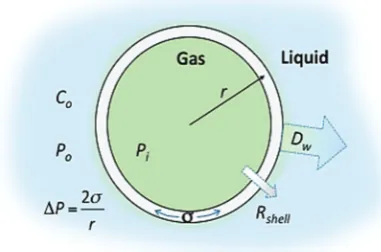
Control over thein vitroandin vivostability (or lifetime) of MBs depends upon three main considerations; (i) the condi-tions of the surrounding medium, such as the temperature, pressure and concentration of the dissolved gas, (ii) the MB shell composition (which controls the surface tension and the resistance to permeation) and (iii) the solubility of the encapsulated gas core in the medium.23 In 1950 Epstein and Plesset introduced a model describing the rate of growth and/or dissolution of ‘‘shell-less’’ or ‘‘uncoated’’ bubbles in aqueous media and showed them to be critically dependent on the diffusion of gas away from the bubble surface,Dw, the degree
of saturation of the solution,f(=C0/Cs), and the initial bubble
radius,r(Fig. 1).C0is the concentration of dissolved gas and Cs is the concentration at saturation.24 More recently Borden
and Longo suggested a modified version of the Epstein–Plesset model, as shown in eqn (1), that included the effect of the MB coating as a barrier against gas diffusion,Rshell, and a modifier of
the surface tension,s.25
dr
dt ¼ H r DwþRshell
1þ2s
Parf
1þ 4s 3Par
!
(1)
whereHis the Ostwald coefficient for the gas (the ratio of the gas concentration in the aqueous phase to that in the gas phase in contact with the aqueous phase).26,27
The Laplace pressure, DP, places the gas core under increased pressure due to surface tension and curvature effects and thus provides a strong driving force for MB dissolution.28 The inclusion of surfactants, in our case lipids, at the gas/liquid interface significantly reduces the surface tension and, con-sequently, the Laplace pressure.29,30 Such surfactants also provide a resistive barrier, Rshell, to gas leaving the MB and
dissolving into the aqueous phase. Important shell properties that affect the bubble stability are surface tension, surface
hardening, and resistance to gas transport.30–32 Borden and Longo25showed that MB stability is strongly dependent on the lipid shell resistance and increases with the increasing acyl chain length of the lipids.33–36They also showed that increasing
the acyl chain length between DPPC (16) and DBPC (24) increases the lipid rigidity (Wrinkling threshold) and con-sequently the MB stability and circulation time. The use of higher molecular weight, less soluble gases such as SF6and
perfluoro-carbons (PFCs) also significantly enhances MB lifetime and permits diagnostic and therapeutic applications.5,23,27,37Several groups have investigated the effect of different gases, or gas mixtures, on MB stability. Sarkeret al.27,38developed a modified EP model for gas diffusion from MBs filled with air and PFC gas and showed that the dependence of shell permeability to gas type predicts a 500increase in the time taken for MB dissolution for PFC compared to air filled bubbles. Kraftet al.used acoustical methods, to investigate the effect of the gas composition on the size and stability of shelled MBs. Using bubbles filled with nitrogen and saturated with perfluorohexane, they reported that the PFC gas increased the compressibility of the lipid monolayer resulting in more flexible and stable MBs.39,40Kabalnovet al.26,41
presented a detailed model andin vivoexperimental studies on the efficacy of different PFC gases (as osmotic agents) mixed with oxygen or nitrogen on MB dissolution in the blood stream. They showed an increase in the bubble lifetime with the increasing molecular weight of the osmotic agent when mixed with oxygen. Increasing the PFC molecular weight beyond C6F14does not have
a positive effect. Finally, Schuttet al. encapsulated a mixture of different PFCs in their gaseous state, to show that MBs containing mixtures of C4F10and C6F14persist for 3 min, which was longer
than with either gas on its own.28,42
The combined effect of saturation of the surrounding medium,f, and different MB shells,Rshell, was investigated by
Kwan and Borden in 2010.43 Sulphur hexafluoride, SF 6, was
encapsulated in SDS or lipid shell MBs and used in a modified perfusion chamber to observe the MB dissolution behaviour in a SF6or air-saturated medium. When suddenly placed in an
air-saturated medium, MBs initially grow (air influx) and then decrease in size as a result of SF6 efflux. Lipid coated MBs
deviated from the model, as when placed in an air-saturated environment, the initial growth regime was shorter and it was followed by rapid non-uniform dissolution to the original diameter, and then a steady dissolution with a constant wall velocity and final stability at around 10mm in diameter.
For the studies reported here, MF-MBs were produced with an average diameter of 2mm. The stability of the population was examined in vitro, at 37 1C, and in vivo using mouse
models. The aim of the study was to optimize the in vivo
lifetime of the MF-MBs. Factors investigated include: shell resistance,Rshell, through control over the lipid compositions,
and gas dissolution, (Dw, f, H), through control over the
molecular weight of the gas and saturation of the surrounding medium. By optimising these factors we achieved a prolonged lifetime of MBs in vivo. Our optimised MBs have lifetimes of 414 minutes in vivo and also retain excellent ultrasound contrast enhancement properties.
Fig. 1 Schematic representation of a lipid shelled MB illustrating the factors that affect MB lifetime. The different terms are defined in the text.
Open Access Article. Published on 28 July 2016. Downloaded on 24/10/2016 11:42:11.
This article is licensed under a
[image:2.595.69.260.558.684.2]2 Materials and methods
2.1 MaterialsThe lipids used throughout this study were
1,2-dipalmitoyl-sn-glycero-3-phosphocholine (DPPC), 1,2-distearoyl-sn-glycero -3-phosphocholine (DSPC), 1,2-distearoyl-sn-glycero -3-phosphoethanol-amine-N-[methoxy(polyethylene-glycol)-2000] (DSPE-PEG2000), and
1,2-dipalmitoyl-sn-glycero-3-phosphoethanolamine-N -[methoxy-(polyethyleneglycol)-5000] (DPPE-PEG5000) which were purchased
from Avanti Polar Lipids (Alabaster, AL, USA) and used without further purification. All lipids were received in the powder form, and then dissolved in a 50/50 chloroform/methanol solution.
2.2 Microbubble preparation and characterisation
The lipid composition as specified for each MB formulation was prepared as described previously.19,44 Briefly, the lipid mixture was dried under a steady stream of nitrogen gas on the vial walls. This dried film was then suspended in a solution containing 4 mg mL1NaCl and 1% glycerine (499%,
Sigma-Aldrich, St. Louis, MO, USA) to a final lipid concentration of 1 mg mL1 unless otherwise specified. This solution was vortexed for 1 minute before being placed in an ultrasonic bath for 1 hour. The lipid solutions were allowed to cool down in the fridge for 5 minutes prior to use in the MF-MB maker.
Polymethylmethacrylate (PMMA) MF-chips, designed in Leeds and produced by Epigem plc (Redcar, UK), were used to prepare MBs according to our previously described protocols, in which gas flow is focussed through a nozzle before being rapidly expanded to create a microspray regime.19 Two gases were investigated of different molecular weight: perfluoro-propane gas (C3F8), Mw = 188 g mol1; and perfluorobutane
(C4F10), Mw = 238 g mol1. The gas pressure was controlled
using a Kukuke microprecision regulator (RS supplies, Leeds, UK). The flow rate of the liquid phase, containing the lipid products, was controlled using an Aladdin AL 2000 syringe pump (World Precision Instruments, Stevenage, UK). The flow rate was fixed for all MB preparations at 80mL min1. In some cases tetradecafluorohexane (C6F14, Sigma-Aldrich, St. Louis,
MO, USA) was used to saturate the lipid solution (10mL). A typical production run produced 1 mL of MBs. For each MB population formed, a 10 mL sample (collected from the middle of the homogenous MB solution) was diluted 10-fold to facilitate counting and sizing of the bubbles. From this diluted sample 30mL was introduced into a 50mm chamber on a glass slide. The MBs were allowed to rise for B1 minute before acquiring images. An inverted microscope (Nikon, Japan) was used to image the MBs at 60 magnification. A CCD camera (DS-Fil 5 Mega pixel, Nikon, Japan) was used to capture 40 images of each sample, from which the concentration and size distribution were obtained using Image J freeware (http:// rsbweb.nih.gov/ij/) and statistically analysed using Origin Pro (Version 8.5 or later).
2.3 In vitrolifetime
The MB lifetime was measuredin vitroas described previously.45 Briefly, 500mL of MB solution was introduced into 500mL of cell
medium [RPMI from Invitrogen, Life Technologies, UK, with 10% (v/v) foetal calf serum (Sigma Aldrich, UK)] and incubated at 371C in a digital dryblock heater (Model D1100, Labnet
Inter-national, USA). The vial containing the sample was left open exposed to air and 10mL samples were collected every 15 min for sizing and counting.
2.4 In vivolifetime
For in vivo measurements 50 to 100 mL of the MB solution (in PBS) was injected via a syringe attached to a tail vein catheter. The injection of the MB bolus was controlled by a syringe driver at a rate of 0.6 mL min1. A typical bolus
containedB108MBs in 100mL.
All animal work was performed under licence and in accordance with the UK Animals (Scientific Procedures) Act 1986 following local ethical review and procedures. Eighteen athymic CD1-nu/nu male mice (6–8 weeks old) were maintained in individual ventilated cages under specific pathogen-free conditions with free access to diet and water.
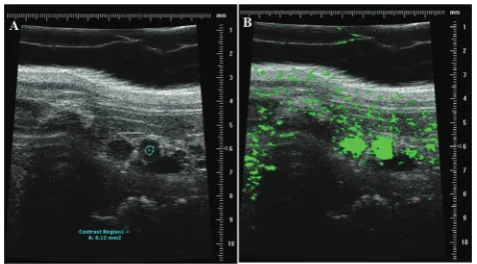
The mouse aorta was identified and imaged by pulsed wave (PW) Doppler imaging using a Vevo770 (FUJIFILM VisualSonics, Inc.) using the 40 MHz transducer. For post-processing analysis, a region of interest (ROI) was drawn within the aorta such that the ROI was maintained within the aorta for the whole video loop, ensuring that with respiration motion, the ROI was not sampling tissue outside the aorta, as indicated by the blue circle in Fig. 2A. Fig. 2B shows a snapshot of the accumulation of MBs in the aorta post injection.
2.5 Langmuir trough
A Langmuir trough (KSV Nima) was used to measure the differences in monolayer compressability and elasticity. The trough was equipped with two movable PTFE barriers to compress the monolayer symmetrically. A Wilhelmy plate tensiometer (paper method) was used to measure the surface pressure of the monolayer. This experiment was performed for the same lipid monolayer composition found to form the most stable MBs. 20mL of a 1 mg mL1solution of (DPPC + 5% DSPE-PEG2000),
in chloroform, was spread on the surface of a subphase of water
Fig. 2 In vivoimaging of mouse aorta with high frequency ultrasound. (A) A region of interest (ROI) within the aorta was selected for post-processing analysis (blue region) to determine the contrast intensity within the aorta over time. (B) Example image showing the aorta post injection filled with MBs.
Open Access Article. Published on 28 July 2016. Downloaded on 24/10/2016 11:42:11.
This article is licensed under a
[image:3.595.309.548.540.672.2]in the presence and absence of C6F14. Pressure–area isotherms
were made with the compression rate of the barriers set to 5 mm min1and the surface pressure was not allowed to rise
beyond 30 mN m1; this ensured the reversibility of the
isotherms and allowed us to observe multiple compression/ expansion cycles, which is important for the determination of whether any material is lost from the monolayer during compression.
3 Results
3.1 Microbubble production and characterisation
MBs were prepared in the spray regime of a specially designed MF-chip19shown schematically in Fig. 3A. The image (inset) in Fig. 3B shows a typical MB population, with an average MB diameter of 1.7 1.1 mm and concentrations of B2 109 MB mL1. No bubbles were produced with a diameter47mm.
3.2 MB lifetime
In vitroMB lifetime was initially determined by measuring the MB concentration, using optical microscopy, every 30 min in a closed vial at room temperature and atmospheric pressure. MB concentrationversus time (in vitro results) for MBs prepared with shells of DPPC (or DSPC) with 10% DSPE-PEG2000
encap-sulating C3F8gas was tested (see S1, ESI†). The data showed
that the MBs were relatively long lived in both cases,i.e. for both lipid types, with no significant difference in their stability over a period of B3 h following production. In contrast, the
in vivolifetime in the mouse aorta, as determined from time– intensity curves (TICs), showed that both MBs decayed within 2 minutesin vivo. A slightly higher acoustic intensity signal was observed for the DPPC MBs compared to the DSPC ones, which is consistent with previous observations for such MBs.46These initial results showed that thein vitro study of MBs, at room temperature and atmospheric pressure, is not a good indicator of the in vivo behaviour and that physiological conditions (increased temperature, pressure and potential for gas exchange around the MBs) are likely to significantly affect the MB stability. Thus, in order to better test our MBs under more realistic conditions thein vitro experiment was modified to use a cell medium (RPMI with 10% (v/v) foetal calf serum) incubated at
371C and the sample was left in an open tube exposed to air for
gaseous exchange. Based on thein vivodata (S1, ESI†), and that DPPC MBs have a more homogenous lipid distribution on the bubble shell,47the slightly shorter DPPC (16 : 0) lipid was chosen
for subsequent MB studies over the DSPC (18 : 0). A series of factors were investigated to detect their effect on MB stability, firstlyin vitro
and thenin vivo. These included: (i) the degree of pegylation in the MB shell, which affects the potential for phase separation;45,48 (ii) the gas core, by switching to a heavier gas (C4F10) to reduce
solubility and diffusivity in the surrounding medium; and finally (iii) factors related to the surrounding solution, such as super saturating the lipid solution with C3F8gas prior to bubble
produc-tion, and also increasing the concentration of NaCl in the lipid solution to over 0.1 M to prevent bubble fusion.49
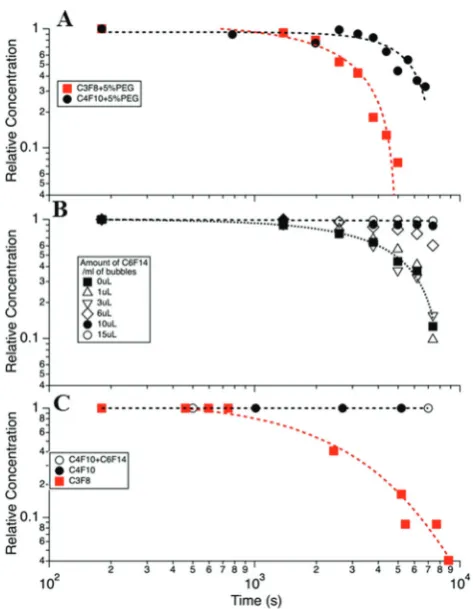
Of the factors identified above only two showed a significant effect on MB stability. Summary data has been taken from a larger data set of the variables investigated, which is detailed in the ESI†(S2). The first significant effect was that on changing from the C3F8core to the higher molecular weight C4F10 gas,
the MB population displayed a doubling in lifetime from the order of one to two hours (at 371C) Fig. 4A. This effect is well
understood and is due to the reduced solubility of the higher
Fig. 3 Bubble production and characterisation. (A) A schematic of the microfluidic chip design emphasizing the 3D expansion region for the production of MBs in the spray regime. (B) Graph displaying the size distribution for one of the bubble populations. The inset shows a bright field image representing the produced MBs (sample is 10-fold diluted).
Fig. 4 (A) MB concentrationversustime for DPPC + 5% PEG DSPE MBs with C3F8and C4F10gas cores. (B) The effect of adding liquid C6F14to the
MB bolus, in increasing amounts from 0 to 15mL mL1, on MB lifetime. (C) Calculated lifetime expected for the MB distribution profile shown in Fig. 3 for 3 cases, (i) with a C3F8core, (ii) with a C4F10core and (iii) C4F10+ C6F14
(open circles). The parameters for calculations were taken from Sarkar27and
given in detail in the ESI†(S4). All data was taken at 371C in cell media and at atmospheric pressure.
Open Access Article. Published on 28 July 2016. Downloaded on 24/10/2016 11:42:11.
This article is licensed under a
[image:4.595.309.546.327.632.2] [image:4.595.46.286.554.663.2]Mw gas in solution (the Ostwald coefficient reduces from
5.2104for C3F8to 2.0104for C4F10), a slightly reduced
diffusion rate in water (from 7.451010for C
3F8to 6.91010
for C4F10) and an increase in the resistance of the shell
to the increased Mw gas. These effects have been modelled
in S3 in the ESI†, following the work of Sarkar et al.27,38for
MBs with different cores and assuming the surface tension of the shelled MBs to be 25 mN m1.
Decreasing the PEG concentration from 10% to 5% led to a modest increase in the average lifetime (S4, ESI†). However, in spite of this significant improvement in the in vitrolifetime, at body temperature, these formulations showed negligible improvement in thein vivo MB lifetime, as indicated by the TIC curves (S4, ESI†).
To control the saturation,f, or solubility of the gas in the solution,H, the medium containing the MBs was saturated with C6F14, which is a liquid at room temperature. The solubility of
C6F14in water, at 251C, is 2.7104mol L1, which is equivalent
toB0.05mL for 1 mL of the lipid solution.11,50The volume of
C6F14per mL of MB was varied between 0 and 15 mL mL1in
the lipid solution (DPPC + 5% DSPE-PEG2000) to determine the
optimum concentration at which the MBs have the longest life-time. Fig. 4B shows the fraction of bubbles remaining in the medium at 371C, as a function of time for different volumes of
C6F14added to a 1 mL MB bolus. The data shows that MB lifetime
was significantly increased upon the addition of C6F14 for
con-centrationsZ6mL mL1, with the 15mL mL1sample producing the most stable MB population. However, the addition of such volumes of C6F14adversely affected the MB production leading to
a 10-fold reduction in the concentration of MBs produced. Thus the addition of 10mL of C6F14was selected as being the optimal
amount. At this concentration MBs were still produced at a high concentration ofB1109MB mL1whilst also increasing MBs stability. The MB decay rate was reduced to only 0.07% over the 2 h period.
Fig. 4C shows the calculated MB population profile expected based on the calculation of a typical MB distribution, given in Fig. 3B, and that the MBs decay in accordance with the modified Epstein–Plesset model proposed by Borden25 and Sarkar.27 In these models the surface tension was assumed to
be 25 mN m1and the saturation,f, was taken as unity, and all other parameters are given in the ESI.†We note that in this model MBs of a diametero0.5mm were considered to not be observable optically and so bubbles were removed from the MB population when their size decreased below 0.5mm. Essentially we see the expected trend that C4F104C3F8, however we note
that the model predicts longer lifetimes than were experi-mentally observed, probably indicating that the MB surface tension, shell resistance and/or the degree of saturation are not accurately modelled in our system.
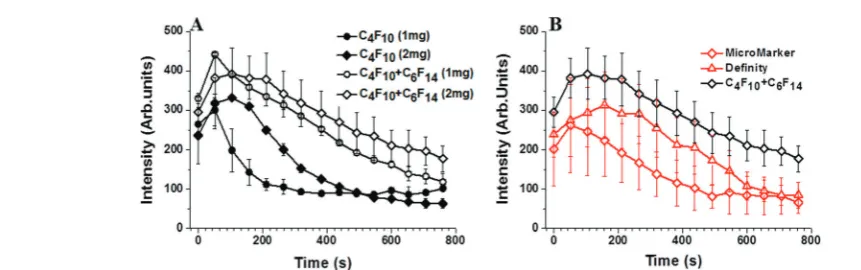
Fig. 5A shows thein vivoTIC for four different MB variants, comparing both the effect of the presence of C6F14in the bolus
and the concentration of the lipid. Comparison of the area under the curves for the cases with and without C6F14 clearly
indicates that the presence of C6F14 significantly enhances
MB persistence in the bloodstream. Furthermore, by doubling the lipid concentration, from 1 mg mL1to 2 mg mL1, during the production of the MBs, the concentration of the MBs was doubled from 1109to 2109MB mL1, and the lifetime was
modestly enhanced, leading to a larger area beneath the TIC curves. Fig. 5B shows the TIC curves for our bestin vivoMB in comparison to those obtained using commercially available MBs (Micromarker (MM), Definity).
For each MB population the intensity versus time curves were collected from 5 mice, and from each curve 6 different parameters were extracted, as shown in Fig. 6A. These can facilitate the comparison of the different MBs and aid the determination of the one with the best properties for in vivo
imaging. These parameters are presented with the codes as follows: (1) rate of decay. This can be calculated from the slope of the curve after the peak point. The smaller the decay rate the longer the MB lifetime. (2) Peak enhancement, which is the point at the highest contrast intensity. This mainly depends on the MB shell properties and concentration. (3) Area under the curve, which is proportional to both the MB concentration and persistence time. A greater area indicates better quality and stability of MBs. (4) Time to peak, which is the time to reach the maximum intensity at the ROI. It is better if this is short. (5) Peak enhancement duration, which is the time at which there was the highest contrast intensity after injection. (6) Time to
Fig. 5 Ultrasound time intensity curves in mice aorta. (A) shows the effect of increasing the final lipid concentration, and saturating the lipid solution with C6F14on MB lifetime for MBs made with DPPC + 5% PEG2000and encapsulating C4F10gas. (B) compares TIC curves for our improved in-house MBs and
commercial MBs.
Open Access Article. Published on 28 July 2016. Downloaded on 24/10/2016 11:42:11.
This article is licensed under a
[image:5.595.57.488.546.681.2]half peak contrast. The longer this parameter is, the more prolonged the lifetime of the MBs is at the ROI.
Fig. 6B shows the data analysis for the TIC curves comparing the six parameters between our in-house MF-MBs and the commercially available MBs. The data suggests that the MF-MBs produced in-house display an improved peak enhancement and area under the curve, and a significantly longer time to half peak. In order to understand the role of C6F14 in enhancing MB
lifetime, a Langmuir trough was used to plot the relationship of the surface pressure,P(mN m1),versusthe average molecular area, for a 1 mg mL1(DPPC + 5% PEG2000) solution spread at
the air/water interface in the presence and absence of C6F14in
the sub-phase. Fig. 7 shows the compression isotherms of the
monolayer. All conditions are fixed for both cases with the only difference being the sub-phase; either just with MilliQ water or MilliQ water plus C6F14at the same concentration used during
MB production (10mL mL1).
The mean molecular area was found to increase from 0.5 nm2 to 0.63 nm2upon the inclusion of C6F14 in the
sub-phase, which indicates the incorporation of the C6F14molecules
within the lipid layer. The fractional component of C6F14in the MB
shell was calculated to be 0.4, which means an estimation of 2 PFC molecules for every 5 lipid molecules. As a consequence of incorporating C6F14(surface tension 11 mN m1 51) at this
propor-tion in the lipid layer, the surface tension of the monolayer is reduced from 25 mN m1 27,38to 19 mN m1. Consequently, this leads to a reduction in the Laplace pressure from 50103N m1 in the absence of C6F14, to 38 103N m1 in the presence of
C6F14, which leads to an improved estimate in the MB lifetime.
The hollow circles in Fig. 4C indicate the predicted enhancement in MB lifetime due to the reduction in surface tension. This is shown more clearly in S3 (ESI†).
The isothermal compressibility, C, and the compression modulus (elasticity), K, of the lipid modified interface are calculated from the extrapolated lines shown on the isotherm (Fig. 7). These calculations showed that the existence of PFC in the surrounding solution increased the compressibility (C) from 1.0102to 1.2102m mN1, which corresponds to a decrease in the elasticity (K) from 97 mN m1to 88 mN m1in the presence of PFC molecules. These results are in good agreement with the previously published work by Krafft39 on the effect of saturating the surrounding air with different PFC gases on the compressibility and elasticity of lipid monolayers.
4 Discussion and conclusion
MB lifetime stability has been investigated by changing different factors that are known to have an effect on MB lifetime. The MB architectures have a shell comprising a DPPC/DSPE-PEG2000 Fig. 6 In vivoTIC analysis. (A) shows an example time–intensity curve
(TIC) for MB flow in a mouse aorta and defines six key parameters for defining MB lifetime: (1) is the decay rate calculated from the slope of the curve after the peak intensity, the slower the decay rate the greater the MB stability; (2) is the peak enhancement, which is the maximum intensity signal, and is due to the MB shell properties as well as the gas used; (3) is the area under the curve, which indicates the signal from the total MB population present and therefore the concentration of MBs; (4) is the time to peak, which is the time to reach the peak signal intensity, it should be short enough to enable imaging within a realistic time-frame; (5) is the peak enhancement duration, which is the length of time the MB signal persists, this needs to be of sufficient duration to allow a useful imaging session following MB injection; (6) is the time to half peak, which is the time it takes the signal to reduce to half the peak intensity, which is a further measure of the duration of the signal. (B) The six parameters for our in-house MBs and two commercial MB formulations. In-house MBs showed (1) slower decay rate, (2) improved peak enhancement signal and (5) duration, (3) larger area under the curve, (4) shorter time after injection to reach the maximum intensity, and (6) significantly longer time to half peak, indicating betterin vivostability, better contrast enhancement and longer imaging time.
Fig. 7 Langmuir isotherms of DPPC + 5% DSPE-PEG2000monolayers, on
water sub-phase (black) and water with 10mL mL1C6F14added to the
sub-phase (red). Dashed lines show the extrapolated average molecular area for the DPPC/DSPE-PEG2000phase.
Open Access Article. Published on 28 July 2016. Downloaded on 24/10/2016 11:42:11.
This article is licensed under a
[image:6.595.326.530.47.206.2] [image:6.595.51.284.49.333.2]binary system, the components of which are completely miscible below 15% PEG2000concentrations forming a single condensed
phase with low permeability.52We have previously shown that
reducing the PEG2000 concentration from 10 to 5% helped
increase the MB lifetime.45 MB lifetime was also improved by
changing the encapsulated gas from C3F8to one with a larger
molecular weight, i.e. C4F10. This decreases the coefficient of
diffusivity from 7.451010to 6.91010m2s1.27Combining the changes outlined above has resulted in a considerable improvement in thein vitrolifetime of the MBs, as discussed in the Results section above.
Recently, C6F14 has been encapsulated together with Dox
or gold nano-rods in nanoparticles and locally activated at the site of a tumour to form MBs, and C6F14had been shown to
enhance the acoustic imaging, cavitation and therapeutic delivery effects.53,54In this work, saturating the medium sur-rounding the MBs with liquid C6F14and using C4F10in the gas
core are considered key to the improvements in MB lifetime. The presence of C6F14 in the surrounding medium increased
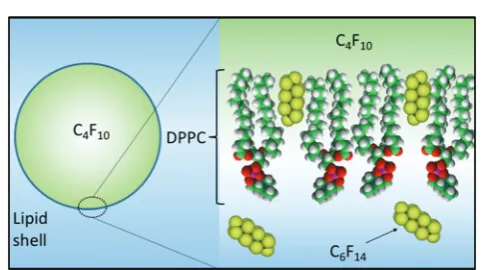
the stability and lifetime of the MBsin vitro and showed an improvement of up to 14 minin vivo(Fig. 5). We believe this improvement in stability arises for two reasons (Fig. 8); firstly, the addition of C6F14effectively results in the saturation of the
surrounding medium, reducing the ability for C4F10to partition
into the aqueous phase. Secondly, the incorporation of C6F14
molecules into the lipid shell of the MB, as concluded from Fig. 7, leads to a 25% reduction in the surface tension of the membrane, and hence also a reduction in the Laplace driving force for dissolution. This also modifies the mechanical properties of the shell, where a 17% increase in the compressibility is observed accompanied by a 10% decrease in the shell elasticity. The effect of saturating the gas medium with PFC gases on the lipid monolayers has been studied by Gerber et al.,55,56 who saturated the atmosphere above the Langmuir monolayer of DPPC with vapours of C6F14. They reported that saturating the gaseous
medium with PFC gas has a fluidizing effect on the DPPC monolayer adsorption at the gas/water interface, as it prevents the liquid condensed phase formation and hinders lipid crystal-lisation. Krafftet al.39 also demonstrated that DMPC lipid shell
MBs showed a 20% increase in compressibility of the membrane and a 26% decrease in the surface tension upon saturating the air with C6F14 in the gas medium. Krafft and Fainerman et al.57,58
theoretically modelled and practically showed that in case of DPPC monolayers, saturating the gas phase with C6F14 led to C6F14
molecules being adsorbed at the lipid surface, causing a reduction in the energy of attraction between the DPPC molecules, which leads to a fluidization of the monolayer. From the data shown here it appears that the surface tension alone is not a significant enough change to account for the increased MB stability and thus we also believe that the inclusion of the C6F14molecules into the
lipid chain must also increase the shell resistance.
In vivoMB lifetime improved from 2 min to 14 min through a combination of changes to the lipid shell, the gas core and the addition of C6F14 to the medium. Furthermore, comparing
in-house MF-MBs and commercial MBs (Fig. 5) showed that the sat-C4F10 MBs provided enhanced lifetime and contrast
properties compared to their commercial counterparts. In conclusion, control of MB properties including decay rate, intensity and enhancement duration, was achieved by changing the phospholipid shell composition, the encapsu-lated gas and, most significantly, the degree of saturation of the surrounding medium with C6F14. Our data suggests the
C6F14 molecules are incorporated in the lipid shell reducing
the surface tension and also increasing the mechanical com-pressibility and collapse pressure. MBs for drug delivery appli-cations are likely to require longer lifetimes to allow for accumulation at the ROI for optimal dose delivery and will thus benefit greatly from such improvements.
Acknowledgements
The authors would like to acknowledge the EPSRC for funding (EP/I000623, EP/K023845) and thank the Microbubble Consortium (http://www.microbubbles.leeds.ac.uk/) at the University of Leeds for useful discussions. The data presented in this article are openly available from the University of Leeds Data Repository http://doi. org/10.5518/68.
References
1 S. B. Feinstein,Am. J. Physiol.: Heart Circ. Physiol., 2004,287, H450–457.
2 J. R. Lindner,Nat. Rev. Drug Discovery, 2004,3, 527–532. 3 B. Geers, I. Lentacker, N. N. Sanders, J. Demeester, S. Meairs
and S. C. De Smedt, J. Controlled Release, 2011, 152, 249–256.
4 J. R. McLaughlan, N. Ingram, R. H. Abou-Saleh, S. Harput, T. Evans, S. D. Evans, L. Coletta and S. Freear,High-Frequency Subharmonic Imaging of Liposome-Loaded Microbubbles, Prague, 2013.
5 E. C. Unger, T. Porter, W. Culp, R. LaBell, T. Matsunaga and R. Zutshi,Adv. Drug Delivery Rev., 2004,56, 1291–1314. 6 J. Zhang, Y. Luan, Z. Lyu, L. Wang, L. Xu, K. Yuan, F. Pan,
M. Lai, Z. Liu and W. Chen,Nanoscale, 2015,7, 14881–14888.
Fig. 8 Schematic diagram showing (i) the incorporation of C6F14into the
MB shell thereby reducing surface tension and the Laplace driving force for dissolution and (ii) the saturation of the medium with C6F14 thereby
reducing the solubility of C4F10in the ambient phase.
Open Access Article. Published on 28 July 2016. Downloaded on 24/10/2016 11:42:11.
This article is licensed under a
[image:7.595.46.289.537.672.2]7 F. Cavalieri, I. Finelli, M. Tortora, P. Mozetic, E. Chiessi, F. Polizio, T. B. Brismar and G. Paradossi, Chem. Mater., 2008,20, 3254–3258.
8 B. Geers, I. Lentacker, N. N. Sanders, J. Demeester, S. Meairs and S. C. De Smedt,J. Controlled Release, 2011,152, 249–256. 9 R. Chen, Y. Luan, Z. Liu, W. Song, L. Wu, M. Li, J. Yang, X. Liu, T. Wang, J. Liu and Z. Ye, BioMed Res. Int., 2015,
2015, 514234.
10 Y. Luan, Z. Chen, G. Xie, J. Chen, A. Lu, C. Li, H. Fu, Z. Ma and J. Wang,J. Nanosci. Nanotechnol., 2015,15, 1357–1361. 11 E. G. Schutt, D. H. Klein, R. M. Mattrey and J. G. Riess,
Angew. Chem., Int. Ed., 2003,42, 3218–3235.
12 C. Christiansen, H. Kryvi, P. C. Sontum and T. Skotland,
Biotechnol. Appl. Biochem., 1994,19(pt 3), 307–320.
13 G. Pu, M. A. Borden and M. L. Longo,Langmuir, 2006,22, 2993–2999.
14 E. Stride and M. Edirisinghe,Med. Biol. Eng. Comput., 2009,
47, 883–892.
15 J. R. Lindner, M. P. Coggins, S. Kaul, A. L. Klibanov, G. H. Brandenburger and K. Ley,Circulation, 2000,101, 668–675. 16 J. R. Lindner, P. A. Dayton, M. P. Coggins, K. Ley, J. Song,
K. Ferrara and S. Kaul,Circulation, 2000,102, 531–538. 17 U. Farook, H. B. Zhang, M. J. Edirisinghe, E. Stride and
N. Saffari,J. Biomed. Eng., 2007,29, 749–754.
18 M. Hashimoto and G. M. Whitesides, Small, 2010, 6, 1051–1059.
19 S. A. Peyman, R. H. Abou-Saleh, J. R. McLaughlan, N. Ingram, B. R. G. Johnson, K. Critchley, S. Freear, J. A. Evans, A. F. Markham, P. L. Coletta and S. D. Evans,
Lab Chip, 2012,12, 4544–4552.
20 E. Talu, K. Hettiarachchi, R. L. Powell, A. P. Lee, P. A. Dayton and M. L. Longo,Langmuir, 2008,24, 1745–1749.
21 E. Talu, K. Hettiarachchi, S. Zhao, R. L. Powell, A. P. Lee, M. L. Longo and P. A. Dayton, Mol. Imaging, 2007, 6, 384–392.
22 S. A. Peyman, J. R. McLaughlan, R. H. Abou-Saleh, G. Marston, B. R. Johnson, S. Freear, P. L. Coletta, A. F. Markham and S. D. Evans,Lab Chip, 2016,16, 679–687. 23 J. J. Kwan and M. A. Borden,Adv. Colloid Interface Sci., 2012,
183, 82–99.
24 P. S. Epstein and M. S. Plesset,Adv. Colloid Interface Sci., 1950,183, 82–99.
25 M. A. Borden and M. L. Longo,Langmuir, 2002,18, 9225–9233. 26 A. Kabalnov, D. Klein, T. Pelura, E. Schutt and J. Weers,
Ultrasound Med. Biol., 1998,24, 739–749.
27 K. Sarkar, A. Katiyar and P. Jain,Ultrasound Med. Biol., 2009,
35, 1385–1396.
28 E. G. Schutt, D. P. Evitts, C. D. Anderson and J. G. Weers,
US Pat., US 6953569 B2, 2005.
29 H. D. Van Liew and M. E. Burkard, Adv. Exp. Med. Biol., 1997,411, 395–401.
30 D. E. Yount,Aviat., Space Environ. Med., 1979,50, 44–50. 31 H. D. Van Liew and S. Raychaudhuri,J. Appl. Physiol., 1997,
82, 2045–2053.
32 C. Li, J. Chen, J. Wang, Z. Ma, P. Han, Y. Luan and A. Lu,Sci. Total Environ., 2015,521–522, 101–107.
33 B. A. Lewis and D. M. Engelman,J. Mol. Biol., 1983,166, 211–217.
34 K. H. Kim, S. Q. Choi, J. A. Zasadzinski and T. M. Squires,
Soft Matter, 2011,7, 7782–7789.
35 D. H. Kim, M. J. Costello, P. B. Duncan and D. Needham,
Langmuir, 2003,19, 8455–8466.
36 J. J. Kwan and M. A. Borden,Soft Matter, 2012,8, 4756–4766. 37 K. Ferrara, R. Pollard and M. Borden, Annu. Rev. Biomed.
Eng., 2007,9, 415–447.
38 A. Katiyar and K. Sarkar,J. Colloid Interface Sci., 2010,343, 42–47.
39 C. Szijjarto, S. Rossi, G. Waton and M. P. Krafft,Langmuir, 2012,28, 1182–1189.
40 S. Rossi, G. Waton and M. P. Krafft, Langmuir, 2010, 26, 1649–1655.
41 A. Kabalnov, J. Bradley, S. Flaim, D. Klein, T. Pelura, B. Peters, S. Otto, J. Reynolds, E. Schutt and J. Weers,
Ultrasound Med. Biol., 1998,24, 751–760.
42 E. G. Schutt, C. D. Anderson and D. P. Evitts, US Pat., 5605673, 1997.
43 J. J. Kwan and M. A. Borden,Langmuir, 2010,26, 6542–6548. 44 R. H. Abou-Saleh, S. A. Peyman, K. Critchley, S. D. Evans and
N. H. Thomson,Langmuir, 2013,29, 4096–4103.
45 R. H. Abou-Saleh, S. D. Evans and N. H. Thomson,Langmuir, 2014,30, 5557–5563.
46 T. V. Rooij, Y. Luan, G. Renaud, A. F. W. van der Steen, M. Versluis, N. De Jong and K. Kooiman,Ultrasound Med. Biol., 2015,41, 1432–1445.
47 K. Kooiman, T. J. A. Kokhuis, T. V. Rooij, I. Skachkov, A. Nigg, J. G. Bosch, A. F. W. van der Steen, W. A. van Cappellen and N. De Jong,Eur. J. Lipid Sci. Technol., 2014,
116, 1217–1227.
48 A. K. Kenworthy, S. A. Simon and T. J. McIntosh,Biophys. J., 1995,68, 1903–1920.
49 B. W. Ninham and P. Lo Nostro,Molecular forces and self assambly: in colloid, nano science and biology, Cambridge University Press, USA, 2010, ch. 8, pp. 232–249.
50 A. S. Kabalnov, K. N. Makarov and O. V. Scherbakova,
J. Fluorine Chem., 1990,50, 271–284.
51 Y. Luan, J. Xu, B. Huang, X. Liu, Y. Liu, L. Chen and X. Chu,
Zhonghua Xueyexue Zazhi, 2015,36, 286–290.
52 M. M. Lozano and M. L. Longo, Soft Matter, 2009, 5, 1822–1834.
53 J. Zhong, S. Yang, L. Wen and D. Xing,J. Controlled Release, 2016,226, 77–87.
54 N. Zhang, X. Cai, W. Gao, R. Wang, C. Xu, Y. Yao, L. Hao, D. Sheng, H. Chen, Z. Wang and Y. Zheng, Theranostics, 2016,6, 404–417.
55 F. Gerber, M. P. Krafft, T. F. Vandamme, M. Goldmann and P. Fontaine,Angew. Chem., Int. Ed., 2005,44, 2749–2752. 56 F. Gerber, M. P. Krafft, T. F. Vandamme, M. Goldmann and
P. Fontaine,Biophys. J., 2006,90, 3184–3192.
57 M. P. Krafft, V. B. Fainerman and R. Miller,Colloid Polym. Sci., 2015,293, 3091–3097.
58 V. B. Fainerman, E. V. Aksenenko and R. Miller,Adv. Colloid Interface Sci., 2015, DOI: 10.1016/j.cis.2015.11.004.
Open Access Article. Published on 28 July 2016. Downloaded on 24/10/2016 11:42:11.
This article is licensed under a