White Rose Research Online URL for this paper:
http://eprints.whiterose.ac.uk/116215/
Version: Accepted Version
Article:
Iten, Raban, Colbeck, Roger Andrew orcid.org/0000-0003-3591-0576 and Christandl,
Matthias (2017) Quantum Circuits for Quantum Channels. Physical Review A. 052316.
ISSN 1094-1622
https://doi.org/10.1103/PhysRevA.95.052316
[email protected] https://eprints.whiterose.ac.uk/ Reuse
Items deposited in White Rose Research Online are protected by copyright, with all rights reserved unless indicated otherwise. They may be downloaded and/or printed for private study, or other acts as permitted by national copyright laws. The publisher or other rights holders may allow further reproduction and re-use of the full text version. This is indicated by the licence information on the White Rose Research Online record for the item.
Takedown
If you consider content in White Rose Research Online to be in breach of UK law, please notify us by
Quantum Circuits for Quantum Channels
Raban Iten,1,∗ Roger Colbeck,2,† and Matthias Christandl3,‡ 1
Institute for Theoretical Physics, ETH Z¨urich, 8093 Z¨urich, Switzerland
2
Department of Mathematics, University of York, YO10 5DD, UK
3
QMATH, Department of Mathematical Sciences, University of Copenhagen, Universitetsparken 5, 2100 Copenhagen, Denmark
(Dated: 10th
May 2017)
We study the implementation of quantum channels with quantum computers while minimizing the experimental cost, measured in terms of the number of Controlled-not(C-not) gates required (single-qubit gates are free). We consider three different models. In the first, the Quantum Circuit Model (QCM), we consider sequences of single-qubit andC-notgates and allow qubits to be traced out at the end of the gate sequence. In the second (RandomQCM), we also allow external classical randomness. In the third (MeasuredQCM) we also allow measurements followed by operations that are classically controlled on the outcomes. We prove lower bounds on the number of C-not gates required and give near-optimal decompositions in almost all cases. Our main result is a MeasuredQCM circuit for any channel frommqubits tonqubits that uses at most one ancilla and has a lowC-not count. We give explicit examples for small numbers of qubits that provide the lowest knownC-notcounts.
I. INTRODUCTION
Quantum channels, mathematically described by com-pletely positive, trace-preserving maps, play an impor-tant role in quantum information theory because they are the most general evolutions quantum systems can undergo. The ability to experimentally perform an arbi-trary channel enables the simulation of noisy channels. For example, this is useful to test how a new component (e.g., a receiver) will perform when subjected to noise in a more controlled environment. Moreover, experimental groups can show their command over quantum systems consisting of a small number of qubits by demonstrat-ing the ability to perform arbitrary quantum channels on them (see for example [1] and references therein). Instead of building a different device for the implementation of each quantum channel, it is convenient to decompose ar-bitrary channels into a sequence of simple-to-perform op-erations. In this paper we work with a gate set consisting of C-not and single-qubit gates, which is universal [2].
However, note that the main ideas of our circuit con-structions and lower bounds generalize to arbitrary gate sets. The implementation of a C-not gate is usually
more prone to errors than the implementation of single-qubit gates. For example, the lowest achieved infidelities are by a factor of more than 10 smaller for single-qubit gates than for two qubit gates [3, 4]. This motivates us-ing the number ofC-notgates to measure the cost of a
quantum circuit.1
∗Electronic address: [email protected] †Electronic address:[email protected] ‡Electronic address:[email protected]
1 Certain experimental architectures only allow nearest neighbour C-notgates. Here we assign the same cost to eachC-notgate regardless of its interaction distance. However, our circuit con-structions for channels are based on decompositions of
isome-In this work we consider the construction of universal circuit topologies comprising gates from this universal set. A circuit topology [5, 6] corresponds to a set of quantum channels that have a particular structure but in which some gates may be free or have free parameters. Our aim is to find circuit topologies that minimize the C-notcount but are universal in the sense that any channel
frommtonqubits can be obtained by choosing the free parameters appropriately.
We work with three different models. In the first we considerthe quantum circuit model (QCM), in which we allow a sequence of C-not, single-qubit gates and
par-tial trace operations on the qubits and any ancilla. In the second (RandomQCM) we allow the use of classical randomness in addition. In the third (MeasuredQCM), we allow the operations of the QCM as well as measure-ments and operations that are classically controlled on the measurement outcomes.
A task that is related to the construction of a circuit to-pology is that of minimizing theC-notcount for a given
quantum channel (on a channel-by-channel basis). Al-though this appears quite different, we show that it is re-lated in the sense that our lower bounds on the number of
C-notgates for circuit topologies that are able to
gene-rate all quantum channels of Kraus rankKare also lower bounds for almost all (in a mathematical sense) quantum channels of Kraus rankK individually, where the Kraus rank of a channel is defined as the smallest number of Kraus operators required to represent the channel and is equal to the rank of the corresponding Choi state [7].
It is worth emphasizing that there is a (measure zero) set of channels for which our lower bounds do not apply individually, and this set contains experimentally
esting channels. In other words, there are circuits of lower cost than those given in this paper if the channel has a simple or special form. Nevertheless, our constructions could still be used as a starting point to find a low-cost circuit in such cases. Further optimizations could then be performed with algorithms such as, for example, the one given in [8].
For certain special cases, the theory of decomposing operations is quite developed. Considerable effort has been made to reduce the number of C-not gates
re-quired in the QCM for general unitary gates [9–14] and state preparation [13, 15], which are both examples of a wider class of operations, isometries. Recently, it was shown that every isometry from m to n qubits can be implemented by using about twice theC-not count
re-quired by a lower bound [16]. This leads to a method to implement quantum channels by using Stinespring’s the-orem [17], which states that every quantum channel from
mto nqubits can be implemented by an isometry from
mtom+2nqubits, followed by tracing outm+nqubits. The isometry can be decomposed into single-qubit gates and 4m+n C-nots to leading order [16]. Working in the
quantum circuit model thisC-notcount is optimal up to
a factor of about four to leading order [16]. However, one can significantly lower thisC-notcount and the required
number of ancillas in more general models.
Quantum operations beyond isometries have been in-vestigated in [18]. Although [18] did not focus on a de-composition into elementary gates, combining the decom-position in [18] with an idea given in [19] and with the circuits for isometries given in [16], leads to low-cost de-compositions of quantum channels into single-qubit and
C-notgates in the MeasuredQCM using only one ancilla
qubit. The combination of [18] and [19] was fleshed out in [20], which appeared shortly after the first version of the present work. In [20], several applications are also discussed.
In this work, we give a new decomposition and proof that also leads to near-optimal circuits for quantum chan-nels. In contrast to the work mentioned above, we con-sider channels that map between spaces with different di-mensions. Our decomposition can be used for arbitrary channels frommtonqubits (ifm= 0 our channels allow the preparation of arbitrary mixed states). In spite of the different proof technique, the form of decomposition has similarities with the one based on [18], which we discuss later.
Previously, the task of minimizing the number of re-quired C-notgates for the implementation of quantum
channels in the MeasuredQCM has been studied in the case of channels on a single qubit [21]. In the special case of a single-qubit channel, we recover a circuit to-pology (consisting of only one C-not gate) similar to
that given in [21]. We also note that Ans¨atze for de-compositions of arbitrary channels have been considered in [22, 23]. One of these, Ansatz 1 in [23], is based on ap-plying the Cosine-Sine decomposition to the Stinespring dilation isometry of the channel, and hence will always
work [16]. Our results imply that the Ansatz given in [22] (which is designed for the RandomQCM) cannot work in general because it does not have enough parameters.2
Further Ans¨atze are given in [23], but it is not proven whether these work. In contrast, our constructive de-compositions are proven to always work.
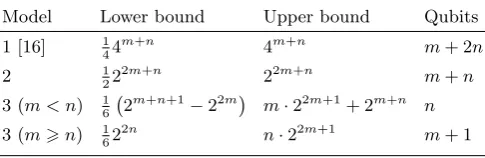
In the following we describe how to construct circuit topologies for quantum channels in the two aforemen-tioned generalizations of the quantum circuit model. Our asymptotic results are summarized in Table I. First, we show that in the QCM with additional classical random-ness (for free) the number of required ancillas can be reduced tomand theC-notcount to 22m+n to leading
order. Moreover, we derive a lower bound in this model, which shows thatmancillas are necessary and that our
C-notcount is optimal up to a factor of about two to
leading order.
Second, we show that the MeasuredQCM offers further improvement. Our main result is a decomposition scheme for arbitrarym tonchannels, which leads to the lowest knownC-notcount ofm·22m+1+ 2m+n ifm < n and
ofn·22m+1 ifm>n(to leading order). Moreover, our
construction shows that we can implementm to n6m
channels using onlym+ 1 qubits (i.e., one ancilla), and
m to n > m channels using n qubits (which is clearly minimal, because the output of the channel is ann-qubit state).
Our construction also leads to low-cost implementa-tions ofm tonchannels for smallmandn(as does the construction resulting from the combination of [18], [19] and [16]). We give the explicit MeasuredQCM topologies for m to n channels for 1 6 m, n 6 2 in Appendix A. These circuits are most likely to be of practical relevance for experiments performed in the near future. In particular, they show that every one to two channel can be implemented with 4 C-not gates, every two to one
channel with 7 and every two to two channel with 13. These counts are lower than those achieved by working in the QCM or the RandomQCM. For example, the best known implementation of a two to two channel in the quantum circuit model requires about 580C-nots.3
Allowing classical randomness reduces this count to 54
C-nots,4which is over four times ourC-notcount of 13
when measurement and classical control are also allowed. In future work, it would be interesting to generalize our circuit constructions for other universal gate sets. This could be achieved by finding circuits for isometries
2Note that some of the phrasing in [22] gives the impression that
this Ansatz is proven to work in all cases; however the authors confirmed that this is not intended.
3
This is an an upper bound based on the Column-by-Column Decomposition for isometries [16].
4This corresponds to the C-notcount for a two to four
3
TABLE I: Asymptotic upper and lower bounds on the number ofC-notgates formtonchannels in the three different mod-els (Model 1: QCM, Model 2: RandomQCM, and Model 3: MeasuredQCM). The total number of qubits required for the constructions is also indicated.
Model Lower bound Upper bound Qubits
1 [16] 1 44
m+n
4m+n
m+ 2n
2 1
22 2m+n
22m+n
m+n
3 (m < n) 1 6 2
m+n+1
−2
2m
m·22m+1
+ 2m+n
n
3 (m>n) 1 62
2n
n·22m+1
m+ 1
and then applying our construction for channels in the MeasuredQCM described in Section III A, which works independently of the chosen gate set. The ultimate goal would be to design an algorithm that takes as input a given set of gates, a noise model, an accuracy tolerance and a desired operation, and that gives as output a circuit composed of gates from the set that would approximate the desired operation to within the accuracy tolerance (if this is possible), with the number of gates in the cir-cuit being close to minimal. Note that the constructions introduced in this paper could be used as a subroutine in a version of this algorithm, and could serve as a start-ing point to which further optimizations (to remove gates where possible) are applied.
II. DECOMPOSITION ALLOWING CLASSICAL
RANDOMNESS
In the following, we consider the implementation of quantum channels in the RandomQCM, i.e., we allow classical randomness for free. Since the set of all quan-tum channels from mto n qubits is convex, everymto
n channel E can be decomposed into a (finite) convex combination of extrememtonchannels Ej.5
Physically this means that, allowing classical random-ness, the channel E = PJ
j=1pjEj can be implemented
by performing the channel Ej with probability pj (and
forgetting about the outcomej).
A. Upper bound
By Remark 6 of [7],6 every extreme channel from m
to n qubits has Kraus rank at most 2m. Stinespring’s
5 For a bound on the number of channels required see [26]. 6
In particular, Theorem 5 (and Remark 6) of [7] characterizes the extreme points of the set of all completely positive, unital maps. But the theorem (and the remark) can be adapted to trace preserving (completely positive) maps by considering the adjoint map (see [24] or [26] for more details).
theorem [17] then implies that in order to implement ev-ery extreme channel it suffices to be able to implement arbitrary isometries from m to m+n qubits. Decom-positions of such isometries use 22m+n C-not gates to
leading order [16]. In the following section, we derive a lower bound on the number ofC-notgates and ancilla
qubits required for m to n channels allowing classical randomness, which shows that theC-not count stated
above is optimal up to a factor of two in leading order and optimal in the number of required ancillas.
B. Lower bound
Because extreme channels cannot be decomposed into a convex combination of other channels, classical ran-domness cannot help implement them. Hence, a lower bound for extreme channels in the QCM is also a lower bound for channels in the RandomQCM. Since the set of extreme channels of Kraus rank 2m is nonempty [24],
at leastmancillas are required (using fewer ancillas, we could only generate channels of smaller Kraus rank).7 To find a lower bound on the number ofC-notgates
re-quired for a quantum circuit topology formtonextreme channels, we can use a parameter counting argument, similar to the argument used to derive a lower bound for unitaries [5, 6] or for channels in the quantum circuit model [16].
First, we count the number of (real) parameters re-quired to describe the set of all extreme channels.8
Every quantum channel E from m to n qubits with Kraus rank K can be represented by Kraus operators
Ai ∈ MatC(2n×2m) such that PKi=1A†iAi = I and
E(X) = PK
i=1AiXA†i [for allX ∈ MatC(2m×2m)] [7].
By Theorem 5 of [7],6 a channel E is extreme if and
only if all elements of the set{A†iAj}i,j∈{1,2,...,K}are
lin-early independent. EachmtonchannelE of Kraus rank
K= 2mcan be described byK2n×2m(complex)
matri-cesAi, which satisfy 4mindependent (note that the
ma-trixPK i=1A
†
iAi is Hermitian) conditions (overR).
How-ever, the Kraus representation is not unique. Two sets of Kraus operators {Ai}i∈{1,2,...,K} and {Bi}i∈{1,2,...,K}
describe the same channel if and only if there exists a unitaryU ∈ U(2m), such that A
i = PKj=1(U)i,jBj [7].
Since a 2m×2m unitary matrix is described by 4m
pa-rameters, we conclude that the set of all extreme channels formmtonqubits is described by 22m+n+1−22m+1
pa-rameters. Note that the condition that the elements in
7By a similar argument, one can see that the implementation of
channels in the quantum circuit model requiresm+nqubits.
8
{A†iAj}i,j∈{1,2,...,K} must be linearly independent is an
open condition forK= 2mand can therefore be ignored
for the parameter counting.
A quantum circuit topology for extrememton chan-nels must therefore introduce at least 22m+n+1−22m+1
parameters. SinceC-notgates cannot introduce
param-eters into a circuit topology, all the paramparam-eters have to be introduced by the single-qubit gates. We work with the following single-qubit rotation gates
Rx(θ) =
cos[θ/2] −i sin[θ/2]
−i sin[θ/2] cos[θ/2]
; (1)
Ry(θ) =
cos[θ/2] −sin[θ/2] sin[θ/2] cos[θ/2]
; (2)
Rz(θ) =
e−iθ/2 0
0 eiθ/2
. (3)
For every unitary operationU ∈U(2) acting on a sin-gle qubit, there exist real numbersα, β, γandδsuch that
U =eiαRz(β)Ry(γ)Rz(δ). (4)
A proof of this decomposition can be found in [25]. Note that (by symmetry) equation (4) holds for any two orthogonal rotation axes. The statement above can be represented as a circuit equivalence as follows.
U = Rz Ry Rz
The wire represents a qubit and the time flows from left to right. We ignore the global phase shift, because it is physically undetectable.
Let us consider l qubits, l −m of which start in a fixed (not necessarily product) state. We can act with a single-qubit gate on each qubit at the beginning of the quantum circuit topology (introducing 3l parameters). To introduce further (independent) parameters, we have to introduce C-not gates. Naively, one would expect
that every C-not gate can introduce six new
parame-ters by introducing a single-qubit gate after the control-and one after the action-part of it. But by the following commutation relation:
Rz Ry Rz • Rz Ry • Rz
=
Rx Ry Rx Rx Ry Rx
eachC-notgate can introduce at most four
parame-ters. Since we trace out l−n qubits at the end of the circuit, the single-qubit gates on these qubits can not in-troduce any parameters into the circuit topology [which removes 3(l−n) parameters]. We conclude that by us-ing r C-not gates we can introduce at most 4r+ 3n
parameters into the circuit topology. By the parameter count above, we require 4r+ 3n>22m+n+1−22m+1 or
equivalentlyr>22m−1(2n−1)−3
4nfor a quantum
cir-cuit topology that is able to perform arbitrary extreme channels frommtonqubits.
Remark 1 (Lower bound for nonexact circuits)
The derived lower bound can be strengthened and made more general (see [26]): the set of all quantum circuit topologies that have fewer than ⌈22m−1(2n−1)− 3
4n⌉ C-not gates, together,9 are not able to approximate
every m ton extreme channel arbitrarily well. In fact, they can only generate a closed set of measure zero10
in the smooth manifold of m to n extreme channels of Kraus rank 2m. Therefore, the lower bound holds for almost every m ton extreme channel of Kraus rank2m individually.
III. DECOMPOSITION ALLOWING
MEASUREMENT AND CLASSICAL CONTROL
We now move to the consideration of quantum circuit topologies in the MeasuredQCM where we allow mea-surements (of single qubits in the computational basis) and classical control on the measurement results (and an arbitrary number of ancillas). This generalizes the model used above, since classical randomness can be generated by preparing ancilla qubits in a certain state (by acting with single-qubit unitaries on them), performing mea-surements and then controlling the parameters of a cir-cuit topology on the measurement results. In the follow-ing section we describe how to construct circuit topolo-gies for arbitrarymtonchannels of Kraus rankK. Ap-plying this to extreme channels (which have Kraus rank at most 2m) leads to theC-notcounts given in Table I.
A similar result could be found by using the decomposi-tion described in [18] using binary search [19].
A. Upper bound
Let E be a channel from m to n qubits with Kraus rank K = 2k and Kraus operators {A
i}i∈{1,2,...,K}, Ai ∈ MatC(2n×2m). We define the matrix V =
[A1;A2;. . .;AK] ∈ MatC 2n+k×2m
, by stacking the Kraus operators.11 SinceV†V =PK
i=1A †
iAi=I, we can
consider the matrix V as an isometry from m to n+k
qubits (which corresponds to a Stinespring dilation of the channelE). Ifn+k=mork= 0, we can performE by implementingV and tracing outkqubits afterwards. In
9By combinatorial arguments, there are only finitely many
differ-ent quantum circuit topologies consisting of a fixed number of
C-notgates (w.l.o.g. we can consider circuit topologies in which
we perform single-qubit gates on all qubits at the start of the circuit and two after eachC-notgate).
10Nevertheless, many interesting operations lie in this set. This
is similar to the case of isometries, where, for example, the op-eration required to implement Shor’s algorithm [27] lies in (the analog of) this set [16].
11For example, we have [A 1;A2] :=
A1
A2
5 all other cases,12 we consider each half of the matrix V
separately and defineB0= [A1;A2;. . .;AK/2] and B1=
[AK/2+1;AK/2+2;. . . , AK]. By the QR-Decomposition
(for rectangular matrices), we can find unitary matri-ces Q0, Q1 ∈ U(2n+k−1) and R0, R1 ∈ {[T; 0;. . .; 0] ∈
MatC 2n+k−1×2m
: T ∈ MatC(2m×2m) is upper
triangular}, such that Q0R0 = B0 and Q1R1 = B1.
Note that Q0 and Q1 are not unique: indeed only the
first 2mcolumns are determined and the others are free
(up to orthonormality). We can therefore consider Q0
andQ1 as isometries from mton+k−1 qubits.
Sum-marized, we have (Q0 ⊕Q1)[R0;R1] = V and hence, R := [R0;R1] = (Q0⊕Q1)†V is an isometry. We can
represent this decomposition as an equivalence of circuit topologies onn+kqubits, where the firstn+k−mstart in the state|0ivia
|0i
V
|0i
R
|0i |0i
V′
..
. = ...
|0i |0i
m \ m \
where the backslash stands for a data bus of several (in this case m) qubits and V′ ={Q
0, Q1} is a placeholder
for two isometries in MatC 2n+k−1×2m. The unfilled
square denotes a uniform control.13 In the case above,
we implement Q0 if the most significant qubit is in the
state |0i and Q1 if it is in the state |1i. Note that the
gateRonly acts nontrivially on the most significant and them least significant qubits. In particular, the second to (n+k−m)th qubits are still in the state |0i after applying R (the lack of action of a gate on a particular qubit is indicated by use of a dotted line for that qubit). We can apply the same procedure to the isometries Q0
andQ1. We repeat this ˜ktimes, until we end up with a
quantum circuit topology of the form
|0i
V
|0i
R1
. . .
|0i |0i
R2 . . .
..
. = ... ... ...
|0i |0i . . .
R˜k
|0i⊗l \ |0i⊗l \ . . .
˜
V
m \ m \ . . .
where ˜V ∈MatC 2m+l×2m
is an isometry and where each gateRi acts nontrivially only on theith and them
12
Note that for all channels fromm to n qubits of Kraus rank
K= 2k
we have thatn+k>m(cf. Lemma 6 of [24]).
13The notation of “uniform control” was introduced in [12].
Some authors also call these gates “multiplexed” (for example, see [14]).
least significant qubits. Ifm < n, we set l=n−mand ˜
k=kand ifm>n, we setl= 1 and ˜k=n+k−m−1. Re-call that we can implement the channelEby applying the isometryV and tracing out the firstk qubits afterwards (which we can think about as performing measurements on them and forgetting the result). Since measurements commute with controls, we conclude that the following MeasuredQCM topology is able to perform all channels frommtonqubits of Kraus rank at mostK
|0i
R1
. . .
|0i
R2
. . .
..
. ... ...
|0i . . .
R˜k
|0i⊗l \ . . .
˜
V
m \ . . .
where we also measure the firstk−k˜ of thel+mleast significant qubits. Note that the circuit above can be implemented with only one ancilla qubit by resetting it to the state |0i after the measurements and saving the measurement outputs in classical registers
0 • . . .
0 • . . .
..
. ... ...
0 . . .
0 . . . •
|0i
R1 R2 . . .
R˜k
˜
V
|0i⊗l−1 \ . . .
m \ . . .
(5) where the second symbol means that anotis performed
on the first classical register if the output of the first measurement is one.
The construction above can be implemented on a sys-tem consisting of l+m qubits. The number of C-not
gates N(m, n, k) required for the MeasuredQCM topo-logy above is ˜kNIso(m, m+ 1) +NIso(m, m+l). Working
out the different cases, we conclude that the number of
C-notgates required for a quantum channel frommto n qubits of Kraus rank 2k is N(m, n, k) = N
Iso(m, n)
if k = 0, N(m, n, k) = NIso(m, m) if n+k = m, and
otherwise
N(m, n, k)6
kN
Iso(m, m+ 1) +NIso(m, n) if m < n
(k+n−m)NIso(m, m+ 1) ifm>n,
whereNIso(m, n) denotes the number ofC-notgates
NIso(m, n) ≃2m+n (for a more precise count, see [16]).
Note that the gates Ri are isometries of a special form,
which could in principle be implemented by using fewer
C-nots than an arbitrary isometry. For simplicity, we
have not accounted for this in our C-not counts. The
structure of the gatesRi could be significant when
com-paring our decomposition to that of [18], which has a similar form to (5) but where the isometriesRi are
gen-eral (rather than upper triangular).14
Note that the main idea behind our construction and the requirement of at most one ancilla is general: any de-composition scheme for isometries (including with other universal gate sets; see, e.g., [28]) can be applied to
R1, R2, . . . , R˜k and ˜V arising in the decomposition.
B. Lower bound
We expect that allowing measurement and classi-cal controls cannot help when implementing isometries. Since isometries are special cases of channels, we expect further that a MeasuredQCM topology formto n chan-nels requires Ω (2m+n)C-notgates ifm < nand Ω (4n)
C-notgates ifm > n[16]. Since the proof of this fact is
quite technical and uses similar arguments as used to de-rive the lower bound for extreme channels above, we defer it to Appendix B. The result is summarized in Table I. Note that the lower bound for the case where m > n is quite weak and it would be interesting to improve it in future work.
IV. ACKNOWLEDGEMENTS
We acknowledge financial support from the European Research Council (ERC Grant Agreement no 337603), the Danish Council for Independent Research (Sapere Aude), the Innovation Fund Denmark via the Qubiz project and VILLUM FONDEN via the QMATH Cen-tre of Excellence (Grant No. 10059). R.C. acknowledges support from the EPSRC’s Quantum Communications Hub. The authors are grateful to Bryan Eastin and Steven T. Flammia, whose packageQcircuit.texwas used to produce the circuit diagrams. We thank Jonathan Home for helpful discussions.
Appendix A: Circuits formto nchannels for
16m, n62
The decomposition scheme in the MeasuredQCM de-scribed in Section III A also leads to low-cost circuits for
14On a technical level, the reason for the lack of structure
corre-sponds to the use of the polar decomposition rather than the QR-decomposition.
extrememto nchannels for small mand n. In the fol-lowing, we demonstrate how to find circuits form to n
channels in the cases where 16m, n62.
1 to 1 channels—An extreme channel from one to one qubit (which is of Kraus rank at most two) can be imple-mented by performing a one to two isometry followed by tracing out the first qubit. We can use the circuit topo-logy for one to two isometries from Appendix B1 of [16]:
|0i U • Ry • U
U Ry U
Noting that a unitary before a partial trace can be re-moved, and that controls commute with measurements, we obtain the following circuit for a one to one channel:
|0i U • Ry •
U Ry U
Therefore, any single-qubit channel can be implemented with oneC-notgate. A similar circuit topology was first
derived in [21].
1 to 2 channels—We do the decomposition exactly as described in the general case in Section III A. This leads to a circuit topology of the form
|0i
V
|0i
R
|0i = |0i
V′
where V is a 1 to 3 isometry corresponding to a Stine-spring dilation of the implemented channel and R and
V′ denote 1 to 2 isometries. We use the circuit topology
for one to two isometries given in Appendix B1 of [16] (consisting of twoC-notgates). Therefore, an extreme
channel from one to two qubits (of Kraus rank at most two) requires 2·NIso(1,2) = 4C-notgates.
2 to 1 channels— A channel from two qubits to one qubit of Kraus rank at most four can be implemented by an isometry from two to three qubits and tracing out the first two qubits afterwards. We do the first few steps of the decomposition of an two to three isometry as in Appendix B2b of [16]. This leads to the circuit topology
|0i Ry Ry
A0 B˜
•
whereA0 and ˜B are two qubit unitaries. We can use a
technical trick introduced in Appendix B of [14] to save oneC-notgate: by Theorem 14 of [14], we can
7 consisting of two C-not gates (and single-qubit gates)
and a diagonal gate Λ.
|0i Ry Ry
ˆ
A0 Λ • B˜
Note that we reversed the gate order of the circuit given in Theorem 14 of [14], such that the diagonal gate is performed after the gate ˆA0. We commute the diagonal
gate Λ to the right and merge it with the gate ˜B (and call the merged gate ˆB). Therefore, and since controls commute with measurements, the circuit topology given above is equivalent to the following.
|0i Ry Ry
ˆ
A0 • Bˆ
We decompose the uniformly controlledRy gates as
de-scribed in Theorem 8 of [14]. Noting that 2C-notgates
cancel out each other, we get the following circuit topo-logy.
|0i Ry Ry Ry Ry
ˆ
A0
• • ˆ
B
•
We can further save oneC-notgate in the decomposition
of the gate ˆB. By [5, 6], we have the following equivalence of circuit topologies.
ˆ
B
U • Ry Ry • U
=
U Rz • U
Since controls commute with measurements, we get the following equivalence.
ˆ
B
U • Ry Ry •
=
U Rz • U
Substituting this circuit into the second-to-last one, we find a circuit topology for channels from two qubits to one qubit of Kraus rank at most four (and hence, in par-ticular, for extreme two to one channels) consisting of 7
C-notgates.
2 to 2 channels—This case works similarly to the case of two to one channels of Kraus rank at most four. We use the CSD-approach (cf. [16]) to decompose the isometries arising from the decomposition scheme described in Sec-tion III A, and apply the technical tricks introduced in the Appendix of [14]. Indeed, decomposing the first two to three isometry arising in the decomposition described in Section III A as described above in the case of two to
one channels, we find the following circuit for (extreme) two to two channels of Kraus rank at most four
|0i Ry Ry Ry Ry
|0i
˜
V
ˆ
A0 • • • Bˆ
where ˜V denotes the second two to three isometry arising in the decomposition described in Section III A. We can merge the gate ˆB into ˜V, which leads to
|0i Ry Ry Ry Ry
|0i
ˆ
V
ˆ
A0 • • •
where ˆV is a two to three isometry. Therefore, we can again apply the decomposition scheme described above for two to one channels to ˆV. Since we do not measure the third qubit at the end of the circuit, we use 8C-not
gates to decompose the gate ˆV. We conclude that we can decompose any channel from two to two qubits of Kraus rank at most four (and hence, in particular, any extreme two to two channel) with at most 13C-notgates.
Appendix B: Lower bound for isometries in the MeasuredQCM
We give a lower bound on the number ofC-notgates
required for a MeasuredQCM topology that is able to ge-nerate all isometries fromm ton qubits using the basic gate library comprising arbitrary single-qubit unitaries andC-not. A lower bound for mtonisometries in the
quantum circuit model was already given in [16]. How-ever, here we work in a more general model than that of [16], since we allow measurements and classical con-trols (and an arbitrary number of ancillas, each of which start in the state|0i).
MeasuredQCM topology formtonisometries consisting ofp>nqubits can be represented in the following form
Q1
. . .
Q2
. . .
Q3 . . .
..
. ...
. . .
n \ . . . Qk+1
(B1)
where k := p−n and we can think of Qi as the set of
(p+ 1−i)-qubit unitaries that can be generated by the corresponding quantum circuit topology. In other words, there is a first quantum circuit topology (perhaps with free parameters), followed by a measurement, then a clas-sically controlled quantum circuit topology conditioned on the outcome, followed by a second measurement and so on.
Theorem 1 (Lower bound in the MeasuredQCM)
A MeasuredQCM topology that is able to generate all isometries from m to n > m qubits using ancillas initialized in the state |0i has to consist of at least
⌈1 6 2
n+m+1−22m−max(2,3m)−1
⌉C-notgates.
Remark 2 The lower bound given in Theorem 1 is by a constant factor of 2
3 (to leading order) lower than
the one for isometries in the quantum circuit model of ⌈14 2n+m+1−22m−2n−m−1
⌉ C-not gates [16].
Intuitively, the use of ancillas, measurements and classi-cal controls should not be helpful for implementing isome-tries. Therefore, we expect that the lower bound given in Theorem 1 can be improved.
Since isometries fromm to n qubits are special cases ofmton>mchannels, we get the following Corollary.
Corollary 2 A MeasuredQCM topology that is able to generate all channels from m to n > m qubits has to consist of at least⌈1
6 2
n+m+1−22m−max(2,3m)−1
⌉
C-notgates.
Moreover, we find the following lower bound for m to
n < mchannels.
Corollary 3 A MeasuredQCM topology that is able to generate all channels from m to n < m qubits has to consist of at least ⌈16(4n−3n−1)⌉C-notgates.
Proof. Assume to the contrary that there exists a MeasuredQCM topology consisting of fewer than
⌈1 6(4
n−3n−1)⌉C-notgates that is able to generate all
channels frommton < mqubits. Such a topology must, in particular, be able to implement alln-qubit unitaries from the firstninput qubits to the noutput qubits (in-dependently of the state of the otherm−ninput qubits).
We can turn this topology into a MeasuredQCM topo-logy for unitaries onn qubits by fixing the state of the lastm−ninput qubits to|0i. But such a topology cannot exist by Theorem 1.
Before giving the proof of Theorem 1, we sketch the idea. We start with a circuit topology of the form (B1) consisting ofp>nqubits,p−mof which are initially in the state |0i, and assume that it is able to generate all isometries from m to n qubits. In principle, one would expect that a circuit topology controlled on one (ran-domized) classical bit can introduce twice as many pa-rameters as the circuit topology itself, and hence that controlling on measurement results can help to reduce theC-notcount (as we saw in Section III A). However,
in the special case where we want to implement isome-tries, the classical control cannot increase the number of introduced parameters. The reason for this is related to the fact that the distribution of the measurement out-puts are independent of the input state of the isometry. The precise statement is given in the following Lemma.
Lemma 4 (Independence of measurement results)
Assume that the whole circuit in (B1)performs an iso-metry frommtonqubits for a certain choice of the free parameters of the MeasuredQCM topology. Then the distribution of the measurement outcomes is independent of the input state of the isometry.
Proof. It suffices to show this for all non-orthogonal states.15 Take two non-orthogonal input states|ψ
0iand
|ψ1i and assume to the contrary that there exists a
measurement M in (B1), whose output distribution is different depending on which of these states is input. Let P be the distribution over the outcomes for M if we choose the input state |ψ0i, and Q be the
analo-gous probability distribution if we choose the input state
|ψ1i. Since we are implementing an isometry, the
out-put states |ψ′
0i := V|ψ0i and |ψ′1i := V |ψ1i can be
turned back into |ψ0i and |ψ1i. If we repeat this
pro-cedurettimes, then, the distribution of outcomes forM
is either the i.i.d. distributionP×t or the i.i.d.
distribu-tion Q×t. Since Q 6= P by assumption, these two
dis-tributions can be distinguished arbitrarily well for large enought. This contradicts the fact that in any measure-ment procedure the maximum probability of correctly guessing which of these states is given as an input is
1
2[1 +D(|ψ0ihψ0|,|ψ1ihψ1|)] < 1, where D is the trace
distance.
To handle the independence of the measurement distributions on the input state, it is useful to introduce the concept of postselection (see also [29]). We introduce the Postselected Quantum Circuit Model (PostQCM for
15
If all non-orthogonal states have the same distribution, then all states do, since the distribution for two orthogonal states|ψ0i
and|ψ1imust then agree with that of any third state|ψithat
9 short) as a modification of the QCM to include also
single-qubit projectors onto the states|0iand|1iat the end of the circuit.16 Note that the single-qubit projectors
correspond to linear maps that are not unitary. We say that a PostQCM topology with associated total linear map C implements the isometry V, if C = cV, where
c6= 0 is some complex number.
We say that a PostQCM topology corresponds to a MeasuredQCM topology of the form (B1), if it can be obtained from (B1) using the following procedure. First, every measurement is replaced by a single-qubit projec-tor (onto either |0i or |1i). Then all classical controls are removed. Finally we move the single-qubit projec-tors to the end of the circuit. Note that the number of single-qubit gates andC-nots of a circuit topology of the
form (B1) is the same as that of the PostQCM topology formed by making these replacements.
Lemma 5 The set of isometries that can be generated by a MeasuredQCM topology of the form(B1)is a subset of the set of isometries that can be generated by all the corresponding PostQCM topologies together.
Proof. Assume that an isometry V can be generated by a MeasuredQCM topology of the form (B1) for a cer-tain choice of its free parameters. Hence, by Lemma 4, the distribution of the measurement outputs is indepen-dent of the input state of the isometry. Therefore, the circuit must perform the isometry regardless of the mea-surement outputs and hence we can choose and fix an arbitrary output which occurs with nonzero probability. In other words, we can replace each measurement in (B1) with a single-qubit projector onto|0iif the probability of measuring 0 is nonzero, and with a single-qubit projector onto|1iotherwise. Note that this circuit can still perform the isometryV. Removing the classical controls, which does not change the action performed by the whole cir-cuit, we obtain a corresponding PostQCM topology that is able to generateV.
Lemma 6 A PostQCM topology that has fewer than
2n+m+1−22m−1 free parameters can only generate a set of measure zero of the set of all m to n isometries (where we identify isometries that only differ by a global phase).
Proof. The argument works similarly to the arguments used in [5, 6, 26]. Let us denote by C the linear map corresponding to the PostQCM topology. We can think of this map as sending a certain choice of d real pa-rameters (θ1, . . . , θd) of the PostQCM topology to the
corresponding 2n×2m matrix C(θ
1, . . . , θd), which
de-scribes the whole action of the circuit. We restrict the
16Note that this is equivalent to a measurement in the{|0i,|1i}
basis and postselecting on one of the outcomes.
domain of the free parameters to the setD ⊂ Rd, such that for all (θ1, . . . , θd)∈ D there exists an isometry V
and a complex numberc6= 0, such that C(θ1, . . . , θd) = cV. We denote the set of one dimensional unitaries by U(1) and define the orbit space Vm,n/U(1), which
corresponds to the set of all m to n isometries, af-ter quotienting out the (physically undetectable) global phase. We denote the corresponding (smooth) quotient map by π : Vm,n 7→ Vm,n/U(1) (see [26] for more
de-tails). Then, we define the smooth mapT(θ1, . . . , θd) := π◦ √ C(θ1,...,θd)
2−mtrC(θ
1,...,θd)†C(θ1,...,θd)
: D 7→ Vm,n/U(1). By
Sard’s theorem,T(D) is of measure zero inVm,n/U(1) if d <dim(Vm,n/U(1)) = 2m+n+1−22m−1.
Lemma 7A PostQCM topology that consists of fewer than ⌈16 2n+m+1−22m−max(2,3m)−1
⌉ C-not
gates (and an arbitrary number of ancilla qubits initial-ized in the state|0i) can only generate a set of measure zero of the set of allmtonisometries.
Proof. We may assume n > 1 (for n = 1 the state-ment of the Lemma is trivial). By Lemma 6, we have left to show that a PostQCM topology consisting of fewer than⌈16 2n+m+1−22m−max(2,3m)−1
⌉ C-nots cannot introduce 2m+n+1−22m−1 or more
(in-dependent) real parameters. Since single-qubit projec-tions do not introduce parameters into the circuit, all parameters must be introduced by single-qubit gates. To relate the number of single-qubit rotations to the num-ber of C-not gates, we use similar arguments to those
used in Section II B to derive the lower bound for chan-nels allowing classical randomness. We again use the commutation properties ofC-notgates and single-qubit
rotations, which show that a C-not can introduce at
most four parameters. However, in contrast to Sec-tion II B, we commute all single-qubit rotaSec-tions to the left (instead of to the right) and use the fact that the first single-qubit rotation on an ancilla can introduce at most two parameters (because an ancilla qubit always starts in the state |0i and two parameters are enough to describe an arbitrary single-qubit pure state). Note that, in general, the single-qubit rotations performed di-rectly before a single-qubit projection have a nontriv-ial effect on the operation performed by the whole cir-cuit. Thus, a PostQCM topology with q C-not gates
and consisting of p > n qubits can introduce at most 4q+ 2(p−m) + 3m parameters. Note that we may as-sumeq>min(p−m, p−1), since otherwise, there exists a collection of ancilla qubits and output qubits (which are not input qubits) that are not quantum-connected to the m input qubits.17 Any unconnected output qubits
that are not input qubits start in the state|0i and
al-17This follows from a simple statement in graph theory, that a
ways remain product with the other output qubits.18 For n > 1, the set of isometries for which the output state always has a product form has fewer parameters than the set of arbitrary isometries, and is hence of measure zero. In the case that all the unconnected qubits are an-cilla qubits, they have a trivial effect on the performed circuit and can be removed without affecting the action of the circuit. Therefore, a PostQCM topology with
q C-not gates can introduce at most 6q+ max(2,3m)
parameters and hence, a circuit topology consisting of fewer than ⌈16 2n+m+1−22m−max(2,3m)−1
⌉ C-nots cannot introduce 2m+n+1−22m−1 (or more)
pa-rameters.
Proof of Theorem 1. Consider a
Mea-suredQCM topology of the form (B1) consisting of fewer than ⌈1
6 2
n+m+1−22m−max(2,3m)−1
⌉ C-not gates. Since each of the corresponding PostQCM
topologies consists of the same number ofC-not gates,
each can only generate a set of measure zero in the set of all m to n isometries by Lemma 7. Since the Mea-suredQCM topology (B1) has at most 2k corresponding
PostQCM topologies, the set of isometries that can be generated by all corresponding PostQCM topologies to-gether is still of measure zero. The theorem then follows from Lemma 5 and the fact that a subset of a set of measure zero is again of measure zero.
[1] J. T. Barreiroet al., Nature (London)470, 486 (2011). [2] A. Barenco, C. H. Bennett, R. Cleve, D. P. DiVincenzo,
N. Margolus, P. Shor, T. Sleator, J. Smolin, and H. Wein-furter, Phys. Rev. A52, 3457 (1995).
[3] C. J. Ballance, T. P. Harty, N. M. Linke, M. A. Sepiol, and D. M. Lucas, Phys. Rev. Lett.117, 060504 (2016). [4] J. P Gaebleret al., Phys. Rev. Lett.117, 060505 (2016). [5] V. V. Shende, I. L. Markov, and S. S. Bullock, Phys. Rev.
A69, 062321 (2004).
[6] V. Shende, I. Markov, and S. Bullock, inProceedings of the Design, Automation and Test in Europe Conference and Exhibition, Paris, France (IEEE, 2004), p. 980. [7] M.-D. Choi, Lin. Alg. Appl.10, 285 (1975).
[8] D. Maslov, G. W. Dueck, D. M. Miller, and C. Ne-grevergne, IEEE Transactions on Computer-Aided De-sign of Integrated Circuits and Systems 27(3), 436, (2008).
[9] E. Knill, LANL report LAUR-95-2225, arXiv:quant-ph/9508006 (1995).
[10] A. V. Aho and K. M. Svore, quant-ph/0311008 (2003). [11] J. J. Vartiainen, M. M¨ott¨onen, and M. M. Salomaa, Phys.
Rev. Lett. 92, 177902 (2004).
[12] M. M¨ott¨onen, J. J. Vartiainen, V. Bergholm, and M. M. Salomaa, Phys. Rev. Lett.93, 130502 (2004). [13] V. Bergholm, J. J. Vartiainen, M. M¨ott¨onen, and
M. M. Salomaa, Phys. Rev. A71, 052330 (2005). [14] V. V. Shende, S. S. Bullock, and I. L. Markov, IEEE
Transactions on Computer-Aided Design of Integrated Circuits and Systems25, 1000 (2006).
[15] M. Plesch and ˇC. Brukner, Phys. Rev. A 83, 032302 (2011).
[16] R. Iten, R. Colbeck, I. Kukuljan, J. Home and M. Chri-standl, Phys. Rev. A93, 032318 (2016).
[17] W. F. Stinespring, Proc. Amer. Math. Soc.6, 211 (1955). [18] S. Lloyd and L. Viola, Phys. Rev. A 65, 010101(R)
(2001).
[19] E. Andersson and D. K. L. Oi, Phys. Rev. A77, 052104 (2008).
[20] C. Shenet al., Phys. Rev. B95, 134501 (2017).
[21] D.-S. Wang, D. W. Berry, M. C. de Oliveira and B. C. Sanders, Phys. Rev. Lett. 111, 130504 (2013). [22] D.-S. Wang and B. C. Sanders, New J. Phys.17, 043004
(2015).
[23] D.-S. Wang, Int. J. Quantum Inform.14, 1650045 (2016). [24] S. Friedland and R. Loewy, On the extreme points of
quantum channels, arXiv:1309.5898 (2013).
[25] M. A. Nielsen and I. L. Chuang, Quantum Computa-tion and Quantum InformaComputa-tion: 10th Anniversary Edi-tion(Cambridge University Press, New York, 2011). [26] R. Iten and R. Colbeck, Smooth Manifold Structure for
Extreme Channels, arXiv:1610.02513 (2016).
[27] P. Shor, SIAM Journal on Computing26, 1484 (1997). [28] E. A Martinez, T. Monz, D. Nigg, P. Schindler and
R. Blatt, New J. Phys.18, 063029 (2016).