eurostat
ESTADÍSTICAS DEMOGRÁFICAS
BEFOLKNINGSSTATISTIK
EVOLKERUNGSSTATISTIK
ΔΗΜΟΓΡΑΦΙΚΕΣ ΣΤΑΤΙΣΤΙΚΕΣ
DEMOGRAPHIC STATISTICS
STATISTICHE DEMOGRAFICHE
BEVOLKINGSSTATISTIEK
ESTATÍSTICAS DEMOGRÁFICAS
1988
Population and social conditions
Population et conditions sociales
Π
eurostat
OFICINA ESTADÍSTICA DE LAS COMUNIDADES EUROPEAS DE EUROPÆISKE FÆLLESSKABERS STATISTISKE KONTOR STATISTISCHES AMT DER EUROPÄISCHEN GEMEINSCHAFTEN ΣΤΑΤΙΣΤΙΚΗ ΥΠΗΡΕΣΙΑ ΤΩΝ ΕΥΡΩΠΑΪΚΩΝ ΚΟΙΝΟΤΗΤΩΝ STATISTICAL OFFICE OF THE EUROPEAN COMMUNITIES OFFICE STATISTIQUE DES COMMUNAUTÉS EUROPÉENNES ISTITUTO STATISTICO DELLE COMUNITÀ EUROPEE
BUREAU VOOR DE STATISTIEK DER EUROPESE GEMEENSCHAPPEN SERVIÇO DE ESTATÍSTICA DAS COMUNIDADES EUROPEIAS
L2920 Luxembourg Tél. 43011 Télex : Comeur Lu 3423
B1049 Bruxelles, bâtiment Berlaymont, rue de la Loi 200 (bureau de liaison) Tél. 2351111
Las publicaciones de Eurostat están clasificadas por temas y por series. La clasificación se encuentra al final de la obra. Para mayor información sobre las publicaciones, rogamos se pongan en contacto con Eurostat.
Para los pedidos, diríjanse a las oficinas de venta cuyas direcciones figuran en la página interior de la contracubierta.
Eurostats publikationer er klassificeret efter emne og serie. En oversigt herover findes bag i hæftet. Yderligere oplysninger om publikationerne kan fås ved henvendelse til Eurostat.
Bestilling kan afgives til de salgssteder, der er anført på omslagets side 3.
Die Veröffentlichungen von Eurostat sind nach Themenkreisen und Reihen gegliedert. Die Gliederung ¡st hinten in jedem Band aufgeführt. Genauere Auskünfte über die Veröffentlichungen erteilt Eurostat. Ihre Bestellungen richten Sie bitte an die Verkaufsbüros, deren Anschriften jeweils auf der dritten Umschlagseite der Veröffentlichungen zu finden sind.
Οι εκδόσεις της Eurostat ταξινομούνται κατά θέμα και κατά σειρά. Η ακριβής ταξινόμηση αναφέρεται στο
τέλος κάθε έκδοσης. Για λεπτομερέστερες πληροφορίες σχετικά με τις εκδόσεις, μπορείτε να απευθύνεσθε στην Eurostat.
Για τις παραγγελίες μπορείτε να απευθύνεσθε στα γραφεία πώλησης, των οποίων οι διευθύνσεις αναγράφονται στη σελίδα 3 του εξωφύλλου.
Eurostat's publications are classified according to themes and series. This classification is indicated at the end of the publication. For more detailed information on publications, contact Eurostat.
Orders are obtainable from the sales offices mentioned on the inside back cover.
Les publications de l'Eurostat sont classées par thème et par série. Cette classification est précisée à la fin de l'ouvrage. Pour des informations plus détaillées sur les publications, contactez l'Eurostat.
Pour les commandes, adressez-vous aux bureaux de vente dont les adresses sont indiquées à la page 3 de la couverture.
Le pubblicazioni dell'Eurostat sono classificate per tema e per serie. Tale classificazione è precisata alla fine dell'opera. Per informazioni più dettagliate sulle pubblicazioni rivolgersi all'Eurostat.
Per eventuali ordinazioni rivolgersi a uno degli uffici di vendita i cui indirizzi figurano nella 3a pagina
della copertina.
De publikaties van Eurostat zijn ingedeeld naar onderwerp en serie. Deze indeling is achter ¡n het boek opgenomen. Voor nadere informatie over de publikaties kunt u zich wenden tot Eurostat.
Gelieve bestellingen op te geven bij de verkoopbureaus, waarvan de adressen op bladzijde 3 van de omslag zíjn vermeld.
As publicações do Eurostat estão classificadas por tema e por série. Esta classificação está indicada no fim da obra. Para mais informações sobre as publicações é favor contactar Eurostat.
ESTADÍSTICAS DEMOGRÁFICAS
BEFOLKNINGSSTATISTIK
BEVÖLKERUNGSSTATISTIK
ΔΗΜΟΓΡΑΦΙΚΕΣ ΣΤΑΤΙΣΤΙΚΕΣ
DEMOGRAPHIC STATISTICS
STATISTIQUES DÉMOGRAPHIQUES
STATISTICHE DEMOGRAFICHE
BEVOLKINGSSTATISTIEK
Una ficha bibliográfica figura al fin de la obra Bibliografiske data findes bagest i denne publikation
Bibliographische Daten befinden sich am Ende der Veröffentlichung
Βιβλιογραφικό σημείωμα δίδεται στο τέλος του βιβλίου Cataloguing data can be found at the end of this publication Une fiche bibliographique figure à la fin de l'ouvrage Una scheda bibliografica figura alla fine del volume
Bibliografische data bevinden zich aan het einde van deze publikatie Uma ficha bibliográfica encontra-se no fim da obra
Luxembourg: Office des publications officielles des Communautés européennes, 1988
ISBN 92-825-8223-X
Kat./cat.: CA-49-87-365-9A-C
© CECA - CEE - CEEA, Bruxelles · Luxembourg, 1988
Reproduction autorisée, sauf à des fins commerciales, moyennant indication de la source.
índice
Página
Introducción
5Población total en la Comunidad
6
Principales términos utilizados en las cabeceras de los cuadros
7
CUADROS
Cuadros comunitarios
— Variación de la población, crecimiento natural, saldo migratorio
59
— Población de los Estados miembros (19601986)
60
— Población por sexo y grupos de edad (media anual)
62
IV. — Nacimientos y defunciones (cifras absolutas)
63
V. — índices de natalidad y mortalidad
64
VI. — Comparaciones internacionales de los principales índices demográficos 1960,1970,1980,
1985/86
6 6Cuadros con los datos de cada país:
Bélgica
7 1Dinamarca
63
R. F. de Alemania
9 7Grecia
1 1 1España
■
1 2 3Francia
1 3 5Irlanda
■ ·
1 4 9Italia
1 5 9Luxemburgo
1 7 1Países Bajos
183
Portugal
1 9 5Contenido de los cuadros por países
1 — Variación de población, crecimiento natural, saldo migratorio
2 — Población por sexo y grupos de edad al 1 de enero
3 — Población por sexo y grupos de edad (media anual)
4 — Población por sexo y edad (en años) al 1 de enero de 1986
4A — Población por sexo y edad (en años) al 1 de enero de 1987
(Dinamarca, R. F. de Alemania, Francia, Italia y Países Bajos)
5 — Nacimientos y defunciones (cifras absolutas)
6 — índices de natalidad y mortalidad
7 — Matrimonios y divorcios
8 — Tasas bruta y neta de reproducción; nacidos vivos por orden de nacimiento;
edad al nacer el primer hijo
9 — índices de fecundidad por grupos de edad; fecundidad total
10 — Esperanza de vida a ciertas edades
Introducción
i
El contenido de los cuadros de esta publicación
surge, en primer lugar, como respuesta a las
princi-pales necesidades de los servicios de la Comisión en
materia de estadísticas demográficas. Sin embargo,
hemos podido comprobar que, también fuera de la
Comunidad, existe un gran interés por las
estadísti-cas demográfiestadísti-cas de los Estados miembros,
estable-cidas de tal forma que permitan la comparación entre
ellas. Poresta razón,
lapresentepublicaciónestádes-tinada a una difusión general. Los cuadros se han
establecido sobre la base de datos procedentes, ya
sea de los servicios estadísticos nacionales, ya sea de
las publicaciones nacionales. Los datos se presentan
en forma de un conjunto de cuadros para cada país,
precedidos todos ellos por los cuadros en los que se
indican los totales comunitarios. Por razones
técni-cas, no hemos podido establecer agregados
comuni-tarios para todos los fenómenos tratados en los
cuadros nacionales.
Aunque las series estadísticas presentadas existen,
por regla general, para la mayoría e incluso para la
totalidad de los Estados miembros, su nivel de
actua-lización no es el mismo en todas partes. Así, ciertos
países ya han establecido su estimación de la
pobla-ción por grupos de edad al 1 de enero de 1987,
mien-tras que otros no disponen de datos más recientes
que los referidos al 1 de enero de 1986. Sin embargo,
se ha optado por una presentación uniforme para
to-dos los países, de forma que, en algunos casos, la
co-lumna «1 de enero de 1987» ha debido quedar vacía.
Por regla general, no se han redondeado las cifras,
salvo en aquellos casos en que es costumbre del país
en cuestión proporcionar cifras redondeadas.
La Oficina Estadística agradece a los distintos
servi-cios nacionales su eficaz colaboración.
El presente volumen hasido elaborado porladivisión
«Población, educación y estadísticas sociales
gene-rales» de la dirección «Estadísticas demográficas y
sociales. Estadísticas de la agricultura».
Población total en la Comunidad
A mediados de 1986, la población de la Europa de los
Doce se elevabaa323 millones de personas, osea, un
15% más que la URSS y, aproximadamente, un 34%
más que EEUU. Los 66 países asociados ACP (África,
Caribe y Pacífico) contaban en 1986 con un total de
441 millones de habitantes.
En la República Federal de Alemaniayen Dinamarca,
el índice de natalidad es inferior al índice de
mortali-dad, mientras queen la mayoríade ios demás Estados
miembros es tan sólo ligeramente superior. Por
con-siguiente, el índice de crecimiento de la población en
la Comunidad es bastante bajo en relación con el
resto del mundo. Las últimas previsiones disponibles
indican un aumento de la población comunitaria
si-tuado en el 2% para el año 2010, frente al 19% de
EEUU,al7%deJapón,al20%delaURSSyal42%de
la población mundial. El porcentaje de la población
comunitaria en la población mundial pasaríadel 6,6%
en 1986 al 4,7% en el año 2010.
Población total, índices de natalidad y mortalidad. Provisiones de población
País
Bélgica Dinamarca R. F. de Alemania Grecia
España Francia Irlanda Italia Luxemburgo Países Bajos Portugal Reino Unido
EUR 12
URSS EEUU Japón
Mundo
Población 1986 (1000)
9 862 5 121 61 066 9 966 38 668 55 394 3 541 57 246 369 14 572 10 208 56 763
322 776
280140 241 600 121 490
4 917 000
índice de natalidad 19860)
11,9 10,8 10,3 11,3 12,1 14,1 17,3 9,7 11,7 12,7 12,4 13,3
11,9
19,4 15,5 11,5
26
indice de modalidad 1986C)
11,2 11,3 11,5 9,2 7,7 9,9 9,5 9,5 10,7 8,6 9,4 11,7
9,1
10,6 8,7 6,2
10
Proyección de población (1 000)
2000 2010
9 674 9 433 5 154 5 044 60 484 57 803 10 334 10 554 40 747 41 194 57 882 58 765 3 929 4 216 57 226 55 646
374 369 15 588 15 749
11 077 11 141 58 857 59 391
331 326 329 305
314 818 336 450 268 079 286 688 127 683 130 088
6127 000 6 995 000
Variación de población 1986-2010
(%)
-4,4 -1,5 -5,3 5,9 6,5 6,1 19,1 -2,8 0,0 8,1 9,1 4,6
2,0
20,1 18,7 7,1
42,3
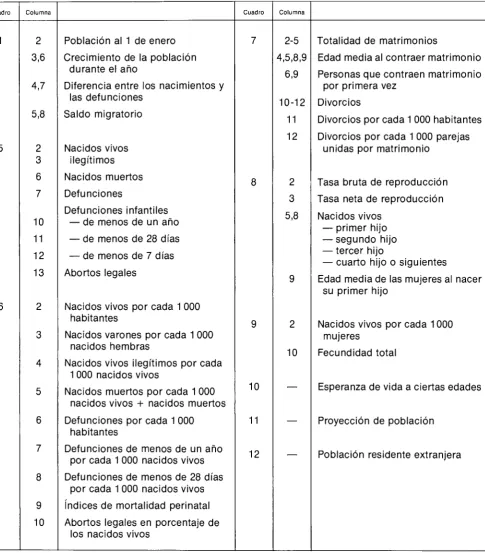
Principales términos utilizados en las cabeceras de los cuadros
π
Cuadro
1
5
6
Columna
2
3,6
4,7
5,8
2
3
6
7
10
11
12
13
2
3
4
5
6
7
8
9
10
Población al 1 de enero
Crecimiento de la población
durante el año
Diferencia entre los nacimientos y
las defunciones
Saldo migratorio
Nacidos vivos
ilegítimos
Nacidos muertos
Defunciones
Defunciones infantiles
— de menos de un año
— de menos de 28 días
— de menos de 7 días
Abortos legales
Nacidos vivos por cada 1 000
habitantes
Nacidos varones por cada 1 000
nacidos hembras
Nacidos vivos ilegítimos por cada
1 000 nacidos vivos
Nacidos muertos por cada 1 000
nacidos vivos + nacidos muertos
Defunciones por cada 1 000
habitantes
Defunciones de menos de un año
por cada 1 000 nacidos vivos
Defunciones de menos de 28 días
por cada 1 000 nacidos vivos
índices de mortalidad perinatal
Abortos legales en porcentaje de
los nacidos vivos
Cuadro
7
8
9
10
11
12
Columna
25
4,5,8,9
6,9
1012
11
12
2
3
5,8
9
2
10
—
—
Totalidad de matrimonios
Edad media al contraer matrimonio
Personas que contraen matrimonio
por primera vez
Divorcios
Divorcios por cada 1 000 habitantes
Divorcios por cada 1 000 parejas
unidas por matrimonio
Tasa bruta de reproducción
Tasa neta de reproducción
Nacidos vivos
— primer hijo
— segundo hijo
— tercer hijo
— cuarto hijo o siguientes
Edad media de las mujeres al nacer
su primer hijo
Nacidos vivos por cada 1 000
mujeres
Fecundidad total
Esperanza de vida a ciertas edades
Proyección de población
Inholdsfortegnelse
Side
Indledning 11
Fællesskabets samlede befolkningstal 12
De vigtigste udtryk anvendt i tabelhovederne 13
TABELLER
Fællesskabstabeller
I — Ændringer i befolkningstallet; naturlig befolkningstilvækst; nettovandringer 59
II — Medlemslandenes befolkning, 1950-1986 60
III — Befolkningen fordelt efter køn og aldersklasser, middelfolketal 62
IV — Fødsler og dødsfald, (i absolutte tal) 63
V — Fødsels- og dødsfaldskvotient 64
VI — Internationale sammenligninger af de vigtigste demografiske indikatorer 1960,1970, 1980,
1985/86 66
Tabeller for de enkelte lande i nedenstående rækkefølge:
Belgien 71
Danmark 83
Forbundsrepublikken Tyskland 97
Indholdet af tabellerne for de enkelte lande:
1 — Ændringer i befolkningstallet; naturlig befolkningstilvækst; nettovandringer
2 — Befolkningen fordelt efter køn og aldersklasser, pr. 1. januar
3 — Befolkningen fordelt efter køn og aldersklasser, middelfolketal
4 — Befolkningen fordelt efter køn og alder pr. 1. januar 1986
4A — Befolkningen fordelt efter køn og alder pr. 1. januar 1987
(for Danmark, Forbundsrepublikken Tyskland, Frankrig, Italien og Nederlandene)
5 — Fødsler og dødsfald, (i absolutte tal)
6 — Fødsels- og dødsfaldskvotient
7 — Vielser og skilsmisser
8 — Brutto- og nettoreproduktionstal; levendefødte fordelt efter barnets fødselsnummer;
gennemsnitsalder ved det første barns fødsel
9 — Aldersbetingede fertilitetskvotienter; samlet fertilitet
10 — Middellevetid ved forskellige aldre
11 — Befolkningsfremskrivninger
12 — Fastboende udlændinge
Indledning
Tabellernes indhold i denne publikation er først og
fremmest bestemt af de behov for
befolkningsstati-stik, som oftest opstår inden for Kommissionens
for-skellige tjenestegrene. Det har imidlertid vist sig, at
der også uden for Kommissionen er betydelig
efter-spørgsel efter befolkningsstatistikker for
Fællesska-bets medlemsstater udarbejdet på et
sammenligne-ligt grundlag, og derfor præsenteres materialet
her-ved i en publikation til almindelig distribution.
Tabel-lerne er baseret både på opgørelser fra de nationale
statistiske kontorer og på nationale publikationer.
Oplysningerne præsenteres i form af et sæt tabeller
med de samlede tal for Fællesskabet efterfulgt af et
sæt tabellerfor hvert land. Af tekniske grunde har det
ikke været muligt at opgive de samlede tal for hele
Fællesskabet for alle de punkter, der medtages i de
nationale tabeller.
Selv om de anførte statistiske oplysninger i
alminde-lighed findes for de fleste eller alle medlemslandene,
er de ikke ligeajourført i alle landene. For nogle landes
vedkommende er skønnene over befolkningens
for-deling efter aldersklasser foretaget pr. 1.januar1987,
medens de seneste oplysninger for andre lande er pr.
1. januar 1986. Der er imidlertid gennemført en
ensar-tet opstilling for alle lande, således at det i visse
tilfæl-de har været nødvendigt at latilfæl-de rubrikkerne for 1.
ja-nuar 1987 stå tomme. Almindeligvis er tallene ikke
af-rundede bortset fra de tilfælde, hvor denne
frem-gangsmåde anvendes i den pågældende nationale
publikation.
Det Statistiske Kontor retter en tak til de nationale
statistiske kontorer for deres aktive medvirken.
Publikationen er blevet udarbejdet af afdelingen
»Be-folkning, Uddannelse og Almen Socialstatistik«
under direktoratet »Befolknings og Socialstatistik
-Landbrugsstatistik«.
Fællesskabets samlede befolkningstal
Midt i 1986 udgjorde befolkningen i EUR 12 323
mil-lioner mennesker, hvilket overstigerbefolkningstallet
for USSR med 15% og tallet for USA med ca. 34%.
De 66 associerede AVS-lande (Afrika, Vestindien og
Stillehavet) havde i 1986 et samlet befolkningstal på
441 millioner.
I Forbundsrepublikken Tyskland og Danmark er
fød-selskvotienten lavere end dødsfaldskvotienten,
me-dens den for adskillige andre medlemsstater kun
knapt når op over dødsfaldskvotienten. Som følge
heraf er væksten i befolkningstallet i Fællesskabet
meget lille i sammenligning med den øvrige verden.
Den nyeste befolkningsfremskrivning regner kun
med en stigning til udgangen af år 2010 på 2% i
Fællesskabets befolkningstal. Dette skal
sammen-holdes med en formodet vækst på 19% i USA, 7% i
Japan 20% i USSR og 42% for verdens samlede
be-folkning. Fællesskabets andel forventes at falde fra
6,6% i 1986 til 4,7% i år 2010.
Befolkning i alt, fødsels- og dødsfaldskvotient - befolkningsfremskrivning
Land
Belgien Danmark
Forbundsrepublikken Tyskland Grækenland
Spanien Frankrig Irland Italien Luxembourg Nederlandene Portugal
Det Forenede Kongerige
EUR 12
USSR USA Japan
Verden
Befolkning 1986 (1000)
9 862 5121 61 066 9 966 38 668 55 394 3 541 57 246 369 14 572 10 208 56 763
322 776
280140 241 600 121 490
4 917 000
Fodsels-kvotient 1986C)
11,9 10,8 10,3 11,3 12,1 14,1 17,3 9,7 11,7 12,7 12,4 13,3
11,9
19,4 15,5 11,5
26
Dodsfalds-kvotient 1986 (')
11,2 11,3 11,5 9,2 7,7 9,9 9,5 9,5 10,7 8,6 9,4 11,7
9,1
10,6 8,7 6,2
10
Belolkningsf remskrivning (1000)
2000
9 674 5 154 60 484 10 334 40 747 57 882 3 929 57 226 374 15 588 11 077 58 857
331 326
314 818 268 079 127 683
6 127 000
2010
9 433 5 044 57 803 10 554 41 194 58 765 4 216 55 646 369 15 749 11 141 59 391
329 305
336 450 286 688 130 088
6 995 000
Ændringer i belolk-ningstallet 1986-2010
(%)
-4,4 -1,5 -5,3 5,9 6,5 6,1 19,1 -2,8 0,0 8,1 9,1 4,6
2,0
20,1 18,7 7,1
42,3
(') Spanien, 1984; USSR, 1985.
De vigtigste udtryk anvendt i tabelhovederne
II:
Tab.
1
5
6
Col.
2
3,6
4,7
5,8
2
3
6
7
10
11
12
13
2
3
4
5
6
7
8
9
10
Befolkning pr. 1. januar
Befolkningstilvækst i løbet af året
Fødselsoverskud
Nettoindvandringer
Levendefødte
heraf født uden for ægteskab
Dødfødte
Dødsfald
Døde
— børn under 1 år
— børn under 28 dage
— børn under 7 dage
Legale aborter
Antal levendefødte pr. 1000
ind-byggere
Antal fødte drenge født pr. 1000
fødte piger
Antal fødsler uden for ægteskab pr.
1000 fødte
Antal dødfødte pr. 1000
levende-fødte + dødlevende-fødte
Antal døde pr. 1 000 indbyggere
Antal døde under 1 år pr. 1 000
levendefødte
Antal døde under 28 dage pr. 1000
levendefødte
Perinatal dødelighed
Antal legale aborter i % af antal
levendefødte
Tab.
7
8
9
10
11
12
Col.
2-5
4,5,8,9
6,9
10-12
11
12
2
3
5,8
9
2
10
—
—
Alle vielser
Gennemsnitsalder ved vielsen
Førstegangsviede
Skilsmisser
Skilsmisser pr.1000 indbyggere
Skilsmisser pr. 1 000 bestående
ægteskaber
Bruttoreproduktionstallet
Nettoreproduktionstallet
Levendefødte
— førstegangsfødsler
— andengangsfødsler
— tredjegangsfødsler
— fjerdegangefødsler eller
herudover
Kvinders gennemsnitsalder ved
førstegangsfødsler
Levendefødte pr. 1000 kvinder
Samlet fertilitet
Forventet levealder for bestemte
aldre
Befolkningsfremskrivning
Inhalt
Seite
Einleitung 17
Die Gesamtbevölkerung der Gemeinschaft 18
Die wichtigsten in den Tabellenköpfen verwendeten Ausdrücke 19
TABELLEN
Gemeinschaftstabellen
I — Bevölkerungsveränderung, Geburtenüberschuß, Wanderungssaldo 59
II — Bevölkerung der Mitgliedstaaten, 1960-1986 60
III — Bevölkerung nach Geschlecht und Altersgruppen—Jahresdurchschnitt 62
IV — Geburten und Sterbefälle (Grundzahlen) 63
V — Geburten und Sterbefälle (Verhältniszahlen) 64
VI — Internationaler Vergleich der wichtigsten Bevölkerungsindikatoren, 1960, 1970,1980,
1985/86 66
Ländertabellen, in folgender Reihenfolge:
Inhalt der Ländertabellen:
1 — Bevölkerungsveränderung, Geburtenüberschuß, Wanderungssaldo
2 — Bevölkerung nach Geschlecht und Altersgruppen am 1. Januar
3 — Bevölkerung nach Geschlecht und Altersgruppen —Jahresdurchschnitt
4 — Bevölkerung nach Geschlecht und Altersjahren am 1. Januar 1986
4A — Bevölkerung nach Geschlecht und Altersjahren am 1. Januar 1987
(nur für Dänemark, BR Deutschland, Frankreich, Italien und die Niederlande)
5 — Geburten und Sterbefälle (Grundzahlen)
6 — Geburten und Sterbefälle (Verhältniszahlen)
7 — Eheschließungen und Ehescheidungen
8 — Brutto- und Nettoreproduktionsziffern, Lebendgeborene nach der
Lebendgeburtenfolge, Alter bei der Geburt des ersten Kindes
9 — Fruchtbarkeitsziffern nach Altersgruppen; Fruchtbarkeit insgesamt
10 — Lebenserwartung in bestimmten Lebensaltern
11 — Voraussichtliche Bevölkerungsentwicklung
12 — Ausländische Wohnbevölkerung
Einleitung
Der Inhalt derTabellendieserVeröffentlichung wurde
in ersterLinieauf den Bedarf der
Kommissionsdienst-stellen an Bevölkerungsstatistiken abgestimmt. Da
jedoch auch außerhalb der Kommission eine
be-trächtliche Nachfrage nach Bevölkerungsstatistiken
der Gemeinschaftsländer auf vergleichbarer
Grund-lage besteht, wird hier das Zahlenmaterial in einer
Veröffentlichung zur allgemeinen Verbreitung zur
Verfügung gestellt. Die Tabellen beruhen auf
Anga-ben der statistischen Ämter der Mitgliedstaaten und
auf einzelstaatlichen Veröffentlichungen. Die Daten
werden in Form eines Tabellensatzes für jedes Land
dargestellt. Ein Satz mit Übersichten für die
Gemein-schaft ist vorangestellt. Aus technischen Gründen
war es nicht möglich, Gesamtzahlen für die
Gemein-schaft zu allen Punkten anzugeben, die in den
Ab-schnitten überdie einzelnen Länder aufgeführt sind.
Obwohl die dargestellten Statistischen Reihen im
all-gemeinen für die meisten oderfürsämtliche
Mitglied-staaten bestehen, sind sie nicht überall in gleichem
Maße aktuell. So warenzum Beispiel füreinige Länder
die Schätzungen in bezug auf die Bevölkerung nach
Altersgruppen zum 1. Januar 1987 verfügbar,
wäh-rend sich bei anderen die neuesten Informationen auf
den Stand vom 1. Januar 1986 beziehen. Trotzdem
wurde für alle Länder eine einheitliche Darstellung
gewählt, so daß in einigen Fällen die Spalten für die
Daten zum 1. Januar 1987 frei bleiben mußten. Die
Zahlen wurden im allgemeinen nicht auf- oder
abge-rundet, ausgenommen in den Fällen, in denen dies
der entsprechenden nationalen
Veröffentlichungs-praxis widersprechen würde.
Der besondere Dank des Statistischen Amtes gilt all
den Angehörigen nationalerstatistischerDienste,auf
deren wirkungsvolle Zusammenarbeit es sich stützen
konnte.
Diese Veröffentlichung wird von der Abteilung
„Be-völkerung, Bildung und allgemeine Sozialstatistik"
der Direktion „Bevölkerungs- und Sozialstatistik —
Landwirtschaftsstatistik" betreut.
Die Gesamtbevölkerung der Gemeinschaft
Mitte 1986 belief sich die Bevölkerung von EUR 12 auf
323 Millionen; sie war damit 15% höher als die der
UdSSR und etwa um 34% höher als die der USA. Die
66 assoziierten AKP (afrikanischen, karibischen und
pazifischen)-Länder hatten 1986 insgesamt 441
Mil-lionen Einwohner.
In der BundesrepublikDeutschland und Dänemarkist
die Geburtenziffer niedriger als die Sterbeziffer,
wo-gegen sie in den meisten anderen Ländern nur etwas
höher ¡st. Somit ist der Gesamtüberschuß der
Bevöl-kerung der Gemeinschaft ganz schwach gegenüber
dem Rest der Welt. Nach den letzten bekannten
Vor-ausschätzungen ist ein Bevölkerungswachstum in
der Gemeinschaft von 2% bis zum Jahre 2010 zu
er-warten, gegenüber den Vorausschätzungen von 19 %
in den USA, 7% in Japan, 20% in der UdSSR und 42%
für die Bevölkerung der ganzen Welt. Der Anteil der
Bevölkerung der Gemeinschaft an der
Gesamtbevöl-kerung der Welt würde von 6,6% im Jahre 1986 auf
4,7% im Jahre 2010 zurückgehen.
Gesamtbevölkerung, Geburten- und Sterbeziffer, Bevölkerungsentwicklung
Land
Belgien Dänemark BR Deutschland Griechenland Spanien Frankreich Irland Italien Luxemburg Niederlande Portugal
Vereinigtes Königreich
EUR 12
UdSSR USA Japan
Welt
Bevölkerung 1986 (1000)
9 862 5 121 61 066 9 966 38 668 55 394 3 541 57 246 369 14 572 10 208 56 763
322 776
280 140 241 600 121 490
4 917 000
Geburten-ziffer 1986C)
11,9 10,8 10,3 11,3 12,1 14,1 17,3 9,7 11,7 12,7 12,4 13,3
11,9
19,4 15,5 11,5
26
Sterbe-ziffer 1986C)
11,2 11,3 11,5 9,2 7,7 9,9 9,5 9,5 10,7 8,6 9,4 11,7
9,1
10,6 8,7 6,2
10
Voraussichtliche Bevölkerungsentwicklung (1000)
2000 2010
9 674 9 433 5 154 5 044 60 484 57 803 10 334 10 554 40 747 41 194 57 882 58 765 3 929 4 216 57 226 55 646
374 369 15 588 15 749
11 077 11 141 58 857 59 391
331 326 329 305
314 818 336 450 268 079 286 688 127 683 130 088
6127 000 6 995 000
Veränderung der Bevölkerung
1986-2010
(%)
-4,4 -1,5 -5,3 5,9 6,5 6,1 19,1 -2,8 0,0 8,1 9,1 4,6
2,0
20,1 18,7 7,1
42,3
(') Spanien: 1984; UdSSR: 1985.
Die wichtigsten in den Tabellenköpfen verwendeten Ausdrücke
Tab
1
5
6
Col.
2
3,6
4,7
5,8
2
3
6
7
10
11
12
13
2
3
4
5
6
7
8
9
10
Bevölkerung am 1. Januar
Bevölkerungszunahme im Jahr
Geburtenüberschuß
Wanderungssaldo
Lebendgeborene
darunter unehelich Geborene
Totgeborene
Sterbefälle
Sterbefälle
— im ersten Lebensjahr
— weniger als 28 Lebenstage
— weniger als 7 Lebenstage
Legale
Schwangerschaftsunter-brechungen
Lebendgeborene auf 1000
Ein-wohner
Knaben auf 1000 lebendgeborene
Mädchen
Unehelich Lebendgeborene auf
1000 Lebendgeborene
insgesamt
Totgeborene auf 1000
Lebend-und Totgeborene
Sterbefälle auf 1 000 Einwohner
Sterbefälle im ersten Lebensjahr
auf 1000 Lebendgeborene
Sterbefälle in den ersten 27
Le-benstagen auf 1 000
Lebend-geborene
Perinatale Sterblichkeitsrate
Legale
Schwangerschaftsunter-brechungen in % der
Lebendgeburten
Tab.
7
8
9
10
11
12
Col.
2-5
4,5,8,9
6,9
10-12
11
12
2
3
5,8
9
2
10
—
—
Alle Eheschließungen
Durchschnittsalter bei der
Eheschließung
Personen, die zum 1. Mal heiraten
Ehescheidungen
Ehescheidungen je 1000 Einwohner
Ehescheidungen je 1 000 Ehen
Bruttoreproduktionsziffer
Nettoreproduktionsziffer
Lebendgeborene
— erstes Kind
— zweites Kind
— drittes Kind
— viertes oder weiteres Kind
Durchschnittsalter der Frauen bei
der Geburt des ersten Kindes
Lebendgeborene auf 1000 Frauen
Fruchtbarkeit insgesamt
Lebenserwartung in bestimmten
Lebensaltern
Voraussichtliche
Bevölkerungs-entwicklung
Περιεχόμενα
Σελίδα
Εισαγωγή 23
Συνολικός πληθυσμός της Κοινότητας 24
Κυριότεροι όροι που χρησιμοποιούνται στις επικεφαλίδες των πινάκων 25
ΠΙΝΑΚΕΣ
Κοινοτικοί πίνακες:
Ι — Μεταβολές του πληθυσμού, φυσική αύξηση, καθαρή παλιννόστηση 59
II — Πληθυσμός των κρατών μελών, 1960-1986 60
III — Πληθυσμός κατά φύλο και ομάδες ηλικίας — ετήσιος μέσος όρος 62
IV — Γεννήσεις και θάνατοι (απόλυτοι αριθμοί) 63
V — Ποσοστά γεννητικότητας και θνησιμότητας, γάμων και διαζυγίων 64
VI — Διεθνείς συγκρίσεις κύριων δημογραφικών δεικτών για τα έτη 1960,1970,1980,1985/86 . . 66
Πίνακες για κάθε χώρα με την εξής σειρά:
Βέλγιο 71
Δανία 83
Ομοσπονδιακή Δημοκρατία της Γερμανίας 97
Ελλάδα 111
Ισπανία 123
Γαλλία 135
Ιρλανδία 149
Ιταλία 159
Περιεχόμενο των πινάκων για κάθε χώρα:
1 — Μεταβολές του πληθυσμού, φυσική αύξηση, καθαρή παλιννόστηση
2 — Πληθυσμός κατά φύλο και ομάδες ηλικίας την 1η Ιανουαρίου
3 — Πληθυσμός κατά φύλο και ομάδες ηλικίας — ετήσιος μέσος όρος
4 — Πληθυσμός κατά φύλο και κατά ηλικία την 1η Ιανουαρίου 1986
4Α — Πληθυσμός κατά φύλο και κατά ηλικία την 1η Ιανουαρίου 1987 (Δανία, ΟΔ της Γερμανίας,
Γαλλία, Ιταλία και Κάτω Χώρες)
5 — Γεννήσεις και θάνατοι (απόλυτοι αριθμοί)
6 — Ποσοστά γεννητικότητας και θνησιμότητας
7 — Γάμοι και διαζύγια
8 — Μεικτά και καθαρά ποσοστά αναπαραγωγής, γεννήσεις ζωντανών παιδιών κατά τάξη, ηλικία
κατά τη γέννηση του πρώτου παιδιού
9 — Ποσοστά γονιμότητας κατά ομάδες ηλικίας, συνολική γονιμότητα
10 — Προσδοκία ζωής για ορισμένες ηλικίες
11 — Προβολές πληθυσμού
12 — Αλλοδαπός μόνιμος πληθυσμός
Εισαγωγή
Το περιεχόμενο των πινάκων του παρόντος
δημοσιεύματος καθορίστηκε κυρίως από τις
κυριότερες ανάγκες για δημογραφικές στατι
στικές που παρουσιάζονται στις υπηρεσίες
της Επιτροπής. Παρ' όλα αυτά έχει επίσης
παρατηρηθεί ότι και εκτός της Επιτροπής
υπάρχει σημαντική ζήτηση για συγκρίσιμες
δημογραφικές στατιστικές των χωρών της
Κοινότητας, και έτσι τα δεδομένα παρουσιά
ζονται σε ένα δημοσίευμα που προορίζεται για
γενικότερη χρήση. Οι πίνακες βασίζονται και σε
στοιχεία που μας εστάλησαν από τις εθνικές
στατιστικές υπηρεσίες και σε εθνικά δημοσιεύ
ματα. Τα δεδομένα δίνονται υπό τη μορφή μιας
ομάδας πινάκων για κάθε χωρά, αφού προηγου
μένως παρουσιάσουμε μερικούς πίνακες που
περιέχουν κοινοτικά συνολικά μεγέθη. Για
τεχνικούς λόγους δεν ήταν δυνατό να δώσουμε
κοινοτικά συνολικά μεγέθη για όλες τις
κατηγορίες που εμφανίζονται στα τμήματα κατά
Χώρα.
Αν και οι στατιστικές σειρές που παρουσιά
ζουμε υπάρχουν στα περισσότερα ή όλα τα κράτη
μέλη, δεν είναι παντού στον ίδιο βαθμό ενημερω
μένες. Για παράδειγμα, σε μερικές χώρες οι
εκτιμήσεις του πληθυσμού κατά ομάδες ηλικιών
αναφέρονται στην 1η Ιανουαρίου του 1987, ενώ για
άλλες οι πιο πρόσφατες πληροφορίες αναφέρονται
στην 1η Ιανουαρίου του 1986. Επειδή όμως
υιοθετήθηκε μια ομοιόμορφη παρουσίαση για
όλες τις χώρες, αναγκαστήκαμε σε μερικές
περιπτώσεις να αφήσουμε κενές τις στήλες για
την 1η Ιανουαρίου του 1987. Γενικά, τα στοιχεία
δεν έχουν στρογγυλοποιηθεί, εκτός εάν αυτό
αντίκειται στην πρακτική που ακολουθείται για
τα αντίστοιχα εθνικά δημοσιεύματα.
Η Στατιστική Υπηρεσία θα ήθελε να ευχα
ριστήσει τις εθνικές στατιστικές υπηρεσίες
για την αποτελεσματική τους συνεργασία.
Το παρόν δημοσίευμα καταρτίστηκε από το τμήμα
«πληθυσμός, απασχόληση, εκπαίδευση και γενι
κές κοινωνικές στατιστικές» της διεύθυνσης
«Δημογραφικές και κοινωνικές στατιστικές —
Γεωργικές στατιστικές».
O synolików plhqysmów thw Koinóthtaw
Περί τα μέσα του 1986 ο πληθυσμός της Ευρώπης
των Δώδεκα ανερχόταν σε 323 εκατομμύρια άτομα,
ήτοι κατά 15% μεγαλύτερος εκείνου της ΕΣΣΔ και
περίπου 34 % μεγαλύτερος εκείνου των ΗΠΑ. Οι 66
συνδεδεμένες χώρες ΑΚΕ (Αφρικής, Καραϊβικής
και Ειρηνικού) αριθμούσαν το 1986 συνολικά 441
εκατομμύρια κατοίκους.
Στην Ομοσπονδιακή Δημοκρατία της Γερμανίας
και τη Δανία το ποσοστό γεννήσεων είναι κατώ
τερο του ποσοστού θανάτων, ενώ στην πλειοψηφία
των άλλων κρατών μελών το ποσοστό γεννήσεων
σπάνια υπερβαίνει το ποσοστό θανάτων. Συνεπώς,
το γενικό ποσοστό αύξησης του πληθυσμού στην
Κοινότητα είναι χαμηλό για τα παγκόσμια
πρότυπα. Οι τελευταίες διαθέσιμες προβολές
δείχνουν μια αύξηση 2 % του πληθυσμού της
Κοινότητας για το έτος 2010 συγκρινόμενη με
προσδοκώμενες αυξήσεις 19% στις ΗΠΑ, 7% στην
Ιαπωνία, 20% στην ΕΣΣΔ και 42% στο συνολικό
παγκόσμιο πληθυσμό. Το μερίδιο του κοινοτικού
πληθυσμού της Κοινότητας στο σύνολο του
παγκόσμιου πληθυσμού αναμένεται να πέσει από
6,6% το έτος 1986 στο 4,7% το έτος 2010.
Συνολικός πληθυσμός, ποσοοτά γεννήσεων και θανάτων, προβολές πληθυσμού
Χώρα
Βέλγιο Δανία
ΟΔ της Γερμανίας Ελλάδα
Ισπανία Γαλλία Ιρλανδία Ιταλία
Λουξεμβούργο Κάτω Χώρες Πορτογαλία Ηνωμένο Βασίλειο
EUR 12
ΕΣΣΔ ΗΠΑ Ιαπωνία
Παγκόσμιο σύνολο
Πληθυσμός 19Θ6 (1 000)
9 862 5 121 61 066 9 966 38 668 55 394 3 541 57 246 369 14 572 10 208 56 763
322 776
280 140 241 600 121 490
4 917 000
Ποσοστό γεννήσεων
1986C)
11,9 10,8 10,3 11,3 12,1 14,1 17,3 9,7 11,7 12,7 12,4 13,3
11,9
19,4 15,5 11,5
26
Ποσοστό θανάτων 1986C)
11,2 11,3 11,5 9,2 7,7 9,9 9,5 9,5 10,7 8,6 9,4 11,7
9,1
10,6 8,7 6,2
10
Προβολή πληθυσμού (1 000)
2000 2010
9 674 9 433 5 154 5 044 60 484 57 803 10 334 10 554 40 747 41 194 57 882 58 765 3 929 4 216 57 226 55 646
374 369 15 588 15 749
11 077 11 141 58 857 59 391
331 326 329 305
314 818 336 450 268 079 286 688 127 683 130 088
6127 000 6 995 000
Μεταβολές πληθυσμού 1986-2010
{%)
^ , 4 -1,5 -5,3 5,9 6,5 6,1 19,1 -2,8 0,0 8,1 9,1 4,6
2,0
20,1 18,7 7,1
42,3 (') Ισπανία. 1984' ΕΣΣΔ: 1985.
Κυριότεροι όροι που χρησιμοποιούνται στις επικεφαλίδες των πινάκων
Πίνακας
1
5
6
Στήλη
2
3,6
4,7
5,8
2
3
6
7
10
11
12
13
2
3
4
5
6
7
8
9
10
Πληθυσμός κατά την 1η Ιανου
αρίου
Αύξηση του πληθυσμού κατά τη
διάρκεια του έτους
Υπεροχή των γεννήσεων έναντι
των θανάτων
Καθαρή παλιννόστηση
Γεννήσεις ζώντων
από τα οποία εξώγαμα
Γεννήσεις νεκρών
θάνατοι βρεφών
— κάτω του ενός έτους
— κάτω των 28 ημερών
— κάτω των 7 ημερών
Νόμιμες αμβλώσεις
Γεννήσεις ζώντων ανά 1 000
κατοίκους
Γεννήσεις αρρένων ανά 1 000
γεννήσεις θηλέων
Γεννήσεις ζώντων εξωγάμων ανά
1000 γεννήσεις ζώντων
Γεννήσεις νεκρών ανά 1000
γεννήσεις ζώντων και
γεννήσεις νεκρών
θάνατοι ανά 1 000 κατοίκους
θάνατοι κάτω του ενός έτους ανά
1 000 γεννήσεις ζώντων
Θάνατοι κάτω των 28 ημερών ανά
1 000 γεννήσεις ζώντων
Ποσοστό περιγεννητικής θνησι
μότητας
Νόμιμες αμβλώσεις επί τοις % των
γεννήσεων ζώντων
Πίνακας
7
8
9
10
11
12
Στήλη
2-5
4,5,8,9
6,9
10-12
11
12
2
3
5,8
9
2
10
—
—
Σύνολο γάμων
Μέση ηλικία γάμου
'Ατομα συνάπτοντα γάμο για
πρώτη φορά
Διαζύγια
Διαζύγια ανά 1000 κατοίκους
Διαζύγια ανά 1 000 υπάρχοντες
γάμους
Μεικτό ποσοστό αναπαραγωγής
Καθαρό ποσοστό αναπαραγωγής
Γεννήσεις ζώντων
— πρώτη γέννηση
— δεύτερη γέννηση
— τρίτη γέννηση
— τέταρτη γέννηση ή επόμενες
Μέση ηλικία γυναικών κατά τη
γέννηση του πρώτου παιδιού
Γεννήσεις ζώντων ανά 1 000
γυναίκες
Συνολική γονιμότητα
Προσδοκία ζωής για ορισμένες
ηλικίες
Προβολή πληθυσμού
Contents
Page
Introduction 29
The total population of the Community 30
Principal terms used in table headings 31
TABLES
Community tables
I — Population change, natural increase, net migration 59
II — Population of member countries 1950-86 60
III — Population by sex and age group — annual average 62
VI — Births, deaths, marriages, divorces (absolute numbers) 63
V — Birth, death, marriage and divorce rates 64
VI — International comparisons of principal demographic indicators, 1960, 1970, 1980,
1985/86 66
Country tables, in the following order:
Belgium 71
Denmark 83
FR of Germany 97
Greece 111
Spain 123
France 135
Ireland 149
Italy 159
Luxembourg 171
The Netherlands 183
Content of country tables:
1 — Population change, natural increase, net migration
2 — Population by sex and age group at 1 January
3 — Population by sex and age group — annual average
4 — Population by sex and year of age at 1 January 1986
4A — Population by sex and year of age at 1 January 1987
(for Denmark, FR of Germany, France, Italy and the Netherlands)
5 — Births and deaths (absolute numbers)
6 — Birth and death rates
7 — Marriages and divorces
8 — Gross and net reproduction rates; live births by parity; average age at birth of first child
9 — Fertility rates by age group; total fertility
10 — Expectation of life at certain ages
11 — Population projections
12 — Foreign residents
Introduction
The content of the tables in this publication has been
determined primarily by the needs for demographic
statistics arising most frequently within the services
of the Commission. However, it has been noted that
outside the Community there is also a considerable
demand fordemographic statistics of the countries of
the Community on a comparable basis, and the
mate-rial is therefore presented in a publication for general
distribution. The tables are based both on returns
pro-vided by the national statistical services and on
natio-nal publications. Thedataare presented in theform of
a set of tablesforeach country, preceded by aset
con-taining Community totals. Fortechnical reasons it has
not been possible to give Community totals in respect
of all the items featured in the country sections.
Although the statistical series shown generally exist
for mostorall membercountries,they are not equally
up-to-date everywhere. For example, for some
coun-tries estimates of the population by age group are
available for 1 January 1987 but in others the most
recent information is for 1 January 1986. A uniform
presentation has, nevertheless, been adopted forali
countries so that in some cases it is necessary to leave
the columns for 1 January 1987 blank. Generally, the
figures given are un rounded except where this is
con-trary to the practice in the relevant national
publica-tion.
The Statistical Office would like to thank the national
statistical services for their effective cooperation.
This publication was prepared by the Division
'Popu-lation, education and general social statistics', which
forms part of the Directorate'Demographic and social
statistics - Agricultural statistics'.
The total population of the Community
In mid-1986thepopulationof EUR 12amountedto323
million persons, 15%more than that oftheUSSRand
some 34% greater than that of the USA. The 66
asso-ciated ACP (African, Caribbean and Pacific) countries
had, in 1986, a total of 441 million inhabitans.
In the Federal Republic of Germany and in Denmark
the birth rate is belowthe death rate while in a number
of other member countries also the birth rate scarcely
exceeds the death rate. In consequence the overall
rate of population growth in the Community is low by
world standards. The latest available projections
indi-cate a rise of 2% in the population of the Community
by the year 2010 compared with expected increases of
19% in the USA, 7% in Japan, 20% in the USSR and
42% in the total world population. The proportion of
the total world population within the Community is
expected to decline from 6.6% in 1986 to 4.7% in the
year 2010.
Total population, birth and death rates, population projections
Country
Belgium Denmark FR of Germany Greece Spain France Ireland Italy Luxembourg The Netherlands Portugal United Kingdom
EUR 12
USSR USA Japan
World
Population 1986 (1000)
9 862 5 121 61 066 9 966 38 668 55 394 3 541 57 246 369 14 572 10 208 56 763
322 776
280140 241 600 121 490
4 917 000
Birth rate 1986 (')
11,9 10,8 10,3 11,3 12,1 14,1 17,3 9,7 11,7 12,7 12,4 13,3
11,9
19,4 15,5 11,5
26
Death rate 1986C)
11,2 11,3 11,5 9,2 7,7 9,9 9,5 9,5 10,7 8,6 9,4 11,7
9,1
10,6 8,7 6,2
10
Population projection (1000)
2000
9 674 5 154 60 484 10 334 40 747 57 882 3 929 57 226 374 15 588 11 077 58 857
331 326
314818 268 079 127 683
6 127 000
2010
9 433 5 044 57 803 10 554 41 194 58 765 4 216 55 646 369 15 749 11 141 59 391
329 305
336 450 286 688 130 088
6 995 000
Population change
(%)
1986-2010
^t,4 -1,5 -5,3 5,9 6,5 6,1 19,1 -2,8 0,0 8,1 9,1 4,6
2,0
20,1 18,7 7,1
42,3
(') 1984 for Spain; 1985 for USSR
Principal terms used in table headings
Tab.
1
5
6
Col.
2
3,6
4,7
5,8
2
3
6
7
10
11
12
13
2
3
4
5
6
7
8
9
10
Population on 1 January
Population increase over year
Excess of births over deaths
Net migration
Live births
of which illegitimate
Still births
Deaths
Infant deaths
— under 1 year
— under 28 days
— under 7 days
Legal abortions
Live births per 1 000 population
Males born per 1000 female births
Illegitimate live births per 1000 total
live births
Still births per 1000 live + still
births
Deaths per 1 000 population
Deaths under 1 year per 1000 live
births
Deaths under 28 days per 1 000 live
births
Perinatal mortality rate
Legal abortions as % of live births
Tab.
7
8
9
10
11
12
Col.
2-5
4,5,8,9
6,9
10-12
11
12
2
3
5,8
9
2
10
—
—
—
All marriages
Average age at marriage
Persons marrying for the first time
Divorces
Divorces per 1000 population
Divorces per 1 000 existing
marriages
Gross reproduction rate
Net reproduction rate
Live births
— first
— second
— third
— fourth or higher order
Average age of women at birth
of first child
Live births per 1 000 women
Total fertility
Expectation of life at certain ages
Population projection
Table des matières
Page
Introduction 35
Population totale dans la Communauté . 36
Principaux termes utilisés dans les en-têtes des tableaux 37
m
TABLEAUX
Tableaux communautaires:
I — Variation de la population, accroissement naturel, solde migratoire 59
II — Population des pays membres, 1960-1986 60
III — Population par sexe et groupes d'âge — moyenne annuelle 62
IV — Naissances et décès (chiffres absolus) 63
V — Taux de natalité et de mortalité 64
VI — Comparaisons internationales des principaux indicateurs démographiques 1960, 1970, 1980,
1985/86 66
Tableaux pour chaque pays dans l'ordre suivant:
Belgique 71
Danemark 83
République fédérale d'Allemagne 97
Grèce 111
Espagne 123
France 135
Irlande 149
Italie 159
Luxembourg 171
Contenu des tableaux pour chaque pays:
1 — Variation de la population; accroissement naturel; solde migratoire
2 — Population par sexe et groupes d'âge au 1
erjanvier
3 — Population par sexe et groupes d'âge — moyenne annuelle
4 — Population par sexe et par années d'âge au 1
erjanvier 1986
4A — Population par sexe et par années d'âge au 1
erjanvier 1987 (pour le Danemark, la RF d'Allemagne,
la France, l'Italie et les Pays-Bas)
5 — Naissances et décès (chiffres absolus)
6 — Taux de natalité et de mortalité
7 — Mariages et divorces
8 — Taux brutet net de reproduction; naissances vivantes par rang; âge à la naissance du premier enfant
9 — Taux de fécondité par groupes d'âge; somme des naissances réduites
10 — Espérance de vie à certains âges
11 — Projections de la population
12 — Population étrangère résidente
Introduction
Le contenu des tableaux de cette publication a été
déterminé, en premierlieu, parles besoins principaux
des services de la Commission en matière de
statisti-ques démographistatisti-ques. Toutefois, nous avons
cons-taté qu'en dehors de la Communauté, il existe aussi
un vif intérêt à l'égard des statistiques
démographi-ques des pays membres, établies sous une forme
per-mettant des comparaisons, et c'est pourquoi la
pré-sente publication est destinée à une diffusion
géné-rale. Les tableaux ont été établis sur la base de
don-nées provenant soit des services statistiques
natio-naux, soit de publications nationales. Les données
sont présentées sousformed'un jeu de tableaux pour
chaque pays, le tout étant précédé de tableaux
don-nant les totaux communautaires. Pour des raisons
techniques, nous n'avons pu établir des agrégats
communautaires pour tous les phénomènes traités
dans les tableaux nationaux.
pays membres, leur niveau d'actualisation n'est pas le
même partout. Ainsi, certains pays ont déjà établi leur
estimation de la population par groupe d'âge au 1
erjanvier 1987, alorsque,pourd'autres, les données les
plus récentes se réfèrent au 1
erjanvier 1986. Une
pré-sentation uniforme a cependant été adoptée pour
tous les pays, de sorte que, dans certains cas, la
colon-ne «1
erjanvier 1987» a dû rester vide. En général, les
chiffres n'ont pas étéarrondis, sauf quand l'usage
na-tional est de donner des chiffres arrondis.
L'Office statistique tient à remercier les services
na-tionaux de leur collaboration efficace.
Le présent volumeaétéélaborépariadivision
«Popu-lation, éducation et statistiques sociales générales»
de la direction «Statistiques démographiques et
so-ciales — Statistiques de l'agriculture».
D
Bien que les séries statistiques présentées existent
Population totale de la Communauté
A la mi-1986, la population de l'Europe des Douze
s'élevait à 323 millions de personnes, soit 15 %de plus
que celle de l'URSS et supérieur de quelque 34% à
celle des USA. Les 66 pays associés ACP (Afrique,
Ca-raïbes et Pacifique) comptaient en 1986 un total de
441 millions d'habitants.
En Républiquefédéraled'Allemagneetau Danemark,
le taux de natalité est inférieur au taux de mortalité,
tandis qu'il ne lui est que très légèrement supérieur
dans la plupart des autres pays membres. En
consé-quence, le taux d'accroissement global de la
popu-lation dans la Communauté est faible par rapport au
reste du monde. Les dernières progressions
disponi-bles indiquent pour l'an 2010 une augmentation de
2% de la population communautaire, comparée avec
les prévisions d'augmentation de 19% aux USA, 7%
au Japon, 20% en URSS et 42% pour la population
mondiale. La part de la population de l'Europe des
Douze dans la population mondiale passerait de6,6%
en 1986 à 4,7% en l'an 2010.
Population totale, taux de naissance et de décès. Projections de la population
Pays
Belgique Danemark RF d'Allemagne Grèce
Espagne France Irlande Italie Luxembourg Pays-Bas Portugal Royaume-Uni
EUR 12
URSS USA Japon
Monde
Population 1986 (1000)
9 862 5 121 61 066 9 966 38 668 55 394 3 541 57 246 369 14 572 10 208 56 763
322 776
280 140 241 600 121 490
4 917 000
Taux de naissance
1986C)
11,9 10,8 10,3 11,3 12,1 14,1 17,3 9,7 11,7 12,7 12,4 13,3
11,9
19,4 15,5 11,5
26
Taux de mortalité
1986C)
11,2 11,3 11,5 9,2 7,7 9,9 9,5 9,5 10,7 8,6 9,4 11,7
9,1
10,6 8,7 6,2
10
Projection de la population (1000)
2000
9 674 5 154 60 484 10 334 40 747 57 882 3 929 57 226 374 15 588 11 077 58 857
331 326
314818 268 079 127 683
6 127 000
2010
9 433 5 044 57 803 10 554 41 194 58 765 4 216 55 646 369 15 749 11 141 59 391
329 305
336 450 286 688 130 088
6 995 000
Changement de la population
1986-2010
(%)
^t,4 -1,5 -5,3 5,9 6,5 6,1 19,1 -2,8 0,0 8,1 9,1 4,6
2,0
20,1 18,7 7,1
42,3
(') 1984 pour l'Espagne, 1985 pour l'URSS.
Principaux termes utilisés dans les en-têtes des tableaux
Tab.
1
5
6
Col.
2
3,6
4,7
5,8
2
3
6
7
10
11
12
13
2
3
4
5
6
7
8
9
10
Population au 1
erjanvier
Accroissement de la population
pendant l'année
Excédent des naissances sur les
décès
Solde migratoire
Naissances vivantes
dont illégitimes
Mort-nés
Décès
Décès d'enfants
— de moins d'un an
— de moins de 28 jours
— de moins de 7 jours
Avortements légaux
Nés vivants pour 1 000 habitants
Naissances masculines pour 1000
naissances féminines
Naissances vivantes illégitimes pour
1000 naissances vivantes
Mort-nés pour 1 000 nés vivants +
mort-nés
Décès pour 1 000 habitants
Décès de moins d'un an pour 1 000
nés vivants
Décès de moins de 28 jours pour
1 000 nés vivants
Taux de mortalité périnatale
Avortements légaux en % des
naissances vivantes
Tab.
7
8
9
10
11
12
Col.
2-5
4,5,8,9
6,9
10-12
11
12
2
3
5,8
9
2
10
—
—
Ensemble des mariages
Age moyen au mariage
Personnes se mariant pour la
première fois
Divorces
Divorces pour 1000 habitants
Divorces pour 1 000 couples unis
par le mariage
Taux brut de reproduction
Taux net de reproduction
Naissances vivantes
— première naissance
— deuxième naissance
— troisième naissance
— quatrième naissance ou
suivantes
Age moyen des femmes à la
naissance du premier enfant
Naissances vivantes pour 1 000
femmes
Somme des naissances réduites
Espérance de vie à certains âges
Projection de la population
Population résidente étrangère
Indice
Pagina
Introduzione 41
La popolazione totale della Comunità 42
Principali espressioni utilizzate nelle tabelle 43
TABELLE
Tabelle per l'insieme della Comunità:
I — Movimenti della popolazione, incremento naturale, saldo migratorio 59
II — Popolazione degli Stati membri, 1960-1986 60
III — Popolazione per sesso e classi d'età (media annuale) 62
IV — Nascite e decessi (valori assoluti) 63
V — Tassi di natalità e di mortalità 64
VI — Confronti internazionali dei principali indicatori demografici 1960, 1970, 1980,
1985/86 66
Tabelle per paese nell'ordine seguente:
Belgio 71
Danimarca 83
RF di Germania 97
Grecia 111
Spagna 123
Francia 135
Irlanda 149
Italia 159
Lussemburgo 171
Elenco delle tabelle per paese:
1 — Movimenti della popolazione, incremento naturale, saldo migratorio
2 — Popolazione per sesso e classi d'età, 1° gennaio
3 — Popolazione per sesso e classi d'età (media annuale)
4 — Popolazione per sesso e anni d'età, 1 ° gennaio 1986
4A — Popolazione per sesso e anni d'età, 1° gennaio 1987 (solo per Danimarca, RF di Germania, Francia,
Italia e Paesi Bassi)
5 — Nascite e decessi (valori assoluti)
6 — Tassi di natalità e di mortalità
7 — Matrimoni e divorzi
8 — Tasso lordo e tasso netto di riproduzione, nati vivi per ordine di nascita, età media alla nascita del
primo figlio
9 — Tassi di fecondità per classi d'età: fecondità totale
10 — Speranza di vita a determinate età
11 — Proiezioni della popolazione
12 — Stranieri residenti
Introduzione
Il contenuto delle tabelle di questa pubblicazione è
stato determinato essenzialmente con riferimento
al-le esigenze d'informazione nel campo delal-le
statisti-che demografistatisti-che manifestatesi con maggior
fre-quenza nell'ambito dei servizi della Commissione. Si
è rilevato peraltro che anche al di fuori della
Commis-sione esiste una considerevole richiesta di statistiche
demografiche dei paesi della Comunità, su base
com-parabile; per questo motivo il materiale disponibile
viene presentato in una pubblicazione destinata alla
diffusione generale.
Le tabelle si basano sia su dati statistici
appositamen-te forniti dai servizi nazionali di statistica, sia su
pub-blicazioni nazionali. I dati sono presentati sotto forma
di una serie di tabelle perogni paese, preceduti da una
serie con i totali comunitari. Per motivi tecnici non è
stato possibile fornire i totali della Comunità per tutte
le voci considerate nelle sezioni per paese.
Le serie statistiche riportate sono generalmente
di-sponibili per tutti o quasi tutti ¡paesi membri, ma non
sono sempre aggiornate allastessadata. Peresempio
le stime della popolazione per classi di età relative a
ta-luni paesi sono disponibili ad "gennaio 1987; nel
ca-so di altri paesi, invece, le informazioni più recenti non
risalgono che al 1 ° gennaio 1986. Si è tuttavia scelto
un tipo di presentazione uniforme per tutti i paesi,
sicché in taluni casi si sono dovute lasciare in bianco
le colonne relative al 1 ° gennaio 1987. Di massima, si
forniscono cifre non arrotondate a meno che ciò non
contrasti con la prassi seguita nelle corrispondenti
pubblicazioni nazionali.
L'Istituto satistico desidera ringraziare tutti coloro
che, nell'ambito dei servizi nazionali di statistica,
han-no fornito una proficua e fattiva collaborazione.
La presente pubblicazione è stata compilata dalla
di-visione «Popolazione, istruzione e statistiche sociali
generali» della direzione delle «Statistiche
demogra-fiche e sociali: statistiche dell'agricoltura».
La popolazione totale della Comunità
Verso la metà del 1986 la popolazione dell'Europa dei
dodici era di 323 milioni di persone, una cifra
supe-riore del 15% a quella della popolazione dell'URSS e
del 34% circa a quella della popolazione degli Stati
Uniti. 166 paesi associati ACP (Africa, Caraibi e
Pacifi-co) avevano nel 1986 una popolazione totale di 441
milioni di abitanti.
Nella Repubblica federale di Germania e in
Danimar-ca si è registrato un tasso di natalità inferiore al tasso
di mortalità mentre nella maggior parte degli altri
paesi esso è leggermente superiore. Di conseguenza,
il tasso globale d'incremento della popolazione nella
Comunità risulta basso rispetto a quello del resto del
mondo. Le ultime proiezioni disponibili mostrano, per
l'anno 2010, un aumento della popolazione
comunita-ria del 2%, mentre detto aumento sarà del 19% negli
USA,del7%nelGiappone,del20%inURSSedel42%
sul totaledella popolazione mondiale. La percentuale
della popolazione comunitaria rispetto alla
popola-zione mondiale, molto probabilmente, scenderà dal
6,6% nel 1986 al 4,7% nel 2010.
Popolazione totale, tassi di natalità e di mortalità, proiezioni della popolazione
Paese
Belgio Danimarca RF di Germania Grecia
Spagna Francia Irlanda Italia Lussemburgo Paesi Bassi Portogallo Regno Unito
EUR 12
URSS USA Giappone
Mondo
Popolazione 1986 (1 000)
9 862 5 121 61 066 9 966 38 668 55 394 3 541 57 246 369 14 572 10 208 56 763
322 776
280 140 241 600 121 490
4 917 000
Tassi di natalità 1986C)
11,9 10,8 10,3 11,3 12,1 14,1 17,3 9,7 11,7 12,7 12,4 13,3
11,9
19,4 15,5 11,5
26
Tassi di mortalità
1986C)
11,2 11,3 11,5 9,2 7,7 9,9 9,5 9,5 10,7 8,6 9,4 11,7
9,1
10,6 8,7 6,2
10
Proiezioni della popolazione (1000)
2000
9 674 5 154 60 484 10 334 40 747 57 882 3 929 57 226 374 15 588 11 077 58 857
331 326
314 818 268 079 127 683
6 127 000
2010
9 433 5 044 57 803 10 554 41 194 58 765 4 216 55 646 369 15 749 11 141 59 391
329 305
336 450 286 688 130 088
6 995 000
Cambiamenti nella popolazione
(%)
1986-2010
-4,4 -1,5 -5,3 5,9 6,5 6,1 19,1 -2,8 0,0 8,1 9,1 4,6
2,0
20,1 18,7 7,1
42,3
(') Spagna: 1984; URSS: 1985.
Principali espressioni utilizzate nelle tabelle
Tab.
1
5
6
Col.
2
3,6
4,7
5,8
2
3
6
7
10
11
12
13
2
3
4
5
6
7
8
9
10
Popolazione al 1 ° gennaio
Incremento annuo della
popola-zione
Saldo tra nati e morti
Saldo migratorio
Nati vivi
di cui illegittimi
Nati morti
Morti
Mortalità infantile
— a meno di un anno di età
— a meno di 28 giorni
— a meno di 7 giorni
Aborti legali
Nati vivi per 1000 abitanti
Nati maschi per 1 000 nati
fem-mine