White Rose Research Online URL for this paper:
http://eprints.whiterose.ac.uk/95764/
Version: Published Version
Article:
Ford, Adriana E S, Graham, Hilary orcid.org/0000-0001-7949-6819 and White, Piran C L
orcid.org/0000-0002-7496-5775 (2015) Integrating Human and Ecosystem Health Through
Ecosystem Services Frameworks. Ecohealth. pp. 1-12. ISSN 1612-9210
https://doi.org/10.1007/s10393-015-1041-4
[email protected] https://eprints.whiterose.ac.uk/ Reuse
Items deposited in White Rose Research Online are protected by copyright, with all rights reserved unless indicated otherwise. They may be downloaded and/or printed for private study, or other acts as permitted by national copyright laws. The publisher or other rights holders may allow further reproduction and re-use of the full text version. This is indicated by the licence information on the White Rose Research Online record for the item.
Takedown
If you consider content in White Rose Research Online to be in breach of UK law, please notify us by
Integrating Human and Ecosystem Health Through
Ecosystem Services Frameworks
Adriana E. S. Ford ,1Hilary Graham,2and Piran C. L. White1
1Environment Department, University of York, Heslington, York YO10 5DD, UK
2Department of Health Sciences, Seebohm Rowntree Building, University of York, Heslington, York YO10 5DD, UK
Abstract: The pace and scale of environmental change is undermining the conditions for human health. Yet the environment and human health remain poorly integrated within research, policy and practice. The ecosystem services (ES) approach provides a way of promoting integration via the frameworks used to rep-resent relationships between environment and society in simple visual forms. To assess this potential, we undertook a scoping review of ES frameworks and assessed how each represented seven key dimensions, including ecosystem and human health. Of the 84 ES frameworks identified, the majority did not include human health (62%) or include feedback mechanisms between ecosystems and human health (75%). While ecosystem drivers of human health are included in some ES frameworks, more comprehensive frameworks are required to drive forward research and policy on environmental change and human health.
Keywords: conceptual framework, determinants of health, environmental drivers, public health, socio-ecol-ogical systems
I
NTRODUCTIONThe Earth’s climate is changing at an unprecedented rate, with rising atmosphere and ocean temperatures, snow and ice retreat, sea-level rise and growing concentrations of greenhouse gases (IPCC 2014). These anthropogenic changes pose serious threats to human health (Myers and Patz 2009; McMichael 2013). Health risks include an in-crease in thermal stress and injury from floods, storms and bushfires, proliferation of vector-borne disease and dan-gerous microbes, increased cardiovascular and respiratory
disease resulting from air pollution, and a rise in malnu-trition and other secondary health effects from the loss of crops, fisheries and livelihoods and displacement (Haines et al.2006; McMichael et al. 2006; IPCC 2014). Environ-mental change and its associated health risks are unequally distributed across and within societies; poorer communi-ties in poorer health have contributed least to changes in the Earth’s life-support systems but are and will be dis-proportionately affected by its adverse effects (McMichael et al.2008; Woodward and Mcmillan 2015).
The pressing challenge of environmental change is underlining the need for environmental interventions with dual conservation and human health goals (e.g. Bhatia and Wernham2009; Costello et al.2009; Harris et al.2009). Yet the natural environment remains poorly integrated into health research and policy (Lang and Rayner2012; Reis et al.2013). Electronic supplementary material:The online version of this article (doi:10.1007/
s10393-015-1041-4) contains supplementary material, which is available to
autho-rized users.
Correspondence to:Adriana E. S. Ford, e-mail: [email protected]
Original Contribution
One avenue for promoting this integration is through an ecosystem services (ES) approach (Keune et al. 2013). Increasingly used in environmental research and policy (Fisher et al.2009), it focuses on the benefits people obtain from ecosystems (MEA2005a), including health. We focus on ES frameworks to explore how ES approaches represent linkages between the natural (biophysical) environment and human health. Frameworks represent complex pro-cesses and pathways in a simplified visual form and can facilitate communication across disciplines and between science and policy (Reis et al. 2013). They can therefore promote shared understandings and joined-up approaches to complex challenges that cross traditional scientific and policy boundaries. Our aim is to examine the opportunities for ES frameworks to provide this bridge, noting frame-works where features relevant to ecosystem and human health are integrated.
In undertaking this analysis, we recognise that ES frameworks serve a broad range of functions and audiences (e.g. stakeholder participation, decision-making or eco-nomic evaluation); many are therefore not designed to represent ecosystem and human health. But, taken to-gether, they provide a potential resource for linking envi-ronmental and health science and reaching across policy sectors. Some analyses of ES frameworks have been undertaken (Nahlik et al.2012; Fisher et al.2013); however, to our knowledge, there has been no broad review of their representation of the links between the natural environ-ment and human health.
To guide our review, we identified the key features that an integrated ecosystem-human health framework should possess. The inclusion of both human and ecosystem health would be essential. In this regard, we define ‘human health’ as ‘‘a state of complete physical, mental, and social well-being and not merely the absence of disease or infirmity’’ (WHO 1998). When considering human health, we also include the related term ‘human wellbeing’, which we de-fine as ‘‘a multidimensional concept covering physical, psychological, and social aspects of wellness. It includes the presence of positive emotions and moods (e.g. content-ment, happiness), and the absence of negative emotions (e.g. depression, anxiety), satisfaction with life, fulfilment, resilience and positive functioning’’ (drawing on Centers for Disease Control and Prevention 2013). We define ‘ecosystem health’ as ‘‘the state of an ecosystem and its associated structure and processes in relation to its ability to function normally, in particular regarding its ability to deliver ecosystem services’’ (adapted from Rapport et al.
1998b). A healthy ecosystem is therefore one that shows resilience in its structure and function and delivery of ecosystem services in the face of external pressure, and exhibits no obvious signs of distress (see Health of Popu-lations and Ecosystems2014).
To promote positive states and prevent harm, the determinants of ecosystem and human health—including their interdependency—should also be represented in an integrated ecosystem-human health framework. Time and space are also important, given the temporal and spatial scales over which environmental and social changes have effects (MEA 2005a) and the potential for ecological and human-health tipping points or thresholds, where abrupt system changes occur, or a small change in the driving force results in large health responses (Groffman et al. 2006; McMichael et al.2006).
M
ETHODSSearching and Screening
Scoping reviews are used for emergent areas of research characterised by diversity of approaches. We adopted the methods recommended by Arksey and O’Malley (2005), which include broad search terms and inclusion criteria without quality appraisal filters. During August and September 2014, we searched, with no date restrictions, for papers published in English using search terms relating to ecosystem services frameworks (see Searches 1–6, Table1). We combined an electronic database search of Web of ScienceTM (Thomson Reuters 2014) with hand-searching (using citations and searching policy websites). Two broad inclusion criteria were applied.
significant feature or improved ES management is a pri-mary objective.
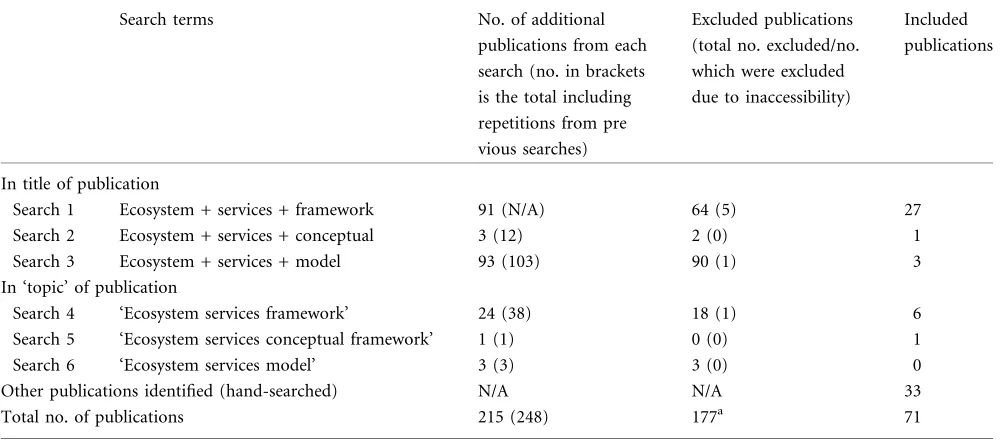
The electronic searches were conducted in succession (Searches 1–6), generating a total of 215 unique potential publications (Table 1). Each publication was assessed against the two inclusion criteria. This resulted in 177 exclusions and 38 inclusions. We also included 33 publi-cations identified through hand-searching. From this total of 71 publications, we identified 84 conceptual frameworks for analysis (some publications contained more than one relevant framework). These are summarised in chrono-logical order in Appendix 1. The frameworks themselves (i.e. in diagrammatic form) are presented in Appendix 2.
Key Feature Analysis
The frameworks were examined with respect to seven key features: (i) human health; (ii) ecosystem health; (iii) deter-minants or drivers of human health; (iv) deterdeter-minants or drivers of ecosystem health; (v) feedback mechanisms (be-tween ecosystem and human health); (vi) time; and (vii) space. All authors were involved in the assessment process which was led by one author with checks on progress and consistency by the other authors. Disagreements were re-solved by discussion. The representation of the seven key
features in each framework was assessed via its inclusion of relevant terms (e.g. for human health, terms included ‘well-being’ ‘welfare’ and ‘health’). While this ensured an objective, transparent and consistent approach, it may have resulted in the scope and potential of frameworks with more oblique reference to these features being inadequately recognised.
For each framework, we provide (Appendix 3) a tex-tual description and a ‘traffic light’ summary of the rep-resentation of each feature as follows:
Red—feature absent or represented in a very limited way; Amber—feature partially represented (e.g. related terms or concepts used) and/or present as a minor feature only; and Green—feature clearly represented and/or present as a major feature in the framework.
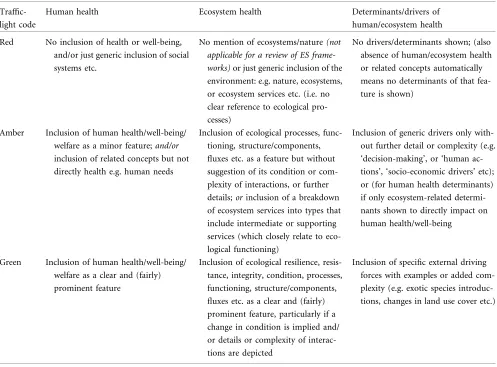
[image:4.594.49.549.90.311.2]Most traffic-light coding was straight-forward; how-ever, particularly with respect to human and ecosystem health and their determinants, finer judgments were re-quired. We therefore developed guidelines to improve consistency (see Table2). As with all reviews, a subjective element nonetheless remained. Each framework was as-sessed and assigned a traffic-light score for each of the seven key features. This was used as a simple way of gauging the level of representation of each of the key features across all of the frameworks.
Table 1. Identification Process of Publications Containing Ecosystem Services Frameworks.
Search terms No. of additional
publications from each search (no. in brackets is the total including repetitions from pre vious searches)
Excluded publications (total no. excluded/no. which were excluded due to inaccessibility)
Included publications
In title of publication
Search 1 Ecosystem + services + framework 91 (N/A) 64 (5) 27
Search 2 Ecosystem + services + conceptual 3 (12) 2 (0) 1
Search 3 Ecosystem + services + model 93 (103) 90 (1) 3
In ‘topic’ of publication
Search 4 ‘Ecosystem services framework’ 24 (38) 18 (1) 6
Search 5 ‘Ecosystem services conceptual framework’ 1 (1) 0 (0) 1
Search 6 ‘Ecosystem services model’ 3 (3) 3 (0) 0
Other publications identified (hand-searched) N/A N/A 33
Total no. of publications 215 (248) 177a 71
a
R
ESULTS: E
COSYSTEMS
ERVICESF
RAMEWORKSA
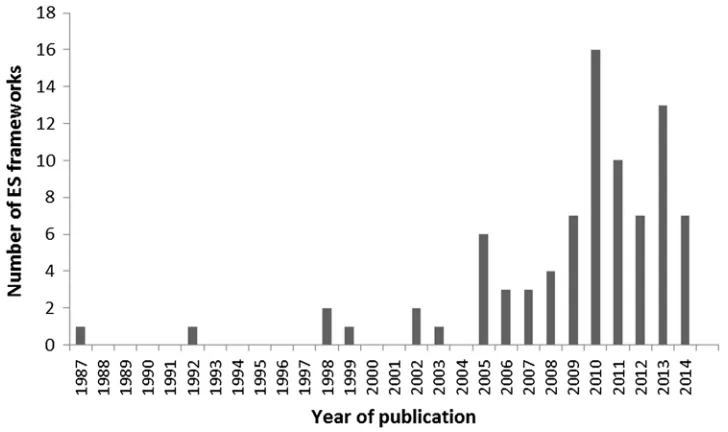
NALYSISWe identified 84 ES (or ES-related) frameworks, the earliest dating from 1987. The majority (90%) were published from 2005 (see Fig.1), suggesting that the Millennium Ecosys-tem Assessment (Millennium Ecosystem Assessment (MEA) 2005a, b) acted as a catalyst for the ES approach (Fisher et al. 2009). Below, we consider the frameworks’ representation of the seven key features.
Human Health
Most frameworks (62%) do not represent human health (or well-being or welfare) in any way. Of those that do, 23 frameworks (27%) include it as a relatively major feature,
whilst nine include it either as a minor feature or via a related concept e.g. human needs. Even those that depict human health prominently, many do so in generic terms e.g. ‘human health risks’ (Rapport et al.1998a) or ‘health’ as component of ‘human welfare’ (Ekins et al.2003).
[image:5.594.50.547.88.455.2]The MEA (2005a) framework was the first to consider different dimensions of human health, including ‘strength’, ‘feeling well’ and ‘access to clean air and water’. The MEA (2005b) framework from theHealth Synthesisalso describes different health impacts of ecosystem change—(i) direct health impacts (e.g. floods, heat waves, water shortage, landslides etc.), (ii) ‘ecosystem-mediated’ health impacts (e.g. altered infectious disease risk, reduced food yields, depletion of natural medicine etc.), and (iii) indirect, de-ferred and displaced health impacts (e.g. diverse health consequences of livelihood loss, population displacement
Table 2. Rules for Traffic-Light Coding of Human and Ecosystem Health and Their Determinants.
Traffic-light code
Human health Ecosystem health Determinants/drivers of
human/ecosystem health
Red No inclusion of health or well-being,
and/or just generic inclusion of social systems etc.
No mention of ecosystems/nature(not
applicable for a review of ES frame-works)or just generic inclusion of the environment: e.g. nature, ecosystems, or ecosystem services etc. (i.e. no clear reference to ecological pro-cesses)
No drivers/determinants shown; (also absence of human/ecosystem health or related concepts automatically means no determinants of that fea-ture is shown)
Amber Inclusion of human health/well-being/
welfare as a minor feature;and/or
inclusion of related concepts but not directly health e.g. human needs
Inclusion of ecological processes, func-tioning, structure/components, fluxes etc. as a feature but without suggestion of its condition or com-plexity of interactions, or further
details;orinclusion of a breakdown
of ecosystem services into types that include intermediate or supporting services (which closely relate to eco-logical functioning)
Inclusion of generic drivers only with-out further detail or complexity (e.g. ‘decision-making’, or ‘human ac-tions’, ‘socio-economic drivers’ etc); or (for human health determinants) if only ecosystem-related determi-nants shown to directly impact on human health/well-being
Green Inclusion of human health/well-being/
welfare as a clear and (fairly) prominent feature
Inclusion of ecological resilience, resis-tance, integrity, condition, processes, functioning, structure/components, fluxes etc. as a clear and (fairly) prominent feature, particularly if a change in condition is implied and/ or details or complexity of interac-tions are depicted
etc.). We have not found any ES framework published since the MEA that depicts human health more comprehensively, although Balmford et al. (2011) distinguish between ‘physical health’ and ‘psychological well-being’ and Daw et al. (2011) indicate how the human beneficiaries of ES, and hence their well-being, should be disaggregated in ES management.
Ecosystem Health
Most frameworks (64%) represent ecosystem health in some form, although only 19 (23%) do so clearly. Despite the focus on ES, 30 (36%) have only a generic inclusion of the environment (e.g. ‘ecosystems’, or ‘ecosystem services’). Terms related to ecosystem health in a broad sense are used, such as ecological processes, functioning and struc-ture (e.g. de Groot et al. 2010a, b; Collins et al. 2010; Haines-Young and Potschin 2010 etc.); in some cases, terms more specifically related to ecosystem health are used, such as resilience, integrity, condition and resistance (e.g. MEA 2005a). Cowling et al. (2008) go further with their axis of ‘status of social-ecological system’ depicting a continuum of states from vulnerable to resilient. Rapport et al. (1998a) provide the clearest representation of ecosystem health as ‘changed ecosystem structure and function’, using examples of ‘decreased biodiversity and resilience, increased disease, change in community struc-ture towards r-selected species, eutrophication’, all which suggest negative changes in ecosystem health.
Determinants and Drivers of Human Health
Most (63%) frameworks have no, or very limited, repre-sentation of health determinants or drivers. In the 22 frameworks where human health is relatively prominent, the primary focus is on ES as a determinant of human health, with a strong focus on positive impacts through provision-ing, regulatprovision-ing, cultural and supporting services and goods (e.g. UK NEA 2011). More rarely, negative impacts of ecosystems on human health are included (e.g. the MEA
Health Synthesis framework, 2005b), for example through
climate change, stratospheric ozone depletion, forest clear-ance and land cover change. In a number of frameworks, external driving forces are shown to ultimately drive the ecosystem (thus affecting ES provision and hence human health), but without indication of any additional direct determinants of human health (e.g. de Groot et al.2010b; Potschin and Haines-Young2010; Maes et al.2013etc.).
Only seven frameworks (8%) represent the determi-nants of human health in a comprehensive way. The MEA (2005a) conceptual framework illustrates how direct drivers of change (e.g. changes in local land use cover) and indirect drivers of change (e.g. demographic factors) determine hu-man health and well-being both directly and indirectly. Some frameworks also represent drivers of human health beyond those related to ecosystems. For example, Scoones (1998) illustrates how improvement of well-being is deter-mined by livelihood strategies, which are affected by various factors including context, resources and institutional
pro-Figure 1. Number of ecosystem
services frameworks published
[image:6.594.48.412.66.282.2]cesses. Additionally, White et al. (2010) and Bastian et al. (2013), although both representing ES as a determinant of human health, also include the role of social factors in ES delivery, including legislation, incentives, technological development, governance and equity (White et al.2010) and the role of stakeholders and valuation (Bastian et al.2013). Reis et al. (2013) explicitly refer to ‘determinants of health’ in their framework, drawing upon the ‘social determinants of health’ (SDH) model (Dahlgren and Whitehead 1991), a model that has underpinned global, national and local strategies on public health and health inequalities (WHO
2008).
Determinants and Drivers of Ecosystem Health
Most frameworks (68%) include some determinants or drivers of ecosystem health (or ecosystems more generally), with 13 (15%) depicting them strongly. The earliest example is Rapport et al. (1998a) who include ‘human pressures on ecosystems and landscapes’, such as harvesting, waste residuals, physical restructuring, magnified extreme events and exotic species introductions. More recent frameworks, including the MEA (2005a) conceptual framework and de Groot et al. (2010b), also include direct and indirect drivers of change upon ecosystems and ES delivery. Human drivers are often represented as having negative impacts on ecosystems (e.g. Rapport et al. 1998a, b; de Groot et al.
2010b; White et al.2010) or a negative impact is implied, such as ‘pressures’ (e.g. Haines-Young and Potschin2010).
There are two other noteworthy approaches to con-ceptualising ecosystem health drivers. Firstly, there is the Framework for Ecosystem Service Provision (FESP), based on a Driver-Pressure-State-Impact-Response (DPSIR) framework (Rounsevell et al.2010). It depicts ‘states’ (which include the supporting system) determined by ‘pressures’ (e.g. climate change, land use change, invasive species, air pollution), which are determined by ‘drivers’ (e.g. economy, demography, society, technology) and ‘responses’ (policy, strategic decisions and management). A similar approach is taken by Kelble et al.2013. Secondly, there is the Press-Pulse Dynamics framework (Collins et al. 2010). This shows the ecological system determined by pulse events (sudden events e.g. fire, drought, storms, dust events etc.) and press events (extensive, pervasive, and subtle changes e.g. climate change, nutrient loading, sea-level rise etc.). These events are also shown to be influenced by external drivers such as climate and globalisation, and human behaviour and outcomes.
Feedback Mechanisms (Between Human Health and
Ecosystem Health)
With human health absent from most frameworks, feed-back mechanisms between human and ecosystem health are largely absent too. Where human health is present, most only show a one-directional pathway from ecosystem health to human health outcomes, e.g. the MEA (2005a) framework on harmful effects of ecosystem change on human health. Only 25% (21) of the frameworks include feedback mechanisms, for example the overall MEA (2005a) framework, which includes the impact of human well-being directly on ecosystems and indirectly on ecosystem drivers, thus closing the loop.
A few frameworks go further and identify the mecha-nisms involved. For example, de Groot et al. (2010b) include governance and decision-making as mechanisms which impact upon the determinants of ecosystems and biodiver-sity, and similarly Duraiappah et al. (2014) link natural systems and human well-being via institutions and gover-nance. Bastian et al. (2013) include the mechanisms ‘use, management, decision, participation, steering’ to close the loop between ecosystem benefits (which include well-being), and ecosystem properties. White et al. (2010) illustrate how legislation, incentives and voluntary agreements influence the outputs (e.g. waste and pollution) from social develop-ment and well-being, which then impact upon the ecosystem either directly or indirectly. Some frameworks depict deci-sion-making and governance processes in further detail, e.g. Lopes and Videira (2013) describe the feedback mechanism between policy formation and assessment with decision-making and implementation, in the context of ES. However these processes relate to feedback mechanisms solely within ES management, rather than describing the feedback mechanisms between human health and ecosystem health.
Time
Time is not represented in the majority (82%) of the frameworks. Eleven have time as a minor feature, and only four frameworks (5%) have a prominent representation of time. The earliest example of the inclusion of time is the MEA (2005a), although not as a significant feature.
as a change between two time-points, for example changes following ES management. The framework by Bastian et al. (2013) also includes the ‘temporal aspect’; ‘time scale, driving forces, changes and scenarios’ links to the five pil-lars of their system—although, like the framework of Wallace (2007), this does not necessarily capture longer
[image:8.594.48.544.96.618.2]timeframes. The framework developed by Reed et al. (2013) includes a longer time perspective by showing the impact on the natural and social system of ‘future change’ in comparison to ‘current context’. However overall, ES frameworks pay relatively little attention to ecosystem-human health inter-relationships over time.
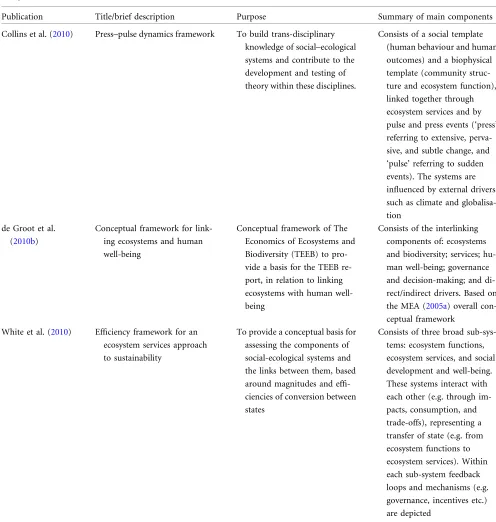
Table 3. The Three Top-Scoring Frameworks Based on Overall Scores for all Seven Features (Excluding Those Not Scoring ‘Green’ for Ecosystem Health and Human Health).
Publication Title/brief description Purpose Summary of main components
Collins et al. (2010) Press–pulse dynamics framework To build trans-disciplinary
knowledge of social–ecological systems and contribute to the development and testing of theory within these disciplines.
Consists of a social template (human behaviour and human outcomes) and a biophysical template (community struc-ture and ecosystem function), linked together through ecosystem services and by pulse and press events (‘press’ referring to extensive, perva-sive, and subtle change, and ‘pulse’ referring to sudden events). The systems are influenced by external drivers such as climate and globalisa-tion
de Groot et al. (2010b)
Conceptual framework for link-ing ecosystems and human well-being
Conceptual framework of The Economics of Ecosystems and Biodiversity (TEEB) to pro-vide a basis for the TEEB re-port, in relation to linking ecosystems with human well-being
Consists of the interlinking components of: ecosystems and biodiversity; services; hu-man well-being; governance and decision-making; and di-rect/indirect drivers. Based on
the MEA (2005a) overall
con-ceptual framework
White et al. (2010) Efficiency framework for an
ecosystem services approach to sustainability
To provide a conceptual basis for assessing the components of social-ecological systems and the links between them, based around magnitudes and effi-ciencies of conversion between states
Space
The spatial dimension is absent from 69% of the frame-works. While only 12 frameworks (14%) include it as a prominent feature, they do so in innovative ways. The framework by Cowling et al. (2008) has a spatial axis from regional to local which corresponds to different stages for safeguarding ES and Bastian et al. (2012) depict space as a continuum from local/micro through to global/macro-space, with examples of different types of natural or con-structed space for each spatial level. Lo´pez-Hoffman et al. (2010) take a different approach, illustrating the relation-ship between two world regions, linked by transboundary interventions. Both Fisher et al. (2009) and Serna-Chavez et al. (2014) depict the spatial relationships between ES production areas and service benefit areas.
While the focus on space can mean other dimensions are given less attention, some frameworks include space within an integrated and comprehensive approach, e.g. Robinson et al. (2009) and Carpenter et al. (2009) divide their frame-work into spatial levels. Possibly the best example is the framework by Duraiappah et al. (2014). Here, space is de-picted in three ways, relating to (i) society (household, community, nation, region, globe); (ii) institutions and governance (community, national, regional, international) and (iii) ecosystems (resource system, landscape, bioregion, biome, planet). At these different scales, the natural and social systems are linked via institutions and governance, the pro-ductive base (capital) and ES. As this suggests, space has been more extensively incorporated into ES frameworks than time.
Highly Rated Frameworks
The traffic-light system enabled us to identify frameworks that gave prominence to ecosystem and human health and included most of the other five features well or moderately well. Three frameworks stood out using this scoring system. These were (i) the Press–Pulse Dynamics Framework by Collins et al. (2010); (ii) the conceptual framework of The Economics of Ecosystems and Biodiversity (TEEB) by de Groot et al. (2010b), which builds on the MEA main conceptual framework and the cascade model by Haines-Young and Potschin (2010); and (iii) the efficiency framework for an ES approach to sustainability by White et al. (2010) (see Table 3).
A number of other frameworks also provide examples of how features relevant to ecosystem and human health can be integrated. These include the following:
– Ekins et al. (2003), showing environmental functions and attributes in relation to human influences and welfare; – Rapport et al. (1998a), showing the linkages between
pressures from human activity, ecosystem change and degradation of ecosystem and human health;
– The main MEA (2005a) conceptual framework, showing the relationship between indirect and direct drivers of change with ES and human well-being/poverty allevia-tion. However, this framework, along with that by Lo´pez-Hoffman et al. (2010) which also scored highly overall (based on the MEA overall framework and depicting transboundary ES), only scored moderately for their representation of ecosystem health;
– The MEA (2005a) framework depicting biodiversity as response variable affected by global change drivers; – Maes et al. (2013)—the conceptual framework for
EU-wide ecosystem assessments, which emphasises the role of biodiversity in delivering ES and human well-being; and – Bastian et al. (2013)—the extended Ecosystem
Proper-ties, Potentials, and Services (EPPS) framework.
C
ONCLUSIONSToday’s economic systems, together with the lifestyles that they sustain, are driving environmental change and its associated impacts on ecosystem and human health. To address the interacting processes linking ecosystem and human health, new ways of working across science and policy are urgently required. This in turn demands ways of working across communities—for example, across disci-plines and across local, national and global policy—which, until recently, have developed and operated separately (Myers and Patz2009; Keune et al. 2013; Woodward and Mcmillan 2015). Frameworks are recognised as vehicles through which knowledge and perspectives can be shared across boundaries; they can help open up the common ground necessary for cooperation around shared goals (Star and Griesemer 1989). ES frameworks have particular potential in this respect.
a basis on which to build an integrated ecosystem and human health framework capable of informing environ-mental interventions with dual conservation and human health goals.
To promote this integrated perspective, we make the following suggestions. With respect to human health, we recommend building upon the MEA (2005b) approach of ‘direct’, ‘ecosystem-mediated’, and ‘indirect, deferred and displaced’ health impacts, which could be illustrated using specific health conditions linked to specific changes in ES delivery. In this context, it is also important to consider that biodiversity’s impact on human health, for example in relation to infectious disease, is not always beneficial, and may be considered as a ‘disservice’ rather than a ‘service’ (Dunn 2010). Recognising such plurality of concepts is important in building bridges across disciplines (Keune et al. 2013) and frameworks that seek to integrate ecosys-tems and public health should be flexible to accommodate these negative impacts of ecosystems, as well as positive ones. For ecosystem health, we recommend approaches that, like Rapport et al. (1998a,b), indicate what constitutes poor versus good ecosystem health. This would support the use of standard measures of ecosystem health and aid interpretation by the public health community for which measurement and monitoring are well established tools supporting policy-making and impact assessment.
With respect to health determinants, more attention needs to be given to non-environmental determinants and their effects on both ecosystem and human health. Poten-tial resources here are public health frameworks with the social determinants of health (e.g. Dahlgren and Whitehead
1991; WHO2008) and the wider ecosystem (e.g. McLeroy et al.1988; Lang and Rayner2012) as their primary focus. For ecosystem drivers, the press-pulse approach (Collins et al. 2010) would complement the representation of hu-man health in MEA (2005b). Pulse events are likely to have substantial direct health impacts, whilst press events are likely to have significant indirect, deferred and displaced health impacts. Both press and pulse events have the potential to have substantial ecosystem-mediated health impacts. This could be combined with FESP, in order to incorporate pressures, drivers, and responses more effec-tively.
We suggest incorporating feedback mechanisms be-tween ecosystem and human health (e.g. White et al.2010; Bastian et al.2013). These are essential for policy guidance on how to promote ecosystem and human health
co-ben-efits by enhancing positive feedbacks and minimising negative feedbacks.
Space figures centrally in a number of ES frameworks, and the use of spatial levels (e.g. local, national, global) would align well with resource allocation and planning in the environmental and public health communities. Time needs to be equally prominent, and represented at a scale extending beyond the short-term. This is particularly important for capturing longer-term ecosystem and human health benefits of ecosystem interventions and for risk assessments of potential thresholds or tipping points in ecosystem and human health (Lenton2011).
While our review points the way to a new framework incorporating these features, its development would require detailed work and extensive consultation. A parallel review of how ecosystem processes are represented in public health frameworks would also be needed to ensure any new framework spoke to both the environmental and the health sector. What our review demonstrates however is the scope for ES approaches to invigorate and inform cross-sector working, alerting researchers and decision-makers to co-dependencies between ecosystem and human health and highlighting the opportunities for policies that can benefit ecosystems and the health of humans who depend upon them.
A
CKNOWLEDGMENTSThis research was funded by the Economic & Social Research Council (ESRC) Transformative Research Grant (ES/L003015/1). We thank the Health of Populations and Ecosystems (HOPE) project advisory panels for their valuable contribution and the journal reviewers for their helpful feedback.
O
PENA
CCESSR
EFERENCESArksey H, O’Malley L (2005) Scoping studies: towards a
methodological framework.International Journal of Social
Re-search Methodology: Theory & Practice8(1):19–32. doi:10.1080/ 1364557032000119616
Balmford A, Fisher B, Green RE, Naidoo R, Strassburg B, Turner RK, Rodrigues ASL (2011) Bringing ecosystem services into the real world: an operational framework for assessing the economic
consequences of losing wild nature.Environmental & Resource
Economics48:161–175. doi:10.1007/s10640-010-9413-2 Bastian O, Grunewald K, Syrbe RU (2012) Space and time aspects
of ecosystem services, using the example of the EU Water
Framework Directive.International Journal of Biodiversity
Sci-ence, Ecosystem Services & Management 8(1–2):5–16. doi:10.1080/21513732.2011.631941
Bastian O, Syrbe RU, Rosenberg M, Rahe D, Grunewald K (2013) The five pillar EPPS framework for quantifying, mapping and
managing ecosystem services. Ecosystem Services 4:15–24.
doi:10.1016/j.ecoser.2013.04.003
Bhatia R, Wernham A (2009) Integrating human health into environmental impact assessment: an unrealized opportunity for environmental health and justice.Cieˆncia & Sau´de Coletiva
14:1159–1175. doi:10.1289/ehp.11132
Carpenter RS, Mooney HA, Agard J, Capistrano D, DeFries RS, Dı´az S, Dietz T, Duraiappah AK, Oteng-Yeboah A, Pereira HM, Perrings C, Reid WV, Sarukhan J, Scholes RJ, Whyte A (2009) Science for managing ecosystem services: beyond the
Millen-nium Ecosystem Assessment.Proceedings of National Academy
of Sciences of the United States of America 106(5):1305–1312. doi:10.1073/pnas.0808772106
Centers for Disease Control and Prevention (2013)Health-Related
Quality of Life (HRQOL): Well-Being Concepts.http://www.cdc. gov/hrqol/wellbeing.htm. Accessed 4 May 2015
Chapin FS, Lovecraft AL, Zavaleta ES, Nelson J, Robards MD, Kofinas GP, Trainor SF, Peterson GD, Huntington HP, Naylor RL (2006) Policy strategies to address sustainability of Alaskan boreal forests in response to a directionally changing climate. Proceedings of National Academy of Sciences of the United States of America103(45):16637–16643
Collins SL, Carpenter SR, Swinton SM, Orenstein DE, Childers DL, Gragson TL, Grimm NB, Grove JM, Harlan SL, Kaye JP, Knapp AK, Kofinas GP, Magnuson JJ, McDowell WH, Melack JM, Ogden LA, Robertson GP, Smith MD, Whitmer AC (2010) An integrated conceptual framework for long-term
social–eco-logical research. Frontiers in Ecology and the Environment
9(6):351–357. doi:10.1890/100068
Costello A, Abbas M, Allen A, Ball S, Bell S, Bellamy R, Friel S, Groce N, Johnson A, Kett M, Lee M, Levy C, Maslin M, McCoy D, McGuire B, Montgomery H, Napier D, Pagel C, Patel J, Puppim de Oliveira JA, Redclift N, Rees H, Rogger D, Scott J, Stephenson J, Twigg J, Wolff J, Patterson C (2009) Managing the health effects of climate change: Lancet and University
College London Institute for Global Health Commission.The
Lancet373:1693–1733. doi:10.1016/S0140-6736(09)60935-1 Cowling RM, Egoh B, Knight AT, O’Farrell PJ, Reyers B, Rouget
M, Roux DJ, Welz A, Wilhelm-Rechman A (2008) An opera-tional model for mainstreaming ecosystem services for
imple-mentation.Proceedings of the National Academy of Sciences of the
United States of America 105(28):9483–9488. doi:10.1073/ pnas.0706559105
Dahlgren G, Whitehead M (1991)Policies and strategies to promote
social equity in health, Stockholm: Institute for Future Studies Daw T, Brown K, Rosendo S, Pomeroy R (2011) Applying the
ecosystem services concept to poverty alleviation: the need to
disaggregate human well-being. Environmental Conservation
38(4):370–379. doi:10.1017/S0376892911000506
de Groot RS, Alkemade R, Braat L, Hein L, Willemen L (2010) Challenges in integrating the concept of ecosystem services and values in landscape planning, management and decision mak-ing. Ecological Complexity 7:260–272. doi:10.1016/j.ecocom. 2009.10.006
de Groot R, Fisher B, Christie M, Aronson J, Braat L, Gowdy J, Haines-Young R, Maltby E, Neuville A, Polasky S, Portela R, Ring I (2010) Integrating the ecological and economic
dimen-sions in biodiversity and ecosystem service valuation. In: The
Economics of Ecosystems and Biodiversity: Ecological and Eco-nomic Foundations, Kumar P (editor), London: Earthscan Dunn RR (2010) Global mapping of ecosystem disservices: the
unspoken reality that nature sometimes kills us. Biotropica
42:555–557
Duraiappah AK, Asah ST, Brondizio ES, Kosoy N, O’Farrell PJ, Prieur-Richard AH, Subramanian SM, Takeuchi K (2014) Managing the mismatches to provide ecosystem services for human well-being: a conceptual framework for understanding
the New Commons. Current Opinion in Environmental
Sus-tainability7:94–100. doi:10.1016/j.cosust.2013.11.031
Ekins P, Simon S, Deutsch L, Folke C, de Groot R (2003) A framework for the practical application of the concepts of critical natural capital and strong sustainability.Ecological Eco-nomics44:165–185. doi:10.1016/S0921-8009(02)00272-0 Fisher B, Turner RK, Morling P (2009) Defining and classifying
ecosystem services for decision making. Ecological Economics
68:643–653. doi:10.1016/j.gloenvcha.2013.04.002
Fisher JA, Patenaude G, Meir P, Nightingale AJ, Rounsevell MDA, Williams M, Woodhouse IH (2013) Strengthening conceptual foundations: analysing frameworks for ecosystem services and pov-erty alleviation research.Global Environmental Change23:1098–1111 Go´mez-Baggethun E, de Groot R, Lomas PL, Montes C (2010) The history of ecosystem services in economic theory and practice: from early notions to markets and payment schemes. Ecological Economics69:1209–1218. doi:10.1016/j.ecolecon.2009. 11.007
Groffman PM, Baron JS, Blett T, Gold AJ, Goodman I, Gunderson LH, Levinson BM, Palmer MA, Paerl HW, Peterson GD, Poff NL, Rejeski DW, Reynolds JF, Turner MG, Weathers KC, Wiens J (2006) Ecological thresholds: the key to successful environmental management or an important concept with no practical
appli-cation?Ecosystems9(1):1–13. doi:10.1007/S10021-003-0142-Z
Haines A, Kovats RS, Campbell-Lendrum D, Corvalan C (2006) Climate change and human health: impacts, vulnerability and
public health. Public Health 120(7):585–596. doi:10.1016/
j.puhe.2006.01.002
Haines-Young R, Potschin M (2010) The links between
biodi-versity, ecosystem services and human well-being. In:Ecosystem
Ecology: A New Synthesis. BES Ecological Reviews Series, CUP, Raffaelli D, Frid C (editors), Cambridge: Cambridge University Press, pp 110–139
Harris PJ, Harris E, Thompson S, Harris-Roxas B, Kemp L (2009) Human health and wellbeing in environmental impact assess-ment in New South Wales, Australia: Auditing health impacts
Environ-mental Impact Assessment Review 29:310–318. doi:10.1016/ j.eiar.2009.02.002
Health of Populations and Ecosystems (2014) HOPE Glossary of
Terms. http://www.york.ac.uk/healthsciences/research/public-health/projects/hope/glossary/. Accessed 15 Jan 2015
IPCC (2014) Summary for policymakers. In:Climate Change 2014:
Impacts, Adaptation, and Vulnerability. Part A: Global and Sec-toral Aspects. Contribution of Working Group II to the Fifth Assessment Report of the Intergovernmental Panel on Climate Change, Field CB, Barros VR, Dokken DJ, Mach KJ, Mastrandrea MD, Bilir TE, Chatterjee M, Ebi KL, Estrada YO, Genova RC, Girma B, Kissel ES, Levy AN, MacCracken S, Mastrandrea PR, White LL (editors), Cambridge, UK: Cambridge University Press Kelble CR, Loomis DK, Lovelace S, Nuttle WK, Ortner PB, Fletcher P, Cook GS, Lorenz JJ, Boyer JN (2013) The EBM-DPSER conceptual model: integrating ecosystem services into
the DPSIR framework. PLoS One 8:e70766. doi:
10.1371/jour-nal.pone.0070766
Keune H, Kretsch C, de Blust G, Gilbert M, Flandroy L, Van den Berge K, Versteirt V, Hartig T, de Keersmaecker L, Eggermont H, Brosens D, Dessein J, Vanwambeke S, Prieur-Richard AH, Wittmer H, Van Herzele A, Linard C, Martens P, Mathijs E, Simoens I, Van Damme P, Volckaert F, Heyman P, Bauler T (2013) Science–policy challenges for biodiversity, public health
and urbanization: examples from Belgium.Environmental
Re-search Letters8:025015. doi:10.1088/1748-9326/8/2/025015 Lang T, Rayner G (2012) Ecological public health: the 21st
cen-tury’s big idea? An essay by Tim Lang and Geof RaynerBMJ
345:e5466. doi:10.1136/bmj.e5466
Lenton TM (2011) Early warning of climate tipping points.
Na-ture Climate Change1:201–209. doi:10.1038/NCLIMATE1143 Lopes R, Videira N (2013) Valuing marine and coastal ecosystem
services: an integrated participatory framework. Ocean &
Coastal Management84:153–163
Lo´pez-Hoffman L, Varady RG, Flessa KW, Balvanera P (2010) Ecosystem services across borders: a framework for
trans-boundary conservation policy. Frontiers in Ecology and the
Environment8(2):84–91. doi:10.1890/070216
Maes J, Teller A, Erhard M, Liquete C, Braat L, Berry P, Egoh B, Puydarrieux P, Fiorina C, Santos F, Paracchini ML, Keune H, Wittmer H, Hauck J, Fiala I, Verburg PH, Conde´ S, Scha¨gner JP, San Miguel J, Estreguil C, Ostermann O, Barredo JI, Pereira HM, Stott A, Laporte V, Meiner A, Olah B, Royo Gelabert E, Spyropoulou R, Petersen JE, Maguire C, Zal N, Achilleos E, Rubin A, Ledoux L, Brown C, Raes C, Jacobs S, Vandewalle M,
Connor D, Bidoglio G (2013) Mapping and Assessment of
Ecosystems and their Services An analytical framework for ecosystem assessments under action 5 of the EU biodiversity strategy to 2020, Luxembourg: Publications Office of the Euro-pean Union
McLeroy KR, Bibeau D, Steckler A, Glanz K (1988) An ecological
perspective on health promotion programs. Health Education
Quarterly15(4):351–377
McMichael AJ (2013) Globalization, climate change, and human
health. The New England Journal of Medicine 368:1335–1343.
doi:10.1056/NEJMra1109341
McMichael AJ, Friel S, Nyong A, Corvalan C (2008) Global environmental change and health: impacts, inequalities, and the
health sector. BMJ 336:191–194. doi:10.1136/bmj.39392.
473727.AD
McMichael AJ, Woodruff RE, Hales S (2006) Climate change and
human health: present and future risks.The Lancet367:859–869.
doi:10.1016/S0140-6736(06)68079-3
Millennium Ecosystem Assessment (MEA) (2005)Ecosystems and
Human Well-Being: Current State and Trends, Washington DC: Island Press
Millennium Ecosystem Assessment (MEA) (2005)Ecosystems and
Human Well-being: Health Synthesis, Washington DC: Island Press
Myers SS, Patz JA (2009) Emerging threats to human health from
global environmental change. Annual Review of Environment
and Resources 34:223–252. doi:10.1146/annurev.environ.033 108.102650
Nahlik AM, Kentula ME, Fennessy MS, Landers DH (2012) Where is the consensus? A proposed foundation for moving ecosystem
service concepts into practice Ecological Economics 77:27–35.
doi:10.1016/j.ecolecon.2012.01.001
Potschin MB, Haines-Young RH (2010) Ecosystem services:
exploring a geographical perspective. Progress in Physical
Geography35:575–594. doi:10.1177/0309133311423172 Rapport DJ, Costanza R, McMichael AJ (1998) Assessing
ecosys-tem health.Trends in Ecology and Evolution13:397–402
Rapport DJIn: Gaudet CLConstanza REpstein PRLevins R
(edi-tors) (1998)Ecosystem Health, Malden, MA: Blackwell Science
Robinson DA, Libron I, Vereecken H (2009) On the definition of the natural capital of soils: a framework for description,
eval-uation, and monitoring.Soil Science Society of America Journal
73:1904–1911. doi:10.2136/sssaj2008.0332
Reed MS, Podesta G, Fazey I, Geeson N, Hessel R, Hubacek K, Letson D, Nainggolan D, Prell C, Rickenbach MG, Ritsema C, Schwilch G, Stringer LC, Thomas AD (2013) Combining ana-lytical frameworks to assess livelihood vulnerability to climate
change and analyse adaptation options. Ecological Economics
94:66–77. doi:10.1016/j.ecolecon.2013.07.007
Reis S, Morris G, Fleming LE, Beck S, Taylor T, White M, De-pledge MH, Steinle S, Sabel CE, Cowie H, Hurley F, McP Dick J, Smith RI, Austen M (2013) Integrating health and
environ-mental impact analysis.Public Health. doi:10.1016/j.puhe.2013.
07.006
Rounsevell MDA, Dawson TP, Harrison PA (2010) A conceptual framework to assess the effects of environmental change on
ecosystem services.Biodiversity and Conservation19:2823–2842.
doi:10.1007/s10531-010-9838-5
Scoones I (1998) Sustainable rural livelihoods: a framework for analysis. IDS Working Paper 72:1–22
Serna-Chavez HM, Schulp CJE, van Bodegom PM, Bouten W, Verburg PH, Davidson MD (2014) A quantitative framework
for assessing spatial flows of ecosystem services. Ecological
Indicators39:24–33. doi:10.1016/j.ecolind.2013.11.024
Star SL, Griesemer JR (1989) Institutional ecology, ‘‘translations’’ and boundary objects: amateurs and professionals in Berkeley’s
Museum of Vertebrate Zoology, 1907–39.Social Studies of
Sci-ence19(3):387–420
Thomson Reuters. Web of ScienceTM [Software] (2014) http://
thomsonreuters.com/thomson-reuters-web-of-science/. Accessed 15 Jan 2015
UK National Ecosystem Assessment (UK NEA) (2011)UK
Wallace KJ (2007) Classification of ecosystem services: problems
and solutions.Biological Conservation139:235–246. doi:10.1016/
j.biocon.2007.07.015
White PCL, Godbold JA, Solan M, Weigand J, Holt AR (2010) Ecosystem services and policy: a review of coastal wetland ecosystem services and an efficiency-based framework for
implementing the ecosystem approach. In: Ecosystem Services
Issues in Environmental Science and Technology, Vol 30, Hester RE, Harrison RM (editors), Cambridge: RSC Publishing, pp 29–
51. doi:10.1039/9781849731058-00029
WHO (World Health Organization) (1998) Health Promotion
Glossary. Geneva, Switzerland: World Health Organization.
http://www.who.int/healthpromotion/about/HPR%20Glossary% 201998.pdf. Accessed 16 Jan 2015
WHO (World Health Organization) (2008)Closing the gap in a
generation: health equity through action on the social determi-nants of health. Final Report of the Commission on Social Determinants of Health. Geneva, Switzerland: World Health Organization
Woodward A, Mcmillan A (2015) The environment and climate
change. In: Oxford textbook of global public health, Detels R,