Double quick, double click reversible peptide
“
stapling
”
†
Claire M. Grison, abGeorge M. Burslem, abJennifer A. Miles, ab
Ludwig K. A. Pilsl,abDavid J. Yeo,abZeynab Imani,abStuart L. Warriner, ab
Michael E. Webb aband Andrew J. Wilson *ab
The development of constrained peptides for inhibition of protein–protein interactions is an emerging strategy in chemical biology and drug discovery. This manuscript introduces a versatile, rapid and reversible approach to constrain peptides in a bioactive helical conformation using BID and RNase S peptides as models. Dibromomaleimide is used to constrain BID and RNase S peptide sequence variants bearing cysteine (Cys) or homocysteine (hCys) amino acids spaced atiandi+ 4 positions by double substitution. The constraint can be readily removed by displacement of the maleimide using excess thiol. This new constraining methodology results in enhanced a-helical conformation (BID and RNase S peptide) as demonstrated by circular dichroism and molecular dynamics simulations, resistance to proteolysis (BID) as demonstrated by trypsin proteolysis experiments and retained or enhanced potency of inhibition for Bcl-2 family protein–protein interactions (BID), or greater capability to restore the hydrolytic activity of the RNAse S protein (RNase S peptide). Finally, use of a dibromomaleimide functionalized with an alkyne permits further divergent functionalization through alkyne–azide cycloaddition chemistry on the constrained peptide with fluorescein, oligoethylene glycol or biotin groups to facilitate biophysical and cellular analyses. Hence this methodology may extend the scope and accessibility of peptide stapling.
Introduction
Inhibition of a-helix mediated protein–protein interactions (PPIs)1–4represents an area of intense interest, due to their role in intracellular signalling processes5and demonstrated tractability for drug discovery.6,7 The last decade has seen an increasing emphasis on the development of constrained peptides8–10for PPI inhibition. Constraint of a peptide in a bioactive conformation is proposed to improve target binding affinity (by preorganiza-tion),11,12 increase stability (e.g. by protecting against proteol-ysis)13–15 and enhance cell-uptake,16,17 although a number of recent studies have provided conicting evidence for the enhanced cell permeability and cellular potency that is conferred through stapling.18–20 Available strategies9,13,21–25 to constrain a peptide in a helical conformation (Fig. 1a–e), include hydro-carbon“staples”,26–28lactam bridges,29–31hydrogen-bond surro-gates,32photoswitches11,33,34and triazoles introduced by “click” chemistry.35–38 The nature of the linker, including any
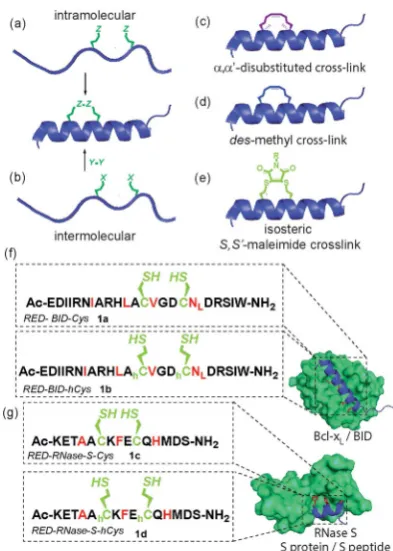
stereocenters, plays a role in regulating peptide conformation and target protein affinity.31,39Introduction of constraints may be achieved either by intramolecular reaction (Fig. 1a)28,31 or by chemoselective intermolecular reaction (Fig. 1b) between suit-ably disposed residues within the peptide sequence and an appropriate coupling partner.36,40Introduction of a constraint by intermolecular reaction, whilst synthetically more demanding, may be advantageous in that it provides access to functionalized constraints36 and thus to peptides tailored for biophysical, cellular and chemical proteomics analyses. Herein, we use BID and RNase S variant peptides (1a–d) which respectively bind Bcl-xLproteins41and RNase S protein42(Fig. 1f and g), to demonstrate that dibromomaleimides43–51serve as versatile constraints that can be introduced and removed.52–57 These reagents have not previously been studied for their ability to control peptide hel-icity. Introduction of an alkyne onto the dibromomaleimide permits further divergent functionalization by “click” chem-istry.58 This approach may therefore complement recently
re-ported methods to constrain peptides by reaction of
dichloroacetone59 with side chain thiols and photo-reversible constraints usingS,S0-tetrazine.60
Previously, we14and others61introduceda-pentenylglycine as an alternative to the widely useda,a0-pentenylalanine for cross-linking theiandi+ 4 residues within a peptide (Fig. 1c and d).26 Production of thisdes-methyl constraint requires a more easily aSchool of Chemistry, University of Leeds, Woodhouse Lane, Leeds LS2 9JT, UK. E-mail:
bAstbury Centre For Structural Molecular Biology, University of Leeds, Woodhouse Lane, Leeds LS2 9JT, UK
†Electronic supplementary information (ESI) available: Synthesis and characterization, additional biophysical and biochemical analyses. See DOI: 10.1039/c7sc01342f
Cite this:Chem. Sci., 2017,8, 5166
Received 27th March 2017 Accepted 11th May 2017
DOI: 10.1039/c7sc01342f
rsc.li/chemical-science
Science
EDGE ARTICLE
Open Access Article. Published on 31 May 2017. Downloaded on 01/07/2017 11:36:04.
This article is licensed under a
Creative Commons Attribution 3.0 Unported Licence.
synthesized amino acid which is less sterically hindered for peptide coupling, and, as shown by us, has no deciencies in terms of biophysical properties when applied to BH3 peptides BID and BIM.62We hypothesized that this all hydrocarbon 8-atom constraint could be replaced with an iso8-atomicS,S0 -mal-eimide crosslink by reaction of suitably disposed homocysteine (hCys) residues with dibromomaleimide (or for cysteine (Cys), a 6-atom constraint) (Fig. 1e).
Peptides1a–dbearing Cys orhCys amino acids in positions used previously26,62fori/i+ 4 constraints were independently oxidised to the constrained disulde2a–dor cross-linked with dibromomaleimide4to generate3a–dwith rapid and complete conversion. Alternatively, this sequence1a–dto3a–dcould be performed in one pot and peptides1a–dfully regenerated by addition of an excess of thiol (Fig. 2 and S4–7†). It is noteworthy that conversion of the Cys-derived sequences1aand1cto their constrained derivatives3aand3cwas more rapid than for the correspondinghCys derivatives1band1d. It should be noted that these studies were carried out in unbuffered aqueous solution and future studies will focus on a more detailed anal-ysis of the reaction rates, their pH dependence and comparison to other rapid constraining reactions.63Of further note is the
fact that a range of thiols were used including a 10 mM aqueous solution of glutathione, which corresponds to the average concentration present in cancer cells.64,65It may thus be feasible to harness this approach for controlled delivery of a peptide to the diseased cell; a focus of future studies. Interestingly, removal of the maleimide cross-link could be abrogated through addition of an excess of the reducing agent TCEP, resulting in a permanent succinimide cross-link (Fig. S9†). Succinimide linkages of a similar nature have been shown to undergo thiol mediated cleavage;48future efforts to“lock”the constraint may therefore be more appropriately served by hydrolysis of the imide in the maleimide crosslink.66
Peptides1a,b and3a,b were analysed by CD spectroscopy and subjected to proteolysis assays anduorescence anisotropy competition assays for inhibition of the BID/Mcl-1, BAK/Bcl-xL and NOXA-B/Mcl-1 interactions (Fig. 3, S19–23 and S29–30†). Constrained peptides3a,bshowed no signicant difference in helicity (42% and 43%) to each other as a result of the different cross-link length but both were more helical than the corre-sponding reduced peptide1aor1b, (24% and 29%). Molecular dynamics calculations were conducted on1b and3b – these further support the conclusion that the helical conformation predominates when constrained by the maleimide linker (Fig. S25 and S26†). Tryptic proteolysis as monitored by LC-MS14 established that the conformationally constrained peptides3a,b exhibit improved proteolytic resistance in comparison to the reduced peptides1a,b; proteolysis was retarded up to 7 residues removed from either side of the thiol residues (Fig. S19–23†). Taken together these data indicate that the maleimide constraint confers comparable enhancement of helicity and Fig. 2 Reversible constraining reaction sequence for peptides1–3a– d: conditions for conversion from the oxidised state (OX) through the intermediate reduced state (RED) to the constrained peptide (STA) and
vice versa (LHS); HRMS analyses of reaction mixture for reversible interconversion between1band3b(relevant masses are indicated in black for the peptide and in green for excess glutathione used during unconstraining) (RHS).
Fig. 1 Overview of peptide stapling strategies and linkers for con-straining peptides in ana-helical conformation together with struc-tures for the model protein–protein interactions used in this study; (a) schematic for intramolecular crosslinking; (b) schematic for intermo-lecular crosslinking; (c) S,S-a,a0-disubstituted i, i + 4 hydrocarbon
“staple”; (d)S,S-des-methyli,i+ 4 hydrocarbon constraint; (e)i,i+ 4
S,S0-maleimide staple reported in this work; (f) and (g) model peptide sequences1a–d for BID (1a–b) and RNase S (1c–d) and protein– protein interactions in this study (Bcl-xL(green)/BID (blue) PDB ID:
4QVE; RNase S protein (green)/S peptide (blue) PDB ID: 1CJQ; hotspot residues (red)).
Open Access Article. Published on 31 May 2017. Downloaded on 01/07/2017 11:36:04.
This article is licensed under a
[image:2.595.67.264.46.322.2]proteolytic resistance to thedes-methyl hydrocarbon constraint reported by us earlier.62Peptides1a,band3a,b inhibited the BID/Mcl-1 interaction with comparable potency to the native WT-BID 8 sequence (IC50 15–25 mM) except for the con-strained peptide3bwhich was slightly more potent (IC504.2 mM), thus the constraining/unconstraining reagents have either a weak or no effect on the inhibitory potency for this PPI. Although inconsistent with the concept that preorganization should promote higher binding affinity, the result is consistent with our own recent studies on hydrocarbon-constrained
peptides, which illustrated enthalpy-entropy compensation operates for these peptides which bind through an induced-t mechanism.62 For inhibition of BAK/Bcl-x
L both constrained peptides3a,bwere shown to be signicantly superior inhibitors compared to the reduced peptides1a,b. The differential effects upon potency for the same peptide against Bcl-xLand Mcl-1 may arise as a consequence of favourable non-covalent contacts between the maleimide and Bcl-xL; it is anticipated that future structural analyses will shed light on these differences.
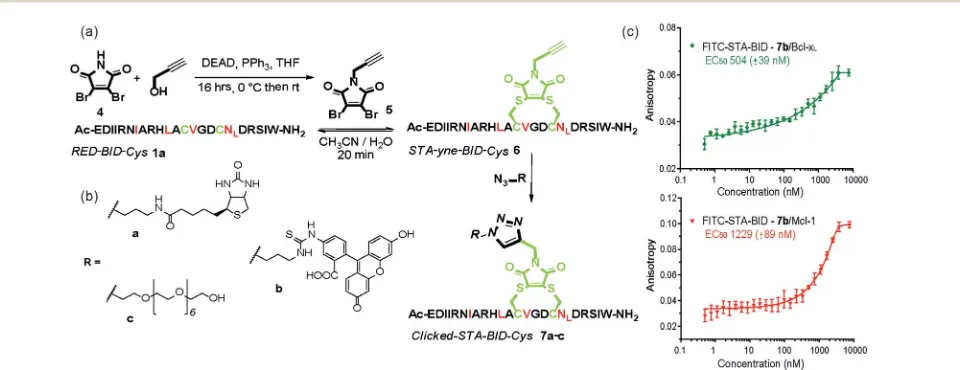
The synthetic method was further adapted to allow the functionalization of the BID–Cys peptides 7a–c. Using Mitsu-nobu alkylation,67 alkyne–dibromomaleimide 5 was prepared and conjugated to peptide 1a to generate the constrained peptide6. Without isolation or purication, subsequent“click” reaction with biotin, uorescein and PEG azides38 afforded complete conversion to click-conjugated constrained peptides 7a–c (Fig. 4a and b). Related “clickable maleimides” have previously been used to conjugate small molecule drugs to polymers,68 whilst “clicked” dibromomaleimides have been used to conjugate polymers to oxytocin so as to improve solu-bility.51 Here we have expanded this methodology, demon-strating that this functionality can be used to constrain peptide conformation and as a divergent method for peptide function-alization. The utility of these modications was demonstrated through a direct uorescence anisotropy titration with the
uorescein linked peptide7b(Fig. 4c). The observed potencies are consistent with the EC50values determined in the compe-tition assays for 3a,bindicating no detrimental consequence from the introduction of auorophore in this position. Such a modication could thus facilitate cellular studies whilst leaving the N-terminus of the peptide free to allow further orthogonal derivatization.
The use of dibromomaleimide-based constraints for
promotion ofa-helicity was then further demonstrated using the RNase S-protein/S-peptide interaction with the choice of amino acid positions at which to introduce the constraint Fig. 3 Analyses on BID derived peptides1a,band3a,b. (a) Circular
dichroism spectra (water/30% acetonitrile); (b) trypsin proteolysis in a 1 : 10 000 enzyme/substrate ratio (50 mM phosphate buffer, 200 mM NaCl, pH 7.50); (c)fluorescence anisotropy competition assay for inhibition of the FITC-BID/Mcl-1 interaction (25 nM tracer, 150 nM protein, 50 mM Tris buffer, 150 mM NaCl, 0.61% of Triton X-100, pH 7.40); (d)fluorescence anisotropy competition assay for inhibition of the BODIPY-BAK/Bcl-xLinteraction (25 nM tracer, 150 nM protein,
50 mM phosphate buffer, 200 mM NaCl, 0.02 mg mL1BSA, pH 7.50).
Fig. 4 (a) Scheme illustrating double click chemistry for generating functionalized constrained peptides7a–c. An alkyne-maleimide was used to generate yne-STA-BID-Cys6, which was further functionalized by click reaction with (b) various azide derivatives. (c) Fluorescence anisotropy direct binding assay for interaction of FITC-STA-BID7bwith Mcl-1 and Bcl-xL(75 nM tracer, 15mM protein, 50 mM Tris buffer, 150 mM NaCl,
0.61% of Triton X-100, pH 7.40).
Open Access Article. Published on 31 May 2017. Downloaded on 01/07/2017 11:36:04.
This article is licensed under a
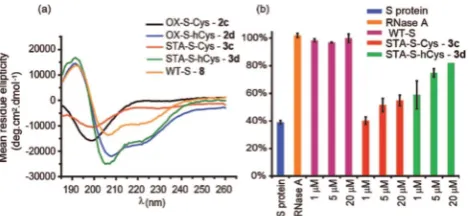
[image:3.595.57.279.47.243.2] [image:3.595.63.543.495.680.2]informed by previous studies by the Verdine,26Hamachi69and Dawson59groups. S peptides1cand1dbearing Cys andhCys residues at thei and i + 4 positions were synthesized using standard solid-phase synthesis in good yield and puried by HPLC (Fig. S2 and S3†). Peptides1cand1dcould not readily be isolated as reduced bis-thiols; one-pot reduction followed by the reaction with dibromomaleimide4afforded peptides3cand3d (Fig. 2). Both peptides were then analysed by CD spectroscopy and used in an RNA degradation assay to determine the resto-ration of enzymatic activity to S-protein in place of the S-peptide (Fig. 5a and b). In this instance, different and more pronounced behaviour for the Cys and hCys variants was observed, high-lighting that the effects of introducing a constraint are context-dependent. The Cys-derived RNase S peptides2–3cexhibit poor helicity (e.g. 3c ¼ 9% versus wild-type 8 ¼ 30%) and corre-sponding low restoration of enzymatic activity (Fig. S31†). Molecular modelling suggests that the introduction of a
disul-de or a maleimide bridge does not support a helical confor-mation (Fig. S27 and S28†). In contrast, for thehCys1–3dseries introduction of a disulde or a maleimide crosslink supports a helical structure comparable to the WT sequence and consistent with the moderate effects on helicity for an 8-carbon constraint in these positions. (Furthermore, and fully consis-tent with the work of Hamachi and co-workers,69upon addition of triuoroethanol (TFE), the constrained peptides reach a greater overall a-helical content). Here, introduction of a disulde (2d) or a maleimide (3d) crosslink results in enhanced helicity in comparison to the WT sequence (2d ¼ 56%,3d¼52% and wild-type8¼30%). As a result3dis much better able to restore RNase S protein activity than is3c.
Conclusions
In conclusion, the attractiveness of thiol-based “stapling” approaches has been recognized for some time,24but no general approach has been widely adopted; we have developed a new method to rapidly and reversibly introduce a functionalized constraint into two model peptides that enhances a range of biophysical and biochemical properties. Moreover, the constraint may be further functionalized in a divergent manner with motifs useful in chemical biology and proteomics
applications. The approach can be carried out using natural readily available amino acid side chains on unprotected peptides, potentially bringing peptide stapling to a larger community than hitherto have had access and extends the applications of dibromomaleimide and related reagents. Future efforts will apply this approach to a wider range of helix medi-ated PPIs with the aim of establishing the generality of the method. The approach may also be useful to identify transient binding pockets proximal to a native ligand binding site using the template directed approach introduced by Sharpless.70 Similarly, the reversibility of the constraint, may permit more facile delivery of a peptide-based reagent to the cell, where it can become unconstrained and less easily transported back out of the cell. Together with the additional functional handle intro-duced on the maleimide constraint (which is orthogonal in terms of its reactivity), this could facilitate detailed cellular and biochemical analysese.g.identication of additional targets of the constrained peptide by pull-down. These objectives will represent the focus of our future studies.
Acknowledgements
This work was supported by the European Research Council [ERC-StG-240324] and [ERC-PoC-632207], the Leverhulme Trust [RPG-2013-065], the EPSRC [EP/P505593/1], [EP/KO39292/1], for funding NMR facilities and The Wellcome Trust [094232/Z/10/Z] for funding CD facilities. We thank Dr Nasir Khan for assistance with CD. Ms Kirstin Spence for help with protein expression and Dr Thomas A Edwards for useful discussions.
References
1 V. Azzarito, K. Long, N. S. Murphy and A. J. Wilson, Nat. Chem., 2013,5, 161–173.
2 L.-G. Milroy, T. N. Grossmann, S. Hennig, L. Brunsveld and C. Ottmann,Chem. Rev., 2014,114, 4695–4748.
3 M. R. Arkin, Y. Tang and J. A. Wells,Chem. Biol., 2014,21, 1102–1114.
4 M. Pelay-Gimeno, A. Glas, O. Koch and T. N. Grossmann,
Angew. Chem., Int. Ed., 2015,54, 8896–8927.
5 A. Vinayagam, U. Stelzl, R. Foulle, S. Plassmann, M. Zenkner, J. Timm, H. E. Assmus, M. A. Andrade-Navarro and E. E. Wanker,Sci. Signaling, 2011,4, rs8.
6 W. H. Wilson, O. A. O'Connor, M. S. Czuczman,
A. S. LaCasce, J. F. Gerecitano, J. P. Leonard, A. Tulpule, K. Dunleavy, H. Xiong, Y.-L. Chiu, Y. Cui, T. Busman,
S. W. Elmore, S. H. Rosenberg, A. P. Krivoshik,
S. H. Enschede and R. A. Humerickhouse, Lancet Oncol., 2010,11, 1149–1159.
7 I. Ray-Coquard, J.-Y. Blay, A. Italiano, A. Le Cesne, N. Penel, J. Zhi, F. Heil, R. Rueger, B. Graves, M. Ding, D. Geho, S. A. Middleton, L. T. Vassilev, G. L. Nichols and B. N. Bui,
Lancet Oncol., 2012,13, 1133–1140.
8 P. M. Cromm, J. Spiegel and T. N. Grossmann,ACS Chem. Biol., 2015,10, 1362–1375.
9 Y. H. Lau, P. de Andrade, Y. Wu and D. R. Spring,Chem. Soc. Rev., 2015,44, 91–102.
Fig. 5 Biophysical and bioactivity analyses of WT-S and S derived peptides3–4a,c. (a) Circular dichroism spectra recorded in water (30% TFE); (b) RNA degradation assay showing the restoration of S protein activity. S protein was used as a negative control, and RNase A as a positive control. (50 mM Tris, 100 mM NaCl, pH 7.50).
Open Access Article. Published on 31 May 2017. Downloaded on 01/07/2017 11:36:04.
This article is licensed under a
[image:4.595.51.287.49.157.2]10 L. Nevola and E. Giralt,Chem. Commun., 2015,51, 3302–3315. 11 P. Wysoczanski, R. J. Mart, E. J. Loveridge, C. Williams, S. B. M. Whittaker, M. P. Crump and R. K. Allemann, J. Am. Chem. Soc., 2012,134, 7644–7647.
12 Y. S. Chang, B. Graves, V. Guerlavais, C. Tovar, K. Packman,
K.-H. To, K. A. Olson, K. Kesavan, P. Gangurde,
A. Mukherjee, T. Baker, K. Darlak, C. Elkin, Z. Filipovic, F. Z. Qureshi, H. Cai, P. Berry, E. Feyfant, X. E. Shi, J. Horstick, D. A. Annis, A. M. Manning, N. Fotouhi, H. Nash, L. T. Vassilev and T. K. Sawyer,Proc. Natl. Acad. Sci. U. S. A., 2013,110, E3445–E3454.
13 D. Wang, W. Liao and P. S. Arora,Angew. Chem., Int. Ed., 2005,44, 6525–6529.
14 D. J. Yeo, S. L. Warriner and A. J. Wilson,Chem. Commun., 2013,49, 9131–9133.
15 P. M. Cromm, J. Spiegel, P. K¨uchler, L. Dietrich, J. Kriegesmann, M. Wendt, R. S. Goody, H. Waldmann and T. N. Grossmann,ACS Chem. Biol., 2016,11, 2375–2382. 16 Q. Chu, R. E. Moellering, G. J. Hilinski, Y.-W. Kim,
T. N. Grossmann, J. T. H. Yeh and G. L. Verdine,
MedChemComm, 2015,6, 111–119.
17 G. H. Bird, E. Mazzola, K. Opoku-Nsiah, M. A. Lammert, M. Godes, D. S. Neuberg and L. D. Walensky, Nat. Chem. Biol., 2016,12, 845–852.
18 T. Okamoto, K. Zobel, A. Fedorova, C. Quan, H. Yang, W. J. Fairbrother, D. C. S. Huang, B. J. Smith, K. Deshayes and P. E. Czabotar,ACS Chem. Biol., 2012,8, 297–302. 19 Y.-C. Li, L. W. Rodewald, C. Hoppmann, E. T. Wong,
S. Lebreton, P. Safar, M. Patek, L. Wang, K. F. Wertman and G. M. Wahl,Cell Rep., 2014,9, 1946–1958.
20 T. Okamoto, D. Segal, K. Zobel, A. Fedorova, H. Yang, W. J. Fairbrother, D. C. S. Huang, B. J. Smith, K. Deshayes and P. E. Czabotar,ACS Chem. Biol., 2014,9, 838–839. 21 M. M. Madden, A. Muppidi, Z. Li, X. Li, J. Chen and Q. Lin,
Bioorg. Med. Chem. Lett., 2011,21, 1472–1475.
22 H. Jo, N. Meinhardt, Y. Wu, S. Kulkarni, X. Hu, K. E. Low, P. L. Davies, W. F. DeGrado and D. C. Greenbaum,J. Am. Chem. Soc., 2012,134, 17704–17713.
23 A. Muppidi, K. Doi, S. Edwardraja, E. J. Drake, A. M. Gulick, H.-G. Wang and Q. Lin,J. Am. Chem. Soc., 2012,134, 14734– 14737.
24 D. P. Fairlie and A. Dantas de Araujo,Pept. Sci., 2016,106, 843–852.
25 A. J. Rojas, C. Zhang, E. V. Vinogradova, N. Buchwald, J. Reilly, B. Pentelute and S. Buchwald, Chem. Sci., 2017, DOI: 10.1039/C6SC05454D.
26 C. E. Schafmeister, J. Po and G. L. Verdine,J. Am. Chem. Soc., 2000,122, 5891–5892.
27 Y.-W. Kim, P. S. Kutchukian and G. L. Verdine,Org. Lett., 2010,12, 3046–3049.
28 Y.-W. Kim, T. N. Grossmann and G. L. Verdine,Nat. Protoc., 2011,6, 761–771.
29 C. Bracken, J. Guly´as, J. W. Taylor and J. Baum,J. Am. Chem. Soc., 1994,116, 6431–6432.
30 R. S. Harrison, G. Ruiz-G´omez, T. A. Hill, S. Y. Chow, N. E. Shepherd, R.-J. Lohman, G. Abbenante, H. N. Hoang and D. P. Fairlie,J. Med. Chem., 2010,53, 8400–8408.
31 A. D. de Araujo, H. N. Hoang, W. M. Kok, F. Diness, P. Gupta, T. A. Hill, R. W. Driver, D. A. Price, S. Liras and D. P. Fairlie,
Angew. Chem., Int. Ed., 2014,53, 6965–6969.
32 A. Patgiri, A. L. Jochim and P. S. Arora,Acc. Chem. Res., 2008, 41, 1289–1300.
33 S. Kneissl, E. J. Loveridge, C. Williams, M. P. Crump and R. K. Allemann,ChemBioChem, 2008,9, 3046–3054. 34 L. Nevola, A. Mart´ın-Quir´os, K. Eckelt, N. Camarero, S. Tosi,
A. Llobet, E. Giralt and P. Gorostiza,Angew. Chem., Int. Ed., 2013,52, 7704–7708.
35 O. Torres, D. Y¨uksel, M. Bernardina, K. Kumar and D. Bong,
ChemBioChem, 2008,9, 1701–1705.
36 Y. H. Lau, P. de Andrade, S.-T. Quah, M. Rossmann, L. Laraia, N. Skold, T. J. Sum, P. J. E. Rowling, T. L. Joseph, C. Verma, M. Hyvonen, L. S. Itzhaki, A. R. Venkitaraman, C. J. Brown, D. P. Lane and D. R. Spring,Chem. Sci., 2014, 5, 1804–1809.
37 Y. H. Lau, P. de Andrade, N. Skold, G. J. McKenzie, A. R. Venkitaraman, C. Verma, D. P. Lane and D. R. Spring,
Org. Biomol. Chem., 2014,12, 4074–4077.
38 P. T. Tran, C. Ø. Larsen, T. Røndbjerg, M. De Foresta, M. B. A. Kunze, A. Marek, J. H. Løper, L.-E. Boyhus, A. Knuhtsen, K. Lindorff-Larsen and D. S. Pedersen,
Chem.–Eur. J., 2017,23, 3490–3495.
39 K. Hu, H. Geng, Q. Zhang, Q. Liu, M. Xie, C. Sun, W. Li, H. Lin, F. Jiang, T. Wang, Y.-D. Wu and Z. Li, Angew. Chem., Int. Ed., 2016,55, 8013–8017.
40 S. K. Sia, P. A. Carr, A. G. Cochran, V. N. Malashkevich and P. S. Kim, Proc. Natl. Acad. Sci. U. S. A., 2002,99, 14664– 14669.
41 M. Kvansakul and M. Hinds,Apoptosis, 2015,20, 136–150. 42 R. T. Raines,Chem. Rev., 1998,98, 1045–1066.
43 M. E. B. Smith, F. F. Schumacher, C. P. Ryan, L. M. Tedaldi, D. Papaioannou, G. Waksman, S. Caddick and J. R. Baker,J. Am. Chem. Soc., 2010,132, 1960–1965.
44 P. Moody, M. E. B. Smith, C. P. Ryan, V. Chudasama, J. R. Baker, J. Molloy and S. Caddick,ChemBioChem, 2012, 13, 39–41.
45 M. W. Jones, R. A. Strickland, F. F. Schumacher, S. Caddick, J. R. Baker, M. I. Gibson and D. M. Haddleton,J. Am. Chem. Soc., 2012,134, 1847–1852.
46 F. F. Schumacher, V. A. Sanchania, B. Tolner, Z. V. F. Wright, C. P. Ryan, M. E. B. Smith, J. M. Ward, S. Caddick, C. W. M. Kay, G. Aeppli, K. A. Chester and J. R. Baker,Sci. Rep., 2013,3, 1525.
47 M. P. Robin, P. Wilson, A. B. Mabire, J. K. Kiviaho, J. E. Raymond, D. M. Haddleton and R. K. O'Reilly,J. Am. Chem. Soc., 2013,135, 2875–2878.
48 C. Marculescu, H. Kossen, R. E. Morgan, P. Mayer, S. A. Fletcher, B. Tolner, K. A. Chester, L. H. Jones and J. R. Baker,Chem. Commun., 2014,50, 7139–7142.
49 J. Youziel, A. R. Akhbar, Q. Aziz, M. E. B. Smith, S. Caddick, A. Tinker and J. R. Baker,Org. Biomol. Chem., 2014,12, 557– 560.
50 M. P. Robin and R. K. O'Reilly,Chem. Sci., 2014,5, 2717– 2723.
Open Access Article. Published on 31 May 2017. Downloaded on 01/07/2017 11:36:04.
This article is licensed under a
51 J. Collins, J. Tanaka, P. Wilson, K. Kempe, T. P. Davis, M. P. McIntosh, M. R. Whittaker and D. M. Haddleton,
Bioconjugate Chem., 2015,26, 633–638.
52 Oxime and Hydrazone constraints employing non-natural amino acids introduced by Horne and co-workers [ref. 53 and 54] have been used to stabilize a helical conformation but not applied to PPI inhibition.
53 C. M. Haney, M. T. Loch and W. S. Horne,Chem. Commun., 2011,47, 10915–10917.
54 C. M. Haney and W. S. Horne,J. Pept. Sci., 2014,20, 108–114. 55 Both iminoboronate formation56and reaction of Meldrums acid with an amine and thiol side chain57 have recently shown to be amenable to reversible peptide cyclization and might be applied to stabilization of peptides for inhibiton of PPIs.
56 A. Bandyopadhyay and J. Gao,J. Am. Chem. Soc., 2016,138, 2098–2101.
57 A. M. Johnson and E. V. Anslyn,Org. Lett., 2017,19, 1654– 1657.
58 H. C. Kolb, M. G. Finn and K. B. Sharpless,Angew. Chem., Int. Ed., 2001,40, 2004–2021.
59 N. Assem, D. J. Ferreira, D. W. Wolan and P. E. Dawson,
Angew. Chem., Int. Ed., 2015,54, 8665–8668.
60 S. P. Brown and A. B. Smith,J. Am. Chem. Soc., 2015,137, 4034–4037.
61 W. Nomura, H. Aikawa, N. Ohashi, E. Urano, M. M´etiot, M. Fujino, K. Maddali, T. Ozaki, A. Nozue, T. Narumi,
C. Hashimoto, T. Tanaka, Y. Pommier, N. Yamamoto, J. A. Komano, T. Murakami and H. Tamamura,ACS Chem. Biol., 2013,8, 2235–2244.
62 J. A. Miles, D. J. Yeo, P. Rowell, S. Rodriguez-Marin, C. M. Pask, S. L. Warriner, T. A. Edwards and A. J. Wilson,
Chem. Sci., 2016,7, 3694–3702.
63 P. Diderich, D. Bertoldo, P. Dessen, M. M. Khan, I. Pizzitola, W. Held, J. Huelsken and C. Heinis,ACS Chem. Biol., 2016, 11, 1422–1427.
64 J. M. Estrela, A. Ortega and E. Obrador,Crit. Rev. Clin. Lab. Sci., 2006,43, 143–181.
65 P. Monostori, G. Wittmann, E. Karg and S. T´uri, J. Chromatogr. B: Anal. Technol. Biomed. Life Sci., 2009, 877, 3331–3346.
66 M. Morais, J. P. M. Nunes, K. Karu, N. Forte, I. Benni, M. E. B. Smith, S. Caddick, V. Chudasama and J. R. Baker,
Org. Biomol. Chem., 2017,15, 2947–2952.
67 F. F. Schumacher, M. Nobles, C. P. Ryan, M. E. B. Smith, A. Tinker, S. Caddick and J. R. Baker, Bioconjugate Chem., 2011,22, 132–136.
68 H. Wang, M. Xu, M. Xiong and J. Cheng,Chem. Commun., 2015,51, 4807–4810.
69 I. Hamachi, Y. Yamada, T. Matsugi and S. Shinkai,Chem.– Eur. J., 1999,5, 1503–1511.
70 W. G. Lewis, L. G. Green, F. Grynszpan, Z. Radi´c, P. R. Carlier, P. Taylor, M. G. Finn and K. B. Sharpless,
Angew. Chem., Int. Ed., 2002,41, 1053–1057.
Open Access Article. Published on 31 May 2017. Downloaded on 01/07/2017 11:36:04.
This article is licensed under a