ISSN 0252-8266
%
eurostat
EUROSTATISTIK
Daten zur Konjunkturanalyse
EUROSTATISTICS
Data for short-term economic analysis
EUROSTATISTIQUES
Données pour l'analyse de la conjoncture
Monatlich D Monthly Π Mensuel
10 D
1994
i
Theme / Thème
eurostat
OFICINA ESTADÍSTICA DE LAS COMUNIDADES EUROPEAS
DE EUROPÆISKE FÆLLESSKABERS STATISTISKE KONTOR
STATISTISCHES AMT DER EUROPÄISCHEN GEMEINSCHAFTEN
ΣΤΑΤΙΣΤΙΚΗ ΥΠΗΡΕΣΙΑ ΤΩΝ
ΕΥΡΩΠΑΪΚΩΝ ΚΟΙΝΟΤΗΤΩΝ
STATISTICAL OFFICE OF THE EUROPEAN COMMUNITIES
OFFICE STATISTIQUE DES
COMMUNAUTÉS EUROPÉENNES
ISTITUTO STATISTICO DELLE COMUNITÀ EUROPEE
BUREAU VOOR DE STATISTIEK DER EUROPESE GEMEENSCHAPPEN
SERVIÇO DE ESTATÍSTICA DAS COMUNIDADES EUROPEIAS
L2920 Luxembourg Tél. 43 011 Télex COMEUR LU 3423
B1049 Bruxelles, rue de la Loi 200 Tél. 299 11 11
Las publicaciones de Eurostat están clasificadas por temas y por series. La clasificación se encuentra al final de
la obra. Para mayor información sobre las publicaciones, rogamos se pongan en contacto con Eurostat.
Para los,pedidos, diríjanse a las oficinas de venta cuyas direcciones figuran en la página interior de la
contracubierta.
Eurostats publikationer er klassificeret efter emne og serie. En oversigt herover findes bag i hæftet. Yderligere
oplysninger om publikationerne kan fås ved henvendelse til Eurostat.
Bestilling kan afgives til de salgssteder, der er anført på omslagets side 3.
Die Veröffentlichungen von Eurostat sind nach Themenkreisen und Reihen gegliedert. Die Gliederung ist hinten in
jedem Band aufgeführt. Genauere Auskünfte über die Veröffentlichungen erteilt Eurostat.
Ihre Bestellungen richten Sie bitte an die Verkaufsbüros, deren Anschriften jeweils auf der dritten Umschlagseite
der Veröffentlichungen zu finden sind.
Οι
εκδόσεις της Eurostat ταξινομούνται κατά θέμα και κατά σειρά. Η ακριβής ταξινόμηση αναφέρεται στο
τέλος κάθε έκδοσης. Για λεπτομερέστερες πληροφορίες σχετικά με τις εκδόσεις, μπορείτε να
απευθύ-νεσθε στην Eurostat.
Για τις παραγγελίες μπορείτε να απευθύνεσθε στα γραφεία πώλησης, των οποίων οι διευθύνσεις
αναγράφονται στη σελίδα 3 του εξωφύλλου.
Eurostat's publications are classified according to themes and series. This classification is indicated at the end of
the publication. For more detailed information on publications, contact Eurostat.
Orders are obtainable from the sales offices mentioned on the inside back cover.
Les publications d'Eurostat sont
classées par thème et par série. Cette classification est précisée à la fin
de l'ouvrage. Pour des informations plus détaillées sur les publications, contactez Eurostat.
Pour les commandes, adressez-vous aux bureaux de vente dont les adresses sont indiquées à la page 3
de la couverture.
Le pubblicazioni dell'Eurostat sono classificate per tema e per serie. Tale classificazione è precisata alla fine
dell'opera. Per informazioni più dettagliate sulle pubblicazioni rivolgersi all'Eurostat.
Per eventuali ordinazioni rivolgersi a uno degli uffici di vendita i cui indirizzi figurano nella 3
apagina della
copertina.
De publikaties van Eurostat zijn ingedeeld naar onderwerp en serie. Deze indeling is achter in het boek
opgenomen. Voor nadere informatie over de publikaties kunt u sich wenden tot Eurostat.
Gelieve bestellingen op te geven bij de verkoopbureaus, waarvan de adressen op bladzijde 3 van de omslag zijn
vermeld.
As publicações do Eurostat estão classificadas por tema e por série. Esta classificação está indicada no firn da
obra. Para mais informações sobre as publicações é favor contactar Eurostat.
EUROSTATISTIK
Daten zur Konjunkturanalyse
EUROSTATISTICS
Data for short-term economic analysis
EUROSTATISTIQUES
Données pour l'analyse de la conjoncture
Luxembourg: Office des publications officielles des Communautés européennes, 1994
© EGKS-EG-EAG, Brüssel · Luxemburg, 1994
Nachdruck — ausgenommen zu kommerziellen Zwecken — mit Quellenangabe gestattet.
© ECSC-EC-EAEC, Brussels · Luxembourg, 1994
Reproduction is authorized, except for commercial purposes, provided the source Is acknowledged.
© CECA-CE-CEEA, Bruxelles · Luxembourg, 1994
Reproduction autorisée, sauf à des fins commerciales, moyennant mention de la source.
Vorwort
Mit der monatlich erscheinenden Veröffentlichung Eurostatistik - Daten zur
Konjunkturanalyse werden innerhalb kürzester Frist die neuesten statistischen Daten
über die Europäische Gemeinschaft als Ganzes (EUR 12), über jedes Mitgliedsland
sowie über die Vereinigten Staaten und Japan bekanntgegeben.
Eurostatistik enthält nicht die Gesamtheit des bei Eurostat verfügbaren statistischen
Materials, sondern eine Auswahl der relevantesten Reihen über die konjunkturelle
Entwicklung.
Schnelligkeit und Pünktlichkeit sind die wichtigsten Vorzüge dieser Veröffentlichung.
Aus diesem Grunde wurde sie im Umfang bewußt klein gehalten und enthält keine
Anmerkungen zur Methodik, die im übrigen in den spezialisierten Veröffentlichungen
von Eurostat zu finden sind.
Die in Eurostatistik veröffentlichten Daten stammen aus dem ICG -Bereich der
On-line-Datenbank Cronos von Eurostat.
Wer Zugang zu Cronos besitzt, kann jederzeit die Tabellen dieser Veröffentlichung
abfragen, wobei die Daten täglich auf den neuesten Stand gebracht werden (Hinweise
zur On-line -Benutzung finden sich auf der letzten Seite). Darüber hinaus sind die
Daten in der Datenbank Eurocron verfügbar, die vom Host Eurobases der
Kommission angeboten wird.
Weitere Informationen über Eurostat und seine Produkte können bei folgender Stelle
angefordert werden:
Eurostat - Informationsbüro Data Shop
L-2920 LUXEMBURG 121, rue Joseph II
Telephon: (352) 4301 34567 Büro 3/235
Telefax: (352) 43 64 04 B-1049 Bruxelles
Inhaltsverzeichnis
Zeichen und Abkürzungen
KURZ NOTIERT
5
KONJUNKTURDATEN
1. Volkswirtschaftliche Gesamtrechnungen . .35
2. Beschäftigung
39
3. Arbeitslosigkeit
44
4. Industrielle Produktion
49
5. Meinungsumfrage in der Industrie
59
6. Industrieerzeugnisse
65
7. Einzelhandel
70
8. Landwirtschaftliche Erzeugnisse
72
9. Außenhandel
75
10. Verbraucherpreise
106
11. Landwirtschaftliche Erzeugerpreise . . . . 111
12. Löhne und Gehälter
113
13. Finanzstatistiken
114
14. Zahlungsbilanz
121
Anmerkung betreffend Grafiken und Tabellen:
(*) Die Daten beziehen sich auf das Gebiet der
Bundesrepublik Deutschland vor dem
3.10.1990 einschließlich WestBerlin.
πτ1%
πτ4%
πτι 2%
BALANCE%
1985=100
EUR12=100
1000
MIO
MRD
Τ
TJ(GCV)
GWH
USD
ECU
SZR
ESVG
NACE
SITC
EUR
UEBL
ACP
Weniger als die Hälfte der verwendeten
Einheit
Prozent
Prozentualer Zuwachs eines
Vierteljahres gegenüber dem vorher
gehenden Vergleichszeitraum
(Monat,Vierteljahr.Jahr)
Prozentualer Zuwachs eines
Vierteljahres gegenüber dem
entsprechenden Vierteljahr des
Vorjahres
Prozentualer Zuwachs eines Monats
gegenüber dem entsprechenden Monat
des Vorjahres
Saldo zwischen den positiven
Antworten (Zunahme.Verbesserung der
Situation)und den negativen Antworten
(Abnahme,Verschlechterung der
Situation)der Konjunkturumfrage bei
den Unternehmern in der Gemeinschaft
Basisjahr
Gemeinschaft der 10 oder 12 (=100)
in 1000
Million
Milliarde
Metrische Tonne
Terajoule = 109KJ
Gigawattstunde = 106kWh
USDollar
Europäische Währungseinheit
Sonderziehungsrechte
Europäisches System
Volkwirtschaftlicher Gesamtrechnungen
Allgemeine Systematik der
Wirtschaftszweige in den Europäischen
Gemeinschaften
Standard International Trade
Classification
Mitgliedstaaten insgesamt
BelgischLuxemburgische
Wirtschaftsunion
EUROSTATISTIK: kurz notiert
■ ι
Soweit nicht anders angegeben, beziehen sich die Angaben auf den Gebietsstand der Bundesrepublik Deutschland vor dem 3.10. 1990; sie schließen
Berlin (West) ein.
WECHSELKURSE: Zinsanstieg im Vereinigten Königreich
Die Bank of England kündigte am 12. September einen Anstieg der
Basisausleihesätze britischer Banken um 0,5 Prozentpunkte auf 5,75 %
an. Dies war— mit Ausnahme des kurzzeitigen Zinsanstiegs im Septem
ber 1992 vor dem Ausscheren des Pfund Sterling aus dem Wechselkurs
mechanismus — die erste Zinserhöhung seit 1989. Damit soll einem
eventuellen Inflationsdruck in der britischen Wirtschaft, die derzeit die
höchsten Wachstumsraten seit Jahren zu verzeichnen hat, der Boden
entzogen werden. Das Pfund Sterling reagierte positiv auf die Zinserhö
hung und schloß am 12. September in London bei 2,41 DM, das sind drei
Pfennig mehr als am Vortag.
Nach der Erhöhung der britischen Zinssätze haben die Zinsen in den
letzten Wochen in drei europäischen Ländern angezogen, nämlich in
Italien, Schweden und nun auch im Vereinigten Königreich. Während die
Zinserhöhung in Italien in erster Linie mit der Schwäche der Lira
begründet wurde, dienten die Erhöhungen sowohl in Schweden als auch
im Vereinigten Königreich als Präventivmaßnahme gegen die Inflation.
Eigentlich sollte durch die Heraufsetzung der italienischen Zinsen, wie
bereits erwähnt, die Lira gestützt werden, die jedoch zunächst einmal an
Wert verlor. Sie erholte sich zwar später wieder etwas, war Mitte
September jedoch noch nicht wieder über die Marke von 1000 LIT
geklettert, die als wichtiger Schwellenwert gilt.
Der Dollar verlor zwar am 9. September nach der Meldung, daß die
Großhandelspreise in den Vereinigten Staaten stärker als erwartet stiegen,
leicht an Wert, erholte sich anschließend jedoch wieder etwas und
bewegte sich fast die gesamte erste Septemberhälfte hindurch um die
Marke von 1,55 DM.
Innerhalb des Wechselkursmechanismus gab es in der ersten Hälfte des
Monats September nur wenig Bewegung. Der holländische Gulden blieb
weiterhin die stärkste Währung, gefolgt vom belgischen Franc und der
DMark. Schwächste Währungen waren die spanische Peseta und die
dänische Krone.
Der Schweizer Franken erreichte am 14. September seinen höchsten
Stand gegenüber der DMark und schloß in London bei 0,83 Sfr für 1 DM.
Diesen Stand konnte die schweizerische Währung auch am darauffolgen
den Tag behaupten.
RENDITEN VON
STAATSANLEIHEN: Weiterer Renditeanstieg und Kon
solidierung im Sommer
In den drei Ländern, für die Daten vorliegen, war im August ein weiterer
Renditeanstieg zu verzeichnen. Erstmals seit Juni 1993 stiegen die
italienischen Renditen auf über 10 % an, in Spanien lagen sie mit 10,4 %
sogar noch etwas höher. Trotz eines leichten Anstiegs blieben die
Renditen im Vereinigten Königreich unter dem im Juni 1994 erzielten
Durchschnittswert.
Einem Bericht des Europäischen Währungsinstituts zufolge lassen sich
bei der Untersuchung des Ausmaßes, in dem die langfristigen Zinsen in
den ersten acht Monaten des laufenden Jahres gestiegen sind, drei
Gruppen von EUMitgliedstaaten unterscheiden. Zur ersten Gruppe zählen
die Länder, in denen die Renditen um weniger als zwei Prozent und damit
in ähnlichem Maß gestiegen sind wie in den Vereinigten Staaten und
Japan; dazu zählen Deutschland, Frankreich, Belgien, Luxemburg und die
Niederlande. Die zweite Gruppe umfaßt Dänemark, Irland und das
Vereinigte Königreich, also diejenigen Länder, in denen die Renditen
zwischen zwei und drei Prozent gestiegen sind, und die dritte Gruppe
besteht aus den Ländern mit einem Anstieg von über drei Prozent, d. h.
Italien, Spanien und Portugal.
GELDVOLUMEN:
(Keine neuen Daten)
AMTLICHE WÄHRUNGSRESERVEN:
(Keine neuen Daten)
VIERTELJÄHRLICHE GESAMTRECHNUNGEN: Erstes Quartal 1994: Posi
tive Entwicklung der Wirtschaft der Europäischen Union
(BIP
+0,8 %)
Im ersten Quartal 1994 wird für die Wirtschaft der Europäischen Union
insgesamt eine Zunahme des Wirtschaftswachstums (BIP +0,7 %) ver
zeichnet, die auf zwei Jahre der Ungewißheit und der Rezession folgt. Das
gute Ergebnis des ersten Quartals gewinnt an Bedeutung, wenn man
berücksichtigt, daß das erste Quartal in der Regel strukturell recht
schwach ist und daß meteorologisch gesehen der Winter 1994 ziemlich
hart war, was sich nachteilige auf bestimmte Wirtschaftszweige, wie z. B.
die Landwirtschaft, das Baugewerbe usw., auswirkte. Dieses Ergebnis
könnte in der Tat auf eine Umkehrung der Trends bei den wichtigsten
Indikatoren auf makroökonomischer Ebene zu Beginn des laufenden
Jahres hindeuten. Vorsicht ist jedoch angeraten, um die derzeitige
wirtschaftliche Lage nicht zu optimistisch zu beurteilen. Tatsächlich ist die
wirtschaftliche Lage noch durch eine Reihe von Problemen gekennzeich
net, z. B. Arbeitslosigkeit und Abbau der öffentlichen Defizite. Zu diesen
Problemen treten die jüngsten Spannungen auf den Finanz und Devisen
märkten, die die Stabilität der Weltwirtschaft zu einem kritischen Zeitpunkt
wie dem Ende eines Konjunkturtiefs zu gefährden drohen.
Was die anhand des impliziten BIPDeflators gemessene Preisentwicklung
betrifft, so ist ein leichter Anstieg der Inflationsrate (+0,5 %) festzustellen.
Daraufhin haben einige Mitgliedstaaten im August die Zinsen erhöht.
Bezüglich der Bestandteile des BIP erscheint es angebracht, den starken
Anstieg bei den Investitionen (+1,9%) und die positive Entwicklung des
privaten Verbrauchs (+0,8 %) gegenüber einem stagnierenden Staatsver
brauch (+0,1 %) hervorzuheben.
Was die Situation in den einzelnen Mitgliedstaaten angeht, so liegen für
Deutschland, Frankreich und die Niederlande Angaben zum zweiten
Quartal vor. Demnach hält die Wiederbelebung der Wirtschaftstätigkeit in
Frankreich und den Niederlanden (BIP jeweils +1,0%) weiter an. In
Deutschland ist dagegen nach dem kräftigen Produktionswachstum des
ersten Quartals nur ein mäßiges Wachstum (BIP +0,5 %) zu verzeich
nen.
In den Vereinigten Staaten geht die positive Entwicklung des Wirtschafts
wachstums (BIP +0,9 %) einher mit einer stabilen Inflationsrate (+0,7 %).
Bei den Bestandteilen der Inlandsnachfrage ist weiterhin ein starker
Anstieg der Investitionen (+2,1 %) festzustellen. Der private Verbrauch
verlangsamt sich dagegen spürbar (+0,4 %), während der Staatsver
brauch erneut rückläufig ist (0,4 %).
In Japan ¡st der deutliche Produktionsanstieg (BIP +1,0%) mit einer
leichten Deflation (0,1 %) verbunden. Was die Verwendung angeht, so
ist ein starker Zuwachs beim privaten Verbrauch (+1,4 %) festzustellen,
der mit einem erneuten Investitionsrückgang (0,8 %) einhergeht. Der
Staatsverbrauch weist dagegen einen eher schwachen Zuwachs auf
(+0,5 %).
PREISE: Die Jahresinflationsrate der EU betrug 3,1 % im August
Die Jahresinflationsrate für die EU insgesamt stieg leicht von 3,0 % im
Juli auf 3,1 % im August. Vor Jahresfrist betrug sie 3,5 %.
Der Monatsindex für EUR12 stieg um 0,3% infolge nachstehender
Preissteigerungen in den Mitgliedstaaten der EU: Spanien 0,7 %, Vereinig
tes Königreich 0,5 %, Niederlande und Dänemark 0,4 %, Griechenland
0,3 %, Belgien, Italien und Portugal 0,2 %, Deutschland und Luxemburg
0,1 %. In Frankreich blieb der Index zwischen Juli und August unverän
dert.
Der Vierteljahresindex Irlands stieg zwischen Mitte Mai und Mitte August
um 0,8 %, was einer monatlichen Steigerung von etwa 0,3 % ent
spricht.
In aufsteigender Reihenfolge nach der derzeitigen Inflation geordnet sind
die Raten für die angegebenen Zeiträume wie folgt:
Aug. '94 Aug. '93
Frankreich 1,7 %p Luxemburg 2,0 % Dänemark 2,2 % Ver. Königreich 2,4 % Belgien 2,4 %
Irland 2,5 %
Aug. '93 Aug. '92
2,2 % 3,7 % 1,2% 1,7% 3,2 % 1,3%
Niederlande Deutschland" Italien Spanien Portugal Griechenland
Aug. '94 Aug. '93
2,6 % 3,0 % 3,8 %p 4,8 % 4,8 % 11,1 %
Aug. '93 Aug. '93
3,0 % 4,2 % 4,5 % 4,6 % 5,6 % 14,6 %
Der Verbraucherpreisindex der Bundesrepublik Deutschland bezieht sich weiterhin auf den Gebietsstand vor dem 3.10.90.
ρ vorläufig.
i
(3,4%). Die entsprechenden Zahlen für einige weitere Ländern sind:
Vereinigte Staaten 2,9 % (2,8 %), Japan -0,1 % (1,9 %), Kanada 0,2 %
(1,7 %) und Schweiz 0,5 % (3,6 %).
ARBEITSLOSIGKEIT IN DER EUROPÄISCHEN UNION
Eurostat schätzt die saisonbereinigte Arbeitslosenquote in der
Europäi-schen Union für August 1994 auf 10,7 %. Gegenüber dem Vormonat ist
sie um 0,1 Prozentpunkte gefallen.
Der mit Ende des Frühjahrs einsetzende leichte Rückgang der
Arbeitslo-sigkeit in der Union setzt sich mithin fort. Die Arbeitslosenquote
insge-samt hat sich mittlerweile auf das Niveau von August 1993
zurückgebil-det.
Allerdings ist der Rückgang lediglich verhalten und zeigt sich
systema-tisch nur auf der Iberischen Halbinsel (Spanien und Portugal) sowie im
Vereingten Königreich und in Irland.
Diese Schätzung der Arbeitslosenquoten und der Zahl der Arbeitslosen
schaltet Unterschiede in den nationalen Methoden zur Erfassung der
Arbeitslosigkeit weitgehend aus.
Foreword
0
Eurostatistics - data for short-term economic analysis is a monthly publication aimed
at providing, as rapidly as possible, the latest statistical data on the European
Community as a whole (EUR12), each Member State, the United States and Japan.
Eurostatistics does not present all the statistics held by Eurostat, but a selection of the
most relevant series on the economic situation.
Speed of publication and punctuality are the main features of this publication; that is
why it is deliberately streamlined and does not contain any methodological notes,
which are given in Eurostat's specialized publications.
The data published in Eurostatistics are taken from the ICG domain of Eurostat's
on-line database, Cronos (instructions regarding on-on-line consultation may be found at the
end of this publication). They are also available via the Commission host Eurobases in
the Eurocron database.
Further information on Eurostat and its products can be obtained from the following
addresses:
Eurostat - Information Office Data Shop
L-2920 Luxembourg 121, Rue Joseph II
Tel. : (352) 4301 -34567 Office 3/235
Fax: (352) 43 64 04 B-1049 Bruxelles
Contents
Symbols and abbreviations
IN BRIEF
9
SHORT-TERM TRENDS
1. National accounts
35
2. Employment
39
3. Unemployment
44
4. Industrial production
49
5. Opinions in industry
59
6. Industrial products
65
7. Retail sales
70
8. Agricultural products
72
9. External trade
75
10.
Consumer prices
106
11. Producer prices of agricultural products.
.111
12. Wages and salaries
113
13. Financial statistics
114
14. Balance of payments
121
Note concerning graphs and tables:
( ) Data for the Federal Republic of Germany,
including WestBerlin, as constituted prior to
3 October 1990.
0
%
T/T1
%
T/T4%
πτ12%
BALANCE"/«.
1985=100
EUR12=100
1000
MIO
MRD
Τ
TJ(GCV)
GWH
USD
ECU
ESA
SDR
NACE
SITC
EUR
UEBL
ACP
Data less than the unit used
Per cent
Percentage increase of one period
(month, quarter, year) on the
corresponding previous period
Percentage increase on the
corresponding quarter of the previous
year
Percentage increase on the
corresponding month of the previous
year
Balance between positive replies
(increase, improvement in the situation)
and negative replies (reduction,
worsening of the situation) in the short
termtrends enquiry conducted among
heads of enterprises in the Community
Reference year
Data for countries expressed as a
percentage of the Community of 12
(=100)
Thousand
Million
Thousand million
Tonne
Terajoule=109kj
Gigawatt hour (= 106kWh)
US dollar
European currency unit
European system of integrated
economic accounts
Special drawing right
General industrial classification of
economic activities within the European
Communities
Standard international trade
classification
EUROSTATISTICS: in brief
Unless otherwise stated, data for the Federal Republic of Germany, including West Berlin, as constituted prior to 3 October 1990.
EXCHANGE RATES: interest rates rise in the United Kingdom
On September 12 the Bank of England signalled an increase in bank base
rates of 0.5% to 5.75%, the first rise in these rates since 1989 with the
exception of the short-lived rise in September 1992 before sterling left the
exchange rate mechanism. The increase is intended to damp down any
inflationary pressures existing in the British economy, which is currently
growing at its fastest rate for some years. Sterling reacted positively to
the news, closing in London on September 12 at DM 2.41, almost three
pfennigs up on the previous day.
The increase in UK interest rates means that short-term rates have
increased in three European countries in the last weeks; Italy, Sweden and
now the UK. Although the Italian increase was primarily a response to
currency weakness, in both Sweden and the UK the increases were
intended as pre-emptive strikes against inflation.
Although as mentioned above Italian interest rates were increased in an
attempt to strengthen the lire, the immediate effect was a weakening of
the currency. However, it later strengthened slightly, but by the middle of
September had not risen above the LIT 1000 point, regarded as an
important threshold.
The dollar fluctuated around the DM 1.55 level for much of the first half of
September, weakening slightly on September 9 with the announcement of
faster than expected growth in US wholesale prices, but then subsequent
ly strengthening slightly.
Within the exchange rate mechanism of the EMS there was little
movement in the first half of September. The Dutch guilder remains the
strongest currency, followed by the Belgian franc and the Deutschemark.
The Spanish peseta and the Danish krone are the weakest currencies.
In mid-September the Swiss franc appreciated to its highest level against
the Deutschemark for almost three years: on September 14 it closed in
London at Sfr 0.83, a level which it maintained the following day.
GOVERNMENT BOND YIELDS: further increases in yields in June; some
consolidation in July
The three countries for which data are available experienced further
increases in government bond yields in August. Yields rose above 10% in
Italy for the first time since June 1993, and were slightly higher in Spain
at 10.4%. In the United Kingdom yields were up slightly, but were lower
than their average level in June 1994.
A report by the European Monetary Institute has established that three
groups of EU Members can be identified when looking at the different
extent of the increases in long-term interest rates in the first eight months
of 1994. The first group consists of countries were yields have risen by
less than two per cent, similar rises to those experienced in the US and
Japan, and includes Germany, France, Belgium, Luxembourg and the
Netherlands. The second group includes Denmark, Ireland and the United
Kingdom, where yields have risen by between two and three per cent, and
the third group, with increases of over three per cent, consists of Italy,
Spain and Portugal.
MONEY SUPPLY:
(no new data)
FOREIGN OFFICIAL RESERVES:
(no new data)
QUARTERLY ACCOUNTS: economic growth in the European Union (GDP
+0.8%).
The first quarter of 1994 saw a promising overall upswing in the economy
of the European Union (GDP +0.8%), after two years of uncertainty and
recession. The good result in the first quarter is even more significant
when one bears in mind that the first quarter of the year is generally fairly
weak in structural terms and that the rather severe winter of 1994
adversely affected certain activities such as agriculture, the building
industry, etc. This result may well mark a genuine reversal of the trends in
most of the macroeconomic indicators for the first part of the current
year. On the other hand, some caution is called for before indulging in
over-optimistic interpretations of the current economic situation, as
several problems such as unemployment and the reduction of public
deficits still remain. To these must be added the recent renewed tensions
in the financial and monetary markets, which threaten to destabilize the
world economy at a moment as critical as its emergence from reces
sion.
As regards inflation measured by the implicit GDP deflator, there was a
slight increase (+0.5%), in the wake of which some Member States
decided during August to raise interest rates.
For the components of GDP, it is worth stressing the sharp upswing in
investment (+1.9%) and the increase in private consumption (+0.8%),
while public consumption remained stable (+0.1%).
In terms of the situation in the Member States, data for the second
quarter are available for Germany, France and the Netherlands. They show
that growth was being maintained in France and the Netherlands (GDP
+1.0% in both cases), while in Germany, after the marked upswing in the
first quarter, growth was fairly modest (GDP +0.5%).
In the United States there was an upswing in economic growth (GDP
+0.9%) during the second quarter, accompanied by an unchanged rate of
inflation (+0.7%). Of the components of domestic demand, investment
again showed firm growth (+2.1%), whereas growth in private consump
tion slowed down considerably (+0.4%). Public consumption continued
its downward trend (-0.4%).
In Japan there was a noticeable growth in output (GDP +1.0%)
accompanied by slight deflation (-0.1%). In terms of uses, there was
strong growth in private consumption (+1.4%) accompanied by a
renewed fall in investment (-0.8%), while public consumption was
somewhat weak (+0.5%).
PRICES: EU annual inflation at 3.1 % in August
The annual inflation rate for the EU as a whole rose slightly from 3.0% in
July to 3.1% in August. A year ago it was 3.5%.
The monthly index for EUR-12 rose by 0.3% due to the following
increases in the different EU Member States: Spain 0.7%, United
Kingdom 0.5%, Netherlands and Denmark 0.4%, Greece 0.3%, Belgium,
Italy and Portugal 0.2%, Germany and Luxembourg 0.1%. There was no
change in the index of France between July and August.
The quarterly index for Ireland rose by 0.8%, between mid-May and
mid-August, corresponding on an average increase of about 0.3% per
month.
In ascending order of current inflation the annual rates of the individual
Member States for August 1994-and those for the corresponding period
a year ago - are:
Aug. '94 Aug. '93
France 17%p Luxembourg 2.0% Denmark 2 2% United Kingdom 2 4% Belgium 2.4% Ireland 2.5%
Aug. '93 Aug. '92
2.2% 3.7% 1.2% 1.7% 3.2% 1.3%
Netherlands Germany* Italy Spain Portugal Greece
Aug. '94 Aug. '93
2.6% 3.0% 3.8% 4.8% 4.8% 11.1%
Aug. '93 Aug. '92
3.0% 4.2% ρ 4.5% 4.6% 5.6% 14.6%
• The CPI for the Federal Republic of Germany continues to reflect borders prior to 3 October 1990.
ρ Provisional.
Corresponding rates for other countries include : United States 2.9%
(2.8%), Japan - 0 . 1 % (1.9%), Canada 0.2% (1.7%), Switzerland 0.5%
(3.6%).
UNEMPLOYMENT IN THE EUROPEAN UNION
Eurostat estimates that the seasonally-adjusted unemployment rate in the
European Union for the month of August 1994 was 10.7%, which
represents a decrease of - 0 . 1 % by comparison with the previous
month.
This seems to indicate that the slow decrease in unemployment which
began in late spring 1994, is continuing; the unemployment rate has fallen
to the same level as In August 1993.
This tendency nevertheless remains uncertain; only in the Iberian
penin-sula (Spain and Portugal) and in the British Isles (the United Kingdom and
Ireland) is the decrease consistent.
The unemployment rate and the number of unemployed persons are
estimated after taking account of the differences between national
methods of recording unemployment.
The rate of unemployment is estimated by extrapolating the 1991 results
of the labour force surveys for all the Member States. The introduction of
the 1992 results, when available, will probably lead to a revision of the
estimates.
Avant-propos
El
Eurostatistiques - Données pour l'analyse de la conjoncture est une publication
mensuelle qui a pour but de fournir dans les meilleurs délais les données statistiques
les plus récentes pour la Communauté européenne en tant qu'ensemble (EUR12),
pour les pays membres ainsi que pour leurs principaux partenaires
extra-communautaires (États-Unis d'Amérique et Japon).
Eurostatistiques ne publie pas d'une manière exhaustive toutes les statistiques
disponibles auprès d'Eurostat, mais les plus importantes parmi celles-ci.
Cette publication se veut rapide et facilement maniable. Pour cette raison, elle ne
comporte pas de notes méthodologiques, qui sont par ailleurs disponibles dans les
publications spécialisées d'Eurostat.
Les données publiées dans Eurostatistiques proviennent du domaine ICG de la base
de données Cronos (les instructions pour le mode de consultation on-line se trouvent
à la fin de cette publication). Ces données sont aussi disponibles dans la base de
données Eurocron, accessible par l'intermédiaire du serveur Eurobases de la
Commission.
De plus amples informations concernant Eurostat et ses produits peuvent être
obtenues aux adresses suivantes:
Eurostat - Bureau d'information Data Shop
L-2920 Luxembourg 121, Rue Joseph II
Tél. : (352) 4301 -34567 Bureau 3/235
Fax : (352) 43 64 04 B-1049 Bruxelles
Tél. : (02) 299 66 66
Fax: (02) 295 01 25
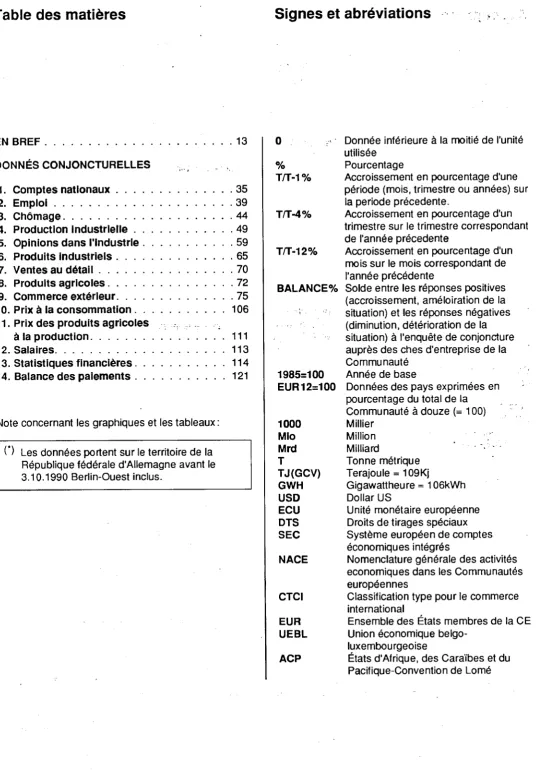
Table des matières
Signes et abréviations
1
EN BREF
13
DONNÉS CONJONCTURELLES
1. Comptes nationaux
35
2. Emploi
39
3. Chômage
44
4. Production industrielle
49
5. Opinions dans l'industrie
59
6. Produits industriels
65
7. Ventes au détail
70
8. Produits agricoles
72
9. Commerce extérieur
75
10. Prix à la consommation
106
11. Prix des produits agricoles
à la production
111
12. Salaires
113
13. Statistiques financières
114
14. Balance des paiements
121
Note concernant les graphiques et les tableaux :
(*) Les données portent sur le territoire de la
République fédérale d'Allemagne avant le
3.10.1990 BerlinOuest inclus.
0
%
T/T1%
T/T4%
T/T12%
BALANCE
0/»
1985=100
EUR12=100
1000
Mio
Mrd
Τ
TJ(GCV)
GWH
USD
ECU
DTS
SEC
NACE
CTCI
EUR
UEBL
ACP
Donnée inférieure à la moitié de l'unité
utilisée
Pourcentage
Accroissement en pourcentage d'une
période (mois, trimestre ou années) sur
la periode précédente.
Accroissement en pourcentage d'un
trimestre sur le trimestre correspondant
de l'année précédente
Accroissement en pourcentage d'un
mois sur le mois correspondant de
l'année précédente
Solde entre les réponses positives
(accroissement, améloiration de la
situation) et les réponses négatives
(diminution, détérioration de la
situation) à l'enquête de conjoncture
auprès des ches d'entreprise de la
Communauté
Année de base
Données des pays exprimées en
pourcentage du total de la
Communauté à douze (= 100)
Millier
Million
Milliard
Tonne métrique
Terajoule = 109Kj
Gigawattheure = 106kWh
Dollar US
Unité monétaire européenne
Droits de tirages spéciaux
Système européen de comptes
économiques intégrés
Nomenclature générale des activités
économiques dans les Communautés
européennes
Classification type pour le commerce
international
Ensemble des États membres de la CE
Union économique belgo
luxembourgeoise
États d'Afrique, des Caraïbes et du
PacifiqueConvention de Lomé
EUROSTATISTIQUES: en bref
Sauf indications contraires, les données portent sur le territoire de la République fédérale d'Allemagne avant le 3.10.1990, Berlin-Ouest inclus.
TAUX DE CHANGE: Augmentation des taux d'intérêts au
Royaume-Uni
Le 12 septembre, la banque d'Angleterre a annoncé une augmentation de
0,5 % des taux de base bancaires qui passent ainsi à 5,75 %, la première
augmentation de ces taux depuis 1989 à l'exception d'une hausse de
durée limitée en septembre 1992 avant la sortie de la livre sterling du
mécanisme des taux de change. Cette augmentation vise à atténuer les
pressions inflationnistes pesant sur l'économie britannique qui enregistre
actuellement le taux de croissance le plus rapide depuis quelques années.
La livre sterling a réagi positivement à cette nouvelle, clôturant à Londres
le 12 septembre à DM 2,41, soit près de 3 pfennigs de plus que le jour
précédent.
Le Royaume-Uni est ainsi, après l'Italie et la Suède, le troisième pays
européen à augmenter ses taux d'intérêts à court terme au cours des
dernières semaines. Bien qu'en Italie, il s'agissait principalement de réagir
à la faiblesse de la monnaie, en Suède et au Royaume-Uni, les
augmentations étaient toutes deux des mesures préventives de lutte
contre l'inflation.
Bien que, comme indiqué ci-dessus, la hausse des taux d'intérêts en Italie
visait à raffermir la lire, l'effet immédiat a été un affaiblissement de la
monnaie qui toutefois s'est légèrement redressée ultérieurement mais
n'avait pas repassé à la mi-septembre le seuil considéré comme critique
des 1000 lires.
Durant la première moitié de septembre, le dollar a presque toujours
fluctué autour de 1,55 DM, s'affaiblissant légèrement le 9 septembre avec
l'annonce d'une hausse plus rapide que prévue des prix de gros aux
États-Unis, mais s'est raffermi légèrement par la suite.
A l'intérieur du mécanisme des taux de change du SME, les variations ont
été peu marquées durant la première moitié de septembre. Le florin reste
la monnaie la plus forte, suivi par le franc belge et par le deutschemark.
La peseta espagnole et la couronne danoise sont les monnaies les plus
faibles.
Mi-septembre, le franc suisse a atteint son niveau le plus élevé par
rapport au deutschemark depuis trois ans au moins: le 14 septembre, il
clôturait à Londres à 0,83 SFR, niveau qui s'est maintenu le jour
suivant.
RENDEMENT DES OBLIGATIONS D'ETAT: Poursuite de l'augmentation
des rendements en juin; une certaine consolidation en juillet
Les trois pays pour lesquels des données sont disponibles ont enregistré
de nouvelles hausses des rendements des obligations d'État en août. Les
rendements ont dépassé 10 % en Italie pour la première fois depuis juin
1993 et étaient légèrement plus élevés en Espagne à 10,4%. Au
Royaume-Uni, la tendance était à une légère hausse mais les rendements
étaient inférieurs au niveau moyen de juin 1994.
Selon un rapport de l'Institut monétaire européen, si l'on considère les
augmentations des taux d'intérêts à long terme des huit premiers mois de
1994, on peut subdiviser les pays de l'UE en trois groupes. Le premier
groupe est constitué des pays dont les rendements ont augmenté de
moins de 2 %, augmentation analogue à celle enregistrée aux États-Unis
et au Japon, et inclut l'Allemagne, la France, la Belgique, le Luxembourg et
les Pays-Bas. Le deuxième groupe inclut le Danemark, l'Irlande et le
Royaume-Uni où la progression des rendements se situe entre 2 et 3 % et
le troisième groupe, avec des augmentations de plus de 3 %, est
constitué de l'Italie, de l'Espagne et du Portugal.
MASSE MONÉTAIRE:
(pas de donnée nouvelle)
RÉSERVES DE CHANGE:
(pas de donnée nouvelle)
COMPTES TRIMESTRIELS: Premier trimestre 1994: évolution positive
de l'économie de l'Union européenne (PIB +0,8%).
Au cours du premier trimestre 1994, on a constaté, pour l'économie de
l'Union européenne dans son ensemble, une bonne reprise de la
croissance économique (PIB +0,8 %). Celle-ci se produit après deux
années d'incertitude et de récession. Le bon résultat du premier trimestre
est encore plus significatif si l'on considère que, en général, le premier
trimestre est assez faible sur le plan structurel et que, du point de vue
météorologique l'hiver 1994 a été assez dur en défavorisant certaines
activités comme, par exemple, l'agriculture, les constructions, etc.. Ce
résultat pourrait représenter la vraie inversion des tendances que la
plupart des indicateurs guides, au niveau macro-économique, situés dans
la première partie de l'année en cours. D'autre part, il convient d'être
assez prudent avant de se lancer dans des interprétations trop optimistes
de la situation économique actuelle. En effet, plusieurs problèmes
caractérisent encore la situation économique comme, par exemple, le
chômage et la réduction des déficits publics. A ce problème il faut ajouter
les nouvelles tensions qui ont caractérisé récemment les marchés
financiers et monétaires et qui risquent de déstabiliser l'économie
mondiale dans un moment critique tel que celui de la sortie d'une phase
négative.
En ce qui concerne l'inflation, mesurée par le déflateur implicite du PIB,
on constate une légère reprise (+0,5 %). Suite à cela certains Etats
membres ont décidé, au cours du mois d'aôut, une hausse du taux
d'intérêt.
En ce qui concerne les composantes du PIB, il nous semble utile de
mettre en évidence la forte reprise des investissements (+1,9%) et
l'évolution positive de la consommation privée (+0,8 %), tandis que la
consommation publique reste stagnante (+0,1 %).
En ce qui concerne la situation dans les Etats membres, nous disposons
des données pour le deuxième trimestre pour l'Allemagne, la France et les
Pays-Bas. Ces données montrent une poursuite de la phase d'expansion
en France et aux Pays-Bas (PIB +1,0 % et +1,0 % respectivement). Tandis
qu'en Allemagne, après la forte reprise enregistrée au cours du premier
trimestre, on observe une croissance assez modérée (PIB +0,5 %).
Aux Etats-Unis, au cours du deuxième trimestre, évolution positive de la
croissance économique (PIB +0,9%) accompagnée, par une inflation
stable (+0,7%). Parmi les composantes de la demande interne, on
constate la poursuite de la phase de forte croissance des investissements
(+2,1 %). Par contre, la consommation privée ralentie de manière sensible
(+0,4 %) tandis que la consommation publique continue dans sa phase
négative (-0,4 %).
Au Japon, sensible croissance de la production (PIB +1,0 %)
accompag-née par une légère déflation (-0,1 %). Du côté des emplois, on constate la
forte progression de la consommation privée (+1,4 %) qui est
accompag-née par un nouveau fléchissement des investissements (-0,8 %). Par
contre, la consommation publique présente une évolution plutôt faible
(+0,5 %).
PRIX: l'inflation annuelle de l'UE à 3,1 % en août
Le taux d'inflation annuelle pour l'ensemble de l'UE a augmenté
légère-ment de 3,0 % en juillet à 3,1 % en août. Il y a un an ce taux était de
3,5 %.
L'indice mensuel pour EUR-12 a progressé de 0,3% dû aux hausses
suivantes dans les différents Etats membres de l'UE: Espagne 0,7%,
Royaume-Uni 0,5 %, Pays-Bas et Danemark 0,4 %, Belgique, Italie et
Portugal 0,2 %, Allemagne et Luxembourg 0,1 %. L'indice de la France
est resté inchangé entre juillet et août.
L'indice trimestr el de l'Irlande est monté de 0,8 % entre mi-mai et
mi-août, ce qui correspond à une moyenne mensuelle d'environ 0,3 %.
Dans l'ordre croissant de l'inflation actuelle, les taux annuels des Etats
membres pour le mois d'août et ceux d'il y a un an, sont:
France Luxembourg Danemark Royaume-Un Belgique Irlande
Août '94
Août '93 1,7 %p 2,0 % 2,2 % 2,4 % 2,4 % 2,5 %
Août '93
Août '92 2,2 % 3,7 % 1,2% 1,7% 3,2 % 1.3%
Pays-Bas Allemagne" Italie Espagne Portugal Grèce
Août '94
Août '93 2,6 % 3,0 % 3,8 %p
4,8 % 4,8 % 11,1 %
Août '93
Août '92 3,0 % 4,2 % 4,5 % 4,6 % 5,6 % 14,6%
L'IPC pour la R.F. d'Allemagne continue à se rapporter à la situation territoriale d'avant le 3 octobre 1990.
Provisoire
9
Les taux d'inflation annuelle des Etats candidats à l'adhésion sont :
Norvège 1,6 % (2,2 %), Finlande 1,9 % (2,1 %), Suède 2,6 % (4,8 %) et
Autriche 3,2 % (3,4 %).
Les taux correspondants de quelques autres pays sont: Etats-Unis 2,9 %
(2,8 %), Japon -0,1 % (1,9 %), Canada 0,2 % (1,7 %) et Suisse 0,5 %
(3,6 %).
LE CHOMAGE DANS L'UNION EUROPEENNE
Dans l'Union Européenne, le taux de chômage corrigé des variations
saisonnières atteint 10,7 % au mois d'août 1994 selon Eurostat, en baisse
de -0,1 point de pourcentage par rapport au mois précédent.
La lente décroissance du chômage dans l'Union Européenne, amorcée à la
fin du printemps 1994, semble donc se poursuivre : le taux de chômage
total est revenu à son niveau d'août 1993.
Toutefois, cette décroissance reste hésitante et n'apparaît régulière que
dans la Péninsule Ibérique (Espagne et Portugal) et dans les îles
Britanniques (Royaume-Uni et Irlande).
Le taux de chômage et le nombre de chômeurs sont estimés après
élimination des différences dans les méthodes nationales de recensement
du chômage.
Le taux de chômage est estimé en extrapolant les résultats 1991 des
enquêtes sur les forces de travail pour tous les Etats membres.
L'introduction des résultats de l'année 1992, dès qu'ils seront disponibles,
entraînera probablement une révision des estimations.
SCHAUBILDER
GRAPHICS
ARBEITSLOSENQUOTEN
SAISONBEREINIGT
EUR
UNEMPLOYMENT RATES
SEASONALLY ADJUSTED
USA
TAUX DE CHOMAGE
DESAISONNALISE
JAPAN
j i_J ι ι I ι ι I ι L j i_l ι ι I : ι I ι L j i_l ι ι I ι ι I ι L
11
10
9
1991
1992
1993
1994
15
14
13
12
11
10
9
8
7
6
—
" T T . . . ,
I 1
ARBEITSLOSENQUOTEN
^ - ^ - BCSGESAIiT/SAISONBEREIiaGT — — — MAEMŒR/SAISONBERHMGT
ntAUEN/SAISONBEREINIGT
^
.
Ι ι ι 1 r ι Ι ι ι
»»
—^"""
ι ι Ι ι ι Ι ι
UNEMPLOYMENT RATES
EUR
TOTAL/SEASONALUf ADJUSTED ION/SEASONALLY ADJUSTED ¥ OMEN/SEASONALLY ADJUSTED
- — "
Ι ι ι
""""
ι ι Ι ι ι Ι ι ι 1
TAUX DE CHOMAGE
TOTAL/DESAISONNAliSE HOlMES/DÏSAISOMiAliSE m O f f i S /DESAISONNALISE
I 1 ι ι Ι ι ι Ι ι ι Ι ι
—
—
—
—
—
1
15
14
13
12
11
10
9 8 7
1991
1992
1993
1994
ARBEITSLOSENQUOTEN
SAISONBEREINIGT
UNEMPLOYMENT RATES
SEASONALLY ADJUSTED
%
TAUX DE C H O M A G E
DESAISONNALISE
"IRL
E
■I1991
1992
1993
1994
12
11
10
9
8
7
_ ^
_^--'
"U
.- —-"'
UK F
^ - ^ —- — " "
__
.
-
-
-
-
'
. , 1 . , 1 , , 1 , ,
^ - - " " X yv
— ^ /
^^~~\
, , 1 , . 1 . . 1 . .
■ - B
. . 1 . . 1 . . 1
— 1
—
12
11
10
1991
1992
1993
1994
1991
1992
1993
1994
ARBEITSLOSENQUOTEN
SAISONBEREINIGT
UNEMPLOYMENT RATES
SEASONALLY ADJUSTED
TAUX DE CHOMAGE
DESAISONNALISE
BELGIQUE - BELGIË 50
40
30
20
10
Q I I . I I I I I I I I I I I I I H I 1111, 11 , 1 , , I , , I,
1991 1992 1993 1994
DANMARK
10
ΐ ΐ
Q ■ ■ ■ I l i l l u i l i l l u i l u l , i l i , I ,
1991
1992
1993
1994
50
40
30
20-DEUTSCHLAND (*)
10
" f ^ "
l u l l i i n i l u l i l n l n i l l .
1991
1992
1993
1994
ESPANA
1991
1992
1993
1994
50
40
30
20
10
0
FRANCE
ι ' · · I I I " !
50
40-30
20
10
IRELAND
11111111111 ■ 111111111111 111111 111 11 1111111111
1991
1992
1993
1994
1991
1992
1993
1994
ITALIA NEDERLAND
i l i i l n l n l i i l i i l i . l n I . . I .
1991
1992
1993
1994
■ I " I ' I . I n I n i
50Γ
40
30
20
10
PORTUGAL
1991
1992
1993
1994
1991
1992
1993
1994
UNITED KINGDOM
ι Ι , ι Ι , , Ι , , Ι , , Ι , , Ι , . Ι I n i , , I n i ,
1991
1992
1993
1994
USA
ι '* m
,1 η I , ■ l i ι I ι ι I ι ι I ι ι I ι ι I ι i l ι ι I ι ι I ι ι I ι ι I ι ι I ι ι I ι ι
1991
1992
1993
1994
Moina de 25 ana
INDUSTRIELLE PRODUKTION
TENDENZ 1985=100
INDUSTRIAL PRODUCTION
TREND 1985=100
PRODUCTION INDUSTRIELLE
TENDANCE 1985=100
NACE 1 - 4
EUR
USA
JAPAN
130 —
125 —
120 —
115
110
105
^
- *
1 n n . ι ι Ι ι ι Ι ι ι Ι ι ι Ι ι ι Ι ι ι Ι ι ι Ι ι ι Ι ι ι Ι ι ι Ι ι ι Ι ι ι Ι ι ι Ι ι ι Ι ι ι Ι ι ι , — 1 3 0
125
120
115
— 1 1 0
105
1991
1992
1993
ENriCH-LOGABnHHBCSE S U L i SDfl-LOCAHIHMIC SCALI
1994
I t a m i snn-LOGUBIHinQDI
EUR
INDUSTRIE NACE 1 - 4
GRUNDST. U. PRODUKTIONSGUETER
MVESTrnONSGUETER
VERBRAUCHSGUETER
DiDUSTRY NACE 1 - 4
INTHUIKDlATg GOODS CAPITAL GOODS
CONSUMER GOODS
INDUSTRIE NACE 1 - 4
BIENS INTERMEDIAIRES
BIENS DTNVESTISSEMENT
BIENS DE CONSOMMATION
rarACH-LOGUOTfluscBiauu -LOGAUTHMIC SCAI2 I C B H U SXM-LOGÁHTBMIQUI
150 140 130 120 110
100-INDUSTRIELLE PRODUKTION
BELGIQUE - BELGIË
90 l i l l u i n I I n i , , I n i ,
INDUSTRIAL PRODUCTION
NACE 1-4 1985=100
DANMARK
1991
1992
1993
1994
150 140 130 120 110
100 90
■TÖ^V
i l t i Ι ι t t ι ι I t i l ι ι t i t Ι ι ι Ι ι i l ι ι Ι ι ι I t ι Ι ι i l ι ι I t ι l i
1991
1992
1993
1994
150 140 130 120 110 100 90
PRODUCTION INDUSTRIELLE
DEUTSCHLAND (*)
' I n i I I n t u i I n i
1991
1992
1993
1994
ELLADA ESPANA
150 140 130 120 110
ìoor
90 ■ ' ■ ■ ' ■ ■ ' n i ■ ■ ' n ' ι ι ' ■ ' 11 l ' i ' ' ■ ' ' ■ ■ I n ' ■ ' ' ' ■ ' ' ■
1991
1992
1993
1994
150 140 130 120 110 100
90 ι ! 11 ί ι ι 1111 1111111 111111 i l 11 Ιι ι t i 1111!111ι 1111
150Γ
140
130
120
110
100
FRANCE
1991 1992 1993 1994
90' n i I n i , i l i , I n Ι , i l , l i l i l í
1991
1992
1993
1994
IRELAND 180
170 160 150)« 140 130-120
110
100 1 1 1 1 1 1 1 1 1 1 1 1 1 i l i ι t u 11 il ι il 1 1 1 1 1 1 1 1 1 1 il 11 li ι 1 1 1
1991
1992
1993
1994
150 140 130 120 110 100
-ITALIA LUXEMBOURG
90 ι i l i t Ι ι ι t ι ι Ι ι i l ι ι Ι ι ι Ι ι ι Ι ι i l ι ι Ι ι ι Ι ι ι Ι ι i l ι ι Ι ι ι l i ι
1991
1992
1993
1994
150 140 130 120 110 100
90 η ! , Ι , , Ι , , Ι , Ι , . I n
1991
1992
1993
1994
150 140 130 120 110 100 90
NEDERLAND PORTUGAL
■ l u l l i l i i l i i l n l n l i i i I n i i l .
1991
1992
1993
1994
150-140 130 120 110 100
UNITED KINGDOM
1991
1992
1993
1994
90 uι i l 11 i t ι 11 i l ι t l 11 l i ι l i 11< 1111 i i 111 111 i l 1111 ι l i ι
1991
1992
1993
1994
EUR
nWACB-LOOSITHlOSCHI SALA Snfl-LOOBIHMIC SCALI t c H D i i ano-LOGUimuqui
MEINUNGSUMFRAGE
IN DER INDUSTRIE (NACE 1 - 4 )
SALDO 7.
^ - ^ - PRODUKTIONSAUSSICHTEN
— — — AUFTRAGSBESTAND
LAGERBESTAENDE AN FERTIGERZEUGNISSEN
OPINIONS
IN INDUSTRY (NACE 1 - 4 )
BALANCE %
EUR
PRODUCTION EXPECTATIONS ORDER BOOKS
STOCKS OF FINISHED PRODUCTS
OPINIONS
DANS ^INDUSTRIE (NACE 1
-SOLDE %
PERSPECTIVES DE PRODUCTION CARNETS DE COMMANDES STOCKS DE PRODUITS FTMS
30
20
10
0
-10
-20
-30
-40
-50
-60
1991
1992
1993
1994
30
20
10
0
-10
-20
-30
-40
-50
-60
VERTRAUENSINDIKATOR
IN DER INDUSTRIE
SALDO %
CONFIDENCE INDICATOR
IN INDUSTRY
BALANCE %
INDICATEUR DE CONFIANCE
DANS L'INDUSTRIE
SOLDE %
io
-10
-20
-30
-40
10
— 0
1991
1992
1993
1994
-io
-20
-30
-40
VERKAUFSVOLUMEN
DES EINZELHANDELS
140 135-130" 125- 120-115 110 105 100 95
BELGIQUE - BELGDÏ
I n i . ' n i l i l i l í ι
1989
1990
1991
1992
RETAIL TRADE VOLUME
1985 = 100 140 135 130 125 120 115 I 110- 105-100
95
VOLUME DES VENTES
DU COMMERCE DE DETAIL
DANMARK
I n t n l . i l I I n i
1989
1990
1991
1992
140 135 130-125 120 115 110 105 100 95
DEUTSCHLAND (*) ELLADA FRANCE
n ' ■ ■ ' ι ■ ' ' ■ I ' ' 'ι ι ' η I' ' I " ' η ' ■ 'I ' ■ I n ' ■ ■ I ' ■ ' ' ■
140Γ 135 130 125-120 115 110 105 100
■ '■■''■'■■In' I '"I
1989
1990
1991
1992
1989
1990
1991
1992
g 5u ^
1989
1990
1991
1992
IRELAND LUXEMBOURG
140 135 130 125 120 115 110 105 lOOh
95 I , i l i , I n l n l n l n l i , I , i l n l i ι
1989
1990
1991
1992
140 135 130 125 120 115 110 105 100
95 " I " ! I n I n I n i , , I n i i l ,
1989
1990
1991
1992
140
135
130
125-
120-115
110|i
105
100
NEDERLAND
95 il ' " I n i n i , ,
1989
1990
1991
1992
UNITED KINGDOM
USA
140 135 130 125 120
115t
no
105
-
ìoo-95^
■ ι ι ■ Ί 111111 ■ Ί ι ' ■ ι Ί ■ 1 ■ i l i ■ I ■ ι ' ι 111 ■ 11111 ■ 1111989
1990
1991
1992
140 135 130 125 120 115 110 105 100
95 ι il ι ι Ι, ι I ■ il ι il ι ι I ■ ■ I n I n i ι ι Ι ι ι Ι ι ι Ι ι il ι ι I ■■ I ■ 140 135 130 125 120 115 HO 105 100 95
JAPAN
■ ■' 1 1 1 1 ■ ii 11 ■ ii 1 1 ' 1 1 ' ι ■ 11 ii ti ι■ ' ' ■ ■ I ■ ' 1 1 1 ' 1 1 ' ■ ■
1989
1990
1991
1992
1989
1990
1991
1992
3-MQ!UTSDOBCB9CHmrn
(1) OHNE HAUEN
EUR (1)
3USOKAUT ADJUSBD HIDOS 3 MOHTBMOVmc ATOAIS
(1) WITHOUT ITALY
INDICI DCSABOniAUSI
M o n n a H O H O I S O I S MOIS
(1) SAUF ITALIE
AUSSENHANDEL
EXTERNAL TRADE
MRD ECU
COMMERCE EXTERIEUR
IMPORT - - - EXPORT
50 45 40 35 30 25 20
EUR (1)
—
5Ä^f\
. , 1 . , 1 . . 1 , ,
— /
\ /
x. , ι , , ι , , I , , . . 1 . , 1 . . 1 . .
V
, . 1 , . 1
^
—
, , 1 , ,
1990
1991
1992
1993
50 45 40 35 30 25 20
USA
1990
1991
1992
1993
JAPAN
30 \—
25 20 15 10 5
— .Λ
, I . . I .
/^.--"-'^-'V'^-v
I . . I . ■ I
«v /
\
/*
*
I . . I I . ■ I
30 25 20 15 10 5 0
1990
1991
1992
1993
180 155 — 130 — . 105
80 55 30
USA
EXPORTS / IMPORTS %
EUR(l)
_ ! I I l_
JAPAN
— 180 155 130 105 80 55 30
1990
1991
1992
1993
AUSFUHREN FOB Di PROZENT DER mFUHREX OF
(l)DTRA-IG BINDEL
nPORTS FOB DC FIB CENT o F m p o B T s a F
| 1 ) Ε Π Β Α - α TRADÌ
nPOKUriONS FOB EN POUR CENT DtsmPOBTATiOHSCAr
(1) COMMERCI EXTRA ( 3