
Introducing a Stakeholder Management Methodology into the EU
11
0
0
Full text
(2) Introducing a Stakeholder Management Methodology into the EU. Abstract This paper describes the introduction of the Stakeholder Circle® methodology (SHC) and software into the European Union by Tiba Managementberatung GmbH. The methodology was developed in Australia and initially targeted at the North American project management market. A partnership with a German consulting company, Tiba Managementberatung GmbH was formed in 2006 to introduce the methodology into the European market place. This paper describes the results of the training and implementation efforts in Europe and discusses the question: is there is a common ‘EU culture’, or do differences in both PM maturity and national and organisational culture make the concept of an ‘EU marketplace’ for project management processes and tools a dangerous illusion?. Introduction A revolutionary methodology for stakeholder relationship management - the Stakeholder Circle is being implemented into organisations across the globe. The methodology was developed in Australia and has been successfully implemented in international organisations based in Europe. A German consultancy company, Tiba Managementberatung GmbH has commenced marketing the methodology and software in Germanspeaking countries. The focus of this paper is the result of issues and challenges and lessons learned in the process of marketing and implementing the methodology into the diverse corporate and national cultures present in the European market place. The objectives of the authors are to contribute to knowledge about stakeholder relationship management and how to implement these processes and practices successfully in organisations in Europe and in other parts of the world. The format of this paper will be as follows: first a discussion of culture in its various forms, particularly organisational, professional and generational cultures, and how cultural issues and values can affect implementation. This is followed by a brief discussion of the importance of stakeholders to an organisation’s activities and a description of a specific stakeholder relationship management methodology, the Stakeholder Circle. The third section describes the experiences of the authors in working with organisations to implement stakeholder management processes and practices and to conduct training that includes stakeholder management. The findings from experiences in three European organisations are described along with three Australian Government organisations, augmented by their experiences in training groups in stakeholder management practices. A description of the Stakeholder Relationship Management Maturity (SRMM®) model and its potential to assist organisations overcome resistance to changes required for the implementation of stakeholder relationship management processes and practices follows. The final section will draw on the previous sections of the paper to investigate the question: is there is a common ‘EU culture’, or do differences in both PM maturity and national and organisational culture make the concept of an ‘EU marketplace’ for project management processes and tools a dangerous illusion?. Culture Culture is ‘how we do things around here’ and cultural norms are the ‘unwritten rules of behaviour’ of a group, organisation or nation. It is important to understand that ‘how we do things around here’ varies with each group and/or organisation and that there is no ‘universal law’ of organisational management or universal management tool kit (Hampden-Turner and Trompenaars 2000). Culture is a set of assumptions about how the world is, and ought to be, shared by a society through patterns of shared meaning manifested by stories, rituals, formal and informal practices, jargon and physical arrangements (Martin 2002). This shared understanding defines how a group and the individuals within it perceive their world, and provides the basis for their thoughts and behaviour. Culture is expressed in symbols, words (language), gestures and rituals that tell the stories and express the values of the culture. The © 2009, Dr Lynda Bourne & Stephan Kasperczyk. 2 of 11. Originally published as a part of 2009 PMI Global Congress Proceedings – Amsterdam. www.mosaicprojects.com.au.
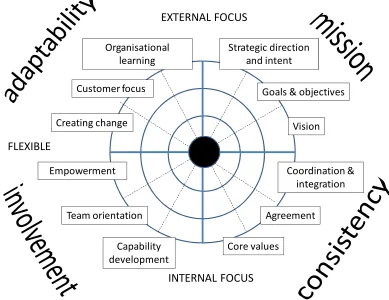
(3) Introducing a Stakeholder Management Methodology into the EU four types of culture that may affect any attempt to introduce stakeholder relationship management processes and practices in an organisation are: national/regional, organisational, professional or industry, and generational cultures. They are defined in the next section. National or Regional culture: Culture is often best described by comparison of qualities of different cultures. The work of (Hofstede 1997) and (Hampden-Turner and Trompenaars 2000) in describing the differences between different national or regional cultures is well known and rarely disputed. Organisational culture: Organisational culture has been defined and categorised in many ways, but there is not any one model generally accepted as the basis for discussions of organisational culture. In the opinion of one of the authors there is at least one useful model, however, that of Denison, Haaland and Goelzer ( 2004) that divides organisational culture into four traits: • • • •. Involvement: empowerment of employees and commitment of managers of the goals of the organisation; Consistency: stability leads to common mindset and high degree of conformity; Adaptability: driven by customers, take risks and learn from their mistakes and readily embrace change; Mission: clear sense of purpose that defines the organisation’s goals and strategies.. In this model there is no ‘winning’ set of traits that make the organisation successful, identifying the traits of an organisation may be best expressed in a way that allows a mapping of strength of traits - see figure 1. These traits can be contradictory: often the factors of organisational internal stability make adaptability difficult, and there will always be tension between an internal and external focus. This model is being used by its developer as a diagnostic tool to assist in an understanding of strengths and weaknesses of each organisation’s culture and as an indicator of potential improvement paths for modifying culture to achieve specific organisational outcomes.. EXTERNAL FOCUS Organisational learning. Strategic direction and intent. Customer focus. Goals & objectives. Creating change. Vision. FLEXIBLE Empowerment. Coordination & integration. Team orientation. Agreement. Capability development. Core values. INTERNAL FOCUS Figure 1: the Denison organisational culture model (Denison, Haaland et al. 2004) © 2009, Dr Lynda Bourne & Stephan Kasperczyk. 3 of 11. Originally published as a part of 2009 PMI Global Congress Proceedings – Amsterdam. www.mosaicprojects.com.au.
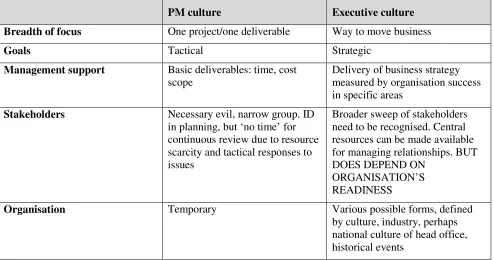
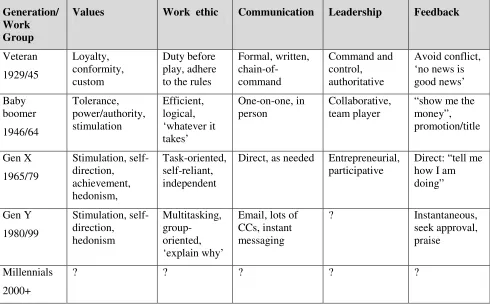
(4) Introducing a Stakeholder Management Methodology into the EU Organisation culture models are not as well understood or codified as national or regional cultures, but must still be recognised as an important factor to consider when developing strategies or plans for those introducing stakeholder relationship management processes and practices Professional or industry culture: Another way to view organisations is through its occupational communities (Schein 1996). In this model there are three typical communities – operators, engineers or technical specialists, and senior managers/CEOs. The operator culture evolves locally within line units of an organisation and is unique to that organisation. The guiding principles of this cultural group are trust and teamwork: rules and hierarchy within this group are often counterproductive. The engineering/technical specialist culture is present in all industries and nations and consists of designers and implementers of technology with common education, work experience, and vocational interest. Project management culture or specialisation fits into this category. The culture of executives, like engineers, industry-wide and internationally, supports a worldview of fiscal responsibility, and more often than not, command and control systems. The engineering/technical culture and senior manager/CEO culture both have their point of reference outside any organisation. Because they have developed worldwide communities, they learn more from each other than from their subordinates within the organisation. This theory supports the view of the authors that the PM culture worldwide is a more robust basis for focus than is national culture. The differences between PM culture and executive culture is summarised in figure 2. PM culture. Executive culture. Breadth of focus. One project/one deliverable. Way to move business. Goals. Tactical. Strategic. Management support. Basic deliverables: time, cost scope. Delivery of business strategy measured by organisation success in specific areas. Stakeholders. Necessary evil, narrow group. ID in planning, but ‘no time’ for continuous review due to resource scarcity and tactical responses to issues. Broader sweep of stakeholders need to be recognised. Central resources can be made available for managing relationships. BUT DOES DEPEND ON ORGANISATION’S READINESS. Organisation. Temporary. Various possible forms, defined by culture, industry, perhaps national culture of head office, historical events. Figure 2: summary of PM culture. Generational culture: Finally there is the newly emerging concept of generational culture. In the topic under consideration there are two aspects to consider: • •. The effects of generational differences The benefits of experience from years of managing and leading in the field.. Generational differences are summarised in figure 3. As is shown in this table, there are significant differences in the values, work ethics, communication styles and attitudes to leadership of each generation. Generational differences, when coupled with experience in particular areas such as project management or other specialist cultures have a strong influence on how activities are managed and delivered. © 2009, Dr Lynda Bourne & Stephan Kasperczyk. 4 of 11. Originally published as a part of 2009 PMI Global Congress Proceedings – Amsterdam. www.mosaicprojects.com.au.
(5) Introducing a Stakeholder Management Methodology into the EU Generation/ Work Group. Values. Work ethic. Communication. Leadership. Feedback. Veteran. Loyalty, conformity, custom. Duty before play, adhere to the rules. Formal, written, chain-ofcommand. Command and control, authoritative. Avoid conflict, ‘no news is good news’. Tolerance, power/authority, stimulation. Efficient, logical, ‘whatever it takes’. One-on-one, in person. Collaborative, team player. “show me the money”, promotion/title. Stimulation, selfdirection, achievement, hedonism,. Task-oriented, self-reliant, independent. Direct, as needed. Entrepreneurial, participative. Direct: “tell me how I am doing”. Stimulation, selfdirection, hedonism. Multitasking, grouporiented, ‘explain why’. Email, lots of CCs, instant messaging. ?. Instantaneous, seek approval, praise. ?. ?. ?. ?. ?. 1929/45 Baby boomer 1946/64 Gen X 1965/79. Gen Y 1980/99. Millennials 2000+. Figure 3: summary of generational cultures (Crumpacker and Crumpacker 2007). Stakeholder relationship management Critical role of stakeholders in organisational change (projects) The importance of stakeholders the success (or failure) of an organisation’s activities is best described by the example of the construction and transition to operational state of Heathrow Terminal 5 (T5) in 2008. The saga of T5 covers many years and many stages. The construction of the building and terminal facilities has been hailed as ‘enlightened’ due to the adoption of innovative project management practices (Potts 2006). The construction of the terminal was lauded as a success, from a time, cost, scope and quality perspective, but also from the management of risk and reduction of disputes and conflicts. T5 was designed exclusively for the use of British Airways (BA), and was officially opened on 14 March, 2008 by HM Queen Elizabeth. From the first day of operation flights had to be cancelled, passengers were stranded, and over 15000 pieces of baggage were lost. From interviews and news items it became evident that there was no contingency on that first day, no recognition that something might go wrong: • Management did not ask staff to come early to counter potential delays following new security procedures; • The staff did not even know what they had to do that first day, because they did not know how to use the new resource management system; • Management did not pay for additional staff, merely asking staff to come on their day off to help out; • The baggage handlers appear to have not been trained at all – they did not know how to work within the new processes.. © 2009, Dr Lynda Bourne & Stephan Kasperczyk. 5 of 11. Originally published as a part of 2009 PMI Global Congress Proceedings – Amsterdam. www.mosaicprojects.com.au.
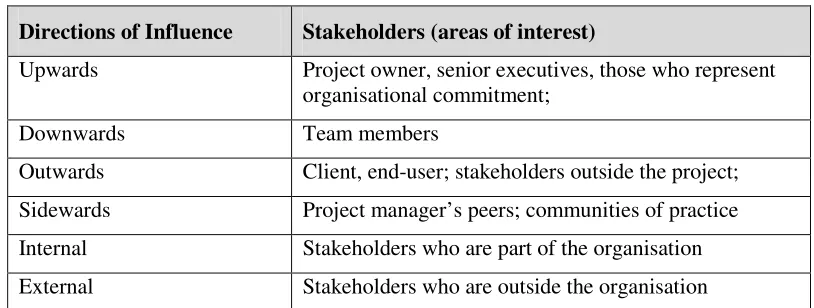
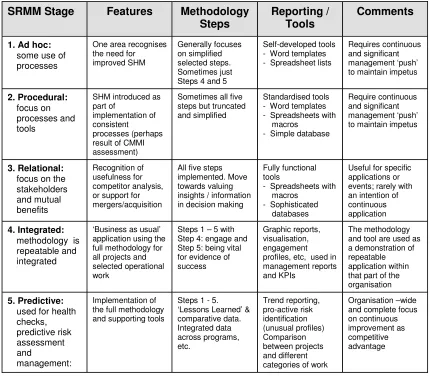
(6) Introducing a Stakeholder Management Methodology into the EU BA’s reputation is damaged from the events of T5’s opening. It did indeed fail on opening, but the failure was clearly a failure to manage the people side – poor preparation of the people responsible for operation of the facility: poor management of BA’s relationships with stakeholders both internal (staff) and external (travelling public). If T5’s success were to be judged just on the completion of the construction project it would continue to be known as a success. But for now T5 is synonymous with failure, because of the poor management of the implementation of the outcome of the project. The perception of the travelling public and many other stakeholders is that T5 “does not work”.. A methodology for stakeholder relationship management The story of T5 provides a good analogy for the focus and direction of the professionals in an organisation. Just as in the world of construction, the technical aspects were the focus of the engineers and technical professionals, in other organisational activities, there will usually be attention paid to the technical aspects of delivering a solution on time, within budget and to specifications to the detriment of implementation activities. Implementation usually involves building relationships with the potential users or staff, and working to provide these stakeholders with the training and support they need and to deliver to their expectations. Stakeholder relationship management methodologies provide guidance in understanding and managing the expectations of stakeholders. One methodology, the Stakeholder Circle, provides a 5-step process to identify, prioritise, visualise, engage and communicate with the ‘stakeholders that matter’, and finally monitor the effectiveness of that communication. Stakeholders are defined as: Individuals or groups who are impacted by, or can impact, the work or its outcomes (Walker, Bourne and Rowlinson, 2008). The underlying principle of the Stakeholder Circle methodology is that the community of project stakeholders will change as the project moves through its lifecycle, and as the structure of the performing organisation changes. The Stakeholder Circle® methodology is examined in detail elsewhere (Bourne 2009). In this paper the guidelines for the team for identifying the ‘right’ stakeholders, and developing the most appropriate communication strategies for engaging these important stakeholders are summarised: • Step 1: identify all stakeholders and document their expectations; • Step 2: prioritise; • Step 3: visualise the key stakeholders, mapping each stakeholder’s relative importance, power and influence; • Step 4: engage through understanding each stakeholder’s attitude to the project and develop targeted communication; • Step 5: monitor the effectiveness of this communication.. Stakeholders’ Influence The methodology categorises stakeholders according to their ‘direction of influence’; how they may influence the project or be influenced by the work of the project or its outcomes. These directions are: upwards (senior managers), downwards (the team), sidewards (peers of the PM) and outwards (outside the project); managing the expectations and gaining the support of each type of stakeholder depend on understanding the how best to manage the relationships described by these categories. Figure 4 summarises. This is essential data in developing targeted communication to manage relationships with important stakeholders and must be defined. It is also essential to understand the expectations of each important stakeholder so that the message or content of the information supplied meets the needs of the stakeholder as well as the needs of the activity. The methodology is supported by software tools. There are three types from simple to complex: •. Templates (Word and Excel). © 2009, Dr Lynda Bourne & Stephan Kasperczyk. 6 of 11. Originally published as a part of 2009 PMI Global Congress Proceedings – Amsterdam. www.mosaicprojects.com.au.
(7) Introducing a Stakeholder Management Methodology into the EU • •. Simple analysis (Excel with Macros) Sophisticated analysis and tracking (database). For more information about these tools go to www.stakeholder-management.com.. Directions of Influence. Stakeholders (areas of interest). Upwards. Project owner, senior executives, those who represent organisational commitment;. Downwards. Team members. Outwards. Client, end-user; stakeholders outside the project;. Sidewards. Project manager’s peers; communities of practice. Internal. Stakeholders who are part of the organisation. External. Stakeholders who are outside the organisation. Figure 4: summary of directions of influence of stakeholders. Implementing Stakeholder Management globally The authors have been involved in a number of implementations of stakeholder management methodologies in different organisations based in Europe as well as in Australia. This and other work involved: •. Over 300 PMs and management-level individuals in stakeholder relationship management (SRM) workshops globally over a period of three years: o Stakeholder relationship management public courses, mainly in the US; o Stakeholder relationship management in-house courses in Australia and in Europe; o Project management courses that include stakeholder relationship management in Europe and other parts of the world.. The process of implementation and training has produced data about: •. The prevalence and type of stakeholder management practices in organisations;. •. The willingness expressed or demonstrated by management-level personnel in organisations to improve practices in stakeholder relationship management;. •. The willingness of individuals at the team level or project management level to introduce structured stakeholder relationship management methodologies such as the Stakeholder Circle.. This data is being assembled for the development of a series of key indicators that may assist in the implementation of improved stakeholder relationship management processes and practices in organisations.. Case Studies The companies whose data is cited in this paper - three European multinational companies, and three Australian Government departments, cover four industries: • Transportation; • IT and telecommunication; • Pharmaceuticals; • Government services. © 2009, Dr Lynda Bourne & Stephan Kasperczyk. 7 of 11. Originally published as a part of 2009 PMI Global Congress Proceedings – Amsterdam. www.mosaicprojects.com.au.
(8) Introducing a Stakeholder Management Methodology into the EU Each of the companies has regional offices in other countries but retain their own strong organisational culture based on: • The culture of the country of origin – where the Head Office is located; • The industry or market that they operate in. There were three types of responses to the concept of implementation of a structured stakeholder relationship management such as the Stakeholder Circle: • Recognition of the potential utility of application of the methodology for analysis and improvement of many commercial and competitive processes – management level individuals; • Passive aggression – functional or middle management: o o. Reading emails during meetings or workshops; Being ‘called away’;. o. Arriving late;. • Outright rejection team personnel : o. Complaining about the time applying the methodology takes;. o. Insisting that using teams to make decisions is a waste of time;. o. Doing heroic PM – being a sole operator and decision maker.. A common ‘EU culture’? The purpose of comparing the work of multinational companies based in Europe with Australian implementations of stakeholder relationship management and workshops and training courses in Australia, is to isolate aspects of implementation or willingness to implement that may be common to Europe but different from the other countries or regions. The findings of both authors from their own experiences indicate that it is the organisation’s culture that prevails. Organisational culture provides the incentive, the drivers, the environment and the reason for introducing structured stakeholder relationship management methodologies. The professional culture will also have some influence on acceptance and successful implementation. Less experienced PMs or team members will be focussed on the tactical activities necessary to complete the project deliverables, whereas the more experienced project personnel or teams and managers who are involved in more strategic longer term work will understand and embrace the activities involved in stakeholder relationship management. What part does national culture play? Both authors have observed that there is indeed a difference in approach to the communication or information sharing activities necessary to effectively manage stakeholder relationships. And the work of (Hofstede 1997) is still a useful guidance for these activities. The structure of the Stakeholder Circle provides a useful framework for all cultures to form the basis for their culture-related actions. The Stakeholder Circle methodology provides the what or science for effective communication, whereas the local knowledge and understanding of the team within the context of the environment formed by the various interrelated cultures of organisation, profession, generation and national is the how – the ‘art’ of communication. Over the five years that the Stakeholder Circle has been implemented in organisations world-wide the issues raised by team members or personnel of organisations have been consistent. The responses have already been described earlier in this paper, and some of the remarks are quoted below: •. “We don’t have time to do this”;. •. “It is too structured”;. •. “Application of the tool is too complicated”;. •. “We are already doing stakeholder management”.. © 2009, Dr Lynda Bourne & Stephan Kasperczyk. 8 of 11. Originally published as a part of 2009 PMI Global Congress Proceedings – Amsterdam. www.mosaicprojects.com.au.
(9) Introducing a Stakeholder Management Methodology into the EU These comments and concerns are legitimate. Even if the organisation really wants implementation of new or improved stakeholder relationship management processes and practices to occur, if those individuals or teams who are essential for its success are not committed to making it a success, the implementation will be sustainable, even if it is implemented. To help resolve these issues the Stakeholder Relationship Management Maturity SRMM® model was developed to ensure that the change process to implement and accept stakeholder relationship management processes and practices was pitched at the right level of ‘readiness’ of any particular organisation. In this way it is possible to introduce processes and practices that are seen to be valuable to the organisation in its existing state.. Stakeholder Relationship Management Maturity SRMM Stage. Features. Methodology Steps. Reporting / Tools. Comments. 1. Ad hoc: some use of processes. One area recognises the need for improved SHM. Generally focuses on simplified selected steps. Sometimes just Steps 4 and 5. Self-developed tools - Word templates - Spreadsheet lists. Requires continuous and significant management ‘push’ to maintain impetus. 2. Procedural: focus on processes and tools. SHM introduced as part of implementation of consistent processes (perhaps result of CMMI assessment). Sometimes all five steps but truncated and simplified. Standardised tools - Word templates - Spreadsheets with macros - Simple database. Require continuous and significant management ‘push’ to maintain impetus. 3. Relational: focus on the stakeholders and mutual benefits. Recognition of usefulness for competitor analysis, or support for mergers/acquisition. All five steps implemented. Move towards valuing insights / information in decision making. Fully functional tools - Spreadsheets with macros - Sophisticated databases. Useful for specific applications or events; rarely with an intention of continuous application. 4. Integrated: methodology is repeatable and integrated. ‘Business as usual’ application using the full methodology for all projects and selected operational work. Steps 1 – 5 with Step 4: engage and Step 5: being vital for evidence of success. Graphic reports, visualisation, engagement profiles, etc, used in management reports and KPIs. The methodology and tool are used as a demonstration of repeatable application within that part of the organisation. 5. Predictive: used for health checks, predictive risk assessment and management:. Implementation of the full methodology and supporting tools. Steps 1 - 5. ‘Lessons Learned’ & comparative data. Integrated data across programs, etc.. Trend reporting, pro-active risk identification (unusual profiles) Comparison between projects and different categories of work. Organisation –wide and complete focus on continuous improvement as competitive advantage. Figure 5 – SRMM® guidelines. SRMM is a structured approach that enables an organisation to identify its level of ‘readiness’ for the introduction of stakeholder engagement practices and to identify areas of potential improvement. The 5 levels of SRMM are: 1. Ad hoc: some use of processes; 2. Procedural: focus on processes and tools; 3. Relational: focus on the stakeholders and mutual benefits; 4. Integrated: methodology is repeatable and integrated across all programs and projects; 5. Predictive: used for health checks and predictive risk assessment and management. © 2009, Dr Lynda Bourne & Stephan Kasperczyk. 9 of 11. Originally published as a part of 2009 PMI Global Congress Proceedings – Amsterdam. www.mosaicprojects.com.au.
(10) Introducing a Stakeholder Management Methodology into the EU By identifying the level of readiness of the organisation to implement stakeholder engagement practices and processes, and following the guidelines appropriate to each level of ‘readiness’ implementation of stakeholder engagement can be more effective by reducing the chances of failure caused by selecting either too ambitious or too low-level approaches. Figure 4 summarises the guidelines for organisations to ensure that their implementation of stakeholder management processes and practices is appropriate for the identified level of readiness. Key indicators of the readiness of an organisation to engage in a successful culture change (in this case the implementation of new or improved stakeholder relationship management processes and practices) include: • • • • • •. A generally perceived problem, opportunity or threat (internal conversations exist); Active support from ‘the top’; Some initial internal moves to start the change process; No group with a high investment in a competitive or contradictory option; An appreciation of the cost and time to create the change and the expected benefits; Tools used to support the methodology need to be localised.. Conclusion This paper summarises the experience of both authors in working with European organisations in training and implementing stakeholder relationship management processes and practices. The results of these experiences have been summarised, some have been documented. But overwhelmingly the results put organisational culture and professional culture as the dominating factor that needs to be addressed in any activity to introduce stakeholder relationship management in an organisation. The concepts of SRMM have been devised to assist organisations to achieve the most appropriate stakeholder relationship management implementation as effectively as possible. There is a need to consider aspects of generational culture and national or regional culture in preparation for implementation of new or improved stakeholder relationship management processes and practices within each country or region. There may be a need to consider translations and localisation of training and marketing materials as well as the development of multi-lingual versions of tools. However, the data collected to date confirms that the structure of the Stakeholder Circle methodology is culture-free and can be adapted to fit the needs, values and approaches of any national or generational culture. The data also suggests that the successful implementation of any sophisticated organisational activity management process, including projects, programs and PMOs will require careful consideration of the organisation and its culture and strategies. A piecemeal or simplistic approach cannot be sustainable. Considerations of national or regional cultural differences are essential but not the major driver of successful implementation of new or improved stakeholder relationship management processes and practices. A structured but flexible approach to stakeholder relationship management such as the Stakeholder Circle methodology has wide potential within Europe and fits the perceived culture of European project management and business. SRMM should be a valid model for assessing the readiness of organisations within Europe to implement stakeholder management processes and practices; however most organisations require localisation of training, language, approaches and examples to facilitate the engagement of their internal stakeholders (staff). The data gathered through the activities described in case studies in this paper could not provide an answer to the question of a common ‘EU culture’ or market. But perhaps the alternative question to ask must also be: does that really matter?. © 2009, Dr Lynda Bourne & Stephan Kasperczyk. 10 of 11. Originally published as a part of 2009 PMI Global Congress Proceedings – Amsterdam. www.mosaicprojects.com.au.
(11) Introducing a Stakeholder Management Methodology into the EU References Bourne, L. (2009). "Stakeholder Mapping" in Construction Stakeholder Management. eds E. Chinyio and P. Olomolaiye. Oxford, Wiley-Blackwell. Crumpacker, M. and J. Crumpacker (2007). "Succession Planning and Generational Stereotypes: should HR consider age-based values and attitudes a relevant factor or a passing fad?" Public Personnel Management 36(4): 349 - 369. Denison, D., S. Haaland, and Goelzer, P. (2004). "Corporate Culture and Organizational Effectiveness: Is Asia Different From the Rest of the World?" Organizational Dynamics 33(1): 98 - 109. Hampden-Turner, C. and F. Trompenaars (2000). Building Cross-Cultural Competence - How to create wealth from conflicting values. New York, John Wiley & Sons. Hofstede, G. (1997). Cultures and Organisations: Software of the Mind. New York, McGraw-Hill. Martin, J. (2002). Organizational Culture: Mapping the Terrain. London, Sage Publications. Potts, K. (2006). Project Management and the changing nature of the quantity surveying profession Heathrow Terminal 5 case study. COBRA 2006, London, The RICS, London. Schein, E. H. (1996). "Three Cultures of Management: The Key to Organizational Learning." Sloan Management Review Fall, 1996: 9 - 20. Walker, D. H. T., L. Bourne and S. Rowlinson (2008). "Stakeholders and the supply chain". Procurement Systems: a cross-industry project management perspective. London, Taylor & Francis: 70 - 100.. © 2009, Dr Lynda Bourne & Stephan Kasperczyk. 11 of 11. Originally published as a part of 2009 PMI Global Congress Proceedings – Amsterdam. www.mosaicprojects.com.au.
(12)
Figure
+2
Related documents
[r]
Enter the “Service → System Test” screen and do the “Pressure 1” procedure as instructed in operation manual The error will be removed if the test result is normal;. check
Differences that influenced societal growth and development have been especially important, because societies that have grown in size and developed in complexity and military
being there being where good things happen, being in the right place at the right time.. Caleb seems to succeed by just
Because there may exists the problem of "curse of dimensionality" in multivariate nonparametric spatial autoregressive models, We firstly established both single index
Minimum four (4) years of general experience shall include specialized analytical and programmatic experience in business, management, stakeholder communications, and other
Bar Q & A in Administrative Law and Laws on Public Officers by ASP Ryan Rey S. Quilala for Jurists Bar Review Center™. All rights reserved 2016 by Jurists Review Center
Ideally, a robotic cable carrier system should allow sufficient clearance inside the cable carrier for electrical cables, pneumatic hoses and tubing for other media. This
