
An Evaluation of the Performance of a NoSQL Document Database in a
Simulation of a Large Scale Electronic Health Record (EHR) System
A Thesis submitted by
Mehmet Zahid Ercan BBA, MIT
For the award of
Doctor of Philosophy
i
Abstract
Electronic Healthcare Record (EHR) systems can provide significant benefits by improving the effectiveness of healthcare systems. Research and industry projects focusing on storing healthcare information in NoSQL databases has been triggered by practical experience demonstrating that a relational database approach to managing healthcare records has become a bottleneck. Previous studies show that NoSQL databases based on consistency, availability and partition tolerance (CAP) theorem have significant advantages over relational databases such as easy and automatic scaling, better performance and high availability. However, there is limited empirical research that has evaluated the suitability of NoSQL databases for managing EHRs. This research addressed this identified research problem and gap in the literature by investigating the following general research: How can a simulation of a large EHR system be developed so that the performance of NoSQL document databases comparative to relational databases can be evaluated?
Using a Design Science approach informed by a pragmatic worldview, a number of IT artefacts were developed to enable an evaluation of performance of a NoSQL document oriented database comparative to a relational database in a simulation of a large scale EHR system. These were healthcare data models (NoSQL document database, relational database) for the Australian Healthcare context, a random healthcare data generator and a prototype EHR system. The performance of a NoSQL document database (Couchbase) was evaluated comparative to a relational database (MySQL) in terms database operations (insert, update, delete of EHRs), scalability, EHR sharing and data analysis (complex querying) capabilities in a simulation of a large scale EHR system, constructed in the cloud environment of Amazon Web Services (AWS). Test scenarios consisted of a number of different configurations ranging from 1, 2, 4, 8 and 16 nodes for 1Million, 10 Million, 100 Million and 500 Million records to simulate database operations in a large scale and distributed EHR system environment.
ii Couchbase NoSQL document database for the complex query test that demonstrates basic analysis capabilities. Furthermore, the Couchbase NoSQL document database used significantly more disk space than the MySQL relational database to store the same number of EHRs.
iii
Certification
of
Thesis
This thesis is entirely the work of Mehmet Zahid ERCAN except where otherwise acknowledged. The work is original and has not previously been submitted for any other award, except where acknowledged.
Student and supervisors signatures of endorsement are held at USQ.
Dr. Michael Lane
Principal Supervisor
Prof. Raj Gururajan
iv
List
of
Publications
CONFERENCE PROCEEDINGS
v
Acknowledgements
First and foremost, I would like to express my humbleness and gratitude for being a part of the humanity who have been given the health, energy, time, and knowledge to be able to work on this research.
I acknowledge, with deep gratitude, the inspiration and encouragement by the great leaders of mankind who emphasised the value of seeking knowledge and advocation of knowledge and truth.
I would like to thank my principal supervisor Dr Michael Lane. I am deeply indebted and grateful to him for his extensive guidance, patience, continuous support, and encouragement. This thesis would not have been completed without his support and motivation.
I also would like to thank my associate supervisor Prof Raj Gururajan for guiding me in the right direction and for his support over the duration of this PhD Thesis. I also would like to acknowledge and thank Chris O'Reilly and Ms Sohrab for their editorial assistance and the Australian Government for supporting this research through the Research Training Scheme (RTS).
vi
Table
of
Contents
Abstract ... i
Certification of Thesis ... iii
List of Publications ... iv
Acknowledgements ... v
List of Figures ... x
List of Tables ... xii
List of Abbreviations ... xv
Chapter 1 – Introduction ... 1
1.1 Chapter Introduction ... 1
1.2 Background and Motivation ... 1
1.3 Research Problem and Research Questions ... 4
1.4 Research Paradigm and Methodological Approach ... 5
1.5 Research Design and Scope ... 7
1.6 Planned Research Contributions ... 9
1.7 Outline of the Thesis ... 10
1.8 Definition of Key Terms ... 11
1.9 Chapter Summary ... 12
Chapter 2 - Literature Review ... 14
2.1 Introduction ... 14
2.2 Electronic Health Records (EHR) ... 15
2.2.1 EHR systems ... 16
2.2.2 EHR Systems in Australia ... 17
2.2.3 Electronic Health Record sharing functionality in EHR systems ... 17
2.2.4 Importance of EHR systems for Healthcare ... 18
2.2.5 Technological issues affecting EHR systems ... 18
2.3 NoSQL databases ... 20
2.3.1 Types of NoSQL databases ... 21
2.4 Theoretical Background ... 25
2.4.1 Relational Database Theory ... 26
2.4.2 Advantages of NoSQL document databases over relational databases .... 27
2.4.3 NoSQL Data Modelling versus Relational Data Modelling ... 29
2.4.4 Determining EHR data elements for NoSQL and Relational Data Models ... 33
2.4.5 CAP Theorem and NoSQL Databases ... 34
2.4.6 ACID Properties and NoSQL Databases ... 35
vii
2.5.1 CAP Theorem and NoSQL Databases in EHR systems ... 38
2.6 Previous Research on Performance and Scalability of NoSQL Databases ... 39
2.6.1 Previous Research on Evaluation of NoSQL Databases in Healthcare .... 40
2.7 Literature Gap and Research Focus ... 41
2.8 Conceptual Model and Research Questions ... 42
2.9 Conclusion ... 44
Chapter 3 - Methodology ... 47
3.1 Introduction ... 47
3.2 Research Philosophy ... 48
3.2.1 Methodological Approach ... 51
3.3 Overall Research Design ... 54
3.3.1 Identify research problem and need to conduct research ... 57
3.4 Research Plan ... 61
3.5 Evaluating Design Science Research Approach ... 65
3.6 Planned Research Contribution ... 67
3.7 Conclusion ... 68
Chapter 4 - Development of IT Artefacts ... 71
4.1 Introduction ... 71
4.2 Identification of Australian Healthcare Data Set Requirements ... 72
4.3 Development of Relational and NoSQL Data Models ... 75
4.3.1 Relational EHR Data Model ... 75
4.3.2 NoSQL EHR Data Model ... 79
4.4 Identification of Relevant Australian Healthcare Statistics ... 80
4.4.1 Separations ... 81
4.4.2 Age Group and Sex ... 84
4.4.3 Indigenous Status ... 85
4.4.4 Mode of Admission ... 86
4.4.5 Urgency of Admission ... 86
4.4.6 Principal Diagnosis ... 87
4.5 Development of Random Healthcare Data Generator ... 88
4.5.1 Data distribution algorithm ... 89
4.5.2 Validation of the random data generation algorithm ... 92
4.6 Development of Prototype EHR System ... 94
4.7 Conclusion ... 96
Chapter 5 – Simulation and Evaluation ... 98
5.1 Introduction ... 98
viii
5.3 Setting up the distributed test environment and scenarios ... 100
5.3.1 Establishing cloud environment ... 100
5.3.2 Test scenarios ... 101
5.4 Running the tests ... 102
5.4.1 Simulation of data insertion ... 103
5.4.2 Simulation of update operations ... 117
5.4.3 Simulation of delete operations ... 130
5.4.4 Simulation of EHR sharing through retrieval of patient EHRs ... 142
5.4.5 Data Size ... 145
5.4.6 Query Capabilities ... 146
5.5 Conclusion ... 147
Chapter 6 – Discussion and Evaluation of this Research ... 149
6.1 Introduction ... 149
6.2 Discussion of Key Findings ... 150
6.2.1 Development of Relational and NoSQL Data Models - Research Question 1 ... 150
6.2.2 Random Healthcare Data Generator – Research Question 2 ... 151
6.2.3 EHR System Prototype – Research Question 3 ... 152
6.2.4 Performance evaluation for basic database operations (insert, update, delete) for NoSQL and relational databases – Research Question 4 ... 153
6.2.5 Scalability capabilities of NoSQL document database and relational database – Research Question 5 ... 156
6.2.6 EHR Sharing Simulation – Research Question 6 ... 159
6.2.7 Complex Query – Research Question 7 ... 159
6.2.8 Data Size ... 160
6.3 Evaluation of this Research using Design Science Guidelines ... 162
6.3.1 Design of IT Artefacts in this Study ... 162
6.3.2 Problem Relevance of this Study ... 162
6.3.3 Design Evaluation of IT Artefacts in this Study ... 163
6.3.4 Research Contributions ... 164
6.3.5 Research Rigour ... 165
6.3.6 Design as a Search Process in this Study ... 166
6.3.7 Communication of this Research ... 166
6.4 Conclusion ... 168
Chapter 7 – Conclusion ... 169
7.1 Introduction ... 169
7.2 Summary of Study ... 170
ix
7.2.2 Research Methodology – Design and Evaluation Activities ... 171
7.3 Summary of Key Findings for each Research Question Investigated ... 174
7.4 Research Contributions to Theory and Practice ... 177
7.4.1 Contribution to Theory ... 177
7.4.2 Contribution to Practice ... 179
7.5 Limitations and Future Research ... 180
7.6 Summary ... 182
List of References ... 184
List of Appendices ... 199
Appendix A. Separation statistics, public and private hospitals, states and territories, 2014–15 (Adopted from (AIHW 2016)) ... 200
Appendix B. Separations, by state or territory of usual residence and establishments, 2014–15 (Adopted from (AIHW 2016)) ... 202
Appendix C. Separations per 1,000 population, public and private hospitals, states and territories, 2014–15 (Adopted from (AIHW 2016)) ... 203
Appendix D. Same-day and overnight separations per 1,000 population, states and territories, 2014–15 (Adopted from (AIHW 2016)) ... 204
Appendix E. Separations by mode of admission, public and private hospitals, states and territories, 2014–15 (Adopted from (AIHW 2016)) ... 205
Appendix F. Admitted Patient Care National Minimum Dataset Details (Adopted from (AIHW 2015)) ... 206
x
List
of
Figures
Figure 1.1 Structure of Chapter 1 ... 1 Figure 1.2 Overview of the research activities undertaken in this research ... 9 Figure 2.1 Structure of Chapter 2 ... 14 Figure 2.2: Google search trends NoSQL databases versus Relational Databases .... 21 Figure 2.3: Key-Value Store representation (Adapted from Sadalage (2014)). ... 22 Figure 2.4: A sample representation of data stored in a document store (Adapted
from Sadalage (2014) ... 22 Figure 2.5: A sample data structure representation of column family type of NoSQL
database (Adapted from Sadalage (2014) ... 23 Figure 2.6: Data structure representation for a graph database (Adapted from
Sadalage (2014) ... 24 Figure 2.7. Comparison of NoSQL databases based on model complexity and
scalability (Adapted from Hsieh (2014) ... 30 Figure 2.8: Diagram showing a sample user data in relational model (Adapted from
Couchbase (2016) ... 32 Figure 2.9: Initial result set for querying a sample user data in relational model
(Adapted from Couchbase (2016) ... 32 Figure 2.10: Result set for querying a sample user data in document data model
(Adapted from Couchbase (2016) ... 32 Figure 2.11: Related and Nested Document Database Models compared to Relational Database Model for sample user data (Adapted from Segleau (2016)) ... 33 Figure 2.12: Comparison of the three main data model types, Key-Value, Column
Family, and Document Oriented, used in NoSQL databases with relational databases in terms of CAP Theorem (Adapted from Fernando (2016) ... 36 Figure 2.13: Conceptual model of artefacts built and evaluated and associated
research activities conducted to achieve main objectives of this study ... 43 Figure 3.1 Structure of Chapter 3 ... 47 Figure 3.2: Framework for theory development in Design Science Research
(Adapted from Kuechler and Vaishnavi (2008) ... 53 Figure 3.3. Design Science Research Model (Adapted from Hevner, 2004) ... 55 Figure 3.4. Research Phases used to conduct this research ... 62 Figure 3.5. DSR Knowledge Contribution Framework (Gregor & Hevner, 2013) ... 68 Figure 4.1 Structure of Chapter 4 ... 72 Figure 4.2. Entity Relationship Diagram for relational data model ... 78 Figure 4.3. A sample section of NoSQL EHR data model ... 80 Figure 4.4. The relationship between IT artefacts (Random Healthcare Data
Generator, Prototype EHR System) and database nodes ... 96 Figure 5.1. Structure of Chapter 5 ... 99 Figure 5.2. Average number of records inserted per second with standard deviations
for Couchbase and MySQL in single-node configuration. ... 106 Figure 5.3. Average number of records inserted per second with standard deviations
for Couchbase and MySQL in 2-node configuration. ... 108 Figure 5.4. Average number of records inserted per second with standard deviations
for Couchbase and MySQL in 4-node configuration. ... 111 Figure 5.5. Average number of records inserted per second with standard deviations
for Couchbase and MySQL in 8-node configuration. ... 114 Figure 5.6. Average number of records inserted per second with standard deviations
xi Figure 5.7. Average number of records updated per second with standard deviations
for Couchbase and MySQL in single-node configuration. ... 119 Figure 5.8. Average number of records updated per second with standard deviations
for Couchbase and MySQL in 2-node configuration. ... 122 Figure 5.9. Average number of records updated per second with standard deviations
for Couchbase and MySQL in 4-node configuration. ... 125 Figure 5.10. Average number of records updated per second with standard deviations for Couchbase and MySQL in 8-node configuration. ... 127 Figure 5.11. Average number of records updated per second with standard deviations for Couchbase and MySQL in 16-node configuration. ... 129 Figure 5.12. Average number of records deleted per second with standard deviations
for Couchbase and MySQL in single-node configuration. ... 132 Figure 5.13. Average number of records deleted per second with standard deviations
for Couchbase and MySQL in 2-node configuration. ... 135 Figure 5.14. Average number of records deleted per second with standard deviations
for Couchbase and MySQL in 4-node configuration. ... 137 Figure 5.15. Average number of records deleted per second with standard deviations
for Couchbase and MySQL in 8-node configuration. ... 140 Figure 5.16. Average number of records deleted per second with standard deviations
for Couchbase and MySQL in 16-node configuration. ... 142 Figure 5.17. The average number of EHR sharing operations per second for
Couchbase and MySQL. ... 145 Figure 5.18. Size of the data by the number of records stored for Couchbase and
MySQL. ... 146 Figure 6.1. Structure of Chapter 6 ... 150 Figure 6.2. Average number of operations per second per node count for Couchbase
database. ... 157 Figure 6.3. Average number of operations per second per node count for MySQL
xii
List
of
Tables
Table 2.1. Typical Use Cases and Example Applications for NoSQL database types (Adapted from (Gudivada, Rao & Raghavan 2016) ... 25 Table 2.2. Comparison of Key Differences between NoSQL Databases and
Relational Databases ... 27 Table 2.3. Comparison of healthcare data and NoSQL database characteristics
(Adapted from Goli-Malekabadi, Sargolzaei-Javan and Akbari (2016)) ... 31 Table 2.4. Comparison of EHR requirements and NoSQL database features that
address these requirements ... 38 Table 3.1 Summary of Research Paradigm Perspectives used in Information Systems (adapted from Aljafari and Khazanchi (2013)) ... 49 Table 3.2 Design Science Activities/Steps Taken Distilled from Literature (adopted
from Alturki, Gable & Bandara (2011) ... 56 Table 3.3. Guidelines for assessment of DSR adapted from Hevner et al. (2004) .... 67 Table 4.1. Data elements by categories in the selected datasets: Admitted Patient
Care and Non-admitted Patient Emergency Care (AIHW 2015) ... 75 Table 4.2. Separation statistics for 2014-2015 based on age and sex (Adopted from
AIHW 2016) ... 85 Table 4.3. Separation statistics for 2014-2015 based urgency of admission (Adopted
from AIHW 2016). ... 87 Table 4.4. Separation statistics for 2014-2015 based principal diagnosis (Adopted
from AIHW 2016). ... 88 Table 4.5. An example table for lower-upper boundaries for age group statistics. ... 90 Table 4.6. An example table for lower-upper boundaries for sex statistics. ... 91 Table 4.7. An example combined table for lower-upper boundaries for age group and sex statistics. ... 91 Table 4.8. Validation test for random data generation algorithm based on actual
urgency of admission statistics... 93 Table 5.1 Configuration Scenarios for Performance Tests ... 101 Table 5.2 Execution time statistics in milliseconds for data insert operations on
single-node Couchbase database ... 104 Table 5.3 Number of insert operations per second on single-node Couchbase
database ... 104 Table 5.4 Execution time statistics in milliseconds for data insert operations on
single MySQL database instance. ... 105 Table 5.5 Number of transactions per second for data insertion on single MySQL
database instance. ... 105 Table 5.6 Execution time statistics in milliseconds for data insert operations on
2-node Couchbase cluster ... 107 Table 5.7 Number of insert operations per second on 2-node Couchbase database 107 Table 5.8 Execution time statistics in milliseconds for data insert operations on
2-node MySQL cluster ... 108 Table 5.9 Number of insert operations per second on 2-node MySQL database .... 108 Table 5.10 Execution time statistics in milliseconds for data insert operations on
4-node Couchbase cluster ... 109 Table 5.11 Number of insert operations per second on 4-node Couchbase database
... 109 Table 5.12 Execution time statistics in milliseconds for data insert operations on
xiii Table 5.13 Number of insert operations per second on 4-node MySQL database .. 110 Table 5.14 Execution time statistics in milliseconds for data insert operations on
8-node Couchbase cluster ... 112 Table 5.15 Number of insert operations per second on 8-node Couchbase database
... 112 Table 5.16 Execution time statistics in milliseconds for data insert operations on
8-node MySQL cluster ... 113 Table 5.17 Number of insert operations per second on 8-node MySQL database .. 113 Table 5.18 Execution time statistics in milliseconds for data insert operations on
16-node Couchbase cluster ... 115 Table 5.19 Number of insert operations per second on 16-node Couchbase database
... 115 Table 5.20 Execution time statistics in milliseconds for data insert operations on
16-node MySQL cluster ... 115 Table 5.21 Number of insert operations per second on 16-node MySQL database 116 Table 5.22 Execution time statistics in milliseconds for data update operations on
single-node Couchbase database ... 118 Table 5.23 Number of update operations per second on single-node Couchbase
database ... 118 Table 5.24 Execution time statistics in milliseconds for data update operations on
single node MySQL cluster ... 119 Table 5.25 Number of update operations per second on single node MySQL database
... 119 Table 5.26 Execution time statistics in milliseconds for data update operations on
2-node Couchbase cluster ... 120 Table 5.27 Number of update operations per second on 2-node Couchbase cluster 121 Table 5.28 Execution time statistics in milliseconds for data update operations on
2-node MySQL cluster ... 121 Table 5.29 Number of update operations per second on 2-node MySQL database . 121 Table 5.30 Execution time statistics in milliseconds for data update operations on
4-node Couchbase cluster ... 123 Table 5.31 Number of update operations per second on 4-node Couchbase cluster 123 Table 5.32 Execution time statistics in milliseconds for data update operations on
4-node MySQL cluster ... 124 Table 5.33 Number of update operations per second on 4-node MySQL database . 124 Table 5.34 Execution time statistics in milliseconds for data update operations on
8-node Couchbase cluster ... 125 Table 5.35 Number of update operations per second on 8-node Couchbase cluster 126 Table 5.36 Execution time statistics in milliseconds for data update operations on
8-node MySQL cluster ... 126 Table 5.37 Number of update operations per second on 8-node MySQL database . 127 Table 5.38 Execution time statistics in milliseconds for data update operations on
16-node Couchbase cluster ... 128 Table 5.39 Number of update operations per second on 16-node Couchbase cluster
... 128 Table 5.40 Execution time statistics in milliseconds for data update operations on
16-node MySQL cluster ... 129 Table 5.41 Number of update operations per second on 16-node MySQL database
xiv Table 5.42 Execution time statistics in milliseconds for delete operations on
single-node Couchbase database ... 131 Table 5.43 Number of delete operations per second on single-node Couchbase
cluster ... 131 Table 5.44 Execution time statistics in milliseconds for data delete operations on
single-node MySQL cluster ... 132 Table 5.45 Number of delete operations per second on single-node MySQL database
... 132 Table 5.46 Execution time statistics in milliseconds for delete operations on 2-node
Couchbase cluster... 133 Table 5.47 Number of delete operations per second on 2-node Couchbase cluster 134 Table 5.48 Execution time statistics in milliseconds for data delete operations on
2-node MySQL cluster ... 134 Table 5.49 Number of delete operations per second on 2-node MySQL database .. 135 Table 5.50 Execution time statistics in milliseconds for delete operations on 4-node
Couchbase cluster... 136 Table 5.51 Number of delete operations per second on 4-node Couchbase cluster 136 Table 5.52 Execution time statistics in milliseconds for data delete operations on
4-node MySQL cluster ... 137 Table 5.53 Number of delete operations per second on 4-node MySQL database .. 137 Table 5.54 Execution time statistics in milliseconds for delete operations on 8-node
Couchbase cluster... 138 Table 5.55 Number of delete operations per second on 8-node Couchbase cluster 138 Table 5.56 Execution time statistics in milliseconds for data delete operations on
8-node MySQL cluster ... 139 Table 5.57 Number of delete operations per second on 8-node MySQL database .. 139 Table 5.58 Execution time statistics in milliseconds for data delete operations on
16-node Couchbase cluster ... 140 Table 5.59 Number of delete operations per second on 16-node Couchbase cluster
... 141 Table 5.60 Execution time statistics in milliseconds for data delete operations on
16-node MySQL cluster ... 141 Table 5.61 Number of delete operations per second on 16-node MySQL database 141 Table 5.62 Execution time statistics in milliseconds for EHR sharing simulation .. 143 Table 5.63 Number of operations per second for EHR sharing simulation ... 144 Table 5.64 Size of the data by the number of records stored for Couchbase and
MySQL ... 146 Table 6.1. Average number of operations per second by the number of nodes and
operation type for Couchbase database and MySQL database. ... 153 Table 6.2. Average execution times by the number of nodes and operation type for
Couchbase database and MySQL database. ... 154 Table 6.3. Average number of operations per second for the number of stored
records and operation type for Couchbase database and MySQL database. 155 Table 6.4. Percentage change in average number operations per second per change in
xv
List
of
Abbreviations
1NF First Normal Form
2NF Second Normal Form
ACID Atomicity, Consistency, Isolation and Durability
ACIS Australasian Conference on Information Systems
AIHW Australian Institute of Health and Welfare
AWS Amazon Web Services
BASE Basic Availability, Soft State, Eventual Consistency
CAP Consistency, Availability, and Partition-tolerance
CDAC Centre for Development of Advanced Computing
CPU Central Processing Unit
DIGHT Distributed Infrastructure for Global Electronic Health Record Technology
DSR Design Science Research
DSRM Design Science Research Methodology
DSS Data Set Specification
EBS Elastic Block Storage
EC2 Elastic Compute Cloud
EHR Electronic Health Record
EPR Electronic Patient Records
GB Gigabyte
ICD10 International Statistical Classification of Diseases and Related Health Problems, Tenth Edition
IO Input Output
IOPS Input Output Per Second
IS Information Systems
xvi
IT Information Technology
JSON JavaScript Object Notation
MIS Management Information Systems
NCRS National Care Record Service
NEHTA National E-Health Transition Authority
NHDD National Health Data Dictionary
NHDID National Healthcare Document ID
NHS National Health Service
NMDS National Minimum Data Sets
NSP National Switch Point
PCEHR Personally Controlled Electronic Health Record
RDBMS Relational Database Management Systems
SICS Swedish Institute of Computer Science
SSD Solid-state Drive
TPC Transaction Processing Performance Council
XML Extensible Markup Language
1
Chapter
1
–
Introduction
1.1ChapterIntroduction
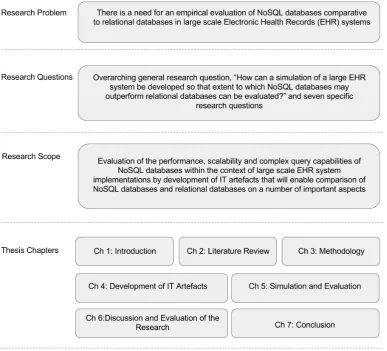
[image:18.595.125.513.314.665.2]This first chapter of the thesis provides the foundation for this research. First, the background and the motivation for undertaking this research are discussed. Then a description of the research problem is provided and the research questions that were investigated in this study are introduced. Next, the research paradigm and methodological approach that guided the conduct of this research are outlined. Finally, the scope and planned contributions of this research are presented, followed by a general outline of the thesis chapters. Figure 1.1 outlines the structure of this chapter.
Figure 1.1 Structure of Chapter 1
2 Electronic Health Record (EHR) systems and healthcare data sharing between healthcare providers remain a significant challenge for many countries, despite many developments in database technology and network infrastructure (Bacelar-Silva et al. 2011; Hoerbst et al. 2010; Pearce & Haikerwal 2010). Many countries such as Australia, Finland, Germany and Turkey are working on establishing nationwide e-health platforms that will facilitate data sharing. However, issues about data standards, scalability, high volumes of data storage, data processing and the cost of EHR system implementations are particularly challenging for governments and healthcare providers (Bacelar-Silva et al. 2011; Drejhammar 2010; Grimson 2001; Hoerbst et al. 2010; Jin, Deyu & Xianrong 2011; Pearce & Haikerwal 2010; Schmitt & Majchrzak 2012; Vest 2012).
Data intensive information systems such as healthcare systems require database management systems in order to function properly (Mengchen 2011; Vera et al. 2015). The size and heterogeneity of data stored and managed in modern distributed systems, including healthcare systems, are increasing exponentially (Floratou et al. 2012; Goli-Malekabadi, Sargolzaei-Javan & Akbari 2016; Lee, Tang & Choi 2013).
Most EHR systems are based on relational databases which struggle to accommodate the expanding size and evolving structure and use of healthcare data that requires data management systems that support scalability, high availability and data model flexibility which cannot be provided by relational databases (Blobel 2006; Dolin et al. 2006; Freire et al. 2016; Guo et al. 2004; Jin, Deyu & Xianrong 2011; Orfanidis, Bamidis & Eaglestone 2004; Schmitt & Majchrzak 2012). Furthermore, large scale EHR systems have significant potential for improving clinical decision support, population health management, discovering patterns and developing new treatments using efficient parallel data analytics over large volumes of healthcare data (Goli-Malekabadi, Sargolzaei-Javan & Akbari 2016; Hermon & Williams 2014). However, managing and analysing large scale healthcare data requires new data management tools and methods (Raghupathi & Raghupathi 2014; Sun & Reddy 2013)
3 new systems are referred to as “NoSQL” databases. While the name is not entirely agreed upon, NoSQL stands for “Not Only SQL” (Cattell 2011).
Relational database management systems have limitations due to scalability and infrastructure cost issues (Borkar, Carey & Li 2012; Cattell 2011). NoSQL database systems which have emerged in response to these limitations are mostly open-source and can run on commodity hardware architectures (Jin, Deyu & Xianrong 2011; Konishetty et al. 2012; Valduriez 2011). NoSQL database systems can scale horizontally with no single point of failure or bottlenecks because of a shared-nothing architecture (Borkar, Carey & Li 2012; Konishetty et al. 2012).
In a shared-nothing architecture, servers have their own resources, thus they do not share RAM, processor or storage capability (Borkar, Carey & Li 2012; Cattell 2011). This enables horizontal scaling, the distribution of data and processing operations over many servers to achieve large numbers of read/write operations per second (Cattell 2011).
NoSQL databases offer low-cost solutions that provide high availability and address scalability issues. NoSQL database systems have been heavily influenced by Google’s Bigtable and Amazon’s Dynamo systems and can easily scale up to accommodate large datasets (Borkar, Carey & Li 2012; Schram & Anderson 2012). Some NoSQL databases have been developed and used commercially by companies such as Google and Amazon. However, there are many open source NoSQL database systems based on similar approaches, including HBase, MongoDB, CouchDB, Cassandra, Couchbase, etc. (Schram & Anderson 2012).
4 Implementation of EHR systems in many countries are in progress. Countries such as Turkey, Australia, China and the UK are following an e-health transition strategy. The use of information systems in healthcare facilities is increasing as it is promoted by national strategies and working groups (Australian Digital Health Agency 2015; Nøhr et al. 2005). Increasing diffusion of information systems to deliver healthcare and the increasing size and heterogeneity of healthcare data has resulted in a bottleneck for storage, retrieval, high availability and analysis aspects of relational databases. NoSQL database systems might be the solution to this bottleneck (Jin, Deyu & Xianrong 2011; Schmitt & Majchrzak 2012).
While there are significant advantages in using NoSQL database systems, there is limited research which has compared the performance of NoSQL databases in terms of database operations (insert, update, delete), scalability and data analysis (complex querying) capability with relational database systems in a healthcare domain. There are numerous white papers, blog entries and comments mentioning the advantages of NoSQL database systems over relational databases. However, there are very few empirical studies that compare NoSQL database systems and relational database systems, particularly in the context of healthcare (Parker, Poe & Vrbsky 2013). Hence, there is a significant need to evaluate these different types of database systems (NoSQL versus relational) in a healthcare context.
1.3ResearchProblemandResearchQuestions
The identification of the gap in the literature provided the motivation for conducting this research. The research problem that was addressed in this PhD thesis can be defined as:
There is a need for an empirical evaluation of the performance of NoSQL document databases in terms of database operations, scalability, data sharing and data analysis aspects comparative to relational databases in large scale Electronic Health Records (EHR) systems based on a healthcare data model.
5 General RQ: How can a simulation of a large EHR system be developed so that the performance of NoSQL document databases comparative to relational databases can be evaluated?
In order to investigate this general research question, seven specific research questions are investigated to evaluate the feasibility of NoSQL document databases for managing distributed EHRs in an Australian healthcare context.
RQ1: How can a NoSQL document data model and a relational data model be developed for an EHR system that are in line with documents published by healthcare authorities in Australia?
RQ2: How can a random healthcare data generator be developed that will generate EHRs that are representative of the characteristics of Australian healthcare data based on statistics available in the public domain?
RQ3: How can a prototype EHR system be developed that will facilitate database operations and measure performance and scalability for NoSQL document databases and relational databases?
RQ4: How do NoSQL document databases perform compared to relational databases in executing basic database operations such as insert, delete and update on electronic health records?
RQ5: How do NoSQL document databases scale compared to relational databases in electronic health record systems?
RQ6: How do NoSQL document databases perform compared to relational databases in supporting electronic health record sharing through patient record retrieval in a distributed EHR system?
RQ7: How do NoSQL document databases perform compared to relational databases in executing complex queries on electronic health records?
1.4ResearchParadigmandMethodologicalApproach
6 scalability, data sharing and data analysis (complex querying) capabilities comparative to a relational database in the context of the healthcare domain using healthcare-specific data models and data characteristics. This performance evaluation of a NoSQL database in the healthcare domain is based on the development of IT artefacts that are specifically built for healthcare applications rather than using a generic performance-measurement approach.
Researchers in the Information Systems (IS) discipline have increasingly used Design Science Research (DSR) as an approach to understand and provide solutions to real world problems. Design Science Research is identified as a problem-solving paradigm, as opposed to a problem understanding paradigm. There has been a number of research projects based on a DSRM which consist of design and evaluation of artefacts to justify the contributions to theory and practice in the IS discipline (Hevner et al. 2004; Peffers et al. 2007). Since the purpose of this research project is to develop IT artefacts and evaluate these IT artefacts as a suggested solution to a particular IS problem, a Design Science Research (DSR) is an appropriate research paradigm and methodology for collecting data to answer the specific research questions framed by the research problem and main objectives of this study.
Hevner et al (2004) argue that the understanding of a problem domain and providing a real world solution can be achieved by designing, building and evaluating an artefact (Hevner et al. 2004). The term artefact is a broad term. IT artefacts are diverse, with many possible manifestations and forms and may be composed from hardware, software and process information based on predefined rules, logic, structures, routines and values embedded in them (Zhang, Scialdone & Ku 2011).
Although various steps for conducting Design Science Research have been suggested there are commonly-agreed steps such as identification of the problem, design of the artefacts and evaluation of artefacts as solutions to a specific problem (Alturki, Gable & Bandara 2011; Gregor & Jones 2007; Rossi & Sein 2003).
7
1.5ResearchDesignandScope
This research focuses on the evaluation of the performance of a NoSQL document database in terms of database operations, scalability and data analysis capabilities (complex querying) comparative to a relational database within the context of large scale EHR system implementations. This evaluation is achieved by development of IT artefacts that enable a performance evaluation of a NoSQL document database comparative to a relational database on a number of important data management aspects, namely, the performance of basic database operations (insert, update, delete, retrieval), scalability, data sharing and data analysis capabilities (complex querying). Previous empirical studies guided the performance comparison of a NoSQL document database with a relational database. The performance evaluation conducted in this study made use of commonly executed workload scenarios for evaluating database performance using the Yahoo Cloud Serving Benchmark (YCSB) tool (Cooper et al. 2010) that is discussed in detail in section 2.6.
In order for the performance evaluation of databases for a particular domain such as healthcare to be a realistic representation, it is required to establish a relevant data structure. The structure of the data for a specific domain such as healthcare can directly affect the overall performance of the underlying database. The required data sets and data elements of the required data structure are modelled across tables and fields for a relational database and the required data structure similarly determines the type of the NoSQL database to be used. Furthermore, the complexity of database operations and the overall database size are also directly determined by the required data structure (Nance et al. 2013; Swaroop & Vijit Gupta 2016). Therefore selecting data sets and data elements for performance comparison of a NoSQL document database with a relational database needed to be aligned with the context of the study, healthcare to achieve more accurate results.
8 elements in reality, the Australian National Health Data Dictionary establishes a sound basis for determining the minimum (basic) required data sets and elements to be stored in an EHR system (AIHW 2015).
Following the identification of the data elements of a data model for storing EHRs, healthcare statistics that represent the data characteristics for the Australian health system are identified, and provide the basis for populating an EHR data model with healthcare data.
After these steps, IT artefacts are developed that underpin the simulation of a large scale EHR system to enable the evaluation of NoSQL document databases in the healthcare domain comparative to relational databases in this research. These IT artefacts are a Random Healthcare Data Generator and prototype EHR system. The Random Healthcare Data Generator, provides simulated healthcare data that is representative of Australian healthcare data based on Australian healthcare statistics. The second artefact, the prototype EHR system, facilitated conducting tests for the evaluation of a NoSQL document database comparative to a relational database in a healthcare domain for a number of important database operations such as insert, update, delete of EHRs, scaling, EHR sharing and execution of complex database queries.
EHR sharing is one of the important aspects of EHR systems (Narayan, Gagne & Safavi-Naini 2010). Sharing EHRs between healthcare providers and a national EHR system has various challenges including authentication, security, and privacy concerns, however, from a technical and operational perspective, EHR sharing requires the retrieval of EHRs from the underlying source database in all cases whether it is a single database or a distributed multi-system architecture (Bergmann et al. 2007; Jin et al. 2009; Zhang & Liu 2010). In this research, the EHR sharing was limited in scope to the retrieval of EHRs of a particular person as a key operation that needs to be evaluated in terms of performance.
9 EHR sharing includes identification of EHRs (multiple records) of a particular person, retrieving these records, and -for the relational database- adding the corresponding values for the foreign key fields (joining the lookup tables) to make sure the output of the operation is an meaningful aggregation of multiple EHRs.
[image:26.595.112.526.213.467.2]The overall research design, research steps and their relationship with the research questions investigated in this study are presented in Figure 1.2.
Figure 1.2 Overview of the research activities undertaken in this research
The scope of this research is limited to seven research questions concerned with the development of specific IT artefacts which then enabled an evaluation of the performance, scalability, data sharing and analysis capabilities (complex querying) of a NoSQL document database comparative to a relational database in a specific healthcare domain. Related topics such as privacy, interoperability, encryption, standards, etc. are independent and comprehensive areas of research within the healthcare domain and are out of scope for the main objectives and specific research questions investigated in this research.
1.6PlannedResearchContributions
10 world problem (Hevner et al. 2004; Peffers et al. 2007). This research will contribute to theory and practice in a number of ways. Foremost, this research will address the gap in the literature by developing purpose-built IT artefacts and providing an empirical performance evaluation of database operations, scalability, data sharing and complex query capabilities of a NoSQL document database comparative to a relational database in a simulation of a large scale EHR system. This will contribute to design theory and knowledge by applying existing knowledge about NoSQL databases in a specific industry section, the healthcare domain, so that a number of artefacts can be built and evaluated to address a specific and important problem—data management in distributed EHR systems.
1.7OutlineoftheThesis
Following this introduction chapter, a comprehensive literature review is presented in Chapter 2. The previous literature on Electronic Health Records (EHR) systems and NoSQL databases was reviewed and identified the research problem and gap in the literature that is addressed by this study. The literature review is then used to frame the theoretical basis of this study. The scope and focus of this study is defined through an overarching general research question and seven specific research questions that were investigated.
Chapter 3 describes and justifies the choice of the research paradigm, Design Science, that in turn, guided the methodological approach used in this research. This chapter then discusses the steps taken to conduct this research using a Design Science Research Methodological approach and describes why this methodological approach is relevant and appropriate for this research. The research design and the steps undertaken in the design and evaluation of a number of IT artefacts are described and justified.
11 Then, the steps undertaken in the design and implementation of the Random Healthcare Data Generator and Electronic Health Record System Prototype artefacts are described.
Chapter 5 presents the results of the performance evaluation of a NoSQL document database comparative to a relational database in a distributed EHR system. Following the selection of a relational database and a NoSQL document database for the purpose of this research, the Random Healthcare Data Generator artefact is used to generate simulated healthcare records data and populate a NoSQL document data model and a relational data model. A prototype EHR system is used to conduct and measure the performance of various test scenarios. Then, the results of the test scenarios used to evaluate the performance of a NoSQL document database comparative to a relational database are presented.
In Chapter 6 the key findings regarding each of the seven research questions in relation to existing literature are discussed in turn. The development of the IT artefacts to enable the performance evaluation of the selected NoSQL document database and selected relational database in a simulation of a large scale EHR system are discussed in relation to research questions 1, 2, 3 and the existing literature. The detailed test results for the selected NoSQL document database and the selected relational database are discussed in relation to research questions 4, 5, 6 and 7 and the existing literature. This is followed by an evaluation of the research activity undertaken in this study using well-established design science assessment guidelines (Gill & Hevner 2013; Hevner et al. 2004).
In the last chapter of this PhD thesis, Chapter 7, the research problem and general research question that was addressed in this study is restated, and the overall study design and research activities undertaken to conduct this study are summarised. Then the key research findings of this study are summarised in relation to each of the research questions addressed in this study. Next, the key contributions of this study to theory and practice are discussed. Finally, the limitations of this study are acknowledged and suggestions are provided for future research that builds on this study.
12 In this section, the key terms that are used throughout this thesis are defined in terms of the context and scope of this research.
NoSQL: A new kind of database system that is emerged as a response to the need to overcome the limitations of relational databases mainly in terms of scalability and availability. The term is usually defined as an acronym for "Not Only SQL". (Cattell 2011).
NoSQL Document Database: A type of NoSQL database in which the data is stored as documents, mainly in a format like JSON.
Relational Database: Database systems store data in interrelated tables using normalisation which is introduced by Codd (1970).
Electronic Health Record (EHR): A digital record that holds the patient's healthcare-related data.
EHR System: The system that is responsible for managing EHRs for patients. In this research an EHR System refers to a large-scale, mainly national system that manages the collection and storage of EHRs for patients from birth to death.
EHR Sharing: It is one of the important features of EHR Systems that enables the sharing EHRs between an EHR system and healthcare providers. In the context of this research, the performance of EHR sharing is evaluated as a technical operation that involves the data retrieval of a patient’s EHRs for the purpose of simulating the sharing of EHRs in a large scale distributed EHR system.
1.9ChapterSummary
14
Chapter
2
‐
Literature
Review
2.1Introduction
This chapter provides an extensive overview of the relevant literature in order to demonstrate the gap in the literature and to provide the context and justification for the specific research problem being investigated. Then, the review of the literature provides a theoretical and conceptual foundation for this research, underpinning how this research can make a contribution to existing theory and practice. Figure 2.1 presents the structure of this chapter.
Figure 2.1 Structure of Chapter 2
15 managing distributed healthcare data sharing (Freire et al. 2016; Goli-Malekabadi, Sargolzaei-Javan & Akbari 2016).
In this chapter, concepts of Electronic Health Records (EHR) and NoSQL database systems are introduced and explained, as these technologies provide the foundation for the IT artefacts which are developed and evaluated in this study. Recent research on these types of systems is reviewed and the important roles that EHRs and NoSQL database systems can play in the healthcare systems are presented. Then, Consistency, Availability and Partition Tolerance (CAP) theorem is discussed in terms of NoSQL document databases in healthcare; and the evaluation of the performance of NoSQL document databases is discussed in terms of basic database operations, scalability, data sharing and complex query capabilities in a healthcare domain. Finally this chapter identifies the gap in the literature regarding the evaluation of the performance of NoSQL document databases in EHR systems and justifies how this gap in the literature will be addressed in an overarching research question and a specific set of research questions.
2.2ElectronicHealthRecords(EHR)
The practice of storing healthcare information electronically emerged several decades ago in the 1990s because paper-based records could no longer meet the requirements of an advanced health care system (van Ginneken 2002). Electronically stored healthcare information has been identified by a number of different names such as Electronic Patient Records (EPR), Computerised Patient Records, Electronic Medical Records and Electronic Health Records (EHR) (ISO 2011; Narayan, Gagne & Safavi-Naini 2010).
While these terms might sometimes be used interchangeably, the National Health Service (NHS) suggests that EPR is “the record of the periodic care provided mainly by one institution”. On the other hand, EHR is defined as the collection of a patient’s health and healthcare information, from birth to death. According to these definitions, EHR is described as a collection of EPRs for a single individual (NHS 1998).
16 processable form and, transmitted securely, accessible by multiple authorized users” (ISO 2004).
Based on these definitions, and in the context of this research, an electronic record that holds a patient’s lifetime health-related information will be referred to as an EHR; and systems that handle operations on EHRs will be referred to as EHR systems.
2.2.1EHRsystems
EHR systems play an important role in improving healthcare service delivery by increasing quality and effectiveness of health services (Narayan, Gagne & Safavi-Naini 2010; van der Linden et al. 2009). When EHR systems are implemented at the national level and facilitates accumulation of healthcare data, EHR systems through data sharing can enable enhanced decision-making by health practitioners and health managers—including identification of effective treatments and pattern analysis (Goli-Malekabadi, Sargolzaei-Javan & Akbari 2016; Kruse et al. 2016; Raghupathi & Raghupathi 2014). In order to establish a foundation for the many significant benefits that can be realised, EHR systems should be designed to handle increasing data volume and diversity and facilitate sharing of healthcare data (Goli-Malekabadi, Sargolzaei-Javan & Akbari 2016). Therefore, this research focuses on large scale EHR systems that can be comparable to a national system rather than a system for a single healthcare service provider, such as a single hospital.
Many countries have developed their own national EHR system architecture. For example, Turkey has a national system called “Saglik-NET” which collects and centrally stores a wide range of medical data (Dogac et al. 2011; Kose et al. 2008). In the Netherlands, the data is stored locally and a central system called a “National Switch Point (NSP)” handles the links to the data and allows access to information by various services in the health network (Bacelar-Silva et al. 2011). Austria and Germany are also establishing their own nationwide EHR systems (Hoerbst et al. 2010).
17 2.2.2EHRSystemsinAustralia
In Australia, there is a significant effort underway in establishing a Personally Controlled Electronic Health Record (PCEHR) system (Vest 2012). This system is now named as “My Health Record”. The Australian Digital Health Agency (ADHA) (previously known as The National E-Health Transition Authority (NEHTA)) is working on establishing governing standards for the My Health Record system. The Australian Digital Health Agency is responsible for digital health activities in Australia and also provides all stakeholders of digital health, including healthcare professionals, patients and implementers with relevant resources and information (Australian Digital Health Agency 2015).
Furthermore, as a part of its role, the Australian Digital Health Agency publishes documents guiding the community and software vendors on technical information for infrastructure, integration, and clinical document and messaging standards (Australian Digital Health Agency 2015; Pearce & Haikerwal 2010).
2.2.3ElectronicHealthRecordsharingfunctionalityinEHRsystems
The literature emphasises the importance of the information sharing function of an EHR system in improving healthcare outcomes. Iakovidis (1998) suggests that the purpose of an EHR system is to support continuity of care; and van der Linden et al. (2009) note that the primary purpose of an EHR system is the support of continuing, efficient and quality integrated health care. Narayan et al. (2010) suggest that a life-time health record system is established to keep track of all healthcare-related information of individuals from birth to death to allow efficient, consistent and universal sharing of health information. Previous studies also suggest that additional purposes of an EHR system include providing support in development of health policies, medical education and advanced research (Heard 2006; Iakovidis 1998; Murphy, Hanken & Waters 1999).
18 been a subject of previous research to explore the extent of its usefulness. (Ibrahim, Mahmood & Singhal 2016; Keller et al. 2015; Pussewalage & Oleshchuk 2016).
Therefore, EHR sharing has the potential for significantly improving healthcare outcomes both at the patient level and at the national level. Furthermore, EHR sharing enables a platform that would facilitate providing valuable information to inform healthcare policy, medical practice and training, and medical research. EHR sharing in this research is delimited in scope to EHR sharing through patient EHR retrieval in a large scale EHR system.
2.2.4ImportanceofEHRsystemsforHealthcare
According to the US Institute of Medicine, an EHR system improves patient safety, supports efficient patient care delivery and improves the efficiency of healthcare services (Englebardt & Nelson 2002; Kohn, Corrigan & Donaldson 2000). Schiff et al. (2003) note that patient safety and quality of healthcare can be increased by sharing EHRs amongst healthcare facilities.
Halamka et al (2005) demonstrated that an uncoordinated approach to managing medical records leads to a significant waste of time and medical errors. Previous literature suggests that implementing a fully-functioning national EHR system with the participation of all healthcare organisations could lead to a USD77.8 billion benefit for the United States (Halamka et al. 2005; Schiff et al. 2003; Walker et al. 2005; Yasnoff et al. 2004).
Brazil and Switzerland has adopted e-health strategies to facilitate interoperability and sharing of healthcare information across healthcare service providers inspired by the positive outcomes of the EHR system implementations of other countries to achieve better quality of care and greater efficiency (Chaim, Oliveira & Araújo 2017; De Pietro & Francetic 2017).
2.2.5TechnologicalissuesaffectingEHRsystems
19 There are a number of obstacles and challenges that exist in relation to establishing large scale national EHR systems described previously in the literature, such as standardisation of vocabulary, security, privacy and data quality (Gunter & Terry 2005). In addition to these matters which are extensively covered in various publications, Orfanidis, Bamidis and Eaglestone (2004) claim that the expanding size of healthcare data also creates an obstacle for EHR systems. Blobel (2006) suggests that an EHR system which allows the exchange of health information should be scalable, flexible and portable, with Internet access.
Patients’ records can contain different types of documents such as full-text reports, test results, images, prescriptions, etc. This heterogeneous nature of healthcare data, together with increasing size and the requirement of scalability for EHR systems, are also considered to be a major bottleneck for EHR system implementations. Most current EHR systems are based on relational databases which struggled to support unstructured data types (Dolin et al. 2006; Guo et al. 2005; Guo et al. 2004; Jin, Deyu & Xianrong 2011; Schmitt & Majchrzak 2012; Takeda et al. 2000).
Healthcare data is changing over time and the value that can be derived from an EHR system cannot be underestimated. Database systems used in healthcare should be able to support efficient parallel processing over large volumes of data to discover patterns, support decision-making, development of effective treatments and management of health policies (Goli-Malekabadi, Sargolzaei-Javan & Akbari 2016). Moreover, database systems should be flexible enough to adapt to the changing structure of healthcare data, provide high availability, and be easy to maintain in order to achieve a great range of benefits (Freire et al. 2016). These requirements cannot be fulfilled entirely by relational database systems and a new approach to data management should be considered in the healthcare domain to address the shortcomings of relational databases in relation to changing demands of healthcare data.
20 Raghupathi 2014). Existing literature demonstrates that rich healthcare data and EHR systems have significant potential for improving clinical decision support; and for improving population health management using vast data analytics (Hermon & Williams 2014; Raghupathi & Raghupathi 2014). However, it is difficult or impossible to manage and analyse large healthcare datasets with traditional or common data management tools and methods (Raghupathi & Raghupathi 2014; Sun & Reddy 2013).
Challenges and changing requirements for data management in general has led to the emergence of new forms of data-related systems to handle ‘big data’ in multiple aspects, including capturing, transformation, management, analysis and so on (MarkLogic 2014; Raghupathi & Raghupathi 2014; Stonebraker & Cattell 2011). A new category of non-relational databases, NoSQL databases, has emerged as a response to meeting big data management requirements (MarkLogic 2014; Mason 2015; Sadalage & Fowler 2012; Stonebraker & Cattell 2011).
2.3NoSQLdatabases
NoSQL is a term often used to describe the category of non-relational databases (Li & Manoharan 2013; Sadalage & Fowler 2012). A NoSQL database, also known as a distributed data store, is capable of scaling large datasets with no single point of failure (Ferreira, Calil & Mello 2013). Data may span server nodes, racks, and even multiple data centres. The emergence of NoSQL databases has been heavily influenced by a seminal whitepaper published by Google about its BigTable system and Amazon’s related system called Dynamo (Cattell 2011; Featherston 2010; Li & Manoharan 2013; Wu 2011).
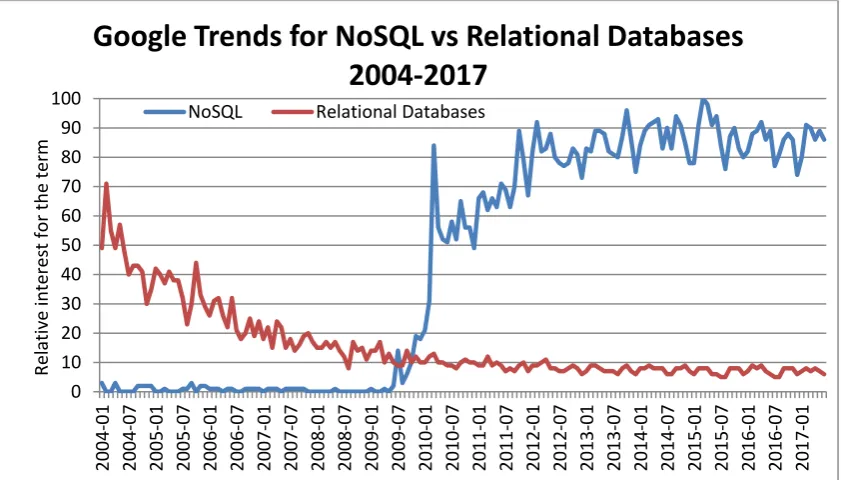
21 NoSQL database systems have attracted a lot of attention from industry and researchers due to the demand for distributed database systems capable of delivering high performance access to large volumes of data across geographical locations without requiring significant effort for scaling and tuning (Ferreira, Calil & Mello 2013). Figure 2.2 shows how NoSQL is trending in terms of attention in contrast to relational databases between 2004 and 2017, based on Google searches.
Figure 2.2: Google search trends NoSQL databases versus Relational Databases
2.3.1TypesofNoSQLdatabases
There were more than 200 NoSQL databases available as at December 2017. Based on the data model used, NoSQL databases can be grouped into four main categories: (1) Key-value store; (2) Document store; (3) Column-family, and (4) Graph database (Abramova & Bernardino 2013; Edlich 2017; Haseeb & Pattun 2017; Leavitt 2010; Yassien & Desouky 2016).
Although there are some other categories used for NoSQL database types such as multimodel, NoSQL databases mainly demonstrate characteristics of one or more of the four main categories listed above. Each NoSQL database type has its own data structure, strength, and typical use cases which are discussed in the following subsections. 0 10 20 30 40 50 60 70 80 90 100 20 04 ‐ 01 20 04 ‐ 07 20 05 ‐ 01 20 05 ‐ 07 20 06 ‐ 01 20 06 ‐ 07 20 07 ‐ 01 20 07 ‐ 07 20 08 ‐ 01 20 08 ‐ 07 20 09 ‐ 01 20 09 ‐ 07 20 10 ‐ 01 20 10 ‐ 07 20 11 ‐ 01 20 11 ‐ 07 20 12 ‐ 01 20 12 ‐ 07 20 13 ‐ 01 20 13 ‐ 07 20 14 ‐ 01 20 14 ‐ 07 20 15 ‐ 01 20 15 ‐ 07 20 16 ‐ 01 20 16 ‐ 07 20 17 ‐ 01 Relative interest for the term
Trends
for
NoSQL
vs
Relational
Databases
2004
‐
2017
22 2.3.1.1Key‐ValueStore
Figure 2.3: Key-Value Store representation (Adapted from Sadalage (2014)).
In key-value stores, all data is stored as key-value pairs, in which the keys are unique values that are used to access the information stored in values (Moniruzzaman & Hossain 2013; Sadalage & Fowler 2012; Sumbaly et al. 2012; Yassien & Desouky 2016). A key-value store is the simplest form of NoSQL databases to allow fast retrieval of values which can be a string, list or any other object. Redis, Amazon SimpleDB, Voldemort and DynamoDB are examples of key-value stores (Leavitt 2010; Moniruzzaman & Hossain 2013).
2.3.1.2DocumentStore
Figure 2.4: A sample representation of data stored in a document store (Adapted
23 Document stores are essentially similar to key-value stores. However, the values are usually documents in known formats such as XML or JSON. Documents (values) can be a structured or unstructured document, as well as de-normalised (aggregate) database entries. Document stores are also known as ’aggregate databases’. Contents of documents may vary between records. This allows flexibility for the types of data stored in document stores, a feature which has become increasingly important for healthcare data given its increasing volume and variety. Well-known examples of document stores are MongoDB and Couchbase (Abramova & Bernardino 2013; Dede et al. 2013; Li & Manoharan 2013; MarkLogic 2014; Moniruzzaman & Hossain 2013).
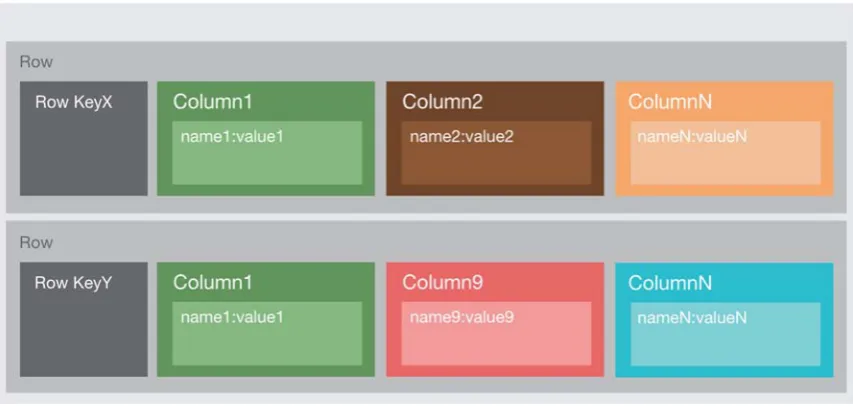
2.3.1.3ColumnFamily
[image:40.595.114.541.386.589.2]For the column family type of NoSQL databases, data is stored in columns, however the columns are not required to be defined at the beginning and there may be countless numbers of columns which may also be organized in groups called supercolumns (Leavitt 2010; Yassien & Desouky 2016).
Figure 2.5: A sample data structure representation of column family type of
NoSQL database (Adapted from Sadalage (2014)
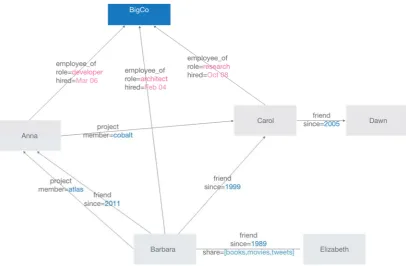
24 2.3.1.4GraphDatabases
Figure 2.6: Data structure representation for a graph database (Adapted from
Sadalage (2014)
Graph databases are examples of data stores that can store and handle graph type of data such as social network relations. Neo4j and InfoGrid are examples of graph databases (Abramova & Bernardino 2013; Moniruzzaman & Hossain 2013; Yassien & Desouky 2016).
25 NoSQL Database Type Typical Use Case Examples
Key-Value Real-time processing of
extremely large data, horizontal scalability, high reliability and high
availability, primary query mechanism is key-based lookup.
Session management, real-time bidding, online trading
Document Applications that need
flexible schema, semi-structured, nested hierarchical data
Healthcare records and derivative securities
Column Family Applications requiring flexible, evolving database schema, tolerance to network failure and temporary data inconsistency
Mixed content management, stock trading
Graph Applications with queries
that require graph traversals
Social media applications, recommendation engines
Table 2.1. Typical Use Cases and Example Applications for NoSQL database types (Adapted from (Gudivada, Rao & Raghavan 2016)
The data model and NoSQL database type that will be used for a particular system depends on the use case; and each of these NoSQL database types have their own characteristics, as summarised in Table 2.1. Therefore, it is essential to determine the most feasible data model and NoSQL database type for specific system applications. However, understanding the architecture of scalable databases and deciding the most suitable candidate database technology that satisfies the needs of an application is a challenging tasks due to the complexity of comparing different types of NoSQL databases (Gorton, Klein & Nurgaliev 2015). The data model and NoSQL database type considered to be most suitable for EHR systems are discussed in detail later in this chapter.
2.4TheoreticalBackground
26 activities undertaken in this study to build and evaluate artefacts to solve a real world problem.
2.4.1RelationalDatabaseTheory
The relational model and database theory known as a product of E.F. Codd has existed since the 1970s. Since then, the relational model has been adopted widely in industry and many of the current modern day commercial database systems are influenced by the work of Codd (Suciu 2001; Yassien & Desouky 2016). In database theory, Codd (1970) suggests that the data stored in large shared data banks can be defined and organised based on interrelationships of data, and redundancy and consistency problems can be eliminated by normalisation of data. Normalisation is a procedure for organising data into relational views, eliminating the need for copies of the same data and establishing a link between data groups using primary keys (Abiteboul, Hull & Vianu 1995; Codd 1970).
27 2.4.2AdvantagesofNoSQLdocumentdatabasesoverrelationaldatabases Database systems are crucial for all sorts of data-intensive applications which store and manage huge amounts of data. Modern applications such as high-traffic web sites or large enterprise systems require new approaches to data storage in order to achieve higher performance and higher availability than is possible with traditional relational database management systems (RDBMS). This is particularly the case when it involves high concurrent numbers of transactions and large amounts of data (Klein et al. 2014; Mengchen 2011; Parker, Poe & Vrbsky 2013). NoSQL databases have emerged as a response to this requirement and they have significant differences compared to relational databases, which are summarised in Table 2.2 below.
Relational Databases NoSQL Databases
Structured Semi- or Non-structured
Difficult and Manual Scaling Easy and Automatic Scaling
Share resources Shared-nothing
Possible Single Point of Failure High Availability
Strong Consistency Weak Consistency
Mostly Commercial, Expensive Many Open Source Alternatives
Table 2.2. Comparison of Key Differences between NoSQL Databases and Relational Databases
28 2.4.2.1Performance
One of the advantages of NoSQL databases is high performance in terms of higher number of operations per second and lower execution times of database operations. NoSQL databases can achieve higher performance than relational databases due to simpler and mostly de-normalised data structures and their distributed nature, and the performance difference can be significant in larger datasets depending on the use case (Aboutorabi et al. 2015; Freire et al. 2016).
2.4.2.2Scalability
A significant advantage of NoSQL databases is that they allow scaling up to large datasets without any changes in the overall structure of data model or architecture (Ferreira, Calil & Mello 2013). Hardware requirements and costs can grow in a linear manner as storage requirements grow. Therefore, cost-effective scaling up is made possible and high initial investment in hardware requirements is avoided (Lakshman & Malik 2010).
Relational database systems mostly rely on purchasing more expensive and powerful servers in order to increase capacity. In contrast, distributed data storage systems such as NoSQL database systems are based on a shared-nothing approach (Stonebraker & Cattell 2011). Capacity can be increased by adding more commodity servers dynamically. The redistribution of the data occurs on the fly and seamlessly without reconfiguration or a decrease in performance. This aspect is one of the most important advantages of NoSQL database systems over relational database systems (Pokorny 2011).
2.4.2.3HighAvailability
Furthermore, achieving high availability by maintaining a number of replications, enabling high performance on transactions using distributed algorithms is also another major advantage of distributed data storage systems such as NoSQL database systems have over relational database systems (Featherston 2010; Mengchen 2011). In order to achieve this, NoSQL database systems trade-off consistency for availability, an aspect which is discussed in more detail later in this chapter (Dede et al. 2013).
2.4.2.4FlexibleDataModel
29 each column. However, NoSQL databases have flexible data models where all types of structured, semi-structured and unstructured data can be stored and processed, which eliminates the requirement for a pre-defined data structure and schema. Therefore, NoSQL databases are often referred to as schema-less (Freire et al. 2016).
This feature gives the flexibility to handle the changing structure of the data stored in NoSQL databases, which is an important requirement for managing healthcare data. Changing requirements and improved technologies increasingly means different forms of healthcare data need to be stored; and any change in information requirements can be easily implemented without any changes in database structure in NoSQL databases (Goli-Malekabadi, Sargolzaei-Javan & Akbari 2016).
2.4.2.5OpenSourceAvailability
In addition to these advantages of NoSQL databases over relational databases, it is also important to note that there are many open source NoSQL database alternatives available in the marketplace. This may help in reducing the overall cost of implementation by achieving lower cost per terabyte and making customisation of a database system possible as open source NoSQL database solutions provide access to the source code (Leavitt 2010; Stonebraker & Cattell 2011).
2.4.3NoSQLDataModellingversusRelationalDataModelling
30 Figure 2.7. Comparison of NoSQL databases based on model complexity and
scalability (Adapted from Hsieh (2014)
Figure





Outline
Related documents
