COMPARATIVE EVALUATION OF DIMENSIONAL ACCURACY OF DENTAL CASTS OBTAINED FROM THREE PUTTY WASH
IMPRESSION TECHNIQUES AND MATRIX IMPRESSION TECHNIQUE - AN INVITRO STUDY
Dissertation submitted to
THE TAMIL NADU Dr. M.G.R. MEDICAL UNIVERSITY In partial fulfillment for the Degree of
MASTER OF DENTAL SURGERY
CERTIFICATE
Certified that the dissertation on ‘‘COMPARATIVE EVALUATION OF DIMENSIONAL ACCURACY OF DENTAL CASTS OBTAINED FROM THREE PUTTY WASH IMPRESSION TECHNIQUES AND MATRIX IMPRESSION TECHNIQUE - AN INVITRO STUDY” done by Dr.P.Ranjith Kumar, Postgraduate student (MDS), Branch VI Prosthetic Dentistry, Saveetha Dental College and Hospitals, submitted to The Tamil Nadu Dr.M.G.R. Medical
University in partial fulfillment for the M.D.S.degree examination in march
2006, is a bonafide dissertation work done under my guidance and
supervision.
Dr.R.Haribabu, MDS
Professor & Head of the Department,
Department of Prosthodontics,
CERTIFICATE
Certified that the dissertation on ‘‘COMPARATIVE EVALUATION OF DIMENSIONAL ACCURACY OF DENTAL CASTS OBTAINED FROM THREE PUTTY WASH IMPRESSION TECHNIQUES AND MATRIX IMPRESSION TECHNIQUE - AN INVITRO STUDY” done by Dr.P.Ranjith Kumar, Postgraduate student (MDS), Branch VI Prosthetic Dentistry, Saveetha Dental College and Hospitals, submitted to The Tamil Nadu Dr.M.G.R. Medical
University in partial fulfillment for the M.D.S.degree examination in march
2006, is a bonafide dissertation work.
Dr. A.Venkatesan, MDS
Principal,
ACKNOWLEDGEMENT
Firstly I express my gratitude to the Almighty God for His blessings in
making things right for me.
I wish to express my heartfelt thanks to Dr.R.Haribabu MDS,
Professor and Head of the Department of Prosthodontics, Saveetha Dental College and Hospitals, Chennai, for his sterling encouragement, valuable guidance and constant support throughout this study
I gratefully acknowledge Prof. Dr.M.F. Baig, Dean, Saveetha
Dental College, Dr.A.Venkatesan, Principal, Saveetha Dental College and Dr.N.M.Veeraiyan, Chancellor, Saveetha Institute of Medical and
Technical Sciences for giving me an opportunity to be a part of this esteemed institution.
I would like to extend my deepest gratitude and sincere thanks to
Dr.Vinaya Bhat MDS,DNB,. and Dr. Padma MDS for their keen
surveillance and unflinching support through out this study.
I would like to thank Dr.Dhanraj for his painstaking efforts in
helping me construct the text of my study.
My sincere thanks to Dr.Venkat Prasad, Dr.Saket, Dr.Abby Abraham, Dr.Mohamed Behanam, Dr.Jafar and Dr.Manimekalai for
I express my gratitude to Prof. Ravishankar, professor and Head
of the Department of Physics, Saveetha Engineering College, Chennai, for permitting me to utilize the facilities in his laboratory to conduct this study.
I thank Mr. A.K.Mathai, statistician for helping me meticulously
with the analysis of the statistical data.
I also express my sincere gratitude and indebtness to my respected teacher and erstwhile Head of Department of Prosthodontics,
Dr.R.Subramanian MDS, Saveetha Dental College and Hospitals,
Chennai, for his constant encouragement and continuous guidance through out the course.
I am extremely thankful to all my Batch-mates , Seniors, Juniors and friends who have been with me , advised me and encouraged me
through out the study .
I am also thankful to the non teaching staffs, who, from behind the
scene have helped me during the course.
I express my profound thanks to my parents who gave me the
CONTENTS
Sl
No.
Page
No.
1 Introduction
1
2
Review of Literature
4
3
Materials & Methods
44
4 Results
57
5 Discussion
67
6
Summary and Conclusion
76
INTRODUCTION
The fixed partial prosthodontics is one of the well developed and
well accepted treatment modalities in the field of Prosthodontics and their
success is immensely dependent on a multitude of factors involving a high
degree of precision in both clinical and laboratory procedures. Any
compromise in clinical and laboratorial protocols can seriously jeopardize
the outcome of a successful treatment.
After the completion of tooth preparation an accurate impression is
essential for fabrication of a precise fixed partial denture. Numerous studies
have been conducted to assess the efficacy of different impression materials
and various impression techniques that are widely used in contemporary
fixed prosthodontics. The researchers have claimed that despite tremendous
advances in the impression materials, the impression technique can alter the
reproduction of surface detail, there by influencing the final fit of the
restoration.25,50,51,56,66
Among the myriad of various impression materials, there is a wide
clinicians for accurate impression making. Several techniques have been
suggested to improve the accuracy of poly vinyl siloxane (PVS) impressions
among clinicians. The most commonly used putty-wash impression
techniques are - single step technique, putty-wash double stage technique
and putty wash double stage technique with polyethylene spacer.
Furthermore, the thickness of the wash material is an essential factor that
influences the accuracy of elastomeric materials.1,8,19,66
A new system of matrix impression technique using elastomers has
been reported in the literature62 which incorporates the attributes of
traditional methods and attempts to overcome the deficiencies of the older
systems. This system is reported to effectively control the four determinants
namely relapsing, retraction, displacement and collapsing that impact on the
gingiva during the critical phase of impression making when attempting to
register the sub-gingival margins.62
Though the putty-wash impression technique is
widely used for impression making, their modifications and variations play a
major role in their accuracy. Also the evolution of newer innovative
greatly demands the proper selection of an impression technique to achieve
clinical success. Hence the study was carried out,
1. to determine the accuracy of stone casts obtained from single stage
putty-wash, double stage putty-wash with polyethylene spacer,
double stage putty-wash with 2mm spacer and matrix impression
technique.
2. to compare the values and evaluate the amount of discrepancy
REVIEW OF LITERATURE
Fairhurst, C.W. et al (1956)1 studied the elastic behavior of rubber base
impression materials during the setting period at various time intervals. The
results showed that for most rubber base impression materials, the elastic
properties improved considerably when they were allowed to set longer than
recommended by the manufacturer. After proper setting, most of these
materials exhibited excellent elastic properties and stability during storage
for atleast twenty – four hours. Best accuracy in reproduction, particularly
over long spans was obtained by a technique utilizing an individual tray of
acrylic resin allowing 2 to 3 mm thickness of the impression materials.
Mitchell J.V., J.J. Damele (1970)2investigated the effects of the restrictive
influence of the impression trays upon distortion of 4 types of elastic
impression materials. The impression materials tested, included reversible
and irreversible hydrocolloids and two elastomeric materials (polysulfide
and silicone base). The distortion produced by shrinkage of elastic
the shrinkage of the impression towards attachment of the tray was a major
contributor.
Stackhouse J.A. (1970)3used a laboratory method to measure the accuracy
of stone dies made from four rubber base elastomers (One polysulfide and
three silicones) in three clinically simulated techniques and found out that
more uniform dies were produced from the silicone impression material than
from the polysulfide rubber impression material. Perforated tray technique
caused the stone dies to be undersized in diameter, but has less effect on die
length. Two techniques (relief area and simultaneous double mix) were not
significantly different from each other.
Fusayama T. et al (1974)4evaluated the accuracy of stone dies made from
the laminated single impression technique with silicone material. They
concluded that the laminated single impression techniques which is
clinically simple, was found to be capable of producing stone models having
Sawyer H.F. et al (1974)5 conducted a study to determine the comparative
accuracy of stone casts produced from eight different elastomeric impression
materials namely - one polysulfide, five silicones and two polyether
impression materials. Each impression was permitted to set for 15 minutes
without pressure at 38°C and was immediately poured in die stone, except
for polyether rubber for which pouring was delayed one week after the
impressions were made. The most accurate casts were produced from the
polyether impression elastomers and the next most accurate from the silicone
impression elastomers. The measurements of the casts produced from the
impression, poured one week later, varied slightly from those poured
immediately.
Stackhouse J.A. (1975)6 investigated various brands of elastic impression
materials and concluded when the die material was poured in 30 minutes,
there were no significant differences in accuracy among all of the elastomers
tested. The analysis also showed that the dies poured immediately from the
hydrocolloids did not differ significantly from those of the other materials
poured in 30 minutes. In general, the second and third generations of dies
obtained from the mercaptans and silicones were significantly different from
had changed more rapidly than the mercaptans, and with each type,
individual brands varied.
Reports of Councils and Bureaus (1977)7 revised American Dental
Association specification No.19 for non aqueous, elastomeric dental
impression materials.
Eames W.B. et al (1979)8conducted a study to determine the effect of bulk
on the accuracy of elastomeric impression materials. A stainless steel master
die representing a complete crown preparation with a 12-degree taper was
used. Impression trays were fabricated providing 2, 4 and 6mm spaces to
determine the stability and accuracy of nine elastomeric impression
materials. The results showed that the 2mm space produced the most
accurate impression for all of the materials tested.
Eames W.B. et al (1979)9 conducted a study to determine the accuracy and
dimensional stability of elastomeric impression materials. 20 impression
systems were used and found that the amount of contraction that all
the silicones demonstrated the greatest change. At 24 hours, stability ranged
from 0.18% to 0.84%. Polyethers and polysulfides were generally more
stable and silicones were least stable dimensionally. The new addition
reaction silicones, president and premagum exhibited the least change. They
were found to be statistically equivalent to the polyether materials.
Robert J. Luebke et al (1979)10 studied the effect of delayed and second
pour on accuracy of polysulfide, silicone and polyether impression material.
Results showed delay in time for pouring adversely affected silicone and
polysulfide impression material. Polyether showed no difference. All
materials did not differ from master die when poured within 15 mins.
Eames W.B. J.C. Sieweke (1980)11 investigated the feasibility of the putty –
wash system of impressions as an alternative to the custom made tray of
acrylic resin.
Yeh C.L. J.M. Powers, R.G. Craig (1980)12 conducted a study using
commercially available addition type silicone impression materials. These
properties. They concluded that these materials have low dimensional
change on setting, low creep, moderately short working time and are fairly
stiff at the time of removal from the mouth with moderately high resistance
to tear.
Brown David (1981)13 assessed the factors, which can influence the
accuracy and stability of elastomeric impression materials and the
impression procedures. The result showed that, polysulfide impression
materials had the greatest overall shrinkage, due to both thermal shrinkage
and polymerization shrinkage. The polyether impression materials showed
greatest thermal shrinkage but later when stored in damp condition, the
impression showed good accuracy.
The Type I (condensation silicone) impression materials showed
little shrinkage on storage. The author recommended the twin-mix
impression technique or two stages without spacer impression technique for
better results.
The Type II (addition silicone) was the most stable impression
material. The author advocated the twin-mix and two stages with spacer
Ciesco J.N. et al (1981)14 compared the accuracy and dimensional stability
of various elastomeric impression materials used in fixed prosthodontics.
Two techniques were evaluated and concluded that all impression materials
that were poured immediately and evaluated using a custom tray and
adhesive consistently demonstrated superior results in comparison to those
tested without the custom tray. Polyether material consistently yielded
superior result with or without a custom tray when compared to other
impression materials. The addition polymerization silicone ranked second,
followed by the lead cure polysulfide and the condensation polymerization
silicone respectively.
Lacy A.M. et al (1981)15 conducted a quantitative study to compare the
accuracy and dimensional stability of one polyether, four polysulfide rubber
and four polyvinylsiloxane (addition polymerization silicones). They
compared the rate and magnitude of change of die size obtained from
sequential pours of dental die stone in a given impression over a 4-day
period. They concluded that polyvinyl siloxanes (addition polymerization)
consistency were best maintained by use of custom tray and adhesives to
retain polyvinyl siloxanes.
Marcinak C.F., R.A. Draughn (1982)16 conducted a study on linear
dimensional changes in addition silicone impression materials. The
dimensional stability of the impression materials was evaluated by
measuring the size of a stone die produced from an impression of a master
model and comparing the die size with the master model. The impression of
the master model was stored for various periods prior to pouring. They
found that there was no consistent pattern of increase or decrease in die size
that occurred with time. Dies produced at 168th hour were as accurate as
those produced at 10 minutes.
Sandrik J.L., J.L. Vacco (1983)17determined the tensile properties of putty
and wash elastomeric impression materials and the strength of the bond
between these materials. The impression materials used were polysulfide,
condensation silicone and addition silicone. The results showed that
addition reaction silicone impression materials had the greatest bond
strength of these materials was found to be greater than the strength of the
adhesive bond of the elastomer to the impression tray. Also, the bond
strength of putty – wash elastomers was less than the tensile strength of the
respective components except for the addition reaction silicone materials.
Williams P.T, D.G. Jackson, W. Bergman (1984)18 evaluated the
dimensional stability of eleven commercially available impression materials
(three polysulfides, one condensation – cured silicone, one polyether and six
addition cured silicones) when poured immediately and after storage for 1, 4
and 24 hours. They found that the greatest accuracy occurred when the
impression were poured immediately. All the addition cured silicone
materials exhibited excellent dimensional stability for all storage times. The
condensation – cured silicone materials had good accuracy if poured
immediately.
Araujo P.A.D., K.D. Jorgensen (1985)19 determined the influence of the
bulk of elastomeric impression material and size of undercut on the
dimensions of stone dies. It was found that both conditions affect the
the impression material from 1 to 4mm caused a greater distortion than the
height increase of the undercut from 1 to 3mm.
Craig R.G. (1985)20 investigated to determine the validity of prescribed
advantages of automatic mixing system used for an addition silicone
impression material ; like simplicity, reduced bubbles in the mix resulting in
more precise impression, no spatulation and practically no wasted material.
The results showed that a uniform mixing of base and catalyst occurs with
the automatic system with one fourth to one fifth bubbles in the mix,
compared to mixes obtained by hand spatulation. It also simplifies mixing
and nearly eliminates the training of assistants in the mixing of rubber
impression materials. The automatic mixing system is economical as it
wastes only a third as much material as a typical hand dispensing and mixing
system. The properties and accuracy of the system are excellent and typical
of addition silicones, including excellent recovery from deformation, low
dimensional change on setting, and low flow. So the author concluded that a
wash or two phase impression technique may be used with equal clinical
Johnson G.H., R.G. Craig (1985)21compared the accuracy of four types of
elastomeric impression materials (addition silicones, condensation silicone,
polysulfide and polyether) by varying the die location, and time of pouring
and with a repeat pour of models. There was a little change in dimension
among abutment preparation for all materials, for all times of pour and with
a repeat pour of models. The addition silicone and condensation silicone
products demonstrated the best recovery from undercuts and least change in
dimension between an initial and second pour of an impression. The
addition silicone and polyether were the least affected with delays of 1, 4
and 24 hours in pouring the impression.
Stackhouse J.A. (1985)22 reported the relationship between the syringe – tip
diameter and the number and distribution of bubbles in extruded strips of
impression materials. Two medium viscosity polyvinyl-silicone elastomers
were used in the investigation. The results showed that there were
significantly fewer bubbles in impression material extrusions from the
second half of the syringeful, than from the first half. Also, the smaller tip
orifices, 0.6 and 0.67mm in diameter, caused significantly fewer bubbles in
Arauja P.A.D., K.D. Jorgensen (1986)23 studied the effect of reheating
addition reaction silicone impression on accuracy. The results revealed that
reheating the impression to mouth temperature before pouring the dies
improved their accuracy. The results also demonstrated that there was more
distortion with increasing thickness of impression material.
Drummond. J.L. R.G. Randolph (1986)24examined the variability of casts
from impression made with four impression materials by using a set of
master castings and varying the pour time of the impressions. The four one
phase impression materials were condensation silicone, addition silicone and
two polyethers. The study also indicated that by altering just one variable
i.e. the pour time from one hour to one week, a wide range of results were
obtained, some clinically acceptable and other clinically unacceptable.
Johnson G.H., R.G. Craig (1986)25 evaluated the three impression
technique (1. A putty – wash ; 2. A single mix impression and 3. A double
mix impression) for addition silicones and compared them with those of the
condensation silicone products. They also evaluated the effect of the tray
significant differences between types of silicone was that condensation
silicone produced significantly shorter dies (2.4% to 0.37%) than addition
silicones (0.08%). The same accuracy of impression was achieved for all
techniques when addition silicone was used, where as the putty – wash
technique produced the most accurate dies for the condensation silicones.
The custom trays produced dies that were more accurate in vertical
dimensions than the stock trays.
Tjan A.H.L. et al (1986)26 evaluated the accuracy of reversible
hydrocolloid, polysulfide, condensation silicone, polyether and addition
silicone and concluded that the elastomeric impression materials exhibited
comparable clinical accuracy when properly handled.
Johnson G.H , D.G Drennon (1987)27 evaluated the reproduction of fine
detail of elastomeric impression materials by using combination of
techniques. A subject was selected for ¾ and full crown preparation of two
posterior maxillary teeth. Identical custom impression trays were constructed
produced better detail than single mix. Heavy consistencies, rather than
medium, in combination with light – body resulted in better detail.
Schelb E. et al (1987)28 conducted a study to evaluate the compatibility of
five polyvinyl siloxane impression materials with ten modified type IV
dental stones. The polyvinyl siloxane impression materials which were used
demonstrated greater compatibility when tested with the commercially
modified dental stones. They suggested that before using a dental stone with
an impression material their compatibility should be determined and this
could be made easy if manufacturers of polyvinyl siloxane impression
material identify one or more dental stones that are compatible with their
products.
Bomberg T.J. et al (1988)29 determined the effect of some of the adhesion
factors of various combinations of trays and adhesive usage which included
the use or lack of use of liquid adhesive cement bonding in perforated and
non-perforated custom acrylic resin and stock impression trays. The results
showed that the most replicative impression and resultant die were found in
acrylic resin, stock non perforated and perforated impression trays, and with
mechanical retention in perforated custom acrylic resin and stock impression
trays. The putty-wash impression technique with full adhesive application
yielded poorer but similar results in stock perforated and non-perforated
trays, closely followed by the stock perforated tray with no adhesive
application. So the authors concluded that the results are enhanced, both in
accuracy and consistency, when the adhesive is used in a perforated tray
Johnson G.H, Drennon, L. Powell (1988)30 evaluated the accuracy and
surface quality of stone dies made from impression that had been placed in
disinfectants. Results indicated that selection of the type of impression
material is more important than selection of the disinfectant. Addition
silicone and polysulfide impression were disinfected without a loss in
accuracy, whereas polyether impressions were adversely affected.
Reitz C.D., N.P Clark (1988)31 found that the disadvantage of elastomers is
the setting inhibition caused by some brands of latex gloves. They are of
opinion that if putty system is used, gloves that do not interfere with setting
Chee W.W.L T.E. Donovan (1989)32 evaluated the fine detail reproduction
of ten commercially available very high viscosity polyvinyl siloxane
impression material using the American Dental Association specification no
19 stainless steel test die. They found out that the two of the material
consistently reproduced the 20 µm line. Three materials were able to
reproduce the 20 µm line 50% of the time. The remainder reproduced the 50
and 75 µm line consistently but were unable to reproduce the 20 µm line.
Cullen. D.R James L. Sandrik (1989)33 conducted the study to evaluate the
bond strength between the light body, heavy body and putty rubber base
impression materials. The author reported that, the bond strength of about
90psi was adequate. All the products showed good bond strength between
light body/heavy body and putty materials. The study showed that, chemical
bonding takes place between light body and previously cured putty material
and further bond failure that occurred was cohesive failure in the weaker
material.
Drennon D.G., G.H. Jonhson, G.L. Powell (1989)34 examined five
distortion of elastomeric impression materials and the associated improved
type IV gypsum casts. The results showed that the use of a spray
disinfectant will not appreciably alter the dimensional accuracy of improved
stone casts made within elastomeric impression. The most accurate stone
cast system was produced by addition silicone impressions disinfected by a
surface spray. It was also shown that four of the disinfectants applied by
spray atomization were effective in disinfecting the surface of an elastomeric
impression material with selected test organisms.
Chong Y.H et al (1990) 35examined the relationship between contact angles
of the die stone and voids in casts produced from five medium- viscosity
impression materials. Contact angles of a die stone material formed against
impression specimens made from polyether, addition and condensation
silicones were measured by reflex microscope. The results showed that the
contact angles of die stone obtained against the hydrophilic addition
silicones were intermediate between those of the polyether and other silicone
impression materials. The contact angle values correlated significantly with
the number of voids found at margins and line angles but not with those on
Craig R.G., N.J. Urquiola, C.C. Liu (1990)36 presented the quantitative
data for a comparison of some commonly marketed rubber impression
materials with some of the earlier products. The results showed that in
general, the qualities of addition silicones and polyethers were superior to
polysulfides and condensation silicones. So the author concluded that the
selection of a product for a particular application should be based on proper
data rather than on the type and class of rubber impression material.
Gordon G.H. Johnson, D.G. Drennon (1990)37 evaluated the accuracy of
reproduction of stone casts made from impressions using different tray and
impression material used were an acrylic resin, a thermoplastic and a plastic.
Impression were poured at one hour with a type IV dental stone. Results
indicated that the custom made trays of acrylic resin and the thermoplastic
material performed similarly regarding die accuracy and produced clinically
acceptable casts. The stock plastic tray consistently produced casts with
greater dimensional change than the two custom trays.
Marshak B., D. Assif, R. Pilo (1990)38 presented a technique to achieve an
provisional restorations in the arch as landmarks, stop and guiding plane.
This technique ensures exact reseating of the putty impression tray and
creation of a uniform wash space, which is essential for accurate result.
Saunders W.P et al (1990)39 investigated the accuracy of casts produced by
mixing dental stone with water at different temperatures. Consecutive
impressions of an acrylic resin model of the mandibular arch, on which the
occlusal surfaces of three teeth had been indented with reference points,
were made in poly(vinyl siloxane) impression materials using a one-stage
technique. After 1 hour these were cast in stones using water at temperatures
of 18 degrees C, 20 degrees C, or 24 degrees C. The distances between the
points were measured using a reflex microscope, and the difference between
each cast and the model was calculated. Analysis of variance of the mean
differences showed that there was no significant interaction between the
temperature of the water and the accuracy of casts.
Chai J.V., T.C Yeung (1991)40studied the wettability of eight nonaqueous
results showed that nonhydrophilic poly(vinyl siloxane) materials and the
poly(vinyl siloxane) putty were found to be significantly less wettable.
Chong Y.H., G Soh (1991)41investigated voids in impressions made by five
automixed addition silicone elastomers with and without intraoral delivery
tips. The results showed that there was no statistically significant difference
in the mean number of voids produced in each automixed silicone dispensed
with the use of intraoral delivery tips and the number of voids produced
without the use of the tips.
Dounies G.S., G.J. Ziebert, K.S. Dounis (1991)42 compared the
dimensional accuracy of the impression material in the production of
working casts in fixed prosthodontics. Prostheses were made on casts
constructed from three commonly used impression materials - Polyether,
polyvinyl siloxane (medium viscosity and putty-wash). Under the
conditions of this study, the following conclusions were drawn. The
polyether and addition silicone impression material were significantly more
dies for single restorations. However, all of the materials tested produced
clinically acceptable single crowns.
Panichuttre R. et al (1991)43 compared three hydrophilic poly
(vinylsiloxane) impression materials, containing an intrinsic surfactant with
a hydrophobic poly (vinyl siloxanes) and a polyether impression material.
The results showed that the hydrophobic poly (vinyl siloxane) material was
dimensionally more accurate than the hydrophilic poly (vinyl siloxanes) in
two of three measured dimensions, but the difference was small. The
polyether material was the most wettable, and the hydrophilic poly (vinyl
siloxanes). However, when a topical surfactant was used, difference in
wettability was noted between the hydrophilic and hydrophobic poly(vinyl
siloxanes), and their wettability was comparable to the polyether material,
indicating that the topical surfactant was more effective than the intrinsic
surfactants. Stone dies made from the hydrophobic poly(vinyl siloxane)
material were harder than those obtained from the other materials.
Peterson G.F., E. Asmussen (1991)44measured the distortion of impression
of material of high and low viscosity was measured on beam like specimens.
Significant differences between materials were observed. The phenomenon
may be explained by a swelling of the material of low viscosity. The
swelling may be associated with a diffusion of unreacted compounds from
the material of high viscosity into the material of low viscosity.
Measurements of the swelling of specimens immersed in the catalyst
component of unset material showed an increase in length of 2-5%.
Price R.B. et al (1991)45 determined the dimensional accuracy of dies made
using a combination of four impression material and three type IV die
stones. Impression of the metal master die were made using three different
automix addition reaction silicone impression material and one polyether
impression material. Results showed that all of the four stone dies are larger
than the metal dies. Although there were significant differences between
some of the impression material/ die stone combination, all of the stone dies
were measured to be within 9µm of each other.
Saunders W.P et al (1991)46 examined the accuracy of stone casts produced
been strengthened with autopolymerizing polymethyl methacrylate resin.
The impression material was a putty- wash polyvinyl siloxane material and
five impressions were made for each type of tray. The results of the study
showed that the design of tray, or the impression technique employed, has
little effect on the accuracy of impressions made with the polyvinyl siloxane
materials when used as a putty-wash and a two-stage technique, but accuracy
of the impression material within the bulk of the material was affected
adversely using a one-stage technique.
Schelb .E et al (1991)47 evaluated four polyvinyl siloxane impression
materials and 14 modified type IV dental stones for their abilities to
reproduce surface detail. Each combination of impression material and
dental stone was used to duplicate a 20µm wide line. The results showed that
the line was reproduced in all impression material specimens, but in only
32% of the stone cast specimens. Some combinations of impression
material/dental stone reproduced the line all or most of the time, but 12
Soh.G. Y.H. Chong (1991)48 investigated voids present in impressions of
five auto mixed addition silicone elastomers . Impressions were prepared
with putty body impression technique on stainless-steel cylinders with
acrylic spacers. The result showed that auto mixed materials generally
produced impressions with significantly fewer voids than the hand-mixed
material. So the authors concluded that auto mixing was effective in
reducing void defects in elastomeric impressions.
Wassell R.W., R.J. Ibbetson (1991)49assessed the influence of plastic stock
trays on the accuracy of impressions recorded with heavy light-body (HL)
and putty light-body (PL) wash impression techniques. Two brands of trays
were tested and the same trays were reinforced with acrylic resin. Individual
die accuracy and overall distortion of the resultant casts were assessed. PL
impressions in both stock trays gave undersized buccolingual dimensions at
the preparation finish lines whereas reinforcing the trays reduced this
distortion. Resultant overall cast distortion was reduced, but not eliminated,
Chee W.W.L., T.E. Donovan (1992)50 reviewed the composition, physical
properties, and manipulative variable of polyvinyl siloxane impression
materials and the authors recommended that for best results acrylic resin
custom trays should be used. The interaction of polyvinyl siloxane materials
with latex products was discussed and it was suggested to avoid this
interaction; And one of the disadvantages of the impression material is that
it has a relatively short working time. So, refrigerating the material will
increase working time without affecting accuracy.
Hung S.H et (1992)51 compared the accuracy of one step versus two step
putty-wash addition silicone impression techniques. Five addition silicone
impression materials were assessed by measuring six dimensions on stone
dies poured from impressions of the master model. They concluded that the
accuracy of the addition silicone impression material tested was affected
more by the material than by the techniques. The accuracy of the
putty-wash, one step techniques was not different from that of putty-wash two step
techniques except at one measurement, where the one step impression
Lim K.C. Y.H. Chong, G. Soh (1992)52 examined the voids produced in
impressions of an automixed addition – reaction silicone. Two operators
took the impressions using material dispensed from either intra oral tips or
an impression syringe. The material was also hand mixed for comparison.
The results showed that there were no differences in the number of voids in
the automixed material dispensed using the intra oral tip or impression
syringe. Automixing produced substantially fewer voids than hand mixing.
There was a significant difference in the number of voids in the impressions
made by the two operators.
Tjan A.H.L. et al (1992)53 assessed the effect of tray space on the
dimensional accuracy and stability of impression made from four brands of
monophasic polyvinyl siloxane impression material. They evaluated the
accuracy by a quantitative method i.e. by measuring the linear changes of
several critical dimensions of the recovered stone dies and also by a
qualitative method, i.e. by usual ranking based on the preciseness of the fit
of the master castings on the stone dies. They concluded that tray space, as
well as repeat pour at later time periods, did not affect the dimensional
accuracy and stability of impressions made from monophasic polyvinyl
appeared to suggest a potential problem for a fixed partial denture when
casted in one piece because of a significantly reduced distance between the
two abutments. From the findings of this study, it can be concluded that a
rigid stock tray can be used with monophasic polyvinyl siloxane impression
material.
Robinson P.R., S.M. Dunne, B.J. Millar (1994)54determined whether the
use of a topical surfactant (Hydrosystem) reduced the number of air bubbles
visible on the surface of polyvinyl siloxane impression and stone dies. The
results showed that the impressions exhibited a mean of 1.4 ± 2.1 bubbles
when Hydrosystem wetting agent was used, which was significantly less
than when it was not used (mean 5.5 ± 4.7 bubbles). Dies prepared with
Hydrosystem surfactant contained a mean of 0.4±0.8 bubbles, which was
significantly less than when Wax – Mate surface agent was used (mean
3.5±5.2). So the authors concluded that in vitro use of Hydrosystem
surfactant reduced the number of air bubbles on the surface of silicone
Takahashi H, W.J. Finger (1994)55 conducted a study to determine the
accuracy of the double mix impression relative to the time of placing the tray
impression material on preparations covered with medium viscosity
polyvinyl siloxane. Addition curing silicone impression materials having
different viscosities were used. The observed kinetics showed the possible
appearance of elastic characteristics of the syringed material before the tray
impression was placed. Accuracy of the impression was not statistically
different unless the setting reaction had progressed so that the consistencies
of both the syringe and the tray impression were high. These results
indicated that the double – mix impression were accurate independent of the
curing kinetics of the syringed material alone.
Idris B., F. Houston, N. Claffey (1995)56 compared the putty-wash one step
and two step techniques for making addition silicone impression and stated
that the differences in techniques were not considered to be clinically
important.
Millar B.J. et al (1995)57 compared the tear strengths of hydrophilic and
that the inclusion of intrinsic surfactant adversely affects the physical
properties of these materials. So the authors concluded that addition cured
silicone impression materials which showed lower advancing contact angles,
and are therefore more hydrophilic, have lower tear strengths.
Boulton J.L et al (1996)58 evaluated three elastomeric impression materials
which were used in custom and stock trays to determine the accuracy of
impressions taken from an experimental stainless steel model representing
premolar and molar bridge abutment preparations. The results of the study
demonstrated that polysulphide is the least accurate impression material for
both vertical and horizontal individual abutment dimensions. However, for
inter-abutment horizontal dimensions, no statistical differences were noted
between impression material types when using a custom tray. Stock trays
produced unreliable results for all the materials tested.
Laufer B.Z. et al (1996)59 compared the dimensional accuracy of Elite,
Examix and Express polyvinyl siloxanes, Permadyne polyether and
Permalastic polysulfide elastomeric impression material. These material
abutments with gingival sulci of various widths. No great differences could
be detected in the distortion of impression of an abutment with sulcular
widths greater than 0.2 mm when different impression materials were used.
Examix and Permadyne material gave the most consistent and accurate
impression with sulci narrower than 0.2mm. None of the impression
material used was suitable for sulci 0.05 mm wide because of high
prevalence of tears.
Millar B.J. S.M. Dunne, P.B. Robinson (1997)60 determined whether the
use of a surfactant designed for clinical use (Hydrosystem) reduced the
number of visible air bubbles on the surface of a range of impression
materials. The results showed that Hydrosystem surfactant significantly
reduced the number of surface voids when it was used with low-viscosity
addition-cured silicone material but not when used with irreversible
hydrocolloid, polysulfide, a hydroactive monophase addition-cured silicone,
or a putty-wash condensation silicone. So the use of Hydrosystem surfactant
Gus J Livadits (1998)63 compared the methods and effectiveness of four
main impression systems, copper tube/resin coping, syringe/tray, putty-wash
and matrix system. Several concepts were questioned and alternative
procedures were proposed to eliminate most of the unfavorable while
retaining the favorable points.
Millar B.J., S.M. Dunne, P.B. Robinson (1998)64 compared the number of
surface defects in addition-cured silicone impressions recorded with
monophase materials in stock trays and two-phase impressions in custom
trays. By counting the number of voids visible on the surface of impressions
recorded, showed that no significant differences were observed for number
of voids between the monophase materials or between the two-phase
systems. However, both two-phase materials in custom trays had
significantly fewer surface voids than the two-monophase materials used in
stock trays. So the authors concluded that monophase addition-cured
impression materials in stock trays carries an increased risk of void
formation on the surface of the impression when compared with two-phase
Mahony .A, P. Spencer, K. Williams (2000)65 determined the effect of
retraction cord medicaments (aluminum chloride, ferric sulfate, and ferric
subsulfate/ferric sulfate) on the dimensional accuracy and surface detail
reproduction of polyvinyl siloxane impressions. The results showed that the
medicaments did not significantly affect the dimensional accuracy; mean
shrinkage was within ADA guidelines in the treatment groups. All of the
medicaments had an adverse effect on surface detail reproduction. These
effects were statistically significant compared to the untreated control.
Nissan J. et al (2000)66 studied the accuracy of 3 putty wash impression
techniques using the same impression material (polyvinyl siloxane) in a
laboratory model. The 3 putty wash techniques used were 1 step (putty
wash impression material used simultaneously), 2step with 2mm relief and
2 step techniques with a polyethylene spacer. For each techniques, 15
impressions were made of a stainless steel master model that contained 3
complete crown abutment preparations, which were used as positive
controls. Accuracy was assessed by measuring 6 dimensions on stone dies
poured form impression of the master model and they concluded that the
polyvinyl siloxane 2 step, 2mm relief putty wash impression techniques was
Ragain J.C et al (2000)67 conducted a study to compare interfacial contact
angles, and die hardness for some combinations of elastomeric impression
and die materials. Representative polyvinyl siloxanes, polysulfide,
polyether, and reversible hydrocolloid impression material and type IV , type
V, and resin reinforced – type IV die materials were evaluated using a
factorial design. The results showed that for both contact angle and die
hardness, a statistically significant interaction between the impression and
die materials were found.
Dhiman R.K., S.K. Agarwal., R.C. Dhir (2001)68 compared the accuracy
of reproduction of addition silicone impression material (Reprosil) with
putty wash one step and two step techniques. The result showed that two
step techniques produced more accurate casts with less standard deviation. It
was also observed that in general, the material produced slightly larger casts
as compared to the master die.
Milward P.J, M.G. Waters (2001)69 evaluated the effect of disinfection
addition-polymerized silicone impression materials. Two disinfection
solutions (Actichlor and Perform) and one wetting agent (Vacufilm) were
used. The results showed that disinfection with Actichlor is recommended
in preference to Perform to maintain the wettability of impression materials.
Treatment with Vacufilm after disinfection is recommended to improve the
wettability of materials and thus reduce the likelihood of voids within casts.
Lepe X et al (2002)71 compared wettability, and mass change of various
recently introduced automixed low-viscosity addition silicone and polyether
materials before and after immersion for disinfection. The results showed
that the two polyether materials tested exhibiting significantly lower
advancing contact angle and reducing contact compared with the five
addition silicones higher. Polyether materials lost significantly more (0.6%
to 0.8%) and Aquasil LV (addition silicone) gained significantly more
(0.6%) mass in air.
Thongthammachat S. et al (2002)72 evaluated the influence on
dimensional accuracy of dental casts made with different with types of trays
results showed that accurate casts can be made with either stock trays or
custom trays. An impression made from polyether should be poured only
once and within 24 hours after impression making, because of the distortion
of the material over time. Silicone impression material has better
dimensional stability than polyether.
Johnson G.H. L. Lepe, T.C. Aw (2003)75 determined whether type of
material, viscosity selection, and presence of moisture affect detail
reproduction of elastomeric impressions. The results showed that single
viscosity systems reproduced the standard saw-tooth pattern better than the
dual viscosity systems, as did polyether impression materials compared to
addition silicones. Moisture led to a lower mean roughness or less detail
compared to dry conditions.
Ceyhan J.A , Johnson G.H (2003)76 compared the accuracy of working
dies made from impressions with metal and plastic trays, for 2 different
viscosities of impression tray material. The result showed that the
monophase material, when compared with the rigid impression material, was
not as accurate in the buccolingual. When a monophase impression material
was used, plastic trays yielded gypsum dies which were significantly smaller
than the ones generated from the metal trays.
Omar R , Abdullah M.A et al (2003)77 compared the accuracy of stone
models obtained from two-stage, pre-spaced putty/wash impressions under
conditions in which known volumes of wash material were introduced
during the second stage of the impression: It was concluded that putty recoil,
resulting from compression by excess wash material, plays a significant role
in the undersizing of working dies.
Abdelaziz K.M, Hassan A.M (2004)79 evaluated the reproducibility of
rubber impressions after sterilization by different methods. Dimensional
accuracy and wettability of two rubber impression materials (vinyl
polysiloxane and polyether) were evaluated after sterilization by each of
three well-known methods (immersion in 2% glutaraldehyde for 10 h,
autoclaving and microwave radiation). Non-sterilized impressions served as
control. The effect of the tray material on impression accuracy and the effect
that a) sterilization of rubber impressions made on acrylic trays was usually
associated with a degree of dimensional change; b) microwave energy seems
to be a suitable technique for sterilizing rubber impressions; c) topical
surfactant application helped restore wettability of sterilized impressions.
Lampe I , Morton S (2004)80 evaluated the effect of mixing technique on
shrinkage rate of one polyether and two polyvinyl siloxane impression
materials. Shrinkage rates of the same materials mixed using different
techniques were compared 30 minutes, 24 hours, and 72 hours after mixing.
The results showed that there was no significant difference in dimensional
changes when hand- and cartridge-mix techniques were compared at the
same measuring time for the tested polyvinyl siloxane materials. The
cartridge-mix technique for the polyether material showed significantly
higher shrinkage at 24 and 72 hours, while the mean shrinkage rate of all
materials showed a significant time-dependent increase.
Cho G.C , Chee W.W (2004)81 evaluated the rigidity and ability to resist
deformation of plastic stock trays and metal stock tray when used in
concluded that when disposable plastic stock trays were used, there was
distortion of the tray both across the arch and in cross section.
Shah S , Sundaram G et al (2004)82 compared the dimensional accuracy of
an impression technique using a polyether material (Impregum) and a vinyl
poly siloxane material (President) using a laser scanner with
three-dimensional superimpositional software and concluded that both impression
materials provided an accurate replica of the prepared teeth supporting the
view that these materials are highly accurate.
Chen S.Y, Liang W.M (2004)83 evaluated the effects of various impression
materials, different storage times and the proportion of inorganic filler on the
accuracy and stability of elastometric impression materials. The results
showed that there was a significant interaction effect between materials and
storage times on the accuracy of the impressions. Addition type silicone
materials had the greatest accuracy and stability and the alginate impression
material had the least accuracy. When the experimental material had a low
proportion of filler, there was a significantly greater dimensional
Wadhwani C.P , Johnson GH et al (2005)84 assessed the accuracy of
fast-setting elastomeric impression materials when disinfected with acid
glutaraldehyde. Measurements of the master model and working casts
included anteroposterior (AP) and cross-arch (CA) dimensions. A stainless
steel circular crown preparation incorporated within the master model was
measured in buccolingual (BL), mesiodistal (MD), and occlusogingival
(OG) dimensions and compared to measurements from recovered gypsum
dies. The result doesnot show any significant difference.
Forrester-Baker. L et al (2005)85 compared the dimensional accuracy
between three different addition cured silicone impression materials. Ten
impressions were made with each of three addition-cured silicone
impression materials. Comparison of the measurements indicated that the
mean dimension measured from the shoulder region for each group of
impression materials was significantly different from those taken from the
original metal abutment. However, when these impressions were cast in a
gypsum based die material, none of the measured dimensions taken from the
abutment. Thus, any change in measured dimensions occurring during
impression making, was compensated for in some way by the casting
process.
Samet N , Shohat M (2005)86 evaluated the quality of impressions sent to
commercial laboratories for the fabrication of fixed partial dentures by
describing the frequency of clinically detectable errors. The result showed
that impressions made with polyethers had the most detectable errors
followed by condensation-type silicones. The high frequency of detectable
MATERIALS AND METHODS
MATERIALS
• Metal master model
• Modelling wax ( manufacturer INDU)
• Auto polymerizing resin (DPI-RR cold cure)
- For custom tray construction
• Tray adhesive (3M ESPE)
• Impression materials
Addition polyvinyl siloxane impression materials from
IVOCLAR VIVADENT (fig.1) were used and the viscosities used were as
follows:
- VIRTUAL low viscosity ( cartridge form)
- VIRTUAL medium viscosity ( cartridge form)
- VIRTUAL high viscosity ( cartridge form)
- VIRTUAL bite registration ( cartridge form)
- VIRTUAL putty consistency
Armamentarium
• Polyethylene sheet
• Rubber bowl
• Dispensing cups
• Measuring jar
• Weighing machine
• Plaster spatula
• Mechanical vibrator (VIBRO C-70)
• Camel hair brush
• Straight fissure bur ( TC bur)
• Weswox High resolution Travelling microscope ( model HEL 7)
• Vernier calipers
• Ivansons calipers
• Williams probe
METHODOLOGY EMPLOYED IN THE STUDY
(I)
PREPARATION OF MASTER MODEL
A metal master model (fig.2), comprising two fixed partial denture
(FPD) abutment preparations (α and β) were fabricated by “Turning
procedure” for making the measurements in this study. The abutments were
prepared with a taper of 6 degrees. The metallic model consists of a
horizontal platform with a height of 10mm in which a groove of 2mm depth
on one side and two depressions on the other side were made for the
orientation of the tray during impression making. The metallic dies
simulating the abutment preparations (α and β) were mounted on the base
with the help of screws attached from underside of the platform. They were
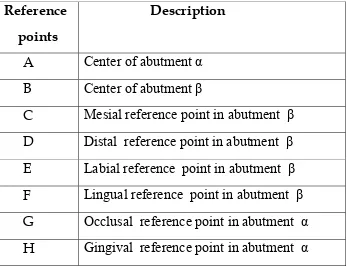
of 10 mm height and 6mm and 10mm in width respectively. Three reference
markers in the form of depressions were made on the surface of abutment α,
one in the center of occlusal surface and other two on the lateral surface
which are approximately 2mm and 6mm from the occlusal surface. These
two points were used to measure variation in the occluso-gingival direction
if any.
Similarly five reference markers were made on the occlusal
of mesial, distal, labial and lingual aspects of occlusal surface. These points
were used to measure variation in mesio-distal and labio-lingual direction if
any. Metal coping of 2mm thickness throughout were fabricated to fit
[image:53.612.134.481.265.533.2]precisely on both abutment preparations.
TABLE 1: Description of reference points
Reference points
Description
A Center of abutment α
B Center of abutment β
C Mesial reference point in abutment β
D Distal reference point in abutment β
E Labial reference point in abutment β
F Lingual reference point in abutment β
G Occlusal reference point in abutment α
(II)
FABRICATION OF IMPRESSION TRAYS
(fig.3)Forty, identical rigid custom impression tray with uniform
thickness of 2mm were fabricated using auto polymerizing acrylic resin,
which could be placed on to the platform of the metallic model accurately
with the help of grooves and depressions engraved on the horizontal
platform for the purpose of orientation, thus preventing the rotation of the
tray. Initially modelling wax of 3mm thickness was adapted to the model.
Tissue stops were created mesial and distal to the abutment.
Polyvinylsiloxane impression was made from the master model along with
the wax spacer and casts were poured with type III dental stone and
obtained. This stone cast was used to fabricate 40 identical rigid custom
trays with uniform thickness of 2mm using auto polymerizing resin. This
ensured that the internal dimensions of all the trays remained the same, thus
(III) SEGREGATION OF THE IMPRESSION TECHNIQUES
The final impressions to be made with silicone elastomers were
segregated into 4 groups viz
Group I: Single stage technique in which putty and wash impression
materials were used simultaneously and the casts obtained from them were
segregated as group I casts.70 (fig.4 & 5)
Group II: Double stage technique in which a polyethylene spacer was used
with putty impression first and followed by the wash impression after
removal of the polyethylene spacer. The casts obtained from them were
segregated as group II casts.70 (fig.6 & 7)
Group III: Double stage technique in which 2 mm coping covering the
abutments was used with the putty first to make a preliminary impression, so
that a uniform 2 mm space is created and then followed by wash impression.
The casts obtained from them were segregated as group III casts. (fig.8 & 9)
Group IV: Matrix impression technique in which an occlusal registration
material and picked up using an impression tray filled with medium
viscosity impression material. The cast obtained from them were group IV.62
(fig.10& 11)
The tray adhesive was coated on the internal surface of the tray
and air dried for 5 minutes before making the impressions. The use of tray
adhesive enhance the results both in accuracy and consistency.29, 15
DESCRIPTION OF IMPRESSION TECHNIQUES
GROUP I IMPRESSIONS (fig.4)
Equal amount of putty base and catalyst were hand mixed
without gloves because some brands of latex gloves cause the setting
inhibition of elastomers50 and loaded on to the perforated custom tray.
Simultaneously, the light body (Virtual) impression material was injected
over the abutments with an automatic mixing syringe with a tip attached to
it. A mechanical mixing system was used because of its simplicity, reduced
bubbles in the mix resulting in more precise impressions, no spatulation and
tray loaded with putty material was seated on to the abutments and was held
in place for 8 minutes for the material to set.
GROUP II IMPRESSIONS (fig.6)
Initially impression was made in the putty material with the
polyethylene spacer on the master model. The impression was allowed to
set for 5 minutes. Once the impression was set, the spacer was removed and
the final (light body) impression material was injected over the abutments
and the tray was reseated over the master model accurately. The tray was
held in place allowing the material to set for 8 minutes.
GROUP III IMPRESSIONS (fig.8)
Initially impression was made in the putty material with 2mm
copings on the abutment preparations. After the putty material was set, the
copings were removed and the final (light body) impression material was
injected over the abutments and the tray was reseated over the master model
accurately and the material was allowed to set for 8 mins. The light body
material occupies the space of 2mm all around, created by removing the
GROUP IV IMPRESSIONS (fig.10)
Initially impression was made with the occlusal registration
material on the abutment preparations using a carrier (pre-made with
vaccum-forming equipment). Occlusal registration material was used
because of its semi rigidity and superior stability. The carrier should provide
at least 2-3mm of space between its walls and the abutment. It was allowed
to set for 5 mins. Matrix was then removed from the carrier and scalpel was
used to trim the matrix till the finish line margin. Then the final (heavy
body) impression material was injected over the abutments and the matrix
was reseated over the master model. Immediately medium viscosity
impression material was loaded in an impression tray and seated over the
matrix and allowed to set for 8 minutes.62
(IV)
PREPARATION OF THE MASTER CAST
After the impressions were completed, they were stored at room
temperature for 30 minutes before being poured. All the impressions were
sprayed with surfactant and blow dried as it reduces the surface tension of
the elastomers and results in void free casts.60
Then 12 ml of distilled water was dispensed in the jar of vacuum
mixer and 50 g of improved dental stone (type IV) was sifted gradually in to
the water and allowed to soak for 30 seconds. Type IV die stone was used
because it has a minimal linear setting expansion of 0.1 percent. Later the
stone was mechanically mixed under vacuum for 30 seconds. The small
increments of the stone mix were placed in the impression which was placed
on the vibrator by using the camel hair brush from one end of the
impression. The stone mix was directed in to the prepared abutment
impression with the help of a probe and extreme caution was observed to
avoid entrapment of the air bubbles. After pouring the casts, the stone was
The obtained casts were checked for voids and the defective casts
were discarded. Each cast was trimmed and labeled according to the group.
10 such impressions were made for each group and the casts were poured to
[image:60.612.124.492.279.418.2]obtain the master casts.
TABLE 2: Description of locations measured
Location Description
(V) Measurement of dimensional accuracy
The dimensional accuracy of the impressions was determined
directly by measuring the die by non-contact method using Weswox high
resolution travelling microscope (fig.12). It had a least count i.e. minimum
possible distance measured by the device was 0.001 cm so that it has the
accuracy of 0.001 centimeter. The magnification produced by the
microscope was 25 times of its original image.
The measurement was done by focusing the entire distance i.e.
from one point to the opposing point to be measured. Here In-focus
technique was used to avoid parallax error. To determine the accuracy at
each site, the surface to be measured was focused till the point was clearly
appreciable. The marker on the magnifying lens was aligned at the center of
one point and the tightening screws were tightened so that it does not move
while recording the main scale reading(MSR) no.1 and Vernier scale count
(VSC) no.1. The vertical arm of the microscope was then moved laterally till
the marker on the magnifying lens is at the center of the opposing point and
screw tightened and the main scale reading no.2 and vernier scale count no.2
Vernier scale reading (VSR) no.1 was obtained by multiplying
VSC no.1 and least count (LC), that is, the least count the microscope can
measure, which is constant at 0.001cm. VSR=VSC x LC. From this correct
reading (CR) for reading no.1 can be calculated by using the formulae CR =
MSR + VSR. Likewise correct reading (CR) for reading no.2 was calculated.
Finally the distance between the two points was obtained by subtracting CR
no.1 and CR no.2. For example to measure the distance between point A and
point B, that is, the inter abutment distance, the CR of point A and B were
determined respectively first and their difference gives the correct distance
between them.
In the same way mesio-distal, labio-lingual and occluso-gingival
dimensions were calculated for each die and the standard metal master
model. The readings obtained were tabulated according to groups and this
RESULTS
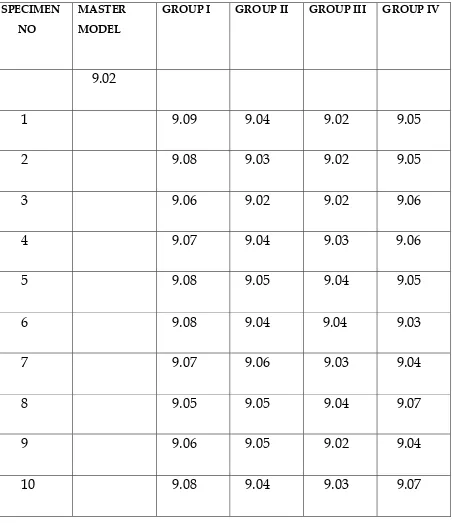
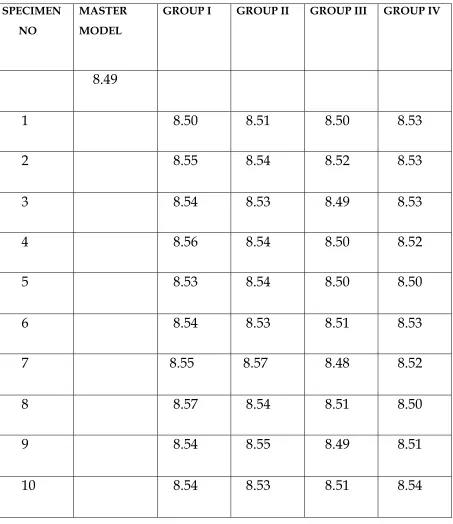
The aim of the study was to compare the accuracy of stone casts obtained from single stage putty-wash, double stage putty-wash with
polyethylene spacer, double stage putty-wash with 2mm spacer and matrix
impression technique.
The impressions made by single stage putty-wash technique were
considered as group I impressions, double stage using polyethylene spacer as
group II impressions, using 2mm coping as group III impressions and matrix
impression technique as group IV impressions.
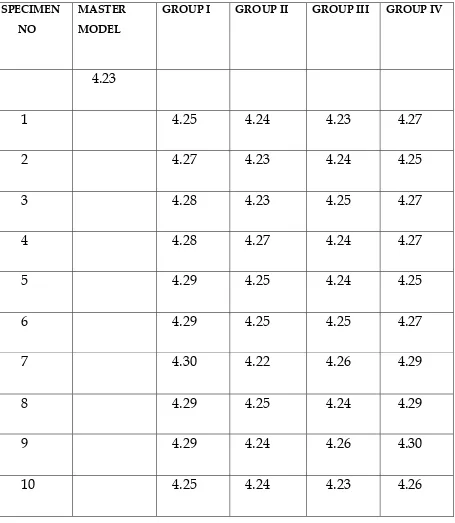
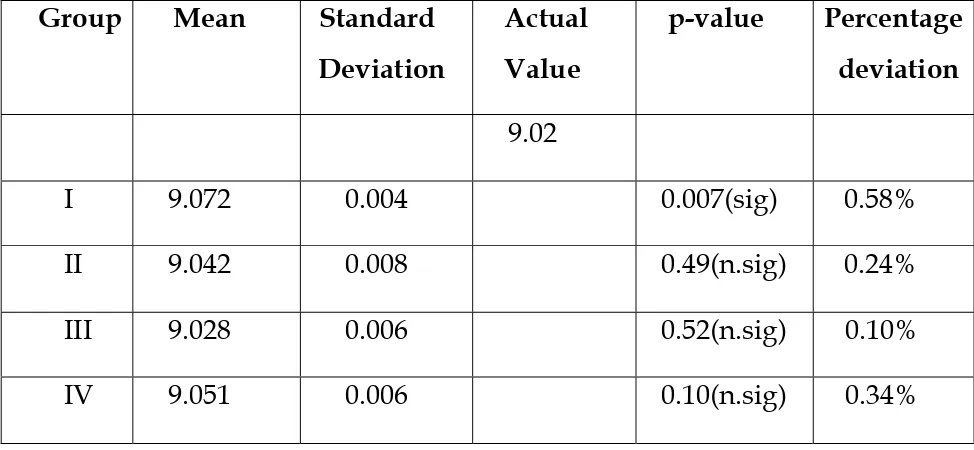
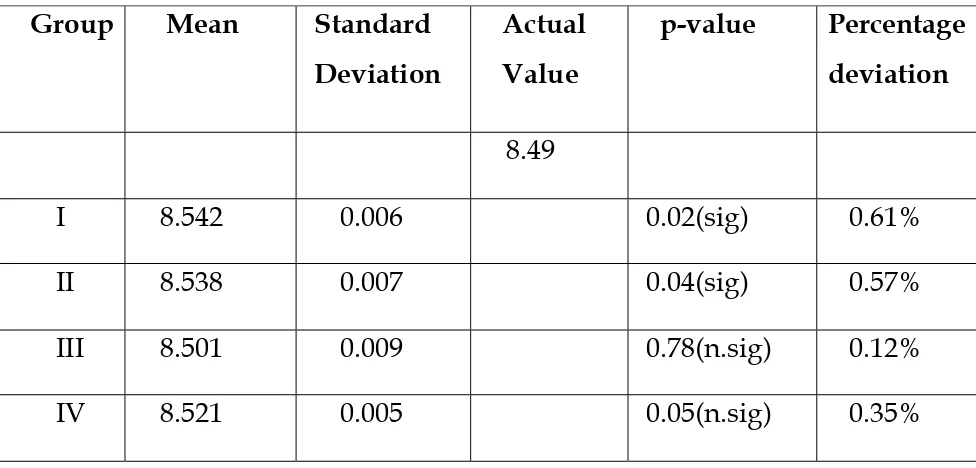
10 impressions were made in each group and the casts
obtained from them were considered as group I, II, III, IV casts respectively.
The dimensional changes of the casts obtained from the
various impression techniques were measured and analysed using Weswox
High resolution Travelling microscope ( model HEL 7). Each measurement
was analyzed 3 times by the same operator; the mean was calculated,
standard deviation were calculated for each group and differences. Their
level of significance is calculated by one sample t-test and One-way analysis
of variance (ANOVA) followed by multiple range test by Tukey-HSD
procedure was used for multiple group comparison.
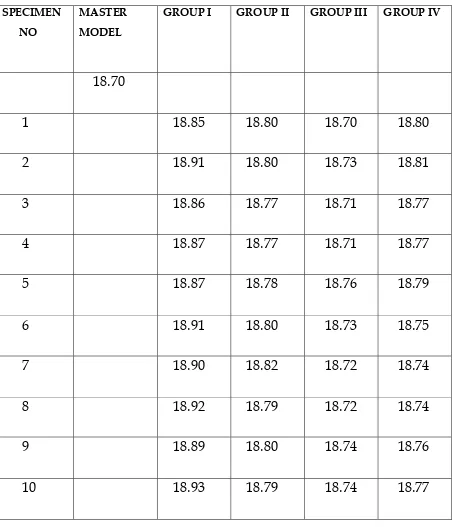
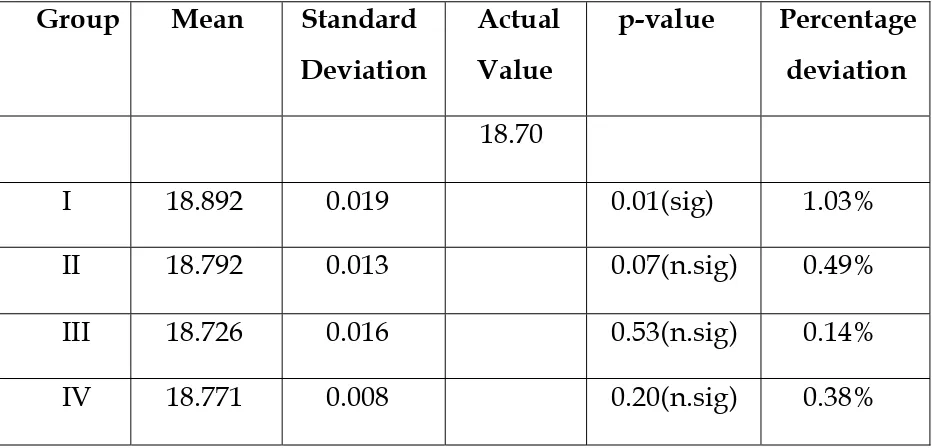
TABLE-3:shows the measurement of inter abutment distance (AB) between master model and different groups. (In millimeters)
SPECIMEN NO
MASTER MODEL
GROUP I GROUP II GROUP III GROUP IV
18.70
1 18.85 18.80 18.70 18.80
2 18.91 18.80 18.73 18.81
3 18.86 18.77 18.71 18.77
4 18.87 18.77 18.71 18.77
5 18.87 18.78 18.76 18.79
6 18.91 18.80 18.73 18.75
7 18.90 18.82 18.72 18.74
8 18.92 18.79 18.72 18.74
9 18.89 18.80 18.74 18.76