To Evaluate the Efficiency of the Specific Plyometric
Training Programme for Increasing Accelerations
Power in High Jump and Long Jump Players
Dissertation
Submitted To
The Tamilnadu Dr. MGR Medical University
In partial fulfillment for the degree ofMASTER OF PHYSIOTHERAPY
(Advanced PT in Sports Physiotherapy)
Cherraan’s College of Physiotherapy
Cherraan’s Institute of Health Sciences Coimbatore, Tamilnadu, India
D
D
e
e
d
d
i
i
c
c
a
a
t
t
e
e
d
d
t
t
o
o
M
M
y
y
B
B
e
e
l
l
o
o
v
v
e
e
d
d
P
P
a
a
r
r
e
e
n
n
t
t
s
s
,
,
T
C
CERTIFICATE
The work embodied in the thesis entitled “To Evaluate the Efficiency of the Specific Plyometric Training Programme for Increasing
Accelerations Power in High Jump and Long Jump Players” submitted to the The Tamilnadu Dr. MGR Medical University, Chennai in partial fulfillment for the degree of Master of Physiotherapy [Advanced PT in Sports Physiotherapy], was carried out by candidate bearing register number
27103014 at Cherraan’s College of Physiotherapy, Coimbatore under my supervision. This is an original work done by him and has not been submitted in part or full for any other degree/diploma at this or any other university/institute. The thesis is fit to be considered for evaluation for award of the degree of Master of Physiotherapy.
……… ………
Signature of Supervisor Principal
Prof. Kamal Janakiraman MPT (Ph.D) Prof. Kamal Janakiraman MPT (Ph.D)
Date: ……..………… Date: ……..…………
……… ………
Internal Examiner External Examiner
D
DECLARATION
The work embodied in the thesis entitled “To Evaluate the efficiency of the specific plyometric training programme for increasing accelerations
power in high jump and long jump players”submitted to The Tamilnadu Dr. MGR Medical University, Chennai, in partial fulfillment for the degree of
Master of Physiotherapy [Advanced PT in Sports Physiotherapy], was the original work carried out by me and has not been submitted in part or full for any other degree/diploma at this or any other university/institute. All the ideas and references have been duly acknowledged.
……… ………
Signature of Supervisor Signature of Student
Prof. Kamal Janakiraman M.PT (Ph.D.)
Principal
A
ACKNOWLEDGEMENT
I kneel down to the Lord Almighty, the foundation of knowledge and wisdom whose pure love and grace enabled me to achieve my target.
I proudly express my deep sense of gratitude and indebtedness to Prof.KamalJanakiraman MPT (Ph.D), Principal of Cherraan’s College of Physiotherapy & my study guide for his excellent suggestions, valuable guidance, and constant encouragement throughout this study.
I express my sincere thanks to Mrs.Selvarani M.P.T, Mrs.Sheeba Francino M.P.T, Mr.Karthik M.P.T, Mr.Gopinath M.P.T, Mrs. Jency
Thangasheela M.P.T Lectures, and Cherraan’s college of physiotherapy for her encouragement, guidance and support to pursue this study.
I express my sincere thanks to athletes, Coaches and athletes trainer
for their co-operation.
Above all the investigator owes her success to Lord Almighty.
T
TABLE OF CONTENTS
• To Evaluate the Efficiency of the Specific Plyometric Training
Programme for Increasing Accelerations Power in High Jump and Long Jump Players
• Certificate
• Declaration by the student
• Acknowledgement
• Abstract
S.No Chapter Page No.
1 INTRODUCTION 1
Statement of the Problem 2
Significance of the Study 2
Aim and Objectives of the Study 3
Hypothesis 3
2 REVIEW OF LITERATURE 5
Neuro muscular principle 5
Plyometric exercise phases 8
Pre - plyometric considerations 8 Plyometric Program consideration 10
Plyometric program design 11
Equipment used for plyometric exercises 13 Precautions and contraindications of plyometric 13
3 MATERIAL AND METHODS 16
Research Design 16
Setting 16
Sampling 16
Procedure 17
Evaluation of parameters 17
Sergeant jump 17
Standing broad jump 17
Program Schedule 17
Protocol 21
4 DATA ANALYSIS AND RESULTS 32
5 DISCUSSION 52
6 LIMITATIONS AND RECOMMENDATIONS 53
7 CONCLUSION 54
9 BIBLIOGRAPHY 55
L
L
i
i
s
s
t
t
o
o
f
f
T
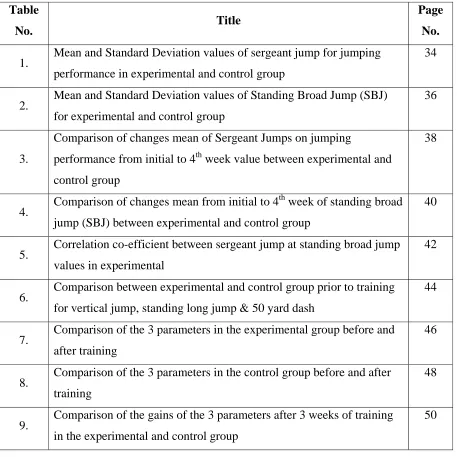
LIST OF TABLES
Table
No. Title
Page
No.
1. Mean and Standard Deviation values of sergeant jump for jumping performance in experimental and control group
34
2. Mean and Standard Deviation values of Standing Broad Jump (SBJ) for experimental and control group
36
3.
Comparison of changes mean of Sergeant Jumps on jumping
performance from initial to 4th week value between experimental and control group
38
4. Comparison of changes mean from initial to 4
th
week of standing broad jump (SBJ) between experimental and control group
40
5. Correlation co-efficient between sergeant jump at standing broad jump values in experimental
42
6. Comparison between experimental and control group prior to training for vertical jump, standing long jump & 50 yard dash
44
7. Comparison of the 3 parameters in the experimental group before and after training
46
8. Comparison of the 3 parameters in the control group before and after training
48
9. Comparison of the gains of the 3 parameters after 3 weeks of training in the experimental and control group
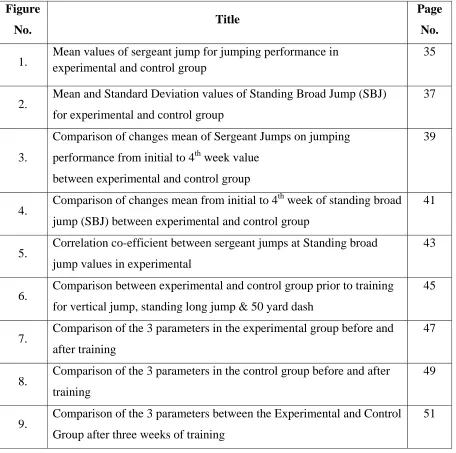
[image:13.612.80.537.108.565.2]LIST OF FIGURES
Figure
No. Title
Page
No.
1. Mean values of sergeant jump for jumping performance in experimental and control group 35
2. Mean and Standard Deviation values of Standing Broad Jump (SBJ) for experimental and control group
37
3.
Comparison of changes mean of Sergeant Jumps on jumping performance from initial to 4th week value
between experimental and control group
39
4. Comparison of changes mean from initial to 4
th
week of standing broad jump (SBJ) between experimental and control group
41
5. Correlation co-efficient between sergeant jumps at Standing broad jump values in experimental
43
6. Comparison between experimental and control group prior to training for vertical jump, standing long jump & 50 yard dash
45
7. Comparison of the 3 parameters in the experimental group before and after training
47
8. Comparison of the 3 parameters in the control group before and after training
49
9. Comparison of the 3 parameters between the Experimental and Control Group after three weeks of training
A
ABSTRACT
Title:
Analyzing the study to evaluate the efficiency of the specific plyometric training programme for increasing accelerations power in high jump and long jump players.
Objective:
To compare the effect of plyometric training by increase on jumping performance of sergeant jump and standing broad jump.
Background:
Many athletes and coaches have reported that the specific plyometric training on high jump shows more power and strength output then in long jump players. This study focuses on the effectiveness in the high jump players,
Methods & Measures:
Total 40 subjects were selected for this entire study and they were randomly allotted into the experimental group and control group consisting 20 subjects in each group.
Results:
In this study, the results showed a significant increase in jumping performance in the experimental group.
This improvement is due to the elastic energy storage and release, as appears the results from the changes in the level of neuromuscular activation and motor coordination, in response to plyometric training.
Conclusion:
I
1
INTRODUCTION
Players have explored a multitude of methods designed to enable them to jump higher, to achieve such goals, power is essential.
Speed is considered as players best friend, the common question raised by almost all players and coaches is can speed and power be increased? Studies have shown that speed and power can be increased by 10% in most players. To achieve such goals through one of the most successful power training method called plyometric exercises.
Long Jump, Sprinting is the products of three factors namely stride frequency, stride length, and anaerobic endurance. High jump, volley ball is a game of vertical jumping and lateral movements.
It is important that the players work to improve their abilities in these areas to increase their performance by plyometric exercises jumping can be broken down in to three phases: preparatory, Propulsive and Flight Phase. There are several variables that need to be trained in Improving both high jump a long jump players. Some of the very important components are strength, power, flexibility, co-ordination etc.
Improve the strength and power of sprinters increase performance and decrease the occurrence of injuries. Strength is the maximum force that muscle can produce and power is the ability of the neuromuscular system to produce the greatest possible force in the shortest period of time.
The term plyometric (Polio-More, Metric-Measure) was first coined the term by American track and field coach fried wilt in 1975 plyometric was referred to as jump training.
Statement of the Problem
Comparative study of plyometric exercise in high jump and long jump players.
Significance of the study
3
Aim:
To evaluate the efficiency of the specific plyometric training programme for increasing acceleration power in high jump and long jump players.
Objectives
To evaluate the efficiency of low impact jumps in increasing
accelerations power in high jump and long jump players.
To evaluate the efficiency of low reactive jumps in increasing
accelerations power in high jump and long jump players.
To evaluate the efficiency of bounding exercise in increasing
accelerations power in high jump and long jump players.
Hypothesis:
Null Hypothesis:
Ho1
There is no increase in acceleration power in high jump and low jump
players in low impact jumps
Ho2
There is no increase in acceleration power in high jump and low jump
players in low reactive jumps
Ho3
There is no increase in acceleration power in high jump and low jump
Alternative Hypothesis:
H1
There is increase in acceleration power in high jump and low jump
players in low impact jumps
H2
There is increase in acceleration power in high jump and low jump
players in low reactive jumps
H3
There in increase in acceleration power in high jump and low jump
R
REVIEW OF LITERATURE
Neuro Muscular Principles
Plyometric involves the techniques of first lengthening then shortening the muscles to produce and increased power output. This is referred to as stretch-shortening exercise.
Contractile Elements are the myofibrils. It contains the sarcomeres, muscle is the only structure in the body that actively shortens or lengthens to cause motion, and contractile elements control the non-contractile elements.
In this study the performance can be increased and the injury potential decreased if plyometric training is performed along with landing technique instruction for female athletes.HEWETT (1966).
In this study proved that plyometric significantly increased power more than strength in the muscle. KUBACHKA E.M and STEVENS W.C. (1966) .
Non contractile elements tendons and connective tissue are divided according to their arrangements Tendons, Sheath, Sarcolemma and Primary Structures that make up the series elastic components muscle connective tissue composes the parallel elastic components.
6
In their studies confirmed that pre-stretch before a contraction produced highest firing rates. PROCHAZKA A. (1976).
In this study Suggested that stretching of an activated muscle prior to its shortening enhances its performance during the concentric contraction. Increase in performance was attributed to a combination of utilization of elastic energy and myoelectric potential of muscle activation. BOSCO C.KOMI P.V. (1976).
Stretch reflex is one of the fastest reflexes in the body it does not involve an internuncial neuron. It goes directly from afferent to the spinal cord where it makes contact with efferent motor to permit rapid response by the muscle. No additional nerves are involved in the relay process.
During plyometric training, the GTO excitatory level is increased so that more stimulating is necessary to facilitate a response from the GTO, this allows for an increase tolerance for additional stretch loads in the Muscle. As the stretch loads are better tolerated, there may be the ability to create stronger stretch reflex that would result in additional power during the concentric phase of motion.
In this study authenticated stretch shortening cycle refers to a mechanical condition in which store and recoil of elastic energy occurs in the skeletal muscles. This leads to a greater work output when compared to a simple shortening contraction. BOSCO C.Titan (1982).
released, the stored elastic energy converts to kinetic energy to produce the rubber band’s recoil.
Raising the threshold of the Golgi Tendon organs permits a greater stretch of the muscle to provide for greater concentric activity. If a muscle is able to go through a greater range of motion, the ability to produce grater force is improved. For example the patient who squats to only 60ºC of knee flexion dose not jump as high as when he or she squats to 110 ºC of knees flexion prior to take off.
In this study substantiated that enhancement of performance in stretch shortening exercise has been attributed to the recoil of elastic energy stored during the stretching phase. They also suggested that if the time between and shortening were too long, and then the stored elastic energy would get wasted. RUSKO H. (1983).
8
Better coordination permits greats power production since the activity can be performed more efficiently and in less time. When speed and co-ordination are improved, grater power can be produced, as follows from the force-velocity relationship of increased strength with increased speed during eccentric activity.
Plyometric Exercise Phases:
• Eccentric Phase - Preparation • Amortization Phase - Transition
• Concentric Phase - Outcome
Eccentric Phase occurs when the muscle is prestreched as it actively lengthens.
Amortization phase the amount of time takes to move from eccentric to concentric motion. This phase should be quick, it too much time is spend elastic energy dissipated as heat and is wasted. Prolonged amortization also inhibits stretch reflex concentric phase result of combined eccentric and amortization phases.
In this study found that it is only the neuromuscular system which optimizes first during the first few sessions. HIRVONEN J., RUSKO H., BOSCO.C. (1984).
Pre-Plyometric Considerations
Power is important in most sports. It is an important element of basketball, volleyball, gymnastics, track and field, baseball, softball and skating.
because of hypertrophy following strengthening, it will have greater elastic elements to provide additional eccentric strength. Start skipping and hopping progress to squat 60% of body weight for five repetitions. Flexibility permits greater lengthening of the muscle. Hence it provides better eccentric phase muscle risk for injury because of reduced flexibility.
No flexibility leads to demised level of force absorption, needed especially for impact and deceleration stress. For example patient who is able to flex his knee to only 60 º will be unable to absorb the forces imposed on him when the jumps form a 40 cm box. But person who is able to fully flex her knee can absorb the impact stress more effectively to prevent the forces from being transmitted up the extremity.
Before flexibility strength proprioceptive elements are essential person must have agility, balance and co-ordination to control rapid and forceful movement in plyometric activities.
10
Plyometric Program Considerations
Age
Plyometric activities prepubescent are early pubescent should remain at low volume and low intensity children are high risk than older because their central nervous system are not nature and their GTO activation threshold is lower than in adults. Bone muscle also not strong enough, it may be a safe to restrict patient under 16 from participating in moderate to high intensity plyometric.
Body Weight
The intensity of plyometric exercise for heavier patient should be selected cautiously. The stress imposed on tendons and joints may be too great if designed high intensity plyometric activities.
Competitive Level
Competitive sports are appropriate for moderate and high level plyometric exercise than those in recreational activities.
Surface
Whether indoor (or) outdoor the surface should be one that yields to absorb some of the impact stress of the plyometric activity. Ideal surfaces spring-loaded floors, resolute mats and grass
Footwear
Progression
Gradually increase simple to difficult task, few to more, general to specific.
Long jump will have a different plyometric jumping program than high jump player.
In the results of their study indicated that the fast subjects demonstrate a greater percentage of reuse of elastic energy that slows ones after fatigue. BOSCO C. (1986).
Plyometric Program Design
Plyometric activities are the bridge between therapeutic exercise and functional performance. It helps the patients overall co-ordination efficiency, speed and power output in preparation for sport participation patient should not be expected to perform high level plyometric exercise with 4/5 muscle strength, they must have 5/5. The progression is form general exercise to more sport specific activities, from simple to complex and low stress to high stress activities. Use the variable like intensity, volume, recovery, frequency.
12
Recovery is the amount of rest time between sets of exercise groupings. Less rest time between exercise provides endurance, longer rest times provides more power, as general 45 to 60 second between sets promote power increase, 10 to 15 second for endurance.
Frequently depends on the exercise intensity tolerance, ability recover. As a rule you should allow 48 hours between plyometric exercise sessions.
Is their study declared that explosive power is the main requirements for success in many athletic skills and this is not be confused with the common concept of strength. They also measured the highest power output using vertical jump test. KRAEME J.W. and NEWTON (1994).
Equipment used for Plyometric Exercises • Cones ( Size for 20 to 60 cm)
• Boxes (Variety of heights from 15 to 106 cm with various designs) • Hurdles (Adjustable with 15 to 100 Cm)
• Medicines Balls (for upper extremity additional resistance for lower
extremities) • Jump ropes • Stairs
Precautions and Contraindications Of Plyometric
• Time should not performed for extended period of time should
performed early part of therapeutic exercise before becomes fatigued. • Post exercise delayed onset muscle soreness is common it is important
to caution the patient
Contraindication
• Acute inflammation
• Immediate post-operative conditions
• Instability: (Stability is achieved by strengthen then muscle than start
plyometric)
14
In this study proved that training regime improved the training activity but did not transfer the improvement to functional performance in prepubescent male athletes. HETZLER R.K. (1997).
Lower Limb Plyometric
1) Jumps-in-place
a. Two Feet ankle HOP b. Hip Twist Ankle HOP 2) Standing Jumps
a. Standing Long Jump b. Standing Jump over barrier c. Standing long jump with sprint. 3) Multiple jumps and Hops
a. Single leg hops b. Stadium Hops 4) Bounding
a. Skipping
b. Sing Leg bounding 5) Box Drills
a. Front Box jump b. Pyramiding box jumps 6) Depth jumps
a. Depth jump
b. Single leg depth jump
Upper Extremely and Trunk Plyometric • Chest Pass with Medicine Ball • Overhead throw
greater amount of elastic energy is stored in the muscle. This elastic energy is then reused in the following concentric action to make it stronger.
Plyometric exercise product more powerful contraction, the power being one of the very important variables of sprinting and increase in the power is an indication of increase in the performance of the high jump and long jump players.
In this studied the role of plyometric in the scope of periodised training model. ROBERT PEFFIRT (1999).
In this study defined speed strength on the ability of the neuromuscular system to produce the greatest possible impulse in the shortest possible time and speed strength is also known power. DENIS KNOWLES (1999).
The muscle stretched before a contraction will contract more forcefully and rapidly, plyometric is used to develop speed and power in competitive sports, reactive jumps results in increase in the vertical jump.
Plyometric training had a significant effect on knee stabilization and prevention of serious knee injuries. Plyometric significantly increase power more than strength so far jumping a large number of fast switch fibers capable of generating peak power quickly is advantageous.
In this study observed that plyometric jump training continued over a longer period of time during adolescent growth may increase peak bone mass. WITZKE K.A. SNOW C.M. (2000):
M
MATERIALS AND METHODS
Research Design
Experimental study design was chosen the effect of plyometric exercise on college level high jump players and Long Jump players.
Settings
This study was conducted with different High Jump and Long Jump Players, Who were students in cherraan’s College of Physiotherapy, Coimbatore , who were student in various Departments and years. Plyometric training and evaluation relating to this study was done in cherraan’s College ground.
Sample
Random Sampling:
Total 40 subjects were selected for this entire study and they were randomly allotted into the experimental group and control group consisting 20 subjects in each group.
Selection Criteria
Male High jump long jump players age group between 18-25 years. They should have taken part atleast in the Inter college level competitions. They should demonstrate and clear both static and dynamic stability testing. The players should not have undergone surgeries or debilitating injuries in the lower limbs.
Tools for Data Collection
17
Procedure
The investigator personally met the subject and explained the program objective and significance of the study.
Prior to the study consent of the entire subject were taken after explaining them the objective and the program of the study. Evaluation of subjects were done based on the questionnaire attached in appendix warm up was mandatory before all the parameter were evaluated.
Evaluation of Parameters
Parameters were measured initially and the end of 1st 2nd 3rd and 4th week of the plyometric program schedule.
Sergeant Jump
Players chalks the end of his fingertips, stands front on to the wall, keeping both feet remaining on the ground, reaches up as high as possible with both hands and marks the wall the tips of the fingers (M1) from static position jumps as high as possible and make the wall with the chalk on his fingertips (M2) three such jumps were measured at the different between M1 and M2 was recorded using Inch Tape at average was taken with account.
Standing Board Jumps
Arm held being the back, to eliminate the positive of arm oscillation, a jump for length is done with both feet together three such jumps were measured using the inch tape and the average result was taken into account.
Program Schedule
the regular training schedule. The experimental group was given the following program schedule together with the regular schedule.
• Low – impact Jumps • Low- Reactive Jumps
• Bounding exercises was used
The intensity, repetitions all sets as follows
1 and 2 week : Low impact Jumps on Sport
No of Reps per set : 10-12’ No of Sets per Session : 10-12 Rest Interval (RI) : 3-5 minutes Frequency per week : 2-3
3rd Week
Intensity : Moderate (Low reactive Jumps)-30 cms No of Reps per Set : 10-12
No of Sets per session : 8-10 Rest Interval (RI) : 3-5 minutes Frequency per week : 2-3
4th week
Intensity : Sub Maximum (Bounding Exercise) No of Reps per set : 10-12
No of Sets per session : 5-10 Rest Interval (RI) : 3-5 minutes Frequency per week : 2-3
Measures followed during plyometric Sessions:
19
jumps were done using 30cm high block, the 4th week bounding exercise of the alternate legs was done.
The above mentioned parameters were followed strictly by the subject.
A cool down and stretching protocols were mandatory after each session.
Long Jump Study
Criteria for Participating Were • Subjects should be male splinters
• Should have undergone proper weight training program for not less than
more years
• Should not have undergone any surgery
Spinsters were excluded from the study in case they discontinued the training programme (or) if they any injury in the legs during the experimental period.
Following parameters were measured both prior to the training and at the end of the third week of the programme.
• Vertical Jump • Standing long Jump • 50 yard dash(45 meter)
Standing Long Jump
Athletes stand at the line marked on the grand with feet slightly apart. A two floor take-off and landing is used, swinging of the arms and bending of the knees to provide forward drive. The distance between the starting and landing point is recorded. Best of three attempts is recorded.
50 yards dash:
21
PROTOCOL
3 WEEKS OF POWER TRAINING USING PLYOMETRIC EXERCISE
Weeks Exercises
Day 1
Rep X
set – RI
Day 2
Rep X
set – RI
Day 3
Rep X
set – RI
Week 1
Low Reactive jumps 20-50cms 5x7-4 min (25 cms) 5x7-4 min (35 cms) 5x8-5 min (45 cms)
Bounding alternate legs 10x4-4 min 15x3-4 min 20x3-4 min
Ricochets 10x2-3 min 10x3-3 min 10x2-3 min
Week 2
Tack Jumps 4x8-4 min 4x9-4 min 4x9-4 min
Drop Jumps 80-120cms
5x7-6 min (80 cms)
5x8-6 min (95 cms)
5x8-6 min (115 cms)
Single leg speed hop (30mts)
Change leg for every 15mts. 5x7-5 min 5x8-5 min 5x9-5 min
Week 3
High reactive jumps >60cms 5x7-8 min (75 cms)
5x8-8 min (85 cms)
5x8-8 min (100 cms)
Reactive jump followed by
several double speed hops 3x10⁻¹⁰ min 4x10⁻¹⁰ min 4x10⁻¹⁰ min
Reactive jump followed by
series of bonding exercises 3x10⁻¹⁰ min 4x10⁻¹⁰ min 4x10⁻¹⁰ min
NOTATTION:
Procedure:
Subject was divided into study and control group, both the groups underwent a proper warm-up session which consisted of jogging, stretching, general and specific warm-up exercises. Exercises were scheduled for duration of three weeks; these types of exercise were designed for each week, which were performed thrice a week. Intensive were increased from simple to complex.
Low Reaction Jump:
The subject drops off a box and lands on the balls of the feet and then jumps instantly upward in a spring like take off. The heights of the box was increased form 30 to 40 to 50 cms respectively week by week for three weeks.
Bounding alternate legs:
Subject performs bound drills by jumping forward off on one foot, and landing on the opposite foot, then immediately performs the next bound. The subject moves his leg alternately and aims for both height and assistance.
Ricochets:
23
II week
• Tuck Jumps • Drop Jumps
• Single leg speed Hope for 30mts ( Changing the leg after 15mts)
Tuck Jumps:
The subject was asked to bring their knees as high as possible, concentrating on landing on both the feet and training off again.
DROP JUMPS
Subject was asked to drop off and land on the ball of the feet from a box, with knees and hip bend and was asked to maintain that position for 1 or 2 second. The complexity was increased by increasing the heights of box from 80cms to 120cms respectively.
Single leg speed Hop:
Subject was asked to hop as fast as possible on one leg for the first 15mts and was asked to change leg for the next 15mts.
III weeks
• High Reactive Jump
• High reactive jump followed by several double leg speed Hop • High Reactive jumps followed by series of bounding exercises
High Reactive Jumps
High Reactive Jump followed by several double leg speed Hop:
As mentioned above the subject jumps off the box and lands on the balls of his feet than instantly jumps upward in a spring like take off followed which he performs several double leg hops.
High Reactive jumps followed by bounding exercises:
Subject jumps off the box and lands on the balls of his feet, then instantly jumps upward in the spring like take off followed by several bounding exercises.
Adequate rest was given between sets for full recovery, week III Rest interval was designed for 10 minutes. Week II the rest interval was designed for 5 minutes. For week I the rest interval was designed for 3 minutes.
25
27
29
31
R
32
DATA ANALYSIS AND RESULTS
STATISTICAL METHOD
1. Collateral data were tabulated and analysed using descriptive and inferential statistics
2. To asses all the parameters, such as sergeant jump, standing broad jump, means and SD was used
3. To find out the significant changes between 0 to 1st week, 2 week, 3 week, and 4 week paired ‘t’ rest was used.
4. To compare the changes mean values between experimental and control group student ‘t’ rest was used.
Formula Used:
• Mean
• Standard Deviation
34
[image:55.612.105.508.200.354.2]STATISTICAL ANALYSIS AND RESULTS
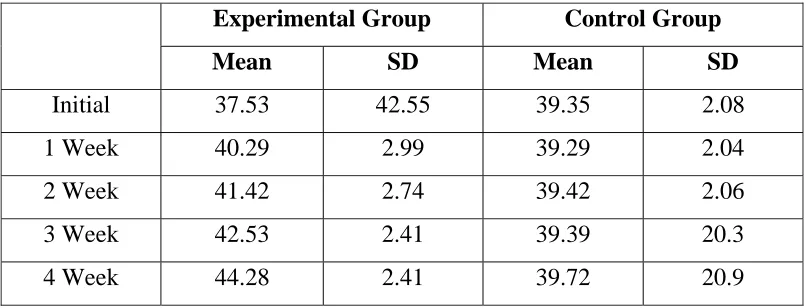
Table 1: Mean and Standard Deviation values of sergeant jump for
jumping performance in experimental and control group
Experimental Group Control Group
Mean SD Mean SD
Initial 37.53 42.55 39.35 2.08
1 Week 40.29 2.99 39.29 2.04
2 Week 41.42 2.74 39.42 2.06
3 Week 42.53 2.41 39.39 20.3
4 Week 44.28 2.41 39.72 20.9
Results:
Results shows that in the experimental group the mean and standard deviation of sergeant jumps initial is 37.53 and 2.55. This is less when compared with the 4th week mean (44.28 with SD of 2.41)
But in the control group, the mean value initially in 39.35 with the Standard Deviation of 2.08 which is more (or) less same when compared with the fourth week mean (39.2 with SD of 2.09)
36
Table 2: Mean and Standard Deviation values of Standing Broad Jump
(SBJ) for experimental and control group
Experimental Group Control Group
Mean SD Mean SD
Initial 151.00 12.82 161.03 12.40
1 Week 162.64 13.63 160.97 12.14
2 Week 169.62 13.77 161.04 12.30
3 Week 177.00 14.20 161.06 12.33
4 Week 184.09 12.49 161.21 12.30
Results:
Result shows that in the experimental group the mean and SD of SBJ initial is 151.00 and 12.82. This is less when compared with the 4th week mean (184.09 with SD of 12.49)
But in the control group, the mean value initially in 161.03 with the SD of 12.40 which is more (or) less same when compared with the fourth week mean (161.21 with SD of 12.30)
38
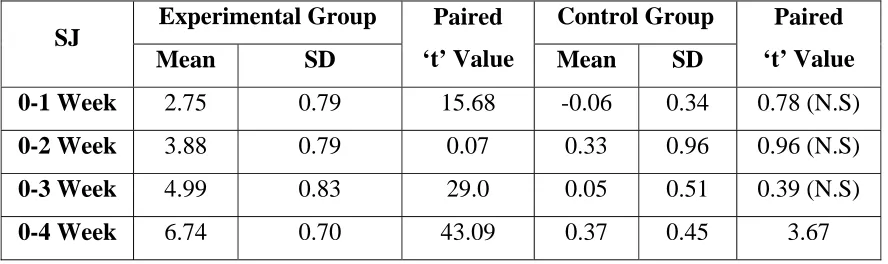
Table 3: Comparison of changes mean of Sergeant Jumps on jumping
performance from initial to 4th week value between experimental and control group
SJ Experimental Group Paired ‘t’ Value
Control Group Paired
‘t’ Value
Mean SD Mean SD
0-1 Week 2.75 0.79 15.68 -0.06 0.34 0.78 (N.S)
0-2 Week 3.88 0.79 0.07 0.33 0.96 0.96 (N.S)
0-3 Week 4.99 0.83 29.0 0.05 0.51 0.39 (N.S)
0-4 Week 6.74 0.70 43.09 0.37 0.45 3.67
Results:
Result reveals that in the experimental group the changes mean from initial (0) to 1st week is 2.75 with SD of 0.79. The initial to 4th week changes means shows marked changes i.e., 6.74 with SD of 0.70. The paired ‘t’ value shows that there is statistically difference at p<0.001 level for 0-1 week, 0-2 week, 0-3 week and 0-4 week.
But in the control group there are no statistically significant changes. The last 0-4 shows a slight changes in paired ‘t’ value at <0.05.
40
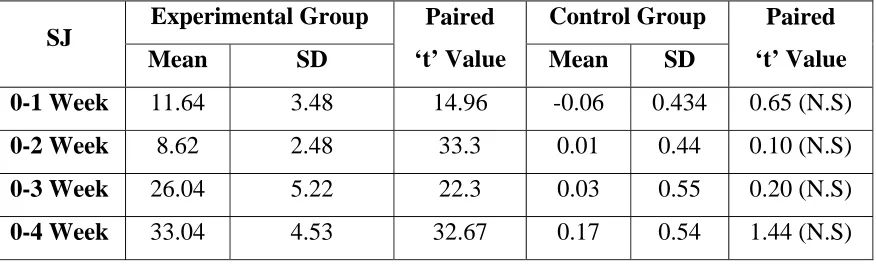
Table 4: Comparison of changes mean from initial to 4th week of standing broad jump (SBJ) between experimental and control group
SJ Experimental Group Paired ‘t’ Value
Control Group Paired
‘t’ Value
Mean SD Mean SD
0-1 Week 11.64 3.48 14.96 -0.06 0.434 0.65 (N.S)
0-2 Week 8.62 2.48 33.3 0.01 0.44 0.10 (N.S)
0-3 Week 26.04 5.22 22.3 0.03 0.55 0.20 (N.S)
0-4 Week 33.04 4.53 32.67 0.17 0.54 1.44 (N.S)
Results:
Result reveals that in the experimental group the changes mean from initial (0) to 1st week is 11.64 with SD of 3.48. The initial to 4th week changes means shows tremendous changes i.e., 33.09 with SD of 4.53. The period ‘t’ value shows that there is statistical difference at p<0.001 level for 0-1week, 0-2 week, 0-3 week and 0-4 week.
Figure 4: Comparison of changes mean from initial to 4th week of standing broad jump (SBJ) between experimental and
42
Table 5 :Correlation co-efficient between sergeant jump at standing broad
jump values in experimental
Sergeant Jump Standing Broad
Jump R Values
Mean SD Mean SD
Initial 37.53 2.55 151.50 12.82 0.6677
1st week 40.29 2.99 162.64 13.623 0.6526
2nd week 40.29 2.99 162.62 13.77 0.6892
3rd week 42.53 2.41 177.04 14.20 0.5885
4th week 44.28 2.41 184.09 12.49 0.6959
P<0.004 P<0.001
Results:
Results shows relationship between sergeant jump at standing Broad jump using ‘r’ value showed there is statistical significant positive relationship at P<0.001 level from initial to 4 week.
44
Table 6: Comparison between experimental and control group prior to
training for vertical jump, standing long jump & 50 yard dash
Parameters
Experimental
Group
Control
Group Values
Mean SD Mean SD T Value P Value
VJ (cms) 55.65 2.89 55.95 2.78 0.335 <0.001
SLJ (mts) 2.474 1.1218 2.511 0.069 1.164 <0.001
50 yards
dash (sec) 5.2665 0.1583 5.2365 0.1186 0.678 <0.001
Results:
Figure 6: Comparison between experimental and control group prior to training for vertical jump, standing long jump &
46
Table 7: Comparison of the 3 parameters in the experimental group before
and after training
Parameters
Pre Training
0 Week
Post Training
after 3 Weeks Values
Mean SD Mean SD T Value P Value
VJ (cms) 55.65 2.89 61.85 3.74 26.249 <0.001
SLJ (mts) 2.474 1.1218 2.543 0.1248 22.480 <0.001
50 yards
dash (sec) 5.2665 0.1583 5.0665 0.1734 30.444 <0.001
Results:
48
Table 8: Comparison of the 3 parameters in the control group before and
after training
Parameters
Pre Training
0 Week
Post Training
after 3 Weeks Values
Mean SD Mean SD T Value P Value
VJ (cms) 55.65 2.78 55.50 11.34 0.183 <0.001
SLJ (mts) 2.511 0.069 2.5370 0.0693 12.698 <0.001
50 yards
dash (sec) 5.2365 0.1186 2.1515 0.1221 13.223 <0.001
Results:
50
Table 9: Comparison of the gains of the 3 parameters after 3 weeks of
training in the experimental and control group
Parameters
Experimental
Group
Control
Group Values
Mean SD Mean SD T Value P Value
VJ (cms) 6.05 1.28 2.05 0.83 11.786 <0.001
SLJ (mts) 6.90 1.37 2.65 0.93 11.450 <0.001
50 yards
dash (sec) 0.2 0.029 0.16 0.0237 7.486 <0.001
Results:
Figure 9: Comparison of the 3 parameters between the Experimental and Control Group after three weeks of
D
DISCUSSION
This study concentrated in increasing acceleration power in high jump and long jump players. In this study i have taken 40 participants, they were randomly allotted into the experimental group and control group. Consisting 20 participants in each group, the control group was asked to undergo the regular training schedule. The experimental group was given program schedule together with the regular schedule.
As suggested the plyometric as the best method for power training sports. The ability to rapidly apply reactive force is the major goal of plyometric training plyometric is part of an overall program used to apply an overload to the muscles with speed strength as a goal speed strength ability is knows as power.
In this study, the results showed a significant increase in jumping performance in the experimental group. This improvement is due to the elastic energy storage and release, as appears the results from the changes in the level of neuromuscular activation and motor coordination, in response to plyometric training.
After 4 weeks of training, statistically significant increase was found both in sergeant jump and standing broad jump values were found this was due to the increase in the power by the training method employed.
L
L
i
i
m
m
i
i
t
t
a
a
t
t
i
i
o
o
n
n
s
s
&
&
R
LIMITATIONS OF THE STUDY
• The participants should be available for 4 weeks. (It is a time
consuming)
• The technique has to be mastered properly but at the same time it has to
be implemented properly.
• Participants were excluded from the study in case they discontinued the
training programme (or) if they any injury in the legs during the experimental period.
RECOMMENDATIONS
• A similar study with large samples can be done • A similar study can be done for female players
• A similar study can be done comparing male and female players
• A similar study can be done comparing normal player and
post-operative symptom less players
• Study focus on player with ankle sprain is now ready for plyometric
exercise what are the criteria that he or she has to meet before this exercise can be added to the Therapeutic exercise program
• A study about the determining whether player is eligible for plyometric
C
CONCLUSION
From this study it is concluded that any training program will be successful only if sufficient time is allowed for adaptation to occur. The gain in power can be achieved through plyometric in a 4 week program. Whether such gains would continue at the same rate for a longer period of time requires another study.
B
BIBLIOGRAPHY
1. Anderson, Susan Hall, Plyometric, SPORTS INJURIES AND MANAGEMENT, P21, II Ed 2000.
2. Church JB, Crist R, Effect & Warmup & Flexibility treatments on vertical jump performance, J STRENGTH CONDITIONING & RESEARCH, 15(3):332 – 6, 2001.
3. Costill; Jumpers have a predominance of FT fibers, PERIODISATION TRAINING SPORTS, P.18-20, 1999.
4. D.Matavulji, A limited amount of plyometrics training could improve jumping performance in junior basket ball players, J.SPORTS MEDICINE, PHYSICAL FITNESS, 41(3): 342 – 8; 2001.
5. Don A.Chu, JUMPING AND PLYOMETRIC HUMAN KINETIC, IInd Ed 1998.
6. Douglas Bovell, Myra Nimmo, PRINCIPLES OF PHYSIOLOGY, P.56, 1996.
7. Garly Egger, Nigel Champion, Depth jump is common plyometric exercises, THE FITNESS LEADERS HAND BOOK; P65-66, 4th Ed, 1998.
8. HOumard JA. Johnstra, Smith LL, The effect of warm-up on responses to intense exercise, Int.J. Sports medicine, 1991; 12:480–483.
9. James Watkins, STRUCTURE & FUNCTION OF MUSCULO SKELETAL SYSTEM, P 249 – 254, 1999.
10.Joseph Hamill, Kathlem M. Kutzen, BIOMECHANICS BASIS OF HUMAN MOVEMENTS, P130 – 135, I.Ed 1995.
11.M.A. Huston, Plyometric Exercise, SPORTS INJURIES, P192, II Ed 1996.
56
13.Morris B.Mellion, PLYOMETRICS, SPORTS MEDICINE SECRETS P 378, 1st Ed 1994.
14.Peter M.Mc Ginnis, Biomechanics of Vertical jump and effect of prestretch, Biomechanics of sports and exercise, Human kinetic, p 146-49, 1999.
15.Ruger Barlett, effect of Stretch Shortening cycle on lower extremity, SPORTS BIOMECHANICS, P23-24; 97-98, 154-56 1st ed. 1999.
16.Steven Roy, Richard Irwin, Evaluation in sports, SPORTS MEDICINE PREVENTION EVALUATION, MANAGEMENT AND REHABILITATION. P18-24, 1st Ed 1983.
17.Tippet, FUNCTIONAL PROGRESSION IN SPORTS, Human Kinetics, P.73 – 82, 1st ed, 2000.
18.Tudor O.Bompa: PERODISATION TRANING FOR SPORTS, Human Kinetics, USA, P.18 – 20; 114; 170 – 189, 1999.
19.Wiklander J.Lysholm J: Simple tests for surveying muscle strength and muscle stiffness in sportsmen. INT.J.Sports MED. (8) 50 – 54, 1987.
20.Wilf Paish: THE COMPLETE MANUAL OF SPORTS SCIENCE, A & C, Black, London, P. 40- 44; 128 – 129, 1999.
A
57
APPENDIX I
QUESTIONNAIRE
1. Name :
2. Age :
3. Sex :
4. Discipline : 5. The Level Played
a. University b. District c. State
d. Zonal (or) National
6. Have you fooled a strength training session as a part of your training programme?
7. If so, then for how many years?
8. Do you follow a warm up programme before every training session? 9. If yes, how many minute per session?
10.Do you follow a cool down program after every training session?
11.Does your warm up and cool down program contains stretching exercise also?
12.Do you suffer from any heart or lung diseases?
13.Do you have any previous history of Hip, thigh, Knee, Ankle or Foot injury?
14.If yes specify the area of injury at duration of the injury?
15.Do you have any previous history of surgery in this Hip, Thigh, Knee, Ankle or Foot?
Assessment Chart I
Name : Age :
Sex : Height : Weight:
59
APPENDIX II
I, ……… agree to take part in the research study conducted by Chandrakant Patel, postgraduate student (M.P.T Sports Physiotherapy) Cherraan’s College of Physiotherapists, entitled To Evaluate the efficiency of the specific plyometric training programme for increasing accelerations power in high jump and long jump players.
I acknowledge that the research study has been explained to me and I understand that agreeing to participate in the research means that I am willing to provide information and complete questionnaire(if any) about my health status to the research(s).
Allow the research(s) to have access to my medical/academic/ professional record, pertaining to the purpose of the study.
Participate in evaluator/ therapy/ observatory program for duration of _____ weeks.
Make myself available for further interview(s) / follow up. Understand and follow the home advice(s) that will be provided.
I have been informed about the purpose, procedures(s), measurement(s) and risk(s) involved in the research and my queries towards the research have been clarified.
I provide consent to the researcher to use the information, video or audio recording(s), for research and educational purpose only.
I understand that my participation is voluntary and can withdraw at any stage of the research project.
Name of the participants
APPENDIX III
1. Name
2. Age, Sex, Height, weight 3. Discipline
4. (a) Level of Game played University
College
(b) Number of years played From - To
5. Practice Session
(a)How many month in a year do you practice? (b)How many weeks in a months do you practice? (c)How many day in a week do you practice? (d)How many hours in a day do you practice?
6. Do you follow a warm up session before each training session / game? (a)Yes / NO
(b) If yes how many minutes (c) It is guided (or) self-taught 7. Do you have a cool down schedule?
(a) After each training session (b) After each competitive game
8. Do you follow stretching schedule Yes/No? (a) How many times a week
1) As a part of warm up 2) As a part of cool down
61
(c) No of repetitions (d) No of sets
10.Do you have any previous Hip, Knee, Ankle survey? Yes/ No 11.Do you have any previous history ? Yes / No
(a) Contact Injury (b) Non-Contact Injury (c) Does it recur often? (d) If yes how frequently
Do you have any pain in the lower limb now? Yes/ No 12.Stability Test
(a)Static (b)Dynamic
ASSESSMENT CHART 2
Name : …………..…………..…………..…………..
Age : …………..…………..…………..…………..
Sex : …………..…………..…………..…………..
Weight : …………..…………..…………..…………..
Date : …………..…………..…………..………
Vertical jump in (cms) : …………..………..
Standing long jump in (mts) : …………..…………..…..
APPENDIX IV
MASTER CHART
Subject No
Age of the
Subject
Sex of the
Subject
Pre Test Post Test
1 18 M 20 26
2 21 M 23 28
3 19 M 25 30
4 25 M 21 25
5 20 M 22 27
6 22 M 23 28
7 24 M 27 33
8 25 M 35 41
9 18 M 44 50
10 21 M 36 41
11 19 M 33 39
12 25 M 23 28
13 20 M 27 33
14 22 M 35 41
15 24 M 44 50
16 25 M 36 41
17 18 M 33 39
63
20 21 M 38 44
21 19 M 44 50
22 25 M 28 33
23 20 M 31 38
24 22 M 42 49
25 24 M 23 28
26 25 M 27 33
27 18 M 35 41
28 18 M 44 50
29 21 M 36 41
30 19 M 33 39
31 25 M 23 28
32 20 M 27 33
33 22 M 43 49
34 24 M 23 28
35 25 M 27 33
36 18 M 35 41
37 21 M 44 50
38 19 M 36 41
39 25 M 33 39