This text was adapted by The Saylor Foundation under a
Creative
Commons Attribution-NonCommercial-ShareAlike 3.0 License
without
Preface
This book is meant to be a textbook for a standard one-semester introductory statistics course for general education students. Our motivation for writing it is twofold: 1.) to provide a low-cost alternative to many existing popular textbooks on the market; and 2.) to provide a quality textbook on the subject with a focus on the core material of the course in a balanced presentation.
The high cost of textbooks has spiraled out of control in recent years. The high frequency at which new editions of popular texts appear puts a tremendous burden on students and faculty alike, as well as the natural environment. Against this background we set out to write a quality textbook with materials such as examples and exercises that age well with time and that would therefore not require frequent new editions. Our vision resonates well with the publisher’s business model which includes free digital access, reduced paper prints, and easy customization by instructors if additional material is desired.
Over time the core content of this course has developed into a well-defined body of material that is substantial for a one-semester course. The authors believe that the students in this course are best served by a focus on the core material and not by an exposure to a plethora of peripheral topics. Therefore in writing this book we have sought to present material that comprises fully a central body of knowledge that is defined according to convention, realistic expectation with respect to course duration and students’ maturity level, and our professional judgment and experience. We believe that certain topics, among them Poisson and geometric distributions and the normal approximation to the binomial distribution (particularly with a continuity correction) are distracting in nature. Other topics, such as nonparametric methods, while important, do not belong in a first course in statistics. As a result we envision a smaller and less intimidating textbook that trades some extended and unnecessary topics for a better focused presentation of the central material.
In our experience most students come to an introductory course in statistics with a calculator that they are familiar with and with which their proficiency is more than adequate for the course material. If the instructor chooses to use technological aids, either calculators or statistical software such as Minitab or SPSS, for more than mere arithmetical computations but as a significant component of the course then effective instruction for their use will require more extensive written instruction than a mere paragraph or two in the text. Given the plethora of such aids available, to discuss a few of them would not provide sufficiently wide or detailed coverage and to discuss many would digress unnecessarily from the conceptual focus of the book. The overarching philosophy of this textbook is to present the core material of an introductory course in statistics for non-majors in a complete yet streamlined way. Much room has been intentionally left for instructors to apply their own
instructional styles as they deem appropriate for their classes and educational goals. We believe that the whole matter of what technological aids to use, and to what extent, is precisely the type of material best left to the instructor’s discretion.
All figures with the exception of Figure 1.1 "The Grand Picture of Statistics",Figure 2.1 "Stem and Leaf Diagram", Figure 2.2 "Ordered Stem and Leaf Diagram",Figure 2.13 "The Box Plot", Figure 10.4 "Linear Correlation Coefficient ", Figure 10.5 "The Simple Linear Model Concept", and the
Chapter 1
Introduction
In this chapter we will introduce some basic terminology and lay the groundwork for the course. We will explain in general terms what statistics and probability are and the problems that these two areas of study are designed to solve.
1.1
Basic Definitions and Concepts
LEARNING OBJECTIVE
1. To learn the basic definitions used in statistics and some of its key concepts.
We begin with a simple example. There are millions of passenger automobiles in the United States. What is their average value? It is obviously impractical to attempt to solve this problem directly by assessing the value of every single car in the country, adding up all those numbers, and then dividing by however many numbers there are. Instead, the best we can do would be to estimate the average. One natural way to do so would be to randomly select some of the cars, say 200 of them, ascertain the value of each of those cars, and find the average of those 200 numbers. The set of all those millions of vehicles is called the population of interest, and the number attached to each one, its value, is a measurement. The average value is a parameter: a number that describes a characteristic of the population, in this case monetary worth. The set of 200 cars selected from the population is called a sample, and the 200 numbers, the monetary values of the cars we selected, are the sample data. The average of the data is called a statistic: a number calculated from the sample data. This example illustrates the meaning of the following definitions.
Definition
A population is any specific collection of objects of interest. A sample is any subset or subcollection of the population, including the case that the sample consists of the whole population, in which case it is termed a census.
Definition
Definition
A parameter is a number that summarizes some aspect of the population as a whole. A statistic is a number computed from the sample data.
Continuing with our example, if the average value of the cars in our sample was $8,357, then it seems reasonable to conclude that the average value of all cars is about $8,357. In reasoning this way we have drawn an inference about the population based on information obtained from the sample. In general, statistics is a study of data: describing properties of the data, which is called descriptive statistics, and drawing conclusions about a population of interest from information extracted from a sample, which is called inferential statistics. Computing the single number $8,357 to summarize the data was an operation of descriptive statistics; using it to make a statement about the population was an operation of inferential statistics.
Definition
Statistics is a collection of methods for collecting, displaying, analyzing, and drawing conclusions from
data.
Definition
Descriptive statistics is the branch of statistics that involves organizing, displaying, and describing
data.
Definition
Inferential statistics is the branch of statistics that involves drawing conclusions about a population
based on information contained in a sample taken from that population.
The measurement made on each element of a sample need not be numerical. Inthe case of
automobiles, what is noted about each car could be its color, its make, its body type, and so on. Such data are categorical or qualitative, as opposed to numerical or quantitative data such as value or age. This is a general distinction.
Qualitative data are measurements for which there is no natural numerical scale, but which consist of
attributes, labels, or other nonnumerical characteristics.
Definition
Quantitative data are numerical measurements that arise from a natural numerical scale.
Qualitative data can generate numerical sample statistics. In the automobile example, for instance, we might be interested in the proportion of all cars that are less than six years old. In our same sample of 200 cars we could note for each car whether it is less than six years old or not, which is a qualitative measurement. If 172 cars in the sample are less than six years old, which is 0.86 or 86%, then we would estimate the parameter of interest, the population proportion, to be about the same as the sample statistic, the sample proportion, that is, about 0.86.
The relationship between a population of interest and a sample drawn from that population is perhaps the most important concept in statistics, since everything else rests on it. This relationship is illustrated graphically in Figure 1.1 "The Grand Picture of Statistics". The circles in the large box represent elements of the population. In the figure there was room for only a small number of them but in actual situations, like our automobile example, they could very well number in the millions. The solid black circles represent the elements of the population that are selected at random and that together form the sample. For each element of the sample there is a measurement of interest, denoted by a lower case x (which we have indexed as x1,…,xn to tell them apart); these measurements
collectively form the sample data set. From the data we may calculate various statistics. To anticipate the notation that will be used later, we might compute the sample mean x− and the sample
Figure 1.1 The Grand Picture of Statistics
KEY TAKEAWAYS
• Statistics is a study of data: describing properties of data (descriptive statistics) and drawing conclusions about a population based on information in a sample (inferential statistics).
• The distinction between a population together with its parameters and a sample together with its statistics is a fundamental concept in inferential statistics.
• Information in a sample is used to make inferences about the population from which the sample was drawn.
EXERCISES
6. Explain what a statistic is.
7. Give an example of a population and two different characteristics that may be of interest.
8. Describe the difference between descriptive statistics and inferential statistics. Illustrate with an example. 9. Identify each of the following data sets as either a population or a sample:
a. The grade point averages (GPAs) of all students at a college.
b. The GPAs of a randomly selected group of students on a college campus.
c. The ages of the nine Supreme Court Justices of the United States on January 1, 1842. d. The gender of every second customer who enters a movie theater.
e. The lengths of Atlantic croakers caught on a fishing trip to the beach. 10. Identify the following measures as either quantitative or qualitative:
a. The 30 high-temperature readings of the last 30 days. b. The scores of 40 students on an English test.
c. The blood types of 120 teachers in a middle school.
d. The last four digits of social security numbers of all students in a class. e. The numbers on the jerseys of 53 football players on a team.
11. Identify the following measures as either quantitative or qualitative: a. The genders of the first 40 newborns in a hospital one year. b. The natural hair color of 20 randomly selected fashion models. c. The ages of 20 randomly selected fashion models.
d. The fuel economy in miles per gallon of 20 new cars purchased last month. e. The political affiliation of 500 randomly selected voters.
12. A researcher wishes to estimate the average amount spent per person by visitors to a theme park. He takes a random sample of forty visitors and obtains an average of $28 per person.
a. What is the population of interest? b. What is the parameter of interest?
c. Based on this sample, do we know the average amount spent per person by visitors to the park? Explain fully.
a. What is the population of interest? b. What is the parameter of interest?
c. Based on this sample, do we know the average weight of newborns in South America? Explain fully.
14. A researcher wishes to estimate the proportion of all adults who own a cell phone. He takes a random sample of 1,572 adults; 1,298 of them own a cell phone, hence 1298∕1572 ≈ .83 or about 83% own a cell phone.
a. What is the population of interest? b. What is the parameter of interest? c. What is the statistic involved?
d. Based on this sample, do we know the proportion of all adults who own a cell phone? Explain fully.
15. A sociologist wishes to estimate the proportion of all adults in a certain region who have never married. In a random sample of 1,320 adults, 145 have never married, hence 145∕1320 ≈ .11 or about 11% have never married.
a. What is the population of interest? b. What is the parameter of interest? c. What is the statistic involved?
d. Based on this sample, do we know the proportion of all adults who have never married? Explain fully.
16. a. What must be true of a sample if it is to give a reliable estimate of the value of a particular population parameter?
b. What must be true of a sample if it is to give certain knowledge of the value of a particular population parameter?
ANSWERS
1. A population is the total collection of objects that are of interest in a statistical study.
5. A parameter is a value describing a characteristic of a population. In a statistical study the value of a parameter is typically unknown.
7. All currently registered students at a particular college form a population. Two population characteristics of interest could be the average GPA and the proportion of students over 23 years.
9. a. Population. b. Sample.
c. Population. d. Sample. e. Sample.
11. a. Qualitative. b. Qualitative. c. Quantitative. d. Quantitative. e. Qualitative.
13. a. All newborn babies in South America in the last five years. b. The average birth weight of all newborn babies in South America in the last five years. c. No, not exactly, but we know the approximate value of the average.
1.2
Overview
LEARNING OBJECTIVE
1. To obtain an overview of the material in the text.
The example we have given in the first section seems fairly simple, but there are some significant problems that it illustrates. We have supposed that the 200 cars of the sample had an average value of $8,357 (a number that is precisely known), and concluded that the population has an average of about the same amount, although its precise value is still unknown. What would happen if someone were to take another sample of exactly the same size from exactly the same population? Would he get the same sample average as we did, $8,357? Almost surely not. In fact, if the investigator who took the second sample were to report precisely the same value, we would immediately become suspicious of his result. The sample average is an example of what is called a random variable: a number that varies from trial to trial of an experiment (in this case, from sample to sample), and does so in a way that cannot be predicted precisely. Random variables will be a central object of study for us,
beginning in Chapter 4 "Discrete Random Variables".
Sampling may be done not only to estimate a population parameter, but to test a claim that is made about that parameter. Suppose a food package asserts that the amount of sugar in one serving of the product is 14 grams. A consumer group might suspect that it is more. How would they test the competing claims about the amount of sugar, 14 grams versus more than 14 grams? They might take a random sample of perhaps 20 food packages, measure the amount of sugar in one serving of each one, and average those amounts. They are not interested in the true amount of sugar in one serving in itself; their interest is simply whether the claim about the true amount is accurate. Stated another way, they are sampling not in order to estimate the average amount of sugar in one serving, but to see whether that amount, whatever it may be, is larger than 14 grams. Again because one can have certain knowledge only by taking a census, ideas of probability enter into the analysis. We will examine tests of hypotheses beginning in Chapter 8 "Testing Hypotheses".
Several times in this introduction we have used the term “random sample.” Generally the value of our data is only as good as the sample that produced it. For example, suppose we wish to estimate the proportion of all students at a large university who are females, which we denote by p. If we select 50 students at random and 27 of them are female, then a natural estimate is p≈pˆ-27/50-0.54 or
54%. How much confidence we can place in this estimate depends not only on the size of the sample, but on its quality, whether or not it is truly random, or at least truly representative of the whole population. If all 50 students in our sample were drawn from a College of Nursing, then the
proportion of female students in the sample is likely higher than that of the entire campus. If all 50 students were selected from a College of Engineering Sciences, then the proportion of students in the entire student body who are females could be underestimated. In either case, the estimate would be distorted or biased. In statistical practice an unbiased sampling scheme is important but in most cases not easy to produce. For this introductory course we will assume that all samples are either random or at least representative.
KEY TAKEAWAY
1.3
Presentation of Data
LEARNING OBJECTIVE
1. To learn two ways that data will be presented in the text.
In this book we will use two formats for presenting data sets. The first is a data list, which is an explicit listing of all the individual measurements, either as a display with space between the individual measurements, or in set notation with individual measurements separated by commas.
EXAMPLE 1
The data obtained by measuring the age of 21 randomly selected students enrolled in freshman courses at a university could be presented as the data list
18 18 19 19 19 18 22 20 18 18 17 19 18 24 18 20 18 21 20 17 19
or in set notation as
{18,18,19,19,19,18,22,20,18,18,17,19,18,24,18,20,18,21,20,17,19}
A data set can also be presented by means of a data frequency table, a table in which
each distinct value x is listed in the first row and its frequency f, which is the number of times the value x appears in the data set, is listed below it in the second row.
EXAMPLE 2
The data set of the previous example is represented by the data frequency table x 17 18 19 20 21 22 24
f 2 8 5 3 1 1 1
The data frequency table is especially convenient when data sets are large and the number of distinct values is not too large.
KEY TAKEAWAY
• Data sets can be presented either by listing all the elements or by giving a table of values and frequencies.
1. List all the measurements for the data set represented by the following data frequency table.
x 21 22 22 24 25
f 1 5 6 4 2
2. List all the measurements for the data set represented by the following data frequency table.
x 97 98 99 100 101 102 102 105
f 7 5 2 4 2 2 1 1
3. Construct the data frequency table for the following data set.
22 25 22 27 24 23 26 24 22 24 26
4. Construct the data frequency table for the following data set.
{1,5,2,3,5,1,4,4,4,3,2,5,1,3,2, 1,1,1,2}
ANSWERS
1. {31,32,32,32,32,32,33,33,33,33,33,33,34,34,34,34,35,35}.
3.
x 22 23 24 25 26 27
Chapter 2
Descriptive Statistics
2.1
Three Popular Data Displays
LEARNING OBJECTIVE
1. To learn to interpret the meaning of three graphical representations of sets of data: stem and leaf diagrams, frequency histograms, and relative frequency histograms.
A well-known adage is that “a picture is worth a thousand words.” This saying proves true when it comes to presenting statistical information in a data set. There are many effective ways to present data graphically. The three graphical tools that are introduced in this section are among the most commonly used and are relevant to the subsequent presentation of the material in this book.
Stem and Leaf Diagrams
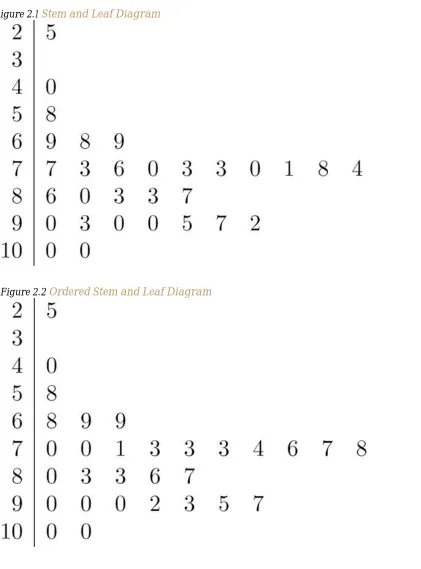
Suppose 30 students in a statistics class took a test and made the following scores: 86 80 25 77 73 76 100 90 69 93
90 83 70 73 73 70 90 83 71 95 40 58 68 69 100 78 87 97 92 74
igure 2.1
Stem and Leaf Diagram
Figure 2.2
Ordered Stem and Leaf Diagram
8 0 3 3 8 6 7
The definitions of stems and leaves are flexible in practice. The general purpose of a stem and leaf
diagram is to provide a quick display of how the data are distributed across the range of their values; some improvisation could be necessary to obtain a diagram that best meets that goal.
Note that all of the original data can be recovered from the stem and leaf diagram. This will not be true in the next two types of graphical displays.
Frequency Histograms
The stem and leaf diagram is not practical for large data sets, so we need a different, purely graphical way to represent data. A frequency histogram is such a device. We will illustrate it using the same data set from the previous subsection. For the 30 scores on the exam, it is natural to group the scores on the standard ten-point scale, and count the number of scores in each group. Thus there are two 100s, seven scores in the 90s, six in the 80s, and so on. We then construct the diagram shown in by drawing for each group, or class, a vertical bar whose length is the number of observations in that group. In our example, the bar labeled 100 is 2 units long, the bar labeled 90 is 7 units long, and so on. While the individual data values are lost, we know the number in each class. This number is called the frequency of the class, hence the name frequency histogram.
The same procedure can be applied to any collection of numerical data. Observations are grouped into several classes and the frequency (the number of observations) of each class is noted. These classes are arranged and indicated in order on the horizontal axis (called the x-axis), and for each group a vertical bar, whose length is the number of observations in that group, is drawn. The resulting display is a
frequency histogram for the data. The similarity in and is apparent, particularly if you imagine turning the stem and leaf diagram on its side by rotating it a quarter turn counterclockwise.
In general, the definition of the classes in the frequency histogram is flexible. The general purpose of a frequency histogram is very much the same as that of a stem and leaf diagram, to provide a graphical display that gives a sense of data distribution across the range of values that appear. We will not discuss the process of constructing a histogram from data since in actual practice it is done automatically with statistical software or even handheld calculators.
Relative Frequency Histograms
In our example of the exam scores in a statistics class, five students scored in the 80s. The number 5 is the frequency of the group labeled “80s.” Since there are 30 students in the entire statistics class, the proportion who scored in the 80s is 5/30. The number 5/30, which could also be expressed as 0.16≈.1667, or as 16.67%, is the relative frequency of the group labeled “80s.” Every group (the 70s, the 80s, and so on) has a relative frequency. We can thus construct a diagram by drawing for each group, or class, a vertical bar whose length is the relative frequency of that group. For example, the bar for the 80s will have length 5/30 unit, not 5 units. The diagram is a relative frequency histogram for the data, and is shown in . It is exactly the same as the frequency histogram except that the vertical axis in the relative frequency histogram is not frequency but relative frequency.
The same procedure can be applied to any collection of numerical data. Classes are selected, the relative frequency of each class is noted, the classes are arranged and indicated in order on the horizontal axis, and for each class a vertical bar, whose length is the relative frequency of the class, is drawn. The resulting display is a relative frequency histogram for the data. A key point is that now if each vertical bar has width 1 unit, then the total area of all the bars is 1 or 100%.
Although the histograms in and have the same appearance, the relative frequency histogram is more important for us, and it will be relative frequency histograms that will be used repeatedly to
represent data in this text. To see why this is so, reflect on what it is that you are actually seeing in the diagrams that quickly and effectively communicates information to you about the data. It is the relative sizes of the bars. The bar labeled “70s” in either figure takes up 1/3 of the total area of all the bars, and although we may not think of this consciously, we perceive the proportion 1/3 in the figures, indicating that a third of the grades were in the 70s. The relative frequency histogram is important because the labeling on the vertical axis reflects what is important visually: the relative sizes of the bars.
When the size n of a sample is small only a few classes can be used in constructing a relative frequency histogram. Such a histogram might look something like the one in panel (a) of . If the sample size n were increased, then more classes could be used in constructing a relative frequency histogram and the vertical bars of the resulting histogram would be finer, as indicated in panel (b) of . For a very large sample the relative frequency histogram would look very fine, like the one in (c) of. If the sample size were to increase indefinitely then the corresponding relative frequency
histogram would be so fine that it would look like a smooth curve, such as the one in panel (d) of .
It is common in statistics to represent a population or a very large data set by a smooth curve. It is good to keep in mind that such a curve is actually just a very fine relative frequency histogram in which the exceedingly narrow vertical bars have disappeared. Because the area of each such vertical bar is the proportion of the data that lies in the interval of numbers over which that bar stands, this means that for any two numbers a and b, the proportion of the data that lies between the two numbers a and b is the area under the curve that is above the interval (a,b) in the horizontal axis. This is the area shown in . In particular the total area under the curve is 1, or 100%.
Figure 2.6 A Very Fine Relative Frequency Histogram
KEY TAKEAWAYS
• Graphical representations of large data sets provide a quick overview of the nature of the data.
• A population or a very large data set may be represented by a smooth curve. This curve is a very fine relative frequency histogram in which the exceedingly narrow vertical bars have been omitted.
2.2
Measures of Central Location
LEARNING OBJECTIVES
1. To learn the concept of the “center” of a data set.
2. To learn the meaning of each of three measures of the center of a data set—the mean, the median, and the mode—and how to compute each one.
The Mean
The first measure of central location is the usual “average” that is familiar to everyone. In the formula in the following definition we introduce the standard summation notation Σ, where Σ is the capital Greek letter sigma. In general, the notation Σ followed by a second mathematical symbol means to add up all the values that the second symbol can take in the context of the problem. Here is an example to illustrate this.
In the examples above the data sets were described as samples. Therefore the means were sample means, denoted by x̅. If the data come from a census, so that there is a measurement for every element of the population, then the mean is calculated by exactly the same process of summing all the measurements and dividing by how many of them there are, but it is now the population mean and is denoted by μ, the lower case Greek letter mu.
The mean of two numbers is the number that is halfway between them. For example, the average of the numbers 5 and 17 is (5 + 17) ∕ 2 = 11, which is 6 units above 5 and 6 units below 17. In this sense the average 11 is the “center” of the data set {5,17}. For larger data sets the mean can similarly be regarded as the “center” of the data.
The Median
To see why another concept of average is needed, consider the following situation. Suppose we are interested in the average yearly income of employees at a large corporation. We take a random sample of seven employees, obtaining the sample data (rounded to the nearest hundred dollars, and expressed in thousands of dollars).
24.8 22.8 24.6 192.5 25.2 18.5 23.7
The mean (rounded to one decimal place) is x̅-47.4, but the statement “the average income of employees
the case here. We would get a better measure of the “center” of the data if we were to arrange the data in numerical order,
18.5 22.8 23.7 24.6 24.8 25.2 192.5
then select the middle number in the list, in this case 24.6. The result is called the median of the data set, and has the property that roughly half of the measurements are larger than it is, and roughly half are smaller. In this sense it locates the center of the data. If there are an even number of measurements in the data set, then there will be two middle elements when all are lined up in order, so we take the mean of the middle two as the median. Thus we have the following definition.
Definition
The sample median x^~ of a set of sample data for which there are an odd number of measurements is the middle measurement when the data are arranged in numerical order. The sample median x^~of a set of sample data for which there are an even number of measurements is the mean of the two middle measurements when the data are arranged in numerical order.
The population median is defined in a similar way, but we will not have occasion to refer to it again in this text.
The median is a value that divides the observations in a data set so that 50% of the data are on its left and the other 50% on its right. In accordance with , therefore, in the curve that represents the
The relationship between the mean and the median for several common shapes of distributions is shown in . The distributions in panels (a) and (b) are said to be symmetric because of the symmetry that they exhibit. The distributions in the remaining two panels are said to be skewed. In each distribution we have drawn a vertical line that divides the area under the curve in half, which in accordance with is located at the median. The following facts are true in general:
b. When the distribution is as shown in panel (c) of , it is said to be skewed right. The mean has been pulled to the right of the median by the long “right tail” of the distribution, the few relatively large data values.
[image:39.612.71.532.179.664.2]c. When the distribution is as shown in panel (d) of , it is said to be skewed left. The mean has been pulled to the left of the median by the long “left tail” of the distribution, the few relatively small data values.
Figure 2.8 Skewness of Relative Frequency Histograms
The Mode
sitting in a driveway. In such a context the following measure for central location might make more sense.
Definition
The sample mode of a set of sample data is the most frequently occurring value.
The population mode is defined in a similar way, but we will not have occasion to refer to it again in this text.
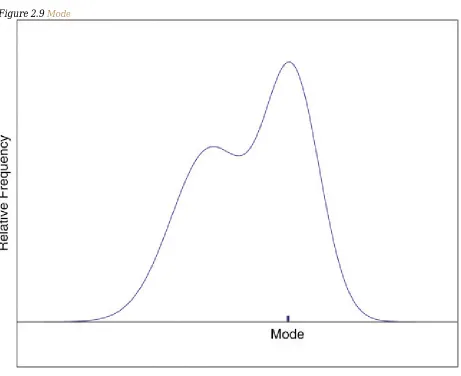
[image:40.612.74.535.298.674.2]On a relative frequency histogram, the highest point of the histogram corresponds to the mode of the data set. illustrates the mode.
Figure 2.9 Mode
that every value occurs with the same frequency, in which case the concept of the mode does not make much sense.
EXAMPLE 8
Find the mode of the following data set.
−1 0 2 0
Solution:
The value 0 is most frequently observed and therefore the mode is 0.
EXAMPLE 9
Compute the sample mode for the data of .
Solution:
The two most frequently observed values in the data set are 1 and 2. Therefore mode is a set of two values: {1,2}.
The mode is a measure of central location since most real-life data sets have moreobservations near the center of the data range and fewer observations on the lower and upper ends. The value with the highest frequency is often in the middle of the data range.
KEY TAKEAWAY
LARG E DAT A SET EXERCI SE S
28. Large Data Set 1 lists the SAT scores and GPAs of 1,000 students.http://www.1.xls
a. Compute the mean and median of the 1,000 SAT scores. b. Compute the mean and median of the 1,000 GPAs. 29. Large Data Set 1 lists the SAT scores of 1,000 students.
http://www.1.xls
a. Regard the data as arising from a census of all students at a high school, in which the SAT score of every student was measured. Compute the population mean μ.
b. Regard the first 25 observations as a random sample drawn from this population. Compute the sample mean x^− and compare it to μ.
c. Regard the next 25 observations as a random sample drawn from this population. Compute the sample mean x^− and compare it to μ.
30. Large Data Set 1 lists the GPAs of 1,000 students.
http://www.1.xls
a. Regard the data as arising from a census of all freshman at a small college at the end of their first academic year of college study, in which the GPA of every such person was measured. Compute the population mean μ.
b. Regard the first 25 observations as a random sample drawn from this population. Compute the sample mean x^− and compare it to μ.
c. Regard the next 25 observations as a random sample drawn from this population. Compute the sample mean x^− and compare it to μ.
31. Large Data Sets 7, 7A, and 7B list the survival times in days of 140 laboratory mice with thymic leukemia from onset to death.
http://www.7.xls http://www.7A.xls http://www.7B.xls
a. Compute the mean and median survival time for all mice, without regard to gender.
b. Compute the mean and median survival time for the 65 male mice (separately recorded in Large Data Set 7A).
2.3
Measures of Variability
LEARNING OBJECTIVES
1. To learn the concept of the variability of a data set.
2. To learn how to compute three measures of the variability of a data set: the range, the variance, and the standard deviation.
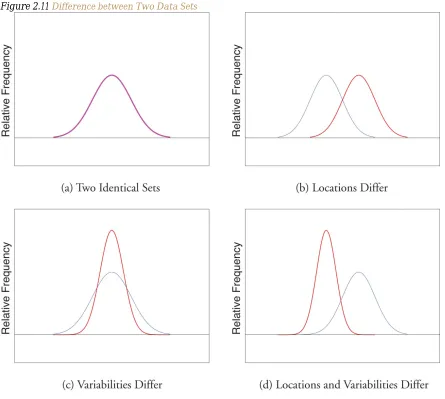
Look at the two data sets in Table 2.1 "Two Data Sets" and the graphical representation of each, called a dot plot, in Figure 2.10 "Dot Plots of Data Sets".
Table 2.1 Two Data Sets
Data Set I: 40 38 42 40 39 39 43 40 39 40
Figure 2.10
Dot Plots of Data Sets
The two sets of ten measurements each center at the same value: they both have mean, median, and mode 40. Nevertheless a glance at the figure shows that they are markedly different. In Data Set I the measurements vary only slightly from the center, while for Data Set II the measurements vary
greatly. Just as we have attached numbers to a data set to locate its center, we now wish to associate to each data set numbers that measure quantitatively how the data either scatter away from the center or cluster close to it. These new quantities are called measures of variability, and we will discuss three of them.
The Range
The first measure of variability that we discuss is the simplest.
Definition
The range of a data set is the number R defined by the formula
R=xmax−xmin
where xmax is the largest measurement in the data set and xmin is the smallest.
EXAMPLE 10
Find the range of each data set in Table 2.1 "Two Data Sets".
Solution:
The range is a measure of variability because it indicates the size of the interval over which the data points are distributed. A smaller range indicates less variability (less dispersion) among the data, whereas a larger range indicates the opposite.
The Variance and the Standard Deviation
The other two measures of variability that we will consider are more elaborate and also depend on whether the data set is just a sample drawn from a much larger population or is the whole population itself (that is, a census).
If the data set comprises the whole population, then the population standard deviation,
denoted σ (the lower case Greek letter sigma), and its square, the population variance σ2, are defined
as follows.
Note that the denominator in the fraction is the full number of observations, not that number reduced by one, as is the case with the sample standard deviation. Since most data sets are samples, we will always work with the sample standard deviation and variance.
Figure 2.11 Difference between Two Data Sets
KEY TAKEAWAY
LARG E DAT A SET EXERCI SE S
19. Large Data Set 1 lists the SAT scores and GPAs of 1,000 students.
http://www.1.xls
a. Compute the range and sample standard deviation of the 1,000 SAT scores. b. Compute the range and sample standard deviation of the 1,000 GPAs. 20. Large Data Set 1 lists the SAT scores of 1,000 students.
http://www.1.xls
a. Regard the data as arising from a census of all students at a high school, in which the SAT score of every student was measured. Compute the population range and population standard deviation σ.
b. Regard the first 25 observations as a random sample drawn from this population. Compute the sample range and sample standard deviation s and compare them to the population range and σ.
c. Regard the next 25 observations as a random sample drawn from this population. Compute the sample range and sample standard deviation s and compare them to the population range and σ.
21. Large Data Set 1 lists the GPAs of 1,000 students.
http://www.1.xls
a. Regard the data as arising from a census of all freshman at a small college at the end of their first academic year of college study, in which the GPA of every such person was measured. Compute the population range and population standard deviation σ.
b. Regard the first 25 observations as a random sample drawn from this population. Compute the sample range and sample standard deviation s and compare them to the population range and σ.
c. Regard the next 25 observations as a random sample drawn from this population. Compute the sample range and sample standard deviation s and compare them to the population range and σ.
22. Large Data Sets 7, 7A, and 7B list the survival times in days of 140 laboratory mice with thymic leukemia from onset to death.
http://www.7.xls http://www.7A.xls http://www.7B.xls
a. Compute the range and sample standard deviation of survival time for all mice, without regard to gender.
b. Compute the range and sample standard deviation of survival time for the 65 male mice (separately recorded in Large Data Set 7A).
2.4
Relative Position of Data
2. To learn the meaning of each of two measures, the percentile rank and the z-score, of the relative position of a measurement and how to compute each one.
3. To learn the meaning of the three quartiles associated to a data set and how to compute them.
4. To learn the meaning of the five-number summary of a data set, how to construct the box plot associated to it, and how to interpret the box plot.
When you take an exam, what is often as important as your actual score on the exam is the way your score compares to other students’ performance. If you made a 70 but the average score (whether the mean, median, or mode) was 85, you did relatively poorly. If you made a 70 but the average score was only 55 then you did relatively well. In general, the significance of one observed value in a data set strongly depends on how that value compares to the other observed values in a data set.
Therefore we wish to attach to each observed value a number that measures its relative position.
Percentiles and Quartiles
Anyone who has taken a national standardized test is familiar with the idea of being given both a score on the exam and a “percentile ranking” of that score. You may be told that your score was 625 and that it is the 85th percentile. The first number tells how you actually did on the exam; the second says that 85% of the scores on the exam were less than or equal to your score, 625.
Definition
Given an observed value x in a data set, x is the Pth percentile of the data if the percentage of the data
that are less than or equal to x is P. The number P is the percentile rank of x.
EXAMPLE 13
What percentile is the value 1.39 in the data set of ten GPAs considered in Note 2.12 "Example 3" in Section 2.2 "Measures of Central Location"? What percentile is the value 3.33?
Solution:
The data written in increasing order are
1.39 1.76 1.90 2.12 2.53 2.71 3.00 3.33 3.71 4.00
The only data value that is less than or equal to 1.39 is 1.39 itself. Since 1 is 1∕10 = .10 or 10% of 10, the
The Pth percentile cuts the data set in two so that approximately P% of the data lie below it
[image:63.612.70.541.174.628.2]and (100−P)% of the data lie above it. In particular, the three percentiles that cut the data into fourths, as shown in Figure 2.12 "Data Division by Quartiles", are called the quartiles. The following simple computational definition of the three quartiles works well in practice.
Figure 2.12 Data Division by Quartiles
Definition
For any data set:
1. The second quartile Q2 of the data set is its median. 2. Define two subsets:
4. The third quartile Q3 of the data set is the median of the upper set.
EXAMPLE 14
Find the quartiles of the data set of GPAs of Note 2.12 "Example 3" in Section 2.2 "Measures of Central Location".
Solution:
As in the previous example we first list the data in numerical order: 1.39 1.76 1.90 2.12 2.53 2.71 3.00 3.33 3.71 4.00
This data set has n= 10 observations. Since 10 is an even number, the median is the mean of the two middle observations: x˜=(2.53 + 2.71)/2=2.62. Thus the second quartile is Q2=2.62. The lower and upper subsets
are
Lower: L={1.39,1.76,1.90,2.12,2.53}
Upper: U={2.71,3.00,3.33,3.71,4.00}
Each has an odd number of elements, so the median of each is its middle observation. Thus the first quartile is Q1=1.90, the median of L, and the third quartile is Q3=3.33, the median of U.
EXAMPLE 15
Adjoin the observation 3.88 to the data set of the previous example and find the quartiles of the new set of data.
Solution:
As in the previous example we first list the data in numerical order:
1.39 1.76 1.90 2.12 2.53 2.71 3.00 3.33 3.71 3.88 4.00
This data set has 11 observations. The second quartile is its median, the middle value 2.71. Thus Q2=2.71. The lower and upper subsets are now
Lower: L={1.39,1.76,1.90,2.12,2.53}
Upper: U= {3.00,3.33,3.71,3.88,4.00}
The lower set L has median the middle value 1.90, so Q1=1.90. The upper set has median the middle value
In addition to the three quartiles, the two extreme values, the minimum xmin and the maximum xmax are also useful in describing the entire data set. Together these five numbers are called the
five-number summary of the data set:
{xmin, Q1, Q2, Q3, xmax}
The five-number summary is used to construct a box plot as in Figure 2.13 "The Box Plot". Each of the five numbers is represented by a vertical line segment, a box is formed using the line segments
at Q1 and Q3 as its two vertical sides, and two horizontal line segments are extended from the vertical segments marking Q1 and Q3 to the adjacent extreme values. (The two horizontal line segments are referred to as “whiskers,” and the diagram is sometimes called a “box and whisker plot.”) We caution the reader that there are other types of box plots that differ somewhat from the ones we are constructing, although all are based on the three quartiles.
Figure 2.13
The Box Plot
Note that the distance from Q1 to Q3 is the length of the interval over which the middle half of the
data range. Thus it has the following special name.
Definition
The interquartile range (IQR) is the quantity
IQR=Q3−Q1
EXAMPLE 16
Construct a box plot and find the IQR for the data in Note 2.44 "Example 14".
Solution:
The box plot is
The interquartile range is IQR=3.33−1.90=1.43.
z
-scores
Another way to locate a particular observation x in a data set is to compute its distance from the mean in units of standard deviation.
The formulas in the definition allow us to compute the z-score when x is known. If the z-score is known then x can be recovered using the corresponding inverse formulas
The z-score indicates how many standard deviations an individual observation x is from the center of the data set, its mean. If z is negative then x is below average. If z is 0 then x is equal to the average. If z is positive then x is above average. See Figure 2.14.
EXAMPLE 18
Suppose the mean and standard deviation of the GPAs of all currently registered students at a college are μ= 2.70 andσ= 0.50. Thez-scores of the GPAs of two students, Antonio and Beatrice,
are z=−0.62 and z= 1.28, respectively. What are their GPAs?
Using the second formula right after the definition of z-scores we compute the GPAs as Antonio: x=μ+z σ=2.70+(−0.62)(0.50)=2.39
Beatrice: x=μ+z σ=2.70+(1.28)(0.50)=3.34
KEY TAKEAWAYS
• The percentile rank and z-score of a measurement indicate its relative position with regard to the other measurements in a data set.
• The three quartiles divide a data set into fourths.
35.
Emilia and Ferdinand took the same freshman chemistry course, Emilia in the fall, Ferdinand in the spring. Emilia made an 83 on the common final exam that she took, on which the mean was 76 and the standard deviation 8. Ferdinand made a 79 on the common final exam that he took, which was more difficult, since the mean was 65 and the standard deviation 12. The one who has a higher z-score did relatively better. Was it Emilia or Ferdinand?
36. Refer to the previous exercise. On the final exam in the same course the following semester, the mean is 68 and the standard deviation is 9. What grade on the exam matches Emilia’s performance? Ferdinand’s? 37. Rosencrantz and Guildenstern are on a weight-reducing diet. Rosencrantz, who weighs 178 lb, belongs to an
age and body-type group for which the mean weight is 145 lb and the standard deviation is 15 lb.
Guildenstern, who weighs 204 lb, belongs to an age and body-type group for which the mean weight is 165 lb and the standard deviation is 20 lb. Assuming z-scores are good measures for comparison in this context, who is more overweight for his age and body type?
LARG E DAT A SET EXERCI SE S
38. Large Data Set 1 lists the SAT scores and GPAs of 1,000 students.
http://www.1.xls
a. Compute the three quartiles and the interquartile range of the 1,000 SAT scores. b. Compute the three quartiles and the interquartile range of the 1,000 GPAs. 39. Large Data Set 10 records the scores of 72 students on a statistics exam.
http://www.10.xls
a. Compute the five-number summary of the data.
b. Describe in words the performance of the class on the exam in the light of the result in part (a). 40. Large Data Sets 3 and 3A list the heights of 174 customers entering a shoe store.
http://www.3.xls
http://www.3A.xls
41. Large Data Sets 7, 7A, and 7B list the survival times in days of 140 laboratory mice with thymic leukemia from onset to death.
http://www.7.xls
http://www.7A.xls
http://www.7B.xls
a. Compute the three quartiles and the interquartile range of the survival times for all mice, without regard to gender.
b. Compute the three quartiles and the interquartile range of the survival times for the 65 male mice (separately recorded in Large Data Set 7A).
2.5
The Empirical Rule and Chebyshev’s Theorem
LEARNING OBJECTIVES
1. To learn what the value of the standard deviation of a data set implies about how the data scatter away from the mean as described by the Empirical Rule and Chebyshev’s Theorem.
2. To use the Empirical Rule and Chebyshev’s Theorem to draw conclusions about a data set.
You probably have a good intuitive grasp of what the average of a data set says about that data set. In this section we begin to learn what the standard deviation has to tell us about the nature of the data set.
The Empirical Rule
We start by examining a specific set of data. Table 2.2 "Heights of Men" shows the heights in inches of 100 randomly selected adult men. A relative frequency histogram for the data is shown in Figure 2.15 "Heights
of Adult Men". The mean and standard deviation of the data are, rounded to two decimal places, x^−=69.92
and s = 1.70. If we go through the data and count the number of observations that are within one standard deviation of the mean, that is, that are between 69.92−1.70=68.22 and 69.92+1.70=71.62 inches, there are 69 of them. If we count the number of observations that are within two standard deviations of the mean, that is, that are between 69.92−2(1.70)=66.52 and 69.92+2(1.70)=73.32 inches, there are 95 of them. All of the
measurements are within three standard deviations of the mean, that is,
between 69.92−3(1.70)=64.822 and 69.92+3(1.70)=75.02 inches. These tallies are not coincidences, but are in agreement with the following result that has been found to be widely applicable.
Table 2.2 Heights of Men
68.7 72.3 71.3 72.5 70.6 68.2 70.1 68.4 68.6 70.6
73.7 70.5 71.0 70.9 69.3 69.4 69.7 69.1 71.5 68.6
70.9 70.0 70.4 68.9 69.4 69.4 69.2 70.7 70.5 69.9
69.8 69.8 68.6 69.5 71.6 66.2 72.4 70.7 67.7 69.1
68.8 69.3 68.9 74.8 68.0 71.2 68.3 70.2 71.9 70.4
71.9 72.2 70.0 68.7 67.9 71.1 69.0 70.8 67.3 71.8
70.3 68.8 67.2 73.0 70.4 67.8 70.0 69.5 70.1 72.0
72.2 67.6 67.0 70.3 71.2 65.6 68.1 70.8 71.4 70.2
Figure 2.15
Heights of Adult Men
The Empirical Rule
If a data set has an approximately bell-shaped relative frequency histogram, then (see Figure 2.16 "The Empirical Rule")
1. approximately 68% of the data lie within one standard deviation of the mean, that is, in the interval with endpoints x^−±s for samples and with endpoints μ±σ for populations;
2. approximately 95% of the data lie within two standard deviations of the mean, that is, in the interval with endpoints x^−±2s for samples and with endpoints μ±2σ for populations; and
Figure 2.16
The Empirical Rule
Figure 2.17Distribution of Heights
EXAMPLE 20
Scores on IQ tests have a bell-shaped distribution with mean μ= 100 and standard deviationσ= 10. Discuss what the Empirical Rule implies concerning individuals with IQ scores of 110, 120, and 130.
Solution:
A sketch of the IQ distribution is given in Figure 2.18 "Distribution of IQ Scores". The Empirical Rule states that
Figure 2.18Distribution of IQ Scores
Since 68% of the IQ scores liewithinthe interval from 90 to 110, it must be the case that 32%
lie outsidethat interval. By symmetry approximately half of that 32%, or 16% of all IQ scores, will lie above 110. If 16% lie above 110, then 84% lie below. We conclude that the IQ score 110 is the 84th percentile.
The same analysis applies to the score 120. Since approximately 95% of all IQ scores lie within the interval form 80 to 120, only 5% lie outside it, and half of them, or 2.5% of all scores, are above 120. The IQ score 120 is thus higher than 97.5% of all IQ scores, and is quite a high score.
By a similar argument, only 15/100 of 1% of all adults, or about one or two in every thousand, would have an IQ score above 130. This fact makes the score 130 extremely high.
Chebyshev’s Theorem
The Empirical Rule does not apply to all data sets, only to those that are bell-shaped, and even then is stated in terms of approximations. A result that applies to every data set is known as Chebyshev’s Theorem.
Chebyshev’s Theorem
For any numerical data set,
1. at least 3/4 of the data lie within two standard deviations of the mean, that is, in the interval with
endpoints x^−±2s for samples and with endpoints μ±2σ for populations;
2. at least 8/9 of the data lie within three standard deviations of the mean, that is, in the interval with
3. at least 1−1/k2 of the data lie within k standard deviations of the mean, that is, in the interval with
endpoints x^−±ks for samples and with endpoints μ±kσ for populations, where k is any positive whole number that is greater than 1.
Figure 2.19 "Chebyshev’s Theorem" gives a visual illustration of Chebyshev’s Theorem.
igure 2.19 Chebyshev’s Theorem
EXAMPLE 22
The number of vehicles passing through a busy intersection between 8:00 a.m. and 10:00 a.m. was observed and recorded on every weekday morning of the last year. The data set contains n= 251
numbers. The sample mean is x^−=725 and the sample standard deviation is s= 25. Identify which of
the following statements must be true.
1. On approximately 95% of the weekday mornings last year the number of vehicles passing through the intersection from 8:00 a.m. to 10:00 a.m. was between 675 and 775.
2. On at least 75% of the weekday mornings last year the number of vehicles passing through the intersection from 8:00 a.m. to 10:00 a.m. was between 675 and 775.
3. On at least 189 weekday mornings last year the number of vehicles passing through the intersection from 8:00 a.m. to 10:00 a.m. was between 675 and 775.
4. On at most 25% of the weekday mornings last year the number of vehicles passing through the intersection from 8:00 a.m. to 10:00 a.m. was either less than 675 or greater than 775.
5. On at most 12.5% of the weekday mornings last year the number of vehicles passing through the intersection from 8:00 a.m. to 10:00 a.m. was less than 675.
6. On at most 25% of the weekday mornings last year the number of vehicles passing through the intersection from 8:00 a.m. to 10:00 a.m. was less than 675.
Solution:
1. Since it is not stated that the relative frequency histogram of the data is bell-shaped, the Empirical Rule does not apply. Statement (1) is based on the Empirical Rule and therefore it might not be correct. 2. Statement (2) is a direct application of part (1) of Chebyshev’s Theorem because (x^−−2s,x^−+2s)=(675,775). It
must be correct.
3. Statement (3) says the same thing as statement (2) because 75% of 251 is 188.25, so the minimum whole number of observations in this interval is 189. Thus statement (3) is definitely correct.
4. Statement (4) says the same thing as statement (2) but in different words, and therefore is definitely correct.
6. Statement (4) is definitely correct and statement (4) implies statement (6): even if every measurement that is outside the interval (675,775) is less than 675 (which is conceivable, since symmetry is not known to hold), even so at most 25% of all observations are less than 675. Thus statement (6) must definitely be
correct.
KEY TAKEAWAYS
• The Empirical Rule is an approximation that applies only to data sets with a bell-shaped relative frequency histogram. It estimates the proportion of the measurements that lie within one, two, and three standard deviations of the mean.
• Chebyshev’s Theorem is a fact that applies to all possible data sets. It describes the minimum proportion of the measurements that lie must within one, two, or more standard deviations of the mean.
EXERCISES
B ASIC
1. State the Empirical Rule.
2. Describe the conditions under which the Empirical Rule may be applied. 3. State Chebyshev’s Theorem.
4. Describe the conditions under which Chebyshev’s Theorem may be applied.
5. A sample data set with a bell-shaped distribution has mean x^−=6 and standard deviation s= 2. Find the approximate proportion of observations in the data set that lie:
a. between 4 and 8; b. between 2 and 10; c. between 0 and 12.
6. A population data set with a bell-shaped distribution has mean μ= 6 and standard deviationσ= 2. Find the approximate proportion of observations in the data set that lie:
a. between 4 and 8; b. between 2 and 10; c. between 0 and 12.
7. A population data set with a bell-shaped distribution has mean μ= 2 and standard deviationσ= 1.1. Find the approximate proportion of observations in the data set that lie:
a. above 2; b. above 3.1;
c. between 2 and 3.1.
a. below −0.2; b. below 3.1;
c. between −1.3 and 0.9.
9. A population data set with a bell-shaped distribution and size N= 500 has mean μ= 2 and standard deviation σ= 1.1. Find the approximate number of observations in the data set that lie:
a. above 2; b. above 3.1;
c. between 2 and 3.1.
10. A sample data set with a bell-shaped distribution and size n= 128 has meanx^−=2and standard deviation s= 1.1. Find the approximate number of observations in the data set that lie:
a. below −0.2; b. below 3.1;
c. between −1.3 and 0.9.
11. A sample data set has mean x^−=6 and standard deviation s= 2. Find the minimum proportion of observations in the data set that must lie:
a. between 2 and 10; b. between 0 and 12; c. between 4 and 8.
12. A population data set has mean μ= 2 and standard deviationσ= 1.1. Find the minimum proportion of observations in the data set that must lie:
a. between −0.2 and 4.2; b. between −1.3 and 5.3.
13. A population data set of size N= 500 has meanμ= 5.2 and standard deviationσ= 1.1. Find the minimum number of observations in the data set that must lie:
a. between 3 and 7.4; b. between 1.9 and 8.5.
14. A sample data set of size n= 128 has meanx^−=2 and standard deviation s= 2. Find the minimum number of observations in the data set that must lie:
a. between −2 and 6 (including −2 and 6); b. between −4 and 8 (including −4 and 8).
15. A sample data set of size n= 30 has meanx^−=6 and standard deviation s= 2.
c. What can be said about the proportion of observations in the data set that are above 10? d. What can be said about the number of observations in the data set that are above 10? 16. A population data set has mean μ= 2 and standard deviationσ= 1.1.
a. What is the maximum proportion of observations in the data set that can lie outside the interval (−1.3,5.3)?
b. What can be said about the proportion of observations in the data set that are below −1.3? c. What can be said about the proportion of observations in the data set that are above 5.3?
AP PLICATI ONS
17. Scores on a final exam taken by 1,200 students have a bell-shaped distribution with mean 72 and standard deviation 9.
a. What is the median score on the exam?
b. About how many students scored between 63 and 81? c. About how many students scored between 72 and 90? d. About how many students scored below 54?
18. Lengths of fish caught by a commercial fishing boat have a bell-shaped distribution with mean 23 inches and standard deviation 1.5 inches.
a. About what proportion of all fish caught are between 20 inches and 26 inches long? b. About what proportion of all fish caught are between 20 inches and 23 inches long? c. About how long is the longest fish caught (only a small fraction of a percent are longer)?
19. Hockey pucks used in professional hockey games must weigh between 5.5 and 6 ounces. If the weight of pucks manufactured by a particular process is bell-shaped, has mean 5.75 ounces and standard deviation 0.125 ounce, what proportion of the pucks will be usable in professional games?
20. Hockey pucks used in professional hockey games must weigh between 5.5 and 6 ounces. If the weight of pucks manufactured by a particular process is bell-shaped and has mean 5.75 ounces, how large can the standard deviation be if 99.7% of the pucks are to be usable in professional games?
21. Speeds of vehicles on a section of highway have a bell-shaped distribution with mean 60 mph and standard deviation 2.5 mph.
c. What is the percentile rank of the speed 65 mph? d. What speed corresponds to the 16th percentile?
22. Suppose that, as in the previous exercise, speeds of vehicles on a section of highway have mean 60 mph and standard deviation 2.5 mph, but now the distribution of speeds is unknown.
a. If the speed limit is 55 mph, at least what proportion of vehicles must speeding? b. What can be said about the proportion of vehicles going 65 mph or faster?
23. An instructor announces to the class that the scores on a recent exam had a bell-shaped distribution with mean 75 and standard deviation 5.
a. What is the median score?
b. Approximately what proportion of students in the class scored between 70 and 80? c. Approximately what proportion of students in the class scored above 85?
d. What is the percentile rank of the score 85?
24. The GPAs of all currently registered students at a large university have a bell-shaped distribution with mean 2.7 and standard deviation 0.6. Students with a GPA below 1.5 are placed on academic probation. Approximately what percentage of currently registered students at the university are on academic probation?
Chapter 3
Basic Concepts of Probability
Suppose a polling organization questions 1,200 voters in order to estimate the proportion of all voters who favor a particular bond issue. We would expect the proportion of the 1,200 voters in the survey who are in favor to be close to the proportion of all voters who are in favor, but this need not be true. There is a degree of randomness associated with the survey result. If the survey result is highly likely to be close to the true proportion, then we have confidence in the survey result. If it is not particularly likely to be close to the population proportion, then we would perhaps not take the survey result too seriously. The likelihood that the survey proportion is close to the population proportion determines our confidence in the survey result. For that reason, we would like to be able to compute that likelihood. The task of computing it belongs to the realm of probability, which we study in this chapter.
3.1
Sample Spaces, Events, and Their Probabilities
LEARNING OBJECTIVES
1. To learn the concept of the sample space associated with a random experiment. 2. To learn the concept of an event associated with a random experiment.
3. To learn the concept of the probability of an event.
Sample Spaces and Events
Definition
A random experiment is a mechanism that produces a definite outcome that cannot be predicted
with certainty. The sample space associated with a random experiment is the set of all possible
outcomes. An event is a subset of the sample space.
Definition
An event E is said to occur on a particular trial of the experiment if the outcome observed is an element
of the set E.
EXAMPLE 1
Construct a sample space for the experiment that consists of tossing a single coin.
Solution:
The outcomes could be labeled h for heads and t for tails. Then the sample space is the set S={h,t}.
EXAMPLE 2
Construct a sample space for the experiment that consists of rolling a single die. Find the events that correspond to the phrases “an even number is rolled” and “a number greater than two is rolled.”
Solution:
The outcomes could be labeled according to the number of dots on the top face of the die. Then the sample space is the set S={1,2,3,4,5,6}.
The outcomes that are even are 2, 4, and 6, so the event that corresponds to the phrase “an even number is rolled” is the set {2,4,6}, which it is natural to denote by the letter E. We write E={2,4,6}.
Similarly the event that corresponds to the phrase “a number greater than two is rolled” is the set T={3,4,5,6}, which we have denoted T.
A graphical representation of a sample space and events is a Venn diagram, as shown in Figure
3.1 "Venn Diagrams for Two Sample Spaces" for Note 3.6 "Example 1" and Note 3.7 "Example 2".
In general the sample space S is represented by a rectangle, outcomes by points within the
ure 3.1 Venn Diagrams for Two Sample Spaces
EXAMPLE 3
A random experime