Comparison of Laser Performance for Diode-Pumped Tm:YLF of
Various Doping Concentrations
J. I. Mackenzie, S. So, D. P. Shepherd, and W. A. Clarkson
Optoelectronics Research Centre, University of Southampton, Southampton SO17 1BJ, UK. [email protected]
Abstract: Single-end-pumped laser performance of 2, 4, and 6at.% Tm-doped YLF rods is reported. For the pumping configuration employed, crystal fracture was observed to occur for a thermal load per unit absorption length of ~13W/cm. The 2at.% Tm-doped crystal was found to have a quantum yield of ~90% of that of 4at.% Tm. However, due to a lower thermal loading density, the maximum possible incident pump power is predicted to be >60% higher, hence offering a greater output power per rod for the lower doping concentration. Power scaling considerations are discussed with reference to cross-relaxation, upconversion, and thermal loading of the host crystal.
OCIS codes: (140.3580) Lasers, solid-state; (140.3070) Infrared and far-infrared lasers; (140.3480) Lasers, diode-pumped
Introduction
Two-micron Tm3+ lasers are of interest for many applications in the scientific, defence, and medical fields. Thulium readily substitutes into many crystal hosts that are suitable for high-average-power laser systems and it has an absorption band at ~0.8µm allowing excitation with commercially available high-power laser diodes [1]. Thulium-doped YLF has been investigated by several groups, with several tens of Watts being reported by Budni et. al. [2], and Dergachev et. al. [3], in end- and side-pumped
configurations respectively. YLF, although recognised as a good laser host for its spectroscopic properties, is a relatively fragile crystal with a low stress-fracture limit. Thermally-induced fracture has been reported to occur when end-pumping Tm:YLF with 792nm diodes and beam-waist pump intensities of >5kWcm-2 [2]. This limit can be increased by ~60% via the use of diffusion bonded un-doped end caps [4]. Alternatively, for power scaling, reducing the doping concentration of the host crystal and thus the absorption coefficient, albeit with higher demands on the pump-source brightness, leads to smaller temperature excursions and thus reduces stress on the rod-air interface. However, in the case of Tm-doped solid-state lasers there are conflicting requirements since at high doping levels Tm lasers benefit from an increase in the quantum efficiency due to the ‘two-for-one’ cross-relaxation (self-quenching) process, 3F4, 3H6 → 3H4,3H4, which becomes less efficient as the Tm concentration is reduced leading to a reduction in the slope efficiency and increased thermal loading.
lasers with different Tm concentrations, since this encapsulates all the inter-dependent processes. Ultimately therefore, when choosing a Thulium concentration there is a trade off between the beneficial cross-relaxation, detrimental ETU, and thermal loading density within the laser crystal.
To allow a strategy to be formulated for scaling of Tm:YLF laser powers requires knowledge of several key design parameters, of which there are few to be found in the literature. Reported here are preliminary findings of a comparative study of laser performance for singly-end-pumped Tm:YLF rods with a range of doping concentrations.
Experimental set-up
The 3mm diameter (a-cut) Tm:YLF laser rodsi investigated in our study were doped with 2, 4, and 6 at.% Tm3+. Both end faces of the rods were antireflection coated for pump and lasing wavelengths at 792nm and ~1.9µm respectively, and the rod lengths were selected to be two absorption lengths at the pump wavelength (i.e. 24mm, 12mm, and 8mm respectively). All rods were mounted in water-cooled copper blocks to allow effective heat removal whilst pumped by high-power diode-laser arrays.
For this study a simple two-mirror resonator configuration was employed, comprising a plane pump in-coupling mirror with high reflectivity at the lasing wavelength and high transmission at the pump wavelength, and a concave output coupler with a 200mm radius of curvature. A cavity length of 100-120mm was selected to produce a calculated average TEMoo beam radius in the YLF crystal (under unpumped conditions) of ~260µm, which was expected to increase by up to 50% at the maximum available pump power due to the effect of the weak negative thermal lensing in Tm:YLF. The pump beam was focussed to a waist radius, wp≈ 460μm, roughly equal to that required for confocal pumping of the 2at.% rod (i.e. wp=(M2λL/2nπ)1/2) and positioned approximately at the mid-point of each laser rod respectively. In this way all of the Tm:YLF lasers were deliberately operated in a multi-transverse mode regime and under the same conditions, as such the effects of thermally-induced lens aberration on output power and efficiency were minimised, and a relative comparison between the performance for each doping concentration could be made.
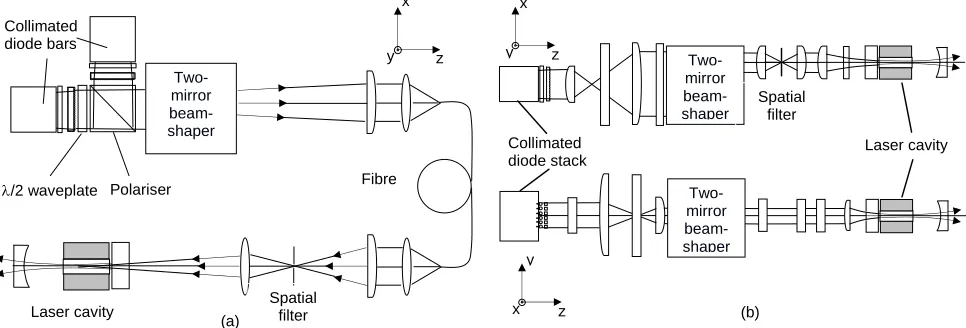
[image:2.595.56.539.508.672.2]Two diode-laser pump sources were employed in this study (Fig. 1): the first consisted of two low-fill-factor water-cooled diode-bars and the second a 6-bar low-fill-factor diode stack. Each bar, for
Fig. 1: Experimental configuration with (a) diode-bar pumping and (b) diode-stack pumping.
i Impex High-Tech, Rheine,Germany
Two-mirror beam-shaper
x
z y
Fibre
Spatial filter Laser cavity
Polariser
λ/2 waveplate Collimated diode bars
(a)
Two-mirror beam-shaper
Laser cavity
Two-mirror beam-shaper
Spatial filter x
z y
y
z x Collimated diode stack
both of the sources, was collimated in the fast and slow-axes with micro-lenses. The single diode bars were then polarisation combined to produce a single beam. Two-mirror beam-shapers [5] were employed to re-format the beams with roughly equal beam-quality factors in the orthogonal planes. For the polarisation-coupled bars, the resulting beam-quality was Mx2≈80 (parallel to the array) and My2≈52 (perpendicular to the array) with a maximum power of ~52W. In contrast the final beam-shaped diode stack beam-quality was Mx2≈160 and My2≈100 with a maximum power of ~265W. A uniform pump distribution was desirable for these comparative studies, hence the output beam from the diode-bar pump source was ‘homogenised’ by coupling into a multi-mode fibre with a core diameter of 365μm and 0.22 NA. A spatial filter was used to reduce the M2 value to ~100 allowing relatively tight pump focussing with minimal diffraction spreading even in the longest Tm:YLF rod under investigation, limiting the maximum available pump power to ~33W. To produce a similar beam-quality from the diode stacks, a spatial filtering slit was employed in the x-axis only, limiting the available incident power to ~115W, which was more than sufficient for our study.
Results and Discussion
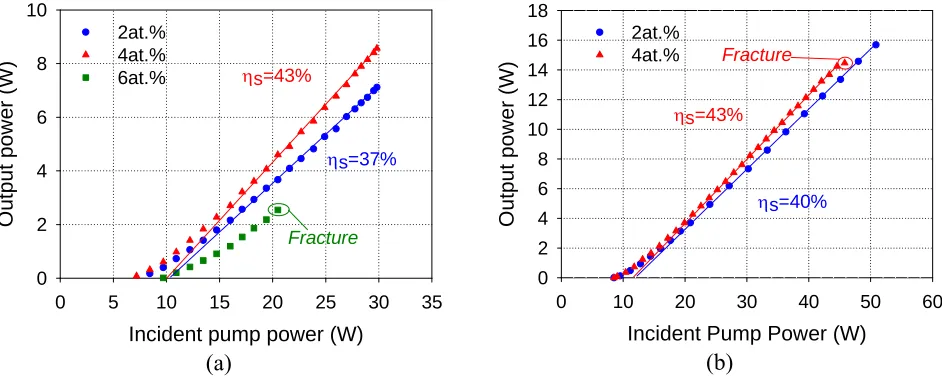
Fig. 2(a) shows the output power versus incident pump power for all three Tm:YLF rods using a 13.5% output coupler. Less than 10% output coupling resulted in a longer operating wavelength away from the peak of the σ-polarised emission cross section at 1.91µm. A linear fit to the data points for pump powers greater than three times threshold has been used to calculate the slope efficiency thus providing a good basis for comparison when operating in the saturated regime. Similar performance curves are shown in Fig. 2(b) for diode-stack pumping, apart from the 6at.% crystal which fractured whilst diode-bar pumping at an incident pump power of 20.5W. Furthermore the fracture limit for the 4at.% crystal was found when diode-stack pumping at an incident power of 45.8W. The pump absorption efficiencies at threshold were ~82% and ~84% respectively for Fig. 2(a) and (b), this small difference can be attributed to the linearly-polarised output of the diode stack source in contrast to the “un-polarised” output from the fibre-coupled diode-bars.
The laser output was determined to be σ-polarised with a wavelength of 1.91 μm. Thermal lensing is known to be weaker for σ-polarised light in YLF crystals due to a lower value for dn/dT than for the orthogonal π-polarisation. The weak nature of thermal lensing in the Tm:YLF laser is apparent, since there is no evidence of a thermally-induced roll-over in the output power.
Incident pump power (W)
0 5 10 15 20 25 30 35
O
u
tp
ut po
w
e
r (W
)
0 2 4 6 8 10
2at.% 4at.%
6at.% ηs=43%
ηs=37%
Fracture
(a)
Incident Pump Power (W)
0 10 20 30 40 50 60
Out
p
ut
p
o
wer
(
W
)
0 2 4 6 8 10 12 14 16 18
2at.%
4at.% Fracture
ηs=40%
ηs=43%
[image:4.595.63.534.119.307.2](b)
Fig. 2. Tm:YLF laser performance for various doping concentrations for (a) diode-bar and (b) diode-stack pumping.
An approximate value for the stress-fracture pump power limit can be obtained by comparing the thermal load per unit length for the three doping concentrations. The maximum stress, σmax, which YLF can tolerate in an end-pumped configuration before fracture occurs is dependent upon its material parameters, the pump beam size and the rod diameter [6]. The variable parameters for comparison here are the absorption length, αabs and the total maximum heat load, Ph_max:
max _ max αabsPh
σ ∝ (1)
where Ph is the power converted to heat when the pump power exceeds that required for threshold, and is given by:
(
QY St)
(
abs ETU)
ETUh P P P
P = 1−η η − + (2)
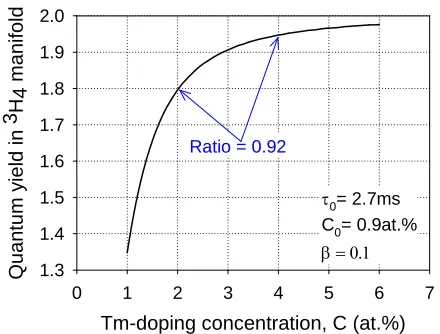
where ηQY is the quantum yield, ηSt the Stokes efficiency, PETU the amount of absorbed power channelled into ETU, which is clamped at threshold and is totally transferred to the crystal lattice as heat, and Pabs the absorbed pump power. At this point an estimation of the quantum yield as a function of doping concentration is required, which has been calculated (Fig. 3) following the method of Honea
et. al. [7], where the reported Tm:YLF lifetime measurements by Armagan et. al. [8] for various doping
concentrations and the 3F4→3H4 branching ratio after Walsh et. al. [9] have been used. The ratio of the predicted quantum yield values for 2 and 4at.% Tm (see Fig. 3) and the measured slope efficiencies are in good agreement. Therefore we can be confident in utilising the predicted quantum yield values to estimate the maximum heat load for the various doping concentrations investigated. The method employed is as follows, first one has to evaluate the threshold pump power that would be expected in the absence of ETU. This is achieved by simply scaling the threshold pump power measured for the 2at.% crystal by the ratio of 1.8, the quantum yield for 2at.%, with the quantum yield for the doping concentration of interest. The difference between the measured threshold power and the predicted threshold pump power without ETU represents PETU. Note it is necessary to assume PETU is negligible for 2at.% Tm with respect to the threshold pump power, such an assumption is warranted noting the small difference in threshold between 2 and 4at.% Tm in contrast to that for 6at.% Tm.
diode-bar pumping experiments, (b) there was negligible ETU for 2at.% Tm, thus enabling the estimation of the threshold power without ETU for each doping level, and (c) the calculated thermal load at which the 6at.% crystal failed, ~13W/cm, is a benchmark for the other crystals.
Table 1. Comparison summary of the parameters used to calculate the thermal loading in the diode-bar pumped Tm:YLF
Doping conc.
(At.%) Pth meas. (W)ηQY predicted without ETU Pth estim. P(W) ETU * α6At.% (W/cm) absPh @ Pfrac for
Predicted Pinclimit
(W)
2 7.2 1.8 7.2 ~0 3.6 74.6
4 6.8 1.95 6.6 0.13 5.6 48.5
6 9.7 1.97 6.6 2.6 13.0 20.5 (meas.)
* Note the absorption efficiency of 82% has been included here.
Tm-doping concentration, C (at.%)
0 1 2 3 4 5 6 7
Quan tum y ield in 3H 4 manifold 1.3 1.4 1.5 1.6 1.7 1.8 1.9 2.0
τ0= 2.7ms C0= 0.9at.%
β = 0.1
Ratio = 0.92
Incident pump power (W)
0 10 20 30 40 50 60 70 80
H e a ti n g po w e r pe r ab so rp tio n l e n g th ( W /c m) 0 2 4 6 8 10 12 14 2At.% 4At.% 6At.%
[image:5.595.310.534.254.426.2]6At.% Fracture limit
Fig. 3. Estimated quantum yield versus Tm concentration. τ0
is the un-quenched lifetime of the 3F
4 manifold, C0 a
characteristic doping concentration, and β the branching ratio for 3F
[image:5.595.61.281.265.432.2]4 →3H4 [7-9].
Fig. 4. Predicted heating power versus incident pump power for the various doping concentrations
Considering Fig. 4. it is important to note that equation (2) is valid only above threshold, i.e. when PETU is clamped, below threshold both the quantum defect heating and heating due to upconversion vary with pump power and would tend to zero for no incident pump power. Comparing the measured incident pump power at which fracture was observed for 4at.% Tm, i.e. 45.8W (Fig.2(b)), with the predicted value, 48.5W (Fig. 4.), we see that there is good agreement. Further support of this method is found when accounting for the higher threshold condition measured for diode-stack pumping, Fig 2(b). The higher threshold was attributed to the difference in the absorption efficiency and pump distribution within the Tm:YLF crystals for the two pump sources. As such a thermal load per absorption length of 13W/cm, corresponding to the 6at.% fracture limit, is calculated for the 4at.% crystal, which corresponds to an incident power of 45W and is in excellent agreement with the measured value of fracture-limit of 45.8W for diode-stack pumping. This provides a good level of confidence for the predicted maximum pump power limit for the 2at.% Tm:YLF crystal of 75W, which could generate ~25W of output power from a single standard single-end-pumped rod.
Conclusions
the stress-fracture limit for Tm:YLF rods. Consequently at the few tens of Watts pump power levels, the 4at.% Tm:YLF rod offered the best performance in terms of maximum output power and overall efficiency. However, despite having a ~10% lower quantum yield, the 2at.% Tm:YLF crystal, by virtue of a lower thermal loading density and therefore a much higher fracture-limit at the pump wavelength of ~792nm, appears to offer better prospects for end-pumped power scaling.
Acknowledgements
The authors would like to acknowledge Dr G. Rustad for very helpful discussions regarding earlier work on this topic. This work was funded by QinetiQ and carried out under the auspices of the UK Ministry of Defence Corporate Research Programme.
References
[1] S. A. Payne, L. L. Chase, L. K. Smith, W. L. Kway, and W. F. Krupke, "Infrared Cross-Section Measurements for Crystals Doped with Er3+, Tm3+, and Ho3+,"
IEEE Journal of Quantum Electronics, vol. 28, pp. 2619-2630, 1992.
[2] P. A. Budni, M. L. Lemons, J. R. Mosto, and E. P. Chicklis, "High-power/high-brightness diode-pumped 1.9μm Thulium and resonantly pumped 2.1μm Holmium lasers," IEEE Journal of Selected Topics in Quantum Electronics, vol. 6, pp. 629-635, 2000.
[3] A. Dergachev, K. Wall, and P. F. Moulton, "A CW side-pumped Tm : YLF laser," in Advanced Solid-State Lasers, Proceedings, vol. 68, OSA Trends in Optics and Photonics, 2002, pp. 343-346.
[4] M. Tsunekane, N. Taguchi, T. Kasamatsu, and H. Inaba, "Analytical and experimental studies on the characteristics of composite solid-state laser rods in diode-end-pumped geometry," IEEE Journal of Selected Topics in Quantum Electronics, vol. 3, pp. 9-18, 1997.
[5] W. A. Clarkson and D. C. Hanna, "Two-mirror beam-shaping technique for high-power diode bars," Optics Letters, vol. 21, pp. 375-377, 1996.
[6] L. Yan and C. H. Lee, "Thermal effects in end-pumped Nd:phosphate glasses," Journal of Applied Physics, vol. 75, pp. 1286-1292, 1994.
[7] E. C. Honea, R. J. Beach, S. B. Sutton, J. A. Speth, S. C. Mitchell, J. A. Skidmore, M. A. Emanuel, and S. A. Payne, "115-W Tm:YAG diode-pumped solid-state laser," IEEE Journal of Quantum Electronics, vol. 33, pp. 1592-1600, 1997.
[8] G. Armagan, A. M. Buoncristiani, A. T. Inge, and B. D. Bartolo, "Comparison of the spectroscopic properties of Tm and Ho in YAG and YLF crystals," in Advanced Solid-State Lasers, Proceedings, vol. 10, OSA Trends in Optics and Photonics, 1991, pp. 222-226.
[9] B. M. Walsh, N. P. Barnes, and B. Di Bartolo, "Branching ratios, cross sections, and radiative lifetimes of rare earth ions in solids: Application to Tm3+ and Ho3+ ions in LiYF4,"