-/-;>4@0 /4==0748->498 91 80>A9<5 =>->0
589A60/20 48 =><?.>?<0/ ;00<!>9!;00<
80>A9<5=
7BSJI 3BKJBRBCEFRLBOJ
- >IFSJS =UCNJTTFE GPR TIF /FHRFF PG ;I/
BT TIF
?OJVFRSJTY PG =T -OERFWS
&$%(
1UMM NFTBEBTB GPR TIJS JTFN JS BVBJMBCMF JO
<FSFBRDI,=T-OERFWS+1UMM>FXT
BT+
ITTQ+##RFSFBRDI!RFQPSJTPRY"ST!BOERFWS"BD"UL#
;MFBSF USF TIJS JEFOTJGJFR TP DJTF PR MJOL TP TIJS JTFN+
ITTQ+##IEM"IBOEMF"OFT#%$$&'#)*)%
>IJS JTFN JS QRPTFDTFE CY PRJHJOBM DPQYRJHIT
Adaptive Dissemination of Network State
Knowledge In Structured Peer-to-Peer Networks
Masih Hajiarabderkani
This thesis is submitted in partial fulfilment for the degree of
Doctor of Philosophy
at the
University of St Andrews
School of Computer Science
Abstract
One of the fundamental challenges in building Peer-to-Peer (P2P) applications is to locate resources across a dynamic set of nodes without centralised servers. Structured overlay networks solve this challenge by proving a key-based routing (KBR) layer that maps keys to nodes. The performance of KBR is strongly influenced by the dynamic and unpredictable conditions of P2P environments.
To cope with such conditions a node must maintain its routing state. Routing state maintenance directly influences both lookup latency and bandwidth con-sumption. The more vigorously that state information is disseminated between nodes, the greater the accuracy and completeness of the routing state and the lower the lookup latency, but the more bandwidth that is consumed.
Existing structured P2P overlays provide a set of configuration parameters that can be used to tune the trade-off between lookup latency and bandwidth con-sumption. However, the scale and complexity of the configuration space makes the overlays difficult to optimise. Further, it is increasingly difficult to design adaptive overlays that can cope with the ever increasing complexity of P2P environments.
This thesis is motivated by the vision that adaptive P2P systems of tomorrow, would not only optimise their own parameters, but also generate and adapt their own design. This thesis studies the effects of using an adaptive technique to automatically adapt state dissemination cost and lookup latency in structured overlays under churn. In contrast to previous adaptive approaches, this work investigates the algorithmic adaptation of the fundamental data dissemination protocol rather than tuning the parameter values of a protocol with fixed design. This work illustrates that such a technique can be used to design parameter-free structured overlays that outperform other structured overlays with fixed design such as Chord in terms of lookup latency, bandwidth consumption and lookup correctness.
A large amount of experimentation was performed, more than the space allows to report. This thesis presents a set of key findings. The full set of experiments and data is available online1.
Acknowledgements
Words fail to describe my profound gratitude for the people who have provided invaluable help during the course of my thesis. Yet, I strive to express my deepest appreciation for their help in the form of words.
I am forever indebted to Dr. Graham Kirby and Prof. Alan Dearle for their inspiration, insightful comments, support and guidance as I pursued this work. I am deeply grateful for their patience, and always encouraging me to think out of the box.
I would like to thank the Scottish Informatics and Computer Science Alliance for providing the funds to support my studies.
I am grateful to Dr. Dharini Balasubramaniam for her encouragement and help to start my research.
I thank Stuart, Jim, Jose, Davie and Andy for their support. I would like to specially thank Stuart and Jim for setting up and maintaining the cluster of computers that I ran my experiments on.
I would also like to thank Dr. John Thomson for the helpful conversations during my research. They helped me greatly to shape up my scattered thoughts.
I thank my office mates over the years for the interesting conversations, keeping me from going mad and helping me to finish my research.
I thank my fellow research students for the cakes, distractions, discussions and advice during my time as a research student.
This work would have not been possible without the help of the open source community. I thank you.
Declarations
Candidate declarations
I, Masih Hajiarabderkani, hereby certify that this thesis, which is approximately 32,768 words in length, has been written by me, that it is the record of work carried out by me and that it has not been submitted in any previous application for a higher degree.
I was admitted as a research student in October 2010 and as a candidate for the degree of Doctor of Philosophy in October 2010; the higher study for which this is a record was carried out in the University of St Andrews between 2010 and 2014.
Date: 26th October 2014 Signature of Candidate:
Supervisor declarations
I hereby certify that the candidate has fulfilled the conditions of the Resolution and Regulations appropriate for the degree of Doctor of Philosophy in the Uni-versity of St Andrews and that the candidate is qualified to submit this thesis in application for that degree.
Date: 26th October 2014 Signature of Supervisor:
Permission for publication
may be required in order to allow such access and migration, or have requested the appropriate embargo below.
The following is an agreed request by candidate and supervisor regarding the electronic publication of this thesis:
• No embargo on print copy. • No embargo on electronic copy.
Date: 26th October 2014 Signature of Candidate:
Contents
Abstract iii
Acknowledgements v
Declarations vii
List of Tables xiii
List of Figures xv
Code Listings xix
List of Acronyms xxi
1 Introduction 1
1.1 Key-based Routing . . . 2
1.2 Lookup Performance and Cost Under Churn . . . 3
1.3 Tuning Lookup For The Better . . . 4
1.4 Challenges . . . 6
1.5 Hypothesis . . . 7
1.6 Thesis Contributions . . . 7
1.7 Thesis Structure . . . 8
2 Related Work 9 2.1 Overlay Networks . . . 9
2.1.2 Structured Overlays . . . 11
2.2 Key-based Routing Tradeoffs . . . 12
2.3 Parameter Optimisation . . . 13
2.3.1 Off-line Parameter Optimisation . . . 14
2.3.2 On-line Parameter Optimisation . . . 15
2.4 Beyond Parameter Optimisation . . . 18
3 Algorithmic Adaptation of Routing State Maintenance 19 3.1 Motivation . . . 20
3.2 Challenges . . . 21
3.3 Representing Network State Dissemination Strategy . . . 23
3.3.1 Related Work . . . 23
3.3.2 Overview of Abstractions . . . 24
3.3.3 Peer State . . . 25
3.3.4 Routing . . . 25
3.3.5 Maintenance . . . 27
3.4 Adaptation of Network State Dissemination Strategy . . . 28
3.4.1 Environment Characterisation . . . 31
3.4.2 Fitness . . . 32
3.4.3 Fitness Relative to Environment . . . 34
3.4.4 Adaptive Strategy Selection . . . 35
3.4.5 Adaptive Strategy Generation . . . 35
3.5 Discussion . . . 38
4 A Platform to Study Adaptation of Network State Dissemina-tion Strategies 41 4.1 Requirements . . . 41
4.2 Design . . . 42
4.2.1 Peer . . . 43
4.2.2 Peer State . . . 44
4.2.3 Peer Statistics . . . 45
4.2.5 Adaptive Maintenance . . . 47
4.3 Implementation . . . 49
4.3.1 Peer State Implementations . . . 49
4.3.2 Pre-defined Selectors . . . 50
4.3.3 Fixed Maintenance . . . 50
4.3.4 Evolutionary Maintenance . . . 51
4.3.5 Random Maintenance . . . 52
4.4 Discussion . . . 52
5 Evaluation Infrastructure 53 5.1 Motivation . . . 54
5.2 Related Work . . . 57
5.3 The Ideal Evaluation Infrastructure . . . 58
5.4 Requirements . . . 60
5.5 Shabdiz: an Evaluation Infrastructure . . . 61
5.6 Design . . . 62
5.6.1 Application Network . . . 63
5.6.2 Application Descriptor . . . 64
5.6.3 Host . . . 65
5.6.4 Application Manager . . . 66
5.6.5 Scanner . . . 67
5.6.6 Remote Job Execution . . . 68
5.7 Implementation . . . 71
5.7.1 Remote Host Management . . . 71
5.7.2 Remote Platform Recognition . . . 71
5.7.3 Probing . . . 72
5.7.4 Java Application Deployment Strategy . . . 73
6 Evaluation of Adaptive Dissemination Approach 77
6.1 Experiment Design . . . 77
6.1.1 Workload Models . . . 78
6.1.2 Churn Models . . . 78
6.1.3 Dissemination and Adaptation Strategies . . . 79
6.1.4 Evaluation Criteria . . . 79
6.1.5 Justification Experiment . . . 80
6.2 Effect of Churn . . . 82
6.3 Effect of Workload . . . 85
6.4 Routing State Correctness vs. Completeness . . . 89
6.5 Effect of Adaptive Strategy . . . 90
6.6 Effect of Training . . . 92
6.7 Effect of Clustering Algorithm . . . 93
6.8 Effect of Lookup Correctness on Fitness Metric . . . 96
6.9 Analysis Over Time Under Oscillating Churn Rate . . . 97
7 Conclusion 103 7.1 Thesis Summary . . . 103
7.2 Future Work . . . 104
7.3 Final Thoughts . . . 105
A Evaluation of A Distributed Application Management Infras-tructure 107 A.1 Experiment Design . . . 107
A.2 Effects of Network Size . . . 109
A.3 Effects of Deployment Strategy And Application Size . . . 111
A.4 Effects of Scan Interval Duration . . . 114
A.5 Effects of Scanner Thread Pool Size . . . 118
A.6 Effects of Failure Proportion . . . 123
A.7 Large Heterogeneous Deployment . . . 124
Glossary 129
List of Tables
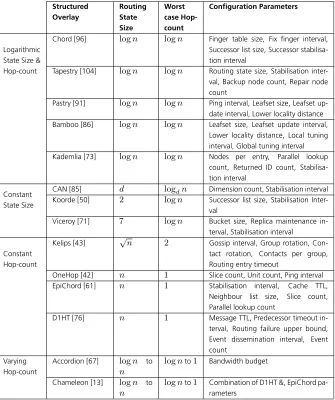
2.1 Comparison of notable structured overlays in terms of routing state size vs. hop-count trade-offs and configuration parameters in a network size ofn. . . 14
3.1 The mapping of phases in autonomic management cycle to dis-semination strategy adaptation. . . 30
5.1 Feature comparison of existing P2P evaluation infrastructure with an ideal infrastructure. . . 59
6.1 Workload patterns evaluated. . . 78
List of Figures
2.1 An overlay network sitting on top of a physical network. . . 10
3.1 The abstract components in a structured overlay and their rela-tionships. . . 25
3.2 Example of a dissemination strategy. . . 28
3.3 Structure of autonomic management cycle and its phases [53]. . . 30
3.4 Fitness measurement of a strategy in a 3 dimensional space. . . . 33
3.5 An example of GA crossover and mutation. . . 37
5.1 A high-level view of Shabdiz core components. . . 63
5.2 An object diagram of a network of 4 instances deployed on 2 hosts, where 3 of the instances are deployed on a single host and all the instances are members of a single network. . . 66
5.3 An object diagram of a network of 4 instances managed by 2 Application Managers. . . 67
5.4 Sequence diagram showing procedures that are performed upon job submission by the user. . . 70
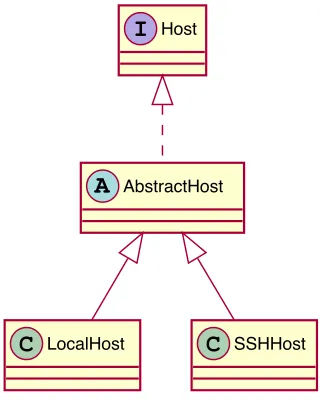
5.5 Hierarchy of Host implementations. . . 72
5.6 Hierarchy of platforms for which Shabdiz has built-in support. . 73
5.7 Hierarchy of built-in Application Network scanners. . . 73
6.1 Successful lookup rate per network size. . . 81
6.2 Successful lookup latency per network size. . . 81
6.3 Sent bytes rate per network size. . . 82
6.5 Hop-count of successful lookups by churn model. . . 84
6.6 Percentage of unsuccessful lookups by churn. . . 84
6.7 Latency of successful lookups by churn model. . . 85
6.8 Bandwidth consumption by workload model. . . 86
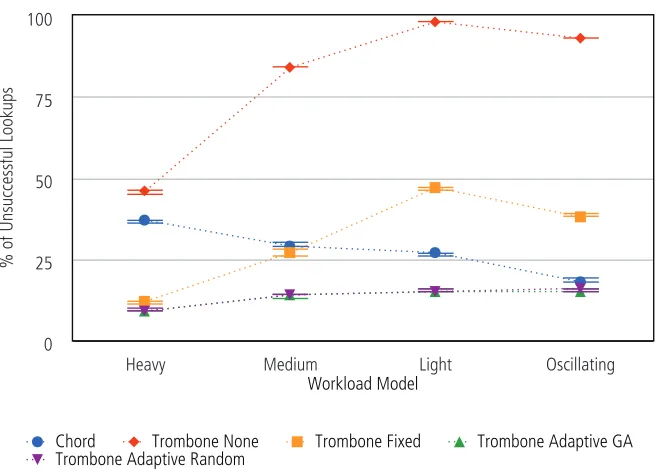
6.9 Percentage of unsuccessful lookups by workload model. . . 87
6.10 Hop-count of successful lookups by workload model. . . 87
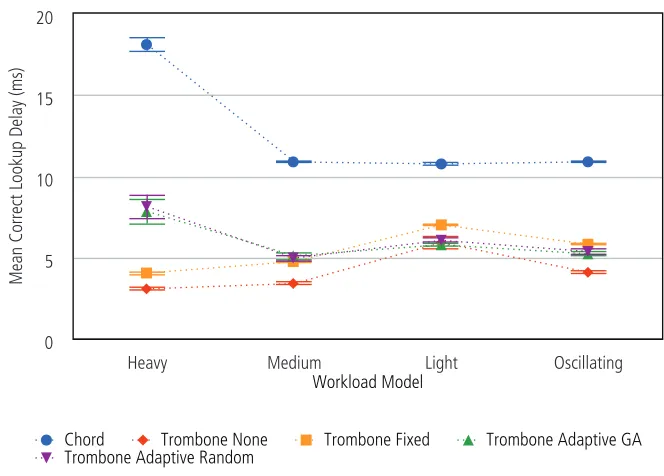
6.11 Latency of successful lookups by workload model. . . 88
6.12 Percentage of correct routing entries by churn model. . . 89
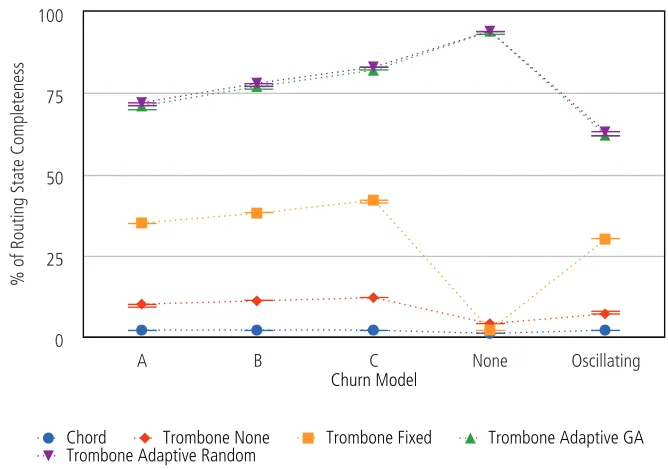
6.13 Completeness of routing state by churn model. . . 90
6.14 Percentage of correct routing entries by workload model. . . 91
6.15 Completeness of routing state by workload model. . . 91
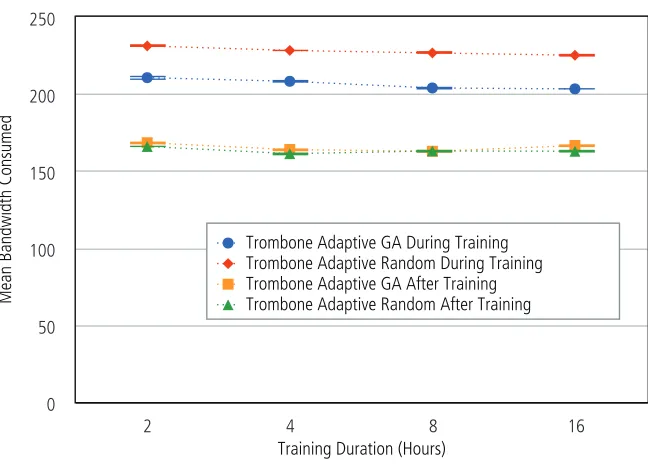
6.16 Bandwidth consumption by training duration. . . 93
6.17 Percentage of unsuccessful Lookups by training duration. . . 94
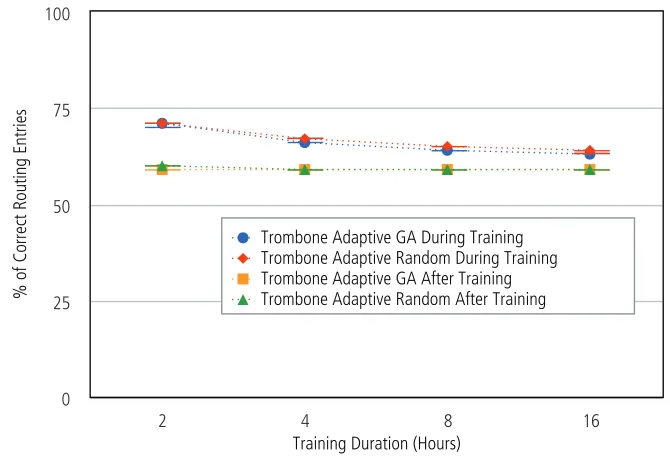
6.18 Percentage of correct routing entries by training duration. . . 94
6.19 Completeness of routing entries by training duration. . . 95
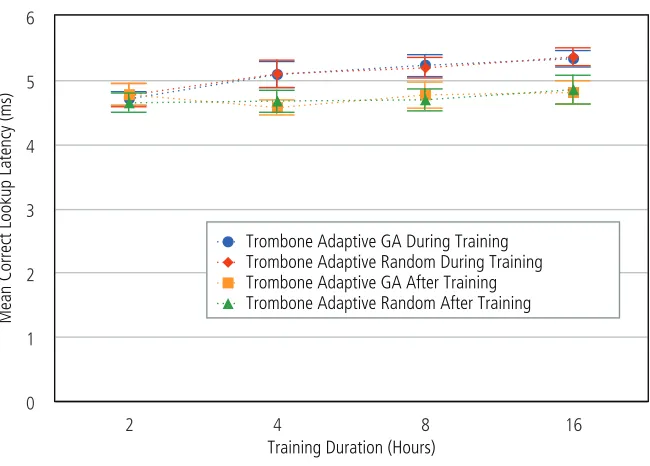
6.20 Successful lookup latency by training time. . . 95
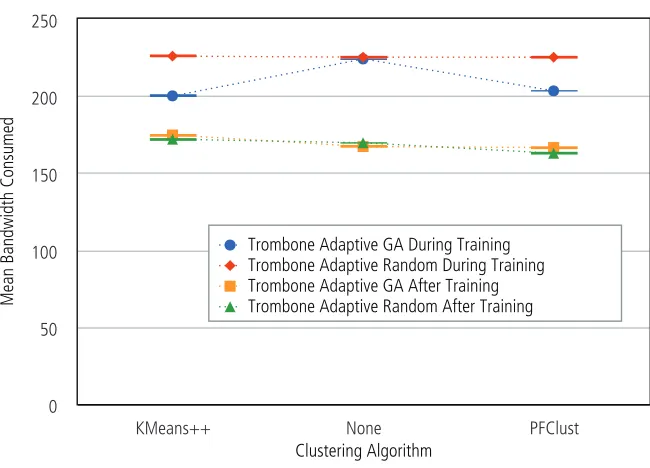
6.21 Bandwidth consumption per clustering algorithm. . . 97
6.22 Correctness of different configurations under oscillating churn. . . 98
6.23 Completeness of different configurations under oscillating churn. 99 6.24 Hop-count of correct lookups under oscillating churn for different configurations. . . 99
6.25 Fraction of unsuccessful lookups under oscillating churn for dif-ferent configurations. . . 100
6.26 Sent bytes per node per second under oscillating churn for differ-ent configurations. . . 101
A.1 Time to reach AUTH state per network size. . . 110
A.2 Time to reach RUNNING state per network size. . . 110
A.3 Time to reach RUNNING state per network size after killing 50% of instances. . . 111
A.4 Time to reach AUTH state per network size after killing all in-stances. . . 112
A.6 Time to reach RUNNING state per deployment strategy after
killing 50% of instances. . . 114
A.7 Percentage of CPU usage on the coordinator node per deploy-ment strategy. . . 115
A.8 Time to reach AUTH state per scanner interval. . . 116
A.9 Time to reach RUNNING state per scanner interval. . . 116
A.10 Time to reach stabilised Chord ring per scanner interval. . . 117
A.11 Percentage of CPU usage per scanner interval. . . 117
A.12 Percentage of CPU usage per scanner interval. . . 118
A.13 Kilobytes sent by the coordinator per scanner interval. . . 119
A.14 Kilobytes sent by the coordinator per scanner interval. . . 119
A.15 Time to reach AUTH state per thread pool size. . . 120
A.16 Time to reach RUNNING state per thread pool size. . . 121
A.17 Time to reach stabilised Chord ring per thread pool size. . . 121
A.18 Percentage of CPU usage on the coordinator node per thread pool size. . . 122
A.19 Kilobytes sent per second on the coordinator node per thread pool size. . . 122
A.20 Time to reach RUNNING state after kill per proportion of killed instances. . . 123
A.21 Time to reach an application state. . . 125
A.22 State change of application instances through the experiment. . . 125
A.23 Percentage of CPU usage through the experiment. . . 126
A.24 Memory usage through the experiment. . . 127
Code Listings
3.1 Operation to determine the closest node to a given target key
using local routing state. . . 26
3.2 Operation to lookup the responsible node for a given target key. 26 4.1 The peer interface representing a node in a structured P2P overlay. 43 4.2 The peer state interface representing the operations provided by the peer state data structure. . . 44
4.3 The abridged dissemination strategy interface representing the abstract model of routing state maintenance. . . 46
4.4 The dissemination operation interface representing network state dissemination operations. . . 46
4.5 The selector interface representing an algorithm to select a subset of routing state entries. . . 47
5.1 The host interface. . . 65
5.2 The application manager interface. . . 67
5.3 The abridged scanner class. . . 67
5.4 The worker class. . . 69
List of Acronyms
API Application Programming Interface CPU Central Processing Unit
DHT Distributed Hash Table DNS Domain Name System GA Genetic Algorithm
HTTP Hypertext Transfer Protocol ID Identification
IP Internet Protocol JDK Java Development Kit JRE Java Runtime Environment JVM Java Virtual Machine KBR Key-based Routing OS Operating System P2P Peer-to-Peer PC Personal Computer
PNS Proximity Neighbour Selection RPC Remote Procedure Call RTD Round-trip Delay
SFTP Secure File Transfer Protocol SSH Secure Shell
TCP Transmission Control Protocol TTL Time to Live
Chapter 1
Introduction
In August 2001, ASCI White [58] was the world’s fastest supercomputer. It was built by IBM [46] for the U.S. Department of Energy and the National Nuclear Security Administration, costing $110 million. With the peak performance of 12.3 teraFLOPS, ASCI White is capable of over 12 trillion operations per second [8].
Two years earlier University of California, Berkeley, launched SETI@home [94], massively distributed computing for SETI, a project searching for extra-terrestrial intelligence. SETI@home is a distributed system that uses millions of PCs around the globe to analyse radio signals from space. It costed $700 thousand to build [81, p. 49]. To date, its average throughput exceeds 700 teraFLOPS [12].
SETI@home is faster than ASCI White at less than 1% of the cost. Of course, the cumulative cost of millions of PCs running SETI@home far exceeds that of ASCI White. However, the PCs were bought and maintained before SETI@home existed and would continue to exist without it. SETI@home is an example of how powerful collective resources of millions of devices on the Internet can be.
Peer-to-Peer (P2P) applications are a class of distributed systems that unleash the tremendous potential of computing resources available at the edge of the Internet. While they offer great promise without excessive cost, there are many challenges that must be addressed to realise their full potential. One of the key challenges in the design of such systems is robustness, the ability to maintain correct functionality across different operating conditions [38].
perturbations to the operating conditions. An ideal system would monitor itself, and attempt to adapt its own configuration dynamically to tolerate unexpected load bursts and surges of failure.
This thesis investigates the challenges of designing such an adaptive system in the context of Key-based Routing (KBR) [25] in structured overlay networks, one of the building blocks of large-scale peer-to-peer applications. The thesis explores the effects of an adaptive approach on the robustness of KBR under volatile operating conditions.
1.1 Key-based Routing
Structured P2P overlay networks are one of the platforms for the construction of resilient, large-scale distributed systems [96, 91, 104, 73, 67]. Structured overlays conform to a graph structure that enables efficient location of resources among a dynamic set of participants by exchanging a few messages.
Anodeor apeerrepresents a participant in the overlay, where a single physical machine may host multiple nodes. Each node is assigned a uniform random iden-tifier from a large identifier space. Application-specific resources are assigned unique identifiers called keys that are selected from the same identifier space. For instance, Chord [96] and Tapestry [104] use a circular identifier space of 160-bit integers. The overlay dynamically maps each key to a unique live node, called theresponsible node. To route queries efficiently to the responsible node, each node maintains arouting stateconsisting of the identifier and IP addresses of the nodes to which the local node maintains overlay links.
Key-based routing is at the core of structured overlays. KBR provides a lookup service lookup(key → address) [25]: given a key, lookup yields the IP address of the key’s responsible node. The working of the lookup relates totransactive memory[102] in sociology. The concept is that people do not have to remember all the information they need. Instead, they remember who knows what. For example, when we do not know something, we ask a friend. If the friend does not know, we ask another friend or friend-of-a-friend.
Lookup operates similarly to the concept of transactive memory. A node locates the value of a given key by asking the node responsible for it in its routing state. If the node does not maintain a direct link to the node responsible for the key, the query is exchanged across overlay links to nodes whose identifier are progressivelycloser to the queried key in the identifier space. The definition of closeness varies across existing systems. For instance, Chord defines closeness as the clockwise distance from the queried key to the identifier of live nodes. Tapestry defines it as the longest matching prefix of the queried key to the identifier of live nodes.
[45]. For instance, a lookup service can be used to construct a simple DHT to store and retrieve values across a dynamic set of nodes. To store a value, a node calculates a unique key for the value (e.g. using a hash function) and looks up the node on which to store the value. Any node that knows the key, can then retrieve the value by looking up the same responsible node.
One of the distinguishing properties of structured overlays is that for a routing state size they can theoretically guarantee the maximum number ofhops, the number of messages that needs to be exchanged between nodes in order to map a key to the IP address of its responsible node. In general, the larger the routing state size, the less hops it takes to resolve a lookup. For instance, in a network of N nodes, where each node maintains a routing state of size logN, Chord guarantees to resolve lookups within logN hops. OneHop [42] guarantees to resolve lookups within a single hop by maintaining full routing state at each node. However, the guarantees only apply to networks in steady state, where node memberships do not change.
The change of node memberships is one of the fundamental characteristics of P2P networks [95, 89, 83]. In a P2P network each node is autonomous and may join or leave the network at any time. The continuous process of nodes joining and leaving the network is called churn. As nodes join and leave the network, the overlay dynamically maps keys to live responsible nodes. To cope with churn each node maintains the accuracy and completeness of its routing state. Routing state maintenance involves detection of stale routing entries and discovery of new ones. It is often performed periodically where the liveness of nodes are probed in regular intervals [96, 91], or opportunistically where information about the liveness of nodes is piggybacked on top of lookup requests [67, 42].
1.2 Lookup Performance and Cost Under Churn
A user of a structured overlay is mainly concerned with performance in terms oflookup latencyand cost in terms ofbandwidth consumption.
Lookup latency is the time it takes to map a key to the address of its responsible node. Lookup latency is of great importance in building delay-sensitive P2P ap-plications such as multiplayer online games [1] and distributed video streaming [79].
expensive than other consumed resources such as storage and computation. Fur-ther, in a typical scenario a node is more likely to hit its bandwidth limit first comparing to resources like storage.
Churn strongly influences both lookup performance and cost. Churn causes stale routing entries that lead to communication failures. Detection of stale routing entries by routing state maintenance incurs bandwidth use. Further, as the stale routing entries are detected and removed by the maintenance process, the routing state shrinks, which in turn increases the number of hops.
The increase of the number of hops affects lookup performance and cost in three ways. First, the more hops, the more messages are exchanged between nodes and the higher the bandwidth consumption. Second, since the latency of message transmission is high relative to local computation, more hops increases lookup latency. Third, the more hops, the higher the likelihood of communication failure. Such failures result in connection timeouts that require re-routing of lookup messages, which further increases lookup latency.
The number of hops is not the only factor affecting lookup latency. The Round-trip Delay (RTD) of each hop and the relative node speed also affects how long a lookup takes. Structured overlays such as Pastry [91] and Tapestry [104] use a locality-aware approach to populate their routing state. The idea is that each node populates its routing state with nodes to which it has low RTD. This technique is called Proximity Neighbour Selection (PNS) [40]. PNS is shown to effectively decrease the lookup latency in large-scale structured overlays [18]. But, PNS does not decrease the number of hops.
One way to decrease the number of hops is to increase the size of routing state. Intuitively, the more nodes a node knows about, the fewer hops are required to route a lookup. However, the larger the routing state the more bandwidth is consumed by routing state maintenance to keep the routing entries up-to-date in the face of churn.
The amount and accuracy of routing state is a fundamental tradeoff [103]. As a result, there is a spectrum of overlay designs. Some trade lookup latency for a small bandwidth consumption by maintaining a small routing state [96, 104, 91, 73]. Others trade bandwidth for fast lookups by maintaining a large routing state [42, 76, 61]. Structured overlays with small state size, like Chord [96], are suited to environments with high churn rate, where bandwidth is scarce. Structured overlays with large state, like OneHop [42], provide the best lookup latency, but may consume excessive bandwidth under high churn [66].
1.3 Tuning Lookup For The Better
is configurable, which directly affects the bandwidth that is consumed by main-tenance. D1HT [76] allows a user-specified TTL for maintenance messages that controls the extent of information dissemination about membership changes through the network. The configuration parameters enable users to choose and prioritise tradeoffs based on their needs, but tuning of the parameters for a particular scenario is non-trivial.
Parameter tuning requires deep understanding of the system and the operating environment. Consider routing state size in Chord, a well-studied structured P2P overlay. The routing state size of a Chord node is calculated bylogNwhere N is the maximum number of nodes in the network. The maximum number of nodes in the system is typically unknown, and so must be estimated. The size of a P2P network is dynamic, where it is affected by diurnal patterns and user behaviour [95, 80]. IfN is underestimated it takes more hops to resolve lookups, and if it is overestimated it results in high network traffic and bandwidth usage by the routing state maintenance process. Most existing structured P2P over-lays provide multiple configuration parameters. Their parameter space is often large and complex, and it is difficult to understand the relative impact of each parameter on the performance and cost of lookup under churn.
Structured overlays are typically optimised when the system isoff-line, at the pre-production stage under a controlled simulated environment. Off-line opti-misation typically involves systematic exploration of a subset of the parameters under a range of simulated environments that resemble deployment scenarios [66, 93]. The outcome of off-line optimisation is one or more static system configurations that are suited for particular environments.
Off-line system configuration has a number of limitations. The replication of the environment that a system experiences at the production stage during off-line optimisation can be difficult. P2P environments are complex and difficult to understand; they may vary over time and no longer resemble the simulated off-line conditions. Consequently, the applicability of the configurations that are found to be effective during off-line optimisation is limited.
One of the most important limitations of off-line optimisation is that it result in static system configurations. Commonly, statically configured overlays aim to achieve desired robustness even under uncommon adverse conditions. This results in high cost in the common case, or poor robustness in unexpected conditions [70]. For example, one of the common configurable parameters in structured overlays is the periodic maintenance interval. The smaller the inter-val, the more vigorously the state is maintained. Although this is an effective configuration to cope with high churn scenarios, under low churn it results in unnecessary traffic. Conversely, if the interval is large the system will consume less bandwidth, but it leads to poor lookup performance under high churn.
1.4 Challenges
Structured overlays operate thorough complex interactions of components dis-tributed across a large number of nodes. Nodes may be geographically far apart and may join or leave the network at any time. They may have widely differing bandwidth capacities that vary by orders of magnitude, and may experience changing levels of network traffic. Achieving robustness in such volatile and diverse environments is a challenge. The reasons are threefold.
First, due to the system complexity, it is difficult to entirely understand node interactions. As structured overlay networks grow larger the complexity of node interactions increases. Therefore, it is increasingly difficult to design effective maintenance strategies solely through theoretical speculation.
Second, since nodes are heterogeneous, a single configuration cannot result in optimum performance in all the nodes. Manual optimisation of the parameters for a particular environmental condition is non-trivial: the parameter space is often large and complex, where it is difficult to understand the relationships between the parameters and system behaviour [93]. Further, because of the large number of nodes in the networks, it is impractical to manually tune individual nodes.
Third, even if nodes are individually configured for optimum performance in a particular environment, the optimisation is only temporary. This is due to the unpredictable variation of operating conditions over time.
Statically configured systems are fundamentally prone to failure when faced with unexpected change of operating environment, since there is no single con-figuration that can offer the best performance and cost tradeoff in all scenarios. As computer networks grow larger and more complex, the necessity of adaptive systems is increasingly tangible.
Overlays are generally evaluated using simulation [5]. Due to the different features that are offered across simulators, it is difficult to compare the results of simulations between different studies. Further, simulators often require specific implementation of the overlay protocols. The overlay design is then adapted to accommodate requirements of the simulator. An ideal evaluation framework would not force the user to implement a specific version of the system only for evaluation. Instead, it would allow the evaluation implementation to be as close as possible to the production version. Facilitating such a framework is a challenge.
1.5 Hypothesis
This thesis is driven by the vision that the adaptive systems of tomorrow will not only configure themselves, but also, given basic building blocks, generate and adapt their own design in the context of adaptive structured P2P overlays.
This work illustrates that a structured overlay can benefit from a greater degree of adaptation, where it is the fundamental maintenance strategy that is adapted, rather than parameters to a fixed strategy.
This thesis hypothesises that a KBR can automatically and dynamically adapt the structure of its algorithm to changing environments, and can do so in a fully decentralised manner without any human intervention or configuration, and outperform static KBR systems in terms of performance and resource con-sumption.
1.6 Thesis Contributions
The contributions of this thesis are:
• A comparative performance study of a range of routing state maintenance strategies across changing environments.
• The development of a technique to automatically and dynamically adapt routing state maintenance strategy in a structured overlay network with-out human supervision or user-specified configuration parameters.
• The development of a framework to define and study complex routing state maintenance strategies in structured overlay networks.
• An open source parameter-free structured P2P overlay that dynamically adapts the state dissemination strategy with respect to both lookup la-tency and bandwidth usage under volatile environmental conditions.
• An open source distributed application deployment and monitoring frame-work. This framework is able to conduct an experiment on a single or multiple machines without the need for code alteration.
A large number of experiments were performed to study the effects of a greater degree of adaptation on the robustness of KBR against changing operating conditions. A large volume of results were gathered, more than the space allows to report. This thesis presents a set of key findings. The full set of experiments and data is available online1.
The evaluation was performed on a full implementation of an overlay protocol, without simulators. One of the main challenges in evaluating the system was to develop a platform that coordinates the deployment of large-scale P2P networks and data gathering from a full implementation of overlay protocols.
1.7 Thesis Structure
The rest of the thesis is organised as follows:
• Chapter 2presents a review of a broad range of literature related to the de-sign and optimisation of structured overlays. It concludes by highlighting the limitations of existing approaches. The work presented in this chapter provides motivation and a base for the system proposed in Chapter 3.
• Chapter 3 establishes the objectives of an adaptive parameter-free struc-tured overlay. This chapter proposes a system for adaptive and automatic network state dissemination under varying operating conditions, and de-scribes its design and implementation.
• Chapter 4 describes a platform for investigation of the effects of network state dissemination strategies on the performance and efficiency of routing in structured P2P overlays
• Chapter 5 describes the evaluation infrastructure used for the results pre-sented in Chapter 6.
• Chapter 6describes the design of the experiments conducted to investigate the effectiveness of adaptive state dissemination and evaluates the perfor-mance of the adaptive parameter-free DHT that is described in Chapter 4 under a range of churn and lookup rates. This chapter provides an extensive comparison of a number of adaptive approaches with Chord.
Chapter 2
Related Work
P2P is a class of applications that takes advantage of resources such as storage, computation, content and human presence available at the edges of the Internet [81, p. 19]. By their nature, P2P networks are volatile, composed of heteroge-neous nodes that may be physically far apart. P2P nodes are autonomous and may join or leave the network at any time.
In such diverse dynamic conditions, there are many challenges facing the de-signers of P2P systems such as load-balancing, security, anonymity, mobility and availability. One of the most fundamental of these challenges is to locate resources among a dynamic set of nodes without centralised servers.
2.1 Overlay Networks
To locate resources without centralised servers, P2P nodes self-organise to form anoverlay network. Buford et al. [14, p. 206] define an overlay network as:
“An application layer virtual or logical network in which end points are addressable and that provides connectivity, routing, and mes-saging between end points. Overlay networks are frequently used as a substrate for deploying new network services, or for provid-ing a routprovid-ing topology not available from the underlyprovid-ing physical network.”
Figure 2.1:An overlay network sitting on top of a physical network.
Many P2P systems operate by forming overlay networks that run on top of an existing network like the Internet. Characteristics of P2P overlay networks include:
• Cooperation- nodes contribute resources like storage and computation to the operation of the system.
• Decentralisation - there is no central point of control. Collective actions of nodes determine the behaviour of the system.
• Interconnection - nodes are connected to other nodes, forming the mem-bers of a connected graph.
• Self-organisation - nodes organise themselves to form an overlay network without central orchestration.
• Fault-tolerance - the system continues to operate despite unexpected fail-ure of nodes.
• Scalability- the system can expand to accommodate millions of nodes and growing workload.
• Autonomy - nodes are self-governed and may join or leave the network autonomously.
One of the most widely researched issues in a P2P network is routing: how to locate resources among a dynamic set of nodes without centralised control [4]. To locate resources, nodes employ arouting scheme. The routing scheme enables nodes to forward queries to nodes that are closer to the destination than this node.
• Bandwidth Usage- the bandwidth that is consumed by nodes in order to locate resources and maintain the overlay.
• Latency - the time it takes to locate a resource among the current set of nodes. It is desirable to locate resources quickly. One of the metrics that contributes to the routing latency is the number of forwards or hops a request will take before reaching its destination.
• Scalability- the ability to accommodate routing in large-scale networks or growing workload without incurring excessive cost.
Based on these metrics, the rest of this section discusses the performance of routing schemes in two classes of overlay networks: unstructuredandstructured.
2.1.1 Unstructured Overlays
Unstructured overlay networks do not have a fixed topology. In an unstruc-tured overlay each node stores data at will, and independently maintains a set of random links to other nodes. Since the topology of the network is formed ran-domly, unstructured overlays are simple to implement. In unstructured overlays there is no correlation between nodes and the data stored at them. As a result, locating resources in such networks essentially amounts to a search problem. To propagate queries across the overlay, nodes utilise heuristic routing strategies such as flooding, used by Gnutella [41], random walk, used by Gia [20] and hill climbing/backtracking, used by Freenet [22].
While heuristic routing techniques can effectively locate highly replicated data items, they are poorly suited for locating items that are not highly replicated. A search for resources that are not highly replicated can cause large-scale flooding across the entire network, and there is no guarantee that the query will ever be answered. Unstructured overlays generally suffer from scalability issues when handling a high query rate and sudden increases in system size [89, 69].
2.1.2 Structured Overlays
Structured P2P overlays aim to overcome the inefficiency of search in unstruc-tured overlays using a rigid structure for topology of nodes. The nodes arrange themselves based on a topology such as ring [96] or tree [104, 91]. Unlike un-structured overlays, there is a correlation between data placement and nodes.
Since there is a rigid structure to the network topology, structured overlays typically consume more bandwidth to maintain the network topology under churn. But they offer a number of key benefits:
• Full Search Space Coverage – theoretical guarantee that if a data item exists it will be found.
• Scalability – due to the small number of messages that need to be ex-changed in order to locate a resource they can scale to large number of nodes and handle high workload rates without excessive cost.
KBR is the main service that is provided by structured overlays. KBR is one of the key infrastructures for building a wide range of P2P applications. These applications range from high-level services such as distributed storage systems [55], distributed file systems [24, 90] and email [75]. Today KBR is at the heart of modern large-scale distributed systems such as Google’s Bigtable [19], Ama-zon’s DynamoDB [29], Facebook’s Cassandra [60], and LinkedIn’s Voldemort [98]. The proposal to separate addresses into identifier and locator in next gen-eration networking offers another important application of KBR, in particular mapping permanent host identity to changing IP address [51]. Taking into ac-count the wide-spread use of KBR protocols, they themselves must be robust and perform well under unexpected load bursts and surges in failures.
The rest of the chapter reviews related work on routing tradeoffs, optimisation and evaluation of structured overlays, and highlights the limitations of existing approaches to robust and efficient routing under churn.
2.2 Key-based Routing Tradeoffs
A fundamental tradeoff in the performance and cost of KBR in structured P2P overlays is the relationship between routing state size and hop-count. The larger the routing state size the fewer hops that are required to route a lookup. Fewer hops in general leads to lower lookup latency. However, the larger the routing state the more bandwidth that is consumed to keep the state up-to-date under churn. Other maintenance costs such as the cost of computation and storage are often ignored since bandwidth is typically far more expensive. The literature offers a spectrum of overlay designs that explore the tradeoff points between routing state size and worst case scenario lookup hop-count.
At the other end of the spectrum there are overlays that focus on fast lookups at the cost of higher bandwidth usage. They resolve lookups within a constant number of hops, independent of the size of the network. Such designs argue that maintaining a larger routing state at each node is viable even in networks with millions of nodes with reasonable bandwidth usage. For example, Kelips [43] in a network size ofnmaintainsO(√n)routing entries and aims to resolve lookups within two hops. OneHop [42], EpiChord [61] and D1HT [76] strive to resolve lookups with a single hop by maintaining complete state at every node.
Overlays with small routing state such as Chord are more suitable for high churn scenarios where low bandwidth usage is top priority. Further, overlays with large routing state are more desirable under low churn environments where low lookup latency is a primary requirement. Varying-hop structured overlays aim to fill this gap.
Varying-hop structured overlays monitor the current operating conditions to adaptively configure their own routing state size. As a result, the worst-case sce-nario hop-count varies depending on conditions such as churn rate or available bandwidth. For instance, Accordion [67] limits its routing state maintenance based on a given bandwidth budget, and automatically adjusts the size of its routing state. Chameleon forms a two-tier overlay of low and high bandwidth nodes. It then adapts the maintenance strategy for each tier: it uses an op-portunistic strategy for low-bandwidth nodes based on EpiChord [61], and an active strategy for high-bandwidth nodes based on D1HT [76]. Under low band-width or high churn rate, varying-hop overlays offer a logarithmic hop-count, while for higher bandwidth they provide near single-hop routing.
Table 2.1 lists a summary of notable structured overlays with routing state size and their worst-case hop-count.
Routing state size and hop-count are not the only factors affecting the tradeoff between routing performance and maintenance cost. The tradeoff is also affected by the optimisation of overlay configuration parameters.
2.3 Parameter Optimisation
Existing structured overlays provide a set of configuration parameters that can tune their performance versus cost tradeoffs. Table 2.1 lists the configuration parameters for a number of notable structured overlays.
Table 2.1:Comparison of notable structured overlays in terms of routing state size vs. hop-count trade-offs and configuration parameters in a network size ofn.
Structured Overlay Routing State Size Worst case Hop-count Configuration Parameters Logarithmic State Size & Hop-count
Chord [96] logn logn Finger table size, Fix finger interval, Successor list size, Successor stabilisa-tion interval
Tapestry [104] logn logn Routing state size, Stabilisation inter-val, Backup node count, Repair node count
Pastry [91] logn logn Ping interval, Leafset size, Leafset up-date interval, Lower locality distance Bamboo [86] logn logn Leafset size, Leafset update interval,
Lower locality distance, Local tuning interval, Global tuning interval Kademlia [73] logn logn Nodes per entry, Parallel lookup
count, Returned ID count, Stabilisa-tion interval
Constant State Size
CAN [85] d logdn Dimension count, Stabilisation interval Koorde [50] 2 logn Successor list size, Stabilisation
Inter-val
Viceroy [71] 7 logn Bucket size, Replica maintenance in-terval, Stabilisation interval
Constant Hop-count
Kelips [43] √n 2 Gossip interval, Group rotation, Con-tact rotation, ConCon-tacts per group, Routing entry timeout
OneHop [42] n 1 Slice count, Unit count, Ping interval EpiChord [61] n 1 Stabilisation interval, Cache TTL,
Neighbour list size, Slice count, Parallel lookup count
D1HT [76] n 1 Message TTL, Predecessor timeout in-terval, Routing failure upper bound, Event dissemination interval, Event count
Varying Hop-count
Accordion [67] logn to n
lognto1 Bandwidth budget
Chameleon [13] logn to n
lognto1 Combination of D1HT &, EpiChord pa-rameters
2.3.1 Off-line Parameter Optimisation
the pre-production stage before the system is deployed and used by end-users. Off-line optimisation can provide valuable insight about the system behaviour. It allows consistent evaluation and validation of the system under particular operating conditions that may not be possible at the production state due to unexpected changes in operating conditions [93].
One of the key challenges of parameter optimisation is to understand the ef-fect of individual configuration parameters on performance and cost. Li et al. [65] comprehensively study the configuration parameters of Chord, Tapestry, Kademlia, Kelips and OneHop. They present PVC [66], a performance versus cost framework that compares the relative importance of individual configura-tion parameters to the performance and cost of lookup. PVC measures cost in terms of bytes sent per live node per second, and performance in terms of the frequency of failed lookups and latency of successful lookups. PVC exhaustively evaluates a set of parameter combinations. It then usesconvex hullsto find the best performance/cost tradeoffs for a given churn and workload scenario. It is possible that better combinations exist that are not found by PVC.
Although off-line optimisation may provide valuable insights about system be-haviour, it has a number of shortcomings:
1. Off-line optimisation is only possible if the system can be simulated.
2. Replicating the environment that a system experiences at production stage can be difficult. To be replicated, the environment must be un-derstood; this is particularly challenging in P2P overlays because of their scale, heterogeneous nodes and complexity of underlying network condi-tions.
3. The applicability of the results from off-line optimisation may be lim-ited. The configuration parameters and operating environments that are studied off-line typically cover a small fraction of the space of possible scenarios. Further, the environment at the production stage may change or not resemble the evaluated off-line conditions [97].
4. Off-line optimisation aims to find a set of static configurations. Stati-cally configured systems are prone to failure under changing environments, since there is no single configuration that can satisfy performance versus cost criteria in all scenarios. To cope with the change of operating condi-tions, the system configuration must be dynamically adjusted.
2.3.2 On-line Parameter Optimisation
configuration. The fitness is typically represented as a function that summarises the performance of the system as a numerical value. The fitness function defines the relationship between the current state of the system and a desired state.
The existing work on on-line parameter optimisation of overlays can be classified intoexternal andinternal optimisation.
External parameter optimisation focuses on tuning the parameters of an exist-ing overlay without changexist-ing the design of the overlay. In this approach the optimisation mechanism is an independent component from the overlay itself. External optimisation mechanisms are often presented as generic adaptation frameworks that are applicable to most existing overlays.
Ghinita et al. [32] present a framework that, in order to satisfy a user-specified quality threshold (such as the maximum lookup failure rate), adaptively adjusts the periodic maintenance interval based on a local estimation of churn rate. The framework uses a statistical model of node arrival and departure rates to ap-proximate the probability of routing entry failures. Based on this probability the system calculates the interval between maintenance cycles. Using simu-lation, they illustrate that the framework effectively adjusts the maintenance interval of Chord overlay under varying churn rates. However, the framework is applicable to any overlay with a configurable periodic maintenance interval.
Tauber et al. [99], using a generic adaptation framework [100], automatically adjust the maintenance intervals in Chord. They characterise a maintenance cycle that does not result in change of state as a wasted cycle. Further, the system counts the number of cycles that result in failure. Given a responsiveness factor, the system then automatically increases the maintenance intervals with the increase of wasted cycles, and decreases the interval when the number of failed maintenance cycles rises.
External parameter optimisation hides the complexities of adaptation, where an adaptation approach can be reused across a wide range of existing overlays. A key shortfall of external parameter optimisation is that the performance of the system as a whole is intrinsically limited by the design of the overlay itself. Another shortfall of this approach is that parameter optimisation typically re-quires a user-specified threshold, which although easier to understand, is not trivial to specify. Ideally the user should not have to specify any policies for adaptation.
Internal parameter optimisation is integrated with the design of the overlay. The integration of the optimisation mechanism with the overlay components helps the designers to release the full benefits of on-line parameter optimisation. It results in structured overlays that are designed with adaptation in mind. Some approaches to internal parameter optimisation offer new techniques to maintain routing state entries for existing overlays such as Bamboo [86] and MSPastry [17]. Others provide a complete overlay re-design like Accordion [67].
overlay tries to replace a stale routing entry upon detection. They illustrated that under limited bandwidth, reactive recovery can lead to a positive feedback cycle that overloads the network, causing high latency lookups and incorrect mapping of keys to responsible nodes. They proposed Bamboo [86], an over-lay based on Pastry that can be configured to perform periodic and reactive maintenance. Bamboo uses two techniques to minimise lookup latency under churn. First, to minimise the communication timeouts caused by stale routing entries, Bamboo estimates an appropriate timeout value for outgoing messages during lookup. The timeout is calculated using Vivaldi [26], a virtual coordi-nate system that estimates timeouts without measuring the response time to every node in the system. Second, Bamboo utilises PNS [40] to minimise the RTD of individual hops. It has been shown that Bamboo is able to provide low latency lookups under churn with low bandwidth consumption in comparison with overlays such as Chord and Kademlia [6].
Castro et al. proposed MSPastry [17], a refined version of Pastry that aims to provide robust routing under churn. MSPastry uses periodic probing to detect stale routing entries. To control its bandwidth consumption, it self-tunes the probe intervals depending on the node failure rate estimated using historical failure observations. MSPastry exploits the structure of the overlay to minimise the failure detection overhead. Each node periodically probes a pre-defined subset of its routing entry and shares the results of the probe with nodes closest to itself.
Li et al. [67] introduced Accordion, an overlay that dynamically adjusts the size of its routing state and the degree of lookup parallelism. Accordion has a single tuneable configuration parameter: bandwidth budget, the maximum bandwidth that may be consumed by a node. Depending on the current environment the system automatically adjusts the size of its routing state to use the available bandwidth effectively. If bandwidth is available, Accordion actively discovers new entries via lookup. Under heavy workload, Accordion decreases its learning rate to cut back on bandwidth usage. Further, when the bandwidth is available it uses parallel lookups to avoid the latency that is caused by timeouts due to stale routing entries.
2.4 Beyond Parameter Optimisation
A desirable property of a structured overlay is to adapt itself in order to be robust across a wide range of operating environments [38]. A key issue is the extent of adaptation in existing approaches. To our knowledge, all existing approaches to adaptation involve tuning internal system parameters of fixed maintenance strategies. For instance, the adaptive tuning of the maintenance interval in Chord does not change the fundamental strategy by which a Chord node maintains its routing state. It only affects the intensity with which the state is maintained. Another example is the routing state learning mechanism in Accordion. The system has built-in strategies to discover new nodes using lookups. When the system decreases its learning rate it is the intensity of learning that is adapted and not the strategy by which new nodes are discovered. It is possible that there is a more effective strategy for routing state discovery that could have offered a better tradeoff in a particular environment.
Chapter 3
Algorithmic Adaptation of
Routing State Maintenance
Routing state maintenance fundamentally affects the performance and cost of an overlay. The more vigorously the state is maintained the more accurate the routing state at each node, but the more resources that are consumed.
Adaptive structured overlays such as Accordion aim to dynamically tune their system configuration parameters to provide a better performance versus cost tradeoff in the face of changing operating conditions: varying degrees of churn and workload. The maintenance mechanism in adaptive structured overlays is typically decided at the design stage. It often provides a set of internal con-figuration parameters that are dynamically tuned based on the changes in the operating conditions. The effectiveness of the system in the face of unexpected changes is highly dependent on the decisions made at the design stage. Al-though existing adaptive overlays dynamically adjust their internal parameters, due to their fixed maintenance mechanism their adaptability is fundamentally limited.
As P2P systems grow larger and more interconnected, it is increasingly difficult to anticipate interactions between their components. Manual supervision of such large-scale complex systems is impossible due to their high diversity and unpredictable changes in operating conditions. As a result, designing adaptive overlays that are robust in the face of unexpected changes in the operating conditions is increasingly difficult.
conservative and premature assumptions about the operating conditions, and offer more flexible and powerful adaptation in the face of unexpected changes to the operating conditions.
This work is driven by the vision that the P2P systems of tomorrow, given basic building blocks, will adapt and tune their own designs in order to cope with the dynamism of their operating conditions. An ideal system should adapt itself without the need for any human intervention. Such a system would learn about the environment and its own performance and adapt itself to suit the changes to the operating conditions. If a system can tune the design of its internal algorithm there would be a greater opportunity for adaptation. This thesis explores the effects of this approach, referred to as algorithmic adaptation, in the context of routing state maintenance in structured overlay networks.
Algorithmic adaptation of routing state maintenance is a process that dynami-cally and automatidynami-cally tunes the underlying algorithm by which the complete-ness and correctcomplete-ness of routing state is maintained; the adaptation is performed in response to the changes of the operating environment in order to increase per-formance and decrease cost. Algorithmic adaptation allows a node to dynam-ically switch between periodic and opportunistic maintenance strategies, and dynamically select the content, the size and the recipients of the network state dissemination messages. In comparison with the design of existing adaptive overlays such as Accordion, algorithmic adaptation provides a greater degree of adaptability; algorithmic adaptation, given basic building blocks for mainte-nance, generates and adapts its own maintenance mechanism.
This chapter motivates the need for algorithmic adaptation in order to cope with unpredictable changes in the operating conditions of structured P2P overlay networks. The chapter discusses the challenges of algorithmic adaptation and explains an approach to tackle the challenges.
3.1 Motivation
The routing state maintenance algorithm in existing overlays is fixed: the mech-anism by which the network state knowledge is disseminated is decided at the design stage (typically based on some assumptions about the operating environ-ment) and does not change at runtime. Instead, the system tradeoffs are tuned via a combination of internal and user-specified configuration parameters.
p. 72]. The more lookup messages there are, the more vigorously the network state is disseminated. Accordion automatically adjusts the degree of parallel lookups to stay within a user-specified bandwidth budget, which in turn affects the information dissemination rate.
Changing the degree of lookup parallelism in Accordion does not change the mechanism by which the state is disseminated. Regardless of the degree of lookup parallelism, the system always uses the same mechanism to select piggy-backed information and the information is always transmitted opportunistically. There could be operating conditions where an active approach or another se-lection mechanism would offer a better tradeoff. Further, it has been shown that their underlying assumption about node lifetimes is not valid in large-scale file sharing networks such as BitTorrent [11, 80, 97]. The invalidity of their assumption can cause dissemination of information about nodes that may be unstable, which can lead to stale routing entries and potentially cause network partitions. A fixed algorithm is fundamentally limited in its adaptability to the changing operating conditions because of the unchangeable decisions made at the design stage.
When the routing state maintenance mechanism is decided at the design stage, the maintenance operation is typically optimised to perform well in the com-mon scenario. As a result, under uncomcom-mon scenarios the maintenance opera-tion may not be ideal. If the scope of adaptaopera-tion incorporates the algorithmic structure of the routing state maintenance mechanism, not only are designers freed from having to make decisions about unknown operating environments, but there is also a greater opportunity to adapt to unexpected operating condi-tions for the adaptation mechanism. There may be a maintenance mechanism that is highly effective in a particular scenario and not as effective in others. An algorithmic adaptation mechanism can detect such cases and gracefully switch between different maintenance strategies to suit the current environment. Fur-ther, when the system is faced with a scenario that is not anticipated by the system designers, the system may be able to generate its own maintenance mech-anism and can potentially offer superior adaptation to unexpected conditions.
In order to algorithmically adapt the routing state maintenance in a structured overlay, a set of challenges must be overcome. The following section discusses these challenges.
3.2 Challenges
Algorithmic adaptation of the maintenance mechanism involves automatic and dynamic tuning of how routing entries are kept up-to-date; this aims to offer a better performance versus cost tradeoff in the current operating conditions.
The maintenance mechanism needs to be reified to a data structure that can be manipulated by the adaptation process.
It is desirable to model maintenance mechanism representation in such a way that the model can capture the maintenance mechanism of existing overlays. This is so that fixed maintenance mechanisms can be compared with algorith-mically adaptable maintenance mechanisms.
In existing overlays the maintenance mechanism is tightly coupled with other overlay components such as the routing state and routing protocol. For example, Chord and Accordion periodically maintain a list of successors, which is used to maintain lookup functionality upon successor failure. In such designs, sepa-rating the maintenance mechanism from the routing algorithm or the routing state, without breaking the functionality of the protocol, would be impossible. To allow algorithmic adaptation, other overlay components must not directly depend on a specific maintenance mechanism. Instead, a generic model of the overlay is needed to separate the maintenance mechanism from other overlay components. Further, the routing state must be designed in such a way to allow flexibility of the maintenance mechanism.
The main objective of algorithmic adaptation is to find good maintenance mech-anisms for changing operating conditions. From this objective follow a number of challenges:
1. The system must be able to automatically generate new maintenance mechanisms in order to cope with operating conditions that none of the pre-designed maintenance mechanisms are effective.
2. The fitness of a strategy must be evaluated under changing operating conditions, since the fitness of a generated maintenance mechanism may dramatically change in a different environment. To estimate the fitness of a maintenance mechanism, the system must measure its fitness relative to the current conditions.
Algorithmic adaptation of overlay maintenance is amulti-objectiveoptimisation problem. Optimisation is multi-objective when a decision needs to be made while taking into account tradeoffs between conflicting concerns such as perfor-mance and cost. In a non-trivial multi-objective optimisation problem there are often multiple solutions. The challenge is to automatically choose between different maintenance mechanisms in order to improve the performance and efficiency of routing in the current environment.
To overcome the challenges discussed above, the next section presents a model for representing maintenance mechanisms. The rest of the chapter presents an approach to algorithmic adaptation of maintenance mechanisms relative to the current operating conditions.
3.3 Representing Network State Dissemination
Strategy
This section introduces an abstract model for the design of structured overlays that aims to decouple routing state maintenance from other overlay compo-nents such as the routing state and routing scheme, and provide basic building blocks to define routing state maintenance mechanisms. The model aims to allow dynamic algorithmic adaptation of routing state maintenance while cap-turing commonalities between existing maintenance mechanisms in order to make understanding, comparison and extension of existing work easier. The model provides a common ground for the comparison of different overlay pro-tocols. Hence, a more coherent experimental comparison of different overlays is possible. Further, it allows more convenient adoption of innovative and new improvements into existing systems.
In comparison with previously proposed models [25], this work focuses on captur-ing the structure of routcaptur-ing state maintenance mechanisms. The routcaptur-ing state maintenance mechanism has a direct and significant impact on the performance and cost of an overlay. Therefore, capturing the commonalities between differ-ent routing state maintenance mechanisms is necessary to appropriately com-pare different overlay designs and identify innovative maintenance approaches.
3.3.1 Related Work
Past studies propose a range of models and APIs that aim to capture the com-monalities among the designs of structured P2P overlays.
Dabek et al. [25] identify high-level abstractions for existing structured over-lays. They propose a key-based routing API that can be implemented by ex-isting structured P2P overlays. They further present a number of high-level abstractions over the communication model of structured overlays and discuss how such abstractions can capture the commonality between distributed hash tables, group anycast/multicast protocols, and decentralised object location and routing systems.
work does not explicitly capture commonality among routing state maintenance mechanisms.
Other efforts to capture commonalities between structured overlays include domain-specific languages such as OverML [9]. OverML is a language for speci-fying P2P overlay protocols. The idea is to provide a platform for rapid overlay implementation using a high-level protocol specification. Their approach can re-duce the development time for an overlay protocol. OverML can be used to gen-erate specific implementations for various testbeds such as sensor networks from a single protocol specification specified in a domain-specific language. OverML is primarily aimed at rapid development of overlays using a domain-specific lan-guage, covering the entire development process (i.e. from design to deployment). The overlay abstractions presented in this chapter discusses a model for overlays at an abstract level where the primary objective is to capture common design features and maintenance mechanisms.
Extending the work of Dabek et al., Ciaccio proposes a generic API for P2P programs [21]. The work offers a more extensive model for RPC that allows unidirectional communication between peers. Although the work offers a more extensive API for developing P2P applications, the API does not capture the commonality of routing state maintenance operations. The API simply provides request and response methods. It is up to the user to use the request and response methods to express exact maintenance operations. Hence, there is no clear separation between the components of a structured overlay, in particular the maintenance mechanism.
3.3.2 Overview of Abstractions
This work proposes the following abstract components in a structured overlay protocol:
• Peer state– a data structure containing the local knowledge of the network state,
• Routing– a process that using the peer state maps a key to its responsible node, and
• Maintenance– a process that maintains the correctness and completeness of the peer state.
Figure 3.1:The abstract components in a structured overlay and their relationships.
3.3.3 Peer State
The peer state is a data structure that stores the network state knowledge at each node. This is a collection of references to nodes that are believed to be alive. A reference to a live node consists of two pieces of information: 1) the key for the live node, and 2) the network address of the live node. The node’s key is needed by the routing component to route lookup messages. The node’s network address is necessary to establish network connections to the node in order to exchange lookup and maintenance messages.
The peer state does not have a fixed size; the state is free to grow as large as the network size or shrink to an empty state. This design has a number of advantages. Firstly, the user is freed from explicitly configuring the state size. Secondly, a peer state data structure with varying size provides a greater opportunity for adaptation to unexpected operating conditions. Thirdly, it simplifies the peer state design and maintenance mechanism, since there is no need for additional mechanisms to ensure the peer state size remains fixed. Further, it has been shown that expansion of peer state is a more effective use of bandwidth in comparison with vigorously maintaining the correctness of a small state in the face of churn [66]. This work is not the first to propose a varying-size peer state. Accordion [67] is one of the first structured overlays that proposed this design.
3.3.4 Routing
The routing component is responsible for the main operation provided by the structured overlay, i.e. key-based routing. Using the information stored in the peer state, and communicating with other nodes the routing component maps a given key to its responsible node.