THE ROLE OF UNCERTAINTY IN CLOUD COMPUTING
CONTINUANCE: ANTECENDENTS, MITIGATORS, AND
CONSEQUENCES
Trenz, Manuel, University of Augsburg, Universitätsstr. 2, 86159 Augsburg, Germany,
[email protected]
Huntgeburth, Jan, University of Augsburg, Universitätsstr. 2, 86159 Augsburg, Germany,
[email protected]
Veit, Daniel, University of Augsburg, Universitätsstr. 2, 86159 Augsburg, Germany,
[email protected]
Abstract
While initial acceptance of information systems (IS) is an important step, the elimination of an up-front commitment implies that the success of cloud-based services depends on customers’ continued use rather than the initial adoption. Even in long term business relationships, it is difficult for users to judge the true qualities, intentions and actions of cloud providers. Drawing on principal-agency theory, we therefore establish users’ uncertainty perceptions as a key driver of cloud computing continuance. We identify privacy, security and availability concerns as the major sources of these uncertainties. In a survey among 143 users of cloud storage services, we find empirical evidence that trust is the primary mitigator of privacy and security concerns while low switching costs reduce availability concerns. Overall, our study confirms that the principal-agent theory is a very fruitful theoretical perspective to explain post-adoption phenomena in an IT world where digital services begin to substitute IT products. Our results provide guidance for providers on how to successfully manage customers’ concerns in this highly competitive market.
1
Introduction
The potential benefits and transformative power of cloud computing are widely acknowledged by practitioners and researchers. One of the most popular applications of cloud computing are cloud storage services allowing users to back-up, synchronize and share their personal files via remote disks accessible as a service over the internet (Armbrust et al., 2010). Cloud storage services are widely adopted by internet users (Zetta, 2010) and share many characteristics with other cloud-based services (e.g., appearance of infinite computing resources available on demand, elimination of an up-front commitment, ability to pay for use of computing resources, see Armbrust et al., 2010). While initial acceptance of information systems (IS) is an important step, the elimination of an up-front commitment implies that market success for cloud providers depends on consumers continued rather than first-time use (Bhattacherjee, 2001). Understanding the mechanisms influencing cloud computing continued use (continuance) among individual consumers is the goal of this study.
There is considerable research on IS continuance examining the phenomenon among individual consumers (students: e.g. Bhattacherjee, 2001; online banking users: e.g. Limayem et al., 2007), based on different theoretical (expectation-confirmation theory: e.g. Bhattacherjee, 2001; theory of planned behavior: e.g. Hsieh et al., 2008) and methodological perspectives (cross-sectional: e.g. Hong et al., 2011; longitudinal: e.g. Nicolaou and McKnight, 2011). While classical adoption and diffusion theory view continuance as an extension of individual acceptance behaviors, this view does not elaborate on the users’ changing perceptions emerging after the initial adoption decision (Bhattacherjee, 2001; Karahanna et al., 1999). Accordingly, user satisfaction and usefulness of the product are the most prominent predictors of IS continuance (Bhattacherjee, 2001; Hong et al., 2011; Limayem et al., 2007; Sun, 2010). Cloud computing differs from previously studied products and services in the way that it introduces a continuous uncertainty into the relationship between the provider and the user. Although the user depends on the cloud service provider at all time, he has only limited information about the providers’ qualities, intentions, and actions. However, the role of uncertainty has not been examined in the literature on IS continuance. Therefore, we tackle the research question: what is the role of uncertainty in cloud computing continuance?
Overall, the expected contribution of this paper is twofold. First, the study aims at extending previous research on IS continuance by examining the role of uncertainty in a scenario where the user depends on the service provider over the whole life-cycle of the relationship. Thereby, we aspire to establish uncertainty as a key driver of IS continuance in the age of cloud computing. Second, to our best knowledge this is the first study to apply a principal-agent perspective on IS continuance. While the principal-agent perspective is a well-established theoretical lens in IT outsourcing (Dibbern et al., 2004), it has not been used to study IT adoption and continuance behavior (Jeyaraj et al., 2006). The remainder of this paper is structured as follows. The next section establishes the theoretical framework to study cloud computing continuance and presents our hypotheses. Section three introduces the method deployed to test the research model. While data analysis and results are presented in section four, section five discusses implications for theory and practice as well as limitations and future research opportunities.
2
Cloud Computing Continuance: A Principal-Agent Problem
2.1
The Principal-Agent Perspective on Cloud Storage Services
We draw on principal-agent theory to better understand the role of uncertainty in cloud computing continuance. Principal-agent theory seeks to understand the causes and subsequent consequences of goal conflict between two partners in an economic transaction (Jensen and Meckling, 1976). An
agency relationship occurs if one partner (the principal) delegates work to another (the agent) and the welfare of the principal is affected by the choices of the agent. Principal-agent theory applies to any variation of relationships where one party is offering a service and the other is providing compensation and where bounded rationality, fears of opportunism and information asymmetry exist (Milgrom and Roberts, 1992).
Pavlou et al. (2007) outline six key requirements for the applicability of the principal–agent perspective in an ongoing economic exchange and Table 1 shows how these requirements are fulfilled in the context of the cloud storage provider-user relationship. We propose that the agency problem between the cloud storage provider and the user spans over the whole life-cycle of the relationship and that users’ cloud computing continuance depends on how uncertainty caused by information asymmetries are successfully mitigated.
Characteristics of agency problems Relationship between Cloud Storage Service Provider and User
Principal delegates responsibility to agent who acts on her behalf.
The user (the principal) shares her data and the provider (the agent) acts on behalf of the user.
Principal and agent have different interests and goals.
Users want a service that maintains security, privacy, and availability, whereas providers want to operate their service at the lowest expense possible and want to bind users to their service.
Possibility for agents to gain by shirking or acting opportunistically.
Provider could sell critical information to a third party, neglect security actions to be taken, or dissimulate security problems.
Principals cannot easily monitor agents and enforce their actions.
It is hard for users to monitor where the data is stored and how it is processed.
Agents not bearing any consequences of their actions.
If the service is unavailable or the data is lost or stolen (e.g. from a hacker), the providers are not bearing any immediate consequences of their actions.
There is a time lag in which the agent’s actions can be manifested.
There can be a significant time lag until users recognize reduction in promised service quality. In some case (e.g. selling critical information to competitors), the hidden actions of the provider may even never been detected.
Table 1. Application of the Principal-Agent Perspective on Cloud Storage Services
2.2
The Nature of Cloud Computing Continuance
Following the logic of previous research on IS continuance, we assess attitude as the user’s satisfaction with the cloud storage service defined as an affective state representing an emotional reaction of using the cloud storage service (Devaraj et al., 2002). The link between satisfaction and continuance intention is also consistent to expectation-confirmation theory (ECT) which is widely used in consumer behavior research to study repurchase or complaining behavior (Anderson and Sullivan, 1993; Patterson et al., 1997). ECT suggests that where users form a level of satisfaction, based on their confirmation level and their expectations, they will also form a repurchase intention, while dissatisfied users tend to terminate the relationship (Oliver, 1980). We believe that satisfied users will be more likely to continue using the cloud storage service and that the level of satisfaction is driven by certain beliefs about the service.
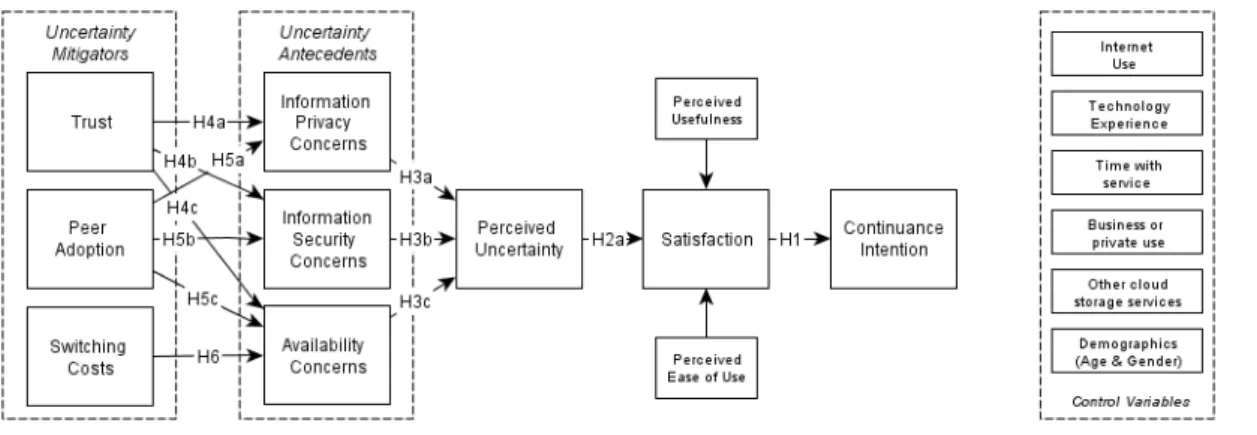
In line with the theory of planned behavior (Fishbein and Ajzen, 1975), we link beliefs (perceived uncertainty), attitudes (assessed as user satisfaction) and behavioral intention (user’s cloud computing continuance intention) and formally hypothesize:
H1: Users’ level of satisfaction with cloud storage service is positively associated with their intention to continue using the service.
H2: Users’ perceived uncertainty of using the cloud storage service is negatively associated with their level of satisfaction.
Figure 1 . Research Model and Proposed Hypotheses
2.3
The Sources of Uncertainty Perceptions
In line with the agency logic, we propose that uncertainty perceptions are manifested in user’s concerns that the service quality (i.e. privacy, security, availability) is not met by the provider either due to hidden information (i.e. the provider does not have the qualities) or hidden actions (i.e. provider acts opportunistically). As surveys on e-commerce adoption reveal, the most important reasons for avoiding online transactions are not functional but are related to users’ loss of control over their personal information (Hoffman et al., 1999). Information privacy and information security concerns are shown to be two major sources why users are skeptical about online transactions (Pavlou et al., 2007). From a principal-agent perspective, we define information privacy concerns as the user’s belief about a cloud provider’s inability (adverse selection) and unwillingness (moral hazard) to protect personal information from improper use, disclosure to third parties, and secondary use without the user’s consent (Pavlou et al., 2007). These privacy concerns are expected to largely contribute to the users’ uncertainty perceptions in the cloud provider-user relationship:
H3a: Information privacy concerns positively influence a user’s perceived uncertainty.
Information security concerns are defined as the user’s belief about the cloud provider’s inability and unwillingness to safeguard user’s personal information from security breaches during transmission and storage (Salisbury et al., 2001). Due to the information asymmetry, the customer can hardly judge whether security breaches occur (adverse selection) and whether the appropriate prevention measures are in place (moral hazard). The related security concerns contribute to the perceived uncertainty of the user:
H3b: Information security concerns positively influence a user’s perceived uncertainty.
Besides the existing constructs of information privacy concerns and information security concerns, uncertainty in cloud computing provider-user relationships is proposed to also arise from concerns on the availability as well as the scalability of the service. In fact, in order to rely on a cloud storage provider, users expect a reliable uptime of the cloud storage service (Bitcurrent, 2011). Thus, availability concerns are of increased importance for this type of service. In contrast, cloud storage users are not so much concerned whether storage can be elastically provisioned and released or not because the amount of storage they can use is typically bounded by the amount of storage on their local computer. Therefore, we did not include scalability concerns in our study. Consistent with the definitions of privacy and security concerns, we define availability concerns as the user’s belief about the inability and unwillingness of a provider to deliver full service availability. The information asymmetry driving the availability concerns are based on the limited possibilities to evaluate uptime (adverse selection) and the difficulty to assess the reliability and provided buffer capacities (moral hazard). Accordingly, we propose that arising availability concerns increase the user’ perceived uncertainty:
H3c: Availability concerns positively influence a user’s perceived uncertainty
2.4
Mitigators of Perceived Uncertainty
As there is no perfect correspondence between actual signaling investments and incentive structures and their subjective evaluation by users (Singh and Sirdeshmukh, 2000), this study aims to test several user-related factors that influence users’ subjective evaluation of signals and incentives rather than studying the effectiveness of specific signals or incentive structures (Bergen et al., 1992). Consistent to previous research (Pavlou et al., 2007; Singh and Sirdeshmukh, 2000), we propose three user-related factors – trust, peer adoption and switching costs – which are believed to influence user’s concerns on information privacy, information security and availability.
Trust is an important aspect in situations that involve dependence on a third party (Gefen et al., 2003; Gefen et al., 2008). We define trust as a set of specific beliefs in the cloud storage provider, namely competence (the cloud storage provider is able to meet the user’s needs), benevolence (the provider cares and is motivated to act in the client’s interest), and integrity (the provider is honest and keeps its promises) (Gefen et al., 2003). Consistent to previous studies (Pavlou et al., 2007), we propose that trust influences how user’s receive both signaling and incentive structures and thus, mitigates all three proposed sources of perceived uncertainty.
On the one hand, users are proposed to rely on trust to resolve their issue with hidden information. Typically, providers signal their benevolence, competence and integrity by showing their procedural fairness with respect to privacy protection (e.g. through publishing a data privacy statement), security protection (e.g. through having third parties verify their security policy) and reliability (e.g. through publishing past down times) (Pavlou et al., 2007). On the other hand, trust is proposed to reduce fears of hidden actions. Users are willing to disclose their data to the cloud provider if the provider is deemed to be competent, to be of integrity, and to be benevolent. Realizing that trustworthy, high-quality providers will not jeopardize their reputation, users will be less concerned to use the cloud storage service. In sum, while all providers send signals and incentives, users will only believe in those coming from providers they trust (Pavlou et al., 2007). Following our line of argumentation, we propose:
H4a: Trust negatively influences a user’s information privacy concerns. H4b: Trust negatively influences a user’s information security concerns. H4c: Trust negatively influences a user’s availability concerns.
Prior research on IT usage behavior suggests that under conditions of uncertainty individual’s beliefs such as concerns about using cloud storage services are influenced by the extent to which a relevant social network such as colleagues or friends has adopted the service (Karahanna et al., 1999), defined as peer adoption (Zhu et al., 2006). Thereby, we draw upon the work of Fulk (1993) who has demonstrated the social influence phenomenon in context of a study on email use within an organization. Based on her work, we propose that users are more likely to positively judge signals and incentives if their peers are using the same cloud storage provider due to the increasing consequences for the provider when hidden information and actions are unveiled. As a result, the more peers use the cloud storage provider, the less concerned are individuals to use the service. This is also consistent to institutional theory which suggests that individual’s efforts to deal rationally under uncertainty often lead, in the aggregate, to homogeneous output among others due to conscious or unconscious imitation of others’ behavior (DiMaggio and Powell, 1983). Thus, we propose that:
H5a: Peer adoption negatively influences a user’s information privacy concerns. H5b: Peer adoption negatively influences a user’s information security concerns. H5c: Peer adoption negatively influences a user’s availability concerns.
A lock-in situation represents vulnerability since the user cannot leave the cloud provider-user relationship without incurring economic losses (Ray et al., 2012). The specific nature of the vulnerability has important implications for how users can react on hidden actions of cloud storage providers (Wathne and Heide, 2000). Two types of switching costs can generally be differentiated: sunk costs and procedural switching costs (Beatty et al., 2012; Jones et al., 2007). Due to the low investment necessary to use a cloud storage service, procedural switching costs are most important in this scenario. Procedural switching costs involve the time, effort, and hassle of finding and adapting to a new provider (Jones et al., 2007). For cloud storage services, adopting implies two major steps: retrieving the data from the cloud storage provider and uploading it to the new service. Switching costs for cloud storage services can furthermore be of social nature (Jones et al., 2007), for instance reflected in the lost benefit of sharing files with other users of the same service. All of these switching costs can be altered by the cloud storage service provider through different terms of service, openness of the interfaces and so on.
We argue that security and privacy concerns are not affected by users’ switching cost perceptions because, once potential damage in these areas occurs, it cannot be resolved by switching the provider. In contrast, if a service is highly susceptible to blackouts, the user intents to switch to another provider. If switching costs are low, the consequences of availability issues are rather low. Accordingly, providers have high incentives to provide good availability if the users can easily leave in case of technical difficulties. In contrast, the incentive to work on the reliability of a cloud storage service is lower when high switching costs are in place. Therefore, low switching costs can be a signal of a higher quality of the service in terms of availability. In cases of high (procedural) switching costs, users cannot easily move to another provider and are much more affected by availability issues. Accordingly, their availability concerns are proposed to increase with the level of switching costs: H6: Perceived switching costs positively influence a user’s availability concerns.
The overall model is depicted in Figure 1.
3
Research Methodology
The hypotheses derived in the previous section were tested in the context of cloud storage services using survey data from an online questionnaire among actual users. In the following, we describe our measurement development as well as the survey deployment and data collection procedures.
All measures used in our study were adopted from existing measures. The measures and their sources are shown in the Appendix. However, they were adapted to the context of our study. Therefore, we applied a series of procedure to assure the precise measurement of our constructs. First of all, definition, domain and dimensionality of the constructs were discussed and defined. We furthermore ensured construct validity and comprehensibility using four raters and an open sorting procedure (Moore and Benbasat, 1991). We followed the approach by MacKenzie et al. (2011) to validate the content validity of our constructs by having the overlap between the items and the construct domain rated by a second set of raters. The preliminary instrument was then pilot tested with 25 participants. After the pretest, the respondents were asked to give open feedback regarding composition of the survey, overall time, and other issues they experienced. Following the pretest, the instrument was shortened, refined, and validated for its statistical properties.
The final survey was conducted online between March and April 2012. The online survey was very well suited to address users of cloud storage services because the regular online access is a prerequisite for usage of such a service. On the first page of the survey, the definition of cloud storage service was given and participants were asked which cloud storage service they use most (if any). All questions were then automatically adapted to refer to their particular service. The link to the survey was sent out to 527 Bachelor, Master and PhD students at a leading business school in Germany. The chance to win Amazon vouchers was set as incentive for participation. In all, 163 completed responses were collected. The time of completion was recorded to eliminate responses with unusually low completion
times. Furthermore, participants that did not use any cloud storage service were removed. In the end, 143 responses were deemed usable, leading to a 27.1% effective response rate. Respondents were 37% female (63% male) between the ages of 21 and 34 years (Mean: 26; Median: 26). Since the demographics of the non-respondents were unknown, we compared late respondents’ demographics, who often are similar to non-respondents (Miller and Smith, 1983), to the ones that answered in the beginning of the period. Since the demographics of early and late respondents did not differ significantly, we can conclude that their absence does not affect our results.
4
Data Analysis and Results
We used SmartPLS (Ringle et al., 2005) to validate the structural model and test the hypotheses using the bootstrapping method. PLS was especially suitable for our analysis because of the formative nature of the trust construct (Chin, 1998). Furthermore, the technique was well suited to explore relationships between latent variables in this new theoretical context (Gefen et al., 2011). All constructs were measured as first-order reflective constructs using three or more indicators, except trust. Trust was defined as a multidimensional formative second-order construct using a repeated-indicator approach (Wetzels et al. 2009) consisting of the components benevolence, competence and integrity (Petter et al., 2007; Serva et al., 2005).
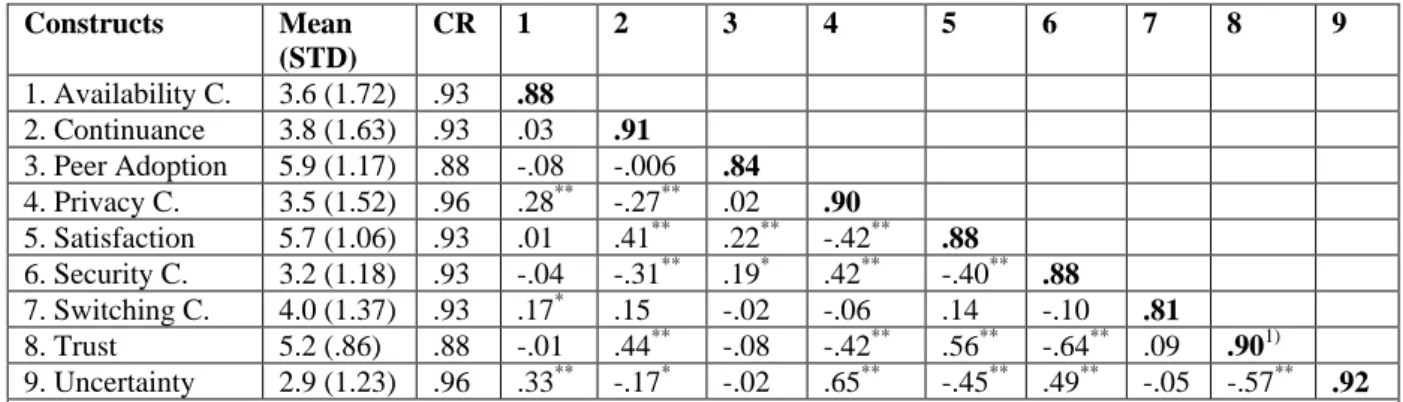
All measurement items of the reflective constructs loaded above the threshold value of 0.7, suggesting an adequate level of individual indicator validity and reliability (Bollen, 1989; Fornell and Larcker, 1981). All constructs reached Cronbach’s alpha above 0.8 (except peer adoption, 0.79) and composite reliability (CR) coefficients were greater than 0.8. Average variance extracted exceeds 0.7 for all constructs. The scores are summarized in Table 2.
Constructs Mean (STD) CR 1 2 3 4 5 6 7 8 9 1. Availability C. 3.6 (1.72) .93 .88 2. Continuance 3.8 (1.63) .93 .03 .91 3. Peer Adoption 5.9 (1.17) .88 -.08 -.006 .84 4. Privacy C. 3.5 (1.52) .96 .28** -.27** .02 .90 5. Satisfaction 5.7 (1.06) .93 .01 .41** .22** -.42** .88 6. Security C. 3.2 (1.18) .93 -.04 -.31** .19* .42** -.40** .88 7. Switching C. 4.0 (1.37) .93 .17* .15 -.02 -.06 .14 -.10 .81 8. Trust 5.2 (.86) .88 -.01 .44** -.08 -.42** .56** -.64** .09 .901) 9. Uncertainty 2.9 (1.23) .96 .33** -.17* -.02 .65** -.45** .49** -.05 -.57** .92
Note: The (bold) diagonal elements represent AVE. **(*) denotes significant correlations at p < .01 (.05).
1)
denotes that trust is a formative construct consisting of benevolence, competence and integrity. The trust AVE stated is the average AVE of these three factors. The variance inflation factor (VIF) as a test for multicollinearity of the three constructs is far below the critical value of 3.3 (Petter et al. 2007) (ben. 1.7; comp. 1.1; integ. 1.6).
Table 2. Descriptive Statistics, Correlations, and Average Variance Extracted
Discriminant validity was confirmed by the Fornell and Larcker criterion (1981) for each construct in the model. Furthermore, we conducted the between constructs test recommended by Anderson and Gerbing (1988). Using AMOS 20, we computed two chi-square statistics for each pair of constructs. One model with a free correlation between the constructs and one model where the correlation between the constructs was set to value one (suggesting that the constructs are not distinct) were compared. The differences between the two chi-square statistics for each pair of constructs were significant (α = 0.01), implying that the constructs are empirically distinct.
Since the data collection was based on a single survey, we applied the recommended procedural and statistical remedies suggested by Podsakoff et al. (2003) to minimize and control for common method bias. We used a Harman one-factor test to test that neither one single factor emerged nor one factor
accounted for more than 50% of the variance. Overall, nine factors with eigenvalues above 1 emerged, explaining 81% of the variance. The most prominent component accounted for 33% of the variance. We furthermore applied a marker variable procedure as suggested by Lindell and Whitney (2001). We used the second smallest correlation in the correlation matrix as proxy for the common method variance. However, the adjustment of the correlation matrix by this value did not change their statistical significance. This indicates absence of a common method bias. Lastly, we reconstructed our model in AMOS 20 to include a latent general common method factor that was allowed to load on every item in our model (Podsakoff et al., 2003). The results suggest that common method was a very small contributor to variance. Overall, we can therefore rule out the concern that a common method variance biased the results of our study.
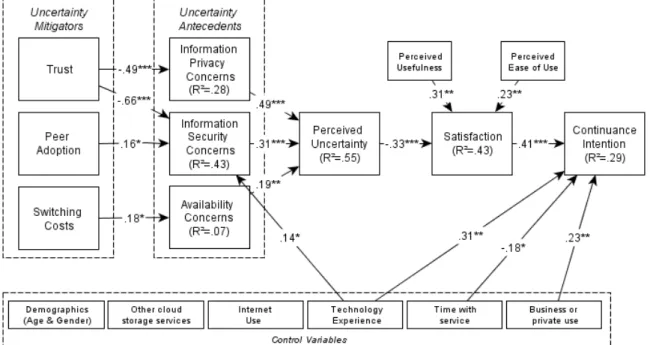
The results of the structural model testing are presented in Figure 2. Bootstrapping with 2000 subsamples was conducted to estimate the significance of the PLS path coefficients and to compare the path estimates statistically. We find support for most of our hypotheses and our model explains a large amount of variance of perceived uncertainty (55%), satisfaction (43%), and continuance intention (29%). However, no support was found for H4c, claiming that trust reduces availability concerns. Furthermore, no empirical evidence for the proposition that peer adoption reduces privacy concerns (H5a), security concerns (H5b) or availability concerns (H5c) was found. The path to security concerns was even significantly positive.
Note: Only significant paths are depicted; * p<0.05, **p<0.01, ***p<0.001. Figure 2. PLS Results of Structural Model
Our hypotheses implicitly include several mediating effects from the mitigators to uncertainty, from the uncertainty antecedents to satisfaction and from uncertainty to continuance. We used the approach by Zhao et al. (2010) to test these mediating effects. Using the bootstrapping procedure as a stronger alternative to the common Sobel test (Preacher and Hayes, 2004), we identified that all complementary mediating paths were strongly significant (p<.05 for Peer Adoption→Security→Uncertainty and Switching Costs→Security→Uncertainty, p<.01 for all other mediating effects).
5
Discussion
The objective of this study is to develop and test a theoretical framework that identifies the antecedents, mitigators and consequences of perceived uncertainty in a post-adoption setting. Our
findings based on actual users of cloud storage services are highly consistent with the proposed perspective on cloud computing continuance as a principal-agent problem. The results have various theoretical implications that are depicted in the subsequent paragraphs.
Our first and major theoretical contribution is the introduction of uncertainty as a core driver of cloud computing continuance. We find strong support for our hypothesis, that uncertainty negatively impacts user’s cloud computing continuance intention, mediated by satisfaction with the service. This persistent uncertainty comes into play due to the move from IT as a product to IT as a service. Uncertainty has not been incorporated in previous studies on IS continuance. In our context however, the effect of uncertainty is even stronger than the role of previously determined drivers of satisfaction such as perceived ease of use and perceived usefulness (e.g.,Bhattacherjee, 2001; Devaraj et al., 2002; Limayem et al., 2007). This result confirms the critical role of uncertainty in cloud provider-user relationships.
Second, we introduce the principal-agent perspective to investigate a post-adoption phenomenon in IS research. The application of this theoretical perspective allowed us to derive new insights on the antecedents and mitigators of uncertainty in the context of cloud-based services. Based on the logic of hidden action and hidden information, we identify three concerns which allow us to explain more than half of the variance of perceived uncertainty (R²=55%). Availability concerns have not been connected to user’s uncertainty in previous research. Our results indicate that, in the context of cloud storage, availability plays a major role as an antecedent of uncertainty. The move towards cloud-based solutions creates a high dependency on its availability. Like an energy blackout, downtime of cloud servers inhibits productivity of cloud storage users. Therefore, future research should pay particular attention to users’ availability concerns.
Third, three user-related factors that influence these concerns are identified based on the logic of signals and incentives. Trust is confirmed as the strongest mitigator of users’ concerns regarding privacy and security. Interestingly, we find no significant relationship between trust and availability concerns. This weak impact could be ascribed to the fact that availability also depends on the infrastructure of the user and not solely on the provider’s willingness and capability. This dependency on further third parties’ (e.g. internet providers) resources has to be incorporated in future studies on cloud computing. While no significant influence is found for trust, availability concerns are reduced when switching costs are low. The results regarding peer adoption, at first, appear flattering. However, prior research has produced contradictory results regarding the role of social influence on user behavior (Karahanna et al., 1999; Lewis et al., 2003). In the context of cloud storage services, peer adoption does not mitigate individuals concerns. To the contrary, the effect of peer adoption on security concerns is found to be significantly positive. An examination of the security literature indicates a possible explanation for this finding. The larger the number of users for a certain solution, the more appealing it is for malicious agents to challenge the security of the service (Galbreth and Shor, 2010). Whether users take this phenomenon under consideration has to be reexamined.
Some limitations of our study should be mentioned. First, although students comprise an important segment of internet users and adopters of cloud services, we recognize that students might not represent the broader population of cloud users as a whole. Whether the results are applicable to other cloud users could only be assessed by replicating the study using different groups of subjects. Nevertheless, since we used Bachelor, Master as well as PhD students in the ages between 21 and 34 years and did not find any significant differences between their answers, we have reason to be confident that our results hold for a broader population. Second, only three specific mitigators, trust, peer adoption, and switching costs, were investigated. We encourage investigators to perform a mitigator-level analysis to gain better insights into the plentitude of possible factors that can reduce user’s concerns.
From a practical perspective, cloud providers aim at establishing long term relationships with their customers. Our results suggest that uncertainties of cloud users have to be incorporated into their strategy and activities. Our classification of the underlying concerns can be utilized by the cloud
providers to directly address these topics. Furthermore, the mitigators we investigated can be implemented by cloud service providers to reduce these concerns.
References
Anderson, E. W., Sullivan, M. W. (1993). The antecedents and consequences of customer satisfaction for firms. Marketing Science, 12 (2), 125–143.
Anderson, J. C., Gerbing, D. W. (1988). Structural equation modeling in practice: a review and recommended two-step approach. Psychological Bulletin, 103 (3), 411–423.
Armbrust, M. et al. (2010). A view of cloud computing. Communications of the ACM, 53 (4), 50–58. Beatty, S. E., Reynolds, K. E., Noble, S. M., Harrison, M. P. (2012). Understanding the Relationships
Between Commitment and Voice: Hypotheses, Empirical Evidence, and Directions for Future Research. Journal of Service Research, 15 (3), 296–315.
Bergen, M., Dutta, S., Walker, O. C. (1992). Agency relationships in marketing: a review of the implications and applications of agency and related theories. Journal of Marketing, 56 (3), 1–24. Bhattacherjee, A. (2001). Understanding information systems continuance: an
expectation-confirmation model. MIS Quarterly, 25 (3), 351–370.
Bitcurrent (2011). Bitcurrent Cloud Computing Survey 2011. Retrieved 29 September, 2012, from http://www.bitcurrent.com/download/cloud-computing-survey-2011/.
Bollen, K. A. (1989). Structural Equations with Latent Variables. Wiley, Chapel Hill, USA. Chin, W. (1998). Issues and opinion on structural equation modeling. MIS Quarterly, 22 (1), 7–16. Devaraj, S., Fan, M., Kohli, R. (2002). Antecedents of B2C channel satisfaction and preference:
validation e-commerce metrics. Information Systems Research, 13 (3), 316–333.
Dibbern, J., Goles, T., Hirschheim, R., Jayatilaka, B. (2004). Information systems outsourcing: a survey and analysis of the literature. ACM SIGMIS Database, 35 (4), 6–102.
DiMaggio, P., Powell, W. (1983). The Iron Cage Revisited: Institutional Isomorphism and Collective Rationality in Organizational Fields. American Sociological Review, 48 (2), 147–160.
Fishbein, M., Ajzen, I. (1975). Belief, Attitude, Intention, and Behavior: An Introduction to Theory and Research. Addison-Wesley, Reading, USA.
Fornell, C., Larcker, D. (1981). Evaluating structural equation models with unobservable variables and measurement error. Journal of Marketing Research, 18 (1), 39–50.
Fulk, J. (1993). Social construction of communication technology. The Academy of Management Journal, 36 (5), 921–950.
Galbreth, M. R., Shor, M. (2010). The impact of malicious agents on the enterprise software industry. MIS Quarterly, 34 (3), 595–612.
Gefen, D., Benbasat, I., Pavlou, P. (2008). A research agenda for trust in online environments. Journal of Management Information Systems, 24 (4), 275–286.
Gefen, D., Karahanna, E., Straub, D. W. (2003). Trust and TAM in online shopping: an integrated model. MIS Quarterly, 27 (1), 51–90.
Gefen, D., Rigdon, E. E., Straub, D. (2011). An update and extension to sem guidelines for administrative and social science research. MIS Quarterly, 35 (2), iii–xiv.
Hoffman, D. L., Novak, T. P., Peralta, M. (1999). Building consumer trust online. Communications of the ACM, 42 (4), 80–85.
Hong, W., Thong, J. Y. L., Chasalow, L. C., Dhillon, G. (2011). User acceptance of agile information systems: a model and empirical test. Journal of Management Information Systems, 28 (1), 235– 272.
Hsieh, J. J. P.-A., Rai, A., Keil, M. (2008). Understanding digital inequality: comparing continued use behavioral models of the socio-economically advantaged and disadvantaged. MIS Quarterly, 32 (1), 97–126.
Jensen, M. C., Meckling, W. H. (1976). Theory of the firm: managerial behavior, agency costs and ownership structure. Journal of Financial Economics, 3 (4), 305–360.
Jeyaraj, A., Rottman, J. W., Lacity, M. C. (2006). A Review of the Predictors, Linkages, and Biases in IT Innovation Adoption Research. Journal of Information Technology, 21 (1), 1–23.
Jones, M. A., Mothersbaugh, D. L., Beatty, S. E. (2002). Why customers stay: measuring the underlying dimensions of services switching costs and managing their differential strategic outcomes. Journal of Business Research, 55 (6), 441–450.
Jones, M. A., Reynolds, K. E., Mothersbaugh, D. L., Beatty, S. E. (2007). The Positive and Negative Effects of Switching Costs on Relational Outcomes. Journal of Service Research, 9 (4), 335–355. Karahanna, E., Straub, D. W., Chervany, N. L. (1999). Information technology adoption across time: a
cross-sectional comparison of pre-adoption and post-adoption beliefs. MIS Quarterly, 23 (2), 183– 213.
Kim, D. J., Ferrin, D. L., Rao, H. R. (2008). A trust-based consumer decision-making model in electronic commerce: the role of trust, perceived risk, and their antecedents. Decision Support Systems, 44 (2), 544–564.
Kim, S. S., Son, J.-Y. (2009). Out of dedication or constraint? A dual model of post-adoption phenomena and its empirical test in the context of online services. MIS Quarterly, 33 (1), 49–70. Lam, S. Y., Shankar, V., Erramilli, M. K., Murthy, B. (2004). Customer value, satisfaction, loyalty,
and switching costs: an illustration from a business-to-business service context. Journal of the Academy of Marketing Science, 32 (3), 293–311.
Lewis, W., Agarwal, R., Sambamurthy, V. (2003). Sources of influence on beliefs about information technology use: an empirical study of knowledge workers. MIS Quarterly, 27 (4), 657–678. Limayem, M., Hirt, S. G., Cheung, C. M. K. (2007). How habit limits the predictive power of
intention: the case of information systems continuance. MIS Quarterly, 31 (4), 705–737. Lindell, M. K., Whitney, D. J. (2001). Accounting for common method variance in cross-sectional
research designs. Journal of Applied Psychology, 86 (1), 114–121.
MacKenzie, S. B., Podsakoff, P. M., Podsakoff, N. P. (2011). Construct measurement and validation procedures in MIS and behavioral research: integrating new and existing techniques. MIS
Quarterly, 35 (2), 293–334.
Milgrom, P., Roberts, J. (1992). Economics, Organization and Management. Prentice-Hall, Stanford, USA.
Miller, L. E., Smith, K. L. (1983). Handling nonresponse issues. Journal of Extension, 21 (5), 45–50. Moore, G. C., Benbasat, I. (1991). Development of an instrument to measure the perceptions of
adopting an information technology innovation. Information Systems Research, 2 (3), 192–222. Nicolaou, A. I., McKnight, D. H. (2011). System design features and repeated use of electronic data
exchanges. Journal of Management Information Systems, 28 (2), 269–304.
Oliver, R. L. (1980). A cognitive model of the antecedents and consequences of satisfaction decisions. Journal of Marketing Research, 17 (4), 460–469.
Patterson, P., Johnson, L., Spreng, R. (1997). Modeling the determinants of customer satisfaction for business-to-business professional services. Journal of the Ac. of Marketing Science, 25 (1), 4–17. Pavlou, P. A., Liang, H., Xue, Y. (2007). Understanding and mitigating uncertainty in online exchange
relationships: a principal-agent perspective. MIS Quarterly, 31 (1), 105–136.
Petter, S., Straub, D., Rai, A. (2007). Specifying Formative Constructs in Information Systems Research. MIS Quarterly, 31 (4), 623–656.
Podsakoff, P. M., MacKenzie, S. B., Lee, J. Y., Podsakoff, N. P. (2003). Common method biases in behavioral research: a critical review of the literature and recommended remedies. Journal of Applied Psychology, 88 (5), 879–903.
Preacher, K. J., Hayes, A. F. (2004). SPSS and SAS Procedures for Estimating Indirect Effects in Simple Mediation Models. Behavior Res. Methods, Instruments, & Computers, 36 (4), 717–731. Ray, S., Kim, S. S., Morris, J. G. (2012). Research note - online users’ switching costs: their nature
and formation. Information Systems Research, 23 (1), 197–213.
Ringle, C. M., Wende, S., Will, A. (2005). SmartPLS. Retrieved 23 July, 2012, from http://www.smartpls.de.
Salisbury, W. D., Pearson, R. A., Pearson, A. W., Miller, D. W. (2001). Perceived security and world wide web purchase intention. Industrial Management and Data Systems, 101 (4), 165–177.
Serva, M. A., Fuller, M. A., Mayer, R. C. (2005). The reciprocal nature of trust: a longitudinal study of interacting teams. Journal of Organizational Behavior, 26 (6), 625–648.
Sia, C. L. et al. (2009). Web strategies to promote internet shopping: is cultural-customization needed? MIS Quarterly, 33 (3), 491–512.
Singh, J., Sirdeshmukh, D. (2000). Agency and trust mechanisms in consumer satisfaction and loyalty judgments. Journal of the Academy of Marketing Science, 28 (1), 150–167.
Strader, T. J., Ramaswami, S. N., Houle, P. A. (2007). Perceived network externalities and
communication technology acceptance. European Journal of Information Systems, 16 (1), 54–65. Sun, H. (2010). Sellers’ trust and continued use of online marketplaces. Journal of the Association for
Information Systems, 11 (4), 182–211.
Taylor, S., Todd, P. A. (1995). Understanding information technology usage: a test of competing models. Information Systems Research, 6 (2), 144–176.
Wathne, K. H., Heide, J. B. (2000). Opportunism in interfirm relationships: forms, outcomes, and solutions. Journal of Marketing, 64 (4), 36–51.
Zetta (2010). Cloud Storage Adoption Trends, Barriers and Expectations - a Survey. Retrieved 3 September, 2012, from http://pages.zetta.net/rs/zetta/images/Zetta_Cloud_Storage_Survey.pdf. Zhao, X., Jr., J. G. L., Chen, Q. (2010). Reconsidering Baron and Kenny: Myths and Truths about
Mediation Analysis. Journal of Consumer Research, 37 (2), 197–206.
Zhu, K., Kraemer, K. L., Gurbaxani, V., Xu, S. X. (2006). Migration to open-standard
interorganizational systems: network effects, switching costs, and path dependency. MIS Quarterly, 30 (1), 515–539.
Appendix
Continuance Intention (Ray et al., 2012) Trust (Pavlou et al., 2007; Sia et al., 2009) It means a lot to me to continue to use [provider name].
I feel loyal towards [provider name].
I consider myself to be highly loyal to [provider name].
[Provider name] understands the market they provide services in.
(comp.)
[Provider name] knows a lot about cloud storage services. (comp.)
In general, [provider name] is very knowledgable about issues of cloud storage services. (competence)
I do not doubt the honesty of [provider name]. (integrity)
I expect that [provider name] will keep promises it makes. (integ.)
[Provider name] is trustworthy. (integ.)
I expect that [provider name] has good intentions toward me.
(benev.)
I expect that the intentions of [provider name] are benevolent.
(benev.)
I trust [provider name] to keep users’ best interests in mind. (ben.)
Perceived Uncertainty (Pavlou et al., 2007)
I feel that using [provider name]'s service involves a high degree of uncertainty.
I feel that the uncertainty associated with the services provided by [provider name] is high.
I am exposed to many uncertainties if I use [provider name]'s services.
There is a high degree of uncertainty (i.e., the service you receive may not be what you expect) when using [provider name]'s services.
Satisfaction (Kim and Son, 2009; Lam et al., 2004) Peer Adoption (Strader et al., 2007; Zhu et al., 2006) I am very contented with [provider name].
I am very pleased with [provider name]. Overall, I am very satisfied with [provider name].
Many people use [provider name]'s services. Many of my friends use [provider name]'s services. Many of my colleagues use [provider name]'s service. Inf. Privacy Concerns (Kim et al., 2008; Pavlou et al., 2007) Switching Costs (Jones et al., 2002; Kim and Son, 2009) I am concerned that [provider name] will use my personal
information for other purposes without my authorization. I am concerned that [provider name] will share my personal information for other purposes without my authorization. I am concerned that [provider name] is collecting too much information about me.
I am concerned about my privacy when using [provider n.].
Switching to a new cloud storage provider would involve some hassle.
It would take a lot of time and effort changing the cloud storage provider.
Some problems may occur when I switch to another cloud storage provider.
It is complex for me to change the cloud storage provider. Inf. Sec. Concerns (Kim and Son, 2009; Pavlou et al., 2007) Perceived Usefulness (Davis 1989; Pavlou et al. 2007) [Provider] implements security measures to protect my data.
[Provider name] usually ensures that transferring information is protected.
I feel safe in making transactions on [provider name]. I feel secure in transferring information when using [prov.]
Using [provider name] enhances my effectiveness. Using [provider name] enhances my productivity. Using [provider name] improves my performance. Using [provider name] enables me to accomplish tasks more quickly.
Avail. Concerns (Kim et al., 2008; Taylor and Todd, 1995) Perceived Ease of Use (Davis 1989; Pavlou et al. 2007) I am concerned about [provider name]'s availability.
I am concerned that [provider name] could be unavailable when I need it.
I am concerned that [provider name] could be unaccessible.
I find [provider name] easy to use.
Using [provider name] does not require a lot of mental effort. I find it easy to get [provider name] to do what I want it to do. It is easy for me to become skillful at using [provider name].