Running head: IMAGEN
Modulation of orbitofrontal-striatal reward activity by dopaminergic functional polymorphisms contributes to a predisposition to alcohol misuse in early adolescence
Travis E. Baker, PhD*1, Natalie Castellanos-Ryan1, Gunter Schumann2,3; Anna Cattrell2,3; Herta
Flor4; Frauke Nees4, Tobias Banaschewski6; Arun Bokde7; Rob Whelan7; Christian Buechel9; Uli Bromberg9; Dimitri Papadopoulos Orfanos11; Juergen Gallinat12; Hugh Garavan13; Andreas Heinz12; Henrik Walter12; Rüdiger Brühl14; Penny Gowland15; Tomáš Paus15; Luise Poustka6;
Jean-Luc Martinot17; Herve Lemaitre17, Eric Artiges17, Marie-Laure Paillère Martinot 17; Michael N. Smolka20; Patricia Conrod1,2; and the IMAGEN consortium.
1Department of Psychiatry, Universite de Montreal, CHU Ste Justine Hospital, Canada;2 Institute of Psychiatry,
King‟s College London, United Kingdom; 3Medical Research Council – Social, Genetic and Developmental
Psychiatry Centre, Institute of Psychiatry, Kings College London, De Crespigny Park, London, United Kingdom;
4Department of Cognitive and Clinical Neuroscience, Central Institute of Mental Health, Medical Faculty
Mannheim, Heidelberg University, Square J5, Mannheim, Germany; 6Department of Child and Adolescent
Psychiatry, Central Institute of Mental Health, Faculty of Clinical Medicine Mannheim, Medical Faculty Mannheim, Heidelberg University, Square J5, 68159 Mannheim, Germany; 7Discipline of Psychiatry, School of Medicine and
Trinity College Institute of Neurosciences, Trinity College Dublin; 9University Medical Centre
Hamburg-Eppendorf, Haus S10, Martinistr. 52, Hamburg, Germany; 11Neurospin, Commissariat à l'Energie Atomique,
CEA-Saclay Center, Paris, France; 12Department of Psychiatry and Psychotherapy, Campus Charité Mitte, Charité,
Universitätsmedizin Berlin, Charitéplatz 1, Berlin, Germany; 13Departments of Psychiatry and Psychology,
University of Vermont, 05405 Burlington, Vermont, USA; 14Physikalisch-Technische Bundesanstalt, Abbestr. 2 -
12, Berlin, Germany; 15School of Psychology, University of Nottingham, University Park, Nottingham, United
Kingdom; 17 Institut National de la Sante et de la Recherche Medicale, INSERM CEAUnit1000,Imaging &
Psychiatry, University Paris Sud, 91400 Orsay, France; 19Department of Psychology and Behavioural and Clinical
Neuroscience Institute, University of Cambridge, Downing Site, Cambridge, United Kingdom; 20Department of
Psychiatry and Neuroimaging Center, Technische Universität Dresden, Dresden, Germany.
The manuscript contains 4954 words including references, 3 figures, and 2 tables total. *Corresponding author:
Center for Molecular and Behavioral Neuroscience 197 University Avenue
Newark, NJ 07102 Rutgers University, Newark USA Ph: (862)-250-3351
Acknowledgements: This work received support from the following sources: the European Union-funded FP6 Integrated Project IMAGEN (Reinforcement-related behaviour in normal brain function and psychopathology) (LSHM-CT- 2007-037286), the FP7 projects
Abstract
Background: Abnormalities in reward circuit function are considered a core feature of addiction. Yet, it is still largely unknown whether these abnormalities stem from chronic drug use, a genetic predisposition, or both. Methods: In the present study, we investigated this issue using a large sample of adolescent children by applying structural equation modeling to examine the effects of several dopaminergic polymorphisms of the D1 and D2 receptor type on the reward function of the ventral striatum and orbital frontal cortex, and whether this relationship predicted the propensity to engage in early alcohol misuse behaviours at 14 years of age and again at 16 years of age. Results: The results demonstrated a regional specificity with which the functional polymorphism rs686 of the DRD1 gene and Taq1A of the ANKK1 gene influenced medial and lateral orbital frontal cortex activation during reward anticipation, respectively. Importantly, our path model revealed a significant indirect relationship between the rs686 of the DRD1 gene and early onset of alcohol misuse through a medial orbital frontal cortex and the ventral striatum interaction. Conclusions: These findings highlight the role of D1 and D2 in adjusting reward-related activations within the mesocorticolimbic circuitry, as well as in the susceptibility to early onset of alcohol misuse.
…
Introduction
More than a decade of neuroimaging studies point towards functional abnormalities of the mesocorticolimbic reward system in substance use disorders (Redish et al., 2008, Volkow et al., 2009). Overall, the data imply that chronic drug use can lead to increased neuronal activation in response to drug-associated cues, and reduced response to natural rewards, a maladaptive process thought to facilitate the progression towards excessive drug choice (Volkow et al., 2009). While much attention in the field has focused on identifying addiction-related endophenotypes contributing to pre-existing abnormalities in reward circuit function, the search has been plagued by questions of causality: Do the observed reward-related abnormalities stem from chronic drug use itself, or from factors related to genetics that facilitate a progression towards excessive drug use, or some combination of both? Of importance, the longitudinal path from a potential genetic vulnerability to substance misuse outcomes later in life have not been investigated from such a neurodevelopmental perspective, due, in part, to the lack of sufficiently powered longitudinal genetic-neuroimaging studies (Conrod and Nikolaou, 2016).
investigate changes in neural activity in response to the processing of different stages of reward processing (e.g. reward prediction, anticipation of obtaining rewards of different magnitude or avoiding punishment, outcome processing) in typical and atypical populations, with findings that converge with both animal and human studies emphasizing the essential role of the VS and OFC in processing reward-related information (for review, see (Lutz & Widmer, 2014; Balodis & Potenza, 2015; Knutson & Heinz, 2015). However, both hypo-responsiveness and
hyper-responsiveness of reward-related brain regions (e.g., VS) have been reported during anticipation of reward in the MID task in substance dependent adults (for review, see (Balodis and Potenza, 2015), so it remains uncertain what functional state (hyper vs hypo) of the reward system may actually precipitate a substance use disorder.
Nevertheless, the relevant reward signal (i.e. positive and negative reward prediction error signals) critical to the functioning of the VS and OFC are thought to originate in the midbrain dopamine system (Schultz, 2001; Schultz et al., 2000). These reward signals are conveyed to the neural targets of the dopamine system where their impact reorganizes synaptic connectivity in a way that drives learning and motivation (Schultz, 2011, Schultz, 2001). For this reason, we focused on functional polymorphisms that would appear to alter dopaminergic
& Miyoshi, 2007) and addiction (Batel et al., 2008; Comings et al., 1997; Zhu et al., 2013; Huang et al., 2008). To date, the rs686 SNP of the DRD1 has yet to be investigated in the context of human reward-related learning or behaviour. Further, we selected the promoter rs12364283 SNP of the DRD2 gene – the C allele has been shown to confer higher transcriptional activity (Zhang et al., 2007)− because of the association D2 has with reward signalling (Assadi et al., 2009; Suhara & Miyoshi, 2007), reinforcement learning (Baker et al., 2013; Frank & Hutchison, 2009), and addiction (Noble, 1994; Noble, 2000). Likewise, the Taq1A polymorphism
(rs1800497) of the ANKK1 gene was also selected because of its association with striatal D2 receptor function (Thompson et al., 1997) but see (Laruelle et al., 1998), altered activation of OFC (Cohen et al., 2005) and VS (Nymberg et al., 2014), impaired reinforcement learning (Klein et al., 2007), and addiction (Munafo et al., 2007; Noble et al., 1994; Abi-Dargham, 2004; Noble, 1998; Noble, 2003; Noble, 2000).
Taken together,we hypothesized that these specific dopaminergic functional polymorphisms − DRD1rs686, DRD2rs12364283, ANKK1rs1800497, and PPP1R1Brs87694 – may
selectively modulate the VS and OFC BOLD signal (hyper vs hypo) during reward anticipation. In turn, we predicted that the relationship between these SNPs and alcohol related behaviourat 14 years and 16 years of age would be indirect and be mediated by their effect on the reward response in these selected brain regions. Although less explored, because both the VS and OFC have been proposed to play an important role in reward learning (Frank & Claus, 2006),
variable of interest in our SEM. Our proposed imaging genetics approach constitutes a natural application of SEM, which provides a means for modeling such complex interrelationships.
Methods
Participants and Procedure
A community-based sample of young adolescents (N=2463) was recruited for the IMAGEN study (for details on the IMAGEN project, see Schumann et al. 2010). Individuals who provided assent, and whose parents provided informed written consent, completed an extensive battery of neuropsychological, clinical, personality and drug use assessments online and at the testing centers. Participants were excluded if, among other criteria, they had contra-indications for MRI (for example, metal implants, claustrophobia). After data quality control, complete and reliable data sets were available for 1840 participants at Time 1 (1666 participants at Time 2). Of these volunteers at Time 2, 1639 had complete neuroimaging data. The
demographic information of the participants at time 1 was: mean age = 14.55 ± 0.447 years, 51.7% female, 88.80% right-handed, verbal IQ = 110.67 ± 14.85, performance IQ = 107.57 ± 14.77.
Alcohol Use Disorders Identification Test
use of alcohol (score >0) (for an overview of these data, see Table 1). To note, participants AUDIT score were significantly larger at Time 2 compared to Time 1, t(1461) = -25.8, p < .001.
***Table1***
fMRI task, acquisition and analysis
Monetary incentive delay task In order to assess reward processing during fMRI in an
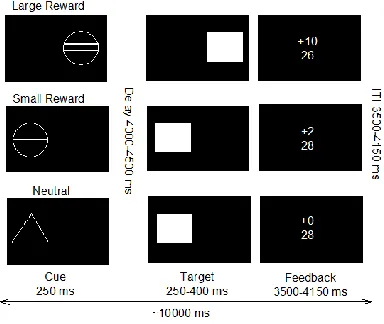
adolescence population, a modified version of the MID task was used (Figure 1). In brief, each trial consisted of anticipation, response, and feedback related cues. Before the anticipation phase, a cue signaled the position of the target as well as the type of reward that could be attained by a correct response. Different cues distinguished between large reward (10 points), small reward (2 points) and neutral (zero points) conditions. After a random anticipation interval of 4000–
4500ms length, the target appeared. Participants were instructed to respond to the target as quickly as possible via button press and informed that the points they earned would be converted into chocolate treats after scanning (i.e. 1 candy [M&Ms] for every 5 points scored). The
duration of the target was continuously adapted to the performance of the subject, ensuring a successful performance on approximately 66% of all the trials. Immediately following the response, feedback indicated the number of points attained in the recent trial as well as the total points earned during the task. The inter-trial interval varied so that each trial took approximately 10,000 ms (Figure 1). Large, small, and neutral conditions were randomized throughout the task (22 trials each, summing up to 66 trials in total). Task presentation and recording of the
***Figure 1. Here***
Figure 1. Monetary Incentive Delay (MID) task, adapted from Knutson et al (2001).
Imaging parameters Allscanning was performed with a 3T whole body MRI system made by several manufacturers (Siemens, Philips, General Electric, Bruker) at the eight IMAGEN assessment sites (London, Nottingham, Dublin, Mannheim, Dresden, Berlin,
Hamburg, and Paris). To ensure a comparison of MRI data acquired on these different scanners, we implemented image-acquisition techniques using a set of parameters compatible with all scanners that were held constant across sites (cf., Schumann et al, 2010). We acquired 40 slices in descending order (2.4 mm, 1 mm gap) using a gradient-echo T2*-weighted sequence (EPI) with the following image parameters: TR=2200 ms, TE=30 ms, and an in-plane matrix size of 64 × 64 pixels. We used a plane of acquisition tilted to the anterior–posterior commissure line (rostral>caudal). For anatomical reference, a 3D magnetization prepared gradient-echo sequence (MPRAGE) based on the ADNI protocol (http://www.loni.ucla.edu/ADNI/Cores/index.shtml) with TR=6.8 ms and TE=3.2 ms over the whole brain was carried out.
Functional preprocessing and analysis The fMRI data were analyzed with Statistical
College London, London, UK). All individual data were slice time corrected using the first slice as reference, then spatially realigned to correct for head movement, and non-linearly warped on the MNI space using custom EPI template based on an average of mean images of 400
adolescents. This custom template image (53 × 63 × 46 voxels) was subsequently applied to all functional T2* data and voxels were resampled at a resolution of 3 × 3 × 3 mm. The functional data were smoothed using an isotropic Gaussian kernel for group analysis (5 mm full-width at half-maximum). First level statistics were performed by modeling reward anticipation and reward feedback as predictor variables within the context of the GLM on a voxel-by-voxel basis, with AR noise model against a design matrix. Estimated movement was added to the design matrix in the form of 18 additional columns (3 translational, 3 rotations, 3 quadratic and 3 cubic translations, 3 translations shifted 1 TR before, and 3 translations shifted 1 TR later). A
movement threshold of 2 mm was employed. Furthermore, each individual fMRI time series underwent an automatic spike detection method.
For anticipation cues of neutral, small reward, and large reward, as well as information on feedback (hit [response within the correct time window] vs missed [response outside the correct time window]) trials,
regressors in the design matrix. A significance level of p<0.05 was selected (FWE-corrected), with a minimum cluster size of 10 voxels.
Based on previous IMAGEN studies, (cf., Nees et al, 2012, Whelan et al. 2012), the analyses focused on weighted mean BOLD signal change of the designated ROIs (OFC and VS) over both hemispheres for anticipation of large reward vs neutral (large reward condition) and anticipation of small reward vs neutral (small reward conditions). Furthermore, we analyzed two distinct regions in OFC (medial OFC and lateral OFC) based on evidence suggesting dissociable functions in reward processing (Elliott et al., 2000; Elliott et al., 2008; Frank & Claus, 2006) (O'Doherty et al., 2001; Diekhof et al., 2012). The ROI masks were taken from the Wake Forest University Pick-Atlas (Maldjian et al. 2003) using various atlases (medial OFC [aal atlas], lateral
OFC [Broadman’s area 47], ventral striatum [nucleus accumbens]), and the mean contrast value for each ROI
was calculated for each subject for both large reward and small reward contrasts1. To note, only
trials that subjects made a successful response were included in this analysis and our analysis focused on the reward anticipation period of the task.
Genetic data
*** Table 2. ***
After quality control, genome-wide data were available for N=1,839 of the participants. Details of quality control procedures are available in the supplementary online material. We investigated 4 SNPs, which were selected from each member of the full set of autosomal catecholamine genes; namely, those that that have empirical support for variation in the
degradation and receptor signalling of dopamine D1 and D2 receptors. In brief, we focused on two functional polymorphisms related to D1 receptors (DRD1rs686, PPP1R1Brs87694), and two genetic polymorphisms that affect D2 expression (DRD2rs12364283, ANKK1rs1800497).
Statistical analysis strategy
We performed two main sets of analysesusing SPSS 17.0.1 and MPlus version 6.12 (Muthen & Muthen 2011). First, a simple regression analysis was performed to identify unique relationships between genetic data (DRD1rs686, DRD2rs12364283, ANKK1rs1800497, and
PPP1R1Brs87694) and neuroimaging data (medial/lateral OFC and VS), and between
neuroimaging data and alcohol misuse at 14 and 16 years. In addition, interactions terms (medial OFC*VS and lateral OFC * VS) were derived from the product of the medial/lateral OFC and VS standardized scores in order to examine whether the interaction between the two reward regions contribute to the prediction of alcohol misuse scores. Type 1 errors were statistically controlled following Benjamin and Hochberg (1995) with a corrected significance level of α = 0.05. Sex, age, and imaging site (8 sites) were included in each regression model as nuisance variables using a stepwise approach.
(MLR), which is robust to non-normality. Model fit was assessed with the Chi-square and Comparative Fit Indices (CFI), the Standardized Root Mean Square Residual (SRMR) and the Root Mean Square Error of Approximation (RMSEA). Hu and Bentler (1999) suggest the following guidelines for interpreting Goodness-of-Fit Indices: SRMR and values close to or below .08, RMSEA values close to or below .06 and CFI close to or above .90 indicate acceptable model fit. To help interpret the interaction effects, these were plotted based on procedures by Aiken and West (1991), Dawson (2013) and Dawson and Richter (2006).
Results Univariate results
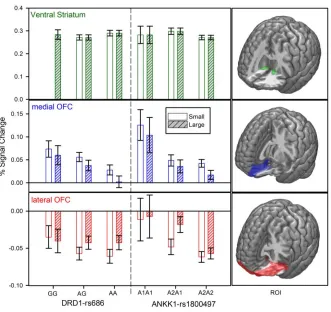
Gene-Brain Associations SNP (DRD1rs686, DRD2rs12364283, ANKK1rs1800497, and PPP1R1Brs87694), and ROI (VS, medial and lateral OFC) associations were assessed using univariate regression models, while controlling for Sex, Age, and imaging site (corrected for multiple comparisons, B-H, p<.0125). All regression results are presented in Table S2. This analysis yielded two significant associations. First, DRD1rs686 reliably predicted medial OFC BOLD signal (Beta = -.08, t = -2.7, p = .008) to the large reward anticipation cue (F(10, 1230) = 6.5,
p < .001, r2= .05,), indicating that increasing the number of G allele was associated with a stronger medial OFC BOLD response to the large reward anticipation cue (see Figure 2, middle panel). It is also worth noting that DRD1rs686 also predicted medial OFC BOLD response to small
reward anticipation, (Beta = -.07, t = -2.4, p = .014), but this relationship did not survive our correction for multiple-comparisons. Second, ANKK1rs1800497 significantly predicted lateral
OFC BOLD, (Beta = -.09, t = -3.1, p = .002) response to the large reward anticipation cue (F(10, 1227) = 2.9, p < .001, r2= .03), indicating that increasing the number of A2 alleles was associated
Figure 2, bottom panel). It is also worth noting that these SNPROI relationships remained significant (ANKK1rs1800497 [Beta = -.11, t = -3.1, p = .002]; DRD1rs686 [Beta = -.08, t = -2.3, p =
.01]) when AUDIT Zone 0 participants (i.e. reported never using alcohol) were the only
participants included in the regression analysis, suggesting that this genetic influence on reward activity precedes alcohol use at age 14.
[image:14.612.143.474.257.569.2]***Figure 2 here***
Brain-AUDIT Associations The relationship between reward anticipation (large and small) and AUDIT scores (Time 1 and Time 2) were assessed using univariate regression models (corrected for multiple comparisons, B-H, p<.0125). All regression results are presented in Table S3. While the ROIs did not uniquely predict AUDIT scores at either time point, this analysis demonstrated that the interaction between medial OFC and VS (Beta = .09, t = 2.98, p < .005; F(10, 1079) = 5.3, p < .001, r2= .05) and lateral OFC and VS (Beta = .08, t = 2.6, p < .01; F(10, 1079) =
5.3, p < .001, r2= .05) during high reward anticipation uniquely predicted alcohol misuse at 14
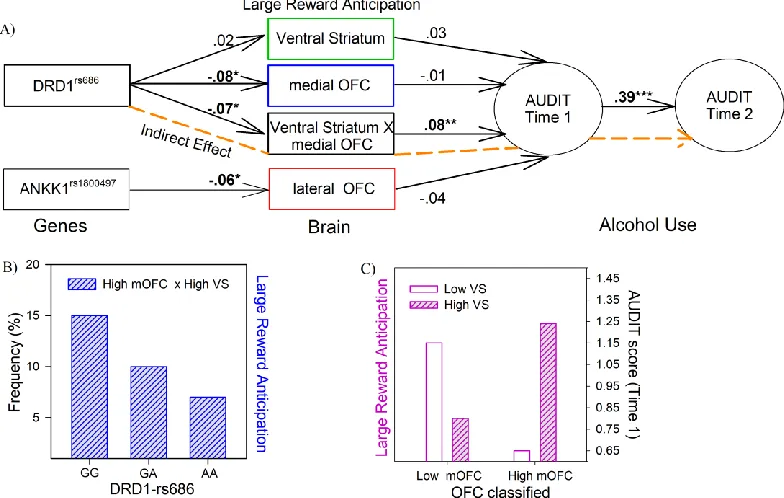
years of age. No other associations were observed (p>.1). The finding suggests that when both the medial OFC and VS are highly active or inactive (i.e., synergistic), individuals displayed higher levels of Audit scores at 14 years of age (Figure 3C). It is interesting to note that the rs686 SNP of the DRD1 gene reliably predicted both medial OFC and VS interaction (Beta = .10, t = -3.4, p < .001) for the large reward anticipation condition (F(10, 1230) = 4.3, p < .001, r2= .03)2, and
AUDIT scores (Beta = .07, t = 2.7, p = .008) at Time 2, (F(10, 1385) = 4.3, p < .001, r2= .03).
SEM results
***Figure 3 here***
2 As a check, we tested all other SNP and OFC*VS interaction associations (Table S4). No associations were
Figure 3. Results of the SEM A) Significant direct and indirect paths between gene, brain and alcohol misuse. Paths that are part of significant indirect effects are highlighted in orange, other direct effects are shown in black. * P<.05, **P<.005, ***p < .001 (two-tailed). B) DRD1 genotypes plotted by individuals classified as high medial OFC and high VS. C) Audit scores at 14 years plotted by groups classified as high and low medial OFC and VS activation during large reward anticipation. Note: VS-ventral striatum, OFC-orbital frontal cortex.
In the hypothesized model, all brain variables with genetic predictors were modeled to predict alcohol misuse at 14 years of age, which in turn predicted alcohol misuse at 16 years of age. Results from the SEM analysis showed that this model fit the data very well, X2(21, 2052) =
29.69; CFI = .97; TLI = .95; RMSEA = .014 (90%CI= .00 - .025); SMRM = .018. The model indicated that the medial OFC*VS interaction term calculated for the large reward condition predicted alcohol use at 14 years of age (Beta = .08, t = 2.9, p<.01), which in turn significantly predicted alcohol use at 16 years (Beta = .39, t = 13.57, p <.001). In order to better understand the interaction effects, a Chi-Square Test of Independence was conducted and indicated that the DRD1rs686 genotypes differ in the medial OFC*VS interaction, Χ2(4, 1396) = 12.85, p =.012,
high VS (15%, 10%, and 7% respectively) (Figure 3B). Furthermore, the interaction effect on alcohol use at 14 years was plotted (see Figure 3C), which indicated that when both the medial OFC and VS are highly active or inactive (i.e., synergistic), individuals displayed higher levels of Audit scores at 14 years of age. Finally, two significant indirect effects/paths from genes to alcohol misuse were identified: from rs686 SNP of the DRD1, through the medial OFC*VS interaction, to alcohol misuse at 14 years (ab= -.006, se=.003, 95% CI=-.013, -.01), and then on to alcohol misuse at 16 years (abc= -.002, se=.001, 95% CI= -.005, -.001) (Figure 3 A, orange path).
Discussion
Human neuroimaging studies confirm that the reward function of the mesocorticolimbic system is altered in substance use disorders (Volkow et al., 2011; Volkow et al., 2012).
However, these data cannot distinguish whether the abnormalities observed in adults are induced by drug exposure or represent a pre-existing condition that predispose individuals to drug
addiction, or a combination of both (Schoenbaum & Shaham, 2008; Schneider et al., 2012). In the present study, we attempted to resolve this issue by examining the relationship between dopaminergic functional polymorphisms, VS and OFC reward functioning, and alcohol use behaviour in early adolescence.
Foremost, we found a novel association between the DRD1rs686 (Huang & Li, 2009) and medial OFC activation during reward anticipation: reducing DRD1 expression (increasing G alleles)(Huang & Li, 2009)predicted an increase in medial OFC response (but not lateral OFC or VS) to reward predicting cues. This finding appears consistent with a plethora of evidence
2004; Durstewitz & Seamans, 2002; Hikosaka & Watanabe, 2000; Frank & Claus, 2006; Elliott et al., 2008; Elliott et al., 2000). Further, D1 density differs quantitatively between
sub-compartments of the frontal cortex with the highest expression in the medial OFC (Hurd et al., 2001). Our findings suggest that a reduction in DRD1rs686 expression may allow a greater proportion of D1 housing medial OFC neurons to become stimulated by dopaminergic reward signals, thereby intensifying its hemodynamic response. Although suggestive, this idea aligns with the proposal that the intensity of a reward response depends on the absolute number of interactions between dopamine and its post-synaptic D1 (or D2) receptors (Cox et al., 2015)pg. 99, and further, with evidence demonstrating that when D1 receptors are more highly activated in OFC, behaviours becomes more focused, and reward associations learned more rapidly (Garske et al., 2013). Taken together, this novel finding revealed that variation in expression DRD1rs686 can modulate the reward response of the medial OFC.
Perhaps more intriguing was the SEM findings, which point to a specific molecular pathway by which DRD1rs686 modulated the balance of activity between medial OFC and VS during reward anticipation, and this specific balance of activity predicted the level of problematic alcohol use behaviours early in adolescence. Consistent with anatomical, functional, and
computational evidence highlighting the interplay between medial OFC and VS during learning (Pujara & Koenigs, 2014), a synergistic (hypo or hyper) response between medial OFC and VS during reward anticipation predicted elevated levels of problematic alcohol use behaviours. Such a synergistic relationship of activity between medial OFC and VS are interesting in light of known differential developmental trajectories for these regions in relation to reward processing and to increased risky behaviour during adolescents (Galvan et al., 2006). In particular,
prefrontal regions or an imbalance between prefrontal and subcortical regions (Galvan et al., 2006), a developmental pattern proposed to be exacerbated in those adolescents with a
predisposition toward risk-taking (Galvan et al., 2006; Casey, 2015; Casey et al., 2008; Galvan et al., 2006). However, our results seem to suggest that a synergistic recruitment of medial OFC and VS during reward processing may facilitate a progression towards excessive drug use behaviours in adolescents.
Notably, the relationship between a synergistic medial OFC and VS reward response and problematic alcohol use may be explained in the context of a recent dual system model of
decision making, which refers to the competition between an automatic and deliberative system during learning (McClure & Bickel, 2014). According to this model, behaviours reflected in VS and OFC circuitry (the automatic system) develop slowly through the regular co-occurrence of stimuli and reinforcers, a process facilitated by positive (increase in dopamine activity) or negative (decrease in dopamine activity) reward prediction error (RPE) signals (Schultz, 2010). With sufficient experience, this learning process is thought to give rise to stereotyped or habitual (automatic) behaviours (McClure & Bickel, 2014). By contrast, the role of the deliberative system, comprised of the dorsal lateral prefrontal/posterior parietal cortex, is to modulate behaviours by down regulating value-related responses in the automatic behavioural system (McClure & Bickel, 2014).
maladaptive process may in turn prevent the deliberative system to sufficiently compete in the decision making process, failing to down regulate and implement control over high-valued drug-related stereotype, possibly explaining how early drug use can quickly spiral to problematic use. Alternatively, an automatic system with high DRD1 expression may function at a suboptimal reward state and antagonize positive RPE signalling. In turn, the automatic system may bias behaviours that are highly rewarding (e.g. following high risk behaviours, drug use) to
compensate for a chronically low “reward” state (Blum et al., 2000; Comings & Blum, 2000). Furthermore, the deliberative system may fail to recognize the need to down regulate such high value-related responses by the automatic system since these reward responses may appear normalized. Although speculative, the association between a synergistic response between medial OFC and VS by DRD1rs686 (Huang & Li, 2009), and early onset of alcohol misuse behaviour may provide initial support for such possibilities.
A challenging question is why this pattern of activation between the medial OFC and VS directly predicted AUDIT scores at 14 years of age, and mediated the effect between the
context of the many type I errors observed in candidate gene studies. Nevertheless, we hope that the results of this study will motivate future research on this issue.
The D2 dopamine receptor (DRD2) gene has received the most attention as a risk
candidate for the genetic transmission of substance use disorders, yet, we did not observe such an association in this adolescent sample. Instead we observed that an increase in A2 alleles of the ANKK11800497 gene (Thompson et al., 1997) was associated with an increase in lateral OFC deactivation or suppression during reward anticipation. To note, this association is complicated by the difficulty in determining whether suppression or deactivations reflect an active process such as inhibition, a passive consequence of the redistribution of blood as activity is orchestrated within a distributed network (i.e. due to increase medial OFC activation) or a product of the baseline (Frankenstein et al., 2002). Nevertheless, increasing A2 alleles, which have been associated with an increase in D2 density, may have strengthened the D2 inhibitory signal in lateral OFC, thereby reducing neuronal excitability for the purpose of suppressing competing behavioural responses maintained in working memory (Elliott et al., 2000; Elliott & Deakin, 2005). Based on these findings, perhaps D2’s role in addiction is only observed in later stages of addiction (Blum et al., 1993; Noble et al., 1994; Munafo et al., 2007), which might be through impaired inhibitory control by lateral OFC. For instance, in a drug-using state (elevated
dopamine levels), the lateral OFC should serve to inhibit the execution of competing behaviours to promote heighted drug-seeking behaviour. In an abstinent state (reduced dopamine levels), the lateral OFC may be unable to suppress drug-related behaviours that are not aligned with prosocial goals. Although speculative, how genetic variants related to D2 expression translate into a vulnerability to addiction warrants continued research.
Adolescence is thought to constitute a critical developmental period during which the frontal and striatal brain systems implicated in decision-making are particularly vulnerable to the addictive properties of drugs (Castellanos-Ryan et al., 2014; Conrod & Nikolaou, 2016). Our study provides a potential genetic link to this vulnerability, supporting the possibility that
alterations in OFC and VS signalling by DRD1rs686 render youth susceptible to the early onset of substance misuse. Specifically, a genetic profile contributing to the presence of a suboptimal or supraoptimal balance between OFC and VS may present a primary risk factor of drug-seeking behaviour. Although speculative, it is possible that our findings may reflect a maladaptive U-shaped tuning of reciprocal projections between these brain regions during reward functioning (e.g., motivated behavior, working memory, and reward related learning) and dopamine
Acknowledgments
The IMAGEN study receives research funding from the European Community’s Sixth Framework Programme (LSHM-CT-2007-037286) the FP7 project IMAGEMEND (Imaging Genetics for Mental Disorders) and the Innovative Medicine Initiative Project EU-AIMS (115300-2), the Medical Research Council Programme Grant “Developmental Pathways Into Adolescent Substance Abuse” (93558), and the Swedish funding agency FORMAS. Further support was provided by the Bundesministerium für Bildung und Forschung (BMBF grants 01GS08152 and 01EV0711), the Deutsche Forschungsgemeinschaft (DFG) Reinhart- Koselleck Award (SP 383/5-1), and DFG grants SM80/5-2, SM 80/7-1, SFB 940/1. This research was also supported by the German Ministry of Education and Research (grant 01EV0711). Dr. Baker’s salaries are awarded from the Canadian Institute of Health Research Post-doctoral fellowship. Author Contributions
M.F.-B., H.G. and T.W.R. carried out the functional neuroimaging. G.J.B., C.B., P.J.C., H.F., J.G., H.G., A.H., B.I., E.L., K.M., J.-L.M, F.N., M.N.S., T.P., M.R., R.S., D.S., T.W.R., M.S. and A.S. acquired the data. J.-B.P., R.W. and T.B. carried out neuroimaging data processing and analysis.. M.A.B., T.D.R.C., M.L., A.L. and G.S. carried out genotyping and genetic analysis. T.B. N.C-R, and P.J.C. designed and prepared the manuscript. P.J.C., and T.P edited the manuscript.
Competing financial Interests
Reference List
Abi-Dargham A (2004). Do we still believe in the dopamine hypothesis? New data bring new evidence IntJNeuropsychopharmacol, 7 Suppl 1, S1-S5.
Assadi, SM, Yucel, M, & Pantelis, C (2009). Dopamine modulates neural networks involved in effort-based decision-making NeurosciBiobehavRev, 33(3), 383-393.
Baker, TE, Stockwell, T, & Holroyd, CB (2013). Constraints on decision making: implications from genetics, personality, and addiction Cogn AffectBehavNeurosci, 13(3), 417-436. Balodis, IM, & Potenza, MN (2015). Anticipatory reward processing in addicted populations: a
focus on the monetary incentive delay task BiolPsychiatry, 77(5), 434-444.
Batel, P, Houchi, H, Daoust, M, Ramoz, N, Naassila, M, & Gorwood, P (2008). A haplotype of the DRD1 gene is associated with alcohol dependence Alcohol ClinExpRes, 32(4), 567-572.
Blum, K, Braverman, ER, Holder, JM, Lubar, JF, Monastra, VJ, Miller, D et al (2000). Reward deficiency syndrome: a biogenetic model for the diagnosis and treatment of impulsive, addictive, and compulsive behaviors JPsychoactive Drugs, 32 Suppl, i-112.
Blum, K, Noble, EP, Sheridan, P J, Montgomery, A, Ritchie, T, Ozkaragoz, T et al (1993). Genetic predisposition in alcoholism: association of the D2 dopamine receptor TaqI B1 RFLP with severe alcoholics Alcohol, 10(1), 59-67.
Bohn, M J, Babor, T F, & Kranzler, HR (1995). The Alcohol Use Disorders Identification Test (AUDIT): validation of a screening instrument for use in medical settings JStudAlcohol, 56(4), 423-432.
Casey, BJ (2015). Beyond simple models of self-control to circuit-based accounts of adolescent behavior AnnuRevPsychol, 66, 295-319.
Casey, BJ, Jones, R M, & Hare, TA (2008).The adolescent brain AnnNYAcadSci, 1124, 111-126. Castellanos-Ryan, N, Struve, M, Whelan, R, Banaschewski, T, Barker, GJ, Bokde, AL et al
(2014). Neural and Cognitive Correlates of the Common and Specific Variance Across Externalizing Problems in Young Adolescence AmJPsychiatry.
Cetin, T, Freudenberg, F, Fuchtemeier, M, & Koch, M (2004). Dopamine in the orbitofrontal cortex regulates operant responding under a progressive ratio of reinforcement in rats NeurosciLett, 370(2-3), 114-117.
Comings, DE, & Blum, K (2000). Reward deficiency syndrome: genetic aspects of behavioral disorders ProgBrain Res, 126, 325-341.
Comings, DE, Gade, R, Wu, S, Chiu, C, Dietz, G, Muhleman, D et al (1997). Studies of the potential role of the dopamine D1 receptor gene in addictive behaviors MolPsychiatry, 2(1), 44-56.
Conrod, PJ, & Nikolaou, K (2016). Annual Research Review: On the developmental
neuropsychology of substance use disorders J Child Psychol Psychiatry, 57(3), 371-394 doi:101111/jcpp12516.
Cools, R, & D'Esposito, M (2011). Inverted-U-shaped dopamine actions on human working memory and cognitive control BiolPsychiatry, 69(12), e113-e125.
Cox, SM, Frank, MJ, Larcher, K, Fellows, LK, Clark, CA, Leyton, M et al (2015). Striatal D1 and D2 signaling differentially predict learning from positive and negative outcomes Neuroimage, 109, 95-101.
Diekhof, EK, Kaps, L, Falkai, P, & Gruber, O (2012). The role of the human ventral striatum and the medial orbitofrontal cortex in the representation of reward magnitude - an activation likelihood estimation meta-analysis of neuroimaging studies of passive reward
expectancy and outcome processing Neuropsychologia, 50(7), 1252-1266.
Durstewitz, D, & Seamans, JK (2002). The computational role of dopamine D1 receptors in working memory Neural Netw, 15(4-6), 561-572.
Elliott, R, Agnew, Z, & Deakin, JF (2008). Medial orbitofrontal cortex codes relative rather than absolute value of financial rewards in humans EurJNeurosci, 27(9), 2213-2218.
Elliott, R, & Deakin, B (2005). Role of the orbitofrontal cortex in reinforcement processing and inhibitory control: evidence from functional magnetic resonance imaging studies in healthy human subjects IntRevNeurobiol, 65, 89-116.
Elliott, R, Dolan, RJ, & Frith, CD (2000). Dissociable functions in the medial and lateral orbitofrontal cortex: evidence from human neuroimaging studies CerebCortex, 10(3), 308-317.
Frank, MJ, & Claus, ED (2006). Anatomy of a decision: striato-orbitofrontal interactions in reinforcement learning, decision making, and reversal PsycholRev, 113(2), 300-326. Frank, MJ, & Fossella, JA (2011). Neurogenetics and pharmacology of learning, motivation, and
cognition Neuropsychopharmacology, 36(1), 133-152.
Frank, MJ, Moustafa, AA, Haughey, HM, Curran, T, & Hutchison, KE (2007). Genetic triple dissociation reveals multiple roles for dopamine in reinforcement learning
ProcNatlAcadSciUSA, 104(41), 16311-16316.
Frankenstein, U, Wennerberg, A, Richter, W, & et al (2002). Activation and Deactivation in BOLD fMRI Concepts in Magnetic Resonance, 16A(1), 63-70.
Galvan, A, Hare, TA, Parra, CE, Penn, J, Voss, H, Glover, G et al (2006). Earlier development of the accumbens relative to orbitofrontal cortex might underlie risk-taking behavior in adolescents JNeurosci, 26(25), 6885-6892.
Garske, AK, Lawyer, CR, Peterson, BM, & Illig, KR (2013). Adolescent changes in dopamine D1 receptor expression in orbitofrontal cortex and piriform cortex accompany an associative learning deficit PLoSOne, 8(2), e56191.
Hikosaka, K, & Watanabe, M (2000). Delay activity of orbital and lateral prefrontal neurons of the monkey varying with different rewards CerebCortex, 10(3), 263-271.
Huang, W, & Li, MD (2009). Differential allelic expression of dopamine D1 receptor gene (DRD1) is modulated by microRNA miR-504 BiolPsychiatry, 65(8), 702-705.
Huang, W, Ma, JZ, Payne, TJ, Beuten, J, Dupont, RT, & Li, MD (2008). Significant association of DRD1 with nicotine dependence HumGenet, 123(2), 133-140.
Hurd, YL, Suzuki, M, & Sedvall, GC (2001) D1 and D2 dopamine receptor mRNA expression in whole hemisphere sections of the human brain JChemNeuroanat, 22(1-2), 127-137. Ikemoto, S, Glazier, BS, Murphy, JM, & McBride, WJ (1997). Role of dopamine D1 and D2
receptors in the nucleus accumbens in mediating reward JNeurosci, 17(21), 8580-8587. Klein, TA, Neumann, J, Reuter, M, Hennig, J, von Cramon, DY, & Ullsperger, M (2007).
Genetically determined differences in learning from errors Science, 318(5856), 1642-1645.
Knutson, B, & Heinz, A (2015). Probing psychiatric symptoms with the monetary incentive delay task BiolPsychiatry, 77(5), 418-420.
Knutson, B, Westdorp, A, Kaiser, E, & Hommer, D (2000). FMRI visualization of brain activity during a monetary incentive delay task Neuroimage, 12(1), 20-27.
Laruelle, M, Gelernter, J, & Innis, RB (1998). D2 receptors binding potential is not affected by Taq1 polymorphism at the D2 receptor gene MolPsychiatry, 3(3), 261-265.
McClure, SM, & Bickel, WK (2014). A dual-systems perspective on addiction: contributions from neuroimaging and cognitive training AnnNYAcadSci, 1327, 62-78.
Meyer-Lindenberg, A, Straub, RE, Lipska, BK, Verchinski, B A, Goldberg, T, Callicott, J H et al (2007). Genetic evidence implicating DARPP-32 in human frontostriatal structure,
function, and cognition JClinInvest, 117(3), 672-682.
Munafo, MR, Matheson, IJ, & Flint, J (2007). Association of the DRD2 gene Taq1A
polymorphism and alcoholism: a meta-analysis of case-control studies and evidence of publication bias MolPsychiatry, 12(5), 454-461.
Nees F, Tzschoppe J, Patrick CJ, et al. (2012) Determinants of Early Alcohol Use In Healthy Adolescents: The Differential Contribution of Neuroimaging and Psychological Factors. Neuropsychopharmacology. 37(4):986-995.
Noble, EP (1994). Polymorphisms of the D2 dopamine receptor gene and alcoholism and other substance use disorders Alcohol Alcohol Suppl, 2, 35-43.
Noble, EP (1998). The D2 dopamine receptor gene: a review of association studies in alcoholism and phenotypes Alcohol, 16(1), 33-45.
Noble, EP (2000). The DRD2 gene in psychiatric and neurological disorders and its phenotypes Pharmacogenomics, 1(3), 309-333.
Noble, EP (2003). D2 dopamine receptor gene in psychiatric and neurologic disorders and its phenotypes AmJMedGenetB NeuropsychiatrGenet, 116B(1), 103-125.
Noble, EP, Syndulko, K, Fitch, RJ, Ritchie, T, Bohlman, MC, Guth, P et al (1994). D2 dopamine receptor TaqI A alleles in medically ill alcoholic and nonalcoholic patients Alcohol Alcohol, 29(6), 729-744.
Nymberg, C, Banaschewski, T, Bokde, A L, Buchel, C, Conrod, P, Flor, H et al (2014). DRD2/ANKK1 Polymorphism Modulates the Effect of Ventral Striatal Activation on Working Memory Performance Neuropsychopharmacology.
O'Doherty, J, Kringelbach, ML, Rolls, ET, Hornak, J, & Andrews, C (2001). Abstract reward and punishment representations in the human orbitofrontal cortex NatNeurosci, 4(1), 95-102.
Pujara, M, & Koenigs, M (2014). Mechanisms of reward circuit dysfunction in psychiatric illness: prefrontal-striatal interactions Neuroscientist, 20(1), 82-95.
Redish, AD, Jensen, S, & Johnson, A (2008). A unified framework for addiction: vulnerabilities in the decision process BehavBrain Sci, 31(4), 415-437.
Schoenbaum, G, & Shaham, Y (2008). The role of orbitofrontal cortex in drug addiction: a review of preclinical studies BiolPsychiatry, 63(3), 256-262.
Schultz, W (2001). Reward signaling by dopamine neurons Neuroscientist, 7(4), 293-302. Schultz, W (2010) Dopamine signals for reward value and risk: basic and recent data
BehavBrain Funct, 6, 24.
Schultz, W (2013). Updating dopamine reward signals CurrOpinNeurobiol, 23(2), 229-238. Schultz, W, Tremblay, L, & Hollerman, JR (2000). Reward processing in primate orbitofrontal
cortex and basal ganglia CerebCortex, 10(3), 272-284.
Schumann, G, Loth, E, Banaschewski, T, Barbot, A, Barker, G, Buchel, C et al (2010). The IMAGEN study: reinforcement-related behaviour in normal brain function and psychopathology MolPsychiatry, 15(12), 1128-1139.
Suhara, T, & Miyoshi, M (2007) Distribution and function of dopamine D1, D2 receptor Rinsho Shinkeigaku, 47(11), 826-828.
Svenningsson, P, Nishi, A, Fisone, G, Girault, JA, Nairn, A C, & Greengard, P (2004). DARPP-32: an integrator of neurotransmission AnnuRevPharmacolToxicol, 44, 269-296.
Thompson, J, Thomas, N, Singleton, A, Piggott, M, Lloyd, S, Perry, EK et al (1997). D2
dopamine receptor gene (DRD2) Taq1 A polymorphism: reduced dopamine D2 receptor binding in the human striatum associated with the A1 allele Pharmacogenetics, 7(6), 479-484.
Volkow, ND, Fowler, JS, Wang, GJ, Baler, R, & Telang, F (2009). Imaging dopamine's role in drug abuse and addiction Neuropharmacology, 56 Suppl 1, 3-8.
Volkow, ND, Wang, GJ, Fowler, JS, & Tomasi, D (2012). Addiction circuitry in the human brain AnnuRevPharmacolToxicol, 52, 321-336.
Volkow, ND, Wang, GJ, Fowler, JS, Tomasi, D, & Telang, F (2011). Addiction: beyond dopamine reward circuitry ProcNatlAcadSciUSA, 108(37), 15037-15042.
Whelan, R, Conrod, PJ, Poline, JB, Lourdusamy, A, Banaschewski, T, Barker, GJ et al (2012). Adolescent impulsivity phenotypes characterized by distinct brain networks NatNeurosci, 15(6), 920-925.
Zhang, Y, Bertolino, A, Fazio, L, Blasi, G, Rampino, A, Romano, R et al (2007). Polymorphisms in human dopamine D2 receptor gene affect gene expression, splicing, and neuronal activity during working memory ProcNatlAcadSciUSA, 104(51), 20552-20557.
Authors Affliations
From the Department of Psychiatry and the Department of Psychoeducation, University of Montreal, and CHU Sainte-Justine Hospital, Montreal; the Department of Clinical and Cognitive Neuroscience and the Department of Addictive Behaviour and Addiction Medicine, Central Institute of Mental Health, Medical Faculty Mannheim, Heidelberg University, Mannheim, Germany; the Departments of Psychiatry and Psychology, University of Vermont, Burlington; the Institute of Psychiatry, King’s College London; the Institute of Neuroscience and Discipline of Psychiatry, School of Medicine, Trinity College Dublin; University Medical Center Hamburg-Eppendorf, Hamburg, Germany; Neurospin, Atomic Energy and Alternative Energies
Commission, Paris; the Department of Psychiatry and Psychotherapy, Campus Charité Mitte, Charité-Universitätsmedizin, Berlin; the School of Psychology and the School of Physics and Astronomy, University of Nottingham, Nottingham, U.K.; Physikalisch-Technische