0022-538X/85/080281-05$02.00/0
Copyright © 1985, AmericanSociety for Microbiology
Analysis of Wild-Derived Mice for Fv-1 and Fv-2 Murine Leukemia
Virus Restriction Loci:
a
Novel Wild Mouse Fv-1 Allele Responsible
for Lack of Host
Range Restriction
CHRISTINE A. KOZAK
Laboratory ofMolecularMicrobiology, National InstituteofAllergyandInfectious Diseases, National Institutes of Health, Bethesda, Maryland20205
Received31January 1985/Accepted 19April 1985
Wild-derived miceoriginally obtained from Asia,Africa,NorthAmerica, and Europeweretyped forinvitro sensitivity to ecotropicmurme leukemia viruses and forsusceptibility to Friend virus-induced disease. Cell cultures established fromsomewild mousepopulationsweregenerally less sensitive to exogenousvirus than
werecellcultures from laboratory mice. Wild mice alsodiffered from inbred strains in their in vitro sensitivity tothe hostrangesubgroups definedby restriction attheFv-1 locus. None of the wild mice showed theFv-JT orFv-1brestrictionpatternscharacteristic ofmostinbredstrains, several mice resembledthe few inbredstrains carrying Fv-1n1, and most differed from laboratory mice in that they did not restrict either N-or B-tropic
murineleukemia viruses. Analysis of geneticcrossesofMusspretusand Mus musculuspraetextusdemonstrated thatthe nonrestrictivephenotype is controlled byanovel allele attheFv-1 locus, designated Fv-1°. The wild
micewerealso testedfor sensitivitytoFriendviruscomplex-inducederythroblastosistotypefor Fv-2.OnlyM. spretus was resistant to virus-induced splenomegaly and did not restrict replication ofFriend virus helper murine leukemia virus. Genetic studiesconfirmed thatthismousecarriestheresistance allele atFv-2.
Inbred mice contain a number of genetic loci, notably
Fv-J, Fv-2, and Fv4, which restrict the replication and spread of various murine leukemia viruses (MuLVs). Mice carrying the resistance alleleatFv4 (Fv4r)arenot suscep-tible toinfection by ecotropic MuLVs (27). An endogenous ecotropic proviral sequence wasrecently identified atFv4r (12), and resistance apparently results from the binding of the Fv4' gene product to ecotropic MuLV cell surface
receptors(10, 12, 31). The Fv-2locus controls susceptibility
to acute erythroblastosis induced by Friend leukemia virus complex (16). Although the resistance allele is known to
restrict in vivoreplication of the spleen focus-forming virus (SFFV)componentof Friend leukemia virus(26), thenature
ofthe Fv-2 restriction hasnotbeen determined.
Howeverj
it has been suggested that the Fv-2gene product may have a normalfunction in erythropoiesis (1, 17, 23). Finally, allelesat the Fv-J locus control the relative sensitivity of cells to
differentsubgroups of ecotropic, amphotropic, and mink cell focus-inducingordualtropic MuLVs (21). These virusescan be classed as N-tropic if they replicate best in Fv-l cells, B-tropic if they replicate best in Fv-lb cells,orNB-tropic if they grow equally well in Fv-I" orFv-lb cells (8). A third
restriction allele, termed Fv-1lr, affects susceptibility to
B-tropic viruses aswell as certain N-tropic MuLV isolates
(W. P. Rowe, J. W. Hartley, and T. Pincus, unpublished data). TheFv-1 restriction isnotabsolute but is detectedas a 100- to 1,000-fold reduction in plaquing efficiency. Al-though this restriction is known to affect a postpenetration stage in the viral replicative cycle (9, 14), the underlying molecular mechanism hasnotbeen determined. However, it hasbeenshown that the virusFv-1 typeis determined within
thep30 region of the viralgaggene(4), and there aresome data that suggest that Fv-J restrictsreplication by blocking
theformation of closed circularproviral DNA (11, 30). Fv4-mediated resistance was first identified in G strain
mice and hasnowbeenfound in various wildmouse
popula-tions (13, 20). However, studiesonthe Fv-1 and Fv-2genes largely have been restrictedtotheanalysis of inbred strains. Because the majority of the older inbred strainswerederived from acommon source (18), these strains donot represent
the fullrangeofgenetic diversitywithin thegenusMus. Inan
effort to extend our knowledge of genes affecting MuLV
transmission and diseaseinduction,Itestedavariety of wild
mousepopulations for their in vitro sensitivity to ecotropic MuLVs and for their sensitivity to disease induction by Friend viruscomplex. Results indicated that the Fv-2r allele, heretofore described only in C57BL and closely related inbred strains, is also carried by the North African mouse, Musspretus. InstudiesontheFv-J restriction,itwasfound that many wild mice differphenotypically from the inbred strains and thattwoof thesewildmicecarry anovel alleleat
the Fv-1 locus which does notrestrict any of the ecotropic MuLV subgroups.
MATERIALS AND METHODS
Mice. BALB/cN and the NIH Swiss inbred line NFS/N
were obtained from the Small Animal Section, National
Institutes of Health, Bethesda, Md. Inbred strains C57L/J andC57BL/6Jwereobtained from The JacksonLaboratory,
BarHarbor, Maine. InbredC57BL/6 mice congenic for Fv-2s (B6.S)were obtained from R. Steeves (Albert Einstein
Col-lege of Medicine, Bronx, N.Y.) andwere maintained in this laboratory by J. Silver.Muscervicolorwasobtained from R.
Callahan (National Cancer Institute, National Institutes of Health). All other wild-derived mice and the (C57BL/6x M.
spretus)Fls andthe (C57L x Mus musculuspraetextus)Fls were kindly provided by M. Potter (National Cancer
Insti-tute). Allotherhybrid mice were bred in ourlaboratory. Viruses and inoculations. Tissue cultures were prepared from individualmouseembryosorfrom the tailbiopsy tissue
of2-to4-week-old mice (15). Cultures weremaintained for
281
on November 10, 2019 by guest
http://jvi.asm.org/
282 KOZAK
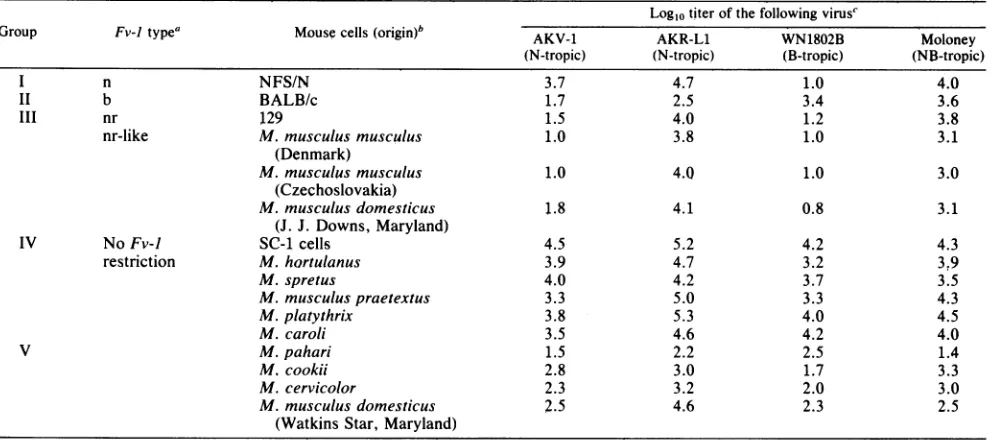
TABLE 1. Plaquingefficiency of ecotropic MuLVs in inbred strains and wild-derived mice Log10titer of thefollowingvirusC
Group Fv-Jtypea Mouse cells(origin)bWN18'2BAKV-1 AKR-L1 Moloney (N-tropic) (N-tropic) (B-tropic) (NB-tropic)
l n NFS/N 3.7 4.7 1.0 4.0
II b BALB/c 1.7 2.5 3.4 3.6
III nr 129 1.5 4.0 1.2 3.8
nr-like M. musculus musculus 1.0 3.8 1.0 3.1
(Denmark)
M.musculusmusculus 1.0 4.0 1.0 3.0
(Czechoslovakia)
M.musculus domesticus 1.8 4.1 0.8 3.1
(J. J. Downs, Maryland)
IV NoFv-1 SC-1 cells 4.5 5.2 4.2 4.3
restriction M. hortulanus 3.9 4.7 3.2 3,9
M.spretus 4.0 4.2 3.7 3.5
M.musculuspraetextus 3.3 5.0 3.3 4.3
M.platythrix 3.8 5.3 4.0 4.5
M. caroli 3.5 4.6 4.2 4.0
V M. pahari 1.5 2.2 2.5 1.4
M. cookii 2.8 3.0 1.7 3.3
M. cervicolor 2.3 3.2 2.0 3.0
M.musculus domesticus 2.5 4.6 2.3 2.5
(Watkins Star, Maryland)
a Mice listed in group V cannot be categorized as a single phenotype.
bNFS/N and BALB/c were tested both as embryo fibroblasts and tail cultures; M. pahari was tested only as embryo fibroblasts. All other mice were tested only
astail cultures.
Data were taken from seven different experiments.
7 to 10days in minimal essential mediumorMcCoysmedium with10%fetal calf serum and antibiotics. When the cultures
reached confluency, the cells were passaged and infected
withvirus the next day. Virus stocks were obtained from J.
Hartley (National Institute ofAllergy and Infectious
Dis-eases, National Institutes ofHealth) and included the
NB-tropic Moloney and Friendecotropic MuLVs, the N-tropic ecotropic viruses AKV-1 and AKR-L1, and the B-tropic
virusWN1802B (22). The NB-tropic virus strains were used to assess virus sensitivity independently ofFv-1 type, and the two N-tropic strainswere used totypeforFv-Jlr which restricts AKV-1 butnotAKR-L1.
Virus replication in cultured cells was scored by the XC
test 4 to 5 days after inoculation (24). For comparison, viruses were titrated in culturesof SC-1 cells and in tailor
embryo fibroblasts prepared from NFS/N
(Fv-J'l)
and BALB/c(Fv-Jb).Friend virus complex susceptibility. Mice were typed for
Fv-2 afterretro-orbital inoculation of0.2mlofa 1%spleen suspensionof Friend viruscomplex.
NB-tropic
Friendviruscomplex was originally obtained from F.
Lilly (Albert
Einstein College ofMedicine) and was serially passaged inBALB/c mice.Thevirus poolused for inoculation contained
3 x 10⁴SFFV/ml and 3 x 10⁶ XC PFU/ml.
Micewere sacrificed 14 days after
inoculation,
and their spleens were weighed. Because resistance to Friend virus can be attributed to Fv4 as well as Fv-2, spleens fromresistant micewerealsotypedfor infectioushelpervirusby plating single cell suspensions on SC-1 cells. Virus was
scored intheseculturesbytheXCtest4to5dayslater. The presence ofhigh titers ofecotropic virus in spleens from
resistant mice is characteristic of Fv-2 restriction but not
Fv4restriction (16).
Gpd-1
typing. TofollowtheFv-J locusingenetic
crosses,hybrid mice were typed for
Gpd-J
(glucose-6-phosphate dehydrogenase-1), acloselylinked isozymelocus (25). Kid-ney extracts were electrophoresed on cellulose acetatestrips, andGpd-I wasscoredafter histochemicalstaining by
the proceduredescribed by Harris and Hopkinson (6).
RESULTS
Replication of ecotropic viruses in wild mouse cells. Suscep-tibilitytoecotropic virus was
mneasured
by determining the titers ofstandardvirus stocksinculturedcells of laboratoryor wild-derived mice (Table 1). Although a given pool of
NB-tropicvirus gave the same titer(withina 10-foldrange) incellsofdifferentlaboratorystrains, severalwildmicewere less susceptible than control cultures to infection by the
NB-tropicecotropic MuLVs(Table 1,groupV). Most
nota-bly, virus titerswere reducedincells ofMuspahari by2to
4logscompared withcontrol SC-1 cells. Alesspronounced
decrease insensitivity wasnoted inother wild mice suchas
Musmusculusdomesticus(Watkins Star). Thesedifferences were reproduciblein repeated assays, suggestingthat there
isa
genetic
basis forthem.The wild mice also differed substantially from inbred
strains in their susceptibility to the different host range
subgroups defined by restriction at the Fv-J locus. While cells from Fv-J" or
Fv-lb
inbred strains showed at least a50-fold difference in
susceptibility
to N- andB-tropic
vi-ruses, none of the wild mouse cellstested reproduced thispattern. However, some of the wild-derived mice
from
easternMarylandandEurope
(Table
1,groupIII)restrictedB-tropic virus as well as the AKR-L1 N-tropic
ecotropic
virus. These mice resembled the inbred strains
carrying
the Fv-1l"" allele.The remaining wild mice tested
generally
wereequally
susceptibletoN-tropicandB-tropic
ecotropic
viruses(Table
1, groups IV andV). Forthese wild
mice,
thedifference insensitivity to these two virus subgroups was less than 30-fold. This pattern has not been
previously
describedfor any inbred mouse,althoughit resembles thatofSC-1,
acell line established fromawild mousefromCalifornia(7).Finally, among the wild mice
typed
ashaving
thisJ. VIROL.
on November 10, 2019 by guest
http://jvi.asm.org/
nonrestrictivephenotype,therewerealsosomesmall differ-ences in relative susceptibility to the two virus host range classes. Thus, Mus caroli cells were reproducibly more sensitivetoinfection with B-tropic virus than with N-tropic virus, and although all viruses replicated poorly in cells of M. pahari, these cells were clearly more sensitive to B-tropic MuLVs.
Absenceof Fv-1 restrictionmapstochromosome 4. It isnot
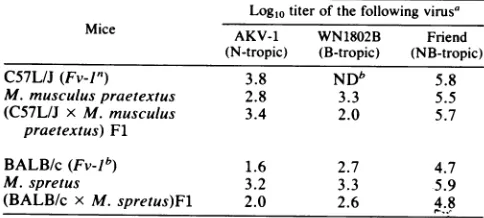
knownwhether the absence of Fv-J typerestriction of N-or B-tropic MuLVs in SC-1 cells is afunction ofa novel Fv-1 allele or whether it is due to an unlinked genetic locus or somefactorresulting from long-term culture in vitro. How-ever,classicalMendeliancrossescould be usedtodetermine the genetic basis for this same phenotype in wild mice. Progeny of genetic crosses between M. spretus and M. musculus praetextus with various laboratory strains were typed forvirus susceptibility (Table 2). Results indicate that Fl hybrids between M. spretus and the
Fv-lJb
mouse BALB/c resemble the BALB/c parent in that they aresusceptibletoB-tropic virus but restrict N-tropic virus. Cells from Fls between M. musculus praetextus and the Fv-Jn mouseC57L restricted B-tropic virus. In bothcrosses, the
Fl hybrids more closely resembled the resistant parent,
although titers of the restricted virusweregenerally higherin
cultures fromheterozygotesthanfromtheresistantparental strain. Therefore, resistance is inherited as a semidominant ordominant trait.
Single gene control of this phenotype in M. musculus
praetextus wasestablished in severalcrosses. M. musculus
praetextuswasmated withC57Lfemales foronegeneration and NFS females for five generations. Ateach generation, mice were typed for virus sensitivity, and heterozygotes wereselected forsubsequent mating. Of 37 hybrid mice, 15
were more sensitivetoB-tropic virus than weretheir litter-mates(by 1to2logs), indicating inheritance ofasinglegene from M. musculus praetextus (P > 0.25). (C57L x M. musculus praetextus)F2 mice were also typed for virus sensitivity (Table 3). Of 36 mice,7(19o)werefullysensitive to B-tropic virus, which is consistent with single gene segregation. All sevenof these micewere also showntobe
homozygous for Gpd-lb. Similarly, there was concordance
between resistance to B-tropic virus and inheritance of
Gpd-la. These data indicate that virus sensitivity is con-trolled byagene closely linkedto Gpd-J (recombination =
1.5 + 1.4centiMorgans).
[image:3.612.309.549.96.166.2]Virus susceptibility and Gpd-l were typed in two M.
TABLE 2. Plaquingefficiency ofN-,B-,and NB-tropic viruses in
primary tail cellsof Fl hybridsand parentalmice Log10 titer of thefollowingvirus'
Mice AKV-1 WN1802B Friend
(N-tropic) (B-tropic) (NB-tropic)
C57L/J(Fv-1") 3.8 NDb 5.8
M.musculuspraetextus 2.8 3.3 5.5
(C57L/J x M. musculus 3.4 2.0 5.7
praetextus)Fl
BALB/c(Fv-1b) 1.6 2.7 4.7
M. spretus 3.2 3.3 -5.9
(BALB/c x M.spretus)Fl 2.0 2.6 4.8
aThe titers for each of these viruses in the fully permissive SC-1cellswere
[image:3.612.306.548.550.665.2]asfollows: AKV-1, 3.6; WN1802B,3.2;Friend, 5.4. bND, Not detectable.
TABLE 3. SegregationofGpd-J andsensitivity to ecotropic virus
in(CS7L x M. musculuspraetextus)F2 mice'
b No.of
~~~~~~~~~Logl0
titer ofGpd-Itypeb No.of WN1802B
mice
~~~(Mean
± SD)Caa 14 0.4+ 0.6
ab 1 1.0d
15 2.2 ± 0.1
bb 7 3.3± 0.02
aRecombinationwas 1.5 ± 1.4,ascalculated by the method of maximum likelihood(5).
bM.musculuspraetextuswasscoredasGpd-lb;C57Lwasscoredas
Gpd-la.
'Log10virus titers in controls were 3.0 to 3.8 in M. musculus praetextus
cells,2.0 to 2.5intheFlhybrids,andless than1.1inC57L.
dSinglemousescoredasrecombinant.
spretus crosses (Table 4). The observed pattern of virus
susceptibilityin theprogenywascompatiblewithsingle gene
control
(P
>0.65).
Aheterozygousmalefrom theC57BL/6x
(NFS
x M.spretus)
cross was matedtoNFSfemales forthreegenerations. Combineddata from virus typingateach
generationalso showed
single
genesegregationsince 11 of 26 mice inherited the M.spretusphenotype (P>0.45;data notshown).
This locuswasclosely
linked toGpd-J(recombina-tion = 8 ± 5.5centiMorgans).
These datasuggestthat bothM. spretusand M. musculus
praetextus carry a novel Fv-J allele which permits the unrestricted replication of N- and B-tropic MuLVs. To establishwhether this lack of restriction is controlledbythe samegenetic locus in these twowild-derived mice,
hybrid
mice heterozygous for the nonrestrictive alleles from M.
spretus and M. musculus praetextus were mated.
Twenty-oneprogenyof this cross weretypedforsensitivitytoN- and
B-tropic virus (Table 5). Gpd-I was not typed since the
parental mouse carrying the M. musculuspraetextus virus
restriction locuswas homozygous for Gpd-1. Results show that six of the progeny showed the nonrestrictivephenotype,
seven were typed as
Fv-1",
and eight were typed asheterozygotes.Thesedata indicate that mice which inherited
TABLE 4. Segregation ofGpd-I andsensitivitytoecotropic viruses in M. spretuscrosses
Inheritance of
Log10
virus Cross M. spretustiterb
Gpd-l type'
NFS/N x (C57BL/6x M. spretus) - 1.0, 1.5, 2.0, 2.0, 2.3, 2.3, 2.6
+ 3.3, 3.6, 3.7, 3.8 ND' 3.6,4.1 C57BL/6 x (NFS x M. spretus) - 1.3, 1.5, 1.5,
3.4d
+ 2.0d,2.6,3.4
aM. spretus carries a unique Gpd-l allele which is electrophoretically distinguishablefrom bothGpd-l (C57BL/6) andGpd-lb (NFS/N).
b The firstcrosssegregatedFv-lbandthereforewastyped for sensitivityto
N-tropic virus (virus titer in M. spretus cells was 3.2). The secondcross segregatedFv-J"and was typedfor sensitivitytoB-tropicvirus (virus titer in
M.spretus cells was 3.3). cND, Not done.
dScoredasrecombinant.
on November 10, 2019 by guest
http://jvi.asm.org/
[image:3.612.46.288.594.703.2]284 KOZAK
TABLE 5. Plaquing efficiency of ecotropic viruses in the progeny ofa crossbetweenmice heterozygousfor thenonrestrictiveFv-1
alleles from M. spretus and M. musculus praetextus' Log1otiter (Mean ±SD) of the
followingvirus' No.of Genotype
AKV-1 WN1802B progeny
3.7± 0.7 3.1 ±0.5 6 Fv-1°'o
3.7± 0.3 1.8 ±0.5 7 Fv nln
3.7 ± 0.5 0.7 ±0.2 8 Fv-1n/o
a Thefemale parent was the product of a cross between an NFS female and
aheterozygous male from the cross: NFSx(C57BLxspretus)F1. The male parent was the progeny of a series of crosses in which a M. musculus praetextus male was mated with C57L for one generation and with NFS females for three generations. At each generation, males were typed for virus sensitivity, andheterozygotes were used for subsequent mating.
bTiters in SC-1 cells were 4.6 (AKV-1) and 3.7(WN1802B).
boththe M. spretus and M. musculuspraetextus recessive
genesresponsible for the lack ofvirus restriction show the
fully sensitive phenotype. Therefore, this phenotype is
con-trolled by the same genetic locus in both wild mice. The
novel nonrestrictive allele at the Fv-1 locus will be desig-natedFv-1P.
Fv-2-mediated resistance in wild mice. Three tofive mice from each wildmousepopulation weretested forsensitivity
to induction oferythroleukemia and susceptibility to virus spread after they were inoculated with Friend virus com-plex. Six of the wild mouse species were found to be
resistant to Friend virus-induced splenomegaly: M.
cervi-color,M.pahari, M. caroli, M. cookii, M. hortulanus, and M. spretus. Spleens from five of these mice contained no
recoverable viruswhentested 2 to 4weeks afterthey were
inoculated. This resistancetohelpervirus ischaracteristic of
Fv4restrictionand,in fact,oneof these five micewasfound by blot hybridization to contain theresistance allele at the Fv4locus (13).
Spleens fromthe sixth resistant mouse, M. spretus,
con-tained high levels ofecotropic virus after inoculation, de-spite the absence ofsplenomegaly. Since this is characteris-tic ofFv-2 resistance, genetic crosses were carried out to
determine whether M. spretus carries the recessive resist-ance allele (Fv-2r) at this locus (Table 6). Fls between M. spretusandFv-2-sensitive
(Fv-2s)
NFSmice were sensitiveto virus-induced splenomegaly, whereas the Fls with Fv-2r
C57BL/6 mice were resistant. Furthermore, all ofthe prog-eny between a spretus male and females from a C57BL/6
congenic
line carrying Fv-2s weresusceptible
to diseaseinduction consistent with the hypothesis that M. spretus
carriesFv-2r. Finally, (NFS x M. spretus)Flswere crossed
with C57BL/6 males. Of the 27 progeny tested, 15 showed the resistance phenotype, which is consistent with
single
gene segregation. These results indicate that M. spretus is resistant to Friend virus-induced disease because these mice carry the resistance alleleatthe Fv-2 locus.
DISCUSSION
A survey of13 wild-derived mouse populations revealed that many ofthese mice differ from inbred strains in their sensitivity to MuLVs. Data from Mendelian crosses con-firmed that onephenotype foundinmanyof thesemice,the
absence of
Fv-J
type restriction, is determined by a novelallele
attheFv-1
locus(Fv-1P)
in twodifferentspecies. Oneof the mice typed as
Fv-1P,
M. spretus, wasalso shown tocarry the rare recessive resistance allele atFv-2.
Although several of the wild mice tested were typed as
Fv-1"l,r
aphenotype whichhasbeenidentifiedinafew inbredstrains such as F, 129, and NZB (19; W. P. Rowe, J. W.
Hartley, and T. Pincus, unpublished data), none of these
mice showed the characteristic Fv-1" orFv-lb phenotypes foundinmostinbred strains.However,the absence of Fv-J"
andFv-lb isnot surprisingsincethissurvey did not include
wild mice from western Europe and Japan. It is these wild mouse populations which most closely resemble the older inbred strains, interbreed readilywithlaboratory mice,and werepresentin thecolonieswhichprovided the progenitors ofthe commoninbred strains (18).
Although in this studyanewalleleatFv-1wasidentified, the data failedtoidentifyanyadditionalgenetic loci affecting in vitrovirusreplicationinwild mice. However,someof the wild mice tested, particularly M. pahari, differed from laboratory miceintheiroveralllack ofvirussensitivity, and
the mice typed as Fv-J° showed someminor differences in their relative sensitivities toN- and B-tropic viruses. Since
most of these wild-derived mice do not interbreed with
laboratory strains, the genetic basis for these differences
could not be ascertained. However, results of comparable
studies on inbred strains have described similar subtle dif-ferences among Fv-1" strains in their patterns ofB-tropic virus restriction(2, 22). While itispossiblethat these minor differences in virus restrictionmaybe duetotheexistence of other unlinkedloci, amorelikelyexplanationis that Fv-J is a complex locus with multiple alleles thatcannot be easily distinguished by usingassaysbased on plaquing efficiency.
Results of this survey alsoshowthatonly onemouse, M. spretus, carries the recessive resistance allele atFv-2. This
locus is also rare among laboratory mice since it is found
onlyinC57BL/6andrelated strains. Acomparative analysis
of inbred strains has shown that C57BL/6 differs
substan-tially from the other strains in its distribution of alleles at
various polymorphicloci (28). However, thereisno known
ancestral link between this strain and any specific wild mouse population, includingM. spretus.
As pointed out in an earlier report (13), Friend virus disease resistance patterns in these wild mice suggest that there may beadditional genetic loci which affect resistance tovirus-inducederythroblastosis. Anumber of resistantwild
mice, including M. pahari, M. caroli, M. cookii, and M.
hortulanus, do not carry the ecotropic provirus associated
withFv4r(13), nordothey supportreplication ofecotropic helper virus, suggesting that Fv-2r is not responsible for resistance. For M.pahari,this invivoresistancemaybedue tothefactthat,asshown in thisreport,ecotropicviruses do not replicate well in cells from these mice. However, the basis for resistance in the other mice remains obscure. Since thesemicedonotinterbreed withlaboratory strains,itisnot
possibletodetermine whether resistance isdue toanyof the
TABLE 6. SensitivitytoFriendvirus-inducedsplenomegaly
No.of Spleen Ecotropicvirus
Mice o. o weight (XCPFU)/no.
range (g) of spleen cells
NFS 6 0.91-4.6 >1,000/104
C57BL/6 4 0.17-0.25 >1,000/103
M.spretus 3 0.02-0.22 800/104
(NFS x M. spretus)F1 6 0.71-2.39 800/104
(C57BL/6 x M.spretus)F1 4 0.07-0.15 600/103
(B6.S x M.spretus)Fl 17 0.76-3.3 NDa
aND,Notdone.
J. VIROL.
on November 10, 2019 by guest
http://jvi.asm.org/
[image:4.612.327.568.629.716.2]same loci described in inbred mice affecting sensitivity to Friend virus(29).
Further studies with these wild mice mayhelpdetermine the molecular mechanisms affecting virus restriction and
virus-induced pathogenesis. Since wild mice carryingFv-1°
and Fv-2' contain few chromosomally integrated MuLV
genomes (3, 13; unpublished data), analysis ofexogenous virusreplication in these mice shouldbe greatly simplified. Studiesonviralleukemogenesis should also benefitfrom the use ofinbred strains congenic for Fv-J°, since such mice
would provide a common genetic background to study
diseaseinductionbyN-andB-tropicviruses. Finally,Fv-1° congenic mice may also be useful instudies on the expres-sion of
endogenous
MuLVs. Although mostproviral genesare not inducible as infectious virus, these sequences can
contribute to the generation of recombinant viruses (12). Since Fv-11 and Fv-lb restrict the spread of viruses with
specificgag sequences(4),abroaderrange of viruses might
be recoverable from Fv-1°mice.
ACKNOWLEDGMENTS
I thankClarenceCoreyfortechnicalassistance; Jonathan Silver and Janet Hartleyfor helpful discussions, virus stocks,and mice;
Michael Potter for access to his wild mouse colony; and Susan Rosenfeldforpreparationof this manuscript.
LITERATURE CITED
1. Axelrad, A.A.,H. Croizat,and D. Eskinazi. 1981. Awashable macromolecule from Fv2rr marrow negatively regulates DNA
synthesis in erythropoietic progenitor cells BFU-E. Cell 26:233-244.
2. Benjers, B. M., R. H. Bassin, A. Rein, B. I. Gerwin, and G. Duran-Troise. 1979. Mechanism of restriction of murine leuke-mia viruses varies between different strains ofFv-I"mice.Int.J. Cancer24:600-607.
3. Chattopadhyay,S.K.,M.R.Lander,E.Rands,and D. R.Lowy. 1980. Structure ofendogenous murine leukemia virusDNA in
mousegenomes. Proc. Natl. Acad. Sci. U.S.A. 77:5774-5778. 4. Gautsch, J. W., J. H. Elder, F. C. Jensen,and R. A. Lerner.
1980.In vitro construction ofB-tropicvirusbyrecombination:
B-tropismisacryptic phenotype ofxenotropicmurine
retrovi-ruses.Proc. Natl. Acad. Sci. U.S.A. 77:2989-2993.
5. Green,E. L. 1981.Genetics andprobabilityinanimalbreeding experiments. OxfordUniversityPress, NewYork.
6. Harris, H., and D. A. Hopkinson. 1976. Handbook of enzyme
electrophoresis in human genetics. North-Holland Publishing
Company,Amsterdam.
7. Hartley,J. W.,and W. P. Rowe. 1975. Clonalcelllines froma feral mouse embryo which lack host-range restrictions for murine leukemia viruses.Virology 65:128-134.
8. Hartley, J. W., W. P. Rowe, and R.J. Huebner. 1970. Host-rangerestrictions of murine leukemia viruses inmouseembryo cellcultures.J. Virol. 5:221-225.
9. Huang, A. S., P. Besmer, L. Chu, and D. Baltimore. 1973. Growth of pseudotypes of vesicular stomatitis virus with
N-tropicmurine leukemia viruscoatsincells resistanttoN-tropic viruses. J. Virol. 12:659-662.
10. Ikeda, H., andT. Odaka. 1983. Cellular expressionof murine leukemia virus gp7O-related antigen on thymocytes of uninfected mice correlates withFv4gene-controlledresistance
toFriendleukemia virus infection.Virology 128:127-139. 11. Jolicoeur,P.,and E.Rassart.1980. EffectofFv-1 geneproduct
on synthesis of linear and supercoiled viral DNA in cells infectedwith murine leukemiavirus. J. Virol.33:183-195.
12. Khan,A.S. 1984. Nucleotide sequence analysis establishes the role ofendogenous murine leukemia virus DNA segments in formation of recombinant mink cellfocus-forming murine leu-kemia viruses.J. Virol. 50:864-871.
13. Kozak, C. A., N. J.Gromet, H. Ikeda, and C. E. Buckler. 1984. A unique sequence related to the ecotropic murine leukemia virus is associated with the Fv4resistance gene. Proc. Natl. Acad. Sci. U.S.A. 81:834-837.
14. Krontiris, T. G., R. Soeiro, and B. N. Fields. 1973. Host restriction of Friend leukemia virus. Role oftheviraloutercoat. Proc.Natl. Acad. Sci. U.S.A. 70:2549-2553.
15. Lander,M.R., B. Moll, and W. P. Rowe. 1978. A procedure for cultureof cellsfrommousetailbiopsies: brief communication. J. Natl. Cancer Inst. 60:477.
16. Lilly,F.1970. Fv-2:identification and location ofasecondgene
governingthespleen focus responsetoFriendleukemia virus in mice.J. Natl.CancerInst.45:163-169.
17. Mak, T. W.,A.A.Axelrad, andA.Bernstein. 1979. Fv-2 locus controls expression of Friend spleen focus-forming
virus-specific sequences in normal and infected mice. Proc. Natl. Acad. Sci. U.S.A. 76:5809-5812.
18. Morse,H.C., III.1978.Originsof inbred mice. Academic Press, Inc., New York.
19. Morse,H.C.,III, C.A.Kozak,R. A.Yetter,andJ. W.Hartley. 1982. Unique features of retrovirus expression in F/St mice. J. Virol.43:1-7.
20. Okada, T.,H.Ikeda,H.Yoshikura,K.Moriwaki,andS. Suzuki. 1981. Fv4: gene controlling resistance to NB-tropic Friend murine leukemia virus. Distribution in wildmice, introduction into genetic background of BALB/c mice, and mapping of chromosomes.J. Natl. CancerInst.67:1123-1127.
21. Pincus, T., J. W. Hartley, and W. P. Rowe. 1971. A major
genetic locus affectingresistanceto infection with murine leu-kemia viruses. I. Tissue culture studies of naturally occurring viruses.J. Exp. Med. 133:1219-1233.
22. Pincus, T., J. W. Hartley, and W. P. Rowe. 1975. A major genetic locus affecting resistanceto infection with murine leu-kemia viruses.IV.Dose-responserelationships inFv-1sensitive andresistant cell cultures. Virology 65:333-342.
23. Risser,R.1979.Frienderythroleukemiaantigen:aviralantigen specifictospleenfocus-forming virus and differentiation antigen controlledby theFv-2locus. J. Exp. Med. 149:1152-1167. 24. Rowe,W.P.,W. E.Pugh,andJ.W.Hartley. 1970.Plaque assay
techniquesfor murine leukemia viruses.Virology42:1136-1139. 25. Rowe,W. P., and H. Sato. 1973.Genetic mapping of the Fv-1
locusofthe mouse. Science 180:640-641.
26. Steeves, R., J. Bubbers,F. Plata,and F. Lilly. 1978.Origin of
spleencoloniesgenerated byFriendvirus Fv-2r infected cells in mice.Cancer Res. 38:2729-2738.
27. Suzuki,S. 1975. Fv4: a newgene affecting the splenomegaly induction by Friend leukemia virus. Jpn. J. Exp. Med. 45:473-478.
28. Taylor,B. A.1972.Geneticrelationships between inbred strains of mice. J. Hered. 63:83-86.
29. Teich, N., J. Wyke,T.Mak,A.Bernstein,and W.Hardy.1982. Pathogenesis of retrovirus-induced disease, p. 785-998. In R.
Weiss, N. Teich, H. Varmus, andJ. Coffin(ed.),RNA tumor viruses. ColdSpring Harbor Laboratory, Cold Spring Harbor, N.Y.
30. Yang, W. K., J. 0. Kiggans, D. M. Yang, C. Y. Ou, R. W. Tennant, A. Brown, and R. H. Bassin. 1980. Synthesis and circulation ofN-and B-tropic retroviralDNAin Fv-J permis-sive andrestrictivemousecells. Proc.NatI. Acad. Sci. U.S.A. 77:2994-2998.
31. Yoshikura, H.,and T.Okada. 1982. Surfaceantigen expressed inhemotopoieticcellsderived fromFv4r mousestrains. J. Natl. CancerInst.68:1005-1009.