
Int. J. Electrochem. Sci., 10 (2015) 859 - 869
International Journal of
ELECTROCHEMICAL
SCIENCE
www.electrochemsci.org
Short Review
Recent Developments in Electrode materials and Methods for
Pesticide Analysis - An overview
Rasu Ramachandran2, Veerappan Mani1, Shen-Ming Chen1,*, George Gnana kumar3, Mani Govindasamy4
1
Electroanalysis and Bioelectrochemistry Lab, Department of Chemical Engineering and
Biotechnology, National Taipei University of Technology, No.1, Section 3, Chung-Hsiao East Road, Taipei 106.Taiwan (ROC).
2
The Madura College, Department of Chemistry, Vidya Nagar, Madurai – 625 011, Tamil Nadu, India.
3
Department of Physical Chemistry, School of Chemistry, Madurai Kamaraj University, Madurai-625 021,Tamil Nadu, India.
4
Department of Chemistry, Bishop Heber College (Autonomous), Tiruchirappalli-620 017, Tamil Nadu, India.
*
E-mail: [email protected]
Received: 24 September 2014 / Accepted: 15 October 2014 / Published: 2 December 2014
Different types of electrode materials have been developed recently for the potential application in pesticide sensor analysis. These electrodes are employed for the determination of organophosphates, carbamates and methyl parathion. This short review article gives an overview of different analytical and electrochemical methods (High performance liquid chromatography, cyclic voltammetry, square wave voltammetry, differential pulse voltammetry and electron impedance spectroscopy) reported for the pesticide detection and new kinds of electrode materials including carbon nanomaterials, metal oxides, conducting polymers and clays based materials for the detection of environmentally and biologically toxic pesticides and herbicides. The recently developed electrode materials which are able to detect upto lower level concentrations of pesticides with high sensitivity and specificity have been reviewed. Real sample studies carried out in apple, cabbage, tap water and lake water were also overviewed.
Keywords: Electrode materials, electroanalytical techniques, electrochemistry, real samples, pesticides.
1. INTRODUCTION
health [1, 2]. Organophosphates (OPs) have been widely used as pesticides in agricultural industry. The deposited pesticide residue of OPs may enter in to the food chain through soil, air and water. Some of the pesticides (OPs, carbamates, organochlorides, mercury and arsenics) have been used to destroy weeds, insects and microorganisms. The inhibition study of biosensor based on acetylchelensterase is a promising approach for monitoring the toxicity, safety of the environment and to maintain the quality of the food [3]. Moreover, the acetylcholensterase inhibition biosensor is versatile method for the detection of organophosphates and carbamates.
Recently, methyl parathion detection studies have been developed by the following analytical techniques such as gas chromatography [4], mass spectrophotometry [5] and liquid chromatography [6]. Among various electrode materials, recently graphene based nanocomposites have been widely employed to fabricate biosensors which are shown to be promising electrode material to improve the sensitivity and detection limit [7]. Graphene, a two dimensionally arranged honeycomb lattice with sp2 carbon atoms is the thinnest material which recently become ‘rising star’ among all other carbon nanomaterials owing to its unique physicochemical properties [8]. Graphene is an attractive nanomaterial for the pesticide analysis ascribed to its unique properties such as high surface area, superb conductivity, appreciable electrocatalytic ability and excellent electrical, thermal and conducting properties [9]. Similarly, metal oxides have high conductivity, large surface area, non-toxicity and good catalytic activity. Nickel oxide with graphene nanocomposites were synthesized and applied to various fields like supercapacitors, batteries and dye-sensitized solar cells [10–12].
Recently, our research group [13] overviewed various electrode materials such as carbon nanomaterials (fullerene, carbon nanotube and graphene), conducting polymers (Polypyrrole, polythiophene, poly-(3,4-ethylenedioxythiophene) and polyaniline) and metal oxides (Ruthenium oxide, manganese dioxide and zinc oxide) for high performance supercapacitor applications. As a continuation of our research work, herein we are reviewing the recently reported high performance electrode materials for the pesticide analysis. Various morphologies of MnO2 nanoparticles, like rod,
belt and flowers were studied for the non-enzymatic determination of hydrogen peroxide [14]. In recent years, graphene based electrode materials have been reviewed for the better electrochemical applications such as electrochemical sensors, biosensors and energy storage devices (Batteries, supercapacitors and fuel cells) [15]. Multi-walled carbon nanotube modified with gold nanoparticle composites exhibited excellent electronic and catalytic properties for electrochemical sensor applications [16]. The analysis of these studies shows that we have to control the usages of all kind of pesticides and save good environment for coming generations [17].
In this review, we have discussed about the recently reported electrode materials and various kinds of instrumentation methods reported for the sensitive determination of methyl parathion, organophosphate and carbofuran pesticide sensor applications.
2. ANALYTICAL TECHNIQUES FOR THE PESTICIDE ANALYSES
2.1 Chromatography
(HPLC) has been used to detect carbamate pesticide values. The toxicity of pesticides (carbamate) may induce nausea, vomiting and coma like health effects. This type of problems could be controlled by minimizing residue levels (MRLs) of pesticides in the food samples [18, 19]. Chromatography technique can be used as versatile detection methods which are ideally suited for analyzing a wide range of compounds. Using these techniques, samples have been analyzed within 7 minutes. This is due to the high sensitivity of the diamond electrode, which allows a well defined chromatogram for 10 nM mixture of the pesticide analyte. However, HPLC is a time consuming method, uses some toxic organic reagents and require expensive equipment. Also, HPLC involves with complicated operating protocols.
2.2 Electrochemical analysis 2.2.1 Cyclic voltammetry
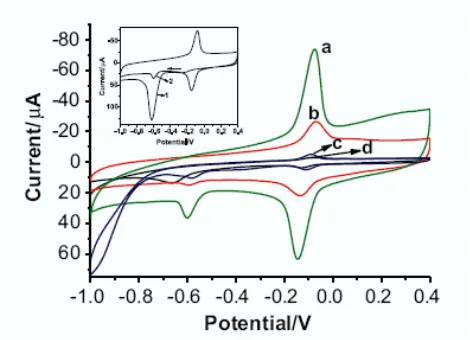
Figure 1. Cyclic voltammograms of MIP–IL–EGN/GCE (a), NIP–IL–EGN/GCE (b), MIP–IL– GO/GCE (c), MIP/GCE (d) in 0.1 M PBS (pH 6.8) containing 10 µM methyl parathion (MP). Inset: the CVs corresponding to the first and second scans of MIP–IL–EGN/GCE. Scan rate: 50 mV/s. (Reproduced with permission from ref. [66]).
Zhao et al [17] have reported the determination of methyl parathion (MP) through cyclic voltammetry at four different kinds of electrode materials such as molecularly imprinted polymer-ionic liquid-graphene composite, non-imprinted polymer-ionic liquid-graphene composite, molecularly imprinted polymer ionic liquid graphene oxide composite, and molecularly imprinted polymer-ionic liquid (Fig. 1). During this voltammetric analysis, methyl parathion exhibited a sharp irreversible peak at the potential of - 0.59 V ascribed to the irreversible reduction of nitro phenyl group into hydroxylamine.
[image:3.596.182.417.307.477.2]
Michaelis–Menten constant app m
k of the sensor was calculated using Line weaver Burk equation (1) [20]:
max max
1 1
1
i C i
k i
app m
ss
(1)
Where, iss, imax and Care represents the steady state current after the addition of substrate and the maximum current measured under saturated substrate condition and concentration of the substrate.
2.2.2 Square wave voltammetry
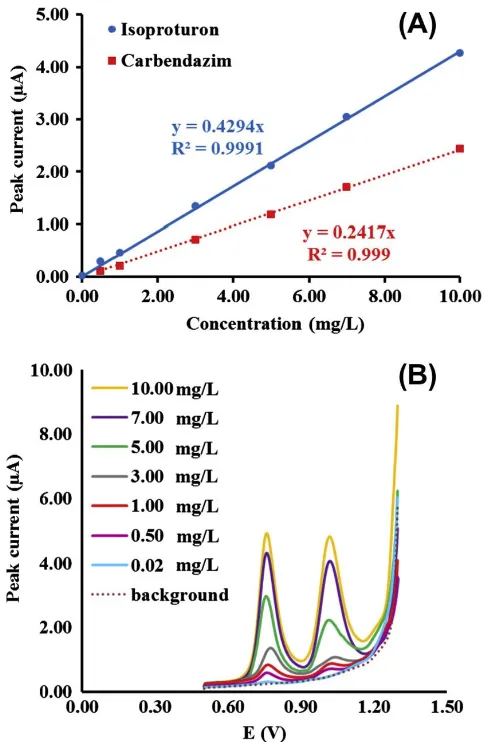
Figure 2. (A) Calibration curves, and (B) square wave stripping voltammetric curves for different concentrations of isoproturon and carbendazim in 1.0 M HClO4. (Reproduced with permission
from ref. [24]).
[image:4.596.176.418.264.635.2]
electrode (Au-ME) has the ability to detect very low concentration of paraquat (herbicide) with limit of detection value of 5.0 x 10⁻⁶ mol L-1 using SWV [21]. A graphene doped carbon paste electrode has been prepared by electrochemical deposition method and utilized to analyse 4-amino phenol by SWV method which achieved the lowest limit of detection value of 1.68 x 10⁻⁹ ± 1.18 x 10⁻¹⁰ M [22].
Liu and Lin [23] have reported the preparation of ZrO2/Au modified electrode for the detection
of methyl parathion. A well-defined peak current has been observed for the methyl parathion analyte solution and the working linear range lies from 5 to 100 ng/mL, while the limit of detection value was estimated to be 1 ng/mL.
P. Noyrod et al., have reported the simultaneous detection of isoproturon and carbendazim via single drop analysis employing graphene-based electrochemical sensor with square wave stripping voltammetry [24]. The oxidation peak currents increases linearly with concentrations of isoproturon, where linear ranges for the detection of isoproturon and carbendazim have been observed as 0.02-10.0 mg/L and from 0.50 -10.0 mg/L respectively. The limit of detection has been calculated as 0.02 and 0.11 mg/L for isoproturon and carbendazim respectively (Fig. 2). Moreover, practical applicability of the proposed electrode has been assessed in water, soil and vegetable samples, with good recoveries and the results were compared with standard HPLC–UV method.
2.2.3 Differential pulse voltammetry
Differential pulse voltammetry (DPV) is a sensitive electrochemical technique for trace level analysis of organic and inorganic analytes. The important parameters, such as sampling time, pulse width and pulse amplitude have been optimized to use DPV. Huo et al [25] have prepared copper oxide nano wire and single-walled carbon nanotube composite film modified electrode for the detection of organophosporus pesticide malathion through DPV. The sensitivity and limit of detection values were calculated to be 628.71 µA cm-2 ppb-1 (2.1 x 10⁴ µA cm2 M) and 0.1 ppb (0.3 nM) respectively. Carbon nanotube modified composite have been developed for the ultrasensitive electrochemical detection of methyl parathion in aqueous solution which exhibited linear range between 20-1000 nM and limit of detection of 1 nM [26].
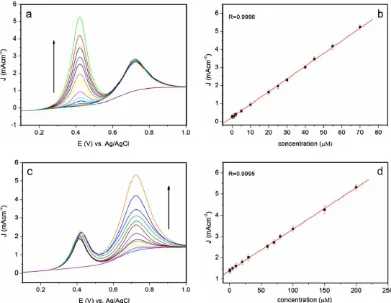
Figure 3. (a) DPV curves obtained at CoO/rGO/GCE for the oxidation of carbofuran with various concentration 0, 0.2, 1, 2, 5, 10, 20, 25, 30, 40, 45, 55, 70 µM (from inner to outer) in the presence of 70 µM carbaryl. (b) Calibration plots of peak currents vs. [carbofuran]. (c) DPV curves obtained at CoO/rGO/GCE for the oxidation of carbaryl with various concentration 0, 0.5, 1, 5, 10, 20, 30, 60, 70, 80, 100, 150, 200 µM (from inner to outer) in the presence of 30 µM carbofuran and Calibration plots of peak currents vs. [carbaryl]. (Reproduced with permission from ref. [27]).
2.2.4 Electrochemical impedance spectra (EIS)
Electrochemical impedance spectroscopy (EIS) can reveal the interfacial changes of the modified electrodes. The semicircles in the Nyquist plot indicates the parallel combination of electron transfer resistance (Ret) and double layer capacitance (Cdl) at the electrode surface resulting from
electrode impedance, while the linear portion represents the diffusion limited process. Y. Liu et al. fabricated a fast and sensitive acetylcholensterase based platinum-carbon aerogel-boron doped diamond (AChE/Pt-CAs/BDD) composite modified electrode for the determination of organophosphorous pesticides (Fig. 4) [28]. Gong et al [29] have prepared high quality zirconia nanoparticles decorated graphene nanosheets for the fabrication of enzymeless methyl parathion sensor. Dong et al [30] reported the preparation of multi-walled carbon nanotubes–CeO2–Au
[image:6.596.102.493.71.374.2]
Figure 4. EIS (Nyquist plot) obtained at (a) bare BDD electrode, (b) Pt-CAs/BDD electrode, and (c) AChE/Pt-CAs/BDD electrode in 0.1 M KCl solution containing 0.01 M [Fe(CN)6]3-/4-.
Frequency range: 0.1 Hz to 10 kHz. (Reproduced with permission from ref. [28]).
3. ELECTRODE MATERIALS
3.1 Carbon electrode materials
Carbon based electrode materials (Fullerene, carbon nanotube and graphene oxide) are widely used in many fields, such as electrochemical sensors, biosensors, energy storage devices (Batteries, supercapacitor and fuel cell) and pesticide sensor applications. Recently, electrochemically synthesized graphene nanosheets have been used as supporting electrode material to deposit CdTe quantum dots and prepared AChE-GNs-QDs modified hybrid as cathodic electrochemiluminescence emitters for the fabrication of organophosphates pesticide sensors (Fig. 5) [31].
[image:7.596.176.418.527.704.2]
A carbon based chemically modified electrode with Amberlite XAD-2 resin (MCPE) has been reported for the determination of paraquat by cathodic striping voltammetry [32]. The MCPE exhibited good linearity calibration curve with limit of detection value of 0.10 µg mL-1. Yan et al [33] have reported the fabrication of (MWCNTs/ALB)6/GCE (multi-walled carbon
nanotubes-acetylcholinesterate liposome bioreactor electrode) for the sensitive determination of organophosphate pesticides and reported the detection value of 0.68 ± 0.76 µg/L. Laccase on graphene doped carbon paste electrode functionalized with Prussian blue (LACC/PB/GPE) film electrode was shown to detect carbamate pesticides (carbofuran (CBF), carbaryl (CBR), formetanate (FMT), pirimicarb (PMB) and ziram (ZRM)) present in tomato and potato crops [34]. The modified electrode based on hexadecane (C16)-coated glassy carbon electrode has been developed for the determination of parathion with limit
of detection value of 2 x 10⁻⁸ mol L-1 for an accumulation time of 30s [35]. Carboxilic graphene-metal oxide composite electrode has been developed for the detection of methyl parathion and carbofuran which reported the lowest limit of detection values of 5 x 10-14 M and 5 x 10-13 M for the detection of methyl parathion and carbofuran respectively [36].
3.2 Metal oxide based electrode materials
Metal oxides (Al2O3, SnO2, TiO2, CuO, RuO2, MnO2, V2O5 and MgO) have been used as
important electrode materials for the various electrochemical applications including sensors, electronic devices and catalytic applications [37, 38]. In comparison with other functional electrode materials, metal oxides possess uniform size, identical shape and well defined crystanality nature. Remarkably, depends on the preparation methods, the morphological shapes of metal oxides varies as tubes, fibres, wires, needles and rods and these are tuned to the desired applications [39]. Li et al. synthesized a nano TiO2 based thin film (Nano-TiO2/p-tert-butylcalix [4] arene hybride) by shelf assembled method and
employed it for the determination of parathion [40]. The working linear range was found between 5.0 x 10⁻⁸ and 1.0 x 10⁻⁵ M, while the detection limit value was calculated to be 1.0 x 10⁻⁸ M. Wang et al [19] reported cobalt (II) oxide-decorated reduced graphene oxide electrode for the detection of carbofuran and Carbaryl and they reported limit of detection value of 4.2 µg/L and 7.5 µg/L for carbofuran and carbaryl respectively. Recently, Huo et al [25] reported a hybrid nanocomposite consisting of copper oxide nanowires and single-walled carbon nanotube for the development of organophosphorous pesticide sensor studies.
3.3 Polymer electrode materials
carbon nanotube-nafion/gold-platinum alloy nanoparticles (GE-CNT-Nafion/AuPtNPs) modified composite electrode and used for the hydrogen peroxide sensor studies. Pardieu et al [47] investigated the molecular imprinted conducting polymer electrode for the detection of atrazine with lowest limit of detection value of 1.0 x 10⁻⁷ mol L-1 [17].
3.4 Clay modified electrode
Colloidal clays attracted much attention in the recent years and widely used to prepare chemically modified electrodes for the electrochemical analysis [48]. It is abundant in nature, environment friendly and inexpensive. Recently, clay modified electrodes were used for the analysis of some toxic compounds such as pesticides [49] and nitro phenols [50]. Chemical method is a versatile technique to prepare a gemini surfactant-intercalated clay-modified electrode for the determination of methyl parathion [51]. Manisankar et al [52] have reported heteropolyacid montmorillonite clay-modified glassy carbon electrode for the determination of isoproturon, carbendazim and methyl parathion through SWV analysis and achieved the limit of detection value of 1, 10 and 20 ng mL-1 for isoproturon, carbendazim and methyl parathion respectively. Organo-smectite clay based composite was fabricated for the electro-oxidation of p-nitrophenol [53]. In this composite electrode, when the loading of the benzyltrimethylammonium (BTMA) cation increases the oxidation peak current of p-nitrophenol simultaneously decreases. Xing and Willemure [54] have reported two types of clays based on cobalt smectites such as [(Si8.05)(Co5.58)O20(OH)4Na0.66 and [(Si7.93)(Co5.92)O20(OH)4] Na0.42.
4. REAL SAMPLE ANALYSIS
The practical applicability of the fabricated modified electrodes has been investigated in various real samples. Zhou et al [55] have tested three kinds of samples such as apple, cabbage and lake water for the detection of methyl parathion and carbofuran. The percentage recovery of these tested samples (Apple, cabbage and lake water) varies between 92.0 % and 107.5 % which were determined by amperometry. Also, a significant progress in this field is the synthesis of carboxylic graphene-zinc oxide based nanocomposite electrode for the development of acetylcholenesterase biosensor analysis [56]. This composite modified electrode has been studied for the real samples analysis in water samples such as tap water and lake water. The recoveries of these samples were observed to be in the range of 93.2 to 104.8 % for the chlorpyrifos and carbofuran.
5. CONCLUSIONS
the commercial analysis of biosensors by using different analytical as well as electrochemical techniques. Remarkable lowest limits of detection values have been achieved by these nanocomposites electrode materials. Acetylcholensterase inhibitor biosensors exhibited excellent sensitivity, low cost, good stability and good reproducibility of results for pesticide sensor applications.
ACKNOWLEDGEMENTS
The research work was supported by the Ministry of Science and Technology, Taiwan and India-Taiwan Science and Technology Cooperation program, DST, India. The authors would like to thank Natarajan Brunthadevi, Graduate student, S.V.N College, Madurai, India for her valuable suggestion on the pesticide sensor analysis,.
References
1. J. Gong, X. Miao, T. Zhou, L. Zhang, Talanta, 85 (2011) 1344.
2. F. Mazzei, F. Botre, S. Montilla, R. Pilloton, E. Podesta, C. Botre, J. Electroanal. Chem., 574 (2004) 95.
3. N.A. Hosea, H.A. Berman, P. Taylor, Bioeletrochemistry 34 (1995) 11528-11536.
4. A. Shanker, C. Sood, V. Kumar, S.D. Ravindranath, Pest Management Science 57 (2001) 458. 5. C.P. Sanz, R. Halko, Z.S. Ferrera, Anal. Chim. Acta, 524 (2004) 265.
6. G. Huang, J. Ouyang, W.R.G. Baeyens, Y. Yang, C. Tao, Anal. Chim. Acta, 474 (2002) 21. 7. S. Wu, X. Lan, L. Cui, L. Zhang, S. Tao, H. Wang, M. Han, Z. Liu, C. Meng, Anal. Chim. Acta,
699 (2011) 170.
8. C. Lu, H. Yang, C. Zhu, X. Chen, G. Chen, Angew. Chem. Int. Ed. 48 (2009) 4785. 9. Z.M. Ao, F.M. Peeters, J. Phys. Chem. C, 114 (2010) 14503.
10. M.L. Sanchez, P. Atienzar, G. Abellán, M. Puche, V. Fornés, A. Ribera, H. García, Carbon, 50 (2012) 518.
11. D.L. Fang, Z.D. Chen, X. Liu, Z.F. Wu, C.H. Zheng, Electrochim. Acta, 81 (2012) 321. 12. W. Lva, F.M. Jin, Q.G. Guo, Q.H. Yang, F.Y. Kang, Electrochim. Acta 73(2012) 129. 13. R. Ramachandran, V. Mani, S.M. Chen, R. Saraswathi, B.S. Lou, Int. J. Electrochem. Sci., 8
(2013) 11680.
14. K.J. Babu, A. Zahoor, K.S. Nahm, R. Ramachandran, M.A.J. Rajan, G. Gnanakumar, J. Nanopart. Res. 16 (2014) 2250.
15. S.M. Chen, R. Ramachandran, V. Mani, R. Saraswathi, Int. J. Electrochem. Sci., 9 (2014) 4072. 16. J. Ma, W. Zhang, Microchim. Acta, 175 (2011) 309.
17. L. Zhao, F. Zhao, B. Zeng, Sens. Actuators, B, 176 (2013) 818.
18. T.N. Rao, B.H. Loo, B.V. Sarada, C. Terashima, A. Fujishima, Anal. Chem. 74 (2002) 1578. 19. M.Y. Wang, J.R. Huang, M. Wang, D.E. Zhang, J. Chen, Food Chem., 151 (2014) 191. 20. L. Yang, G. Wang, Y Liu, M. Wang, Talanta, 113 (2013) 135.
21. D.D. Souza, S.A.S. Machadoa, R.C. Pires, Talanta, 69 (2006) 1200.
22. T.M.B.F. Oliveira, M.F. Barroso, S. Morais, M. Araujo, C. Freire, P.L. Neto, A.N. Correia, M.B.P.P. Oliveira, C.D. Matos, Bioelectrochemistry, 98 (2014) 20.
23. G. Liu, Y. Lin, Anal. Chem. 77 (2005) 5894.
24. P. Noyrod, O. Chailapakul, W. Wonsawat, S. Chuanuwatanakul, J. Electroanal. Chem. 719 (2014) 54.
25. D. Huo, Q. Li, Y. Zhang, C. Hou, Y. Lei, Sens. Actuators, B, 199 (2014) 410–417.
26. M. Musameh, M.R. Notivoli, M. Hickey, C.P.H.Stephen C. Hawkins, J.M. Yousef, I.L. Kyratzis, Electrochim. Acta, 101 (2013) 209.
28. Y. Liu, M. Wei, Food Control 36 (2014) 49.
29. J. Gong, X. Miao, H. Wan, D. Song, Sens. Actuators, B, 162 (2012) 341. 30. J. Dong, X. Wang, F. Qiao, P. Liu, S. Ai, Sens. Actuators, B, 186 (2013) 774. 31. H. Liang, D. Song, J. Gong, Biosens. Bioelectron., 53 (2014) 363.
32. E. Alvarez, M.T. Sevilla, J.M. Pinilla, L. Hemandez, Anal. Chim. Acta, 260 (1992) 19. 33. J. Yan, H. Guan, J. Yu, D. Chi, Pestic. Biochem. Physiol. 105 (2013) 197.
34. T.M.B.F. Oliveira, M.F. Barroso, S. Morais, M. Araújo, C. Freire, P.L. Neto, A.N. Correia, M.B.P.P. Oliveira, C.D. Matos, Biosens. Bioelectron. 47 (2013) 292.
35. C. Xu, K. Wu, S. Hu, D. Cui, Anal, Bioanal. Chem. 373 (2002) 284.
36. Q. Zhou, L. Yang, G. Wang, Y. Yang, Biosens. Bioelectron. 49 (2013) 25–31. 37. B. J. Plowman, S. K. Bhargava, A. P. OMullane, Analyst 136 (2011) 5107.
38. R. S. Devan, R. A. Patil, J.H. Lin, and Y. R. Ma, Adv. Funct. Mater. 22 (2012) 3326. 39. T. Asefa, C. T. Duncanc and K. K. Sharma, Analyst, 134 (2009) 1980.
40. C. Li, C. Wang, C. Wang, S. Hu, Sens. Actuators, B 117 (2006) 166.
41. A. Vakurov, C.E. Simpson, C.L. Daly, T.D. Gibson, P.A. Millner, Biosens. Bioelectron. 20 (2004) 1118–1125.
42. R. Eisert, K. Levsen, Fresenius J. Anal. Chem., (1995) 351:555.
43. E. N. Izakovich, V. M. Geskin, S. V. Stepanov, Synth. Met. 46 (1992) 71.
44. S. G. Haupt, D. R. Riley, J. Zhao, J. T. McDevitt, J. Phys. Chem. 97 (1993) 7796.
45. M. Sba, H.E. Tome, U. Gombert, T. Breton, M. Ponti, Sens. Actuators, B 124 (2007) 368. 46. Q. Sheng, M. Wang, J. Zheng, Sens. Actuators, B 160 (2011) 1070.
47. E. Pardieu, H. Cheap, C. Vedrine, M. Lazerges, Y. Lattach, F. Garnier, S. Remita, C. Pernelle, Anal. Chim. Acta., 649 (2009) 236.
48. P.K. Ghosh, A.J. Bard, J. Am. Chem. Soc., 105 (1983) 5691.
49. H.L. Tcheumi, I.K. Tonle, E. Ngameni, A. Walcarius, Talanta, 81 (2010) 972.
50. I.N. Rodríguez, J.A.M. Leyva, J.L. Hidalgo, H. Cisneros, Anal. Chim. Acta, 344 (1997) 167. 51. H.L. Tcheumi, I.K. Tonle, E. Ngameni, A. Walcarius, Talanta, 81 (2010) 972.
52. P. Manisankar, G. Selvanathan, C. Vedhi, Talanta, 68 (2006) 686.
53. M.J. Zuni, A.D.M. Nikoli, D.M. Stankovi, D.D. Manojlovi, N.P. Jovi, Predrag T. Bankovi, Z.D. Mojovi, D.M. Jovanovi, Applied Surface Science 313 (2014) 440.
54. Y. Xiang, G. Villemure, Clays Clay Miner., 44 (1996) 515.
55. Q. Zhou, L. Yang, G. Wang, Y. Yang, Biosens. Bioelectron., 49 (2013) 25.
56. G. Wanga, X. Tanb, Q. Zhoub, Y. Liua, M. Wanga, L. Yang, Sens. Actuators, B 190 (2014) 730.
![Figure 4. EIS (Nyquist plot) obtained at (a) bare BDD electrode, (b) Pt-CAs/BDD electrode, and (c) AChE/Pt-CAs/BDD electrode in 0.1 M KCl solution containing 0.01 M [Fe(CN)6]3-/4-](https://thumb-us.123doks.com/thumbv2/123dok_us/1880316.145330/7.596.176.418.527.704/figure-nyquist-obtained-electrode-electrode-electrode-solution-containing.webp)
