EWE-ENGLISH CODESWITCHING:
A CASE OF COMPOSITE RATHER THAN CLASSIC
CODESWITCHING
by
Evershed Kwasi Amuzu
A thesis submitted for the degree of
DOCTOR OF PHILOSOPHY
of
The Australian National University
Except where it is otherwise acknowledged in the text, this thesis represents the original
ACKNOWLEDGEMENT
It is a pleasure to thank all those who have helped me in one way or another during the preparation of this thesis.
Special thanks are due to my supervisors Dr. Harold Koch, Professor Andrew Pawley, Dr. Patrick McConvell and Dr. James Essegbey for their intellectual and moral support throughout my study. They were steadfast companions through a difficult journey that seemed endless. I hope that this thesis reflects the time and energy they spent in guiding me. I am deeply indebted to Dr. Koch in one other respect: his generosity with books opened his entire library to me.
I cannot express fully my gratitude to my father. As a shepherd, he inspired me every step of the way. And he did more: he became my fourth supervisor. His comments helped improve various aspects of this thesis. My other shepherd is Dr. Ben Amenuvegbe. His native speaker competence in Ewe and his expertise in statistics made him an invaluable critic of aspects of my ‘findings’. Dr. Felix Ameka belongs to this special group for 1 consulted him on many thorny theoretical and Ewe linguistics issues.
I have benefited from discussions with the staff and colleagues in the programme in Linguistics & Applied Linguistics at the School o f Languages in the Faculty of Arts and in the department o f Linguistics in the Research School of Pacific and Asian Studies at the Australian National University. Many thanks especially to Anna Gladkova, Marie Fellbaum, Felicita Carr, Susan Love, and Francisca Handoko for their interest in my work. The Centre for Research on Language Change seminar series offered me a special setting (for which I am most grateful) where I obtained valuable reactions to thoughts still unformed. In Canberra at large, I owe special thanks to many individuals and families. Among them are the Ayers, Charles and Bernice, Aunties Elizabeth and Bridget, and Jody. Besides giving my family and me a lot of support, moral and otherwise, they often served as ready informants on various language issues.
There is a whole world in Ghana that must be remembered. Unfortunately, I can only mention a few people here. I begin with my parents, brothers and sisters, and in-laws. Their loving support from afar was all we in Canberra needed to go through this journey to a PhD. Many thanks go to Worfa Xomam Atta and Mr. Ketorwu. Their interviewing skills will be emulated in future efforts to gather verbal data. I will forever be indebted to my ‘subjects’, the interviewees, and the questionnaire survey population. The evidence they represent opened a window onto “what is happening in Ghana”. I would also like to express
my sincere gratitude to the many friends who assisted with the survey, the interviews, and the transcriptions and to others who had been wonderfully inspirational. The list can be tall. Some of these friends and mentors, at the University of Ghana, are Kwasi Tordzro, Kofi Dovlo, Dziedzorm Gilbert, Prince Adika, Sika Ahadzie, Kafui Ofori, Doe Lawson, Professor F. Dolphyne, Professor A. Duthie, Professor M.E.K. Dakubu, and Professor K. Darko. Others are Doe Lawson’s aunt and the Vormawors in Accra, and Togbui Aho, Peter Quam, Amekor Korbla, Eric Ocloo and his aunt of Akatsi.
For financial support, I am indebted to the Australian National University who offered me a PhD scholarship. I am also grateful to the University of Ghana for granting me a study leave.
Charity begins at home. This study would never have been completed without the loving support, understanding and sacrifice of my dear wife Becky and our beloved children, Emefa and Selassie. We have made this journey together - the least I can do is to dedicate its fruit, this thesis, to you. A kp e nä m i , m ia w o e wo d o ‘Thank you, well done’.
Evershed Kwasi Amuzu Canberra,
ABSTRACT
This thesis is a detailed investigation of grammatical structures in Ewe-English Codeswitching (CS). It assumes Myers-Scotton’s ideas of Matrix Language (ML) and confronts the question What is the ML in mixed constructions in Ewe-English CS? In an attempt to answer this question, in relation to various types of mixed constructions, the study explores two types of ML hypothesis: the Ewe-only ML hypothesis and a composite ML hypothesis. The two hypotheses share common assumptions and subtle similarities but differ with regard to a few crucial theoretical considerations that by and large determine which of the two adequately and satisfactorily answers the research question.
The Ewe-only ML hypothesis says that Ewe-English CS is a case of Classic CS: Ewe lexemes project slots in Ewe grammatical frames into which English counterparts selected for CS are inserted. The composite ML hypothesis, on the other hand, says that Ewe-English CS is a case of Composite CS: English lexemes project their own slots in Ewe grammatical frames, in conformity with Ewe grammatical procedures. The study shows that the composite ML hypothesis answers the research question more satisfactorily. This finding represents a departure from the traditional way of looking at Ewe-English CS as Classic CS. It raises questions about the usefulness of notions like “matching lemmas”, “compromise strategies” and “Generalized Lexical Knowledge” (Myers-Scotton 2002) for Ewe-English CS as well as for CS from some other communities in post-colonial Africa.
ABBREVIATIONS & SYMBOLS
A d d r=
A d d re ssiv eaF O C
=
A rg u m e n t F o c u s A D J=
A d je c tiv e A dvS=
A d v e rb ia l S u ffixA P C
=
A d n o m in a l P o sse ssiv e C o n stru c tio n A S S O C=
A sso c ia tiv eC A R D
=
C a rd in a lC L
=
C la s sC L S
=
C la u s eC O M P
=
C o m p le m e n tiz e r C o n se=
C o n se c u tiv eC P
=
P ro je c tio n o f C o m p le m e n tiz e r, C o m p le m e n t P h ra s ecs
=
C o d e s w itc h in g D E F=
D e fin ite n e s s M a rk e r D EM = D e m o n stra tiv e F O C=
F o c u s M ark er F U T=
F u tu reH A B
=
H a b itu a lIN D E F
=
In d e fin ite n e s s M a rk e r IN T=
In te n sifie rIN G R
=
In g re ssiv eL O G
=
L o g o p h o ric P ro n o u n M A S C=
M a sc u lin eN
=
N o u nN E G
=
N e g a tiv e N P=
N o m in a l P h rase N P R E S=
N o n -P re s e n t O R D=
O rd in a l P A S T=
P a s t T e n se pF O C=
P re d ic a te F o c u s PL=
P lu ral M a rk e r por=
P o s s e s s o r posm=
P o sse ssu mP O T = P o t e n t i a l
P R E S = P r e s e n t T e n s e
P R O = P r o n o u n
P R O G = P r o g r e s s i v e
P t = P a r t i c l e o f u n c e r t a i n g r a m m a t i c a l f u n c t i o n
P u r p = p u r p o s i v e
Q
= Q u e s t i o n M a r k e r Q T = Q u a n t i f i e rR E D = R e d u p l i c a t i v e
R E L = R e l a t i v i s e r
R E P = R e p e t i t i v e
s g = S i n g u l a r
S U B J = S u b j u n c t i v e
T A M = T e n s e , A s p e c t a n d M o o d
T P = T o p i c M a r k e r
V P = V e r b P h r a s e
0
= A n e l e m e n t is o m i t t e d1 , 2 , 3 = F i r s t - , S e c o n d - , a n d T h i r d - P e r s o n s .
[ ] = A S y n t a c t i c C o n s t i t u e n t
{ } = A n E m b e d d e d C o n s t i t u e n t
( X ) = X is o p t i o n a l
( * X ) = U n a c c e p t a b l e i f X i n c l u d e d
* ( X ) = U n a c c e p t a b l e i f X o m i t t e d
c f . = c o f e r
e .g . = f o r e x a m p l e
e tc . = e t c e t e r a
i.e . = t h a t is
lit. = l i t e r a l l y
TABLE OF CONTENTS
ACKNOWLEDGEMENT... Ill
ABSTRACT...V
ABBREVIATIONS & SYMBOLS... VI
CHAPTER 1: INTRODUCTION...1
1.1 AIMS OF THE STUDY...1
1.2 SOCIOLINGUISTIC BACKGROUND OF EWE-ENGLISH BILINGUALS... 1
1.3 TYPES OF DATA CONSIDERED...3
1.3.1 Primary data (Out-group data)... 3
1.3.1.1 Introduction...3
1.3.1.2 Why interview rather than naturally-occurring out-group data... 3
1.3.1.3 Out-group collaborators... 4
1.3.1.4 Interviewers... 4
1.3.1.5 Subjects...5
1.3.1.6 Topics discussed... 6
1.3.1.7 Interview setting and format... 6
1.3.1.8 Referencing examples taken from the primary / out-group data... 6
1.3.2 Secondary data (In-group data)... 7
1.3.3 Use made of the out-group vs. in-group data...7
1.4 THE MATRIX LANGUAGE FRAME MODEL AND RELATED LITERATURE... 8
1.4.1 Concepts and assumptions...8
1.4.1.1 What does it mean for a construction to have a “Matrix Language”? ...8
1.4.1.2 Outline of the remainder of this section...11
\ .4.1.3 Assumptions about language production and the nature of lexical structure... 12
1.4.1.4 The Abstract Level model... 13
1.4.1.5 The 4-M model... 15
1.4.1.5.1 The feature-based classification... 15
1.4.1.5.2 Content morphemes... 17
1.4.1.5.3 Early system morphemes... 18
1.4.1.5.4 Late system morphemes...18
1.4.2 The Classic CS vs Composite CS distinction...20
1.4.2.1 Introduction...20
1.4.2.2 Classic C S ...20
1.4.2.2.1 The One-Language ML hypothesis... 20
1.4.2.2.2: Fully integrated EL content morphemes...22
1.4.2.2.3 EL bare forms... 26
1.4.2.2.4 EL islands... 28
1.4.2.3 Composite CS and convergence...30
1.4.2.3.1 Composite C S ... 30
1.4.2.3.2 Convergence... 33
1.4.3 Some Classic CS communities and Composite CS communities... 36
1.4.4 Ewe-English bilinguals and their C S ... 38
1.4.4.1 Introduction... 38
1.4.4.2 The Ewe-only ML hypothesis...39
1.4.4.3 The composite ML hypothesis for Ewe-English C S ...39
1.5 ORGANIZATION OF THE REST OF DISSERTATION...41
CHAPTER 2: NONVERBAL PREDICATION IN EWE-ENGLISH CS 43
2.0 IN TRO D U CTIO N ... 43
2.1 BACKGROUND: ENGLISH AND EWE STRUCTURES... 43
2.1.1 Distributions of nonverbal predicates in English...43
2.1.1.1 The copula b e ... 43
2.1.1.2 English quasi-copulas or semi-copulas... 46
2.1.2 Distributions of nonverbal predicates in E w e... 47
2.1.2.1 Ny e-constructions...47
2.1.2.2 Le-constructions...48
2.1.2.3 Other strategies for predicating quality in E w e... 52
2.1.3 CS patterns at a glance... 55
2.2 PREVIOUS STUDIES... 57
2.2.1 Myers-Scotton (1993a)...57
2.2.1.1 Introduction... 57
2.2.1.2 Explicating the hypothesis... 58
2.2.1.3 Problems... 61
2.2.1.3.1 Adjectives whose Ewe equivalents are verbal elements... 62
2.2.1.3.2 Absence of the e-adverbializer... 65
2.2.2 Amuzu (1998)... 66
2.2.2.1 Overview... 66
2.2.2.2 Amuzu’s argument...67
2.2.3 The b e — l e substitution theory...69
2.3 THE PRESENT STUDY: COMPOSITE ML ACCOUNT... 72
2.3.1 Mixed l e constructions with English predicate adjectives... 73
2.3.2 Mixed locational-le constructions... 77
2.3.3 Mixed ascriptive n y e construction... 83
2.3.4 Mixed equative n y e construction... 84
2.4 ANALOGOUS CASES OF CS IN WEST A FRICA ...86
2.4.1 Mixed copula constructions in Akan-English C S ... 86
2.4.1.1 The Akan copula system ... 86
2.4.1.2 The CS data... 88
2.4.2 Mixed copula constructions in Fongbe-French C S ...91
2.4.2.1 The data...91
2.4.2.1.1 Ascriptive d o ...91
2.4.2.1.2 L ocationaldo... 92
2.4.2.1.3 Nyi constructions... 92
2.4.2.2 The Meechan- Poplack criticism (1995) of the MLF m odel... 93
2.4.2.2.1 Their argum ent... 93
2.4.2.2.2 Theoretical background of Meechan and Poplack... 94
2.4.2.2.3 Meechan and Poplack’s analysis of the mixed do-construction... 95
2.4.2.3 Myers-Scotton’s response... 96
2.4.2.4 The composite ML account... 97
2.5 SUMMARY... 99
CHAPTER 3: MIXED ADNOMINAL POSSESSIVE CONSTRUCTIONS... 101
3.0 IN TR O D U C TIO N ...101
3.1 PRESENTATION OF DATA... 101
3.1.1 Background... 101
3.1.2 The Mixed APCs...104
3.1.2.1 Illustrations: naturally-occurring examples, Table 3 .1 ... 104
3.1.2.2 Emergent conclusions, questions... 107
3.2 POPLACK’S FRAM EW ORK... 108
3.3 EWE-ONLY ML ACCOUNT... 114
3.3.1 Lexically-driven Ewe-only ML account...115
3.3.1.1 The default expectation: where congruence exists between cross-language possessum nominals... 115
3.3.1.2 Weaknesses of the hypothesis... 118
3.3.2 Construction-driven Ewe-only ML account...120
3.4 THE PRESENT STUDY: THE COM POSITE ML ACCOUNT...122
3.4.1 Hypothesis and illustrations...122
3.4.2 Language change in progress?... 125
3.5 MIXED APCs IN AKAN-ENGLISH C S ... 126
3.5.1 The data... 126
3.5.2 Theoretical discussion... 130
3.6 CONCLUDING R EM A R K S...132
CHAPTER 4: THE MIXED VERB PHRASE... 133
4.1 ASILEVI’S (1990) ACCOUNT... 133
4.2 EWE-ONLY ML ACCOUNT...136
4.2.1 Premises... 136
4.2.2 A puzzle for the Ewe-only ML hypothesis...141
4.2.3 The role of Generalized Lexical Knowledge of E w e... 147
4.3 COMPOSITE ML ACCOUNT OF MIXED V P s ... 149
4.3.1 Premise... 149
4.3.2 Illustrations... 149
4.3.2.1 Lend... 149
4.3.2.2 Stab in example (21)...151
4.3.2.3 English verbs that require satellites...152
4.3.2.4 Non-reduplication of English verbs in mixed V Ps...154
4.4 OTHER PATTERNS IN THE MIXED V P ...156
4.4.1 Mixed serial verbal constructions...156
4.4.1.1 Types... 156
4.4.1.2 Explaining the patterns in the mixed SVCs...158
4.4.2 The English progressive marker - i n g in mixed V P s?... 163
4.4.3 English verbs that do not occur as CS verbs...166
4.4.4 English lexicalized verbal expressions... 175
4.5 SUMMARY AND CONCLUDING R EM A R K S...178
CHAPTER 5: NOUN PHRASES IN THE MIXED C P ... 180
5.1 BACKGROUND: EWE AND ENGLISH NP STRUCTURES... 180
5.2 THE CS PATTERNS AT A G LA N C E... 195
5.3 ENGLISH NOUNS...197
5.3.1 The mixed N P ... 197
5.3.1.1 The data... 197
5.3.1.2 Composite ML account... 198
5.3.1.3 The Ewe-only ML account... 201
5.3.2 English nouns as single-word N Ps... 202
5.4 ENGLISH ATTRIBUTIVE A D JECTIV ES...203
5.4.2 Explanation... 208
5.5 ENGLISH CARDINALS AND ORDINALS AS MODIFIERS AND A N C H O R S... 210
5.5.1 Mixed N P s ...210
5.5.1.1 Cardinals...210
5.5.1.2 O rdinals... 212
5.5.1.3 Explanation...214
5.5.2 English ordinals and cardinals in CS 0-slot...215
5.6 DISTRIBUTION OF ENGLISH PLURAL, DETERMINERS AND IN TENSIFIERS...216
5.6.1 The data... 216
5.6.1.1 The p l u r a l - s ...216
5.6.1.2 Determiners... 219
5.6.2 Explanation of the phenomenon of double morphology... 221
5.6.3 English pronouns as lone-word NPs in mixed C P s... 224
5.7 SUMMARY AND CONCLUDING REMARKS...225
CHAPTER 6: MOTIVATIONS FOR CODESWITCHING IN GHANA... 227
6.0 IN T R O D U C T IO N ... 227
6.1 DEGREE OF FORM ALITY OF SETTIN G ... 227
6.2 TO PIC OF DISCUSSION...230
6.3 LINGUISTIC REPERTOIRES OF ADDRESSEES... 231
6.4 DIFFICULTY W ITH LEXICAL A C C ESS... 232
6.4.1 The issues...232
6.4.2 Background to speakers’ online lexical access problem...235
6.5 THE CO M PO SITE ML MECHANISM: A FACILITATOR OF THE PERVASIVE C S ...237
6.6 SUMMARY AND CONCLUDING R EM A R K S... 240
CHAPTER 7: CONCLUSION... 242
7.1 THE QUESTION OF MATRIX LANGUAGE... 242
7.1.1 Common and conflicting assumptions in the hypotheses... 242
7.1.2 Nonverbal predication in Ewe-English C S ... 243
7.1.3 Mixed adnominal possessive constructions... 244
7.1.4 Mixed verb phrases... 244
7.1.5 Mixed noun phrases... 245
7.1.6 Significance of findings regarding the question of M L ... 245
7.2 THE CLASSIC CS vs. COM POSITE CS DISTINCTION R E V ISITED ...246
7.3 FUTURE RESEA RCH ...248
7.3.1 Codeswitching typology... 248
7.3.2 The role of a lexical filter in CS... 248
7.3.3 Optimising the methodology for collecting verbal data... 249
7.3.4 The questionnaire survey...249
7.3.5 Other gaps in the study...249
APPENDIX 1: QUESTIONNAIRE ON PATTERNS OF LANGUAGE USE... 250
APPENDIX 2: SOME FINDINGS FROM THE SURVEY... 257
2.0 INTRODUCTION...257
2.1 SELF-REPORTS ABOUT LANGUAGES SPOKEN... 257
2.2 LANGUAGES USED WITH RELATIONS AND FRIENDS... 260
APPENDIX 3: SOCIOLINGUISTIC BACKGROUNDS OF INTERVIEWEES / SUBJECTS...265
3.1 ACCRA SUBJECTS...265
3.2 AKATSI SUBJECTS...268
APPENDIX 4: TEXT OF AN INTERVIEW...270
REFERENCES... 322
CHAPTER 1:
INTRODUCTION
1.1 AIMS OF THE STUDY
The study defines codeswitching as the interaction of two grammars in a constituent frame. It is mainly concerned with grammatical aspects of Ewe-English Codeswitching. Its orientation is clearly theoretical. In Amuzu (1998), I employed Myers-Scotton’s Matrix Language Frame model (Myers-Scotton 1993a) in analysing Ewe-English CS structures. In that study, I concluded that the codeswitching (CS) structures conform to the model’s stipulations regarding what is termed “Classic CS”. However, recent developments in the model (particularly the introduction of two new sub-models, the Abstract Level model and the 4-M model) have changed my views drastically. In this study, I make a case for viewing the CS structures as “Composite CS” structures instead.
My new position comes up against some assumptions central to the Matrix Language Frame (MLF) model that make it almost anomalous to say that bilinguals like Ewe-English bilinguals use Composite rather than Classic CS. I will, however, demonstrate that the anomaly is rather with those assumptions and that Ewe-English bilinguals are not the only ones with their kind of bilingualism who use Composite CS. The MLF model and related literature are presented in section 1.4 where I also introduce what constitutes my shift of viewpoint. Section 1.5 outlines issues to be debated in subsequent chapters.
The study’s interest in grammatical theory as applied to CS will not stop at exploring the MLF model. Some sections will be devoted to demonstrating that approaches that do not assume the notion of “matrix language” for CS constituents— such as the approach proposed by Shona Poplack—fail to adequately explain the nature of CS structures found in Ewe-English CS.
I also devote a chapter (Chapter 6) to exploring possible explanations for the speakers’ (pervasive) use of CS.
1.2 SOCIOLINGUISTIC BACKGROUND OF EWE-ENGLISH
BILINGUALS
Fongbe which is spoken in Benin and Nigeria1. Speakers of Ewe, the second largest ethnic group in Ghana following the Akan group, constitute approximately 13% of the country’s population. Most of them, especially those who live outside their homeland (Volta Region), speak at least one more Ghanaian language, notably Akan.2
In Ghana the acquisition of English is “strongly associated with formal education and its use with the local arms of the national administration, and with government and international institutions...” (Dakubu 2000: 18).3 This situation is largely the result of the fact that English is the official language and, presently, the sole medium of instruction from Primary 1.4 Level of education may therefore be considered as an important index of a Ghanaian’s length of exposure to the English language (although his/her level of proficiency in the language may be influenced by other factors as well). Following Forson (1979 and 1988), I consider Senior Secondary School (SSS) or equivalent education— approximately High School education—to be high enough for a Ghanaian to have been exposed long enough to English to speak it reasonably fluently. I call qualified Ewe speakers “Ewe-English bilinguals”.
Previous studies are agreed that Ewe-English bilinguals have native-level fluency in the grammar of Ewe. For instance, Asilevi (1990), who was highly critical of their vocabulary knowledge of Ewe, stopped short of saying that they are non-fluent in the grammar as well (see section 6.4.1, present study). Dzameshie (1994 and 1996) writes glowingly about their grammatical competence in both Ewe and English indicating, for instance, that their CS is “a reflection of [their] dual communicative competence..., [their] tacit knowledge of the grammaticality and acceptability of utterances in the two languages” (Dzameshie 1996: 9). Amuzu (1998) shares Dzameshie’s view. Concerning the bilinguals’ use of CS, these studies found (as other studies of CS in Ghana5 also did about other codeswitchers) that they use it pervasively in in-group interactions. We take up the issue of motivations for CS in Chapter 6.
1 See Ameka 1991 for a map o f the region.
2 A report from a survey o f 381 Ewe-English bilinguals regarding their bilingualism and language socialization patterns appears in Appendix 2. The questionnaire that was administered to them is reproduced in Appendix 1.
3 O f course, there are a few people who acquire fluency in English informally because they find themselves in home networks in which English is the dominant language. Classic examples o f such people are young house-helps from ethnic backgrounds other than those o f their host families who need to acquire English as the main language o f daily interactions at home.
4 Until mid 2002, Ghanaian languages were used in most primary schools as medium o f instruction in Primary 1 - 3, but even at that time some schools, especially schools in parts o f multilingual Accra, used English for formal instruction from Primary 1,
5 For example, Forson 1979, 1988 and Mensah 1992 on Akan-English CS; and Nartey 1982 on Dal]me-English CS, etc.
1.3
TYPES OF DATA CONSIDERED
1.3.1 Primary data (Out-group data)
1.3.1.1 Introduction
The previous studies of Ewe-English CS have relied exclusively on data gathered in in group interactions of the bilinguals. This was done largely for two reasons: (a) because of the belief that the bilinguals used CS pervasively only in in-group interactions and (b) because it was easy to obtain naturally-occurring recordings of such interactions (see e.g. Amuzu’s 1998 experience). My pre-fieldwork feeling was that the assumption in (a) was untested and probably incorrect. The primary data I sought during my three-month fieldwork in Ghana (January-April 2002) were, therefore, of the out-group type. My plan was to obtain recordings of the bilinguals’ verbal behaviour patterns during interactions with members of their out-group, Ewe speakers who are not educated and therefore speak little or no English. The rationale was not only to test the assumption in (a) above; I hypothesized that such data would provide a more balanced picture o f the verbal behaviour of the bilinguals than we knew.
1.3.1.2 Why interview rather than naturally-occurring out-group data
When I headed to Ghana to commence my fieldwork, my plan was to use my questionnaire survey to identify Ewe-English bilinguals (EEBs) who were living with out-group relatives. Questions (3f) and (3g) in the questionnaire and the invitation at the end o f it for respondents to provide their names and contact details were meant to lead me to the relevant EEBs. However, I found after four weeks of the survey that only a few who indicated that they were living with out-group relatives provided their names (the majority were domiciling on school campuses). Of these, still fewer provided useful contact details. I managed to reach only five of them but found to my dismay that only one was willing to go ahead with my plan to use them as subjects.
At the time I was mid-way through the survey in Accra, which means that the possibility existed that I would find additional subjects by and by. But I knew that I needed then to begin the primary data collection, so I was becoming impatient. It was at this juncture that the value of Muysken’s (2000) call for experimentation in CS data collection dawned on me.6 I realized that if I was going to gather enough data of the out-group type
6 Muysken (2000) described a field that was characterized by twenty years o f copious documentation o f CS in mostly in-group interactions by bilinguals around the globe and recommended that:
It is tentatively suggested that the taxonomic stage of the gathering of large bilingual corpora has reached the limits of its usefulness, and that new, both
and still have time to transcribe them, then I needed to quickly convene interviews between eligible subjects and Ewe speakers who qualify as out-group members, whether they were the subjects’ relations or not. The interviews resulted in more than 20 hours of data, from ten subjects in Accra and five at Akatsi (in the Volta Region).
1.3.1.3 Out-group collaborators
Through friends I made contact in Accra with an elderly woman (approx. 85 years of age) and with a slightly younger couple willing to act as collaborators in the Accra interviews. I also found another collaborator (a woman in her late seventies) in Akatsi for the interviews conducted there. The key qualification of these four was that they were illiterates and could not speak English. However, I found during the interviews that although they could not use CS themselves they were exposed to it through years of communication with EEBs. Each collaborator received orientation on what the interviews would be about, i.e. language use patterns of ‘the young ones’. Their main role was to serve as attentive addressees who asked questions and sought clarification. The eighty-five-year-old Accra collaborator participated in four interviews while the couple (one per interview) participated in the remaining four Accra interviews. The collaborator in Akatsi was present in all five Akatsi interviews.
1.3.1.4 Interviewers
While giving orientation to the collaborators, I realized that they would need an interviewer to lead the discussions, which would, beside familiar topics, involve such topics as the economy of Ghana, politics, the computer, etc. I disqualified myself for the role because being a regular user of Ewe-English CS I knew that my (lead) participation was going to handicap my primary objective of creating a monolingual, i.e. Ewe-only, mode (Grosjean 2001) for each interview.
The only option, then, was for me to seek the services o f an interviewer. I was fortunate to find two very able personalities—one in Accra and another in Akatsi—for the role. Suffice it to say that the key criteria that led me to them were (a) their ability to speak Ewe without codeswitching and (b) their prior records as professional interviewers and public speakers. The Accra interviewer, aged 35, was the host o f a radio (phone-in) talk show that he conducted in Ewe and the Akatsi interviewer, a retired schoolteacher, was
historical and experimental techniques are needed in subsequent code-mixing research. (Muysken 2000: 34, emphasis added).
renowned throughout southern part of the Volta Region for performances of his own Ewe poetry.
1.3.1.5 Subjects
[image:17.531.55.420.282.437.2]Ten subjects were interviewed in Accra and another five in Akatsi. The respondents were picked from the survey population on the basis of their backgrounds. I tried to have representations of two broad types of EEBs. In one group were male and female EEBs whose responses to questions 17-21 showed that they could be regarded as fluent in Ewe and that they did not like using CS. The other group comprised male and female EEBs who thought they did not speak Ewe well enough to avoid using CS. The purpose of the division was to obtain data that could form the basis of systematic comparison of speakers’ CS behaviour patterns. The following table presents the range of the subjects’ ages and gender:
TABLE 1.1: SUBJECTS ’ AGES AND SEXES
Count
REGION
GENDER
Total
F M
accra AGE 15-24 1 1
25-39 5 3 8
40plus 1 1
Total 6 4 10
volta AGE 15-24 1 1 2
25-39 1 1 2
40plus 1 1
i Total 3 2 5
I decided to concentrate on the 25-39 year olds because they were more exposed to English than younger Ewe-English bilinguals and were better represented in the survey than older ones. The disparity between the numbers of Accra vs. Akatsi subjects reflects the difficulties I faced in organizing the interviews. For instance, if one team player was absent, an interview had to be called off. It was easier to re-convene interviews in Accra because I stayed there during the fieldwork.
Each subject was given orientation about what to expect in the interviews. For instance, the questionnaire had already made them aware that I wanted to know about their Ewe language socialization patterns. I told them matter-of-factly that in the interviews they were expected to aim at using Ewe without codeswitching since their principal addressee was going to be an elderly person who would not understand their English. They also were told that beside the elderly person and me there would be an interviewer whose job it would be to guide discussions. A more detailed sociolinguistic profile of each respondent appears in Appendix 3.
1.3.1.6 Topics discussed
The received opinion in the CS literature, both from Ghana and elsewhere, is that the type of topic codeswitchers discuss determines by and large the amount of CS they produce. For example, Forson (1988: 185) suggests that Akan-English bilinguals and other bilinguals in Ghana normally use CS pervasively only when they talk about foreign-origin concepts. He notes specifically that the bilinguals suppress CS, even in in-group interactions, when discussing indigenous concepts. It was therefore a welcome opportunity to test this hypothesis in the interviews. With the able assistance of the Accra interviewer, I scripted topic areas to concentrate on and the order to follow. The topics ranged from traditional marriage vs. wedding ceremonies, domestic issues such as husband-wife relations and child rearing, social issues and politics, to the advent of computers and the Internet.
1.3.1.7 Interview setting and format
Except for one interview where two subjects participated, each interview had one subject only. All the Accra interviews took place at the home of the participating collaborator. I would set my recorder on a table around which all four of us (collaborator, interviewer, subject and this researcher) sat. The interviewer would spend a few minutes introducing the topics to be discussed. The text of one such introductory remark, as well as the full text of the interview at which it was made, appears in Appendix 4. The duration of an interview was one to one and a half hours.
The interview format was for the interviewer to ask subjects questions and for the subjects to address their responses to the collaborator. However, as the text in Appendix 4 shows, this rigid plan was hardly followed. Heated ‘naturally-occurring’ debates often ensued no sooner than the proceedings had commenced. The interview-like nature of interactions is discernible only in the interviewers’ input and occasionally mine: we would occasionally shift an ongoing debate to a new topic with pointed questions. The interviewers also used various prompting strategies to regularly remind interviwees that CS should be avoided because of the presence of the collaborator.
1.3.1.8 Referencing examples taken from the primary / out-group data
The following convention is used for referencing an example that comes from an interview:
Me-nye force be wo a-va yi church be wo a-va wo wedding o
3sg-NEG COP 3PL SUBJ-come go COMP 3PLSUBJ-come do NEG
‘It is not compulsory for one to go to church for the purpose of doing wedding.’ (AMI-Accra-RECl: sn248)
Beneath this example is provided the code name of the subject (AMI) followed by the region o f survey and recording/interview index. The Serial Number (sn) of the utterance comes last.
1.3.2 Secondary data (In-group data)
The secondary data comprise mainly citations of data from previous studies, namely Asilevi (1990), Amuzu (1998, 2002) and Nortsu-Kotoe (1999). These examples, which were obtained exclusively in in-group contexts, are referenced following standard convention as with the following example from Asilevi:
Mia tequ a- no in position a- entertain mia fe client-wo le both sides
1PL can SUBJ be SUBJ 1PL poss -PL be
‘We would be in position to entertain our clients on both sides.’ (Asilevi 1990: 74)
Also cited as secondary data are instances of CS that I heard and noted on the spur of the moment during conversations with my wife and other EEBs in Canberra. I took most of these written data during pre-fieldwork times, i.e. before mid-January 2002.1 would grab a pen and jot down a CS construction or two that someone uttered (with the person’s permission). The habit earned me the title “scribe” in those days. These examples, sparingly used in the study, are referenced only with the city tag “CANBERRA” to shield individuals’ identities as promised them. One such example is the following:
Sydney nyonu acje stab e-,fe ahiavi kple bread knife.
Sydney woman INDEF 3sg-poss lover with
‘A Sydney woman stabbed her lover with a bread knife.’ (CANBERRA)
1.3.3 Use made of the out-group vs. in-group data
I complement instances of CS in the primary data (i.e. the out-group data) with instances of CS from secondary sources (i.e. the in-group data) in grammatical analyses in Chapters 2 to 5 in which I aim to demonstrate the nature of the Composite Matrix Language mechanism I identify with Ewe-English CS. By choosing freely from both the out-group and in-group types o f data, I seek to make the point that there are no qualitative grammatical differences between CS structures that bilinguals use in informal in-group interactions and the CS structures they use in (semi)formal interactions in which out-group members are present.
The possibility exists for the out-group data to be used to investigate qualitative structural variations in the CS of different individuals, e.g. subjects who used CS pervasively in the interviews (interpreted as a sign of lack o f communicative competence in Ewe) and the CS of subjects who do not. However, this possibility will not be explored in the study. Also, I will not attempt any quantitative analysis o f instances of various CS structures found in the out-group data. The focus throughout the study will be, as noted, to explain the nature of grammatical constraints that govern morpheme distribution in CS structures, i.e. make the case for viewing the structures as Composite rather than Classic CS structures. Language use patterns of participants in the interviews (such as patterns related to the question of lexical access during CS) are, however, explored in Chapter 6, where we deal with factors that motivate CS in Ghana.
1.4 THE MATRIX LANGUAGE FRAME MODEL AND RELATED
LITERATURE
1.4.1 Concepts and assumptions
1.4.1.1 What does it mean fo r a construction to have a “Matrix Language ”? The Matrix Language Frame model is the theoretical stance that there is a matrix language
in all constituents (to be precise, Projections of Complementizer / CP7) that are bilingual. As such, the model is not meant to be used for analyzing monolingual CPs. A matrix language (ML) is the source of the abstract grammatical frame for the bilingual CP. What this means is that the ML “includes specifications at three [abstract] levels of grammatical structure... (lexical-conceptual structure, predicate-argument structure and morphological realization patterns)” (Myers-Scotton 2001: 32). They provide specifications which form the bases upon which slots are projected for permissible surface-level morphemes in the bilingual CP.8
There are two types o f ML, i.e. two types of codeswitching (CS) mechanisms. In one type, which is characteristic of Classic Codeswitching, abstract grammatical structures of bilingual CPs are derived from only one of the languages participating in the CS. A
7 The CP is the highest unit projected by lexical items, i.e. the highest level in a tree o f syntactic structures (e.g. NP, VP, etc). It is headed by the complementizer (COMP). Myers-Scotton (2002: 54) defines the CP as “a syntactic structure expressing the predicate-argument structure o f a clause, plus the additional syntactic structures needed to encode discourse-relevant structure and logical form o f that clause”. It is argued that the CP is a more exact / unambiguous unit o f analysis than both the “clause” and the “sentence”.
convention of the model is to name this ML type after the language that serves as its source (and the convention in the present study is to call such an ML a “one-language ML”, e.g. “Swahili-only ML” for Swahili-English CS). This convention is, however, not without problems. Myers-Scotton (2001) has stressed that
...equating the matrix language with a language is inexact in that the matrix language exists only as a morphosyntactic abstraction. In contrast, languages exist as full linguistic systems when they are realized as their dialects. (Myers-Scotton 2001: 32, emphasis in the original)
The other language in the bilingual CP is called “Embedded Language” / EL. Within the Classic CS framework, the EL is said to be restricted by CS constraints—e.g. notably the System Morpheme Principle and Morpheme Order Principle—to contribute only lexical material for insertion into slots in mixed CPs framed by the ML.
The distinction between the concept of ML and the concept of “language” (or its variety/dialect) is clearer with respect to the other type of ML, the composite ML, which is associated with Composite CS. This type o f ML is a composite of abstract grammatical structure from more than one source variety in the CS contact.
There are three distinguishable types of constituents within the bilingual CP: (a) Mixed constituent, i.e. a constituent with morphemes from both the ML and the EL (b) ML island, i.e. a well-formed ML constituent that is realised as a part of a mixed
constituent, and
(c) EL island, i.e. a well-formed EL constituent that is is realised as a part of a mixed constituent.
ML islands and EL islands may be phrasal categories within the mixed CP: Noun Phrases, Verb Phrases, Adjective Phrases, Adverb Phrases, a relative clause, etc.
A CP achieves its bilinguality if it contains at least a mixed constituent (i.e. Type 1 above) or an EL island (i.e. Type 3). Myers-Scotton and Jake (2001: 91) illustrate the three types of constituents within bilingual CPs with the following two examples:
(la) Ena pa-ka-khal-a ngati [pa-Friday] a-ma-ngo-tumis-a
Some LOC-CONDIT-stay-FV like LOC-Friday 3s-HAB-CONSEC-send-FV
[ti-ma- message ta chondchi]
DIM-CL6/PL- message DIM-like.this
‘When it’s Friday, (some people) like posting such messages’ (Chichewa/English corpus 7.2; Myers-Scotton and Jake 2001: 91)
(lb) Hata siyo mwezijane. I-li-ku-w-a [early this month].
Even NEG[COP) month yesterday. CL9(it)-PST-INF-BE-FV
‘.. .Not even last month. It was early this month.’
(Swahili/English: Myers-Scotton, 1993a: 174; Myers-Scotton and Jake 2001: 92)
In example (la), from Chichewa-English CS, two EL (i.e. English) nouns Friday and
message occur singly in mixed NPs in which they are accompanied by ML (i.e. Chichewa)
grammatical morphemes (system morphemes9): the locative p a appears with Friday and
the diminutive marker t i - and the noun class cum plural marker ma- appear with
message. In example (lb), from Swahili-English CS, early this month is an EL
(English) island that occurs as a predicate in a CP with a Swahili copula. All the
morphemes in the English phrase come from English and they occur within the phrase in
accordance with the grammar of English. It is called “EL island” because it occurs as a part
o f a larger mixed CP, the Swahili-based copula construction. In the two examples, the non-
bracketed segments represent various kinds of ML islands.
The following Ewe-English CS utterance, taken from Asilevi (1990), illustrates all
three types o f CS constituents.
(2) [Sentl] In fact la, mele sure kokoko be Auntie Maggie-e report-0 -m nä Uncle-a. [Sent2]
How on earth can it be be Uncle nä- get to know of all the times-siwo nyemedo a,fe me o?
[Sent3] Even kura la, time siwö wono trek le north kple esi wöva yi home le old-lady
doleyi me ha, could you believe it be Uncle tequ list days-wo si ke nyemedo a je me o a?
[Sentl] In fact, I am very sure that it was Auntie Maggie who reported me to Uncle. [Sent2]
How on earth can it be that Uncle could get to know of all the times when I didn’t sleep at
home? [Sent3] Even, the times when he was on trek in (the) north (of Ghana) and when he
came and went (to) home(town) during old-lady’s illness too, could you believe it that Uncle
could list the days on which I didn’t sleep at home?
(Asilevi 1990:106; bracketed numbering and translation added)
Instances of Type 1 constituents (i.e. “mixed constituents”) in the utterance are:
• Two sentence-initial English adverbs that are marked by the Ewe topicalizer la : in
fact l a and even k u r a la '
9 The content morpheme - system morpheme distinction, which is central to discussions within the model, is presented in §1.4.1.5 under the 4-M model. Suffice it here to note that content morphemes are such elements as nouns, verbs, adverbs and adjectives and system morphemes are grammatical elements like verbal affixes, case-markers, etc.
• The entire copula construction m e le s u r e k o k o k o (see Sentence 1) in which the English adjective sureis the complement of the Ewe existential copula l e
• The English verb with a zero inflection, report-0,which is understood in Ewe morphosyntax as non-present (NPres)
• te rju list in which the English verb list occurs with the Ewe auxiliary verb terju ‘can’
• English nouns with or without Ewe modifiers, which are embedded in otherwise Ewe CPs ( u n c l e , time, trek, north, home and days ).
The second CP of Sentence 2 10, b e uncle na'- get to know of all the times- s i wo nyem edo a f e me o, achieves its bilinguality by two means: first by the appearance of the Ewe subjunctive morpheme na- on the main verb get in the English phrasal predicate get to know of ... (i.e. the VP is a mixed VP), and second by the modification of the English NP t h e times by the Ewe relative clause, s iw o nyem edo a f e me o ‘when I didn’t sleep at home’ (i.e. the entire object NP is a mixed NP).
However, within both the mixed VP and the mixed NP, we also find examples of islands from both English and Ewe (the Types 2 and 3 CS constituents). In the mixed VP there is an English island g e t t o know o f and in the mixed N P there is an English island t h e
timesas well as an Ewe island, the relative clause s iw o n y em e d o a f e me o. Similar observations may also be made about constituents found in Sentence 3.
1.4.1.2 Outline o f the remainder o f this section
The notion of ML entails a number of assumptions that need to be understood before we examine hypotheses of the MLF model and assess how they are employed in CS data analysis. Therefore, I devote the remainder of this introductory section to presenting the key assumptions. I also discuss the two sub-models of the MLF model (the Abstract Level model and the 4-M model) in this section. This means that we shall not be returning to the subjects of the ML and how it is used in carrying out CS analysis before §1.4.2. In §1.4.2,1 explain further the hypotheses of each ML type and provide evidence for them through reviews of the relevant literature. The issue of whether the ML in Ewe-English CS is a
one-10 Notice that the first CP of this sentence (‘how could it b e ...’) is a unilingua! English CP. Therefore, the Matrix Language vs Embedded Language opposition does not apply to that CP. It does have an inter-sentential (or correctly, inter-CP) relationship with the second CP (this second CP is b e uncle n ä ....,).
language (Ewe-only) ML or a composite ML—which is the primary issue around which
this dissertation turns— is introduced in §1.4.3.
1.4.1.3 Assumptions about language production and the nature o f lexical structure
The MLF model derived motivation for its assumptions about the nature of language
production from Levelt’s (1989) psycholinguistic model o f language production. The
assumption in Levelt (1989) is that language production proceeds in a modular fashion
involving three functions, which are aptly described as follows in Clyne (2003):
1. Conceptualizer - which generates messages, selecting information (micro planning) and deciding on speech acts, on the marking of given and new information, and the assigning of topic and focus (microplanning);
2. Formulator - which encodes; and
3. Articulator - which executes phonetic planning through neuromuscular instruments
(Clyne 2003: 194)
Operations are assumed to be lexically driven because lemmas supporting content
morphemes are supposed to play crucial roles. A speaker’s need to
a. express pre-verbal concepts leads him to
b. activate lemmas supporting particular content morphemes, which impose certain
abstract grammatical structure requirements on the environments in which the
content morphemes may occur, which requirements
c. result in the projection of particular slots in which the content morphemes
eventually occur.
Item (a) expresses the function o f the Conceptualizer in the speaker’s brain, (b) the function
of the Formulator and (c) that o f the Articulator.11 As noted, lemmas supporting content
morphemes play crucial roles in the operations. So, what are lemmas?
Lemmas, which are stored in the mental lexicon, are non-phonological sets o f
information about surface-level elements in a language. They are necessarily language
specific. According to Myers-Scotton,
The lemmas contain lexical rules and these rules contain all the necessary
information to realize surface constructions. (Myers-Scotton 2002: 14)
The information about a morpheme consists of three interrelated levels of abstract lexical structure, which make up the lemma supporting the morpheme. They are: (i) the morpheme’s lexical-conceptual structure, i.e. details about its semantic and pragmatic representation; (ii) the morpheme’s predicate-argument structure, i.e. its syntactic properties (namely details about the subcategorization frame in which the morpheme may occur); and (iii) the morpheme’s morphological realization pattern, i.e. specifications about language-specific devices like word order restrictions, agreement, tense / aspect marking system, case marking system, etc that may be used to signal the morpheme’s relationship with other morphemes in the construction in which it occurs.
These assumptions about the nature of language production and the nature of lexical structure are central to understanding the Abstract Level model, one of the two sub-models of the MLF model, which I present in §1.4.1.4. The above discussion also assumes a distinction made between content morphemes and grammatical elements (i.e. system morphemes). The specifics of that distinction and the details of characteristics of each morpheme type will be given when we discuss the 4-M model, the second sub-model of the MLF model, in §1.4.1.5.
1.4.1.4 The Abstract Level model
The Abstract Level model is based on Levelt’s (1989) assumption, presented above, that speech production is not syntactically, but rather lexically driven in the sense that the need to express pre-verbal concepts leads to the mostly unconscious choice of particular lexical items that impose certain abstract grammatical requirements on their environment, hence syntax. The model tracks how language production involving two languages proceeds in this modular fashion across four— instead of Levelt’s (1989) three—stages of abstract operation. Myers-Scotton introduces the lemma level (the level of the Lexicon), to which she ascribes some of the functions Levelt ascribes to the Formulator (see table below). Importantly, the model also tracks how the different levels or sub-parts of lemmas supporting lexical items-—lexical-conceptual structure, predicate-argument structure, and morphological realization pattem—become relevant at different levels of the language production.
Myers-Scotton and Jake (2001: 105), writing about what may be called the “linguistic” levels o f language production (lemma-functional-surface), let us know that “the first-two of these levels are based on Rappaport and Levin [1988]; the third relies heavily on Talmy [1985]”. Table 1.2 is a sketch of the processes. It is an adaptation of sketches presented in Myers-Scotton and Jake (1995 and 2001) as well as in Myers-Scotton (2002).
TABLE 1.2: THE ABSTRACT LEVEL MODEL
The conceptual Level (Level of the Conceptualizer)
• At this level, speakers make selections encapsulating the conceptual structures they wish to convey. What this means is that, pre-verbally, speakers make decisions regarding what their intentions are. Such pre-verbal speaker-intentions (which consist of universally available semantic and pragmatic information) are conflated as specific semantic/pragmatic feature bundles, or SP feature bundles, which are necessarily language-specific.
• If discourse includes CS, then the ML for mixed constructions is selected. • Information is sent to the Lexicon
The Lemma Level (Level of the Lexicon)
• The language-specific SP feature bundles activate entries in the mental lexicon called lemmas, which support the realization of actual surface lexemes. Specifically, the SP feature bundles activate lemmas supporting content morphemes. These lemmas may also indirectly-elect or point to lemmas supporting system morphemes that are needed to complete their lexical-conceptual structure (termed, under the 4-M model to be presented below, “early system morphemes”). For instance, at the conceptual level the lemma underlying the verb Took’ may in turn point to the early system morpheme ‘into’ (as in Took into’) so as to satisfy the speaker’s intention, which contrasts with such other intentions as those captured in Took’, Took for’, Took after’, Took up to’ Took forward to’, etc. Another example is that a noun lemma may point to the lemma supporting the plural, an early system morpheme, for it to complete the conceptual saliency of a pluralized entity, which the noun is selected to represent.
• The language-specific lemma supporting a content morpheme, and where applicable an early system morpheme, sends directions to the formulator (a kind of “control centre” in actual online production) at the functional level regarding details of abstract lexical structure that need to be spelt out when the content morpheme is realized in surface surface.
The Functional Level (Level of the Formulator)
• The formulator interprets the language-specific abstract lexical structure information about the content morpheme, which comprises the already salient lexical-conceptual structure and the two other sub-parts o f lemma structure: predicate-argument and morphological realisation pattern.
• Concerning predicate-argument structure, the formulator maps thematic structure onto grammatical relations. For instance, it determines how many arguments a verb takes, what thematic role the verb assigns each argument and then maps the grammatical relations among these elements.
• Concerning morphological realisation pattern, the formulator determines what language-specific devices for word order, agreement, tense / aspect / mood marking, case marking, negation, etc are suitable for expressing the morpheme’s grammatical relations with other morphemes. Crucially, “late system morphemes”—structurally- assigned system morphemes—are selected at this level to furnish the content morpheme’s morphosyntactic requirements.
• Information is sent to the Articulator at the positional level. The Positional / Surface Level (Level of the Articulator)
• Morphophonological realizations take place: i.e. surface structure after move-alpha, agreement inflections, etc as well as the production of phonetic forms.
The following discussion from M yers-Scotton and Jake (1995) explains further the
roles that lemmas play in language production as captured above in the Abstract Level
model:
What follows develops our view of lemmas and their relation to lexical entries.
First, they are not concrete; that is, they are not lexical items with
subcategorization features. Rather, they support such items. In order for this to be
so, what is their nature? Each one includes the specific bundling of semantic and
pragmatic features that encodes the lexical-conceptual structures that represent the
speaker’s communicative intentions. They also include information as to how these
intentions are grammatically realized in a sentence. An example of such
morphosyntactic information is lexical category (e.g. Noun vs Verb) or
grammatical gender. Note that such categories are not what speakers select at the
conceptual level; rather, speakers are dealing in terms of notions such as “thing” or
“process.” This information (predicate-argument structure and morphological
realisation patterns) is something o f a default choice; that is, selecting features
in the conceptualizer that become a specific semantic/pragmatic bundle in language
X entails selecting the predicate-argument structure and its morphological
realizations associated with this bundle in language X. Thus, lemmas are what link
conceptual intentions (=semantic and pragmatic features) to the predicate-argument
structures and morphological realisation patterns of a specific language. (Myers-
Scotton and Jake, 1995: 988, emphasis added).
1.4.1.5 The 4-M model
The 4-M model explains “how morpheme distributions relate abstract entries in the mental
lexicon to surface structures in CS” (M yers-Scotton and Jake 2000a: 3).
The 4-M model recognizes four types o f m orphem es: (1) content m orphem es, (2)
early system m orphem es, (3) late bridge system m orphem es, and (4) late outsider system
m orphem es. Three features are used in this classification, namely
(i) [ ± conceptually activated]
(ii) [± them atic role assignment]
(iii) [± referring to grammatical information outside o f its m aximal projection, i.e. XMax]
1.4.1.5.1 The feature-based classification
With the feature [± conceptually activated], m orphem es are classified as to their status with
respect to conceptual activation. Having a plus reading for this feature is not only an
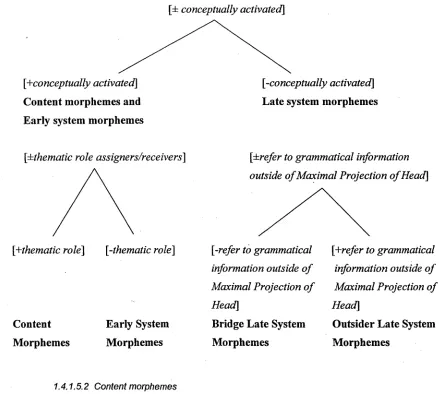
indication that a morpheme is semantically and pragmatically salient at the lemma level; but it also is an indication that all of the information necessary for the form of the morpheme is available at this lemma level. As shown in Figure 1.1 below, this feature separates content morphemes and early system morphemes from two types of system morphemes, which have minus setting for the feature because their forms are selected later in language production, at the functional level. I will return to the relevance of this feature when I discuss content morphemes and early system morphemes.
The feature [± thematic role assignment] marks the distinction made between content morphemes and all system morphemes. Content morphemes have a plus setting for this feature but system morphemes do not. It is therefore the feature which marks the distinction between content morphemes and early system morphemes, which, as indicated, share the feature of [± conceptually activated] with the content morphemes.
The feature [± referring to grammatical information outside of its XMax] classifies morphemes according to how their forms participate in building larger constituents (Myers- Scotton and Jake 2000a: 3; 2001: 98ff). As indicated in the table, this feature is relevant only in distinguishing among grammatical elements, i.e. late system morphemes. Late bridge system morphemes have a minus setting for this feature while late outsider system morphemes have a plus setting for it.
FIGURE 1.1: ‘FEATURE-BASED CLASSIFICATION OF MORPHEMES IN THE 4-M MODEL'
(MYERS-SCOTTON 2002: 73)
[± conceptually activated]
[+conceptually activated]
Content morphemes and Early system morphemes
[-conceptually activated]
Late system morphemes
[:Ethematic role assigners/receivers]
[Hhematic role] [-thematic role]
Content Early System
Morphemes Morphemes
[±refer to grammatical information
outside o f Maximal Projection o f Head]
[-refer to grammatical
information outside o f
Maximal Projection o f
Head]
Bridge Late System Morphemes
[+refer to grammatical
information outside o f
Maximal Projection o f
Head]
Outsider Late System Morphemes
1.4.1.5.2 Content morphemes
Content morphemes either assign or receive thematic roles. They are therefore the only morphemes that have a plus reading for the feature [± thematic role assignment]. Typical content morphemes that assign thematic roles are most verbs12 and some prepositions. Typical thematic role receivers are nouns, non-clitic pronouns and attributive adjectives. Content morphemes also constitute the primary type of morphemes that have a plus reading for the feature [± conceptually activated]. This means that they become semantically and pragmatically salient at the lemma level. They are described as “the direct link between a speaker’s intentions and linguistic units” (Myers-Scotton and Jake 2000a: 3) because their conceptual activation leads to the activation of other aspects of their lexical structures— predicate-argument structures and associated morphological realization patterns—and ultimately to the building of the grammatical structures in which they appear. They have a
12 Copulas, for example, are verbs that do not assign thematic roles. Rather, they are late bridge system morphemes.
[image:29.531.38.477.74.468.2]minus reading for the third criterion, the feature [± referring to grammatical information outside of its XMax] because of reasons that will become clear in the discussion of late outsider system morphemes.
In the following sentence, the transitive English verb killassigns the role of Agent to its subject noun man and the role of Patient to its object noun snake while the preposition with, also a thematic role assigning content morpheme, specifies the role of Instrumental to its object noun club:
The man killed the snake with a club.
The system morphemes in the example (i.e. the past tense morpheme -edand functional elements, the,and a ) neither assign nor receive thematic roles.
1.4.1.5.3 Early system morphemes
Like the other two types of system morphemes, early system morphemes have minus reading for the feature [± thematic role assignment] and do not participate in the thematic role grid of a CP. However, like content morphemes, they are conceptually activated at the lemma level (i.e. have a plus setting for the feature [± conceptually activated]). According to Myers-Scotton and Jake (2000a: 3), an early system morpheme is indirectly-elected when a content-morpheme lemma “point to” it. An example of indirectly-elected early system morpheme is u p in the following sentence:
Bora chewed up the new toy. (Myers-Scotton and Jake 2000a: 4)
The analysis is that the lemma underlying chew, which is directly-elected at the lemma level, in turn indirectly-elects or points to the lemma supporting up, also at the same lemma level. It is the combination of these two (chew u p as opposed to chew) which then captures the essential concept that the speaker intends to convey. Content morphemes plus the early system morphemes they occur with constitute single lexical units.
1.4.1.5.4 Late system morphemes
structures. They are therefore said to be “structurally-assigned” as opposed to content
morphemes and early system morphemes which are “conceptually assigned”.
Late bridge system morphemes and late outsider system morphemes are
distinguished on the basis of how their forms participate in building larger constituents, i.e.
on the basis o f the feature [± referring to grammatical information outside o f XMax]. Myers-
Scotton and Jake (2000a: 4) write concerning these two system morpheme types that
One type of late system morpheme unites morphemes into larger constituents,
showing their hierarchical relationship. These are called “bridges”. The other late
system morpheme also integrates morphemes into large constituents, but, in
addition, it shows coindexical relationships across maximal projections. Such late
system morphemes are “outsiders”; their form depends on information outside of
the maximal category projected by their own lexical head. That is, all of the
information for the form of such outsider morphemes is only available when the
formulator sends direction to the positional/surface level for how the larger
constituent (the CP) is unified.
The difference between late bridge system morphemes and late outsider system morphemes is that while the grammatical relevance o f bridges is limited to the immediate phrasal
category in which they occur, the grammatical relevance o f late outsiders goes beyond the
immediate phrasal category in which they occur. Thus, bridges have a negative reading for
the feature [± referring to grammatical information outside its XMax] while outsiders have a
plus reading for this feature.
A typical bridge morpheme is the English possessive marker -s, as in
The boy^s father loves playing golf
or its prepositional relative “o f ’, as in
The father of the boy loves playing golf.
The relevance o f these possessive morphemes is limited to their maximal projections, the
adnominal constructions the boy's father and the father of the boy
respectively. Bridge system morphemes are said to ‘create’ their maximal projections (see
Myers-Scotton 2001: 98ff).
A typical outsider system morpheme is the English third person present tense form
-s. Although it relates grammatically to its verb (love) in both examples above, its form
depends on and agrees with a unit outside its maximal projection (the VP), the subject NP
the role of late outsider systems metaphorically thus: “outsider system morphemes are important as the cement holding the clause together because they are coindexed with elements outside their immediate maximal projection”.
1.4.2 The Classic CS vs Composite CS distinction
1.4.2.1 Introduction
As noted in §1.4.1.1, a matrix language (ML) is thought of as the source of abstract grammatical specifications (regarding lexical-conceptual structure, predicate-argument structure and morphological realization patterns) that inform the projection of slots for permissible surface-level morphemes in the bilingual CP. We have indicated that there are two types of ML and that the difference between them is whether only one o f the languages participating in CS (called ‘one-language ML’) serves as the source of the abstract specifications or whether the abstract specifications come from two or more languages (that constitute a ‘composite ML’).
In §1.4.2.2 I will discuss the one-language ML, which is characteristic of Classic Codeswitching and in §1.4.2.3 we will return to the composite ML, which is associated with Composite CS. Basically, the two sections are reviews of the relevant literature on these two types of CS with a focus on the methodology used for analyzing CS data.
1.4.2.2 Classic CS
1.4.2.2.1 The One-Language ML hypothesis
Users of Classic CS are deemed to have “full access to the morphosyntactic frame of one of the participating languages that becomes the Matrix Language and anywhere from limited to full proficiency in the grammar of the other language” (Myers-Scotton 2002: 25; see also 105 and Myers-Scotton 2001: 52). Because of their grammatical competence in their target ML, which is typically their mother tongue or LI, Classic CS users are expected to produce mixed constituents that conform to the grammar of this language. Myers-Scotton (2002) notes that