INTERFEROMETRIC STUDY OF
DENSITY FLUCTUATIONS IN A
TOKAMAK PLASMA
by
Raffi Nazikian
A thesis submitted for
the degree of Doctor of Philosophy at
the Australian National University
e ^ y C
/ ^
^/t^ / ^ y ^ ur^-'
y # V z-D e c la ra tio n
I declare that, except where explicitly stated, this thesis is my own original work
and th at no part of it has been previously accepted or presented for the award of
any other degree or diploma, and that no material previously published or written
by another person is included. Chapter 2 of the thesis presents a description of
the LT-4 tokamak which is largely a synopsis of research reports and publications
produced by the laboratory and constitutes the work of a large number of peo
ple. Chapter 3, on the theory of scattering from plasma inhomogeneities, is a
distillation of im portant results produced in collaboration with Dr. John Howard
and Dr. L. E. Sharp towards the production of a book titled “Forward Angle
Collective Scattering on Fusion Plasmas” which will be published as part of the
Adam Hilger series on plasma physics.
Rafft Nazikian
A c k n o w l e d g e m e n t s
In a large laboratory like this one, there are lots of people who in some way
contributed to the successful completion of this thesis and who created an inter
esting and enjoyable environment in which to work.
First and foremost, I would like to thank my supervisor, Dr. Les Sharp, for
giving me the opportunity to work in one of the the most exciting and interesting
areas of experimental plasma research; the interferometric imaging and charac
terization of density fluctuations in Tokamak plasmas. W ithout his insight and
vision to build such an interferometer, this work would never have been carried
out in Australia.
I would like to thank my head of department, Dr. Sydney Hamberger, for his
wisdom, guidance, friendship and very real concern for my well being, and the well
being of all my PHD colleagues over the years. Of those, I would like to extend a
special thanks to Shi Xue-hua and her family for making me feel a part of their
family and for extending to me their infinite generosity, warmth and friendship.
I would like to make a very special acknowledgement to my wife, Fumiko, for
instilling in me a sense of optimism and purpose which has supported me and
which will sustain me for all the years to come.
I would like to extend my strongest gratitude to Dr. John Howard for his
guidance, support, and close collaboration throughout the last year. I owe much
of my scientific development to him, and I hope th at our collaboration will be as
fruitful in the future as it has been up till now.
The close technical support I received from the laboratory technicians was
essential for the success of the project, and I especially thank Eddy Wedhom for
his assistance throughout all stages of the construction and commissioning of the
interferometer. On the electronics side I would like to thank Clint Davies for
battling with the noise problems of the detectors and for finally winning; Ray
Kimlin for constructing many of the filters and amplifiers used in the experiment;
and Gerry McCluskey and the technicians for operating the homopolar generator.
who operated and maintained the old and dying homopolar generator, keeping
it free of major breakdowns, and allowing me a clear and uninterrupted run on
the tokamak before its decommissioning. The technical assistance provided by
David Vender in operating the tokamak single handedly was invaluable to the
success of the research program. His expertise and clear understanding of the
machine with all its idiosyncrasies freed me to concentrate on the operation of the
interferometer.
Finally, it is with some sadness and trepidation that I leave this campus and
its tranquil environment. This university has provided me with an idyllic envi
A b s tr a c t
Density fluctuations in the LT-4 tokamak plasma are investigated using a Phase
Scintillation Interferometer operating at 10.6/Ltm which is sensitive to density fluc
tuations of <5he/ n e > 10~4. The plasma is imaged across a linear detector array
which can be rotated to record projections in any direction, from toroidal to
poloidal.
The theory of forward scattering from plasmas is developed from the Rytov
approximation and aspects of the Fourier diffraction projection theorem relevant
to plasma scattering. The result is a clear conceptual picture of diffraction from
arbitrary extended refractive media, from which im portant analytical tools are
developed.
The Phase Scintillation Interferometer is used to image density perturbations
produced by large scale magnetohydro dynamic (MHD) modes in the plasma asso
ciated with Mimov oscillations. Structural characteristics are determined, and a
comparison between experimental and computed projections of the Dubois model
is made which shows th at the density fluctuations are consistent with a model of
rotating magnetic islands. Island widths and local magnetic field fluctuations are
determined and are found to compare well with measured poloidal magnetic field
fluctuations.
The interferometer is used in conjunction with other diagnostics to investi
gate minor and major disruptions in LT-4. The time frequency distribution is
introduced as an im portant analytical tool in the characterization of the various
regimes of MHD activity. Frequency and amplitude variations of an m = 3 mode
during current rise appear correlated with variations in toroidal loop voltage. The
mode is also found to persist throughout the whole discharge and to play a part
in mode locking which precedes major disruptions. Mode frequencies are found
minor and major disruptions are identified. A strong m — 1 type of internal
relaxation is found to follow rapid growth and locking of an m = 2 mode during
minor disruptions.
The interferometer is also applied to the measurement of fine scale density
fluctuations in the LT-4 tokamak during periods of low level MHD activity. Line
integral measurements indicate an edge fluctuation level of about 10% and broad
band spectra typical of strong turbulence. Anisotropy in the spectrum of fluc
tuations perpendicular to the magnetic field is observed. This observation runs
counter to reported measurements of isotropic fluctuations made on other toka-
maks using small angle scattering techniques. Very long correlation lengths along
the field lines are observed, which are consistent with nearly all models of tur
bulence in tokamak plasmas. The images are numerically filtered so as to isolate
Contents
1 IN T R O D U C T IO N 1-1
2 T H E LT-4 T O K A M A K 2-1
2.1 Description of A p p a ratu s... 2-1
2.2 Principal D iag n o stics... 2-2
2.3 MHD Activity and Fluctuation M easurements... 2-6
2.4 Need for a Density Imaging D iagnostic... 2-11
3 T H E O R Y OF P L A S M A SC A T T E R IN G 3 -1
3.1 SCATTERING FROM PLASMA REFRACTIVE INDEX VARI
ATIONS ... 3-1
3.1.1 The Helmholtz Wave Equation ... 3-2
3.1.2 Approximations to the Scattered F ie ld ... 3-6
3.1.3 Free Space Propagation ... 3-9
3.1.4 Approximations to Free Space P r o p a g a tio n ... 3-11
' 3.1.5 The Lens as a Fresnel Transforming D e v ic e ... 3-13
3.1.6 Diffraction From Thin Phase Screens... 3-15
3.2 THE DIFFRACTION PROJECTION T H E O R E M ... 3-19
3.2.1 Plane Wave Illu m in atio n ...3-22
3.2.2 Limiting Forms of the Scattered F i e l d ...3-24
3.3 OPTICAL DETECTION M ETHODS... 3-30
3.3.1 Homodyne Detection ...3-32
3.3.2 Heterodyne Detection ...3-33
4 T H E P H A S E S C IN T IL L A T IO N IN T E R F E R O M E T E R 4-1
4.1 Mach-Zehnder Interferometer: A General D e sc rip tio n ... 4-1
4.1.1 Mechanical stability and feedback control... 4-6
4.1.2 Laser stability and mode p u r i t y ... 4-9
4.1.3 Image Quality and R eso lu tio n ... 4-12
4.1.4 Detection and Phase Sensitivity ... 4-14
4.2 FINITE APERTURES AND NON-GAUSSIAN BEAM PROFILES4-19
5 M H D A C T IV IT Y IN T H E LT-4 T O K A M A K 5 -1
5.1 TIME FREQUENCY DISTRIBUTIONS AND QUASI STATION
ARY SPECTRA ... 5-1
5.2 INTERFEROMETRY AND RELIABLE INFORMATION . . . . 5-5
5.3 MODELS OF MHD MODES AND LINE INTEGRAL MEASURE
MENTS ... 5-6
5.3.1 The Dubois M o d e l ... 5-7
5.3.2 Projections Of The Dubois M o d e l ... 5-10
5.4 STRUCTURE OF LARGE AMPLITUDE M=2 AND M=1 MODES5-15
5.4.1 A Large Amplitude m=2 Isla n d ... 5-15
5.4.2 Radial field fluctuations at the Rational Surface... 5-21
5.4.3 A Large Amplitude m = l M o d e ... 5-22
5.5 PLASMA REGIMES IN L T - 4 ... 5-24
5.5.1 Regime I ... 5-24
5.5.2 Regime I I ... 5-30
5.5.3 Regime III ...' ... 5-34
5.5.4 Regime IV ... 5-39
5.6 MAJOR D ISR U PTIO N S... 5-45
6 SM A L L S C A L E D E N S IT Y F L U C T U A T IO N S IN LT-4 6 -1
6.2 Scattering From Random Plasma F lu c tu a tio n s ... 6-6
6.2.1 Angular spectrum and the Rytov phase of scattered light 6-10
6.3 Experimental O bservations... 6-16
6.4 Discussion And Comparison W ith Other T okam aks... 6-24
C hapter 1
IN T R O D U C T IO N
and after the initial optimism for the machine, fundamental problems still persist
with MHD instabilities and anomalous transport1 of particles and energy from
the plasma.
Although the role instabilities play in the density and current limits of toka-
mak plasmas are fairly well understood[2, 3], the role of instabilities in anoma
lous transport remains poorly understood. The problem is not least compounded
by the experimental difficulties in determining the nature of fluctuations in the
plasma responsible for the enhanced transport. The hope of finding conclusive
evidence for turbulence driven transport has motivated the development of scat
tering diagnostics for tokamaks for at least a decade[4, 5]. Such techniques, to this
day, utilize the angular scattering of radiation from refractive index variations to
directly measure the spectrum of plasma fluctuations within a scattering volume.
Unfortunately, to achieve reasonable spatial resolution whilst trying to observe
larger scale length structures expected in large tokamaks, the beam wavelength
must also be made longer. However, high density fusion type plasmas presents a
limit to the m a x im u m wavelength one can use due to operation near the critical
density limit. A compromise seems to be in the far infrared (FIR) region of the
spectrum applied most successfully on the Text tokamak[6] , however, even by
using FIR sources, the small scattering angles involved for large scale structures
would provide insufficient spatial resolution for large machines like T F T R and
JET.
Imaging diagnostics can in theory produce high resolution images of plasmas
using tomographic techniques, however, in practice, tomography of structures
sm all compared with the plasma minor radius would be exceedingly costly to
implement and technically very challenging to say the least. The application of
imaging techniques towards the analysis of microfluctuations in tokamak p la sm a s
using a single probe beam has been demonstrated as a useful diagnostic on the
TCA and LT-4 tokamaks [7, 8]. Although tomographic recovery of local fluctua
tion levels are not possible with such s y s te m s without a large amount of a priori
information, still the methods axe very useful in determining the structure of laxge
scale MHD modes as well as to some extent the spatial distribution of sm all scale
structures.
Curiously, the measurement of large scale MHD modes relevant to the macro
scopic stability of plasm as has been left to arrays of X-ray detectors and Mimov
coils[9, 10], whilst interferometers have been used principally for measuring mpan
line integral densities. Early attem pts at using interferometers to obtain spatially
resolved plasma perturbations used an array of independent beams which could
only be used for resolving structures of the scale size of the p la sm a and effectively
filtered out small scale density fluctuations [11]. On the other hand, scattering
diagnostics, of use in determining power spectra of plasma fluctuations were of
little use in the analysis of large scale MHD activity.
The development and application of an interferometer capable of imaging both
small scale density fluctuations characteristic of plasma turbulence, as well as
narrow band, large scale MHD activity constitutes the scope of this thesis. The
diagnostic developed for the purpose is a “Phase Scintillation Interferometer”
operating at 10.6/xm with a phase sensitivity of 10“8 radians. The interferometer
was first proposed by Sharp [12] as an extension to work already performed on
Cleo using microwaves to scatter from plasma fluctuations. The choice of the
probing wavelength and the method of detection, (imaging instead of far field
scattering) follows naturally from the theory of interplanetary scintillation[13],
originally developed to study refractive index variations in the earths ionosphere,
stellar radio sources. The radio wavelengths were short enough that the ground
stations were effectively in the optical near field of the ionosphere, where density
variations in the ionosphere modulated the intensity of the transm itted radiation.
The modulations were observed to drift across the ground and the drift velocity
of ionospheric irregularities were determined using multiple observer points and
correlation techniques [14].
The main problem with imaging devices is their inability to provide localized
measurements along the line of sight. The problem is common to many fields of
physics grouped under the very general field of inverse scattering and tomography.
Some related fields include,
• Interstellar and interplanetary scintillations,
• Ultrasonic tomography,
• Seismology,
• and X-ray crystallography
just to name a few. In some cases a known source is used to probe the medium in
a non-perturbing way such as in seismology or plasma scattering, whilst in others,
emissions from extended objects axe used such as in X-ray tomography of plasmas.
Plasma scattering in the laboratory is only one aspect of a subclass of inverse
scattering problems where the scattered field conforms to solutions of the inho
mogeneous Helmholtz equation[15]. Although the central problem of scattering
theory is finding solutions to the inverse scattering problem, this in general is too
difficult to solve except by the use of many a priori conditions, and by perform
ing multiple simultaneous projections of the plasma. Such problems are called
illconditioned as inversions have to be produced with typically insufficient data
for a complete determination of the source. Instead, we adopt the typical, and
much simpler approach of restricting ourselves to the fully deterministic problem
of obtaining the form of the scattered radiation from a known distribution, and
then using this knowledge to infer properties of the scatterer which are conveyed
In this thesis, we present a general formalism in which the diffracted field from
an arbitrary, extended medium can be determined in a simple way by use of the
Fourier diffraction projection theorem (FDPT) given that the scatterer satisfies
certain weak constraints. This formalism provides insight into how tomography
m ay be performed on tokamak plasmas without the requirement th at line integral
projections of the medium be formed.
The foundations of optical scattering from waves in transparent media may
be traced back to the early 1930’s when Brillouin first proposed th at light waves
would scatter from transparent waves in the same way th at X-rays were observed
to scatter from crystals. However the foundational work on the diffraction of light
from waves in transparent media is due to Raman and N ath where they correctly
noted th at waves in transparent media acted as phase gratings to the incident
radiation, and produced a theory which for the most part explained the complex
scattered fields which were observed experimentally even from strong phase per
turbing screens. An excellent review of the history of this era and many references
may be found in Bergmann[16]. The representation of the scattering medium as a
transparent thin phase grating also forms the basis of modem investigations into
far forward scattering from plasmas by very high frequency laser beams[17, 18,19],
where the plasma is represented as a thin refractive screen.
The construction of a phase scintillation interferometer on the LT-4 Toka
mak was motivated by a need to spatially resolve the high order modes thought
responsible for anomalous transport. A high priority was to observe turbulent
fluctuations present in the plasma with the hope of identifying non-sinusoidal
‘coherent’ structures[20, 21] not readily determined by power spectral techniques
such as microwave scattering.
Chapter 2 provides an overview of the LT-4 Tokamak. The principal diagnos
tics on LT-4 are presented and the limitations of the diagnostics in determining
the nature of plasma instabilities and fluctuations are discussed. There is also
an overview of the characteristic regimes of MHD activity in LT-4. The LT-4
tokamak, like many other smaller tokamaks, tends to disrupt when the q at the
which, is used to characterize the various plasma regimes.
The theory of forward angle scattering from plasmas and its relation to the
Fourier diffraction projection theorem is discussed in chapter 3. The concept
of the Rytov phase is introduced, and the conditions under which the Rytov
approximation can be considered a good approximation to the scattered field is
discussed. It is shown that the solution in the Rytov approximation is more general
than the solution for the scattered field in the Bom approximation, and describes
both large phase shift interferometry as well as large angle scattering within the
one formalism. The expression for the Rytov phase is then used to characterize
the performance of a wide range of optical diagnostics used on plasmas. These
methods and their application to fusion plasmas are reviewed.
Chapter 4 presents a detailed discussion of the phase scintillation interferom
eter and its operation on the LT-4 tokamak. Certain anomalies appeared in the
diffracted field from sound waves which lead to the identification of adverse effects
due to non-Gaussian beam profiles, and a theoretical framework is provided for
the analysis of truncated gaussian beams.
Chapter 5 centers on the interferometric study of low order MHD activity
in LT-4. An analysis of MHD mode activity is presented and an m = 2 island
is identified from its projections. The projections axe shown to conform with a
modified form of the Dubois model, extended to model m > 2 tearing modes. The
assumption made in this work is that the density isobars correspond closely to
magnetic flux surfaces. For the proper tomographic analysis of the MHD modes
in LT-4, a knowledge of their instantaneous frequencies axe required. Although
MHD activity in tokamak plasmas axe spectrally non-stationary, little in the way
of applying joint time frequency domain (TFD) analysis of MHD signals has taken
place. It is found that the TFD analysis of the MHD data allows a convenient
categorization of the various regimes of plasma activity.
Finally in chapter 6, fine scale density fluctuations are examined. The main
aim is to produce images of small scale density perturbations. The motivation
for imaging is th at it may be possible to resolve the nature of the instabilities
discussion of scattering from random media is presented, and a new method is
introduced whereby the location of thin random phase screens may be obtained
B ib lio g r a p h y
[1] L. A. Artsimovich and et. al., “(proc. int. conf., 3rd, novosibirisk, ussr, vol.
1),” in Plasma Physics and Controlled Nuclear Fusion Research, p. 157, IAEA
Vienna, 1969. English translation.: Nucl. Fusion Special Suppl. 17 (1969).
[2] C. Z. Cheng, H. P. Furth, and A. H. Boozer, “Mhd Stability Regime of the
Tokamak,” Plasma Physics and Controlled Fusion, vol. 29, pp. 351-366, 1985.
[3] M. Persson, Resistive MHD Stability {or Rotating Plasmas. PhD thesis,
Chalmers University of Technology, Goteborg, Sweden, November 1987.
[4] E. Mazzucato, “Spectrum of Small-Scale Density Fluctuations in Tokamaks,”
Phys. Rev. Lett., vol. 48, p. 1828, 1976.
[5] V. G. Zhukovskii and V. A. Rtishchev, “Diagnostics of Tokamak Plasmas
based on th e R adiation Scattered b y D en sity F lu ctu a tio n s,” S o vie t Journal
of Plasma Physics, vol. 14, p. 276, 1988.
[6] D. L. Brower, W. A. Peebles, and N. C. J. Luhmann, “Observation of Large
Amplitude, Narrow band Density Fluctuations in the Interior of Ohmic Toka
mak Plasmas,” Phys. Rev. Lett., vol. 55, p. 2579, 1985.
[7] H. Weisen, “Turbulent Density Fluctuations in the TCA Tokamak,” Plasma
Physics and Controlled Fusion, vol. 30, p. 293, 1988.
[8] R. Nazikian and L. E. Sharp, “C0 2 Laser Scintillation Interferometer for the
Measurement of Density Fluctuations in Plasma Confinement Devices,” Rev.
Sei. Instrum., vol. 58, p. 2086, 1987.
[9] R. S. Granetz and P. Smeulders, “X-ray Tomography on JET,” Nuclear Fu
[10] H. Ku.wah.ara, A. D. Ch.eeth.am, and A. H. Morton, “Observation of
m = 7 /n = 3 , m = 5 /n = 2 , and m = 3 /n = l mhd modes During Current Ramp
ing in the LT-4 Tokamak,” Nuclear Fusion, vol. 26, p. 1092, 1986.
[11] A. R. Jacobson, “Interferometric Studies of Plasma Density Fluctuations
Propagating along the Major Radius in ZT-40M using Time Delayed Correla
tion Techniques,” Plasmas Physics and Controlled Fusion, vol. 24, pp. 1111—
1131, 1982.
[12] L. E. Sharp, “The Measurement of Large-Scale Density Fluctuations in
Toroidal Plasmas from the ’’phase scintillations” of a Probing Electromag
netic Wave,” Plasmas Physics and Controlled Fusion, vol. 25, p. 781, 1983.
[13] E. E. Salpeter, “Electron Density Fluctuations in a Plasma,” Physical Review,
vol. 120, p. 1528, 1960.
[14] R. V. E. Lovelace, Interplanetary Scintillations. PhD thesis, Cornell Univer
sity, Ithaca, N.Y., USA, 1970.
[15] H. P. Baltes, ed., Inverse Scattering Problems in Optics. Springer-Verlag,
1980.
[16] L. Bergmann and S. Hatfield, Ultrasonics. John Wiley and Sons, Inc., 1948.
[17] D. E. Evans, H. M., and H. E., “Fourier Optics Approach to Fax Forward
Scattering and Related Refractive Index Phenomena in Laboratory Plasmas,”
Plasma Physics and Controlled Fusion, vol. 24, pp. 819-834, 1982.
[18] B. W. James and C. X. Yu, “Diffraction of Laser Radiation by a Plasma
W ave- the Near Field and Far Field Limiting Cases,” Plasma Physics and
Controlled Fusion, vol. 27, p. 557, 1985.
[19] Y. Sonoda, Y. Suetsugu, K. Muraoka, and M. Akazaki, “Application of the
Fraunhofer Diffraction Method for Plasma Wave Measurements,” Plasmas
Physics and Controlled Fusion, vol. 25, pp. 1113-1132, 1983.
[20] J. Jimenez, ed., The Role of Coherent Structures in Modelling Turbulence
[21] S. L. Zweben, “Search for Coherent Structure within Tokamak Plasma Tur
C hapter 2
TH E LT-4 T O K A M A K
The LT-4 tokamak is one of many tokamaks currently operating around the world
designed to study the properties of toroidally confined plasmas. The operational
parameters of LT-4 allows for the investigation of equilibrium, stability and trans
port processes in fully ionized hot plasmas. These studies axe of m ajor relevance
to the thermonuclear fusion p r o g r a m .
A brief description of the LT-4 Tokamak is presented followed by an outline
of some im portant diagnostics on the machine. An overview of the operational
regimes of LT-4 together with some characteristic MHD activity is presented and
the chapter finishes with a discussion of phase scintillation interferometry on LT-4.
2 .1 D e s c r ip t io n o f A p p a r a tu s
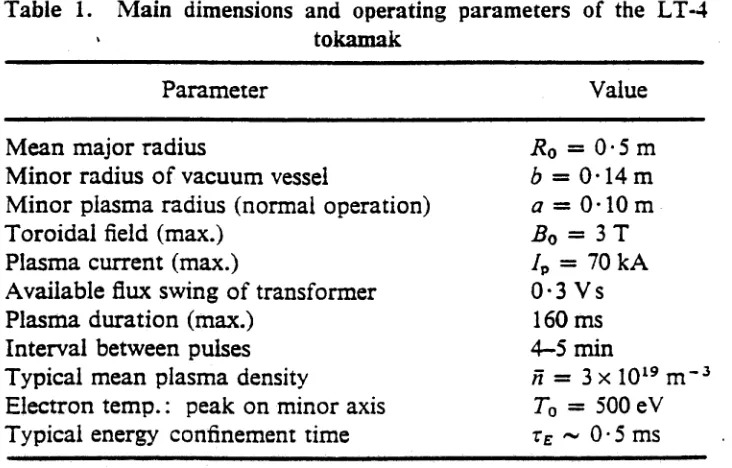
The main dimensions and operating conditions of the LT-4 tokamak are listed in
table 1.
As a thin high resistivity vacuum vessel was used on LT-4, the location of the
plasma column was stabilized during normal operation to within 1mm vertical
or horizontal displacement by use of external windings which automatically feed
back on plasma position shifts[1].
The vacuum vessel’s cutoff frequency is about 30kHz whilst most Mimov os
cillations are below this, so th at the signals remain unattenuated.
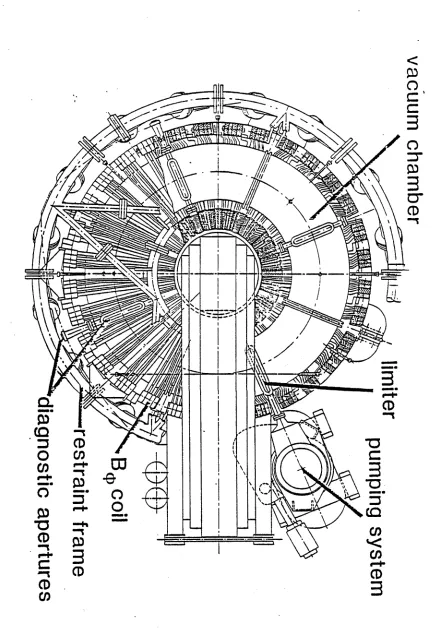
Fig. 2.1 shows a cut away view of the tokamak, exposing some of the 128
TF coils, the location of diagnostic ports, and the iron core. A large num ber of
coils were used to minimize field ripple which can be a problem for a system of
Table 1. Main dimensions and operating parameters of the LT-4
» tokamak
Parameter Value
Mean major radius R 0 = 0 • 5 m
Minor radius of vacuum vessel b = 0-14 m
Minor plasma radius (normal operation) a — 0-10 m
Toroidal field (max.) Bo = 3T
Plasma current (max.) /p = 70 kA
Available flux swing of transformer 0*3 Vs
Plasma duration (max.) 160 ms
Interval between pulses 4-5 min
Typical mean plasma density n = 3 x 10¹⁹ m -3
Electron temp.: peak on minor axis T0 = 500 eV
Typical energy confinement time rE ~ 0- 5 ms
Table 2.1: Main dimensions and operating conditions of the LT-4 tokamak
approaches the lifetime of the plasma. Diagnostic access to the plasma is via four
sets of 200x20mm rectangular vertical viewing ports with 18 9.5mm diameter ports
providing tangential views of the plasma. The plasma minor radius is confined to
10cm by a stainless steel limiter with an adjustable vertical limiter which can be
used to modify the minor radius of the plasma.
A maximum operating toroidal field of 3T was supplied by the Canberra
ho-mopolar generator operating with a cycle time of about 5 minutes. The plasma
current is the secondary of a transformer whose primary current is supplied by
capacitor banks and a mercury arc mains rectifier power supply [2]. The plasma
current attains its maximum value within 15 ms and the pulse length ( about 100
ms) is set by the saturation of the iron core.
2.2 P rin cip al D iagn ostics
The diagnostics on LT-4 can be divided into two groups. The first and simplest,
both in terms of construction and analysis, are various magnetic pick up loops
[image:21.562.100.466.113.347.2]volt-d
ia
g
n
o
st
ic
a
p
e
rt
u
re
s
3
Figure 2.1: Plan view of LT-4 showing the iron core, toroidal field coils, restraint frame and vacuum chamber.
v
ac
u
u
m
c
h
am
b
[image:22.562.73.505.45.682.2]Mode Coils, 0 = 90* m = 1,2, 3, 7v
M16 Coils, 0=45*
Limiter, 0=22,5*
Mode Coils
core
0 = 180
A -16 ch SX array, 0 = 202,5 B- 7 ch SX array, 0 =292,5
x = N8 Coils
[image:23.562.47.508.59.462.2]M8 Coils, 0 = 191
Figure 2.2: Arrangement of diagnostics on LT-4.
age, plasma current and plasma position. Loop voltage is obtained by measuring
the poloidal flux changes using four toroidal coils located at R=39, 61 cm and
z = ± llc m . Plasma current is obtained by numerical integration of the voltage
signal from a Rogovskii coil located outside the vacuum vessel. The plasma’s
position is determined by suitably located sine and co-sine coils on the vacuum
vessel. A description of the various pickup coils used on tokamaks can be found
in Hutchinson’s thesis[3].
Various arrays of small Mimov coils (100 turns, 3.2mm radius) are arranged
azimuthally and poloidally outside the vacuum vessel to detect local variations in
the poloidal magnetic field (Be) at a minor radius of 14.5 cm, well outside the
plasma. Two sets of coils are arranged poloidally, called M16 ( 16 individually
monitored equispaced coils) and M8 at ^ — 45° and 191° respectively (see Fig.
2.2). Another array (N8) consists of 8 equispaced toroidal coils. A single magnetic
probe is also mounted inside the vacuum vessel to pick up any high frequency
18
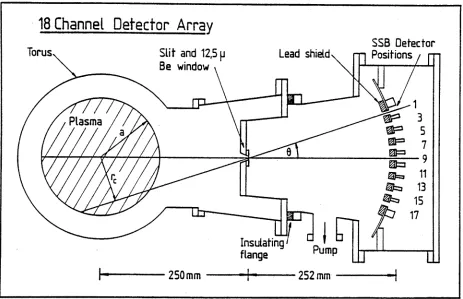
Channel D etector Array
SSB D etector Slit and 12,5
Be window »
Lead shield Positions
Insulating flange
250mm 252 mm
Figure 2.3: Schematic diagram of the soft X-ray array on LT-4.
The only diagnostic available which measures rapid internal variations in the
core of the plasma is the 18 channel soft X-ray (SXB.) detector array. Fig. 2.3
provides a schematic view of the soft X-ray diagnostic.
Unfortunately, as the X-ray emissivity depends on Te, ne, Z^g, and also on
the recombination of ions and impurity radiation, it is difficult to deduce absolute
parameters within the plasma[4].
The only density measuring device routinely used on LT-4 is a rotating grating
HCN Mach-Zehnder interferometer, operating at A = 337/mi, [5] providing single
point, line integral density measurements w it hin a band width of 1 kHz and able
to resolve line integral density fluctuations greater than 1013 cm-2. Typical line
integral densities for LT-4 are 5 x l0 14 cm-2.
[image:24.562.62.525.115.414.2]light from the plasma using a Q-switched ruby laser operating at A = 694.3 nm ,
where the scattered light is detected at 90° to the beam direction. The laser beam
is focussed at the plasma mid plane and can be located at any one of three major
radial positions. The scattered spectrum is measured using a series of prisms and
photomultiplier tubes. The thermal velocities of electrons in LT-4 are low enough
that they can be considered non-relativistic to the extent th at the relativistic blue
shift in the s p e c t r u m is entirely negligible.
Hard X-rays (>100keV) are detected using a Nal scintillation photomultiplier.
A fuller description of the LT-4 diagnostics including ECE spectroscopic mea
surements can be found in the literature[2]. Fig. 2.2 gives the location of most
diagnostics on LT-4.
2.3 M H D A c tiv ity a n d F lu c tu a tio n M e a s u re m e n ts
In LT-4 the plasma current is controlled from an external power supply whilst
density is controlled by adjusting a programmable rate of gas puffing during the
pulse. It can be seen from the Hugill diagram (Fig. 2.4), th at for LT-4 (or any
other tokamak) to achieve high currents and densities, it is necessary for the Hugill
trajectory of the discharge to pass through a very narrow window. This window
is unfortunately a very strong function of the impurity level in the plasma and
impurities are a major problem for tokamaks. A discussion of impurities and
plasma confinement can be found in a review by Hugill[6]. In Fig. 2.4, q(a)
represents the safety factor at the plasma’s edge and refers to the average helicity
of field lines in the toroidal geometry where q(r) = r B r / R B o and where Bt
and Be refer to the toroidal and poloidal field components at a minor radius
r. The motivation for achieving low q operation in ohmic plasmas is to obtain
higher tem peratures and hence higher ß. In scanning the various safety factors
and density ranges in LT-4, the toroidal current was held fixed to maintain a
roughly constant power input to the plasma whilst the toroidal magnetic field was
varied by adjusting the rotor speed of the homopolar generator. From scans in
the toroidal field and plasma density, four m ajor operating regimes in LT-4 have
Figure 2.4: Hugill diagram of LT-4 showing the trajectory of a plasma discharge and boundary curves within which stable operation can be maintained.
The four basic regimes and their location in the Hugill diagram axe clearly
marked in Fig. 2.4. The regimes are identified by their distinct MHD activity
as can be seen from shot data in Fig. 2.5 taken for the discharge in the Hugill
diagram of Fig. 2.4.
• Regime I: 3.6 > q(a) > 2.9
This regime is characterized by little detectable activity on the magnetic coils
except for weak irregular signals. We will return to a discussion of these ‘irregular’
signals in chapter 5 where non-stationary spectral analysis techniques are used to
identify coherent structures in the Mimov coil data.
The soft X-ray signals show strong sawtooth activity at ~ 5kHz accompanied
by weak precursor oscillations at ~ 20kHz. Sawtooth oscillations in the plasma
centre cure indicative of a q on axis of about one and a peaked current profile[7].
The q = 1 surface is located at about r = 3cm, and is inferred from the inversion
[image:26.562.77.488.33.349.2](kA) 3 0
-V,
2 0
-(v)
10(mm) 1
-q(a)
3 .
Time (ms)
q(a=9,5cm)
F ig u r e 2.6: Maximum percentage poloidal field variation in the four regimes mapped against
?(o)
• Regime II: 2.9 > q(a) > 2.8
This regime is characterized by small amplitude m =3 oscillations on the Mimov
coils with a Bq/ Bq ~ 0.05% and frequencies in the range of 40 kHz. The X-ray
data shows stronger and more regular oscillations around 20kHz superimposed
on the sawtooth signals which are diminished in amplitude compared to regime I
sawteeth.
• Regime III: 2.8 > q(a) > 2.5
This regime is by fax the most active, exhibiting pronounced MHD activity
with Be/Be ~ 0.3% with a significant m =2 component. This regime is charac
terized by a sudden growth and saturation of ~ 20kHz oscillations observed both
on mimov coils and SXR detectors. Sawtooth oscillations typically cease in this
regime. Fig. 2.6 shows the variation in the amplitude of the magnetic fluctuations
in the different regimes.
SX-OIODE ARRAY
1 2 .5 MICRON BE
F ig u re 2.7: Temporal evolution of the SXR. profile showing a substantial drop during regime III activity.
and the sudden growth in the amplitude of the fluctuations (presumably extending
right across the minor radius) typically occurs simultaneously with a sharp drop
in the X-ray emission profile (see Fig. 2.7).
The internal oscillation recorded on the soft X-ray array demonstrates clear
m = l (odd) parity and the absence of sawtooth activity is generally indicative of
poor confinement and a flattened current profile.
• Regime IV: q(a) < 2.5
Below a q(a) of 2.5, and operating at low densities and low impurity levels, the
plasma may again enter a quiet MHD regime which is denoted as regime IV, where
the amplitude of magnetic fluctuations drops below 0.01%. Surprisingly, strong
sawtooth oscillations reappear (similar in amplitude to regime I sawteeth) which
are indicative of the recovery of a peaked current profile. The low level of MHD
plasma has regained stable operation. The X-ray emission profile remains rather
flat however. Any further decrease in q(a) may results in a m ajor disruption.
2.4 N e ed for a D e n s ity Im ag in g D iag n o stic
The measurement of MHD fluctuations and their correlations with various bulk
plasma properties forms the large part of the scientific work on the LT-4 tokamak.
Despite this, inherent limitations in the available diagnostics severely limits the
ability to resolve the structure of these fluctuations.
Knowledge of the magnetic perturbations outside the plasma cannot provide a
unique description of the perturbed currents in the plasma without considerable
a priori knowledge[8]. Although the presence of coherent magnetic perturbations
provides strong circumstantial evidence for the existence of tearing modes, still
no direct determination of their structure is possible on LT-4 except by X-ray
tomography from emissions near the plasma center.
The measurement of line integral density variations with very good resolution
across the line of sight can provide a direct measure of internal mode structure.
Further, as an absolute measurement of the density fluctuation level is possible,
estimates of local magnetic field fluctuations can be made provided island widths
can be determined from the line of sight data and the magnetic shear scale length
can be estimated.
It should be noted th at although micro-fluctuations have not been observed
in LT-4 by use of existing diagnostics, their observation constituted the main
motivation for building a phase scintillation interferometer. Thus, its design was
planned to allow for the detection of structures having a wide range of scale sizes.
It was also necessary for the interferometer to have a wide band width (~ 1MHz)
B ib lio g r a p h y
[1] A. B. Cheetham, S. M. Hamberger, J. A. How, H. Kuwahara, A. H. Morton,
and L. E. Sharp, “The LT-4 Tokamak. II, MHD Activity,” Aust. J. Phys.,
vol. 39, pp. 35-55, 1986.
[2] M. G. Bell and et. al., “The LT-4 Tokamak. I Description of the Apparatus
and its Operation,” Aust. J. Phys., vol. 37, p. 137, 1984.
[3] I. H. Hutchinson, The Evolution of a Tokamak Discharge. PhD thesis, Re
search School of Physical Sciences, The Australian National University, Can
berra, A.C.T. Australia, 1976.
[4] I. H. Hutchinson, Principles of Plasma Diagnostics. Cambridge University
Press, 1987.
[5] L. B. W hitboum , “A 337/xm Density Interferometer for the LT-4 Tokamak,”
International Journal o f Infrared and Millimeter Waves, vol. 5, p. 625, 1984.
[6] J. Hugill, “Transport in Tokamaks - a Review of Experiment,” Nuclear Fusion,
vol. 23, pp. 331-373, 1983.
[7] J. A. Wesson, “Hydrodynamic stability of tokamaks,” Nuclear Fusion, vol. 18,
p. 87, 1978.
[8] M. Kikuchi, “A Note for the Mimov Signal Analysis in Tokamaks,” Tech. Rep.
PPPL-2215, Plasma Physics Laboratory, Princeton University, N.J. USA,
C h a p te r 3
T H E O R Y O F P L A S M A S C A T T E R IN G
The following is a review, together with new material, on the scattering of radi
ation from inhomogeneous refractive media. The representation of the scattered
field in terms of the Fourier diffraction projection theorem (FDPT) is established,
which provides a unified treatm ent of all coherent optical methods used to inves
tigate plasmas. Certain limiting properties of the scattered field are determined,
and the applicability of frequency and/or real space representations of the scat
tered field are discussed for each of the limiting cases.
The Rytov approximation to the scattered field is introduced and the Bom
approximation is shown to be contained within the Rytov approximation. The
Rytov approximation provides a unified description of both large phase shift in
terferometry (which violates the Bom approximation) and far field scattering.
The limitations of the Rytov approximation are discussed. Different forms of the
FD PT for the Rytov and Bom approximations are determined. Optical systems
and mixing techniques used to image plasmas are discussed.
3.1 SCATTERING FROM PLASMA REFRACTIVE INDEX VARI
ATIONS
The microscopic treatm ent of plasma scattering theory is based on the classical
electro dynamic interaction between an incident plane wave and a collection of
essentially free plasma electrons. Though scattering from ions can be neglected
(for reasons of their greater mass ), it turns out that for scattering from inhomo
geneities much larger than the Debye length, and fluctuations much slower than
the plasma frequency, the scattered spectrum will be dominated by the electron
As we will be dealing with the properties of the scattered radiation, from the
near field to the far field diffraction limits by use of the inhomogeneous Helmholtz
equation, it is instructive to derive the expression for the scattered field directly
from the wave equation, instead of from a consideration of the scattering from
single electrons [2, 3],
3.1.1 T he H elm holtz W ave Equation
We begin by considering the propagation of an arbitrary incident wave (Fig. 3.1)
through a weakly scattering medium (in this case the plasma). The propagation of
Plasma
Arbitrary Incident Wave
Figure 3.1: Geometry for diffraction from macroscopic plasma irregularities. Note that the form of the incident illumination is not specified.
the incident wave is governed by the relative permittivity Fr, which is a complex
incident monochromatic held is very high[l], (a;0 ujp + a;« where a;0, ujp and
cJtx are the beam, plasma and electron cyclotron frequencies respectively) then we
may write
t ) — 1 (3.1)
where ne(r, t) is the plasma density and the cutoff density is
n _ *o2
71 cr — . ?
47rre (3.2)
where ka is the incident wavenumber. As long as n^/n^ «C 1 and e* « 1 then the
plasma may be treated as a weakly scattering medium.
Given these restrictions on we investigate the solution to the vector wave
equation for the propagation of electromagnetic waves in an idealized source free
medium. The wave equation can be expressed in terms of the electric displacement
D = eo^E [4]:
( V2 - ^ ) D = - V x v X ( D - e ° E ). (3.3)
Given
E = [E0(r) + E,(r, t)}exp (-jujQt), (3.4)
where Eq is the incident field and Ea is the scattered field and where the first
order solution (setting Ea = 0) is just the equation for free space propagation of
the incident field,
(V 2 -f ^ ) E 0 = 0. (3.5)
This is of course the homogeneous Helmholtz equation for free space propagation
which, in order to distinguish it from the total field (incident and scattered), we
now write as Eo(r, t) = Eo(r) exp (— juot). The general solution of Eqn. 3.5 is a
linear superposition of plane waves. The inhomogeneous wave equation for E , is
given by
— E (3.6)
, — 2 1 0 N_ _ _ ( 7l e \ i O f 71,
^ ‘ w ) - c2 9 ? W - .
where use has been made of the vector identity V x V x = VV. — V 2. Eqn. 3.6
side is often called the scattering potential or forcing function and is denoted by
f(r, t). The time derivatives can be eliminated using a Fourier representation
together with the low tem perature (nearly monochromatic or quasi-stationary)
approximation. Noting that V .E = 0 in the plasma, the scattering potential
becomes
f(r, t) = — [V (E .V nc) + fc’n .E l . (3.7)
T i e r
Let us consider a single component of the vector wave equation. If we take the
scalar scattering potential to be impulsive,
/ ( r, t) = 8(r - r')5(t - t'), (3.8)
then the inhomogeneous wave equation has the Green’s function solutions :
^ — [*=F i r — 1 /c])
47t I r — r' I (3.9)
In experiments, one usually considers the scattering potential as making no con
tribution to the total field at remote times t —> —oo before the radiation source
is activated. In this case it is appropriate to use the retarded Green’s function
to construct the particular solution for the wave equation [4]. The first order
vector field at the observation point P = P (r) outside the plasma is constructed
from the superposition of wave fields scattered by the collection of point elements
constituting the plasma:
E ( r,t) =
J
d t'f d= - f dr' ■
g&ilk-
JV. 47T I r — ri I
where the numerator of the integrand is evaluated at the retarded time t‘ = t — q/c.
Substituting Eqn. 3.7 for the scattering potential, and making use of the Fourier
integral representation for n e, we obtain
(3.10)
where
E .( r ,t) = — [ dr' [fcoVE + V '(E .V 'n .)l g{r,r')
n>cx
s(r >r') -e x p (jfe 0| r - r /l) 47r|r — ril
(3.11)
and where the scattering potential has been evaluated at time t by virtue of
the quasi-stationary approximation . Notice the natural appearance of the time
independent Green’s function kernel g. The two terms in the integrand axe dis
cussed by TATARSKI[5] who notes that in the radiaiion zone of the scattered
field (&o I r — r71^> 1), the longitudinally polarized second term ensures that the
scattered field E a is transverse to the direction of propagation.
To show this, an integration by parts may be performed in the radiation zone
giving,
V<7 = jkogq (3.13)
and given the identity,
E = q(q.E ) — q x (q x E), (3-14)
then
E«(r, t) = —47rre exp (—jujot) f d r'n ^ r',* ) [qX (qX E (r'))] #(r, r'). (3.15)
* V*
The classical electron radius is introduced through the relation
re = k%/(Inner). (3.16)
Unfortunately the wave equation, which serves to describe the interaction be
tween the radiation field and the transparent medium, does not yield an exact
solution for the diffracted field in closed form. One approximation valid for scat
tering in the forward direction is where the double cross product in Eqn. 3.14 can
be replaced by —E. This reduces to the scalar diffraction theory, which is exact
for scalar fields such as sound, and is approximate for vector field forward
scattering. This means that the polarization remains unchanged so that we may
introduce the complex field u(r, t) defined as
E (r, £) = E 0u(r, £). (3.17)
The solution to the scattered scalar field is then
.(r , t ) = J v * 7 ( r'> 0 ? (r > r')
where the scattering potential is
/(r , t) = 47rrene(r, t)u( r) (3.19)
and where
u(r,£) = tio(r) + ug(r,£). (3.20)
Eqn. 3.18 is the solution to the inhomogeneous Helmholtz equation
(V 2 + %)u = / (3.21)
where, for / ( r) = 0, Eqn. 3.20 reduces to the homogeneous Helmholtz equation
(V 2 + k20)uo = 0 (3.22)
valid for free space propagation. Comparing the expression for the scalar scat
tering potential with the vector scattering potential in Eqn. 3.7, it can be seen
that the scalar approximation is valid provided the first term in Eqn. 3.7 can be
neglected. The conditions under which this simplification is valid are discussed in
the literature[6].
3 .1 .2 A p p r o x im a tio n s to t h e S c a tte r e d F ie ld
Unfortunately, the solution (Eqn. 3.18) to the inhomogeneous wave equation
is not obtainable in general as the scattered field appears on both sides of the
equation. A survey of approaches to this problem is given by STROHBEHN[6].
However the simplest approximations most relevant to plasma scattering are when
the scattered field can be expanded in an perturbation series in amplitude or in
phase. The amplitude perturbation series leads to first order to the Bom approx
imation, whilst the first order phase expansion leads to the Rytov approximation.
A detailed analysis of these approximations is presented by GOODMAN[7].
The Bom series is a series expansion of the light amplitude,
u = u0 + ui -f u2 -f- ••• (3.23)
whilst the Rytov series is an expansion of the complex phase,
It will be shown that the first order Rytov solution, known as the Rytov approx
imation, can be constructed from the first order Bom solution in cases where
the Bom approximation is not valid. Consequently, results derived in the Bom
approximation can be transformed into equivalent expressions valid in the Rytov
approximation. It is known that in many circumstances the Rytov approximation
yields more general solutions to the scattered field than the Bom approxima
tion, not least because the validity of the first order Rytov approximation is not
restricted to the weak scattering limit[6].
Substituting the Bom expansion of Eqn. 3.23 and / ( r , £) of Eqn. 3.19 into the
wave equation 3.21 and talcing only first order terms gives[5],
(V 2 + k*)ui = 47rren euo- (3.25)
Eqn. 3.25 is valid provided
|iti/txo| 1. (3.26)
As a necessary, (though not sufficient) condition for a small scattered component
is th at |A<^>| <C 7r, where A</> ~ rcX0neL is the extra phase shift on propogating
through the plasma, and where L is the thickness of the plasma slab. Then we
arrive at the condition for the Bom approximation to hold,
t t e / t t c r l < AK z/ko (3.27)
where AK z = 27t/ L is the wavenumber uncertainty in the z-direction. Given the
first order approximation to be valid, then
where
u. [ * 7 i ( r ' , % ( r , r ' )
J —aa
/ i ( r , £) = 47rren e(r,£)uo(r)r(r)
(3.28)
(3.29)
and where r ( r ) is a window function which restricts the volume of integration:
r ( r ) = 1 r £ Vp
For the Rytov approximation, we write the light amplitude in the form,
u(r,£) = exp[ip(r,t)] (3.31)
where ip is a complex phase. Inserting this expression into Eqn. 3.21 for the
inhomogeneous Helmholtz equation yields the Riccati equation for the complex
phase:
V 2V> + Vtf.VV* + *g(l - — ) = 0. (3.32)
Tl^r
Then, expanding ip out only to first order (ip = ipo + ipi) we obtain,
V V o + Vipo.'Vipo + = 0 (3.33)
for free space propagation and
V V i + 2VipQ.Vipi = 47rrene (3.34)
where we neglect the (’Vipi)2 term, valid provided[6]
(V ^ i)2 < 47rrene = (3.35)
From dimensional arguments, | V ^il ~ KA<p so that the above condition becomes,
n c/ncr (AK z/ K ) 2. This condition is then dependant on the scale size of the in
homogeneity. Note that the condition for the validity of the Rytov approximation
depends on the gradient of the phase and not the absolute phase and th at provided
the phase gradient is not too strong, then the approximation is valid for arbitrarily
large phase shifts. In particular, for forward scattering where \K/ko\ 1 then
the Rytov approximation is generally far superior to the Bom approximation. For
large angle scattering however, \K/ko\ ~ 1, so that the Rytov approximation is
roughly equivalent to the Bom approximation. The attractiveness of the Rytov
approximation is in its ability to accomodate interferometry, where K/ko ~ 0.
Second order correction to ip are discussed by STROHBEHN[6], however we will
ignore higher order approximations which is equivalent to ignoring the effects of
strong refraction. It now remains to identify the nature of the solutions to Eqn.
It turns out that the solution to f a in Eqn. 3.33 is given by
f a = — (3.36)
uo
where u\ is the solution for the scattered field in the Born approximation in Eqn. 3.25 which can be verified by direct substitution. Hence,
Ar,t) ( = dr'fi(r', t )g( r,r'). (3.37)
As we will not consider higher order corrections to be necessary, we set ipa = f a and u a = u i, and / = / i so that
u (r ,t) = uo(r) exp (T/>,(r, t))
u (r ,t) = uo(r) exp (3-38)
Because of the relative simplicity in evaluating scattered fields for u ay we will develope the theory in the B om approximation, and where necessary, extend the solution to the R ytov approximation by inserting u a and uq into Eqn. 3.36 after
they are determined.
3.1.3 Free Space Propagation
Assum e an incident field propagates in the positive z direction with wavenumber fco. For arbitrary u, the wave field in the plane z = 0 can be decomposed into its incident “angular spectrum” [8]:
A ( k xl ky-, 0) =
JJ
u ( r ',2//;0)ex p [ - j ( k xx' 4- kyy')]dx'dy' (3.39)= (3-40)
where x' and y ‘ denote spatial coordinates on the incident plane (here taken at
z — 0 and denoted by subscript “i ”), and where (kx, k y ) are wavenumbers on the
incident plane.
Satisfaction of the homogeneous wave equation requires that the Fourier am plitudes A in some plane z be expressed in terms of the angular components A+ on the incident plane by the relation
where
H{kx,ky]z) = exp \j(k$ - k 2x - k l) 1/2z}. (3.42)
This result is easily obtained upon Fourier transformation of the homogeneous
Helmholtz equation (c.f. Eqn. 3.22). The transfer function H describes free
space propagation and may be regarded as a linear, dispersive, finite bandwidth
spatial filter [9]. Observe th at H is of unit modulus and exhibits phase dispersion
for spatial frequencies less them the bandlimit. This implies that the angular
spectrum is essentially unchanged during propagation in free space so that in
principle one should be able to obtain the amplitudes Ai(kx,ky) at any observer
plane z. Propagation over a distance z introduces only a phase delay between the
spectral amplitudes, depending on the angle of propagation.
The filter transmission is zero for spatial frequencies greater than ko radians
per unit length. In other words, for kl + k* > kg, kz is imaginary and the wave
propagation is evanescent. In the remainder of this chapter we implicitly ignore
the evanescent wave fields as these contributions diminish exponentially away from
the plasma and are insignificant at distances greater than a few wavelengths for
scattering in the forward direction.
One can determine the light amplitude on any plane z from the angular spec
trum at the plane z — 0 by first applying the propagation operator to &y)
and then performing an inverse fourier transform. Doing this we obtain,
u ( x ,y ; z ) =
J
(3-43)Supposing we have a single plane wave k = (kx, ky, kz) and assuming the radiation
is monochromatic then k = (fcr , ky,(k% — kl — kJ)1/2). Notice that the angular
spectrum of any monochromatic source will then lie on a hemisphere in fourier
space with radius ko and centre (0,0, —ko). This rather innocous result is of central
importance in diffraction tomography and its implications will be discussed in the
next sections where the attractiveness of working in fourier space over the real
3.1.4 A p p ro x im a tio n s to Free Space P ro p a g a tio n
Several im portant approximations to free space propagation are introduced. Later,
similar approximations will be considered for the scattered field in terms of the
properties of the scatterer. The parabolic approximation in frequency space allows
the free space propagator H to be expressed as,
Hf = exp (jkoz) exp - J + *y (3.44)
where kx and Ky are taken as the displacements from the mean wavenumber which
is assumed to be ko = (0,0, &o). The inverse fourier transform of HF is just the
well known Fresnel kernel hF,
hF{x, y; z) = exp (jkoz) exp[— (x jho 2 + y )].2
j X o z r L 2z
By the fourier convolution theorem and from Eqn. 3.41, we obtain
(3.45)
u(r, t) = Ui* hF
=
JJ
u(x\y'-,0)hF(x - x',y — y ’\ z)<Lx'dy'. (3.46)However, in relating the amplitude u to the angular spectrum A*, it is instructive
to write the total field in terms of A+. From GOODMAN[8], we may express the
total field u as a fourier transform over Ui with extra quadratic phase factors.
By simply expanding out hF and applying the Fourier convolution theorem we
obtain,
u(r,t) = hF(x,y ;z) (A i * I » ( f c o - , A*j-) (3-47)
z z
where
TF(Kx,Ky-,z) = jXozexp (— j2Trz/zF) (3.48)
and where
zf/(2tt) = (2ko)/(K.2x4- *y). (3.49)
Note th at zF is the Ftesnel length for diffraction from perturbations of wavenumber
*IY/2-This is a very important result as it indicates not only the precise relationship
between the field and the angular spectrum, but also the likely experimental
degree of difficulty in extracting the spectrum from the measured field. In general,
performing numerical deconvolutions of recorded data in the presence of noise is an
illconditioned process which can generate significant errors, so that various limits
of the diffracted field are sought which provide a simpler relationship between the
field and the angular spectrum.
In the ultra near field, ( z/zj? < 1 ), the second order terms in Hp can be
neglected. The propagated spectrum is then identical, apart from a constant
phase factor, to the initial angular spectrum. All near field techniques rely on
minimal phase dispersion to recover images and angular spectra.
On the other hand, when second order terms can be neglected in the exponent
of hp, (i.e. zA0 (xa 4- y/2)) then IV becomes a simple delta function in which
case,
u(r) = hp( x, y ] z ) Ai(k0- , k 0- ) . (3.50)
z z
This is of coarse the Fraunhofer limit, however, unlike the near field limit where
their is minimal phase dispersion, in the fraunhofer limit, hp behaves as a phase
dispersive filter. The phase curvature in the far field is so strong that relative phase
information between spectral components is lost, and only the power spectrum
may be extracted from the angular spectrum.
Whilst the two most important limits for recovering the angular spectrum
are the ultra near field and the far field, it seems that the phase as well as the
amplitude of the angular spectrum can only be recovered in the near field and
th at it is effectively impossible to recover the spatial relative phase in the far
field due to strong phase dispersion. Thus, far field techniques can only be used
to determine power spectra. An exception to this is when lenses are used, and
where the parabolic approximation still holds on propagation through the optical
3.1.5 T h e L ens as a F resn el T ran sfo rm in g D evice
It will be shown that the effect of propagation through a lens is to Fresnel trans
form the light amplitude and the parabolic approximation. Given an analytic
expression for u(r) in the absence of a lens and under conditions where the Fres
nel approximation is valid, then the field beyond the lens can be expresses simply
as a coordinate transform on u(r), i.e. (x ,y ;z) —► (x/,y /;z /). This follows nat
urally from the Fresnel transforming properties of lenses and the fact that an
analytic Fresnel transform of Ui(x,y) exist. Various limits of optical systems axe
investigated in terms of the angular spectrum of the incident field. For small angle
scattering in the paraxial approximation and for large enough optical elements,
we may assume apertures to be effectively infinite. Then the optical field through
a series of thin lenses can be obtained from multiple coordinate transformations
of our scalar field u(r).
Suppose we have a light amplitude function uq specified at a distance do in
front of a thin lens, and observe the field u\ at a distance d\ in front of the lens.
Then,
U i(zi,yi;do +
di)
=JJ
dx0 dyoh^xo^o^xi^y^do.d^uoixo.yo^O ) (3.51)where the lens kernel h i is given by[8]
- 1
W i
x
JJ
<7L(x,y)expexp [jko(do + dr)\ exp . ko
'.ko ( l _ 1 _ 1
3 2 U + d, f
x exp
{-*[(2
d„+i ) x+
2d,
+ V
?)
*2+ y )
. ko
(*o + Vo)
(3.52)
and where the integration is over the plane containing the lens with pupil function
This development follows Goodman’s very closely[8], however, where he
proceeds to find approximations to h i in order to derive the lens law for imag
ing, we instead show the correspondence between h i and the Fresnel kernel hp.
Assuming that ctl = 1 then the correspondence is greatly simplified. Performing