Wellbeing in
Educational
Contexts
Wellbeing in Educational Contexts by University of Southern Queensland is licensed under a Creative Commons Attribution-NonCommercial 4.0 International License, except where otherwise noted.
Disclaimer
Note that corporate logos (such as the USQ Phoenix, and any other company represented) and branding are specifically excluded from the Creative Commons Attribution NonCommercial 4.0 International Licence of this work, and may not be reproduced under any circumstances without the express written permission of the copyright holders.
The following content is specifically excluded from the Creative Commons Attribution-NonCommercial 4.0 International licence of this work, and may not be reproduced under any circumstances without the express written permission of the copyright holders –
Figure 3.2 – DECS Learner Wellbeing Framework – Reproduced from South Australian Department of Education and Children’s Services {SADECS} (2007). DECS Learner Wellbeing Framework for birth to year 12. Retrieved from http://apo.org.au/system/files/29959/apo-nid29959-62641.pdf
Copyright
Wellbeing in Educational Contexts is licensed under a Creative Commons Attribution NonCommercial 4.0 International Licence by the University of Southern Queensland, Toowoomba, Australia.
Copyright permission has been granted to include and/or adapt the following content:
Figure 2.4 – Tripartite Model of Subjective Wellbeing – Adapted from Galiha, I.C. & Pais-Riberiro (2011). Cognitive, affective and contextual predictors of subjective wellbeing. International Journal of Wellbeing, 2(1), 34-53, p.38. Excerpt from McCallum, F & Price, D (2012) Keeping teacher wellbeing on the agenda. Professional Educator, 11(2),4–7.
Contents
Foreword
Susan Carter 1
1. Connecting and Activating Prior Knowledge
Susan Carter and Cecily Andersen 7
2. Theoretical Conceptualisations of Wellbeing
Susan Carter and Cecily Andersen 17
3. Policy, Frameworks and Legislation Informing a Focus on Wellbeing
Susan Carter and Cecily Andersen
36
4. Contemporary Perspectives on the Impactors and Enablers to Wellbeing
Susan Carter and Cecily Andersen
63
5. Pragmatic Applications of Embedding an Education Wide Focus on Wellbeing Susan Carter and Cecily Andersen
82
6. Ecological and Contextual Analysis of Wellbeing in Your Context
Susan Carter and Cecily Andersen
128
7. Conclusion
Foreword
SUSAN CARTER
ACKNOWLEDGEMENT OF COUNTRY
In the spirit of reconciliation the authors wish to acknowledge the Giabal and Jarowair peoples of the Toowoomba area, the Jagera, Yuggera and Ugarapul peoples of Ipswich and Springfield, the Kambuwal peoples of Stanthorpe and the Gadigal peoples of the Eora nation, Sydney as the keepers of ancient knowledge where USQ campuses and hubs have been built and whose cultures and customs continue to nurture this land. As authors, we acknowledge the cultural diversity of all Aboriginal and Torres Strait Islander peoples and pay respect to Elders past, present and future. We celebrate the continuous living cultures of First Australians and acknowledge the important contributions Aboriginal and Torres Strait Islander people have and continue to make in Australian society. The authors wrote this textbook on the lands of the Giabal and Jarowair peoples of the Toowoomba area.
ACKNOWLEDGEMENT
We sincerely thank Adrian Stagg, Manager (Open Educational Practice), Program Quality and Enhancement at the University of
Southern Queensland who encouraged and guided us to publish our on-line textbook. His support and problem solving skills have been greatly appreciated as he helped bring the project to fruition. We also thank the Media Design and Development (MDD) team at the University of Southern Queensland, who helped us to create some of the media images used in this text. The kindness of colleagues has also been greatly appreciated as many people especially Melissa Fanshawe, took the time to provide feedback on images that we were considering for the book. Thank you to everyone who helped us in our journey to embrace the Pressbooks platform so that we could help realise our vision of providing an open, free, easily accessible textbook.
ABOUT THE AUTHORS
Susan Carter is both an educational leader and an academic. She has been an educator in schools for over 25 years in a variety of roles: teacher; teaching principal; deputy principal; principal of a P-10 school; and as a principal of a large rural school. She has studied, education and two Master of Education degrees: one in special education, and the other in education theology. Her PhD research was in the area of how school Principals maintain their Subjective Well-Being. Her current research interests include: subjective well-being (SWB) in educational contexts; inclusion; social justice and school leadership.
Susan can be contacted by email: [email protected]
or
Cecily Andersen is an experienced educational leader. She has been an educator for over 40 years across a variety of roles: teaching, school leadership and district and regional educational leadership, within primary, secondary, inclusive education and
Indigenous community settings across remote, rural and regional areas. Cecily Andersen’s research interests include social justice, wellbeing, leadership in complex contexts, and how school leaders use coaching and mentoring to build capacity in others.
Cecily can be contacted by email: [email protected] or
WELLBEING AS AN ISSUE
Wellbeing has been identified as a serious issue for principals, teachers and students within educational contexts. The problem of principal health and wellbeing has also been recognised at both national and state levels in Australia for the at least a decade and has been acknowledged as an issue of concern by the state, private, and independent school sectors. The first full scale independent study into the occupational health, safety and wellbeing of Australia’s school principals paints a pretty grim picture about the current work conditions for Australia’s school leadership (Riley, 2014). The survey of 2,049 principals found that along with threats and acts of violence, school principals are also more likely to be bullied, and are dealing with ever-increasing volumes of work and health problems due to stress (Riley, 2014).
Phillips and Sen (2011, cited in Riley, 2014) reported that, “work related stress was higher in education than across all other industries…with work-related mental ill-health…almost double the rate for all industry” (p. 177-8). This trend appears to be continuing, with another report suggesting that that in Queensland over $10 million has been paid in five years to stressed teachers and that teachers are making more mental stress claims than in any other industry (Worksafe Queensland, 2013, as cited in Acton & Glasgow,
2015). Reducing these impacts of work stress in the teaching profession has been the focus of much research in education. Although historically resilience to stress has been the main focus of studies, research in the area has recently shifted towards the school wide promotion of wellbeing (Powell & Graham, 2017).
Figure (i) Photograph of a hand by Sharon McCutcheon on Pexels.
Within the wellbeing literature, there is a shared view that educational contexts are best positioned to reach out to everyone and explicitly teach and promote wellbeing, potentially arresting trends of reported declining student and teacher wellbeing (Acton & Glasgow, 2015; Hogan, Thompson, Sellar, & Lingard, 2018), principal wellbeing (Riley, 2014), or of feeling of not belonging (Allen, Kern, Vella-Brodrick, Hattie, & Waters, 2018; Seligman, Ernst, Gillham, Reivch & Linkins, 2009). There is, however, a lack of consensus as to the application and delivery of wellbeing programs within educational systems and educational contexts (Powell &
[image:10.396.43.357.157.367.2]Graham, 2017) and it is in this space that we hope to make worthwhile contribution.
REFERENCES
Acton, R., & Glasgow, P. (2015). Teacher wellbeing in neoliberal contexts: A review of the literature. Australian Journal of Teacher Education, 40 (8), 6.
Allen, K., Kern, M. L., Vella-Brodrick, D., Hattie, J., & Waters, L. (2018). What schools need to know about fostering school belonging: A meta-analysis. Educational Psychology Review, 30 (1), 1-34.
Hogan, A., Thompson, G., Sellar, S., & Lingard, B. (2018). Teachers’ and school leaders’ perceptions of commercialisation in Australian public schools. The Australian Educational Researcher,
45 (2), 141-160.
Powell, M.A. & Graham, A. (2017). Wellbeing in schools: Examining the policy practice nexus. Australian Educational Researcher, 44 (2), 213-231. doi.org/10.1007/s13384-016-0222-7
Riley, P. (2014). Australian principal occupational health, safety and wellbeing survey: 2011–2014 data. Melbourne, VIC: ACU.
Seligman, M., Ernst, R., Gillham, J., Reivich, K. & Linkins, M. (2009). Positive education: Positive psychology and classroom interventions. Oxford Review of Education, 35 (3), 293-311. doi: 10.1080/03054980902934563
Worksafe Queensland. (2013). Queensland teachers most stressed
workers. Retrieved 23 March 2015 from:
https://www.worksafe.qld.gov.au/education/articles/ queensland-teachers-most-stressed-workers
CHAPTER 1
Connecting and Activating Prior
Knowledge
SUSAN CARTER AND CECILY ANDERSEN
Key Concepts
• Making meaning of the text.
• Connecting and activating pertinent prior knowledge on wellbeing within educational contexts.
• Connecting with your own sense of wellbeing.
GUIDING QUESTION
• What do you already know about wellbeing and what do you need to learn?
Photograph of street art by Luis Alfonso Orellana on unsplash.
This photograph, shown on the left, which also appears on the front cover is representative of the opening of possibilities, the growing and co-creation of knowledge, and it is through these doors that we enter. The colours on the doors can be seen to represent the differences in people, the perceptions of wellbeing and the differing feelings of wellbeing. Some colours are bold and vivid, others less so but the varying colours are what creates the spectacular artwork. The imagery of the tree could be viewed as representative of the growing of wellbeing in more than one direction as the trees branch out. It is our hope as authors that the information contained in this book can be of use to help people in various educational contexts, support the growth of positive wellbeing.
INTRODUCTION
Educational contexts (e.g., schools, special education units and early childhood centres) are places of social hope capital, a place and space where people can inspire positive thinking, engage in educational growth and the sustainment of wellbeing. Considerable research suggests that the promotion of wellbeing,
is a core role of schools and teachers are in a prime position to recognise changes indicative of wellbeing concerns.
The quality of life or wellbeing of an individual or community is a function of the actual conditions of that life and what an individual or community makes of those conditions. What a person or community makes of those conditions is in turn a function of how the conditions are perceived, what is thought and felt about those conditions, what is done and, finally, what consequences follow from all these inputs. People’s perceptions, thoughts, feelings and actions, then, have an impact on their own and others’ living conditions (Michalos, 2007, p.4).
Prior to embarking on this journey of exploring wellbeing within educational contexts, this Chapter will connect with your prior knowledge on wellbeing and explore your own sense of wellbeing.
CONNECTING WITH YOUR PRIOR KNOWLEDGE
Connecting and activating pertinent prior knowledge assembles bridges connecting knowledge already integrated into understanding of a topic, and new knowledge, thus enabling learning through the creation of mental hooks that assist to anchor new instructional concepts, processes and skills (Andersen, 2018). Mazano (2004) contends that linking to prior expertise or knowledge in any sphere, increases the quantity of requisite knowledge that is accessible for use when bearing in mind new information, queries, questions or challenges. Further to this Campbell and Campbell (2009) pose that this is the reason some individuals with great expertise are more likely to ponder multiple perspectives of matters, queries, questions or problems and reach additional reasoned answers than novices. Re-examining prior knowledge shapes firm foundations on which to develop new
learning experiences, and supports self-worth, reducing feelings of ignorance or general lack of ability, as new stimulating options are created when linkages are made between past ideas and new information (Andersen, 2018). Activating and connecting pertinent prior knowledge is vital in setting the scene.
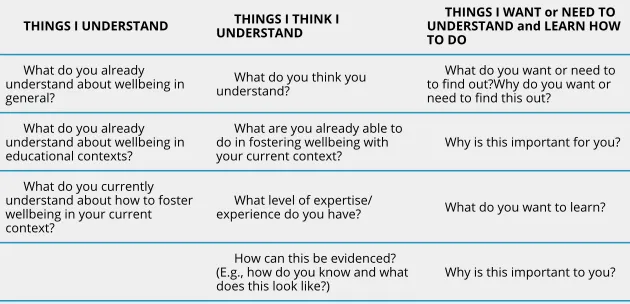
Activity
Let’s connect with your own prior knowledge by considering the topic of
this textbook – wellbeing, and specifically wellbeing within educational
contexts.Complete the tasks below.
THINGS I UNDERSTAND UNDERSTAND THINGS I THINK I UNDERSTAND and LEARN HOW THINGS I WANT or NEED TO TO DO
What do you already understand about wellbeing in general?
What do you think you understand?
What do you want or need to to find out?Why do you want or need to find this out?
What do you already understand about wellbeing in educational contexts?
What are you already able to do in fostering wellbeing with
your current context? Why is this important for you?
What do you currently understand about how to foster wellbeing in your current context?
What level of expertise/
experience do you have? What do you want to learn?
How can this be evidenced? (E.g., how do you know and what
[image:16.396.41.356.267.419.2]does this look like?) Why is this important to you?
Table 1.1 Connecting with your prior wellbeing knowledge to what you want or need to learn. Adapted from Campbell, L. & Campbell, B. (2009). Mindful learning: 101 Proven strategies for student and teacher success, Thousand Oaks, CA: Corwin Press. p.14
CONNECTING WITH YOURSELF
Being familiar to your inner signals and values and recognising how your feelings impact on you, contributes towards understanding
your own wellbeing, as well as understanding the holistic complex situation that is wellbeing within a wider educational context. As such self-awareness is a key foundation block essential to understanding personal wellbeing and the wellbeing of individuals, teams and the school community (Andersen, 2018). Self-awareness is required for creating trusting relationships and promoting wellbeing. If we don’t know ourselves, it becomes increasing difficult to know, understand and effectively assist someone else.
According to Eurich (2017), self-awareness is “the ability to see ourselves clearly, understand who we are, how other see us, and how we fit into the world” (Eurich, 2017, p.4). Covey (2004) expands this further by explaining self-awareness as the ability to accurately understand and reflect upon one’s own skills, knowledge, feelings, and behaviour, and then enact this insight to identify strengths and to try and mitigate any weaknesses. The notion of self-awareness posed by Goleman (2005), goes beyond just such passive actions, to advocacy for a strong basis in proactive action, where self-informed individuals exercise agency to craft intentional and informed decisions and choices monitoring and controlling their thoughts and subliminal biases. Eurich (2013), explains that this proactive active action involves two different forms of self-awareness:
1. Internal self-awareness – knowing and understanding yourself (Eurich, 2017).
2. External self-awareness – knowing how other people perceive you and perceiving yourself accurately from other’s perspectives (Eurich, 2017).
An individual’s ability to perceive, identify and manage emotions provides the basis for the types of social and emotional competencies needed for successful personal and professional conversations (Reiss, 2009). The identity of self influences the
perspectives of others and can have a powerful impact on one’s efforts to collaboratively work with others and support, enhance, and promote their wellbeing. It is therefore important to ask yourself who you are and understand how you can and will engage with others in a caring professional and educative manner. It through knowing yourself and being aware of what is important to you (i.e., your values, and beliefs), that you can behave authentically when engaging with others in both personal and professional relationships (Andersen, 2018).
Understanding the wellbeing of others in the first instance often commences with an understanding yourself.
Key Questions
• Howwould you rate your own wellbeing? Is this accurate? What evidence do you use to validate this? Would others see you the same way?
• What are your core values? How are they aligned / or not aligned to your context’s core values? How does this impact / or not impact on your wellbeing?
• What do you stand for? What principles guide you? How do they impact / or not impact on your wellbeing?
Activity
Rochat’s (2003) extensive study on the development of self-awareness offers one way of conceptualising levels of self-awareness, and how self-awareness develops over time as a result of life experiences (see Table 1.2). Where would you place your level of self-awareness? What evidence do you have to support the level you have identified? How accurate is your judgement? How could you validate your judgement?
Le
vel Development Rochat’s Levels of Description
0 Confusion individual actions connect to, or impact on the environment. Having no self- awareness or understanding of a how
1 Differentiation
At this level there is an awareness of a difference between what is perceived by self and what is reflected in an
environment, and gaining a sense of how self is situated relative to that environment.
2 Situation actions can be observed inA growing understanding that the results of self-produced , and can impact on the impact on the environment.
3 Identification
Basic self-awareness. Consciousness and active gathering and processing information from the environment with a focus on the reality (impact) of own behaviour. Identification of own feelings, physical sensations, reactions, habits, behaviours and thoughts. Understanding of how self is managed and how one engages with other people.
4 Permanence
A recognition that this is me and I am stuck with it (sometimes). The self is able to be identified beyond the moment and the here and now. At this level self manifests as enduring, while also at the same time being responsive to changes over time. This is the point where changes can be made; an appreciation is developed of reasons for past behaviour or self-protection systems; vulnerabilities that were had at that time are recognised and acknowledged; and negative and positive core beliefs identified.
5 or meta Self-consciousness self-awareness
A realisation that this is the “me” that everyone else sees and that “I” have come to terms with that. At this level individuals are fully aware of who they are, how they present and how they are perceived in the minds of others. Self-consciousness or meta self-awareness provides opportunities to make changes that make a real difference and as self-aware individuals are also open to further evaluation of how they are perceived.
Table 1.2 Rochat’s 5 Levels of Self-awareness. Text adapted from Self-awareness. Wikipedia. Retrieved from https://en.wikipedia.org/wiki/Self-awareness, available under a Creative Commons Attribution-ShareAlike 3.0 Unported Licence.
We acknowledge that a journey in self-discovery can at times be challenging, an understanding of self creates deeper authenticity in professional relationships and wellbeing conversations by developing more complex internal mechanisms for knowing when and how to engage with other people. The understanding of self is not a “one off” epiphany or process. It is a life-long learning journey that involves hard work, takes considerable practice, may
[image:19.396.43.353.99.399.2]be emotionally painful at times when a person recognises and acknowledges their strengths and weaknesses, takes time to master but most importantly it is worthwhile work. You may find that you may need to utilise the learning activities above many times as you grow as a learner.
THIS TEXT
This text focuses on wellbeing in educational contexts as educational contexts play a pivotal role in teaching students about nonviolence, promoting understanding of diversity, endowing people with a shared purpose and meaning and the skills and behaviours to create a more inclusive, healthy, and positive future (Niemi, Lavonen, Kallioniemi, & Toom, 2018). Weare (2013) affirms the words of Maslow (1970), averring that there is significantly important to satisfy an individual’s social emotional needs before concentrating on the academic needs. The Queensland Department of Education and Training {DET} (2018) reiterates the importance of catering for an individual’s needs, posing that students learn best in environments where their social, emotional and physical wellbeing is nurtured. So how do we do this?
To generate real educational context community purpose there needs to be a shared understanding of purpose, a clear vision and a common language around established ways of working that positively contribute to building a safe, inclusive culture where wellbeing is fore-fronted. At the start of each chapter we posed guiding questions for you to consider. In chapter one we outline a possible way of meaning making using the text; chapter two explores some theoretical conceptualisations of wellbeing (guiding question: what is wellbeing?); chapter three presents policy, frameworks and legislation that has informed the focus on wellbeing (guiding question: how is wellbeing enacted?); chapter
four outlines possible impactors and enablers to wellbeing (guiding question: how is wellbeing enhanced?); chapter five explores embedding an education wide focus on wellbeing (guiding question: how is wellbeing enacted and embedded?) and the final chapter, chapter six, explores the ecological and contextual analysis of wellbeing in relation to a workplace wellbeing framework (guiding question: how can wellbeing be enacted and promoted in my context?).
We hope that you love learning with us and we invite you to contact us in the hope of co-constructing knowledge and understandings that are helpful in educational contexts.
REFERENCES
Andersen, C. (2018). EDU8400. Coaching and mentoring in educational contexts: Course notes. Toowoomba, Australia: University of Southern Queensland.
Campbell, L. & Campbell, B. (2009). Mindful learning:101 Proven strategies for student and teacher success, Thousand Oaks, CA: Corwin Press.
Covey, S.R. (2004). The 8th habit: From effectiveness to greatness. New York, NY: Free Press.
Department of Education and Training. (DET). (2018). Health and wellbeing. Retrieved from http://education.qld.gov.au/schools/ healthy/
Eurich, T. (2013). Bankable leadership: Happy people, bottom-line results, and the power to deliver both. Austin Texas, TX: Green Leaf Book Press.
Eurich, T. (2017). Insight: The power of self-awareness in a self-deluded world. London, UK: Pan Books.
Goleman, D. (2005). Emotional intelligence. New York, NY: Random House.
Maslow, A. H. (1970). Motivation and Personality. New York, NY: Harper & Row.
Mazano, R. (2007) The art and science of teaching: A comprehensive framework for effective instruction. Alexandria, VA: Association of Superiors and Curriculum Development.
Michalos, A.C (2007). Education, happiness and wellbeing. Paper presented at the International Conference on ‘Is happiness measurable and what do those measures mean for public policy?’, Rome, Italy.
Niemi, H., Lavonen, J., Kallioniemi, A., & Toom, A. (2018). The role of teachers in the Finnish educational system. In The teacher’s role in the changing globalizing world: Resources and challenges related to the professional work of teaching (pp. 47-61). Leiden, Netherlands: Brill Sense. Retrieved from https://brill.com/abstract/book/ edcoll/9789004372573/BP000008.xml
Reiss, K. (2009). Leadership coaching for educators. Cheltenham, VIC: Hawker Brownlow Education.
Rochat, P. (2003). Five levels of self-awareness as they unfold early in life. Consciousness & Cognition, (12), 707-731.
Weare, K. (2013). Promoting mental, emotional and social health: A whole school approach. London, UK: Routledge.
CHAPTER 2
Theoretical Conceptualisations of
Wellbeing
SUSAN CARTER AND CECILY ANDERSEN
Key Concepts
• There is a lack of consensus in the literature as to exactly what wellbeing is, as well as an array of wellbeing models.
• The challenge is for educational contexts to clearly define wellbeing and select or develop a model of the concept before trying to implement wellbeing programs.
GUIDING QUESTION
• What is wellbeing?
Figure 2.1 Photograph by Daniel Minárik on unsplash.
INTRODUCTION
Wellbeing is now a concept at the core of many educational policy agendas and practices. Increasing attention is focussed on both student and staff mental and emotional wellbeing initiatives and polices, in order to equip individuals with the social and emotional skills, knowledge and the disposition required to operate and contribute productively within both an educational setting and the broader societal context.
This Chapter will explore the following questions: What does the concept of wellbeing mean? Does the term wellbeing have the same meaning for all individuals and groups within a school? Does the concept of wellbeing hold constant across time and events despite the diversity of experiences, culture, beliefs and values evident within educational contexts? What foundational approaches and models inform wellbeing educational initiatives? And what is the role of education in the wellbeing of student and staff? In exploring the above questions, the theoretical concept of wellbeing will be explored by examining definitions of wellbeing, wellness and mental health; investigating theoretical conceptualisations of wellbeing; and by exploring subjective wellbeing as an approach to fostering wellbeing an examining the place of wellbeing in educational contexts.
WHAT IS WELLBEING?
The seeking of a definition for wellbeing is a complex pursuit, as increasingly it is utilised in conversations, on the community and global media, and within the literature, in many different ways, with wellbeing seemingly taking shape as a chameleon (Carter, 2016). Originally there appeared two specific schools of thought where wellbeing was seen either as hedonic or eudemonic.
From a hedonic view, focusing on happiness can be seen as the totality of pleasurable moments. Philosophers such as Hobbes viewed wellbeing as “a pursuit of human appetites”, DeSade held that it was the “pursuit of sensations and pleasure” and Bentham claimed that “through maximising pleasure and self-interest that the good society is built” (cited in Husain, 2008). Other philosophers held a somewhat different view, deeming that people experience happiness in the expression of their virtues, engaged in what they believe is worth doing (Carter, 2016). This notion of eudemonia – being true to one’s inner self can be equated with an eudemonic perspective of wellbeing. Building upon the eudemonic view of wellbeing is Maslow’s (1970) concept of self- actualization and Deci and Ryan’s (2000) self-determination theory. An individual’s or community’s quality of life is a direct function of the conditions that arise in life, and how an individual or community utilises the conditions that life presents. How an individual or community perceives the condition, thinks and feels about those conditions, what is done and, ultimately, what consequences follow from all these inputs in turn becomes a function of how the conditions are perceived. People’s perceptions, their feelings, their thoughts, and their actions, then, have a direct impact on their own and others’ living conditions (Michalos, 2007).
McCallum and Price (2016) argue that wellbeing has emerged as “something everyone seemingly aims for, and arguably has a right
to” (McCallum & Price, 2016, p.2). While wellbeing is not a new concept, it has become an important concept within contemporary school community contexts. However, identifying an agreed definition of wellbeing, in addition to establishing a consensus on how quality wellbeing can be achieved and sustained, is far more problematic with the term wellbeing often poorly defined and under-theorised (Camfield, Streuli & Woodhead, 2009). To compound the issue of definition inconsistency, wellbeing is often used interchangeably with other terms such as ‘happiness’, ‘flourishing’, ‘enjoying a good life’ and ‘life satisfaction’, all which have very different interpretations and underlying meanings.
Bradburn (1969) (as cited in Dodge, Daly, Huyton & Saunders, 2012) defined wellbeing as being present when an individual is high in psychological wellbeing, where an excess of positivity (positive affect) predominates over negative affect. In contrast, Shah and Marks (2004) argued that wellbeing is more than just positive affect (happiness, feeling satisfied), with feeling fulfilled and developing as a person an equally important aspect in defining wellbeing. Diener et al. (1999) extend the definition of wellbeing even further by defining wellbeing as subjective (thus the term subjective wellbeing, {SWB}) more specifically as consisting of three essential interrelated components: life satisfaction, pleasant affect, and unpleasant affect.
The characteristic intensity with which people perceive their affective states, has no bearing on overall subjective well-being (Larsen, Diener & Emmons, 1985). It seems that the predominant predictor of overall SWB is the rate of positive compared to negative states in a person’s life, throughout time (Larsen, Diener, & Emmons, 1985). “Because subjective well-being refers to affective experiences and cognitive judgments, self-report measures of subjective wellbeing are indispensable” (Larsen & Eid, 2008, p. 4).
Together with his associates Ed Diener designed the Satisfaction with Life Scale (Diener, Emmons, Larsen, & Griffin, 1985), which developed into the standard measure of life satisfaction in the wellbeing field. The implications concerning the measurement of SWB are that:
1. SWB can be assessed by self-report with significant consistency and authority (Larsen & Eid, 2008).
2. Each measurement method has drawbacks and benefits (Larsen & Eid, 2008).
3. Comprehensive assessment of SWB necessitates a multimethod assessment tool (Diener, 2009; Diener & Eid, 2006).
Diener (2006) suggested that people over emphasise their emotional intensity and underestimate and underrate the frequency of their positive affect when recollecting emotional moments. This research signifies that there is no single cause of SWB. It seems apparent then, that certain conditions appear to be essential for high SWB {e.g., mental health, positive social relationships}, but are not singularly sufficient to cause happiness (Diener, 2006). Diener’s work has detected a number of circumstances that seem to be required for, or correlated with happiness, however no one condition or characteristic is adequate to ensure happiness in itself (Larsen & Eid, 2008).
It should be noted that there is evidence that diverse circumstances and outcomes make people happy. Diener and colleagues have shown that the links to happiness alter between young versus old people (Diener, 2000). So what makes a younger person happy may not make an older person happy. Likewise, Diener, Suh, Smith, and Shao (1995) reported that there are different connections to happiness in differing cultures. Diener
(2000) has suggested that that there are likely universals, such as experiencing close positive social relationships that are associated with happiness by almost everyone. Larsen and Eid (2008, p 8.) cleverly suggest a cooking analogy explaining that when cooking some ingredients are essential, many just enhance flavour or texture but no singular ingredient, produces the desired outcome, rather all ingredients need to come together in the right way for success to be achieved.
SWB appears to contribute to beneficial outcomes in life. Diener (2000), along with his colleagues has determined that happy people are more creative and sociable; have increased likelihood of longevity; display generally sturdier immune systems; earn more money; are good leaders; and display generally better citizenship in their workplace. Furthermore, numerous positive outcomes were linked to happiness, such as marital satisfaction, job satisfaction, and improved coping. Therefore, high SWB is particularly desirable at individual, at educational system levels, and at societal levels. It therefore makes sense to invest in promoting a culture in educational contexts where wellbeing is important. This text will aim to explore, how educational contexts can create a culture where SWB is valued, and high levels of SWB are desired as outcomes, planned for and hopefully achieved.
McCallum and Price (2016) propose an even more encompassing definition of wellbeing outlining it as diverse and fluid, respecting the beliefs and values of individual, family, and community; and experiences, culture, opportunities, and contexts across time and change. They aver that it encompasses interwoven environmental, collective, and individual elements that interact across a lifespan (McCallum & Price, 2016). Despite a range of notions encompassed in wellbeing definitions, wellbeing can then be described in very broad terms as a holistic, balanced life experience where wellbeing needs to be considered in relation
to how an individual feels and functions across several areas, including cognitive, emotional, social, physical, and spiritual wellbeing.
Key Questions
• How does your context define wellbeing?
• How and why do these definitions align or not align with you own definition of wellbeing?
WHAT IS WELLNESS?
The term wellness is often used interchangeably with the term wellbeing (McCallum & Price, 2016). However, Roscoe (2009) argues that wellness is not the same as wellbeing, and instead contributes to it, as wellness is the sum of the positive steps taken to achieve wellbeing.
Key Question
Do you agree with Roscoe’s statement and why / why not ?
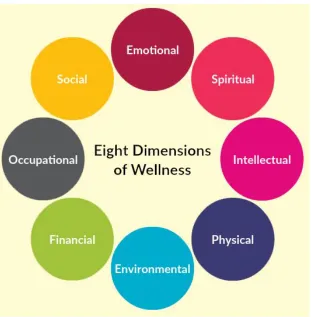
The term wellness was first introduced by Dunn (1959) (as cited in Kirkland, 2014), who argued that health was much more than the absence of disease, and remains the cornerstone of today’s concept of wellness. Dunn defined wellness in terms of the integration of the whole person – the body, mind and spirit, with wellness described as different spiritual, cognitive, emotional, environmental and physical aspects (refer to Figure 2.2), all of which combine to form wellness (Albrecht, 2014).
Figure 2.2 Unknown author, (u.d.). Eight Dimensions of Wellness . Adapted from Dunn’s Wheel of Wellness, Albrecht, N. (2014). Wellness: A conceptual framework for school-based mindfulness programs. The International Journal of Health, Wellness, and Society, 4(1), 21-36, p. 26.
Roscoe (2009) identified the above core principles of wellness, depicted in Figure 2.2:
1. Wellness is dynamic, and changing and evident on many levels.
2. A range of factors work in combination to form wellness.
3. Wellness emerges from the integrative and dynamic whole rather than from the sum of its parts.
4. Environmental contexts impact wellness.
5. Life-span developmental changes affect wellness.
6. Awareness, education and growth are central to the paradigm of wellness.
Key Questions
• How are definitions of wellness different to, or the same as definitions of wellbeing?
• Where and how does wellness fit into the conceptualisation of wellbeing?
WHAT IS MENTAL HEALTH?
A similar lack of consensus is also evident when defining mental health. Bhugra, Till and Sartorius (2013) describe mental health as an integral and essential part of overall health which can be defined in at least three ways including: the absence of disease; a balance within oneself and balance between oneself and one’s physical and social environment; and finally a state of being that allows for the full performance of all its mental and physical functions (Bhurga, Dill & Satorius, 2013). Watson, Emery, Bayliss, Boushel & McInnes, 2012) similarly define mental health as a state of being that also includes the biological, psychological or social factors which contribute to an individual’s mental state and ability to function within the environment. The World Health Organisation {WHO} (2007) extends the definition of mental health further to include realising one’s potential; the ability to cope with normal life stresses; and community contributions as core components of
mental health. Other definitions also extend beyond this to include intellectual, emotional and spiritual development, positive self-perception, feelings of self-worth and physical health, and intrapersonal harmony as key aspects in defining metal mental (Bhurga et al., 2013).
Key Question
[image:32.396.44.354.252.446.2]View Figure 2.3 and consider, how does mental health fit into the conceptualisation of wellbeing?
Figure 2.3 Photograph by Martin Adams on unsplash
THEORETICAL CONCEPTUALISATIONS OF
WELLBEING
While many theoretical constructs of wellbeing exist, two
conceptual approaches to wellbeing research now tend to dominate the field of research and discussion.Objective wellbeing theories tend to define wellbeing in terms of objective, external and universal notions of quality of life indicators such as social attributes {health, education, social networks and connections} and material resources {income, food and housing} (Watson et al., 2012). Objective theories of wellbeing largely arise from Amartya Sen’s work in welfare economics, and tend to focus on agreed core human capabilities necessary for quality life such as body health and integrity; the ability to think and imagine; the ability to express emotions; the ability to exercise practical reasoning and autonomy in contributing to one’s own education, work and political and social participation (Bourke & Geldens, 2007).
In contrast, subjective theories of wellbeing are focused on subjective overall life evaluations, and comprise two main components – affect {feelings, emotions and mood} and life satisfaction, which is identified as a distinct construct and defined relative to specific domains in life {such as school, work and family} (Diener & Ryan, 2009). Affect is dived further into positive and negative emotions, with subjective wellbeing experienced when a predominance of positive emotions occurs more than negative emotions (Diener et al., 1999). As people and perceptions are at the heart of the meaning of subjective wellbeing, Watson et al. (2012) argue that subjective wellbeing has direct utility in describing and facilitating staff and student social and emotional wellbeing. The following contemporary models of wellbeing outline frameworks for exploring wellbeing.
TRIPARTITE
TRIPARTITE MODEL MODEL OF OF SUBJECTIVE SUBJECTIVE WELLBEING WELLBEING
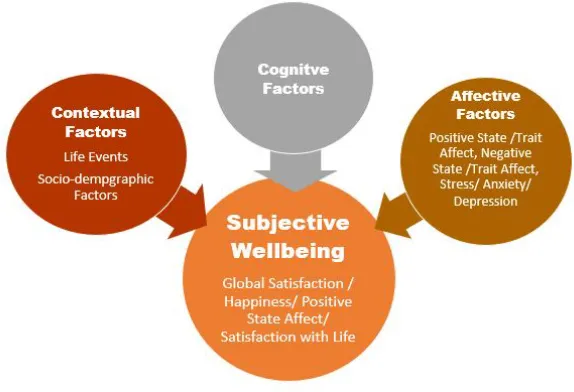
Diener and Ryan’s (2009) Tripartite Model of Subjective Wellbeing
(refer to Figure 2.4) presents wellbeing as a general evaluation of an individual’s quality of life in terms of three key components:
1. Life satisfaction, which is composed of: Imperfect assessment of the balance between positive and negative affect in one’s life. An assessment of how well one’s life measures up to aspirations and goals;
2. Positive affect (pleasurable feelings); and 3. Negative affect (painful feelings).
Figure 2.4, a Tripartite Model of Subjective Wellbeing is a representation of the relationship between SWB and cognitive, affective and cultural variables.
Figure 2.4 Tripartite Model of Subjective Wellbeing. Adapted from Galiha, I.C. & Pais-Riberiro (2011). Cognitive, affective and contextual predictors of
subjective wellbeing. International Journal of Wellbeing, 2(1), 34-53, p.38.
[image:34.396.53.340.286.482.2]SELIGMAN’S
SELIGMAN’S PERMA PERMA WELLBEING WELLBEING MODEL MODEL
Seligman’s (2011) PERMA model (refer to Figure 2.5) proposes that wellbeing has several measurable elements, each contributing to wellbeing. The PERMA model identifies five essential elements to wellbeing:
1. Positive emotions include a wide range of feelings, not just happiness and joy {P}.
2. Engagement refers to involvement in activities that draws and builds upon one’s interests {E}.
3. Positive Relationships are all important in promoting positive emotions, whether they are work-related, school related, familial, romantic, or platonic {R}.
4. Meaning also known as purpose, and prompts the question of “why” {M}.
5. Achievement / accomplishment are the pursuit of success and mastery {A}.
MCCALLUM
MCCALLUM AND AND PRICE’S PRICE’S MODEL MODEL OF OF HOLISTIC HOLISTIC WELLBEING WELLBEING
McCallum and Price (2016) outlined a model of holistic wellbeing where the student is central. They suggest that the model captures the interplay between learner wellbeing, educator wellbeing, and community wellbeing. Six key principles are identified together with six key strategies as the means of enactment in nurturing wellbeing in education.
1. Positive relationships – building and sustaining healthy relationships.
2. Positive strengths – developing and nurturing individual and group strengths.
3. Positive communication – establishing effective and safe communication strategies.
4. Positive behaviour – behaving in a way that welcomes a sense of belonging and connections to others and positive, peaceful and caring action.
5. Positive emotion – nurturing emotional health.
6. Positive leadership – scaffolding wellbeing through growing leaders with a democratic leadership style.
(McCallum & Price, 2016, p. 144).
SCHOOL COMMUNITY WELLBEING
Educational contexts are now key stakeholders in promoting student and staff wellbeing, regardless of the diversity of wellbeing definitions and approaches. McCallum and Price (2016) argue that given the link between wellbeing and academic achievement, educators, policy and curriculum developers, it is no surprise that educational contexts are being increasingly challenged to centre wellbeing as both a foundation to, and integral part of learning. As a result, an increasing an emphasis is now being placed on producing successful and confident learners, resulting in a more holistic approach to education in order to support both academic achievement and wellbeing of students. McCallum and Price (2016) also suggest that wellbeing education is for the whole community and have proposed a Wellbeing education model which supports that notion by suggesting that wellbeing education is an essential provider to academic learning and achievement (McCallum & Price, 2016). We believe that wellbeing education goes beyond this and is essential to the creation of social hope and social capital.
Figure 2.5 Photograph of a person by Warren Wong on unsplash
Supportive educational environments must now promote the wellbeing of learners by assisting them to develop a positive sense of identity, agency, self-worth and connectedness within their community. Learners, educators, communities and educational institutions hold responsibility in this regard. Scoffham and Barnes (2011) noted that the challenge for today’s educators is to provide a place as well as programs that are both secure and demanding, and based upon pedagogy that furthers the present and future wellbeing and happiness of the children and young people within positive social and environmental change contexts.
Key Questions
• Has your definition of wellbeing changed or not changed and if so why and how? • What factors influence your wellbeing definition?
CONCLUSION
Despite the range of notions encompassed in wellbeing definitions explored throughout this chapter, we believe that wellbeing is experienced differently by different people. We embrace Diener’s (2009) definition that wellbeing consists of three elements that involve the cognitive evaluation of overall satisfaction with life; positive affect; and lower levels of negative affect. Wellbeing can be viewed holistically, in terms of balanced life experience where, wellbeing needs to be considered in relation to how an individual feels and functions across several areas, including cognitive, emotional, social, physical and spiritual wellbeing. As authors we hope that readers are challenged to deeply ponder how they define wellbeing.
As educational contexts are now key stakeholders in promoting children, young people and staff wellbeing, it is no surprise that educational communities are being increasingly challenged to centre wellbeing as both a foundation to, and integral part of an educational context’s structures, processes and learning. The challenge for educational contexts then is to clearly define wellbeing; select or develop a model of wellbeing that promotes the wellbeing of students (children / young people) and staff; and develop a positive sense of identity, agency, self-worth and connectedness.
REFERENCES
Albrecht, N. (2014). Wellness. The International Journal of Health, Wellness, and Society, 4 (1), 21-36.
Bourke, L. & Geldens, L. M, (2007). Subjective wellbeing and its meaning for young people in a rural Australian centre. Social Indicators Research, 82 (1), 165-187.
Bhugra, D., Dill, A. & Sartorius, N. (2013). What is mental health?
International Journal ofSocial Psychiatry, 59 (1), 3-4. doi:10.1177/ 002076401246331.
Camfield, L., Streuli, N. & Woodhead, M. (2009). What’s the use of ‘well-being’ in contexts of child poverty? Approaches to research, monitoring and children’s participation. The International Journal of Children’s Rights, 17, 65-109.
Carter, S. (2016). Holding it together: an explanatory framework for maintaining subjective well-being (SWB) in principals. [Thesis (PhD/Research)].
Deci, E.L. & Ryan, R.M. (2000). ‘The ‘‘what’’ and ‘‘why’’ of goal pursuits: Human needs and the self-determination of behaviour.
Psychological Inquiry, 11, 227–268.
Diener, E. (2000). SWB: The science of happiness, and a proposal for a national index. American Psychologist, 55, 34-43. doi: 10.1037/0003-066X.55.1.34.
Diener, E. (2009). Assessing well-being: The collected works of Ed Diener. Social Indicators Research Series, 39. New York, NY: Springer.
Diener, E., & Eid, M. (2006). The finale: Take-home messages from the editors. In M. Eid & E. Diener (Eds.). Handbook of multi-method measurement in psychology. (pp. 457-463). Washington, DC:American Psychological Association.
Denier, E. & Ryan, K. (2009) Subjective wellbeing: A general overview. South African Journal of Psychology, 39(4), 391 – 406.
Diener, E., Emmons, R. A., Larsen, R. J., & Griffin, S. (1985). The satisfaction with life scale. Journal of
Personality Assessment, 49, 71–75.
Diener, E., Suh, M., Lucas, E., & Smith, H. (1999). Subjective well-being: Three decades of progress. Psychological Bulletin, 125 (2), 276–302. doi:10.1037/0033-2909.125.2.276.
Diener, E., Suh, E. M., Smith, H., & Shao, L. (1995). National differences in reported subjective well-being: Why do they occur?
Social Indicators Research Special Issue: Global Report on Student Well-Being, 34, 7–32.
Dodge, R., Daly, A., Huyton, J., & Sanders, L. (2012). The challenge of defining wellbeing. International Journal of Wellbeing, 2 (3), 222-235. doi:10.5502/ijw.v2i3.4
Husain, A. (2008). Horizons of Spiritual Psychology. New Delhi: Global Vision Publishing House.
Kirkland, A. (2014). What is wellness now? Journal of Health Politics, Policy & Law, 39 (5),957-970.
Larsen, R. J., Diener, E., & Emmons, R. A. (1985). An evaluation of subjective well-being measures. Social Indicators Research, 17, 1–18.
Larsen, R. J. & Eid, M. (2008). Ed Diener and the Science of SWB. In M. Eid &. R. J. Larsen (Eds.), The
science of SWB. New York, NY: Guilford.
Maslow, A, H. (1970). Motivation and personality (2nd ed.). New York, NY: Harper & Row.
McCallum, F. & Price, D. (Eds.) (2016). Nurturing wellbeing
development in education: From little things, big things grow. New York, N.Y: Routledge.
Michalos, A.C (2007). Education, happiness and wellbeing. Paper presented at the International Conference on ‘Is happiness measurable and what do those measures mean for public policy?’ Rome, Italy.
Roscoe, L.J. (2009). Wellness: A review of theory and measurement for counsellors. Journal of Counselling & Development. 87 (2), 216-226.
Scoffham, S. & Barnes, J. (2011) Happiness matters: towards a pedagogy of happiness and wellbeing. Curriculum Journal, 22 (4), 535-548. doi: 10.1080/09585176.2011.627214.
Shah, H., & Marks, N. (2004). A well-being manifesto for a flourishing society. London, UK:The New Economics Foundation.
Sigleman, M. (2011). Flourish: A visionary new understanding of happiness and wellbeing. New York, NY: Free Press.
Watson, D., Emery, C., Bayliss, P., Boushel, M. & McInnes, K. (2012). Children’s social and emotional wellbeing in schools: A critical perspective. Bristol, UK: The Policy press.
World Health Organisation {WHO}. (2007). The international classification of functioning, disability and health children and youth (ICF-CY). World Health Organization, Geneva.
CHAPTER 3
Policy, Frameworks and
Legislation Informing a Focus on
Wellbeing
SUSAN CARTER AND CECILY ANDERSEN
Key Concept
Policy, frameworks and legislation are complex and open to multiple interpretations which make enactment problematic.
GUIDING QUESTIONS
• Do policy, frameworks and legislation provide guidance? • How is wellbeing enacted?
Figure 3.1 Photograph of text by Leonardo Bugos on unsplash
INTRODUCTION
National and state policy reports have indicated that many Australian students, teachers and leaders are experiencing difficulty maintaining their wellbeing. As educational contexts (e.g., schools, special education units and early childhood centres) represent a major component of Australia’s society and economy, it is no surprise then that national and international concern regarding the social and emotional wellbeing of children, young people and educators has now become a major focus in a wide range of international and Australian policy initiatives. As a consequence, interest has increased in the role educational contexts and educators play in promoting student wellbeing, and the interface that occurs between policy and practice when implementing wellbeing programs in schools. This Chapter explores Australian and international legislation, policy, and frameworks which inform a focus on wellbeing.
Activity
POLICY, FRAMEWORKS AND LEGISLATION INFORMING A FOCUS
Before we examine policy, framework and legislation that informs a focus on wellbeing, how would you define each of the preceding terms?
Consider how the literature defines policy, framework and legislation, alongside the understandings you have of the concepts. Bacchi (2000) defined the term policy as a “discourse of ideas or plans that form the basis for making decisions to accomplish goals that are deemed worthwhile” (p.46). Cochran and Malone (2010) described policy in terms of the actions of government, and the intentions that determine those actions. Birkland (2016) espoused that the term policy referred to a plan of what to do, that has been agreed to officially, by either a group of people, an organisation or a government, in order to achieve a set of goals.
In contrast, the term framework has been conceptualised in a number of different ways. Coburn and Turner (2011) described a framework as an abstract, logical structure of meaning that guides action, and includes identification of key concepts, and the relationships between those concepts. On the other hand, Garrison (2011) considered a framework to be a set of beliefs, rules or ideas that outline what actions can be undertaken. White (2010) presented an alternate viewpoint, that a wellbeing framework is “a social process with material, relational, and subjective dimensions” (p.158), that can be assessed at individual and collective levels, with relationships at the centre. Compared to above, the term legislation is more simply defined as all Bill and Acts passed and subordinate legislation made by government.
Key Questions
Consider how wellbeing is represented in your own context’s policies and curriculum. How effectively is this applied?
LEGISLATION INFORMING A FOCUS ON
WELLBEING
McCallum and Price (2016) argue that at local, national and international levels, all children and young people have the right to an education that supports their wellbeing and development. As a consequence, improving the wellbeing and developmental outcomes of Australia’s children have become a key priority for Australian governments (Kyriacou, 2012). We will now explore legislation that impacts on the notion of wellbeing for children, young people and educational contexts (e.g., schools, special education units and early childhood centres).
AUSTRALIAN LEGISLATION
There are two key pieces of international legislation: Education and Child Protection Acts; and Australian Human Rights and Equal Opportunity Act 1986.
EDUCATION
EDUCATION AND AND CHILD CHILD PROTECTION PROTECTION ACTS ACTS
The most significant pieces of guiding legislation for educational contexts across Australia are jurisdictional Education (General Provisions) Acts, which set out the conditions and requirements for the provision of education, and Child Protection Acts which set out protection for children and young people. However, while wellbeing is not referred to specifically in these acts, there is an underlying principle that guides both legislation and any subsequent policy on education, children and young people that falls out from legislation. The principle that governments must operate in “best interests of the child” is evident across all jurisdictions (Powell & Graham, 2017). (Your jurisdiction’s Education
POLICY, FRAMEWORKS AND LEGISLATION INFORMING A FOCUS
and Child Protection Acts can be located by searching for the relevant Act from your jurisdiction).
AUSTRALIAN
AUSTRALIAN HUMAN HUMAN RIGHTS RIGHTS AND AND EQUAL EQUAL OPPORTUNITY OPPORTUNITY ACT ACT 1986
1986
The Australian Human Rights and Equal Opportunity Act 1986, overseen by the Australian Human Rights and Equal Opportunity Commission {HREOC}, plays a role in protecting and promoting the rights of children and young people within Australia. While the Act does not specifically promote wellbeing, it does refer to the right to an education and also provides policy and recourses to specifically to support the prevention of bullying, harassment and racism.
Activity
Consider how and why this legislation may or may not link to the definitions of wellbeing identified in Chapter 2.
INTERNATIONAL LEGISLATION
There are three key pieces of international legislation that have influenced the Australian landscape: the Convention on the Rights of the Child, United Kingdom Children’s Act 2004; and No Child Left Behind Act 2001.
THE
THE CONVENTION CONVENTION ON ON THE THE RIGHTS RIGHTS OF OF THE THE CHILD CHILD
The International Year of the Child (1979) brought commitment by national and international governments and organisations to extend human rights to children. As a consequence, the United Nations United General Assembly {UNGA} (1989) Convention on the Rights of the Child {CRC} (1989) was developed. The CRC emphasized the civil and political rights of individual children as
well as economic, social, and cultural rights; the right to be raised in peace; and the right to dignity, tolerance, freedom, equality and solidarity (UNGA, 1989). As Australia is a signatory to the CRC many of the principles within the Convention are embedded within legislation, policy and frameworks pertaining to children and young people.
UNITED
UNITED KINGDOM KINGDOM CHILDREN’S CHILDREN’S ACT ACT 2004 2004
The United Kingdom Government {UKG} Children’s Act 2004 was specifically designed to care and support children, with many of the principles from the Convention on the Rights of the Child embedded within this legislation. Part 2, Section 10 refers specifically to wellbeing and identifies six guiding principles: allow children to be healthy; allow children to remain safe in their environments; help children to enjoy life; assist children in their quest to succeed; to make a positive contribution to the lives of children; and to achieve economic stability for children’s futures (UKG, 2004).
NO
NO CHILD CHILD LEFT LEFT BEHIND BEHIND ACT ACT 2001 2001
In the United States of America {USA}, the No Child Left Behind Act (NCLB, 2001) focusses on the premise that setting high standards and establishing measurable goals can improve individual outcomes in education and the quality of lives of children and young people. While not specifying wellbeing development, the main goal of this Act is to close the achievement gap that separates disadvantaged children and young people and their peers. Waters (2017) argues that while closing the gap in educational attainment and opportunity may enhance wellbeing, much debate exists as to whether this Act contributes to or hinders the wellbeing of children and young people.
POLICY, FRAMEWORKS AND LEGISLATION INFORMING A FOCUS
Activity
We suggest that you access both acts and consider the wording in each, and the implications of enactment.
• Compare and contrast the notion of wellbeing in the UKG Children’s Act 2004 and the USA No Child Left Behind 2001 legislation.
• Critique how wellbeing is defined or not defined within these documents. • Critique the intentions of the above legislation.
POLICY INFORMING A FOCUS ON WELLBEING
Powell and Graham (2017) note that the increasing focus on the social and emotional wellbeing of children and young people in Australia has attracted considerable community and political interest, with educational contexts now taking a key role in supporting and promoting the wellbeing of students. Waters (2017) argues that such interest has created a rapidly changing landscape of education governance within Australia, where responsibility shifts between state and Commonwealth governments, which in turn contributes to a broad and diffuse policy environment. The rising interest wellbeing has been guided by a number of key policy initiatives and approaches that have been put forward over the past decade.
AUSTRALIAN POLICY
There are two key pieces of influential Australian policy: the Melbourne Declaration on Educational Goals for Young Australians, and the National Mental Health Policy.
Melbourne Declaration on Educational Goals for Young Australians Melbourne Declaration on Educational Goals for Young Australians
The Melbourne Declaration on Educational Goals for Young Australians (Ministerial Council on Education, Employment, Training and Youth Affairs {MCEETYA},2008) identified major world issues impacting on Australian schools including high levels of international mobility, ever-increasing globalisation and technological change, in conjunction with increased environmental, social and economic pressures and the ongoing acceleration of advances in information communication technologies, which together are placing greater demands on, and as well as providing greater opportunities for young people.
National Mental Health Policy National Mental Health Policy
The Fifth National Mental Health and Suicide Prevention Plan (Council of Australian Governments Health Council {COAG}, 2017) outlines priorities to achieve the National Mental Health Policy {NMHP}. This plan also specifically outlines an agreed set of actions to address social and emotional wellbeing, mental illness and suicide as a priority, as well elevate the importance of addressing the needs of people who live with mental illness, and reducing the stigma and discrimination that accompanies mental illness.
For further detailed information, we suggest that you access both policies.
Activity
• Compare and contrast the notion of wellbeing in the Melbourne Declaration on Educational Goals for Young Australians (2008) and the NMHP.
• Critique how wellbeing is implicitly or explicitly defined in each policy, and how well definitions align with notions of wellbeing discussed in Chapter 2.
POLICY, FRAMEWORKS AND LEGISLATION INFORMING A FOCUS
• Critique the intentions of the documents, and how well they align with notions of wellbeing discussed in Chapter 2.
• Document and consider how elements of each policy could be in tension with each other, or with practice and programs in educational contexts .
INTERNATIONAL POLICY
There are two main pieces of international policy that have been influential in Australian landscape: Every Child Matters Policy United Kingdom; and the World Health Organization Mental Health Action Plan for 2013-2020.
Every Child Matters Policy United Kingdom Every Child Matters Policy United Kingdom
Every Child Matters policy {ECM} (Government of the United Kingdom {GUK}, 2003) recognised 5 positive outcomes as being essential to children and young people’s wellbeing including: being healthy, happy and safe; developing skills for adulthood in order to get the most out of life; to make a positive contribution in life; being involved with the community and society and not engaging offending or anti-social behaviour and lastly experiencing economic wellbeing and full life potential.
It is worth noting that while there has been an increase in international wellbeing policy, there is still no universal definition or agreement as to what wellbeing is. Copestake’s (2008) study of international wellbeing policy identified contrasting views of wellbeing evident across many international policies. In many cases policies were based on very different contrasting assumptions about what the definition of wellbeing was, and how it could be achieved. Similarly, Spratt (2016) argued that within Scottish wellbeing policy “different professional discourses of wellbeing
have migrated into education policy” (p. 223), which have resulted in differing views of wellbeing being represented.
World Health Organization
World Health Organization Mental Health Action Plan for 2013-2020 Mental Health Action Plan for 2013-2020
Student wellbeing has become a focus of international education policy for global organisations such as the World Health Organization {WHO}. The WHO identifies mental wellbeing as a fundamental component of good health and wellbeing. The WHO Mental Health Action Plan for 2013-2020 (WHO, 2013) is a comprehensive action plan that recognises the essential role of mental health in achieving health and wellbeing for all people.
Activity
• Examine the policies in your education system and compare and contrast the notion of wellbeing in each policy/ program / document.
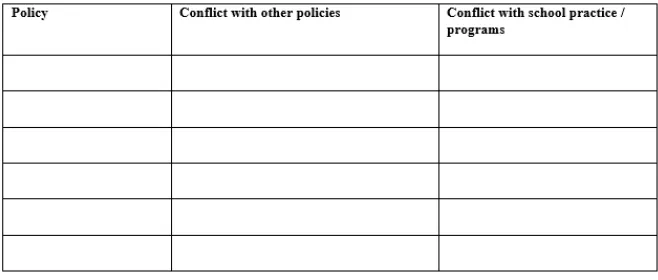
• Critique how wellbeing is implicitly or explicitly defined in each policy, and how well definitions align with notions of wellbeing discussed in Chapter 2. • Use the following template and consider elements of each policy that could
be in tension with each other or with practice and programs in educational contexts.
POLICY, FRAMEWORKS AND LEGISLATION INFORMING A FOCUS
Table 3.1 Elements of policy in tension
FRAMEWORKS INFORMING A FOCUS ON
WELLBEING
Clarke, Sixsmith and Barry (2014) note that long-term benefits, such as improvement in social and emotional learning, increased social emotional functioning and improved academic performance are achieved for children and young people when wellbeing programs are implemented effectively. The following frameworks promote wellbeing as an intended key action.
AUSTRALIAN FRAMEWORKS
Several Australian frameworks have promoted wellbeing as an intended outcome: National Framework for Protecting Australia’s Children 2009-2024; National Safe Schools Framework; Australian Student Wellbeing Framework; Learner Wellbeing Framework for Birth to Year 12; the National Framework for Values Education
in Australian Schools 2005; the National Strategic Framework for Aboriginal and Torres Strait Islander Peoples’ Mental Health and Social and Emotional Wellbeing.
National Framework for Protecting Australia’s Children 2009-2024 National Framework for Protecting Australia’s Children 2009-2024
The National Framework for Protecting Australia’s Children {NFPAC}2009-2020 (Council of Australian Governments {COAG}, 2009) policy has a strong focus on protecting children and young people from abuse and neglect, with wellbeing highlighted as a key action.
The National Safe Schools Framework The National Safe Schools Framework