UNIVERSITI TEKNIKAL MALAYSIA MELAKA
ADVANCE SWIFT COMMUNICATION SYSTEM
This report is submitted in accordance with the requirement of the Universiti Teknikal Malaysia Melaka (UTeM) for the Bachelor of Computer Engineering Technology
(Computer System) with Honours.
by
WONG SHAO PEI
B071310549
931102-01-6333
BORANG PENGESAHAN STATUS LAPORAN PROJEK SARJANA MUDA
TAJUK: Advance Swift Communication System
SESI PENGAJIAN: 2016/17 Semester 2
Saya WONG SHAO PEI
mengaku membenarkan Laporan PSM ini disimpan di Perpustakaan Universiti Teknikal Malaysia Melaka (UTeM) dengan syarat-syarat kegunaan seperti berikut:
1. Laporan PSM adalah hak milik Universiti Teknikal Malaysia Melaka dan penulis.
2. Perpustakaan Universiti Teknikal Malaysia Melaka dibenarkan membuat salinan untuk tujuan pengajian sahaja dengan izin penulis.
3. Perpustakaan dibenarkan membuat salinan laporan PSM ini sebagai bahan pertukaran antara institusi pengajian tinggi.
4. **Sila tandakan ( )
(Mengandungi maklumat yang berdarjah keselamatan atau kepentingan Malaysia sebagaimana yang termaktub dalam AKTA RAHSIA RASMI 1972)
(Mengandungi maklumat TERHAD yang telah ditentukan oleh organisasi/badan di mana penyelidikan dijalankan)
Disahkan oleh:
Alamat Tetap:
383, JLN SENTOSA 1,
TAMAN SRI SENTOSA,
81000 KULAI, JOHOR
Tarikh: ________________________
Cop Rasmi:
Tarikh: _______________________
UNIVERSITI TEKNIKAL MALAYSIA MELAKA
TIDAK TERHAD TERHAD
SULIT
iii
DECLARATION
I hereby, declared this report entitled “Advance Swift Communication System” is the results of my own research except as cited in references.
Signature : ……….
Author’s Name : ……….
iv
APPROVAL
This report is submitted to the Faculty of Engineering Technology of UTeM as a partial fulfillment of the requirements for the degree of Bachelor Degree of Engineering Technology (Computer System) with Honours.. The member of the supervisory is as follow:
v
ABSTRAK
vi
ABSTRACT
vii
DEDICATION
viii
ACKNOWLEDGEMENT
I would like to express my sincere gratitude to my supervisor Sir Aiman Zakwan bin Jidin for his invaluable guidance, continuous encouragement and constant support in making this research possible. I really appreciate to him for give me a chance to do the project. I also sincerely thanks for the time spent proofreading and correcting my mistakes. I also would like to express very special thanks to my family and girlfriend who had encourage me all the time and support me spiritually throughout writing this thesis and my life in general.
ix
TABLE OF CONTENT
Abstrak v
Abstract vi
Dedication vii
Acknowledgement viii
Table of Content ix
List of Tables xiii
List of Figures xiv
List Abbreviations, Symbols and Nomenclatures xvii
CHAPTER 1: INTRODUCRION 1
1.0 Introduction 1
1.1 Background of Study 1
1.2 Problem Statement 4
1.3 Objectives 5
1.4 Work Scope 5
1.5 Conclusion 6
CHAPTER 2: LITERATURE REVIEW 7
2.0 Introduction 7
2.1 Introduction to Android 7
2.1.1 Android Application 7
2.1.2 Android Integrated Development Environment (IDE) 8
2.1.2.1 Eclipse 8
2.1.2.2 Android Studio 9
2.1.2.3 MIT App Inventor 10
x
2.1.3.1 Java 11
2.1.3.2 LUA 11
2.1.3.3 HTML / CSS / JS 12
2.2 Web-based Database 13
2.2.1 MySQL 14
2.2.2 phpMyAdmin 14
2.2.3 XAMPP 15
2.2.4 SQL Language 15
2.2.5 PHP Language 16
2.2.6 Database Language 18
2.2.6.1 Data Definition Language (DDL) 18
2.2.6.2 Data Manipulation Language (DML) 19
2.2.6.3 Data Control Language (DCL) 19
2.2.6.4 Transaction Control (TCL) 20
2.3 Connecting Android Application to Database 20
2.3.1 Web Service 21
2.3.1.1 REST 22
2.3.1.2 SOAP 22
2.3.1.3 XML 23
2.3.1.4 JSON 24
2.4 Connecting Android Application to Network 25
2.4.1 Uses-permission 26
2.4.2 Http Client 26
2.5 Send SMS in Android Application 27
2.5.1 Uses-permission 27
2.5.2 SmsManager API 28
2.5.3 Built-in SMS 29
CHAPTER 3: METHODOLOGY 30
3.0 Introduction 30
xi
3.2 Project Overview 32
3.3 System Workflow 33
3.4 System Flowchart 35
3.4.1 Android Application 35
3.4.2 Server 40
3.5 Project Planning 44
CHAPTER 4: RESULT & DISCUSSION 46
4.0 Introduction 46
4.1 Local Based Database 46
4.1.1 Create a Database 47
4.1.2 Create a Database Driven Website 48
4.2 Android Application 55
4.2.1 Register and Login 56
4.2.2 Send SMS 59
4.2.3 Draft 62
4.2.4 Settings 63
4.3 Connecting Android Application to Database 67
4.3.1 Receive Data from Database 68
4.3.2 Transmit Data to Database 69
4.4 Project Limitations 71
CHAPTER 5: CONCLUSION 73
5.0 Introduction 73
5.1 Summary 73
5.2 Recommendation 74
5.3 Potential Commercialization 75
xii
APPENDICES 79
A Android Application 79
xiii
LIST OF TABLES
Table 2.1: Main areas of using PHP 17
Table 2.2: Usage of DDL statements in SQL 18
Table 2.3: Usage of DML statements in SQL 19
Table 2.4: Usage of DCL statements in SQL 19
Table 2.5: Usage of TCL statements in SQL 20
Table 2.6: Differences between REST and SOAP 23
Table 2.7: Similarity and Differences of XML and JSON 25
xiv
LIST OF FIGURES
Figure 1.1: Illustration of Advance Swift Communication System 3
Figure 2.1: Blockly 10
Figure 2.2: PHP Code 10
Figure 2.3: Client and Server-side JavaScript of Web-based Database 13
Figure 2.4: SQL Architecture 16
Figure 2.5: Example code of PHP 17
Figure 2.6: Accessing remote database via web services. 21
Figure 2.7: Example of XML and HTML 24
Figure 2.8: Scrap example of JSON 24
Figure 2.9: Function code for HttpClient. 27
Figure 2.10: Function code for HttpURLConnection. 27
Figure 2.11: Simple method that used to send SMS 28
Figure 2.12: Simple method that used to send SMS more than 160 characters. 28 Figure 2.13: Simple method to send SMS with built-in SMS application 29
Figure 3.1: Project’s Flowchart 31
Figure 3.2: Overall system block diagram for Advance Swift Communication System 32 Figure 3.3: Use case diagram of Advance Swift Communication System 34
Figure 3.4: Operation can be done by lecturer 35
Figure 3.5: Operation of send message can do by lecturer 36
Figure 3.6: Operation in draft menu 37
Figure 3.7: Operation can do in settings 38
Figure 3.8: Operation can be done in my account. 39
xv Figure 3.12: Operation can be done in manage user menu 43
Figure 4.1: XAMPP server control with Apache and MySQL server started. 47 Figure 4.2: Interface of phpMyAdmin for manage database. 47 Figure 4.3 Database language used to create a table named “lecturer”. 48 Figure 4.4: Example code of combination HTML and SQL language in PHP 49
Figure 4.5: Login page of the website 49
Figure 4.6: Alert box shows the wrong password is entered. 50
Figure 4.7: Home page of the website 50
Figure 4.8: Page of Manage Database 51
Figure 4.9: Page of adding a new class 51
Figure 4.10: Page of view class 52
Figure 4.11: Page of edit class name 52
Figure 4.12: Alert box to confirm delete the chosen class 53
Figure 4.13: Edit student information. 53
Figure 4.14: Double security when the user clicks to manage application user. 54
Figure 4.15: Page of application user list 55
Figure 4.16: First page of the application 56
Figure 4.17: Register Page 57
Figure 4.18: Login Page 58
Figure 4.19: SMS page 59
Figure 4.20: Recipients Group 59
Figure 4.21: When SMS sent 59
Figure 4.22: When SMS delivered 59
Figure 4.23: Message received by the recipient 60
Figure 4.24: Alert dialog show when achieved maximum characters 60
Figure 4.25: Function other than send SMS 61
Figure 4.26: Draft page 62
Figure 4.27: Settings page 63
Figure 4.28: Usage history 63
xvi
Figure 4.30: About the system 63
Figure 4.31: Logout from the application 64
Figure 4.32: Page of My Account 65
Figure 4.33: Change Username 65
Figure 4.34: Change E-mail 65
Figure 4.35: Change Phone Number 65
Figure 4.36: Change new password 66
Figure 4.37: Delete account 67
xvii
LIST OF ABBREVIATIONS, SYMBOLS AND
NOMENCLATURE
ADT ` - Android Development Tools APK - Android Application Package
ASCS - Advance Swift Communication System AVD - Android Virtual Device
CSS - Cascading Style Sheet CSS - Cascading Style Sheet
DBMS - Database Management System DCL - Data Control Language
DDL - Data Definition Language DML - Data Manipulation Language
GSM - Global System for Mobile communications GUI - Graphical User Interface
HTML - Hyper Text Markup Language HTTP - HyperText Transfer Protocol
IDE - Integrated Development Environment JDBC - Java Database Connectivity
JS - JavaScript
JSON - Javascript Object Notation
MCMC - Malaysian Communications and Multimedia Commission MIT - Massachusetts Institute of Technology
NDK - Native Development Kit ODBC - Open Database Connectivity PHP - Hypertext Preprocessor
xviii SDK - Software Development Kit
SIM - Subscriber Identification Module SMS - Short Message Service
SOAP - Simple Object Access Protocol SQL - Structured Query Language TCL - Transaction Control
1
CHAPTER 1
INTRODUCTION
1.0 Introduction
Advanced swift communication system (ASCS) based on android is an application that provides a very effective way in sending SMS from application to a group of recipients. To use this application, the user first requires to create a new account and will be authorized when try to log into the application. The user being authenticated will bring to a user menu which included several functions such as send new message, draft, view profile and usage history. A database is provided which it stored all the contacts group inside and allow users to choose which group to send the message. This chapter mainly covers the general background of this project, the problem statement, project objectives, work scopes, project significance and conclusion.
1.1 Background of Study
2 From the statistics above, it can be said that most of the handphone users use the internet services on the free messaging applications such as WeChat, WhatsApp and Messenger. All of these applications provide a medium for the user to communicate with each other under internet access and it almost displaces the SMS. This is because SMS may cause a loss in cost and fee for messaging is calculated per message. The free messaging applications really provide a convenient medium for the user, but how if there is not internet connection on the recipients?
In an example, people not only use the application on chatting but also to share information or importance message. Just think about it, if someone had no internet access and one of the group members share an importance message in a group, then the one who had no internet access at that time will definitely miss the message.
For another, someone had a phone always in internet access and are the group members in several groups. The group members are always chit-chatting inside the group. Those conversations may not in his business, so group notifications are muted. When an urgent message was shared in the group, someone may also miss the message. Furthermore, when that the group had hundred more unread messages, people may blunder away the importance message. With this ASCS system, the message in send out via SMS service with the database provided. People may get the alert either not under internet connection or group notification muted. For a built-in messaging application, it also can do this process without using the ASCS system. Why this system should be choosing?
3 In addition, this system is suitable to be used in an institute or a department of the company. In this project, it will be done for a university’s faculty use. The functionality of this system is the lecturer may use the system to share information or make a reminder to their student. For example, lecturers can use this system to make an alert to remind their students 30 minutes before the examination start. That message may include about the subject being taken, time, venue and the things need to bring. This message is sent via SMS service and directly send to the students one by one no matter he or she is under internet connection or not and the probability for them to miss the message is decrease.
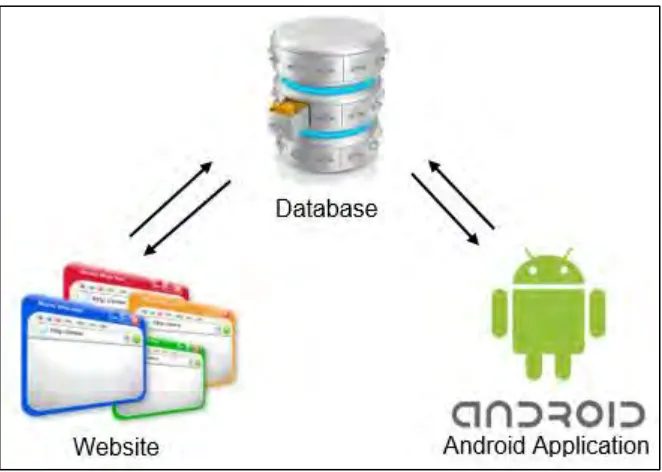
[image:21.612.162.493.338.574.2]Typically, the system contains two part, the application part and server part. The application part is the place where the user can send the SMS with the contact saved on the server while the server part is place for administrator to manage the application user and also the contact database. Figure 1.1 is the illustration of the ASCS system based on Android application and website.
Figure 1.1: Illustration of Advance Swift Communication System
4 edit and delete the contact group. For the android application, it allows user send SMS. The application will get the recipients group from the database via web service call. With web service, application allows to get or post data to database. Then, the message will be sent to the recipients chose via SMS manager API called in the application and is done send to recipients’ mobile device with the help of Global System for Mobile communications, GSM which built inside the mobile device. Other than send SMS, this application also allows the user to save the message as draft for next time use, manage the account and check the usage history.
In exploitation of this system, the focus is in develop an android application and website. With the supporting of database in this system, it is totally improved the convenient on using the system. As long as the application users are authenticated, every user can share the same database and link to the database wherever and whenever. It can be very useful for a team or a group of members. Thus, the advance swift communication system can be the succedaneum of the built-in mobile messaging system and solve the problem of no internet connection on the recipients.
1.2 Problem Statement
In this technology sophisticated era, the free messaging applications were getting more. Every user had their own choice on which types of applications is more comfortable and suitable to use. All of these free applications not only provide a very expedient way for the user contact to each other. Yes, all of these applications is free to use, but the first condition is the device is under network connection. If not on the internet accessed, the message could not be received.
5 person who does not really like be disturbed when chit-chatting is started in the group which is not really his or her business. Hence, if the notification is muted or network is not connected, that particular member may not receive the urgent information on time. This all can be solved if the urgent messages were sent directly to the recipients via SMS service.
This ASCS system is designed based on database and android application as user interface. It allows the user to send the message from the application to certain recipients group via SMS services. The advantages of using this system are the recipients may receive the message which the user wish to deliver to the recipients no matter that he or she is internet access or not.
1.3 Objectives
Based on the problem statements, the objectives of the project are as below:
To develop a swift communication system that allows sending SMS from android application.
To study how android application can send SMS with access to the database created.
To analyze performance and functionality of project regarding advance swift communication system.
1.4 Work Scope
6 In addition, this project was divided into two parts, which are the application part and server part. The application part is the user interface which allows users to carry out the function of sending SMS with database while server is for administrator to manage the database and store information.
The work scope of the application part is to study the development of the android application. Java language will be used in develop the application. Furthermore, XAMPP server, PHP, MySQL and HTML may use for development of the website and manage database system. The application will provide several functions but the main is send SMS. In activity of send SMS, the interface will provide a space for the user to enter the messages and select the recipients group. Besides, the data stored in database should link with the application.
To get this system work perfectly, everything of these should work correctly. If any part of this failed to carry out their function properly, the system may be faulty. So every part of these should be studies, test and analysis over and over.
1.5 Conclusion
In this report, the introduction chapter covers the background, problem statement, objective and scope. With all the information stated in this chapter, the reader will be able to understand the basic idea of this ASCS system.