Research paper
T-cell libraries allow simple parallel generation of multiple
peptide-speci
fi
c human T-cell clones
Sarah M. Theaker
a, Cristina Rius
a, Alexander Greenshields-Watson
a, Angharad Lloyd
a, Andrew Trimby
a,
Anna Fuller
a, John J. Miles
a,b, David K. Cole
a, Mark Peakman
c, Andrew K. Sewell
a,⁎
,1, Garry Dolton
a,1a
Division of Infection and Immunity, Cardiff University School of Medicine, Cardiff, UK
b
QIMR Berghofer Medical Research Institute, Brisbane, Queensland 4029, Australia
c
Peter Gorer Department of Immunobiology, King's College London Faculty of Life Sciences & Medicine, Guy's Hospital, London, UK
a b s t r a c t
a r t i c l e i n f o
Article history:
Received 23 December 2015
Received in revised form 26 January 2016 Accepted 26 January 2016
Available online 28 January 2016
Isolation of peptide-specific T-cell clones is highly desirable for determining the role of T-cells in human disease, as well as for the development of therapies and diagnostics. However, generation of monoclonal T-cells with the required specificity is challenging and time-consuming. Here we describe a library-based strategy for the simple parallel detection and isolation of multiple peptide-specific human T-cell clones from CD8+or CD4+polyclonal T-cell populations. T-cells werefirst amplified by CD3/CD28 microbeads in a 96U-well library format, prior to screening for desired peptide recognition. T-cells from peptide-reactive wells were then subjected to cytokine-mediated enrichment followed by single-cell cloning, with the entire process from sample to validated clone taking as little as 6 weeks. Overall, T-cell libraries represent an efficient and relatively rapid tool for the generation of peptide-specific T-cell clones, with applications shown here in infectious disease (Epstein–Barr virus, influenza A, and Ebola virus), autoimmunity (type 1 diabetes) and cancer.
© 2016 The Authors. Published by Elsevier B.V. This is an open access article under the CC BY license (http://creativecommons.org/licenses/by/4.0/). Keywords:
Ebola Library Peptide-specific T-cell clone Tumour Type 1 diabetes
1. Introduction
Classical CD8+(cytotoxic) and CD4+(helper) T-cell subsets scan for anomalies in the proteome by recognising peptides presented by major histocompatibility complex class I (MHC-I) and class II (MHC-II) proteins, respectively, through their heterodimericαβT-cell receptors (TCRs) (Attaf et al., 2015b). The TCR repertoire of a person is clono-typically diverse (Attaf et al., 2015a), with individual clonotypes exhibiting peptide cross-reactivity (Wooldridge et al., 2012; Sewell, 2012), thereby enabling the host to combat invading pathogens and
occasionally neoplasms. T-cells can also play a detrimental role in host health, as is seen during autoimmune disease (Gomez-Tourino et al., 2015; Salou et al., 2015) and organ transplant rejection (Lin et al., 2015). T-cell clones provide a good experimental system to address re-search hypotheses without the ambiguities associated with polyclonal populations of T-cells, and also enable production of monoclonal T-cell receptors (TCRs) for immunotherapy approaches. However, generation of T-cell clones can be challenging, with factors such as sample availabil-ity, clonotype frequency, and access to suitable detection systems all im-pinging on the isolation of desired peptide-specific T-cell populations.
Here we describe a library-based strategy for the relatively rapid generation of peptide-specific human T-cell clones from polyclonal populations of CD8+or CD4+T-cells. Firstly, CD3/CD28 microbeads were used to amplify the T-cells (Trickett and Kwan, 2003) in a 96U-well library format, from which they were subsequently screened for re-activity against desired peptides via enzyme-linked immunospot assay (ELISpot). T-cells from peptide-reactive wells were then enriched using cytokine-mediated strategies, subjected to single-cell cloning, and grown to sufficient numbers for functional validation, with the en-tire process from blood to validated clone taking as little as 6 weeks. We have now used this T-cell library approach to generate many hundreds of different T-cell clones, without the need for access to peptide-MHC (pMHC) multimers or autologous dendritic cells (DCs). Our methodolo-gy is not only compatible with small sample sizes (e.g. 1 ml of blood or a small biopsy), but also permits the isolation of potentially rare T-cell Abbreviations:APC, Antigen presenting cells; CDH3, cadherin-3;51
Cr, chromium-51; DC, dendritic cell; EBOV-Z, Zaire Ebola virus; EBV, Epstein–Barr virus; ELISA, enzyme-linked immunosorbent assay; ELISpot, enzyme-enzyme-linked immunospot assay; EN2, Engrailed-2;flu, influenza A; FBS, foetal bovine serum; GAD65, glutamic acid decarboxyl-ase; gp, glycoprotein; HA, haemagglutinin; HLA, human leukocyte antigen; IGRP, islet-specific glucose-6-phosphatase catalytic subunit-related protein; IMP-3, Insulin-like growth factor 2 mRNA binding protein 3; InsB, insulinβchain; MAGE, melanoma-associated antigen; MHC, major histocompatibility complex; MP, matrix protein; NP, nu-cleoprotein; PAP-3, prostatic acid phosphatase-3; PBMC, peripheral blood mononuclear cells; PHA, phytohemagglutinin; pMHC, peptide–MHC; PPI, preproinsulin; SFC, spot forming cells; TCR, T-cell receptor; T1D, Type 1 diabetes.
⁎ Corresponding author at: Division of Infection and Immunity, Cardiff University School of Medicine, Henry Wellcome Building, University Hospital of Wales, Heath Park, Cardiff CF14 4XN, UK.
E-mail address:[email protected](A.K. Sewell).
1
These authors contributed equally.
http://dx.doi.org/10.1016/j.jim.2016.01.014
0022-1759/© 2016 The Authors. Published by Elsevier B.V. This is an open access article under the CC BY license (http://creativecommons.org/licenses/by/4.0/).
Contents lists available atScienceDirect
Journal of Immunological Methods
clonotypes from diverse polyclonal T-cell populations. Overall, T-cell libraries represent a simple and efficient tool for the simultaneous de-tection and isolation of multiple peptide-specific T-cell clones, with ex-amples shown here for infectious disease (Epstein–Barr virus, influenza A, and Ebola virus), autoimmunity (type 1 diabetes) and cancer.
2. Materials and methods
2.1. T-cell subset isolation
Buffy coats from healthy human leukocyte antigen (HLA)-A*0201+ (HLA-A2+) donors were obtained from the Welsh Blood Service. Peripheral blood was obtained from a healthy HLA-DRB*0101+ (HLA-DR1+) donor, an HLA-A2+donor with type 1 diabetes (T1D), and a healthy HLA-A2+donor who had previously participated in a clinical trial for an Ebola virus (EBOV) DNA vaccine (EBODNA012-00-VP) (Martin et al., 2006). Informed consent was obtained from all donors, and blood was collected according to institutional guidelines. Isolation of peripheral blood mononuclear cells (PBMC) was carried out by den-sity gradient centrifugation. On day 1 of the described method, T-cells were enriched from fresh or frozen PBMC by positive selection with anti-CD8+or -CD4+microbeads, according to the manufacturer's in-structions (Miltenyi Biotec, Bergisch Gladbach, Germany).
2.2. Tumour lines and immortalised cell lines
All HLA-A2+tumour lines (Mel 624, Mel 526, MM909.24 and MCF-7) were maintained in culture at 37 °C as adherent monolayers with R10 media (RPMI 1640 medium supplemented with 10% foetal bovine serum (FBS), 100 U/ml penicillin, 100μg/ml streptomycin, and 2 mML -Glutamine (Life Technologies, Paisley, UK)). T2 cells expressing either HLA-A2 (T2) or T2 cells transduced with HLA-DR1 (T2-DR1s) were cul-tured at 37 °C as suspension cells in R10.
2.3. Production of HLA-DR1 expressing T2 cells
HLA-DR1 was cloned into the pRRLSIN.cPPT.PGK-GFP.WPRE transfer vector (Addgene #12252). Integrase proficient lentivirus stocks were produced by co-transfecting 293T/17 cells via calcium phosphate pre-cipitation with the transfer vector and packaging plasmids: pCMV-dR8.74 (Addgene #22036) and pMD2.G (Addgene #12259). Lentivirus containing supernatant was collected after 24 h and 48 h incubations. The lentivirus stocks were concentrated by ultracentrifugation before being used to transduce T2 (174 × CEM) cells. The surface expression of DR1 was assessed using a mouse anti-human unconjugated HLA-DR antibody (clone L243, 0.5 mg/ml; Biolegend®, London, UK) and a goat anti-mouse polyclonal conjugated antibody (BD Biosciences, Oxford, UK). Populations were then enriched using the above antibodies and anti-fluorochrome microbeads (Miltenyi Biotec). Monoclonal popula-tions were generated by single-cell cloning of the HLA-DR1 enriched population.
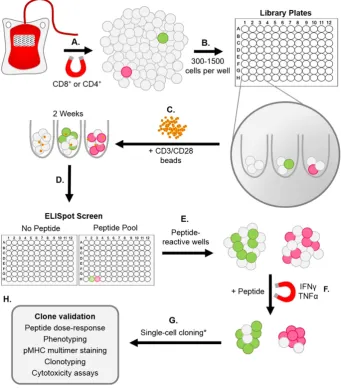
2.4. Establishing CD8+and CD4+T-cell libraries
An overview of our T-cell library methodology is illustrated inFig. 1. Following enrichment from PBMC on day 1, T-cells were immediately seeded (range of densities tested from 300 to 1500 cells per well) across multiple (typically 1 to 6) 96U-well plates with Human T-Activator CD3/CD28 Dynabeads® (Life Technologies) (Trickett and Kwan, 2003) at a 1:2 cell:bead ratio, in 20 IU IL-2 T-cell media (R10 media supple-mented with 1X MEM non-essential amino acids, 1 mM sodium pyru-vate, 10 mM HEPES buffer (Life Technologies), and 20 IU/ml IL-2 (aldesleukin, brand name Proleukin®; Prometheus, San Diego, CA). Li-brary plates were spun before culture at 300 G for 5 min, and then maintained (at 37 °C) by feeding on days 3 and 6 with 20 IU and 200 IU IL-2 T-cell media, respectively. From day 9 onwards, libraries
were maintained by feeding every 3 days with 200 IU IL-2 T-cell media (+25 ng/ml IL-15 (PeproTech, Rocky Hill, NJ) for CD8+libraries). Between days 14 and 17 of culture, 3 random wells from each library plate were counted to establish an average T-cell number per well. Using this representative count, enough cells were removed from each library well to provide approximately 2.5 × 10⁴cells per well for an ELISpot screen. These cells were rested in 96U well plates by washing in R0 (recipe as for R10 but with no serum), and then culturing for 24 h in R5 (recipe as for R10 but with 5% FBS). Rested library cells were then screened ± peptide(s) (10−5to 10−6M) via ELISpot, using 5 × 10⁴antigen presenting cells (APC) (T2 or T2-DR1s) per well. This relatively high level of peptide was used in order to ensure capture of all responses, although the use of 10−7and 10−8M peptide also worked well (data not shown). We were concerned that the use of high concen-trations of peptide for screening might result in the generation of T-cell clones that were only capable of recognising targets displaying high densities of cognate peptide. These worries were unfounded as the clones generated by this method were often capable of recognising lower levels of peptide, as demonstrated by the peptide titration data in the relevantfigures. ELISpot screens were carried out according to the manufacturer's instructions (Mabtech, Nacka, Sweden), and an AID ELISpot reader (AID, Strassberg, Germany) was used to read the number of spot forming cells (SFC) present in each well. If the limit of detection was exceeded, and individual spots could not be accurately discerned by the reader, peptide-reactive wells were enumerated by eye. Cells from peptide-reactive wells of the screen, with a SFC increase of≥20 from the corresponding“no peptide”well, were either pooled or kept as individual wells.
2.5. Isolating T-cell clones
Peptide-specific (IFNγor IFNγ/TNFαsecreting) T-cells were isolated from the positive library well(s) by resting the cells in R5 media (as above), stimulating the rested cells with 10−5M peptide for 4 h, and then using an IFNγor dual IFNγ/TNFαcapture method to isolate the ac-tivated T-cells, according to the manufacturer's instructions (Miltenyi Biotec). The cells were then cloned to the single-cell level by dilution, or expanded as an enriched line. T-cell clones and lines were maintained at 37 °C in either 20 IU or 200 IU IL-2 T-cell media (+IL-15 for CD8+ cells). T-cells were stimulated fortnightly with 1μg/ml phytohemagglu-tinin (PHA) (Alere, Cheshire, UK), in the presence of irradiated (3100 Gy) allogeneic feeder cells (PBMC) from three healthy donors (5 × 10⁴per well).
2.6. Peptides
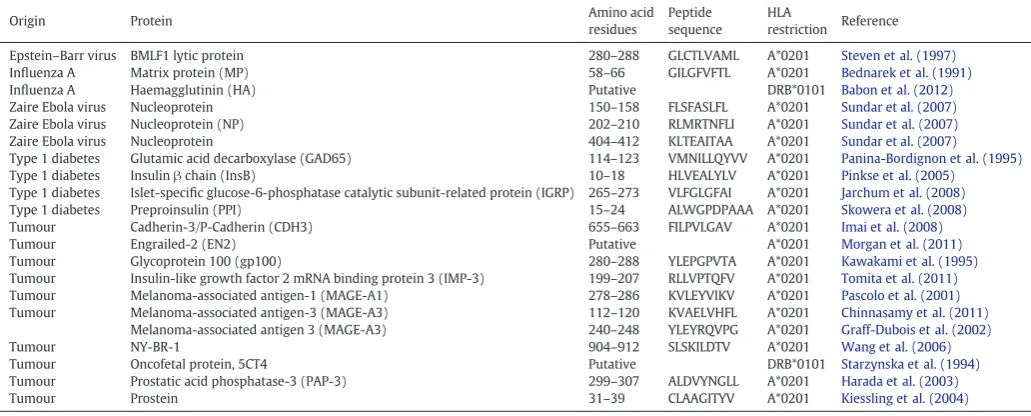
The peptides and their known HLA restriction are listed inTable 1. In addition to generating T-cell clones specific for established T-cell epitopes, we were also interested in using the technique to verify new epitopes. In this respect, we used the T-cell library strategy to test new peptide epitopes from Engrailed-2 (EN2) (Morgan et al., 2011), influenza A (flu) haemagglutinin (HA) (Babon et al., 2012), and the 5T4 oncofetal protein (Starzynska et al., 1994).
2.7. Clone validation
was used to confirm TCR binding to peptide via HLA-A2 presentation. In the case of tumour-specific clones, a chromium (51Cr)-release cytotox-icity assay (Tungatt et al., 2015) (PerkinElmer, Waltham, MA) was car-ried out to determine if the T-cell clones were capable of tumour cell killing. Percentage (%) specific lysis was calculated using the following equation: (experimental release−spontaneous release) / (maximal re-lease−spontaneous release) × 100.
3. Results
3.1. Generation of a T1D-relevant CD8+T-cell clone from limited starting material
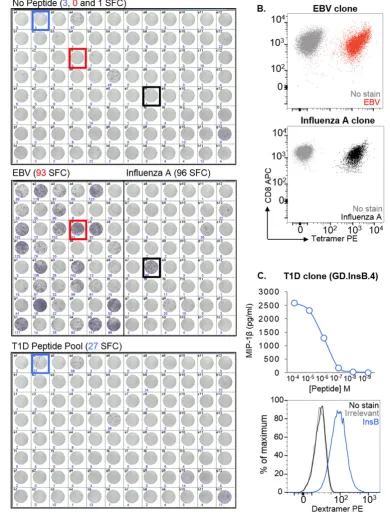
One of the main challenges in identifying and isolating peptide-specific T-cells from patients is that there is often limited cell availability due to sample sharing between researchers, ethical limitations on the size/volume of the sample that can be taken, and also the nature of the tissue source, such as with biopsies. To demonstrate that T-cell li-braries can be used to overcome this limitation, 1 ml of blood from an HLA-A2+donor with T1D was used to make a library consisting of 96 wells with 1000 CD8+T-cells per well. After 14 days, and an approxi-mate 300- to 400-fold expansion of T-cells, the library was screened
[image:3.595.131.473.55.445.2]against two pools of HLA-A2-restricted peptides using IFNγELISpot. Peptides from Epstein–Barr virus (EBV) (BMFL1280–288(Steven et al., 1997)) andflu (matrix protein (MP)58–66(Bednarek et al., 1991)) were used to test the feasibility of screening in this manner, as robust T-cell responses are elicited in HLA-A2+people exposed to these virus-es. Background release of IFNγwithout added peptide was observed in some wells (Fig. 2A, top), however this did not preclude the identifi ca-tion of peptide-reactive wells: 30 wells of the 48 screened (17/48) were positive for the EBV peptide, and 2/48 for theflu peptide (Fig. 2A, mid-dle). More interestingly, 1/96 of the wells screened with a pool of four well-characterised T1D-relevant peptides (preproinsulin (PPI)15–24 (Skowera et al., 2008), insulinβchain (InsB)10–18(Pinkse et al., 2005), glutamic acid decarboxylase (GAD65)114–123(Panina-Bordignon et al., 1995), and islet-specific glucose-6-phosphatase catalytic subunit-related protein (IGRP)265–273(Jarchum et al., 2008)) was peptide-reactive (Fig. 2A, bottom). One peptide-reactive well from each of the three screens was enriched based on IFNγproduction in response to stimulation with relevant peptide(s), prior to T-cell cloning. pMHC tetramer staining was used to confirm the specificities of the EBV and flu clones (Fig. 2B). We established that the T1D peptide-reactive clone (GD.InsB.4) was specific for the InsB peptide, as shown via peptide dose–response (MIP-1βELISA) and pMHC dextramer staining (Fig. 2C). Fig. 1.Overview of T-cell library methodology. (A–C) T-cells were enriched from fresh or frozen peripheral blood mononuclear cells (PBMC) via magnetic separation using anti-CD8+
or -CD4+microbeads, prior to seeding into multiple 96U-well plates (range tested from 300–1500 cells per well) with CD3/CD28 beads at a 1:2 cell:bead ratio. (D) Approximately 2 weeks
All the InsB clones that were grown stained with the same TCR variable βchain antibody (data not shown), suggesting they were likely to be derived from the same precursor. Together, these data verify that peptide-specific T-cells of interest can be successfully isolated from patient samples even when cells are in short supply.
3.2. Generation of tumour-specific T-cell clones from potentially rare populations using CD8+T-cell libraries
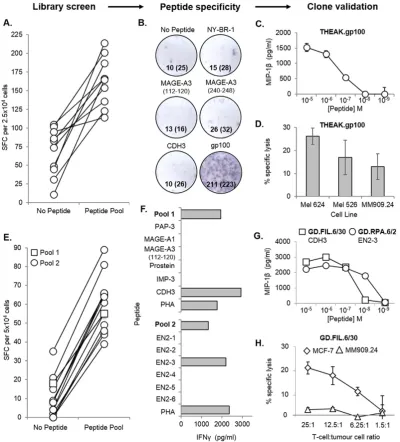
In addition to the limitations associated with sample size, the pro-duction of T-cell clones is often made more difficult when the peptide-specific T-cells of interest occur at naturally low frequencies. This is often the case with tumour-reactive T-cells (Sharpe and Mount, 2015) (recognising tumour-associated antigens) in PBMC, as a result of thymic selection reducing the presence of“self”reactive T-cells in the pe-riphery (Klein et al., 2014). Thus, with the aim of isolating rare tumour-specific T-cells, a CD8+T cell library (576 wells at 1000 cells per well) was generated from the PBMC of a healthy HLA-A2+ donor, and screened via IFNγELISpot against a pool offive HLA-A2-restricted tumour peptides (melanoma-associated antigen-3 (MAGE-A3)112–120 (Chinnasamy et al., 2011), MAGE-A3240–248 (Graff-Dubois et al., 2002), cadherin-3/P-cadherin (CDH3)655–663 (Imai et al., 2008), NY-BR-1904–912(Wang et al., 2006) and glycopro-tein 100 (gp100)280–288(Kawakami et al., 1995)).Fig. 3A shows the positive library wells (10/576) from this library screen, which were subsequently pooled, and specificity for the gp100 peptide deter-mined (by IFNγELISpot) prior to enrichment and cloning (Fig. 3B). From this library, a gp100-specific clone (THEAK.gp100) was pro-duced, and its reactivity confirmed via a peptide dose–response ex-periment using MIP-1βELISA (Fig. 3C). THEAK.gp100 was able to kill multiple HLA-A2+melanoma cell lines (Mel 624, Mel 526 and MM909.24) in a51Cr-release assay after 18 h, at a T-cell:tumour cell ratio of 10:1 (Fig. 3D).
Next, a second CD8+T-cell library (288 wells at 500 cells per well) was produced from a different healthy HLA-A2+donor, but this time screened against two separate pools of HLA-A2-restricted tumour pep-tides, (Pool 1: prostatic acid phosphatase-3 (PAP-3)299–307(Harada et al., 2003), melanoma-associated antigen-1 (MAGE-A1)278–286 (Pascolo et al., 2001), MAGE-A3112–120, prostein31–39(Kiessling et al., 2004), insulin-like growth factor 2 mRNA binding protein 3
(IMP-3199–207) (Tomita et al., 2011), and CDH3655–663; Pool 2: six putative peptides from EN2 (EN2-1, -2, -3, -4, -5, and -6)). ELISpot data for the peptide-reactive wells (1/288 for pool 1, and 13/288 for pool 2) is shown inFig. 3E. T-cells were then cloned from the positive wells, and screened against individual peptides by IFNγELISA (Fig. 3F). Two clones were produced; one recognising the CDH3 peptide (GD.FIL.6/30), and the other recognising a putative EN2-3 peptide (GD.RPA.2/30), as con-firmed by a peptide dose–response (MIP-1βELISA) (Fig. 3G). The CDH3-specific clone was shown to specifically kill an HLA-A2+breast cancer cell line (MCF-7), and not an HLA-A2+metastatic melanoma cell line (MM909.24; obtained from the Center for Cancer Immune Therapy, Herlev Hospital, Copenhagen, Denmark) in a51Cr-release assay after 4 h (Fig. 3H). Collectively, these data show that obtaining tumour-reactive T-cell clones using this method is not hindered by pre-dicted low clonotype frequencies.
3.3. Generation of T-cell clones from CD4+T-cell libraries
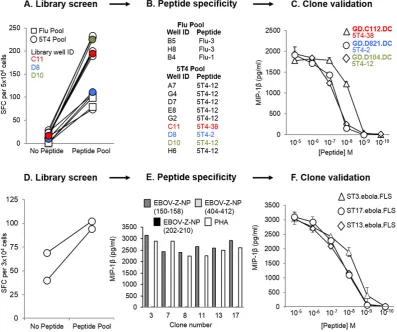
[image:4.595.35.551.86.294.2]To further illustrate the versatility of the T-cell library method, a CD4+T-cell library (192 wells at 1000 cells per well), was generated from a healthy HLA-DR1+donor, and simultaneously screened via IFNγELISpot for reactivity against two HLA-DR1-restricted peptide pools. Thefirst peptide pool contained three putative peptides from HA offlu (Flu-1, -2, and -3), and the second peptide pool contained five putative peptides from 5T4 oncofetal protein (5T4-2, -12, -20, -38, and -PMS). Positive wells from the screen (3/48 for theflu pool, and 9/144 for the 5T4 pool: shown inFig. 4A) were enriched based on IFNγproduction in response to peptide(s), and then expanded once with PHA and irradiated allogeneic feeder cells to produce lines. The lines were subsequently screened against individual peptides in an IFNγELISpot (Fig. 4B), and then cloned to the single-cell level. From this, three 5T4-clones (GD.C112.DC, GD.D821.DC and GD.D104.DC) were generated and tested against decreasing doses of peptide via MIP-1βELISA, in order to establish their sensitivity to the corresponding epitope (Fig. 4C). Thus, these data indicate that our T-cell library strate-gy can also successfully produce CD4+T-cells with desired specificities. It is noteworthy that autologous EBV immortalised B-cell lines were ini-tially used for the screening of CD4+libraries, but these induced high numbers of positive wells (data not shown), presumably because of T-cells with reactivity against EBV.
Table 1
List of peptides used in this study. HLA restriction and full peptide sequence are listed in all but 3 cases. Sequences of the new HLA-A*0201-restricted Engrailed-2-derived epitopes, and the new HLA-DRB*0101-restricted epitopes from influenza haemagglutinin and 5T4 oncofetal protein will be published in other studies we are currently preparing.
Origin Protein Amino acid
residues
Peptide sequence
HLA
restriction Reference
Epstein–Barr virus BMLF1 lytic protein 280–288 GLCTLVAML A*0201 Steven et al. (1997) Influenza A Matrix protein (MP) 58–66 GILGFVFTL A*0201 Bednarek et al. (1991)
Influenza A Haemagglutinin (HA) Putative DRB*0101 Babon et al. (2012)
Zaire Ebola virus Nucleoprotein 150–158 FLSFASLFL A*0201 Sundar et al. (2007) Zaire Ebola virus Nucleoprotein (NP) 202–210 RLMRTNFLI A*0201 Sundar et al. (2007) Zaire Ebola virus Nucleoprotein 404–412 KLTEAITAA A*0201 Sundar et al. (2007) Type 1 diabetes Glutamic acid decarboxylase (GAD65) 114–123 VMNILLQYVV A*0201 Panina-Bordignon et al. (1995) Type 1 diabetes Insulinβchain (InsB) 10–18 HLVEALYLV A*0201 Pinkse et al. (2005)
Type 1 diabetes Islet-specific glucose-6-phosphatase catalytic subunit-related protein (IGRP) 265–273 VLFGLGFAI A*0201 Jarchum et al. (2008) Type 1 diabetes Preproinsulin (PPI) 15–24 ALWGPDPAAA A*0201 Skowera et al. (2008) Tumour Cadherin-3/P-Cadherin (CDH3) 655–663 FILPVLGAV A*0201 Imai et al. (2008)
Tumour Engrailed-2 (EN2) Putative A*0201 Morgan et al. (2011)
Tumour Glycoprotein 100 (gp100) 280–288 YLEPGPVTA A*0201 Kawakami et al. (1995) Tumour Insulin-like growth factor 2 mRNA binding protein 3 (IMP-3) 199–207 RLLVPTQFV A*0201 Tomita et al. (2011) Tumour Melanoma-associated antigen-1 (MAGE-A1) 278–286 KVLEYVIKV A*0201 Pascolo et al. (2001) Tumour Melanoma-associated antigen-3 (MAGE-A3) 112–120 KVAELVHFL A*0201 Chinnasamy et al. (2011)
Melanoma-associated antigen 3 (MAGE-A3) 240–248 YLEYRQVPG A*0201 Graff-Dubois et al. (2002)
Tumour NY-BR-1 904–912 SLSKILDTV A*0201 Wang et al. (2006)
Tumour Oncofetal protein, 5CT4 Putative DRB*0101 Starzynska et al. (1994)
Tumour Prostatic acid phosphatase-3 (PAP-3) 299–307 ALDVYNGLL A*0201 Harada et al. (2003)
Tumour Prostein 31–39 CLAAGITYV A*0201 Kiessling et al. (2004)
3.4. Generation of Zaire Ebola virus (EBOV-Z)-specific T-cell clones from a vaccinated donor
Finally, we reasoned that this method of T-cell clone generation could also be used to generate peptide-specific T-cell clones from vacci-nated individuals. Therefore, a CD8+T cell library (192 wells at 1000
[image:5.595.113.504.54.568.2]cells per well) was generated from the PBMC of a healthy HLA-A2+ donor, who had previously participated in a clinical trial for an EBOV DNA vaccine. The library was screened via IFNγELISpot for reactivity against a pool of three predicted HLA-A2-restricted EBOV-Z nucleopro-tein (NP) epitopes (EBOV-Z-NP150–158, EBOV-Z-NP202–210, and EBOV-Z-NP404–412) (Sundar et al., 2007) (Fig. 4D). Positive wells from the screen Fig. 2.Generation of clones that recognise EBV, influenza A, and insulinβchain peptides from a type 1 diabetes (T1D) CD8+T-cell library. (A) A CD8+T-cell library (96 wells at 1000 cells
per well) from an HLA-A2+
donor with T1D was screened by IFNγenzyme-linked immunospot assay (ELISpot), using T2 as antigen presenting cells. Library cells were tested alone (top), against HLA-A2-restricted peptides from Epstein Barr virus (EBV) (BMFL1280–288) and influenza A (flu) virus (matrix protein (MP)58–66) (middle), and against a pool of four
HLA-A2-restricted T1D-relevant peptides (preproinsulin (PPI)15–24, insulinβchain (InsB)10–18, glutamic acid decarboxylase (GAD65)114–123and islet-specific glucose-6-phosphatase catalytic
subunit-related protein (IGRP)265–273) (bottom). The number of spot forming cells (SFC) per 3.3 × 10⁴cells, as determined by the ELISpot reader, is shown for each well. Those used
(2/192) were pooled, subjected to IFNγ/TNFαdual enrichment, and then cloned to the single-cell level. Six EBOV-Z-specific clones were generated, all reactive to the EBOV-Z-NP150–158peptide, as determined by MIP-1βELISA (Fig. 4E). Peptide dose–response curves (MIP-1β ELISA) for three of the clones (ST3.ebola.FLS, ST13.ebola.FLS, and ST17.ebola.FLS) are shown as an example (Fig. 4F). These data demon-strate the ability of this T-cell library method to rapidly produce viral-specific T-cell clones from the blood of a vaccinated donor.
4. Discussion
Modern advances in cell sorting, usingfluorescence or magnetic beads, have allowed the generation of T-cell clones following physical
[image:6.595.94.495.50.493.2]isolation with pMHC multimers, or functional detection using antibod-ies specific for cellular activation markers. Although these techniques have worked well in our laboratory for some antigens, we have failed to grow robust clones using these standard methodologies more often than we have succeeded. In order to circumvent this difficulty, we de-veloped the T-cell library strategy described here. Previous studies have applied a T-cell library approach to study T-cell frequencies, but in-stead used PHA in combination with irradiated allogeneic feeder cells for T-cell expansion (Campion et al., 2014; Geiger et al., 2009). The CD3/CD28 beads used in our strategy have been shown to better pre-serve the TCR repertoire duringin vitroexpansion (Neller et al., 2012). Nevertheless, while this methodology maintains the general TRBV families and dominant antigen-specific T-cell responses faithfully, it Fig. 3.CD8+
T-cell clone generation from T-cell libraries screened with tumour peptides. A CD8+
T-cell library (576 wells at 1000 cells per well) from an HLA-A2+
donor was screened ± an HLA-A2-restricted tumour peptide pool by IFNγenzyme-linked immunospot assay (ELISpot), using T2 as antigen presenting cells. (A) Spot forming cells (SFC) per 2.5 × 10⁴
cells is shown for the 10 peptide-reactive wells. (B) Positive wells were then pooled, and tested for individual peptide-specificity by IFNγELISpot. SFC per 2.5 × 10⁴
cells for each well is shown (SFC for duplicate wells has been shown in brackets). The pooled cells were then enriched for reactive T-cells based on IFNγproduction, and subjected to single-cell cloning. (C & D) One of the clones (THEAK.gp100) was specific for the gp100-derived peptide by MIP-1βELISA, and also successfully killed multiple HLA-A2+melanoma cell lines (Mel 624, Mel
526, and MM909.24) in a51
Cr-release assay after 18 h, at a T-cell:tumour cell ratio of 10:1. A library from a second HLA-A2+
donor (288 wells at 500 cells per well) was screened as in (A), but with two pools of HLA-A2-restricted tumour peptides. (E) SFC per 5 × 10⁴
cells for the 14 peptide-reactive wells. (F) Cloned T-cells were screened against individual peptides by IFNγELISA, and were found to recognise a peptide from either cadherin-3 (CDH3) or Engrailed-2 (EN2). (G) Both the CDH3-specific clone (GD.FIL.6/30) and EN2-3-specific clone (GD.RPA.6/2) were tested for sensitivity to cognate peptide by MIP-1βELISA. (H) The GD.FIL.6/30 clone was also tested for cytotoxicity towards an HLA-A2+
breast cancer cell line (MCF-7), and an HLA-A2+
metastatic melanoma cell line (MM909.24) in a51
Cr-release assay after 4 h.
remains possible that extremely rare clones are lost during this expan-sion phase.
Using the methodology we describe here, we have been able to si-multaneously generate many hundreds of peptide-specific T-cell clones, with at least one being grown from each library. T-cell libraries have be-come the method of choice for generating monoclonal T-cells in our lab-oratory, as they avoid the need for pMHC multimers, ample donor material, or time-consuming DC production. Furthermore, we consider it an advantage to have the T-cells already adapted toin vitroculture prior to screening, and also to avoid repeated exposure to antigenic pep-tide, which can often lead to T-cell exhaustion (Wherry and Kurachi, 2015). Importantly, we have found T-cell clones to be extremely advan-tageous for improving pMHC multimer staining protocols (Dolton et al., 2015; Tungatt et al., 2015), T-cell epitope identification, defining T-cell cross-reactivity (Wooldridge et al., 2012), obtaining monoclonal TCRs (for genetic, biophysical and structural studies), and peptide vaccine de-velopment (Ekeruche-Makinde et al., 2012).
In summary, we have developed an efficient and reproducible library-based strategy for the successful detection and isolation of peptide-specific human T-cell clones from polyclonal CD8+or CD4+ T-cell populations. By introducing a degree of clonality at the start of culture, and by coupling this with effective cytokine-mediated en-richment strategies, our methodology permits the relatively rapid
generation of fully validated clones in as little as 6 weeks. Overall, T-cell libraries provide a useful tool for the T-T-cell immunologist, as they can be used for the simple parallel generation of multiple T-cell clones with numerous research applications in infectious dis-ease, autoimmunity and cancer.
Acknowledgements
SMT is a Breast Cancer Now funded PhD student. CR is funded by a Cancer Research Wales (CRW) studentship. AGW is a Life Sciences Re-search Network Wales (LSRNW) funded PhD student. AL is funded by an MRC studentship. JJM is a National Health and Medical Research (NHMRC) Career Development Fellow. DKC is a Wellcome Trust Career Development Fellow. MP receives support from the National Institute for Health Research Biomedical Research Centre, based at Guy's and St Thomas' NHS Foundation Trust and King's College London. AKS is a Wellcome Trust Senior Investigator.
References
Attaf, M., Huseby, E., Sewell, A.K., 2015a.αβT cell receptors as predictors of health and disease. Cell Mol. Immunol. 12, 391–399.
[image:7.595.104.502.53.385.2]Attaf, M., Legut, M., Cole, D.K., Sewell, A.K., 2015b.The T cell antigen receptor: the Swiss army knife of the immune system. Clin. Exp. Immunol. 181, 1–18.
Fig. 4.Isolation of peptide-specific CD4+
T-cells, and Zaire Ebola virus (EBOV-Z) specific CD8+
T-cells from T-cell libraries. T-cell libraries (192 wells per library at 1000 cells per well) were established from a healthy HLA-DR1+
donor (A–C), and a healthy HLA-A2+
donor who had previously participated in an EBOV DNA vaccine trial (D–F). (A) The healthy HLA-DR1+
library was screened by IFNγenzyme-linked immunospot assay (ELISpot) against two pools of peptides, using T2-DR1s as antigen presenting cells (APC). Spot forming cells (SFC) per 5 × 10⁴
cells are shown for the peptide-reactive wells. 3 wells were positive for the influenza A (flu) pool (three putative peptides from haemagglutinin: Flu-1, -2 and -3), and 9 wells were positive for the 5T4 oncofetal protein pool (five putative peptides: 5T4-2, -12, -20, -38 and -PMS). 3 of the positive library wells (C11, D8 and D10), shown to respond to different 5T4 peptides, have been colour coded to illustrate their progression to validated 5T4-specific clones (B). Peptide dose–responses for the T-cell clones grown from these wells (GD.C112.DC, GD.D821.DC and GD.D104.DC) have been illustrated in (C). (D) A second library established from a healthy HLA-A2+
EBOV vaccinated individual was screened by IFNγELISpot, using T2 cells as APC. SFC per 3 × 10⁴
cells has been shown for the peptide-reactive wells. 2 wells showed a positive response to the pool of three HLA-A2-restricted epitopes (EBOV-Z-NP150–158, EBOV-Z-NP202–210, and
EBOV-Z-NP404–412) from EBOV-Z nucleoprotein (NP). These wells were pooled, subjected to IFNγ/TNFαdual enrichment, and then cloned to the single-cell level. (E) All six clones
Babon, J.A.B., Cruz, J., Ennis, F.A., Yin, L., Terajima, M., 2012.A human CD4+ T cell epitope in the influenza hemagglutinin is cross-reactive to influenza A virus subtypes and to influenza B virus. J. Virol. 86, 9233–9243.
Bednarek, M.A., Sauma, S.Y., Gammon, C.C., Porter, G., Tamhankar, S., Williamson, A.R., Zweerink, H.J., 1991.The minimum peptide epitope from the influenza virus matrix protein. Extra and intracellular loading of HLA-A2. J. Immunol. 147, 4047–4053. Campion, S.L., Srodie, T.M., Fischer, W., Korber, B.T., Rossetti, A., Goonetilleke, N.,
Mcmichael, A.J., Sallusto, F., 2014.Proteome-wide analysis of HIV-specific naive and memory CD4(+) T cells in unexposed blood donors. J. Exp. Med. 211, 1273–1280. Chinnasamy, N., Wargo, J.A., Yu, Z., Rao, M., Frankel, T.L., Riley, J.P., Hong, J.J., Parkhurst,
M.R., Feldman, S.A., Schrump, D.S., 2011.A TCR targeting the HLA-A*0201–restricted epitope of MAGE-A3 recognizes multiple epitopes of the MAGE-A antigen superfam-ily in several types of cancer. J. Immunol. 186, 685–696.
Dolton, G., Tungatt, K., Lloyd, A., Bianchi, V., Theaker, S.M., Trimby, A., Holland, C.J., Donia, M., Godkin, A.J., Cole, D.K., Thor Straten, P., Peakman, M., Svane, I.M., Sewell, A.K., 2015.More tricks with tetramers: a practical guide to staining T cells with peptide– MHC multimers. Immunology 146, 11–22.
Ekeruche-Makinde, J., Clement, M., Cole, D.K., Edwards, E.S., Ladell, K., Miles, J.J., Matthews, K.K., Fuller, A., Lloyd, K.A., Madura, F., 2012.T-cell receptor-optimized pep-tide skewing of the T-cell repertoire can enhance antigen targeting. J. Biol. Chem. 287, 37269–37281.
Geiger, R., Duhen, T., Lanzavecchia, A., Sallusto, F., 2009.Human naive and memory CD4+ T cell repertoires specific for naturally processed antigens analyzed using libraries of amplified T cells. J. Exp. Med. 206, 1525–1534.
Gomez-Tourino, I., Arif, S., Eichmann, M., Peakman, M., 2015.T cells in type 1 diabetes: in-structors, regulators and effectors: a comprehensive review. J. Autoimmun. Graff-Dubois, S., Faure, O., Gross, D.-A., Alves, P., Scardino, A., Chouaib, S., Lemonnier, F.A.,
Kosmatopoulos, K., 2002.Generation of CTL recognizing an HLA-A*0201-restricted epitope shared by MAGE-A1,-A2,-A3,-A4,-A6,-A10, and-A12 tumor antigens: implica-tion in a broad-spectrum tumor immunotherapy. J. Immunol. 169, 575–580. Harada, M., Noguchi, M., Itoh, K., 2003.Target molecules in specific immunotherapy
against prostate cancer. Int. J. Clin. Oncol. 8, 193–199.
Imai, K., Hirata, S., Irie, A., Senju, S., Ikuta, Y., Yokomine, K., Harao, M., Inoue, M., Tsunoda, T., Nakatsuru, S., Nakagawa, H., Nakamura, Y., Baba, H., Nishimura, Y., 2008.Identifi -cation of a novel tumor-associated antigen, cadherin 3/P-cadherin, as a possible tar-get for immunotherapy of pancreatic, gastric, and colorectal cancers. Clin. Cancer Res. 14, 6487–6495.
Jarchum, I., Nichol, L., Trucco, M., Santamaria, P., Dilorenzo, T.P., 2008.Identification of novel IGRP epitopes targeted in type 1 diabetes patients. Clin. Immunol. 127, 359–365.
Kawakami, Y., Eliyahu, S., Jennings, C., Sakaguchi, K., Kang, X., Southwood, S., Robbins, P.F., Sette, A., Appella, E., Rosenberg, S.A., 1995.Recognition of multiple epitopes in the human melanoma antigen gp100 by tumor-infiltrating T lymphocytes associated with in vivo tumor regression. J. Immunol. 154, 3961–3968.
Kiessling, A., Stevanovic, S., Fussel, S., Weigle, B., Rieger, M.A., Temme, A., Rieber, E.P., Schmitz, M., 2004.Identification of an HLA-A*0201-restricted T-cell epitope derived from the prostate cancer-associated protein prostein. Br. J. Cancer 90, 1034–1040. Klein, L., Kyewski, B., Allen, P.M., Hogquist, K.A., 2014.Positive and negative selection of
the T cell repertoire: what thymocytes see (and don't see). Nat. Rev. Immunol. 14, 377–391.
Lin, K., Chen, S., Chen, G., 2015.Role of memory T Cells and perspectives for intervention in organ transplantation. Front. Immunol. 6, 473.
Martin, J.E., Sullivan, N.J., Enama, M.E., Gordon, I.J., Roederer, M., Koup, R.A., Bailer, R.T., Chakrabarti, B.K., Bailey, M.A., Gomez, P.L., Andrews, C.A., Moodie, Z., Gu, L., Stein, J.A., Nabel, G.J., Graham, B.S., 2006.A DNA vaccine for Ebola virus is safe and immu-nogenic in a phase I clinical trial. Clin. Vaccine Immunol. 13, 1267–1277.
Morgan, R., Boxall, A., Bhatt, A., Bailey, M., Hindley, R., Langley, S., Whitaker, H.C., Neal, D.E., Ismail, M., Whitaker, H., Annels, N., Michael, A., Pandha, H., 2011.Engrailed-2 (EN2): a tumor specific urinary biomarker for the early diagnosis of prostate cancer. Clin. Cancer Res. 17, 1090–1098.
Neller, M.A., Sewell, A.K., Burrows, S.R., Miles, J.J., 2012.Tracking the repertoire of human adult and neonatal T cells during ex vivo amplification. Br. J. Haematol. 159, 370–373. Panina-Bordignon, P., Lang, R., Van Endert, P.M., Benazzi, E., Felix, A.M., Pastore, R.M., Spinas, G.A., Sinigaglia, F., 1995.Cytotoxic T cells specific for glutamic acid decarbox-ylase in autoimmune diabetes. J. Exp. Med. 181, 1923–1927.
Pascolo, S., Schirle, M., Guckel, B., Dumrese, T., Stumm, S., Kayser, S., Moris, A., Wallwiener, D., Rammensee, H.G., Stevanovic, S., 2001.A MAGE-A1 HLA-A A*0201 epitope
identi-fied by mass spectrometry. Cancer Res. 61, 4072–4077.
Pinkse, G.G., Tysma, O.H., Bergen, C.A., Kester, M.G., Ossendorp, F., Van Veelen, P.A., Keymeulen, B., Pipeleers, D., Drijfhout, J.W., Roep, B.O., 2005.Autoreactive CD8 T cells associated with beta cell destruction in type 1 diabetes. Proc. Natl. Acad. Sci. U. S. A. 102, 18425–18430.
Salou, M., Nicol, B., Garcia, A., Laplaud, D.A., 2015.Involvement of CD8(+) T Cells in mul-tiple sclerosis. Front. Immunol. 6, 604.
Sewell, A.K., 2012.Why must T cells be cross-reactive? Nat. Rev. Immunol. 12, 669–677. Sharpe, M., Mount, N., 2015.Genetically modified T cells in cancer therapy: opportunities
and challenges. Dis. Model. Mech. 8, 337–350.
Skowera, A., Ellis, R.J., Varela, C., Xf, O.R., Arif, S., Huang, G.C., Van-Krinks, C., Zaremba, A., Rackham, C., Allen, J.S., Tree, T.I.M., Zhao, M., Dayan, C.M., Sewell, A.K., Unger, W., Drijfhout, J.W., Ossendorp, F., Roep, B.O., Peakman, M., 2008.CTLs are targeted to killβcells in patients with type 1 diabetes through recognition of a glucose-regulated preproinsulin epitope. J. Clin. Invest. 118, 3390–3402.
Starzynska, T., Marsh, P.J., Schofield, P.F., Roberts, S.A., Myers, K.A., Stern, P.L., 1994. Prog-nostic significance of 5T4 oncofetal antigen expression in colorectal carcinoma. Br. J. Cancer 69, 899–902.
Steven, N.M., Annels, N.E., Kumar, A., Leese, A.M., Kurilla, M.G., Rickinson, A.B., 1997. Im-mediate early and early lytic cycle proteins are frequent targets of the Epstein–Barr virus–induced cytotoxic T cell response. J. Exp. Med. 185, 1605–1618.
Sundar, K., Boesen, A., Coico, R., 2007.Computational prediction and identification of HLA-A2.1-specific Ebola virus CTL epitopes. Virology 360, 257–263.
Tomita, Y., Harao, M., Senju, S., Imai, K., Hirata, S., Irie, A., Inoue, M., Hayashida, Y., Yoshimoto, K., Shiraishi, K., Mori, T., Nomori, H., Kohrogi, H., Nishimura, Y., 2011. Pep-tides derived from human insulin-like growth factor-II mRNA binding protein 3 can induce human leukocyte antigen-A2-restricted cytotoxic T lymphocytes reactive to cancer cells. Cancer Sci. 102, 71–78.
Trickett, A., Kwan, Y.L., 2003.T cell stimulation and expansion using anti-CD3/CD28 beads. J. Immunol. Methods 275, 251–255.
Tungatt, K., Bianchi, V., Crowther, M.D., Powell, W.E., Schauenburg, A.J., Trimby, A., Donia, M., Miles, J.J., Holland, C.J., Cole, D.K., Godkin, A.J., Peakman, M., Straten, P.T., Svane, I.M., Sewell, A.K., Dolton, G., 2015.Antibody stabilization of peptide–MHC multimers reveals functional T cells bearing extremely low-affinity TCRs. J. Immunol. 194, 463–474.
Wang, W., Epler, J., Salazar, L.G., Riddell, S.R., 2006.Recognition of breast cancer cells by CD8+ cytotoxic T-cell clones specific for NY-BR-1. Cancer Res. 66, 6826–6833. Wherry, E.J., Kurachi, M., 2015.Molecular and cellular insights into T cell exhaustion. Nat.
Rev. Immunol. 15, 486–499.
Wooldridge, L., Ekeruche-Makinde, J., Van Den Berg, H.A., Skowera, A., Miles, J.J., Tan, M.P., Dolton, G., Clement, M., Llewellyn-Lacey, S., Price, D.A., Peakman, M., Sewell, A.K., 2012.A single autoimmune T cell receptor recognizes more than a million different peptides. J. Biol. Chem. 287, 1168–1177.