arXiv:cond-mat/0309349 v1 15 Sep 2003
Atomic interaction effects in the superradiant light scattering
from a Bose-Einstein condensate
N. Piovella, L. Salasnich, R. Bonifacio
Dipartimento di Fisica, Universit`a Degli Studi di Milano and INFM,
Via Celoria 16, Milano 20133, Italy
G.R.M. Robb
Department of Physics, University of Strathclyde Glasgow, G4 0NG, Scotland.
Abstract
I. INTRODUCTION
The long coherence time of the Bose-Einstein condensate (BEC), now routinely produced
in many laboratories, offers the possibility to study the collective motion induced by exter-nal radiation beams [1]. In particular, a single far-off resonance laser sent on an elongated BEC produces superradiant Rayleigh scattering [2, 3, 4], generating coherent backscattered
radiation and splitting the condensate into fractions moving at velocities differing by multi-ples of 2¯hk/m, where k =ω/c is the wave-vector of the laser incident along the symmetry
axis of the condensate, ω is the laser frequency and m is the atomic mass. Superradiant Rayleigh scattering from a BEC is the quantum analog of the collective atomic recoil laser (CARL) [5] in which the emitted radiation is not confined in a high-Q ring cavity [6]. The
complete absence in a BEC of Doppler broadening due to thermal motion allows for a regime in which the atoms scatter a single laser photon and recoil with an extra momentum of 2¯hk
in the direction of the incident photon. The number of scattered photons and the amplitude
of the density grating resulting from the interference between the two atomic wavepackets with momentum difference 2¯hk are exponentially enhanced via the CARL instability [7]. In the absence of any mechanism of atomic dephasing, the process is sequential [2, 8], with a
complete transfer of atoms, after the superradiant process, from the original motional state with momentum p to a state with a momentum p+ 2¯hk. However, in a real BEC several
mechanisms contribute to the decay of the coherence between the two momentum states. Some of them are due to the decoherence induced by spontaneous emission [9] or phase diffusion [4]. The main characteristic of this kind of decoherence is irreversibility. Other
mechanisms arise from inhomogeneous broadening, as those due to a finite size of the con-densate wavefunction, responsible for a broadening of the atomic momentum distribution,
and from mean-field broadening due to the atomic interaction [10]. It has been recently suggested that the dephasing due to inhomogeneous broadening can be reversed applying, after the superradiant scattering process, a Bragg pulse of area π inducing a superradiant
II. BASIC MODEL
We consider an elongated Bose-Einstein condensate driven by a single laser incident along
the positive direction of the symmetry axis z of the condensate. The laser is far-detuned from the atomic resonance, so that radiation pressure due to absorption and subsequent random incoherent, isotropic emission of a photon, can be neglected. In this regime, the
atoms backscatter photons at frequency ωs and wave vector ks=ωs/c ≈k, recoiling with a momentum 2¯hk along the same direction of the incident laser beam.
In a simplified 1D description of the process along the axisz, the evolution of the matter-wave field Ψ(z, t) and of the dimensionless amplitude a(t) of the scattered radiation is determined by the following self-consistent equations:
i∂Ψ
∂t = −ωr ∂2Ψ
∂θ2 +ig
h
a∗ei(θ−δt)−c.c.i
Ψ + 2πβ|Ψ|2Ψ (1)
da
dt = gN Z
dθ|Ψ|2ei(θ−δt)−κa. (2)
where θ = 2kz, a = (ǫ0V /2¯hωs)1/2E is the dimensionless electric field amplitude of the
scattered beam with frequency ωs, ωr = 2¯hk2/m is the two-photon recoil frequency, g = (Ω/2∆0)(ωd2/2¯hǫ0V)1/2 is the coupling constant, Ω is the Rabi frequency of the laser beam
of frequency ω =ck, detuned from the atomic resonance frequency ω0 by ∆0 =ω−ω0, d is
the electric dipole moment of the atom along the laser polarization direction,V is the volume
of the condensate containing N atoms, δ = ω −ωs and ǫ0 is the permittivity of the free
space. The second term on the right hand side of Eq.(1) is the self-consistent optical lattice, resulting from the interference between the laser and the backscattered radiation, whose
amplitude is amplified by the matter-wave grating described by the first term on the right hand side of Eq.(2). The matter-wave field Ψ is normalized to one, i.e. R
dθ|Ψ(θ, t)|2 = 1, and
the last term on the right hand side of Eq.(1) describes the atomic interaction due to binary collisions, whereβ = 4¯hkasN/mΣ, as is the scattering length and Σ is the condensate cross section. Eq.(2) has been written in the “mean-field” limit, which models the propagation
effects of the light by replacing the nonuniform electric field by an average value and by adding to the equation a damping term with decay constant κ ≈ c/2L, where L is the
III. HOMOGENEOUS CASE
If the condensate is much longer than the radiation wavelength and the density is uniform,
then periodic boundary conditions can be assumed onθand the wavefunction can be written as a Fourier series
Ψ(θ, t) =X
n
cn(t)un(θ)e−inδt, (3)
where un(θ) = (1/√2π) exp(inθ) are momentum eigenfunctions with eigenvalues pz =
n(2¯hk). Using Eq.(3), Eqs.(1) and (2) reduce to an infinite set of ordinary differential equations,
˙
cn = −iδncn+g(a∗cn−1−acn+1)−iβ
X
m,l
cmclc∗m+l−n (4)
˙
a = gNX
n
cnc∗n+1−κa, (5)
where δn =n2ωr−nδ and the dot indicates the time derivative.
A. Two-level approximation
Assuming that the only two momentum levels involved in the process are the initial level
n and the final level n+ 1, Eq.(4) and (5) reduce to:
˙
cn ≈ −i
h δn+β
|cn|2+ 2|cn+1|2
i
cn−gacn+1 (6)
˙
cn+1 ≈ −i
h
δn+1+β
2|cn|2+|cn+1|2
i
cn+1+ga∗cn (7)
˙
a ≈ gNcnc∗n+1−κa. (8)
Defining S =cnc∗n+1 and W =|cn|2− |cn+1|2, we obtain from Eqs.(6)-(8):
˙
S = −i(∆−βW)S+gaW −γS (9)
˙
W = −2g(aS∗+ c.c.) (10)
˙
a = gNS−κa, (11)
where ∆ = δn−δn+1 = δ−ωr(2n+ 1) and we have introduced a damping term in Eq.(9),
to account for the decay of the coherence between the two motional states n and n+ 1. We
from Eq.(9) that the atomic interaction term has a dynamical dispersive effect on the Bragg
resonance, proportional to the population difference W. In the linear regime, when a is still small and W ≈ 1, the Bragg condition is ∆ = β, i.e. δ = ωr(2n+ 1) +naU/¯h, where
naU =na4π¯h2as/m is the chemical potential andna= 2N/λΣ is the atomic density. In the superradiant regime the field amplitudeacan be adiabatically eliminated for times much longer than κ−1. In fact, let introduce the slowly varying variable ˜S(t) = S(t)eiα(t), where α(t)∆t−βRt
0dt′W(t′), and let integrate Eq.(11):
a(t) =a(0)e−κt+gNZ t
0 dt
′S˜(t−t′)e−iα(t−t′)−κt′
. (12)
If we assume that ˜S andW do not change appreciably in a timeκ−1 during the superradiant process, i.e. ifτsr ≫κ−1whereτsr is a characteristic time for superradiance, then in Eq.(12)
˜
S(t−t′) ≈S˜(t) and α(t−t′)≈ α(t)−[∆−βW(t)]t′. Performing the residual integration
in t′ and assuming t ≫κ−1, we finally obtain:
a(t)≈ gNS(t)
κ−i[∆−βW(t)], (13)
so that the fielda follows istantaneously the atomic evolution. Combining Eqs.(9), (10) and
(13) and defining I =|S|2, we obtain
˙
I = 2
(
GW
1 + [(∆−βW)/κ]2 −γ
)
I (14)
˙
W = − 4GI
1 + [(∆−βW)/κ]2 (15)
where G = g2N/κ is the superradiant gain. Defining the characteristic time as τ
sr = 1/G, it follows that the adiabatic approximation (13) is true for κ ≫ G, i.e. for κ ≫ g√N. Furthermore, the two-level approximation is valid ifG < ωr. ¿From Eqs.(14) and (15) it is possible to derive the following analytical results:
• In the linear regime, for W ≈ 1, the threshold condition for superradiance is G > γ{1 + [(∆−β)/κ]2}, so that the only effect of the atomic interaction is a shift of the
resonance from ∆ = 0 to ∆ =β.
• Neglecting decoherence (γ = 0), Eqs. (14) and (15) admit the constant of motion 4I +W2 = 1. Writing 2√I = sinφ and W = cosφ, we obtain an equation for the
Bloch angleφ:
˙
φ= Gsinφ
Although Eqs.(16) can be solved exactly by quadrature, its solution can not be set
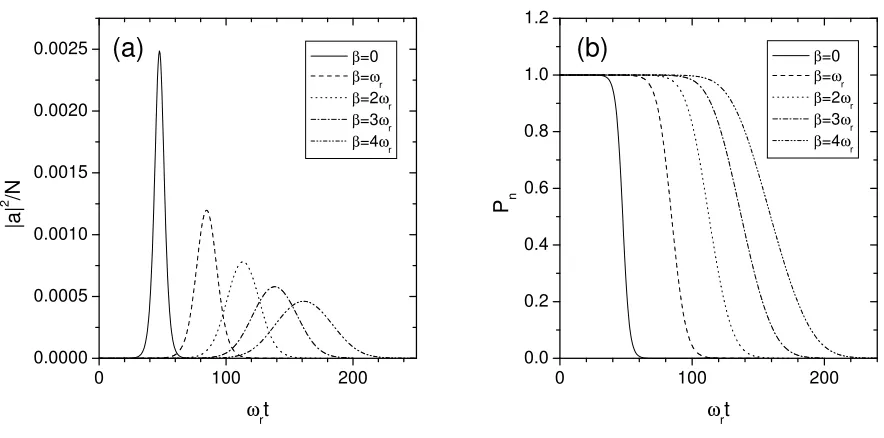
in an explicit form. Fig.1 shows |a|2/N, (a), and P
n = |cn|2 = (W + 1)/2, (b), as a function of ωrt for different values of β, obtained solving numerically Eqs.(4) and (5)
for κ = 20ωr, g√N = 2ωr and ∆ = β. The results are in excellent agreement with the numerical solution of the approximated Eq.(16), not reported in the figure. We note that the effect of the atomic interaction is only a broadening of the superradiant
pulse, which still preserves the same area equal toπ, transfering completely the atoms from the initial momentum staten to the final momentum state n+ 1.
• It is easy to calculate the exact analytical solution of Eqs. (14) and (15) whenβ = 0. In fact, let introduceG′ =G/[1+(∆/κ)2] and the new variablesx= (W−W
0)/(1−W0)
and y = 2√I/(1−W0), where W0 = γ/G′ < 1. ¿From Eqs. (14) and (15) it follows
thatx2+y2 = 1. Introducing again the Bloch angleφdefined such thatx= cosφand
y= sinφ, Eqs. (14) and (15) give the following equation forφ,
˙
φ =G′(1−W
0) sinφ, , (17)
whose solution yieldsx(t) =−tanh[G′(1−W
0)(t−tD)], where tD =−ln[|S(0)|/(1−
W0)]/G′(1−W0) is the delay time. Coming back to the original variables we finally
obtain:
I(t) =
1−W
0
2
sech2[G′(1−W
0)(t−tD)] (18)
W(t) = W0−(1−W0) tanh[G′(1−W0)(t−tD)] (19)
We note that the asymptotic value of the population difference is 2W0−1, so that the
fraction of atoms left in the initial state after the superradiant process is Pn =W0 =
γ/G′. Measuring experimentally G′ and P
n it is possible to evaluate the decoherence rate γ [4].
IV. INHOMOGENEOUS CASE
Let now consider the case in which the condensate is described initially by a wavepacket
with a finite size σθ = 2kσz and pz = 0. We have solved Eqs.(1) and (2) for an initial Gaussian wavepacket of width σθ = 25, κ= 10ωr, g
√
of β. The numerical integration of Eqs. (1) and (2) is based on a finite-difference
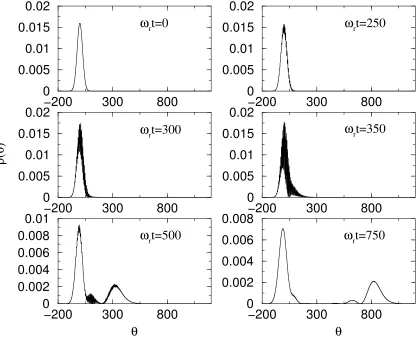
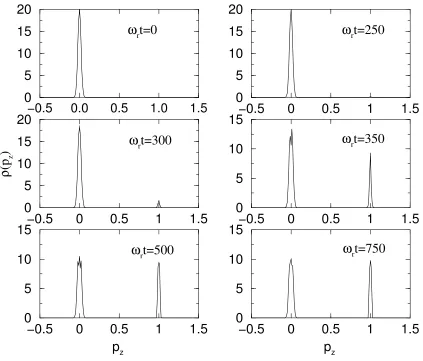
predictor-corrector scheme [13, 14]. Fig.2 shows the density distribution,ρ(θ, t) =|Ψ(θ, t)|2, forβ = 0
at different times, whereas fig.3 shows the corresponding momentum distribution ρ(pz, t) =
|Ψ(˜ pz, t)|2, where ˜Ψ is the Fourier transform of the wavefunction Ψ. We observe that the superradiant process produces a condensate fraction moving with an average momentum
pz = 2¯hk and a smaller momentum spread (see fig.3). In the configuration space (see fig.2)
we clearly observe the interference fringes when the two fractions overlap, whereas for longer times the recoiling atoms move away from the original condensate.
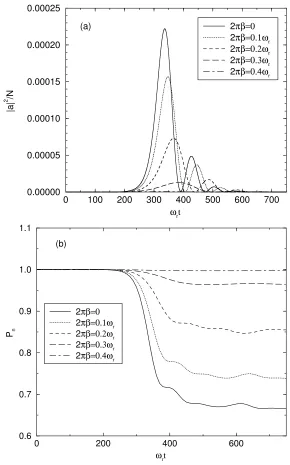
Fig.4 shows|a|2/N, (a), andPn, (b), as a function ofω
rtfor different values ofβ, wherePn is the population of the momentum statepz =n(2¯hk), calculated integrating the momentum distribution over an interval centered around pz = n(2¯hk) and of length 2¯hk. This can
be done only if the momentum distribution remains narrower than the momentum level separation, i.e. if σpz ≪2¯hk.
We observe that contrary to the homogeneous case, increasing β the superradiant pro-cess becomes less efficient, decreasing the area of the superradiant pulse (see fig.4(a)) and increasing the fraction of atoms left in the initial momentum state (see fig.4(b)). This effect
can be interpreted as due to a dephasing caused by a detuning from the resonance depend-ing on the atomic density. Each atom evolves with a different detundepend-ing from the resonance, resulting in a inhomogeneous broadening of the superradiant transition and a subsequent
decay of the coherence between the atoms. Similarly to the photon echo [11], it is expected that this dephasing may be partially reversed applying a suitable Bragg pulse or areaπ, at least for small values of β. For larger or negative values ofβ, it is expected that nonlinear
effects are more important, and this regime will be the object of a future detailed analysis.
[1] See for example Bose-Einstein Condensation in Atomic Gases, M. Inguscio, C. E. Wieman,
S. Stringari, Eds. (IOS Press Amsterdam, Oxford, Tokyo, Washington, 1999).
[2] S. Inouye, A. P. Chikkatur, D. M. Stamper-Kurn, J.Stenger, D. E. Pritchard, and W. Ketterle, Science 285, 571 (1999).
and W. Ketterle, Nature402 641 1999.
[4] R. Bonifacio, F. S. Cataliotti, M. Cola, L. Fallani, C. Fort, N. Piovella, and M. Inguscio, E-print available at http://xxx.lanl.gov/abs/quant-ph/0306500.
[5] R. Bonifacio and L. De Salvo Souza, Nucl. Instrum. and Meth. in Phys. Res. A 341, 360 (1994); R. Bonifacio, L. De Salvo Souza, L.M. Narducci and E.J. D’Angelo, Phys. Rev.A 50, 1716 (1994).
[6] R. Bonifacio, G.R.M. Robb and B.W.J. McNeil, Phys. Rev.A 56, 912 (1997).
[7] M.G. Moore and P. Meystre, Phys. Rev. A 58, 3248 (1998); M.G. Moore, O. Zobay, and P. Meystre, Phys. Rev. A 60, 1491 (1999); M.G. Moore and P. Meystre, Phys. Rev. Lett. 83, 5202 (1999).
[8] N. Piovella, M. Gatelli, and R. Bonifacio, Optics Comm. 194, 167 (2001). [9] V.S. Letokhov and V.G. Minogin, Phys. Report73, 1 (1981).
[10] J. Stenger, S. Inouye, A.P Chikkatur, D.M. Stamper-Kurn, D.E. Pritchard, and W. Ketterle, Phys. Rev. Lett. 82, 4569 (1999).
0 100 200 0.0000
0.0005 0.0010 0.0015 0.0020 0.0025
(a)
|a
|
2 /N
ωrt
β=0
β=ωr β=2ωr β=3ωr β=4ωr
0 100 200
0.0 0.2 0.4 0.6 0.8 1.0 1.2
(b)
P n
ωrt
β=0
β=ωr β=2ωr β=3ωr β=4ωr
FIG. 1: Effects of the atomic interaction on the superradiant regime in the homogeneous case: |a|2/N, (a), and population fraction P
[image:9.612.78.520.97.316.2]−200
300
800
θ
0
0.002
0.004
0.006
0.008
0.01
−200
300
800
0
0.005
0.01
0.015
0.02
ρ
(
θ)
−200
300
800
0
0.005
0.01
0.015
0.02
−200
300
800
θ
0
0.002
0.004
0.006
0.008
−200
300
800
0
0.005
0.01
0.015
0.02
−200
300
800
0
0.005
0.01
0.015
0.02
ω
rt=0
ω
rt=250
ω
rt=300
ω
rt=350
[image:10.612.103.522.73.415.2]ω
rt=500
ω
rt=750
−0.5
0
0.5
1
1.5
p
z0
5
10
15
−0.5
0
0.5
1
1.5
0
5
10
15
20
ρ
(p
z)
−0.5
0.0
0.5
1.0
1.5
0
5
10
15
20
−0.5
0
0.5
1
1.5
p
z0
5
10
15
−0.5
0
0.5
1
1.5
0
5
10
15
−0.5
0
0.5
1
1.5
0
5
10
15
20
ω
rt=0
ω
rt=250
ω
rt=300
ω
rt=350
[image:11.612.98.521.70.431.2]ω
rt=500
ω
rt=750
0 100 200 300 400 500 600 700 ωrt
0.00000 0.00005 0.00010 0.00015 0.00020 0.00025
|a|
2 /N
2πβ=0 2πβ=0.1ωr 2πβ=0.2ωr 2πβ=0.3ωr 2πβ=0.4ωr (a)
0 200 400 600
ωrt
0.6 0.7 0.8 0.9 1.0 1.1
Pn
2πβ=0 2πβ=0.1ωr
2πβ=0.2ωr 2πβ=0.3ωr
2πβ=0.4ωr (b)
[image:12.612.161.451.69.534.2]