Web document summarisation: a task-oriented evaluation
Ryen White
University of Glasgow
Scotland
[email protected]
Ian Ruthven
University of Glasgow
Scotland
[email protected]
Joemon M. Jose
University of Glasgow
Scotland
[email protected]
Abstract
In this paper we present a query-biased summarisation interface for web searching. The summarisation system has been specifically developed to act as a component in exist-ing web search interfaces. The summaries allow the user to more effectively assess the content of web pages. We also present an experimental investigation of this approach. Our experimental results shows the system appears to be more useful and effective in helping users gauge document rele-vance than the traditional ranked titles/abstracts approach.
Keywords :Summarisation, evaluation, WWW.
1
Introduction
The Internet has rapidly become an invaluable digital re-source. However one of the main features that make the Internet useful - the ease with which information providers can add, update and remove documents - can make it dif-ficult to find relevant information. Current web search en-gines are useful information access tools but the dynamic nature and size of the Internet result in searches that are in-complete (each web search engine only indexes part of the available information), outdated (pages can change between indexes) or searches that are difficult to manage (the search returns large numbers of documents).
Users of web search engines potentially run large num-bers of searches but they will typically have little or no train-ing in how to use these systems effectively. Research such as [5], also indicate that users of web search engines are not inclined to use advanced search facilities. If we are to support this group of users we must incorporate, into the interface, functionalities that help users search more effec-tively.
This paper contributes to this overall research aim in two ways: firstly we present a summarisation system specifi-cally designed for web search engines, secondly we present a task-oriented evaluation of retrieval techniques for the
In-ternet. This evaluation looks at the effect of subject search-ing experience, and the user’s task on the use and effective-ness of a summarisation-enhanced interface.
Our initial study is a new approach to web search eval-uation and involves one-to-one sessions during which users work through a series of simulated information needs [1] on a number of systems.
The paper first describes our motivation for this research, section 2, and describes our summarisation system, section 3. It then looks at IR evaluation and web evaluation, section 4, and our evaluation methodology, section 5. Section 6 presents initial results, we conclude in section 7.
2
Motivation
Prior to starting this work on web summarisation we car-ried out a small pilot study to gauge user opinion about the result pages of two major commercial Internet search en-gines; AltaVista and Google. This study was intended to elicit difficulties users faced when searching the web. Users were selected to be representative of the web population and incorporated practiced searchers, infrequent searchers and searchers who were relatively new to web searching.
This was an informal study but the results indicated that users require more information about the content of pages. Most users felt that the abstracts presented by the two sys-tems did not provide a sufficient clue about page content, meaning they were forced to visit each page to assess its relevance.
This not only requires effort on the part of the user but also increases the time a user has to spend searching. An ef-fective and efficient method of indicating the content of web pages to users is to present the user with a short summary of the document.
prove more effective than other representations of a docu-ment, [10].
For the experiments reported in this paper we devel-oped a retrieval interface, named WebDocSum, which uses query-biased summarisation techniques to enhance the re-sult pages of two search engines. An attempt is also made to incorporate web page media, such as tables and images, into the summary if a document contains insufficient text.
In the remainder of this paper we describe this interface and the experiments we carried out to test its effectiveness in web searching. We conducted the experiments using the evaluative framework reported in [6].
3
WebDocSum Retrieval Interface
The summarisation system we developed, WebDocSum, is intended to serve as an adjunct to major commercial search engines. When the user submits a query, the sys-tem queries the underlying search engine, parses the results page, dispatches a thread to each page in the result list and creates query-biased summaries of each of these pages. The entire process, from query being submitted to results being displayed takes around 7 seconds. Summaries are created in the background as the results page is being displayed.
3.1 Summarisation
The summaries are created through a sentence extraction model: each web page is split into its component sentences, the sentences are scored according to useful they will be in a summary and a number of the highly-scored sentences are chosen to compose the summary.
Sentences are scored through their position (initial in-troductory sentences are preferred), the words they contain (words that are emphasised by the user, e.g emboldened words, or words in the document title are treated as impor-tant), and the proportion of query terms they contain. This latter component - scoring by query terms - tailors the sum-maries towards the query.
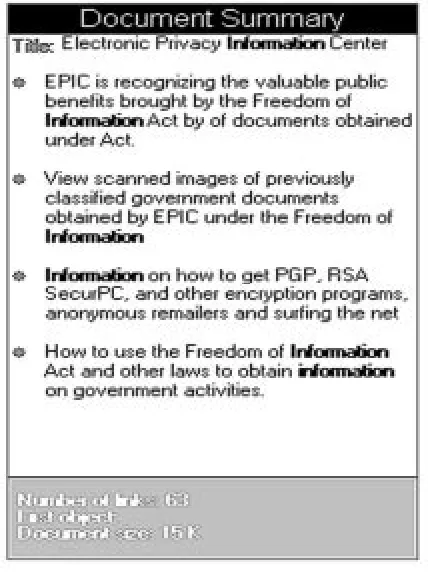
There are three main parts - summary window, Figure 1, results list and query input. Only the title of the document is shown in the results list. When the user moves the mouse over a document title, the summary window will change to show a summary for that page. If a title isclicked, the page will open in a new window. A query form retains the current query for quick and easy reformulation.
3.2 Summary Window
Developed using a Java Applet, the summary window will display a summary of a document when the mouse pointer passes over its link in the results list. In its stan-dard form the window displays the page title, each sentence
[image:2.612.321.535.72.358.2]bullet-pointed and all query terms in bold. A panel at the bottom of the window displays the following extra informa-tion about the document being summarised:
Figure 1. The summary window.
Number of Links- number of links on the page, may
help users identify important sites and hubs;
First Object- first non-text object on page, e.g. the
first image, used in situations where an alternative summary is needed (see below);
Document Size- the size of the document being
sum-marised.
As well as being able to display textual output, the sum-mary window can also give feedback should a web error occur. Such an error would occur if a web page was un-available or was taking too long to retrieve. In such circum-stances the summary window will show the abstract offered by the underlying search engine and an error message de-tailing the reason for the web error.
4
Issues in Evaluation
Evaluative studies are concerned with the assessment of the quality of a system’s performance with respect to the needs of its users with a particular context or situation. The direction of such studies is commonly determined, and thus implicitly validated, by the adoption of some kind of struc-tured methodology or ’evaluative framework’ [6].
The traditional framework for evaluative studies of in-formation retrieval systems derives from the Cranfield projects in the early 1960s and still survives in the large scale experiments undertaken the annual TREC conference (trec.nist.gov). However, this framework assumes low level of interactivity between users and the systems, uses retrieval effectiveness as the primary measures discarding other as-pects such as user satisfaction, efficiency and the entire eval-uative process depends on the pre-defined set of queries and relevance assessments. Recently, the drawbacks of this ap-proach have been the topic of intense discussion in the re-search community [4].
The main exception to the large-scale traditional eval-uation paradigm has been the TREC interactive track [7]. However this has not, as yet, examined web searching.
Because of these problems, this traditional framework can not be applied to the evaluation of the web search sys-tems.
4.1 Web Evaluation
A number of evaluation studies of web search tools have been carried out, e.g. [2, 3, 5]. These studies either only consider one type of search task,[2], use expert searchers rather than representative end-users, [3], or are based on sta-tistical analyses of web logs rather than interactive aspects of searching, [5]. Hence the methods used in these studies are not appropriate for our study of the effectiveness of a new interaction technique.
In the next section we shall describe our evaluation methodology.
5
Task-Oriented Evaluation
It is important to measure systems in actual informa-tion seeking situainforma-tions, and real-world systems can only be meaningfully evaluated in real-world settings. However, we often want to maintain experimental control over the tasks for which a user is searching, to allow system comparison between subjects. An approach known as ’simulated in-formation needs’ [1] allows the use of realistic inin-formation seeking tasks to be used in a laboratory environment. The careful construction of an information-seeking scenario can serve as asimulationof a real information need. This is the
approach that we are using during the course of this task-oriented study. Specifically, we will employ an experimen-tal methodology similar to that reported in [6].
We use simulated information needs to investigate the use and effectiveness of our summarisation techniques for different types of searching tasks. We also investigate how the experience of the searchers influence the results. This is particularly important as the user group of the Internet is large and diverse.
5.1 Experimental Design
In our evaluative study, we are making use of a withsubjects (repeated-measures) experimental design. The in-dependent variable is system type and each participant will use four systems in total. Separate sets of values of a vari-ety of dependent variables indicative of acceptability or user satisfaction were to be determined through the administra-tion of quesadministra-tionnaires to each subject. Our specific experi-mental hypothesis was that the system with the query-based summaries prove to be more effective in satisfying the user.
5.2 Users
Users are at the center of the evaluation framework. We used 24 users in total, 8 from each of the following three categories; novices (infrequent web searchers), occasional users (moderate frequency web searchers) and experts (high frequency web searchers). Subjective tests and evaluation assess the systems from the perspective of the user. This is done via questionnaires using Likert scales and semantic differentials [8], explained in section 6.
5.3 Systems
Four systems were used in our experiments: two com-mercial web search engines (Google and AltaVista) and a version of each search engine that used WebDocSum.
To eliminate possible bias caused by previous searching experience, and to isolate the effect of the summarisation in-terface, we gave the user no indication of the specific search engines being used. Wrappers were developed for both search engines that preserved all content, but masked the identity of the search engine. Google and AltaVista were referred to only as System A and System B. The versions of Google and AltaVista that used WebDocSum were labelled as System C and System D.
5.4 Search Tasks
Through the use of simulated information needs we are able to place the user mentally in an actual information seeking situation. We used 4 tasks in total and great care was taken to ensure that the tasks were as realistic as pos-sible. The tasks were chosen to reflect different types of information need and are the basis of simulated information need. Each need was framed within a simulated task - the user was given a scenario that indicated what material was required and why the information was needed.
The following list outlines the type and topic of search, the full simulated work task is omitted for brevity.
Search for a fact- finding a named person’s current
e-mail address;
Search for a number of items- finding five hotels in
Paris, France that offer an online booking service;
Decision search- finding information about the ’best’
impressionist art museum in Rome, Italy;
Background search- finding information about dust
allergies in the workplace.
Each user performed one task on one system; the order of system presentation and allocation of task to system was randomised.
6
Results & Analysis
In this section we discuss the data collection and results. We look at both the effectiveness of the searches (time and task success) and the users’ perceptions of the systems.
Semantic Differentials: Each respondent was asked to describe various aspects of their experience of using each system, by scoring each system on the same set of 11 5-point semantic differentials. 3 of these focused on the task that had been set; 4 of these had been on the search process that the respondent had just been carried out; 4 focused on the summaries/descriptions presented by the system.
Table 1 shows an example semantic differential for the statement:The task we asked you to perform was.
very reasonably neither-nor reasonably very
clear 1 2 3 4 5 unclear
Table 1. Example semantic differential
We compared the set of 24 scores on each differential for System A (Google) with the corresponding set of 24 scores on each differential from System C (Google with
summaries) and System B (AltaVista) with System D (Al-taVista with summaries).
Given the ordinal scale of the data, the Mann-Whitney test statistic was used to test the one-tailed experimental hy-pothesis.
We first compared the differentials regarding the task and found no significant difference between the differentials concerning the task. This indicates that the task distribution was comparable across systems.
We then compared the users’ perceptions of the sum-maries produced by the WebDocSum interface compared to the descriptions produced by the search engines, section 4.3. The users rated the query-biased WebDocSum sum-maries as more relevant, important, useful and complete (all four assessment categories) compared to the search en-gine descriptions on both Google and AltaVista. All differ-ences were statistically significant across users and within the three user groups (novice, infrequent, expert). This in-dicates a user preference for the query-biased summaries as a document representation.
Finally we compared the differentials relating to the overall search. The search process on Google with Web-DocSum extension gave significant differences on 3 differ-entials out of 4 (with the users rating searches with Web-DocSum as more relaxing, interesting and restful). Only for the differential easy/not easy was a non-significant differ-ence found although the ratings were in favour of WebDoc-Sum. In comparing the search process on AltaVista with WebDocSum extension all differentials were in favour of WebDocSum and statistically significant. These differences held across users and within the user groups
Likert Scale:Each user was invited to indicate, by mak-ing a selection from a 5-point Likert scale [8], Table 2, the degree to which they agreed or disagreed with each of five statements about various aspects of their interaction with the system. These statements were phrased in such a way that responses would indicate the extent to which:
The tasks were familiar and they had an exact idea
of the information that they wanted. These are used to measure whether the simulated work task situation placed them in actual user context.
The use of summaries was helpful to assess the
rele-vance of the page.
The abstract summaries showed the query in the
con-text.
Questions about the outcome of their search.
Table 3 shows an example of a Likert scale for the state-ment:I had an exact idea of the information I wanted.
1 2 3 4 5
I agree completely I disagree completely
Table 2. Example Likert scale
exact idea of the information need. This indicates that dur-ing the evaluation the task contexts were similar across four tasks and four systems.
Regarding the questions about the use of summaries, the systems with query biased summaries scored significantly better on both systems with query-biased summaries. That is, the users rated the summaries as more useful for indi-cating relevance and reported higher task satisfaction with the summaries than with the descriptions, indicating that the query-biased summarisation was beneficial.
Results from the experiments show that the summari-sation component, WebDocSum, significantly reduces the time for a user to complete a task (average search time, Ta-ble 3.
Google 8 mins 53 secs AltaVista 9 mins 21 secs Google + WebDocSum 6 mins 31 secs AltaVista + WebDocSum 6 mins 47 secs
Table 3. Average time to complete a task
WebDocSum also increases the number of users who completed a search task (average number of tasks com-pleted on a non-summarising system 2.75 , compared to 4.75 on a summarising system).
Both of these differences are significant using a Mann-Whitney Test.
7
Conclusions
In this paper we have briefly described a query-biased summarisation system for web search engines and an evalu-ation of its effectiveness. The evaluevalu-ation methodology gives a formal framework for investigating the search process. The results indicate that summarisation techniques, such as the one we propose, are not only more popular than exist-ing document descriptions produced by web search engines but can also lead to more effective user searching. These results hold for users of different search experience and for different types of task.
8
Acknowledgements
We would like to thank all the subjects who participi-ated in this experiment. We would also like to gratefully
acknowledge the contribution of Tassos Tombros and the anonymous referees.
References
[1] P. Borlund and P. Ingwersen. The development of a method for the evaluation of interactive informa-tion retrieval systems. Journal of Documentation, 53(3):225–250, 1997.
[2] B. J. Dempsey, R. C. Vreeland, R. G. Summer Jr, and K. Yang. Design and empirical evaluation of search software for legal professionals on the www. Infor-mation Processing & Management, 36(2):253–273, March 2000.
[3] M. Gordon and P. Pathak. Finding information on the world wide web: the retrieval effectiveness of search engines. Information Processing & Manage-ment, 35:141–180, 1999.
[4] W. R. Hersh. Relevance and retrieval evaluation: Per-spectives from medicine.Journal of The American So-ciety for Information Science, 45(3):201–206, 1994.
[5] B. J. Jansen, A. Spink, and T. Saracevic. Real life, real users, and real needs: A study and analysis of users on the web. Information Processing & Management, 36(2):207–227, March 2000.
[6] J. M. Jose, J. Furner, and D. J. Harper. Spatial query-ing for image retrieval: a user-oriented evaluation. InProceedings of the 21st Annual International SI-GIR Conference, pages 232–240. ACM Press, August 1998.
[7] P. Over. Trec-6 interactive track report. InProceedings of the Sixth Text Retrieval Conference, pages 73–82. NIST Special Publication, Novmber 1998.
[8] J. Preece, editor. Human-Computer Interaction. Addison-Wesley, 1994.
[9] I. Ruthven, A. Tombros, and J. M. Jose. A study on the use of summaries and summary-based query expansion for a question-answering task. InECIR ’01, pages 41–53. electronic workshops in computing, April 2001.
[10] A. Tombros and M. Sanderson. The advantanges of query-biased summaries in information retrieval. In