EUROPEAN COMMISSION
Brussels, 19.7.2012 SWD(2012) 230 final
COMMISSION STAFF WORKING DOCUMENT
Methodology regarding the statistical evaluation of reported irregularities for 2011
Accompanying the document
Report from the Commission to the European Parliament and to the Council
Protection of the European Union's financial interests - Firth against fraud - Annual Report 2011
TABLE OF CONTENTS
INTRODUCTION... 3
1. THE LEGAL FRAMEWORK FOR IRREGULARITIES REPORTING ... 4
1.1. The legal framework ... 4
1.1.1. The reporting obligation... 5
1.1.2. Derogations to the reporting obligation ... 6
1.2. Implementation of the Reporting Obligation ... 6
2. DEFINITIONS... 8
2.1. Legal definitions... 8
2.1.1. Irregularity... 8
2.1.2. Fraud ... 8
2.1.3. Suspected fraud ... 9
2.2. Definitions applied in the analysis ... 9
2.3. Indicators... 10
2.3.1. Irregularity and Fraud Rates... 10
2.3.2. Fraud Frequency and Fraud Amounts Levels ... 11
3. ELECTRONIC reporting systems... 11
3.1. Commission Own Resources (OWNRES)... 11
3.1.1. Monitoring of establishment and recovery of TOR ... 11
3.1.2. Procedure for managing Member States’ reports for write-off... 13
3.1.3. Particular cases of Member State failure to recover TOR ... 13
3.1.4. Detection of fraud and irregularity... 13
3.2. Irregularity Management System (IMS) ... 14
3.2.1. The national structures and users ... 14
3.2.2. The modules ... 14
3.2.3. Data input and data quality ... 15
3.2.4. Data analysis – cases of irregularity and (suspected) fraud ... 15
3.2.5. Impact of IMS on irregularity reporting... 16
COMMISSION STAFF WORKING DOCUMENT
Methodology regarding the statistical evaluation of reported irregularities for 2011
Accompanying the document
Report from the Commission to the European Parliament and to the Council Protection of the European Union's financial interests - Firth against fraud - Annual
Report 2011
INTRODUCTION
The present commission staff working paper accompanies the Annual Report from the Commission to the Parliament and the Council on the protection of the European Union’s financial interests and the fight against fraud (further referred to it as ‘Report’) adopted on the basis of article 325 of the Treaty on the Functioning of the European Union (TFEU).
This document describes the methodology followed regarding the statistical evaluation of irregularities reported as fraud and other irregularities in the areas where Member States implement the EU budget (expenditures for natural resources, cohesion policy and pre-accession funds) and of the collection of the EU’s traditional own resources, as well as in the area of expenditure managed directly by the Commission.
EU legislation requires Member States to report to the Commission, on a quarterly basis, irregularities that have been detected in the areas of shared management and Traditional Own Resources1.
Member States must inform the Commission whether the reported irregularities constitute suspicions of fraud (if they give rise to the initiation of administrative and/or judicial proceedings at national level in order to establish the presence of intentional behaviour, such as fraud2) and must update the reported information in relation to the completion of the relevant proceeding for the imposition of sanctions.
In the area of expenditure managed directly by the Commission it is the Commission services, which have to qualify3 the recoveries, whether they encountered errors, irregularities or suspected fraud.
1
provided that they do not fall in the derogations specifically foreseen by the relevant provisions
2
Commission Regulation (EC) No 1848/2006 of 14 December 2006 concerning irregularities and the recovery of sums wrongly paid in connection with the financing of the common agricultural policy and the organisation of an information system in this field and repealing Council Regulation (EEC) No 595/91, OJ L 355, 15.12.2006, p. 56–62
3
Regarding recoveries (with the exception of those related to Agriculture) the analysis in the Report is limited to the results of the actions undertaken by national authorities to recuperate amounts unduly paid to beneficiaries (mostly private economic operators). Recoveries concerning irregularities –reported as fraudulent or not - whose amount does not exceed EUR 10 000 are excluded from these analyses (see more in details: derogations to the reporting obligation). The section on Agricultural expenditure covers all recoveries.
Furthermore, the recovery amounts reflects the amounts recovered by the national authorities and not by the Commission services. The exception is the section dedicated to the expenditure directly managed by the Commission services, which uses data extracted from the Commission Accrual Based Accounting (ABAC) system.
1. THELEGALFRAMEWORKFORIRREGULARITIESREPORTING 1.1. The legal framework
European legislation provides for the protection of the Union’s financial interests in all areas of activity4. The FinR sets the principles and rules for the correct implementation of the budget. Member States are required to notify the European Commission (EC) of evidence of fraud and other irregularities. This need is particularly evident in those sectors of the EU budget where the main responsibility for management is with the Member States, namely, in the fields of Agriculture and Cohesion Policy (on the expenditure side) and Own Resources (on the revenue side). In these areas, Member States must inform the Commission of all irregularities involving more than EUR 10 000 of EU finances. This applies at all stages in the procedure for recovering monies unduly paid or not received.
Regulation No 1150/2000 specifies the requirement for own resources and Regulation No 1848/2006 for the agriculture sector. For the Cohesion Policy, which runs over multi-annual programmes the legal framework is more complex and is covered by Regulations Nos 1681/945 and 1831/946 for the programming periods
4
See in particular for traditional own resources: Article 6(5) of Council Regulation (EC, Euratom) No 1150/2000; for expenditure: Articles 3 and 5 of Council Regulation (EC) No 1848/2006 of 14 December 2006 (OJ L 355, 15.12.2006) for Agriculture; articles 3 and 5 of Commission Regulation (EC) No 1681/94 of 11 July 1994 (OJ L 178 of 12.7.1994), as amended by Regulation (EC) No 2035/2005 of 12 December 2005 (OJ L 328 of 15.12.2005) for the Structural Funds until the programming period 2000-2006 included; articles 3 and 5 of Regulation No 1831/94 of 26 July 1994 (OJ L 191, 27.7.1994), as amended by Regulation (EC) No 2168/2005 of 23 December 2005 (OJ L 345 of 28.12.2005) for the Cohesion Fund until the programming period 2000-2006 included; articles 28 and 30 of Commission Regulation (EC) No 1828/2006 of 8 December 2006 (OJ L 371, 27.12.2006) as amended by Commission Regulation (EC) No 846/2009 of 1 September 2009 (OJ L 250, 23.9.2009) for the Cohesion Policy 2007-2013; Articles 55 and 57 of Commission Regulation (EC) No 498/2007 of 26 March 2007 (OJ L 120, 10.5.2007) as amended by Commission Regulation (EC) No 1249/2010 (OJ L 341, 23.12.2010) for the European Fishery Fund (EFF).
5
Regulation 1681/94 applies to the Structural Funds, that is to say European Regional Development Fund (ERDF), European Social Fund (ESF), European Agriculture Guidance and Guarantee Fund (EAGGF) – Section Guidance and Financial Instrument for Fisheries Guidance (FIFG). It has been amended by Regulation No. 2035/2005 of 12 December 2005
6
until the 2000-2006 and by Regulation No 1828/20067 for the period 2007-20138. Regulation No 498/2007 covers the European Fishery Fund (EFF).
The obligation to report irregularities in the area of pre-accession assistance is established in the Financing Agreements/Memoranda signed between the acceding countries, Candidate countries and the European Community/Union and is in accordance with the provisions of Commission Regulation (EC) 1681/19949 and 1828/200610. This obligation is yet enhanced by the Commission decision granting conferral of management on extended decentralised basis (EDIS).
1.1.1. The reporting obligation
Member States shall report to the EC any irregularities which have been the subject of a primary administrative or judicial finding, within two months following the end of each quarter. Therefore, the reporting period is divided in four quarters the last of which has as deadline the end of February of the following year11.
The first communication of a case of irregularity is also known as ‘Initial Communication’
The information to be submitted concerns, among others:
(1) The identification of the operation or budget line (for agriculture) affected by the irregularity;
(2) The detection method and the modus operandi;
(3) The financial impact of the irregularity;
(4) The natural and legal persons having committed the irregularity.
7
Commission Regulation (EC) No 1828/2006 of 8 December 2006 setting out rules for the implementation of Council Regulation (EC) No 1083/2006 laying down general provisions on the European Regional Development Fund, the European Social Fund and the Cohesion Fund and of Regulation (EC) No 1080/2006 of the European Parliament and of the Council on the European Regional Development Fund, OJ L 371, 27.12.2006. This repeals Regulations (EC) No 1681/94 and (EC) No 1831/94. Commission Regulation (EC) No 498/2007 of 26 March 2007 laying down detailed rules for the implementation of Council Regulation (EC) No 1198/2006 on the European Fisheries Fund.
8
Regulation (EC) No 1080/2006 of the European Parliament and of the Council of 5 July 2006 on the European Regional Development Fund and repealing Regulation (EC) No 1783/1999; Regulation (EC) No 1081/2006 of the European Parliament and of the Council of 5 July 2006 on the European Social Fund and repealing Regulation (EC) No 1784/1999; Council Regulation (EC) No 1083/2006 of 11 July 2006 laying down general provisions on the European Regional Development Fund, the European Social Fund and the Cohesion Fund and repealing Regulation (EC) No 1260/1999; Council Regulation (EC) No 1084/2006 of 11 July 2006 establishing a Cohesion Fund and repealing Regulation (EC) No 1164/94, OJ L 210, 31.7.2006.
9
As amended by Regulation (EC) No 2035/2005
10
As amended by Regulation (EC) No 846/2009
11
Member States can differ to a subsequent updating communication the integration of the information of which they do not dispose at the moment of the initial communication.
Updating communications provide relevant information about the administrative and judicial follow-up of the irregularities. In the areas of Cohesion and Pre-Accession information about financial follow-up has to be provided for irregularities related to previous programming periods (until 2000-2006 included)12.
The reporting of irregularities shall happen by electronic means, using the modules provided by the EC (see chapter 4 of this document about the electronic reporting systems).
In certain sectors, namely Cohesion Policy and Pre-accession, financial information has to be expressed in Euro by countries which have not adopted it as their currency.
1.1.2. Derogations to the reporting obligation
As a general rule, where the irregularities relate to amounts of less than EUR 10 000 chargeable to the general budget of the EU, Member States shall not send the EC the irregularity communication, unless the Commission expressly requests it.
Further specific derogations to the reporting obligation are foreseen in the areas of Agriculture, Cohesion and Pre-accession policies. More concretely, cases should not be reported:
– where the irregularity consists solely of the failure to partially or totally execute a (co-)financed operation owing to the bankruptcy of the final beneficiary or the final recipient; however, irregularities preceding a bankruptcy and cases of suspected fraud must be reported,
– if the case has been already brought to the attention of the administrative authority by the final beneficiary or the final recipient voluntarily and before detection by the relevant authority, whether before or after the payment of the public contribution,
– where the administrative authority finds a mistake regarding the eligibility of the financed expenditure and corrects the mistake prior to payment of the public contribution.
1.2. Implementation of the Reporting Obligation
The practices of the national administrations still vary, though improvements have been achieved thanks to the efforts made to harmonise their approaches. The data communicated by Member States is sometimes incomplete. Furthermore, the distinction between “suspected fraud” and other irregularities is not consistent as Member States do not always have the same definition of criminal risk.
12
Consequently, a certain proportion of communications received by the Commission does not distinguish between suspected fraud and irregularity.
The Commission works in close cooperation with the Member States to improve the notification system for irregularities, in particular to clarify the concepts of “fraud” and “irregularity”13 and as a result, some measures of the possible economic impact of fraud in certain sectors have been made.
13
2. DEFINITIONS
For the purposes of this document, two sets of definitions are used. The first set refers to legal definitions, the second to specific indicators used throughout the different chapters.
2.1. Legal definitions
2.1.1. Irregularity
Irregularity: means any infringement of a provision of European law resulting from an act or omission by an economic operator which has, or would have, the effect of prejudicing the general budget of the European Union or budgets managed by it, either by reducing or losing revenue accruing from own resources collected directly on behalf of the Union, or by an unjustified item of expenditure14.
2.1.2. Fraud
Fraud: affecting the European Communities' financial interests shall consist of15: a) in respect of expenditure, any intentional act or omission relating to:
– the use or presentation of false, incorrect or incomplete statements or documents, which has as its effect the misappropriation or wrongful retention of funds from the general budget of the European Communities or budgets managed by, or on behalf of, the European Communities;
– non-disclosure of information in violation of a specific obligation, with the same effect;
– the misapplication of such funds for purposes other than those for which they were originally granted;
b) in respect of revenue, any intentional act or omission relating to:
– the use or presentation of false, incorrect or incomplete statements or documents, which has as its effect the illegal diminution of the resources of the general budget of the European Communities or budgets managed by, or on behalf of, the European Communities;
– non-disclosure of information in violation of a specific obligation, with the same effect;
– misapplication of a legally obtained benefit, with the same effect.”
14
Article 2 of Regulation (EC) No 2988/95.
15
National legislations contain several provisions that describe the conducts and the related penalties and sanctions. Some of these provisions are the result of the implementation of the PIF Convention into the national legal system.
The two definitions indicated above seem similar as both refer to “acts or omissions”. In fact, the concept of irregularity is much wider than that of fraud. Fraud explicitly refers to “intentional” act or omission. In this respect, the concept of irregularity includes that of fraud, but refers also to a whole series of infringements of rules which do not imply a deliberate intent to violate or for which such intent is not clear (for instance a breach of rules due to the misinterpretation of certain provisions because of their complexity).
Therefore, the distinction between irregularities and fraud is that fraud is a criminal act that can only be determined by the outcome of judicial proceedings. As such, it occurs only when the judicial procedure has come to an end that the actual amount of fraud can be determined. While awaiting these results, the Commission works on the basis of the information supplied by Member States concerning cases of irregularities some of which, in the opinion of the reporting Member States, give rise to suspicions of fraud. The Commission's statistical assessment of and ability to respond to, irregularities are influenced by the accuracy and timeliness of the notifications made by the Member States.
2.1.3. Suspected fraud
Suspected fraud16: means an irregularity giving rise to the initiation of administrative and/or judicial proceedings at national level in order to establish the presence of intentional behaviour, in particular fraud, such as is referred to in Article 1(1), point (a), of the PIF Convention.
In their communications of irregularity to the Commission, Member States have been requested to indicate whether a reported irregularity can be regarded as 'suspected fraud'. This notion was introduced in order to provide some data for statistical purposes and to avoid the necessity of waiting until the end of criminal procedures for a final indictment.
2.2. Definitions applied in the analysis
However, it is to be noted that for the purpose of greater clarity, in the analysis and in the indicatorts only two broad categories of irregularity are applied:
'Irregularities reported as fraudulent' are those irregularities for which the fraudulent nature is suspected or established, also including those irregularities which Member States have not reported as fraudulent, but whose fraudulent nature could be derived on the basis of the analysis of the information17.
16
This definition has been introduced in Commission Regulation (EC) No 2035/2005. It has been "confirmed" in Regulation (EC) No 1828/2006 for the Programming Period 2007-2013 and in Regulation (EC) No 1848/2006 for the agriculture sector.
17
'Irregularities not reported as fraudulent' are any other type of reported irregularities, for which fraudulent nature has not been ascertained.
2.3. Indicators
2.3.1. Irregularity and Fraud Rates
The Irregularity Rate (IrR) is calculated using Equation 2-1 below:
Equation Error! No text of specified style in document.-1: Irregularity Rate
The Net-Irregularity Rate (Net-IrR) is calculated in the same way as the IrR, but using exclusively the 'irregularities not reported as fraudulent', as described in equation 2-2 below.
Equation Error! No text of specified style in document.-2: Net-Irregularity Rate
The Fraud Rate (FrR) is calculated using Equation 2-3 below:
Equation Error! No text of specified style in document.-3: Fraud Rate
The IrR, Net-IrR and FrR can be calculated by financial year (as in the case of the Agriculture sector) or on the entire Programming Period (as in the case of Structural Funds) and by Member State. The FrR is calculated using amounts linked to cases of suspected and established fraud18.
proceeding is under way; such irregularities include therefore those detected by the Commission (OLAF).
18
2.3.2. Fraud Frequency and Fraud Amounts Levels
The Fraud Frequency Level (FFL) represents the percentage of cases qualified as suspected frauds on the total number of reported irregularities and is calculated using Equation 2-4 below.
Equation Error! No text of specified style in document.-4: Fraud Frequency Level
The Fraud Amounts Level (FAL) represents the percentage of financial amounts involved in cases qualified as suspected frauds on the total reported financial amounts affected by irregularities and it is calculated using Equation 2-5 below.
Equation Error! No text of specified style in document.-5: Fraud Amounts Level
FFL and FAL can be calculated by financial year (as in the case of the Agriculture sector) or on an entire Programming Period (as in the case of Structural Funds) and by Member State.
3. ELECTRONIC REPORTING SYSTEMS
Two main systems are in place for the reporting of irregularities to the Commission: Own Resources (OWNRES) managed by the Directorate General for Budget and the Irregularity Management System (IMS) managed by the European Anti-Fraud Office (OLAF). For the chapter dedicated to ‘Direct expenditure’, data come from a specific functionality of the ABAC (Accrual Based Accounting) system of the Commission.
3.1. Commission Own Resources (OWNRES)
Under Article 6(5) of Regulation No 1150/2000, Member States are required to communicate to the Commission, via the OWNRES system, cases of fraud and irregularity, if the TOR amount exceeds EUR 10 000.
The OWNRES database is a key tool for obtaining data for global analyses of fraud and irregularities, and presents valuable information to the Budgetary Authority.
3.1.1. Monitoring of establishment and recovery of TOR
monitoring is carried out in partnership with different Commission departments, including OLAF.
To this end, the following three methods are used:
(1) Overall monitoring of recovery of TOR via the write-off procedure;
(2) Regular inspection in Member States of the establishment and recovery of TOR and B-account entries;
(3) Specific monitoring (in close cooperation with OLAF, DG TAXUD and DG AGRI) of Member States’ follow-up of recovery in individual cases, which have a significant financial impact and usually involve Mutual Administrative Assistance.
Given the Budgetary Authority’s particular interest in recovery, reliable information must be entered in OWNRES regarding the number of cases of irregularity and fraud and their development. Member States have a special responsibility to ensure that appropriate statistical information on irregularity and fraud is provided to the Commission.
Member States are responsible for making TOR available to the Commission within the deadlines set they have established. Established amounts of customs or agricultural duties that have been recovered, and debts, that are guaranteed and not under appeal, are to be made available via the A-account. However, if TOR have been established by a Member State but not yet recovered and if no security has been provided or the secured amount has been disputed, Member States may enter these TOR amounts in the B-account. These amounts of TOR are not made available until actually recovered. Most fraud and irregularity cases relate to B-account items.
In order to get the right picture of Member States’ TOR recovery activity, it is important to keep in mind that over 97% of all amounts of TOR established are subsequently recovered without any particular problem. These amounts are entered in the A-account and made available to the Commission. This covers most of the ‘normal’ import flows where release for free circulation gives rise to a customs debt. The remaining exceptional items are entered in the B-account. Since all TOR amounts exceeding €10 000 in the B-account normally represent an irregularity (fraud included) by definition, therefore the match between the two - from the standpoint of the B-account - should be 100%19 . Cross-checks are carried out on a regular basis during the Commission inspections in the Member States.
In return for their collection task, and to support sound and efficient management of public finances, Member States may keep 25% of the amounts recovered.
19
3.1.2. Procedure for managing Member States’ reports for write-off
Member States must take all requisite measures to ensure that established amounts of TOR are made available to the Commission. This requirement, mentioned in Article 17(1) of Regulation No 1150/2000, also implies that a Member State is only released from its obligation to make available TOR if it can prove that the debt is irrecoverable either:
(1) for reasons of force majeure; or
(2) for other reasons, which cannot be attributed to that Member State.
There are two ways to conclude that amounts of TOR have become irrecoverable. The first is by a decision of a Member State declaring that they cannot be recovered — this declaration may be made at any time. However, TOR must be deemed irrecoverable by a Member State at the latest five years from the date on which the debt was established, or in the event of an administrative or judicial appeal, the final decision was given, or the last part-payment to the debt was made, whichever is the later. If the amount of the written-off debt is less than EUR 50 000, Member States do not have to communicate the case to the Commission, unless the Commission makes a specific request. However, if the irrecoverable amount of TOR exceeds EUR 50 000, the write-off must be reported to the Commission which has to decide whether the necessary conditions are fulfilled in order to release the Member State from the obligation to make the TOR available.
Member States submit their requests to be released from the obligation to make the TOR available directly via an IT application called WOMIS20 . In 2011 a WOMIS version 2.0 was released.
3.1.3. Particular cases of Member State failure to recover TOR
If TOR are not established because of an administrative error by a Member State, the Commission applies the principle of financial liability21. The main objective of these procedures is to encourage individual Member States to improve their administrative performance and to address weaknesses leading to a loss of TOR. Payments for these cases are made available via the A-account and they reduce in effect the contribution of the Member States via the GNI resource in proportion to their contribution to the EU budget.
3.1.4. Detection of fraud and irregularity
Cases should be included in OWNRES upon the initial discovery of the irregularity or fraud case. As a result the year of the customs operation and the year of discovery of the irregularity or fraud can diverge. Member States are continually adding new
20
WOMIS: Write-Off Management and Information System
21
cases and updating existing items. So the information generated by OWNRES represents the situation on the date of the query. This continuing development is inherent to the system.
According to OWNRES the moment of discovery is an indicator for classifying a case as fraud, since primary inspections more often result in classifying cases as fraud than post-clearance inspections.
The distinction in OWNRES between fraud and irregularity might not be fully comparable between different Member States. In their reports Member States make this distinction usually on subjective grounds and before any court judgment is given. Such subjective grounds vary between national administrations depending on their national practises and legislation.
3.2. Irregularity Management System (IMS)
3.2.1. The national structures and users
According to their competencies and responsibilities national authorities have access to the module(s) which is(are) relevant for them. IMS flexibility allows a cascading system to be set up: national organisations can be arranged in a hierarchical structure with different levels of responsibility, in which the superior level approves the communication prepared by the inferior and forwards it to the next level or to OLAF. Within each organisation, users can receive different roles such as creator (creates the communication of irregularity), manager (validates it and forwards it to the next level) and observer (read-only access).
IMS is a web based application that can be accessed directly via internet therefore it does not only support the needs of the organisations to structure the reporting task, but also introduces an extended accessibility to the system. This has led to an enormous increase in the number of users compared to the previous electronic reporting system.
3.2.2. The modules
The Irregularity Management System (IMS) is an application of the Anti-Fraud Information System (AFIS), developed and maintained by OLAF for a secure exchange of information between Member States and the Commission.
IMS is a complex application divided in several modules which enable Member States to report cases of irregularities and (suspected) fraud under the different sectoral legislations mentioned in chapter 2. The modules are named after the corresponding Regulation, with the exception of the two modules related to Pre-Accession Assistance.
Figure Error! No text of specified style in document.-1: IMS architecture
3.2.3. Data input and data quality
The different modules of IMS offer the users the possibility of submitting the information requested by the sectoral regulations in a structured manner. The different fields are grouped in pages according to 'subjects' and users are assisted through the possibility of choosing from pre-defined selection lists.
Communications of irregularity can also be imported into the system using excel or xml files structured according to specific templates.
Information considered to be essential are treated as mandatory, meaning that a communication cannot be successfully finalised and transmitted without it. Other ‘business rules’ provide warnings or produce errors if the user does not fill correctly the requested data.
Data quality checks are also provided by the different levels of the reporting structure and by OLAF.
The ‘Initial Communication’ and its ‘Updating Communication(s)’ form a ‘Case’.
3.2.4. Data analysis – cases of irregularity and (suspected) fraud
implemented and used correctly influences the accuracy and completeness of the analytical results.
As already mentioned before, in their communications of irregularity to the Commission, Member States have been requested to indicate whether a reported irregularity can be regarded as 'suspected fraud'. This action is performed in IMS by filling a specific field (which is mandatory in all modules except module 1848) which allows classifying any case under three possible categories: (a) irregularity; (b) suspected fraud; (c) established fraud. Therefore, all Member States having implemented IMS specify the requested information.
The analysis of this information, however, has revealed that a number of inconsistencies are still present. Namely, the classification provided by national authorities can be contradictory with other data given in the same communication, for instance the description of the types of irregularities committed and the judicial follow-up undertaken.
In particular, the inconsistencies appear evident in the presence of the following information:
(1) the case is classified as 'irregularity', but it is also indicated that penal proceedings have been initiated;
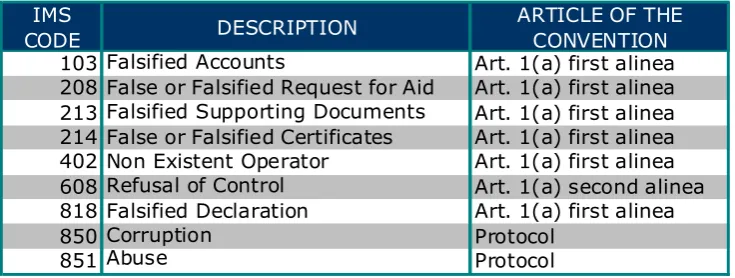
(2) the case is classified as 'irregularity', but one or more of the modus operandi described in Table 3-1 are indicated.
Table Error! No text of specified style in document.-1: List of modus operandi conflicting with the classification ‘irregularity’
IMS
CODE DESCRIPTION
ARTICLE OF THE CONVENTION
103 Falsified Accounts Art. 1(a) first alinea 208 False or Falsified Request for Aid Art. 1(a) first alinea 213 Falsified Supporting Documents Art. 1(a) first alinea 214 False or Falsified Certificates Art. 1(a) first alinea 402 Non Existent Operator Art. 1(a) first alinea 608 Refusal of Control Art. 1(a) second alinea 818 Falsified Declaration Art. 1(a) first alinea
850 Corruption Protocol
851 Abuse Protocol
For the purposes of the analyses in presence of one of the two conditions mentioned above, the case falls in the category 'irregularity qualified as fraudulent' even in the absence of an explicite 'suspected fraud' classification by the national authorities.
3.2.5. Impact of IMS on irregularity reporting
The introduction and successful implementation of IMS has produced a number of consequences on the reporting behaviour and practise of Member States. Those countries which have adopted the system have
[image:16.595.115.483.444.583.2]to level 1, which had the task to perform a quality check and to submit the form to the Commission, on paper or electronically. If the communication was forwarded on paper, someone in OLAF was keying in the information into the irregularities database. This duplication of tasks was at the origin of several clerical mistakes;
(2) accelerated the reporting process. The decentralisation of the reporting task through the same system allows more users to prepare, at the same time, a greater number of communications. The “superior” levels are freed from the “filling” of communications and can, therefore, concentrate on data quality and process the irregularities in a faster way. This acceleration is possibly the source for an increased number of reported irregularities in the first years of implementation of the IMS;
(3) improved the completeness and overall quality of the communications, thanks to the mandatory fields and the “consistency rules” foreseen by the system.
3.3. Accrual Based Accounting System (ABAC)
The ABAC system is a transversal, transactional information system that allows the execution and monitoring of all budgetary and accounting operations by the Commission. The system was developed by the Commission to facilitate compliance with the requirements of the Financial Regulation and its implementing rules.
One of the functionalities of the ABAC system is the ‘Recovery Context’, which gathers detailed information on recovery orders issued by the Commission services and registered in ABAC. Financial officers have to indicate for each recovery order whether it relates to an error, an irregularity or a suspected fraud that has been identified in the implementation of a grant agreement or contract. In case the recovery order is qualified as 'suspected fraud', OLAF has to be notified. For each recovery order, information is given on the method of detection as well as the type of irregularity or suspected fraud that constitutes the basis for the recovery.
For the financial analyses, the following data were used from ABAC:
(1) The number and corresponding financial amounts of recovery orders, which were registered after validation by the authorising officer, including information on the place of residence of the contract partner of the Commission and the budget line concerned; the method of detection; the type of irregularity identified and the time span between the approval of a budget commitment, the notification of a recovery order and the return payment of the undue funds to the Commission;
Table 3-2 and Table 3-3 list the different methods of detection and types of irregularity respectively.
Table Error! No text of specified style in document.-2: List of methods of detection
Community control / Check on the spot Community control / Desk check documents Control by national authorities
European Court of Auditors
Independent control (supervising engineers, auditors) OLAF
Other
METHOD OF DETECTION
Table Error! No text of specified style in document.-3: List of types of ‘irregularity’
Action not implemented
Action not in accordance with the rules Action not used for intended purposes Advances not correctly reflected Beneficiary ineligible
Calculation error Deadline not respected
Expenditure declared not related to the action Expenditure not covered by legal base
Falsified documents
Inappropriate accumulation of aid Incomplete documents
Incorrect rates used in calculating the claim Lack of necessary co-financing
Missing documents Not Applicable
Public procurement procedures not respected Quality of action inadequat
Recoverable VAT, interest received not correctly reflected
TYPE OF IRREGULARITY
[image:18.595.112.402.123.254.2] [image:18.595.114.402.293.578.2]