Rochester Institute of Technology
RIT Scholar Works
Theses Thesis/Dissertation Collections
9-1-2008
Chiasm
Christine HeusnerFollow this and additional works at:http://scholarworks.rit.edu/theses
This Thesis is brought to you for free and open access by the Thesis/Dissertation Collections at RIT Scholar Works. It has been accepted for inclusion in Theses by an authorized administrator of RIT Scholar Works. For more information, please [email protected].
Recommended Citation
CHIASM
BY
CHRISTINE HEUSNER
THESIS
Submitted in Partial Fulfillment of the Requirements for the Degree of
Master of Fine Arts in Imaging Arts
Rochester Institute of Technology
Dr. Therese Mulligan, Chair Date
Angela Kelly, Committe Advisor Date
CHIASM By
Christine Heusner B.A., Art, Elmira College, 2003
M.F.A., Imaging Arts, Rochester Institute of Technology, 2008
Abstract
Table of Contents
List of Figures ...ⅲ
Acknowledgements ...ⅳ
Ⅰ. Introduction: Chiasm ...1
Ⅱ. The Image ...5
Ⅲ. The Installation: Space Experienced ...13
Ⅳ. Aesthetics of Experience ...17
Ⅴ. Conclusion ...21
List of Figures
Figure 1.1 Chiasm (installation image) ...4
Figure 2.1 Chiasm 813_2 (construction) ...5
Figure 2.2 Chiasm 813_2 (digital file) ...6
Figure 2.3 Chiasm 813_2 (silk) ...8
Figure 2.4 Moholy-Nagy, Light-Space Modulator ...9
Figure 2.5 Moholy-Nagy; Light Play: Black, White, and Grey Stills ...10
Figure 2.6 Bell; Untitled ...12
Figure 3.1 Chiasm (installation image) ...13
Figure 3.2 Chiasm (installation image) ...14
Figure 3.3 Chiasm 806_2, 898, and 813_2 (installation image) ...16
Figure 4.1 Holl; Kiasma ...18
Figure 4.2 Holl; Kiasma (gallery) ...19
Acknowledgements
Ⅰ. Introduction: Chiasm
Prior to my education at Rochester Institute of Technology, I thought I had a solid grasp on digital technology and its presence in my life. In the past few years, I have become much more perceptive about the many roles of digital technology and its often dominating influence in my life. In many ways digital technology integrates into my life in such a way that its presence is easily overlooked and taken for granted.
There is a perceived polarity (however artificial) between
technology and the humanities, between science and art, between right brain and left. The burgeoning field of multimedia is likely to be one of those disciplines like architecture that bridges the gap.1
In my thesis work I am investigating the perception of digital technology within the multimedia environment around me. The above quote by Nicholas Negroponte describes the separation I once felt between the digital and the other aspects of my life. I saw it as separate and was not aware of its many influences. I saw digital technology as a tool that I was aware of and used occasionally for various tasks or for entertainment. Recently, I have realized that digital technology transpires into many areas of my life, quietly and often without my awareness.
My thesis work developed through a variety of techniques and media. The creation of the work mimicked my own journey of discovery and contemplation about my own environment. I found inspiration for the work not only in my environment but in a variety of sources. While photographers and artists such as Laszlo Moholy-Nagy and Larry Bell influenced my thesis work both in idea and
aesthetic, I also found inspiration from other sources. The philosophical writings of Maurice Merleau-Ponty provided a conceptual grounding for the work. I was inspired by his ideas about perception and the relationship between the mind, body, and environment. This challenged my own thinking as I questioned how these ideas could be interpreted in the modern digital environment. I found that my own investigation related to the architecture of Steven Holl, who was also inspired by Merleau-Ponty’s philosophies and investigated these ideas in his constructions. Holl uses light and constructed space in a way to unite the body with the architecture, and the building with the landscape. While my thesis work has photographic elements, I found that the concept I was exploring gave the work a more diverse circle of influence.
I chose to title my thesis work Chiasm, because it has multiple references that relate to my concept. Its Greek root, chiazein, refers to the marking chi (x)2.
Its forms are often used to describe different types of crossings or convergences in various fields of study. I use the term chiasm to express the relationship and interaction between the body and mind within contemporary digital and natural environments. The interpretation of chiasm that holds the most relevance to the thesis work refers to the philosophies of Maurice Merleau-Ponty in his final book
The Visible and the Invisible. He uses the word “chiasm” to describe perception as
the crossing of the interpretations within a person’s mind with the reality of a situation: as they cross through the action of reflection, a perception is formed.
Merleau-Ponty describes the concept of chiasm:
Between my body looked at and my body looking, my body touched and my body touching, there is overlapping or
encroachment, so that we may say that the things pass into us as we pass into the things.3
This statement reinterprets the word chiasm as an intertwining between the self and the world, and expresses that while a person is a spectator of their environment they are also a part of it. Merleau-Ponty believes that all we can know about the world has been interpreted in the mind, and the real cannot be conceived in any other way than through it being processed in the mind of the individual.
It is this relationship between the real, the virtual, and the mind that interests me and inspires the thesis work in image and installation. I specifically utilize the digital components commonly found and used in my own environment, including the computer, cellular phone, television, and video projection. Video gaming and the Internet, as digital components popular in the modern environment, could also be included in this grouping. The digital objects present in my environment, such as the television and computer, fall somewhere between the real and the virtual. They display perceptions of the real, while they also have an inherent or real physical presence. The aspect of their presence in which I am most interested is the signal that these objects project in the form of light. This projected light holds the information that captivates the viewer. Merleau-Ponty describes the features of experience as the environment converging with the person, thus becoming a part of them. In the following quote
he describes how light directs our gaze through our surroundings and a shade or color can change depending on the light in which we see it. Therefore, the environment is only truly perceived in the mind because its reality is constantly changing.
Lighting and reflection, then, play their part only if they remain in the background as discreet intermediaries, and lead our gaze instead of arresting it... The shade does not become really a shade... until it has ceased to be in front of us as something to be seen, but surrounds us, becoming our environment in which we establish ourselves.4
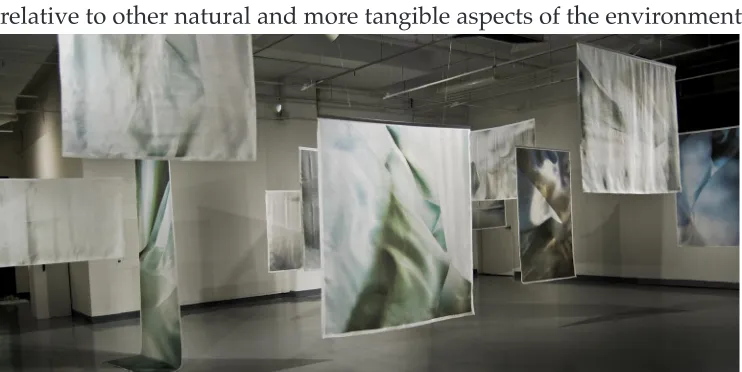
In the thesis work I question how these virtual, digital elements converge with other parts of the environment, those that are real, and how a person will perceive and respond to this interaction. Through the presentation of the thesis work as an installation, I explore the movement and response of the viewers’ body to the images installed in the gallery and the interaction between multiple people viewing the images in the same time and place. Finally, I am challenging how the digital might be interpreted in the mind and retained as a memory relative to other natural and more tangible aspects of the environment.
[image:10.612.108.479.476.662.2]4 Taylor Carmen and Mark B.N. Hansen, eds., The Cambridge Companion to Merleau-Ponty (Cambridge: Cambridge University Press, 2005), 84.
Ⅱ. The Image
The creation of the images for Chiasm mimics the environmental impression I am picturing. The images are created through multiple mediums and processes, both traditional and digital. I am expressing my environmental perception through a representation of photographed and manipulated space and light.
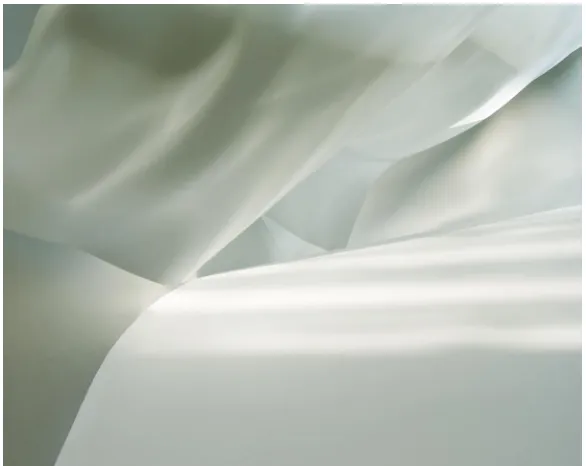
The space pictured in the images is first realized in melted plastic styrene sheets, most commonly used for the construction of architectural models. The plastic is arranged to form miniature, white, empty spatial constructions. These constructions are unrealistic in form and not easily placed as a specific medium or place; they resemble organic forms rather than architectural constructions. The the spaces pictured offer no sense of scale and can simultaneously appear vast or microscopic depending on the perception of the viewer.
The space within the images take form when framed in the lens of the camera. The camera lens allows me to re-interpret these constructions, opening them up to be investigated
[image:11.612.249.542.435.668.2]constructions are photographed in diffused sunlight, creating surreal colors and patterns on the surface of the plastic. I frame and photograph the constructions spontaneously and intuitively as the light changes, exploring each construction from a variety of angles, entrance points, and variations. The light comes through the walls and floors of the space, creating patterns and reflections. The light has no apparent source within the space and changes and shifts quickly in its configuration, intensity, and color, giving each space a fantastical and surreal quality.
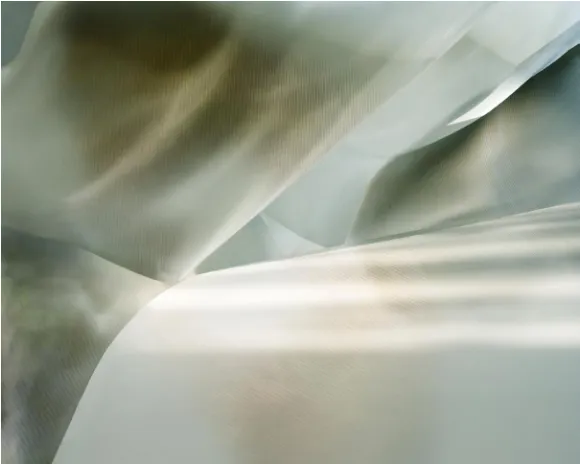
Once photographed, the space is then manipulated and further constructed through digital manipulation in the computer. Each space is
restructured through layering photographs of digital projections from television and computer monitors’
screens obtained through long exposures of the screens. Aberrations of the digital, appearing as fingerprints or traces, are marked on the spaces, creating new texture, color, and lighting effects within the spaces
[image:12.612.250.540.379.611.2]depicted in the images (Fig. 2.2). These new sources of light and texture converge and conflict with the natural light and reflections already present within the
space, creating a visual interaction between the natural light and the digital signal. The photograph of the construction becomes a representation of the real perceived through the imagination and realized in the digital.
The combinations of the two lights represent the interaction between the natural or real, and the digital or virtual, within the constructed environment. The presence of the digital projections in the images varies from subtle and sparse to harsh and dominant. As the lights interact within the image, the distinction between the digital and the natural becomes blurred, making it difficult to find the separation between the two light sources.
The resulting images become abstract impressions, a trace or memory of an environmental reality. The images rest somewhere between the real and the imaginary, the actual and the representation. The color of the images is at once muted and surreal, similar to the appearance of projected light from a television screen as it falls on objects in an environment. Most of the images have a single, significant color or palette referencing how color is a major contributor to how perceptions are formed and memories are organized.5 The images are difficult to
evaluate in content, forcing viewers to consider their own emotions, experiences, and memories as they perceive the image. The images then represent an
innerscape of mind, diffusing the object into nothingness and reality into a trace of its former self.
The digitally-constructed representation of space and light explored in the images illustrates an impression of the modern environment. The digital is a major part of this environment in its many forms and it has managed
to converge with the environment’s other elements, integrating seamlessly with the tangibility of the organic. The digital medium is often used as a tool for reinterpreting the organic, natural, or pdigital world through re-representations in image, projection, video, and sound. The digital is used as a creative, educational, and communicative substitute for analog or natural effects. Digital technology blurs the distinction between real and virtual experiences effecting environmental perception: the cellular phone replaces face-to-face conversation and television allows a person to view places and events that, without its presence, would not be available.
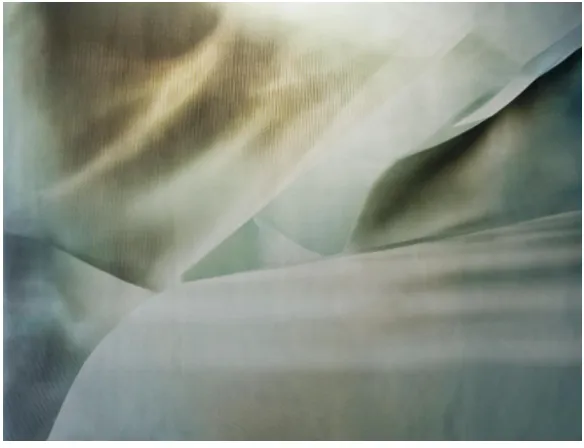
Through the construction of the images in Chiasm, I utilize both traditional and digital techniques to form a representation of this convergence between the real and virtual. The images are outputted through a digital ink-jet printer onto a thin, natural silk.
The process of digitally laying ink onto a natural fabric further illustrates the integration of the natural and the digital. I chose to print the images on silk since it is a natural fabric that
[image:14.612.249.541.406.630.2]exhibits a unique quality when light falls on it. The structure of silk fibers allows it to refract incoming light at different angles creating a shimmering appearance
to the fabric.6 As a natural fabric, the silk fabric has irregularities which integrate
with the details of the images. I chose to print on habotai silk which has a transparent quality at a light weight. It takes ink well allowing for the ink to appear vibrant when printed on the fabric.
The images change when they are realized as an object on the silk fabric: the space represented becomes less tangible, less present. The image dissolves into the translucency of the fabric appearing illusionary, much like an image projected onto a screen. The suggestion of projection reinforces the active role of light within the work, while referencing the digital projection of video, television, and computer screens. The images move away from being an interpretation of a space or moment in time as reality becomes less present in the ethereal quality of the fabric. Instead, the images begin to represent the retention of information or the memory of an experience, not a single
moment of an event, as is often the subject of a photograph.
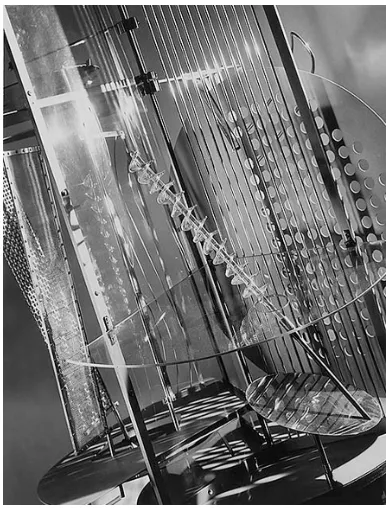
My thesis images are constructed through the manipulation of light and experimentation with its interactions. Laszlo Moholy-Nagy’s investigations with light inspired my experimentation with light in the thesis work. The works of Moholy-Nagy that I found the most influential were the light modulators he
[image:15.612.347.540.414.668.2]6 Silk Fabric Search, Silk Fabric- Technical Description (http://www.silkfabricsearch.com)
Fig. 2.4 Laszlo Moholy-Nagy; Light-Space
created as a way to ‘paint’ with light. He combined technology and scientific principles in the construction of his
modulators as a way to experiment with light and create artistic
impressions. In his Light-Space
Modulator, 1922-1930 (Fig. 2.4), he
used a combination of materials from plastic to metal, each with a unique surface, thickness, and texture. The modulator turned and moved through the use of gears, creating constantly changing light patterns on the walls of
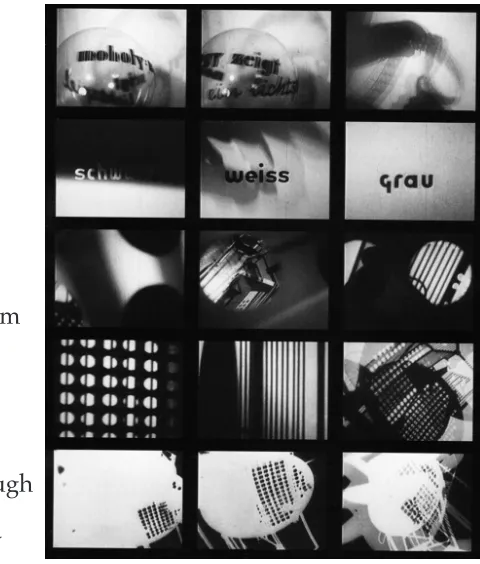
whatever space it was in. Moholy-Nagy filmed the light and shadows made by the modulator, creating the film Light Play: Black, White and Grey Stills (Fig. 2.5) in 1930, framing and reinterpreting the play of light.
[image:16.612.296.536.88.370.2]Through process and experimentation, Moholy-Nagy’s work changed and evolved with his use of variable lights and materials. I was impressed not only with the way he was able to exhibit control over the light, while opening new ways for it to be perceived and experienced, but also by his combination of techniques. He approached each idea from a variety of different perspectives, asking the viewers to stretch their imaginations and consider a multitude of possibilities as they consider what is around them and new properties of their environment. Moholy-Nagy sought to create new links between art and
Fig. 2.5 Laszlo Moholy-Nagy; Light Play: Black,
technology and explore and open new possibilities in seeing, experiencing, and interpreting the environment.
I approached the work in Chiasm in a similar manner by allowing the images to change and evolve as I worked on them. I worked intuitively in the construction of the images in the computer as I layered the different types of light onto the photographed space. The viewing of the images also has an element of chance as they continually change in the installation as they are experienced by the viewer. Depending on where the viewer is standing in relation to a
particular image, it may appear vibrant and detailed or washed in light, allowing for multiple visualizations of each individual image. This attribute suggests that a single environment can be perceived and interpreted from a variety of perspectives.
There are three different types of light at play within the images: the natural light of the sun photographed, digitally projected light photographed and layered into the image through computer manipulation, and the light in the gallery illuminating the images from behind. By printing the images on silk, I intended to remove much of the materiality of the image and create an illusory space for the viewer constructed from these light interactions. While discussing his work, artist Larry Bell presented the question, “What does it mean to perceive light directly, removed from the context of an object?”7 This question led me in
the investigation of my thesis work. In my work, light emanates through the space pictured in the images and then through the surface of the print. The light is removed from context, having little apparent source and moving through the
object. I sought to use the light as a means to provoke imagination while also utilizing it as a tool for evoking emotion through its presence, absence, pattern, and/or color.
Bell uses the properties of light in conjunction with the other materials in his sculptures to create a relationship between the art object and the environment. He creates an illusionary effect as light interacts with his sculptures, which asks the viewer to react and question what they see with their eyes. In Untitled, 1967-1968, (Fig. 2.6) his use of tinted glass and specific lighting creates the illusion of multiplicity of space as the cube’s form
appears to repeat and continue into multiple dimensions of space. The viewer is left questioning what is real and what is illusion. As I viewed a similar Bell sculpture at the Guggenheim Museum, I was prompted to walk around the sculpture and evaluate the glass box from any available angle. What I knew to be present and what I saw were in conflict. Bell is interested in creating this conflicting circumstance for the viewers of his sculpture when what is physically present and how it is perceived through the eyes and in the mind conflict. He is interested in how this conflict dictates a viewer’s interaction with the object:
The various transparent, reflective, and opaque surfaces so undermine our ability to distinguish between what is physically present and what is illusion that the objects seem to de-materialize and we are left to ponder the perception of light per se, and the nature of illusion.8
[image:18.612.399.539.142.365.2]8 Larry Bell, Larry Bell: New Work, 10.
Ⅲ. The Installation: Space Experienced
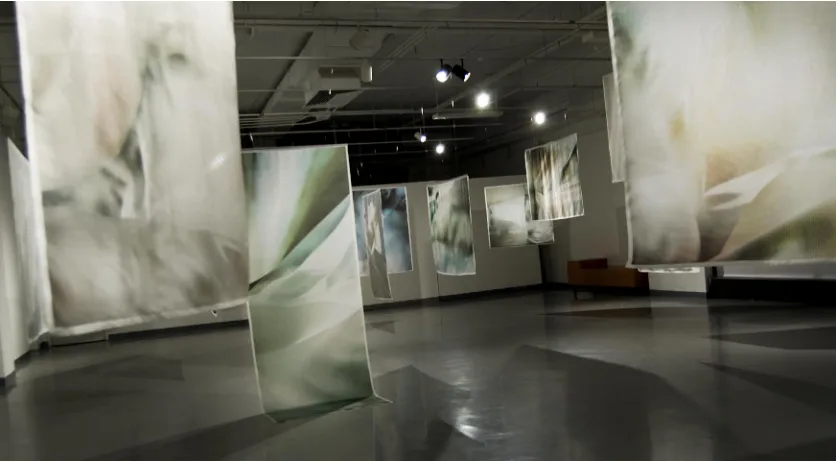
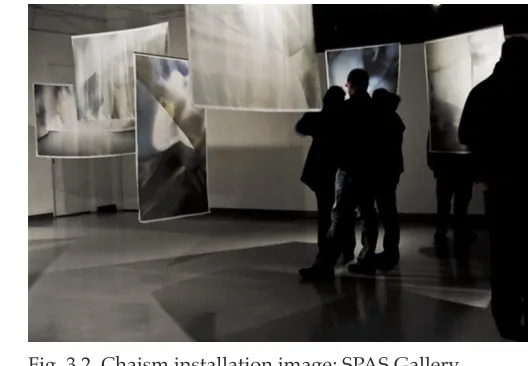
My thesis work is conceptually realized when the images are viewed through installation. The installation allows for a more personal interaction between the images, the viewer, and the environment. By hanging the images off the gallery walls, the image can be seen from two sides. The light weight of the fabric allows the images to flutter as the viewer passes. Their arrangement at varying levels and orientations directs the viewers’ gaze and movement throughout the space of the gallery. This mimics the disorientation of the constructions pictured in the images, while challenging the traditional way a person interacts and
[image:19.612.115.534.438.669.2]interprets the space of the gallery. The orientation of the images, at varying levels and throughout the space of the gallery, influences the movement of people throughout the installation.
Viewers within the space of the installation influence the movement and experience of each other. The viewer is allowed to see the back of the images, the trace of the space through the fabric, as they move through the installation. The quality of the fabric allows
the image to be illuminated in diffused backlight, giving it a dimensionality that is not available with frontal lighting. As people pass behind the backlit images, they become a
part of the them as a shadow or silhouette. At times the lighting in the gallery creates an illusionary effect, as if the images dematerialize when viewed from a specific angle. This further encourages the viewers’ movement, as the image changes as it is viewed from various places within the space. These interactions between the viewers and images give each person a new and separate experience in the installation. Merleau-Ponty describes unique perceptions of a same place:
I do not know the others, in the strong sense that I know myself; I therefore cannot flatter myself in supposing that I participate with them in a thought of the world which would be ideally the same thought.9
The thesis work explores this idea visually by offering each viewer a unique experience of the images.
The images are hung off the gallery walls from the ceiling of the gallery. This display of the work creates a new environment for the viewer to explore.
[image:20.612.274.538.148.331.2]9 Merleau-Ponty, The Visible and the Invisible, 61.
Each of the individual images is simply a portion of the whole; through the installation, they become a unified grouping. The installation of the images realized in space, and as constructed space, changes how the work is perceived and experienced, creating a unique representation of environment, different from what the images represent individually. The installation creates a new environment, re-represented through the imaginary space created in the images and placed in the actual space of the gallery. Through the translucency of the fabric, the real, tangible structure of the gallery enters the constructed, imaginary space represented in the image, unifying the collection of images with the space they inhabit.
The size and scale of the images encourage their formation of a new space within the space of the gallery. The images are printed large, with the smallest dimension of each image being forty inches and vary from forty to one hundred inches in height or length. This large size allows the image to immerse the viewer and establishes the illusion of viewers being within the space depicted, while encapsulating them in the space created through the installation. The variance in scale between each of the images emulates the disorientation of scale and space.
The orientation and sequencing of the images allows for further
realized individually. The minimal white border framing each of the images serves a dual purpose. It is a formal necessity that allows for a coating to be applied to the edges of the fabric to prevent fraying. It also separates the images as individual pieces, allowing them to be evaluated as singular interpretations.
Fig. 3.3 Installation view of images: Chiasm 806_2 (left), Chiasm 898 (center),
Ⅳ. Aesthetics of Experience
Time is another element relevant in the installation and conception of the thesis, as the work explores the experience of environment. Time passes as a person processes and evaluates a place or event. As striking as an experience may be, there is an amount of time that passes as the event is reflected upon and absorbed into a memory. Because of this, a full experience can never be retained; instead, a series of fragmented memories or a perception of the event is formed in the mind. Chiasm is, in effect, my artistic exploration of the absorption of my environment. Each individual image is an abstract expression of the environment. As a whole the images represent an imaginary, dream-like, emotional, visual response to and impression of what is around me. These images, while elusive, exhibit familiar formal qualities of texture, light, movement, and color that remind viewers of past experiences or dreams. Richard Zakia states in Perception and Imaging:
Illusions are real. They are real in the sense that they are perceived as being real. We deny reality when we insist that the visual reality agree with the physical reality.10
The impression of a situation, how it was experienced visually and what is remembered, becomes our own reality regardless of what was physically present.
In my thesis work, I am questioning the familiarity and intensity of the digital in relationship to the analog or natural. How does the presence of the digital affect memory? Digital media can often be perceived as a type of the environment separate from the real, such as a movie or the Internet. A
“real” situation can also be fragmented through its presentation in a digital medium, such as podcasts, commercials, and text messages. There is, however, a convergence of the digital with the non-digital in the environment that often occurs seamlessly.
An environment presented through a digital medium can be perceived as a very real experience. Two characteristics of an experience seem to affect the retention of information: the familiarity of what is involved and the intensity of the experience. Steven Holl is an American architect concerned with how perception, light, and the senses affect how a person experiences the space around them. He questions the fragmented experience of environment by creating a convergence between
his architectural buildings, the people who experience them, the environment they inhibit, and natural elements, such as sunlight. This convergence was explored in his building Kiasma (Fig. 4.1), a contemporary art museum in Helsinki, Finland. In this building, Holl worked to merge the exterior of the building with the city and its
[image:24.612.288.540.349.682.2]the shape of the building mimic the geometry of the city. He sought to create a connection between architecture, art, landscape, and the city through the design of the building. The geometry of the building is meant to represent two hands clasping symbolizing unity between the art that is contained within the building with the building, itself, the city, and the land.
Within Kiasma, one of the largest concerns in the design of the gallery spaces was the way natural light played into the space. Holl designed each of the twenty-five galleries in a way that allowed
them each to have a unique quality of natural light (Fig. 4.2). He describes the experience in the building: “The silver light of the sun, the tree-cast shadow, and the glossy surface of concrete walls interact in a shadow play with the body’s movement through them.”11
Each space offers a unique sensory experience and leads the viewer toward the center
chiasm of the building. The building itself
is a rather neutral space; however, the lighting separates the galleries from the traditional white-cube gallery space, creating an inviting and unique space for contemporary artwork.
The name of the building Kiasma, refers to the idea of chiasm presented in Merleau-Ponty’s Visible and Invisible. The focal point of the building is a
double curved wall, a chiasm, which begins as concrete in the lobby and changes
[image:25.612.359.539.261.519.2]11 Steven Holl, Parallax (Bordeaux: arc en reve centre d’architecture, 1993), 31.
into glass as it reaches upward to the exterior of the building (Fig. 4.3). This design element suggests a movement throughout the space to the visitors and encourages the interaction between the person, the space, and the elements it contains, “[simulating] both inner and outer perception,”12 both the mind and
body.
In Chiasm, I look to merge many different elements, realities, places, and thoughts and to create an overall
impression, memory, or perception of reality in images and installation. Chiasm then becomes an impression of the environment perceived as the natural and digital elements of reality are experienced and impressed into a memory.
[image:26.612.328.540.72.350.2]12 Steve Holl, Kiasma: Museum of Contemporary Art (Helsinki: Museum of Contemporary Art, Art Print, 1998), 7.
Ⅴ. Conclusion
As our technological means multiply, are we growing– or becoming stunted– perceptually? We live our lives in constructed spaces, surrounded by physical objects. But, born into this world of things, are we able to experience fully the phenomena of their interrelation, to derive joy from our perceptions?13
Much of my thesis work centers around Steven Holl’s questions, as cited above. Perhaps I have not offered any definitive conclusion in the work. Yet a finite conclusion is an unreasonable expectation when questioning perception. I hope to have begun to explore the varieties of perceptions experienced in the modern environment, where the real and the digital meet.
Ideally, the images in the thesis should be installed to create their own space within the gallery. I had conceived that the installation space would be dark, with the only light coming through the illuminated images as they are backlit. As the images were installed in the School of Photographic Arts and Sciences Gallery at Rochester Institute of Technology, they did not fully form the interactive space I had envisioned for the work. The lighting in the gallery did not allow me to form the meditative space that I had proposed to create. At this point I have not reached the ideal visual realization of the idea. I believe that it is possible for me to create a stronger installation of the work. The images should be installed in a smaller space with the potential for more hanging and lighting options. There is still much room for development of the work in concept and expression. The concept could be explored in other forms of still imagery,
installation, and video to create a stronger integration of the work with the space
13 Steven Holl, “Questions of Perception: Phenomenology of Architecture,” Architecture and
of the gallery and the viewers. I need to better integrate the suggested space created in the installation of the images with the space of a gallery. I need to discover alternative means to compel the created, imaginary space into reality for the viewer.
The silk images have a familiar, tactile, and inviting quality that provokes an interaction from the viewers and triggers an reflective response provoking the memory. The way they are hung in the gallery also elicits a successful interaction from the audience, encouraging them to touch and interact with the prints. In many instances viewers would be looking at a particular image and then find themselves walking into another print. This action could be elevated by placing the pieces closer together in future installations, thus creating a more deliberate interaction between the viewer and the prints as the viewer moves within the space.
investigation into sound art did influence how I began to conceive the thesis work. It made me more aware of the multimedia environment around me that I was attempting to perceive in the thesis work. I did begin to collect and work with sounds, and it made me more aware of the often subtle presence of the digital in my world and the variety of sources for digital experience.
Selected Bibliography
Arnheim, Rudolf. Art and Visual Perception: A Psychology of the Creative Eye. Los Angeles: Univeristy of California Press, 1974.
Bell, Larry. Larry Bell: New Work. New York: The Hudson River Museum, 1980.
Carmen, Taylor and Mark B.N. Hansen, eds. The Cambridge Companion to
Merleau-Ponty. Cambridge:Cambridge University Press, 2005.
Davidoff, Jules. Cognition Through Color. Massachusetts Institute of Technology, 1991.
DeLillo, Don. White Noise. New York: Viking Penguin Inc., 1985.
Holl, Steven. Kiasma: Museum of Contemporary Art. Helsinki: Museum of Contemporary Art, Art Print, 1998.
Holl, Steven. Parallax. New York: Princeton Architectural Press, 2000.
Holl, Steven. “Questions of Perception: Phenomenology of Architecture.”
Architecture and Urbanism, 1994.
Holl, Steven. Steven Holl. Bordeaux: arc en reve centre d’ architecture, 1993.
Irwin, Robert. Robert Irwin. Los Angeles: The Museum of Contemporary Art, 1993.
Jenkins, Henry. Convergence Culture. New York: University Press, 2006.
LaBelle, Brandon. Background Noise: Perspectives on Sound Art. New York: The Continuum International Publishing Group Inc., 2006.
Merleau-Ponty, Maurice. Phenomenology of Perception. New York: The Humanities Press, 1962.
Merleau-Ponty, Maurice. The Visible and the Invisible. Trans. Alphonso Lingis. Evanston: Northwestern University Press, 1968.
Moholy-Nagy, Laszlo. Vision in Motion. Chicago: Paul Theobald, 1947.
Negroponte, Nicholas. Being Digital. New York: Vintage Books, 1996.