This is a repository copy of The interaction between mixture components in the
mechanism of binary fluidization.
White Rose Research Online URL for this paper:
http://eprints.whiterose.ac.uk/104484/
Version: Accepted Version
Article:
Formisani, B, Girimonte, R and Vivacqua, V (2014) The interaction between mixture
components in the mechanism of binary fluidization. Powder Technology, 266. pp.
228-235. ISSN 0032-5910
https://doi.org/10.1016/j.powtec.2014.06.007
© 2014 Elsevier B.V. Licensed under the Creative Commons
Attribution-NonCommercial-NoDerivatives 4.0 International
http://creativecommons.org/licenses/by-nc-nd/4.0/
[email protected] https://eprints.whiterose.ac.uk/ Reuse
Unless indicated otherwise, fulltext items are protected by copyright with all rights reserved. The copyright exception in section 29 of the Copyright, Designs and Patents Act 1988 allows the making of a single copy solely for the purpose of non-commercial research or private study within the limits of fair dealing. The publisher or other rights-holder may allow further reproduction and re-use of this version - refer to the White Rose Research Online record for this item. Where records identify the publisher as the copyright holder, users can verify any specific terms of use on the publisher’s website.
Takedown
If you consider content in White Rose Research Online to be in breach of UK law, please notify us by
1
THE INTERACTION BETWEEN MIXTURE COMPONENTS
IN THE MECHANISM OF BINARY FLUIDIZATION
B. Formisani*, R. Girimonte and V. Vivacqua
Department of Environmental and Chemical Engineering,
University of Calabria, I 87030 Arcavacata di Rende (Cosenza), Italy
*Correspondind author. Tel: +39 0984 496691; fax: +39 0984 496655. E-mail address: [email protected]
Abstract
The interaction between components during segregating fluidization of two-solid mixtures is shown
to be an intrinsic feature of their mechanism of suspension. Separate force balances on either
mixture component lead to assessing the individual contribution of the two solids to the total
pressure drop. An analytical expression for the interaction force is thus obtained that explains why
the complete fluidization of the mixture is possible at a velocity lower that the higher umf of the two
components and how the roles of 'flotsam' and 'jetsam' are attributed to them during the process of
segregation.
The theoretical expressions for the initial and final fluidization velocity of a binary mixture provided
by this more insightful method of analysis are identical to those discussed in previous works and
validated by a wide variety of experimental results.
1. Introduction and previous work
Component segregation during fluidization of multi-solid beds is considered a practically
2 processes based on fluid-bed technology. Segregating fluidization in beds of two solids has
therefore been extensively investigated in the last four decades, but in spite of this unceasing
endeavor the comprehension of its mechanism and its theoretical representation are still
unsatisfactory. The frequent recourse to empiricism, typical of most literature descriptions of
segregation, is the obvious consequence of the absence of a convincing theory. Important aspects
still poorly understood are the mechanism by which the presence of each of the two bed
components modifies the action of the fluid on the other solid and the nature of the interaction
between the two particulate species during the fluidization process.
The existence of an interaction mechanism between the two solids is suggested by experiments,
which show that the packed-to-fluidized bed transition of two-solid systems is not accomplished at
a single velocity threshold but along a velocity interval. The characteristic boundaries of this
interval, shown in Fig.1, are usually referred to as the initial and final fluidization velocity, uif and uff,
respectively. On the pressure drop versus gas velocity diagram, uif is located at the point p first
deviates from the fixed bed trend, whereas uff is the velocity at which the ultimate value of p is
attained. The pioneering studies of Chen and Keairns [1], Gelperin and Einstein [2] and Vaid and
Sen Gupta [3] first revealed that fluidization of binary and ternary beds is a process that has place
gradually. More recently, the dependence of both uif and uff on the main variables which determine
the fluidization pattern (solid properties, mixture composition and bed geometry) has been
investigated by Formisani et al. [4-6], who analyzed the behaviour of a large number of
two-component mixtures. These studies have provided experimental evidence that the values of uif and
uff are located in between the minimum fluidization velocities of the system components. A
rationale for this behaviour is related to the presence of a mutual interaction between the
particulate species that constitute the bed: in any binary mixture one of the two solids begins to be
fluidized at a velocity lower than its umf, so that it appears to benefit from the presence of the other
component; on the contrary, the suspension process of the latter results hindered, as it ends at a
3 As discussed in this paper, clarifying the nature of this interaction requires undertaking a separate
analysis of the forces that act on either mixture component. Such an approach is alternative to that
traditionally followed by many authors [7-13]; in their investigations, the binary mixture subjected to
fluidization is always regarded as the equivalent of a monosolid system whose particle density and
size are defined by suitable averages of those of its components. These average parameters are
then introduced into well-established equations devised for calculating the minimum fluidization
velocity of monocomponent beds without any theoretical justification. Following this approach,
quantifying the specific effect of each component on the fluidization behaviour of the mixture
becomes unfeasible.
Recently, Formisani et al. [5-6] have developed a unified model of the fluidization behaviour of all
types of two-solid mixtures. On showing how the existence of a fluidization velocity interval is
associated to the progress of segregation, this model provides a fully theoretical equation for
predicting the initial fluidization velocity of a mixture and uses only one parameter, endowed with
physical meaning, to calculate its final fluidization velocity. Even if it gives a deeper insight into the
nature of segregating fluidization, a limitation of the analysis conducted so far is that of being
based on force balances referred to the binary bed as a whole. A necessary development,
therefore, seems that presented in the present study, where separate force balances are written for
either mixture component, a method that elucidates the interaction between the two solids and
leads to its quantitative evaluation.
2. Theory
2.1. Single Component Force Balances
To interpret the behaviour of the two components during the fluidization process of a
homogeneous binary mixture, the “separated flow model” of Wallis [14], successfully applied by the
4 adopting a quasi-continuum representation of the two-phase system, based on the assumption that
the forces acting on the different phases are calculated in an element of volume larger than the
particles.
Separated force balances on each solid can thus be written as follows:
Solid 1
1g
f
s , f1
f
s ,s1 2
0
(1)Solid 2
2g
f
s , f2
f
s ,s2 1
0
(2)In these relationships fsi,f represents the force exerted by the fluid on the unit volume of solid i;
analogously, a term like fs1,s2 indicates the force transferred from solid 2 to the unit volume of
solid 1.
As regards the former type of interaction, the total force Fs,f that the fluid exerts on the solids can
be divided into a pure drag force Fd and a lift force due to the pressure field surrounding the
particles; Fs,f can therefore be expressed as:
s, f s d f
dp
F
V
f V
dz
(3)In eqn 3, fd is the pure drag force per unit volume of fluid, Vf, which does not include the pressure
gradient while Vs is the total volume of the solids.
The pressure drop in the fluid phase is the sum of two contributions: gravitational head loss and
friction on the solid surfaces. Accordingly, with reference to the unit volume of fluid, the pressure
gradient can be written as:
dp
fg
f
d5 Thus, in order to obtain the expression of the interaction force it is necessary to assess the
contribution of the individual solid components to the “frictional pressure drop” fd.
2.2. Drag force on single components
As with other frictional phenomena, fd can be expressed by a relationship that expresses its
dependence on the kinetic energy of the fluid as well as on system geometry by defining a suitable
drag coefficient: 2 1 2 '
d D f
f
A
f C v
V
(5)in it A and Vf are the external surface of the particles and the gas volume in the bed, respectively.
This formulation has been shown by Wallis [14] to provide a theoretical basis to Carman-Kozeny's
or Ergun's equation and is here adapted to the case of a homogeneous bed of two solids; to do
that, one has to distinguish the contribution of either component to the total pressure drop:
2 1 2
1
2
'd D f
f f
A
A
f
C
v
V
V
(6)With the assumption that component concentrations and bed voidage are uniform throughout the
bed, the external surface of the two solids can be expressed as follows:
2 2 2 2 3 2 2 2 1 1 2 1 3 1 11
6
1
6
1
1
6
6
1
d
x
d
d
x
V
A
;
d
x
d
d
x
V
A
f f
6 Substitution of eqns (7) into (6) and definition of a new friction factor CD=3CD’/2 yield:
2 1 2
3
1 2
1
2
d D f
x
x
f
C
u
d
d
(8)In eqn (8) u is the superficial fluid velocity, related to the interstitial fluid velocity by the expression:
u
v
(9)As regards the dependence of the friction coefficient CD on Reynolds number, Wallis theory of
monosolid fluidization makes use of the following definition:
f f f
vV
/
A
Re
(10)It seems therefore appropriated, when dealing with a mixture of two solids, to change the
geometric factor Vf/A into Vf/(A1+A2), so that neglecting the factor 6 (that only changes the
numerical value of Re) allows writing
1 2 2 1 1 2 11
d
x
d
x
u
A
A
vV
Re
f f f f f
(11)The same author showed that the relationship
Re
7 converts eqn (6) into the classical form of Carman-Kozeny; thus, as far as it holds also for a
two-component bed, substitution of eqns (9) and (12) into eqn (8) leads to the following relationship:
21 2
3
1 2
1
180
d f avx
x
f
u
d
d
d
(13)In eqn (13) dav is the Sauter mean diameter of the particle assembly, defined by the relationship
2 2 1 1
1
d
x
d
x
d
av
(14)so that eqn (13) can also be written as
23 2
1
180
d f avf
u
d
(13’)The meaning of eqn (13) is that the pressure drop to which the gas phase is subjected while
flowing across the two-component bed is the sum of the contributions of either solid, to be
calculated separately as:
(15)
(15’)
Thus, the contribution of each mixture component to the total pressure drop turns up to be
8 1
1 av
x d
d
and2 2
av
x d
d
,which coincide, respectively, with the surface fractions A1/(A1+A2) and A2/(A1+A2) and are therefore
related to the relative abundance of either component in the binary mixture.
An analogous result is obtained when Ergun’s equation (or any other relationship of the same kind)
is used in place of Carman-Kozeny's, the only difference being that the dependence of the friction
factor on Reynolds number, previously given by eqn (12), is now expressed by the relationship
875 0 75
. Re
CD (16)
When the friction factor is that provided by eqn (16), the individual contribution of either mixture
component to the total pressure drop per unit bed height becomes
(17)
while the total pressure drop is accordingly calculated as
2
2
3 2 3
1
1
150
1 75
d f f
av av
f
u
.
u
d
d
(18)3. Interaction forces between mixture components
According to what illustrated in the previous section, assessing the contribution of either mixture
9 the right partition factors. Consistently, the force that the fluid exchanges with the single solid
component can be calculated by adapting eqn (3) to the presence of the two mixture components:
i av
si, f si d f
i
x d
dp
F
V
f
V
dz
d
(19)The force per unit volume of solid i, fsi,f , is:
1
si, f av
si, f d
si i
F
dp
d
f
f
V
dz
d
(20)Substitution of eqns (4) and (13) into (20) then yields:
2 3
1
180
1
f av
si, f f
i av
u
d
f
g
d
d
(21)Eqn (21) is then introduced into eqns (1) and (2) to obtain:
Solid 1 1
1 22 3
1
1
180
1
0
f av
f s ,s
av
u
d
g
g
f
d
d
(22)Solid 2 2
1 2 12 3
2 2
1
180
1
0
f av
f s ,s
av
u
d
x
g
g
f
d
x
d
(23)where the mutual force exchange between the two solids has also been considered:
2 1 2 1
2
1
x
f
x
f
s ,s
s ,s (24)10
1 180 3 2 2 2 1 1 f av f gdu x x (25)
1 2 2 1 1 1 2 11
d
d
g
g
f
s,s
f x x f
av (26)Finally, the total pressure drop per unit bed height can be calculated from eqns (4), (13) and (25)
as:
f x x
g
p
dz
dp
2 2 1 11
(27)In the previous analysis, the interaction force expressed by eqn (26) has been derived under the
assumption of viscous regime. However, an identical result can be obtained in the inertial regime.
To this purpose, eqn (18) is used instead of eqn (13) in the component force balances, yielding:
Solid 1
2
1 2 3 3 1 2
1
1
150
f1 75
f1
av0
f s ,s
av av
u
u
d
g
g
.
f
d
d
d
(28)Solid 2
2
1
2 2 3 3 1 2
2 2
1
150
f1 75
f1
av0
f s ,s
av av
u
u
d
x
g
g
.
f
d
x
d
d
(29)Multiplying eqns (28) and (29) by x1 and x2, respectively, and adding them together gives an
equation for the calculation of the equilibrium velocity u at high Reynolds numbers:
2
1 2
1 2
2 3 3
1
150
f1 75
f fav av
u
u
.
x
x
g
d
d
(30)Combination of eqn (30) with eqn (28) gives the same result for the interaction force as in the case
11
1 2
2 1 1 1
2
1
1
d
d
g
g
f
s,s
f x x f
av (31)4. Results and discussion
Equations (25)-(27) constitute the basis of a fundamental model of binary fluidization developed as
a modified version of that in use for monosolid systems. Their analytical form illustrates how the
force equilibrium typical of the incipient fluidized state is influenced by mixture composition and bed
voidage. However, as these two variables cease to be uniform throughout the bed as soon as
particle fluidization begins, the velocity calculated by eqn (25) is but the "initial fluidization velocity"
uif of the homogeneous two-solid mixture.
Right after the commencement of the phenomenon, segregation begins to alter the axial
distribution of the two components as well as the local voidage and the mutual interaction force.
This leads to the formation of stratified layers in which the volume fraction of one of the two solids
grows higher than its average value in the whole system while that of the other becomes lower.
With the variation of and fs1,s2, the typical issue is that at uif the formation of a bubbling layer occurs together with that of a defluidized stratum. A velocity increase is then needed to restore the
fluidization equilibrium in a larger portion of the bed until, at uff, all the mixture is suspended.
However, although eqns (21)-(23) should hold all over the velocity interval of fluidization,
calculation of uff is impeded by the fact that x1, x2, and other parameters, whose local values are
determined by the extent of segregation past uif, are no more uniform along the bed height.
In spite of these limitations, imposed by the persisting difficulty of relating the progress of
segregation to that of fluidization, the theoretical results obtained apparently give a deeper insight
into several aspects of the dynamics of multicomponent fluidization.
12 The method of analysis adopted in this work, which consists of writing separate force balances on
the individual mixture components, has been shown to lead to the theoretical expression of the
initial fluidization velocity embodied by eqn (25). This relationship is formally identical to that
obtained by a different approach and validated by experimental results relevant to a large number
of two-solid systems [4-6], so that no further check of its accuracy (easily recognizable in the
figures of this section) is here required. More interesting is that the present investigation provides a
better understanding of the mechanism by which in any mixture of two solids one of the two
components enters the suspended state at a velocity higher than its umf, whereas the other
achieves fluidization at uff, a velocity however lower than its umf. These circumstances, first
highlighted by Chen and Keairns [1] and Vaid and Sen-Gupta [3], find now a convincing
explanation, so as to allow a quantitative interpretation.
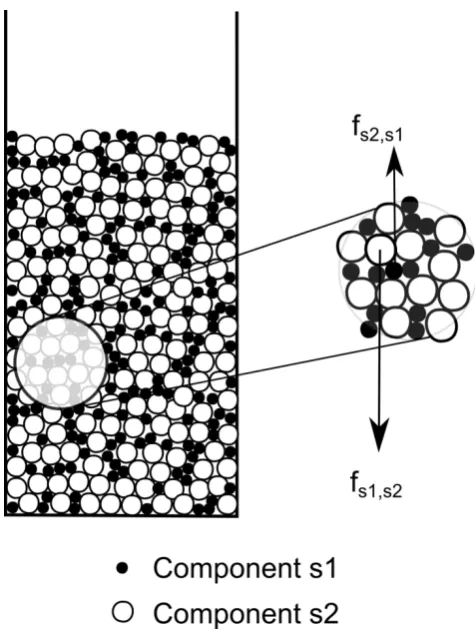
According to what sketched in Fig.2, where component 1 is assumed to be that having the lower
umf (sometimes indicated as the "fluidized" component), the force fs2,s1 arises when the gas drag
and the action of the pressure field acting on solid 1 exceed its weight, so that the unbalanced
excess of force is transferred to the other component. In opposition to that, component 2 (i.e. the
"packed" one), whose weight is not yet balanced by the combined action of the fluid drag and the
pressure field, transfers to solid 1 an additional force directed downwards, which hinders the
suspension of this component. Given the expression of the interaction force provided by eqn (26),
fs1,s2 (i.e. the force exerted by solid 2 on solid 1) results positive when directed upwards.
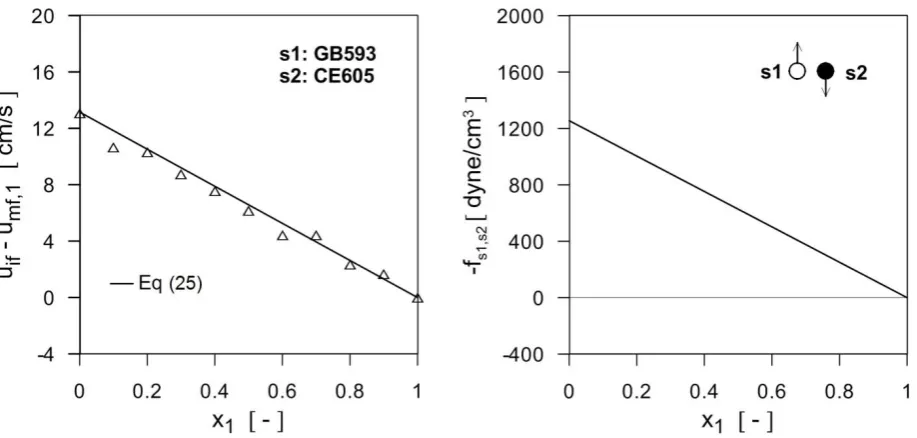
Comparing the variation of the interaction force between components with that of the initial
fluidization velocity of the binary mixture demonstrates the key-role played by this force on the
overall system behaviour. To illustrate the properties of more and more complicated systems,
several couples of diagrams will thus be considered; in each of them the experimental trend of
uif-umf,1 versus x1 as well as the theoretical curve drawn from eqn (25) are compared with that of
-fs1,s2. The velocity difference taken into account represents the amount by which fluidization of
component 1 (i.e. that having the lower umf) is delayed when it finds itself uniformly mixed with the
13 solid 2; this force is in almost all cases directed downwards so that changing its sign is just a way
of highlighting the similarity between the variables under consideration.
The properties of the experimental solids which form the systems relevant to Figs 2-6 are reported
in Table 1. The dependence of the voidage of the homogeneous mixtures on composition is
provided elsewhere [5-6, 15]. Fig.3 reports the case of a mixture whose components differ only in
density, their average diameter being the same. For systems of this kind, substitution of the
condition dav=d1 into eqn (26) yields
x
g
f
s1,s2
1
2 2 (32)so that the curve of fs1,s2 reverts to the simple form of a straight line, just like that of uif-umf,1.
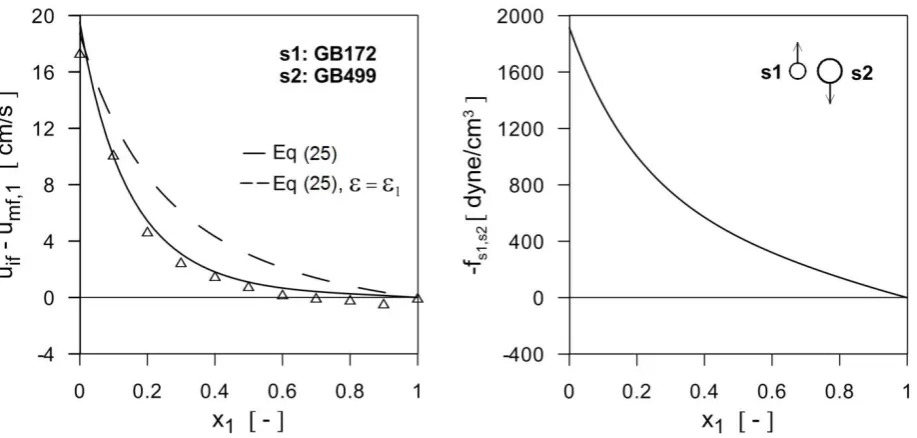
The other simple case is that of a binary bed made of two cuts of the same solid, so that 1=2=. If so, eqn (26) becomes after some algebraic manipulations:
x
g
d
d
d
f
s s f av 21 2 2
, 1
1
1
(33)The variation of fs1,s2 with x1 is compared with that of uif-umf,1 in Fig.4. In order to clarify the effect of
the voidage variation occurring in the bed at varying composition, two curves have been reported
together with the experimental data of the velocity difference: the solid one is the plot of eqn (25),
which fully accounts for the dependence of on x1 and therefore fits the results rather accurately;
the dashed curve, instead, is fictitious in that at all values of x1 bed voidage is taken equal to 1 (i.e. to that of component 1 alone). Keeping unchanged while x1 varies causes the trend of uif-umf,1
versus x1 to be very similar to that of -fs1,s2. The reason is that the dependence of the initial
fluidization velocity of the mixture on composition, expressed by eqn (25), embeds two distinct
phenomena: one is the force associated to component interaction, which delays the beginning of
bed suspension, while the other is the increase of the interstitial gas velocity that corresponds to
14 this reason, even in the absence of any interaction between the two solids, any voidage reduction
ends up with increasing the interstitial gas velocity, lowering by this way the superficial velocity at
which the fluidization process begins. So, disregarding the dependence of on mixture
composition is the way of highlighting the link between the component interaction force and the
velocity at which the fluidization process would start without the added effect of the drag increase
due to the variation of the interstitial gas velocity.
Once that the effects of density and size diversity between mixture components have been
addressed, the same analysis can be extended to more complicated cases. To this regard, Figs 5
and 6 illustrate the behaviour of two mixtures constituted by solids differing both in density and
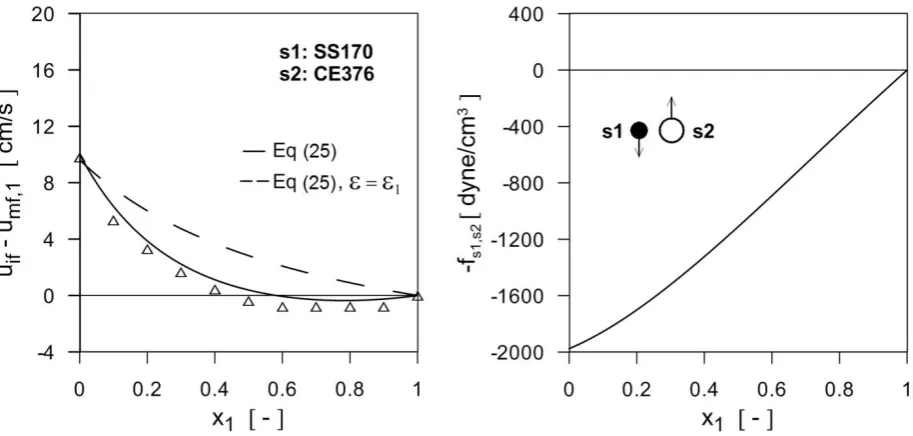
size. The two beds have in common one of the two components (CE376) but the choice of the
other solid is aimed to induce a substantial difference in system behaviour. In the GB271-CE376
mixture the denser solid is also the coarser, so that the difference of density between components
adds itself to the difference of size in determining the tendency to segregation. On the contrary, in
SS170-CE376 the denser species is the smaller, in a way that the difference of density acts in
opposition to the difference of size.
As already done for the mixture GB172-GB499, two prediction curves are reported in the velocity
diagrams, to isolate the effect of voidage variation on the component interaction force. It can be
observed, however, that in the case of the mixture GB271-CE376, whose size ratio of 1.39 is not
too high, the variation of the internal gas velocity is not too significant, so that the two trends are
rather close to each other. As regards instead the fluidization properties of the binary bed
SS170-CE376, the main issue is that this mixture enters the suspended state through the
mechanism of "bottom fluidization", as the components with the lower umf achieves fluidization in
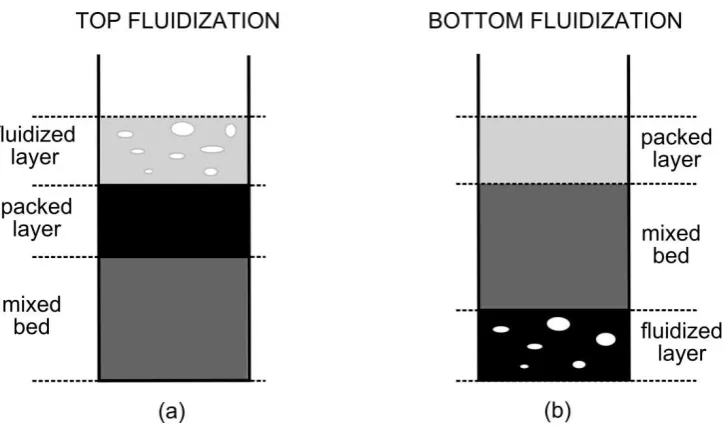
the lower region of the column. The difference between "top" and "bottom fluidization", discussed
in detail in a previous work [6], is here just sketched in Fig.7: in the former case, the
commencement of fluidization occurs in the upper region of the bed, with the formation on top of it
15 "fluidized" component are first observed in the bottom region of the bed while a packed layer of the
other solid forms on top.
Consistently with this experimental finding, the curve of -fs1,s2 results inverted with respect of that of
uif-umf,1, a circumstance that reveals how the force exerted on solid 1 by solid 2 is in this case
directed upwards.
For both the types of mixture taken into consideration, the close similarity between the curves of
uif-umf,1 and those of -fs1,s2 is evident and the role played by the component interaction force in
determining the incipient suspension of the binary bed finds a new confirmation.
Even more significant is the case of a mixture like GB250-OP1544, referred to in Fig.8. This
system exemplifies the behaviour of mixtures for which the mechanism of fluidization may change
along with mixture composition, skipping from "top" to "bottom fluidization". In Fig.6 this change of
phenomenology is signalled by the intersection of the curve of -fs1,s2 with the x1 axis. Olive pits are
the only non-spherical particles used in this work, so that application of model equations to this
mixture requires calculating its Sauter mean diameter from the following modified form of eqn (14):
2 2
2
1 1
1
1
d
x
d
x
d
av
(34)Once more, the peculiar dependence on bed composition of the interaction force at work between
the two components within the particulate bulk provides the explanation for a rather surprising
property of the binary bed, whose fluidization process begins at its free surface as far as the value
of x1 is lower than about 0.3, or at its bottom when the volume fraction of the same component
exceeds this limit.
Altogether, what observed with the various categories of mixtures investigated in this work allows
stating that the mechanism by which the start of the fluidization process occurs is apparently
regulated by the force exerted on the "fluidized" component by the "packed" one.
16 Equation (26) allows also deriving a criterion to establish the segregation direction of the two
components of the mixture. If the right-hand side of the relationship is positive, component 2 will
exert an upward thrust on component 1, a force that will contribute to balance out its weight. This
also means that component 1 will tend to sink, while component 2 will segregate in the upper
region of the bed. According to the notation first introduced by Rowe et al. [16], the first component
is called "jetsam", while the other is referred to as "flotsam". Thus, Eqn (26) provides a criterion to
identify the flotsam as the component which satisfies the inequality:
d
d
avf av
f
1
(35)Equation (35) was first obtained by Di Maio et al. [17-18] who followed a different approach and
validated this criterion by comparing its predictions with a large number of experimental data taken
from the literature.
Conclusions
The theoretical analysis proposed in this work has shown that writing separate force balances for
the fluid and solid constituents of a binary-solid system allows the interaction force between the
two solids to emerge. Although referred to the case of well-mixed binary beds, this interaction is
also present when the component concentration profile within the bed is not homogeneous. The
model proposed, validated by results relevant to a wide variety of mixtures, is consistent with
previous achievements and explains why the initial and the final fluidization velocities of a two-solid
bed fall within the interval bounded by the minimum fluidization velocities of mixture components.
Quantification of the solid-solid interaction requires specifying the drag force exerted by the
17 is provided to evaluate the contribution of each solid to the overall pressure drop. The model also
indicates the initial direction of segregation, in that it proves capable to attribute the roles of
"flotsam" and "jetsam" to the components of the mixture.
Nomenclature
A particle surface, cm2 d particle diameter, cm
dav Sauter mean diameter, cm
dv volume particle diameter (in table 1), m
CD, C'D friction factor, -
fd drag force per unit volume of fluid, dyne/cm3
ff,s1, ff,s2 force per unit volume exerted on the fluid by solid 1, by solid 2, dyne/cm3 fs1,f, fs1,s2 force per unit volume exerted on solid 1 by the fluid, by solid 2, dyne/cm3 fs2,f, fs2,s1 force per unit volume exerted on solid 2 by the fluid, by solid 1, dyne/cm3 Fd total drag force, dyne
Fs,f total force exerted on the solids by the fluid, dyne
g gravity acceleration, cm/s2 H bed height, cm
p, p pressure, pressure drop, dyne/cm2 Re Reynolds number= f u dav/[f (1-)] , - uif, uff initial, final fluidization velocity, cm/s
umf minimum fluidization velocity, cm/s
v interstitial velocity, cm/s
Vf, Vs volume of the fluid, of the solid phase, cm3 x volume fraction of the solid component, -
18 Greek symbols
voidage, -
particle sphericity, -
f fluid viscosity, g/cm s solid density, g/cm3
av average density of the solid mixture (= 1x1+2x2), g/cm3 f fluid density, g/cm3
Subscripts
1 of solid 1, of the component with the lower umf
19 References
[1] Chen JL-P, Keairns DL. Particle segregation in a fluidized bed. Can. J. Chem. Eng.
1975;53:395-402.
[2] Gelperin NI, Einstein VG. The analogy between fluidized beds and liquids. In Davidson JF,
Harrison D. Fluidization. London: Cambridge Press, 1978: 541-568.
[3] Vaid RP, Sen Gupta P. Minimum fluidization velocities in beds of mixed solids. Can. J.
Chem. Eng. 1978;56:292-296.
[4] Formisani B, Girimonte R, Longo T. The fluidization process of binary mixtures of solids:
Development of the approach based on the fluidization velocity interval. Powder Technol. 2009;
185:97-108.
[5] Formisani B, Girimonte R, Vivacqua V. Fluidization of mixtures of two solids differing in
density or size. AIChE J. 2011;57:2325–2333.
[6] Formisani B, Girimonte R, Vivacqua V. Fluidization of mixtures of two solids: a unified model
of the transition to the fluidized state, AIChE J. 2013;59:729-735.
[7] Goossens WRA, Dumont GL, Spaepen GL. Fluidization of binary mixtures in laminar flow
region. Chem. Eng. Prog. Symp. Ser. 1971;67:38-45.
[8] Otero AR, Corella J. Fluidizacion de mezclas de solidos de distintas caracteristicas. Anales
de la RSEFQ. 1971;67:1207-1219.
[9] Rowe PN, Nienow, AW. Minimum fluidization velocity of multicomponent particle mixtures,
Chem. Eng. Sci. 1975;29:1365-1369.
[10] Cheung L, Nienow AW, Rowe PN. Minimum fluidization velocity of a binary mixture of
20 [11] Chiba S, Chiba T, Nienow AW, Kobayashi H. The minimum fluidization velocity, bed
expansion and pressure-drop profile of binary particle mixtures, Powder Technol. 1979;22:255–
269.
[12] Uchida S, Yamada H, Tada I. Minimum fluidization velocity of binary mixtures. J. Chem.
Eng. 1983; 14:257-264.
[13] Thonglimp V, Hiquily N, Laguerie C. Vitesse minimale de fluidisation et expansion des
couches de mélanges de particules solides fluidisées par un gaz. Powder Technol.
1984;39:223-229.
[14] Wallis GB. One-dimensional Two-phase Flow. New York: McGraw-Hill, Inc., 1969.
[15] Formisani B, Girimonte R, Vivacqua V. Modelling the transition to the fluidized state of
two-solid beds: Mixtures of particles of irregular shape. In Kuipers JAM, Mudde RF, van Ommen
JR, Deen NG Fluidization XIV. New York: Engineering Conference International, 2013:
243-250.
[16] Rowe PN, Nienow AW, Agbim, AJ. The mechanisms by which particles segregate in gas
fluidized beds – binary systems of near spherical particles. Trans. Inst. Chem. Eng.
1972;50:310-323.
[17] Di Maio FP, Di Renzo R, Vivacqua V. A particle segregation model for gas-fluidization of
binary mixtures. Powder Technol. 2012;226:180-188.
[18] Di Maio FP, Di Renzo R, Vivacqua V. Extension and validation of the particle segregation
21
22
23
24
25
Figure 5. The relationship between onset of fluidization and interaction force between components at
26
Figure 6. The relationship between onset of fluidization and interaction force between components at
27
28
Figure 8. The relationship between onset of fluidization and interaction force between components at varying mixture composition. D
29 Table 1: Properties of the experimental solids.
Solid
Density
[g/cm
3]
Sieve size
Sauter
diameter
G
group
Minimum
fluidization
velocity
[cm/s]
Re
mf[-]
Glass beads (GB)
2.48
150-180
172
B
2.80
0.32
200-300
250
B
6.20
1.04
200-300
271
B
6.50
1.18
400-600
499
B
20.2
6.78
500-710
593
B
30.8
12.8
Ceramic spheres (CE)
3.76
300-400
376
B
16.7
4.22
500-710
605
B
43.3
17.6
Steel shots (SS)
7.60
150-200
170
B
6.90
0.79
Olive pits (OP)
1.38
1400-2000
1540*
D
66.1
68.4