This is a repository copy of
The effect of sex-allocation biasing on the evolution of worker
policing in hymenopteran societies
.
White Rose Research Online URL for this paper:
http://eprints.whiterose.ac.uk/1303/
Article:
Foster, K.R. and Ratnieks, F.L.W. (2001) The effect of sex-allocation biasing on the
evolution of worker policing in hymenopteran societies. American Naturalist, 158 (6). pp.
615-623. ISSN 0003-0147
[email protected] https://eprints.whiterose.ac.uk/ Reuse
Unless indicated otherwise, fulltext items are protected by copyright with all rights reserved. The copyright exception in section 29 of the Copyright, Designs and Patents Act 1988 allows the making of a single copy solely for the purpose of non-commercial research or private study within the limits of fair dealing. The publisher or other rights-holder may allow further reproduction and re-use of this version - refer to the White Rose Research Online record for this item. Where records identify the publisher as the copyright holder, users can verify any specific terms of use on the publisher’s website.
Takedown
If you consider content in White Rose Research Online to be in breach of UK law, please notify us by
The Effect of Sex-Allocation Biasing on the Evolution of
Worker Policing in Hymenopteran Societies
Kevin R. Foster*and Francis L. W. Ratnieks†
Laboratory of Apiculture and Social Insects, Department of Animal and Plant Sciences, University of Sheffield, United Kingdom
Submitted December 15, 2000; Accepted June 15, 2001
abstract:Mutual policing is thought to be important in conflict suppression at all levels of biological organization. In hymenopteran societies (bees, ants, and wasps), multiple mating by queens favors mutual policing of male production among workers (worker polic-ing). However, worker policing of male production is proving to be more widespread than predicted by relatedness patterns, occurring in societies headed by single-mated queens in which, paradoxically, workers are more related to the workers’ sons that they kill than the queen’s sons that they spare. Here we develop an inclusive-fitness model to show that a second reproductive conflict, the conflict over sex allocation, can explain the evolution of worker policing contrary to relatedness predictions. Among ants, and probably other social Hymenoptera, workers kill males to favor their more related sisters. Importantly, males are killed at the larval stage, presumably because workers cannot determine the sex of queen-laid eggs. Sex-allocation biasing favors worker policing because policing removes some males (the workers’ sons) at low cost at the egg stage rather than at higher cost at the larval stage. Our model reveals an important interaction between two reproductive conflicts in which the presence of one conflict (sex allocation) favors the suppression of the other (male production by workers).
Keywords:mutual policing, worker policing, sex-allocation conflict, reproductive conflict, social insects.
Mutual policing, where group members suppress each other’s reproduction, is thought to have played an im-portant role in the rise of biological complexity (Frank 1995; Maynard Smith and Szathma´ry 1995; Keller 1999).
* Present address: Department of Ecology and Evolutionary Biology, Rice University, MS 170, 6100 Main, Houston, Texas 77005; e-mail: krfoster@ rice.edu.
†E-mail: [email protected].
Am. Nat. 2001. Vol. 158, pp. 615–623.2001 by The University of Chicago. 0003-0147/2001/15806-0005$03.00. All rights reserved.
Multiple mating by queens in the eusocial Hymenoptera (bees, ants, and wasps) is predicted to result in mutual policing of reproduction among workers (worker policing; Starr 1984; Ratnieks 1988; Crozier and Pamilo 1996). Al-though typically unable to mate, workers in most species can compete with the queen over male production by laying unfertilized eggs, which are male. However, in a colony with more than two worker patrilines (effective paternity12), workers are more related to the queen’s sons (brothers; rp0.25) than to other workers’ sons (nephews; r!0.25), so worker policing is selectively favored.
Consistent with theoretical prediction, worker policing by egg eating has been found in the multiple-mated hon-eybeesApis mellifera, Apis cerana, andApis florea(Ratnieks and Visscher 1989; Barron et al. 2001), while in the typ-ically single-mated stingless bees and bumblebees, worker policing appears to be absent because workers’ sons are reared (van Honk et al. 1981; Estoup et al. 1995; Peters et al. 1999). In addition, evidence for worker policing has been found in multiple- but not single-paternity colonies of the waspDolichovespula saxonica (Foster and Ratnieks 2000). However, nonequal paternity in the offspring of some multiple-matedD. saxonica queens makes effective paternity !2, so that workers are in fact slightly more related to nephews than brothers. Worker policing has also been found in the European hornetVespa crabro(effective paternityp1.11; Foster et al. 1999, 2002; Foster 2000) and the common wasp Vespula vulgaris (effective paternityp1.90; Foster and Ratnieks 2001). Further-more, worker policing occurs in three species of queenless ant, where, although genetic studies are required, it may also have evolved contrary to relatedness predictions (Gobin et al. 1999; Kikuta and Tsuji 1999; Liebig et al. 1999). In many colonies, therefore, workers are paradox-ically causing the replacement of their more-related neph-ews (r10.25) by less-related brothers.
616 The American Naturalist
Figure 1:How worker policing reduces the cost of sex-allocation biasing (i.e.,Cp!Cnp; eq. [5]). Three stages are shown.A, Egg stage, during which worker policing occurs and worker-laid eggs are targeted.B, Larval stage, during which sex-allocation biasing is performed by killing a proportion of the male brood (the final sex ratio shown is three females to one male).C, Adult stage, during which workers reinvest the resources from the killed male larvae into the remaining brood, but at an efficiency cost of 20%.
ratio than the queen. This is because workers are more related to the queen’s daughters (sisters; rp0.25⫹ , wherekis effective paternity) than the queen’s sons 0.5/k
(brothers;rp0.25), while the queen is equally related to both sexes (rp0.5; Hamilton 1964; Trivers and Hare 1976). Consistent with worker-control of sex-allocation biasing, sex allocation in most ant species is female biased (Trivers and Hare 1976; Boomsma 1989; Pamilo 1990; Bourke and Franks 1995). In the few species where the mechanism of sex-allocation biasing by workers has been investigated, biasing occurs by the killing of males. Killing of male larvae has been demonstrated in the wood ant
Formica exsecta(Sundstro¨m et al. 1996; Chapuisat et al. 1997) and the Argentine antLinepithema humile(Aron et al. 1994; Passera and Aron 1996). In addition, evidence for the removal of males between the egg and pupae stages occurs in Formica truncorum (L. Sundstro¨m, personal communication), the fire ant Solenopsis invicta(Aron et al. 1995), and the ants Myrmica tahoensis (Evans 1995) and Pheidole pallidula (Keller et al. 1996). It has been suggested that workers remove male larvae rather than eggs because they are unable to identify the sex of eggs (Nonacs 1993). Evidence that workers have difficulty iden-tifying the sex of young brood was provided by Nonacs and Carlin (1990), who showed that workers of the Florida carpenter antCamponotus floridanusfailed to discriminate the sex of brood until the pupal stage.
Here we consider the effect of the queen-worker conflict over sex allocation on the evolution of mutual policing among workers. We model a situation in which workers kill male larvae to bias sex allocation and examine the
conditions under which worker policing, that is, the killing of worker-laid male eggs, is selected. We show that sex-allocation manipulation can select for worker policing when the queen is singly mated because policing reduces the cost of male killing by removing some of the males at very low cost as eggs.
The Model
Overview
We consider a situation in which workers remove excess males to cause a female-biased sex-allocation ratio (fig. 1). They can either start killing males at the egg stage or in the larval stage. Consistent with the empirical data (above), we assume that in the egg stage the only eggs that they know to be male are those laid by workers. That is, workers cannot recognize the gender of queen-laid eggs, but they can recognize whether an egg is queen or worker laid. In the larval stage, we assume that workers can recognize the gender of larvae but not their maternal origin. The latter is supported by Ratnieks and Visscher (1989), who showed that honeybees accepted both workers’ and queen’s sons in the larval stage but preferentially killed workers’ sons at the egg stage. We assume that there is a negligible cost in killing eggs but that larvae that are killed incur a cost of c. That is, only 1⫺c of energy in males can be located by killing. The reinvested resources can be real-located either to reproductives of both sexes (males and queens, as in fig. 1) or only to females (queens).
Table 1:Parameters and variables used in the model
Value Description
Vnp,Vp Allocation component of fitness in nonpolicing and policing colonies
gs,gb,gn Relatedness of focal worker to sisters, brothers, and nephews
v,v
f m Sex-specific reproductive values of females and males
x, y Proportions of colony sex allocation to females and males X, Y Proportions of population sex allocation to females and males Wc Proportion of males that are workers’ sons in the colony
Wpop Proportion of males that are workers’ sons in the population
ychange Reduction in the allocation to males by male killing as a proportion of all the brood
c Proportion of the energy invested in an adult male that is lost if he is killed Bpolicing Difference in inclusive fitness of a worker in a policing versus a nonpolicing colony
Cp,Cnp Proportional reduction in total colony productivity resulting from male killing
k Effective paternity in colonies and the population w Proportion of eggs that are laid by workers
xq,yq Proportions of queen-laid eggs that are female and male
x1,y1 Proportions of females and males before sex-allocation biasing
x2,y2 Proportions of adult females and males after sex-allocation biasing
P Frequency of policing colonies versus nonpolicing colonies Xopt Stable sex-allocation ratio for workers
In colonies with worker policing, the cost of sex-allocation biasing is reduced because some males are removed at low cost as eggs rather than at higher cost as larvae (fig. 1;
).
C !C
p np
Inclusive-Fitness Equations
The model follows Pamilo’s (1991a, 1991b) formulation of inclusive fitness and compares the “allocation com-ponent of fitness” (V) of a nonlaying worker in a colony with worker policing to a nonlaying worker in a colony without worker policing. All parameters used in the model are shown in table 1. The allocation component of fitness is the sum of the fitness gained from each class of offspring or relative. With worker reproduction, there are three classes of reproductive relatives of the focal nonlaying worker: queen’s daughters (the focal worker’s sisters), queen’s sons (the focal worker’s brothers), and workers’ sons (the focal worker’s nephews), so that
g
v
x (1⫺W)gv
y W gv
ys f c b m c n m
Vp ⫹ ⫹ ,
X Y Y
or
g
v
x [(1⫺W)g ⫹W g ]v
ys f c b c n m
Vp ⫹ , (1)
X Y
where
v
andv
are the sex-specific reproductive values off m
females and males,xandyare the proportional allocations to each sex in the focal colony,XandYare the proportional
allocations to each sex in the whole population,Wcis the
proportion of males in the colony that are workers’ sons, andgs,gb, andgnare the regression relatednesses of sisters,
brothers, and nephews to the focal worker. Worker polic-ing will be selected if the inclusive fitness of the focal worker in a policing colony is greater than that of a focal worker in a nonpolicing colony.
First, we calculate the allocation component of fitness for a focal worker in nonpolicing (Vnp) and policing ( )Vp
colonies :
V pg
v
⫹[(1⫺W)g ⫹W g]v
, (2)np s f c b c n m
Vppgs
v
⫹gbv
. (3)f m
We assume that all colonies in the population have the same sex-allocation ratio, so that xpX and ypY in equations (2) and (3), which cancels equation (1). (We discuss the effect of relaxing this assumption below.) Next, we incorporate an efficiency cost of sex allocation (C):
Cpychangec, (4)
wherec is the inefficiency of energy transfer between the killed larval males and the colony andychangeis the change
in the proportional allocation to males (change in male allocation as a proportion of all the brood). We can now compare the inclusive fitness of nonlaying workers in po-licing versus nonpopo-licing colonies (Bpolicing):
618 The American Naturalist
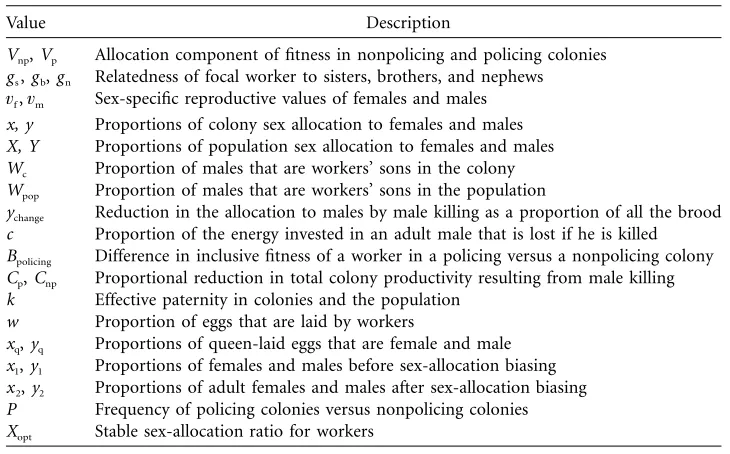
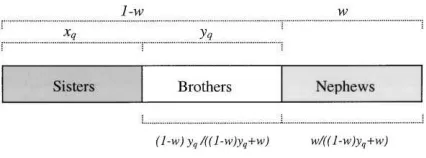
Figure 2:The proportion of males that are workers’ sons if the workers lay a proportionwof the total eggs,xqof the queen’s eggs are female,
andyqp1⫺xqare male (Wc; eq. [7a]).
whereCpandCnpare the costs of sex allocation in policing
and nonpolicing colonies, and, conversely, 1⫺Cp and are the relative productivity of each colony type. 1⫺Cnp
Worker policing is selected whenBpolicingis positive.
Model Parameters
We now have an equation that calculates the fitness effect of worker policing in colonies where sex-allocation biasing occurs. We are interested in the effect of six key factors
onBpolicing, which need to be incorporated into equations
(2)–(5): k (effective paternity; the basis of the original worker policing predictions; Ratnieks 1988),c(cost of re-cycling male larvae),w(amount of worker laying, as this varies greatly between species; Bourke and Franks 1995),
xq(primary sex ratio of queen-laid eggs—the proportion
of eggs that are female), x2 (final allocation to females,
after workers have performed sex-allocation biasing), and
P(proportion of policing colonies in the population). We now define the values in equations (2)–(5) in terms of these factors.
Regression relatedness(Hamilton 1970; Grafen 1985). We base the model on single-queen societies because colony kin structure can be defined in terms of a single variable, “effective paternity,” itself determined by queen mating frequency and sperm use (Boomsma and Ratnieks 1996). However, the method is also applicable to multiple-queen societies where relatedness patterns that favor policing or disfavor policing also occur dependent on the number and relatedness of queens (Pamilo 1991b):
gsp0.25⫹0.5(1/k), (6a)
gbp0.5, (6b)
gnp0.25⫹0.5(1/k). (6c)
The proportion of males in the population that are work-ers’ sons (Wpop). This is dependent on two factors: the
proportion of males that are workers’ sons in the non-policing coloniesWc(fig. 2),
w Wcp
w⫹(1⫺w)yq
w
p , (7a)
w⫹(1⫺w)(1⫺xq)
and the frequency of policing colonies (P), for which we assume that no workers’ sons are reared, versus nonpol-icing colonies (1⫺P),
Wpopp(1⫺P)Wc. (7b)
Reproductive value(Fisher 1930). When all males in the population are queen’s sons, females have twice the re-productive value of males because males contribute only genes to females of the next generation. With worker re-production, however, father males also contribute genes to males, thereby raising male reproductive value (see Bourke and Franks 1995 and Crozier and Pamilo 1996 for a summary of reproductive value and relatedness):
v
p1, (8a)f
1
v
p . (8b)m
2⫺Wpop
The amount of male killing needed to change the primary sex ratio to the sex ratio after sex-allocation biasing(ychange;
eq. [4]).The primary sex allocation to females (fig. 2) is
x1p(1⫺w)xq, (9)
where wp0 in policing colonies. We consider the two extreme cases of male reinvestment into reproductives of both sexes or only into queens: first, if resources are re-invested into reproductives of both sexes (fig. 3A)
(y1⫺ychange) y2
p ,
x1 x2
x1
ychangep1⫺ , (10a)
x2
and, second, if resources are reinvested only into queens (fig. 3B),
y1⫺ychange y2
p ,
x1⫹(1⫺c)ychange x2
x2⫺x1
ychangep . (10b)
Figure 3:Calculation ofychange, the number of males that must be killed
to produce a given secondary sex-allocation ratio. Valuesx1andy1are
the proportions of females and males before, andx2andy2after,
sex-allocation biasing.A, Sex allocation with reinvestment back into the colony as a whole (eq. [10a]).B, Sex allocation with reinvestment back into females (eq. [10b]). Reinvestment of a proportionychangeof the males
results in the production of(1⫺c)ychangenew brood (females and males inAand females only inB) and a waste ofychangec.
The stable sex-allocation ratio for workers(Xopt). The
sta-ble sex-allocation ratio for workers is determined by the relative kin value of males versus females (Fisher 1930; Trivers and Hare 1976; Benford 1978; Pamilo 1991a):
g f•
v
f•Xoptp . (11) g f•
v
f⫹[v
(1⫺Wpop)gb⫹Wpopgn]m
Results
The equations were combined, andBpolicing was evaluated
using Mathematica 3.0 (Wolfram Research 1996; fig. 4). Our aim was to determine the effect of the cost of sex-allocation biasing c on the paternity frequency at which worker policing is selected (whenB 10) and to see
policing
how robust the results are with respect to parametersw,
x2,xq, andP. Unless otherwise stated, the results are for
(10% of the investment in a male that is killed
cp0.1
cannot be recovered),wp0.5(half of all eggs are laid by workers),xqp0.5 (the queen lays eggs at an equal sex ratio),x2pXopt(colony and population sex allocation is at the worker optimum), Pp0 (worker policing is in-vading), andychangeis for killed male larvae reinvested into
both females and males.
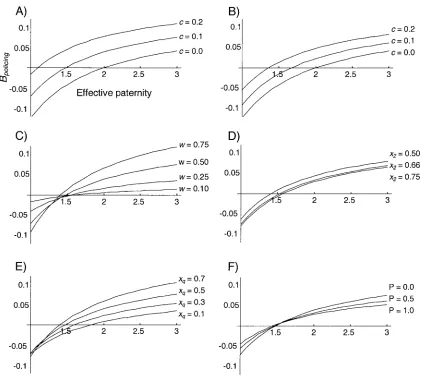
Cost of Sex-Allocation Biasing(Fig. 4A)
Introducing an efficiency cost of 10% or 20% to the re-cycling of males killed during sex allocation has a large effect on the threshold at which worker policing is favored.
An efficiency cost of123% results in policing being favored at all paternities. With no efficiency cost, the classic result that worker policing is selected when effective paternity is 12 (Starr 1984; Ratnieks 1988) is recovered.
Reinvestment Directly into Females(Fig. 4B)
If killed males are reinvested directly into new queens, the benefit of worker policing is reduced. That is, for a given efficiency cost (c), the paternity at which worker policing is favored is higher than in figure 4A. This is expected because reinvestment directly into queens makes sex-allocation biasing by male larvae killing more efficient, thereby reducing the benefit of worker policing.
The Amount of Worker Laying(Fig. 4C)
Worker policing is favored by increased worker egg laying. This is because more worker-laid eggs results in more male larvae to kill, which raises the cost of sex-allocation biasing in nonpolicing colonies. Importantly, worker policing is always selected for at paternities!2 at all levels of worker reproduction. This is logical because worker policing of eggs can only reduce the cost of killing male larvae.
The Proportion of Females Raised by the Workers(Fig. 4D)
The final sex-allocation ratio slightly affects the paternity frequency at which policing is favored. The more female biased the final sex-allocation ratio (closer to the worker optimum), the more difficult it is for worker policing to evolve. This is because a female bias requires more male killing in both policing and nonpolicing colonies, which decreases the difference in the amount of male larvae kill-ing in nonpolickill-ing versus polickill-ing colonies. That is, is slightly reduced (see fig. 1), which reduces the
Cnp⫺Cp
relative benefit of worker policing.
The Proportion of Female Eggs Laid by the Queen(Fig. 4E)
620 The American Naturalist
Figure 4:A, Effect of an efficiency cost of male killing,c, on the paternity frequency at which worker policing is selected. Positive values ofBpolicing
indicate a benefit to nonlaying workers from worker policing. With no cost (cp0), the classic worker-policing result that workers will police at effective paternity12 is recovered (Ratnieks 1988).B, Resources reinvested directly into new queens.C, Effect of the amount of worker laying.D,
Effect of the final sex-allocation ratio.E, Effect of the queen-laid sex ratio.F, Effect of the frequency of colonies with worker policing in the population. Unless otherwise stated, killed males are reinvested into both sexes;cp0.1,wp0.5,x2pXopt,xqp0.5, andPp0.
The Frequency of Worker Policing in the Population(Fig. 4F)
The frequency of policing colonies in the population has little effect on the paternity at which policing is selected. There is, however, a difference in the gradient of the curves in figure 4F. This is because worker policing (P10) duces male production by workers, which lowers the re-productive value of males (eq. [8]). This reduces the al-location component of fitness of workers (V; eq. [1]) in all colonies and decreases the magnitude of Bpolicing at all
paternities.
Discussion
com-mon, and for all but extremely male-biased primary sex ratios of queen-laid eggs (x !0.1; fig. 4).
q
Our model does not consider costs to either worker reproduction or worker policing. If worker reproduction reduces colony productivity, this will also favor the evo-lution of policing, and, like the effect shown in our model, this can also cause policing to evolve at low paternity (Ratnieks 1988). A cost to worker policing itself, con-versely, will disfavor its evolution. However, such costs do not affect our prediction that sex-allocation biasing facil-itates the evolution of worker policing, except in the ex-treme case that worker policing is more costly than male larvae killing. This is highly unlikely given that much more energy will be lost from killing larvae than eggs, while other costs, such as searching the brood, are likely to be comparable.
The paternity frequency at which policing is favored is critically dependent on the amount of investment into males that can be recovered by killing. For our parameter values, a loss of 123% results in worker policing being favored at all paternities, that is, irrespective of relatedness to males. The amount of energy lost through male killing is dependent on four key factors: first, metabolic efficiency, which is the percentage of energy consumed that is in-corporated into new biomass; second, the amount of en-ergy in males at the time of their execution, with less energy lost the earlier that males are killed; third, the labor cost of rearing males, which is permanently lost; and, fourth, accuracy of worker recognition of the sex of larvae. If workers sometimes mistakenly kill females during sex-allocation biasing, the cost of sex-sex-allocation biasing will increase. The importance of the third and fourth factors are unknown. However, given that metabolic efficiency in carnivorous insects is around 45% (Begon et al. 1990; Chapuisat et al. 1997) and male killing sometimes occurs late in the larval stage (Chapuisat et al. 1997), a loss greater than 20% seems realistic and is probably an underestimate. Extension of the theory of worker policing was inspired by the Vespinae wasps, whose worker policing by egg eating occurs at paternities!2 (Foster 2000; Foster and Ratnieks 2000, 2001) and with whom female-biased sex allocation occurs (Edwards 1980; Archer 1998). However, with fe-male-biased sex allocation common in eusocial Hyme-noptera (Pamilo 1990), the potential for this interaction between worker sex-allocation biasing and policing is widespread.
Our model assumes that all colonies have the same sex allocation. This is not always true. When colonies in the same population vary in paternity, it is predicted that workers in low-paternity colonies benefit from specializing in females, while workers in higher-paternity colonies ben-efit by investing in males, which results in split sex ratios (Boomsma and Grafen 1990, 1991; Ratnieks 1991). This
pattern has been found in several species (Queller and Strassmann 1998), including the antsFormica truncorum
(Sundstro¨m 1994a, 1994b) and Formica exsecta (Sund-stro¨m et al. 1996) and the wasp Dolichovespula arenaria
(F. L. W. Ratnieks and J. J. Boomsma, unpublished data). Facultative sex-allocation biasing also occurs when colo-nies vary in the number of queens in the ants Myrmica tahoensis(Evans 1995) andLeptothorax acervorum(Chan and Bourke 1994) and five epiponine wasp species (Queller et al. 1993; Hastings et al. 1998), which is in line with relatedness predictions.
The effect of facultative sex-allocation biasing on our predictions is best understood by considering the two types of colony, low paternity and high paternity, separately. In the low-paternity colonies, workers kill male larvae to bias allocation to females. As in our model, this will select for worker policing even though relatedness does not predict it. Because paternity is so low in these colonies, however, a relatively high cost to male killing is required for worker policing to evolve (c10.23 for single paternity with our parameter values; fig. 4A). Workers in high-paternity col-onies favor male-biased sex allocation, which means that less and maybe no male killing occurs (depending on the amount of worker laying w and the final allocation to females x2). This will reduce or remove the additional
benefit to worker policing predicted by our model. How-ever, the high paternity in these colonies increases the likelihood of worker policing due to relatedness patterns alone (Ratnieks 1988; Foster and Ratnieks 2000). Overall, facultative sex-allocation biasing will also favor the evo-lution of worker policing. With a high cost to male killing required in low-paternity colonies and possibly no male killing in high-paternity colonies, however, the conditions where policing will evolve are likely to be more restrictive, or at least more specific, than in our model.
622 The American Naturalist
Acknowledgments
We thank H. Helantera¨, J. M. Herbers, T. Wenseleers, and two anonymous referees for helpful advice. Funding for this study was provided by a Biotechnology and Biological Sciences Research Council Ph.D. studentship to K.R.F.
Literature Cited
Archer, M. E. 1998. Worker versus sexual and sex ratio investment in the social waspVespula vulgaris(Linn.) (Hymenoptera, Vespinae) in England. Journal of Hy-menopteran Research 7:257–267.
Aron, S., L. Passera, and L. Keller. 1994. Queen-worker conflict over sex-ratio—a comparison of primary and secondary sex-ratios in the Argentine ant,Iridomyrmex humilis. Journal of Evolutionary Biology 7:403–418. Aron, S., E. L. Vargo, and L. Passera. 1995. Primary and
secondary sex ratios in monogyne colonies of the fire ant. Animal Behaviour 49:749–757.
Barron, A., B. P. Oldroyd, and F. L. W. Ratnieks. 2001. Worker policing and anarchy inApis. Behavioral Ecol-ogy and SociobiolEcol-ogy 50:199–208.
Begon, M., J. L. Harper, and C. R. Townsend. 1990. Ecol-ogy: individuals, populations and communities. Black-well, Oxford.
Benford, F. A. 1978. Fisher’s theory of the sex ratio applied to the social Hymenoptera. Journal of Theoretical Bi-ology 72:701–727.
Boomsma, J. J. 1989. Sex-investment ratios in ants: has female bias been systematically overestimated? Ameri-can Naturalist 133:517–532.
Boomsma, J. J., and A. Grafen. 1990. Intraspecific var-iation and the Trivers-Hare hypothesis. Evolution 44: 1026–1034.
———. 1991. Colony-level sex ratio selection in the eu-social Hymenoptera. Journal of Evolutionary Biology 3: 383–407.
Boomsma, J. J., and F. L. W. Ratnieks. 1996. Paternity in the eusocial Hymenoptera. Philosophical Transactions of the Royal Society of London B, Biological Sciences 351:941–975.
Bourke, A. F. G., and Franks, N. R. 1995. Social evolution in ants. Princeton University Press, Princeton, N.J. Chan, G. L., and A. F. G. Bourke. 1994. Split sex ratios in
a multiple-queen ant population. Proceedings of the Royal Society of London B, Biological Sciences 258: 261–266.
Chapuisat, M., L. Sundstro¨m, and L. Keller. 1997. Sex ratio regulation: the economics of fratricide in ants. Pro-ceedings of the Royal Society of London B, Biological Sciences 264:1255–1260.
Crozier, R. H., and P. Pamilo. 1996. Evolution of social insect colonies. Oxford University Press, Oxford.
Edwards, R. 1980. Social wasps: their biology and control. Rentokil, East Grinstead, West Sussex.
Estoup, A., A. Scholl, A. Pouvreau, and M. Solignac. 1995. Monoandry and polyandry in bumblebees (Hyme-noptera: Bombinae) as evidenced by highly variable mi-crosatellites. Molecular Ecology 4:89–93.
Evans, J. D. 1995. Relatedness threshold for the production of female sexuals in colonies of a polygynous ant, Myr-mica tahoensis, as revealed by microsatellite DNA anal-ysis. Proceedings of the National Academy of Sciences of the USA 92:6514–6517.
Fisher, R. A. 1930. The genetical theory of natural selec-tion. Clarendon, Oxford.
Foster, K. R. 2000. The conflict over male production in the Vespinae wasps. Ph.D. diss. Sheffield University. Foster, K. R., and F. L. W. Ratnieks. 2000. Facultative
worker policing in a social wasp. Nature 407:692–693. ———. 2001. Convergent evolution of worker policing by egg eating in the honey bee and common wasp. Proceedings of the Royal Society of London B, Biological Sciences 268:169–174.
Foster, K. R., P. Seppa¨, F. L. W. Ratnieks, and P. A. Thore´n. 1999. Low paternity in the hornetVespa crabro
indicates that multiple mating by queens is derived in vespine wasps. Behavioral Ecology and Sociobiology 46:252–257.
Foster, K. R., J. Gulliver, and F. L. W. Ratnieks. 2002. Worker policing in the European hornet,Vespa crabro. Insectes Sociaux (in press).
Frank, S. A. 1995. Mutual policing and the repression of competition in the evolution of cooperative groups. Na-ture 377:520–522.
Grafen, A. 1985. A geometric view of relatedness. Oxford Survey in Evolutionary Biology 2:28–89.
Gobin, B., J. Billen, and C. Peeters. 1999. Policing behav-iour towards virgin egg layers in a polygynous ponerine ant. Animal Behaviour 58:1117–1122.
Hamilton, W. D. 1964. The genetical evolution of social behavior. I, II. Journal of Theoretical Biology 7:1–52. ———. 1970. Selfish and spiteful behaviour in an
evo-lutionary model. Nature 228:1218–1220.
Hastings, M. D., D. C. Queller, F. Eischen, and J. E. Strass-mann. 1998. Kin selection, relatedness, and worker con-trol of reproduction in a large-colony epiponine wasp,
Brachygastra mellifica. Behavioral Ecology 9:573–581. Keller, L. 1997. Indiscriminate altruism: unduly nice
par-ents and siblings. Trends in Ecology & Evolution 12: 99–103.
———. 1999. Levels of selection in evolution. Princeton University Press, Princeton, N.J.
Kikuta, N., and K. Tsuji. 1999. Queen and worker policing in the monogynous and monandrous ant, Diacamma
sp. Behavioral Ecology and Sociobiology 46:180–189. Liebig, J., C. Peeters, and B. Ho¨lldobler. 1999. Worker
policing limits the number of reproductives in a po-nerine ant. Proceedings of the Royal Society of London B, Biological Sciences 266:1865–1870.
Maynard Smith, J., and E. Szathma´ry. 1995. The major transitions in evolution. W. H. Freeman, New York. Nonacs, P. 1993. Male parentage and sexual deception in
the social Hymenoptera. Pages 384–401 in D. L. Wrensch and M. A. Ebbert, eds. Evolution and diversity of sex ratio in insects and mites. Chapman & Hall, New York.
Nonacs, P., and N. F. Carlin. 1990. When can ants dis-criminate the sex of brood? a new aspect of queen-worker conflict. Proceedings of the National Academy of Sciences of the USA 87:9670–9673.
Pamilo, P. 1990. Sex allocation and queen-worker conflict in polygynous ants. Behavioral Ecology and Sociobiol-ogy 27:31–36.
———. 1991a. Evolution of colony characters in social insects. I. Sex allocation. American Naturalist 137: 83–107.
———. 1991b. Evolution in colony characteristics in social insects. II. Number of reproducing individuals. Amer-ican Naturalist 138:412–433.
Passera, L., and S. Aron. 1996. Early sex discrimination and male brood elimination by workers of the Argentine ant. Proceedings of the Royal Society of London B, Bi-ological Sciences 263:1041–1046.
Peters, J. M., D. C. Queller, V. C. Imperatriz-Fonseca, D. W. Roubik, and J. E. Strassmann. 1999. Mate number, kin selection and social conflicts in stingless bees and honeybees. Proceedings of the Royal Society of London B, Biological Sciences 266:379–384.
Queller, D. C., and J. E. Strassmann. 1998. Kin selection and social insects. BioScience 48:165–175.
Queller, D. C., J. E. Strassmann, C. R. Solis, C. R. Hughes, and D. Moralez DeLoach. 1993. A selfish strategy of social insect workers that promotes social cohesion. Na-ture 365:639–641.
Ratnieks, F. L. W. 1988. Reproductive harmony via mutual policing by workers in eusocial Hymenoptera. American Naturalist 132:217–236.
———. 1991. Facultative sex allocation biasing by workers in social Hymenoptera. Evolution 24:281–292.
Ratnieks, F. L. W., and P. K. Visscher. 1989. Worker po-licing in the honeybee. Nature 342:796–797.
Starr, C. K. 1984. Sperm competition, kinship, and soci-ality in the aculeate Hymenoptera. Pages 427–464inR. L. Smith, ed. Sperm competition and the evolution of animal mating systems. Academic Press, Orlando, Fla. Sundstro¨m, L. 1994a. Ant sex ratios. Nature 370:257–258. ———. 1994b. Sex ratio bias, relatedness asymmetry and queen mating frequency in ants. Nature 367:266–268. Sundstro¨m, L., M. Chapuisat, and L. Keller. 1996.
Con-ditional manipulation of sex ratios by ant workers: a test of kin selection theory. Science (Washington, D.C.) 274:993–995.
Trivers, R. L., and H. Hare. 1976. Haplodiploidy and the evolution of the social insects. Science (Washington, D.C.) 191:249–263.
van Honk, C. G. J., P. F. Ro¨seler, H. H. W. Velthius, and J. C. Hoogeveen. 1981. Factors influencing the egg laying of workers in a captive Bombus terrestris colony. Be-havioral Ecology and Sociobiology 9:9–14.
Wolfram Research. 1996. Mathematica. Version 3. Cham-paign, Ill.