Open Access
Study protocol
An action research protocol to strengthen system-wide
inter-professional learning and practice [LP0775514]
Jeffrey Braithwaite*
1,2, Johanna I Westbrook
3, A Ruth Foxwell
4,
Rosalie Boyce
5, Timothy Devinney
6, Marc Budge
7, Karen Murphy
8,
Mary-Ann Ryall
9, Jenny Beutel
10, Rebecca Vanderheide
11, Elizabeth Renton
12,
Joanne Travaglia
1,2, Judy Stone
8, Amanda Barnard
7, David Greenfield
1,2,
Angus Corbett
13, Peter Nugus
1,2and Robyn Clay-Williams
1,2Address: 1Centre for Clinical Governance Research, Faculty of Medicine, University of New South Wales, 10 Arthur St, Kensington, NSW 2052,
Australia, 2School of Public Health and Community Medicine, Faculty of Medicine, University of New South Wales, Samuels Building, Kensington,
NSW 2052, Australia, 3Health Informatics Research & Evaluation Unit, Faculty of Health Sciences, The University of Sydney, 75 East St Lidcombe,
NSW 1825, Australia, 4University of Canberra, ACT 2601, Australia, 5School of Health & Rehabilitation Sciences, The University of Queensland,
St Lucia, Queensland 4072, Australia, 6Australian Graduate School of Management, University of New South Wales, Sydney NSW 2052, Australia, 7ANU Medical School, The Australian National University, C/- The Canberra Hospital, PO Box 11, ACT 2606, Australia, 8ACT Health, Allied Health
Adviser's Office, Level 2, 11 Moore Street, Canberra City, ACT, Australia, 9ACT Health, c/- 11 Moore St Canberra City, ACT, Australia, 10Department
of Health, CitiCentre Building, 11 Hindmarsh Square, Adelaide South Australia, 5000, Australia, 11School of Health Sciences – Nursing, University
of Canberra, Canberra, ACT 2601, Australia, 12The Canberra Hospital, PO Box 11, ACT 2606, Australia and 13Faculty of Law, University of New
South Wales, Sydney, NSW 2052, Australia
Email: Jeffrey Braithwaite* - [email protected]; Johanna I Westbrook - [email protected]; A
Ruth Foxwell - [email protected]; Rosalie Boyce - [email protected]; Timothy Devinney - [email protected]; Marc Budge - [email protected]; Karen Murphy - [email protected]; Mary-Ann Ryall - [email protected]; Jenny Beutel - [email protected]; Rebecca Vanderheide - [email protected];
Elizabeth Renton - [email protected]; Joanne Travaglia - [email protected]; Judy Stone - [email protected]; Amanda Barnard - [email protected]; David Greenfield - [email protected]; Angus Corbett - [email protected]; Peter Nugus - [email protected]; Robyn Clay-Williams - [email protected]
* Corresponding author
Abstract
Background: Inter-professional learning (IPL) and inter-professional practice (IPP) are thought to be critical determinants of effective care, improved quality and safety and enhanced provider morale, yet few empirical studies have demonstrated this. Whole-of-system research is even less prevalent. We aim to provide a four year, multi-method, multi-collaborator action research program of IPL and IPP in defined, bounded health and education systems located in the Australian Capital Territory (ACT). The project is funded by the Australian Research Council under its industry Linkage Program.
Methods/Design: The program of research will examine in four inter-related, prospective studies, progress with IPL and IPP across tertiary education providers, professional education, regulatory and registration bodies, the ACT health system's streams of care activities and teams, units and wards of the provider facilities of the ACT health system. One key focus will be on push-pull mechanisms, ie, how the education sector creates student-enabled IPP and the health sector
Published: 13 September 2007
BMC Health Services Research 2007, 7:144 doi:10.1186/1472-6963-7-144
Received: 6 July 2007 Accepted: 13 September 2007
This article is available from: http://www.biomedcentral.com/1472-6963/7/144
© 2007 Braithwaite et al; licensee BioMed Central Ltd.
demands IPL-oriented practitioners. The studies will examine four research aims and meet 20 research project objectives in a comprehensive evaluation of ongoing progress with IPL and IPP.
Discussion: IPP and IPL are said to be cornerstones of health system reforms. We will measure progress across an entire health system and the clinical and professional education systems that feed into it. The value of multi-methods, partnership research and a bi-directional push-pull model of IPL and IPP will be tested. Widespread dissemination of results to practitioners, policymakers, managers and researchers will be a key project goal.
Background
IntroductionIndustries as diverse as health [1,2], aviation [3], manu-facturing [4], finance [5], education [6] and the military [7] have identified that collaborative learning and team-based practices are key drivers of performance improve-ment, safer organisations and systems renewal. Yet there is limited research which demonstrates convincing models of inter-professional learning (IPL) (also titled inter-pro-fessional education, IPE) and inter-prointer-pro-fessional practice (IPP) that successfully achieve these outcomes, particu-larly across whole health systems. This is a substantial issue requiring attention.
This project's broad goal is to use IPL as the basis for improving IPP, which in turn is thought to lead to enhanced safety and quality of care for patients, and morale and outcomes for patients, staff and students [8,9], across an entire health system. This means the project stands at the intersection of three industries – ter-tiary education, professionally-based education, and the health system, and it spans both the public and private heath sectors. Specifically, the project will achieve its over-arching goal through an Australian Research Council (ARC) funded action research project to strengthen IPL and IPP across the Australian Capital Territory (ACT) health and tertiary and professional education systems.
By action research we mean disseminating findings to par-ticipants and other stakeholders, encouraging bi-direc-tional feedback and enabling reflection to stimulate productive change and improvement in a participatory environment. The scientific innovation we aim to realise is to enhance systems-wide teamwork and collaboration through the application and testing of a new model of IPL and IPP in order to bring about profound culture change in the way health professionals work together to deliver services. The project contributes the largest, most compre-hensive effort to achieve this yet attempted. We define IPL as "a collaborative, interdisciplinary education and learn-ing process designed to produce effective, multidiscipli-nary patient centred care" [10] and IPP is the enactment of competencies required to attain this [11]. IPL involves educating clinical professional staff (doctors, nurses and midwives, and allied health practitioners) in
multidisci-plinary approaches with the aim of encouraging IPP – ie, greater levels of teamwork, collaboration, knowledge-sharing and problem-solving in health settings.
The significance of IPL and IPP
Why are IPL and IPP important; how will they contribute to improvements? Why is this project significant? Previ-ous studies, reviews and commentaries have suggested that IPL can lead to collaborative IPP amongst clinicians and clinical groups [12,13]. This, in turn, is believed to contribute to safer and higher quality services to patients, and improved morale for staff and students [14,15]. The literature suggests that patient care (or, outside of health care, services to customers more generally) will be improved by stronger practitioner relationships, team-work and inter-professional communication.
Summarising this claim, we have argued that "IPL is cen-trally concerned with improving the way people work together so that clinicians can grow professionally, learn from others, provide support to colleagues and improve the quality of care to patients" [16]. The putative benefits of IPL and IPP have been well documented: enhanced communication and trust amongst clinical groups [17], collaborative skills [18], reductions in between-profes-sional rivalries [19], and better profesbetween-profes-sional relationships [20]. IPL is held to build team approaches [21], and lead to more creative, integrated services [22]. IPL is said to help students understand how to contribute effectively with other disciplines [23]. Establishing common educa-tional curricula across health professional groups will log-ically help create common philosophies, languages, perspectives and values [24] and enable skills transfers across the professional silos that prevail today [25].
often have more theoretical potential than actual impor-tance [28]. The sharpest criticism comes from those who argue that IPL and IPP advocates have failed to provide strong evidence for their claims. The data supporting the proposition that IPL influences IPP to create sustained sys-tems change is weak and diffuse, and the evidence largely comprises non-transferable case study, survey and other limited data [29,30]. There is no level 1, randomised study showing convincingly that IPL has worked; but nei-ther is nei-there strong level 1 evidence showing that it does not [31,32]. Deeper, more extensive evaluation efforts are therefore required and action research demonstrations of IPL and IPP are needed. Ideally, we would study an entire health system in a project that involved multi-methods and multiple levels; it is time to do so.
The action research project we propose addresses this cru-cial problem. It is hard to overestimate its importance. Health is an exemplar industry requiring effective team-work: whenever things go wrong in health care, reports [33], enquiries [34] and studies [35] show that a predeter-mining factor is that patient care is delivered in a frag-mented, isolated way, with health-care professionals having failed to collaborate effectively. Safety is compro-mised and quality suffers in such circumstances [36]. Internationally, the rate of adverse events – incidents which harm patients, caused by the health care system itself – is estimated to occur in 10% of all admissions [37]. It is well established that in the order of 18,000 Australian patients die and 50,000 patients are disabled annually and major causes include poor communication and lack of teamwork as well as tribal, non-collaborative structures [38]. IPL and IPP are thus argued to be crucial underlying determinants of safer acute care models and improved quality of services.
The case for the project
There is a growing understanding amongst policymakers, educators and clinicians that IPL's contribution, and the enactment of IPP, are important but as yet unrealised. For example, the Health Workforce Advisory Committee of the New Zealand Government has argued: "Health practi-tioners must learn to work in teams whose aim is to provide safe, high-quality, integrated and well-managed care that makes best use, in the widest sense, of all the resources a com-munity has to commit to health .... To achieve this will require changes to the way health practitioners are trained and deployed, and to the way they work" [39]. The Institute of Medicine (IOM) in the United States of America put it this way: "Clinical education simply has not kept pace with or been responsive enough to shifting patient demographics and desires, changing health system expectations, evolving practice require-ments and staffing arrangerequire-ments, new information, a focus on improving quality, or new technologies .... Once in practice, health professionals are asked to work in interdisciplinary
teams, often to support those with chronic conditions, yet they are not educated together or trained in team-based skills" [40]. Canada's Commission on the Future of Health Care agrees: "If health care providers are expected to work together and share expertise in a team environment, it makes sense that their education and training should prepare them for this type of working arrangement" [41]. The National Health Service (NHS) in the United Kingdom has expressed a confirming view: "All health professionals should expect their education and training to include common learning with other profes-sions" [42].
Quite simply, however, regardless of the favourable admonitions, no one has put a research team in the field under the right conditions (with receptive research part-ners, a health and related education system with a strong readiness to engage and a motivated and skilled work-force) to do this work, despite the widespread interna-tional agreement about the imperative for systems-wide IPL and IPP. We conducted a literature review on IPL and IPP [10] in preparation for the partnership's work together in 2005 and to design this project. This has helped posi-tion ACT Health and the partners and has laid the plat-form for IPL and IPP across the Territory. We uncovered 37,812 references. We subjected these primary references to a content analysis using Leximancer, a software analysis tool to create a conceptual map of IPL and IPP. We con-ducted a secondary refining process and excluded non-substantial, atheoretical, non-empirical and less relevant articles. The usable literature set comprised 3,765 refer-ences which were reviewed by two independent research-ers, sorted into categories and further synthesised. We found no previous study of the kind we are describing here, internationally or locally. In as rigorous a way as is possible therefore we will be advancing the knowledge base in this area.
Methods/Design
Collaboratorsinstitu-tionalise IPL in four domains: first, through major tertiary health sector education providers (eg, Australian Catholic University (ACU), Australian National University (ANU), Canberra Institute of Technology (CIT) and University of Canberra (UC); second, amongst professional education, regulatory and registration bodies (eg, Australian Physio-therapy Association (APA), Royal College of Nursing, Aus-tralia (RCNA), Royal AusAus-tralian College of Physicians (RACP), Royal Australasian College of Surgeons (RACS), Royal Australian College of General Practitioners (RACGP), the regional General Practice (GP) registrar training group – CoastCityCountry Training, the Council
of Pharmacy Registering Authorities (CPRA), and various ACT Registration Boards); third, via the streams of care through which ACT Health provides Territory-wide serv-ices (eg Community Health Servserv-ices, Mental Health ACT, Capital Region Cancer Services, Aged Care & Rehabilita-tion Service); and fourth, in teams, wards and depart-ments that provide local services (eg, surgical, medical, emergency units).
Research design
We have designed four interrelated prospective studies to meet our aims and objectives. Our design conducts this
Four areas of focus for the IPL project Figure 1
Four areas of focus for the IPL project. x
x
x
x
x
x
x
Ͳ
x x
x Ͳ
!
" # $ % &'( ) * + , -'. % /
0. '-1% '2 . 3 * & % -1( 4 + '( 5 13 . ',
" # $ % & '( ) / 13 , -'. % / 6 '(7 . , ,1( 4 % 8 . 3 * & % -1( 4)
'. 9 * 8% -( '2 % 4 3 '. 9 1, -'% -1( 4 : ( 3 1. ,
; # $ . , () / 13 , -'. % / 0< . " ; 0 = . % 8-< , 2 , -. / >, , -'. % / , ( 7 & % '. % & -15 1-1. ,
? # $ 1& '( ) 3 ( @ 4 , -'. % / 0 . % / ,) * 4 1-,) @ % '3 , A B C D C E F G E H I J
K L M N O P Q R S TUM V W X W TO N TM Y O S ZTY
W X W TO N
A B [[ C E F G E H I J
K L M N Y O S ZTY W X W TON TM O P Q R S TUM V
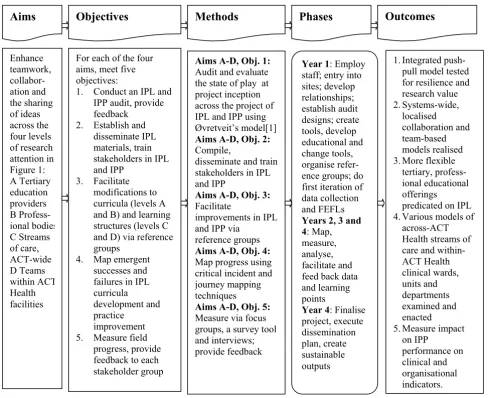
research project with four components in a sustainable study: macro, upstream, involving tertiary education pro-viders; macro, midstream, involving professional educa-tion, regulatory and registration bodies; meso, midstream, involving ACT Health's streams of care activities; and micro, downstream, involving teams, units and wards. As Figure 1 schematically argues, an action research project in the way we have conceptualised, depending on the strength of the enabling forces, can provide the push and pull needed for take up and institutionalisation of IPL and IPP.
While it is true to say that the case has been advanced since the 1960s that IPL and IPP are important, recent work including from the IOM in Health professions educa-tion: a bridge to quality [40], the report of the Pew
Commis-sion [43], the Centre for Inter-profesCommis-sional Education and Research [44], the Higher Education Academy Health Services Practice Network [45] and various other com-mentators have made strong arguments underpinning the kind of research design proposed here. But research into IPL's and IPP's effectiveness has never been done before in this way, across an entire health system. An action research approach with a motivated partner organisation has much to offer, including potential for breakthrough performance gains in practice, rather than in theory, in isolated case studies, or in the laboratory. Conducting a project at four levels is challenging but is what is needed to achieve the much-vaunted but rarely realised work-force-enabled systems change. This is necessary for effec-tive health reform and to provide a demonstration for other sectors which are in need of enhanced teamwork.
Research approach Figure 2 Research approach. e groups outputs alised al indicators. 1. Integrated
push-pull model tested for resilience and research value 2. Systems-wide, localised collaboration and team-based models re 3. More flexible
tertiary, profess-ional educatprofess-ional offerings
predicated on IPL 4. Various models of
across-ACT Health streams of care and within-ACT Health clinical wards, units and departments examined and enacted 5. Measure impact
on IPP
performance on clinical and organisation
Outcomes
Year 1: Employ staff; entry into sites; develop relationships; establish audit designs; create tools, develop educational and change tools, organise refer-ence groups; do first iteration of data collection and FEFLs
Years 2, 3 and 4: Map, measure, analyse, facilitate and feed back data and learning points
Year 4: Finalise project, execute dissemination plan, create sustainable
Phases
Aims A-D, Obj. 1:
Audit and evaluate the state of play at project inception across the project of IPL and IPP using Øvretveit’s model[1]
Aims A-D, Obj. 2:
Compile,
disseminate and train stakeholders in IPL and IPP
Aims A-D, Obj. 3:
Facilitate
improvements in IPL and IPP via
referenc
Aims A-D, Obj. 4:
Map progress using critical incident and journey mapping techniques
Aims A-D, Obj. 5:
Measure via focus groups, a survey tool and interviews; provide feedback
Methods
For each of the four aims, meet five objectives:
1. Conduct an IPL and IPP audit, provide feedback
2. Establish and disseminate IPL materials, train stakeholders in IPL and IPP
3. Facilitate modifications to curricula (levels A and B) and learning structures (levels C and D) via reference groups
4. Map emergent successes and failures in IPL curricula development and practice
improvement 5. Measure field
[image:5.612.59.547.281.679.2]Focusing on a push-pull model, and using improvement cycles based on formative evaluation feedback loops (FEFLs, see Figure 2), have much to recommend them. Providing bi-directional feedback loops is a bespoke strat-egy based on our collective expertise in conducting research and evaluation projects [46,47]. This is research which is conceptually advanced and original, as we are testing a theoretical model never before used; our four-level, push-pull model has been purpose-designed for the task at hand.
Aims and objectives
Few studies illuminate research progress at four levels of a complex system, and even fewer harness the pressure of a push-pull model to try to invoke sustainable change. We are striving for an integrated strategy from education through to practice, and practice through to education, and aim to create culture change across all four levels. In systems dynamics terms this, if successful, becomes self-reinforcing. The project has four specific research aims and it will attempt to address these, and 20 research objec-tives, over four years; see Figure 2, Research approach.
The aims are to enhance teamwork, collaboration and the sharing of ideas, knowledge and practice amongst:
A. Educational facilities and learners in tertiary educa-tional programs associated with ACT Health
B. Professional education, and regulatory and registration bodies providing education to their members, associated with ACT Health
C. Clinicians in ACT Health's streams of care
D. Teams, wards and units throughout ACT Health.
Each of the aims has five project objectives. These are as follows.
1. At project inception conduct an IPL and IPP audit of each stakeholder group in A-D above
2. Establish a repository of education-oriented IPL materi-als, disseminate these to partners and others involved in the project, and train stakeholder groups A-D in IPL and IPP
3. Facilitate modifications to tertiary and professional educational curricula (stakeholder groups A and B) and learning structures in streams of care and team-based units (stakeholder groups C and D) through various refer-ence groups for each of A-D at each level of the project to guide and promote curricula and practice change
4. Map emergent successes and failures in IPL and IPP progress amongst stakeholder groups A-D against curric-ula developments and practice changes at six months and thereafter annually using critical incident and journey mapping techniques [48] and provide feedback to partic-ipants using FEFL strategies to encourage further IPL and IPP improvements
5. Measure progress via focus groups, questionnaire sur-vey administration and key stakeholder interviews at pre-determined marker times – at nine months, one year nine months, two years nine months and three years nine months of the project and provide feedback to stake-holder groups A-D using FEFLs to encourage further IPL and IPP improvements.
The project will examine IPL and IPP processes in the Ter-ritory at the project's inception and as it unfolds, and gather baseline and ongoing data to measure project progress. It will enhance take-up through the FEFL strat-egy. These data will provide an evidence base for ongoing project enhancements.
Research plan
Figure 3 shows how the project will play out in a detailed research plan and process. This builds on the collabora-tive partnership, action research ideals of the research design.
Discussion
IPL and IPP as cornerstones of health care reform
Commis-sion inquiry which culminated in the report Australia's health workforce [53], a major reform document. Addition-ally, the project drew on the other advanced international work in this field [58].
The benefits of multi-method, partnership research Projects of this type are essentially measuring progress formatively, invoking capacity-building measures and attempting to build substantial research assets for the future. The partners enabling these research aims to be met have co-designed the ACT Health's IPL initiative and the action research project specified here. Success is
dependent on strong partnerships and robust relation-ships.
ACT Health is a highly motivated partner and has been an instrumental participant in the development of the study. Staff across the ACT have participated in a reference group last year [n = 65], and consultations have been conducted about this project with approximately 200 staff members. ACT Health and the ARC project investigators and other partners have facilitated discussions with a wide range of stakeholder groups at the four levels identified in Figure 1. The partners have also conducted in late 2006 an
Aus-Detailed research plan and process Figure 3
Detailed research plan and process.
Months
Activity
1 2 3 4 5 6 7 8 9 10 11 12
2007
Ethics/ Recruitment/ Finalisation of initial data collection tools, protocols i i i
Data reports to partners and stakeholders, steering committee meetings i i i i Reference group formation, consultations and meetings i i i i i i Create audit designs, research tactics, collaborative structures i i i i i i
Train stakeholder groups i i i i i i
First iteration of data (mapping successes, failures, providing feedback) i i i i
First iteration of data (measuring progress, providing feedback) i i i i 2008
Reference group, steering committee preparation, consultation processes i i
Data analysis, reports to partners and stakeholders i i i i
Steering committee meetings i i i i
Reference group consultations and meetings i i i i Mapping successes and failures, providing feedback, conducting FEFLs i i i i
Measuring progress, providing feedback, conducting FEFLs i i i i 2009
Reference group, steering committee preparation, consultation processes i i
Data analysis, reports to partners and stakeholders i i i i
Steering committee meetings i i i i
Reference group consultations and meetings i i i i Mapping successes and failures, providing feedback, conducting FEFLs i i i i
Measuring progress, providing feedback, conducting FEFLs i i i i 2010
Reference group, steering committee preparation, consultation processes i i
Data analysis, reports to partners and stakeholders i i i i
Steering committee meetings i i i i
Reference group consultations and meetings i i i i Mapping successes and failures, providing feedback, conducting FEFLs i i i i
Measuring progress, providing feedback, conducting FEFLs i i i i Performance analysis and review i i i i i
tralia-wide inter-jurisdictional workshop for educational providers, regulators, registration bodies and practition-ers. Senior policy, managerial and clinical staff have been involved in the detailed research design developments and several staff members are beginning the process of enrolling in a PhD in the topic area. Many ACT Health staff are keen to be involved in the studies and are willing to commit time as an adjunct to their usual workload. They have a range of experiences and expertise that will provide critical knowledge to the studies.
ACT Health's Health action plan, its primary document set-ting strategic directions, advocates a considered approach to health status improvement for the Territory's residents, calling, inter alia, for healthy systems – building a sustainable workforce, integrating hospital and community health services
and enhancing the quality of health and community services. Although IPL and IPP underpin the various components of the Health action plan's proposals, nevertheless it con-tributes particularly strongly to these three aspects.
The project is valuable to ACT Health in numerous ways, as the foregoing articulates. If we can achieve our aims and realise this project's contributions we will have enabled major team-based, IPP-oriented improvements. Even if we make only modest or uneven progress we stand to cre-ate a platform for improvement, underpinning future ini-tiatives designed to create sustained systems change. These are goals worth pursuing.
In essence, the research aims and objectives posed require a multi-method [59], multi-level approach [60] which incorporates both qualitative and quantitative data [61]. The research program investigates performance in terms of empirical data, what people say occurs (focus groups, interviews and survey questionnaires) and observations of what occurs (critical incident mapping, reference group experiences and field observations). A wide range of eval-uation techniques will thus be applied in meeting the study aims and objectives. This is thus innovative research of high strategic value.
Closing the loop by communicating results
We have designed multiple strategies by which to commu-nicate results. Too often formative results of large-scale research projects lie dormant or are unpublished. First, we are in the process of establishing a website to facilitate dis-semination of our findings and lessons learnt, targeted to our partners and stakeholders as well as other interested parties nationally and internationally. Second, we are keen to diffuse results. We will do this via conference, symposia and workshop presentations and academic journals. Third, we are beginning to target multiple exter-nal stakeholders who are interested in the findings and their implications. To do this we intend designing useful
summaries for the benefit of interested parties. Whenever we have done this previously we have been struck by the way this is warmly received. Fourth, we are motivated to share our experiences with the multi-method research model at the heart of this project. In testing a publicly-funded multi-method model and investigating how this works there is a moral imperative to share this with other researchers and practitioners.
Most important is the research translational competencies we intend applying to this project. We seek to go beyond communications of results; this project itself is based on an action research model but collectively we are commit-ted to translational research. We have involved a very wide range of partners and stakeholders and secured their expertise, engaged them and sought their active involve-ment to develop the research protocol. We plan to con-duct media interviews and public lectures about how our results fit into health sector reform as they emerge, and how to improve the way in which professionals work together. We are also arranging to give lectures to senior high school students to influence their career choices and prepare them for inter-professional learning and practice when they go into the workforce.
Conclusion
Systems-wide, empirical evidence about IPL and IPP is sparse. We seek to redress this deficit in part via this large-scale project. A research design predicated on multi-method, multi-disciplinary, multi-level collaborative principles is one that is likely to reflect the complexity of the issues to be investigated. In disseminating this research protocol through open access we aim to generate debate about the possibilities of success, to generate feed-back from colleagues, and to create a dialogue with other interested researchers in this area.
Abbreviations
Australasian College of Surgeons; RCNA, Royal College of Nursing, Australia; UC, University of Canberra
Competing interests
This research is supported under the Australian Research Council's Linkage Projects funding scheme [project number LP0775514] which brings together industry part-ners [represented by KM] and academics [led by JB] to undertake partnership research. While no-one reports any financial or non-financial competing interests, these kinds of research partnerships require the development of appropriate safeguards, including a clear understanding of roles, responsibilities and the arm's length nature of academic researchers. There is an acceptance of the collab-orators that results may differ from their expectations and be disadvantageous to their interests, but nevertheless publication will be pursued.
Authors' contributions
JB, JW, ARF, RB, TD and MB are chief investigators on the grant and made substantial contributions to the concep-tion and design of the project and this manuscript. KM and M-AR are industry partner investigators, as was JBe at the time of the development of the protocol. RV, ER, JT, JS, AB, DG, AC, PN and RC-W contributed at various times to the project's conceptualisation, as members of one of the steering committees or are involved in one or more com-ponents of the research studies. All authors contributed to this project and the paper and read, and approved, the final manuscript.
Acknowledgements
Sources of funding: JB, JW, ARF, RB, TD, RV, JT, AB, DG, AC, PN and RC-W are academics, remunerated primarily by their respective universities. MB, KM, M-AR, JBe [at the time of the development of the protocol], ER and JS are remunerated primarily via ACT Health. The funding bodies had no role in the study design; collection, analysis or interpretation of data; the writing of this manuscript; and the decision to submit the manuscript for publication. Ethics approvals for the research has been granted by the UNSW Human Research Ethics Committee [HREC 07002(PI)/Panel Ref 9-03-81 on 20 February 2007] and the ACT Health Human Research Ethics Committee [ETH.3/07.274 on 2 April 2007].
References
1. Øvretveit J: Action evaluation of health programmes and changes: a handbook for a user-focused approach. Oxford: Radcliffe Medical Press; 2002.
2. Kvarnström S, Cedersund E: Discursive patterns in multiprofes-sional healthcare teams. J Adv Nurs 2006, 53(2):244-252. 3. Stout R, Salas E: The role of trainee knowledge structures in
aviation team environments. Int J Aviat Psychol 1997, 7(3):235-250.
4. Coupland C, Blyton P, Bacon N: A longitudinal study of the influ-ence of shop floor work teams on expressions of 'us' and 'them'. Hum Relat 2005, 58(8):1055-1081.
5. McKee T: Building successful teams in the midst of transition.
J Qual Part 2003, 26(1):43.
6. Bleakley A: Broadening conceptions of learning in medical education: the message from teamworking. Med Educ 2006, 40(2):150-157.
7. Wright MC, Kaber DB: Effects of automation of information-processing functions on teamwork. Hum Factors 2005, 47(1):50-66.
8. Department of Health: The Report of the Public Enquiry into children's heart surgery at the Bristol Royal Infirmary 1984– 1995: learning from Bristol. London: The Stationary Office; 2001. 9. Douglas N, Robinson J, Fahy K: Inquiry into obstetric and gynae-cological services at King Edward Memorial Hospital 1990– 2000. Perth: Government of Western Australia; 2001.
10. Braithwaite J, Travaglia J: Inter-professional learning and clinical education: an overview of the literature. Canberra: ACT Health Department; 2005:1-59.
11. Braithwaite J, Travaglia J: The ACT Health inter-professional learning and clinical education project: discussion paper #3 [inter-professional relations]. Canberra: ACT Health Depart-ment; 2005:1-17.
12. Barr H: Competent to collaborate: towards a competency-based model for interprofessional education. J Interprof Care
1998, 12(2):181-188.
13. Castro RM, Julia MC: Interprofessional care and collaborative practice. Pacific Grove: Brooks – Cole Publishing Company; 1994. 14. Arredondo P, Shealy C, Neale M, Winfrey LL: Consultation and interprofessional collaboration: modeling for the future. J Clin Psychol 2004, 60(7):787-800.
15. Barr H: Partnership or pretence? J Interprof Care 2004, 18(2):101-102.
16. Braithwaite J, Travaglia J: A framework for inter-professional learning and clinical education for ACT Health. Canberra: ACT Health Department; 2006:1-18.
17. Oandasan I, Reeves S: Key elements in interdisciplinary educa-tion. In Interdisciplinary education for collaborative, patient-centred prac-tice: research and findings report Edited by: Oandasan I, D'Amour D, Zwarenstein M, Barker K, Purden M, Beaulieu MD, Reeves S, Nasmith L, Bosco B, Ginsburg L, et al. Ottawa: Health Canada; 2004. 18. Engeström Y, Engeström R, Kerosuo H: The discursive
construc-tion of collaborative care. Appl Linguist 2003, 24(3):286-315. 19. Hughes JL, Hemingway S, Smith AG: Interprofessional education:
nursing and occupational therapy – could old rivals inte-grate? Nurse Educ Pract 2005, 5(1):10-20.
20. Atwal A, Caldwell K: Do multidisciplinary integrated care path-ways improve interprofessional collaboration? Scand J Caring Sci 2002, 16(4):360-367.
21. Sexton JB, Thomas EJ, Helmreich RL: Error, stress, and teamwork in medicine and aviation: Cross sectional surveys. Br Med J
2000, 320:745-749.
22. Phillips RL Jr, Harper DC, Wakefield M, Green LA, Fryer GE Jr: Can nurse practitioners and physicians beat parochialism into plowshares? A collaborative, integrated health care work-force could improve patient care. Health Aff 2002, 21(5):133-142.
23. Antunez HG, Steinmann WC, Marten L, Escarfuller J: A multidisci-plinary, culturally diverse approach to training health profes-sions students. Med Educ 2003, 37(10):921.
24. Rudland JR, Mires GJ: Characteristics of doctors and nurses as perceived by students entering medical school: Implications for shared teaching. Med Educ 2005, 39(5):448-455.
25. Tucker K, Wakefield A, Boggis C, Lawson M, Roberts T, Gooch J: Learning together: clinical skills teaching for medical and nursing students. Med Educ 2003, 37(7):630-637.
26. Mandy A, Milton C, Mandy P: Professional stereotyping and interprofessional education. Learn Health Soc Care 2004, 3(3):154-170.
27. Finch J: Interprofessional education and teamworking: a view from the educational provider. Br Med J 2000, 321:1138-1140. 28. Barker KK, Bosco C, Oandasan IF: Factors in implementing
interprofessional education and collaborative practice initia-tives: Findings from key informant interviews. J Interprof Care
2005, 19(SUPPL 1):166-176.
29. Barr H: Cochrane review of outcomes from interprofessional education. Educ Health 1998, 11(3):402-403.
30. Zwarenstein M, Atkins J, Barr H, Hammick R, Koppel I, Reeves S: A systematic review of interprofessional education. J Interprof Care 1999, 13(4):417-424.
31. Zwarenstein M, Bryant W: Interventions to promote collabora-tion between nurses and doctors. Cochrane Database Syst Rev
Publish with BioMed Central and every scientist can read your work free of charge "BioMed Central will be the most significant development for disseminating the results of biomedical researc h in our lifetime."
Sir Paul Nurse, Cancer Research UK
Your research papers will be:
available free of charge to the entire biomedical community
peer reviewed and published immediately upon acceptance
cited in PubMed and archived on PubMed Central
yours — you keep the copyright
Submit your manuscript here:
http://www.biomedcentral.com/info/publishing_adv.asp
BioMedcentral
32. Zwarenstein M, Reeves S, Barr H, Hammick M, Koppel I, Atkins J: Interprofessional education: effects on professional practice and health care outcomes. Cochrane Database Syst Rev
2001:CD002213.
33. Kohn L, Corrigan J, Donaldon M, (eds): To err is human: building a safer health system. Washington, D.C.: National Academy Press; 1999.
34. Final Report of the Special Commission of Inquiry into Campbelltown and Camden Hospitals – 30 July 2004 [http:// www.lawlink.nsw.gov.au/special_commission]
35. Forster AJ, Clark HD, Menard A, Dupuis N, Chernish R, Chandok N, Khan A, van Walraven C: Adverse events among medical patients after discharge from hospital. CMAJ 2004, 170(3):345-349.
36. Institute of Medicine: Crossing the quality chasm: a new health system for the 21st century. Washington: National Academy Press; 2001.
37. Runciman B, Merry A, Walton M: Safety and ethics in healthcare: a guide to getting it right. Aldershot: Ashgate; 2007.
38. Braithwaite J: Hunter-gatherer human nature and health sys-tem safety: An evolutionary cleft stick? Int J Qual Health Care
2005, 17(6):541-545.
39. Health Workforce Advisory Committee: The New Zealand health workforce future directions – recommendations to the Minister of Health. Wellington, NZ: HWAC; 2003. 40. Institute of Medicine: Health professions education: a bridge to
quality. Washington: National Academy Press; 2003.
41. Romanow RJ: Building on values: the future of healthcare in Canada – final report. Saskatoon: Commission on the Future of Healthcare in Canada; 2002.
42. Department of Health: Working together – learning together. A framework for lifelong learning for the NHS. London: NHS Department of Health; 2001.
43. O'Neil EH, Pew Health Professions Commission: Recreating health professional practice for a new century. San Francisco, Ca.: Pew Health Professions Commission; 1998.
44. Centre for the Advancement of Interprofessional Education: Inter-professional education: a definition. London: UK Centre for the Advancement of Interprofessional Education; 1997.
45. Freeth D, Fry H: Nursing students' and tutors' perceptions of learning and teaching in a clinical skills centre. Nurse Educ Today 2005, 25(4):272-282.
46. Braithwaite J, Westbrook JI, Pawsey M, Greenfield D, Naylor J, Iedema RA, Runciman B, Redman S, Jorm C, Robinson M, et al.: A prospective, multi-method, multi-disciplinary, multi-level, collaborative, social-organisational design for researching health sector accreditation [LP0560737]. BMC Health Serv Res
2006, 6:113-123.
47. Braithwaite J, Travaglia J, Mallock N, Iedema R, Westbrook M, Long D, Nugus P, Forsyth R, Jorm C, Pawsey M: Evaluation of the patient safety program in New South Wales: overview of studies. Sydney: Centre for Clinical Governance Research, Univer-sity of New South Wales; 2005:1-38.
48. Westbrook J, Coeria E, Gosling A, Braithwaite J: Critical incidents and journey mapping as techniques to evaluate the impact of online evidence retrieval systems on health care delivery and patient outcomes. Int J Med Inform 2006, 76(2–3):234-245. 49. Basu K, Kingma M, Pong RW, Martinez-Carretero JM, Danon-Hersch
N, Frisack J, Oberg K: The Barcelona International Symposium (21–23 April 2005). Synthesis reports. Cah Sociol Demogr Med
2005, 45(2–3):327-364.
50. Martineau T, Willetts A: The health workforce: managing the crisis ethical international recruitment of health profession-als: will codes of practice protect developing country health systems? Health Policy 2006, 75(3):358-367.
51. Gerber DR, Parrillo JE, Bekes CE: The future of hospital eco-nomic health. Crit Care Med 2006, 34(3 Suppl):S88-93. 52. Berger KW: Integrated patient management? Nurs Manage
2006, 37(1):36-40.
53. Productivity Commission: Australia's Health Workforce. Can-berra: Australian Productivity Commission; 2005.
54. Braithwaite J, Travaglia J: The ACT Health inter-professional learning and clinical education project: discussion paper #1 [governance of IPL]. Canberra: ACT Health Department; 2005:1-19.
55. Braithwaite J, Travaglia J: The ACT Health inter-professional learning and clinical education project: discussion paper #2 [inter-professional practice]. Canberra: ACT Health Depart-ment; 2005:1-16.
56. Braithwaite J, Travaglia J: The ACT Health inter-professional learning and clinical education project: discussion paper #4 [clinical education placements]. Canberra: ACT Health Depart-ment; 2005:1-15.
57. Braithwaite J, Travaglia J: An implementation plan for inter-pro-fessional learning and clinical education for ACT Health. Canberra: ACT Health Department; 2005:1-25.
58. Humphris D, Hean S: Educating the future workforce: building the evidence about interprofessional learning. J Health Serv Res Policy 2004, 9(Supplement 1:S1):24-27.
59. Campbell CP: Instructional materials: their preparation and evaluation. J Eur Ind Train 1999, 23(2):57-107.
60. Kleinberg J: Navigation in a small world. Nature 2000, 406:845. 61. Fink A: Evaluation fundamentals: guiding health programs,
research and health policy. Newbury Park: Sage; 1993.
Pre-publication history
The pre-publication history for this paper can be accessed here: