R E S E A R C H A R T I C L E
Open Access
Can quality improvement improve the
quality of care? A systematic review of
reported effects and methodological rigor
in plan-do-study-act projects
Søren Valgreen Knudsen
1,3*, Henrik Vitus Bering Laursen
3, Søren Paaske Johnsen
1, Paul Daniel Bartels
4,
Lars Holger Ehlers
3and Jan Mainz
1,2,5,6Abstract
Background:The Plan-Do-Study-Act (PDSA) method is widely used in quality improvement (QI) strategies. However, previous studies have indicated that methodological problems are frequent in PDSA-based QI projects. Furthermore, it has been difficult to establish an association between the use of PDSA and improvements in clinical practices and patient outcomes. The aim of this systematic review was to examine whether recently published PDSA-based QI projects show self-reported effects and are conducted according to key features of the method. Methods:A systematic literature search was performed in the PubMed, Embase and CINAHL databases. QI projects using PDSA published in peer-reviewed journals in 2015 and 2016 were included. Projects were assessed to determine the reported effects and the use of the following key methodological features; iterative cyclic method, continuous data collection, small-scale testing and use of a theoretical rationale.
Results:Of the 120 QI projects included, almost all reported improvement (98%). However, only 32 (27%) described a specific, quantitative aim and reached it. A total of 72 projects (60%) documented PDSA cycles sufficiently for inclusion in a full analysis of key features. Of these only three (4%) adhered to all four key methodological features.
Conclusion:Even though a majority of the QI projects reported improvements, the widespread challenges with low adherence to key methodological features in the individual projects pose a challenge for the legitimacy of PDSA-based QI. This review indicates that there is a continued need for improvement in quality improvement methodology.
Keywords:PDSA, Plan-do-study-act, Quality, Health services research, Quality improvement
Background
Plan-Do-Study-Act (PDSA) cycles are widely used for quality improvement (QI) in most healthcare systems where tools and models inspired by industrial
manage-ment have become influential [1]. The essence of the
PDSA cycle is to structure the process of improvement in accordance with the scientific method of experimen-tal learning [2–5]. It is used with consecutive iterations
of the cycle constituting a framework for continuous learning through testing of changes [6–10].
The concept of improvement through iterative cycles has formed the basis for numerous structured QI
approaches including Total Quality Management,
Continuous Quality Improvement, Lean, Six Sigma and
the Model for Improvement [4, 6, 10]. These “PDSA
models” have different approaches but essentially
consist of improvement cycles as the cornerstone combined with a bundle of features from the manage-ment literature. Especially within healthcare, several PDSA models have been proposed for QI adding other methodological features to the basic principles of itera-tive PDSA cycles. Key methodological features include
© The Author(s). 2019Open AccessThis article is distributed under the terms of the Creative Commons Attribution 4.0 International License (http://creativecommons.org/licenses/by/4.0/), which permits unrestricted use, distribution, and reproduction in any medium, provided you give appropriate credit to the original author(s) and the source, provide a link to the Creative Commons license, and indicate if changes were made. The Creative Commons Public Domain Dedication waiver (http://creativecommons.org/publicdomain/zero/1.0/) applies to the data made available in this article, unless otherwise stated. * Correspondence:[email protected]
1Danish Center for Clinical Health Services Research (DACS), Department of
Clinical Medicine, Aalborg University, Mølleparkvej 10, 9000 Aalborg, Denmark
3Danish Center for Healthcare Improvements (DCHI), Aalborg University,
Fibigerstræde 11, 9220 Aalborg Øst, Denmark
the use of continuous data collection [2, 6, 8–13], small-scale testing [6, 8, 10, 11, 14–16] and use of a theoretical rationale [5, 9, 17–22]. Most projects are initiated in the complex social context of daily clinical work [12, 23]. In these settings, focus on use of these
key methodological features ensures quality and
consistency by supporting adaptation of the project to the specific context and minimizing the risk of introdu-cing harmful or wasteful unintended consequences [10]. Thus, the PDSA cycle is not sufficient as a
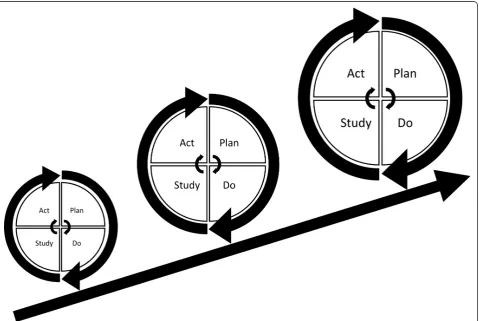
standa-lone method [4] and integration of the full bundle of
key features is often simply referred to as the PDSA method (Fig.1).
Since its introduction to healthcare in the 1990s, numerous QI projects have been based on the PDSA method [10, 24]. However, the scientific literature indi-cates that the evidence for effect is limited [10, 25–30]. The majority of the published PDSA projects have been hampered with severe design limitations, insufficient data analysis and incomplete reporting [12,31]. A 2013 system-atic review revealed that only 2/73 projects reporting use of the PDSA cycle applied the PDSA method in
accord-ance with the methodological recommendations [10].
These methodological limitations have led to an increased awareness of the need for more methodological rigor when conducting and reporting PDSA-based projects
[4, 10]. This challenge is addressed by the emergent
field of Improvement Science (IS) which attempts to systematically examine methods and factors that best facilitate QI by drawing on a range of academic
disci-plines and encourage rigorous use of scientific
methods [5, 12, 32, 33]. It is important to make a dis-tinction between local QI projects, where the primary goal is to secure a change, and IS, where the primary
goal is directed at evaluation and scientific
advancement [12].
In order to improve local QI projects, Standards for Quality Improvement Reporting Excellence (SQUIRE) guidelines have been developed to provide a framework for reporting QI projects [18, 34]. Still, it remains un-clear to what extent the increasing methodological awareness is reflected in PDSA-based QI projects published in recent years. Therefore, we performed a systematic review of recent peer-reviewed publica-tions reporting QI projects using the PDSA method-ology in healthcare and focused on the use of key
[image:2.595.60.540.381.702.2]features in the design and on the reported effects of the projects.
Methods
The key features of PDSA-based QI projects were identi-fied, and a simple but comprehensive framework was constructed. The review was conducted in adherence with the Preferred Reporting Items for Systematic
Reviews and Meta-Analyses (PRISMA) statement [35].
The framework
Informed by recommendations for key features in use and support of PDSA from literature specific to QI in healthcare the following key features were identified:
Use of an iterative cyclic method [6–10]
Use of continuous data collection [2,6,8–13]
Small-scale testing [6,8,10,11,14–16]
Explicit description of the theoretical rationale of the projects [5,9,17–22]
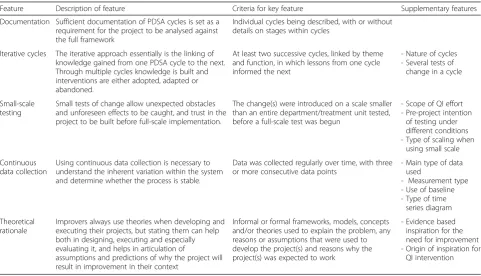
Aiming for conceptual simplicity, we established basic minimum requirements for the presence of the key
fea-tures operationalizing them into binary (yes/no)
variables. General characteristics and supplementary data that elaborated the use of the key features were operationalized and registered as categorical variables.
See Table 1 for an overview of the framework and
Additional file 1 for a more in-depth elaboration of the definitions used for the key features. Since a theoretical rationale can take multiple forms, the definition for this feature was taken from the recent version of the SQUIRE guidelines [18].
Since no formal standardized requirements for report-ing PDSA-based QI projects across journals are estab-lished, not all report the individual PDSA cycles in detail. To ensure that variation in use of key features were inherent in the conduct of the projects and not just due to differences in the reporting, sufficient documen-tation of PDSA cycles was set as a requirement for analysis against the full framework.
Self-reported effects
A pre-specified, quantitative aim can assist to facilitate evaluation of whether the changes represent clinically relevant improvements when using the PDSA method [16]. Self-reported effects of the projects were registered using four categories: 1) Quantitative aim set and reached; 2) No quantitative aim set, improvement regis-tered; 3) Quantitative aim set but not reached; 4) No quantitative aim and no improvement registered.
Systematic review of the literature
[image:3.595.57.539.457.733.2]The target of the literature search was peer-reviewed publications that applied the PDSA cycle as the main
Table 1Framework based on key features of data-driven PDSA projects
Feature Description of feature Criteria for key feature Supplementary features
Documentation Sufficient documentation of PDSA cycles is set as a requirement for the project to be analysed against the full framework
Individual cycles being described, with or without details on stages within cycles
Iterative cycles The iterative approach essentially is the linking of knowledge gained from one PDSA cycle to the next. Through multiple cycles knowledge is built and interventions are either adopted, adapted or abandoned.
At least two successive cycles, linked by theme and function, in which lessons from one cycle informed the next
- Nature of cycles - Several tests of
change in a cycle
Small-scale testing
Small tests of change allow unexpected obstacles and unforeseen effects to be caught, and trust in the project to be built before full-scale implementation.
The change(s) were introduced on a scale smaller than an entire department/treatment unit tested, before a full-scale test was begun
- Scope of QI effort - Pre-project intention
of testing under different conditions - Type of scaling when
using small scale
Continuous data collection
Using continuous data collection is necessary to understand the inherent variation within the system and determine whether the process is stable.
Data was collected regularly over time, with three or more consecutive data points
- Main type of data used
- Measurement type - Use of baseline - Type of time
series diagram
Theoretical rationale
Improvers always use theories when developing and executing their projects, but stating them can help both in designing, executing and especially evaluating it, and helps in articulation of
assumptions and predictions of why the project will result in improvement in their context
Informal or formal frameworks, models, concepts and/or theories used to explain the problem, any reasons or assumptions that were used to develop the project(s) and reasons why the project(s) was expected to work
- Evidence based inspiration for the need for improvement - Origin of inspiration for
method for a QI project in a healthcare setting. The
search consisted of the terms ([‘PDSA’ OR ‘
plan-do-study-act’] AND [‘quality’ OR ‘improvement’]). The terms were searched for in title and abstract. No relevant MeSH terms were available. To get a contemporary sta-tus of the QI field, the search was limited to QI projects published in 2015 and 2016. PubMed, Embase and CINAHL databases were searched with the last search date being 2nd of March 2017.
Study selection
The following inclusion criteria were used: Peer-reviewed publications reporting QI projects using the PDSA methodology in healthcare, published in English. Exclusion criteria were: IS studies, editorials, conference abstracts, opinions and audit articles, reviews or projects solely involving teaching the PDSA method.
Two reviewers (SVK and HVBL) performed the screening process independently. Title and abstract were screened for inclusion followed by an assessment of the full text according to the eligibility criteria. This was per-formed in a standardized manner with the Covidence software. Disagreements were resolved by consensus.
Data collection process
A data collection sheet was developed and pilot tested. The subsequent refinement resulted in a standardized sheet into which data were extracted independently by SVK and HVBL.
Data items
Data from the key and supplementary features were extracted in accordance with the framework. The binary data were used to grade QI projects on a scale of 0–4, based on how many of the four key features were ap-plied. Data were analyzed in STATA (version 15.0, Stata-Corp LLC).
Results
Study selection Selection process
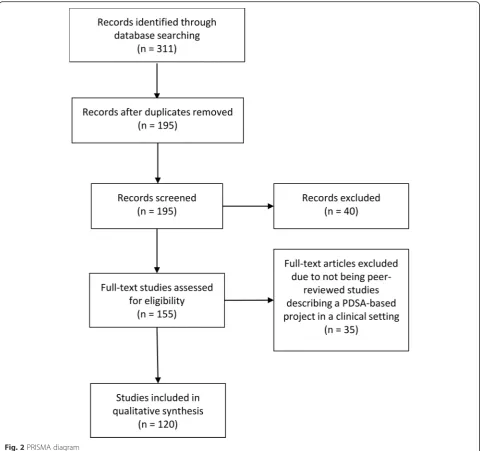
The search identified 311 QI projects of which 195 remained after duplicate removal. A total of 40 and 35 projects were discarded after screening abstracts and full texts, respectively. Hence, a total of 120 pro-jects met the inclusion criteria and were included in the review (see Fig. 2).
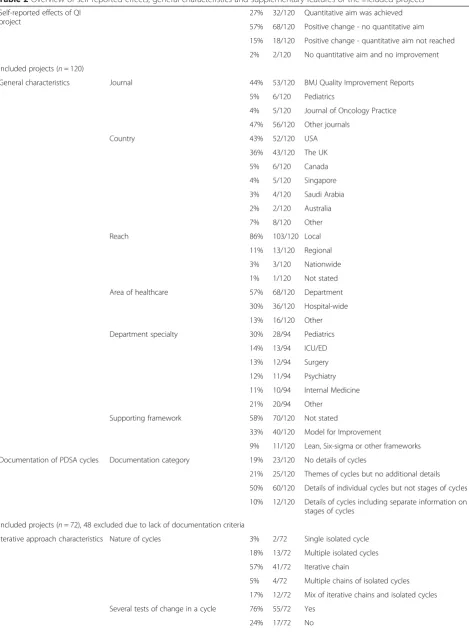
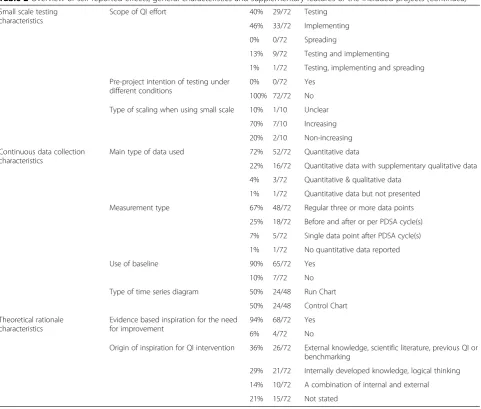
An overview of general characteristics, supplementary features and self-reported effects of the included projects are presented in Table2.
General characteristics Country and journal
The included QI projects originated from 18 different countries including the USA (n= 52), the UK (n= 43), Canada (n= 6), Singapore (n= 5), Saudi Arabia (n= 4), Australia (n= 2) and one each from eight other countries. Fifty different journals had published QI projects with the
vast majority (n= 53) being from BMJ Quality
Improve-ment Reports. See Additional file2for a full summery of the findings.
Area and specialty
In terms of reach, most were local (n= 103) followed by regional (n= 13) and nationwide (n= 3). The areas of
healthcare were primarily at departmental (n= 68) and
hospital level (n= 36). Many different specialties were represented, the most common being pediatrics (n= 28), intensive or emergency care (n= 13), surgery (n= 12), psychiatry (n= 11) and internal medicine (n= 10).
Supporting framework
Most QI projects did not state using a supporting
frame-work (n= 70). However, when stated, most used The
Model for Improvement (n= 40). The last (n= 10) used Lean, Six-sigma or other frameworks.
Reported effects
All 120 projects included were assessed for the self-re-ported effects. Overall, 118/120 (98%) projects reself-re-ported improvement. Thirty-two (27%) achieved a pre-specified aim set in the planning process, whereas 68 (57%) reported an improvement without a pre-specified aim. Eighteen projects (15%) reported setting an aim and not reaching it while two (2%) projects did not report a pre-specified aim and did not report any improvement.
Documentation
Seventy-two projects had sufficient documentation of the PDSA cycles. Sixty of these contained information on individual stages of cycles, while 12 in addition pre-sented detailed information on the four stages of the PDSA cycles.
Application of key features of PDSA
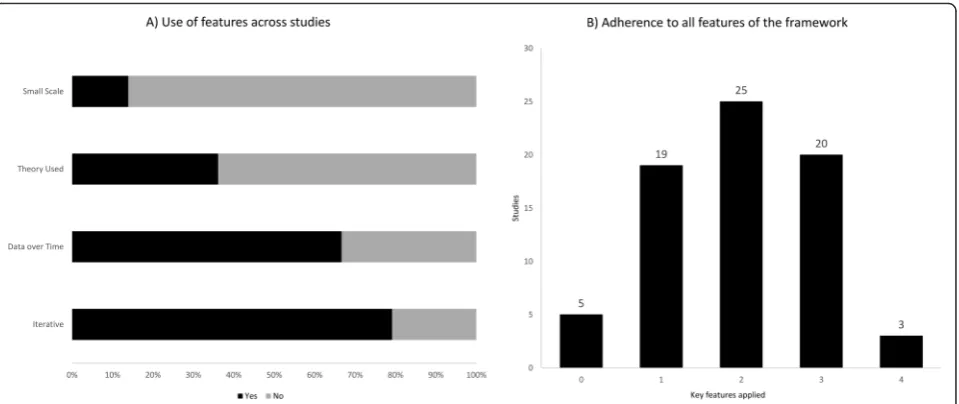
The application of the key PDSA features appeared to be highly inconsistent. The iterative method was used in 75 projects (79%), continuous data collection in 48 (67%), an explicit theoretical rational was present in 26 (36%) projects and small-scale testing was carried out by 10
(14%) (Fig. 3a). All key features of the method were
Iterative cycles
Fifty-seven projects (79%) had a sequence of cycles where one informed the actions of the next. A single iterative chain of cycles was used in 41 (57%), while four (5%) had multiple isolated iterative chains and 12 (17%) had a mix of iterative chains and isolated cycles. Of the 15 projects using non-iterative cycles, two reported a single cycle while 13 used multiple isolated cycles. The majority (55/72) (76%) tested one change per cycle.
Small scale testing
The testing of changes in a small scale was carried out by 10 projects (14%), of which seven did so in an in-creasing scale, while two kept testing at the same scale. It was unclear which type of scaling was used in the
remaining project. Sixty-two projects (86%) carried out testing on an entire department or engaged in full-scale implementation before having tested the improvement intervention.
Continuous data collection
[image:5.595.58.542.87.538.2]Table 2Overview of self-reported effects, general characteristics and supplementary features of the included projects
Self-reported effects of QI project
27% 32/120 Quantitative aim was achieved
57% 68/120 Positive change - no quantitative aim
15% 18/120 Positive change - quantitative aim not reached
2% 2/120 No quantitative aim and no improvement
Included projects (n= 120)
General characteristics Journal 44% 53/120 BMJ Quality Improvement Reports
5% 6/120 Pediatrics
4% 5/120 Journal of Oncology Practice
47% 56/120 Other journals
Country 43% 52/120 USA
36% 43/120 The UK
5% 6/120 Canada
4% 5/120 Singapore
3% 4/120 Saudi Arabia
2% 2/120 Australia
7% 8/120 Other
Reach 86% 103/120 Local
11% 13/120 Regional
3% 3/120 Nationwide
1% 1/120 Not stated
Area of healthcare 57% 68/120 Department
30% 36/120 Hospital-wide
13% 16/120 Other
Department specialty 30% 28/94 Pediatrics
14% 13/94 ICU/ED
13% 12/94 Surgery
12% 11/94 Psychiatry
11% 10/94 Internal Medicine
21% 20/94 Other
Supporting framework 58% 70/120 Not stated
33% 40/120 Model for Improvement
9% 11/120 Lean, Six-sigma or other frameworks
Documentation of PDSA cycles Documentation category 19% 23/120 No details of cycles
21% 25/120 Themes of cycles but no additional details
50% 60/120 Details of individual cycles but not stages of cycles
10% 12/120 Details of cycles including separate information on stages of cycles
Included projects (n= 72), 48 excluded due to lack of documentation criteria
Iterative approach characteristics Nature of cycles 3% 2/72 Single isolated cycle
18% 13/72 Multiple isolated cycles
57% 41/72 Iterative chain
5% 4/72 Multiple chains of isolated cycles
17% 12/72 Mix of iterative chains and isolated cycles
Several tests of change in a cycle 76% 55/72 Yes
Theoretical rationale
Twenty-six (36%) out of 72 projects explicitly stated the theoretical rationale of the project describing why it was predicted to lead to improvement in their specific clinical context. In terms of inspiration for the need for improve-ment 68 projects (94%) referred to scientific literature. For the QI interventions used in the projects 26 (36%) found inspiration in externally existing knowledge in forms of scientific literature, previous QI projects or benchmarking. Twenty-one (29%) developed the projects themselves, 10 (14%) used existing knowledge in combination with own ideas while 15 (21%) did not state the source.
Discussion
In this systematic review nearly all PDSA-based QI projects reported improvements. However, only approxi-mately one out of four projects had defined a specific quantitative aim and reached it. In addition, only a small
minority of the projects reported to have adhered to all four key features recommended in the literature to ensure the quality and adaptability of a QI project.
The claim that PDSA leads to improvement should be interpreted with caution. The methodological limitations in many of the projects makes it difficult to draw firm conclusions about the size and the causality of the reported improvements in quality of care. The methodo-logical limitations question the legitimacy of PDSA as an effective improvement method in health care. The widespread lack of theoretical rationale and continu-ous data collection in the projects makes it difficult to track and correct the process as well as to relate an im-provement to the use of the method [10,11]. The appar-ent limited use of the iterative approach and small-scale-testing constitute an additional methodological limitation. Without these tools of testing and adapting
[image:7.595.58.540.94.503.2]one can risk introducing unintended consequences [1,
Table 2Overview of self-reported effects, general characteristics and supplementary features of the included projects(Continued)
Small scale testing characteristics
Scope of QI effort 40% 29/72 Testing
46% 33/72 Implementing
0% 0/72 Spreading
13% 9/72 Testing and implementing
1% 1/72 Testing, implementing and spreading
Pre-project intention of testing under different conditions
0% 0/72 Yes
100% 72/72 No
Type of scaling when using small scale 10% 1/10 Unclear
70% 7/10 Increasing
20% 2/10 Non-increasing
Continuous data collection characteristics
Main type of data used 72% 52/72 Quantitative data
22% 16/72 Quantitative data with supplementary qualitative data
4% 3/72 Quantitative & qualitative data
1% 1/72 Quantitative data but not presented
Measurement type 67% 48/72 Regular three or more data points
25% 18/72 Before and after or per PDSA cycle(s)
7% 5/72 Single data point after PDSA cycle(s)
1% 1/72 No quantitative data reported
Use of baseline 90% 65/72 Yes
10% 7/72 No
Type of time series diagram 50% 24/48 Run Chart
50% 24/48 Control Chart
Theoretical rationale characteristics
Evidence based inspiration for the need for improvement
94% 68/72 Yes
6% 4/72 No
Origin of inspiration for QI intervention 36% 26/72 External knowledge, scientific literature, previous QI or benchmarking
29% 21/72 Internally developed knowledge, logical thinking
14% 10/72 A combination of internal and external
36]. Hence, QI initiatives may potentially tamper with the system in unforeseen ways creating more harm and waste than improvement. The low use of small-scale-testing could perhaps originate in a widespread misun-derstanding that one should test large-scale to get a proper statistical power. However, this is not necessar-ily the case with PDSA [15].
There is no simple answer to this lack of adherence to the key methodological features. Some scholars claim that even though the concept of PDSA is relatively sim-ple it is difficult to master in reality [4]. Some explana-tions to this have been offered including an urge to favour action over evidence [36], an inherent messiness in the actual use of the method [11], its inability to ad-dress “big and hairy” problems [37], an oversimplifica-tion of the method, and an underestimaoversimplifica-tion of the required resources and support needed to conduct a PDSA-based project [4].
In some cases, it seems reasonable that the lack of adherence to the methodological recommendations is a problem with documentation rather than methodo-logical rigor, e.g. the frequent lack of small-scale pilot testing may be due to the authors considering the infor-mation too irrelevant, while still having performed it in the projects.
Regarding our framework one could argue that it has too many or too few key features to encompass the PDSA method. The same can be said about the supple-mentary features where additional features could also have been assessed e.g. the use of Specific, Measurable, Attainable, Relevant and Timebound (SMART) goals [14]. It has been important for us to operationalize the key features so their presence easily and accurately can be identified. Simplification carries the risk of loss of
information but can be outweighed by a clear and applicable framework.
This review has some limitations. We only included PDSA projects reported in peer-reviewed journals, which represents just a fraction of all QI projects being conducted around the globe. Further, it might be difficult to publish projects that do not document im-provements. This may introduce potential publication bias. Future studies could use the framework to examine the grey literature of evaluation reports etc. to see if the pattern of methodological limitations is consistent. The fact that a majority of the projects reported positive change could also indicate a potential bias. For busy QI practitioners the process of translating a clinical project into a publication could well be motivated by a positive finding with projects with negative effects not being reported. However, we should not forget that negative outcome of a PDSA project may still contribute with valuable learning and competence building [4,6].
The field of IS and collaboration between practitioners and scholars has the potential to deliver crucial insight into the complex process of QI, including the difficulties with replicating projects with promising effect [5, 12,20,
32]. Rigorous methodological adherence may be
experi-enced as a restriction on practitioners, which could dis-courage engagement in QI initiatives. However, by strengthening the use of the key features and improving documentation the PDSA projects will be more likely to contribute to IS, including reliable meta-analyses and
sys-tematic reviews [10]. This could in return provide QI
practitioners with evidence-based knowledge [5, 38]. In this way rigor in performing and documenting QI projects benefits the whole QI community in the long run. It is
important that new knowledge becomes readily
[image:8.595.60.540.87.289.2]available and application oriented, in order for practi-tioners to be motivated to use it. An inherent part of using the PDSA method consists of acknowledging the complexity of creating lasting improvement. Here the scientific ideals about planning, executing, hypothesiz-ing, data managing and documenting with rigor and high quality should serve as inspiration.
Our framework could imply that the presence of all four features will inevitably result in the success of an improvement project. This it clearly not the case. No “magic bullets” exist in QI [39]. QI is about implement-ing complex projects in complex social contexts. Here adherence to the key methodological recommendations and rigorous documentation can help to ensure better quality and reproducibility. This review can serve as a reminder of these features and how rigor in the individ-ual QI projects can assist the work of IS, which in return can offer new insight for the benefit of practitioners.
Conclusion
This systematic review documents that substantial methodological challenges remain when reporting from PDSA projects. These challenges pose a problem for the legitimacy of the method. Individual improvement projects should strive to contribute to a scientific foun-dation for QI by conducting and documenting with a higher rigor. There seems to be a need for methodo-logical improvement when conducting and reporting from QI initiatives.
Additional files
Additional file 1:Description of variables and coding. (DOCX 24 kb)
Additional file 2:Projects identified in the search that used PDSA method. (DOCX 204 kb)
Additional file 3:Projects identified in search that describes PDSA method in sufficient detail to be included for full analysis for framework. (DOCX 145 kb)
Abbreviations
IS:Improvement Science; PDSA: Plan-Do-Study-Act; PRISMA: Preferred Reporting Items for Systematic Reviews and Meta-Analyses; QI: Quality Improvement; SMART: Specific, Measurable, Attainable, Relevant and Timebound; SQUIRE: Standards for QUality Improvement Reporting Excellence
Acknowledgements Not applicable.
Authors’contributions
All authors have made substantive intellectual contributions to the review. SVK and HVBL have been the primary authors and have made substantial contributions to conception and design, acquisition, analysis and
interpretation of the data as well as developing drafts of the manuscript. LHE and JM have been primary supervisors and have contributed substantially with intellectual feedback and manuscript revision. SPJ and PB have made substantial contributions by revising the manuscript critically for intellectual content. Each author agrees to be accountable for all aspects of the work and all authors have given final approval of the version to be published.
Funding
The review was funded by Aalborg University, Denmark. The funding body had no influence on the study design, on the collection, analysis and interpretation of data or on the design of the manuscript.
Availability of data and materials
All data generated or analysed during this review are included in this published article and its supplementary information files.
Ethics approval and consent to participate Not applicable.
Consent for publication Not applicable.
Competing interests
The authors declare that they have no competing interests.
Author details
1Danish Center for Clinical Health Services Research (DACS), Department of
Clinical Medicine, Aalborg University, Mølleparkvej 10, 9000 Aalborg, Denmark.2Psychiatry, Aalborg University Hospital, The North Denmark Region Mølleparkvej 10, 9000 Aalborg, Denmark.3Danish Center for
Healthcare Improvements (DCHI), Aalborg University, Fibigerstræde 11, 9220 Aalborg Øst, Denmark.4Danish Clinical Registries, Denmark, Nrd. Fasanvej 57,
2000 Frederiksberg, Denmark.5Department for Community Mental Health, Haifa University, Haifa, Israel.6Department of Health Economics, University of
Southern Denmark, Odense, Denmark.
Received: 7 January 2019 Accepted: 28 August 2019
References
1. Nicolay CR, Purkayastha S, Greenhalgh A, Benn J, Chaturvedi S, Phillips N, et al. Systematic review of the application of quality improvement
methodologies from the manufacturing industry to surgical healthcare. Br J Surg. 2012;99(3):324–35.
2. Speroff T, O’Connor GT. Study designs for PDSA quality improvement research. Qual Manag Health Care. 2004;13(1):17–32.
3. Moen R. Foundation and history of the PDSA cycle. Assoc Process Improv. 2009; Available from: https://deming.org/uploads/paper/PDSA_History_ Ron_Moen.pdf.
4. Reed JE, Card AJ. The problem with plan-do-study-act cycles. BMJ Qual Saf. 2016;25(3):147–52.
5. Portela MC, Lima SML, Martins M, Travassos C. Improvement Science: conceptual and theoretical foundations for its application to healthcare quality improvement. Cad Saude Publica. 2016;32(sup 2):e00105815. 6. Langley GJ, Moen R, Nolan KM, Nolan TW, Norman CL, Provost LP. The
improvement guide, 2nd edition. Jossey-Bass. 2009.
7. Berwick DM. The science of improvement. JAMA - J Am Med Assoc. 2008; 299(10):1182–4.
8. Berwick DM, Nolan TW. Developing and testing changes in delivery of care. Ann Intern Med. 1998;128(1):651–6.
9. Perla RJ, Provost LP, Parry GJ. Seven propositions of the science of improvement: exploring foundations. Qual Manag Health Care. 2013;22(3):170–86.
10. Taylor MJ, McNicholas C, Nicolay C, Darzi A, Bell D, Reed JE. Systematic review of the application of the plan-do-study-act method to improve quality in healthcare. BMJ Qual Saf 2013;0:1–9.
11. Ogrinc G. Building knowledge, asking questions. BMJ Qual Saf. 2014;23(4): 265–7.
12. Portela MC, Pronovost PJ, Woodcock T, Carter P, Dixon-Woods M. How to study improvement interventions: a brief overview of possible study types. Postgrad Med J. 2015;91(1076):343–54.
13. Thor J, Lundberg J, Ask J, Olsson J, Carli C, Härenstam KP, et al. Application of statistical process control in healthcare improvement: systematic review. Qual Saf Heal Care. 2007;16(5):387–99.
15. Etchells E, Ho M, Shojania KG. Value of small sample sizes in rapid-cycle quality improvement projects. BMJ Qual Saf. 2016;25(3):202–6.
16. Berwick DM. A primer on leading the improvement of systems. BMJ Br Med J. 1996;312(7031):619.
17. Speroff T, James BC, Nelson EC, Headrick LA, Brommels M. Guidelines for appraisal and publication of PDSA quality improvement. Qual Manag Health Care. 2004;13(1):33–9.
18. Ogrinc G, Davies L, Goodman D, Batalden P, Davidoff F, Stevens D. Standards for QUality Improvement Reporting Excellence 2.0: revised publication guidelines from a detailed consensus process. BMJ Qual Saf. 2016;25:986–92.
19. Moonesinghe SR, Peden CJ. Theory and context: putting the science into improvement. Br J Anaesth. 2017;118(4):482–4.
20. Davidoff F, Dixon-Woods M, Leviton L, Michie S. Demystifying theory and its use in improvement. BMJ Qual Saf. 2015;24(3):228–38.
21. Foy R, Ovretveit J, Shekelle PG, Pronovost PJ, Taylor SL, Dy S, et al. The role of theory in research to develop and evaluate the implementation of patient safety practices. BMJ Qual Saf. 2011;20(5):453–9.
22. Walshe K. Pseudoinnovation: the development and spread of healthcare quality improvement methodologies. Int J Qual Heal Care. 2009;21(3):153–9. 23. Walshe K. Understanding what works-and why-in quality improvement: the
need for theory-driven evaluation. Int J Qual Heal Care. 2007;19(2):57–9. 24. Powell AE, Rushmer RK, Davies HT. A systematic narrative review of quality
improvement models in health care. Glasgow: Quality Improvement Scotland (NHS QIS ). 2009.
25. Groene O. Does quality improvement face a legitimacy crisis? Poor quality studies, small effects. J Heal Serv Res Policy. 2011;16(3):131–2.
26. Dixon-Woods M, Martin G. Does quality improvement improve quality? Futur Hosp J. 2016;3(3):191–4.
27. Blumenthal D, Kilo CM. A report Card on continuous quality improvement. Milbank Q. 1998;76(4):625–48.
28. Dellifraine JL, Langabeer JR, Nembhard IM. Assessing the evidence of six sigma and lean in the health care industry. Qual Manag Health Care. 2010; 19(3):211–25.
29. D’Andreamatteo A, Ianni L, Lega F, Sargiacomo M. Lean in healthcare: a comprehensive review. Health Policy (New York). 2015;119(9):1197–209. 30. Moraros J, Lemstra M, Nwankwo C. Lean interventions in healthcare: do
they actually work? A systematic literature review. Int J Qual Heal Care. 2016:150–65.
31. Shojania KG, Grimshaw JM. Evidence-based quality improvement: the state of the science. Health Aff. 2005;24(1):138–50.
32. Marshall M, Pronovost P, Dixon-Woods M. Promotion of improvement as a science. Lancet. 2013;381(9881):419–21.
33. The Health Foundation. Improvement science. Heal Found Heal Scan. 2011. Available from:http://www.health.org.uk/sites/health/files/
ImprovementScience.pdf.
34. Davidoff F, Batalden P, Stevens D, Ogrinc G, Mooney S. Publication guidelines for quality improvement in health care: evolution of the SQUIRE project. Qual Saf Heal Care. 2008;17(SUPPL. 1):i3–9.
35. Liberati A, Altman DG, Tetzlaff J, Mulrow C, Gøtzsche PC, Ioannidis JPA, et al. The PRISMA statement for reporting systematic reviews and meta-analyses of studies that evaluate health care interventions: explanation and elaboration. BMJ Br Med J. 2009;339:b2700.
36. Auerbach AD, Landefeld CS, Shojania KG. The tension between needing to improve care and knowing how to do it. N Engl J Med. 2007;357(6):608–13. 37. Dixon-Woods M, Martin G, Tarrant C, Bion J, Goeschel C, Pronovost P, et al.
Safer clinical systems: evaluation findings. Heal Found. 2014; Available from: https://www.health.org.uk/publications/safer-clinical-systems-evaluation-findings.
38. Dixon-Woods M, Bosk CL, Aveling EL, Goeschel CA, Pronovost PJ. Explaining Michigan: developing an ex post theory of a quality improvement program. Milbank Q. 2011;89(2):167–205.
39. Oxman AD, Thomson MA, Davis DA, Haynes B. No magic bullets: a systematic review of 102 trials of interventions to improve professional practice. Cmaj. 1995;153(10):1423–31.
Publisher’s Note