Open Access
Study protocol
Collaborative Depression Trial (CADET): multi-centre
randomised controlled trial of collaborative care for depression -
study protocol
David A Richards*
1, Adwoa Hughes-Morley
1, Rachel A Hayes
1,
Ricardo Araya
2, Michael Barkham
3, John M Bland
4, Peter Bower
5,
John Cape
6, Carolyn A Chew-Graham
7, Linda Gask
5, Simon Gilbody
4,
Colin Green
8, David Kessler
9, Glyn Lewis
2, Karina Lovell
10, Chris Manning
11and Stephen Pilling
12Address: 1Mood Disorders Centre, School of Psychology, University of Exeter, EX4 4QG, UK, 2Academic Unit of Psychiatry, University of Bristol,
Cotham Hill, BS6 6JL, UK, 3Clinical Psychology Unit, Dept of Psychology, University of Sheffield, S10 2TP, UK, 4Department of Health Sciences,
1st floor, Seebohm Rowntree Building, University of York, Heslington, York, YO10 5DD, UK, 5NPCRDC, Williamson Building, University of
Manchester, Oxford Road, Manchester M13 9PL, UK, 6Camden and Islington Mental Health and Social Care Trust, East Wing, St Pancras Hospital,
4 St Pancras Way, London, NW1 0PE, UK, 7University of Manchester, School of Community Based Medicine, Rusholme Academic Unit, Walmer
Street, Manchester, M14 5NP, UK, 8Peninsula Medical School, University of Exeter, St Lukes Campus, Exeter EX1 2LU, UK, 9Academic Unit of
Primary Health Care, University of Bristol, 25 Belgrave Road, Clifton, Bristol BS8 2AA, UK, 10The School of Nursing, Midwifery and Social Work,
University of Manchester, Room 6.322a, Jean McFarlane Building, University Place, Oxford Road, Manchester, M13 9PL, UK, 11Upstream
Healthcare Ltd, Unit 5, 2a, Laurel Avenue, Twickenham, TW1 4JA, UK and 12CORE, Clinical Health Psychology, 1-19 Torrington Place, London,
WC1E 7HB, UK
Email: David A Richards* - [email protected]; Adwoa Hughes-Morley - [email protected];
Rachel A Hayes - [email protected]; Ricardo Araya - [email protected]; Michael Barkham - [email protected]; John M Bland - [email protected]; Peter Bower - [email protected]; John Cape - [email protected]; Carolyn A Chew-Graham - [email protected]; Linda Gask - [email protected]; Simon Gilbody - [email protected]; Colin Green - [email protected]; David Kessler - [email protected]; Glyn Lewis - [email protected]; Karina Lovell - [email protected]; Chris Manning - [email protected]; Stephen Pilling - [email protected] * Corresponding author
Abstract
Background: Comprising of both organisational and patient level components, collaborative care is a potentially powerful intervention for improving depression treatment in UK primary Care. However, as previous models have been developed and evaluated in the United States, it is necessary to establish the effect of collaborative care in the UK in order to determine whether this innovative treatment model can replicate benefits for patients outside the US. This Phase III trial was preceded by a Phase II patient level RCT, following the MRC Complex Intervention Framework.
Methods/Design: A multi-centre controlled trial with cluster-randomised allocation of GP practices. GP practices will be randomised to usual care control or to "collaborative care" - a combination of case manager coordinated support and brief psychological treatment, enhanced specialist and GP communication. The primary outcome will be symptoms of depression as assessed by the PHQ-9.
Published: 16 October 2009
BMC Health Services Research 2009, 9:188 doi:10.1186/1472-6963-9-188
Received: 3 September 2009 Accepted: 16 October 2009
This article is available from: http://www.biomedcentral.com/1472-6963/9/188
© 2009 Richards et al; licensee BioMed Central Ltd.
Discussion: If collaborative care is demonstrated to be effective we will have evidence to enable the NHS to substantially improve the organisation of depressed patients in primary care, and to assist primary care providers to deliver a model of enhanced depression care which is both effective and acceptable to patients.
Trial Registration Number: ISRCTN32829227
Background
Depression is a major health problem causing substantial disability and set to become the second largest cause of global disability by 2020 [1,2]. Despite the availability of effective pharmacological and psychological treatments for depression, patients often receive a less than optimal treatment programme. In primary healthcare systems internationally, patient adherence with pharmacological treatment is poor [3] and problems are exacerbated fur-ther by organisational barriers between generalist and spe-cialist mental health professionals [4,5]. Generalist primary care physicians often have very limited support when helping patients with both pharmacological treat-ment and psychosocial interventions. Such support may be critical given that in systems such as that in the United Kingdom (UK) and elsewhere, the general practitioner (GP) is the sole responsible medical clinician for 90-95% of patients [6].
Attempts to improve this situation have seen the develop-ment of organisational strategies including increased resources to specialist services, education of primary care clinicians, consultation liaison services and stepped care [7]. A systematic review of 36 organisational intervention studies concluded that simple models such as guidelines and education were ineffective in improving the manage-ment of depression [8]. Gunn et al [9] identified the com-ponents of effective organisational quality improvement strategies as: a multi-professional approach to patient care; a structured management plan; scheduled patient follow-ups; and enhanced inter-professional communica-tion.
One model which has seen an increasing efficacy and effectiveness literature is 'collaborative care' [7] which highlights the chronic nature of depression and proposes that the whole system of care for depression needs to be reengineered. Collaborative care is a complex combina-tion of clinician and patient educacombina-tion, consultacombina-tion-liai- consultation-liai-son between primary and secondary care clinicians and case management [10], translated into practice by the introduction of a new case manager role into primary care who liaises between primary care clinicians and mental health specialists, collects and shares information on the clinical care of individual patients and delivers and man-ages aspects of their care [7].
Whilst collaborative care improves outcomes over usual care [11-13], the vast majority of models have been devel-oped and evaluated in the United States (US) [14]. Given this, it is necessary to establish the international generalis-ability of collaborative care to determine if these out-comes can be replicated beyond the US, where the nature of patient populations and patterns of service utilization may differ. The feasibility and acceptability of implemen-tation in the UK National Health Service (NHS) is likely to be shaped by funding arrangements, deployment of staff and the structure and organization of component parts of the NHS (particularly primary care).
In order to investigate collaborative care in the UK, we adopted the UK Medical Research Council's (MRC) [15,16] strategy for the investigation of complex interven-tions. Through a series of exploratory qualitative and quantitative studies as part of a 'Trial Platform' funded by the Medical Research Council [17-20] we found collabo-rative care to have a moderate to large effect (0.63; 95% confidence interval = 0.18 to 1.07), the first time this has been demonstrated in the UK, with change in PHQ-9 scores achieved by the intervention patients from baseline to follow up equating to a clinical shift of almost two cat-egories of depression severity. We also found that the best method of recruitment was through case finding and that collaborative care was acceptable to patients and mental health workers. As a consequence, we have designed a fully powered trial of collaborative care as the next step in our phased approach to investigating this complex inter-vention.
Methods/Design
Objectives
Is collaborative care more clinically and cost effective than usual care in the management of patients with moderate to severe depression in UK primary care?
Study Design
This is a pragmatic cluster randomised controlled trial with allocation of clusters (GP practices) to two alterna-tive branches (see Figure 1)
1) Collaborative care (experimental group)
Consort diagram detailing progression through the trial Figure 1
Consort diagram detailing progression through the trial.
GP Surgeries: Total Number in all 3 sites= Losses =
Refused to participate n = Not contacted due to target number reached n =
Randomised, Number of GPs sur ger ies n =
Collabor ative Car e Gr oup Total Number of surgeries = Size of Surgery =
(mean and range)
Usual Car e Gr oup Total Number of surgeries = Size of Surgery =
(mean and range)
Patients identified by case note screening n = Excluded n =
Not depressed = Bereavement = Declined = Other =
Patients identified by case note screening n = Excluded n =
Not depressed = Bereavement = Declined = Other = Included Patients = Included Patients =
4 month analysis Patients analysed n = ( %) Patients not analysed
couldn’t be contacted n = ( %) withdraw from study n = ( %) other n = ( %)
4 month analysis Patients analysed n = ( %) Patients not analysed
couldn’t be contacted n = ( %) withdraw from study n = ( %) other n = ( %)
12 month analysis Patients analysed n = ( %) Patients not analysed
couldn’t be contacted n = ( %) withdraw from study n = ( %) other n = ( %)
12 month analysis Patients analysed n = ( %) Patients not analysed
The rationale for a cluster randomised trial comes from data collected in our trial platform [19] where we tested directly for the presence of contamination between exper-imental and control conditions. In this pilot phase, after initially randomising General Practices to treatment or cluster control conditions, patients in the treatment clus-ter group were then individually randomised to either col-laborative care or usual care control. This created three study groups (cluster-randomized controls, individually-randomized intervention patients, individually-rand-omized control patients). Our results showed evidence for substantial contamination, in that when compared to the intervention group's outcomes, patients in the patient-randomised control group (who received no direct patient-level interventions, but may have benefited from organisational effects at the cluster level) had better out-comes (coefficient = -2.99 95% CI -7.56 to 1.58, p = 0.186) than those in the cluster-randomised control who received neither patient- nor organisational-level inter-vention (coefficient = -4.64; 95% CI -7.93 to -1.35, p = 0.008). The intra-class correlation co-efficient (ICC) for our primary outcome was 0.06 (95% CI = 0.00 to 0.32). This suggests that the effect of the intervention was partly mediated through organisational effects. Therefore, we had to conclude that a patient-randomised trial of collab-orative care could be vulnerable to contamination and open to type II error - underestimating the true effect size of the intervention through potential intervention 'leak-age'. As a consequence, a cluster-randomised controlled trial design is the safest in order to minimise this potential source of bias and provide a truer estimate of the collabo-rative care intervention effect size.
Recruitment of GP practices
We will recruit 48 GP practices in three different recruit-ment sites: Manchester, London and Bristol, each site responsible for the recruitment of 16 practices. All GP practices in the local Primary Care Trust (PCT) will be eli-gible for inclusion.
Randomisation of GP Practices
We will allocate practices by minimisation, with a random element, on centre, deprivation and practice size. We will use the Index of Multiple Deprivation 2007 [21] to assess the level of deprivation in each practice.
Patient Recruitment
Sample Size
We have powered this trial to detect an effect size of 0.4. Our effect size is towards the conservative end of our plat-form trial confidence interval [19] SMD: 0.63; 95% CI 0.18 to 1.07, an effect size achieved by Pilling et al [22] SMD 0.42; 95% CI -0.05 to +0.89, and in line with the findings of recent reviews [23] and our group's recent
meta regression [14]. An effect size of 0.4 is also regarded as the most reasonable for determining differences between interventions that are clinically meaningful [24]. Such an effect size at 90% power (alpha 0.05) would require 132 patients per group in a two armed patient ran-domised trial. For the proposed cluster trial, with 14 patients per cluster and the ICC found in our trial plat-form of 0.06, the design effect would be 1.65. The cluster trial sample size is, therefore, 440. In order to follow up 440 patients, we will recruit and randomise 550 patients to anticipate a loss to follow up of 20%.
Patient inclusion criteria
We will include patients meeting the diagnostic criteria for depression who are aged 18 years and above and who are not currently receiving treatment for depression from spe-cialist mental health services. We will establish the diag-nosis of depression by the use of the Clinical Interview Schedule (CIS-R) [25] undertaken by a research worker. We will include both patients newly identified as depressed, with or without one or more previous depres-sive episodes, and those with an existing diagnosis of depression which is not responding to primary care man-agement. We will also include patients who are suffering from peri- or post-natal depression, with either co-morbid physical illness or co-morbid non-psychotic functional disorders, such as anxiety. In line with the pragmatic nature of this trial, we will reflect usual GP care and par-ticipants will be eligible to participate whether they are in receipt of antidepressant medication or not.
Patient Exclusion Criteria
We will exclude patients whose risk of suicide is suffi-ciently acute to demand immediate management by a spe-cialist mental health crisis team. We will exclude patients with psychosis, both type I and type II bi-polar disorder, patients where the low mood is better explained by the death of someone close to them and patients whose pri-mary presenting problem is alcohol or drug abuse. Patients who are currently receiving specialist treatment for their depression will also be excluded.
Patient Identification and Recruitment
depres-sion, and will be conducted by practice staff or Clinical Studies Officers blind to the random allocation of the GP surgery.
Identified patients will receive a letter from their GP sur-gery inviting them to take part in the study, enclosing a patient summary sheet outlining the study with a 'Permis-sion for researcher to contact' form to allow a researcher to contact them. Recruitment which requires patients to return paper forms is known to have a very poor response rate, typically only 15% of those contacted will agree to be contacted, a threat to the study's external validity. A recent review of RCT recruitment methods [26] showed that the only likely method of improving recruitment was through telephone reminders by clinicians to non-responders. Consequently, in order to make our sample more repre-sentative of a primary care depressed population, we will attempt to enhance our response rate through telephone follow up by practice staff or Clinical Studies Officers.
Screening and Baseline
At the screening appointment the researcher will confirm the diagnosis of depression using the R [25]. The CIS-R is a computerised interview schedule that establishes the nature and severity of neurotic symptoms and identifies a categorical diagnosis of mild, moderate or severe depres-sion. If the patient is depressed and meets all other inclu-sion criteria we will collect baseline primary and secondary outcome measures.
Allocation
Once the baseline assessments are complete, the partici-pant's details will be entered into our automated alloca-tion service via telephone or the internet. Each participant will be assigned an ID number and if their practice is one assigned to collaborative care then the participant's details will be automatically sent to the relevant case manager to alert them to contact this person. All new participants' details are also sent to the trial coordinator and their GP will be informed of their involvement in the study.
Intervention - Case Management
The experimental intervention will follow the criteria identified by Gunn et al [9] for effective quality improve-ment strategies, which we have developed into a collabo-rative care protocol, tailored to UK systems and incorporating the preferences of patients, specialists and GPs from our trial platform [17,20].
Participants will receive a structured management plan including education about depression, medication man-agement, behavioural activation and relapse prevention. The case manager will reinforce the information given to participants by their GP and by helping participants and GPs problem solve any difficulties with medication
con-cordance, enabling participants to make good use of their medicines. Behavioural Activation (BA) is an effective cog-nitive-behavioural treatment of depression [27] that focuses upon reducing avoidance and increasing activity. We found BA to be acceptable in our pilot trial [20]. Relapse prevention will involve the development of indi-vidualised recovery plans which will help participants identify signature alert symptoms to prompt them to con-sider reinstating both their pharmacological and psycho-logical depression management strategies.
Scheduled patient follow-ups will be organised via six to twelve scheduled telephone and face-to-face contacts by case managers with participants over a period of fourteen weeks. After an initial face-to-face contact most other con-tacts will be by telephone, although the option for further face-to-face contacts will be available for participants who are having difficulty settling to telephone contact. Negoti-ation of contact frequency will take into account partici-pant preference, response to treatment, the requirements of the psychosocial support programme and the amount of GP-patient contact. However, in general, contacts will be weekly for the first five weeks of contact, followed by fortnightly thereafter. The initial contact session will be 30-40 minutes with subsequent sessions 15-20 minutes each.
Case manager training and supervision
Case Managers will be either graduate psychologists or health care qualified professionals educated through existing mental health education programmes and trained specifically to deliver the collaborative care protocol. Case managers will adhere to a clinical protocol and will be supported by specialist mental health professionals who will provide weekly supervision of cases together with advice and support. Supervision for each individual par-ticipant will be no less than four weekly and will be facil-itated through a bespoke computerised patient management system (PC-MIS) [28] which automatically alerts supervisors of the need to discuss all new patients, each participant at four weekly review and those partici-pants who are not responding to treatment.
Control intervention - Usual GP Care
Outcome Parameters
Primary outcome measure
Our primary outcome will be depression severity and symptomatology as measured by the Patient Health Ques-tionnaire-9 (PHQ9) [29] at four months. The PHQ9 is a nine-item questionnaire, which records the core symp-toms of depression.
Secondary outcome measures
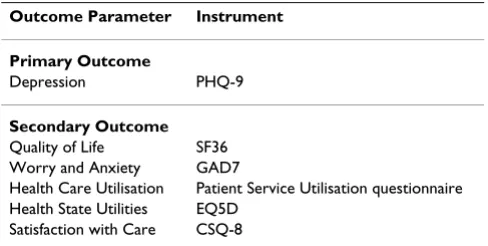
We will measure quality of life using the SF36 [30], worry and anxiety by the GAD7 [31], health care utilisation using a bespoke designed patient service utilisation ques-tionnaire, health state utilities with the EQ5D [32] and patient satisfaction with the CSQ8 [33,34]. All measures will be taken at baseline, four and twelve months follow up (see table 1), except the CSQ-8 which will only be taken at four months. In all cases, steps will be taken to ensure that the researcher who is assessing depressive symptomatology is blind to the participant's treatment arm of the trial.
Process Data
Process data will be collected within the trial. The exten-sive quantitative and qualitative work in our pilot trial has indicated that the planned intervention is effective and acceptable, and our process evaluation in this main trial will focus on (i) mechanisms of change and differential response in patient subgroups, and (ii) the process of implementation of the intervention [35]. Investigation of mechanisms of change and differential response in partic-ipant subgroups will include quantitative measurement of key participant's baseline characteristics (e.g. severity of depression; duration of depression; patient preferences; attitudes towards treatment), treatment process measures (e.g. therapeutic alliance; concordance with treatment; behavioural activity levels), contextual practice variables (e.g. anti-depressant prescription rates; availability of counselling and other mental health services) and will fol-low conventional procedures for analysis [36]. Investiga-tion of the process of implementaInvestiga-tion will utilise routinely collected data from case records, session audio tapes and supervision records. The analysis will examine
the implementation of collaborative care, treatment fidel-ity, differences between sites and different case managers and predictors of outcome.
Analysis
Statistical analysis of clinical data
We will analyse our primary outcome of severity of depression on the PHQ-9 at four months using between groups analysis of covariance on individual baseline depression score. Analysis will take clustering into account by use of robust standard errors in Stata. All other clinical outcome variables will be analysed as secondary variables in the same way, using least squares or ordered logistic regression as appropriate. We will analyse out-comes by site variables to detect any effects on treatment outcomes of a 'therapist effect' - differences between case managers - and practice level variables. We will investigate the effects of any missing data using imputation by best subset regression and apply CONSORT standards for clus-ter randomised trials [37] in data reporting.
The incremental cost per QALY of the intervention com-pared to the control will be calculated from NHS and Per-sonal Social Services (PSS) perspectives following NICE evaluation guidance [38] and a wider societal perspective. The units of resource for the intervention will be collected directly and the use of other health care services by both groups will be collected through a patient questionnaire. Data on social care, other welfare services and employ-ment details will be collected from the Patient Service Uti-lisation questionnaire. Intervention costs will be based on delivery costs within the trial and include supervision and appropriate capital and overhead amounts. Other unit costs will be based on long run opportunity costs and drawn from national sources. Full sensitivity analyses will be conducted with bootstrapping to provide confidence intervals around cost and effect estimates and to produce cost acceptability curves.
Qualitative data will be subject to content analysis within a qualitative methodological framework using QSR NVivo software and analysed according to the conceptual matrix of Miles and Huberman [39].
Frequency of analyses
We will analyse data at four and twelve months follow up. The DMEC will undertake an interim data analysis to detect any reason for halting the trial.
Ethical Issues
[image:6.612.54.298.605.728.2]We will conduct the trial is such a way as to protect the human rights and dignity of the participants as reflected in Helsinki Declaration [40]. Participants will not receive any financial inducement to participate. The study has received Multi-Centre Research Ethics Committee
Table 1: Outcomes and Instrument
Outcome Parameter Instrument
Primary Outcome
Depression PHQ-9
Secondary Outcome
Quality of Life SF36
Worry and Anxiety GAD7
Health Care Utilisation Patient Service Utilisation questionnaire Health State Utilities EQ5D
approval from the South West Research Ethics Committee in the UK. Local Research Ethics Committee and NHS Research and Development approvals have also been given for each recruitment site. To conform to data protec-tion and freedom of informaprotec-tion Acts, all data will be stored securely and anonymised wherever possible. No published material will contain patient identifiable infor-mation.
Obtaining informed consent from participants
Informed consent will be determined by a two phase con-sent process. Participants will receive a study information sheet in the post and a form seeking their permission to be contacted by a member of the research team, not at this stage to give consent to trial participation. Full informed consent will only be obtained through an interview by a researcher where the information sheet is fully explained and where the opportunity to ask questions is given. The opportunity to withdraw from the trial will be fully explained. Researchers seeking consent will be fully trained and supervised by the CI and site leads. Commu-nication and recording systems will be set up to enable the trial team to monitor and act on participants' wishes to withdraw from the trial.
Risks and anticipated benefits for trial
participants and society
All participants will receive usual GP care, and therefore no treatment will be withheld to participants in this trial. This trial may in fact benefit individual participants, since collaborative care is not routinely available and has been shown to be effective in our trial platform. By participat-ing in this trial, participants will also receive a more inten-sive level of monitoring than that normally received in primary care.
Informing potential participants of possible
benefits and known risks
The patient information leaflets will provide potential participants with information about the possible benefits and any known risks of taking part in the trial. Partici-pants will be given the opportunity to discuss this issue with either their GP or trial coordinator prior to consent-ing to participate. The trial coordinator will inform the participants if new information comes to light that may affect the participants' willingness to participate in the trial.
Suicide
Inherent in the nature of the condition under scrutiny (depression) is the risk of suicide and deliberate self-harm. All participants will be subject to usual GP care, and the primary care physician will be responsible for the day to day management of depression - and will ultimately be responsible for all patient-level treatment/management
decisions - including prescribing, referral and assessment of risk. The pragmatic nature of this trial means that we will not seek to influence this arrangement. However, we will follow good clinical practice in monitoring for suicide risk during all researcher encounters with trial partici-pants. Where any risk to participants due to expressed thoughts of self-harm is encountered, case managers will apply the procedures taught in the STORM training [41], and all sites will follow a local suicide protocol. Systems will be put into place to ensure that the CI, trial coordina-tor and researchers will be informed should there be any risks to the participants' safety.
Trial Steering Committee (TSC) and Data Monitoring and Ethics Committee (DMEC)
A Trial Steering Committee has been set up, in addition to a data monitoring and ethics committee (DMEC). These committees will meet at least annually. The DMEC will undertake an interim data analysis to detect any reason for halting the trial.
Forecast execution dates
The preparatory period started in September 2008, and will continue for 9 months. Recruitment will begin in June 2009 for a period of 18 months. Follow up will last 15 months, at four (T1) and 12 months (T2) after inclu-sion (with an additional three months of back up built in). Data analysis and reporting will take another 6 months. The entire study period will last for 48 months.
Discussion
The current trial is designed to implement evidence based treatments within the UK primary care setting. The multi-ple components of collaborative care for depression have been shown to improve outcomes for patients [11-13,42]. However despite a number of collaborative care models being currently trialled in Europe [43-45] the vast major-ity of the evidence emerges from the US, demanding the need to test a model that is specific to the UK context. Col-laborative care is a complex intervention, the develop-ment of which ideally requires a phased approach [15,16,46]. Our trial utilises this phased approach, and follows on from a previous Phase II trial which demon-strated that the collaborative care intervention can be both effective and acceptable to patients [18,20]. We have designed this Phase III cluster trial to deal with contami-nation issues which we explored and identified in our Phase II trial: cluster-randomised trials are recommended for situations where systems level interventions such as collaborative care are to be tested [47] since patient-ran-domised trials may be vulnerable to contamination from the intervention to control patients.
its care for depressed patients in primary care. We expect the results to assist primary care healthcare providers to choose how to deliver an effective model of enhanced depression service.
Competing interests
The authors declare that they have no competing interests.
Authors' contributions
DAR, RA, MB, JMB, PB, JC, CC-G, LG, SG, CG, DK, GL, KL, CM and SP conceived and designed the study and obtained funding. DR, AH-M and RH drafted the manu-script and all other authors contributed to editing of the final manuscript.
Acknowledgements
This research is funded by the Medical Research Council in the UK, Grant Number G0701013
The study has support from the UK Mental Health Research Network and the Primary Care Research Network to aid participant recruitment.
References
1. Murray CJ, Lopez AD: Alternative projections of mortality by cause 1990-2020: Global Burden of Disease Study. Lancet 1997, 349:1498-1504.
2. World Health Organisation: The World Health Report 2001: Mental Health: New Understanding, New Hope. World Health Organisation: Geneva; 2001.
3. Simon G, Ludman E, Tutty S, Operskalski B, Von Korff M: Telephone psychotherapy and telephone care management for primary care patients starting antidepressant treatment: a rand-omized controlled trial. Journal of the American Medical Association 2004, 292:935-942.
4. Gask L: Overt and covert barriers to the integration of pri-mary and specialist mental health care. Social Science and Med-icine 2005, 61:1785-94.
5. Richards DA, Lovell K, McEvoy P: Access and effectiveness in psy-chological therapies: self-help as a routine health technology. Health and Social Care in the Community 2003, 11(2):75-182. 6. Meltzer H, Gill B, Petticrew M, Hinds K: OPCS Surveys of
Psychi-atric Morbidity in Great Britain, Report 2: Physical com-plaints, service use and treatment of adults with psychiatric disorders. London: HMSO; 1995.
7. Bower P, Gilbody S: Managing common mental health disor-ders in primary care: conceptual models and evidence base. British Medical Journal 2005, 330:839-842.
8. Gilbody S, Whitty P, Grimshaw J, Thomas R: Educational and organisational interventions to improve the management of depression in primary care: a systematic review. Journal of the American Medical Association 2003, 289:3145-3151.
9. Gunn J, Diggens J, Hegarty K, Blashki G: A systematic review of complex system interventions designed to increase recovery from depression in primary care. BMC Health Services Research 2006, 6:88.
10. Von Korff M, Goldberg D: Improving outcomes in depression. British Medical Journal 2001, 323:948-949.
11. Katon W, Von Korff M, Lin E, Simon G, Walker E, Unützer J, Bush T, Russo J, Ludman E: Stepped collaborative care for primary care patients with persistent symptoms of depression: a rand-omized trial. Archives of General Psychiatry 1999, 56:1109-1115. 12. Unutzer J, Katon W, Callahan C, Williams JW Jr, Hunkeler E, Harpole
L, Hoffing M, Della Penna RD, Noel PH, Lin EH, Arean PA, Hegel MT, Tang L, Belin TR, Oishi S, Langston C, IMPACT Investigators: Collab-orative care management of late-life depression in the pri-mary care setting: a randomized controlled trial. Journal of the American Medical Association 2002, 288:2836-2845.
13. Wells K, Sherbourne C, Schoenbaum M, Duan N, Meredith L, Unützer J, Miranda J, Carney MF, Rubenstein LV: Impact of
dissem-inating quality improvement programs for depression in managed primary care: a randomized controlled trial. Journal of the American Medical Association 2000, 283:212-220.
14. Bower P, Gilbody S, Richards DA, Fletcher J, Sutton A, Collaborative care for depression in primary care: Making sense of complex intervention: systematic review and meta-regression. British Journal of Psychiatry 2006, 189:484-493.
15. Medical Research Council: A framework for development and evaluation of RCTs for complex interventions to improve health. London: MRC; 2000.
16. Medical Research Council: Developing and Evaluating Complex Interventions: New Guidance. London: MRC; 2008.
17. Richards DA, Barkham M, Bower P, Gask L, Gilbody S, Lovell K, Rog-ers A, TorgRog-erson D, Escott D, Fletcher J, Hennessy S, Kendall S, Lank-shear AJ, Richardson R, Simpson A: A Trial Platform of Enhanced Care for Depression in Primary Care: Final Report. Univer-sity of York: York; 2006.
18. Richards DA, Lankshear AJ, Fletcher J, Rogers A, Barkham M, Bower P, Gask L, Gilbody S, Lovell K: Developing a UK Protocol for Col-laborative Care: A Qualitative Study. General Hospital Psychiatry 2006, 28:296-305.
19. Richards DA, Lovell K, Gilbody S, Gask L, Torgerson D, Barkham M, Bland M, Bower P, Lankshear AJ, Simpson A, Fletcher J, Escott D, Hennessy S, Richardson R: Collaborative Care for Depression in UK Primary Care: A Randomised Controlled Trial. Psycholog-ical Medicine 2008, 38:279-287.
20. Simpson A, Richards D, Gask L, Hennessy S, Escott D: Patients' experiences of receiving collaborative care for the treat-ment of depression in the UK: a qualitative investigation. Mental Health in Family Medicine 2008, 5(2):95-104.
21. Department for Communities and Local Government: The English Indices of Multiple Deprivation 2007. Crown Copyright. HMSO; 2008.
22. Pilling S, Leibowitz J, Cape J, Simmons J, Pamela Jacobsen P, Nazareth I: Developing an enhanced care model for depression using primary care mental health workers. In Reaching the hard to reach: Evidence-based funding priorities for intervention and research Edited by: Fonagy P, Barruch G, Robins D. Chichester Wiley; 2006. 23. Gensichen J, Beyer M, Muth C, Gerlach FM, Von Korff M, Ormel J:
Case management to improve major depression in primary health care: a systematic review. Psychological Medicine 2005, 36:7-14.
24. Elliott R, Stiles WB, Shapiro DA: Are some psychotherapies more equivalent than others? In Handbook of Effective Psychother-apy Edited by: Giles TR. New York: Plenum Press; 1993:455-479. 25. Lewis G, Pelosi AJ, Araya R, Dunn G: Measuring psychiatric
dis-order in the community: a standardized assessment for use by lay interviewers. Psychological Medicine 1992, 22:465-486. 26. Watson JM, Torgerson DJ: Increasing recruitment to
ran-domised trials: a review of ranran-domised controlled trials. BMC Medical Research Methodology 2006, 6:34.
27. Ekers D, Richards DA, Gilbody S: A meta-analysis of randomized trials of behavioural treatment of depression. Psychological Medicine 2008, 38:611-623.
28. PC-MIS [http://www.pc-mis.co.uk]
29. Kroenke K, Spitzer RL, Williams JB: The PHQ-9: validity of a brief depression severity measure. Journal of General Internal Medicine 2001, 16(Supplement 9):606-613.
30. Ware JE, Snow KK, Kosinski M, Gandek B: SF-36 Health Survey: Manual and Interpretation Guide. Boston, MA.: The Health Institute, New England Medical Centre; 1993.
31. Spitzer RL, Kroenke K, Williams JB, Lowe B: A Brief Measure for Assessing Generalized Anxiety Disorder: The GAD-7. Arch Intern Med 2006, 166(Supplement 10):1092-7.
32. EuroQol Group: EuroQol-A new facility for the measurement of health-related quality of life. Health Policy 1990, 16:199-208. 33. Attkisson C, Zwick R: The client satisfaction questionnaire:
psychometric properties and correlations with service utili-sation and psychotherapy outcome. Evaluation and Program Plan-ning 2003, 5:233-237.
34. Larsen DL, Attkisson CC, Hargreaves WA, Nguyen TD: Assess-ment of client/patient satisfaction: DevelopAssess-ment of a general scale. Evaluation and Program Planning 1979, 2:197-207.
Publish with BioMed Central and every scientist can read your work free of charge
"BioMed Central will be the most significant development for disseminating the results of biomedical researc h in our lifetime."
Sir Paul Nurse, Cancer Research UK
Your research papers will be:
available free of charge to the entire biomedical community
peer reviewed and published immediately upon acceptance
cited in PubMed and archived on PubMed Central
yours — you keep the copyright
Submit your manuscript here:
http://www.biomedcentral.com/info/publishing_adv.asp
BioMedcentral 36. Kraemer HC, Wilson TG, Fairburn CG, Agras WS: Mediators and
moderators of treatment effects in randomized controlled trials. Archives of General Psychiatry 2002, 59:877-883.
37. Campbell MK, Elbourne DR, Altman DG: CONSORT statement: extension to cluster randomised trials. British Medical Journal 2004, 328:702-708.
38. National Institute for Health and Clinical Excellence: Methods for technology appraisals. NICE; London; 2004.
39. Miles M, Huberman A: Qualitative Data Analysis: An Expanded Source-book Sage; London; 1994.
40. World Medical Association General Assembly: World Medical Association Declaration of Helsinki: Ethical Principles for Medical Research Involving Human Subjects - Seoul Amend-ment. The World Medical Association; Ferney-Voltaire; 2008. 41. Appleby L, Morriss R, Gask L, Roland M, Perry B, Lewis A, Battersby
L, Colbert N, Green G, Amos T, Davies L, Faragher B: An educa-tional intervention for front-line health professionals in the assessment and management of suicidal patients (The STORM Project). Psychological Medicine 2000, 30(4):805-812. 42. Neumeyer-Gromen A, Lampert T, Stark K, Kallischnigg G: Disease
management programmes for depression. Med Care 2004, 42:1211-1221.
43. Aragonès E, Caballero A, Piñol JLI, López-Cortacans G, Badia W, Hernández JM, Casaus P, Folch S, Basora J, Labad A: Assessment of an enhanced program for depression management in pri-mary care: a cluster randomized controlled trial. The INDI project (Interventions for Depression Improvement). BMC Public Health 2007, 7:253.
44. Horn EK, Benthem TBv, Hakkaart-van Rooijen L, Marwijk HWJv, Beekman ATF, Rutten F, Feltz-Cornelis CMvd: Cost-effectiveness of collaborative care for chronically ill patients with comor-bid depressive disorder in the general hospital setting, a ran-domised controlled trial. BMC Health Services Research 2007, 7:28. 45. Ijff MA, Huijbregts KML, Marwijk HWJv, Beekman ATF, Hakkaart-Van Rooijen L, Rutten FF, Unutzer J, Feltz-Cornelis CMvd: Cost-effec-tiveness of collaborative care including PST and an antide-pressant treatment algorithm for the treatment of major depressive disorder in primary care; a randomised clinical trial. BMC Health Services Research 2007, 7:34.
46. Campbell M, Fitzpatrick R, Haines A, Kinmonth A, Sandercock P, Spiegelhalter D, Tyrer P: Framework for design and evaluation of complex interventions to improve health. BMJ 2000, 321:694-696.
47. Ukoumunne OC, Gulliford MC, Chinn S, Sterne J, Burney P, Donner A: Methods in health service research. Evaluation of health interventions at area and organisational level. BMJ 1999, 319:376-379.
Pre-publication history
The pre-publication history for this paper can be accessed here: