Copyright © 2018 Authors. This is an open access article distributed under the Creative Commons Attribution License, which permits unrestricted use, distribution, and reproduction in any medium, provided the original work is properly cited.
International Journal of Engineering & Technology, 7 (2.29) (2018) 973-979
International Journal of Engineering & Technology
Website: www.sciencepubco.com/index.php/IJET
Research paper
Combining the Methodologies of Ethnography and Grounded
Theory Approach in Understanding the Characteristics of
Traditional Knowledge Related to Medicinal Plants of the
Batek in Kuala Koh,Gua Musang, Kelantan
Amran Alias1*, Hood Salleh2, Shaharuddin Mohamad Ismail3, Sarah Aziz Abdul Ghani Aziz4, Mohd Suhaidi Salleh5, Khairol Aaznuar Kamri6, Bakri Mat7,Sopian Brahim8
1,2,3,4Universiti Kebangsaan Malaysia
5Universiti Malaysia Sarawak 6Universiti Tun Hussein Onn Malaysia
7Universiti Utara Malaysia 8Jabatan Kebajikan Masyarakat
*Corresponding Author E-Mail: [email protected]
Abstract
Traditional knowledge related to medicinal plants of the indigenous people is a valuable asset to the community and could potentially bring economic returns to them if it is utilized appropriately. While much of the existing researches have been focused on document-ing the knowledge, not much however, has been made known on the ‘holistic’ practice of the knowledge at the community level particularly in the Malaysian context. This is an important aspect as documenting the knowledge alone would not bring any meaning if the knowledge itself is not sustainably practiced by the communities who hold the knowledge. However, it is not an easy task to understand the management aspect of the knowledge especially if the researcher comes from a ‘different world view’ that the indige-nous people themselves. This study is an attempt to combine two methodologies namely ethnographic approach as data gathering method and the principles of grounded theory approach as data analysis in understanding how the traditional knowledge related to medicinal plants is being protected by the indigenous people. Using the Orang Asli Batek in Kuala Koh, Gua Musang, Kelantan as a case study, this research involved multiple prolonged stays with the community (2013-2016) and employed ethnographic techniques of individual and group interviews, observation and participant observation as well as document analysis to gather the data. The col-lected data was analysed using the principles of grounded theory where all responses that were recorded in verbatim was organised and analysed in stages of coding such as ‘initial coding’, ‘selective coding’ and ‘theme’ which upon further analysis, had enabled the description of the characteristics of the traditional knowledge related to medicinal plants of the Bateks. The result of this study found that the combination of the two methodologies are indeed useful and in fact are complementary with each other in understanding the characteristics of the traditional knowledge related to medicinal plants of the Bateks of Kuala Koh as part of the indigenous commu-nity in the country. In particular, employing the two methods has enabled the study to identify the characteristics (forms) of the TK that can be found in an indigenous community such as the Bateks of Kuala Koh. This research has provided a greater understanding on the existing state of protecting the TK being practiced by the Bateks. The study also provides useful contribution to the body of knowledge as the methodological approach used could be employed by future researches in understanding similar approach in under-standing similar phenomena.
Keywords: Bateks; Ethnography; Grounded Theory; Medicinal Plants; Traditional Knowledge
1. Introduction
Traditional knowledge (TK) especially the TK on medicinal plants owned by the indigenous people is a very useful asset to the com-munity. However, over the years, evidences have shown that TK of this community has gradually been eroded (1, 2) and in many cases were misappropriated by parties outside of this community (3, 4) and thus needs to be protected accordingly. In the Malaysian context, most studies on the TK owned by the indigenous commu-nity particularly the TK related to medicinal plants were mainly concentrated in the documentation of the TK (5). Very few studies,
Gua Musang Kelantan as a case study, this qualitative research involved 3 years of multiple prolonged stays (2013-2016) with the Bateks community to understand how the knowledge related to medicinal plants are being practiced, protected and managed by the community. Ethnographic methods of individual and group interviews, observations and participants observation as well as document analysis have been employed to gather the relevant data and the principles of grounded theory were used to analyse the data in order to enable the development of the substantive theory and finally the formal theory that provides explanation on the phenomena at the study site. The combined methodologies are then used to develop and explain the characteristics of the tradi-tional knowledge related to medicinal plants of the Bateks.
2. The Bateks
The indigenous people or Orang Asli in Peninsular Malaysia are grouped into 3 namely the Proto-Malays, Senoi and Negritos which is divided into 18 sub-ethnics. The Bateks is one of these 18 sub-ethnics and is grouped into the Negrito Orang Asli. They are among the smallest sub-ethnics as reflected in the census conduct-ed by the Department of Statistics (DOS). According to DOS, in 2011, out of more than 178,000 Orang Asli in Peninsular Malaysia, only 5,009 or 2.81% are the Negritos and out of this, only 1,447
are the Bateks. Further, out of these 1,447 Bateks, only 504 are inhabiting the areas in the state of Kelantan, the state where this study was conducted. The distribution of the Orang Asli in Penin-sular Malaysia by ethnics groups and states and the detail distribu-tion of the Negitos and the Bateks are detailed out in Tables 1 and 2 below:
Table 1: The Distribution of Orang Asli by Ethnics Groups and States (2011)
State Negritos Senoi Proto-Malays Total
Kedah 251 19 - 270 Perak 2,413 50,281 605 53,299 Kelantan 1,381 12,047 29 13,457 Terengganu 34 818 41 893 Pahang 925 29,439 37,142 67,506 Selangor 3 5,073 12,511 17,587 Negeri
Sem-bilan
- 96 10,435 10,531 Melaka 1 28 1,486 1,515 Johor 1 55 13,083 13,139
Total 5,009 97,856 75,332 178,197
Percentage (%)
2.81 54.91 42.27 100
[image:2.595.51.562.324.440.2]Source: Department of Statistics, Malaysia, 2011
Table 2: The distribution of the sub-ethnics under the negrito group and by states (2011)
State Kintak Kensiu Jahai Mendrik Batek Lanoh Total
Johor - - 1 - - - 1
Kedah 208 30 3 - - 10 251
Kelantan - 1 530 344 504 2 1,381
Melaka 1 - - - 1
Negeri Sembilan - - - -
Pahang - - 15 3 906 1 925
Perak 28 163 1,838 12 3 369 2,413
Selangor - - - 3 - - 3
Terengganu - - - - 34 - 34
Total 237 194 2,387 362 1,447 382 5,009
Source: Department of Statistics of Malaysia, 2011
In essence, as reflected in Table 2 above, according to the above figures from the DOS, the Bateks’ population in Peninsular Ma-laysia is rather small. However, although the Bateks, as part of the indigenous people of the world, only made up a small proportion of the global population, they do play an important role in main-taining and managing the planet’s land particularly the forests and the eco-system. According to Galloway McLean (6), despite its small population compared to the rest of the communities of the world, the indigenous people is important as they manage 11% of the world's forest lands and customarily own, occupy or use 22% of the world's land surface maintain an overwhelming 80% of the planet's biodiversity and are located in or adjacent to 85% of the world’s protected areas. This interdependence between the indige-nous people and the forest land and its eco-system has enabled the former to gain and develop knowledge on the uses of the natural resources to their advantage. This knowledge that they had tradi-tionally inherited from their ancestors for many generations has benefited the indigenous people in many ways and continue to survive over time. However, many external and internal forces continues to erode the existence of this valuable asset, which may cause it to loose from human’s system forever.
3. Traditional Knowledge
There are various definitions of traditional knowledge being men-tioned and discussed in the literatures. Traditional knowledge (TK), Indigenous Knowledge (IK), Traditional Environmental Knowledge (TEK) and local knowledge which is often used inter-changeably, is generally referred to knowledge systems embedded in the cultural traditions of regional, indigenous or local communi-ties. According to Berkes, Folke, & Gadgil (7) indigenous knowledge is broadly defined as local knowledge held by indige-nous people or local knowledge unique to a given culture or
socie-ty and is often used interchangeably with traditional knowledge (7). Specifically, according to Berkes et al.(7), traditional ecologi-cal knowledge (TEK) is the subset of indigenous knowledge. In-digenous knowledge or traditional knowledge is defined as a cu-mulative body of knowledge and beliefs handed down through generations by cultural transmission, about the relationship of living beings (including humans) with one another and with the environment (8) cited in (7).
Meanwhile, according to the International Council for Science (ICSU) Study Group on Sciences and Traditional Knowledge (2002), traditional knowledge has been defined as ‘a cumulative body of knowledge, know-how, practices and representations maintained and developed by people with extended histories of interaction with the natural environment. Meanwhile, World Intel-lectual Property Organisation (WIPO) defined TK as:
...knowledge, know-how, skills and practices that are developed, sustained and passed on from generation to generation within a community, often forming part of its cultural or spiritual identity’ (WIPO, 2016)...
In short, traditional knowledge is essentially the know-how, prac-tices or the knowledge owned by a particular community which they had inherited from their previous generations. In the context of this study, traditional knowledge refers to the existing knowledge related to medicinal plants that is owned by and passed on among the members of the Batek of Kuala Koh from genera-tion to generagenera-tion.
4. The Study
owned by Batek community of Kuala Koh, Gua Musang, in Ke-lantan, Malaysia. As described earlier, this community which can be found mostly in the Northeastern part of Peninsular Malaysia (Pahang, Kelantan and Terengganu), is among the smallest sub-ethnics of Orang Asli in Peninsular Malaysia (9-11). The Bateks of Kuala Koh stayed in a deeper part of forested areas in Gua Mu-sang District (approximately 77km from Gua MuMu-sang city) and the group, like the other groups of Bateks in Pasir Lenggi and Felda Aring in Gua Musang district, is still demonstrating the uses of medicinal plants for healing rituals in their daily lives, and hence has easily become the subject of choice for the study. In this study, the use of ethnographic methods to collect data and the utilization of principles of grounded theory to analyse them was ‘put to test’ in describing the management of the traditional knowledge of the Orang Asli Batek and eventually developing an understanding about the characteristics of their traditional knowledge to medicinal plants. In the Malaysian context, there have been many studies in the literatures on the traditional knowledge of the Orang Asli particularly on the documentation of their traditional knowledge (12-14). Due to the nature of the en-quiry of the studies which were generally focusing on document-ing the knowledge, most of them however, were carried out either through undertaking strictly ethnographic approaches for data gathering and analysis, or through interviews, or observation or dissemination of qualitative/quantitative surveys or questionnaires on the respondents to understand the phenomena on the ground. The studies by Ahmad (15) for example, were mostly aimed at gathering and recording medicinal plants used by the indigenous communities in Sarawak and Sabah respectively in healing ail-ments faced by members of the communities.
In addition, a ‘plethora’ of other researches have been embarked to look at similar topic of inventorising and documenting the tradi-tional knowledge related to medicinal plants of both the indige-nous people and local communities in Peninsular Malaysia. These include researches by Das et. al (16) who found that more than 100 species of traditional herbal medicine were used by the locals in the region of Kampong Buloh Nipis, Terengganu while Abdullah & Rusea (17) had successfully documented the use of 13 or 14 species of wild edible fungi belonging to 9 pletora known to Malay population including several populations in East Malaysia. Other researchers who also undertook the documentation of tradi-tional knowledge related to medicinal plants in Malaysia include Chai et. al (2008) who have recorded 77 species of medicinal plants used by the Penan to solve their health problems whenever need arises. There have been various other researches undertaken by both academicians and other researchers on traditional knowledge of medicinal plants of the indigenous people but unfor-tunately, very few studies, if any, were undertaken to understand the ‘holistic’ nature of the traditional knowledge, particularly in understanding whole processes of knowledge management namely how the knowledge is being generated, codified, utilized and transferred at the community level. Let alone, studies that employ a combination of two different methodologies to understand this. This study therefore, provides an opportunity to unlock the poten-tial of combining the ethnographic methods of data gathering and grounded theory approach for data analysis in understanding how the traditional knowledge is being managed at the Batek commu-nity in Kuala Koh, Gua Musang.
5. The Utilization and Practice of Traditional
Knowledge by the Bateks
In order to understand the characteristics of the traditional knowledge of the Bateks, it is imperative to understand how the knowledge is being utilized and practiced by the community. This would enable an understanding and description on how the com-munity ‘manage’ their knowledge. Knowledge management can be defined through many perspectives in the literatures (18, 19). In the context of this study, the main ‘concept’ of how knowledge is being utilized and practiced refers to the description of knowledge
management processes that has been put forward by (20). Alavi & Leidner (20) described that the four processes of management of knowledge are i) knowledge creation (generation); ii) knowledge storage and retrieval (codification); iii) knowledge transfer and iv) knowledge application (utilization). In this study, based on the data obtained from the interviews with members of the Batek community and observation on how the knowledge is being prac-ticed and managed at the study site, the researchers have sought data to describe ‘what happened’ to the knowledge of the commu-nity during all four processes which eventually result in the identi-fication of the characteristics (forms) of the TK.
6. Ethnography as a Research Methodology
Ethnography as Walters (21) summed up:
…is not just another method, for capturing or massaging data. Like other methods in the social and behavioral sciences, ethnog-raphy is an analytical description of the behaviors that characterise and distinguish cultures and sociological groups. But unlike other approaches, ethnography goes beyond mere ‘objective analytical description’ to include description and analysis of the knowledge and beliefs that generate and interpret those behaviors. p. 33. In essence, most significantly, Walters (21) pointed out that the major emphasis of ethnography unlike many other research meth-ods is the ‘width, depth and thickness of data and analysis’ that one has to be able to generate through this method to carry under-take to understand a particular phenomenon. This is very much in line with the approach undertaken in this study whereby this quali-tative study incorporates ethnographic research instruments as data collection methods which involved multiple prolonged stays with the Orang Asli Bateks community in the period of 2013-2016. In going ‘beyond mere objective analytical description’, the eth-nographic activities in this study has also included the description and analysis of the knowledge and beliefs that generate and inter-pret those behaviors’ by engaging in various daily activities of the community including observing and participating in their trips into the forest in obtaining medicinal plants, communicating and en-gaging with the younger generations in understanding their educa-tion pursuits to name a few. In addieduca-tion, series of individual and group interviews with the relevant members of the community were also carried out to gather the relevant data and this was fur-ther ‘triangulated’ with constant reference on existing literatures about the traditional knowledge of the indigenous people.
7. Grounded Theory as a Research
Method-ology
explain the phenomena of traditional knowledge management in the indigenous community being studied.
8. Ethnography and Grounded Theory
Com-bined
The use of ethnography as a qualitative data gathering method in studying indigenous people is well documented. From its early discovery, ethnography has been to seek understanding of a phe-nomenon on indigenous people and marginalised communities. So too is the use of grounded theory. A study by Makokis (26) has enabled the author to identify the beliefs and values of the teach-ings from Cree elderly and how the values, beliefs and stories of the informants were utilised to change the ‘neo-colonial attitudes’ and then assist the Cree to reshape their self-governance system using grounded theory methodology. In addition, in the Malaysian context, a study by Low, Tong, & Low (27) on the selection of treatment strategies among patients with type 2 diabetes mellitus in Malaysia using a grounded theory approach has enabled the authors to generate a theoretical model that describes the strategy selection process that the authors believed to ‘have a broad based applicability to other diseases’.
Meanwhile, the grounded theory, according to B. G. Glaser (28), is applicable to data ‘from which it is generated’. While Glasser together with his colleague, Anselm in their writing ‘Awareness of Dying’ in 1965, saw clearly the ‘general implications of awareness context theory for application’, grounded theory also applies with ‘fit’ and ‘relevance’ to similar areas of concern. In this regard, B. G. Glaser (28) further added that the application of a grounded theory is based on conceptual fit and relevance and ‘even if’ the area is different (from that of medical concern). Thus, although grounded theory was initially discovered and used to come up with a theory that can explain from a medical perspective, as this study is going to show, the use of grounded theory is also ‘rele-vant’ and ‘fit’ with the data obtained from ethnographic method (interviews and observation) in a sense that they both are looking for ‘realities’ or ‘phenomenon’ that are happening on the ‘ground’ at the study site.
B. G. Glaser (28) further explains, these fits to many types, and areas, and data ‘occur almost automatically and conceptually irre-spective of that data from which they were generated’. He further added that ‘their conceptual grab and their use is ‘non-stoppable’ and ‘occurs informally’ and ‘casually’ more often than formally and thus grounded theory applications were done ‘naturally’ in many ways. B. G. Glaser (28) articulated that grounded theory methodology is based on coding ‘what we do naturally’, that is ‘comparing incidents in our lives to see ‘patterns’ in everyday life. On this, Glasser further adds that ‘when applying grounded theory to fit and be relevant to another area of concern, ‘constant com-parative analysis’ was used to ‘apply’ and/or ‘generate’ more the-ory through application.
Although many literatures have often highlighted the separate use of ethnography and grounded theory methodologies in studying a phenomena and that it is ‘unusual’ to see these two are combined, a study by Bamkin, et al.(29) (2016) on assessing the importance of libraries to demonstrate their value to children’s literacy had successfully combined both ethnography and grounded theory as a methodology to answer a research inquiry. This study in particular had combined these two methodologies to study children’s visit-ing children’s mobile libraries (CMLs). The study has succeeded to provide verifications on the benefits of the ‘combined method-ology of grounded theory and ethnography’ as the ethnographic elements allowed the researcher to ‘enter into the children’s world’ while the grounded theory elements provided a ‘structural framework’, exploration into a novel research topic and ensured that a valid conclusion was drawn.
In addition, the use of combined methodologies for research in-quiry was further supported by another study undertaken by Hall (30) who has introduced a dual-level capabilities approach to de-velopment. In this study, the author has improved upon
individual-focused capabilities approaches developed by Amartya Sen and Martha Nuusbaum whereby a seven-months of ‘ethnographic works’ in the Afro-descendant, autochthonous Garifuna communi-ty of Honduras has been combined with a constructive grounded theory methodology to develop a dual-level capabilities approach, inclusive of collective and individual capabilities. In addition, the potential compatibility of combining ethnography and grounded theory was also emphasised by Pettigrew (22) who discusses the compatibility of ethnography with the grounded theory method of theory induction as employed in sociology. In this study, he has proposed that when combined, these two methods have the poten-tial to offer a detailed understanding of consumption as experi-enced by consumers in consumer research. Thus, with the aim of this study to understand the ‘culture’ of an indigenous community, the use of ethnography which has been widely employed since researchers began their effort to study on indigenous communities (Malinowski cited in (31) 1986) can be combined it ‘fits’ relevant-ly with grounded theory approach due to their similar natural characteristics of types data (thickness, depth and width), being gathered and analysed. This is further supported by Pettigrew (22) in his study:
Grounded theory and ethnography are suggested (here) to be high-ly compatible, as ethnographic studies can provide the thick de-scription that is very useful data for grounded theory analysis (24). Part of this compatibility derives from the similarities in the char-acteristics between the two methods. As a naturalistic form of inquiry, ethnography entails observing and analysing behaviour in naturally occurring conditions (32, 33). Grounded theory similarly performs best with data generated in natural settings (34). Both have been derived from the symbolic interactionist perspective (34-36), and both often rely on participant observations (37, 38). Sample selection is emergent in both ethnography and grounded theory (33, 38), and both attempt to obtain emic descriptions of behaviour (39)...
In essence, it is easy to concur with the opinions of Pettigrew (22) in that both ethnography and grounded theory are methods that are ‘compatible’ with each other to be used and in fact can be ‘com-plementary’ between one another as ‘it can be found that they have very much similarities’ in their orientation especially in terms of data gathering for analysis. While ethnography involves ‘observing and analysing behaviour in naturally occurring condi-tions’ ((32, 33) cited in Pettigrew (22)), grounded theory works ‘best with data generated in natural settings’ ((34) cited in Petti-grew (22)). In addition, as Barnes (39) cited in PettiPetti-grew (22) observed similarities between both methods in terms of sample selection and the focus on acquiring ‘emic’ description of behav-iour.
9. Findings
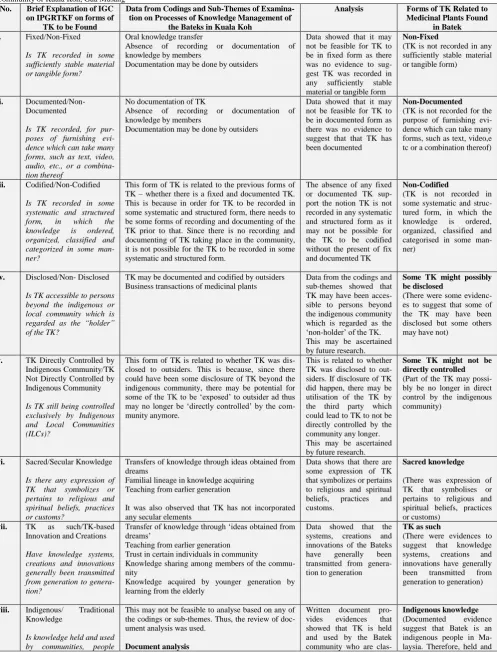
The following table summarises the findings of this study whereby the data that was collected from ethnographic methods (individual
and group interviews and observations as well as participant ob-servation) has been analysed using the principles of grounded theory (initial coding, selective coding, themes etc.) in order to identify the forms or characteristics of the traditional knowledge related to medicinal plants at the study site.
Table 3: TheMapping of Data from Codings, Sub-Themes, Themes Based on The Examination of The Processes of Knowledge Management of The Bateks in Kuala Koh and The Forms (Characteristics) of The Traditional Knowledge Related to Medicinal Plants That Can Be Found at The Bateks Community of Kuala Koh, Gua Musang
No. Brief Explanation of IGC on IPGRTKF on forms of
TK to be Found
Data from Codings and Sub-Themes of Examina-tion on Processes of Knowledge Management of
the Bateks in Kuala Koh
Analysis Forms of TK Related to
Medicinal Plants Found in Batek i. Fixed/Non-Fixed
Is TK recorded in some sufficiently stable material or tangible form?
Oral knowledge transfer
Absence of recording or documentation of knowledge by members
Documentation may be done by outsiders
Data showed that it may not be feasible for TK to be in fixed form as there was no evidence to sug-gest TK was recorded in any sufficiently stable material or tangible form
Non-Fixed
(TK is not recorded in any sufficiently stable material or tangible form)
ii. Documented/Non-Documented
Is TK recorded, for pur-poses of furnishing evi-dence which can take many forms, such as text, video, audio, etc., or a combina-tion thereof
No documentation of TK
Absence of recording or documentation of knowledge by members
Documentation may be done by outsiders
Data showed that it may not be feasible for TK to be in documented form as there was no evidence to suggest that that TK has been documented
Non-Documented
(TK is not recorded for the purpose of furnishing evi-dence which can take many forms, such as text, video,e tc or a combination thereof)
iii. Codified/Non-Codified
Is TK recorded in some systematic and structured form, in which the knowledge is ordered, organized, classified and categorized in some man-ner?
This form of TK is related to the previous forms of TK – whether there is a fixed and documented TK. This is because in order for TK to be recorded in some systematic and structured form, there needs to be some forms of recording and documenting of the TK prior to that. Since there is no recording and documenting of TK taking place in the community, it is not possible for the TK to be recorded in some systematic and structured form.
The absence of any fixed or documented TK sup-port the notion TK is not recorded in any systematic and structured form as it may not be possible for the TK to be codified without the present of fix and documented TK
Non-Codified
(TK is not recorded in some systematic and struc-tured form, in which the knowledge is ordered, organized, classified and categorised in some man-ner)
iv. Disclosed/Non- Disclosed
Is TK accessible to persons beyond the indigenous or local community which is regarded as the “holder” of the TK?
TK may be documented and codified by outsiders Business transactions of medicinal plants
Data from the codings and sub-themes showed that TK may have been acces-sible to persons beyond the indigenous community which is regarded as the ‘non-holder’ of the TK. This may be ascertained by future research.
Some TK might possibly be disclosed
(There were some evidenc-es to suggevidenc-est that some of the TK may have been disclosed but some others may have not)
v. TK Directly Controlled by Indigenous Community/TK Not Directly Controlled by Indigenous Community
[image:5.595.60.558.142.802.2]Is TK still being controlled exclusively by Indigenous and Local Communities (ILCs)?
This form of TK is related to whether TK was dis-closed to outsiders. This is because, since there could have been some disclosure of TK beyond the indigenous community, there may be potential for some of the TK to be ‘exposed’ to outsider ad thus may no longer be ‘directly controlled’ by the com-munity anymore.
This is related to whether TK was disclosed to out-siders. If disclosure of TK did happen, there may be utilisation of the TK by the third party which could lead to TK to not be directly controlled by the community any longer. This may be ascertained by future research.
Some TK might not be directly controlled
(Part of the TK may possi-bly be no longer in direct control by the indigenous community)
vi. Sacred/Secular Knowledge
Is there any expression of TK that symbolizes or pertains to religious and spiritual beliefs, practices or customs?
Transfers of knowledge through ideas obtained from dreams
Familial lineage in knowledge acquiring Teaching from earlier generation
It was also observed that TK has not incorporated any secular elements
Data shows that there are some expression of TK that symbolizes or pertains to religious and spiritual beliefs, practices and customs.
Sacred knowledge
(There was expression of TK that symbolises or pertains to religious and spiritual beliefs, practices or customs)
vii. TK as such/TK-based
Innovation and Creations
Have knowledge systems, creations and innovations generally been transmitted from generation to genera-tion?
Transfer of knowledge through ‘ideas obtained from dreams’
Teaching from earlier generation Trust in certain individuals in community
Knowledge sharing among members of the commu-nity
Knowledge acquired by younger generation by learning from the elderly
Data showed that the systems, creations and innovations of the Bateks have generally been transmitted from genera-tion to generagenera-tion
TK as such
(There were evidences to suggest that knowledge systems, creations and innovations have generally been transmitted from generation to generation)
viii. Indigenous/ Traditional Knowledge
Is knowledge held and used by communities, people
This may not be feasible to analyse based on any of the codings or sub-themes. Thus, the review of doc-ument analysis was used.
Document analysis
Written document pro-vides evidences that showed that TK is held and used by the Batek community who are
clas-Indigenous knowledge
No. Brief Explanation of IGC on IPGRTKF on forms of
TK to be Found
Data from Codings and Sub-Themes of Examina-tion on Processes of Knowledge Management of
the Bateks in Kuala Koh
Analysis Forms of TK Related to
Medicinal Plants Found in Batek and nations that are
‘in-digenous’ The Batek is one of the 18 sub-ethnics of the Orang Asli that is classified as aboriginal (indigenous) people under the Aboriginal Peoples Act of Malay-sia (Act 134). Therefore, their traditional knowledge is considered indigenous knowledge.
sified as an indigenous group of people under the Malaysia Law.
used by this community is ‘indigenous’
ix. Collective/ Individual Knowledge
Is TK developed collective-ly and/or regarded as belonged collectively to an indigenous or local com-munity or to groups of individuals within such a community?
Familial ‘lineage’ in knowledge acquiring
Knowledge acquired by younger generation by learning from the elderly
Knowledge sharing among community members
Data showed that TK is collectively held by the sharing of the knowledge intra and inter-generation.
Collective knowledge
(Evidences suggested that TK is developed collective-ly and/or regarded as be-longed collectively to the indigenous community rather than to groups of individuals within the community
x. Commercialised/ Non-commercialised knowledge
Is thereexchange of goods and services from the point of production to the point of consumption?
Business transactions of medicinal plants
Fulfilling requests from outsiders (obtaining of medicinal plants from forests)
Data showed evidences that there are exchanges of goods or services.
Commercialised knowledge (Some) Evi-dences suggested that there were some exchanges of goods and services from the point of production to the point of consumption Source: Fieldworks at the Bateks of Kuala Koh, Gua Musang, Kelantan, Malaysia, 2013-2016 and adapted from the Intergovernmental Committee (IGC) on Intellectual Property and Genetic Resources Traditional Knowledge and Folklore (IPGRTKF), 2010
In essence, the finding of this study was based on the works un-dertaken by this research team following an enquiry raised by the meeting members at the 17th Session of Intergovernmental
Com-mittee (IGC) on Intellectual Property and Genetic Resources, Tra-ditional Knowledge and Folklore (2010) (referred to as 17th IGC on IPGRTKF from now onwards), where discussions were held and the meeting agreed on the importance of ‘identifying’ the ‘various forms’ in which traditional knowledge may be found. This information, according to 17th IGC on IPGRTKF (2010) is
vital because as mentioned by a delegation member of the Session that ‘traditional knowledge had different meaning for different people in different fora’. Therefore, an analysis of categories of the different manifestations of traditional knowledge is important as ‘such categorization would respond to the different ways in which such traditional knowledge was maintained and transmitted, publicly available or publicly accessible, under the direct control of the indigenous and local communities or not, already in the public domain but not previously commercialized, among other issues (WIPO Homepage, 2016). The statement by the 17th IGC
on IPGRTKF (2010) further mentioned that ‘each of those catego-ries might require a differentconsideration in the kind of protec-tion it should receive which in turn could assist countries to decide accordingly on what kind of protection to be given on TK and how the protection mechanism can be carried out’.
The Secretariat of the 17th IGC on IPGRTKF has also provided the
definitions and brief explanation on the forms of TK that can be found whereby 10 forms of TK that can be found had been de-scribed namely whether the knowledge is i) fixed or non-fixed; ii) documented or non-documented; iii) codified or non-codified; iv) disclosed or non-disclosed; v) TK directly controlled by indige-nous community or TK not directly controlled by indigeindige-nous community; vi) TK as such/TK-based Innovation and Creations; vii) Sacred or Secular Knowledge; viii) indigenous or traditional knowledge; ix) collective or individual knowledge and x) com-mercialized or non-commercialised knowledge. (The brief expla-nation of the forms of the TK appears in Table 3 above).
Based on the lack of or rather the absence of the data on the forms of TK that can be found in the Malaysian context, this research has undertaken ethnographic methods of data gathering by asking ‘what happened’ or ‘what can be described to happen’ during all 4 processes of knowledge management (knowledge crea-tion/generation, storage and retrieve (codification), transfer and application (utilization) as communicated by the Bateks of Kuala Koh. The answers to the question was then analysed using the principles of grounded theory (open coding and selective coding
[image:6.595.47.564.53.307.2]etc) which allowed for certain themes to emerge and map these themes up with the definition and brief explanation on the forms of the TK that can be found at the study site (as can be seen from Table 3 above).
This data analysis process has enabled the emergence of the char-acteristics of the traditional knowledge related to medicinal plants of the Bateks in Kuala Koh based on the forms of the traditional knowledge related to medicinal plants that can be found at the study site. In summary, the characteristics of the traditional knowledge found at the study site are traditional knowledge that is non-fixed, non-documented, non-codified, sacred, disclosed, TK not directly controlled by indigenous community; TK as such, sacred knowledge; indigenous knowledge; collectively held knowledge and commercialized knowledge. Consequently, Figure 1 below further illustrates the low possibility of the traditional knowledge to be protected under the existing protection mecha-nism under the World Intellectual Property Organisation (WIPO) due to its ‘unconducive forms’ to be protected.
Fig. 1: The Possibility of Protection Under World Intellectual Property Organisation (WIPO) Protection Mechanism Based on The Data on The Forms of TK on Medicinal Plants That Can Be Found at The Batek of Kuala Koh, Gua Musang, Kelantan.
Higher Possibility for Protection Under Intellectual Property (IP) Protection Mechanism (WIPO)
Lower Possibility for Protection Under Intellectual Property (IP) Protection Mechanism (WIPO)
Source: Fieldworks and adapted from the Forms of TK and Brief Explanation Compiled by the Secretariat of the said IGC
10. Discussion and Analysis
[image:6.595.316.550.516.563.2]ethnography and grounded theory as a complementary research methodology in understanding issues relating to indigenous people. While some literatures have argued for the appropriateness of selecting a particular or single method in understanding a phe-nomena, some others have injected a ‘mix and match’ approach in employing an appropriate method to undertake research particular-ly in understanding social and indigenous issues. This study has employed the latter method which ‘combined’ ethnographic ap-proach to gather data and grounded theory principles as to analyse the collected data in identifying the characteristics or forms of the TK related to medicinal plants of the Bateks of Kuala Koh. As reflected in the outcome of the study which is an understanding of the existing characteristics of TK in the study site, this study has provided further evidences and strengthened the earlier argument by some researchers(29, 30)on the appropriateness of using such approach in doing research.
11. Conclusion
The study began with the notion that there is a potential for the use of two different methodologies namely ethnography and grounded theory which was further followed by the discussion on the usage of such ‘combined methodologies’ in a number of earlier studies. The result of this study found that the combination of the two methodologies are indeed useful and in fact are complementary to each other in understanding the characteristics of the traditional knowledge related to medicinal plants of the Bateks of Kuala Koh as part of the indigenous community in the country. This approach although have been successfully used by other scholars elsewhere (29, 30), however, in the Malaysian context, and to the best of researcher’s knowledge, this is among the very few studies which adopt this approach in particular, to understand issues with regards to indigenous people. The outcome of a greater understanding on the characteristics of the traditional knowledge related to medici-nal plants of the Oang Asli Bateks that was achieved as a result of employing the ‘mix’ of ethnography and grounded theory meth-odologies such as this, indicates similar approach can be taken by other researchers in the future.
References
[1] Swiderska K. Protecting traditional knowledge: a framework based on customary laws and bio-cultural heritage. IIED: London, UK. 2006.
[2] Oviedo G, Noejovich F. Challenges for the maintenance of traditional biodiversity knowledge in Latin America. Indigenous knowledge systems and sustainable development: Relevance for Africa Tribes and Tribals. 2007;1:225-39.
[3] Correa CM. Traditional knowledge and intellectual property: issues and options surrounding the protection of traditional knowledge. 2001.
[4] Bodeker G. Traditional Medical Knowledge, Intellectual Property Rights & (and) Benefit Sharing. Cardozo J Int'l & Comp L. 2003;11:785.
[5] Prashantkumar P, Vidyasagar G. Documentation of traditional knowledge on medicinal plants of Bidar district, Karnataka. 2014. [6] Galloway McLean K. Advance guard: climate change impacts,
adaptation, mitigation and indigenous peoples—a compendium of case studies. United Nations University-Traditional Knowledge Initiative, Darwin Available via http://www unutki org/news php. 2010.
[7] Berkes F, Folke C, Gadgil M. Traditional ecological knowledge, biodiversity, resilience and sustainability. Biodiversity conservation: Springer; 1995. p. 281-99.
[8] Gadgil M, Berkes F, Folke C. Indigenous knowledge for biodiversity conservation. Ambio. 1993:151-6.
[9] bin Abdullah R, Mamat WHW, Zal WA, bin Ibrahim AM. Teaching and learning problems of the Orang Asli education: students’ perspective. Asian Social Science. 2013;9(12):118. [10] Asmawi I. Pengetahuan Tradisional berkaitan Pemakanan
Masyarakat Orang Asli Suku Kaum Batek, Kuala Koh Gua Musang Kelantan: Master Thesis. Universiti Sultan Zainal Abidin, Kuala Terengganu; 2013.
[11] Fatanah N, Omar M, Daim S. Lawad, Ye’Yo’and Tum Yap: The Manifestation of Forest in the Lives of the Bateks in Taman Negara National Park. Procedia-Social and Behavioral Sciences. 2012;42:190-7.
[12] Foo JJ, Sinha R, editors. Pruning SIFT for scalable near-duplicate image matching. Proceedings of the eighteenth conference on Australasian database-Volume 63; 2007: Australian Computer Society, Inc.
[13] Omar M, Man Z. Tumbuh-Tumbuhan Ubatan Orang Asli. UKM, Bangi, Selangor, Maha Ulung Holdings Sdn Bhd. 2010.
[14] Ahmad FB, Holdsworth DK. Medicinal Plants of Sabah, East Malaysia–Part I. Pharmaceutical biology. 2003;41(5):340-6. [15] Ahmad FB. Medicinal plants used by Kadayan community in
Sarawak. Sarawak museum journal. 1993;44(65):45-57.
[16] Das S, Choudhury MD, Mandal SC, Talukdar A. Traditional knowledge of ethnomedicinal hepatoprotective plants used by certain ethnic communities of Tripura State. Indian Journal of Fundamental and Applied Life Sciences. 2012;2(1):84-97. [17] Abdullah F, Rusea G. Documentation of inherited knowledge on
wild edible fungi from Malaysia. Blumea-Biodiversity, Evolution and Biogeography of Plants. 2009;54(1-2):35-8.
[18] McInerney C. Knowledge management and the dynamic nature of knowledge. Journal of the Association for Information Science and Technology. 2002;53(12):1009-18.
[19] Nonaka I, Takeuchi H. The knowledge-creating company: How Japanese companies create the dynamics of innovation: Oxford university press; 1995.
[20] Alavi M, Leidner DE. Knowledge management and knowledge management systems: Conceptual foundations and research issues. MIS quarterly. 2001:107-36.
[21] Walters JM. What Is Ethnography? EDRS PRICE, MF01/PC06 4us Postage. 1980;31.
[22] Pettigrew SF. Ethnography and grounded theory: a happy marriage? ACR North American Advances. 2000.
[23] Locke K. Rewriting the discovery of grounded theory after 25 years? Journal of Management Inquiry. 1996;5(3):239-45. [24] Glaser B, Strauss A. The discovery ofgrounded theory. London:
Weidenfeld and Nicholson. 1967;24(25):288-304.
[25] Glaser BG. Basics of grounded theory analysis: Emergence vs forcing: Sociology press; 1992.
[26] Makokis L. Teachings from Cree elders: A grounded theory study of indigenous leadership. 2002.
[27] Low LL, Tong SF, Low WY. Social influences of help-seeking behaviour among patients with type 2 diabetes mellitus in Malaysia. Asia Pacific Journal of Public Health. 2016;28(1_suppl):17S-25S. [28] Glaser BG. Memoing: A vital grounded theory procedure:
Sociology Press; 2014.
[29] Bamkin M, Maynard S, Goulding A. Grounded theory and ethnography combined: A methodology to study children’s interactions on children’s mobile libraries. Journal of Documentation. 2016;72(2):214-31.
[30] Hall KM. Developing a Dual-Level Capabilities Approach: Using Constructivist Grounded Theory and Feminist Ethnography to Enhance the Capabilities Approaches. Journal of Ethnographic & Qualitative Research. 2014;8(3).
[31] Clifford J. Marcus GE,(Eds.).(1986). Writing Culture: The Poetics and Politics of Ethnography: University of California Press. [32] Longabaugh R. The systematic observation of behavior in
naturalistic settings. Handbook of cross-cultural psychology. 1980;2:57-126.
[33] Belk RW. Possessions and the extended self. Journal of consumer research. 1988;15(2):139-68.
[34] Robrecht LC. Grounded theory: Evolving methods. Qualitative health research. 1995;5(2):169-77.
[35] Annells M. Grounded theory method: Philosophical perspectives, paradigm of inquiry, and postmodernism. Qualitative health research. 1996;6(3):379-93.
[36] Goulding C. Grounded theory: the missing methodology on the interpretivist agenda. Qualitative Market Research: An International Journal. 1998;1(1):50-7.
[37] Arnould EJ, Wallendorf M. Market-oriented ethnography: interpretation building and marketing strategy formulation. Journal of marketing research. 1994:484-504.
[38] Clark DM, Wells A. A cognitive model of social phobia. Social phobia: Diagnosis, assessment, and treatment. 1995;41(68):00022-3.