FORMULATION AND EVALUATION OF FLOATING TABLETS
FORMULATION AND EVALUATION OF FLOATING TABLETS
OF CIPROFLOXACIN HCL
OF CIPROFLOXACIN HCL
Dissertation submitted to
THE TAMILNADU Dr.M.G.R. MEDICAL UNIVERSITY,
CHENNAI – 32.
In partial fulfillment of the requirements for the award of the degree of
MASTER OF PHARMACY
MASTER OF PHARMACY
In
In
PHARMACEUTICS
PHARMACEUTICS
Submitted by
Reg. No.26106505
Reg. No.26106505
Under the guidance of
Mr. D. KRISHNARAJAN.,M.Pharm.,
Mr. D. KRISHNARAJAN.,M.Pharm., Ph.D,
Assistant Professor
Assistant Professor
DEPARTMENT OF PHARMACEUTICS
J.K.K.MUNIRAJAH MEDICAL RESEARCH FOUNDATION COLLEGE OF PHARMACY,
TABLE OF CONTENTS
Chapter Title Page No.
1 Introduction 1-27
2 Literature Review 28-34
3 Aim and Plan of work 35-36
4 Materials and Methods 37-74
5 Results and Discussion 75-102
6 Summary and conclusion 103-105
Chapter - 1 Introduction
Oral delivery of drugs is by far the most preferred route of drug delivery due to ease
of administration, patient compliance and flexibility in formulation [1]
. Conventional
oral dosage forms provide a specific drug concentration in systemic circulation
without offering any control over drug delivery [2]. These systems achieve as well as
maintain drug concentration within therapeutically effective range needed for
treatment only when taken several times a day. This results in significant fluctuation
in drug levels [3] .
Now-a-days most of the pharmaceutical scientists are involved in developing an ideal
drug delivery system (DDS). An ideal oral drug delivery system should steadily
deliver a measurable and reproducible amount of drug to the target site over a
prolonged period [4].
Controlled release drug delivery systems:
Controlled release drug delivery systems (CRDDS) provide drug release at a
predetermined, predictable rate and optimizes the therapeutic effect of a drug by
controlling its release in the body with lower and less frequent dosing [2],[4] .
In general controlled delivery attempts to [5]
:-a) Sustain drug action at a predetermined rate by maintaining a relatively constant
and effective drug level in the body with concomitant minimization of undesirable
side effects associated with a saw tooth kinetic pattern.
b) Localize drug action by spatial placement of controlled release system (usually
rate controlled) adjacent to or in the diseased tissue or organ.
c) Target drug action by using carriers or chemical derivatization to deliver drugs to
a particular target cell type.
In practice, very few of the applied systems embrace all of these actions. In most
cases the release system creates constant concentration of drug within the body over
Chapter - 1 Introduction
or target tissue, release rate from controlled release system should be equal to the
elimination rate from plasma or target tissue. The most conventional method to
achieve a constant plasma level is the use of intravenous infusion. However, this
would be inconvenient for most therapeutic situations so that other non-invasive route
such as the oral or transdermal route is preferred.
For conventional drug delivery systems, rate-limiting step in drug availability is
usually absorption of drugs across a biological membrane such as the gastrointestinal
wall. However in a sustained / controlled release product one aims for release of drug
from the dosage form as the rate limiting step. Thus drug availability is controlled by
the kinetics of drug release rather than absorption [5] .
Advantages of controlled release dosage forms [6]:
Some of the advantages of controlled release (CR) dosage forms (DFs) include,
• Reduction in dosing frequency.
• Reduced fluctuation in circulating drug levels.
• Increased patient compliance.
• Avoidance of night time dosing.
• More uniform effect
• Reduction in gastrointestinal (GI) irritation.
• Reduction in other dose-related side effects.
Disadvantages of controlled release dosage forms:
Controlled release dosage forms (CR-DFs) have several potential disadvantages. They
Chapter - 1 Introduction
• Cost, Unpredictable, Often poor in vitro – in vivo correlation.
• Dose dumping, reduced potential for dosage adjustment.
• Increased potential for first pass clearance leading to poor systemic availability.
• In general effective drug release period is influenced and limited by GI residence
time [6] .
A major constraint in oral controlled drug delivery is that not all drug candidates are
absorbed uniformly throughout the gastrointestinal tract (GIT). Some drugs are
absorbed only in a particular portion of GIT or are absorbed to a different extent in
various segments of the GIT. An absorption window exists because of physiological,
physicochemical or biochemical factors. The pH dependent solubility and stability
level of a drug plays an important role in its absorption. Because most drugs are
absorbed by passive diffusion of the unionized form, the extent of ionization at
various pH levels can lead to non-uniform absorption or an absorption window. The
presence of certain enzymes in a particular region of the GIT also can lead to regional
variability in absorption of drugs that are substrates of these enzymes [2] .
Drugs having site-specific absorption are difficult to design as oral CRDDS, because
the drug released in the region preceding and in close vicinity to the absorption
window is only available for absorption. After crossing the absorption window the
released drug goes to waste with negligible or no absorption. This drastically
decreases the time available for drug absorption after its release and jeopardizes the
success of the delivery system [2] .
The design of oral controlled drug delivery systems (DDS) is primarily aimed to
achieve more predictable and increased bioavailability. However these systems have
Chapter - 1 Introduction
within desired regions of the GI tract and highly variable nature of gastric emptying
process.
Gastric emptying time in humans, which is normally 2-3 hours through the main
absorption area (stomach or upper part of intestine), can result in incomplete drug
release from DDS leading to diminished efficacy of administered dose. The intimate
contact of the DDS with absorbing membrane has the potential to maximize drug
absorption and may also influence rate of drug absorption. These considerations are
development of oral controlled gastro retentive dosage forms [4] .
GASTRO RETENTIVE DRUG DELIVERY SYSTEMS:
Dosage form is retained in stomach are called gastro retentive drug delivery systems
(GRDDS). GRDDS is improved controlled delivery of drugs and absorption window
by continuously releasing the drug for a prolonged period of time before it reaches its
absorption site, thus ensuring its optimal bioavailability [2] .
Drugs having narrow absorption window are mostly associated with improved
absorption at jejunum and ileum due to enhanced absorption properties e.g. large
surface area, or enhanced solubility in stomach as opposed to the more distal parts of
the GIT [8].
Figure 1:Drug absorption in the case of (a) Conventional dosage forms
Chapter - 1 Introduction
Certain types of drugs using gastro retentive devices include [7]
:-• Drugs acting locally in stomach e.g. Antacids
• Drugs that are primarily absorbed in stomach e.g. Albuterol • Drugs that are poorly soluble at an alkaline pH
• Drugs with a narrow window of absorption e.g. drugs that are absorbed mainly
from the proximal small intestine e.g. Riboflavin, Levodopa
Chapter - 1 Introduction
Longer residence time in stomach could be advantageous for local action in the upper
part of small intestine, for example treatment of peptic ulcer disease.
Advantages of Gastro retentive drug delivery systems [9]:
• Enhanced bioavailability.
• Enhanced first-pass biotransformation.
• Sustained drug delivery/reduced frequency of dosing.
• Targeted therapy for local ailments in the upper GIT.
• Reduced fluctuations of drug concentration.
• Improved selectivity in receptor activation.
• Reduced counter-activity of the body.
• Extended time over critical (effective) concentration.
• Minimized adverse activity at the colon.
• Site specific drug delivery.
Ideal drug candidates for compounding into GRDFs [8]:
a) Drugs stable in gastric milieu.
b) Drugs having narrow absorption window.
c) Drugs to be used for gastro-duodenal local therapy.
Drugs incorporated into GRDFs [8]:
The following are the list of drugs that have been incorporated into GRDFs as
microspheres, granules, capsules, tablets or pills.
Acyclovir Alendronate Atenolol
Chapter - 1 Introduction
Cisapride Furosemide Glipizide
Ketoprofen Levodopa Misoprostol
Nicardipine Riboflavin Tetracycline
Verapamil Diltiazem
Disadvantages of Gastro retentive drug delivery systems [9]:
• The drugs that may irritate the stomach lining.
• The drugs are unstable in its acidic environment should not be formulated in
gastro retentive systems.
• Isosorbide dinitrate are absorbed equally well throughout the GI tract will not
benefit from incorporation into a gastric retention system.
Limitations of Gastro retentive drug delivery systems [2]:
• Requirement of high levels of fluids in stomach for the delivery system to float
and work efficiently.
• Requires the presence of food to delay gastric emptying.
• Drugs having solubility or stability problems in the highly acidic gastric
environment or which are irritants to gastric mucosa cannot be formulated as
GRDDS.
• In case of bioadhesive systems, the acidic environment, thick mucus as well as
high turnover rate of mucous prevents bond formation at the mucous-polymer
interface.
• For swellable systems, the dosage form maintaining a size is larger than the
aperture of the resting pylorus for required time period.
Chapter - 1 Introduction
A number of approaches have been used to increase gastric retention time (GRT) of a
dosage form in stomach by employing a variety of concepts. These include –
a) Floating systems:
Floating Drug Delivery Systems (FDDS) have a bulk density is lower than gastric
fluids and thus remain buoyant in stomach for a prolonged period of time, without
affecting the gastric emptying rate. While the system is floating on gastric
contents, drug is released slowly at a desired rate from the system. After the
release of drug, the residual system is emptied from the stomach. This result is
increase in GRT and a better control of fluctuations in plasma drug
concentrations. Floating systems can be classified into two types, non-effervescent
[image:10.595.120.513.437.781.2]system and effervescent systems [1].
Chapter - 1 Introduction
b) Bio/Muco-adhesive Systems [2]:
Bio/muco-adhesive systems are bind to the gastric epithelial cell surface or mucin
and serve as a potential means of extending GRT of drug delivery system in
stomach, by increasing the intimacy and duration of contact of drug with the
biological membrane.
Binding of polymers to mucin/epithelial surface can be divided into three
Hydration-mediated adhesion.
Bonding-mediated adhesion.
Receptor-mediated adhesion.
c) Swelling and Expanding Systems [2],[4],[8]:
These are dosage forms, which after swallowing; swell to an extent that prevents
their exit from the pylorus. As a result, the dosage form is retained in stomach for
a long period of time. This system is named as “plug type system”, since they
Chapter - 1 Introduction
d) High Density Systems [1],[2],[3]:
These systems with a density of about 3 g/cm3
are retained in the rugae of stomach
and are capable of withstanding its peristaltic movements. A density of 2.6-2.8
g/cm3 acts as a threshold value after which such systems can be retained in the
lower parts of the stomach. High-density formulations include coated pellets.
Coating is done by heavy inert material such as barium sulphate, zinc oxide,
titanium dioxide, iron powder etc.
e) Incorporation of Passage Delaying Food Agents [10]:
Food excipients like fatty acids e.g. salts of myristic acid change and modify the
pattern of stomach to a fed state, thereby decreasing gastric emptying rate and
permitting considerable prolongation of release. The delay in gastric emptying
after meals rich in fats is largely caused by saturated fatty acids with chain length
of C10-C14.
f) Ion Exchange Resins [11]:
Ion exchange resins are loaded with bicarbonate and a negatively charged drug is
bound to the resin. The resultant beads are then encapsulated in a semi-permeable
membrane to overcome the rapid loss of carbon dioxide. Upon arrival in the acidic
environment of the stomach, an exchange of chloride and bicarbonate ions. As a
result of this reaction carbon dioxide is released and trapped in the membrane
thereby carrying beads towards the top of gastric content and producing a floating
layer of resin beads in contrast to the uncoated beads, sink quickly.
g) Raft Systems [7]:
Incorporated alginate gels that have a carbonate component and upon reaction
with gastric acid to give bubbles form in the gel enabling floating.
TYPES OF FLOATING DRUG DELIVERY SYSTEMS (FDDS) [3],[12],[13]
Based on the mechanism of buoyancy, two distinctly different technologies have been
Chapter - 1 Introduction
B. Non – Effervescent System.
A. Effervescent Systems:
This effervescent systems are prepared with swellable polymers such as Methocel
or polysaccharides e.g., chitosan and effervescent components, e.g. sodium
bicarbonate and citric or tartaric acid or matrices containing chambers of liquid
that gasify at body temperature.
The matrices are fabricated so that upon contact with gastric fluid, carbon dioxide
is liberated by the acidity of gastric contents and is entrapped in the
gelyfiedhydrocolloid. This produces an upward motion of the dosage form and
maintains its buoyancy [3] .
The effervescent systems are classified into two types. I. Gas generating Systems
II. Volatile liquid / Vacuum containing Systems.
I. Gas generating Systems:
1. Intragastric single layer floating tablets or Hydrodynamically Balanced
System (HBS)
2. Intragastric bilayer floating tablets 3. Multiple unit type floating pills
II. Volatile liquid / Vacuum containing Systems:
1. Intragastric floating Gastrointestinal Drug Delivery System 2. Inflatable Gastrointestinal Delivery System
3. Intragastric Osmotically Controlled Drug Delivery System
B. Non – Effervescent Systems [3],[4]:
Used gel-forming or highly swellable cellulose type hydrocolloids,
polysaccharides and matrix forming polymers such as polycarbonate,
polyacrylate, polymethacrylate and polystyrene. One of the approaches to the
formulation of such floating dosage forms involves intimate mixing of drug
Chapter - 1 Introduction
after oral administration and maintains a relative integrity of shape and a bulk
density of less than unity within the outer gelatinous barrier.
The air entrapped by the swollen polymer confers buoyancy to these dosage
forms. The gel structure acts as a reservoir for sustained drug release as the
drug is slowly released by controlled diffusion through the gelatinous barrier.
Non-effervescent systems include the following: 1. Single layer floating tablets
2. Bilayer floating tablets 3. Alginate Beads
4. Hollow Microspheres
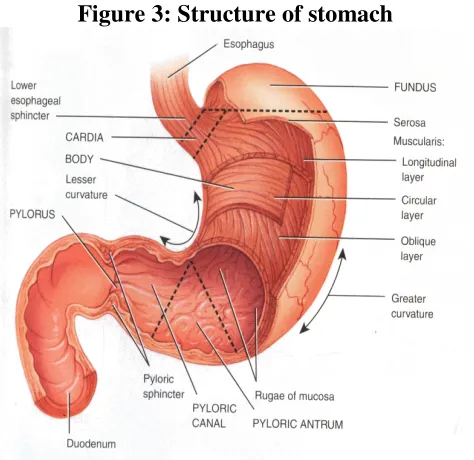
Anatomy and Physiology of Stomach:
The stomach is located in the left upper part of the abdominal hollow under the
diaphragm, between the lower end of the oesophagus and the small intestine and is the
most dilated part of the GIT [8],[14]
. Its opening to the duodenum is controlled by
pyloric sphincter. The stomach has four main regions namely cardia, fundus, body
and pylorus [14]
. Its size varies according to the amount of distention up to 1500 ml
following a meal; after food has emptied, a ‘collapsed’ state is obtained with a resting
volume of only 25-50ml [8].
The two major functions of the stomach are [14]:
• To act as a temporary reservoir for ingested food and to deliver it to the duodenum
at a controlled rate.
• To reduce ingested solids to chyme by the action of acid and enzymatic digestion.
Owing to its small surface area compared to the small intestine very little drug
absorption occurs in stomach [14]. Storage is the main function of the fundus and body,
whereas mixing and grinding takes place in the antrum. The fundus helps to adjust the
increased volume during eating by relaxing its fundus muscle fibres and also exerts a
Chapter - 1 Introduction
pass through pyloric valve into the small intestine the particle size should be in the
[image:15.595.198.435.133.363.2]range of 1 to 2mm [4] .
Figure 3: Structure of stomach
The stomach has a capacity of approximately 1.5 L, although under fasting conditions
it usually contains no more than 50 ml of fluid, which are mostly gastric secretions.
These include [14] :
• Acid secreted by the parietal cells, which maintains pH of the stomach between
1.0 and 3.5 in fasted state.
• The hormone gastrin, which is a potent stimulator of gastric acid production. • Pepsin, which is secreted by peptic cells.
• Mucus that is secreted by surface mucosal cells and lines the gastric mucosa. In
the stomach, mucus protects the gastric mucosa from auto digestion by
pepsin-acid combination.
Gastric volume is important for dissolution of dosage form in-vivo. The resulting
volume of stomach is 25-50ml. gastric pH affects absorption of drugs from CR-DFs.
There is a large volume difference in gastric secretion in normal and achlorohydric
individuals. It affects in-vivo dissolution of drugs when administered with 180 ml of
Chapter - 1 Introduction
2 – 6. The administration of large volume of water with dosage form changes the pH
of stomach to the pH of water initially and this does not improve dissolution of basic
drugs. Generally basic drugs will have a better change to dissolve in fed condition
than in fasted condition [4] .
Food buffers and neutralizes gastric acid, thus increasing the pH up to about 6.5. After
meal-ingestion is completed, the pH rapidly falls back to below 5.0 and then gradually
declines to fasting state values over a period of few hours. The pyloric sphincter has a
diameter of 12.8±7 mm in humans and act as a sieve as well as a mechanical stricture
to the passage of large particles [8] .
Gastric emptying:
The time a dosage form takes to traverse the stomach is usually termed gastric
emptying rate. Gastric emptying of pharmaceuticals is highly variable and is
dependent on the dosage form and the fed/fasted state of the stomach. Normal gastric
residence time usually ranges between 5 minutes and 2 hours, although much longer
times (over 12 hours) have been recorded, particularly for large single units [14].
The GI tract is in a state of continuous motility consisting of two modes: a) Interdigestive motility pattern.
b) Digestive motility pattern
The former is dominant in the fasted state with a primary function of cleaning up the
residual content of upper GIT tract [7] .
The fasted state is associated with various cycle events, commonly referred to as the
migrating motor complex (MMC), which regulates GI motility patterns. The MMC is
organized into alternating cycles of activity and quiescence and can be subdivided
into the following phases.
• Phase I (Basal state):- The quiescent period, lasts from 30-60 minutes and is
characterized by lack of secretory, electrical and contractile activity.
• Phase II (Preburst state):- It exhibits intermittent action for 20-40 minutes during
Chapter - 1 Introduction
duodenum during this phase, while gastric mucus discharge occurs during the
latter part of phase II and throughout phase III.
• Phase III (Burst state):- It is characterized by intense large and regular
contractions, termed housekeeper waves, that sweep off undigested food and lasts
10-20 minutes. Maximal pyloric opening, characterizes this phase which enables
efficient evacuation of the stomach contents.
• Phase IV is the transition period of 0-5 minutes between phase III and I [2].
This series of electrical events originates in the foregut and continues to the terminal
ileum in the fasted state repeating every 2-3 hours [2]
. Concentration of the hormone
motilin in blood controls the duration of the phases. The administration of food
rapidly interrupts the MMC cycle and the digestive phase is allowed to take place [7] .
The motor activity in the fed state is induced 5-10 minutes after ingestion of a meal
and persists as long as food remains in the stomach. The larger the amount of food
ingested, the longer the period of fed activity, with usual time spans of 2-6 hours and
more typically 3-4 hours. The stomach churns food, while suspended fine particles
typically in a size of less than 1mm are emptied through the pylorus into the
duodenum [8].
The pyloric sphincter allows liquids and small food particles to empty while other
material is retropulsed into the antrum of the stomach and caught up by the next
peristaltic wave for further size reduction before emptying. Thus in the fed state
liquids, pellets and disintegrated tablets will tend to empty with food, yet large
sustained or controlled release dosage forms can be retained in the stomach for longer
period of time [14] .
When CRDDS are administered in fasted state, the MMC in any of its phases, which
can significantly influence total GRT and transit time in the GIT. This assumes even
Chapter - 1 Introduction
time of dosage form spends in the region preceding and around the window. The less
time spent in that region the lower the degree of absorption. Therefore the design of
GRDDS take into consideration resistance of the dosage form to gastric emptying
during phase III of MMC in fasted state and continuous gastric emptying through the
pyloric sphincter in the fed state. This means that GRDDS is functional quickly after
administration and able to resist the onslaught of physiological events for the required
period of time [2] .
Emptying of DFs from the stomach:
Non-disintegrating DFs, like other indigestible solids are administered in the fasting
state, they typically are not retained in stomach for over 2 hours due to the MMC. On
the other hand in fed condition the GRT of non-disintegrating DFs depends mostly on
the DF size as well as composition and caloric value of food. In general, GRT of DFs
and in particular large DFs is longer in fed state in comparison to fasting state. Large
DFs are retropelled from pyloric antrum for further digestion and evacuation at the
end of fed state or are retained until arrival of the subsequent ‘housekeeper wave’. In
such cases GRT is a function of the length of digestive process. Thus theoretically
continuous feeding can prolong GRT of DF for more than 24 hours [8].
Gastrointestinal Transit Time [4]:
Food contents remain in each segment of the GIT for different periods of time. The
residence time for both liquid and solid foods in each segment of the GIT is reported
as follows:
Table 1: Residence time
Segment Liquid Solid
Stomach Duodenum Jejunum and Ileum
10 - 30 min < 60 sec 3 ± 1.5 hours
Chapter - 1 Introduction
Colon
Quinolone:
The quinolones are a family of synthetic broad-spectrum antibiotics. The term
quinolone(s) refers to potent synthetic chemotherapeutic antibacterials [15] .
The first generation of the quinolones begins with the introduction of nalidixic acid in
1962 for treatment of urinary tract infections in humans. Nalidixic acid was
discovered by George Lesher and coworkers in a distillate during an attempt at
chloroquine synthesis [16] .
Quinolones, in comparison to other antibiotic classes, have the highest risk of causing
colonization with Methicillin-resistant Staphylococcus aureus (MRSA) and
Clostridium difficile. For this reason, a general avoidance of fluoroquinolones is
recommended based on the available evidence and clinical guidelines. The majority of
quinolones in clinical use belong to the subset fluoroquinolones, which have a
fluorine atom attached to the central ring system, typically at the 6-position or C-7
position [17] .
Figure 4: Essential structure of all quinolone antibiotics: the blue drawn
remainder of R is usually piperazine; if the connection contains fluorine
Chapter - 1 Introduction
The newer fluoroquinolones have broad-spectrum bactericidal activity, excellent oral
bioavailability, good tissue penetration and favorable safety and tolerability profiles.
A new four-generation classification of the quinolone drugs takes into account the
expanded antimicrobial spectrum of the more recently introduced fluoroquinolones
and their clinical indications.
• First-generation drugs (e.g., nalidixic acid) achieve minimal serum levels.
• Second-generation quinolones (e.g., ciprofloxacin) have increased gram-negative
and systemic activity.
• Third-generation drugs (e.g., levofloxacin) have expanded activity against
gram-positive bacteria and atypical pathogens.
• Fourth-generation quinolone drugs (currently only trovafloxacin) add significant
activity against anaerobes.
The quinolones can be differentiated within classes based on their pharmacokinetic
properties. The new classification can help family physicians prescribe these drugs
appropriately [21] .
Classification of Quinolone Antibiotics [21]:
1. First generation
a. Nalidixic acid (NegGram) b. Cinoxacin (Cinobac) 2. Second generation
a. Norfloxacin (Noroxin) b. Lomefloxacin (Maxaquin) c. Enoxacin (Penetrex) d. Ofloxacin (Floxin) e. Ciprofloxacin (Cipro) 3. Third generation
a. Levofloxacin (Levaquin) b. Sparfloxacin (Zagam) c. Gatifloxacin (Tequin) d. Moxifloxacin (Avelox) 4. Fourth generation
a. Trovafloxacin (Trovan)
Chapter - 1 Introduction
Fluoroquinolones are broad spectrum antibiotics that play an important role in the
treatment of serious bacterial infections, especially hospital acquired infections and
others in which resistance to older antibacterial classes is suspected.
Because the use of broad spectrum antibiotics encourages the spread of multi-drug
resistant strains and the development of Clostridium difficile infections, treatment
guidelines from the Infectious Disease Society of America, the American Thoracic
Society, and other professional organizations recommend minimizing the use of
fluoroquinolones and other broad spectrum antibiotics in less severe infections and in
those in which risk factors for multi-drug resistance are not present.
Adverse effects:
In general, fluoroquinolones are well tolerated, with most side effects being mild to
moderate. On occasion, serious adverse effects occur. Some of the serious adverse
effects that occur more commonly with fluoroquinolones than with other antibiotic
drug classes include CNS and tendon toxicity.
The currently marketed quinolones have safety profiles similar to those of other
antimicrobial classes. Fluoroquinolones are sometimes associated with a QTc interval
prolongation and cardiac arrhythmias, convulsions, tendon rupture, torsade de pointes
and hypoglycemia.
These adverse reactions are a class effect of all quinolones; however, certain
quinolones are more strongly associated with increased toxicity to certain organs. For
example, moxifloxacin carries a higher risk of QTc prolongation, and gatifloxacin has
been most frequently linked to disturbed blood sugar levels, although all quinolones
carry these risks.
Some quinolones were withdrawn from the market because of these adverse events
(for example, sparfloxacin was associated with phototoxicity and QTc prolongation,
Chapter - 1 Introduction
trovafloxacin). Simultaneous use of corticosteroids is present in almost one-third of
quinolone-associated tendon rupture. The risk of adverse events is further increased if
the dosage is not properly adjusted, for example if there is renal insufficiency.
Contraindications:
Quinolones are contraindicated if a patient has epilepsy, QT prolongation,
pre-existing CNS lesions, CNS inflammation or those who have suffered a stroke. There
are safeties concerns of fluoroquinolone use during pregnancy and, as a result, are
contraindicated except for when no other safe alternative antibiotic exists.
However, one meta-analysis looking at the outcome of pregnancies involving
Quinolone use in the first trimester found no increased risk of malformations. They
are also contraindicated in children due to the risks of damage to the musculoskeletal
system. Their use in children is not absolutely contraindicated, however. For certain
severe infections where other antibiotics are not an option, their use can be justified.
Quinolones should also not be given to people with a known hypersensitivity to the
drug. Quinolone antibiotics should not be administered to patients who are dependent
on benzodiazepines, since they compete directly with benzodiazepines at the
GABA-A receptor, acting as a competitive antagonist and thus possibly precipitating a severe
acute and potentially fatal withdrawal effect.
Pharmacology:
The basic pharmacophore, or active structure, of the fluoroquinolone class is based
upon the quinoline ring system [18]
. The addition of the fluorine atom at C6 is what
distinguishes the successive-generation fluoroquinolones from the first-generation
quinolones. The addition of the C6 fluorine atom has since been demonstrated to not
be required for the antibacterial activity of this class [19].
Various substitutions made to the quinoline ring resulted in the development of
Chapter - 1 Introduction
a number of specific adverse reactions, as well as increased activity against bacterial
infections, whereas the quinoline ring, in and of itself, has been associated with severe
and even fatal adverse reactions.
Mechanism of action:
Quinolones and fluoroquinolones are chemotherapeutic bactericidal drugs, eradicating
bacteria by interfering with DNA replication. Quinolones inhibit the bacterial DNA
gyrase or the topoisomerase II enzyme, thereby inhibiting DNA replication and
transcription. Recent evidence has shown eukaryotic topoisomerase II is also a target
for a variety of quinolone-based drugs [20] .
Quinolones inhibit the bacterial DNA gyrase or the topoisomerase II enzyme, thereby
inhibiting DNA replication and transcription. Recent evidence has shown eukaryotic
topoisomerase II is also a target for a variety of quinolone-based drugs. Thus far, most
of the compounds that show high activity against the eukaryotic type II enzyme
contain aromatic substituents at their C-7 positions.
Quinolones can enter cells easily via porins and, therefore, are often used to treat
intracellular pathogens such as Legionella pneumophila and Mycoplasma
pneumoniae. For many Gram-negative bacteria, DNA gyrase is the target, whereas
topoisomerase IV is the target for many Gram-positive bacteria. However, there is
debate concerning whether the quinolones still have such an adverse effect on the
DNA of healthy cells, in the manner described above, hence contributing to their
adverse safety profile. This class has been shown to damage mitochondrial DNA.
Mechanism of toxicity:
The mechanisms of the toxicity of fluoroquinolones has been attributed to their
interactions with different receptor complexes such as blockade of the GABAa
Chapter - 1 Introduction
effects and oxidative stress. The severity of oxidative stress generated by
fluoroquinolones has been described as 'enormous' by the authors of one research
study and they suggested co-administration of anti-oxidants when using
fluoroquinolones to minimise the potential for oxidative related cellular damage.
Interactions:
Theophylline, nonsteroidal anti-inflammatory drugs and corticosteroids enhance the
toxicity of fluoroquinolones.
Products containing multivalent cations, such as aluminium- or
magnesium-containing antacids and products magnesium-containing calcium, iron, or zinc, invariably result in
marked reduction of oral absorption of fluoroquinolones.
Other drugs that interact with fluoroquinolones include antacids, sucralfate,
probenecid, cimetidine, warfarin, antiviral agents, phenytoin, cyclosporine, rifampin,
pyrazinamide, andcycloserine.
Many fluoroquinolones, especially ciprofloxacin, inhibit the cytochrome P450
isoform CYP1A2. This inhibition causes an increased level of, for example,
antidepressants such as amitriptyline and imipramine, clozapine (an atypical
antipsychotic), caffeine, olanzapine (an atypical antipsychotic), ropivacaine (a local
anaesthetic), theophylline (a xanthine), and andzolmitriptan (a serotonin receptor
agonist).
Antibiotic misuse and bacterial resistance:
Resistance to quinolones can evolve rapidly, even during a course of treatment.
Numerous pathogens, including Staphylococcus aureus, enterococci, and
Streptococcus pyogenes now exhibit resistance worldwide. Widespread veterinary
usage of quinolones, in particular in Europe, has been implicated.
Fluoroquinolones have been recommended to be reserved for the use in patients that
Chapter - 1 Introduction
to be very important and necessary drugs required to treat severe and life-threatening
bacterial infections, the associated antibiotic misuse remains unchecked, which has
contributed to the problem of bacterial resistance. The overuse of antibiotics such as
happens with children suffering from otitis media has given rise to a breed of super
bacteria that are resistant to antibiotics entirely.
History:
Nalidixic acid is considered to be the predecessor of all members of the quinolone
family, including the second, third and fourth generations commonly known as
fluoroquinolones. This first generation also included other quinolone drugs such as
pipemidic acid, oxolinic acid, and cinoxacin, which were introduced in the 1970s.
They proved to be only marginal improvements over nalidixic acid. Though it is
generally accepted nalidixic acid is to be considered the first quinolone drug, this has
been disputed over the years by a few researchers who believe chloroquine, from
which nalidixic acid is derived, is to be considered the first quinolone drug, rather
than nalidixic acid.
Since the introduction of nalidixic acid in 1962, more than 10,000 analogs have been
synthesized, but only a handful have found their way into clinical practice.
Social and economic impact:
Increased hospitalizations attributed to adverse drug reactions alone account for
billions of dollars each year within the US healthcare system. Severe reactions do
occur with the fluoroquinolone class and can add significantly to the cost of care.
Antibacterial adverse effects account for nearly 25% of all adverse drug reactions
among hospitalized patients.
Patent extensions:
Under the George W. Bush administration (2001–2009), patent extension legislation
Chapter - 1 Introduction
for testing their products for safety in children was signed into law. It has been
estimated that Bayer AG's revenue increased an extra $358 million due to
ciprofloxacin's pediatric patent extension. The legislation was drafted after extensive
lobbying of numerous members of Congress by Bayer AG and others. One of the four
sponsors of this legislation was Chris Dodd (D-CT), who, at the time, ranked as one
of the top three beneficiaries of campaign contributions by drug companies. Sen.
Edward Kennedy (D-MA), who chaired the committee with jurisdiction over the bill,
refused to fight over the language that (if it had been included) would have reduced
the drug company's profits due to these patent extensions. The reasons for Sen.
Edward Kennedy's decision not to fight for the inclusion of this language were not
made known.
Ciprofloxacin is a synthetic antibiotic of the fluoroquinoline drug class. It is a
second-generation fluoroquinoline antibacterial. It kills bacteria by interfering with the
enzymes that cause DNA to rewind after being copied, which stops synthesis of DNA
and protein [15].
Ciprofloxacin interacts with other drugs, herbal and natural supplements, a
characteristic it shares with other widely used antibacterial drugs such as amoxicillin,
trimethoprim, azithromycin, cephalexin and doxycycline [22] .
Medical uses:
Ciprofloxacin is used to treat a number of infections including: infections of bones
and joints, endocarditis, gastroenteritis, malignant otitis externa, respiratory tract
infections, cellulitis, urinary tract infections, prostatitis, anthrax, chancroid [23] .
Availability:
Chapter - 2 Literature Review
Bagherwal et al. [24] (2010)
formulated floating tablets of Ciprofloxacin Hcl belong to
the fluoroquinoline derivatives which is widely used in the long term therapy for
treatment of a wide range of infections including anthrax, biliary tract infection, bone
and joint infection, gastrointestinal including traveler’s diarrhoea and campylobacter
enteritis, shiegella, meningococcal meningitis prophylaxis, surgical infection
prophylaxis, tuberculosis, leprosy and topically in the treatment of eye infections.
Hence there is a potential need for floating tablet as sustained release dosage form for
this drug. HPMC and carbomer are the polymers, used as suspending agent, viscosity
increasing agent and tablet binder coating agents. In the present study, it was aimed to
formulate floating tablet of ciprofloxacin Hcl with HPMC and carbomer in different
proportion (4%, 8% and 12%) by direct compression techniques using polymers
lactose, Magnesium Stearate, talc with sodium bicarbonate.
Mukhopadhyay et al. [25] (2010)
formulated floating-bioadhesive tablets of
Ciprofloxacin Hcl is mainly absorbed in the proximal areas of the gastrointestinal
tract thus the purpose of our study was formulation of floating-bioadhesive tablets to
increase the stay period of drug in its absorption area and decrease the dosing interval
by increasing the bioavailability. Floating-bioadhesive tablets were prepared by direct
compression technique using polymer like hydroxy propyl methyl cellulose (HPMC),
sodium carboxy methyl cellulose (SCMC), carbopol in different ratios. The
effervescent base was prepared by using 1:1 ratio of sodium bicarbonate and citric
acid. It was observed that tablet with 5% effervescent base shows greater control in
Chapter - 2 Literature Review
Sahoo et al. [26] (2007) formulated floating microspheres of Ciprofloxacin Hcl by
cross-linking technique. A polymeric mixture of sodium alginate and hydroxy propyl
methyl cellulose (HPMC) was used. Sodium bicarbonate was used as gas forming
agent. The solution was dropped to 1% calcium chloride solution containing 10%
acetic acid for carbon dioxide release and gel formation. The prepared floating
microspheres were evaluated with respect to particle size distribution, floating
behavior, drug content, entrapped morphology and in-vitro release study. Effect of
sodium bicarbonate on the above mentioned parameters were evaluated and it was
found that sodium bicarbonate had a pronounced effect on various parameters.
Danki et al.[27] (2010)
studied the development of hydrodynamically balanced system
(HBS) of Alfuzosin Hcl as an anti-hypertensive drug designed to increase the gastric
residence time, thus prolonging the drug release. HPMC of different viscosity grades
to prepared HBS by direct compression technique. The drug polymer ratio, viscosity
grades of HPMC, gas generating agents was found to increase drug release and
floating property of prepared HBS. All HBS formulation showed good in vitro
floating property. It was found that three viscosity grades of HPMC (K4M, K15M,
K100M) HPMC K4M along with lactose as diluents were found to be beneficial in
improving the drug release rate and floating property.
Chandira et al. [28] (2010)
formulated floating tablets of Itopride hydrochloride, a
novel prokinetic drug, were developed to prolong the gastric residence time and there
by increase drug bioavailability. Floating tablets were fabricated; using direct
compression method containing Itopride hydrochloride, polymers HPMC K100M,
HPMC K15M and carbopol 934 P, along with gas generating agent sodium
Chapter - 2 Literature Review
K100M, 40 mg HPMC K15M, and 40 mg carbopol provides a better option for 24
hours release action and improved bioavailability
Rao et al. [29] (2009)
formulated and optimized the floating drug delivery system of
cephalexin. Tablets were prepared by direct compression method incorporating
HPMC K4M, xanthan gum, guar gum, sodium bicarbonate and tartaric acid as gas
generating agent. The diffusion exponent of krosmeyer - peppas for optimized
formulation was found to be 0.635 which significantly indicated the mechanism of
drug release.
Bomma et al. [30] (2009)
prepared floating matrix tablets of norfloxcin which were
developed to prolong gastric residence time leading to an increase in drug
bioavailability by using wet granulation technique using polymers such as HPMC
K4M, HPMC K100M and Xanthan gum. The tablets exhibited controlled and
prolonged drug release profile while floating over dissolution medium was confirmed
as drug release mechanism from these tablets.
Thakkar et al. [31] (2008)
formulated and evaluated the levofloxacin hemihydrate
floating tablets that were prepared by direct compression method using gelucire 43/01
and HPMC polymers in different ratio. The in-vitro release study revealed the fact
that the release rate of drug was decreased by increasing the proportions of gelucire
43/01 by 5 to 40% matrix tablets containing 25% HPMC K4M and 15% gelucire
43/01.
Jaimini et al. [32] (2007)
formulated and evaluated famotidine floating tablets. They
used Methocel K100 and Methocel K15M with effervescent mixture. It was observed
that decrease in the citric acid level increased the floating lag time but tablets floated
Chapter - 2 Literature Review
(10 mg) was found to achieve optimum in-vitro buoyancy. They reported that tablets
prepared with K100 had longer floating time compared with formulations containing
Methocel K15M.
Ali et al. [33] (2007)
formulated hydrodynamically balanced system for metformin as a
single unit floating capsule. The formulation was optimized on the basis of in – vitro
buoyancy and in – vitro release in simulated fed state gastric fluid. Effect of various
release modifiers was studied to ensure the delivery of drug from the HBS capsules
over a prolonged period. Capsules prepared with HPMC K4M and ethyl cellulose
gave the best in – vitro percentage release and was taken as the optimized
formulation.
Narendra et al. [34] (2006) reported optimization of bilayer floating tablet containing
metoprolol tartrate as a model drug for gastric retention. They employed a 23
factorial
design in formulating the GFDDS with total polymer content-to-drug ratio (X1),
polymer-to-polymer ratio (X2), and different viscosity grades of HPMC (X3) as
independent variables. The results indicate that X1 and X2 – significantly affected the
floating time and release properties but the effect of different viscosity grades of
HPMC (K4M and K100M) was non-significant.
Rahman et al. [35] (2006)
developed a bilayer-floating tablet (BFT) for captopril using
direct compression technology. HPMC, K-grade and effervescent mixture of citric
acid and sodium bicarbonate formed the floating layer. The release layer contained
captopril and various polymers such as HPMC K15M, PVP-K30 and Carbopol 934p,
alone or in combination with the drug. The floating behavior and in-vitro dissolution
studies were carried out in a USP 23 apparatus 2 in simulated gastric fluid (without
Chapter - 2 Literature Review
while the floating lag time was 10 min and the tablet remained floatable throughout
all studies. Final formulation followed the higuchi release model and showed no
significant change in physical appearance, drug content, floatability or in-vitro
dissolution pattern after storage at 45o
C/75% RH for three months.
Srivastava et al. [36] (2005)
prepared floating matrix tablets of atenolol to prolong
gastric residence time and increase drug bioavailability. The tablets were prepared by
direct compression technique, using polymers such as HPMC K15M, K4M, Guargum
(GG), and sodium carboxy methylcellulose (SCMC), alone or in combination and
other standard excipients. Tablets were evaluated for physical characteristics like
hardness, swelling index, floating capacity, thickness and weight variation. The effect
of effervescent on buoyancy and drug release pattern was also studied. In-vitro release
mechanism was evaluated by linear regression analysis. GG- and SCMC- based
matrix tablets showed significantly greater swelling indices compared with other
batches. The tablets exhibited controlled and prolonged drug release profiles while
floating over the dissolution medium.
Patel et al. [37] (2005)
developed ranitidine floating tablets; in which they optimized
types of filler, different viscosity grades of HPMC and its concentration. Two fillers
namely Avicel pH 102 and Tablettose 80 were used. Study revealed that type of filler
had significant effect on release of drug from hydrophilic matrix tablets (f2 value
41.30) and floating properties. Three different viscosity grades of HPMC namely
K100 LV, K4M and K15M were used. Viscosity had a major influence on drug
release from hydrophilic matrices as well as on floating properties. The drug release
from hydrophilic matrices occurred via diffusion mechanisms following square root
Chapter - 2 Literature Review
might be due to decreased porosity whereas the position of paddle and types of
dissolution medium had no significant effect on drug release.
Dave et al. [38] (2004)
reported a gastroretentive drug delivery system of ranitidine
hydrochloride. Guar gum, xanthan gum, and hydroxy propyl methylcellulose were
evaluated for gel forming properties. Sodium bicarbonate was incorporated as a
gas-generating agent. They investigated the effect of citric acid and stearic acid on drug
release profile and floating properties. They concluded that the proper balance
between a release rate retardant and a release rate enhancer could produce a drug
dissolution profile similar to a theoretical dissolution profile.
Amin et al. [39] (2004)
developed a gastroretentive drug delivery system of ranitidine
hydrochloride which was designed using guar gum, xanthan gum and HPMC. Sodium
bicarbonate was incorporated as a gas-generating agent. The effect of citric acid and
stearic acid on drug release profile and floating properties was investigated. The
addition of stearic acid reduces the drug dissolution due to its hydrophobic nature. A
32
full factorial design was applied to systemically optimize the drug release profile
and the results showed that a low amount of citric acid and a high amount of stearic
acid favor sustained release of ranitidine Hcl from a gastroretentive formulation.
Sangalli et al. [40] (2004)
studied the process parameters and in-vitro performances of
different HPMC viscosity grades as coating agents for an oral time and site controlled
delivery system. Methocel E50 showed the best balance among process time,
retarding ability, dimensions of the coated units and possibility of finely tuning the
delay duration.
Li et al. [41] (2002)
evaluated the contribution of formulation variables on the floating
properties of a gastro floating drug delivery system using a continuous floating
Chapter - 2 Literature Review
using 2x3 full factorial designs for calcium delivery. HPMC was used as a
low-density polymer and citric acid was incorporated for gas generation. Analysis of
variance (ANOVA) test on the results from these experimental designs demonstrated
that the hydrophobic agent magnesium stearate could significantly improve the
floating capacity of the delivery system. High-viscosity polymers had good effect on
floating properties. The residual floating force values of the different grades of HPMC
were in the order K4 M~ E4 M~K100LV> E5 LV but different polymers with same
viscosity, i.e., HPMC K4M, HPMC E4M did not show any significant effect on
floating property. Better floating was achieved at a higher HPMC/carbopol ratio and
Chapter - 3 Aim and Plan of Work
Aim:
The aim of the present study is to formulation and evaluation of floating tablets of
Ciprofloxacin Hcl using HPMC by direct compression techniques.
A rationale for developing Ciprofloxacin Hcl as a gastroretentive dosage form, which
is retained in the stomach for prolonged period of time and produces a constant input
of drug to the absorption site.
This improves bioavailability of the drug, reduces frequency of dosing, thus
minimizing side effects.
Objective:
Ciprofloxacin is a broad-spectrum antibiotic active against both Gram-positive and
Gram-negative bacteria.
It is absorbed completely (91 – 95%) after oral administration and having a biological
half-life of 3 to 5 hrs. The drug should be administered twice a day.
The objective of the present study is to formulate the Ciprofloxacin Hcl floating
tablets using HPMC (K100M, K4M and E50) in different ratio with sodium
Chapter - 3 Aim and Plan of Work
Plan of Work:
1. Literature survey 2. Preformulation studies
• Selection of the drug
• Analytical characterization of the drug • Selection of the excipients
• Characterization of the excipients
3. Standard calibration curve of drug 4. Formulation development
• Formulation of the floating tablet
• Effect of the formulation variables on the drug release, swelling and
floating properties
5. Evaluation of tablets
• Tablet characteristics • Floating properties • Water uptake
• In-vitro drug release studies of tablets
6. Treatment of the dissolution data obtained with different kinetic
release equations
Chapter - 4 Materials and Methods
4.1. MATERIALS AND EQUIPMENTS:
[image:36.595.107.528.155.441.2]Materials:
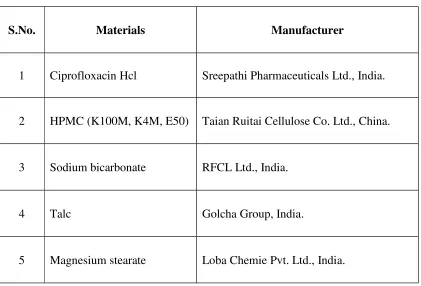
Table 2: List of Materials Used
S.No. Materials Manufacturer
1 Ciprofloxacin Hcl Sreepathi Pharmaceuticals Ltd., India.
2 HPMC (K100M, K4M, E50) Taian Ruitai Cellulose Co. Ltd., China.
3 Sodium bicarbonate RFCL Ltd., India.
4 Talc Golcha Group, India.
5 Magnesium stearate Loba Chemie Pvt. Ltd., India.
Equipments:
Table 3: List of Equipments Used
S.No. Equipments Manufacturers
1 Electronic Balance Sartorius, India.
Chapter - 4 Materials and Methods
3 FTIR Spectrophotometer Shimadzu, Japan.
4 Rotary Tableting Machine Fluidpack, India.
5 Dissolution Test Apparatus Electrolab, India.
6 Vernier Calipers Mitutoyo, Japan.
7 Hardness Test Apparatus Monsanto, India.
8 Friability Test Apparatus Electrolab, India.
4.2. DRUG PROFILE
CIPROFLOXACIN HYDROCHLORIDE [42],[43],[44],[45],[22]:
Ciprofloxacin Hydrochloride is
1-cyclopropyl-6-fluoro-1,4-dihydro-4-oxo-7-(1-piperazinyl)-3-quinolinecarboxylic acid hydrochloride monohydrate.
Structure of Ciprofloxacin Hcl:
Empirical Formula:
C17H18FN3O3•HCl•H2O
Chapter - 4 Materials and Methods
Category:
Antibacterial
Dose:
The equivalent of 250 to 750 mg of ciprofloxacin twice daily (116 mg of
ciprofloxacin hydrochloride is approximately equivalent to 100 mg of ciprofloxacin).
Description:
Faintly yellowish to light yellow crystalline substance.
Solubility:
Soluble in water; slightly soluble in acetic acid and in methanol; very slightly soluble
in ethanol; practically insoluble in acetone, in acetonitrile, in ethyl acetate, in hexane
and in dichloromethane.
Storage:
Store in tightly-closed, light-resistant containers.
Standards:
Ciprofloxacin Hydrochloride contains not less than 98.0 per cent and not more than
102.0 per cent of C17H18FN3O3,Hcl, calculated with reference to the anhydrous
substance.
Identification:
A: The infra-red absorption spectrum, Appendix 5.4, is concordant with the reference
spectrum of ciprofloxacin hydrochloride or with the spectrum obtained
from ciprofloxacin hydrochloride RS.
B: Complies with test B described under Ciprofloxacin using the following solutions
in water containing (1) 1.0% w/v of the substance being examined and (2) 1.0% w/v
of ciprofloxacin hydrochloride RS.
C: Gives the reactions of chlorides, Appendix 3.1.
Procedure:
Dissolve a quantity of the substance being examined equivalent to about 2 mg of
chloride ion in 2 ml of water or use 2 ml of the prescribed solution. Acidify with
Chapter - 4 Materials and Methods
curdy white precipitate is formed, which is insoluble in nitric acid but soluble, after
being well washed with water, in dilute ammonia solution, from which is insoluble in
nitric acid but soluble, after being well washed with water, in dilute ammonia
solution, from which it is reprecipitated by the addition of dilute nitric acid.
pH:
Between 3.0 and 4.5, determined in a 2.5% w/v solution, Appendix 8.11.
Heavy metals:
Not more than 20 ppm, determined on 1.0 g by Method B, Appendix 3.12.
Sulphate:
0.375 g complies with the limit test for sulphates, Appendix 3.15 (400 ppm).
Sulphated ash:
Not more than 0.1%, Appendix 3.22.
Procedure:
Heat a silica or platinum crucible to redness for 10 minutes, allow to cool in a
desiccator and weigh. Unless otherwise specified in the individual monograph,
transfer to the crucible 1 g of the substance being examined and weigh the crucible
and the contents accurately. Ignite, gently at first, until the substance is thoroughly
charred. Cool, moisten the residue with 1 ml of sulphuric acid, heat gently until the
white fumes are no longer evolved and ignite at 800° ± 25° until all black particles
have disappeared. Conduct the ignition in a place protected from air currents. Allow
the crucible to cool, add a few drops of sulphuric acid and heat. Ignite as before, allow
to cool and weigh. Repeat the operation until two successive weighings do not differ
by more than 0.5 mg.
Water:
Between 4.7 and 6.7% w/w, determined on 0.2 g, Appendix 3.24.
Assay:
Carry out the Assay described under Ciprofloxacin using the following solutions in
the mobile phase. Solution (1) is a 0.05% w/v solution of the substance being
Chapter - 4 Materials and Methods
(3) contains 0.05% w/v each of ciprofloxacin ethylenediamine analog
RS and ciprofloxacin hydrochloride RS.
Calculate the content of C17H18FN3O3,Hcl from the declared content of
C17H18FN3O3,Hcl in ciprofloxacin hydrochloride RS.
Mechanism of action [43]:
Ciprofloxacin is a broad-spectrum antibiotic active against both Gram-positive and
Gram-negative bacteria. It functions by inhibiting DNA gyrase, a type II
topoisomerase and topoisomerase IV, enzymes necessary to separate bacterial DNA,
thereby inhibiting cell division.
This mechanism can also affect mammalian cell replication. In particular, some
congeners of this drug family (for example those that contain the C-8 fluorine) display
high activity not only against bacterial topoisomerases but also against eukaryotic
topoisomerases and are toxic to cultured mammalian cells and in vivo tumor models.
Although quinolones are highly toxic to mammalian cells in culture, its mechanism of
cytotoxic action is not known. Quinolone-induced DNA damage was first reported in
1986.
Recent studies have demonstrated a correlation between mammalian cell cytotoxicity
of the quinolones and the induction of micronuclei. As such, some fluoroquinolones
may cause injury to the chromosome of eukaryotic cells.
There continues to be debate as to whether or not this DNA damage is to be
considered one of the mechanisms of action concerning the severe adverse reactions
experienced by some patients following fluoroquinolone therapy.
Clinical Pharmacology [44]:
Absorption:
Ciprofloxacin given as an oral tablet is rapidly and well absorbed from the
gastrointestinal tract after oral administration. The absolute bioavailability is
Chapter - 4 Materials and Methods
maximum serum concentrations and area under the curve are shown in the chart for
the 250 mg to 1000 mg dose range.
Table 4: Ciprofloxacin dose range of maximum serum concentration and area
under curve
Dose (mg) Maximum Serum Concentration (µg/ml)
Area Under Curve (AUC) (µg•hr/mL)
250 1.2 4.8
500 2.4 11.6
750 4.3 20.2
1000 5.4 30.8
Maximum serum concentrations are attained 1 to 2 hours after oral dosing. Mean
concentrations 12 hours after dosing with 250, 500, or 750 mg are 0.1, 0.2, and 0.4
µg/ml respectively. The serum elimination half-life in subjects with normal renal
function is approximately 4 hours. Serum concentrations increase proportionately
with doses up to 1000 mg.
Distribution:
The binding of ciprofloxacin to serum proteins is 20 to 40% which is not likely to be
high enough to cause significant protein binding interactions with other drugs.
After oral administration, ciprofloxacin is widely distributed throughout the body.
Tissue concentrations often exceed serum concentrations in both men and women,
particularly in genital tissue including the prostate.
Ciprofloxacin is present in active form in the saliva, nasal and bronchial secretions,
mucosa of the sinuses, sputum, skin blister fluid, lymph, peritoneal fluid, bile, and
Chapter - 4 Materials and Methods
Ciprofloxacin has also been detected in lung, skin, fat, muscle, cartilage, and bone.
The drug diffuses into the cerebrospinal fluid (CSF); however, CSF concentrations are
generally less than 10% of peak serum concentrations. Low levels of the drug have
been detected in the aqueous and vitreous humors of the eye.
Metabolism:
Four metabolites have been identified in human urine which together account for
approximately 15% of an oral dose. The metabolites have antimicrobial activity, but
are less active than unchanged ciprofloxacin.
Excretion:
The serum elimination half-life in subjects with normal renal function is
approximately 4 hours. Approximately 40 to 50% of an orally administered dose is
excreted in the urine as unchanged drug. After a 250 mg oral dose, urine
concentrations of ciprofloxacin usually exceed 200 µg/ml during the first two hours
and are approximately 30 µg/ml at 8 to 12 hours after dosing.
The urinary excretion of ciprofloxacin is virtually complete within 24 hours after
dosing. The renal clearance of ciprofloxacin, which is approximately 300 ml/minute,
exceeds the normal glomerular filtration rate of 120 ml/minute. Thus, active tubular
secretion would seem to play a significant role in its elimination.
Adverse Effects [45]:
The serious adverse effects that may occur as a result of ciprofloxacin therapy include
irreversible peripheral neuropathy, spontaneous tendon rupture and tendonitis, acute
liver failure or serious liver injury (hepatitis), toxic epidermal necrolysis (TEN), and
Stevens–Johnson syndrome, severe central nervous system disorders (CNS) and
Clostridium difficile associated disease (CDAD: pseudomembranous colitis), as well
as photosensitivity/phototoxicity reactions.
Chapter - 4 Materials and Methods
The toxicity of drugs that are metabolised by the cytochrome P450 system is
enhanced by concomitant use of some quinolones. Quercetin, a flavonol, occasionally
used as a dietary supplement, may interact with fluoroquinolones, as quercetin
competitively binds to bacterial DNA gyrase. Ciprofloxacin can reduce phenytoin
plasma levels, which may, in some cases, result in seizures. Ciprofloxacin may
interfere with the levels of thyroid medications resulting in hypothyroidism.
Coadministration of ciprofloxacin with other drugs primarily metabolized by
CYP1A2 results in increased plasma concentrations of these drugs and could lead to
clinically significant adverse events of the coadministered drug.
Concurrent administration of ciprofloxacin with magnesium or aluminum antacids,
sucralfate or products containing calcium, iron, or zinc(including multivitamins or
other dietary supplements) may substantially decrease the absorption of ciprofloxacin,
resulting in serum and urine levels considerably lower than desired.
Precautions [44]:
General:-Crystals of ciprofloxacin have been observed rarely in the urine of human subjects but
more frequently in the urine of laboratory animals, which is usually alkaline.
Crystalluria related to ciprofloxacin has been reported only rarely in humans because
human urine is usually acidic. Alkalinity of the urine should be avoided in patients
receiving ciprofloxacin.
Central Nervous
System:-Quinolones, including ciprofloxacin, may also cause central nervous system (CNS)
events, including: nervousness, agitation, insomnia, anxiety, nightmares or paranoia.
Renal
Impairment:-Alteration of the dosage regimen is necessary for patients with impairment of renal
function.
![Figure 2: Classification of Gastro retentive Drug Delivery Systems [2].](https://thumb-us.123doks.com/thumbv2/123dok_us/533834.72178/10.595.120.513.437.781/figure-classification-gastro-retentive-drug-delivery-systems.webp)