DISSOLUTION STUDY OF TRAMADOL HCL SUSTAINED RELEASE
MATRIX TABLET FROM HPMC K4M
Md. Arif uddin1, Ariful Islam*3, Md. Rakib Uddin2,Jakia Sultana4, Farjana Chowdhury3, Rumana Ferdushi5
1
Department of Pharmaceutical Technology, University of Dhaka.
2
Department of Pharmaceutical Chemistry, University of Dhaka.
3
Department of Pharmacy, State University of Bangladesh.
4
Department of Pharmacy, University of Rajshahi.
5
Department of Pharmacy, University of Asia Pacific.
ABASTRACT
In the present study, an effort has been made to evaluate of hydroxypropyl methylcellulose HPMC K4M as rate retardant polymer to sustain the release of Tramadol HCl from Tramadol HCl sustained release tablet matrix. Different amount of HPMC K4M were used by considering the factors such as moisture content, stability of ingredients, coating of tablets etc. in formulation of F1 to F5 where drug and polymer ratio were consequently 1:2, 5:9, 5:8, 5:7 and 5:6 in 200 mg tablet matrix . Tablets were prepared by direct compression. The dissolution study of the tablet matrices of different formulations were carried out in the gastric medium (pH 1.3) for first 2 hours and then in the intestinal medium (pH 6.8) for 6 hours using USP dissolution apparatus II. The drug release patterns were simulated in different kinetic orders such as Zero Order release kinetics, First Order release kinetics, Higuchi release kinetics, Korsemeyer-Peppas release kinetics and Hixson-Crowell release kinetics to assess the release mechanism. From the study it was observed that first Order release kinetics was the predominant release mechanism than Higuchi and zero Order kinetics. Among the formulations of F-1 to F-5, a different amount of HPMC K4M polymer can sustain the release of Tramadol HCl 62.33% to 100% in eight hour.
Volume 4, Issue 12, 1447-1459. Research Article ISSN 2277– 7105
*Correspondence for
Author
Ariful Islam
Department of Pharmacy,
State University of
Bangladesh. Article Received on 20 Oct 2015,
KEYWORDS: Tramadol HCl, HPMC K4M, matrix tablet, first order plot, higuchi plot, zero order and dissolution studies.
INTRODUCTION
Hydrophilic matrix containing swell able polymers are referred to as hydro gel matrices, swell able sustained release system or hydrophilic matrix tablets.[10] A number of polymers have been investigated to develop in situ gel forming systems due to ability of these hydro gels to release an entrapped drug in aqueous medium and to regulate the release of such drug by control of swelling and cross linking.[1]
Hydroxy Propyl Methyl Cellulose (HPMC)[7] is the polymer most widely used as the gel forming agent in the formulation of sustained release dosage form. Water penetration, polymer swelling, drug dissolution, drug diffusion and matrix erosion from these dosage forms are controlled by the hydration of HPMC which forms a gel barrier through which the drug diffuses.[4] The adjustment of the polymer concentration, the viscosity grade and the addition of different types and levels of excipientes. The HPMC matrix can modify the drug release rate.[5]
Tramadol HCl is used in the treatment of osteoarthritis when no steroidal anti-inflammatory drug (NSAIDS), acetaminophen, or COX-2 inhibitors alone produce inadequate pain relief. After oral administration, Tramadol HCl is rapidly and almost completely absorbed. Sustained release tablets reach to peak concentration after 4.9 hours and have a bioavailability of 87%-95%. The mean elimination half life is approximately 6 to 8 hours and requires dosing every 6 hours in order to maintain optimal relief of chronic pain As a result an attempt made to formulate once daily extended release tablets. Long term treatment with sustained release Tramadol HCl is generally safe in patients with osteoarthritis or refractory low back pain and is well tolerated. It has the potential to provide patients more control over the management of their pain, fewer interruptions in sleep and improved compliance.
MATERIALS AND METHOD Materials
Preparation of Matrix Tablet
Drug, polymer and other excipients were weighed separately for each tablet per formulation according to proposed formulations shown in.[9,14] Table 3. The proposed formulations were coded as F-1, F-2, F-3, F-4 and F-5. All the amounts of drug and excipients are in milligram unit. Then Active ingredient (Tramadol HCl), polymer (HPMC K4M), and excipients (Avicel, lactose) were blended for 15 minutes and then Magnesium Stearate was added and was blended for another 1 minute. Blended mass was taken in the hopper and then die and punch were adjusted to get the desired weight of the tablet (200 mg). After Direct compression[16] the tablets were weighed and tablet weight was found between 198 mg to 202 mg.[15,18]
PHYSICAL EVALUATION OF GRANULES 1. Bulk density
The bulk density of a powder is dependent on particle packing and changes as the powder consolidates. A consolidated powder is likely to have a greater arch strength than a less consolidated one and may therefore be more resistant to powder flow.
The ease with which a powder consolidates can be used as an indirect method for quantifying powder flow. LBD (Loose Bulk Density) and TBD (Tapped Bulk Density) were determined by 2g of powder from each formula, previously lightly shaken to break any agglomerates formed, was placed into a 10 ml measuring cylinder. After the initial volume was observed, the cylinder was allowed to fall under its own weight onto a hard surface from the height of 2.5 cm at 2 second intervals. The reading of tapping was continued until no further change in volume was noted. Using the following equation LBD and TBD was calculating.
LBD = Weight of the powder/volume of the packing.
TBD = Weight of the powder/Tapping volume of the packing.
2. Compressibility index
The compressibility index of the granules was determined by Carr’s compressibility index. Carr’s index (%) = {(TBD-LBD) x 100}/TBD
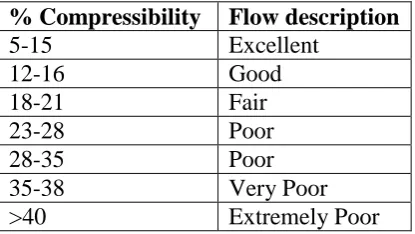
Table 1: Car’s index properties
% Compressibility Flow description
5-15 Excellent 12-16 Good 18-21 Fair 23-28 Poor 28-35 Poor 35-38 Very Poor >40 Extremely Poor
3. Total porosity
Total porosity was determined by measuring the volume occupied by a selected weight of powder (V bulk) and the true volume of granules (the space occupied by the powder exclusive of spaces greater than the intermolecular space (V)
Porosity (%) = Bulk-V/V bulk x 100
4. Angle of repose
The angle of repose of granules was determined by the funnel method. The accurately weighed granules were taken in a funnel. The height of the funnel was adjusted in such a way that the tip of the funnel just touched the apex of the heap of the granules. The granules were allowed to flow through the funnel freely onto the surface. The diameter of the power cone was measured and angle of repose was calculated using the following equation.
Angle of repose, θ = tan-1 h/r
Where, h= Height of the powder cone; r= Radius of the powder conc.
5. Drug content
An accurately weighed amount of powdered Tramadol HCl (200 mg) was extracted with diluents and the solution was filtered through 0.45 μ membrane filter paper. The absorbance was measured at 271 nm after suitable dilution.
6. Flow properties
It is very important parameter to be measured since it affects the mass of uniformity of the dose. It is usually predicted from Hausner ratio and angle of repose measurement.
Table 2: Hausner ratio
Hausner ratio Type of flow
Less than 1.25 Good Flow 1.25-1.5 Moderate More than 1.5 Poor Flow
7. Surface area
As the shape of the tablet is round flat, it can be compared with a cylinder. Surface area of a cylinder is calculated by.
Cylinder surface area = πr2h
Where, r = diameter of tablet in mm2; h= thickness of the tablet in mm
8. Hardness and Friability
For each formulation, the hardness and friability of 6 tablets were determined using the Monsanto harness tester and the Roche friabilator respectively.
9. Thickness
The thickness of the tablet was determined using a thickness gauge. Five tablets from each batch were used, and average values were calculated.
10.Weight variation test
To study weight variation, 20 tablets from each formulation were weighed using an Electronic balance and the test was performed according to the official method.
11.Drug content (Drug potency)
Five tablets were weighed individually, and the drug was extracted with diluents. The solution was filtered through 0.45-μ membrane filter paper. The absorbance was measured at 271 nm after suitable dilution.
12.Preparation of Calibration curve
2 μg / ml to 20 μg / ml. Then absorbance of the solutions was measured at 271 nm using UV spectrophotometer. A plot was constructed showing concentration at X- axis and absorbance at Y- axis.[13]
13.In vitro Dissolution Study of the Tablet Matrix
Dissolution studies were conducted according to USP method (USP XXII) 17 using apparatus II paddle at a speed of 100 rpm and the temperature was maintained at 37.0±0.5o C. The USP paddle system consisted of six glass vessels. These vessels contained the dissolution medium. The total duration of dissolution was 8 hours in which the tablet matrices were subjected to gastric media (0.1 N HCl pH 1.5) for 2 hours and the later hours the tablet matrices were subjected to intestinal media (Buffer pH 6.8).[2]
14.Acid stage
900 ml of 0.1 N HCl was placed in each vessel and the apparatus was assembled. Six tablets from one formulation were weighed and placed in the baskets. The operation in the acid stage was carried out for 2 hours. After each hour 5 ml of sample solution was withdrawn and same volume of fresh medium was replaced. The released drug was assayed by using UV spectrophotometer at 271 nm. Percentage of drug release was calculated using an equation obtained from the standard curve.[11]
15.Buffer Stage
900 ml of intestinal buffer media was placed in each vessel and the apparatus was assembled. Six tablets from each formulation were weighed and placed in the baskets. The operation in the acid stage was carried out for 6 hours. After each hour 5 ml of sample solution was withdrawn and same volume of fresh medium was replaced
The released drug was assayed by using UV spectrophotometer at 271 nm. Percentage of drug release was calculated using an equation obtained from the standard curve.
16.Kinetic Study
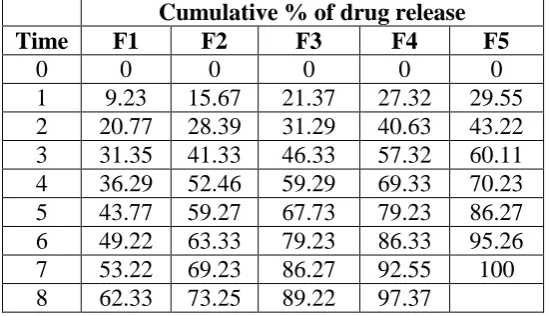
Further to understand the order and mechanism of drug release the data was subjected to various kinetic equations and plotted according to zero order, Higuchi, Korsymere’s Peppas and Hixson-Crowell. The kinetic values obtained from different plots are listed in table 8.
RESULTS: The dissolution studies of five formulations are given bellow;
F-2: After dissolution of tablets the percent release of drug after 8 hour was 73.25%
F-3: After dissolution of tablets the percent release of drug after 8 hour was 89.22%.
F-4: After dissolution of tablets the percent release of drug after 8 hour was 97.37%.
F-5: After dissolution of tablets the percent release of drug after 8 hour was 100%.
[image:7.595.176.421.240.360.2]The aforementioned dissolution study indicates that with the decrease of drug to polymer ratio; increase the percent of release of drug.
Table 3: formulation of batch f1 to f5.[8,17]
F1 F2 F3 F4 F5
Tramadol HCl 50 50 50 50 50 HPMC K4M 100 90 80 70 60 Avicel 101 23 23 23 23 23 Mg stearete 5 5 5 5 5 Talc 2 2 2 2 2 Lactose 20 30 40 50 60 Total in mg 200 200 200 200 200
TABLE4: The tablet of different formulation were evaluated Formula no Weight variation(mg) Diameter (mm) Thickness (mm) Hardness (kg) Friability (%)
F1 200±0.85 8.70±0.04 2.24± 6.5±0.03 0.77 F2 200±0.55 8.50±0.07 2.36± 6.6±0.07 0.65 F3 200±0.94 8.60±0.09 2.26± 6.4±0.04 0.62 F4 200±0.78 8.40±0.04 2.45± 6.7±0.02 0.41 F5 200±0.66 8.30±0.08 2.31± 6.9±0.06 0.33
Table 5: Physical Properties Of Granules Of Five Formulations (F-1 To F-5) Of Tramadol Hcl Matrix Tablets
Formulation Loose bulk density (LBD) gm/ml Tapped bulk density (TBD) gm/ml Carr’s index (%) Hausner ratio Total porosity (%) Moisture content (%) Angle of Repose (o)
Table 6: Data for the calibration curve of Tramadol HCl solution at λmax 271 nm
Serial no. Concentration
(µg/ml) Absorbance
1 2 0.027
2 4 0.042
3 6 0.062
4 8 0.072
5 10 0.081
6 12 0.099
7 14 0.114
8 16 0.120
9 18 0.137
10 20 0.145
Table 7: Zero Order Release Profile Of Five Formulations (F-1 To F-5) Of Tramadol Hcl Matrix Tablets
Cumulative % of drug release
Time F1 F2 F3 F4 F5
0 0 0 0 0 0
1 9.23 15.67 21.37 27.32 29.55 2 20.77 28.39 31.29 40.63 43.22 3 31.35 41.33 46.33 57.32 60.11 4 36.29 52.46 59.29 69.33 70.23 5 43.77 59.27 67.73 79.23 86.27 6 49.22 63.33 79.23 86.33 95.26 7 53.22 69.23 86.27 92.55 100 8 62.33 73.25 89.22 97.37
Table 8: Release Rate Constants And R2 Values For Different Release Kinetics Of Five Formulations (F-1 To F-5) Of Tramadol Hcl Matrix Tablets
Zero order First order Higuchi krosmaayer Hixon- crowell
Formulation No. K0 R2 K1 R2 kh R2 n R2 khc R2
Figure 1: Standard Curve of Tramadol HCl in water media
Figure 2: Zero Order Plot Profile of Five Formulations (F-1 To F-5) Of Tramadol Hcl Matrix Tablets
[image:9.595.151.445.538.722.2]
Figure 4: Higuchi Plot of Five Formulations (F-1 To F-5) Of Tramadol Hcl Matrix Tablets
Figure 5: Korsmeyer- Peppas Plot of Five Formulations (F-1 To F-5) Of Tramadol Hcl Matrix Tablets
[image:10.595.155.443.322.501.2] [image:10.595.154.446.551.717.2]DISCUSION
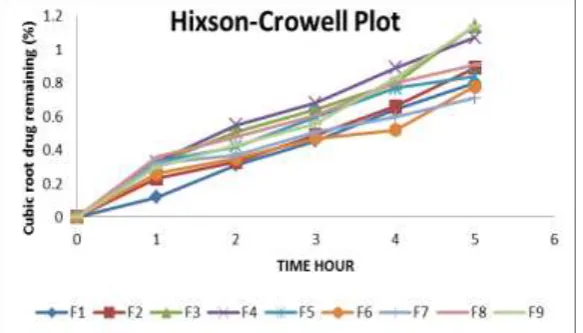
After dissolution study the drug release patterns were simulated in different kinetic orders such as Zero Order release kinetics (figure 1), First Order release kinetics (figure 2), Higuchi release kinetics[6] (figure 3), Korsmeyer-Peppas release kinetics (figure 4) and Hixson-Crowell release kinetics (figure 5) to assess the release mechanism.
F-1: In this formulation Tramadol HCl and HPMC K15M ratio is 1:2. Best fitted model for this formulation was First order (R2=0.991) and Hixson-Crowell (R2=0.995) model.
F-2: In this formulation Tramadol HCl and HPMC K15M ratio is 5:9. Best fitted model for this formulation were first order (R2=0.995) and Hixson-Crowell (R2=0.987) model.
F-3: In this formulation Tramadol HCl and HPMC K15M ratio is 5:4. Best fitted model for this formulation were first order (R2=0.986) and zero order (R2=0.970) model.
F-4: In this formulation Tramadol HCl and HPMC K15M ratio is 5:3. Best fitted model for this formulation were first order (R2=0.944) model.
F-5: In this formulation Tramadol HCl and HPMC K15M ratio is 5:2. Best fitted model for this formulation were higuchi (R2=0.982) and zero order (R2=0.961) model.
From the study, we observed that first Order release kinetics was the predominant release mechanism than Higuchi and zero Order kinetics. Among the formulations of F-1 to F-5, a different amount of HPMC K15M polymer can sustain the Release of Tramadol HCl 62.33% to 100% in eight hour.
CONCLUSION
The half life of Tramadol HCl is 5.5-7 hour for oral dosage. Due to short half life (5.5-7hr) and its higher water solubility make this drug a suitable candidate for sustained release dosage forms. From this study it was concluded that HPMC K4M met the desired sustained release properties.
We also observed that first order release kinetics was the predominant release kinetics among Higuchi, Korsmeyer-Peppas, Hixson-Crowell, Zero Order, and First Order release kinetics.
The proposed formulations may be used for the development of Tramadol HCl release matrix to meet the patient’s demand in order to combat against pain more precisely.
REFERENCES
1. Arthur H.K. Handbook of Pharmaceutical Excipients. 3rd Edition.
2. Aulton M.E., Abdul-Razzak M.H., and HoganJE. The mechanical properties of Hydroxypropyl methyl cellulose films derived from aqueous systems Part I. Aulton, ME., Pharmaceutics: The science of dosage form design, 1981; 191-211.
3. Capan Y. Influence of technological factors on formulation of sustained release tablet. Drug development and industrial pharmacy, 1989; 15: 927-95.
4. Batycky R.P., Hanes, J. Langer, R. and EdwardrsD.A. A theoretical model of erosion and macromolecular drug release from biodegrading microspheres. J Pham Sci, 1997; 89: 1464-77.
5. Langer R. and Folkman J. Polymers for sustained release of proteins & other macromolecules. Nature, 1976; 263: 797-800.
6. Higuchi T mechanism of sustained action medication. Theoretical analysis of rate of release of solid drugs dispersed in solid matrices. J. Pharm. Sciences, 1963; 52: 1145-1149.
7. Dow Chemical Company, Formulation for con-trolled release with METHOCEL cellulose ethers, USA 1987.
8. Lee B.J. Ryu S.G. and Cui J.H. Formulation and release characteristics of hydroxypropyl methylcellulose matrix tablet containing melatonin. Drug Dev Ind Pharm, 1999; 22: 493-501.
9. Kumer P. Singh S. Mishra B. Development and biopharmaceutical evaluation of extended release formulation of tramadol hydrochloride based on osmotic technology. Acta Pharm. Original Research Paper, 2009; 59: 15–30.
10.Peppas N.A. Sahlin J.J. Hydrogels as mucoadhesive and bioadhesive materials: a review. Biomaterials, 1996; 17: 1553-61.
11.Longer, M.A. and Robinson, J.R. Sustained Release Drug Delivery System of Remington's Pharmaceutical Science, 1990; 18: 1676-1690.
13.Sandip B. Tiwari, T. Murthy K. Pai M R. Pavak R. Chowdhary M P. Controlled Release Formulation of Tramadol Hydrochloride Using Hydro-philic and Hydrophobic Matrix System AAPS Pharm Sci Tech, 2003; 4: 31.
14.Gendle R. Kaushik B. Verma S. Patel R. Singh S.K. Namdeo K.P. Formulation and evaluation of sustained release matrix tablet.
15.Vinayak S. Modi, Yogesh S. Thorat, Shashikant C. Dhavale. Formulation and evaluation of sustained release matrix tablet of Tramadol HCl using 32 full factorial design. International Journal of ChemTech Research, 2011; 2: 669-675.
16.Compressed Tablets by Direct Compression. Pharmaceutical Dosage Forms: Tablets, Lieberman H.A. Lachman L and Schwartz J.B. Eds, 1989; 2: 219.
17.United States Pharmacopoeia, 29th Edition 2006; NF 24. of Tramadol HCl. International Journal of ChemTech Research, 2010; 2: 4-10.
![Table 3: formulation of batch f1 to f5.[8,17]](https://thumb-us.123doks.com/thumbv2/123dok_us/811204.589350/7.595.176.421.240.360/table-formulation-batch-f-f.webp)