University of Southern Queensland
Faculty of Engineering and Surveying
The Effectiveness of a Multiple-Frequency
Global Navigation Satellite System
(GNSS) on Multipath Mitigation
A dissertation submitted by
Mr. George Mylne
In fulfilment of the requirements of
Course ENG4111 & ENG4112 – Research Project
towards the degree of
Bachelor of Spatial Science - Surveying
ABSTRACT
Positioning technology is progressing at a rapid pace. One of the latest
developments is the availability of Global Navigation Satellite System (GNSS)
receivers. RTK (Real Time Kinematic) GNSS receivers have the potential to
increase satellite coverage and improve satellite geometry with the additional
available satellites from the GLONASS constellation. This will prove beneficial to
users who work in difficult operating environments such as open pit mines or urban
canyons. This research is interested in the effect of difficult operating environments
(i.e. obstructed satellite window and high multipath presence) on the RTK GNSS
receiver’s ability to operate.
This research project has tested and compared the performance of an RTK GNSS
receiver to a RTK GPS (Global Positioning System) receiver. The antenna was
setup in a difficult operating environment where there was a multipath presence,
and almost half of the satellite window was blocked. An analysis of the results
allowed conclusions to be made about the compatibility of the combined GNSS
satellite positioning frequencies of GPS and GLONASS satellites in a difficult
operating environment, and about the effectiveness of a multiple frequency GNSS
to mitigate multipath compared to a receiver observing solely GPS satellites.
From the results of the tests, it was found that the GNSS receiver has a superior
ability to mitigate errors associated with multipath. This was demonstrated as the
GNSS receiver had 7% less outlying observations than the GPS receiver in a high
multipath environment. The GNSS receiver also had 33 more initialisations and a
decreased time to first fix (TTFF) of 17 seconds. The results indicated that the
GNSS receiver’s accuracy and precision was comparable to the GPS receiver.
This research shows that users who work in difficult operating environment (i.e.
obstructed satellite window, high multipath) will benefit from the advantages of
an RTK GNSS receiver which include; increased satellite coverage, improved
University of Southern Queensland
Faculty of Engineering and Surveying
ENG4111 Research Project Part 1 &
ENG4112 Research Project Part 2
Limitations of Use
The Council of the University of Southern Queensland, its Faculty of Engineering and Surveying, and the staff of the University of Southern Queensland, do not accept any responsibility for the truth, accuracy or completeness of material contained within or associated with this dissertation.
Persons using all or any part of this material do so at their own risk, and not at the risk of the Council of the University of Southern Queensland, its Faculty of Engineering and Surveying or the staff of the University of Southern Queensland.
This dissertation reports an educational exercise and has no purpose or validity beyond this exercise. The sole purpose of the course "Project and Dissertation" is to contribute to the overall education within the student’s chosen degree programme. This document, the associated hardware, software, drawings, and other material set out in the associated appendices should not be used for any other purpose: if they are so used, it is entirely at the risk of the user.
Professor Frank Bullen
Dean
CANDIDATES CERTIFICATION
I certify that the ideas, designs and experimental work, results, analysis and conclusions set out in this dissertation are entirely my own efforts, except where otherwise indicated and acknowledged.
I further certify that the work is original and has not been previously submitted for assessment in any other course or institution, except where specifically stated.
George Thomas Mylne
Student Number: 0050026770
___________________________
Signature
___________________________
ACKNOWLEDGEMENTS
This research was carried out under the principal supervision of Mr Peter Gibbings
who is owed many thanks for his assistance throughout the testing process and
preparation of the dissertation for this research project.
Appreciation is also due to the following people.
Mr Tony Gangemi for installing the new base station equipment, which allowed for
the aims of this project to be tested and for his general technical support throughout
this project.
Mr Dean Beliveau for updating RTK Collector so it could be used with the test
receiver, and for demonstrating how to use this program.
Terry Byrne and Brett Richards for the construction of the repeater mains power
adapter, and for not getting frustrated with my frequently changing needs.
Finally, the University of Southern Queensland, more particularly the Faculty of
ABSTRACT ...I
LIMITATIONS OF USE...II
CANDIDATES CERTIFICATION ...III
ACKNOWLEDGEMENTS... IV
LIST OF FIGURES ... VIII
LIST OF TABLES ... IX
LIST OF APPENDICES ... X
NOMENCLATURE AND ACRONYMS ... XI
CHAPTER ONE - INTRODUCTION ...1
1.1 Background ... 2
1.2 Research aim and objectives ... 3
1.3 Justification ... 4
1.4 Outline of research... 5
1.5 Limitations of Study... 5
1.6 Summary... 6
CHAPTER 2 - LITERATURE REVIEW...7
2.1 Introduction... 8
2.2 Background ... 8
2.2.1 What is GNSS? ... 8
2.2.2 Potential benefits of GNSS... 9
2.2.3 Real Time Kinematic (RTK) surveying ... 10
2.3 Errors in GNSS observations... 10
2.3.1 Multipath ... 11
2.4 Previous Receiver Testing ... 12
2.4.1 Research Undertaken by Lemmon & Gerdan (1999) ... 12
CHAPTER 3 – TEST METHODOLOGY AND DATA PROCESSING ...20
3.1. Introduction... 21
3.2. Test location and Facilities ... 21
3.2.1. Semi-Permanent GNSS Base Station ... 21
3.2.2. Test Location... 23
3.3 Equipment ... 26
3.4 The Trimble SPS880 Antenna... 26
3.5 Test Design... 28
3.5.1 Trimble Configuration Toolbox ... 30
3.5.2 Data Logging... 31
3.6 Creation of Multipath Environment ... 32
3.7 Data Processing ... 33
3.7.1 NMEA-0183 Output Message... 34
3.7.2 Reduction of Observation Data ... 34
3.7.3 True Coordinates... 34
3.7.4 Total Number of Initialisations ... 35
3.7.5 Time to First Fix (TTFF)... 35
3.7.6 Horizontal Coordinate Accuracy and Precision ... 36
3.7.7 Ellipsoidal Height Accuracy and Precision ... 36
3.7.8 Outlying Observations... 37
3.8 Summary... 37
CHAPTER 4 – RESULTS ...39
4.1. Introduction... 40
4.2. Results ... 40
4.2.1. True Coordinates... 40
4.2.2. Total Number of Initialisations ... 41
4.2.3. Time to First Fix... 41
4.2.4. Horizontal Coordinate Precision and Accuracy ... 42
4.2.5. Vertical Coordinate Accuracy and Precision... 44
4.2.6. Outlying Observations... 46
4.3. Summary... 48
CHAPTER 5 – RESULTS ANALYSIS AND IMPLICATIONS ...49
5.1. Introduction... 50
5.2. Results Analysis... 50
5.2.1. Number of Initialisations... 50
5.2.2. Time to First Fix (TTFF)... 51
5.2.3. Horizontal Coordinate Accuracy and Precision ... 53
5.2.4. Ellipsoidal Height Accuracy and Precision ... 54
5.2.5. Outlying Observations... 56
5.2.6. Observation Range ... 57
5.5. Other Observations... 62
5.6. Summary... 63
CHAPTER 6 – CONCLUSION...64
6.1. Introduction... 65
6.2. Conclusions... 65
6.2.1. Number of Initialisations... 65
6.2.2. Time to First Fix... 66
6.2.3. Accuracy and Precision ... 66
6.3. Additional Comments ... 67
6.4. Future Research ... 68
6.5. Close ... 68
LIST OF REFERENCES...70
LIST OF FIGURES
Figure 2.3.1 Representation of multipath... 11
Figure 2.4.1 Ground plane... 15
Figure 2.4.2 Multipath plane. ... 16
Figure 3.2.1 Level 7 base station... 22
Figure 3.2.2 Base station computer within computer hut. ... 23
Figure 3.2.3 Laptop connected to receiver through services duct. ... 24
Figure 3.2.4 Receiver established next to wall on level 5 of Z-block... 25
Figure 3.2.5 Repeater on level 6 of Z-block... 25
Figure 3.4.1 Image of SPS880 antenna. ... 27
Figure 3.4.2 Baseline between base station (level 7) and test receiver (level 5)... 28
Figure 3.5.1 Repeater power pack... 29
Figure 3.5.2 Trimble Configuration Toolbox. ... 31
Figure 3.5.3 RTK Collector menu... 32
Figure 3.6.1 Multipath plane. ... 33
Figure 4.2.1 Total number of initialisations... 41
Figure 4.2.2 Mean and standard deviation of the TTFF for each receiver configuration. ... 42
Figure 4.2.3 Horizontal coordinate accuracy and precision. ... 43
Figure 4.2.4 Filtered horizontal coordinate accuracy and precision chart... 44
Figure 4.2.5 Ellipsoidal height accuracy and precision... 45
Figure 4.2.6 Filtered ellipsoidal height accuracy and precision. ... 45
Figure 4.2.7 Percentage of outlying horizontal coordinates... 46
Figure 4.2.8 Percentage of outlying ellipsoidal height observations... 47
Figure 4.2.9 Percentage of outlying observations. ... 47
Figure 5.2.1 Total number of initialisations... 51
Figure 5.2.2 Combined Time to First Fix (TTFF) for receiver configurations. ... 52
Figure 5.2.3 Horizontal coordinate accuracy and precision. ... 53
Figure 5.2.4 Ellipsoidal height accuracy and precision... 55
Figure 5.2.5 Percentage of outlying observations. ... 56
Figure 5.2.6 Ellipsoidal height maximum observation range. ... 58
Figure 5.2.7 Horizontal distance maximum observation range. ... 58
Figure 5.4.1 Number of GPS satellites in each initialisation as percentage of total initialisations. ... 60
LIST OF TABLES
LIST OF APPENDICES
Appendix A Project Specification………... 72
Appendix B NMEA-0183 Output………. 74
Appendix C Observation Correcting Itself……… 76
Appendix D Observation Not Correcting Itself………... 78
NOMENCLATURE AND ACRONYMS
The following abbreviations have been used throughout the text:-
DOP Dilution of Precision
EU European Union
FOC Full operation capability
GLONASS Global Navigation Satellite System
GNSS Global Navigation Satellite System
GPS Global Positioning System
NMEA National Marine Electronics Association
OTF On the fly
PDOP Precision Dilution of Precision
ppm part per million
PSM Permanent Survey Mark
RMS Root Mean Square
RTK Real Time Kinematic
TSC2 Trimble Survey Controller 2
TTFF Time to First Fix
VRS Virtual Reference Station
USA United States of America
1.1
Background
For almost the past three decades the United States of America (USA) has been the
sole provider of an operational Global Navigation Satellite System (GNSS). This is
now in the process of changing. Russia is rebuilding their GNSS GLONASS and
Europe will be launching a GNSS named Galileo (Defining the Future of Satellite
Surveying With Trimble R-Track Technology 2006). It is also expected that China
will have a GNSS called Compass. While it is expected to provide position signals
across China by 2008, it is unknown when it is expected to reach full operational
capability (FOC) (Thomson 2007).
All three systems (GPS, GLONASS and Galileo) will be interoperable (GNSS
2006). The combination of the three GNSSs could result in an eventual 60+
satellite constellation by year 2010. This increase in satellite availability will be an
advantage in areas where satellite availability is limited, such as in open pit mines
or in urban environments (Lachaleppe et al. 2002).
Real-time kinematic (RTK) Global Positioning System (GPS) positioning has
revolutionised the surveying profession (Trimble 2001). This surveying technique
has increased productivity in almost all of the disciplines related to surveying. The
reason RTK GPS is so productive is its achievable accuracy in real time. RTK GPS
is a relative positioning technique. It reduces errors that are common to both the
base station and roving receiver such as ionosphere and troposphere delay allowing
RTK GPS to be used for high-accuracy applications. RTK GPS relies on GPS
biases being eliminated, or at least minimised at both the receivers.
Multipath is an error which occurs when the signal from the satellite does not travel
the direct route to the receiver. The amount of multipath at a receiver is determined
by the surrounding environment, thus it is almost impossible to have equal amount
of multipath at both antennas. Mitigating errors caused by multipath is crucial to
achieving high accuracies, currently there is a need for more practical testing on the
Accuracy, precision and time to first fix (TTFF) is closely correlated to the number
of available satellites, the geometry of the satellites and the presence of errors due to
multipath. O’Donnell et al. (2003) and Feng et al. (2006) have stated that with the
availability of more satellites in the GNSS there will be a likely improvement in the
satellite geometry, thus improving the accuracy, precision and TTFF of RTK GNSS
under normal conditions.
Lau (2005) created a simulation of a fully operational capable (FOC) GPS and
Galileo constellations and found that in the presence of multipath the positioning
results degraded further than when the receiver was observing solely GPS. This
result creates uncertainty about the combined use of GPS and GLONASS. Will the
combined use of GPS and GLONASS satellite signals improve the receiver’s ability
to provide an accurate fixed position in the presence of multipath, or will the quality
of the position results be further degraded due to compatibility issues between GPS
and GLONASS?
1.2
Research aim and objectives
Aim:
The aim of this research project is to critically analyse the ability of an RTK GNSS
receiver to provide more accurate and precise positioning results in a low and high
multipath environment compared to an RTK GPS receiver.
Objectives:
To achieve the aim the following elements will be tested and analysed:
• Number of fixed solutions; • Time to first fix (TTFF); • Accuracy; and
1.3
Justification
Currently RTK GPS users have been using positional information from GPS only.
With GLONASS being replenished and an expected fully operational Galileo
satellite constellation by 2010 (Lau 2005, p. 43) it is required that research be
undertaken to determine what effect these additional frequencies have on the
positioning ability of receivers when used in conjunction with GPS, in particular in
areas where conditions are considered less than ideal. Will the additional available
frequencies from GLONASS and eventually Galileo being used in conjunction with
GPS provide greater satellite coverage, more accurate and precise positioning
results and faster TTFF by mitigating multipath errors more effectively?
The results of this testing will be beneficial for both users of RTK GPS and RTK
GNSS receivers as the performance of the two receiver configurations will be
analysed in both a low and high multipath environment so the multipath mitigation
capabilities of the receivers can be determined. As a result of this testing an analysis
of the benefits of wider satellite coverage will also be determined by analysing and
comparing the performance elements specified in section 1.2. This will result in a
conclusion able to be made as to the compatibility of GPS and GLONASS in a low
and high multipath environment.
This research will also be applicable to users of Virtual Reference Station (VRS)
RTK. Currently the majority of VRS RTK networks use GPS information only,
knowing the performance of GNSS receivers under difficult conditions (i.e. high
multipath) compared to GPS receivers will assist in deciding whether it would be an
appropriate investment to upgrade VRS networks to observe information from
1.4
Outline of research
Chapter one has identified the need to critically analyse the ability of a GNSS
capable receiver to provide more accurate and precise positioning results compared
to a receiver observing solely GPS in a high and low multipath environment.
A suitable test site will first have to be found to ensure the aim and objectives can
be properly assessed. As it is a requirement that each of the testing period be over a
24 hour period to ensure that observation periods are comparable, having access to
a mains power outlet to power the laptop and receiver is essential. The test site will
also have to represent a situation which is commonly faced by spatial professionals
where it may be difficult to gain a fixed solution using a GPS receiver.
Once the data has been collected using instruments and software which will be
discussed in more detail in Chapter 3, a statistical analysis of the observation data
using Microsoft Excel will be completed. It is from this statistical analysis that a
comparison between GNSS and GPS will be able to be made, and a conclusion
drawn as to the effect of the additional satellite frequencies on the receiver’s
initialisation integrity.
1.5
Limitations of Study
As this project follows on from both Manuel’s (2000) and McCabe’s (2002) project
of receiver testing, it is assumed the readers of this dissertation have some
knowledge of the fundamentals of GPS, initialisation integrity, good and bad
initialisations and ambiguity resolution. Readers with little or no knowledge of this
topic will benefit by referring to GPS texts which should be available in most
libraries. Another source of information is the Trimble Navigation homepage
website (www.trimble.com and click on “GPS Tutorial”). This site provides
instruction on the basics of how positions are determined on the earth and more
1.6
Summary
Multipath is a common undetectable error in RTK GPS surveying. Research will
be undertaken to determine whether the use of a GNSS enabled receiver will
enhance the receiver’s ability to mitigate errors caused by multipath compared to
a receiver observing solely GPS satellites.
As the GNSS receiver will be observing additional satellite frequencies from
GLONASS as well as GPS it is expected that the wider satellite coverage will
result in an increased chance of initialisation. It is expected that the additional
available satellites will improve the elements related to receiver performance,
however it is difficult to determine at these early stages if the receiver performance
will improve as a greater number of satellites become available. This uncertainty is
a result of the research completed by Lau (2005) which found compatibility issues
between the two GNSS constellations GPS and Galileo. This research is given in
more detail in section 2.4.4.
In chapter two a literature review will provide the history and development of
GNSS to the present, and what may be expected in the future with regards to
2.1
Introduction
To achieve the aim and objectives stated in Chapter 1, a comprehensive review of
all current literature will be necessary. This will establish the current understanding
and knowledge with respect to GNSS and the results of past tests, and to identify
previous testing procedures so these can be adopted where appropriate for the
required testing of this project.
The literature review will introduce the RTK surveying style and the benefits it has
provided the users of spatial information. It will also discuss the history of GNSS,
and discuss any testing methodology previously used for testing RTK receivers.
This chapter includes background information about GNSS as well as detailing past
testing and the results of these tests. It will also continue to explain why it is
necessary that GNSS receivers be tested in a high multipath environment by
identifying the current lack of research in this research topic.
2.2
Background
With the additional position signals from GPS, GLONASS and Galileo, GNSS
receivers have the potential to offer users numerous benefits over those who use
receivers only able to receive GPS signals. A brief history and clarification of the
expected benefits of GNSS will be explained in more detail in the following
sections.
2.2.1
What is GNSS?
Federation’s GLONASS, the European Union’s (EU) Galileo (Defining the Future
of Satellite Surveying With Trimble R-Track Technology 2006), and China’s
Compass (Thomson 2007). It is expected by 2010 (when it is expected Galileo will
reach full operational capability (FOC) that there will be a 60+ satellite GNSS
between GPS, GLONASS and Galileo (Gibbons 2006). It is unknown when
Compass will be operational, or even if it will be designed so it is compatible with
the current three GNSSs in operation, it has the potential however to reach FOC
before Galileo as Compass does not have the same funding issues (which China is
also investing in) (Compass GPS 2007).
2.2.2
Potential benefits of GNSS
Provided GPS, GLONASS and Galileo are interoperable, there are a number of
potential benefits which will result from the added available satellites. These
potential benefits are:
• Accuracy: Dilution of Precision (DOP) is a measure of the effect the
satellite geometry will have on accuracy. With the availability of a greater
number of satellites, an improvement in satellite geometry will result, thus
there will be a resultant improvement in accuracy (Wolf & Ghilani 2002, pp.
344-5).
• Increased satellite coverage: It is sometimes difficult to gain an
initialisation when working in urban canyons and steep terrain due to the
view to satellites being obstructed. With a greater number of satellites,
instances of this problem occurring will lessen (Lachaleppe et al. 2002).
• Measurement redundancy: Higher redundancy would result in a reduction
of random errors, including phase noise and multipath effects. This
improvement would lead to greater repeatability of measurements (Feng,
Rizos & Moody 2006, p. 11).
• Time To First Fix (TTFF): With additional satellites available, it will be
possible to resolve the inter-ambiguities faster, allowing for more productive
2.2.3
Real Time Kinematic (RTK) surveying
‘RTK surveying is a carrier phase based relative positioning technique’
(El-Rabbany 2002, p. 77). Measuring the phase of the signal as opposed to the code
allows for high accuracies to be achieved. The phase signal can be read to 1/100th
of a wave length (i.e. 2mm) (Higgins 2006).
High accuracies are achieved by having a base station established on a known
station. The base station will be observing the same satellites as the rover station.
The base station will calculate a correction to apply to the raw satellite observations
so it is at the specified coordinates. This correction will then be broadcast to the
roving receiver, thus enabling points to be positioned within 1 – 5 centimetres in
real-time.
One of the obvious advantages of this technique is that the information is processed
in real-time, so not only is there no post-processing to do, but also points can be set
out with the known accuracy of each point shown on the screen of the controller. A
fixed solution can also be obtained ‘on the fly’ (OTF) with just a few epochs of data
(Geodetic Surveying A - Study Book 2 2005). This means less time is spent waiting
for the receiver to reinitialise.
2.3
Errors in GNSS observations
The RTK GNSS system is not infallible. There are numerous influences which
affect the receiver’s ability to effectively resolve the phase integer ambiguities.
Several are:
• Observation time;
• Ionosphere and troposphere delay;
• Site specific errors such as multipath and electromagnetic interference.
(Higgins & Honor 1999)
A number of these errors, such as ionosphere and troposphere delay, are already
minimised in RTK GNSS. Nearly all the errors mentioned are common to both
base and rover receivers over short to medium baselines (Lau 2005, p. 26), because
of this centimetre to millimetre accuracies are achievable. Multipath and
electromagnetic interference are errors that are generally not in common with both
receivers, this has the potential to cause errors. As the focus of this project is to
research the effects of multipath on receiver initialisation, this effect will be
discussed further in the following section.
2.3.1
Multipath
Multipath errors are caused when direct signals from satellites are mixed with
satellite signals which have not travelled directly to the receiver but have been
reflected from objects in the vicinity. This effect is shown in Figure 2.3.1.
Figure 2.3.1 Representation of multipath.
Because the receiver determines its position by resolving the number of unknown
integers between itself and the satellite, a signal that travels a longer distance than is
There are four primary influencing environments which determine the size of the
multipath error: the reflecting environment; satellite geometry; the type of antenna
used; and the receiver hardware used (Lau 2005, p. 51). The reflecting environment
is the primary driver of this effect, the higher the reflective properties of the surface
the greater the instance of the presence of multipath. The geometry of the satellites
can impact on the amount of multipath. Leick (1995) believes satellites located at
low elevations contribute to an increase in multipath. This is due to the low angle
of elevation above the horizon, the signal is more likely to have been reflected off
the ground prior to arriving at the receiver. To remove ground bounce multipath
from low lying satellites, manufacturers recommend applying an satellite elevation
mask so the receiver will not track these low lying satellites (Trimble SPSx80 Smart
GPS Antenna - User Guide 2006, p. 120). Also antennas are now being built with
internal ground planes which prevent ground bounce multipath. There has been
little development in the way of receiver hardware for dynamic surveying
applications which has been able to prevent multipath (Lau 2005, p. 51). Coupled
with the trend towards shorter occupation time (Geodetic Surveying A - Study Book
2 2005, p. 13.1) multipath is likely to remain a serious and common error for many
GNSS applications for the near-term.
2.4
Previous Receiver Testing
2.4.1
Research Undertaken by Lemmon & Gerdan (1999)
The aim of Lemmon and Gerdan’s (1999) research project was to analyse the effect
of the number of satellites on the accuracy of RTK positions. The testing process
was automated by using a computer program which controlled the operation of the
roving GPS receiver. The primary function of this program is to extract RTK
position information, which included the number of satellites and PDOP values
were four separate tests completed, the time duration of each test ranging from 21 –
25 hours. The test receiver was situated ten kilometres from the base station.
Gerdan and Lemmon (1999, p. 69) concluded “that an increase in available
satellites made no significant contribution to the accuracy of the RTK positions,
although the reliability of the ambiguity resolution process did improve.” There
was a reduction in PDOP values as more satellites became available, however when
a comparison was made between the precision and accuracy of the points collected
when five and nine satellites were observed the difference was negligible. This
suggests that satellite geometry or the number of satellites available doesn’t impact
the accuracy of RTK GPS. However, there were benefits of having a greater
number of satellites available, as shown in an improvement of 75 seconds between
the TTFF of a nine satellite constellation compared to a five satellite constellation
(Lemmon & Gerdan 1999, p. 67).
To analyse the observations to determine the accuracy and precision of the
observations, the data was required to be filtered of outlying observations. An
outlying observation was considered to be more than three times the manufacturer’s
specification for baseline component standard deviation. Out of the four tests
completed almost 3000 points were recorded, and of these 49 or 1.7% were
considered outliers. If one cluster of outlying initialisations is removed when it is
expected that an obstruction was present, the resolution reliability would have
exceeded 99%.
2.4.2
Research Undertaken by Manuel (2000)
Manuel (2000) completed a critical analysis of the Trimble 4700 receiver. To
properly assess the receiver’s ability to initialise correctly, three different test sites
were selected to test receiver performance under different operating environments.
One of the test sites was situated 1.8 metres from the side of a two-story brick town
house. Almost half of the receiver’s satellite viewing window was obstructed. This
initialisation would have been further degraded due to the poor geometry of the
satellites. Ideally a similar test site will be adopted for this research project to test
the benefits of a wider satellite coverage with the additional satellites from
GLONASS.
Manuel chose this test site as it represented difficult conditions in which spatial
professionals may work in such as an open-cut mine or in an urban canyon. The
data was logged over a 12-hour period which allowed each GPS satellite to be
viewed once by the receiver, as it takes a GPS almost 12 hours to complete a single
orbit of the earth (GLONASS - Summary 2001).
Due to the satellites being masked and high PDOP values, only two fixed solutions
out of 180 3-minute epochs of data resulted (Manuel 2000, p. 52) each varying by
approximately 0.030 metres east and 0.030 in the north. Manuel did not detail the
difference in the ellipsoidal height. By blocking half of the satellite window
Manuel severely limited the ability of the receiver to initialise. This does highlight
the limitations of using solely GPS in an RTK survey. If using a GNSS receiver,
such a poor rate of initialisation would be potentially improved with a greater
number of satellites available to obtain a fixed solution.
To automate the initialisation and loss of initialisation of the receiver over the 12
hour period of testing a program call RTK Collector was developed by a USQ
Research Technologists. Manuel decided as the receiver was in a difficult operating
environment that 180 seconds would be the initialisation period, as this would
provide the receiver ample opportunity to gain an initialisation if at all possible.
RTK Collector software allowed for large amounts of data to be transferred and
stored in an external laptop via a serial connection with minimal operator
interference. Further information about the operation of this program is provided in
Chapter 4 of Manuel’s research project. RTK Collector software will be used in
2.4.3
Research Undertaken by McCabe (2002)
In 2001, Trimble released the Zephyr Geodetic GPS antenna; a survey grade, dual
frequency GPS antenna which claimed to have enhanced multipath resistance
compared to the performance of the Choke Ring antenna (industry accepted
benchmark) (McCabe 2002, p. i). This antenna was compared against the
Micro-centred L1/L2 GPS Antenna both with and without a ground-plane to determine
multipath resistance. The conventional ground plane which was used during
McCabe’s testing is a flat piece of metal which the antenna sits on. The purpose of
the ground plane is to remove the effects associated with multipath by preventing
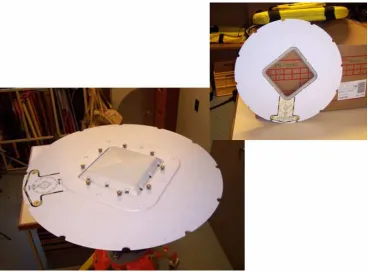
[image:27.595.153.521.316.588.2]ground bounce multipath.
Figure 2.4.1 Ground plane.
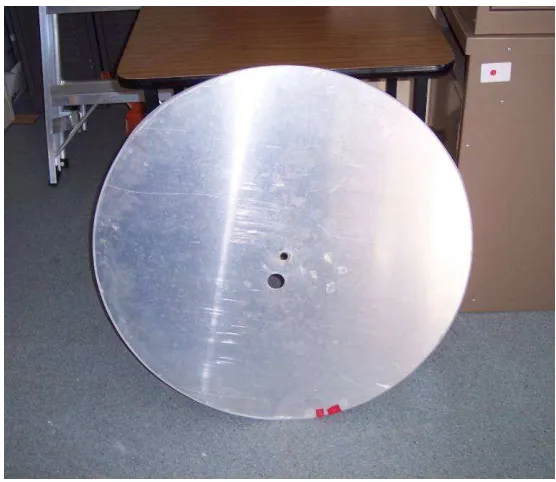
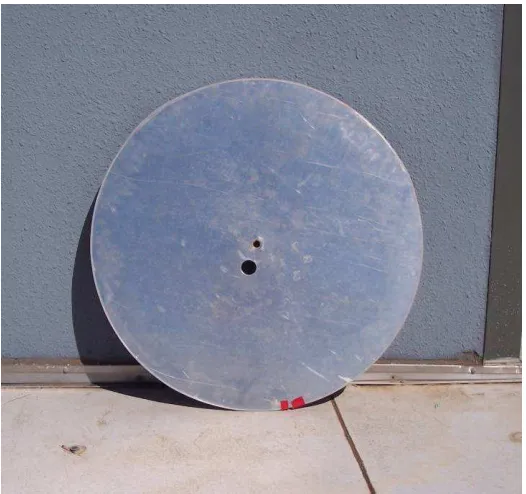
To simulate the effect of multipath during the tests, an 800 millimetre diameter
aluminium disc was secured beneath the antenna during the testing. This ‘multipath
Figure 2.4.2 Multipath plane.
“It is expected that the piece of aluminium will reflect signals so they arrive at the
antenna by an indirect route” (McCabe 2002, p. 31) because the multipath plane
will be fixed beneath the antenna, thus bouncing multipath into the antenna.
Aluminium was used as it was identified in the literature review that foil faced
insulation had the greatest effect on antennas, which aluminium has similar
properties to (McCabe 2002, p. 16). McCabe decided this method of antenna
testing would be the most appropriate compared to methods which used multipath
simulation software, as this was testing the effect of multipath on the GPS antenna,
not the GPS receiver like the software would do (McCabe 2002, p. 30). 24 hours
was also adopted as the minimum observation period as Trimble Navigation has
adopted a 24 hour observation period as an acceptable period to log data for and to
make comparisons to different days (McCabe 2002, p. 20). The reason for this is
that it takes a GPS satellite approximately 12 hours to complete one full orbit of the
earth, a 24 hour observation period would allow each satellite to be viewed twice.
Comparisons would then be able to be made between different data sets with the
analyst being confident that observations on other days would experience similar
satellite geometry.
RTK Collector was used to automate the initialisation and loss of initialisation
with 30 seconds being the resetting time. 30 seconds was chosen as the resetting
time so that the last set of resolved integer ambiguities were not retained (McCabe
2002, p. 34).
McCabe (2002) discovered that the multipath plane did not have a significant
impact on the mean TTFF between the test antennas, or the accuracy and precision
of any of the test antennas. It is suspected that the minimal difference between the
horizontal and vertical coordinate accuracy of each receiver under the two scenarios
(with and without the multipath plane) was due to the multipath suppression
software ‘Everest’. This software appeared to operate correctly with no major
errors in the horizontal or vertical accuracy (McCabe 2002, p. 85).
The effect of multipath was most noticeable when comparisons were made between
the percentages of observations outside the manufacture’s specifications before and
after the multipath plane was fixed beneath the antenna. Observations which were
greater than one standard deviation away from the true coordinates were considered
outliers.
Table 2.4.1 Percentage of horizontal observations outside manufacturer’s specifications under
normal and multipath conditions.
Percentage > 10mm Antenna Type
Normal Multipath
Micro-centred L1/L2 5.4 10.2
Micro-centred L1/L2 with ground plane 2.6 1.0
Zephyr Geodetic 8.3 12.7
Similar results were also produced in regards to the percentage of vertical
observations outside of the manufacturer’s specifications.
The multipath did not impact on the accuracy or precision of the test receivers
without any multipath mitigation equipment (i.e. ground plane), but the reliability
of the receiver was greatly reduced. This is shown in Table 2.4.1 by the increased
2.4.4
Research undertaken by Lau (2005)
Previously research completed on multiple-frequency GNSS data processing has
tended to concentrate on the availability of more frequencies to solve signal
ambiguities. Lau’s primary interest in his research focused on the ability of a
multiple-frequency GNSS to resolve signal ambiguities whilst multipath is present.
Lau only used the frequencies that would be available from GPS and Galileo
satellites. The GLONASS constellation was omitted from the research as at the
time of Lau’s research the status of the development/replenishment was unknown
(Lau 2005, p. 28).
A GNSS data simulator was developed to generate multipath contaminated data.
As expected, the positioning accuracy and precision substantially improved when
more signals were available in a clear environment when multipath was not present.
However when a reflector was present within about one metre of the antenna, Lau
found that positioning results of the GNSS receiver had degraded further than when
compared to the GPS receiver. If the receiver-antenna distance is greater than one
metre, the multiple-frequency system will have significantly better multipath
mitigation capabilities (Lau 2005, p. 202).
Lau (2005, p. 202) concluded that the degraded results were because of the
additional measurements from closely allocated frequencies, and when the
antenna-reflector distance is less than one metre, the phase multipath errors from GPS and
Galileo are highly correlated. A very close reflector will destroy the advantages of
using a multiple-frequency GNSS data (Lau 2005, p. 258), advantages which
2.5
Summary
This chapter introduced the potential benefits that a GNSS capable receiver is able
to offer users. Through reviewing the current literature it is evident that there has
been no research testing the compatibility of the two navigation systems GPS and
GLONASS when in the presence of high multipath. It is important that
professionals who rely on this technology be aware of the combined performance of
these two GNSSs.
Multipath is a dominant source of error in RTK applications and can impact on the
accuracy, precision and the time to first fix of the receivers. It has been found in
previous literature that combined usage of signals from multiple GNSSs can
potentially degrade positioning results. Practical testing will be required to identify
whether combined usage of GPS and GLONASS will either degrade or enhance the
chances of a successful initialisation, the TTFF, accuracy and precision of RTK
GNSS receivers.
To test the compatibility of the combined use of GPS and GLONASS satellite
navigation systems, multipath resistance tests will be completed using the surveying
technique RTK GNSS. The results of this test will be compared to RTK GPS to
determine if receiver performance has either increased or decreased. Chapter 3 will
Chapter 3 – Test Methodology and Data
3.1.
Introduction
Chapter two provided background information in relation to the potential
compatibility issues between different GNSS constellations and described previous
testing procedures. It also demonstrated that there is a current lack of practical
research of GNSS and its operation in a high multipath environment. So
comparisons may be able to be made between this research and pervious research
similar testing procedures and data reduction methods will be adopted.
Chapter 3 will detail all aspects of the testing method to the procedures that will be
adopted to analyse the raw information. This ensures that the reproduction of this
project is possible.
To properly assess the initialisation integrity of GPS compared to GPS and
GLONASS combined there are several factors to be considered: the test location;
test regime; field execution and data processing method. Once the raw observations
have been processed, it will then be necessary to analyse the observations.
Statistics from the observations will be calculated from the processed observation
data in Microsoft Excel. The process of how this is done will be explained in the
following chapter.
3.2.
Test location and Facilities
3.2.1.
Semi-Permanent GNSS Base Station
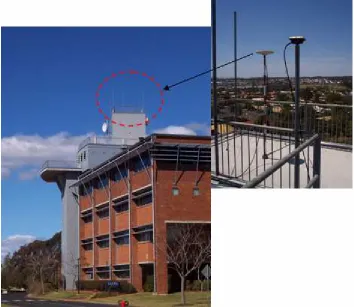
Installed on the roof (level 7) of the University of Southern Queensland’s
Engineering and Surveying building (Z-block) is a semi-permanent GNSS base
Figure 3.2.1 Level 7 base station.
“The base station is painted red and white and is plumbed over a Permanent Survey
Mark (PSM) with Map Grid of Australia (MGA) coordinates. Lightning protection
devices are installed to protect the GNSS antenna, each one is augmented with
independent fuses in all cables that come from the roof” (McCabe 2002, p. 25).
The remaining base station equipment is housed in the computer hut on level 5 of
Z-block. This includes the Trimble NetR5 receiver which is capable of observing
information from multiple GNSSs, and the computers which control the base
Figure 3.2.2 Base station computer within computer hut.
3.2.2.
Test Location
The location to complete the testing ideally had to satisfy several criteria for it to be
suitable:
• Access to mains power to provide a reliable power source for both the
antenna and laptop;
• An area to keep the laptop secure and protect it from the weather;
• Able to simulate difficult conditions that are faced by surveyors in each
working day (i.e. obstructed satellite window and multipath present);
• Able to set up the equipment and be free from human interference; and • Have easy access to the equipment and laptop to be able to periodically
monitor testing to ensure it was still operating correctly.
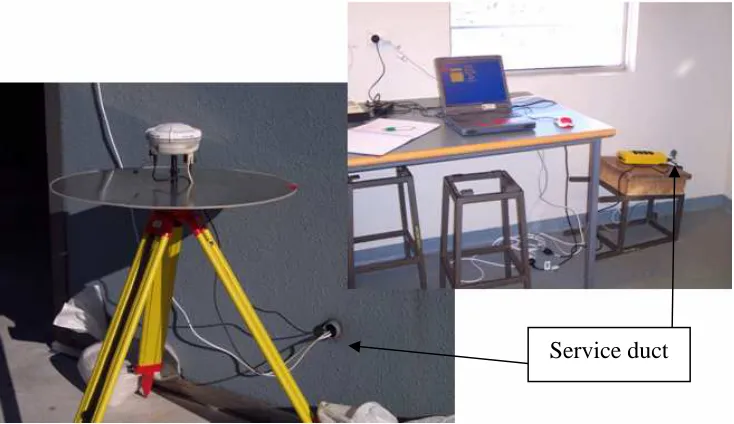
The test location that satisfies all of these criteria is situated on level 5 of the
Z-Block roof. Here the laptop is able to be housed in the same computer hut as the
base station receiver. The laptop was connected to the receiver through a services
duct. Both the laptop and receiver have access to mains power within the computer
Figure 3.2.3 Laptop connected to receiver through services duct.
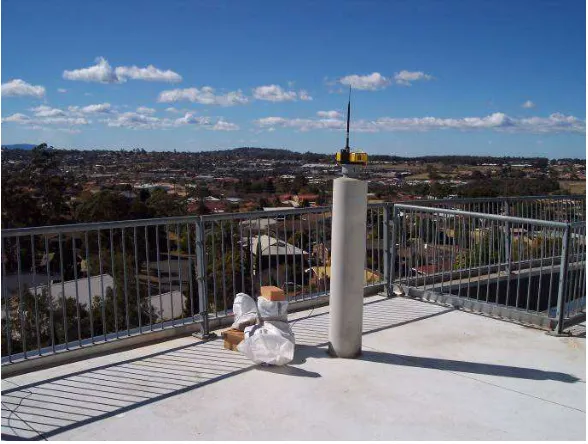
The receiver was established next to the wall which will obstruct almost half of the
antenna satellite window. The antenna is situated next to a concrete wall so it is
expected that multipath will be present. The reason for establishing the antenna in
such a difficult operating environment is to create a commonly faced scenario that
spatial professionals work in frequently. It is not uncommon for the user to be
working next to tall building or in an open pit mine where both the satellite window
will be blocked, as well as having a high presence of multipath, and as stated in
Chapter 1 the aim of this research is to test the receiver under conditions which are
other than ideal.
Figure 3.2.4 Receiver established next to wall on level 5 of Z-block.
As the antenna does not have a line-of-sight vision to the base station radio this will
most likely cause the communication between the base station and rover receiver to
be unreliable (Lemmon & Gerdan 1999, p. 65). To over come this, a repeater radio
will be setup on level 6 of Z-block to propagate the base station signal ensuring that
a robust signal is maintained at all times.
Figure 3.2.5 Repeater on level 6 of Z-block.
It was decided that testing should only be conducted at the test site already
[image:37.595.190.484.461.683.2]satellite window isn’t obstructed, and where multipath would be negligible. The
reason for this is that it has already been proven that “all the interoperability issues
that might affect combined use of GPS and GLONASS have been resolved”
(Zinoviev 2005, p. 1056), thus it is seen as unnecessary to complete testing in an
operating environment where there will be no obstructions.
3.3
Equipment
The equipment required to complete the testing of this project is as follows:
• Laptop (with RTK Collector and Trimble Configuration Toolbox installed); • Tape measure (to conduct checks of the antenna height);
• Db9 serial connection leads (to connect the antenna to the laptop); • Trimble docking station (external power supply for SPS880 antenna); • Tripod;
• Multipath plane; • SPS880 receiver;
• Adaptor to connect SPS880 to tribrach; • Tribrach.
The equipment requirements for the required repeater are as follows.
• Repeater; • Pillar cap;
• Repeater adaptor (to plug repeater into mains power).
3.4
The Trimble SPS880 Antenna
The antenna to be tested is the Trimble SPS880 GPS antenna. This antenna has an
controller. The firmware version that was installed in the receiver during testing
was v3.25.
Figure 3.4.1 Image of SPS880 antenna.
(Source: Trimble SPSx80 Smart GPS Antenna - User Guide 2006, p. 16)
The receiver has 72-channels and tracks L1, L2, L2C, L5 and GLONASS satellites.
This availability of a greater number of satellite frequencies from GLONASS is
expected to increase satellite coverage and increase the areas where GNSS receivers
are able to be operated (Trimble SPS880 Extreme Smart GPS Antenna 2006).
When used with RTK positioning Trimble states that this receiver will provide a
horizontal accuracy of ±(10mm + 1 parts per million (ppm) × baseline length) and a
vertical accuracy of ±(20mm + 1ppm × baseline length) (Trimble SPS880 Extreme
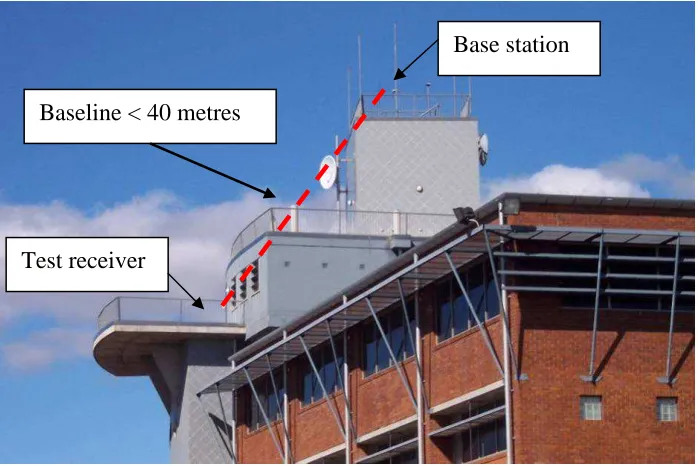
Smart GPS Antenna 2006). The baseline length for testing is less than 40 metres so
this means the parts per million for this length will equal less than one millimetre
Figure 3.4.2 Baseline between base station (level 7) and test receiver (level 5).
3.5
Test Design
The importance of completing each test over a 24 hour period had been identified in
the literature review (section 2.4.3). To do this the laptop, antenna and repeater
have to be connected to a mains power supply as portable battery power will not
last a sufficient amount of time. This most important criterion was satisfied with
the chosen test location.
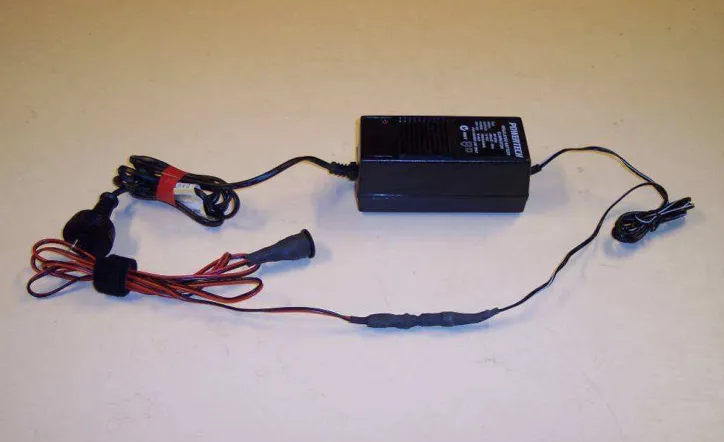
The laptop came with an external charging device and a Trimble docking station
will be used to power the SPS880 antenna. The repeater however will require a
power pack to be assembled so it will be able to be powered from a mains power
outlet. This was completed by a USQ Electronics Technical Officer. Baseline < 40 metres
Base station
Figure 3.5.1 Repeater power pack.
The other important aspects of this project were: having the laptop communicate
with the receiver; and automating the receiver initialisation process. This required
two different software programs: Trimble Configuration Toolbox; and RTK
Collector Software, both of which will be discussed in further detail in the
following two sections.
There are four tests to be completed during this project:
1. Observing solely GPS for 24 hours;
2. Observing GPS and GLONASS for 24 hours;
3. Observing solely GPS with multipath plane fixed beneath it (to enhance the
multipath effect) for 24 hours; and
4. Observing GPS and GLONASS with multipath plane fixed beneath it for 24
hours.
The multipath plane to be used in the testing is the same one that was used in
McCabe’s (2002) research project, which has already been proven to degrade the
receiver performance when it is present (section 2.4.3).
Each 24 hour observation period was divided into three eight hour periods. This
was due to an unknown fault in the RTK Collector software, after approximately
would be reset to the factory defaults. This then meant that information could not
be sent from the receiver via the serial connection to the laptop as they were unable
to communicate. Resetting the receiver each eight hours did not affect the integrity
of the observation data as resetting time only took approximately three minutes
each time. As this only occurred twice throughout the 24 hour observation period,
the impact on the final statistics was minimal.
An analysis of each of these four tests would be able to provide several different
conclusions as to the combined performance of GPS and GLONASS both with and
without the multipath plane, compared to the performance of GPS both with and
without the multipath plane. It will determine if; there is an increased chance of
initialisation when using both satellite constellations, if there is an improvement in
accuracy and precision, if there will be an increase in the percentage of successful
initialisations and if there is an increased TTFF.
3.5.1
Trimble Configuration Toolbox
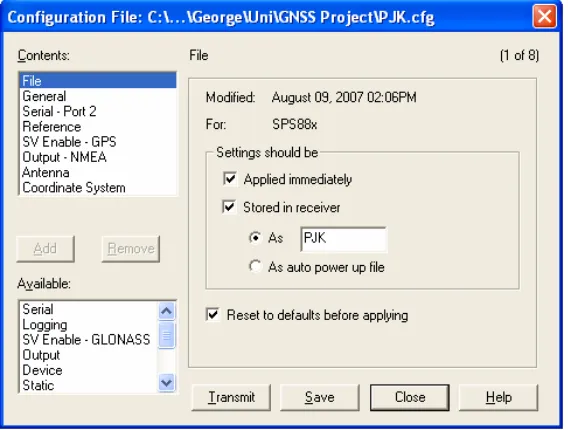
The Trimble Configuration Toolbox is a free program available from Trimble’s
website. It was used to create a configuration file which allows the user to
determine the:
• File name of the configuration file;
• General settings (PDOP, satellite elevation mask);
• The communication parameters between the receiver and laptop; • The latitude and longitude of the reference station;
• The satellite configuration of the receiver (GLONASS and/or GPS); • The output NMEA-0183 file;
• Height of the antenna; and the • Coordinate system.
In previous projects the Trimble Survey Controller (TSC) was used to create the
configuration files, however with the latest release of the survey controller TSC2 it
Figure 3.5.2 Trimble Configuration Toolbox.
All of these options in the contents section in Figure 3.5.2 were necessary to ensure
that observation data was being transferred to the laptop correctly.
3.5.2
Data Logging
Another important aspect of the testing of this project was to be able to control the
receiver over each of the 24 hour testing period without any human intervention.
This was done by using a program called RTK Collector. RTK Collector was
developed by a USQ Research Technologists using LabView. It was initially
developed for Manuel’s (2000) testing (section 2.4.2), however has since been used
in one other research project which was by McCabe (2002) (section 2.4.3).
RTK Collector has three sub menus (Figure 3.5.2) which allows the user to
determine several parameters of the testing. The three sub menus which are present
are; Configure COM Port, Configure On/Off Times and Data Storage Setup. The
Configure COM Port menu allows the user to determine the communication
parameters at which the laptop is to communicate with the receiver. The Configure
switched on and switched off for. The Data Storage Setup allows the user to
determine where the RTK observation will be saved.
Figure 3.5.3 RTK Collector menu.
As the antenna was setup in an intentionally obtrusive environment with almost
50% of the satellite window being obstructed, the observation time will be 180
seconds. This will ensure that there is ample time for the receiver to gain a fixed
solution provided that there are enough satellites available. The resetting time of
the receiver will be 30 seconds. This was identified by McCabe (2002) so the
receiver did not retain the last set of resolved ambiguities, and thereby cause a bias
in the statistical results.
3.6
Creation of Multipath Environment
To generate a high level of multipath during the tests the same method used by
McCabe (2002) will be adopted. McCabe secured an 800mm diameter aluminium
disc beneath his GPS test antennas. It was identified in his conclusion that the
presence of this multipath plane did affect the receivers performance (McCabe
Figure 3.6.1 Multipath plane.
It is expected that multipath will already be present during the testing without the
multipath plane. This will be due to the concrete wall and concrete surface,
however with the multipath plane present it is expected that a much higher level of
multipath will be generated.
3.7
Data Processing
The processing of the observation data was an important part of this project. It was
important to where possible to adopt the methods of filtering the observation data to
ensure comparability of the results from this research project to the results of other
projects. The following sections will detail and justify the methods of processing
3.7.1
NMEA-0183 Output Message
The NMEA-0183 output message was an option in the Trimble Configuration
Toolbox when creating a configuration file. The NMEA output message adopted
for this project was PTNL, PJK. An example of a PTNL, PJK NMEA output file is
shown in Appendix B.
3.7.2
Reduction of Observation Data
Before information and statistics could be drawn from the observation data, it first
had to be reduced to only what will be required in the analysis. Reducing the
observation data included; removing all the information other than the time when
the receiver turned on and then became initialised, determining the UTC (Universal
Time Coordinated) for when the receiver first switched on from the first line of the
initialisation (as until the observation has a fixed solution, the receiver cannot
determine the correct UTC), doing this meant that the time taken for the receiver to
initialise could now be calculated. Also removing the observation periods where an
initialisation did not occur.
What remained after the reduction were two lines of each successful initialisation;
the line when the receiver turned on, and the first line when the receiver initialised,
an example of which is shown in Appendix E. All of this was done manually in
Microsoft Excel.
3.7.3
True Coordinates
The purpose of completing all tests over a single point was so that the accuracy and
precision of the horizontal and vertical coordinates of each test could be compared
The ‘true coordinates’ were calculated using the GPS observation data. It was
decided that the GPS observation data will have any observation outside 1.96 times
(95% confidence interval) the manufacturer’s specification for baseline component
standard deviation from the reiterative mean to be removed. A 95% confidence
interval was chosen as it was desired that the ‘true coordinates’ have a stricter filter
than what will be used to produce the statistics, which will be further explained in
the following section.
3.7.4
Total Number of Initialisations
Once all that was remaining in each observation file was the line when the receiver
initially turned on and when the receiver first initialised, to calculate the total
number of successful initialisations was a simple process. All that was required
was to count the entire number of lines in the observation data file, and then divide
this value by two.
3.7.5
Time to First Fix (TTFF)
The NMEA-0183 time values are presented in UTC and are represented as hhmmss,
where:
• hh is hours, from 00 through 23; • mm is minutes; and
• ss is seconds.
For ease of calculation the TTFF values were converted into seconds. To do this
the single cell containing the UTC was split up, then each of the hh and mm cells
were converted to seconds and then both summed to the ss cell. Then to calculate
the TTFF, the seconds from the receiver switching on line were subtracted from
3.7.6
Horizontal Coordinate Accuracy and Precision
To determine the precision and accuracy of the horizontal coordinates first the
difference between the ‘true coordinates’ and the observation coordinates had to be
found. These calculations were completed in Microsoft Excel by assigning
formulas to cells. The difference in the easting and northing now had to be
converted to a distance value, this was done using Pythagoras theorem: Horizontal
Distance = SQRT (∆E2 + ∆N2). Once the horizontal distance away from the true
coordinates had been calculated a statistical analysis on these observations was
carried out.
As it is expected that there will be a large number of gross observations, two charts
will be produced; one showing the accuracy and precision of all initialisations, the
second chart showing the accuracy and precision of the filtered observations. To
determine if an observation is an outlier the same test will be adopted that Lemmon
& Gerdan (1999) adopted for their testing, and that is to consider an observation to
be an outlier if it is more than three times the manufacturer’s specifications for the
baseline component standard deviation. This second chart will allow comments
about the accuracy and precision of the receiver configurations and operating
environments to be made.
3.7.7
Ellipsoidal Height Accuracy and Precision
To determine the precision and accuracy of the ellipsoidal heights first the
difference between the ‘true’ ellipsoidal height and the observation ellipsoidal
height had to be found. This calculation was completed using Microsoft Excel.
Just as detailed in section 3.7.6 two ellipsoidal height accuracy and precision charts
will be produced; one chart showing the accuracy and precision of all successful
initialisations, the second chart showing the accuracy and precision of the filtered
observations. The same filtering technique as described in section 3.7.6 will be
used, which is to filter ellipsoidal height observations which are greater than three
times the manufacturer’s specifications for the baseline component standard
deviation.
3.7.8
Outlying Observations
As identified in section 2.4.3, McCabe (2002) found the main differing in the
performance of the receivers with the multipath plane and the receivers without the
multipath plane was the percentage of outlying initialisations which occurred. It is
for this reason that it is seen as important the number of outlying observations form
a part of the analysis. As specified in the two previous sections an outlying
observation will once again be considered to be an observation which is greater than
three standard deviations from the true coordinates.
3.8
Summary
This chapter outlined the required equipment for this testing, the tests that will be
completed, the software that will be used to complete the tests and the method to
reduce and process the observation data. The test location that was chosen to
complete all four tests was also justified.
Each testing period will last for 24 hours, with the receiver logging information for
180 seconds and then resetting for 30 seconds. Microsoft Excel will be the program
used to complete a statistical analysis on the data allowing for some conclusions to
The next chapter will present the results of the statistical analysis taken place. It is
expected conclusions about the performance of GPS and GLONASS will be able to
4.1.
Introduction
Chapter 3 discussed the testing methodology and data processing method that will
be used in this project. It also justified these testing procedures, as well as the
location of testing and the use of the multipath plane.
Chapter 4 will present each of the charts that will be used throughout the analysis.
The full detailed analysis of these results will be covered in Chapter 5.
This chapter comprises of two sections, the processing of the raw data and the
collation and analyse technique used to analyse the data. Microsoft Excel was used
to both process the raw data and to collate and compare all the results.
4.2.
Results
4.2.1.
True Coordinates
It is with the process detailed in section 3.7.3 the following ‘true coordinates’
coordinates were calculated:
Table 4.2.1 True coordinates of testing location.
Easting Northing Ellipsoidal
Height
‘True coordinates’ of
4.2.2.
Total Number of Initialisations
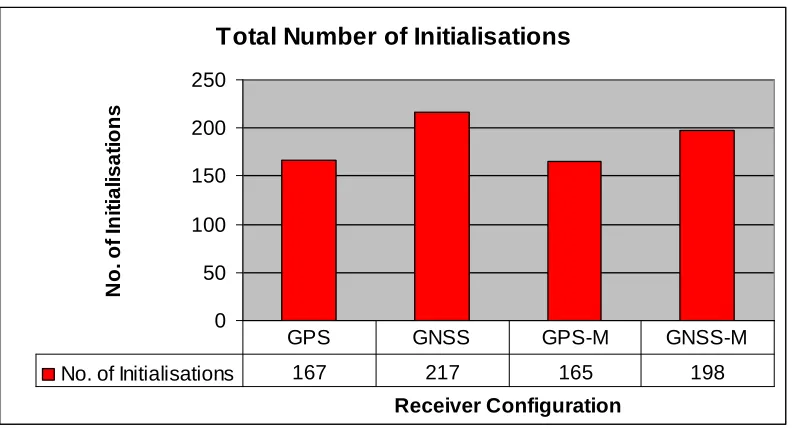
The total number of observations for each of the test periods is shown in Figure
4.2.1.
Total Number of Initialisations
0 50 100 150 200 250 Receiver Configuration N o . o f In it ia li s a ti o n s
No. of Initialisations 167 217 165 198
[image:53.595.138.534.172.386.2]GPS GNSS GPS-M GNSS-M
Figure 4.2.1 Total number of initialisations.
The GPS and GNSS tests were in a low multipath environment (multipath
generated from concrete wall), while the M at the end of GPS-M and GNSS-M
signifies that the multipath plane was present. Figure 4.2.1 will be further discussed
in Chapter 5.
4.2.3.
Time to First Fix
Figure 4.2.2 shows the mean and standard deviation of the TTFF for each test, the
Time to First Fix (TTFF) 0 20 40 60 80 100 120 140 Receiver Configuration T im e ( s e c o n d s )
High 123 112 126 119
Mean 92 75 97 80
Low 62 37 68 41
[image:54.595.173.501.60.304.2]GPS GNSS GPS-M GNSS-M
Figure 4.2.2 Mean and standard deviation of the TTFF for each receiver configuration.
Table 4.2.2 shows another composition of the TTFF.
Table 4.2.2 Percentage breakdown of TTFF.
GPS GNSS GPS-M GNSS-M
% < 60 seconds 11 49 8 43
60 < % < 90 seconds 41 21 39 24
% > 90 seconds 48 29 53 33
4.2.4.
Horizontal Coordinate Precision and Accuracy
Initially the mean and standard deviation of each successful initialisation was
Horizontal Coordinate Accuracy and Precision -0.800 -0.600 -0.400 -0.200 0.000 0.200 0.400 0.600 0.800 1.000 1.200 Receiver Configuration D is ta n c e ( m )
High 0.983 0.616 0.665 0.761
Mean 0.209 0.091 0.135 0.150
Low -0.565 -0.434 -0.395 -0.461
[image:55.595.159.518.60.281.2]GPS GNSS GPS-M GNSS-M
Figure 4.2.3 Horizontal coordinate accuracy and precision.
The high and low bar represent one standard deviation either side of the mean of the
horizontal distances.
It is obvious that there are numerous outlying observations which are impacting the
mean and standard deviation of the horizontal coordinates. For this reason it is
necessary to produce a horizontal coordinate accuracy and precision chart which has
had all outlying observations filtered (for method see section 3.7.6). Trimble had
specified for the test antenna the SPS880, the expected horizontal accuracy is
±(10mm + 1ppm) (Trimble SPS880 Extreme Smart GPS Antenna 2006, p. 3). The
filtering limits for the horizontal coordinate will be set at: 3 × ±(10mm + 40m ×
Filtered Horizontal Coordinate Accuracy and Precision
0.000 0.005 0.010 0.015 0.020 0.025
Receiver Configuration
D
is
ta
n
c
e
(
m
)
High 0.018 0.020 0.019 0.020
Mean 0.011 0.013 0.012 0.013
Low 0.004 0.006 0.005 0.006
[image:56.595.141.534.58.277.2]GPS GNSS GPS-M GNSS-M
Figure 4.2.4 Filtered horizontal coordinate accuracy and precision chart.
This chart will not form part of the analysis in Chapter 5, instead was just shown
here to demonstrate that when outlying observations are removed, the accuracy and
precision of both receiver configurations with and without the multipath plane are
comparable. It will not be used in the final analysis as all it proves that once all the
‘bad’ initialisations