The evolution of host defence when
parasites impact reproduction
Alex Best
1, Andy White
2and Mike Boots
31School of Mathematics and Statistics, University of Sheffield, Sheffield, UK,
2
Department of Mathematics and the Maxwell Institute for Mathematical Sciences,
Heriot-Watt University, Edinburgh, UK and 3Department of Integrative Biology,
University of California Berkeley, Berkeley, California, USA
ABSTRACT
Question: How does the evolution of host defences to parasitism depend on the level of disease-induced sterility?
Mathematical methods: Evolutionary invasion analysis (adaptive dynamics) applied to susceptible-infected host–parasite model.
Key assumptions: Hosts can evolve defence through avoidance (lower transmission), clearance (higher recovery) or tolerance (lower virulence), in isolation or simultaneously, at a cost to their reproductive rate. Separation of ecological and evolutionary timescales and mutations of small phenotypic effect.
Conclusions: Avoidance and clearance are maximized when sterility is high, but tolerance is greatest when sterility is low. However, when clearance and tolerance co-evolve there is greater tolerance at high sterility, as this boosts the effectiveness of clearance. Patterns of investment along other environmental gradients can change as the level of sterility changes. Evolutionary branching to co-existence in avoidance and clearance is most likely when sterility is high.
Keywords: adaptive dynamics, evolution, host–parasite, sterility.
INTRODUCTION
Understanding the evolution of host defences to parasitism, and specifically the ecological feedbacks that drive the patterns of selection, is a major area of theoretical inquiry (van Baalen, 1998; Boots and Bowers, 1999, 2004; Boots and Haraguchi, 1999; Roy and Kirchner, 2000; Restif and Koella, 2003,
2004; Miller et al., 2005, 2007; Best et al., 2008, 2009; Toor and Best, 2014). For the most part, these theoretical studies have assumed that the main fitness impact of parasitism is through disease-induced mortality, generally defined to be ‘virulence’. However, it is also well understood that parasitism can cause sub-lethal effects, specifically through sterilizing effects that reduce the reproduction rate of infected hosts. Indeed, many parasites are known to cause complete
Correspondence: A. Best, School of Mathematics and Statistics, University of Sheffield, Sheffield S10 2TN, UK. e-mail: [email protected]
Consult the copyright statement on the inside front cover for non-commercial copying policies. Evolutionary Ecology Research, 2017, 18: 393–409
castration in their hosts, such as Pasteuria ramosa in Daphnia(Little et al., 2002; Ebert et al., 2004), anther smut infections in Silene(Antonovics et al., 1996), and insect baculoviruses (Boots and Begon, 1993; Boots and Mealor, 2007). Many more parasites cause reduced fecundity in their infected hosts, for example in red grouse (Dobson and Hudson, 1992; Hudson et al., 1992) and vole (Feore et al., 1997; Deter et al., 2007) populations due to parasitic nematodes.
A few theoretical studies have considered the evolution of defence traits that combat parasite-induced sterility directly – that is, sterility itself is being selected on (Restif and Koella, 2004; Bonds, 2006; Best et al., 2008, 2009). These have shown that tolerance mechanisms that reduce the degree of sterility may be a more effective defence strategy for the host than resistance (Best et al., 2009), and that investment in such a tolerance mechanism will be greatest against parasites with a high growth rate (Restif and Koella, 2004). More generally, theoretical studies focus on defences that combat epidemiological processes of transmission or virulence, and this will also be our focus here. Commonly, these studies consider the investment in these defences along environmental gradients. Yet, the majority of these studies have not allowed sterility to vary but instead assumed that sterility is either complete (such that infected hosts do not reproduce at all) or absent (such that infected hosts reproduce at the same rate as susceptible hosts). It is important for us to assess how these assumptions might impact the predicted outcomes of host evolution.
Boots and Haraguchi (1999) showed that resistance (through ‘avoidance’) is maximized against the least virulent parasites, while van Baalen (1998) showed that resistance (through ‘clearance’) is highest when virulence is intermediate. However, these two studies made very different assumptions about disease-induced sterility, with either complete (Boots and Haraguchi, 1999) or no sterilizing effects (van Baalen, 1998). Donnelly et al.(2015) recently offered some insight into this difference by showing that the main driver of selection alters between disease exposure (castrators) and disease prevalence (non-castrators) depending on whether sterility is complete or absent. A few studies of host defence evolution have explored investment in host defences along a gradient of sterility. For example, while exploring the effects of host plasticity, McLeod and Day (2015) showed that avoidance increases as the level of sterility is increased, a result that Toor and Best (2014) showed remains true when a (dynamic) predator is also present. In a separate study, McLeod and Day (2014) also considered the impact of sterility on host reproductive strategy as a defence against sexually transmitted disease, while we showed that investment in immune priming in invertebrates would be highest when parasites are sterilizing (Best et al., 2012). Thus, while we have some knowledge of how parasite-driven sterility impacts host evolution in specific circumstances, we still lack a general overview of its role in the evolution of host defences.
parasites, but it remains an open question as to how static diversity (co-existence due to evolutionary branching) in resistance depends on the degree of sterility.
In this study, we consider the evolution of three forms of host defence: avoidance, clearance, and mortality tolerance, in a similar manner to the study of Miller et al.(2007) on the effects of host lifespan. Our focus here is on how investment in each type of defence varies with the sterilizing effects of the parasite, as well as on how this interacts with variation along other environmental gradients. We also consider the effects of sterility on the potential for diversity through evolutionary branching and on the outcome when two of the defence mechanisms co-evolve together.
MODEL
For consistency with many earlier studies, and in particular Boots and Haraguchi (1999), we use a standard SIS epidemiological model with emergent density-dependence on births, with the population dynamics of susceptible (S) and infected (I) hosts given by
dS
dt =(a−q(S+I)) (S+fI)−bS−βSI+γI (1) dI
dt=βSI−(α+b+γ)I. (2)
All hosts reproduce at rate a, which is reduced due to crowding, q. All hosts die at natural death rate b, with infected hosts suffering additional mortality (virulence) at rate α. Transmission is a mass-action term with parameter β. Again for consistency with earlier studies, notably Boots and Haraguchi (1999) and van Baalen (1998), we assume that trans-mission is density-dependent. We note, however, that because many sexually transmitted infections induce infertility in their hosts (Lockhart et al., 1996), frequency-dependent trans-mission would be an equally relevant assumption, but we leave this for future work. Infected hosts may recover back to susceptibility at rate γ. The key parameter is that infection may reduce the reproduction rate of infected hosts by a fecundity factor f. We note that a low value of f indicates high sterility (with f=0 representing full castration), and high f low sterility (with f=1 meaning infected hosts reproduce at the same rate as susceptibles).
We model evolution of host defence through an evolutionary invasion (adaptive dynamics) framework (Geritz et al., 1998). As such, we assume that a rare mutant type attempts to invade a resident population at its dynamic attractor (Sˆ, Î) with Nˆ =Sˆ + Î. We will consider three forms of host defences: (i) avoidance (lowered susceptibility to infection, β), (ii) clearance (increased recovery, γ), and (iii) tolerance (lowered virulence, α).
In each case, we will assume that there is a cost to higher defence through reduced reproduction, as is commonly assumed in the theoretical literature (e.g. Boots and Bowers, 1999; Boots and Haraguchi, 1999; Restif and Koella, 2003; Miller et al., 2007) and for which there is empirical support (Boots and Begon, 1993). For example, let us assume that defence is through avoidance (the other cases can be expressed similarly), where a mutant host has strategy (βm, a(βm)). We emphasize that this implies a reduced likelihood of a susceptible host becoming infected, not a reduced rate of infection by infected hosts. For the first part of the study we use a generic trade-off function of the form,
a(β)=amax−(amax−amin)
冢
1−β−βmin
βmax−βmin
冣
冫冫
冢
1 +p β−βminβmax−βmin
冣
, (3)
which links maximum and minimum birth and avoidance (defence) values through a smooth function the shape of which is controlled by parameter p (the trade-off is concave for p>0 and convex for −1<p<0). We note that for the recovery trade-off, the values of
amax and amin must be swapped for the trade-off to be decreasing rather than increasing. We emphasize that in all cases, including the evolution of recovery and tolerance, the costs of reduced reproduction are paid both by susceptible and infected hosts. An alternative approach might be to assume that induced defences are plastic, and are only ‘switched on’ once a host is infected, and therefore only infected hosts would pay the costs. Here we assume that all defence mechanisms are constitutive and always present.
By considering the transversal stability of the resident equilibrium, specifically the determinant of the mutant’s Jacobian, it can be found that host fitness is given by [for the derivation, see http://www.evolutionary-ecology.com/data/3071Appendix.pdf]
s=[a(βm)−qNˆ −b−βmÎ][α+b+γ] +βmÎ[γ+f(a(βm)−qNˆ)]. (4) If s>0, then the mutant can invade to replace or co-exist with the resident, whereas if s<0, the mutant will die out. Through a mutation-substitution sequence the population will evolve in the direction of the local selection gradient (e.g. ∂s/∂βm|βm=β for avoidance) until
this gradient is zero and an evolutionary ‘singular point’ has been reached. Here, the evolutionary outcome depends on two second-order derivatives: evolutionary stability (ES), ∂2s/∂β2m|βm=β (is the point evolutionarily invadable?), and convergence stability (CS),
∂2
s/∂β2m|βm=β+∂
2
s/∂βm∂β|βm=β (is the point evolutionarily attracting?). If both expressions
are negative, the point is said to be a ‘continuously stable strategy’ (CSS), a long-term attractor of evolution. As our main focus here is on how sterility impacts quantitative investment in defence mechanism, we shall concentrate on examining the location of CSSs. We shall also look at ‘evolutionary branching points’ where a dimorphic population emerges at a singular point that is CS (second expression is negative) but not ES (first expression is positive).
DIRECT EFFECTS
The pattern for resistance is to be expected. As the level of sterility is increased, the fitness contribution from infected hosts is reduced. Thus selection for resistance mechanisms, which act to keep or move more of the population into the more fecund susceptible state, will 1increase. The pattern for tolerance, in contrast, may not have initially been expected but in fact follows similar reasoning. At high rates of sterility, there is almost no contri-bution to fitness by infected hosts (due to both the direct effect of reduced reproduction and the indirect effect of a reduced infected density), meaning that there is very little reason to invest in tolerance mechanisms. However, when infected hosts do reproduce, they can still make a significant contribution to fitness, as contribution that can be increased by investing in tolerance and thus lengthening the infectious period.
Fig. 1. Direct effects of varying infected fecundity, f, on host investment. (a) Avoidance (for consistency we plot B*=βmax−β*); (b) clearance (γ*); (c) tolerance (for consistency we plot A*=
αmax−α*). Parameter values: β=2, b=1, q=0.1, α=1, γ=1. Trade-offs: (a) a(β)=2.76−
1.18(1.25−0.25β)/(0.84 + 0.16β); (b) a(γ)=1.70 + 0.50(1−0.5γ)/(1−0.17γ); (c) a(α)=2.14− 0.54(1−0.5α)/(1 + 0.91α).
It is clear from the fitness expression given above that there is a special case where f=0. Here, a part of the fitness term disappears. This has an important simplifying effect when calculating the fitness gradient of each case. For example, in the case of avoidance, the full fitness gradient is,
∂s
∂βm
冷
βm=β=[a⬘(β)−Î][α+b+γ] +Î[γ+f(a(β)−qNˆ)] +fa⬘(β)βÎ. (5)
If f=0, this expression simplifies to ∂s
∂βm
冷
βm=β=[a⬘(β)−Î][α+b+γ] +Îγ, (6)
such that the total population size, Nˆ, no longer appears in the fitness gradient and thus does not have an effect on the location of the singular point. In this case, Î, that is the density of infecteds, is the key driver of evolution. However, in the more general case, both
Î and Nˆ impact the location of the singular point. The same argument can be applied to the other two cases [see 3071Appendix.pdf, section A3].
COMBINED EFFECTS
In this section, we look at how investment across other environmental gradients is affected by altering the amount of sterility. We limit our study to the range f ∈ [0, 0.5], noting that further investigation found no further qualitative changes of behaviour occur when f>0.5.
Parasitic characteristics
We first focus on how fecundity interacts with virulence [note that we cannot consider the case of tolerance here, as this selects on virulence. The respective plots will be absent when considering recovery (clearance) and transmission (avoidance) also]. In Fig. 2a we plot the CSS level of transmission as α (horizontal axis) and f (vertical axis) vary. Blue hues indicate high defence (low β) and yellow hues low defence (high β). Here we see that for very low f, defence is highest when virulence is lowest. However, as f increases the pattern shifts so that defence is maximized against parasites with intermediate virulence. Once f is reasonably high, the pattern has completely reversed and defence is highest against the most virulent parasites. The changes in behaviour can be seen as line plots for the cases of f=0 and f=0.5 in Fig. A1 [3071Appendix.pdf].
We now look at the relationship, α and f, when defence is through clearance. In Fig. 2b, once more yellow hues denote low defence (low γ) and blue hues high defence. Here we see a similar pattern as with avoidance. Defence is maximized against parasites with low virulence when there is low fecundity (high sterility), but against parasites with inter-mediate virulence when fecundity is higher. Again, the behaviour at the extremes of f=0 and f=0.5 is shown in Fig. A1.
Fig. 2. Combined effects of varying fecundity, f (y-axis) with virulence (α, top row), recovery (γ, middle row), and transmission (β, bottom row). Plots are of investment in avoidance (a and c), clearance (b and e), and tolerance (d and f). In each case, blue hues indicate high defence and yellow hues low defence. Contours are added for clarity. The dashed line marks the gradient along which the single variable plots from Fig. 1 are taken. Parameter values are as in Fig. 1.
then low rates of recovery. Finally, we show the patterns for varying transmission for defence in clearance and tolerance (Fig. 2e,f). In both cases, fecundity has no qualitative effect on the relationship, with investment increasing with transmission.
Host characteristics
We now consider the variation in investment against different host characteristics, starting with lifespan. In general, Fig. 3 (top row) shows investment is highest (blue hues) in all three defence mechanisms for high lifespans (low death rates). However, at intermediate rates of fecundity we see that for the resistance mechanisms of avoidance (Fig. 3a) and clearance (Fig. 3b), investment may be maximized at intermediate lifespans. (Note that the solid black region in Fig. 3a represents a repelling singular point that is neither ES nor CS instead of an attractor. In this case, evolution will lead to the host either maximizing or minimizing avoidance depending on the initial conditions.) We also consider investment as the competition coefficient q is varied. Figure 3 (bottom row) shows that for all three defence mechanisms, investment is highest when competition is low and therefore the population density is high.
STABILITY AND EVOLUTIONARY BRANCHING
We now examine how fecundity impacts the potential for dimorphism through evolutionary branching, in particular through the evolutionary and convergence stability of a fixed singular point. At such a point, the population is attracted to the singular point (it is CS), but once there it finds it is a local fitness minimum (it is not ES). This results in disruptive selection and the emergence of two co existing strains either side of the singular point (Geritz
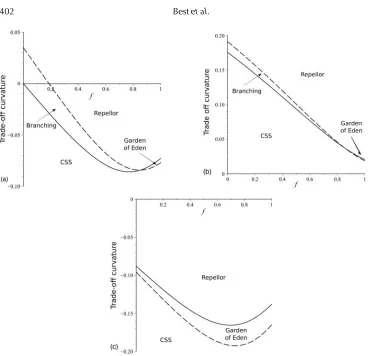
et al., 1998). We now fix the singular point to be at a particular level of defence (and related cost). We no longer choose a fixed trade-off function, but the existence of the singular point at the chosen values requires us to fix the gradient of the trade-off. We then consider the change in behaviour at the singular point as we vary the curvature (second derivative) of the trade-off at the singular point (de Mazancourt and Dieckmann, 2004; Bowers et al., 2005). Specifically, we plot the boundaries of evolutionary stability (ES) and convergence stability (CS) at a fixed singular point in terms of the trade-off curvature (y-axis) at that point, as a function of sterility (x-axis) in Fig. 4. Figure 4a shows the relationship for avoidance, Fig. 4b that for clearance, and Fig. 4c that for tolerance. In each case, curvatures below the solid line are ES and those below the dashed line are CS. As is known to be generally true from earlier work (Hoyle et al., 2008), trade-offs with strongly negative (‘accelerating’) curvatures tend to produce CSS points (both ES and CS), those with strongly positive (‘decelerating’) curvatures tend to produce repelling points (neither ES nor CS), with branching and ‘Garden of Eden’ points (ES but not CS) generally occurring for near-linear trade-offs.
Fig. 3.
Combined ef
fects of v
arying fecundity
,
f
(y-axis) with host mortality (
b
, top r
o
w) and competition (
q
, bottom r
o
w). Plots (a) and (d) ar
e f
o
r
av
oidance
, plots (b) and (e) f
or clear
ance
, and plots (c) and (f) f
or toler
ance
. Again, b
lue hues indica
te high defence and y
el
lo
w hues lo
w defence
. Note
tha
t the solid b
lack r
egion of the top-left plot in fact denotes an e
v
olutionary r
epeller
. P
a
rameter v
alues ar
section A.5, Figs. A.2, A.3]. For the final case, tolerance, we see that there is never any evolutionary branching. It is well known that branching of tolerance mechanisms is not possible in standard models, as the derivatives are such that a singular point can never simultaneously be CS but not ES (Roy and Kirchner, 2000; Miller et al., 2005). After branching has occurred, for most standard trade-off forms (such as that used earlier in this study) the two strains would evolve to the maxima/minima of evolution leaving two co-existing extreme strains [though we note more complex trade-offs may lead to extinction of one of the strains (Best et al., 2015)].
CO-EVOLUTION OF DEFENCES
Direct trade-offs
We now consider the outcome when two of the defence mechanisms co-evolve. We first assume that the two defences are directly traded off against one another, for example where increased avoidance is costly to clearance, γ=γ(β), with no further life-history costs. Let us consider the selection gradient, for example, in the case for γ(β):
∂s
∂βm
冷
βm=β= −Î[α+b+f(a−qNˆ)] +γ⬘(β)[a−qNˆ −b]. (7)
In this specific case, the level of fecundity has no impact on the evolutionary singular point, and thus allocation between the two defence mechanisms of avoidance and recovery will remain the same whatever the degree of sterility. This can be shown to be the case by noting that at equilibrium,
dN
dt =(a−qN
ˆ)(Sˆ +fÎ)−bNˆ −αÎ=0 (8)
⇒Sˆ =Î[α+b−f(a−qN ˆ)] a−qNˆ −b
, (9)
yet we also know that=(Sˆ =(α+b+γ)/β. By comparing this to equation (7) we see that the first term of (7) can be re-written without f appearing explicitly. We can then factor out the term [a−qNˆ −b], noting that this term must be positive at the endemic equilibrium (as Sˆ <(a−b)/q, the disease-free equilibrium), meaning that the solution to equation (7) is independent of f.
For the other two possibilities, this is not the case. When clearance and tolerance are linked (e.g. α=α(γ)), we find that hosts favour recovery at low levels of fecundity and tolerance at higher levels (Fig. 5b). When avoidance and tolerance are linked (e.g. α=α(β)), we find that hosts favour avoidance (low transmission, β*) at low levels of fecundity and tolerance at higher levels (Fig. 5c). Thus, in each case, tolerance is favoured more strongly relative to resistance at higher rates of fecundity, as we might have predicted from the initial results in Fig. 1. However, if the two resistance mechanisms are traded off, there is no impact of sterility.
Simultaneous evolution
We now assume that the two defences are not directly traded off against one another, but instead evolve together simultaneously (i.e. co-evolution). We assume both defences incur costs to the birth rate, as above, with the resulting birth rate being a linear combination of the two cost structures [similar to the approach by Restif and Koella (2004); see the legend of Fig. 6 for the trade-off functions used].
We plot the results of the three cases in Fig. 6. As when the two resistance mechanisms were directly traded off, we find that investment in avoidance and recovery remains relatively constant for varying levels of sterility when they evolve simultaneously, suggesting that the balance of investment in resistance mechanisms is largely independent of sterility.
We find that when tolerance and clearance co-evolve in this way, both defence mechanisms are favoured at low rates of fecundity (we are again plotting here A*=αmax−α* such that high A* means high tolerance). This is of interest, since it reverses the result from the first part of this study for tolerance (i.e. Fig. 1c). When tolerance evolved in isolation, there was little benefit of defence when sterility was high, whereas now increased tolerance boosts the effectiveness of increased recovery. Finally, when avoidance and tolerance co-evolve, we find that both defences retain the patterns of investment as when they evolved in isolation, with high avoidance at low fecundity and high tolerance at high fecundity. In particular, we note that the pattern of tolerance differs markedly from its co-evolution with clearance due to the differing feedbacks of the two resistance mechanisms.
DISCUSSION
[image:13.552.109.461.93.454.2]While the sterilizing effects of disease are known to be important to host–parasite inter-actions, few studies have specifically studied the impact this will have on host evolution (Best et al., 2012; McLeod and Day, 2014, 2015; Toor and Best, 2014; Donnelly et al., 2015). We have shown here that higher sterility selects for higher resistance [reduced transmission (see also McLeod and Day, 2015) or increased clearance], but lower tolerance (increased virulence). For resistance, this is because when sterility is high selection drives individuals to maximize their time in the susceptible state, as this becomes the only source of reproduction. However, understanding the pattern for tolerance needs more consideration. As sterility increases, infected hosts contribute less to fitness and there is therefore less selection to extend the infectious period through tolerance. We find that these results largely hold even when two of the defence Fig. 6. Singular levels of investment for varying fecundity when defence mechanisms evolve simultaneously. As before, we plot B*=βmax−β* and A*=αmax−α*. Parameter values are as in Fig. 1,
with (a) a=0.5(1.5 + 0.5(1−0.5γ)/(1−0.25γ)) + 0.5(2.8−1.15(1.25−0.25β)/(0.84 + 0.25gb)); (b) a= 0.5(1.7 + 0.5(1 − 0.5γ)/(1 − 0.05γ)) + 0.5(2.14 − 0.54(1 −0.5α)/(1 + 0.9α)); (c) a = 0.5(2.14 − 1.5(1 − 0.5α)/ (1 + 4α)) + 0.5(2.76−1.5(1.25−0.25β)/(0.5 + 0.75β)).
mechanisms evolve simultaneously, except that high clearance leads the host to invest in high tolerance to boost the effectiveness of increased recovery. The present study therefore not only further highlights the importance of the distinction between resistance and tolerance mechanisms due to their feedbacks to population densities, but stresses how these feedbacks can influence the simultaneous evolution of one another.
An important result from previous studies is that host resistance may not be highest against the most virulent parasites as might be intuitively expected, owing to the ecological feedbacks. Specifically, Boots and Haraguchi (1999) showed that avoidance is greatest against the least virulent parasites, while van Baalen (1998) showed that clearance is maximized at intermediate rates of virulence. However, these studies focused on specific cases of full and no sterility respectively. Here we have explored in finer detail how these patterns depend on the degree of sterility. In general, if sterility is very high, resistance through either mechanism will be greatest against the least virulent parasites (cf. Boots and Haraguchi, 1999). This is because the key effect of reduced virulence is increased exposure (since reduced disease-induced mortality naturally leads to higher infected densities), which leads to increased selection for resistance. However, as sterility decreases there is a shift to maximize resistance at intermediate levels of virulence (cf. van Baalen, 1998) and then, for avoidance, at the highest virulence rates. Now, infected hosts are able to make a significant contribution to fitness through reproduction. Not only does reduced virulence lead to increased exposure, but also a greater contribution from infected hosts. The balance of these two feedbacks is such that resistance is now greatest at higher rates of virulence. These conclusions fit with the findings of McLeod and Day (2015) and Donnelly et al. (2015), the latter of who showed that for castrating diseases (f=0) the driver of selection is purely parasite exposure (i.e. the density of infected hosts) whereas for non-castrators (f=1) the driver is disease prevalence (i.e. the proportion of infected hosts). Our work extends the findings of Donnelly et al.(2015) by showing the range of behaviours as sterility varies from one extreme to the other (see also McLeod and Day, 2015).
In addition to virulence, we have seen similar shifts in behaviour when sterility is small or large as other parameters are varied with the same reasoning applying. For example, we observed such a relationship as host lifespan is varied for both avoidance and clearance evolution. This pattern was again discussed by Donnelly et al.(2015) in more detail for the specific cases of f=0 and f=1. We also saw that as recovery is varied, tolerance is highest at high recovery rates when parasites are sterilizing, but at intermediate or low recovery rates when infected fecundity is higher. When f=0, infected hosts contribute little to fitness. If in addition recovery rates are high, however, increased tolerance gives infected hosts more chance of recovering to susceptibility where they can contribute more. For larger f, when there is low recovery, tolerance may seem beneficial in order to extend the time producing offspring, but in this case the costs of reduced reproduction are not worth paying. For high f at high recovery rates, hosts are likely to return to susceptibility quickly, making reproduction more important than tolerance. We therefore emphasize how important the degree of sterility is to the evolution of host defences due to the feedbacks to population dynamics.
increase the dichotomy between extreme strategies of a slow but long-lasting reproductive strategy (high resistance) and a fast but short reproductive strategy (low resistance), which makes diversity more likely. We found these results held across different parameter sets, and we have previously found that branching in invertebrate immune priming is also most likely for high levels of sterility (Best et al., 2012). Interestingly, Ashby and Gupta (2014) also showed that the maintenance of temporal diversity (co-evolutionary cycles) similarly required a high degree of sterility. It therefore appears that both static and temporal forms of diversity are far more likely to evolve in host–parasite systems where the disease is sterilizing.
We found that if two of the defences co-evolved, there was little change to our general predictions. There were, however, some key differences. First, when tolerance co-evolves with clearance, increased tolerance boosts the effectiveness of evolving higher clearance. Second, we found that when the two resistance mechanisms co-evolve, whether directly or by evolving simultaneously, the relative investment in each mechanism stays constant no matter the level of sterility. Here we have focused purely on the role sterility plays in the evolution of host defences. It is, of course, very likely that parasites would co-evolve with their hosts to combat these defences. Previous theory has shown that if the parasite can target its negative impacts towards either host mortality or reproduction, it will always evolve to completely sterilize its host, since fecundity has no impact on the parasite’s R0 but mortality does (Jaenike, 1996; O’Keefe and Antonovics, 2002). It is for this reason that in a previous study we argued that tolerance to sterility is likely to be a better defence strategy for the host than resistance, since resistance mechanisms cannot prevent a parasite co-evolving to sterilize its host but tolerance can (Best et al., 2009). McLeod and Day (2015) showed that for avoidance resistance, the pattern of investment along a sterility gradient found here is qualitatively the same when the parasite co-evolves, but further study is needed to explore this question more generally.
ACKNOWLEDGEMENTS
A.B. was supported by a Leverhulme Early Career Fellowship.
REFERENCES
Antonovics, J., Stratton, D., Thrall, P.H. and Jarosz, A.M. 1996. An anther-smut disease (Ustilago violacea) of fire-pink (Silene virginica): its biology and relationship to the anther-smut disease of white campion (Silene alba). Am. Midl. Nat., 135: 130–143.
Ashby, B. and Gupta, S. 2014. Parasitic castration promotes coevolutionary cycling but also imposes a cost on sex. Evolution, 68: 2234–2244.
Best, A., White, A. and Boots, M. 2008. Maintenance of host variation in tolerance to pathogens and parasites. Proc. Natl. Acad. Sci. USA, 105: 20,786–20,791.
Best, A., White, A. and Boots, M. 2009. Resistance is futile but tolerance can explain why parasites do not always castrate their hosts. Evolution, 64: 348–357.
Best, A., Tidbury, H., White, A. and Boots, M. 2012. The evolution of within-generation immune priming in invertebrate hosts. J. R. Soc. Interface, 10: 2012,887.
Best, A., Bowers, R.G. and White, A. 2015. Evolution, the loss of diversity and the role of trade-offs.
Math. Biosci., 264: 86–93.
Bonds, M.H. 2006. Host life-history strategy explains pathogen-induced sterility. Am. Nat., 168: 281–293.
Boots, M. and Begon, M. 1993. Trade-offs with resistance to a granulosis virus in the Indian meal moth, examined by a laboratory evolution experiment. Funct. Ecol., 7: 528–534.
Boots, M. and Bowers, R.G. 1999. Three mechanisms of host resistance to microparasites – avoidance, recovery and tolerance – show different evolutionary dynamics. J. Theor. Biol., 201: 13–23.
Boots, M. and Bowers, R.G. 2004. The evolution of resistance through costly acquired immunity.
Proc. R. Soc. Lond. B: Biol. Sci., 271: 715–723.
Boots, M. and Haraguchi, Y. 1999. The evolution of costly resistance in host–parasite systems. Am.
Nat., 153: 359–370.
Boots, M. and Mealor, M. 2007. Local interactions select for lower pathogen infectivity. Science, 315: 1284–1286.
Bowers, R.G., Hoyle, A., White, A. and Boots, M. 2005. The geometric theory of adaptive evolution: trade-off and invasion plots. J. Theor. Biol., 233: 363–377.
de Mazancourt, C. and Dieckmann, U. 2004. Trade-off geometries and frequency-dependent selection. Am. Nat., 164: 765–778.
Deter, J., Cosson, J.F., Chaval, Y., Charbonnel, N. and Morand, S. 2007. The intestinal nematode Trichus arvicolae affects the fecundity of its host, the common vole Microtus arvalis. Parasitol.
Res., 101: 1161–1164.
Dobson, A.P. and Hudson, P.J. 1992. Regulation and stability of a free-living host–parasite system: Trichostrongylus tenuis in Red Grouse. II. Population models. J. Anim. Ecol., 61: 487–498.
Donnelly, R., White, A. and Boots, M. 2015. The epidemiological feedbacks critical to the evolution of host immunity. J. Evol. Biol., 28: 2042–2053.
Ebert, D., Carius, H.J., Little, T. and Decaestecker, E. 2004. The evolution of virulence when parasites cause host castration and gigantism. Am. Nat., 164 (suppl. 5): S19–S32.
Feore, S.M., Bennett, M., Chantrey, J., Jones, T., Baxby, D. and Begon, M. 1997. The effect of cowpox virus infection on fecundity in bank voles and wood mice. Proc. R. Soc. Lond., B: Biol.
Sci., 264: 1457–1461.
Geritz, S.A.H., Kisdi, E., Meszéna, G. and Metz, J.A.J. 1998. Evolutionarily singular strategies and the adaptive growth and branching of the evolutionary tree. Evol. Ecol., 12: 35–57.
Hoyle, A., Bowers, R.G., White, A. and Boots, M. 2008. The influence of trade-off shape on evolutionary behaviour in classical ecological scenarios. J. Theor. Biol., 250: 498–511.
Hudson, P.J., Newborn, D. and Dobson, A.P. 1992. Regulation and stability of a free-living host– parasite system: Trichostrongylus tenuis in Red Grouse. I. Monitoring and parasite reduction experiments. J. Anim. Ecol., 61: 477–486.
Jaenike, J. 1996. Suboptimal virulence of an insect-parasitic nematode. Evolution, 50: 2241–2247. Little, T., Carius, H.J., Sakwinska, O. and Ebert, D. 2002. Competitiveness and life-history
characteristics of Daphnia with respect to susceptibility to a bacterial pathogen. J. Evol. Biol., 15: 796–802.
Lockhart, A., Thrall, P.H. and Antonovics, J. 1996. Sexually transmitted diseases in animals: ecological and evolutionary implications. Biol. Rev., 71: 415–471.
McLeod, D. and Day, T. 2014. Sexually transmitted infection and the evolution of serial monogamy.
Proc. R. Soc. Lond. B: Biol. Sci., 281: 20141726.
McLeod, D. and Day, T. 2015. Pathogen evolution under host avoidance plasticity. Proc. R. Soc.
Lond. B: Biol. Sci., 282: 20151656.
Miller, M.R., White, A. and Boots, M. 2005. The evolution of host resistance: tolerance and control as distinct strategies. J. Theor Biol., 236: 198–207.
Miller, M.R., White, A. and Boots, M. 2007. Host life span and the evolution of resistance characteristics. Evolution, 61: 2–14.
Restif, O. and Koella, J.C. 2003. Shared control of epidemiological traits in a coevolutionary model of host–parasite interactions. Am. Nat., 161: 827–836.
Restif, O. and Koella, J.C. 2004. Concurrent evolution of resistance and tolerance to pathogens.
Am. Nat., 164: E90–E102.
Roy, B.A. and Kirchner, J.W. 2000. Evolutionary dynamics of pathogen resistance and tolerance.
Evolution, 54: 51–63.
Toor, J. and Best, A. 2014. The evolution of host resistance to disease in the presence of predators.
J. Theor. Biol., 365: 104–111.
van Baalen, M. 1998. Coevolution of recovery ability and virulence. Proc. R. Soc. Lond., B: Biol.
Sci., 265: 317–325.