
www.electrochemsci.org
Simultaneous Electrochemical Determination of Uric Acid and
Ascorbic Acid Using
L-Cysteine
Self-Assembled Gold Electrode
YuqingZhao1, Junyue Bai1,2, Liang Wang1,∗, XuHong E1, Pengfei Huang1,2, Hongjing Wang1, Liying Zhang1
1College of Life Science, Dalian Nationalities University, Dalian 116600, P. R. China
2School of Environmental and Biological Science and Technology, Dalian University of Technology,
Dalian 116024, P. R. China
*E-mail: [email protected]
Received: 26 August 2006 / Accepted: 30 September 2006 / Published: 1 November 2006
The electrochemical behaviors of uric acid (UA) and ascorbic acid (AA) at theL-cysteine (L-Cys)
self-assembled monolayers modified gold electrode (L-Cys/Au electrode) have been studied. The modified
electrode shows an excellent electrocatalytical effect on the oxidation of UA and AA by cyclic voltammetry (CV) in 0.1 M phosphate buffer solution (pH 7.0). In differential pulse voltammetric (DPV) measurements, the L-Cys/Au electrode can separate the oxidation peak potentials of UA and
AA present in homogeneous solution by about 236 mV though the bare electrode give a single broad response. A successful elimination of the fouling effect by the oxidized product of AA on the response of UA has been achieved at the L-Cys/Au electrode. The detection limit of UA and AA is 2.0 × 10⁻⁶ M
and 1.1 × 10⁻⁵ M, respectively. The proposed method can be used for the determination of UA in urine sample. The method is simple, quick, sensitive and accurate.
Keywords: L-Cysteine; Self-assembled monolayers; Electrochemical determination; Uric acid;
Ascorbic acid 1. INTRODUCTION
measurement; (iii) there may be interference from other electroactive compounds like ascorbic acid (AA) and (iv) the oxidation requires large overpotential. Moreover, at the bare electrode the oxidation of AA occurs at a potential close to that of UA and the bare electrode very often suffers from fouling effects [1]. Until now, sensitive and selective methods still needed to be developed for the determination.
Self-assembled monolayers (SAMs) provide a means for controlling the chemical nature of the electrode-solution interface [15]. The well-characterized self-assembled monolayers on metal electrodes have been widely used as a new strategy for the immobilization, orientation and molecular organization of biomolecules at interfaces. The stability on the bond between the specific functional group of a reagent and the electrode surface over a wide range of applied potentials and the well-defined microenvironment mimicking biological membranes make such a system facilitate the electron transfer of biomolecules and lead to important applications in the development of biosensors. Such chemically modified electrodes to improve the selectivity and sensitivity of the electrochemical behavior of some biomolecules have been widely studied [16-19].
In an effort to develop a voltammetric method for the selective and sensitive determination UA, the present investigation employed a gold electrode which was modified with L-cysteine
self-assembled monolayers. The L-cysteine self-assembled monolayers modified electrode showed high
electrocatalytic activity toward the oxidation of UA and AA and could efficiently overcome the major difficulty from the overlapped oxidation potential of AA.
2. EXPERIMENTS
2.1. Reagents
Uric acid was purchased from Sigma and it was used as received. Ascorbic acid was from Beijing Chemical Factory (Beijing, China) and L-cysteine (L-Cys) was from Shanghai Biochemical
Institute (Shanghai, China) and they were used as received. All other chemicals were of analytical grade and were used without further purification. A 0.1 M phosphate buffer solution was used to control the pH. All solutions were prepared with deionized water treated in a Millipore water purification system (Millipore Corp.). All experiments were carried out at room temperature.
2.2. Apparatus
Voltammetric measurements were performed with a CHI 440 electrochemical analyzer (CH Instruments, Chenhua Co. Shanghai, China). A conventional three-electrode cell was used, including a saturated calomel electrode (SCE) as reference electrode, a platinum wire counter electrode and a bare or modified gold working electrode. The pH values were measured with a PB-10 pH meter (Sartorius). Unless otherwise stated, the electrolyte solutions were thoroughly degassed with N2 and kept under a
2.3. Preparation of the L-Cys/Au electrode
Monolayer was formed by the self-assembling technique on gold substrates. The working electrode was a Au disk electrode with a diameter of 2 mm. Prior to each measurement, the electrode was polished with diamond pastes and an alumina slurry down to 0.05 µm on a polishing cloth (Buehler, Lake Bluff, IL), followed by sonication in water and ethanol. Then, the Au electrode was electrochemically cleaned by cycling the electrodes potential between 1.6 V and -0.4 V (vs.SCE) in 0.5 M H2SO4 until a stable voltammogram was obtained. After it was washed with sonication and dried
with a stream of high purity nitrogen, the electrode was immersed in an aqueous solution of 20 mM L
-Cys for about 36 h at 4 oC. Upon removal from the deposition solution, the substrate was thoroughly
rinsed with water to remove the physically adsorbed species. Hereafter the L-Cys self-assembled gold
electrode will be referred as L-Cys/Au electrode.
3. RESULTS AND DISCUSSION
3.1. Electrochemical oxidation of UA at the L-Cys electrode
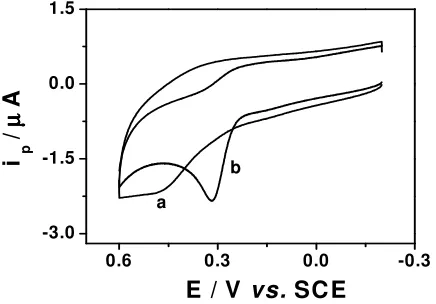
Fig. 1 shows the cyclic voltammograms at bare (Fig. 1a) and L-Cys/Au electrode (Fig.1b) in
presence of 0.10 mM UA in phosphate buffer of pH 7.0. At the bare electrode, the electrochemical oxidation of UA occurs at approximately 0.46 V and the voltammetric peak is rather broad, suggesting slow electron transfer kinetics, presumably due to the fouling of the electrode surface by the oxidation product. It is reported that the oxidation of UA is irreversible at glassy carbon and metal electrodes and is quasi-reversible at a graphite electrode [20].
Figure 1. Cyclic voltammograms for 0.1 mM UA in 0.1 M phosphate buffer solution (pH 7.0) at bare Au electrode (a) and L-Cys/Au electrode (b). Scan rate: 100 mV s-1
The electrochemical oxidation of UA proceeds in a 2e-, 2H+ process to lead to an unstable
diimine species which is then attacked by water molecules in a step-wise fashion to be converted into an imine-alcohol and then uric acid-4,5 diol. The uric acid-4,5 diol compound produced is unstable and decomposes to various products depending on the solution pH [21]. However, a well-defined redox
0.6 0.3 0.0 -0.3
-3.0 -1.5 0.0 1.5
b a
i p
/
µµµµ
A
[image:3.612.200.418.451.603.2]wave of UA was obtained at the L-Cys/Au electrode. The oxidation peak potential shifts negatively to
0.32 V and the peak current increases significantly. L-Cys/Au electrode showed no redox peaks on
cyclic voltammograms when scanning in phosphate buffer of pH 7.0. The above results indicate that catalytic reaction occurred between the L-Cys/Au electrode and UA. The catalytic reaction facilitates
electron transfer between UA and the modified electrode, as a result the electrochemical oxidation of UA becomes easier. The reason for this is that the L-Cys-SAMs can act as a promoter to increase the
rate of electron transfer [15, 22], lower the overpotential of UA at the bare electrode, and the anodic peak shifts negatively.
The influence of the scan rate on the electrochemical response of UA at the L-Cys/Au electrode was
investigated by cyclic voltammetry. The oxidation peak potential was observed to shift positively with the increase in scan rate, and in addition, exhibited a linear relation to the square root of the scan rate, v1/2, in the range from 20 mV s-1 to 400 mV s-1 with the linear regression equation i
pa / µA = -0.0527 +
5.4540 v1/2 / (mV s-1) 1/2 (correlation coefficient, r = 0.9994). The result indicates that the oxidation of
UA at the L-Cys/Au is a diffusion-controlled process. The L-Cys/Au electrode used for the oxidation of
UA did not show any voltammetric signal for UA after it was transferred to pure supporting electrolyte, confirming that the oxidation process is free from the adsorption of UA.
3.2. Electrochemical oxidation of AA at the L-Cys electrode
As mentioned above, L-Cys/Au electrode shows high electrocatalytic activity toward the
oxidation of UA. It might be used as a chemically modified electrode to explore biological and analytical applications. Besides UA, biomolecules such as AA has been measured on the L-Cys/Au
electrode. The results show that the L-Cys/Au electrode has favorable catalytic activity with AA. Fig. 2
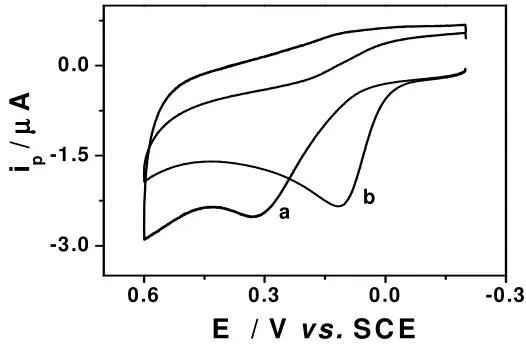
shows the cyclic voltammograms of AA at bare (Fig. 2a) and L-Cys/Au electrode (Fig. 2b). At the bare
Au electrode, the oxidation occurs at around 0.33 V and the oxidation peak is rather broad.
Figure 2. Cyclic voltammograms for 0.2 mM AA in 0.1 M phosphate buffer solution (pH 7.0) at bare Au electrode (a) and L-Cys/Au electrode (b). Scan rate: 100 mV s-1
0.6 0.3 0.0 -0.3
-3.0 -1.5 0.0
b a
i
p/
µµµµ
A
[image:4.612.161.424.482.656.2]Oxidation of AA at bare electrode is generally believed to be totally irreversible and requires high overpotential and also, no reproducible electrode response is obtained due to fouling of the electrode surface by the adsorption of the oxidized product of AA [23]. However, the oxidation peak shifts negatively to 0.11 V at the L-Cys/Au electrode, indicating that the L-Cys-SAMs on the electrode
surface favors the oxidation process. Since L-Cys molecules form a ‘thin’ monolayer and this prevents
the fouling of the electrode surface, the electron transfer kinetics for the oxidation of AA are faster at the L-Cys/Au electrode. So the possible explanation for the negative shift observed in the oxidation
peak potential of AA could be due to the prevention of the electrode surface fouling by the oxidation product. Because the oxidation peak of AA is shifted to less positive potential, it would not interfere with the measurement of UA. The oxidation peak potential was observed to shift positively with the increase in scan rate, and in addition, exhibited a linear relation to the square root of the scan rate, v1/2,
in the range from 50 mV s-1 to 500 mV s-1 with the linear regression equation i
pa / µA = 0.2269 +
5.3302 v1/2 / (mV s-1) 1/2 (correlation coefficient, r = 0.9989). The result indicates that the oxidation of
AA at the L-Cys/Au electrode is a diffusion-controlled irreversible oxidation process.
3.3. Determination of UA in the presence of AA
The electrochemical sensing of biomolecules using the bare electrodes suffers from the
interference of AA that is present at millimolar level in biological fluids, because the fouling effect of the oxidized product of AA is not negligible and the oxidation potential for AA is fairly close to those of most of biomolecules [21].
0 .6 0 .3 0 .0 -0.3 -3 .2 -1 .6 0 .0 A AA U A b a
i p / µµµµ
A
E / V v s . S C E
0 .6 0 .3 0 .0 -0 .3 -2 .0 -1 .0 0 .0 B A A U A b a
i p
/
µµµµ
A
E / V v s . S C E
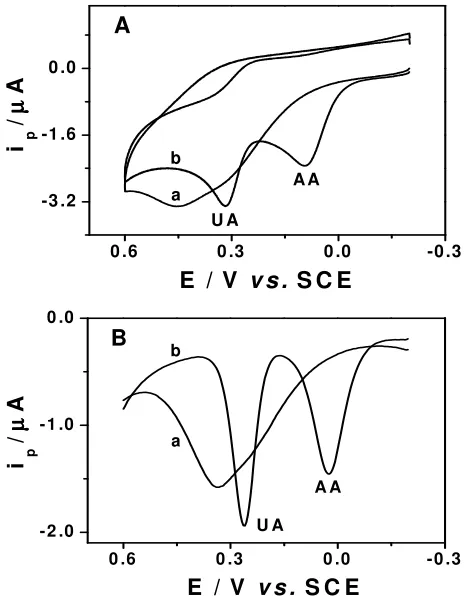
Figure 3. CVs (A) and DPVs (B) for the homogeneous solution of 0.1 mM UA and 0.2 mM AA at bare (a) and L
[image:5.612.104.337.426.726.2]Fig. 3 shows the CV and DPV voltammograms obtained for UA and AA coexisting at bare and
L-Cys/Au electrode. As shown in Fig. 3, the bare electrode cannot separate the voltammetric signals of
UA and AA. Only one broad voltammetric signal was observed for both analytes. The fouling of the electrode surface by the oxidation products results in a single voltammetric peak for UA and AA. Therefore it is impossible to use the bare electrode for the voltammetric determination of UA in the presence of AA.
Moreover, the L-Cys/Au electrode resolved the mixed voltammetric signals into two well-defined
voltammetric peaks. The L-Cys/Au electrode shows good selectivity and excellent sensitivity in the
simultaneous determination of UA and AA. The peaks observed at 0.262 and 0.026 V in DPV recording is corresponding to the oxidation of UA and AA, respectively (Fig. 3B). As the oxidation potential of AA is shifted to the less positive side, the anodic current of UA has no contribution from AA, because AA is readily oxidized well before the oxidation potential of UA reached. Thus elimination of the fouling of the electrode surface by the oxidation products could be achieved and the precise determination of UA in the presence of AA or the precise determination of AA in the presence of UA is possible at the L-Cys/Au electrode. The voltammetric signals of UA and AA remained
unchanged in the subsequent sweeps, indicating that the L-Cys/Au electrode does not undergo surface
[image:6.612.168.423.388.610.2]fouling. Furthermore, the separation between the DPV oxidative peaks of UA and AA is large (– 236 mV) and thus the simultaneous determination of UA and AA is feasible at the L-Cys/Au electrode.
Figure 4. DPVs of UA and AA at L-Cys/Au electrode in 0.1 M phosphate buffer solution (pH 7.0),
[AA] was kept constant and [UA] was changed (i.e., [AA]=0.16 mM, [UA]: (a) 10, (b) 20, (c) 30, (d) 40, (e) 60, (f) 80 µM). Scan rate: 4 mV s-1; pulse amplitude: 50 mV; pulse width: 50 ms; pulse time:
200 ms
0.6
0.3
0.0
-0.3
-1.0
-0.5
f
a
AA
UA
i
p/
µµµµ
A
The next attempt was taken to determine UA and AA simultaneously by using the L-Cys/Au
electrode with DPV. Fig. 4 represents the DPV recordings at different concentrations of UA where the concentration of AA was kept constant. The oxidative peak current for UA was increased linearly with the increase in UA concentration in the range of 1.0 × 10⁻⁵ - 8.0 × 10⁻⁵ M. The linear regression
equation was ipa / µA = -0.9950 + 0.0764 C / µM (correlation coefficient, r = 0.9963) and the detection
limit was 2.0 × 10⁻⁶ M in the presence of 0.16 mM AA. Furthermore, while UA peak current increased
with the increase in UA concentration, the peak current of AA kept almost constant. Thus, it is
confirmed that the responses of UA and AA at the L-Cys/Au electrode are independent.
Overall facility of the L-Cys/Au electrode for simultaneous determination of UA and AA was
demonstrated by simultaneously changing the concentration of UA and AA. Fig. 5 illustrates the DPV responses of the L-Cys/Au electrode while simultaneously varying the concentrations of UA and AA.
The calibration curves for UA and AA were linear for a wide range of concentrations (54 - 150 µM for UA and 140 - 500 µM for AA) with correlation coefficients 0.9978 and 0.9954, respectively. The determination limits for UA and AA were found to be 2.0 × 10⁻⁶ M and 1.1 × 10⁻⁵ M, respectively. The
slopes (∆ I / ∆ C ) of the linear calibration curves were estimated to be 0.0099 and 0.0040 µA / µM for UA and AA, respectively. This suggests that the oxidation of AA mediated by the oxidized UA cannot occur at the L-Cys/Au electrode. Thus, the simultaneously selective and sensitive determination of UA
[image:7.612.158.439.383.623.2]and AA was achieved at the L-Cys/Au electrode.
Figure 5. DPVs for UA and AA at L-Cys/Au electrode in 0.1 M phosphate buffer solution (pH 7.0)
while simultaneously changing their concentration (i.e., [UA] = (a) 54, (b) 65, (c) 75, (d) 87, (e) 100, (f) 110, (g) 120, (h) 130, (i) 140, (j) 150 µM; [AA] = (a) 140, (b) 180, (c) 220, (d) 260, (e) 300, (f) 340, (g) 380, (h) 420, (i) 460, (j) 500 µM). Scan rate: 4 mV s-1; pulse amplitude: 50 mV; pulse width: 60
ms; pulse time: 200 ms
0.6
0.3
0.0
-0.3
-3.0
-1.5
0.0
j
a
UA
AA
i
p/
µµµµ
A
To ascertain further the reproducibility of the results, three different Au electrodes were modified with L-Cys SAMs and their responses towards the oxidation of UA and AA were tested. The separation
between the voltammetric signals of UA and AA and the sensitivities remained the same at all three modified electrode, confirming that the results are reproducible. The stability of the L-Cys/Au electrode
was also investigated. Its electrocatalytic effect on the electrochemical response of UA and AA, respectively, or the homogeneous solution of UA and AA, did not change after storage in air for at least one week.
Analytical utility of the L-Cys/Au electrode has been examined using human urine samples.
Human urine is diluted 25 times in phosphate buffer of pH 7.0 and subjected to electrochemical analysis. The amount of uric acid present in the urine is estimated to be 0.48 ± 0.05 g / L. This value is comparable to the reported values in the literature [24].
4. CONCLUSIONS
The present study demonstrates an excellent approach for the development of a novel voltammetric UA sensor based on L-Cys-SAMs. The L-Cys/Au electrode showed high electrocatalytic
activity toward the oxidation of UA and AA and can separated oxidation peaks toward UA and AA, which are indistinguishable at the bare electrode. The modified electrode could be used to the selective determination of UA in the presence of high concentration of AA. The modified electrode shows excellent sensitivity, good selectivity and antifouling properties.
ACKNOWLEDGEMENTS
We gratefully acknowledge the financial support from the Doctor Foundation of Dalian Nationalities University(20056101).
References
1. C.R. Raj, F. Kitamura, T. Ohsaka, Analyst, 9 (2002) 1155
2. J.X. Wang, M.X. Li, Z.J. Shi, N.Q. Li, Z.N. Gu, Microchem J, 73 (2002) 325 3. Y.X. Li, X.Q. Lin, Sensor. Actuat. B-Chem., 115 (2006) 134
4. H.R. Zare, N. Rajabzadeh, N. Nasirizadeh, M.M. Ardakani, J. Electroanal. Chem., 589 (2006) 60 5. S. Shahrokhian, M. Ghalkhani, Electrochim. Acta, 51 (2006)2599
6. S.S. Kumar, J. Mathiyarasu, K.L. Phani, Y.K. Jain, V. Yegnaraman, Electroanal., 17 (2005) 2281 7. H.R. Zare, F. Memarzadeh, M.M. Ardakani, M. Namazian, S.M. Golabi, Electrochim. Acta, 50
(2005) 3495
8. J.W. Luo, M. Zhang, D.W. Pang, Sensor. Actuat. B-Chem., 106 (2005) 358 9. J.Premkumar, S.B. Khoo J. Electroanal. Chem., 576 (2005) 105
10. R.N. Goyal, V.K. Gupta, A. Sangal, N. Bachheti, Electroanal., 17 (2005) 2217 11. G.H. Lu, L.Y. Jiang, F. Song, C.Y. Liu, L.P. Jiang, Electroanal., 17 (2005) 901 12. C.R. Raj, T. Ohsa, J. Electroanal. Chem., 540 (2003) 69
13. J.M. Zen, P.J. Chen, Anal. Chem., 69 (1997) 5087
14. X.H. Cai, K. Kalcher, C. Neuhold, B. Ogorevc, Talanta, 41 (1994) 407 15. S.F. Wang, D. Du, Q.C. Zou, Talanta, 57 (2002) 687
17. T. Liu, M.X. Li, Q.Y. Li, Talanta, 63 (2004) 1053
18. Q. Wang, D. Dong, N.Q. Li, Bioelectrochem., 54 (2001) 169 19. Q. Wang, N. Jiang, N.Q. Li, Microchem. J., 68 (2001) 77
20. J.L. Owens, H.A. Marsh, G. Dryhurst, J. Electroanal. Chem., 91 (1978) 231 21. P.R. Roy, T. Okajima, T. Ohsaka, J. Electroanal. Chem., 561 (2004) 75 22. S.F. Wang, D. Du, Anal. Lett., 37 (2004) 361
23. P.R. Roy, T. Okajima, T. Ohsaka, Bioelectrochem., 59 (2003) 11 24. P. Ramesh, S. Sampath, Electroanal., 16 (2004) 866
© 2006 by ESG (www.electrochemsci.org)
![Figure 4. DPVs of UA and AA at [AA] was kept constant and [UA] was changed (i.e., [AA]=0.16 mM, [UA]: (a) 10, (b) 20, (c) 30, (d) 40, (e) 60, (f) 80 L-Cys/Au electrode in 0.1 M phosphate buffer solution (pH 7.0), µM)](https://thumb-us.123doks.com/thumbv2/123dok_us/1948954.155278/6.612.168.423.388.610/figure-dpvs-constant-changed-electrode-phosphate-buffer-solution.webp)
![Figure 5. DPVs for UA and AA at L-Cys/Au electrode in 0.1 M phosphate buffer solution (pH 7.0) while simultaneously changing their concentration (i.e., [UA] = (a) 54, (b) 65, (c) 75, (d) 87, (e) 100, µ](https://thumb-us.123doks.com/thumbv2/123dok_us/1948954.155278/7.612.158.439.383.623/figure-electrode-phosphate-buffer-solution-simultaneously-changing-concentration.webp)
