Methodological and Ideological Options
A Framework for Decoupling Human Need Satisfaction From Energy Use
Lina I. Brand-Correa
⁎
, Julia K. Steinberger
Sustainability Research Institute, School of Earth and Environment, University of Leeds, Leeds LS2 9JT, UK
a b s t r a c t
a r t i c l e i n f o
Article history: Received 12 July 2016
Received in revised form 10 May 2017 Accepted 12 May 2017
Available online xxxx
Climate change poses great challenges to modern societies, central amongst which is to decouple human need satisfaction from energy use. Energy systems are the main source of greenhouse gas emissions, and the services provided by energy (such as heating, power, transport and lighting) are vital to support human development. To address this challenge, we advocate for a eudaimonic need-centred understanding of human well-being, as op-posed to hedonic subjective views of well-being. We also argue for a shift in the way we analyse energy demand, from energy throughput to energy services. By adopting these perspectives on either end of the wellbeing-energy spectrum, a“double decoupling”potential can be uncovered. We present a novel analytic framework and show-case several methodological approaches for analysing the relationship between, and decoupling of, energy ser-vices and human needs. We conclude by proposing future directions of research in this area based on the analytic framework.
© 2017 The Authors. Published by Elsevier B.V. This is an open access article under the CC BY license (http:// creativecommons.org/licenses/by/4.0/). Keywords:
Energy services Human needs Well-being Development Climate change Mixed methods
1. Introduction
Human societies require materials and energy for their activities, and these biophysical requirements (known as“social metabolism”) have been increasing with population, economic growth and technolog-ical demands (Krausmann et al., 2009). The extent of global social me-tabolism is such that, during the last century, the physical scale of energy and material inputs and outputs from human societies has come to dominate important planetary biogeochemical cycles. This has led to the definition of a new geological era: the Anthropocene (Hamilton, 2013; Steffen et al., 2015).
Energy systems are recognized to be a core component of societies (Ayres and Warr, 2009; Cook, 1971; Cottrell, 1955; Smil, 2008; White, 1943) and necessary for development. Energy access was recently in-cluded in the UN's Sustainable Development Goals (UN, 2016) and the Sustainable Energy for All initiative (UN SE4ALL, 2014). Despite the im-portance of energy use, vast segments of the world's population live under conditions of severe energy deprivation, preventing them from living healthy lives or fully participating in their society (Karekezi et al., 2012; Pachauri et al., 2012), while an increasingly international con-sumer class drives the majority of emissions associated with energy sys-tems (Chakravarty et al., 2009; Chancel and Piketty, 2015).
Energy systems are a key intermediary between environmental im-pacts and the functioning of societies, and thus the well-being of their members. The pivotal role of energy becomes even clearer in the
context of a climate-constrained world, where fossil-fuelled energy sys-tems are the largest contributors to GHG emissions (IEA, 2012a) and hence main drivers of climate change (IPCC, 2013). The challenge of achieving human well-being in the Anthropocene era has been summarised byRaworth (2012): can we live above social foundations but below an environmental ceiling, or within the“doughnut” of sustainability?
The centrality of energy in fuelling both human development and climate change can lead to pessimism regarding the achievability of uni-versal social development and keeping climate change below harmful levels (Jakob and Steckel, 2014). In contrast, we believe that more opti-mism may be warranted. If instead societies' efforts–and energy sys-tems- would be focused towards the satisfaction of human needs, it might well be possible to achieve universal well-being within planetary boundaries. In order to shape societies' efforts as outlined above, how-ever, we need to understand more clearly the relationship between en-ergy and human well-being.Day et al. (2016)have made significant advances in this direction from an energy poverty perspective, by apply-ing the capabilities approach to conceptualize why energy is used and needed, as well as proposing a definition of energy poverty that is multi-dimensional and relevant to global North and South contexts.
The main objective of this paper is to present an analytical frame-work for exploring the complex problem outlined above, as well as for conducting research that can lead to relevant policy recommendations. To this end, we advocate for a need-centred understanding of human well-being (Section 2). We also need to change the way we analyse en-ergy demand, from enen-ergy throughput to enen-ergy services (Section 3). By adopting these perspectives on either end of the wellbeing-energy spec-trum, a“double decoupling”potential can be uncovered (Section 4). ⁎ Corresponding author.
E-mail addresses:[email protected],[email protected](L.I. Brand-Correa),
[email protected](J.K. Steinberger).
http://dx.doi.org/10.1016/j.ecolecon.2017.05.019
0921-8009/© 2017 The Authors. Published by Elsevier B.V. This is an open access article under the CC BY license (http://creativecommons.org/licenses/by/4.0/). Contents lists available atScienceDirect
Ecological Economics
Several methodological approaches are showcased inSection 5for analysing the relationship between, and decoupling of, energy services and human needs. Thefinal section of the paper concludes and proposes directions for future research in this area.
2. Human Well-Being Through a Human Needs Lens
Defining and measuring human well-being (HW) are highly debated research areas. No single approach is likely to bring consensus: our goal in this section is simply to summarise two major schools of thought (he-donic and eudaimonic), and explain why we have selected the eudaimonic tradition as the most suitable for this research. We articu-late our argument around three main points: the advantages of a eudaimonic1perspective in the de
finition of HW in relation to sustain-ability (Section 2.1), the suitsustain-ability of non-subjective assessments to measure HW (Section 2.2), and the relation of human needs to HW (Section 2.3). In this way, followingO'Neill (2006, 2008a, 2011), we make the case for the superiority of the eudaimonic approach in sustain-ability research in general, and in relation to our specific question of en-ergy requirements for human well-being in particular.
2.1. Eudaimonic and Hedonic Definitions of Well-Being
Not many would argue against policies that aim at improving human well-being. The wide range of meanings of well-being leads to confu-sion in research outcomes and policy implementations. Well-being is often equated to economic welfare (GDP per capita for example), it can be used to mean happiness (an individual state of mind), or it can have a more holistic meaning (likeflourishing). The meaning societies give to well-being will directly influence the pathways they choose to follow in order to improve it, and these pathways will necessarily have some sort of environmental consequences. In the last centuries, improved well-being in capitalist economies has been seen through the lens of individual purchasing power rather than overall social out-comes. This is a direct consequence of a particular understanding of well-being (hedonic) and has translated into very serious environmen-tal impacts.
Conceptualisations of well-being can be broadly categorised as ei-ther “hedonic” (pleasure-seeking) or “eudaimonic” (flourishing), reflecting their lineage back to the Greek philosophers Epicurus and Ar-istotle respectively (Ryan and Deci, 2001). The Hedonic school of thought sees well-being primarily as maximising pleasure (and minimising pain) (Dolan et al., 2006; Thompson and Marks, 2008): its principal modern representatives can be found in neoclassical econom-ics utility theory, and in the area of subjective happiness research (Layard, 2010), whoseflagship output is the World Happiness Report (Helliwell et al., 2016). It is fair to say that the hedonic school is domi-nant in research as well as ongoing popular and policy discourses. In contrast, the eudaimonic school of thought sees well-being as the en-abling of humans to reach their highest potential within the context of their society: it's most well-known modern representatives are Amartya Sen and Martha Nussbaum, whose capabilities approach (Nussbaum, 2015; Sen, 1999) has been implemented in the UN's Human Development Index–HDI (UNDP, 2016).
The hedonic understanding of well-being became dominant in social philosophy and economics with the development of the concept of util-ity by Jeremy Bentham in the 18th century– “utility is the property of any object that tends to produce the happiness or reduce the unhappi-ness of the party whose interest is considered”(Beckerman, 2011, p. 83). As economics developed, utility theory became grounded in a sys-tem of commensurable, continuous and transitive preferences, based on potentially infinite and insatiable individual wants (Kamenetsky,
1992). Thus utility maximisation became tightly interlinked with pref-erence satisfaction through market consumption,2 which has two major implications: it creates an ethical void in which any consumption behaviour is justified in terms of individual well-being (Richards, 2013), and it paves the way for increased economic activity to become“the pri-mary national policy goal in almost every country”(Costanza, 2014, p. 283).
Hedonism and its modern proponents have clear consequences for sustainability: effectively, any limits to consumption (e.g. limits on re-source use, on environmental impacts or economic growth) can be im-mediately perceived as limits to HW from a mainstream economic perspective.3Many attempts to reconcile a hedonic understanding of HW with environmental sustainability result in policy instruments that are aimed at influencing individual behaviour (e.g. eco-labelling, education on energy efficiency, etc.). That is because, in a hedonic world, the path for improving an individual's well-being is psychologi-cal or cognitive: either improving a person's state of mind or changing their understanding of what contributes to well-being (i.e. their utility function) (O'Neill, 2008a; Trebeck, 2015). It is in this respect that hedo-nism has become especially attractive for some mainstream environ-mental circles: it should be possible to decouple well-being from increased consumption simply by shifting utility functions: by convinc-ing people what other elements (beyond consumption after a minimum level has been reached) are constituents of well-being (O'Neill, 2006). This viewpoint overlooks the many institutional and technological fac-tors that lock people in certain lifestyles. In contrast, other approaches emphasise the importance of everyday social practices as key determi-nants of consumption patterns which are not easily changed (Røpke, 2009; Shove et al., 2008). By doing so, these approaches focus on the co-evolution of social norms and technologies, in which the role of indi-vidual choice is very limited.
Furthermore, the lack of stability in people's preferences makes he-donic well-being a poorly suited assessment of social policies. Adapta-tion and relativity are common criticisms of the logic of preferences (O'Neill, 2008a): The former refers to adaptation to different circum-stances, whilst the latter refers to the positional relativity of an individual's self-assessment of the impact of income and material pos-sessions on their well-being (Easterlin, 1974, 2001). This lack of stability does not allow for intercultural (or even interpersonal) comparisons, and thus makes the overall assessment of any social policy (e.g. redistri-butional policies) virtually impossible (Richards, 2013). Likewise, in a hedonic world, intergenerational factors cannot be considered when assessing well-being, since it is a static evaluation of an individual's par-ticular experience(s). This is especially relevant for environmental and climate considerations, in which current actions inevitably have future impacts (O'Neill, 2008b).
In contrast, eudaimonic approaches are based on ancient Greek Hel-lenistic philosophers after Aristotle that aimed at describing“the good life”(eudaimonia) (Richards, 2013). For an individual to be well, she must be able toflourish and fully participate in her chosen form of life (Doyal and Gough, 1991).“Well-being is not just a matter of subjective experiences, it is a matter of what one can do or be in one's life”(O'Neill, 2006, p. 165). Eudaimonic well-being focuses on the individual in the broader context of her society (as opposed to atomic and isolated in time and space). Such a broadening of the unit of analysis allows for so-cial institutions and political systems to be studied in light of their abil-ity to enable individuals to flourish within them. Therefore, a eudaimonic understanding of well-being is better suited to address questions of sustainability and climate governance, where long term
1
Eudaimonia is a Greek word that can be translated as“humanflourishing”. AsRyan et al. (2008, p. 143)explain,“eudaimonia is thus not conceived of as a mental state, a pos-itive feeling, or a cognpos-itive appraisal of satisfaction, but rather as a way of living”.
2
The market is the institution that allows for the observation of people's choices, and therefore it is through market transactions that people's preferences are revealed.
policy-making is likely to be pivotal. A similar argument can be made for the importance of intergenerational responsibilities in long term environ-mental sustainability. A eudaimonic view of HW allows for the inclusion in the analysis of a sense of social belonging to our community both in the past and future, hence it opens the space for intergenerational citizen-ship through the sharing of common projects and places (O'Neill, 2008b). Many researchers in thefield of international development have based their work on a eudaimonic understanding of well-being (see for exampleOPHI, 2015), focussing on multiple dimensions of poverty and its impact on social inclusion. The emphasis on poverty alleviation leads to evidencing and reducing deprivations in specific areas consid-ered vital for human development. Furthermore, as a result of focusing on humanflourishing rather than individual preferences, eudaimonic approaches to HW have the potential to consider alternative patterns of resource use, which can be compatible with upper limits to consumption4(O'Neill, 2008b, 2011). FollowingO'Neill (2011), there are two main reasons eudaimonic well-being can address alternative levels of resource use. On the one hand, the different dimensions of HW in a eudaimonic sense (i.e. the dimensions necessary for people to flourish or to fully participate in society) can be fulfilled in many differ-ent ways, including less resource intensive ways. And on the other hand, the different dimensions of HW require different resources (including environmental quality) which are not substitutable between them-selves, so that eudaimonic well-being may in itself require lower re-source use. The ability to evidence profound deprivations as well as highlight alternative levels of resource use is a key strength of eudaimonic approaches, and may offer a coherent answer to recent ap-peals to study“sustainable consumption corridors”(Di Giulio and Fuchs, 2014).
“[…Hedonic] well-being matters, [but] it is not all that matters” (O'Neill, 2008b, p. 8). In other words, people's state of mind and feelings in a particular moment are important, however, they are not all that is important, and certainly not the most important thing to consider given the contemporary environmental crises. As Kahneman and Sugden (2005, p. 176), advocates of hedonic well-being, recognise: “human well-being may be thought to depend […] also on other aspects of life, such as autonomy, freedom, achievement, and the development of deep interpersonal relationships, which cannot be decomposed into momentary affective experiences”. In a hedonic world, these“other as-pects of life”are a means to achieving positive emotions, but in a eudaimonic world they are valuable in themselves (O'Neill, 2008b), they are what societies (and physical production and consumption sys-tems) should focus on delivering in an environmentally fragile world.
2.2. Classifying Assessments of Well-Being
Unsurprisingly, given the fundamental division in philosophical viewpoints outlined above, eudaimonic and hedonic HW approaches utilise separate assessment tools and metrics, consistent with their di-vergent definitions of HW and consequently different research ques-tions. In disciplinary terms, eudaimonic understandings of HW and their assessment tend to derive from international development, politi-cal economy and sociology, while hedonic understandings (and assess-ment methods) tend to derive from mainstream economics and psychology.5On the one hand, international development and social
science literature are trying to understand problems entrenched in soci-eties, i.e. poverty, underdevelopment, social structures, social provision-ing systems. On the other hand, economics and psychology are tryprovision-ing to understand the individual, because it is their main object of analysis. In this section, we clarify the consequences for assessing HW.
There are two general approaches for assessing (or measuring) HW: subjective and objective. These can be used to assess either hedonic or eudaimonic well-being. By objective methods we mean assessments made by an agent different from the subject itself and attempting to capture social arrangements. By subjective methods we mean the self-assessment of an individual's experiences. Examples of subjective and objective assessments of eudaimonic and hedonic well-being are summarised inTable 1and critically discussed below in relation to their use in policy-making for sustainability.
Starting clockwise from the top-right, in hedonic well-being the most commonly used objective measurements are done through affl u-ence or monetary wealth, based upon the link between utility and con-sumption discussed in the previous section. Individual income and expenditure, or GDP per capita at a more macro level are often used as proxies for HW.Stevenson and Wolfers (2008)amongst others for ex-ample, try to prove that income predicts hedonic well-being, measured in a subjective way. In addition to the criticisms of a hedonic under-standing of HW outlined in the previous section, this assessment is par-ticularly problematic in that it further justifies the continuous pursuit of economic growth as a main policy goal, and therefore underpins in-creasing global and intra-national inequalities (Piketty, 2014). More-over, the focus on economic growth limits environmental policies to weak decoupling targets, rather than fundamental shifts in structure, scale and focus of the economy (Dietz and O'Neill, 2013). We have also included physiological measures of emotional states in this catego-ry, although we have not found much evidence of these being used in the broader well-being literature.
Stemming from psychology, subjective methods based on a hedonic understanding of HW have been used as the basis for measuring expe-rienced utility (Kahneman et al., 1997; Kahneman and Sugden, 2005). These type of subjective self-assessments of HW (or happiness, as it is usually referred to) have been widespread and have become quite pop-ular in policy-making (Helliwell et al., 2016; Trebeck, 2015). In contrast to income, which is theoretically unbounded, the metrics used here are generally on a bounded scale. Moreover, increases in average national income are often found not to lead to rises in subjective well-being (a phenomenon known as the Easterlin paradox (Easterlin, 1974)). Sub-jective well-being measures face many issues in relation to their inter-nal logic of preferences, which was discussed above. Furthermore, the accuracy of a self-assessment of the impact of certain experience on an individual's well-being is conditioned by the narrative (or the order) of the events (O'Neill, 2006). Therefore, the suitability of these measures for long term policy-making is arguably limited.
Life satisfaction is a subjective evaluation method with both hedonic and eudaimonic aspects (e.g. using the Satisfaction With Life Scale (Dolan et al., 2006)). It is based on the notion that individuals can eval-uate how their life is going in general (Dodds, 1997) rather than balance their feelings of isolated experiences (hedonic approach). These mea-sures overcome some of the issues related to individual assessments of hedonic well-being. However, they remain ill-suited for the assess-ment of sustainability policies, mainly because there is no certainty as to which aspects of well-being individuals are assessing, under which criteria and in what time-scale.
Objective eudaimonic approaches have in common their insistence on multiple non-substitutable dimensions of human well-being, al-though they often differ on the exact dimensions or how to best mea-sure them. The most widely known operationalization is the Human Development Index (HDI), which is based on the capabilities approach and it focuses on three dimensions of HW: education, life expectancy and income (note that in our classification, income belongs in the he-donic column). Sen was reluctant to define a set of dimensions, an 4Eudaimonic understandings of well-being are closer to a conception of individuals as
heteronomous subjects rather than autonomous subjects (O'Neill, 2011): The former is re-lated to concepts of dependence and vulnerability, which have been shown to be key in discussions around social justice (see for exampleFineman, 2008), whilst the latter is in line with mainstream economic theory and classical liberalism.
5
exercise that was undertaken by Nussbaum.6Other authors have de-fined dimensions of HW in terms of human needs (HN) and therefore assess non-individual eudaimonic well-being in different ways (see Table 1for examples). Despite the diversity of these assessments, there is great overlap and consistency in the categories (Alkire, 2002). Alkire (2002)andKamenetsky (1992)argue that achieving well-being and satisfying human needs are the strongest source of motivation for human action, and the conceptual and empirical common ground be-tween these approaches reinforces such argument.
The capabilities approach has been very successful in reaching world-wide policy-making through the HDI, and also in providing the basis for analytical frameworks used in development studies, which have been translated into policy strategies for poverty alleviation in sev-eral countries (OPHI, 2015), often through the lens of“ multi-dimen-sional deprivations”. The capabilities approach is measured at the individual level, which has sparked some criticisms for focusing too much on individual freedoms. For example, it has been seen as problem-atic in relation to current neoliberal policies: the capabilities approach can be consistent with the view of people achieving their needs individ-ually, for instance through the market (Lamb, 2016; Navarro, 2000; Reader, 2006). However, these criticisms are open to debate, given the dependence of many capabilities on social relations and the need for collective action to build such capabilities.
In the next section we focus on non-individual assessments of eudaimonic well-being based on human needs. We argue that these ap-proaches are particularly well suited for the assessment of how sustain-ably societies perform in terms of HW. Human needs introduce a normative goal of achieving minimally impaired participation in society. Therefore, the burden of (political) action shifts from the individual to all social groups (e.g. households, communities, governments, etc.) (Reader, 2006). Furthermore, they attempt to include cultural specifi ci-ty and thus open decoupling possibilities, as well as avoiding paternalism.
2.3. The Human Needs Approach
We have so far argued in favour of a eudaimonic understanding of HW in order to address the issue of improving people's well-being with-in environmental limits. Furthermore, we have discussed the different methods through which HW in these terms might be assessed, empha-sizing the role of non-individual methods in encompassing crucial social factors. We now focus on the Human Needs (HN) approach (Doyal and Gough, 1991; Max-Neef, 1991), as eminently suitable to form the foun-dation for researching well-being within planetary boundaries. The key
features of the human needs approach that single it out for this type of research are the enumeration of afinite, non-substitutable and well-de-fined number of human needs, and the distinction between the means employed to satisfy needs, or“satisfiers”and the needs themselves. We elaborate these points below.
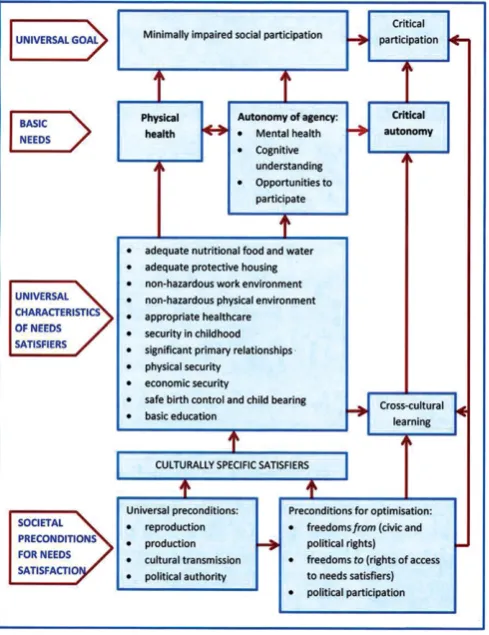
The central idea of the theory of human need is that there are afinite number of self-evident (i.e. universal, recognizable by anyone), incom-mensurable (thus satiable, irreducible and substitutable) and non-hierarchical needs, which encompass the range of capabilities or dimen-sions of HW. It should be noted that thefinite and well-defined nature of needs means they are eminently suited to empirical, quantitative re-search. These needs are prerequisites for living well within society: only when these are satisfied can well-being be achieved. In this sense, the conceptualisation of well-being is negative and minimalist: the goal is “minimally impaired participation in social life”(Gough, 2015). Needs themselves (the goals) are considered unchanging and universal, and that some objective harm will happen if they are not satisfied. However, human needs pose the risk of being considered paternalistic and exter-nally imposed (although see alsoNussbaum (2001)for a capabilities-re-lated discussion of this point), which is why some authors (Guillén-Royo, 2016; Max-Neef, 1991) highlight the importance of par-ticipatory exercises in determining specific actions to achieve high levels of well-being.
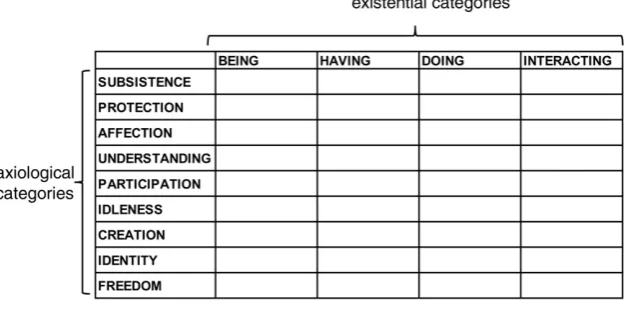
ForDoyal and Gough (1991)there are two basic HN categories which must be satisfied: physical health and autonomy, the latter being further divided into mental health, cognitive skills and opportuni-ties. Furthermore,Doyal and Gough (1991)identify eleven intermediate needs (or“universal characteristics of need satisfiers”(Gough, 2015)) that typically derive in the satisfaction of their basic needs (seeFig. 1). Similarly,Max-Neef (1991)has identified nine needs (subsistence, pro-tection, affection, understanding, participation, leisure, creation, identi-ty and freedom) that are expressed in four different ways: being (attributes), having (tools, norms), doing (agency) and interacting (so-cial expressions in time and space) (seeFig. 2).
Contrasting with the characteristics of needs (the goals), the means employed to satisfy HN are culturally, socially and temporallyflexible. Max-Neef (1991)coined the term“satisfier”to describe the culturally-specific ways universal needs are fulfilled in practice. The inherent di-versity of satisfiers enables the identification and comparison of radical-ly alternative modes of social function and physical provisioning systems. Theflexibility associated with satisfiers has allowed Gough and colleagues (Abu Sharkh and Gough, 2010; Gough, 1994) to assess the success of different political regimes in satisfying human needs. Al-ternatively, thisflexibility in the satisfiers means they allow for in-depth qualitative research.Guillén-Royo (2016)has compiled contextual, con-ceptual and empirical aspects of the Human Scale Development (HSD) methodology developed byMax-Neef (1991), applied specifically to sustainable development. The HSD methodology is based on participa-tory workshops that enable communities to reflect on their own devel-opment pathways, and it will be discussed in more detail inSection 5. 6
Nussbaum's (2000)central human capabilities are: life; bodily health; bodily integri-ty; senses, thought, imagination; emotions; practical reason; affiliation; other species; play; and control over one's environment.
Table 1
Examples of objective and subjective assessments of eudaimonic and hedonic well-being.
Well-being assessment
Eudaimonic (flourishing) Hedonic (maximising pleasure, minimising pain)
Objective Outcomes: health, education, political participation, etc.
Means (satisfiers): public expenditure budgets on health & education, available infrastructure and vital services (hospitals, schools, trained doctors and teachers, etc.).
Community participatory method: Max-Neef's Human-Scale Development matrix of needs and satisfiers.
Income & expenditure studies (well-being as maximising utility through consumption, as making choices given budgetary constraints).
Physiological measurement of emotions.
Subjective Happiness
Finally, given that human needs are incommensurable and non-hi-erarchical, a loss in the level of satisfaction of one need (particularly when talking about minimum thresholds) cannot be substituted by more satisfaction of other needs (O'Neill, 2011). For instance, a loss in the level of satisfaction of the need of subsistence (e.g. in the case of malnutrition) cannot be satisfied by a gain in understanding (e.g. educa-tion), even though some satisfiers can be synergetic in the way the stim-ulate and contribute to the fulfilment of other needs (Max-Neef, 1991). However, the opposite is true: a gain in the level of satisfaction a one need can hinder the satisfaction of other needs. For example, the satis-faction of certain needs through environmentally harmful activities can prevent the satisfaction of other needs (Gough, 2015). In Max-Neef's (1991)work, these type of satisfiers can be classified as viola-tors/destroyers, pseudo-satisfiers or inhibiting satisfiers. This conceptu-alisation enables the inclusion of environmental limits and limits to consumption and economic activity.
3. Energy Services
Within the human needs framework we have outline above, we argue that energy services (ES) are vital“satisfiers”of human needs in many different ways: directly and indirectly, individually and synergetically, enabling and hindering. It is because of its role as “satisfier”that energy (through energy services) is a key intermediary between HW and planetary boundaries. We prefer the concept of ES for two main reasons. Firstly they are closer to satisfiers than primary, final or useful energy–ES, as opposed to Joules, are the ultimate reason why we demand energy. However, there are several challenges regard-ing their classification and measurement (Section 3.1). Secondly be-cause ES allow for the inclusion of additional efficiency improvement
avenues that could result in decoupling of energy use from HW (Section 3.2). We elaborate on these arguments below.
3.1. The Energy“Chain”
Within traditional energy analysis, there are three main links in the “energy chain”of energyflows: primary energy,final energy and useful energy (Grubler et al., 2012; Jochem et al., 2000) (seeFig. 3). Energy balances7report primary andfinal energyflows through the economy, but not useful energyflows. Primary energy generally refers to the ener-gy extracted or captured from the natural environment (e.g. crude oil, coal, hydropower, etc.) (IEA, 2005). Final energy (also called secondary energy) generally refers to energy as it is delivered to thefinal economic consumer, after undergoing transportation and transformation process-es (e.g. gasoline, diprocess-esel, electricity, etc.) (IEA, 2005). The majority of studies within traditional energy analysis8focus either on primary or final energy, both of which fall short in their relation to the exact pur-pose of energy use.
At the point of use,final energy undergoes one last transformation process as it passes through an end-use conversion device, for example furnaces, electric appliances or light bulbs. End-use devices transform energy into a form that is useful for human purposes, hence the term “useful energy”as the outcome of this last conversion process. The types of useful energy are usually classified into heat (low, medium or high temperature), mechanical drive, light, electricity for appliances, and food (Brockway et al., 2014). Few analyses focus on this part of the energy chain, with an exception being a growing amount of litera-ture that comes from an exergy9 perspective (Ayres et al., 2003; Brockway et al., 2015; Chen and Chen, 2009; Ertesvag, 2005; Nakićenovićet al., 1996; Serrenho et al., 2012; Wall, 1990).
Thefinal conversion step occurs within whatCullen et al. (2011) term a“passive system”(shown inFig. 3as passive context). Within passive systems no more conversion processes occur, only energy dissi-pation given the irreversibility of the second law of thermodynamics. Thus“a passive [system] can be thought of as a reservoir or tank of stored energy” (Cullen et al., 2011, p. 1712). Cullen and Allwood (2010a)identified three basic passive contexts: vehicles (for example cars, trains and airplanes), factories (within them the passive systems are the different machines and furnaces) and buildings for commercial and residential use (they themselves can be passive systems for heating and lighting, and the different appliances within them are also passive systems). Within a passive system, useful energy delivers ES (Jochem et al., 2000).
ES constitute the last part of the energy chain and are therefore the ultimate“reason”why energy supply chains exist. In relation to the sat-isfaction of HN, individuals use ES as satisfiers, not Joules of primary, final or useful energy. This makes ES the crucial concept to analyse when examining the relationship between energy systems and HW (Day et al., 2016). Therefore, ES are in themselves recognized as impor-tant for human development (Kaygusuz, 2012; Modi et al., 2005) whilst
7Energy balances (derived from energy statistics) are provided by statistical agencies and research institutes, such as theIEA (2012b, 2008)and theEIA (2014). Commonly used energy balances are derived from internationally agreed standards that are congruent with economic statistics (UNSD, 2014). Additionally, they focus on specific types of ener-gy: technical energy used in industrial supply chains and markets. As a result, they omit biomass used for food or fodder, as well as non-industrial processes, such as work done by draft animals or manual labour (Haberl, 2001). This may prevent a holistic view of the energy in society, particularly of food-fuel trade-offs (Haberl et al., 2011).
8
Within otherfields, particularly energy poverty, there is more of a focus towards en-ergy services. See for exampleNussbaumer et al. (2012)andKaygusuz (2011).
9
[image:5.595.47.292.54.372.2]Exergy can be defined as“the maximum possible work that may be obtained from a system by bringing it to the equilibrium in a process with reference surroundings”(Kostic, 2012, p. 816). AsGaggioli and Wepfer (1980, p. 823)state, exergy“is synonymous with what the layman calls‘energy’. It is exergy, not energy, that is the resource of value, and it this commodity, that‘fuels’processes, which the layman is willing to pay for”. For further details on exergy seeWall (2003, 1986, 1977),Kanoglu et al. (2012),Dincer (2002),Rosen (2006, 2002),Sciubba and Wall (2007).
the specific technical provisioning systems can be seen as culturally spe-cific.Cullen and Allwood (2010a)identified eightfinal services that can be measured using physical data and that are a small number of distinct but comparable categories: passenger transport, freight transport, structure, sustenance, hygiene, thermal comfort, communication and illumination.10
However, ES present significant challenges in terms of their mea-surement. They are each measured in units different from conventional energy units, which vary greatly between them but also depending on the author. Some examples are various physical quantities (i.e. passen-ger-km, Joules, m3K, bytes, lumens/s) (Cullen and Allwood, 2010a, 2010b; Fouquet, 2014; Fouquet and Pearson, 2006; Knoeri et al., 2015); abstract energy service units (Haas et al., 2008); and units of heat or work (Sovacool, 2011). This variety of units makes aggregation and comparability a difficult task (Roelich et al., 2015). Therefore, in terms of measurement, useful energy is the last part of the energy chain that can be measured in energy units, and therefore the closest concept to ES that can be aggregated and calculated (relatively) straightforward using data from energy balances.
3.2. Efficiency in Energy Service Delivery
ES are a set of limited ends which people demand from energy, but the way they are delivered varies greatly between societies and over time. This is similar to the universality of HN and the cultural specificity of satisfiers. A wider picture of potential efficiency improvement ave-nues appears by acknowledging this multiplicity of ES delivery possibil-ities. This in turn allows for possibilities of decoupling energy use from HW, i.e. less energy use in the primary orfinal stages of the energy chain for the same ES delivery.
There are four different approaches to energy efficiency measures in the delivery of ES, as outlined byMarshall et al. (2016): conversion de-vice, passive system, service control and service demand level. Distinguishing between the four approaches allows for a better picture of potential efficiency improvements. Between each of the links of the described energy chain (primary,final and useful energy) conversion processes occur, and hence there are possibilities for technical efficiency improvements in the conversion devices (Summers, 1971). However, these are limited by the laws of thermodynamics. Improvements in pas-sive systems are usually related to larger infrastructure investments and can provide clear long-term benefits (Knoeri et al., 2015; Roelich et al.,
2015). However, changes in either of these may be hampered by lock-in phenomena (Unruh, 2000) and broader social and technical consid-erations. Service control is an alternative for optimizing energy service delivery when is needed only, e.g. programmable heating controls and motion-sensitive lighting (Marshall et al., 2016).
Finally, and potentially most interesting, service level efficiency measures imply a change in the nature or the level of the service re-quired (Nakićenovićand Grubler, 1993).Haas et al. (2008)refer to these as short term components of energy service demand, related to behavioural or cultural aspects. For private vehicle passenger transport for example, car sharing is a change in the nature of the energy service, or driving less is a change in the demand level of the energy service. However, these service level measures are limited by larger systemic as-pects, such as transport infrastructure, population density, and quality of public transport, whichHaas et al. (2008)refer to as long term com-ponents of energy service demand. Similarly,Day et al. (2016)have identified different points along the energy chain where interventions can be made to alleviate energy poverty using a capabilities framework. For improving HW while reducing environmental impacts, under-standing the relationship between ES and HN could allow the prioritisation of policy interventions on the most appropriate energy ef-ficiency measures in the delivery of ES. For example in the case of trans-port (Mattioli, 2016) - if the delivery of transtrans-portation as an ES is found to be highly important for the satisfaction of health as a HN (by provid-ing access to medical facilities), decision makers could decide whether to focus efforts on improving the efficiency of engines (conversion de-vice), lightweighting the friction of cars and buses (passive system), traffic control measures (service control), or localised clinics or telemedicine11(service demand level through a change in the nature of the service provided).
4. Uncovering Potential for Double Decoupling Between Well-Being and Energy Use: The Analytical Framework
Our current context of environmental degradation and climate change, coupled with deep social deprivations, calls for“a profound shift […] in our intellectual approach to complex social problems” (Lamb, 2016, p. 185). Our analytical framework builds upon established, but disconnected, areas of research. On the one hand, it approaches well-being through the lens of eudaimonia in general and human needs in particular, as described inSection 2. On the other hand, the framework focuses on energy requirements, analysed through the lens of energy services, as described inSection 3. These approaches allow 10Note that their list of ES does not include materials or goods and services with
embod-ied energy, but rather the useful property offinished materials. Therefore, Cullen and Allwood's classification of ES seems more appropriate in relation to human needs than the ones proposed byHaas et al. (2008)andSovacool (2011), which lack clear system boundaries.
11
[image:6.595.139.456.61.222.2]Telemedicine is the“delivery of health care services […] using information and com-munication technologies”. (World Health Organization Global Observatory for eHealth, 2010, p. 9).
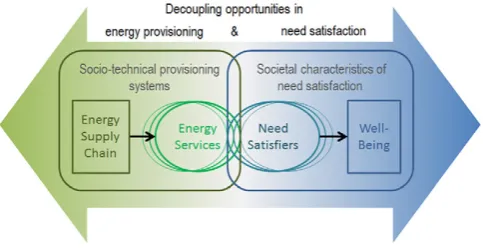
for robust (clear definitions),12empirical (quantifiable metrics)13and systemic (holistic) analysis, which enables the study of decoupling human needs from energy use: both through the open nature of need “satisfiers”(Guillén-Royo, 2016) and the large efficiency potential in en-ergy service delivery (Cullen et al., 2011). In particular, theflexible na-ture of the“satisfiers”concept (secondary capabilities inDay et al.’s (2016)framework) lends itself to holistic analysis of the factors that in-fluence the energy demand associated with the achievement of well-being, and thus the possibilities for their decoupling. Likewise, thefl ex-ibility associated with the energy services provisioning alternatives opens up additional avenues of efficiency improvements, and thus pos-sibilities for decoupling energy services demand and primary energy supply.
The abovementionedflexibility of both“satisfiers”and provisioning of ES (social and physical“provisioning systems”respectively) is the key element of this analytical framework for decoupling (seeFig. 4).Day et al. (2016)refer to these decoupling opportunities as the different areas where to intervene for energy poverty alleviation. Physical provisioning systems allow for the analysis of physical characteristics (e.g. infrastruc-ture) and the effect of different technologies (e.g. lock-in) on the specific energy service provisioning alternatives that a particular society has. In the same way, social provisioning systems allow for the analysis of so-cial and cultural aspects (e.g. everyday practices and norms), economic institutions (e.g. market logics) and socio-political institutions (e.g. the role of the State) in relation to the specific human needs“satisfiers” that a society uses. This framework also enables the analysis of the spaces where these“systemic factors”overlap.
A systemic analysis of this kind has the potential of bridging areas of research that have studied environmental and social problems in a dis-connected way. For example, theory of practices (Shove et al., 2008; Shove and Walker, 2010) and systems of provision (Bayliss et al., 2013; Fine, 2013), together with technological lock-in analysis (Unruh, 2000), can be used to explain the choice of certain“satisfiers” and energy service provisioning alternatives. More importantly, howev-er, are the decoupling alternatives that this analytic framework allows us to identify. The framework enables empirical research to go beyond
the limitations of narrow approaches such as technical energy efficiency improvements (IEA, 2008) or economic incentives (OECD, 2011; UNEP, 2011).
Indeed some of the most important decoupling opportunities are likely to be found at the community level, for example economies of scale through provision of efficient networks of energy service delivery (Knoeri et al., 2015). The existence of collective supply systems (e.g. local supply networks or public transit) may enable economies of scale, in contrast with highly individualised systems, where each house-hold has to use its own forms of energy to procure goods and services. In such cases, the description of alternatives through technologies or mar-kets only is overly simplistic, since the appropriate unit of analysis is not the single actor using the technology, but instead the community or other larger unit making the decisions which enable individuals within it to use more or less energy to satisfy their needs.
5. Connecting Energy Services and Human Needs: The Empirical Framework
In this section, we propose a mixed-methods approach to imple-ment empirically our analytical framework described above. The quan-titative and qualitative methods described below have been used in the past, but in different contexts, and not in conjunction with each other. Past studies have aimed to relate energy and HW using, for example, total primary energy supply, final energy consumption or CO2 emissions14; and life expectancy or the human development index. 12
The approaches described inSections 2 and 3are robust in terms of making a clear dis-tinction between human needs (universal) and satisfiers (culturally and historically spe-cific) on the one hand, and energy use and energy services on the other. This robustness allows to keep a clear conceptual understanding of where the decoupling opportunities might lie.
[image:7.595.134.471.56.220.2]13Given the great variability of satisfiers and ways of delivering energy services means that the empirical task offinding quantifiable metrics is a complex one, with many as-sumptions to be made along the way, which should be clearly described in any empirical applications of this framework.
Fig. 4.Analytical framework for studying the interdependency of energy and well-being.
14
[image:7.595.316.558.272.396.2]Given the current fossil fuel dependency of the global energy system, energy and CO2 emissions are closely correlated, and therefore can be considered proxies.
Fig. 3.Energy chain from primary energy to energy services. Blueflows indicate energy units, whereas ES are measured in different units. (For interpretation of the references to colour in thisfigure legend, the reader is referred to the web version of this article.)
Hence, to the best of our knowledge, the links between energy services and human needs specifically have not been analysed. We consider this analysis to be very important given the potential advantages of using these particular concepts in the context of achieving well-being within planetary boundaries, as described in the previous sections.
5.1. Quantitative Methods
A family of previous studies have focused on methods to relate ener-gy and well-being that share a macro-level and often international scope. Their approach is top-down, observing larger systems, such as countries or regions within countries, in order to estimate their perfor-mance in terms of delivering well-being outcomes (human need satis-faction) at varying levels of environmental impact or energy use (see for exampleAlam et al., 1998; Dias et al., 2006; Dietz et al., 2009, 2012; Knight and Rosa, 2011; Lamb and Rao, 2015; Martínez and Ebenhack, 2008; Pretty, 2013; Rao et al., 2014; Smil, 2003; Steinberger et al., 2012; Steinberger and Roberts, 2010). This means they take macro (country) level variables and use statistical techniques to relate energy and HW, as well asfinding a threshold level after which in-creases in the energy variable translate into only marginal (or none at all) increases in well-being. A caveat with these approaches is that they use national averages rather than distributions, and every country will have residents that use far more than they need from a sufficiency well-being perspective, as well as residents who have far too little. Nev-ertheless, these methods highlight what is currently possible, given the existence of large distributional disparities within countries.
Another family of previous studies has used methods that start bot-tom-up from a list of requirements for well-being (satisfiers) for an av-erage household, and translates these into energy requirements (see for exampleGoldemberg et al., 1985; Zhu and Pan, 2007). A more recent study is the one undertaken byRao and Baer (2012), which uses as a starting point the establishment of a bundle of minimum goods and ser-vices to achieve HW based on the“basic goods”work ofReinert (2011). The energy and carbon emissions embodied in that bundle are then es-timated, thusfinding an energy threshold or carbon entitlements.Rao and Baer (2012)propose to use Environmentally-Extended Input-Out-put data to implement this methodology, which is an established tech-nique to calculate direct and indirect household energy use (Pachauri, 2007).
Both bottom-up and top-down approaches can be adapted to study the energy service requirements of well-being within the framework shown inFig. 4. However, the emphasis should remain upon gaining a deeper understanding of social and physical provisioning systems which underpin the relations between energy use and well-being. This can be done by including parameters which are characteristics of social and physical provisioning: such as infrastructure networks and access and human settlement characteristics for physical provisioning, and government and institutional quality, welfare regimes, equity, political and cultural participation for social provisioning.
Most of the energy-for-well-being research and methods we have described above have a lineage in energy-for-economic-activity: they are generally very aggregate and quantitatively focused, with little con-sideration given to individual, household or community specificities. As we have discussed, universal human needs may rely on a large diversity of“satisfiers”in practice, and this diversity should be reflected in the type and level of energy services relied upon. Therefore, we propose to use household surveys micro-data where possible, which contains in-formation that can be used as proxies for ES and HN. This data is usually collected at the national level, but it has the potential for differentiated analysis at regional, income or other socio-demographic levels.
5.2. Qualitative Methods
In order to capture the diversity of satisfiers used by a specific socie-ty, we propose complementing the quantitative method described
above with a new qualitative approach, drawn from the Human Scale Development work of Manfred Max-Neef and his colleagues (Guillén-Royo, 2016; Max-Neef, 1991), as well as Oxfam's Humankind Index project in the United Kingdom (Dunlop et al., 2012). This ap-proach would use participatory methods (consultations, workshops, focus groups) to explore the forms that need satisfiers or well-being di-mensions take within a community.
This method must be adapted and targeted in order to pinpoint not just the specific forms of need satisfiers, but the energy services under-pinning them (especially challenging given the opaque nature of energy supply to consumers (Attari, 2010; Stern, 2014)). The energy service ap-proach may be of great assistance here, since energy services are typi-cally more meaningful to end-users than energy units themselves. The findings from the participatory research could then be translated into energy service levels and energy requirements depending on the na-tional or regional infrastructure. We anticipate this approach to be ex-tremely fruitful for the following reasons:first, it fully opens the “black box”connecting energy and human needs, since it relies on direct and in depth consultation with the people most concerned; and second, it has the potential to expose a great diversity of energy and energy ser-vice requirements of need satisfaction across different communities and social configurations. Both of these are extremely important in enabling thefindings of this research to guide policies to low-energy delivery of HW.
6. Concluding Remarks
Overcoming the pressing challenge of achieving universal human well-being within environmental limits is the motivation behind this paper. In order to do so, we propose an analytic framework that views human well-being through the lens of human needs and analyses ener-gy demand through the lens of enerener-gy services. Human needs are uni-versal social ends, which are satisfied or provisioned by culturally specific means. Their universality is important in terms of comparability between different societies, and theirflexibility (cultural specificity) provides richness for a systemic analysis of sustainable alternatives. So-cieties demand energy at different levels as a mean to satisfy their needs, and by analysing energy demand from an energy services per-spective, we open up new pathways for the exploration of efficiency im-provement alternatives, including in terms of social and physical provisioning systems.
Our conceptual approach is normative in that it seeks to identify what must be morally met (human needs), but it is not paternalis-tic in defining how they should be met (satisfiers) and by whom. Our empirical framework aims to identify alternative ways in which societies use energy to satisfy their needs and analyse them in terms of their environmental impact. This mixed-methods framework will provide insights on the cultural particularities of how different ways of delivering energy services are being used as human needs satisfiers, and on which systemic factors are influencing the choices of human needs satisfiers and energy services provisioning alternatives. Analysing the evidence in light of these systemic factors and cultural specificities would allow for the provision of much needed context-specific policy recommen-dations for the improvement of human well-being within environ-mental limits.
Funding
Acknowledgements
We thank William Lamb and Elke Pirgmaier for stimulating discus-sions around this topic, as well as Saamah Abdallah, Milena Büchs, Paul Brockway, Tim Foxon, Ian Gough and several anonymous reviewers for their critical comments.
References
Abu Sharkh, M., Gough, I., 2010. Global welfare regimes: a cluster analysis. Glob. Soc. Pol-icy 10:27–58.http://dx.doi.org/10.1177/1468018109355035.
Alam, M.S., Roychowdhury, A., Islam, K.K., Huq, A.M.Z., 1998.A revisited model for the physical quality of life (PQL) as a function of electrical energy consumption. Energy 23, 791–801.
Alkire, S., 2002. Dimensions of human development. World Dev. 30:181–205.http://dx. doi.org/10.1016/S0305-750X(01)00109-7.
Attari, S., 2010. Public perceptions of energy consumption and savings. PNAS:1–16.http:// dx.doi.org/10.1073/pnas.1001509107.
Ayres, R.U., Warr, B., 2009.The Economic Growth Engine. How Energy and Work Drive Material Prosperity. Edward Elgar, Cheltenham, UK.
Ayres, R.U., Ayres, L.W., Warr, B., 2003. Exergy, power and work in the US economy, 1900–1998. Energy 28:219–273.http://dx.doi.org/10.1016/S0360-5442(02)00089-0. Bayliss, K., Fine, B., Robertson, M., 2013.Financialisation, economy, society and sustainable
development. FESSUD Working Papers.
Beckerman, W., 2011.Economics as Applied Ethics. Value Judgements in Welfare Eco-nomics. Palgrave, London.
Brockway, P.E., Barrett, J.R., Foxon, T.J., Steinberger, J.K., 2014. Divergence of trends in US and UK aggregate exergy efficiencies 1960–2010. Environ. Sci. Technol. 48: 9874–9881.http://dx.doi.org/10.1021/es501217t.
Brockway, P.E., Steinberger, J.K., Barrett, J.R., Foxon, T.J., 2015. Understanding China's past and future energy demand: an exergy efficiency and decomposi-tion analysis. Appl. Energy 155:892–903.http://dx.doi.org/10.1016/j.apenergy. 2015.05.082.
Chakravarty, S., Chikkatur, A., de Coninck, H., Pacala, S., Socolow, R., Tavoni, M., 2009. Sharing global CO2emission reductions among one billion high emitters. Proc. Natl. Acad. Sci. U. S. A. 106:11884–11888.http://dx.doi.org/10.1073/pnas. 0905232106.
Chancel, L., Piketty, T., 2015.Carbon and Inequality: From Kyoto to Paris. Paris Sch. Econ.
Chen, G.Q., Chen, B., 2009. Extended-exergy analysis of the Chinese society. Energy 34: 1127–1144.http://dx.doi.org/10.1016/j.energy.2009.04.023.
Cook, E., 1971.Theflow of energy in an industrial society. Sci. Am. 225, 134–146.
Costanza, R., 2014. Time to leave GDP behind. Nature 505:283–285.http://dx.doi.org/10. 1038/505283a.
Cottrell, F., 1955.Energy and Society: The Relation Between Energy, Social Change, and Economic Development. McGraw Hill, New York.
Cullen, J.M., Allwood, J.M., 2010a. The efficient use of energy: tracing the globalflow of en-ergy from fuel to service. Enen-ergy Policy 38:75–81.http://dx.doi.org/10.1016/j.enpol. 2009.08.054.
Cullen, J.M., Allwood, J.M., 2010b. Theoretical efficiency limits for energy conver-sion devices. Energy 35:2059–2069.http://dx.doi.org/10.1016/j.energy.2010. 01.024.
Cullen, J.M., Allwood, J.M., Borgstein, E.H., 2011. Reducing energy demand: what are the practical limits? Environ. Sci. Technol. 45:1711–1718.http://dx.doi.org/10.1021/ es102641n.
Day, R., Walker, G., Simcock, N., 2016. Conceptualising energy use and energy poverty using a capabilities framework. Energy Policy 93:255–264.http://dx.doi.org/10. 1016/j.enpol.2016.03.019.
Deci, E.L., Ryan, R.M., 2008. Hedonia, eudaimonia, and well-being: an introduction. J. Happiness Stud. 9:1–11.http://dx.doi.org/10.1007/s10902-006-9018-1. Di Giulio, A., Fuchs, D., 2014. Sustainable consumption corridors: concept, objections, and
responses. Gaia 23:184–192.http://dx.doi.org/10.14512/gaia.23.S1.6.
Dias, R.A., Mattos, C.R., P. Balestieri, J.A., 2006. The limits of human development and the use of energy and natural resources. Energy Policy 34:1026–1031.http://dx.doi.org/ 10.1016/j.enpol.2004.09.008.
Dietz, R., O'Neill, D., 2013.Enough is Enough: Building a Sustainable Economy in a World of Finite Resources. Berrett-Koehler Publishers, San Francisco.
Dietz, T., Rosa, E.A., York, R., 2009.Environmentally efficient well-being: rethinking sus-tainability as the relationship between human well-being and environmental im-pacts. Hum. Ecol. Rev. 16, 114–123.
Dietz, T., Rosa, E.A., York, R., 2012. Environmentally efficient well-being: is there a Kuznets curve? Appl. Geogr. 32:21–28.http://dx.doi.org/10.1016/j.apgeog. 2010.10.011.
Dincer, I., 2002. The role of exergy in energy policy making. Energy Policy 30:137–149.
http://dx.doi.org/10.1016/S0301-4215(01)00079-9.
Dodds, S., 1997. Towards a“science of sustainability”: improving the way ecological eco-nomics understands human well-being. Ecol. Econ. 23:95–111.http://dx.doi.org/10. 1016/S0921-8009(97)00047-5.
Dolan, P., Peasgood, T., White, M., 2006.Review of Research on the Influences on Personal Well-being and Application to Policy Making.
Doyal, L., Gough, I., 1991.A Theory of Human Need. The Macmillan Press, London.
Dunlop, S., Swales, K., Trebeck, K., 2012.The Oxfam Humankind Index for Scotland: First Results.
Easterlin, R.A., 1974.Does Economic Growth Improve the Human Lot? Some Empirical Evidence. Nations Households Econ. Growth.
Easterlin, R.A., 2001. Income and happiness: towards a unified theory. Econ. J. 111: 465–484.http://dx.doi.org/10.2307/2667943.
EIA, 2014.2014 Annual Energy Outlook.
Ertesvag, I.S., 2005. Energy, exergy, and extended-exergy analysis of the Norwegian society 2000. Energy 30:649–675.http://dx.doi.org/10.1016/j.energy.2004.05.025. Fine, B., 2013.Why consumption matters. Ephemera 13, 217–248.
Fineman, M.A., 2008. The vulnerable subject: anchoring equality in the human condition. Yale J. Law Fem. 20:1–23.http://dx.doi.org/10.4324/9780203848531.
Fouquet, R., 2014. Long-run demand for energy services: income and price elasticities over two hundred years. Rev. Environ. Econ. Policy 8:186–207.http://dx.doi.org/10. 1093/reep/reu002.
Fouquet, R., Pearson, P.J.G.G., 2006. Seven centuries of energy services: the price and use of light in the United Kingdom (1300−2000). Energy J. 27:139–177.http://dx.doi. org/10.5547/ISSN0195-6574-EJ-Vol27-No1-8.
Gaggioli, R.A., Wepfer, W.J., 1980. Exergy economics. Energy 5:823–837.http://dx.doi.org/ 10.1016/0360-5442(80)90099-7.
Goldemberg, J., Johansson, T.B., Reddy, A.K.N., Williams, R.H., 1985.Basic needs and much more with one kilowatt per capita. Ambio 14, 190–200.
Gough, I., 1994.Economic institutions and the satisfaction of human-needs. J. Econ. Issues 28, 25–66.
Gough, I., 2015. Climate change and sustainable welfare: the centrality of human needs. Camb. J. Econ. 39.http://dx.doi.org/10.1093/cje/bev039.
Grubler, A., Johansson, T.B., Mundaca, L., Nakicenovic, N., Pachauri, S., Riahi, K., Rogner, H.-H., Strupeit, L., 2012.Energy primer. Global Energy Assessment - Toward a Sustain-able Future. Cambridge University Press and International Institute for Applied Sys-tems Analysis, Cambridge, UK; New York, NY, USA and Laxenburg, Austria, pp. 99–150.
Guillén-Royo, M., 2016.Sustainability and Wellbeing: Human-scale Development in Prac-tice. Routledge, London and New York.
Haas, R., Nakićenović, N., Ajanovic, A., Faber, T., Kranzl, L., Müller, A., Resch, G., 2008. To-wards sustainability of energy systems: a primer on how to apply the concept of en-ergy services to identify necessary trends and policies. Enen-ergy Policy 36:4012–4021.
http://dx.doi.org/10.1016/j.enpol.2008.06.028.
Haberl, H., 2001. The energetic metabolism of societies part I: accounting concepts. J. Ind. Ecol. 5:11–33.http://dx.doi.org/10.1162/108819801753358481.
Haberl, H., Erb, K.H., Krausmann, F., Bondeau, A., Lauk, C., Müller, C., Plutzar, C., Steinberger, J.K., 2011. Global bioenergy potentials from agricultural land in 2050: sensitivity to climate change, diets and yields. Biomass Bioenergy 35:4753–4769.
http://dx.doi.org/10.1016/j.biombioe.2011.04.035.
Hamilton, C., 2013.Earthmasters: The Dawn of the Age of Climate Engineering. Yale Uni-versity Press, New Haven and London.
Helliwell, J., Layard, R., Sachs, J., 2016.World Happiness Report.
IEA, 2005. Energy Statistics Manual. (Paris). http://dx.doi.org/10.1787/9789264033986-en.
IEA, 2008.Energy Technology Perspectives.
IEA, 2012a.CO2Emissions From Fuel Combustion. Highlights.
IEA, 2012b.World Energy Outlook.
IPCC, 2013.Summary for policymakers. In: Stocker, T.F., Qin, D., Plattner, G.-K., Tignor, M., Allen, S.K., Boschung, J., Nauels, A., Xia, Y., Bex, V., Midgley, P.M. (Eds.), Climate Change 2013: The Physical Science Basis. Contribution of Working Group I to the Fifth Assessment Report of the Intergovernmental Panel on Climate Change. Cam-bridge University Press, CamCam-bridge, United Kingdom and New York, NY, USA, pp. 3–29.
Jakob, M., Steckel, J.C., 2014. How climate change mitigation could harm development in poor countries. Wiley Interdiscip. Rev. Clim. Chang. 5:161–168.http://dx.doi.org/10. 1002/wcc.260.
Jochem, E., Adegbulugbe, A., Aebischer, B., Bhattacharjee, S., Gritsevich, I., Jannuzzi, G., Jaszay, T., Saha, B.B., Worrell, E., Fengqi, Z., 2000.Energy end-use efficiency. World Energy Assessment: Energy and the Challenge of Sustainability. New York, pp. 173–217.
Kahneman, D., Sugden, R., 2005. Experienced utility as a standard of policy evaluation. En-viron. Resour. Econ. 32:161–181.http://dx.doi.org/10.1007/s10640-005-6032-4. Kahneman, D., Wakker, P.P., Sarin, R., 1997. Back to Bentham? Explorations of
experi-enced utility. Q. J. Econ. 112:375–405.http://dx.doi.org/10.1162/003355397555235. Kamenetsky, M., 1992.Human needs and aspirations. Real-Life Economics:
Understand-ing Wealth Creation. Routledge, London and New York, p. 460.
Kanoglu, M., Cengel, Y.A., Dincer, I., 2012.Efficiency Evaluation of Energy Systems. Spring-er, London.
Karekezi, S., McDade, S., Boardman, B., Kimani, J., 2012.Energy, poverty, and develop-ment. Global Energy Assessment - Towards a Sustainable Future. Cambridge Univer-sity Press and International Institute for Applied Systems Analysis, Cambridge, UK; New York, NY, USA and Laxenburg, Austria, pp. 151–190.
Kaygusuz, K., 2011. Energy services and energy poverty for sustainable rural develop-ment. Renew. Sust. Energ. Rev. 15:936–947.http://dx.doi.org/10.1016/j.rser.2010. 11.003.
Kaygusuz, K., 2012. Energy for sustainable development: a case of developing countries. Renew. Sust. Energ. Rev. 16:1116–1126.http://dx.doi.org/10.1016/j.rser.2011.11.013. Knight, K.W., Rosa, E.A., 2011. The environmental efficiency of well-being: a cross-national analysis. Soc. Sci. Res. 40:931–949.http://dx.doi.org/10.1016/j.ssresearch.2010.11.002. Knoeri, C., Steinberger, J.K., Roelich, K., 2015. End-user centred infrastructure operation: towards integrated infrastructure service delivery. J. Clean. Prod. 1–20.http://dx. doi.org/10.1016/j.jclepro.2015.08.079.
Kostic, M.M., 2012. Energy: physics. Encycl. Energy Eng. Technol. 2:pp. 808–823.http:// dx.doi.org/10.1201/9780849338960.ch135.