ISSN 2286-4822 www.euacademic.org
Impact Factor: 3.4546 (UIF) DRJI Value: 5.9 (B+)
Implementation of the “Information Management
System” in Education, in the Municipality of
Gjakova
Prof. Ass. Dr. JUSUF QARKAXHIJA AAB College Yll Morina, Gjakovë Kosovo
Abstract:
The collection and data listing into the data system positively affects the quality of data, not only in a single school but in the whole educational institutions such as: schools, Directorate for Education, Regional inspectorate for Education, up to the Ministry of Education, Science and Technology.
As of nowadays all the schools in the Republic of Kosovo are obligated to collect, process and input data into the system. The data can be read by the municipality directorates and the Ministry of Education (which then uses the data and draws comparisons between different schools).
The introduction of all data in the system by school administrators, is divided into periods of time for the school year and this helps the school’s plan to improve the quality in different fields, such as school budget, school spacial planning and its future.
This research aims to fully understand the systematic work done by the administrators in order to strengthen the paternity between the schools and the Directorate for Education. This can be done best by decent planning by the Directorate for Education for advanced technology equipment and quality internet extensions as a prerequisite for boosting job motivation.
1. INTRODUCTION
The following topic has great importance in the educational process in schools. Before the development of informative technology in schools or educational institutions, data has been processed in the classic way, in writing, or in various forms, where they faced difficulties in equalizations and comparison of results among institutions, and difficulties in sending the data to higher institutions, which means that this process took days (Zeneli 2013). Then logarithmic calculators were used to help get the results, which were supposed to be drawn out of the educational process, especially during the end of school semesters. For the study of this topic we used the data collected in forms, which have been conducted with the administrators, primary, middle and high school directors all over the Municipality of Gjakova. As a first step into the implementation of the data system (IMSE) in the Municipality of Gjakova, we invited the schools directors in an official meeting to be notified that the implementation of collecting, processing and inputing data will begin at the beginning of the school year 2011/12. Firstly, to begin implementing this system, trainings of administrators and directors of all the schools in the Municipality have been conducted by trainers from the Ministry of Education. IMSE program has been improved during years, by adding new modules, which has resulted in the need of trainings and capacity building programs for schools administrators to adapt new materials for this system of data.
2. THE PREVIOUS INFORMATIVE SYSTEM OF EDUCATION
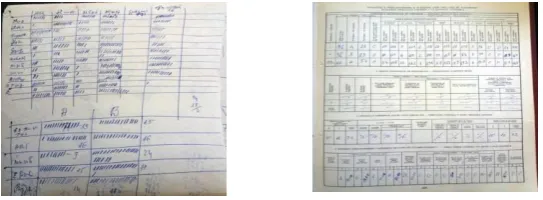
in the first place, and then to process it and get to a quick and correct result. There were simple and not a lot of tools and materials used to manage data before the development of advanced technology, for example: verbal data, written data in various kinds, various forms etc.
The interesting thing is that the important data was delivered to higher institutions through reports in classic forms (envelopes, hand-to-hand delivery) (Potera and Heil 2012). This form of delivering data was not safe, it cost a lot and it spent the energy of a lot of administrators. Taken out of the archives of a middle school.
Figure 1. The previous way of collecting data
3. THE BEGINNINGS OF IMSE
IMSE is an acronym for “Information Management System in Education”. This is a system used to organize basic information in a systematic way to manage and develop education (Lucey 2005). IMSE is an information center for the Ministry of Education, Science and Technology (MEST), which is resposnible for the collection, processing, analyzing, publication, sharing of the information for all educational institutions: preschool, primary, elementary, middle school etc. of the Republic of Kosovo.
Figure 2. The main window to log in to IMSE system
To log in to the program, you have to type the username and password in the bars provided by the supervisors of IMSE.
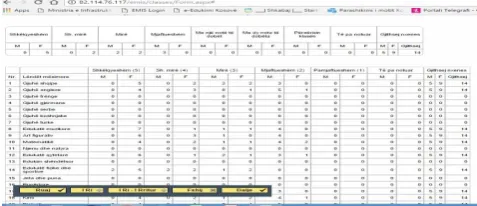
Figure 3. The window that displays the modules
One type of the data which can be extracted from where is seen in the figure below.
4. RESEARCH
The methodology of the research focuses in creating a query for the interview, which was directly conducted with the administrators. The research took place in 48 educational institutions of the Municipality of Gjakova: in one (1) preschool institution, forty one (41) elementary, middle schools and six (6) high schools of the Municipality. After the interviews, the queries were collected, processed, analyzed and then results were derived, which were presented using charts and tables. After each result was presented as a chart or a table, the findings were described in words.
The first question asked how well they could use a computer, and out of 48 answers from the queries, 7 of them or 14.5% answered that they knew little about using a computer, none answered that they did not how to use it at all and 41 of them or 85.5% answered that they could use a computer well.
HOW WELL CAN YOU USE A COMPUTER NUMBER OF
SCHOOLS PERCENTAGE
A little 7 14.5 %
Not at all 0 0 %
Well 41 85.5 %
TOTAL 48 100%
Table 1. How well can you use a computer?
The second question asked if they were skilled, trained to use the data system/IMSE, out of the 48 answers, 34 of them or 71% answered that they had been trained and skilled to use this system, 2 of them or 4% answered that they were not trained at all, and 12 of them or 25 % answered that the previous administrators conducted trainings.
Table 2. Are you skilled, trained to use the data system/IMSE? ARE YOU SKILLED OR TRAINED TO USE THE DATA
SYSTEM IMSE
NUMBER OF
SCHOOLS PERCENTAGE
Yes I am skilled, trained to use this system 34 71 %
I have not been trained at all 2 4 %
Previous administrators conducted trainings 12 25 %
The third questions asked if there is a technological environment to input the data into the system, and out of 48 answers from the queries, 24 of them or 50% answered that they had a computer and internet access, 19 of them or 40% answered that they had a computer but a slow internet connection, 5 of them or 10 % answered that they had an old computer, and 0% answered that there is no computer and no internet, and they input data at home.
Table 3. Is there a technological environment to input the data into the system?
The fourth questions asked if it is easy to access this system as an administrator of it, and out of 48 answers from the queries, 0% answered that it was difficult to access, 16 of them or 35% answered that they could access it but it is not that easy, 32 of them or 65% answered that it is easy to access it.
Table 4. Is it easy to access this system as an administrator of it?
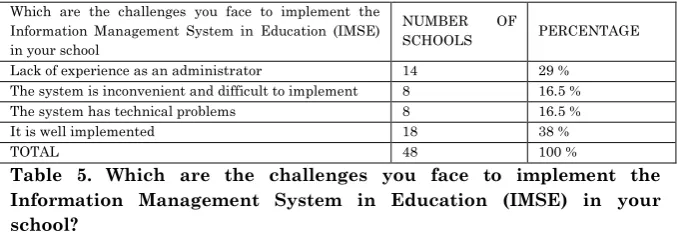
The fifth questions asked which are the challenges you face to implement the Information Management System in Education (IMSE) in your school, and out of 48 answers from the queries, 14 of them or 29% answered that they lack experience as an administrator, 8 or 16.5% answered that the system is inconvenient and difficult to implement, 8 of them or 16.5% IS THERE A TECHNOLOGICAL ENVIRONMENT TO INPUT
THE DATA INTO THE SYSTEM
NUMBER OF SCHOOLS
PERCENTAGE
Yes we have a computer and internet access 24 50 %
We have a computer but a slow internet connection 19 40 %
We have an old computer 5 10 %
We have no computer and no internet, and we input data at home 0 0%
TOTAL 48 100%
IS IT EASY TO ACCESS THIS SYSTEM AS AN ADMINISTRATOR OF IT
NUMBER OF
SCHOOLS PERCENTAGE
It is difficult to access this system 0 0%
I can access it but it is not that easy 16 35%
It is easy to access it 32 65%
answered that the system has technical problems, while 18 of them or 38% answered that it is well implemented.
Which are the challenges you face to implement the Information Management System in Education (IMSE) in your school
NUMBER OF
SCHOOLS PERCENTAGE
Lack of experience as an administrator 14 29 %
The system is inconvenient and difficult to implement 8 16.5 %
The system has technical problems 8 16.5 %
It is well implemented 18 38 %
TOTAL 48 100 %
Table 5. Which are the challenges you face to implement the Information Management System in Education (IMSE) in your school?
The sixth question asked if the system needed changes and why, and out of 48 answers, 17 of them or 35% answered that changes must be made in order to facilitate the way of working, 0% answered that changes are not needed, 11 of them or 24% answered that the deadlines to input data should be prolonged, 3 of them or 6% answered that the input of data should be simplified, 0% answered that the input of data should be done in less than four periods than they are now, while 17 or 35% answered that students should be registered with names, surnames and other notes.
DOES THIS SYSTEM NEED CHANGES AND WHY NUMBER OF
SCHOOLS
PERCENTAG E
Changes must be made in order to facilitate the way of working 17 35 %
No changes are needed 0 0%
The deadlines to input data should be prolonged 11 24 %
The input of data should be simplified 3 6 %
The input of data should be done in less than four periods than
they are now 0 0 %
Students should be registered with names, surnames and other
notes 17 35 %
TOTAL 48 100 %
Table 6. Does this system need changes and why?
is active, 33 of them or 69% answered that they do so within the deadline, 0% answered that it depends on when they collect the data from Head Teachers of the classes, and 0% answered that sometimes we do not do it, and the system is deactivated.
Table 7. Is the input of data done according to the specified timelines?
The eighth question asked what kind of data could be derived from this system of data, and out of 48 answers from the queries, 24 of them or 50 % answered that they derive various reports on students’ successes (according to age, gender, etc.), 0 % answered that they do not derive any reports on the teaching staff, 24 of them or 50 % answered that they do not derive any reports at all from this system.
WHAT KIND OF DATA CAN BE DERIVED FROM THIS SYSTEM OF DATA
NUMBER OF
SCHOOLS PERCENTAGE
Various reports on students’ successes (according to age,
gender, etc.) 24 50 %
Reports on the teaching staff 0 0%
No reports at all 24 50 %
TOTAL 48 100 %
Table 8. What kind of data can be derived from this system of data?
The ninth question asked about the level of satisfaction with the system, out of 48 answers from the queries, 0% answered not satisfied at all, 32 of them or 65% answered somewhat satisfied and 16 of them or 35% answered very satisfied.
Is the input of data done according to the specified timelines NUMBER OF
SCHOOLS PERCENTAGE
Yes, as soon as the system is active 15 31 %
Yes, within the deadline 33 69 %
It depends on when we collect data from Head Teachers 0 0 %
Sometimes we do not do it and the system is deactivated. 0 0 %
Table 9. How satisfied are you with the IMSE system?
The tenth question asked if they faced difficulties or problems with the system, where do they seek help, out of 48 answers from the queries, 5 of them or 9.5% answered that they seek help from officials at the Directorate of Education, 22 of them or 46% answered that they email officials from MEST, 7 of them or 14.5% answered from the manual for IMSE system, 14 of them or 30% answered from colleagues from other schools in the Municipality which have more knowledge or experience.
IF YOU HAVE DIFFICULTIES OR PROBLEMS WITH IMSE, WHERE DO YOU SEEK HELP
NUMBER OF
SCHOOLS PERCENTAGE
Officials at the Directorate of Education 5 9.5 %
Emails to officials from MEST 22 46 %
Manuals for the IMSE system 7 14.5 %
Colleagues from other schools in the Municipality which have
more knowledge or experience 14 30 %
TOTAL 48 100%
Table 10. If you have difficulties or problems with IMSE where do you seek help?
The eleventh question asked if they should get materially rewarded to input data into the system, out of 48 answers from the queries, 24 of them or 50% answered that they should get materially rewarded because it takes a lot of time, 12 of them or 25% answered they should get somehow rewarded because it motivates them, 12 of them or 25% answered that they should not get rewarded because it takes a little time to input the data into the system.
HOW SATISFIED ARE YOU WITH THE IMSE SYSTEM NUMBER OF
SCHOOLS PERCENTAGE
Not satisfied at all 0 0 %
Somewhat satisfied 32 65 %
Very satisfied 16 35 %
Should you get materially rewarded to input data into the system?
NUMBER OF
SCHOOLS
PERCENTAG E
Yes, we should because it takes a lot of time 24 50 %
We should get rewarded because it is motivating 12 25 %
No, because it takes a little time to do it 12 25 %
TOTAL 48 100%
Table 11. Should you get materially rewarded to input data into the system?
5.CONCLUSION
The application of Information Technology in various departments, and in this case the department of education, necessarily brings a lot of advantages that affect the speed of processing information and gaining a lot of information (Kume 2010). However, the ones using Information Technology in schools, should be prepared to apply I because the IMSE program requires it. The results of the research show that:
Most of the administrators in schools (85%) can use computers and they have been trained (71%) to work with IMSE program. This informs us that those who work with the system have been prepared and are aware of the requests that the system has, because they input the data within the given deadlines.
Most of the schools have computers and internet access (although the internet connection is slow for some of them) which enable them to use the system without any problem. According to this, we can conclude that the next investment phase in schools should focus on fast internet or broadband Internet (Colouris et al.2012) Data input in the system can be done four times a year, so
considering that various information is requested continuously then its activation four times a year is a weakness, which should be taken care of urgently.
education, exchanging emails with corresponding officials at MEST, etc.
Most of the administrators require material reward because they consider inputing and extracting data time-consuming.
IMSE program is the one required for the existing educational system in Kosovo, but this system should be expanded by registering all the data of students in Kosovo, which requires a lot of work from the system administrators, and which is directly related to work motivation. Thus, this requires extra financing from the Ministry of Education in Kosovo.
REFERENCES
1. Barry, C et al. (2009) Information System Development, Boise State University, New York 2009
2. Colouris, G et al (2012) Distributed Systems Pearson, Boston 2012
3. Doracaku_EMIS_ON-LINE_ALB (2017) ( http://masht-smia.net/Doracaku_EMIS_ON-LINE_ALB.pdf) Accessed 01 August 2017
4. Heil, N and Potera, I Përdorimi i të dhënave në udhëheqjen arsimore, MASHT - GIZ / CDBE, 2012 (http://www.cdbe.info/wp-content/uploads/2015/06/2012-EMIS-Use-of-Data-in-Education-Leadership-ALB.pdf) Accessed 01 August 2017
5. Kume, V (2010) Marrja e Vendimeve Manaxheriale, Pegi, Tiranë, 2010
6. Lucey, T (2004) Management information Systems Tmomson Learning, London2004