Effective Approximations for Multi-Robot Coordination in
Spatially Distributed Tasks
∗Daniel Claes
University of Liverpool
[email protected]
Philipp Robbel
Massachusetts Institute of Technology
[email protected]
Frans A. Oliehoek
University of Amsterdam University of Liverpool
[email protected]
Karl Tuyls
University of Liverpool
[email protected]
Daniel Hennes
European Space Agency, ESTEC
[email protected]
Wiebe van der Hoek
University of Liverpool
[email protected]
ABSTRACT
Although multi-robot systems have received substantial re-search attention in recent years, multi-robot coordination still remains a difficult task. Especially, when dealing with spatially distributed tasks and many robots, central control quickly becomes infeasible due to the exponential explosion in the number of joint actions and states. We propose a gen-eral algorithm that allows for distributed control, that over-comes the exponential growth in the number of joint actions by aggregating the effect of other agents in the system into a probabilistic model, calledsubjective approximations, and then choosing the best response. We show for a multi-robot grid world how the algorithm can be implemented in the well studied Multiagent Markov Decision Process framework, as a sub-class called spatial task allocation problems (SPAT-APs). In this framework, we show how to tackle SPATAPs using online, distributed planning by combining subjective agent approximations with restriction of attention to current tasks in the world. An empirical evaluation shows that the combination of both strategies allows to scale to very large problems, while providing near-optimal solutions.
Categories and Subject Descriptors
I.2.9 [Artificial Intelligence]: RoboticsGeneral Terms
Algorithms; Experimentation
Keywords
Robotics; Robot Planning and Plan execution; Robot Teams; Multi-Robot Systems; Robot Coordination
1.
INTRODUCTION
Although multi-robot systems are becoming more com-mon in real world applications, in many cases, control still has a centralized component, e.g. approaches using central-ized planning or a single auctioneer for task allocation [5, 34]. These robots have limited autonomy and rely on the central control component of the system for planning pur-poses. Such approaches have two major limitations, namely
∗This paper also appears at AAMAS 2015.
Appears in:The 10th Annual Workshop on Multiagent Se-quential Decision-Making Under Uncertainty(MSDM-2015), held in conjunction withAAMAS, May 2015, Istanbul, Turkey.
robustness and scalability. If a centralized planning algo-rithm fails, for example, the whole system is affected and becomes unavailable. Second, for each additional robot to be added, the joint action and state spaces increase expo-nentially, rendering it infeasible for any central algorithm to solve larger problems optimally in general.
Trying to overcome these issues by decentralized solutions introduces an important challenge in autonomous coordina-tion of the multiple robots in the system. There are different approaches to tackle this problem, for instance swarm ap-proaches inspired by nature [22, 2, 8], or others based on decentralized auctions [9, 3, 23], in which each robot bids for tasks and task assignment ultimately follows from the winning bid values. The swarm approaches are generally reactive approaches that lack the possibility to plan ahead (e.g., when tasks may appear stochastically in the environ-ment) and the auctioning approaches rely heavily on reliable communication during the bidding phase. Furthermore, af-ter the tasks are auctioned off, agent policies are fixed and remain unchanged until the next bidding phase.
In order to avoid these issues we develop a generic algo-rithm that applies to various instances of the coordination problem. We build on the idea from mean field game the-ory [17] that for many tasks it may be sufficient to reason about the aggregate effect of the other agents. This idea has been proven to be useful in particular instances of off-line planning for large agent teams, such as congestion-like games and resource-coupled multiagent planning [16, 32, 1]. In this paper, we demonstrate that these ideas also bring great improvements in effectiveness in a very general class of online multi-robot planning problems. The key idea is to aggregate the effect of other robots in the area by using their locations as a proxy to predict their future actions and then choosing the best response. Using this principle, a robot does not need to reason about every other individual robot but only needs to know in general which tasks are likely ser-viced by another robot, in order to reduce the complexity of its own planning. Because planning is done online and at every time step, the algorithm is flexible in responding to changes in the environment. This also implies that com-munication between robots is strictly not required, however, the robots do need to be able to observe the current state (i.e., locations of the other robots), which can be enabled through (local) communication.
(MMDPs) [7] that we collectively refer to as Spatial Task Allocation Problems (SPATAPs), and develop our algorithm as a number of online planning approximations that are tai-lored to exploit the characteristics of these problems. In par-ticular, we investigate the general algorithm for settings with
negative interactions in which each task can be serviced by a single agent. In such tasks, it makes sense to discount the reward for tasks that are likely attended to by other agents. Such approximateempathicreasoning was recently exploited in the context of multi-robot exploration [24] by making use of a modification of distributed value functions [27] (hence-forth referred to as ‘MDVF’). We introduce a simplification of this algorithm, empathy by fixed weight discounting (E-FWD), that applies to all SPATAPs with negative interac-tions.
While these subjective approximations bring improvements in planning efficiency, they are not sufficient to make the planning problem tractable. Another crucial contribution of our approach is therefore the combination of the algo-rithm with another approximation method, called Phase-Approximation, that forms the basis of an approximate on-line planning technique without any exponential dependence on the number of agents or the number of state factors.
An empirical evaluation shows that these combined tech-niques yield near-optimal solutions in cases in which the optimum can be calculated and is highly scalable, while out-performing the state-of-the-art.
2.
PROBLEM DESCRIPTION & APPROACH
We consider a problem class that we refer to as spatial task allocation problems (SPATAPs). In particular, SPATAPs describe settings in which a team of agents needs to service a set of tasks that are spatially distributed in an environment. Each task can be performed by one or more agents, and new tasks can appear in the world due to exogenous events outside of the agents’ control.
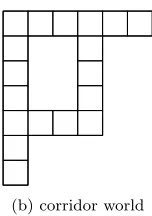
As a running example we consider a cleaning task in for instance an office building. Dirt can appear at any location at any given time in this world, since a human can spill coffee, or leave paper on the floor, etc. A team of cleaning robots, in this case the agents, has the task to continuously keep the building clean. There is no central control of any sort, but the robots can observe the location of other robots, e.g. by using overhead cameras or communication. We will assume that the office building can be represented using a grid world, where each tile corresponds to a part of a room of a fixed size, but other representations (such as a more abstract graph) are also possible. The grid worlds can have arbitrary shape, see Figure 1 for examples that we consider in this paper.
The main problem is how the agents should plan their be-havior in order to ensure that all tasks are serviced, i.e., in this case, that all dirt is continuously cleaned while mini-mizing interference between robots. Since there are nearly no restrictions on the sort of tasks, SPATAPs provide a very powerful and general model which are very hard to solve op-timally. This is due to the fact that the joint action and state spaces increase exponentially with the number of agents in the system.
In fact, only a few methods can deal with such large prob-lems. One approach that offers the required scalability is the ‘partition organization’ [29]. In this approach, the prob-lem is partitioned in (overlapping) regions and each agent
Algorithm 1Aggregated best response Require: D−i: set of other Agents
Require: h: planning horizon (timesteps) forall agentsjinD−i do
compute policyπSAforj
fort= 1 tohdo
compute probability distributionptj followingπSA
end for end for
fort= 1 tohdo //aggregate:
pm=P
j6=ip t j
end for
compute best response of agentigivenpm
is assigned to one region. This approach is well suited for problems in which there is a straightforward partitioning, such as symmetric worlds. However this is not always pos-sible, especially when the task appearance probabilities are not evenly distributed over the world or when specific tasks can only be served by particular agents.
Another common approach, which we will treat in some more detail in Sec. 4.1.1 under the name self-absorbed ap-proximation, is to ignore the presence of other agents during planning and to consider them as mere noise to each individ-ual planning model. In the case of task allocation problems, however, such approximations lead to poor performance (as supported by our empirical evaluation), since the difficulty in this type of problems revolves around the coordination of which agent addresses which task.
We propose to exploit the key characteristics of SPATAPs— independence of agent movement and the locality of tasks— for efficient approximations during online planning. The key idea is that an agent does not need to reason about all other agents individually, but can reason about their aggre-gated effect. In particular, if another agent is close to a task location, we can reason that this task will be serviced with a certain probability at some future time step. If we as-sume a reasonable policy for the other agents we can predict the probabilistic movements for all agents over the planning horizon and use the aggregated presence mass (pm) as a sufficient statistic for calculating our best response.
Algorithm 1 summarizes the idea described above. For all other agents, we fix a policyπand, for the time span of our planning horizon, predict their movements as following
π. By doing this we obtain a probability distribution of the agents’ location for all time steps. These probability distributions can be aggregated and used by each individual agent to calculate a best response.
In the next section, we show that SPATAPs can be di-rectly modeled as MMDPs, and explain why this is not of immediate help since the complexity of solving the prob-lems with standard MMDP methods remains prohibitively high. Section 4 presents a remedy by introducing online ap-proximate methods that exploit the key characteristics of SPATAPs.
3.
SPATAPS FORMULATED AS MMDPS
(a) diamond world (b) corridor world (c) office world
Figure 1: Three possible SPATAP environments.
moving in the world may each fail with some probability, e.g., due to wheel slip), and new tasks can appear due to unforeseen exogenous events (e.g., a human spilling some dirt). Therefore, SPATAPs can be seen as a special case of MMDPs, which we will introduce next.
3.1
Multiagent MDPs
Markov decision processes (MDPs) provide a general frame-work for sequential decision making under uncertainty [26]. The Multiagent MDP (MMDP) is the straight-forward ex-tension to the case of multiple decision makers who observe the full state of the environment:
Definition 1. A Multiagent Markov decision process (MMDP) is defined as a tuple hD,S,A,P,Ri, where D =
{1, . . . ,n}is the set ofnagents,S a finite set of statessof the environment,A=A1× · · · × Anthe set of joint actions a=ha1, . . . ,ani,T the transition probability function
spec-ifyingP(s0|s,a), andR(s,a) the immediate reward function. An MMDP is calledfactored if its state space is spanned by a set of state variables. Note that an MMDP is sig-nificantly different from a Dec-MDP [6], since agents in an MMDP, per definition, can observe the (global) state. A (joint) policyπ:S → Ain an MMDP maps statessto joint actionsa, and is equivalent to a tuple of individual policies
πi : S → Ai. The Q-value of (s,a) under policy π is
de-fined as the expected sum of rewards when executingains
and followingπ afterwards. In this paper we will consider (undiscounted)h-stage look-ahead planning, i.e., construct-ing a plan that specifies actions from ‘now’,t= 0,to stage
t=h−1. For this setting, the value function for each stage
tequalsVt(s) = max
aQt(s,a), where Qt(s,a) =R(s,a) +X
s0
Pr(s0|s,a)Vt+1(s0). (1)
The optimal policyπ∗and corresponding optimal value func-tions Qt, maximize the expected reward for every (s,a).
Solving MMDPs can be done in a similar fashion as (single-agent) MDPs [26]. However, since the number of joint ac-tions is exponential in the number of agents and the number of states is exponential in the number of factors (itself usu-ally dependent on the number of agents), this is intractable for even small problems in practice.
3.2
SPATAPs
SPATAPs can be defined as a sub-class of MMDPs with some additional structure. Underlying a SPATAP is a map that specifies the potential task locationsLand that defines
AM, the set of movement actions. E.g., for the “dirt
clean-ing” example, all agents are homogeneous and share a com-mon (movement) action spaceAM ={N, E, S, W, STAY}.
There further exists a task structure, defined by a set of task types T =
T0,T1, . . . ,T|T | . Each typeTk has an
as-sociated set of task states Tk that indicate the status of
the task. In our running example, T1 could have states
T1 = {very dirty, dirty, nearly clean}. T0 refers to a
spe-cial type indicating there is no task and only has one state T0={CLEAR}. We useT=SkTkto denote the set of all
task states. Each task typeTkmay optionally be associated
with one (or more) particular action aTk to perform that task. Each agentican perform movement and task actions. The agent team can be homogeneous, i.e., have the same capabilities, but the framework also allows agents that have different capabilities, or differences in how effective an agent is at a particular task.1
These SPATAP-specific components can now be used to define the induced MMDP. Agents and their actions are un-changed. A state is a tuples=hλ,τi, whereλis the vector of locations (λidenotes the location of agenti), andτis the
task status vector (τxdenotes the task status at locationx).
The transition function can be factored as
P(λ0,τ0|λ,τ,a) = Y
x∈L pTx(τ
0 x|τx,λ,a)
Y
i∈D pMi (λ
0
i|λi,ai) (2)
wherepT are task transition probabilities andpM are agent movement probabilities.2 The task transition probabilities
pT are assumed to be conditionally independent given the
locations and actions of the agents and encode the proba-bility of progressing toward finishing the tasks, as well as exogenous events that spawn new tasks.
The reward function is additively factored and is the sum of task rewardsRT and movement costsRM:
R(s,a) =X
x∈L
RTx(τx,λ,a) +
X
i∈D
RiM(λi,ai). (3)
As the name ‘movement cost’ implies, the functionsRM i will
typically specify negative rewards. For the task reward func-tions, it is also natural to specify a cost for every stage that the task is not completed (consider the robot rescue set-ting where victims require attention as quickly as possible). More options are possible, e.g., a business may want to use as the reward function the actual amount of money a par-ticular assignment will generate. Note that the model also supports rewards that depend on the next state by taking
1The approximation method we introduce in Sec. 4.1, does
assume homogeneous agents, but the approach can be ex-tended to heterogeneous teams by applying the same tech-nique to each ‘type’ of agent.
2Movements are independent, effectively assuming that
the expectation over next states. E.g.,
RTx(τx,λ,a) =
X
τ0 x
Pr(τx0|τx,λ,a)RTx(τx,λ,a,τ 0
x). (4)
3.3
Locality Assumptions
While the above lays out the general form of SPATAPs, such problems are, in general still very difficult since the termspTx andRxTare non-local, i.e., they depend on all the
agents, including those that are far away from locationx. In order to gain more traction on the problem, we will assume that a task at a particular locationxwill only be influenced by a subset of agents. This subset we call thelocality scope
L(x,τx,λ,a) and it depends on the locationx, the task type
and state encoded byτx, andλ,a. For instance, in our
ex-ample L(x,τx,λ,a) for a dirty location x will only contain
those agents atxthat perform the ‘clean’ action. In the re-mainder of this paper, we will simply writeaLfor the action profile of agents in the locality scope. As such, we will con-sider task transitions of the formpTx(τ
0
x|τx,λL,aL).Similarly, we will assume that the task rewards can be expressed as
RTx(τx,λL,aL).
Each SPATAPs is an MMDP, so MMDP solution methods apply. Unfortunately, both the number of states and joint actions are very large for these problems (see Table 1). As a result, even state-of-the-art MDP solvers that exploit fac-tored structure [19] have problems with the smallest SPAT-APs. One would hope that the special structure of SPATAPs may make them easier to solve but, unfortunately, this is not the case in general:
Theorem 1. Optimally solving SPATAPs is as hard as
solving MMDPs; i.e., SPATAPs are ‘MMDP-hard’.
Proof. We reduce from the problem of solving an MMDP by creating a SPATAP with a single location and a sin-gle task. The task states correspond to the states of the MMDP and similarly can we derive pTx and RTx from the
transitions and reward of the MMDP. The optimal solution of this SPATAP is the optimal solution of the MMDP.
This theorem illustrates that while the concept of tasks is very general and powerful, this comes at a worst-case com-putational cost. Nevertheless, SPATAPs offer ample oppor-tunities to exploit their specific characteristics. In particu-lar, in the following sections, we propose two types of ap-proximation techniques that each directly exploit problem structure.
4.
ONLINE APPROXIMATIONS
We introduce two orthogonal approximation approaches for online planning for SPATAPs, that increase efficiency by exploiting two characteristics of real-world SPATAPs.
First, SPATAPs exhibit independence of movement and locality of task transitions and rewards, which implies that agents in many cases can act relatively independently of each other. To exploit this property, we consider subjec-tive approximations that reduce the complexity introduced by the large number of agents. In particular, we propose a novel ‘empathic’ subjective approximation method that combines the computational benefits of subjective approxi-mations with an approximate reasoning over the team mem-bers as introduced in Algorithm 1.
Second, for SPATAPs that exhibit only infrequent appear-ance of new tasks, planning about the currently active tasks can be expected to yield good performance. We propose to exploit this using a novel ‘phase approximation’ technique, which reduces the complexity introduced by the large num-ber of states.
Both techniques transform a larger input MMDPs into approximate, smaller output (M)MDP models that lever-age the unique properties of SPATAPs. The resulting mod-els can be solved optimally using standard online planning methods. Moreover, both techniques are highly comple-mentary and their combination yields approximate solution methods that are robust, scalable, and easy to implement: each agent can simply use its individual, online (single-agent) MDP planning method applied to asubjective phase MDP, which leverages the techniques described above.
In this paper we assume that the agents use the resulting MDPs to perform online planning over a fixed lookahead horizon (h), but more sophisticated (e.g., adaptive horizon [14]) methods can be applied too.
4.1
Subjective Approximations
The first set of techniques by which we bring computa-tional leverage to the (online) planning process is the im-plementation of the approach described in Section 2, which aims to address the complexity due to the presence of multi-ple agents. They increase planning efficiency by distributed approximation: decomposing the larger problem into a set of approximate smaller planning problems, one for each agent.
4.1.1
Self-absorbed Agent Approximation
The extreme case of subjective approximation is to plan for each agent independently, assuming that it is the only agent present in the problem. This is a common approach [15], and we refer to this type of approach as the ‘self-absorbed agent’ approximation. A self-absorbed agentionly models its own location and thus has individual statessi= hλi,τi. It also assumes that the transitions only depend on
its own actions
pSAi (s 0
i|si,ai) =
" Y
x∈L pT ,SAx (τ
0
x|τx,λi,ai)
#
pMi (λ 0 i|λi,ai)
RSAi (si,ai) =
" X
x∈L
RT ,SAx (τx,λi,ai)
#
+RMi (λi,ai). (5)
It may be difficult to mappTx(τ 0
x|τx,λL,aL),R
T
x(τx,λL,aL) to
pT ,SA x (τ
0
x|τx,λi,ai) and RT ,SAx (τx,λi,ai) respectively.
How-ever, in many cases, it is possible to assume a default effect or default action for the other agent (e.g., we can assume that there will be no other agent cleaning the same spot). Another approach is to treat the agents as noise [15], by imposing some (e.g., uniform) distribution overλ−i,a−i.
Formally, we define asubjective MDP (S-MDP)for agenti
as a tuple
Ss,Ai, pSAi , R SA i
, where Ss is the subjective
state space of states si = hλi,τi. Solving a S-MDP can
be done with standard techniques, yielding value functions
ViSA,t(si) andQSA,ti (si,ai), which directly follow from (1).
self-Table 1: Sizes of the state and actions spaces of the consid-ered models. |D| is the number of agents,A∗ denotes the largest individual action set. Planning times are a polyno-mial function of these quantities.
state space action space
MMDP |L||D|· |T||L| |A∗||D|
S-MDP |L| · |T||L| |A∗|
Phase-MMDP |L||D|· |T||pL| |A∗||D|
SP-MDP |L| · |T||pL| |A∗|
k-SP-MDP |L| · |T|k |A∗|
absorbed agent approximations are insufficient in domains where agents need to perform a fair amount of coordination. Next, we propose a number of approaches that do account for interactions between agents.
4.1.2
Empathy by Predicting other Agents’ Locations
As summarized in Algorithm 1, the key idea is the follow-ing: in order to compute a best-response from the perspec-tive of one agent, it only needs to predict what tasks will be tackled by the other agents. That is, it only cares about the aggregate effect of the actions of the rest of the team, but not about which team member addresses which task in particular. In order to predict what tasks will be addressed by the rest of the team, we use the predicted probability for agents being at a location as a proxy for them addressing the task at that location. We refer to this aspresence mass (pm).In particular, from the perspective of an agenti, we want to be able to predict the locationλt
jof all other agentsj6=i, t-stages from now. That is, we want to compute the prob-ability distribution Pr(λtj|s0) where s0 is the full MMDP
state ‘now’ (i.e., at the time when the agent performs this prediction).
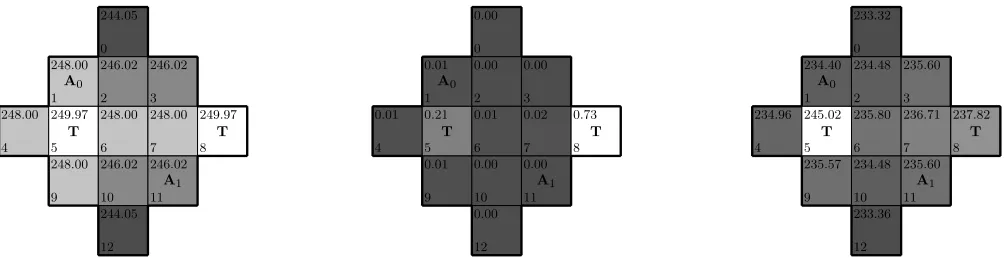
To compute these ‘presence mass’ distributions, one needs to assume particular behavior of the other agents. One pos-sibility is to assume that other agents perform a random walk [24]. This assumption, however, leads to uninforma-tive uniform distributions over states when predicting fur-ther into the future. To avoid this problem, we assume that the other agents use a self-absorbed model with quantile re-sponse (i.e., we assume that the other agents take actions according to a Boltzmann distribution [31] specified using the self-absorbed agent approximationVSA). Fig. 2
(mid-dle) illustrates that this leads to more sensible predictions. When there are multiple agents present, we can accumu-late the presence mass distributions into a single ‘sufficient statistic’ and therefore do not need to account for every sin-gle agent during planning. We use the accumulated presence mass distribution for the next model.
4.1.3
Empathy by Fixed Weight Discounting
After calculating the aggregated presence mass of the other agents, the planning agent has to choose its response. Dis-tributed value functions (DVFs) [27] allow agents to share their value function. This, however, leads to a lot of com-munication overhead. The MDVF [24] approach is inspired by DVFs and implements agent collaboration by using a second value function (specifically,VSA) to discount the
val-ues of future states. In the resulting formulation, however, MDVF agents donot share their value functions. Instead,
each agent computesVSAin parallel and uses it to discount
theVM DV F values.
Realizing this, we propose a more straightforward ap-proach: we do not discount using VSA, but just use the
next-stage value function. We refer to this simplification as
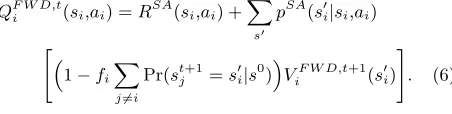
empathy by fixed-weight discounting (E-FWD). The result-ing value function is given by
QF W D,ti (si,ai) =RSA(si,ai) +
X
s0
pSA(s0i|si,ai)
"
1−fi
X
j6=i
Pr(stj+1=s 0 i|s0)
ViF W D,t+1(s0i)
#
. (6)
whereRSAandpSAare the self-absorbed model components (these are the same for all agents and hence we drop the subscriptito simplify notation). The last probability term is the presence mass of an agent j being at the location specified by s0i t+ 1 stages into the future, i.e., Pr(stj+1 = s0i|s0) = Pr(λ
t+1
j |s
0) withλt+1
j the location specified bys 0 i.
Finally, fi is a fixed weight that determines how much the
value of a next state is discounted. We follow [24] and set
fi to maxR(s,a)/maxV(s,a). An example illustrating this
discounting is shown in Fig. 2 (right).
4.2
Phase-Approximations
While subjective approximations reduce the complexity due to multiple agents, they do not sufficiently reduce the complexity of the state space. To overcome the complexity of the state space, we propose a different way of approaching the problem. Rather than seeing each locationx∈ Las a potential location for a task that may appear or disappear over the planning horizon, we focus only on the current ‘task phase’, i.e., the currently active set of tasks indicated by those locationsxfor whichτx6=CLEAR. By focusing only
on these locations, the number of task states induced is much smaller, allowing for big increases in planning efficiency.
4.2.1
Phase MMDPs
We formalize this idea by means of the so-called phase-MMDP, which, given a global state s = hλ,τi, can be defined as follows. A Phase-MMDP for state s, is an MMDP hD,Sp,A, Pp, Rpi. The considered task locations
in this MMDP, however, are restricted to the set of pL=
{x∈ L |τx6=CLEAR}ofphase task locations, i.e., the set
of ‘active’ locations where there is a task. Thus, the state spaceSpis spanned by the setL|D|of joint locations and the
setT|pL|of all possible task vectors for the active locations. We writepτ ∈T|pL| for the restriction ofτ to the locations inpL. A phase-MMDP state is a tupleps =hλ,pτi. The transition (and reward) function follow from equation 2 (and 3) by restricting the product (summation) topL.
A phase-MMDP provides leverage by restricting the num-ber of states compared to the regular MMDP formulation. However, this is highly dependable on the number of active tasks, and, in the worst case, it does not reduce the state space at all. Also, it does not address the large joint action space (see Table 1). This motivates the combination of the previously introduced techniques.
4.2.2
Subjective Phase MDPs
[image:5.612.328.554.138.195.2]0 244.05
1 248.00
A0
2 246.02
3 246.02
4 248.00
5 249.97
T 6 248.00
7 248.00
8 249.97
T
9 248.00
10 246.02
11 246.02
A1
12 244.05
0 0.00
1 0.01
A0
2 0.00
3 0.00
4 0.01
5 0.21
T 6 0.01
7 0.02
8 0.73
T
9 0.01
10 0.00
11 0.00
A1
12 0.00
0 233.32
1 234.40
A0
2 234.48
3 235.60
4 234.96
5 245.02
T 6 235.80
7 236.71
8 237.82
T
9 235.57
10 234.48
11 235.60
A1
[image:6.612.55.557.51.180.2]12 233.36
Figure 2: Left: A sample state for a diamond shaped gridworld with two agents (A0,A1) and two active task locations and
VSAfor the current state. Middle: The presence mass ofA1 from the viewpoint ofA0. Right: The discounted value function
VEF W DforA0resulting for this configuration.
MDP (SP-MDP). An SP-MDP for agent i is a subjective model, meaning that it includes only the actions of agenti
itself, moreover, it is a phase approximation, meaning that the states only include task states for active tasks. Specif-ically, a local state is a tuplesi=hλi, pτi, where λi is the
location of agentiand pτ is the phase task vector. In an SP-MDP, the number of actions is the number of individual actions and the number of states is potentially much smaller due to the phase-approximations assumption (see Table 1).
4.2.3
kSP-MDPs
As mentioned, in the worst case there are many active tasks, which means that the number of states will still be prohibitive. However, by the combination of subjective and phase-approximations, it is possible to exploit the problem structure even further. In particular,the subjective model of each agent may make different approximationsby exploiting what parts of the current state are relevant to that agent.
For instance, in the construction of the SP-MDP for an agenti, we can now make use of the location of that agent, by restricting the state space of the SP-MDP to include only task locations for theknearest tasks. We refer to the resulting model askSP-MDP. The number of states of the
kSP-MDP is given by|Sksp|=|L| · |T|k.
As is clear from Table 1, thekSP-MDP isthe only model
that is guaranteed not to have any exponential complexi-ties. Standard dynamic programming for ah-step lookahead MDP takes timeO(h|S|2|A|), and thus is feasible for large
problems when using thekSP-MDP model.
4.3
Social Laws
One of the drawbacks of subjective approximations is that when deploying a team of identical agents, this can lead to agents behaving identically when this is not desired. For instance, when two agents are in the same location, they will make the same assumptions about the other agents’ be-havior and thus compute the same value function. Conse-quently they will take the same action and (with probability depending on the movement model) end up in the same next location.
Although this phenomenon exposes a principal flaw of sub-jective approximations, in SPATAPs these issues are easy to deal with by employing social laws [28]. For instance, in our experimental evaluation we employ the following social law: whenever more than one agent is in the same location, these agents select their actions based on their IDs: the agent with
the lowest ID selects the action with the highest expected reward, the next agent selects the second best action, etc.
5.
EXPERIMENTS
In this paper we have introduced a number of approxima-tions that culminated in a model without any exponential dependence on the number of agents or state factors. This model can therefore be efficiently solved online using stan-dard MDP techniques. Since the approximations that we introduced are not bounded, we report the results of an em-pirical evaluation aimed at determining the solution qual-ity afforded by these approximations. For this purpose, we implemented a dirt-world simulation in which agents plan online, in a distributed fashion, using thekSP-MDP model. The movement transition probabilitiespMi are such that a
movement can fail (the agent remains at its previous loca-tion) with 10% probability. The task at locationxis deter-ministically completed if any agentiperforms actionST AY
at that location. A task appears at a locationxwith proba-bility 0.05 (but an agent staying at a location prevents task appearance). The team of agents receive reward +1 for ev-ery clean location at evev-ery time step. We do not consider movement costs. Agents solve their individual kSP-MDPs for (a maximum of) h= 20 steps lookahead, using regular dynamic programming.3 Unless reported differently, we use
thek= 4 nearest tasks.
In order to assess overall solution quality, we compare the approach with the global MMDP solution. Note that the global MMDP, unlike the phase-MMDP approximation, considers all locations on the board potential task locations, even currently ‘inactive’ ones. We use SPUDD [19], the state-of-the-art optimal solver for factored MDPs, to pro-vide the value of the optimal solution for horizon 10, and compare this to the average value generated by 100 dirt-world simulations with online planning4. Table 2a shows
the results for this comparison. SPUDD was only able to scale to 2x2 and 3x3 gridworlds with two and three agents respectively. For these problems, the approximations per-form very well; even the naive self-absorbed approximation achieves over 93 % of optimal. The proposed simplification
3Increasing the lookahead beyond 20, did not increase the
performance in our experiments. Shortening it does hurt performance in the larger problems, since it may lead agents to conclude that a task can never be addressed.
4Even though SPUDD is not specialized for MMDPs, it
world SA MDVF EFWD SPUDD
2x2 93.32% 97.86% 98.41% 100%
3x3 94.73% 96.83% 97.24% 100%
(a)
world |L| n |S| |A|
Line 12 2 5.90e+ 05 25
Diamond 13 3 1.80e+ 07 125 Corridors 18 3 1.53e+ 09 125
4x4 16 4 4.29e+ 09 625
6x6 36 5 4.16e+ 18 3125
Office 66 6 6.10e+ 30 15625
(b)
Table 2: (a) Relative values of the three approaches averaged across a set of randomly drawn starting states and compared to the SPUDD optimum value function. (b) Larger dirt-world benchmarks.
0 20 40 60 80 100 0
2 4 6 8 10 12 14 16
t
V
S A
M DVF
EF WD
[image:7.612.343.508.53.138.2]max V
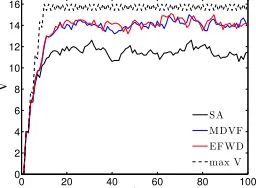
Figure 3: Mean reward over time for a 4x4 gridworld (ini-tially full) with three agents.
E-FWD even yields slightly higher rewards than the more complex MDVF.
In order to provide insight in the differences in behavior between the approaches, we investigate the rewards received over the different stages per episode. Figure 3 shows the mean reward per time step (mean is taken over 10 episodes) in a 4x4 gridworld filled with tasks. As the figure shows, the reward increases at first and then converges close to the maximum reward achievable per time step (which is 16 and received when all squares are clean). Interesting to note is thatVSA outperforms the empathic approximations in the
first time steps but then converges to a lower average reward. This is probably again due to the lack of considering the ef-fects of other agents when usingVSA. The agents first select
the tasks greedily, thus close tasks, and the tasks further away are not covered. The empathic approaches avoid this pitfall: by discounting the values of locations quickly reach-able by many other agents, the locations only reachreach-able by a protagonist are incentivized.
To examine the impact of restricting planning to only the
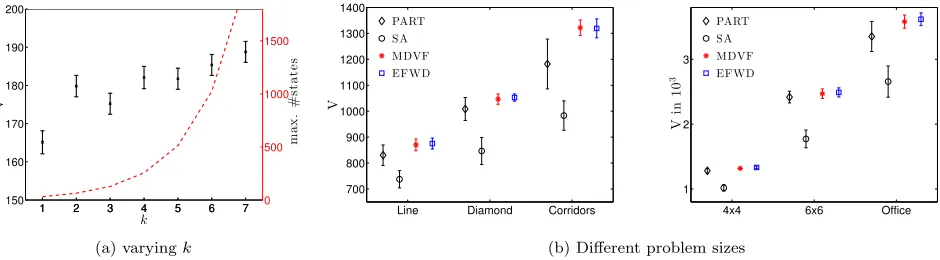
k nearest tasks, we performed an experiment in which we vary k, holding other parameters fixed. For this experi-ment, we used a “full” 4x4 gridworld, i.e. dirt is present everywhere, with three agents that used the E-FWD algo-rithm to select their actions. Results shown in Figure 4a, are averaged over 100 runs of horizon 20 with 95% confidence intervals. Additionally shown are the number of states for each k (the dashed line). The figure clearly shows that, althoughk= 1,3 perform poorly, there is no significant dif-ference for k ≥4, which explains our choice of k = 4 for all the other experiments. Finally, we test the performance of our approximations on a number of larger test problems, listed in Table 2b. The “Line” world is a straight line of 12 states, and the “Corridors” and “Office” world are shown in Figure 1. These problems are too large to be solved opti-mally, e.g., our largest test domain “Office” has 6.10e+ 30 states and 15625 actions, which makes it well beyond any-thing that can be solved optimally.
We compare our approach against the “partition”
ap-U.B. EFWD % of U.B.
Line 1104.8 875.5 79.2%
Diamond 1227.9 1052.6 85.7%
Corridors 1657.2 1379.3 79.6%
4x4 1518.0 1332.1 87.8%
6x6 3242.9 2490.2 76.8%
[image:7.612.336.532.175.260.2]Office 5137.7 3618.6 70.4%
Table 3: Performance of EFWD as compared to an upper bound for problems that cannot be solved optimally. proach as described in Section 2. We automatically calculate the partitions by assigning each location to the closest agent. If there are multiple agents with the same distances, the lo-cation is added to both partitions. We refer to this approach as “PART”. PART still suffers from the fact that large re-gions lead to too large local problems which we addressed by also restricting to theknearest tasks in these problems. Each method is run for 100 steps and repeated 10 times with random initial positions for the agents, while the world always being “full”. Figure 4b shows the mean total reward including the 95% confidence intervals, i.e. non-overlapping error-bars mean statistically significant results. The self-absorbed approach performs the worst for every setting. The simplifications of E-FWD do not lead to a loss: there is no significant difference with MDVF and both have higher means and smaller variance than PART. Especially in more complex worlds, i.e. the “Corridors” and the “Office”, the PART approach has a very high variance due to the different partitioning for each run. E-FWD is more reliable because it does not depend on the initial partitioning.
Additionally, we computed a theoretical (loose) upper bound by assuming that at every stage the expected number of tasks appears (fractions of tasks are allowed) and that all agents are able to clean an assigned task within two time steps. In other words, the upper bound assumes that in one step each agent uses a ‘teleport’ move to reach the location of a next task, which is then serviced in the second step. Clearly, this upper bound is an overestimation of the opti-mal value, since at each time step new tasks appear at ran-dom locations and agents generally need more than one-step travel times to these tasks. However, as demonstrated in Ta-ble 3 the proposed approximations yield rewards relatively close to this upper bound. For instance, about 75% in the 6x6 world and about 70% in the “Office” world are achieved, indicating that our proposed approach demonstrates reason-able behavior even for these huge problems.
6.
RELATED WORK
[image:7.612.107.235.176.270.2]ap-1 2 3 4 5 6 7 150
160 170 180 190 200
k
V
1 2 3 4 5 6 7 0
500 1000 1500
m
a
x
.
#
s
t
a
t
e
s
(a) varyingk
Line Diamond Corridors 700
800 900 1000 1100 1200 1300 1400
V
PART
S A
M DVF
EF WD
4x4 6x6 Office
1 2 3
V
in
1
0
3
PART
S A
M DVF
EF WD
(b) Different problem sizes
Figure 4: (a) Mean reward and number states for k-nearest task phase MDP with a 4x4 gridworld and three agents while increasingk. (b) Mean reward for various gridworlds as presented in Table 2b.
proximately solve exact models (e.g., [20]). The restrictions of the local problem of each agent to a subset of state fac-tors is reminiscent of converting to a Dec-MDP, but in fact fundamentally different, sincethe observation of the global state s is used to construct the agents’ kSP-MDPs. More-over, despite recent advances, e.g., [12], Dec-MDP solution methods do not nearly scale to problems of the size consid-ered here, or are suitable only for transition and observa-tion independent settings [4, 11] (which our setting is not). While there have been other approximate methods for solv-ing MMDPs, these typically depend on pre-specifysolv-ing the fixed, or context-dependent coordination structure [18, 21, 30]. For SPATAPs, however, fixed coordination structures are a poor choice and the number of contexts to be consid-ered is huge. In addition, these methods are not aimed at exploiting the particular structure present in SPATAPs, in-dependence of movement and locality of tasks. To overcome the problem of pre-specifying interaction structures one can try to learn them [25, 10], but the premise underlying these methods is that there are only few states in which the agents need to coordinate. In contrast, in SPATAPs, the agents need to coordinate their task selection inall states.
Swarm approaches based on ant and honeybee colony behavior rely on local interactions in the environment to achieve coordination in multi-robot systems. From these local interactions global intelligence emerges at the group level, i.e. self-organization, capable of achieving efficient co-ordination in foraging and coverage tasks. Although these swarm solutions are efficient and effective for foraging and coverage problems, they do not consider the dynamic ap-pearance of new or different (sub)tasks that can arrive at unpredictable moments in the environment [22, 2, 8]. Fur-thermore, [8] considers sequential interdependent tasks in which subtasks must be completed one after the other in order to complete an overall task. This work however is limited to the foraging problem and two subtasks.
Approaches for assigning agents to tasks based on auc-tions [9, 3] are closely related, but either do not reason about subsets of tasks [9], or do not properly address the sequential nature of the task in SPATAPs [3, 23]. SPATAPs also relate to more general resource allocation problems [33] (agents can be interpreted as resources). We, however, allow reallo-cation at every time step and consider spatially distributed tasks and travel times.
The idea of interacting with the aggregate effect of other agents is studied in detail in the field of mean-field games
[17], where the focus lies on characterizing equilibria. A few approaches have tried to extend these ideas to engineer-ing settengineer-ings such as taxi-fleet optimization [32, 1] and theme park crowd management [16] via off-line planning. However, since these approaches perform off-line planning, these ap-proaches are restricted in the richness of the state space that can be used as the basis for action selection. The ‘aggregate effect’ in these approaches typically consists of the number of agents present in different zones which directly affects utility for the protagonist. In our case, we use the predicted future agent locations as a proxy for their behaviors, which in turn will affect the utility of the protagonist.
Finally, the subjective approximations presented in this paper can be interpreted as online planning for a special in-stance of a level 1 interactive POMDP [15, 13]. In contrast to standard interactive POMDP solution methods, however, we propose dedicated approximation algorithms that exploit the characteristics of SPATAPs by using location as the proxy for the other agents’ policies.
7.
CONCLUSIONS & FUTURE WORK
This paper introduces SPATAPs, a general sub-class of MMDPs suitable for spatially distributed problems that a team of agents or robots needs to solve. Such tasks are characteristic of many realistic multi-robot systems, such as mobile sensor nets, distributed transportation and task assignment, multi-robot exploration, etc. To combat the complexity of general MMDP algorithms, we propose to use phase- and subjective approximations, and combine both to yield an efficient online planning method for SPATAPs. An extensive empirical evaluation shows that the proposed com-bination of approximation techniques yields near-optimal re-sults for problem instantiations that we could solve opti-mally and further scales to much larger problems with thou-sands of states and joint actions. In future work we will focus on quality guarantees for the proposed approach, as well as demonstrating the approach on real teams of robots. Other promising directions of future work include application of approximate online MDP planning methods, and identifying methods for ‘positive interaction’ settings, in which there are joint tasks for which two or more agents are required.
Acknowledgments
[image:8.612.66.536.59.189.2]REFERENCES
[1] Asrar Ahmed, Pradeep Varakantham, and Shih-Fen Cheng. Uncertain congestion games with assorted human agent populations. InProceedings of the Twenty-Eighth Conference on Uncertainty in Artificial Intelligence, pages 44–53, 2012.
[2] S. Alers, K. Tuyls, B. Ranjbar-Sahraei, D. Claes, and G. Weiss. Insect-inspired robot coordination: foraging and coverage. InArtificial life 14, pages 761–768, 2014. [3] Sofia Amador, Steven Okamoto, and Roie Zivan.
Dynamic multi-agent task allocation with spatial and temporal constraints. InProceedings of the
Twenty-Eighth AAAI Conference on Artificial Intelligence, pages 1384–1390, 2014.
[4] Raphen Becker, Shlomo Zilberstein, Victor Lesser, and Claudia V. Goldman. Transition-independent
decentralized Markov decision processes. InAAMAS, pages 41–48, 2003.
[5] Michael Beetz, Ulrich Klank, Ingo Kresse, Alexis Maldonado, Lorenz M¨osenlechner, Dejan Pangercic, Thomas R¨uhr, and Moritz Tenorth. Robotic Roommates Making Pancakes. In11th IEEE-RAS International Conference on Humanoid Robots, Bled, Slovenia, October, 26–28 2011.
[6] Daniel S. Bernstein, Robert Givan, Neil Immerman, and Shlomo Zilberstein. The complexity of
decentralized control of Markov decision processes.
Mathematics of Operations Research, 27(4):819–840, 2002.
[7] Craig Boutilier. Planning, learning and coordination in multiagent decision processes. InProc. of the 6th Conference on Theoretical Aspects of Rationality and Knowledge, pages 195–210, 1996.
[8] Arne Brutschy, Giovanni Pini, Carlo Pinciroli, Mauro Birattari, and Marco Dorigo. Self-organized task allocation to sequentially interdependent tasks in swarm robotics.Autonomous Agents and Multi-Agent Systems, 28(1):101–125, 2014.
[9] Jes´us Capit´an, Matthijs T. J. Spaan, Luis Merino, and An´ıbal Ollero. Decentralized multi-robot cooperation with auctioned POMDPs.International Journal of Robotics Research, 32(6):650–671, 2013.
[10] Yann-Micha¨el De Hauwere, Peter Vrancx, and Ann Now´e. Learning multi-agent state space
representations. InAAMAS, pages 715–722, 2010. [11] Jilles S. Dibangoye, Christopher Amato, Olivier
Buffet, and Fran¸cois Charpillet. Exploiting separability in multiagent planning with continuous-state MDPs. InProceedings of the Thirteenth International Joint Conference on Autonomous Agents and Multiagent Systems, pages 1281–1288, 2014.
[12] Jilles Steeve Dibangoye, Christopher Amato, and Arnaud Doniec. Scaling up decentralized MDPs through heuristic search. InUAI, pages 217–226, 2012. [13] Prashant Doshi, Yifeng Zeng, and Qiongyu Chen.
Graphical models for interactive POMDPs:
representations and solutions.Autonomous Agents and Multi-Agent Systems, 18(3):376–416, 2008.
[14] Greg Droge and Magnus Egerstedt. Adaptive look-ahead for robotic navigation in unknown
environments. InIROS, pages 1134–1139, 2011. [15] Piotr J. Gmytrasiewicz and Prashant Doshi. A
framework for sequential planning in multi-agent settings.Journal of Artificial Intelligence Research, 24:49–79, 2005.
[16] Geoffrey J. Gordon, Pradeep Varakantham, William Yeoh, Hoong Chuin Lau, Ajay S. Aravamudhan, and Shih-Fen Cheng. Lagrangian relaxation for large-scale multi-agent planning. In2012 IEEE/WIC/ACM International Conferences on Intelligent Agent Technology, IAT 2012, Macau, China, December 4-7, 2012, pages 494–501, 2012.
[17] Olivier Gu´eant, Jean-Michel Lasry, and Pierre-Louis Lions. Mean field games and applications. In
Paris-Princeton Lectures on Mathematical Finance 2010, volume 2003 ofLecture Notes in Mathematics, pages 205–266. Springer Berlin Heidelberg, 2011. [18] Carlos Guestrin, Shobha Venkataraman, and Daphne
Koller. Context specific multiagent coordination and planning with factored MDPs. InAAAI, pages 253–259, 2002.
[19] Jesse Hoey, Robert St-Aubin, Alan J. Hu, and Craig Boutilier. SPUDD: Stochastic planning using decision diagrams. InUAI, pages 279–288, 1999.
[20] Levente Kocsis and Csaba Szepesv´ari. Bandit based Monte-Carlo planning. InMachine Learning: ECML 2006, volume 4212 ofLecture Notes in Computer Science, pages 282–293. Springer, 2006.
[21] Jelle R. Kok and Nikos Vlassis. Collaborative multiagent reinforcement learning by payoff
propagation.Journal of Machine Learning Research, 7:1789–1828, 2006.
[22] Nyree Lemmens and Karl Tuyls. Stigmergic landmark optimization.Advances in Complex Systems, 15(8), 2012.
[23] Han lim Choi, Luc Brunet, and Jonathan P. How. Consensus-based decentralized auctions for robust task allocation.IEEE Transactions on Robotics, 2009. [24] La¨etitia Matignon, Laurent Jeanpierre, and
Abdel-Illah Mouaddib. Coordinated multi-robot exploration under communication constraints using decentralized markov decision processes. InAAAI, pages 2017–2023, 2012.
[25] Francisco S. Melo and Manuela Veloso. Learning of coordination: exploiting sparse interactions in multiagent systems. InAAMAS, pages 773–780, 2009. [26] Martin L. Puterman.Markov Decision
Processes—Discrete Stochastic Dynamic Programming. John Wiley & Sons, Inc., 1994. [27] Jeff G. Schneider, Weng-Keen Wong, Andrew W.
Moore, and Martin A. Riedmiller. Distributed value functions. InProc. of the International Conference on Machine Learning, pages 371–378, 1999.
[28] Yoav Shoham and Moshe Tennenholtz. On social laws for artificial agent societies: off-line design.Artificial Intelligence, 73(1–2):231 – 252, 1995.
[29] Jason Sleight and Edmund H. Durfee. A
decision-theoretic characterization of organizational influences. InAAMAS, pages 323–330, 2012. [30] Matthijs T. J. Spaan and Francisco S. Melo.
multiagent planning under uncertainty. InAAMAS, pages 525–532, 2008.
[31] Richard S. Sutton and Andrew G. Barto.
Reinforcement Learning: An Introduction. The MIT Press, March 1998.
[32] Pradeep Varakantham, Shih-Fen Cheng, Geoffrey J. Gordon, and Asrar Ahmed. Decision support for agent populations in uncertain and congested environments. InProceedings of the Twenty-Sixth AAAI Conference on Artificial Intelligence, July 22-26, 2012, Toronto, Ontario, Canada., 2012.
[33] Jianhui Wu and Edmund H. Durfee. Resource-driven mission-phasing techniques for constrained agents in stochastic environments.Journal of Artificial Intelligence Research, 38:415–473, 2010.