Time-varying Models for
Macroeconomic Forecasts
Bo Zhang
A thesis submitted for the degree of
Doctor of Philosophy at
The Australian National University
Except where otherwise indicated, this thesis is my own original work.
Bo Zhang
Acknowledgments
First, I would like to express my deep appreciation to my supervisors, Dr. Joshua
Chan, Dr. Timothy Kam, Dr. Shaun Vahey, and Dr. Rodney Strachan for their inspiring discussion during my study at the Australian National University (ANU), and
their invaluable academic advice on my thesis. I want to thank Prof. Joshua Chan for
spending so much time on my research discussion. He provided valuable advice on the topic selection, academic writing, and economic understanding of my thesis. Without
his supervision, I would not have mastered the necessary research tools or developed
a good understanding of the economy, and my thesis would not have reached a high standard. I would like to thank Dr. Timothy Kam for his dedication to my thesis
over the past year. Without his support, I would not have been able to continue the
second half of my PhD study so smoothly. I also want to thank Dr. Shaun Vahey for his academic inspiration on my thesis topic. His warm encouragement of my research
proposal also provided me with the invaluable opportunity to study at ANU. I would
like to thank Dr. Rodney Strachan for kindly joining the panel as one of my co-supervisors. His wide-ranging academic discussions broadened my economic research
horizons and showed me how to do my research well.
I want to thank Dr. Renee Fry-Mckibbin, Dr. Tue Gorgens, Dr. Bob Gregory, Dr. Kieron Meagher, Dr. Dennis Richard, and Dr. Ronold Stauber for helping me lay a
solid academic foundation. I would also like to express my thanks to other academic and administration staff for their kind support during my research life at ANU.
Financial support provided by an ANU Australian Postgraduate Award is gratefully
acknowledged.
I want to thank my friends Jim Hancock, Dr. Zhongying Sun, Xin Zhang, and
Jamie Cross for polishing the English of my papers. I also wish to thank Xu Yang,
Chenghan Hou, Wenjie Wei, and Yaqing Zhang for their challenges and for sharing knowledge. Editing services were provided by professional editors from Elite Editing.
Finally, I would like to express my sincere appreciation to all my family members
for their patience, understanding, and both spiritual and material support while I undertook my PhD study.
Abstract
This thesis consists of three studies focusing on ways to detect and model time
variation among macroeconomic variables. In these three studies, errors with
autore-gressive moving averages (ARMA), model averaging, and stochastic volatility (SV) are used to investigate the uncertainty and the instability of macroeconomic dynamics.
In particular, I expand upon both univariate (autoregressive; AR) and multivariate
(vector autoregressive; VAR) time series models.
Chapter 1 provides a general introduction to the research interest of this thesis.
Next, Chapter 2 introduces an ARMA component with SV into the unobserved
com-ponent model. A transformation to a stacked matrix form of the model is conducted for posterior fast simulation. The proposed model is then used to study
macroeco-nomic time series in the United States (US). The proposed new model provides good
full-sample simulation for the majority of the macroeconomic variables, and can im-prove both the point and the interval forecasting performance of these variables across
different horizons.
In Chapter 3, I use real-time macroeconomic variables and both time-varying and equal weights with time-varying parameter models to forecast inflation in the US. Three
time-varying coefficient models with three specifications of their error terms are
stud-ied. The alternative error-term assumptions are errors with a Gaussian distribution, errors with SV, and errors with moving average SV. Both point forecasts and density
forecasts suggest that adding variables and allowing time-varying lag length choice
can significantly improve forecasting performance. The forecasting performance of the time-varying and equal weights model combination methods show that adding SV can
improve density forecasts but not point forecasts.
Finally, in Chapter 4, I employ a time-varying parameter VAR with SV (TVP-VAR-SV) to analyze the dynamics of renewable electricity generation (REG), gross
domestic product (GDP) growth, and CO2 emissions. TVP-VAR-SV and other re-stricted variants are employed for forecasting REG with data from the US. The
em-pirical results suggest that TVP-VAR-SV is suitable for studying the relationship
between REG, GDP, and CO2. The forecasting results suggest that VARs with a time-varying volatility specification can perform much better than those without SV, while
allowing for time-varying coefficients does not improve forecasting performance.
Contents
Acknowledgments vii
Abstract ix
1 Introduction 1
2 Forecasting Macroeconomic Series by Models with ARMA-SV Errors 3
2.1 Introduction . . . 3
2.2 UC Models with ARMA Errors and SV . . . 5
2.2.1 Estimation . . . 6
2.2.1.1 Observations Likelihood Function . . . 6
2.2.1.2 Posterior Analysis and Simulation . . . 8
2.3 Application to the US Macroeconomic Series . . . 14
2.3.1 Competing Models . . . 14
2.3.2 Data and Priors . . . 16
2.4 Forecasting Results . . . 17
2.4.1 Forecast Evaluation Methods . . . 17
2.4.1.1 Recursive and Direct Forecasts . . . 17
2.4.1.2 Criteria for Model Selection . . . 17
2.4.2 MSFE Forecast Results . . . 18
2.4.3 LPL Forecast Results . . . 21
2.5 Concluding Remarks and Future Research . . . 23
Appendix 2.A Full-Sample Estimation Results . . . 24
Appendix 2.B A proof forH−ψ1Hϕ=HϕH−ψ1 . . . 28
Appendix 2.C Forecasting Results . . . 30
3 Real-Time Inflation Forecast Combination for Time-Varying Coeffi-cient Models 41 3.1 Introduction . . . 41
3.2 Component Models . . . 43
3.2.1 Time-Varying Coefficient Models . . . 44
3.2.1.1 Constant Variance . . . 44
3.2.1.2 Stochastic Volatility . . . 45
3.2.1.3 Moving Average Stochastic Volatility . . . 45
3.2.2 Inflation Predictors . . . 45
3.2.3 Lag Structure . . . 46
3.2.4 The Priors . . . 47
3.3 Full Sample Estimation . . . 47
3.3.1 Real-Time Data . . . 48
3.3.2 Full Sample Empirical Results . . . 50
3.4 Real-Time Forecasts of US Inflation . . . 55
3.4.1 List of Competing Models . . . 56
3.4.2 Forecasting Metrics . . . 58
3.4.3 Forecast Combination . . . 58
3.4.4 Forecasting Results . . . 59
3.4.5 Weights of Inflation Predictors Grouped by Lag Forms . . . 61
3.5 Concluding Remarks . . . 63
Appendix 3.A Bayesian Estimation Method: MCMC Algorithm . . . 64
Appendix 3.B Figures of Weights for Each Inflation Predictor and Lag Form 69 4 The Importance of Stochastic Volatility in Renewable Energy Fore-casts 71 4.1 Introduction . . . 71
4.2 VAR Models . . . 73
4.2.1 TVP-VAR-SV . . . 73
4.3 Preliminary Empirical Study . . . 74
4.3.1 Data . . . 75
4.3.2 Ordering of Variables in the VARs . . . 77
4.3.3 The Choice of Renewable Electricity Time Series . . . 78
4.3.4 VAR Specification Selection and Lag Length . . . 78
4.4 Application of VARs with REG . . . 80
4.4.1 Empirical Evidence of SV . . . 81
4.5 Forecasting Results . . . 83
4.5.1 Forecasting Metrics . . . 83
4.5.2 Relative Average LPL Results . . . 84
4.5.3 Cumulative Sum of LPL . . . 85
4.5.4 Relative Average CRPS Results . . . 86
4.5.5 Cumulative Sum of CRPS . . . 86
4.5.6 Robustness of Forecasting Results . . . 87
4.6 Conclusion . . . 88
Contents xiii
Appendix 4.B Priors and Initial Values . . . 91
5 Concluding Remarks and Future Research 93
List of Figures
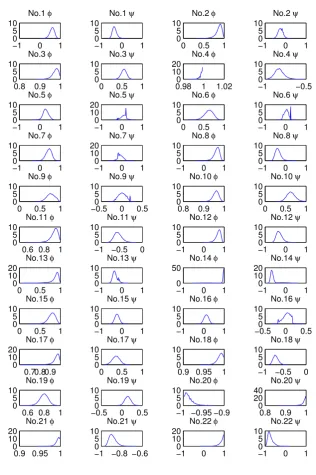
2.1 Marginal probability estimates for ϕand ψunder UC-ARMAmodels. 26
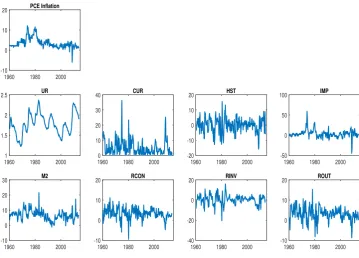
3.1 PCE inflation and inflation predictors. . . 49
3.2 Posterior estimates of TVC-SVMA where the predictor is the UR. . . 50
3.3 Posterior estimates of TVC-SVMA where the predictor is CUR. . . . 52
3.4 Posterior estimates of TVC-SVMA where the predictor is HSTS. . . . 52
3.5 Posterior estimates of TVC-SVMA where the predictor is IMP. . . 53
3.6 Posterior estimates of TVC-SVMA where the predictor is M2. . . 53
3.7 Posterior estimates of TVC-SVMA where the predictor is RCON. . . 54
3.8 Posterior estimates of TVC-SVMA where the predictor is RINV. . . . 54
3.9 Posterior estimates of TVC-SVMA where the predictor is ROUT. . . 55
3.10 Weights of component models forTVC, forecasting horizon one. . . . . 62
3.11 Weights of component models forTVC, forecasting horizon four. . . . . 69
3.12 Weights of component models forTVC, forecasting horizon eight. . . . 69
3.13 Weights of component models forTVC, forecasting horizon sixteen. . . 70
4.1 Plot of REG growth rate. . . 76
4.2 Plot of annualized real GDP growth rate. . . 77
4.3 Plot of CO2 emission growth rate. . . 77
4.4 SD of posterior medians for C-VAR-SVand TVP-VAR-SV. . . . 81
4.5 One-quarter-ahead cumulative sum of LPL for VAR models relative to AR(1) with one lag (left panel) and two lags (right panel). . . 85
4.6 One-quarter-ahead cumulative sum of CRPS for VAR models relative to AR(1) with one lag (left panel) and two lags (right panel). . . 86
List of Tables
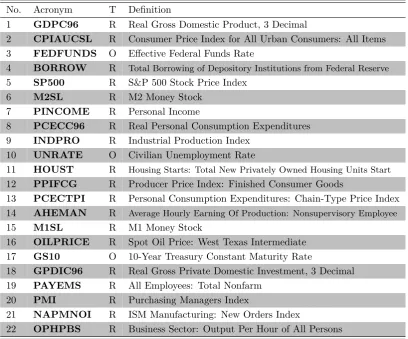
2.1 Variables used in model comparison. . . 16
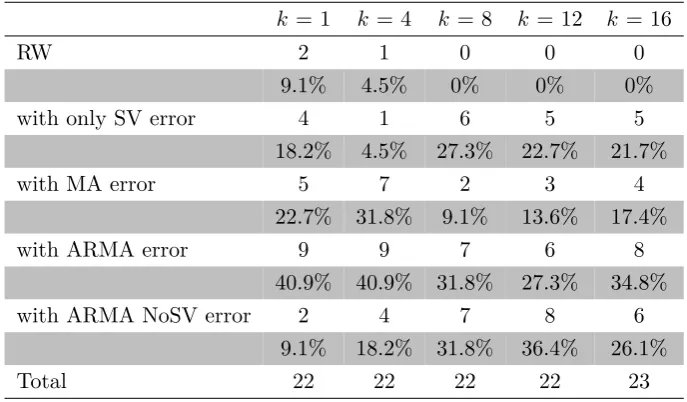
2.2 The number and percentage of the best models with different error spec-ifications based on MSFE for 22 macroeconomic variable forecasting. . . 19
2.3 The number and percentage of the best models with different model group specifications based on MSFE for 22 macroeconomic variable fore-casting. . . 20
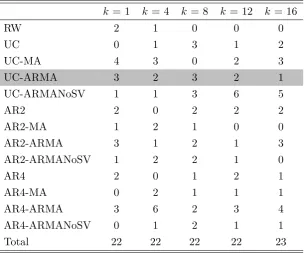
2.4 The number of the best models based on MSFE for 22 macroeconomic variable forecasting. . . 20
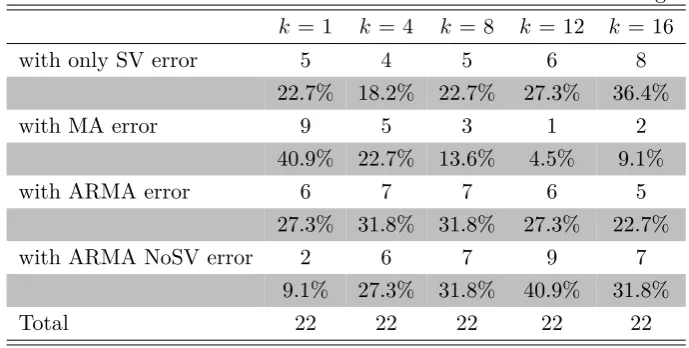
2.5 The number and percentage of the best models with different error spec-ifications based on RelLPL for 22 macroeconomic variable forecasting. . 21
2.6 The number and percentage of the best models with different model group specifications based on RelLPL for 22 macroeconomic variable forecasting. . . 22
2.7 The number of the best model for each specification based on LPL for 22 macroeconomic variable forecasting. . . 22
2.8 The modes ofϕand ψin models withARMA-SVerrors and the mode of ψ in theUC-MA model. . . 24
3.1 Real-time forecasts for PCE inflation. . . 60
3.2 Correlation coefficients between inflation predictors. . . 62
4.1 Sum of MLL and CRPS for the fitness of VARs. . . 80
4.2 SD with 16th and 84th quantiles for TVP-VAR-Cand C-VAR-C. . . 83
4.3 Relative average LPL and CRPS for REG forecasts from 1995. . . 84
4.4 Relative average LPL and CRPS for REG forecasts from 1990. . . 87
4.5 Relative average LPL and CRPS for REG forecasts from 1985. . . 88
Chapter 1
Introduction
In macroeconomic empirical research, the movement of economic variables attracts
strong interest from researchers. To reveal the evolution of these macrovariable time series, both univariate and multivariate frameworks with many time-varying
specifica-tions have been considered in studies. The present thesis contributes to the literature
by modeling these time series with time-varying features. Specifically, the correlation of error terms, model averaging, time-varying parameters, and stochastic volatility
(SV) are highlighted in the three main chapters. After evaluating the in-sample
fit-ness of the proposed models, the results of out-of-sample forecasts are reported in the “Application” section. The empirical parameter simulation and modeling evaluation
in this thesis are conducted by Bayesian econometrics. Both a block-banded sparse matrix and a precision-based algorithm are used for the rapid and efficient simulation
of parameters.
Chapter 2 introduces SV with autoregressive moving average (ARMA; SV-ARMA) errors in the univariate unobserved components (UC) model. Another contribution of
this thesis is that it is the first study to run forecasts on United States (US) macrovari-ables with SV-ARMA error terms. Other competing models include UC models with or
without error correlation and SV assumptions; moreover, some simple but hard to beat
univariate models, such as random walk (RW) and AR models, are also considered. In this chapter, both point and interval forecasting results are presented, and the analysis
of forecasting performance is based on 22 quarterly macroeconomic time series with 13
modeling specifications allocated in four groups.
Chapter 3 focuses on inflation forecasts. Inflation is a core macroeconomic indicator
and has received considerable attention from both central bankers and macroeconomic researchers. In this chapter, model averaging time-varying weight and equal weight
strategies are considered for either point forecasts or density forecasts with eight
infla-tion predictors. The modeling competiinfla-tion is conducted using UC models with SV and SVMA errors, with dynamic model averaging and selection for these highly competitive
models.
Chapter 4 employs a time-varying parameter vector autoregressive (TVP-VAR)
model with SV to investigate the relationship between the renewables, output, and CO2 emissions. In fact, TVP-VARs are already widely accepted and applied to
macroeco-nomic studies to investigate the dynamic interactions between variables. The empirical
results indicate that the SV specification shows a better fitness to the data than the homoscedastic variance models in the full-sample application. The forecasting results
suggest that the specification of SV can substantially improve the forecasting
perfor-mance in comparison with constant variances, whereas specification of the time-varying parameters is not helpful.
Chapter 5 presents the general conclusions of the full thesis and future research
Chapter 2
Forecasting Macroeconomic
Series by Models with
ARMA-SV Errors
2
.
1
Introduction
In empirical macroeconomics, researchers are generally interested in testing classi-cal economic theories or exploring empiriclassi-cal relationships among macroeconomic
vari-ables. To empirically model such variables, practitioners tend to rely on multivariate
time series techniques such as VARs and vector error correction models (VECMs). While historically they have been popular, recent literature has shown that
multivari-ate systems may only work well for in-sample fitness or out-of-sample forecasts in some
episodes (Stock and Watson, 2007), and the number of variables in the information set may change substantially over time when better estimation results are being
pur-sued (Chan et al., 2012). Under such circumstances, revealing the evolution of these
time series through univariate models could be a better strategy.
The instability of coefficients in univariate models has been widely acknowledged
and has been explored in a variety of ways. Examples include shifts in local means, structure breaks, and more recently, time-varying coefficients (e.g., Koop and Potter,
2007; Stock and Watson, 1996; Chan, Koop, Leon-Gonzalez, and Strachan, 2012). For example, Stock and Watson (2007) find that the underlying trend of the time
series shows stochastic changes over time, and the standard deviation (SD) also varies
over time. This indicates that a constant variance assumption is not sufficient for all situations. In this sense, UC with SV could cover the concerns regarding both
the time-varying underlying trend and the stochastic transitory disturbance. In order
to achieve better estimation results, researchers explore different SV setups, such as an unknown degree of freedom of Student’s t-distribution and a jump component in
the error term (Chib et al., 2002), SV models with leverage (Omori et al., 2007), and
moving-average error with SV specification (Chan, 2013), which models the errors with
serial correlation.
In macroeconomic empirical studies, it is not surprising to note that significant serial dependence is found among the observations. Under this circumstance, it is reasonable
to assume that the error terms follow a serially dependent process rather than an
independent distribution. Many applications show that a properly assumed ARMA error process can be better accommodated with the same structure of variable evolution
as those without it. For example, Tsay (1984) studied the least squares estimation with
both stationary and nonstationary ARMA errors, while Chib and Greenberg (1994) and Wu and Wang (2012) discuss linear regression models with ARMA errors under a
Bayesian framework. However, to our knowledge, none of the existing work focuses on
a UC model with ARMA errors or even ARMA errors with an SV component.
Regarding the empirical parameter simulation using Bayesian methods, Chib and Greenberg (1994) develop a practical Markov chain Monte Carlo (MCMC) method that
works well in low dimensions when resorting to the Kalman filter. However, it can be
very time consuming when the estimation applies to much higher dimension models, especially the state space model with time-varying parameters. Chan and Jeliazkov
(2009) solve this problem by introducing a transparent precision-based algorithm for a
state space model with a constant covariance matrix, and it presents rapid and efficient properties due to their block-banded and sparse matrix algorithms. Later, Chan (2013)
presents his work on state space models with a moving average error, which builds on this algorithm, and it shows that the MCMC converges well. However, for models with
the ARMA component, McCausland et al. (2011) believe that the estimation could be
less efficient when using precision-based algorithms than it is with the Kalman filter, as it is difficult to find an expression where the covariance matrix with stacked innovation
terms could avoid full rank.
To conquer these difficulties, we introduce an approach to working on a univariate
UC model with ARMA-SV (abbreviated asUC-ARMAin this thesis) evolution using a precision-based algorithm. The developed algorithm in this chapter can still present
rapid and efficient properties as achieved by Chan (2013).
This is the first study to present forecasting exercises on US macroeconomic time
series byUC-ARMAspecification. Other competing models include UC models with or without error correlation and SV assumptions; moreover, some simple univariate
models, such as RW and AR models (Stock and Watson, 2007) are also considered.
In the literature, there are only a few forecasting applications for macroeconomic
time series, and most studies consider multivariate specifications. For example, Swan-son and White (1997) compare the forecasting performance of linear and nonlinear
§2.2 UC Models with ARMA Errors and SV 5
variables, Athanasopoulos and Vahid (2008) explore five multivariate models
includ-ing both VAR and VAR movinclud-ing average (VARMA) for macroeconomic forecastinclud-ing. With respect to the univariate models, Bauwens et al. (2015) investigate the
forecast-ing performance of two groups of structural break models as well as AR models for 23
quarterly macroeconomic series, while Marcellino et al. (2006) use 170 monthly time se-ries to compare iterated forecast and direct forecast results for an autoregressive model.
In this chapter, we provide both point and interval forecasting results and analyze the
forecasting performance of 22 quarterly macroeconomic time series in the US in four groups—in total, 13 specifications.
In the next section, we present the framework of theUC-ARMAmodel, followed
by the analytical likelihood function as well as the posterior analysis and simulation
methods for the parameters. In Section 2.3, we discuss the application of the US macroeconomic time series with full-sample estimation of the key parameters.
Sec-tion 2.4 introduces the forecast methods and compares the forecasting results among
the competing models. The final section presents the concluding remarks.
2
.
2
UC Models with ARMA Errors and SV
Consider a general state space modeling framework by generating the observation
yt at timetfrom two parts, a UC termτt, and an error termεyt, which is expressed in terms of an ARMA(p,q) process with SV:
yt=τt+εyt, (2.1)
τt=τt−1+ετt, τ1 ∼ N(0,σ20τ),ετt ∼ N(0,στ2), (2.2)
εyt =ϕ1εyt−1+· · ·+ϕpεyt−p+ut+ψ1ut−1+· · ·+ψqut−q, ut∼ N(0,eht), (2.3)
ht=ht−1+εht, h1 ∼ N(0,σ20h),εht ∼ N(0,σ2h), (2.4)
where t = 1,· · ·,T and we assume that the error terms εh
t, ετt and ut are all independent from each other for all the observations. Equation (2.1) is referred to as the
measurement equation or observation equation, which is composed of the unobserved states τ and the error terms εy, whereas Equation (2.2) is the state or transition
equation indicating the evolution of the states. Here, τ is assumed to follow an RW.
The initial value τ1 is generated from a Gaussian distribution whose variance σ02τ is given in advance, and ετt is the smooth parameter whose variance σ2τ is also known.
Equation (2.3) can be rewritten in terms of a polynomial with the lag operator L
ϕ(L)εt=ψ(L)ut,
whereϕ(L) =1−ϕ1L− · · · −ϕpLp, andψ(L) =1+ψ1L+· · ·+ψqLq. We assume that all roots ofϕ(L)stay outside the unit circle for stationarity of the ARMA process,
and all roots ofψ(L)fall outside the unit circle for invertibility of the process (see Chib and Greenberg (1994)) for identification purposes.
The SV parameter ht enters this specification as an instantaneous volatility of the
model, and itself follows an RW evolution with h1 drawn from a stationary Gaussian distribution.
2.2.1 Estimation
We perform the estimation by exploring the Bayesian paradigm using Gibbs sam-pling and the Metropolis-Hasting algorithm, which are powerful data-based MCMC
methods for simulating the joint distributions of interest with suitable convergent speed.
Another matter needs to be considered here: the serially dependent series of the error terms when they have an ARMA structure. When resorting to a conventional
simu-lation Kalman filter, the original data need to be transformed to independence (Chib and Greenberg, 1994); however, as in Chan (2013), our direct approach using
precision-based algorithms does not need to use this transformation, and the MA component also
contains serial dependence for the time series.
2.2.1.1 Observations Likelihood Function
We first investigate the likelihood function of our model. A likelihood function
can provide rich information on the data and describe the precise manner of specified
parameters. For estimation purposes, we also provide the log-likelihood function below. Since the likelihood function L(θ|y) is defined by the joint distribution f(y|θ)
given observationsy= (y1,· · · ,yT)′, and it is L(θ|y) =f(y|θ), we first stack Equa-tion (2.3) into matrices and vectors:
Hϕεy =Hψu, u∼ N(0,Ωu)
then,
εy =H−ϕ1Hψu, put it into Equation (2.1),
§2.2 UC Models with ARMA Errors and SV 7
where
Hϕ=
1 0 0 0 · · · 0
−ϕ1 1 0 0 · · · 0
..
. . .. ... ... ...
−ϕp · · · −ϕ1 1 · · · 0
..
. . .. . .. ... ...
0 · · · −ϕp · · · −ϕ1 1
, Hψ =
1 0 0 0 · · · 0
ψ1 1 0 0 · · · 0
..
. . .. ... ... ...
ψq · · · ψ1 1 · · · 0
..
. . .. . .. ... ...
0 · · · ψq · · · ψ1 1
. y= y1 .. . yT
, τ =
τ1 .. . τT
, εy =
εy1
.. .
εyT
, u=
u1 .. . uT , and
Ωu =
eh1 O
. ..
O eht
.
Given Ωy =H−ϕ1HψΩu(H−ϕ1Hψ)′, the conditional joint probability density function of yis:
(y|ϕ,ψ,τ,h)∼ N(τ,Ωy),
whereh= (h1,. . .,hT)′. It is worth noting thatHϕandHψareT×T banded matrices. The values of p and q are normally much smaller than the number of observations T
in empirical studies, so it is useful to implement banded or sparse matrix algorithms
for precise estimation and rapid computation. Although Hϕ and Hψ are both lower triangular banded matrices and Ωu is a diagonal matrix, the product Ωy is no longer
a sparse matrix, due to H−ϕ1 introduced in the multiplication. The transformation for obtaining sparse matrices is discussed in the next section. The log-likelihood function is followed as:
ℓ(θ|y) =logp(y|ϕ,ψ,τ,h) =−T
2 log(2π)− 1 2
T
∑
t=1
ht− 1
2(y−τ) ′Ω−1
y (y−τ) (2.6)
To calculate the log-likelihood function, we refer to the Cholesky decomposition and forward (backward) substitution introduced by Chan (2013), as it takes computer
packages (e.g.,Matlab).We first calculate the Cholesky decomposition of Ωy:
Cy =chol(Ωy),
then by forward substitution and backward substitution:
A= Ω−y1(y−τ) =C′y\(Cy\(y−τ)),
which is equal toA=C−1′
y (C−y1(y−τ)) =Ω−y1(y−τ), and followed by:
B = (y−τ)′A.
Thus, the log-likelihood function (2.6) can be efficiently evaluated.
2.2.1.2 Posterior Analysis and Simulation
We refer to a Bayesian approach to study the property of the parameters in the proposed specifications. Given the information on the observations y and the prior
distribution of the parameters p(θ), the likelihood p(y|θ) can be obtained by (2.6) and then the posterior density function p(θ|y) can be simulated according to Bayes rule (see Koop (2003)). Formally, our expression for the posterior is:
p(θ|y) = p(θ,y)
p(y) =
p(y|θ)p(θ)
p(y) (2.7)
Since we are only interested in the performance ofθ, the terms that do not involve θ can be ignored. Here, we ignore the term p(y), and (2.7) can be written as:
p(θ|y)∝p(y|θ)p(θ)
Before introducing the posterior analysis for MCMC sampler simulation, we first set
the initial value ofτtasτ1 ∼ N(τ0,σ02τ)andhtash1 ∼ N(h0,σ02h), whereτ0,h0,σ20τand
σ02h are some known constants. Considering the variances of macroeconomic variables and literature (e.g., Stock and Watson, 2007; Chan, 2013), we initialize UC models
with SV by setting τ0 =0,h0 =0,σ02τ =5,and σ02h=5.
The priors for ϕ,ψ,σ2τ, and σh2 are assumed to be independent of each other, and are:
σ2τ ∼ IG(ντ,Sτ), σh2 ∼ IG(νh,Sh), ϕ∼ N(ϕ0,Vϕ), ψ∼ N(ψ0,Vψ).
Note that the priors ofσ2
§2.2 UC Models with ARMA Errors and SV 9
the likelihood function. The conjugate prior has two advantages. One is that the
posterior has the same distribution form as the prior and likelihood function, and thus further analytical discussion is clearer and simpler, and it can be easily used in
posterior analysis and simulation. The other advantage is that the conjugate prior can
reduce the computational demand substantially, because when MCMC methods are used, other priors may require a heavy computational burden (Koop and Korobilis,
2009). The priors of ϕ and ψ are multivariate normal distributions. Here, we assume
that they have a low-dimension structure, which provides ARMA error structure to the state space model, but still retains simplicity.
We sample the posteriors in the following sequence cyclically:
1. p(τ|y,h,ϕ,ψ,σ2τ);
2. p(h|y,τ,ϕ,ψ,σ2h);
3. p(ψ,σh2,σ2τ|y,τ,ϕ,h)=p(ψ|y,τ,ϕ,h)p(σh2|h)p(σ2τ|τ);
4. p(ϕ|y,τ,ψ,h).
Sampling for τ
To investigate how to draw samplers efficiently from p(τ|y,h,ϕ,ψ,στ2), we first propose that:
HϕHψ =HψHϕ & Hϕ−1Hψ =HψH−ϕ1, The proof is given in Appendix 2.B. Thus, (2.5) becomes:
y=τ+HψH−ϕ1u. (2.8)
Then we pre-multiply (2.8) both sides by H−ψ1, which becomes:
e
y=τe+H−ϕ1u,
whereye =H−ψ1yandτe =H−ψ1τ, so thatτ =Hψτe, which means that once we obtain draws ofτe, the estimations of τ can be obtained by pre-multiplyingτe byHψ. The log posterior density forτe is:
logp(eτ|ye,h,ϕ,ψ,σ2τ)∝logp(eτ|σ2τ) +logp(ey|τe,h,ϕ,ψ), (2.9)
the derivation fory, the log-likelihood forye is obtained by:
logp(ey|τe,h,ϕ,ψ)∝ −1
2 T
∑
t=1
ht− 1
2(ey−τe) ′H′
ϕΩ−u1Hϕ(ey−τe), (2.10)
Compared with (2.6), (2.10) can be calculated much faster due to the sparse structure of the resultingH′ϕΩ−u1Hϕmatrix. AsΩ−u1is a diagonal matrix, and bothH′ϕandHϕare banded matrices, their multiplication is still a banded matrix. Fort= 1,· · · ,T, (2.2)
can be stacked as:
Hτ =ετ, ετ ∼ N(0,Ωετ),
whereHis the first difference matrix
H=
1 0 0 0 · · · 0
−1 1 0 0 · · · 0
..
. . .. ... ... ...
0 · · · −1 1 · · · 0
..
. . .. . .. ... ...
0 · · · 0 · · · −1 1
,
and Ωετ =diag(σ
2
0τ,στ,· · · ,στ). So that:
τ =H−1ετ, (2.11)
where τ ∼ N(0,Ωτ) and Ωτ−1 = H′Ω−ετ1H. Now we pre-multiply H
−1
ψ on both sides of (2.11), so that τe ∼ N(0,Ωeτ) and Ωe−τ1 = H′ψΩ−τ1Hψ. It is easy to see that
Hψ′ Ω−τ1Hψ also has a sparse structure like H′ϕΩu−1Hϕ. Noting that |H| = |Hψ|= 1 and |Ωτ|=σ02τ(στ2)T−1. Finally, we have the log prior forτe as:
logp(eτ|σ2τ)∝ −T−1
2 logσ
2 τ−
1 2τe
′H′
ψΩ−τ1Hψτe, (2.12) Then, putting (2.10) and (2.12) into (2.9), we have:
logp(eτ|ye,h,ϕ,ψ,στ2)∝ −1
2τe ′H′
ψΩ−τ1Hψτe− 1
2(ey−τe) ′H′
ϕΩ−u1Hϕ(ey−τe)
∝ −1
2(eτ ′(H′
ψΩ−τ1Hψ +H′ϕΩ−u1Hϕ)eτ−2τe′H′ϕΩ−u1Hϕye)
∝ −1
2(eτ−τb) ′D−1
eτ (eτ−τb),
§2.2 UC Models with ARMA Errors and SV 11
Thus:
(eτ|ye,h,ϕ,ψ,σ2τ)∼ N(bτ,Deτ).
Similar to the approach discussed before, we can use the Cholesky decomposition Ceτ
forD−eτ1 firstly, thenτb can be calculated rapidly by the precision-based algorithm. By implementing the forward and backward substitution, we have:
b
τ =C′eτ\(Ceτ\(H′ϕΩ−u1Hϕye)),
so that the draws ofτe can be obtained by:
e
τ =τb+Ce′τ\R, R∼ N(0,I),
whereR is an RW vector that follows an independent standard normal distribution.
Finally, we can return τ byτ =Hψτe.
Sampling for h
The MCMC sampling for h uses a mixture of a normal distribution, which is
de-signed for the SV component in a log form for any time series model. This improved MCMC algorithm was first introduced by Kim et al. (1998) and has been proven to be
an efficient approximation for SV using just seven normal distributions. To adopt this
method, we transform (2.8) into the following form:
y∗ =log(H−ψ1Hϕ(y−τ))
=log(eh·ε2y∗)
=h+logε2y∗
In the empirical coding, we have:
y∗=log(H−ψ1Hϕ(y−τ) +c)
wherec is the offset element in case the estimation ofε2y∗ is too small. We follow Kim et al. (1998) and setc=0.001. Then:
logε2ty∗ ≈ 7
∑
t=1
pifN(xjµi,σi2),
where pi,µi and σ2i are all known in advance and are given in Kim et al. (1998). The seven Gaussian distributionsSt∈1, 2,· · · , 7are drawn in the probability P(St=
j) =pj, and the covariance matrix ofy∗ is justΩy∗ =diag(σS21,σ
2
S2,· · ·,σ
2
ST). If the
be computed by the same forward-backward smoothing method as before, which is also
based on a precision-based sampler. That is:
Dh−1 =H′Ωh−1H+Ω−y∗1, hb =Dh(Σy−∗1(y∗−µ)), where Ωh =diag(σ02h,σh2,·,σ2h)comes from (3.2.9).
Sampling for σ2
h and στ2
We assume that bothσ2h and στ2 are conditionally independent and the derivations of their posteriors can follow the standard method discussed in Koop (2003). Thus, their posteriors can be obtained after a simple transformation. The simulations for
posteriorsσ2h and σ2τ can use the standard variance result for linear regression models in Koop (2003). Given a conjugate inverse-gamma prior στ2 ∼ IG(ντ,Sτ), we can receive an inverse-gamma posterior for (στ2|τ):
p(στ2|τ)∝p(τ|στ2) +p(στ2) = (σ2τ)−T2exp
(
− 1
2σ2 τ
T
∑
t=2
(τt−τt−1)2
)
·(στ2)−(ν0−1)exp(−Sτ
σ2 τ
)
∝(στ2)−((T2+ν0)−1)exp
( − 1 σ2 τ ( T ∑
t=2
(τt−τt−1)2/2+Sτ)
)
.
That is:
(σ2τ|τ)∼ IG (
T/2+ντ, T
∑
t=2
(τt−τt−1)2/2+Sτ
)
.
Similarly, the posterior density of σh2 can be derived as:
(σh2|h)∼ IG (
T/2+νh, T
∑
t=2
(ht−ht−1)2/2+Sh
)
.
Sampling for ψ and ϕ
Unlike y,τ,σh2 and σ2τ, which all follow affine normal or inverse-gamma standard family distributions, the distributions of parametersψand ϕare unknown and require
suitable candidate generation densities for sampling. The candidate density sampling forψandϕhere is adopted using the acceptance-rejection algorithm (see Kroese et al.
(2011)).
For the moving average term ψ, we stack (2.1) and (2.3) into matrix form:
§2.2 UC Models with ARMA Errors and SV 13
Remember that the prior ψ∼ N(ψ0,Vψ)is a multivariate normal distribution, and the log-likelihood of the posterior is:
logp(ψ|y,τ,h)∝logp(y|ψ,τ,h) +logp(ψ)
∝logp(ψ)−1
2(Hϕ(y−τ)) ′(H′
ψΩuHψ)−1Hϕ(y−τ).
Whenψis high dimensional, adaptive MCMC samplers can be implemented instead of the high-dimensional numerical maximization (Andrieu and Thoms, 2008). Then, we
use the Metropolis-Hastings algorithm detailed in Chib and Greenberg (1995) to sample
ψ, which is widely used to simulate the distribution of multivariates. The proposal density for ψ is multi-normal distribution q(ψ), and the updated ψc is accepted with
the probability:
min{1, p(ψ
c|y,τ,h)
p(ψ|y,τ,h) ·
q(ψ)
q(ψc)}.
In the subsequent sections, ψ is a scalar, which can be evaluated numerically by a
Matlabbuilt-in function by searching for ψ within (-1,1).
For sampling ϕ, we first derive a suitable candidate generation density, so that
the Metropolis-Hastings algorithm can be implemented with a high success rate for
accepting the candidate draws, and the sampling of ϕcan be much faster.
The proposal density for ϕ is a truncated normal distribution. We let z = y−τ and change (2.13) into:
Hϕz=Hψu,
then move Hψ to another side and rearrange it as:
z=Xzϕ+Hψu
whereXz= (z1,· · · ,zT−1)′. So ϕis equivalent to the coefficients of a standard linear regression model. Given the truncated normal prior ϕ ∼ N(ϕ0,Vϕ)1l(ϕ ∈ Aϕ), the posterior density of ϕis just:
(ϕ|y,τ,h)∼ N(ϕb,Dϕ)1l(ϕ∈Aϕ),
whereD−ϕ1=V−ϕ1+X′z(HψΩuH′ψ)−1Xz and ϕb=Dϕ·(V−ϕ1ϕ0+Xz(HψΩuH′ψ)−1z) (see Koop (2003)), Aϕ are a set that satisfies the stationarity restriction to the roots
2
.
3
Application to the US Macroeconomic Series
Here we investigate four groups of univariate models among our UC-ARMA
model, including RW, which is used as the benchmark, UC models, and two
autore-gressive models. For the selection of time series, we refer to the US quarterly macroe-conomic series used in Bauwens et al. (2015). These time series are among the most
important nominal and real activity indicators studied by macroeconomists.
2.3.1 Competing Models
Recent studies show that allowing SV in the standard variances can provide better
model fitness and forecasting performance than models with constant standard variance
(e.g., Clark and Doh, 2014; Chan, 2013), and therefore it is considered an empirically significant component for macroeconomic time series. We include SV in the error term
as a default component in our models, so that all the specifications are with SV unless
the models are marked specifically as “NoSV”. The models with “NoSV” in their names are models defined as those that have constant variances other than SV.
On the other hand, the benchmark model is a standard RW model with fixed
variance. The reason we include RW here is that RW is still a competitive model among
both univariate and multivariate models, and it is often adopted as the benchmark in literature (e.g., Atkeson and Ohanian, 2001; Stock and Watson, 2007; Stella and Stock,
2013).
We also consider autoregressive models as competitive models. In order to focus on the studied specification and keep the discussion compact, we fix the lag order for
these models with two lags (AR2) and four lags (AR4), with and without ARMA error
or SV for comparison ( Marcellino et al. (2006) present a careful discussion of the AR model lag order choice) instead of referring to a data-dependent lag order choice using
the Akaike information criterion (AIC) or Bayes information criterion (BIC). With this
setting, both short lags (AR2) and long lags (AR4) are covered for comparison.
1. the RW model:
yt=yt−1+εt, εt∼ N(0,σ2).
2. the UC model:
yt=τt+εyt,
§2.3 Application to the US Macroeconomic Series 15
with only SV error (UC):
εyt ∼ N(0,eht),
ht=ht−1+εht, εht ∼ N(0,σ2h),
with MA-SV error (UC-MA):
εyt =ut+ψ1ut−1+· · ·+ψqut−q, ut∼ N(0,eht),
ht=ht−1+εht, εht ∼ N(0,σ2h),
with ARMA-SV error (UC-ARMA):
εyt =ϕ1εyt−1+· · ·+ϕpεyt−p+ut+ψ1ut−1+· · ·+ψqut−q, ut∼ N(0,eht),
ht=ht−1+εht, εht ∼ N(0,σh2).
with ARMA error but without SV (UC-ARMA-NoSV):
εyt =ϕ1εyt−1+· · ·+ϕpεyt−p+ut+ψ1ut−1+· · ·+ψqut−q, ut∼ N(0,σy2).
3. the autoregressive (2) model:
yt=ϕ0+ϕ1yt−1+ϕ2yt−2+εyt,
where εyt has the same four specifications as the UC model group; we refer to
them as AR, ARMA, AR-ARMA and AR-ARMANoSV to be consistent
with the above group.
4. the autoregressive (4) model:
yt =ϕ0+ϕ1yt−1+ +· · ·+ϕ4yt−4+εyt,
which has a similar model assumption to that of Model Group 3 but with
lag length 4, so we name them AR4, MA, ARMA and
AR4-ARMANoSV.
As presented above, the UCmodel has SV in the observation equation. However,
for simplicity, we do not expand models with SV in the transition equation as in Stock
and Watson (2007). For Groups 3 and 4, we assume that the AR process is stationary, and all roots of the characteristic polynomial related to the AR coefficients in the
2.3.2 Data and Priors
We conduct the estimation for all the competing models in empirical
macroeco-nomics using 22 quarterly series (detailed in Table 2.1) in the US. For each time series,
the data set is composed of 218 discrete time observations from the third quarter of 1958 to the last quarter of 2012, and the first four quarters data are separated as initial
known lags. As indicated in the table, we leave the series, which is already measured as
rates, in its original quantity but transform the others to growth rates using the first difference of logarithms. We do not transform the series using other methods (e.g.,
[image:34.595.73.482.299.638.2]second difference of logarithms) because only univariate models are considered here.
Table 2.1: Variables used in model comparison.
No. Acronym T Definition
1 GDPC96 R Real Gross Domestic Product, 3 Decimal
2 CPIAUCSL R Consumer Price Index for All Urban Consumers: All Items
3 FEDFUNDS O Effective Federal Funds Rate
4 BORROW R Total Borrowing of Depository Institutions from Federal Reserve
5 SP500 R S&P 500 Stock Price Index 6 M2SL R M2 Money Stock
7 PINCOME R Personal Income
8 PCECC96 R Real Personal Consumption Expenditures
9 INDPRO R Industrial Production Index 10 UNRATE O Civilian Unemployment Rate
11 HOUST R Housing Starts: Total New Privately Owned Housing Units Start
12 PPIFCG R Producer Price Index: Finished Consumer Goods
13 PCECTPI R Personal Consumption Expenditures: Chain-Type Price Index 14 AHEMAN R Average Hourly Earning Of Production: Nonsupervisory Employee
15 M1SL R M1 Money Stock
16 OILPRICE R Spot Oil Price: West Texas Intermediate
17 GS10 O 10-Year Treasury Constant Maturity Rate
18 GPDIC96 R Real Gross Private Domestic Investment, 3 Decimal
19 PAYEMS R All Employees: Total Nonfarm
20 PMI R Purchasing Managers Index
21 NAPMNOI R ISM Manufacturing: New Orders Index
22 OPHPBS R Business Sector: Output Per Hour of All Persons
The third column refers to the transformation methods: O = original series, R = growth rate
after the first difference of logged variables. The sample period (for both O and R transformation methods) was 1958Q3 to 2012Q4. Data were obtained from the St. Louis
FRED database (http://research.stlouisfed.org).
§2.4 Forecasting Results 17
2
.
4
Forecasting Results
2.4.1 Forecast Evaluation Methods
We divide the data into three sub-samples for a pseudo out-of-sample forecast. The
first part (1958Q3 to 1959Q2) is the separated initial four observations that consider the adopted four lags in the autoregressive models so that all models contain the
same estimation starting point (1959Q3). The second part (1959Q3 to 1974Q4) is the estimation sample, consisting of 62 observations in each macroeconomic variable. The
third part (1975Q1 to 2012Q4) is the hold-out sample, which contains 148 observations.
2.4.1.1 Recursive and Direct Forecasts
The parameters are first estimated from the first data part (say it isy1:T0+t−1) using
MCMC simulation, and they are used to generate the forecasts (ybT0+t+k−1, where kis
k-step-ahead) to be compared with the real data yT0+t+k−1 in the third part. Later
on, we expand the observation window by one more data pointy1:T0+t+1−1, update the
parameters for the next-step discrete time point and forecast again until we consume
the complete data set. In the end, the entire forecast series is obtained by a recursive
computation. For each forecasting loop, the parameter simulation is still based on 50,000 draws with a burn-in period of 5,000.
The expanding windows make the estimation sample part larger, and more infor-mation is used for the newer forecasts. Here we do not use a rolling window, which
keeps the number of estimation samples the same for every forecast, as it does not
like expanding windows that can include more known information with time marching. The expanding windows can also examine whether the forecasting performance of a
candidate model can have less influence from structural breaks in the data.
A direct forecast is conducted in the present chapter rather than an iterated forecast,
since UC group models do not have an iterated formula such as AR group models do. We provide five horizons forecast results, that is, one-, four-, eight-, 12-, and
16-step-ahead forecasts for each of these 22 macroeconomic variables using these 13
specifications. This means that the forecasting results cover from one quarter to four years, so that both shorter horizon and longer horizon performance are investigated
using the proposed specifications.
2.4.1.2 Criteria for Model Selection
To evaluate the quantity of the forecasting performance, two metrics are used: the mean square forecast error (MSFE) and the log-predictive-likelihood (LPL). The MSFE
a better performance, while the predictive likelihood is used to evaluate the density
forecast performance, where a larger predictive likelihood value implies a better inter-val forecast performance. The MSFE is used widely as a criterion for model selections.
Similar to the variant of an error term, it is a measurement of the magnitude of the
forecasting error (Tsurumi and Wago, 1991). To calculate the MSFE, we first evalu-ate the forecastybT0+t+k−1 by averaging all the posterior meansE(yT0+t+k−1|y1:T0+t)
when it is time T0+t; then the forecasting error is just e2T0+t+k−1 = y0T0+t+k−1−
E(yT0+t+k−1|y1:T0+t), where k denotes a k-step-ahead forecast. The next step is to
calculate the mean of the forecasting error. Thus, the MSFE is defined as:
MSFE= 1
T−T0−k+1
T−T∑0−k+1
t=1
e2T0+t+k−1
As mentioned in the previous section, an RW model is used as the benchmark. We use
the MSFE values of other models to divide that of the RW model and obtain the relative
MSFE (RelMSFE). Thus, the forecast performance standardizes by setting the perfor-mance of the RW to 1.00. The predictive likelihoodp(byT0+t+k−1 =yT0+t+k−1|y1:T0+t)
is used to evaluate the density forecast performancep(byT0+t+k−1|y1:T0+t), which is the
predictive density of ybT0+t+k−1 evaluated at the observed valueyT0+t+k−1. There is a
close connection between the predictive likelihood and the marginal likelihood. There
is more detailed discussion of the log-predictive likelihood in Geweke and Amisano
(2010). The estimated parameters are conditional on the observed data yT0+t+k−1
producing a larger predictive likelihood value when the observed data fall into the
in-terval of the posterior predictive distribution with higher probability (Hinkley, 1979). The summarized LPL is used here to evaluate the density forecast when considering
easier computation; that is:
LPL=
T−T∑0−k+1
t=1
logp(byT0+t+k−1 =yT0+t+k−1|y1:T0+t)
Since there is no prediction density available for RW, the relative LPL (RelLPL) is
computed using the UC model as the benchmark, and the RelLPL is then obtained using the value of the other models LPL minus that of the UC model. It can be seen
that the RelLPL of UC are all zero and a larger value indicates better prediction density
forecasting for all models except RW.
2.4.2 MSFE Forecast Results
The MSFE and RelMSFE forecast results are tabulated in Appendix 2.B. Here, we
§2.4 Forecasting Results 19
variables according to different errors and different model groups, respectively. The
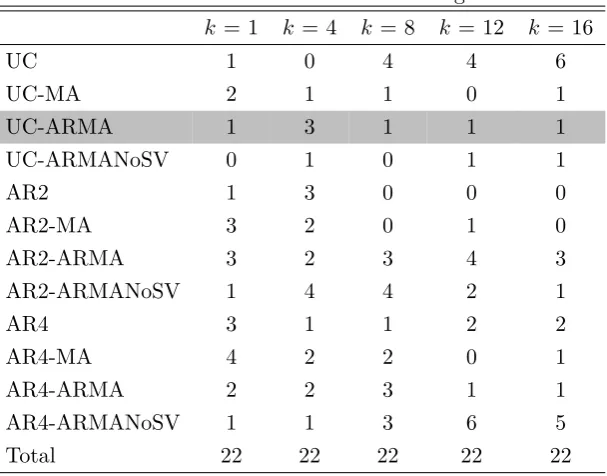
following two tables present the winning times for each specification across short to long horizons, and their winning percentages in the whole data sets are given below
the winning times. Although the results of the MSFE and RelMSFE are kept to four
decimal places, there is still one case where two models, AR2andAR4-MA, tied for the best performance in thek=16horizon for the No. 22 variable forecasting exercise,
so the total number of winning models is 23 and the outperforming percentages are
[image:37.595.146.490.295.496.2]also calculated by dividing by 23 other than 22.
Table 2.2: The number and percentage of the best models with different error specifi-cations based on MSFE for 22 macroeconomic variable forecasting.
k= 1 k = 4 k= 8 k= 12 k= 16
RW 2 1 0 0 0
9.1% 4.5% 0% 0% 0%
with only SV error 4 1 6 5 5
18.2% 4.5% 27.3% 22.7% 21.7%
with MA error 5 7 2 3 4
22.7% 31.8% 9.1% 13.6% 17.4%
with ARMA error 9 9 7 6 8
40.9% 40.9% 31.8% 27.3% 34.8%
with ARMA NoSV error 2 4 7 8 6
9.1% 18.2% 31.8% 36.4% 26.1%
Total 22 22 22 22 23
Table 2.2 showsex anteforecasting evidence that models (UC, AR2, and AR4) with ARMA errors yield the best performance for point forecasting prediction in almost all
horizons except Horizon k= 12. For example, in the one-step-ahead forecast, models
with ARMA error have the smallest MSFE for nine variables in comparison with the other models, and this takes up to 40.9%in all 22 variables.
The results also suggest that models with MA error sometimes provide significantly better forecasting results in short horizons (1 and 4), while models with ARMA NoSV
error can give the best predictions in intermediate to long horizons (8 and 12). As
might be expected, even the benchmark RW can win twice in Horizon 1. However, none of these models can present steady good performance over all horizons like the
models with ARMA error. In other words, the results in Table 2.2 support that the
proposed ARMA error term is a robust forecasting device for point forecasts.
We interpret the results in Table 2.3 as important evidence that the UC model is a
models and the RW model. In Table 2.3, we can see that the UC group models dominate
other models in all horizons except Horizon 4. More specifically, half the variables in longer horizons (Horizons 12 and 16) prefer UC models, and UC models generate more
accurate forecasts than other models for over one-third of variables for a short horizon
[image:38.595.126.431.484.737.2](Horizon 1) and an intermediate horizon (Horizon 8).
Table 2.3: The number and percentage of the best models with different model group
specifications based on MSFE for 22 macroeconomic variable forecasting.
k= 1 k = 4 k = 8 k= 12 k= 16
RW group 2 1 0 0 0
9.1% 4.5% 0% 0% 0%
UC group 8 7 9 11 11
36.4% 31.8% 40.9% 50.0% 50.0%
AR2 group 7 5 7 4 5
31.8% 22.7% 31.8% 18.2% 22.7%
AR4 group 5 9 6 7 7
22.7% 40.9% 27.3% 31.8% 31.8%
Total 22 22 22 22 23
Table 2.4: The number of the best models based on MSFE for 22 macroeconomic
variable forecasting.
k= 1 k= 4 k = 8 k = 12 k = 16
RW 2 1 0 0 0
UC 0 1 3 1 2
UC-MA 4 3 0 2 3
UC-ARMA 3 2 3 2 1
UC-ARMANoSV 1 1 3 6 5
AR2 2 0 2 2 2
AR2-MA 1 2 1 0 0
AR2-ARMA 3 1 2 1 3
AR2-ARMANoSV 1 2 2 1 0
AR4 2 0 1 2 1
AR4-MA 0 2 1 1 1
AR4-ARMA 3 6 2 3 4
AR4-ARMANoSV 0 1 2 1 1
§2.4 Forecasting Results 21
For the two group autoregressive models, the short lag group (AR2) seems to have
better performance over shorter horizons, while the long lag group (AR4) shows better relative performance in longer horizons. It seems that the added lags in AR models
can capture the underlying persistence of the variables in longer horizons but occupy
too much SV in short horizons.
Table 2.4 presents the detailed forecasting performance for each specification. It
is not surprising that no specification can dominate the others for all variables in all
horizons. On one hand, the results in the preceding table suggest that the proposed UC-ARMAcan produces better performance than other specifications for some
vari-ables, such as real gross domestic product in shorter horizons (horizon one and four),
personal income in all horizons except horizon sixteen, real personal consumption ex-penditures in horizon eight, 10-year treasury constant maturity rate in longer horizons
(horizon eight to sixteen), and all employees: total nonfarm in horizon one. On the other hand, UC-ARMANoSV is selected as the best model for many variables in
horizon eight to sixteen, which indicates that UC-ARMA models without SV
specifica-tion can still work well in longer horizons for some variables. Meanwhile,AR4-ARMA is also a highly competitive specifications across forecasting horizons.
2.4.3 LPL Forecast Results
Turning to the analysis of the LPL forecast results in the preceding tables, we can
[image:39.595.145.490.534.708.2]see that the forecasting performance of all models is slightly different from the MSFE results.
Table 2.5: The number and percentage of the best models with different error specifi-cations based on RelLPL for 22 macroeconomic variable forecasting.
k= 1 k = 4 k= 8 k= 12 k= 16
with only SV error 5 4 5 6 8
22.7% 18.2% 22.7% 27.3% 36.4%
with MA error 9 5 3 1 2
40.9% 22.7% 13.6% 4.5% 9.1%
with ARMA error 6 7 7 6 5
27.3% 31.8% 31.8% 27.3% 22.7%
with ARMA NoSV error 2 6 7 9 7
9.1% 27.3% 31.8% 40.9% 31.8%
Total 22 22 22 22 22
average numbers of best forecasting models in all horizons. The relative performance of
models with only SV and ARMANoSV often improves considerably with longer forecast horizons. These results indicate that a flexible error innovation process may be good at
predicting the short-term evolution of a variable, while long horizon forecasts require
[image:40.595.139.416.250.388.2]less dynamic specifications in error terms.
Table 2.6: The number and percentage of the best models with different model group specifications based on RelLPL for 22 macroeconomic variable forecasting.
k= 1 k = 4 k = 8 k= 12 k= 16
UC group 4 5 6 6 9
18.2% 22.7% 27.3% 27.3% 40.9%
AR2 group 8 11 7 7 4
36.4% 50.0% 31.8% 31.8% 18.2%
AR4 group 10 6 9 9 9
45.5% 27.3% 40.9% 40.9% 40.9%
Total 22 22 22 22 22
Table 2.7: The number of the best model for each specification based on LPL for 22
macroeconomic variable forecasting.
k= 1 k= 4 k = 8 k = 12 k = 16
UC 1 0 4 4 6
UC-MA 2 1 1 0 1
UC-ARMA 1 3 1 1 1
UC-ARMANoSV 0 1 0 1 1
AR2 1 3 0 0 0
AR2-MA 3 2 0 1 0
AR2-ARMA 3 2 3 4 3
AR2-ARMANoSV 1 4 4 2 1
AR4 3 1 1 2 2
AR4-MA 4 2 2 0 1
AR4-ARMA 2 2 3 1 1
AR4-ARMANoSV 1 1 3 6 5
Total 22 22 22 22 22
In reference to the model group comparison in Table 2.6, the UC group performs
[image:40.595.127.431.451.689.2]§2.5 Concluding Remarks and Future Research 23
this time the AR4 group shows a relatively better performance in both the short and
long horizons.
The results in Table 2.7 indicate that each model has its own advantages in
forecast-ing variables with different characteristics. Although theUC-ARMAmodel does not
show a significant forecasting performance in interval forecasts, it has its advantages in all the horizons. It provides the best forecasts for real gross domestic product in
horizon four to twelve, personal income in horizon one and four, and real personal
con-sumption expenditures in horizon four and sixteen. It suggests thatUC-ARMAcan forecast some real activity variables well, and it could be helpful in predict the business
cycle for central banks. The ARMA error dynamic introduced in AR2-ARMA also
achieves a substantial forecasting improvement in all the specifications.
The results in the above MSFE and LPL tables suggest that no model or
speci-fication can dominate the others, and the best performing model varies for different
variables and forecast horizons. This holds in particular for forecasting metric changes from point forecasts to interval forecasts. When introducing the ARMA error term
into the UC model, the answer as to whether this model can produce out-of-sample forecasts that are better than those from other univariate models seems to be mixed.
Further, the byproductsAR2-ARMAandAR4-ARMAare also highly competitive
models.
2
.
5
Concluding Remarks and Future Research
In this chapter, we have extended the UC model by introducing an ARMA
compo-nent with SV evolution into the error term. By transforming the stacked matrix form of the model, the computation time is significantly reduced, and the serial dependence
induced by the ARMA component is resolved by an efficient precision-based algorithm
developed especially for this model.
This innovation in the error term was tested using 22 macroeconomic variables in the
US data, and the results show that this new component is necessary in estimation and
forecasting exercises for many variables, although not all of them. The point forecasting performance of UC-ARMAdisplays an improvement in forecast accuracy above the
average number of winning models, while the interval forecast results of UC-ARMA show thatUC-ARMAcan produce scores in all forecasting horizons. Future research
Appendix
2
.A
Full-Sample Estimation Results
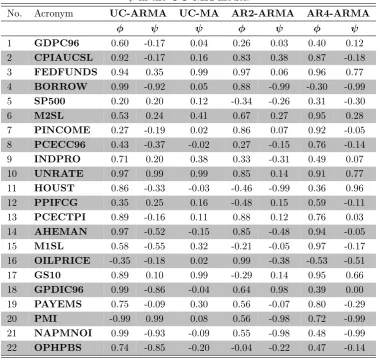
Our implementation of an MCMC algorithm and simulation of parameters is straight-forward under a fast precision-based algorithm. The initial values of variables are set
to zero and the prior of parameters are given a mean of zero with large variances. In
total, 50,000 draws are taken and the first 5,000 draws are discarded, so the next 45,000 draws are retained for computing the posterior properties of the interesting parameters.
Posterior Modes of ϕ and ψ
Following Chan (2013) we set the moving average order in the MA-SV model
vari-ants to be one. For consistency, we also set each of the specifications with ARMA(p,q)
[image:42.595.88.467.379.738.2]errors to be ARMA(1,1). The results for ϕand ψ of models UC, AR2, and AR4 with ARMA errors, as well as the UC-MA model, are summarized in Table 2.8.
Table 2.8: The modes ofϕand ψin models with ARMA-SVerrors and the mode of
ψin the UC-MAmodel.
No. Acronym UC-ARMA UC-MA AR2-ARMA AR4-ARMA
ϕ ψ ψ ϕ ψ ϕ ψ
1 GDPC96 0.60 -0.17 0.04 0.26 0.03 0.40 0.12 2 CPIAUCSL 0.92 -0.17 0.16 0.83 0.38 0.87 -0.18
3 FEDFUNDS 0.94 0.35 0.99 0.97 0.06 0.96 0.77
4 BORROW 0.99 -0.92 0.05 0.88 -0.99 -0.30 -0.99
5 SP500 0.20 0.20 0.12 -0.34 -0.26 0.31 -0.30 6 M2SL 0.53 0.24 0.41 0.67 0.27 0.95 0.28
7 PINCOME 0.27 -0.19 0.02 0.86 0.07 0.92 -0.05
8 PCECC96 0.43 -0.37 -0.02 0.27 -0.15 0.76 -0.14
9 INDPRO 0.71 0.20 0.38 0.33 -0.31 0.49 0.07 10 UNRATE 0.97 0.99 0.99 0.85 0.14 0.91 0.77
11 HOUST 0.86 -0.33 -0.03 -0.46 -0.99 0.36 0.96
12 PPIFCG 0.35 0.25 0.16 -0.48 0.15 0.59 -0.11
13 PCECTPI 0.89 -0.16 0.11 0.88 0.12 0.76 0.03 14 AHEMAN 0.97 -0.52 -0.15 0.85 -0.48 0.94 -0.05
15 M1SL 0.58 -0.55 0.32 -0.21 -0.05 0.97 -0.17
16 OILPRICE -0.35 -0.18 0.02 0.99 -0.38 -0.53 -0.51
17 GS10 0.89 0.10 0.99 -0.29 0.14 0.95 0.66 18 GPDIC96 0.99 -0.86 -0.04 0.64 0.98 0.39 0.00
19 PAYEMS 0.75 -0.09 0.30 0.56 -0.07 0.80 -0.29
20 PMI -0.99 0.99 0.08 0.56 -0.98 0.72 -0.99