The Hoard: Paged Virtual Memory
for the Cell BE SPE
Jonathan Adamczewski, B. Comp. (Hons)
Submitted in fulfilment of the
requirements for the Degree of
Doctor of Philosophy
University of Tasmania
Note
This thesis should be printed in colour, or an additional copy requested from
the author. Black and white reproduction (such as a photocopy) will lose
ii
Declaration of Originality
This thesis contains no material that has been accepted for a degree or diploma by the
University or any other institution, except by way of background information and duly
acknowledged in the thesis, and to the best of my knowledge and belief no material
previ-ously published or written by another person except where due acknowledgement is made
in the text of the thesis, nor does the thesis contain any material that infringes copyright.
Authority of Access
This thesis may be made available for loan and limited copying and communication in
accordance with the Copyright Act 1968.
iv
Statement of Ethical Conduct
The research associated with this thesis abides by the international and Australian codes on
human and animal experimentation, the guidelines by the Australian Government’s Office
of the Gene Technology Regulator and the rulings of the Safety, Ethics and Institutional
Biosafety Committees of the University.
Abstract
The hoard is a paged virtual memory system for program data designed for the Cell
Broad-band Engine processor (Cell BE). The hoard makes it easier to utilise the performance
available from the processor’s Synergistic Processor Elements (SPEs). Traditional
high-performance hardware cache designs are not well-suited to being implemented in
soft-ware on the Cell BE architecture, so the hoard takes advantage of the SPE’s wide registers
to implement a multi-level page table. This permits fast, fully associative lookup into a
dynamically-sized collection of data pages. Write-back of all pages is performed (not just
those modified) and a first-in first-out page replacement method is used. This design is
compared with the software cache provided with the IBM SDK for Multicore Acceleration
— a fixed-size, four-way set associative design, using a traditional hardware approach —
through extensive experiments with a diverse range of benchmarks. An in-depth analysis
is made of the performance of the hoard design, addressing its strengths and shortcomings.
From this analysis, potential improvements to the hoard are considered, implemented,
and their relative benefits measured. Changes include the tracking of page modification,
pre-writing of pages, use of a write-through policy, pre- and partial-fetching of pages, and
alternative replacement algorithms. Results show that simple and speculative methods are
often the most beneficial, and that performance varies greatly depending on the memory
access patterns of a particular program. It was found that programs with high locality of
access will perform better when using the hoard, in some cases exceeding the performance
of the same program running on the Power Processor Element of the Cell BE. For programs
with lower locality of reference, performance of the hoard and SDK cache are within a few
percent of one another.
An additional design goal for the hoard is to make the access and management of data
outside of the SPE’s local store as transparent as possible to the programmer. Not
imple-mented as part of a particular compiler, the hoard is a compile- and run-time library that
makes use of C++ language features to provide a natural pointer interface, requiring a
minimal amount of changes to existing programs. Careful implementation of the interface
ensures that program semantics are well preserved and accidental misuse is discouraged,
while taking advantage of the features of the Cell BE to provide high-speed lookup. The
vi
Acknowledgements
There are so many people that have contributed to this thesis, many without realising it.
Thanks to Arthur, for stepping forward at the very start to supervise a candidate lacking
a clear direction, and to Julian for joining him in that task. There is no way that this would
have made it to completion without your encouragement, detailed and thorough feedback,
and honest reflections on my progress. Thanks also to Arthur for a name for the thesis.
The review and comments from Arthur, Julian, Ian, David, Joe, and Karen have made
an immeasurable difference to this thesis. Thank you all for your persistence and effort.
My thanks to the staff of the School of Computing & (now) Information Systems who
were especially helpful with the range of strange and awkward requests — Dave who could
always find me a desk, an IP address, a TV, and/or a PS3 when needed, Andrew for great
fortitude in repeatedly confronting the video-conferencing system, Tony, Christian, Julia,
Andrea, and all the others who answered questions or solved problems over the course of
writing this thesis.
Thanks to Ian Lewis for the very occasional, but wonderfully in-depth conversations,
and some useful hints.
Thanks to the very helpful individuals at the Barcelona Supercomputing Center, who
very generously provided access to their Cell BE blades.
To Jeremy Kerr for taking the time to drive me around Canberra and introduce me
to OzLabs, Ben Elliston and others there (and in other IBM offices) who have answered
questions and been generally encouraging in lots of little ways, not least Ken Werner, Ulrich
Weigand, and Arnd Bergmann. And to those from (and formerly from) Sony who have also
offered assistance on numerous occasions, especially Geoff Levand and Andrew Pinski. My
sincere thanks to you all.
And thanks to the (other) resident lurkers of#ps3dev,#ps3linux,#cell,#ouros
(forever tears), and#cesspool. All these channels have served to provide technical
sup-port, entertainment, distraction, sanity, conversation in obscure dialects, and — from time
to time — very useful information. Thanks also to the many gamedevs (and other devs)
Thanks to Menace and all the cr3w for makingdcyphersuch a great way to lose entire
weeks.
To Will and Gill for friendship, love and care, for me and my family, and to the
Connec-tions mob for being such a fantastically wonderful and diverse bunch.
Thanks to my parents and Karen’s for their continued care and support for our family.
And many, many thanks to my loving, patient, supportive, hard-working, and
encour-aging wife and to my wonderful, wonderful daughters. I don’t know what comes next, but
viii
Jonathan Adamczewski Burnie, Tasmania, Australia
September 2010
Contents
1 Introduction 1
2 Background — Memory Hierarchies 3
2.1 Virtual Memory . . . 4
2.1.1 Overview . . . 4
2.1.2 Implementation . . . 6
2.1.3 But, at what cost? . . . 7
2.1.4 Replacement . . . 9
2.1.5 Compression . . . 12
2.2 Caches . . . 12
2.2.1 Data placement . . . 13
2.2.2 Replacement . . . 14
2.2.3 Write policy . . . 14
2.3 Fast caches . . . 15
2.3.1 Expecting more, doing less . . . 16
3 Memory and the Cell BE SPE 18 3.1 IBM SDK for Multicore Acceleration . . . 18
3.1.1 SDK software cache . . . 19
3.1.2 Named address spaces . . . 19
3.1.3 IBM single source compiler . . . 20
3.1.4 Automatic overlay generation . . . 20
3.2 COMIC . . . 21
3.3 “A Novel Asynchronous Software Cache” . . . 21
3.4 “Hybrid Access-Specific Software Cache Techniques” . . . 22
3.5 Codeplay Offload . . . 22
3.6 Other . . . 22
3.7 Summary . . . 24
4 The Architecture of the Cell Broadband Engine 26 4.1 Background to the processor . . . 26
4.1.1 Power wall . . . 27
4.1.2 Memory wall . . . 28
4.1.3 Frequency wall . . . 29
CONTENTS x
4.2 Processor features . . . 30
4.2.1 The Power Processor Element . . . 31
4.2.2 Synergistic Processor Elements . . . 31
4.2.2.1 Size and alignment . . . 34
4.2.2.2 The place of the SPE in the chain of command . . . 34
4.2.2.3 Operating environment . . . 35
4.3 Access to the Cell BE . . . 36
5 Architecture of the Hoard 38 5.1 Origins and function . . . 38
5.2 The evolution of a design — it starts with a name . . . 40
5.3 A first cut . . . 41
5.4 The Descriptor . . . 41
5.5 Creating descriptors . . . 44
5.6 Indirection . . . 46
5.6.1 How many bytes? . . . 47
5.6.2 An implementation detail or two . . . 49
5.7 The need for better memory management . . . 51
5.8 Segregation . . . 52
5.9 Why not model a hardware cache? . . . 54
5.10 Fast virtual memory . . . 58
5.11 Reinventing the wheel . . . 59
6 The Hoard API 60 6.1 The implementation of the hoard user interface . . . 60
6.1.1 Declaration . . . 61
6.1.2 Construction and assignment . . . 61
6.1.2.1 Default construction . . . 62
6.1.2.2 Copy construction or assignment fromhoard_ptr<T> . . . 62
6.1.2.3 Explicit construction from ha_t . . . 62
6.1.2.4 Construction or assignment from zero . . . 62
6.1.2.5 hoard_ptr<void>specialisation . . . 63
6.1.3 Dereferencing . . . 63
6.1.4 Comparison . . . 64
6.1.5 Arithmetic operators . . . 64
6.2 Access ordering via proxy object . . . 65
6.2.1 hoard_ref . . . 66
6.2.2 Limitations ofhoard_ref . . . 66
6.2.2.1 Compound types . . . 67
6.2.2.2 Untyped expressions . . . 68
6.2.2.3 Address of indexed array element . . . 69
6.3 Basic hoard configuration . . . 69
6.4 Adopting the hoard . . . 69
6.4.2 File access . . . 70
6.4.3 Memory manipulators . . . 71
6.5 Porting example . . . 71
6.6 Alternatives . . . 75
6.6.1 The bigger picture — why compile- and run-time? . . . 75
6.6.2 More specific —hoard_refspecialisations . . . 76
6.6.2.1 Modifying the compiler . . . 77
6.6.2.2 Manually splitting assignments . . . 77
6.6.2.3 Locking pages . . . 77
7 Methodology 78 7.1 Overview of benchmarks . . . 78
7.1.1 qsort— quicksort . . . 79
7.1.2 hsort— heap sort . . . 79
7.1.3 julia_set— 3D fractal renderer . . . 80
7.1.4 179.art— neural net based image recognition . . . 80
7.1.5 181.mcf— min cost flow solver, transport scheduling . . . 81
7.1.6 183.equake— earthquake propagation simulation . . . 81
7.1.7 mpeg2decode— MPEG2 video decoder . . . 81
7.2 Unsuccessful —256.bzip2 . . . 81
7.3 Benchmark compilation . . . 82
7.4 Benchmark modification . . . 83
7.4.1 Language-related changes . . . 83
7.4.2 Abstraction-related changes . . . 83
7.4.3 Changes related to building comparable versions . . . 84
7.4.4 Limited RAM on PlayStation 3 . . . 85
7.4.5 Shadow reference specialisations . . . 85
7.5 Experimentation . . . 85
7.5.1 Rationale . . . 85
7.5.2 Measurement confidence . . . 86
8 Results & Evaluation 88 8.1 qsort . . . 88
8.1.1 Summary forqsort . . . 93
8.2 hsort . . . 93
8.2.1 Summary forhsort . . . 99
8.3 julia_set . . . 99
8.3.1 Summary forjulia_set . . . 104
8.4 179.art . . . 104
8.4.1 Summary for179.art . . . 109
8.5 181.mcf . . . 109
8.5.1 Summary for181.mcf . . . 110
8.6 183.equake . . . 114
CONTENTS xii
8.7 mpeg2decode . . . 119
8.7.1 Summary formpeg2decode . . . 123
8.8 Interim Conclusions . . . 123
8.9 Comparison with COMIC . . . 124
9 Optimisation 127 9.1 Write back only modified pages . . . 129
9.1.1 Overview . . . 129
9.1.2 Potential impact . . . 129
9.1.3 Implementation . . . 130
9.1.3.1 Flagging the descriptor . . . 130
9.1.3.2 Quadword-mask . . . 131
9.1.4 Results . . . 131
9.1.5 Summary . . . 132
9.2 Pre-writing pages . . . 135
9.2.1 Overview . . . 135
9.2.2 Potential impact . . . 135
9.2.3 Implementation . . . 135
9.2.4 Results . . . 135
9.2.5 Summary . . . 136
9.3 Write-through . . . 138
9.3.1 Overview . . . 138
9.3.2 Potential impact . . . 138
9.3.3 Implementation . . . 138
9.3.4 Results . . . 138
9.3.5 Summary . . . 139
9.4 Pre-fetching data . . . 141
9.4.1 Overview . . . 141
9.4.2 Potential impact . . . 141
9.4.3 Implementation . . . 142
9.4.3.1 Sentinel values in local-store addresses . . . 142
9.4.3.2 Separate pre-fetch flag in page descriptor . . . 143
9.4.3.3 Remainder of the implementation . . . 144
9.4.4 Results . . . 147
9.4.5 Summary . . . 147
9.5 Partial page fetching . . . 149
9.5.1 Overview . . . 149
9.5.2 Potential impact . . . 149
9.5.3 Implementation . . . 150
9.5.3.1 DMA ordering, again . . . 151
9.5.4 Results . . . 152
9.5.5 Summary . . . 152
9.6.1 Overview . . . 152
9.6.2 A simple alternative . . . 154
9.6.3 Observations . . . 154
9.6.4 Alternate replacement algorithms . . . 155
9.6.5 Results . . . 158
9.6.6 Summary . . . 164
9.7 Optimisation conclusions . . . 165
9.7.1 Reducing write latency . . . 165
9.7.2 Reducing fetch latency . . . 166
9.7.3 Reducing the number of misses . . . 166
9.7.4 Other possible improvements . . . 167
10 Conclusions 169 10.1 Implementation . . . 169
10.2 Interface . . . 171
10.3 Performance . . . 171
10.3.1 Comparative performance . . . 172
10.4 Optimal configuration . . . 173
11 Further work 175 11.1 Extending the scope of the hoard . . . 175
11.2 Parallel computation . . . 176
11.2.1 Test more parallel programs . . . 176
11.2.2 Support for synchronisation . . . 177
11.3 COMIC . . . 177
11.4 Further optimisation . . . 177
11.5 Other programs . . . 179
11.6 Closer investigation . . . 179
11.7 Better hardware/OS integration . . . 179
11.8 Optimisation of specific uses . . . 180
11.9 Other technological advances . . . 180
11.9.1 Hardware . . . 180
11.9.2 Software . . . 181
References 181 A The hoard API 195 A.1 hoard_ptr . . . 195
A.2 hoard_ref . . . 197
List of Figures
2.1 The gap in performance between memory and processors over time . . . 8
3.1 Example of named address space syntax . . . 20
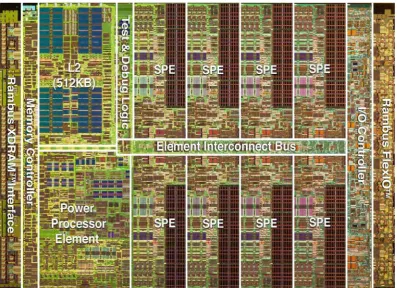
4.1 Layout of the Cell Broadband Engine processor. Source: IBM Corp. . . 27
4.2 The Cell BE memory hierarchy, latencies and sizes. . . 29
4.3 High-level structure of the Cell BE processor . . . 30
4.4 SPE vector register usage and preferred slots . . . 33
5.1 Local address in a quadword . . . 42
5.2 Burroughs B6700 data descriptor format, from Hauck & Dent 1968 . . . 43
5.3 hoard descriptor layout with ea and size fields . . . 44
5.4 Reverse lookup for descriptors . . . 45
5.5 SPE local store space usage — simple page table . . . 46
5.6 d-page descriptors and d-pages . . . 47
5.7 SPE local store space usage — smaller page table . . . 48
5.8 SPE local store space usage — worst case with d-pages . . . 48
5.9 data descriptor and d-page descriptor with usage counter . . . 49
5.10 d-page generation . . . 50
5.11 Hoard address format and mapping to a local store address . . . 52
5.12 SPE local store space usage — example of separate d-page storage . . . 53
5.13 d-page descriptor with cont. field . . . 53
5.14 SDK cache lookup of qword — implementation . . . 55
5.15 SDK cache lookup of qword — generated assembly . . . 56
5.16 Hoard lookup of qword — implementation . . . 57
5.17 Hoard lookup of qword — generated assembly . . . 57
6.1 Use of hoard pointer types . . . 62
7.1 Images rendered withjulia_set . . . 80
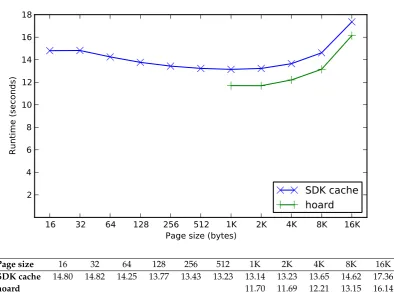
8.1 Runtimes of hoard and SDK cache forqsort . . . 89
8.2 DMA operation count of hoard and SDK cache forqsort . . . 91
8.3 Total data transfer of hoard and SDK cache forqsort . . . 91
8.4 Average DMA throughput of hoard and SDK cache forqsort . . . 92
8.5 Runtimes of hoard and SDK cache forhsort . . . 95
8.6 DMA operation count of hoard and SDK cache forhsort . . . 96
8.7 Split DMAgetandputcounts of hoard and SDK cache forhsort . . . 96
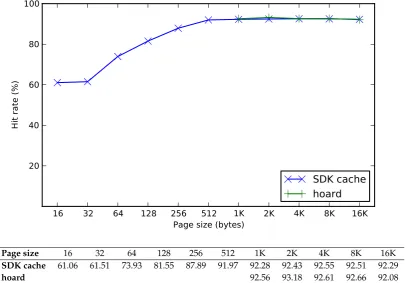
8.8 Hit rates of hoard and SDK cache forhsort . . . 97
8.9 Total data transfer of hoard and SDK cache forhsort . . . 97
8.10 Average DMA throughput of hoard and SDK cache forhsort . . . 98
8.11 Images rendered withjulia_set . . . 99
8.12 Example of a tiled texture . . . 100
8.13 Runtimes of hoard and SDK cache forjulia_set . . . 101
8.14 DMA operation count of hoard and SDK cache forjulia_set . . . 101
8.15 Hit rates of hoard and SDK cache forjulia_set . . . 102
8.16 Total data transfer of hoard and SDK cache forjulia_set . . . 102
8.17 Average DMA throughput of hoard and SDK cache forjulia_set . . . 103
8.18 Runtimes of hoard and SDK cache for179.art . . . 105
8.19 Split DMAgetandputcounts of hoard and SDK cache for179.art . . . 106
8.20 Hit rates of hoard and SDK cache for179.art . . . 107
8.21 Total data transfer of hoard and SDK cache for179.art . . . 107
8.22 Average DMA throughput of hoard and SDK cache for179.art . . . 108
8.23 Runtimes of hoard and SDK cache for181.mcf . . . 111
8.24 Hit rates of hoard and SDK cache for181.mcf . . . 111
8.25 Split DMAgetandputcounts of hoard and SDK cache for181.mcf . . . 112
8.26 Total data transfer of hoard and SDK cache for181.mcf . . . 112
8.27 Average DMA throughput of hoard and SDK cache for181.mcf . . . 113
8.28 Runtimes of hoard and SDK cache for183.equake . . . 114
8.29 Hit rates of hoard and SDK cache for183.equake . . . 115
8.30 Split DMAgetandputcounts of hoard and SDK cache for 183.equake . . 116
8.31 Total data transfer of hoard and SDK cache for183.equake . . . 117
8.32 Average DMA throughput of hoard and SDK cache for183.equake . . . 118
8.33 Runtimes of hoard and SDK cache formpeg2decode . . . 119
8.34 Split DMAgetandputcounts of hoard and SDK cache formpeg2decode . . 120
8.35 Hit rates of hoard and SDK cache formpeg2decode . . . 121
8.36 Total data transfer of hoard and SDK cache formpeg2decode . . . 121
8.37 Average DMA throughput of hoard and SDK cache formpeg2decode . . . . 122
8.38 COMIC lookup of qword — generated assembly . . . 125
9.1 Split DMAgetandputcounts of hoard and SDK cache for181.mcf . . . 129
9.2 One dirty byte, stored in the descriptor . . . 130
9.3 Using thefsmbiinstruction to mark a page dirty . . . 131
9.4 Change in runtime for all tested programs when writing only modified pages . . . 133
9.5 Page fetch logic change as pseudo-code . . . 136
9.6 Change in runtime for all tested programs when pre-writing . . . 137
LIST OF FIGURES xvi
9.8 Change in runtime for all tested programs when using a write-through
pol-icy . . . 140
9.9 Pre-fetch logic as pseudo-code . . . 141
9.10 Regular hoard access . . . 142
9.11 Hoard access, checking sentinel . . . 143
9.12 Descriptor with pre-fetched page address . . . 144
9.13 Fetching page written without sync as pseudo-code . . . 145
9.14 Successor pre-fetching cases . . . 146
9.15 Safe pre-fetching as pseudo-code . . . 147
9.16 Change in runtime for all tested programs when pre-fetching a successor page . . . 148
9.17 Split page fetching as pseudo-code . . . 150
9.18 Handling multiple pending, unfenced DMA operations as pseudo-code . . . 151
9.19 Change in runtime for all tested programs when performing split page fetches . . . 153
9.20 Change in runtime for all tested programs when using Clock replacement . . 156
9.21 Change in runtime for all tested programs with various replacement meth-ods . . . 160
List of Tables
5.1 Address space size for a range of page sizes, with a limit of 4096 descriptors . 46
5.2 Address space size for a range of page sizes, with a two level lookup . . . 48
5.3 Page and d-page sizes for 256MB addressable space . . . 54
9.1 DMAputoperations for base hoard configuration and descriptor flag method
. . . 134
9.2 DMAgetoperations for FIFO and Second Chance Clock methods . . . 157
9.3 Runtimes of all tested programs with various replacement methods . . . 161
9.4 Decrease in DMA operations with various replacement methods —
qsort,hsort&179.art . . . 162
9.5 Decrease in DMA operations with various replacement methods —
181.mcf,183.equake,mpeg2decode&julia_set . . . 163
The Hoard: Paged Virtual Memory
for the Cell BE SPE
Jonathan Adamczewski, B. Comp. (Hons)
Submitted in fulfilment of the
requirements for the Degree of
Doctor of Philosophy
University of Tasmania
for the Cell BE SPE
Jonathan Adamczewski, B. Comp. (Hons)
Submitted in fulfilment of the
requirements for the Degree of
Doctor of Philosophy
University of Tasmania
i
Note
This thesis should be printed in colour, or an additional copy requested from
the author. Black and white reproduction (such as a photocopy) will lose
Declaration of Originality
This thesis contains no material that has been accepted for a degree or diploma by the
University or any other institution, except by way of background information and duly
acknowledged in the thesis, and to the best of my knowledge and belief no material
previ-ously published or written by another person except where due acknowledgement is made
in the text of the thesis, nor does the thesis contain any material that infringes copyright.
iii
Authority of Access
This thesis may be made available for loan and limited copying and communication in
accordance with the Copyright Act 1968.
Statement of Ethical Conduct
The research associated with this thesis abides by the international and Australian codes on
human and animal experimentation, the guidelines by the Australian Government’s Office
of the Gene Technology Regulator and the rulings of the Safety, Ethics and Institutional
Biosafety Committees of the University.
v
Abstract
The hoard is a paged virtual memory system for program data designed for the Cell
Broad-band Engine processor (Cell BE). The hoard makes it easier to utilise the performance
available from the processor’s Synergistic Processor Elements (SPEs). Traditional
high-performance hardware cache designs are not well-suited to being implemented in
soft-ware on the Cell BE architecture, so the hoard takes advantage of the SPE’s wide registers
to implement a multi-level page table. This permits fast, fully associative lookup into a
dynamically-sized collection of data pages. Write-back of all pages is performed (not just
those modified) and a first-in first-out page replacement method is used. This design is
compared with the software cache provided with the IBM SDK for Multicore Acceleration
— a fixed-size, four-way set associative design, using a traditional hardware approach —
through extensive experiments with a diverse range of benchmarks. An in-depth analysis
is made of the performance of the hoard design, addressing its strengths and shortcomings.
From this analysis, potential improvements to the hoard are considered, implemented,
and their relative benefits measured. Changes include the tracking of page modification,
pre-writing of pages, use of a write-through policy, pre- and partial-fetching of pages, and
alternative replacement algorithms. Results show that simple and speculative methods are
often the most beneficial, and that performance varies greatly depending on the memory
access patterns of a particular program. It was found that programs with high locality of
access will perform better when using the hoard, in some cases exceeding the performance
of the same program running on the Power Processor Element of the Cell BE. For programs
with lower locality of reference, performance of the hoard and SDK cache are within a few
percent of one another.
An additional design goal for the hoard is to make the access and management of data
outside of the SPE’s local store as transparent as possible to the programmer. Not
imple-mented as part of a particular compiler, the hoard is a compile- and run-time library that
makes use of C++ language features to provide a natural pointer interface, requiring a
minimal amount of changes to existing programs. Careful implementation of the interface
ensures that program semantics are well preserved and accidental misuse is discouraged,
while taking advantage of the features of the Cell BE to provide high-speed lookup. The
Acknowledgements
There are so many people that have contributed to this thesis, many without realising it.
Thanks to Arthur, for stepping forward at the very start to supervise a candidate lacking
a clear direction, and to Julian for joining him in that task. There is no way that this would
have made it to completion without your encouragement, detailed and thorough feedback,
and honest reflections on my progress. Thanks also to Arthur for a name for the thesis.
The review and comments from Arthur, Julian, Ian, David, Joe, and Karen have made
an immeasurable difference to this thesis. Thank you all for your persistence and effort.
My thanks to the staff of the School of Computing & (now) Information Systems who
were especially helpful with the range of strange and awkward requests — Dave who could
always find me a desk, an IP address, a TV, and/or a PS3 when needed, Andrew for great
fortitude in repeatedly confronting the video-conferencing system, Tony, Christian, Julia,
Andrea, and all the others who answered questions or solved problems over the course of
writing this thesis.
Thanks to Ian Lewis for the very occasional, but wonderfully in-depth conversations,
and some useful hints.
Thanks to the very helpful individuals at the Barcelona Supercomputing Center, who
very generously provided access to their Cell BE blades.
To Jeremy Kerr for taking the time to drive me around Canberra and introduce me
to OzLabs, Ben Elliston and others there (and in other IBM offices) who have answered
questions and been generally encouraging in lots of little ways, not least Ken Werner, Ulrich
Weigand, and Arnd Bergmann. And to those from (and formerly from) Sony who have also
offered assistance on numerous occasions, especially Geoff Levand and Andrew Pinski. My
sincere thanks to you all.
And thanks to the (other) resident lurkers of#ps3dev,#ps3linux,#cell,#ouros
(forever tears), and#cesspool. All these channels have served to provide technical
sup-port, entertainment, distraction, sanity, conversation in obscure dialects, and — from time
to time — very useful information. Thanks also to the many gamedevs (and other devs)
vii
Thanks to Menace and all the cr3w for makingdcyphersuch a great way to lose entire
weeks.
To Will and Gill for friendship, love and care, for me and my family, and to the
Connec-tions mob for being such a fantastically wonderful and diverse bunch.
Thanks to my parents and Karen’s for their continued care and support for our family.
And many, many thanks to my loving, patient, supportive, hard-working, and
encour-aging wife and to my wonderful, wonderful daughters. I don’t know what comes next, but
Jonathan Adamczewski
Burnie, Tasmania, Australia
September 2010
Contents
1 Introduction 1
2 Background — Memory Hierarchies 3
2.1 Virtual Memory . . . 4
2.1.1 Overview . . . 4
2.1.2 Implementation . . . 6
2.1.3 But, at what cost? . . . 7
2.1.4 Replacement . . . 9
2.1.5 Compression . . . 12
2.2 Caches . . . 12
2.2.1 Data placement . . . 13
2.2.2 Replacement . . . 14
2.2.3 Write policy . . . 14
2.3 Fast caches . . . 15
2.3.1 Expecting more, doing less . . . 16
3 Memory and the Cell BE SPE 18
3.1 IBM SDK for Multicore Acceleration . . . 18
3.1.1 SDK software cache . . . 19
3.1.2 Named address spaces . . . 19
3.1.3 IBM single source compiler . . . 20
3.1.4 Automatic overlay generation . . . 20
3.2 COMIC . . . 21
3.3 “A Novel Asynchronous Software Cache” . . . 21
3.4 “Hybrid Access-Specific Software Cache Techniques” . . . 22
3.5 Codeplay Offload . . . 22
3.6 Other . . . 22
3.7 Summary . . . 24
4 The Architecture of the Cell Broadband Engine 26
4.1 Background to the processor . . . 26
4.1.1 Power wall . . . 27
4.1.2 Memory wall . . . 28
4.1.3 Frequency wall . . . 29
4.2 Processor features . . . 30
4.2.1 The Power Processor Element . . . 31
4.2.2 Synergistic Processor Elements . . . 31
4.2.2.1 Size and alignment . . . 34
4.2.2.2 The place of the SPE in the chain of command . . . 34
4.2.2.3 Operating environment . . . 35
4.3 Access to the Cell BE . . . 36
5 Architecture of the Hoard 38
5.1 Origins and function . . . 38
5.2 The evolution of a design — it starts with a name . . . 40
5.3 A first cut . . . 41
5.4 The Descriptor . . . 41
5.5 Creating descriptors . . . 44
5.6 Indirection . . . 46
5.6.1 How many bytes? . . . 47
5.6.2 An implementation detail or two . . . 49
5.7 The need for better memory management . . . 51
5.8 Segregation . . . 52
5.9 Why not model a hardware cache? . . . 54
5.10 Fast virtual memory . . . 58 5.11 Reinventing the wheel . . . 59
6 The Hoard API 60
6.1 The implementation of the hoard user interface . . . 60
6.1.1 Declaration . . . 61
6.1.2 Construction and assignment . . . 61
6.1.2.1 Default construction . . . 62
6.1.2.2 Copy construction or assignment fromhoard_ptr<T> . . . 62
6.1.2.3 Explicit construction from ha_t . . . 62
6.1.2.4 Construction or assignment from zero . . . 62
6.1.2.5 hoard_ptr<void>specialisation . . . 63
6.1.3 Dereferencing . . . 63
6.1.4 Comparison . . . 64
6.1.5 Arithmetic operators . . . 64
6.2 Access ordering via proxy object . . . 65
6.2.1 hoard_ref . . . 66
6.2.2 Limitations ofhoard_ref . . . 66
6.2.2.1 Compound types . . . 67
6.2.2.2 Untyped expressions . . . 68
6.2.2.3 Address of indexed array element . . . 69
6.3 Basic hoard configuration . . . 69
6.4 Adopting the hoard . . . 69
CONTENTS xi
6.4.2 File access . . . 70
6.4.3 Memory manipulators . . . 71
6.5 Porting example . . . 71
6.6 Alternatives . . . 75
6.6.1 The bigger picture — why compile- and run-time? . . . 75
6.6.2 More specific —hoard_refspecialisations . . . 76
6.6.2.1 Modifying the compiler . . . 77
6.6.2.2 Manually splitting assignments . . . 77
6.6.2.3 Locking pages . . . 77
7 Methodology 78
7.1 Overview of benchmarks . . . 78
7.1.1 qsort— quicksort . . . 79
7.1.2 hsort— heap sort . . . 79
7.1.3 julia_set— 3D fractal renderer . . . 80
7.1.4 179.art— neural net based image recognition . . . 80
7.1.5 181.mcf— min cost flow solver, transport scheduling . . . 81
7.1.6 183.equake— earthquake propagation simulation . . . 81
7.1.7 mpeg2decode— MPEG2 video decoder . . . 81
7.2 Unsuccessful —256.bzip2 . . . 81
7.3 Benchmark compilation . . . 82
7.4 Benchmark modification . . . 83
7.4.1 Language-related changes . . . 83
7.4.2 Abstraction-related changes . . . 83
7.4.3 Changes related to building comparable versions . . . 84
7.4.4 Limited RAM on PlayStation 3 . . . 85
7.4.5 Shadow reference specialisations . . . 85
7.5 Experimentation . . . 85
7.5.1 Rationale . . . 85
7.5.2 Measurement confidence . . . 86
8 Results & Evaluation 88
8.1 qsort . . . 88
8.1.1 Summary forqsort . . . 93
8.2 hsort . . . 93
8.2.1 Summary forhsort . . . 99
8.3 julia_set . . . 99
8.3.1 Summary forjulia_set . . . 104
8.4 179.art . . . 104
8.4.1 Summary for179.art . . . 109
8.5 181.mcf . . . 109
8.5.1 Summary for181.mcf . . . 110
8.6 183.equake . . . 114
8.7 mpeg2decode. . . 119
8.7.1 Summary formpeg2decode . . . 123
8.8 Interim Conclusions . . . 123
8.9 Comparison with COMIC . . . 124
9 Optimisation 127
9.1 Write back only modified pages . . . 129
9.1.1 Overview . . . 129
9.1.2 Potential impact . . . 129
9.1.3 Implementation . . . 130
9.1.3.1 Flagging the descriptor . . . 130
9.1.3.2 Quadword-mask . . . 131
9.1.4 Results . . . 131
9.1.5 Summary . . . 132
9.2 Pre-writing pages . . . 135
9.2.1 Overview . . . 135
9.2.2 Potential impact . . . 135
9.2.3 Implementation . . . 135
9.2.4 Results . . . 135
9.2.5 Summary . . . 136
9.3 Write-through . . . 138
9.3.1 Overview . . . 138
9.3.2 Potential impact . . . 138
9.3.3 Implementation . . . 138
9.3.4 Results . . . 138
9.3.5 Summary . . . 139
9.4 Pre-fetching data . . . 141
9.4.1 Overview . . . 141
9.4.2 Potential impact . . . 141
9.4.3 Implementation . . . 142
9.4.3.1 Sentinel values in local-store addresses . . . 142
9.4.3.2 Separate pre-fetch flag in page descriptor . . . 143
9.4.3.3 Remainder of the implementation . . . 144
9.4.4 Results . . . 147
9.4.5 Summary . . . 147
9.5 Partial page fetching . . . 149
9.5.1 Overview . . . 149
9.5.2 Potential impact . . . 149
9.5.3 Implementation . . . 150
9.5.3.1 DMA ordering, again . . . 151
9.5.4 Results . . . 152
9.5.5 Summary . . . 152
CONTENTS xiii
9.6.1 Overview . . . 152
9.6.2 A simple alternative . . . 154
9.6.3 Observations . . . 154
9.6.4 Alternate replacement algorithms . . . 155
9.6.5 Results . . . 158
9.6.6 Summary . . . 164
9.7 Optimisation conclusions . . . 165
9.7.1 Reducing write latency . . . 165
9.7.2 Reducing fetch latency . . . 166
9.7.3 Reducing the number of misses . . . 166
9.7.4 Other possible improvements . . . 167
10 Conclusions 169
10.1 Implementation . . . 169 10.2 Interface . . . 171 10.3 Performance . . . 171 10.3.1 Comparative performance . . . 172 10.4 Optimal configuration . . . 173
11 Further work 175
11.1 Extending the scope of the hoard . . . 175 11.2 Parallel computation . . . 176 11.2.1 Test more parallel programs . . . 176 11.2.2 Support for synchronisation . . . 177 11.3 COMIC . . . 177 11.4 Further optimisation . . . 177 11.5 Other programs . . . 179 11.6 Closer investigation . . . 179 11.7 Better hardware/OS integration . . . 179 11.8 Optimisation of specific uses . . . 180 11.9 Other technological advances . . . 180 11.9.1 Hardware . . . 180 11.9.2 Software . . . 181
References 181
A The hoard API 195
A.1 hoard_ptr . . . 195 A.2 hoard_ref . . . 197
List of Figures
2.1 The gap in performance between memory and processors over time . . . 8
3.1 Example of named address space syntax . . . 20
4.1 Layout of the Cell Broadband Engine processor. Source: IBM Corp. . . 27
4.2 The Cell BE memory hierarchy, latencies and sizes. . . 29
4.3 High-level structure of the Cell BE processor . . . 30
4.4 SPE vector register usage and preferred slots . . . 33
5.1 Local address in a quadword . . . 42
5.2 Burroughs B6700 data descriptor format, from Hauck & Dent 1968 . . . 43
5.3 hoard descriptor layout with ea and size fields . . . 44
5.4 Reverse lookup for descriptors . . . 45
5.5 SPE local store space usage — simple page table . . . 46
5.6 d-page descriptors and d-pages . . . 47
5.7 SPE local store space usage — smaller page table . . . 48
5.8 SPE local store space usage — worst case with d-pages . . . 48
5.9 data descriptor and d-page descriptor with usage counter . . . 49
5.10 d-page generation . . . 50
5.11 Hoard address format and mapping to a local store address . . . 52
5.12 SPE local store space usage — example of separate d-page storage . . . 53
5.13 d-page descriptor with cont. field . . . 53
5.14 SDK cache lookup of qword — implementation . . . 55 5.15 SDK cache lookup of qword — generated assembly . . . 56 5.16 Hoard lookup of qword — implementation . . . 57
5.17 Hoard lookup of qword — generated assembly . . . 57
6.1 Use of hoard pointer types . . . 62
7.1 Images rendered withjulia_set . . . 80
8.1 Runtimes of hoard and SDK cache forqsort . . . 89
8.2 DMA operation count of hoard and SDK cache forqsort . . . 91
8.3 Total data transfer of hoard and SDK cache forqsort . . . 91
8.4 Average DMA throughput of hoard and SDK cache forqsort . . . 92
LIST OF FIGURES xv
8.5 Runtimes of hoard and SDK cache forhsort . . . 95
8.6 DMA operation count of hoard and SDK cache forhsort . . . 96
8.7 Split DMAgetandputcounts of hoard and SDK cache forhsort . . . 96
8.8 Hit rates of hoard and SDK cache forhsort . . . 97
8.9 Total data transfer of hoard and SDK cache forhsort . . . 97
8.10 Average DMA throughput of hoard and SDK cache forhsort . . . 98
8.11 Images rendered withjulia_set . . . 99
8.12 Example of a tiled texture . . . 100
8.13 Runtimes of hoard and SDK cache forjulia_set . . . 101
8.14 DMA operation count of hoard and SDK cache forjulia_set . . . 101
8.15 Hit rates of hoard and SDK cache forjulia_set . . . 102
8.16 Total data transfer of hoard and SDK cache forjulia_set . . . 102
8.17 Average DMA throughput of hoard and SDK cache forjulia_set . . . 103
8.18 Runtimes of hoard and SDK cache for179.art . . . 105
8.19 Split DMAgetandputcounts of hoard and SDK cache for179.art . . . 106
8.20 Hit rates of hoard and SDK cache for179.art . . . 107
8.21 Total data transfer of hoard and SDK cache for179.art . . . 107
8.22 Average DMA throughput of hoard and SDK cache for179.art . . . 108
8.23 Runtimes of hoard and SDK cache for181.mcf . . . 111
8.24 Hit rates of hoard and SDK cache for181.mcf . . . 111
8.25 Split DMAgetandputcounts of hoard and SDK cache for181.mcf . . . 112
8.26 Total data transfer of hoard and SDK cache for181.mcf . . . 112
8.27 Average DMA throughput of hoard and SDK cache for181.mcf . . . 113
8.28 Runtimes of hoard and SDK cache for183.equake . . . 114
8.29 Hit rates of hoard and SDK cache for183.equake . . . 115
8.30 Split DMAgetandputcounts of hoard and SDK cache for 183.equake . . 116
8.31 Total data transfer of hoard and SDK cache for183.equake . . . 117
8.32 Average DMA throughput of hoard and SDK cache for183.equake . . . 118
8.33 Runtimes of hoard and SDK cache formpeg2decode . . . 119
8.34 Split DMAgetandputcounts of hoard and SDK cache formpeg2decode . . 120
8.35 Hit rates of hoard and SDK cache formpeg2decode . . . 121
8.36 Total data transfer of hoard and SDK cache formpeg2decode . . . 121
8.37 Average DMA throughput of hoard and SDK cache formpeg2decode . . . . 122
8.38 COMIC lookup of qword — generated assembly . . . 125
9.1 Split DMAgetandputcounts of hoard and SDK cache for181.mcf . . . 129
9.2 One dirty byte, stored in the descriptor . . . 130
9.3 Using thefsmbiinstruction to mark a page dirty . . . 131
9.4 Change in runtime for all tested programs when writing only modified pages
. . . 133
9.5 Page fetch logic change as pseudo-code . . . 136
9.6 Change in runtime for all tested programs when pre-writing . . . 137
9.8 Change in runtime for all tested programs when using a write-through
pol-icy . . . 140
9.9 Pre-fetch logic as pseudo-code . . . 141
9.10 Regular hoard access . . . 142
9.11 Hoard access, checking sentinel . . . 143
9.12 Descriptor with pre-fetched page address . . . 144 9.13 Fetching page written without sync as pseudo-code . . . 145 9.14 Successor pre-fetching cases . . . 146 9.15 Safe pre-fetching as pseudo-code . . . 147 9.16 Change in runtime for all tested programs when pre-fetching a successor
page . . . 148
9.17 Split page fetching as pseudo-code . . . 150 9.18 Handling multiple pending, unfenced DMA operations as pseudo-code . . . 151 9.19 Change in runtime for all tested programs when performing split page fetches
. . . 153 9.20 Change in runtime for all tested programs when using Clock replacement . . 156 9.21 Change in runtime for all tested programs with various replacement
meth-ods . . . 160
List of Tables
5.1 Address space size for a range of page sizes, with a limit of 4096 descriptors . 46
5.2 Address space size for a range of page sizes, with a two level lookup . . . 48
5.3 Page and d-page sizes for 256MB addressable space . . . 54
9.1 DMAputoperations for base hoard configuration and descriptor flag method
. . . 134
9.2 DMAgetoperations for FIFO and Second Chance Clock methods . . . 157
9.3 Runtimes of all tested programs with various replacement methods . . . 161
9.4 Decrease in DMA operations with various replacement methods —
qsort,hsort&179.art . . . 162
9.5 Decrease in DMA operations with various replacement methods —
181.mcf,183.equake,mpeg2decode&julia_set . . . 163
Chapter 1
Introduction
cache
a collection of items of the same type stored in a hidden or inaccessible place
hoard
a stock or store of money or valued objects, typically one that is secret or carefully guarded an amassed store of useful information, retained for future use
oxforddictionaries.com 2010
This research began with the idea of a softwarecachefor the Cell BE SPE. It became
apparent that ‘cache’ may not be the best word to use, as the assumptions that go into a
traditional cache design were not all appropriate for the architecture of the SPE, and to call
it a cache would evoke unhelpful associations in the mind of the user or researcher. The
namehoardwas suggested, and it has stuck.
This thesis documents the design and development of the hoard — a software paged
virtual memory system for the SPE, designed to aid program portability requiring minimal
changes to an existing program — and examines its performance for a selection of
bench-mark programs. The hoard simplifies the writing and reuse of programs for the SPE while
remaining suitable for use in a broad range of program types, and is used through a C++
smart-pointer style interface.
From the initial analysis, potential improvements are devised and tested to yield a
ver-satile, high-performing design.
CHAPTER 1. INTRODUCTION 2
The contents of this thesis are as follows:
Chapter 2 provides background and context for the ways memory hierarchies are
com-monly handled in computer systems, covering topics related to caching and virtual
mem-ory. Chapter 3 looks in depth at research related to the memory architecture of the SPE.
Chapter 4 contains a deeper examination of the Cell BE hardware, particularly as it
per-tains to implementing a virtual memory system for the SPE.
The design of the hoard is presented in Chapter 5, from the initial ideas through to a
completed implementation and the way it interacts with features of the Cell BE. In
Chap-ter 6, the hoard API — the inChap-terface of the hoard exposed to the programmer — is described,
with explanation of the problems encountered in its development and the solutions
imple-mented to create a C++ smart-pointer class that is able to be safely used in place of a regular
pointer. The chapter includes a case study of converting one of the programs benchmarked
in this thesis to make use of the hoard, and considers some of the difficulties that may be
encountered by a programmer using the hoard.
Chapter 7 contains the experimental method used to evaluate the hoard, along with
the benchmark programs chosen for doing so. In Chapter 8 the results of this evaluation
are presented with analysis. Based on these results, Chapter 9 details various attempted
optimisations of the hoard, working towards a tailored hoard design and configuration
that will perform well for a wide range of memory access patterns.
Chapter 10 provides the conclusions from this research and Chapter 11 lists further
Chapter 2
Background — Memory
Hierarchies
“Ideally one would desire an indefinitely large memory capacity such that any
partic-ular. . . word would be immediately available . . . We are . . . forced to recognise the
possibility of constructing a hierarchy of memories, each of which has greater capacity the preceding but which is less quickly accessible.”(Burks et al. 1946,p. 4)
In designing the hoard to meet the needs and use the features of the Cell BE SPE,
under-standing something of the history of how the same problems have been solved in different
contexts is useful. This chapter gives an overview of that history, which informs the design
of the hoard in later chapters.
Computer designs make use of memories of various sizes. Smaller memories are able to
be accessed more quickly, where larger, slower memories allow the storage of more
expan-sive datasets. In addition to speed and size, other constraints such as price, power, system
performance, availability, and required functionality influence the decisions of system
de-signers (Hennessy & Patterson 2007).
As per Tanenbaum (2007) and Hennessy & Patterson (2007), the memory hierarchy in a
‘typical’ computer consists of:
• A register file — a number of small storage locations that may be accessed quickly
and directly by the processor.
• Caches — small, fast storage used to hold data that is likely to be needed soon by a
running program.
CHAPTER 2. BACKGROUND — MEMORY HIERARCHIES 4
• Primary storage — a series of locations for storing program text and data, able to be
directly accessed by the processor.
• Secondary storage — a slower, larger storage system (disk, networked storage, etc.)
that is not directly accessible by the processor, but that allows for a memory address
space larger than the size of primary store.
The exact method of configuring and connecting these components varies, but they are the
established basic building blocks of high performance systems.
When writing programs for a system with a hierarchy like this, software abstractions
have evolved to the point where the average programmer is able to ignore all of these
details. The vast majority of high-level programming languages take the assignment of
instruction operands to processor registers away from the programmer, to be handled by
the compiler or interpreter. Memory caches operate in a fashion that is transparent to the
running program, locations for program data in primary storage are assigned by the
oper-ating system, and secondary storage will be utilised as necessary based on the demands of
this and other programs running on the system, also managed by the operating system. It
is not necessary for the average programmer to engage directly with any of these memory
hierarchy details. Drepper (2007) provides an in-depth introduction to the ways in which
each of these work in practice.
The abstraction commonly used to hide any the distinction between primary and
sec-ondary storage from a programmer is virtual memory (Denning 1970).
2.1
Virtual Memory
2.1.1
Overview
Virtual memory is, in general use, an abstraction that is provided by the hardware and
operating system to hide the details of the physical memory architecture from a running
program. In a system with virtual memory, the translation of virtual to physical addresses
is not a detail that needs consideration within the logic of a program.
There are a number of benefits of virtual memory: it decreases complexityfor the
grammer, who can ignore the implementation details of the memory architecture, and
memory space and helps to make them easily portable across a range of systems.
Reduced program complexity and increased generality comes at a cost. Hardware and
operating system routines for managing virtual memory require greater complexity, and
incur a time penalty in their use.
In systems that lack virtual memory, the specifics of the memory architecture are
ex-posed to the running program and, consequently, the programmer. The program must
include explicit logic to track and transfer data between memory levels.
For systems without virtual memory, the use of overlays is one approach that has been
used to help manage this process (Pankhurst 1968). The use of modules (or functions, or
subroutines) and data through the course of a program’s execution are statically examined
and these components are mapped into the memory space of the program. These
compo-nents are moved to and from physical memory locations at prescribed points during the
execution of the program.
Such manual methods are time consuming to implement and add an extra degree of
complexity for the programmer to manage. Programs that have highly indeterminate
mem-ory access patterns are more difficult to partition and efficiently manage (Denning 1970).
The extra work involved in manual memory partitioning is not without benefits.
Clar-ifying memory access patterns does make it clear when data may be fetched in advance of
its use, and written back as soon as it is finished with.
Originally developed as a way to hide the separation of storage devices on a system,
virtual memory simplifies the labours of programmers. It was first implemented in the
Atlas computer from Manchester University (Kilburn et al. 1962), and was also notably
present in the commercial Burroughs ‘large systems’ of the early 1960s. The Burroughs
systems provided a novel hardware implementation of virtual memory where data was
ac-cessed through descriptors (rather than the otherwise ubiquitous and typically unadorned
‘pointer’). Descriptors provided a hardware supported mechanism for tracking the
pres-ence of data in main store or in secondary storage of disk or drum (Organick 1973).
Denning (1970) provides a detailed analysis of some of the benefits and penalties of
using virtual memory, and makes a strong case for its inclusion in systems. Of
particu-lar note are the reduction in programmer time required and that performance is typically
comparable.
mem-CHAPTER 2. BACKGROUND — MEMORY HIERARCHIES 6
ory management. Denning (1996) mentions some other needs met through the use of
vir-tual memory systems. These include memory protection which allows control over which
parts of memory a program may access, what sort of access is possible (e.g. read only,
read/write, no-execute), and program modularity (being able to combine separately
com-piled components into a program, with no requirement of explicit coordination of memory
placement).
Virtual memory incurs an extra processing cost on a running system, requiring a
map-ping of virtual memory addresses to physical memory locations on every memory access.
In addition to this per-access overhead, the virtual memory system is responsible for
mov-ing data into physical memory as required by the runnmov-ing program(s), and writmov-ing out data
to make space as needed.
2.1.2
Implementation
Virtual memory is typically implemented using segmentation, paging, or a combination of
the two (Denning 1970).
Segments are variably sized sections of memory containing code and/or data that a
program may access while running. Segments provide a way to manage the various parts
of memory to which a program requires access, in an exclusive or shared fashion.
Seg-mentation provides an effective method for managing the logical separation of program
resources. For virtual memory, segments alone have some limitations: managing the
place-ment of variable-sized objects can be expensive in terms of time and space, particularly for
multi-programmed systems; segments are limited to the size of memory; and the locality of
access for programs is such that not all of a single segment is typically required in memory
at the same time (Tanenbaum 2007).
Paged virtual memory is the division of the virtual address space into fixed-size pages.
The advantages of this method are the easier management of data (re)placement in memory
and typically greater efficiency in moving pages from storage to storage. With paging,
the amount of space required and allocated will almost always be larger than the amount
of memory that a program requires as a single page is the minimum effective size of an
allocation. It is possible for the operating systems to help reduce this cost through the use
of pooled memory allocations.
manage-ment of storage, memory protection and other advantages (Tanenbaum 2007). When
com-bined in this way, a virtual address contains the necessary information to find the location
of the particular information in a segment and page, consisting of (at least) the segment
number, page number and an offset within a page.
2.1.3
But, at what cost?
The use of virtual memory incurs costs. These include performance, system complexity
and efficiency of memory use.
The page table serves as the way to map pages to locations, and may be implemented in
a number of ways, with various trade-offs in terms of size and space. Perhaps the simplest
page table lists virtual addresses and their mapping to a physical location. While simple
and fast to lookup the mapping for a given page, this method requires entries for all virtual
pages and so will need to be large enough for all virtual pages of all processes in the system.
Tanenbaum (2007) considers an example for a 64 bit system with 4KB pages and concludes
that
“Tying up 30 million gigabytes just for the page table is not a good idea, not now and probably not next year either.” (p. 200)
Techniques that are used to reduce the space needed for page tables include:
• inverted page tables;
• hash lookups;
• larger page sizes; and
• multi-level page tables.
Inverted page tables map physical locations to virtual addresses and have the advantage
of requiring entries only for physical memory, not the full size of the virtual address space.
Additionally, they may be dynamically sized, containing only entries for mapped pages.
Lookup requires a slower linear search, but the reverse page table is very space efficient.
Hash tables require more space than a minimal reverse page table, with the size being
traded off to gain speed of access, but will provide closer to the constant time lookup of a
CHAPTER 2. BACKGROUND — MEMORY HIERARCHIES 8
Another way to reduce the storage required for page tables is to use larger page sizes. By
doing so, the total number of pages needed for the address space of a program is reduced.
With fewer pages there are fewer page translation entries required, regardless of the page
table configuration. The cost of this approach is in decreased allocation efficiency as less
space is used in some pages, and page-fault latency increases with the amount of data that
must be transferred between memories. Page sizes of 4KB and 8KB are not uncommon, and
many processors additionally offer huge page sizes for use with large datasets, e.g. 4MB on
x86, 256MB on IA64, and up to 16GB on Power5+ systems.
Multi-level page tables are more complex to manage but reduce the size needed for page
tables. To perform the translation from virtual address to physical location will require at
least one extra memory access for each level of page table. Each of these is described in
more detail in Tanenbaum 2007, p. 198–201.
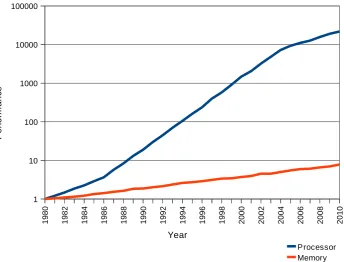
CPU performance has increased at a far greater rate than memory performance, and the
result has been a widening gap between the two, as is illustrated in Figure 2.1. By way of a
current example, the Cell BE processor at 3.2GHz experiences a delay around 500 cycles to
ABCDDA ECFA C
C
A
F
B
C
[image:45.595.132.477.436.698.2]Using 1980 performance as a baseline, this graph shows the widening gap between memory and CPU performance. Graph is based on the graph on page 289 of Hennessy & Patterson (2007).
read from RAM1, and a 3.8GHz Intel Core 2 Duo system2experiences around 400 cycles of
latency3.
It’s clear from these numbers that accessing memory is time consuming and
undesir-able, but address translations occur on almost every memory access. These in turn require
further accesses to memory to perform the translation. To speed up this process and to
avoid multiplying the number of memory accesses that must occur, a translation lookaside
buffer (TLB) is typically included in a processor to cache the most recently used mappings.
It is the presence of a fast TLB that makes a reverse page table a useful option for lookup.
Analogous to a TLB, a segment lookaside buffer (SLB) may also be included in a
pro-cessor to avoid memory accesses to map a virtual address to a particular segment.
2.1.4
Replacement
When a program requires a page that is not in primary store, a page fault occurs. Program
execution will be interrupted while a handler locates and transfers the page from its
lo-cation in secondary storage. This will typically take far longer than an access to primary
storage (by 10–100 times). This being the case, it is desirable to seek to minimise the number
of page faults that occur during the execution of a program.
Data access by a program is difficult or impossible to fully predict. There is a need for a
page replacement system that will be able to make a best guess as to which pages will not
be needed in the near future, so that pages may be replaced as infrequently as possible. For
paged virtual memory, this may be achieved in a number of ways.
Well-written programs tend to exhibit a high locality of reference — access to particular
pieces of data tend to happen close together in time, and data accesses tend to be to
ad-dresses close to one another. From this it can be concluded that if a page has been accessed
recently, it is likely to be accessed again in the near future. The concept of locality and the
history of the term is summarised neatly in Denning (2005).
At a given point in time, there will be a set of pages that will be accessed by a particular
program, known as the working set. Due to the localised nature of references, a program’s
working set does not change much over a small time window. If the working set for a
program is smaller than primary storage, page faults are much less frequent. From this
1Approximately 150ns, as measured withdmabenchfrom the IBM SDK for Multicore Acceleration Version 3.1
(IBM Corporation et al. 2008c)
2upon which this thesis was authored
CHAPTER 2. BACKGROUND — MEMORY HIERARCHIES 10
is can be seen that pages accessed within a certain time window are likely to be accessed
again in the near future. Pages which are not accessed during that time window are less
likely to be needed (Denning 1968).
If locality of reference and the presence of a page in the working set are indicators of
whether a page is a good candidate for removal, it should be considered how these
charac-teristics may be measured. To do this, the following metadata may be stored for a page:
• areferenceflag, to indicate whether a page has been referenced (read or written);
• amodifiedflag, to indicate whether a page has been written to;
• a timestamporordering, to indicate when or how long ago (relatively) that the page was last referenced; and
• counters, recording some characteristic of page use over time.
Using this information, various replacement algorithms have been developed. The
follow-ing are a summary of these, as presented in Tanenbaum (2007):
• Not Recently Used — requiring reference and modified flags and often handled in hardware, the operating system will prioritise page replacement to those that do not
have these flags set. The referenced flag of all pages is reset from time to time to be
able to indicate whether a page has been referenced during a certain time window.
• First In, First Out— the operating system maintains the loaded pages as a list, from most- to least-recently loaded. When page replacement is required, the oldest is
se-lected.
• Second Chance — requiring a reference bit and listing pages in the order they were loaded, the page at the head of the list is considered for replacement and given a
sec-ond chance if its reference flag is set — this happens by resetting the page’s reference
flag and moving it to the end of the list.
• Clock— where Second Chance moves pages around in a list, a more efficient method is to maintain a circular list of pages with a pointer to the head of the list (clock-hand).
When a new page is to be loaded, the page pointed to by the clock-hand is considered
and replaced if it has been unreferenced. Otherwise, the page’s reference bit is reset
and the hand is moved around the ‘clock-face’ and the next page is considered in the
• Least Recently Used— each time a page is accessed, it is moved to the end of the list of pages, the result being that the head of the list refers to the page that was accessed
longest ago, and therefore is an excellent candidate for replacement. The overhead of
updating the list at every access is often too expensive for this algorithm to be used
in practice.
• Not Frequently Used— a poor approximation of Least Recently Used, requiring a ref-erence bit and a page counter for each page. Like Not Recently Used, the refref-erence
flag is reset periodically, and if set, used to increment the counter. This counter gives
an indication of how many times the page has been accessed.
• Ageing — a variant of the Not Frequently Used method, rather than incrementing the counter, the counter is first shifted right and the highest bit set if the reference
flag is set. The resultant bitmask indicates the time windows in which the page was
accessed, providing more information about usage patterns.
• Working Set — requiring referenced and modified flags, this method also requires a timestamp for each page. The referenced flag is periodically reset. When a page
fault occurs, the list of pages is scanned to find a suitable page to replace. If a page’s
referenced flag is set, the timestamp for that page is set to the current time. If a page’s
referenced flag is not set and its timestamp is older than some threshold then the page
is deemed to not be part of the working set and so may be replaced.
• WSClock — again requiring referenced and modified flags and a timestamp, this method maintains a list of pages and a clock-hand, combining ideas from the
Work-ing Set and Clock methods. Pages pointed to are considered for replacement and if
not referenced, not modified, and older than the threshold are replaced. Pages that
have been modified are scheduled to be written and the counter is moved on directly.
Pages that have been referenced have their timestamp set to the current time and the
clock hand is moved on and the next page considered for replacement.
The running time overhead of these algorithms can vary greatly depending on the amount
of support provided by the system for recording the metadata.
Beyond these, a number of more advanced (and more complex) replacement algorithms
have been developed that provide better performance in a range of circumstances. LRU/k
CHAPTER 2. BACKGROUND — MEMORY HIERARCHIES 12
which page to replace, and2Q(Johnson & Shasha 1994) takes this idea further by managing
multiple queues to try to prioritise the replacement of pages based on frequency of use.
Working with the concept of page access recency, and maintaining page access histories
even after a page has left the cache,LIRS(Jiang & Zhang 2002),ARC(Megiddo & Modha
2003),CAR&CART (Bansal & Modha 2004), andCLOCK-Pro(Jiang et al. 2005) provide
smarter methods for managing page replacement. Where 2Q requires a selection of
param-eters to decide when a page should be considered to have a high access rate, CLOCK-Pro
manages page classification queues dynamically. A variant of ARC is used in the
Post-greSQL object-relational database system (Mustain 2005), and variants of the CLOCK-Pro
algorithm is used by the virtual memory systems of the Linux and NetBSD kernels.
Additionally, cost-aware replacement algorithms have been developed for special
mem-ory storage devices, such asCFLRU(Park et al. 2006) andCRAW-C(Park et al. 2009), which
take into account the different costs involved in handling writes and other operations when
utilising non-disk storage.
2.1.5
Compression
In a virtual memory system with relatively slow disk storage there may be a benefit to
keeping pages off-disk by compressing them in memory rather than transferring data to
and from disk. Thecompcachesystem in the Linux kernel (Gupta 2010) is a good example of
this approach. The results from compcache (2010) demonstrate clear performance benefits
in a range of uses.
The benefit of page compression will depend on the processor speed, disk I/O speed,
benefits of asynchronous disk I/O (if possible), size of the working set, and the size of
memory used for compressed and uncompressed pages.
2.2
Caches
The difference between processor and memory speeds affects not only virtual address
translation but all accesses to main memory for program code and data. Where segment
and translation lookaside buffers are specialised tools to increase the performance of
vir-tual memory use, the purpose of processor caches is to reduce the average latency for all