WP-3 Guideline for Data Collection
Christoph Furtschegger, Markus Schermer, Rebecka Milestad & Helmi Risku-Norja
First of all, it is important to stress that this proposal is to be seen as a guideline and not a strict prescription. The methodology we use in HealthyGrowth is goaldriven and the main goal of the case studies is to answer the overarching question of our project: How can growth happen without losing integrity and trust? To answer this question we have developed different theoretical analytical perspectives on the cases to be analyzed in WP5. To support the analysis in the different tasks and the comparative analysis, we need to describe empirically the cases (the case study reports to be elaborated in WP4). To make these descriptions we need to collect data and detailed information on the cases (the case study implementation in WP4). The qualitative data might derive from interviews with a formal questionnaire (i.e. stated practices, preferences, etc.) and observations (i.e. actual practice). Therefore we designed this guideline for data collection in accordance with the outline of the case-study report.
As indicated above it can be helpful to distinguish between theoretical (analytical) questions and empirical (descriptive) questions. The theoretical questions are those we want to answer in WP 5 (e.g. what are the preconditions for successfully management of value based organic food chains?). The empirical or descriptive questions are those we shall answer in the case study report, to be able to answer the analytical questions (e.g. what kinds of contracts and agreements are formed between the different partners in the food chain of the case study). That means that it is the empirical questions that are guiding our data collection and descriptions of the cases.
How to answer the empirical questions to make good case reports in the end is up to the national teams. We want to avoid the provision of a rigidly structured prescription for data collection with preformulated questions, because each case is different and each set of questions will vary according to the interview partner. However we provide a common set of basic empirical questions. We gathered this list of common questions from your feedback on the task perspectives. It should help you to develop your own design for the investigation.
To give you an overview of the needs regarding data collection we would like to draw your attention towards specific aspects of major relevance for our case study analysis. This shall serve as a concrete guideline on what we have to achieve until the Berlin meeting (see steps 1-3 in the timetable below). Just to remind you, the objects of our case studies are value chains and not actors or their network, therefore we would like to emphasize that the focus of our investigations is not only on the structure of the value chain, but primarily on the relationships between the actors from farmer to consumer. We want look specifically at relationships which structure for example values, organisational arrangements, the business logic and the exchange or flow of information. Thus we have to [1] analyse the published information as well as the descriptions of the initiative out of the perspective of different stakeholders and [2] describe value chains from the angle of the various analytical perspectives of WP5.
“Constellation Analysis” (see as an example literature from the core organic project iPOPY and another one regarding the use of wind energy attached) allows presenting the relations between actors and institutions in different ways and to picture changes over time etc.
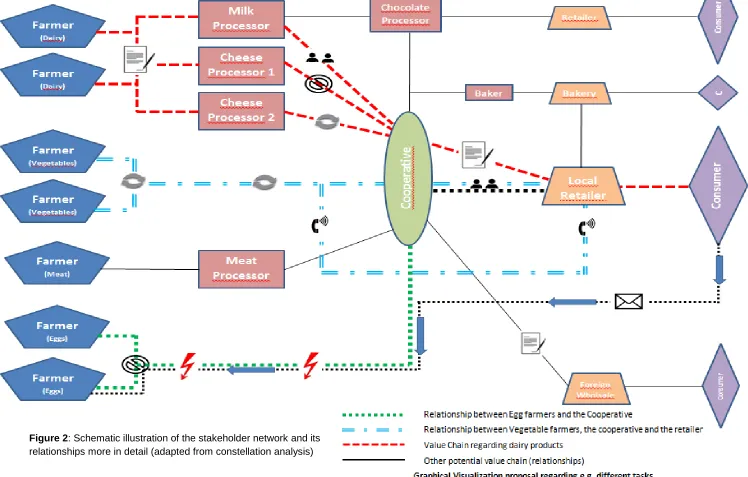
The basic idea of Constellation Analysis is to bring together various approaches, data sources, and forms of knowledge to create a picture of the constellation at large that can be shared by all participants involved, with the perspectives of various actors being brought together in a constructive way. Furthermore it is a way to visualize stakeholders and their relations and it assists to have a common basis for comparison. In the Annex (Figure 2) we have tried to give an example of how the constellation analysis may be adapted to our purpose.
The schematic visualisation might display numerous value-chains the business is involved in and give a first indication where it could be interesting to investigate configurations of relationships in depth out of the various task perspectives. Depending on the case there might be one supply chain selected to be investigated in detail, or it might be appropriate to look at different chains in different tasks (See Figure 2 of the Annex: For example the red-line indicates value-chain relationships that are very interesting to look at from the perspective of all tasks, whereas for Task 4, especially the blue line relationships, or for Task 6 especially the ones along the green line are pivotal).
However, even if there are various value-chains which would be interesting to look at, due to limited resources, we propose to select one or two value-chains that we study in all aspects according to the various tasks. The specific value chain(s) to be studied could be chosen according to various criteria (e.g. recently strong growth, particular dynamic development, very flexible and adaptive to frame conditions, already long time established chain, chain with the most salient values, special features concerning organisation, communication, comparison with other cases, etc.). Please provide a thorough reasoning for your choice.
We need to identify potential gaps for the comparative analysis already at an early stage. Therefore we ask you to provide an argued choice on the specific chain(s) to look at in each case, together with a preliminary Constellation Analysis and a short compilation of first findings until the 7th of March 2014 to the WP5 team. This should enable them identifying potential knowledge gaps until the Berlin meeting. Particular aspects which were not covered by the chosen value chain(s) could then be supplemented by other value chains(s) within the core cases or, if that is not possible, by satellite cases.
Timeline up to the Berlin meeting (First-Third Stage)
FIR
ST
S
TA
G
E
Collect and screen documents/public material analysis
Sample as comprehensive as possible published material on different actors of the value chain (be it on the internet, homepage, Master-, BA- or diploma thesis etc.; official registers, newspaper articles; commercials; magazines; leaflets; videos, images, information mediated via social media/Internet etc. ALL that’s available on first hand). This leads to the:
Public representation
What is the public representation of the case and its value chain relationships – How are they positioning/presenting themself to the outside.
Stakeholder analysis
Brainstorm all potential stakeholders connected to the case (internal or external). For a guide how to do a stakeholder analysis see the paper attached [Bryson, John (2004) – What to do when stakeholders matter?] The material for the public representation will yield an initial list. Try to categorize the stakeholders: draw a map, visualize it in a chart etc. (the initial list/chart/picture should be adapted/extended after the first sequence of the data collection key partners) [proposed way to do this is the Constellation Analysis tool – see Bruhns, E. 2011 & Nölting, B. 2009]; The purpose of this analysis is that it provides us with a first picture and delineation of the netchain to be studied; maybe various interesting value chain relations within businesses evolve; it may give an idea of which concrete chains could be potentially delineated and studied more in detail;
Identification of key partners for a first meeting
Decide on 3-5 key interview partners from different parts of the chain that have an internal perspective and a broad and tacit knowledge of the situation/history of the core-case as these interview partners will be approached at least 3-times. Most probably you will start with the person you have initially contacted to get the general agreement for conduction the case study. It is advisable to share the compilation of the topics/questions that will be discussed as well as the aggregated fact sheet in advance (if available).
* Keep in mind that all interviews (and workshops, focus groups) should be recorded (unless the interviewee opposes this), and the interview recordings should be transcribed. The analysis of the transcripts is best carried out using a set of key words/codes. A
tentative list of key words/codes is presented in the Annex (page 8), but this list needs editing and will thus be modified by all of us according to the needs. There are also software applications available (e.g. Atlas.ti) that help in organizing the material in a consequent way.
JAN
UA
RY
2
0
1
SEC
O
N
D
S
TA
G
E
First round of data collection for general description of the case
Collection of internal written material
In the interviews, ask for and collect written (internal) material like annual reports newsletters, strategy papers, written agreements, meeting protocols, campaign materials, customer surveys, training programs of the personnel or any other documented material the case is willing to provide This will underpin the
Self Presentation
Try to elicit in the first interviews what the different self representations of the cases and its value chain relationships along the chain(s) selected are. Try to find out whether the self perceptions/presentations differ between members of the value chain and with the public representations. The number of interviewees and the number of interviews will differ between the cases. Furthermore in some cases personal meetings with the interviewee will take place, while in other cases telephone calls/e-mail communication will be enough. It is up to case study researchers to judge this.
Selection of specific chain(s)
In cases that are complex and in accordance to task specifities we need to narrow the relations we want to investigate.
FEBR
U
AR
Y
20
14
THI
RD
ST
A
G
E
Preliminary “Constellation Analysis” & argued choice of the actual value chain(s) to study (sent to WP5 leaders by 7th of March 2014)
Decide and justify which chain(s) and which stakeholders will be analyzed more in detail (whom to approach for example with more detailed questions);
Data Compilation Report
Compilation of the results and findings from the first interviews
Further case study design
Selection of further interview partners or events/meetings to participate in order to collect the material needed to answer our analytical questions.
Detailed design of the data collection according to specifities of the case
M
AR
C
H
2
0
1
4
3rd HealthyGrowth Meeting @ IFSA-Berlin 1st of April 2014
- Structured Presentations on basic information of the cases (including task perspectives).
- Discussion of different designs with partners out of their task perspective;
- Discussion on methodological issues
- Discussion on satellite cases
FO URT H S TA G E
Second round of data collection: targeting additional description
more detailed questions based on the preliminary findings and the
feedback of WP5 [Depending on the case, several interview occasions may
be necessary. However, an adequate number of stakeholders identified to
be interesting to interview at the second stage, will be approached at least
once. The in-depth interviews can be supplemented by focus group
discussions, participatory observations, network meetings/stakeholder
workshops, etc.
Supplement information from satellite cases
AP R IL – JULY 2 01 4 FIFT H ST A G E
Draft Report
The results are compiled in a summary report in native language and in the case study reports. The case study reports are written in English for the internal use in HealthyGrowth project; they serve as raw material for the scientific articles, which approach the value-based organic food chains from the six different perspectives (organizational form, business management, balance between quality differentiation and economic performance, communication, consumer information, resilience). The template for the case study reports will be constructed so as to support these analyses. The first manuscripts for the core case study reports will be delivered to the WP4 leaders by the end of August 2014. AUG U ST 2 01 4 SI X TH S TAG E
In combination with WP6:
Third round of data collection, verification of data and descriptions
Data validation in form of a meeting or workshop etc. with the interviewed stakeholders; for verification of results and confirmation and approval of the case-study for the final report.
WP leaders feedback
The WP leaders give feedbackon the preliminary case study reports before the IFOAM meeting in October 2014. At this point it will be also clear, whether or not there is a need to conduct satellite case studies. The necessary procedures to finalize the case study reports will also be discussed.
SEP T .-D EC . 2 0 1 4
4th HealthyGrowth Meeting @ IFOAM World Congress-Istanbul 13.-15. October 2014
- First comparative presentations of in-depth case study results
- Decission on satellite cases
SEVE N TG H ST A G E
FINAL REPORT
ANNEX:
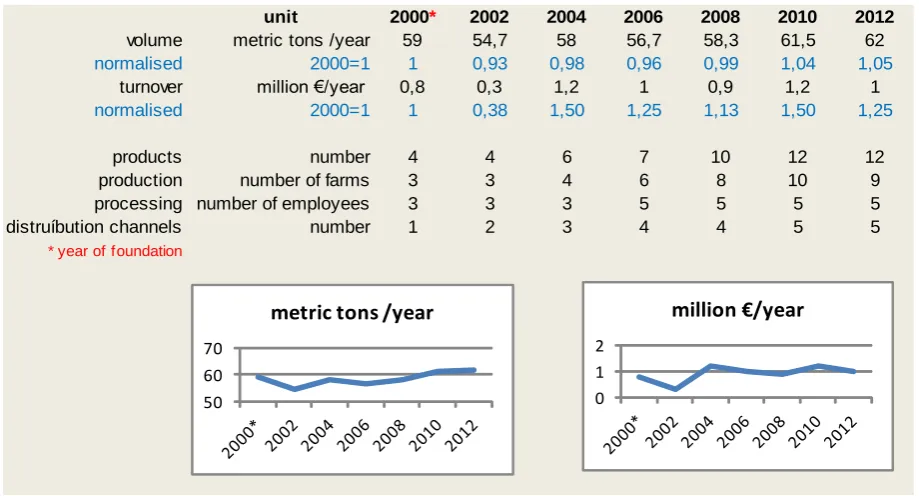
unit 2000* 2002 2004 2006 2008 2010 2012
volume metric tons /year 59 54,7 58 56,7 58,3 61,5 62
normalised 2000=1 1 0,93 0,98 0,96 0,99 1,04 1,05
turnover million €/year 0,8 0,3 1,2 1 0,9 1,2 1
normalised 2000=1 1 0,38 1,50 1,25 1,13 1,50 1,25
products number 4 4 6 7 10 12 12
production number of farms 3 3 4 6 8 10 9
processing number of employees 3 3 3 5 5 5 5
distruíbution channels number 1 2 3 4 4 5 5
* year of foundation
50 60 70
metric tons /year
0 1 2
[image:6.595.70.530.120.368.2]million €/year